

In a post a week ago, I shared some pretty startling numbers about the size of the AI-related capex boom:
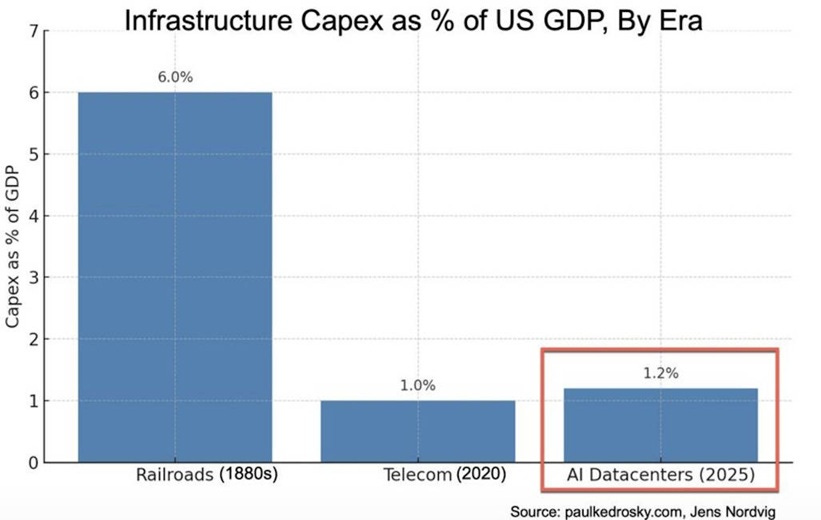
In fact, this boom is so big that in 2025 so far, AI-related investment has contributed more to economic growth than all the growth in consumer spending combined. Since consumption is more than three times as big as investment overall, this is a really startling fact — it means that consumption is sluggish, while AI capex is sustaining economic growth all by itself. Paul Kedrosky calls this a “private sector stimulus program”, and he’s not wrong.
My last post asked whether a crash in the AI sector would hurt the U.S. economy. But there’s another important question here, which is who is actually going to make a profit from all this spending. Will it be the AI model companies themselves, like OpenAI, xAI, and Anthropic? Will it be the companies that provide the compute to train and run the AI models — Amazon, Microsoft, and Google? Will it just be the GPU companies like Nvidia that provide the physical infrastructure?
The profit question is an important one if you’re an investor, of course, since corporate valuations are (usually) based on how much profit companies make — not on how much they invest or how much total revenue they generate. But it’s also important if we want to understand the social impact of the AI boom — in particular, the question of whether AI will lead to extreme economic inequality.
There’s a narrative out there that after AI takes everyone’s jobs, the only people in society who will have money are the people who own the AI companies — the Sam Altmans and Elon Musks of the world, and perhaps the Satya Nadellas and Jensen Huangs. It’s possible to spin sci-fi scenarios where the mass of humanity is impoverished and starving, while a few Robot Lords order their pet AI gods to use all of Earth’s resources to colonize the Solar System.
In reality, those scenarios would run into political problems (i.e., war) long before they came to pass. But it’s important to ask whether that’s the direction in which our economic system is naturally heading. Thomas Piketty, for instance, wrote that inequality in society tends to increase until some sort of major political event — war, revolution, etc. — forces it back down. Some people worry whether the AI boom will represent the fulfillment of that dark vision.
It’s worth it to note that so far, stock markets don’t actually expect anything that extreme to happen. When you look at the price-to-earnings ratios of the major public AI-related companies, they’re somewhat high but not particularly astronomical:
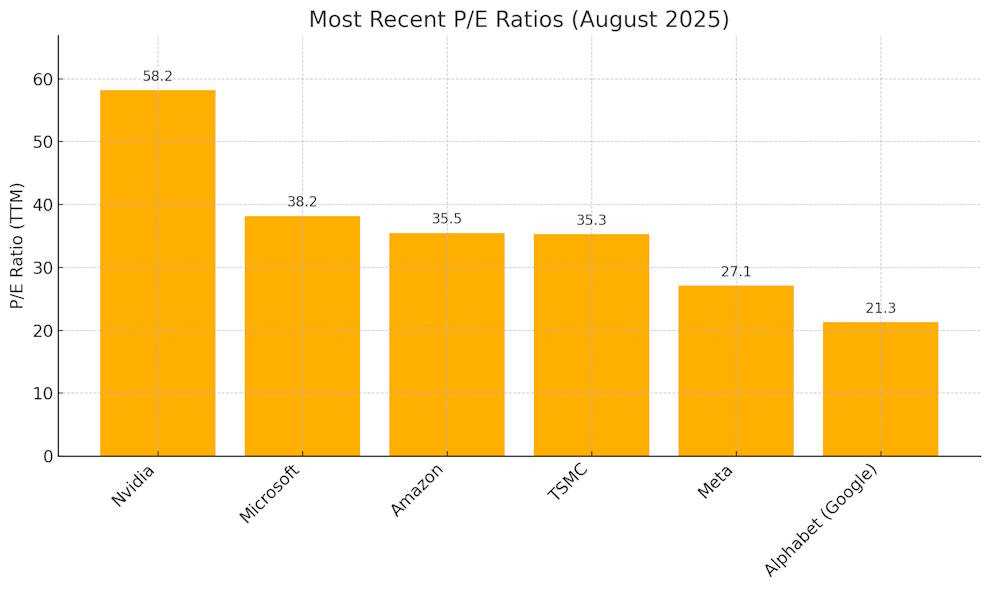
If markets expected these companies to reap untold bonanzas of profit thanks to AI, they’d be valued at far greater ratios to their current earnings, because people would expect their earnings to grow very rapidly. As for OpenAI, xAI, and Anthropic, their combined valuation is still less than $1 trillion; for comparison, Nvidia’s current valuation is around $4.5 trillion. So markets also don’t currently expect the big AI labs to make untold profits, either. As for the broader market, the PE ratio of the S&P 500 is around 30 — historically somewhat high, but not astronomically high.
So we seem to have a disconnect between a popular narrative and market expectations. If AI is going to make all the money in the economy, why are markets not expecting companies to see truly wondrous profit growth? The answer, I think, is that markets are remembering something that popular commentary and folklore has forgotten — the importance of corporate competition in limiting capital income. Investors know that AI companies are going to compete with each other, and that this is going to limit how much they can profit from their creations.
If you build lots of capital, the return on capital goes down
Piketty’s theory of naturally increasing inequality was expressed in a famously simple formula: “r>g”. The “r” is the rate of return on capital, and the “g” is the rate of economic growth. If r>g, then capital owners will accumulate wealth faster than the economy as a whole will grow, meaning that inequality will keep going up.
There are some major problems with this story, and I won’t go into them here, because it’s a bit of a side track.1 But the key observation here is that the rate of return on capital is important for inequality — when one goes up, the other tends to go up too.
But basic economics says that the more capital you have, the lower the rate of return on that capital. This is just the basic idea of scarcity. If you flood the market with apples, apples will get cheap. If you flood the market with industrial machinery, the things those machines produce — cars, or LED TVs, or steel — will get cheap as well, and owning industrial machinery will no longer be a very good way to get rich. And so on. When businesses build more and more and more capital, it ignites a destructive cycle of vicious competition that makes profits vanish.
In fact, this is exactly what we see happening in China right now, with the boom in overcapacity:
Essentially, China has deliberately encouraged its companies to produce far more manufactured goods than they otherwise would, through a gargantuan system of government subsidies and cheap bank loans. The result is that the profits of Chinese companies are crashing, due to competition. This is from a Bloomberg report from July 26:
China’s industrial earnings fell for a second straight month, with authorities set to intensify their drive to rein in excessive competition that’s dragging down prices…Industrial profits dropped 4.3% last month from a year earlier, after a contraction of 9.1% in May…The extended earnings decrease underscored the urgency to curb cutthroat competition among companies — dubbed “involution” in China[.]
Everyone in China is going to the bank and borrowing a ton of money to make an electric car company, or a steel company, or a solar panel company, or a semiconductor company, etc., because the government will pay you to do this, and because the loans are cheap. And so the return on physical capital in China is getting competed away.
Something roughly similar happened in Japan in the 1970s and 1980s as well, though it was less driven by government policy and more a result of the country’s private financial system. Japanese companies were famously unprofitable until the 2010s.
This is very different from Americans’ experience over the past 25 years. Since the turn of the century, corporate profit has risen as a share of GDP:
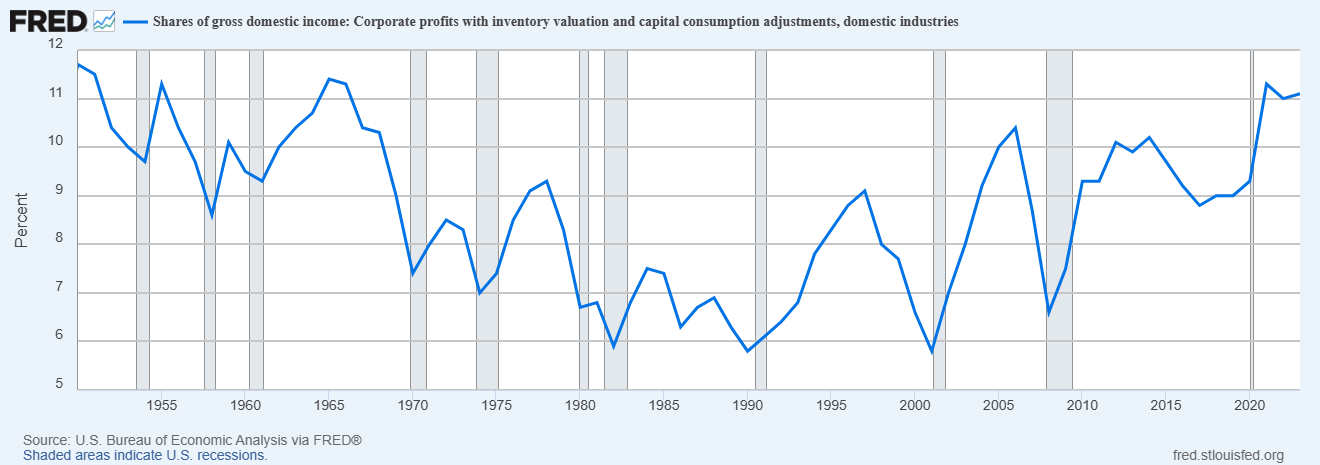
This recent trend is probably why many Americans — especially young Americans who don’t remember the 1970s — have gotten used to the idea that corporate profits eat up more and more of the economy over time.
Why has America escaped the iron law of competition?
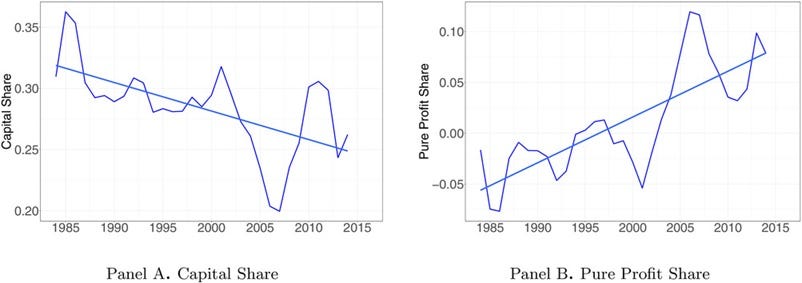
Does profit’s increasing share of the economy mean that the return on capital in the U.S. has been increasing? Well, maybe not. Simcha Barkai had a very interesting paper in 2020 where he drew a distinction capital’s share of income and the pure profit share of income. He observed that bond rates — the rates companies pay to borrow money — have been falling, even as profits rose.
Falling bond rates mean that capital in the U.S. economy — as traditionally defined — was getting cheaper and cheaper. If you’re a company, and you want to buy some industrial machinery, you borrow to buy it.2 If borrowing is cheap, it means that owning industrial machinery is cheap too. So cheap borrowing means that you can’t get rich just by owning a bunch of industrial machinery.
Barkai found that the way companies were making money wasn’t by owning a bunch of machinery or vehicles or buildings. Instead, he found that an increasing share of corporate profits since the year 2000 have been “pure” profits — earnings that can’t be explained simply as the rate of return on owning machinery, vehicles, buildings, or anything else you can borrow money to buy. It was profits, not the return on traditional capital, that were eating the U.S. economy:
How were all these companies making more and more profit, if it wasn’t by investing in physical capital? Some economists suggested that increasing monopoly power was the culprit. But Autor et al. (2019) argued that the trend was due to the rise of “superstar firms” — a few big companies that were much more productive than the rest:
If a change in the economic environment advantages the most productive firms in an industry, product market concentration will rise and the labor share will fall as the share of value-added generated by the most productive firms (‘superstars’) in each sector, those with above-average markups and below-average labor shares, grows. Such a rise in superstar firms would occur if consumers have become more sensitive to quality-adjusted prices due to, for example, greater product market competition (e.g., through globalization) or improved search technologies (e.g., greater availability of price comparisons on the Internet leads to greater buyer sensitivity, as in Akerman, Leuven and Mogstad, 2017). Our “winner take most” mechanism could also arise due to the growth of platform competition in many industries or scale advantages related to the growth of intangible capital and advances in information technology[.]
All of these explanations for “superstar firms” — the Googles and Amazons of the world — depend on either the internet or globalization. Basically, the idea is that changes in technology allowed a few companies to monopolize some sort of intangible asset that allowed them to win dominant positions in their markets without out-investing their competitors.
The intangible assets could be technological secrets or top talent hoarded by the top companies. They could be winner-take-all network effects of online platforms and software ecosystems. Whatever they are, though, they’re not the kind of things a company can just buy more of with a bank loan. Technological secrets, top talent, network effects, and so on are not things that anyone is making more of, so companies don’t tend to just compete the profits from these assets to low levels, as they do with physical capital like machines and vehicles.
Why would superstar companies flourish in America and not in other countries? One theory is that most markets tend to be winner-take-all, and that other countries just have more vigorous antitrust (or equivalent institutions) that forces companies to compete instead of combining. An alternative theory is that the kinds of industries that America specialized in the early 21st century — software, finance, etc. — tend to be winner-take-all industries by their very nature.
If it’s the latter, there’s a strong possibility that AI is different, and that competition is returning as a major force in the U.S. tech industry.
AI involution
Most analyses of the AI industry agree that AI relies on three basic factors of production: talent, data, and compute. Which of these are naturally limited?
Top talent, of course, is limited by definition — we identify “top” AI researchers and engineers by simply identifying the best ones. But it’s not at all clear that you need the very best AI researchers and engineers in order to build a competitive product. China’s DeepSeek, which was spun out of a hedge fund — not exactly a repository for the world’s best AI researchers — has become a globally competitive AI lab. That suggests that if the rewards are large enough, a bunch of the smart people currently working in high-frequency trading or other math-intensive industries will jump into the AI field. On top of that, there’s the possibility that AI itself will start helping mid-level engineers and researchers match the output of the top labs.
As for data, there are certainly some AI applications where private data sources are a source of competitive advantage, and where it’s feasible to collect and hoard crucial data in large amounts. But the most important type of AI — large language models — mostly relies on data from the public internet. And DeepSeek and others have proven that even if you don’t have access to all the data, you can use alternative model training techniques to achieve similar results at least some of the time.
That leaves compute. And compute is just a form of physical capital — you can get more of it by making more GPUs and installing them in more data centers. If talent and data ultimately prove to be plentiful, it means AI looks less like the traditional software industry, and more like an old-school manufacturing industry. GPUs are just the machine tools that make AI, equivalent to the machines that stamp metal into the shape of a car.
And if that’s the case, then AI could return us to the era where companies accumulate capital until they compete away their returns. There’s no technological limit on the amount of debt that companies can borrow in order to build more data centers — a bond, or a bank loan, is just an item in an Excel spreadsheet. All of the “hyperscalers” will just keep building more compute until the rate of return equals the cost of capital — which means that economic profit has been competed to zero.
Of course, if some AI companies have intangible assets that allow them to charge much more for their products, they will still make tons of profit. But right now, it looks like top AI models are interchangeable enough, from a user standpoint, that the big AI labs aren’t able to charge much of a premium. This is from a TechCrunch story about the recent release of OpenAI’s GPT-5 model:
The top-level GPT-5 API costs $1.25 per 1 million tokens of input, and $10 per 1 million tokens for output…This pricing mirrors Google’s Gemini 2.5 Pro basic subscription, which is also popular for coding-related tasks…But OpenAI is really undercutting Anthropic’s Claude Opus 4.1, which starts at $15 per 1 million input tokens and $75 per 1 million output tokens…
Some on X called OpenAI’s fees for the model “a pricing killer,” while others on Hacker News are offering similar praise.
And another recent TechCrunch story suggests that most AI coding apps aren’t able to turn a profit.
This could be the first sign of a China-style “involution” in the AI industry. If AI is a commoditized product — if how much AI value you can produce depends primarily on how many GPUs you can harness — the only real barrier to entry in the industry is whether you can get a loan. That’s not really much of a barrier at all.
The end result of that sort of competition is that none of the big labs or cloud compute providers makes very much profit at all. Instead, the value would accrue to AI’s users — businesses and consumers outside the core industry. This is exactly what happened in the solar industry, which is reshaping the world’s energy supply even though almost no solar manufacturers make much profit.
Even if this happens, it doesn’t mean AI won’t cause a big rise in inequality. It still might be the case that businesses and workers who figure out how to use AI more effectively will reap much of the reward in the new economy, while everyone else gets left behind. But the dominance of physical capital in the AI production process suggests that we won’t get the Thomas Piketty future where OpenAI and Microsoft and Anthropic and Google just swallow the whole economy to feed their massive profits.
Over the past two decades, Americans have gotten too used to the idea that private-sector competition basically doesn’t exist. All those superstar companies and network effects made us forget that in most industries, spending billions on machinery doesn’t mean you just win the market and make all the profit. But if AI turns out to be more like manufacturing than it is like software, the companies spending hundreds of billions of dollars on data centers are in for a rude awakening.
One is that wealth is not actually the same as purchasing power, because if all the rich people tried to sell all their stocks and real estate and so forth, the price of those assets would crash, and the total amount of liquid purchasing power they got would be much less than what they currently have on paper.
You can buy it from your retained earnings instead, of course, but bond rates still represent the cost of doing that, because they represent what you could have earned in the market with that same amount of money, for a similar level of risk.