Trump is back with a new round of big tariff announcements. They include a 35% tariff on Canada (America’s top trading partner), 25% tariffs on Japan and South Korea (two key U.S. allies), a 50% tariff on copper (almost half of which the U.S. imports), and various other high tariffs on various other countries.1
So far, stock markets — which plunged after “Liberation Day” in April — appear not to be reacting to the new announcements. Perhaps investors are assuming that Trump will chicken out and “pause” these tariffs, as he has paused most of his others since taking office. Or perhaps they’re assuming the tariffs will be halted by the courts — constitutionally, tariff powers belong to Congress, and Congress has allowed the President to declare tariffs only in an emergency, so if courts rule that America isn’t in an emergency (which of course it’s not), Trump’s powers vanish. It’s also possible (though unlikely) that American investors have changed their minds since April and decided that tariffs aren’t that bad for the real economy.
Whatever the reason, the country seems to have decided that Trump’s tariff announcements are basically just noise, and that there’s no reason to panic unless and until a tariff-driven recession actually materializes.
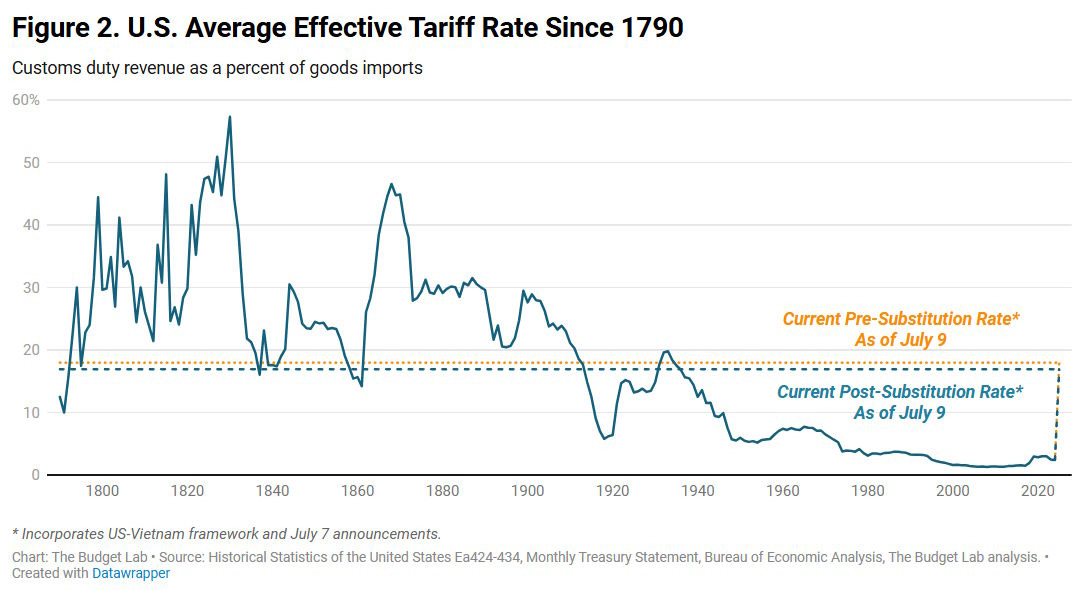
However, amid all the noise of tariff announcements and pauses and court injunctions, actual U.S. tariffs are higher than they’ve been since the 1930s. Yale Budget Lab estimates that even accounting for Americans switching to different types of consumption goods as a result of the tariffs, the current rate that Americans are now legally required to pay on their imports is around 17%:
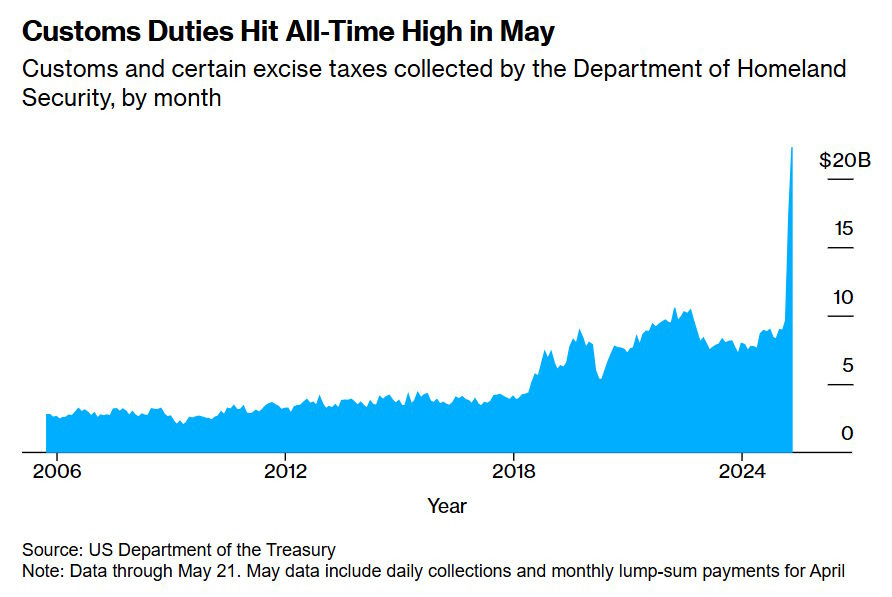
Now, legal requirements aren’t the same as actual tariff revenue collections; a lot of companies find ways around the tax, and the U.S. government’s capacity to actually collect this amount of taxes is patchy. But the most recent data we have shows that even in May, revenue from U.S. customs duties had more than doubled since before “Liberation Day”:
So the tariffs are tariffing. But so far they have failed to do one thing that many commentators predicted they would do: raise inflation. As of May, there was no sign that prices were rising faster than normal — indeed, inflation looked tame:
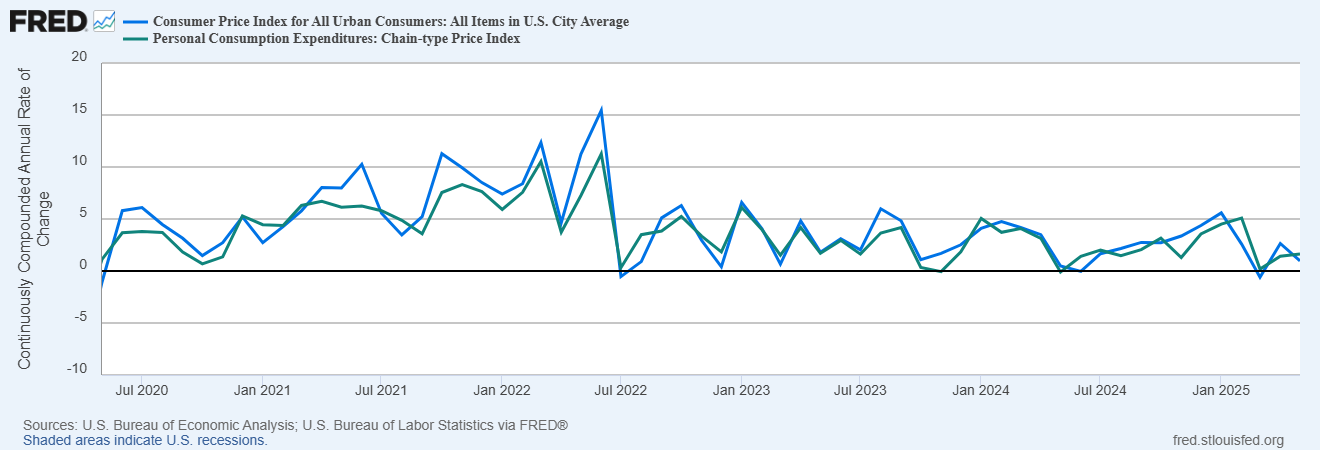
So what’s going on? If you tax something, people should pay more. If people pay more, that means prices go up. So where’s the inflation?
I see three possible explanations. As usual, they aren’t mutually exclusive; the reality could be a combination of the three.
Possibility 1: Tariffs haven’t had time to raise prices yet
The most recent inflation data we have so far are for May; it’s now the middle of July. It’s possible that prices simply haven’t had time to rise yet. CNN has a good explainer about the various reasons for this:
[R]ecent months’ economic data has shown that overall inflation has remained fairly tame…However, the chorus of concern is growing: Prices are moving higher, and economists say this is just the beginning…[P]rice hikes, and hotter inflation, are a slow burn…
Sea cargo shipments can take weeks to more than a month to reach the US from other countries…Once goods land on US soil, they don’t hit shelves the very next day. In addition to domestic transport times, the imported products (which are not always finished goods but rather parts and materials) have to still go through the manufacturing and production processes before being distributed to sales channels…
Near the end of last year, businesses frontloaded import orders…to get ahead of potential tariffs. Those stockpiling efforts surged this year[.]
So basically, 1) it takes time for tariffs to filter through to retail prices, and 2) companies stocked up on cheap stuff before tariffs and have been running down their inventories.
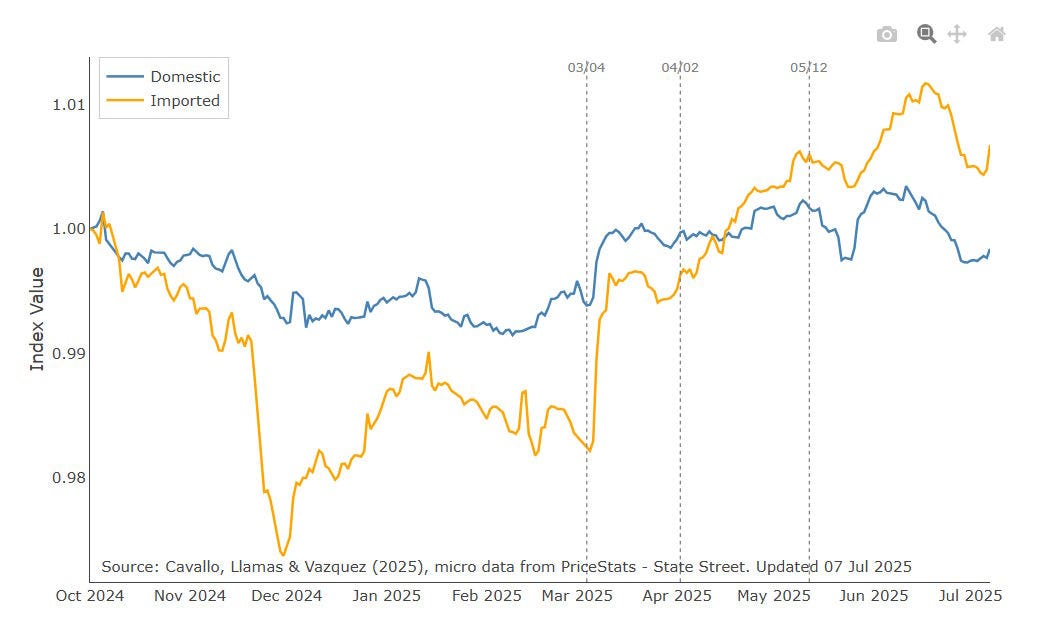
That could mean that higher inflation will come eventually. It could also mean that recent price hikes in June and July have been bigger than what we saw in April and May, and it just hasn’t had time to appear in the official statistics yet. In fact, with more recent data from private sources, we can see import prices rising faster than domestic prices, and the gap widened in June:
Keep in mind that the inflationary effect of tariffs doesn’t just come from consumer goods getting more expensive at Walmart. Intermediate goods — everything from metal ores to auto parts to computer chips — get tariffed too. Those are used in production, so when their prices go up, it eventually feeds through to higher costs for stuff produced in America. But that process takes a while, because production takes a lot longer than simply sticking imported consumer goods on the shelves.
So it’s possible that we’re just starting to see the beginning of the inflation bump from tariffs, and that there’s more to come.
Possibility 2: Companies are eating the costs
One fact that economists constantly like to remind people of is that who actually pays a tax is not the same as who is responsible for sending money to the government. The actual cost of any tax, including a tariff, is borne by whoever is forced to adjust their prices more in response to the tax. This is called “tax incidence”.
When Trump puts a tariff on a TV imported from Korea, the following things happen:
American consumers pay a higher price for the TV.
The American retailer who sells the TV (Best Buy, Amazon, etc.) is forced to lower its markup on the TV in order to maintain sales numbers, thus lowering its profit margin.
Logistics companies and wholesalers who deliver the TV to the retailer are forced to lower their own profit margins.
The Korean TV manufacturer has to lower its prices in order to maintain sales, thus reducing its margins.
The suppliers of the Korean TV company — chipmakers, screen makers, mineral processors, miners, etc. — are forced to reduce their own prices and margins.
So there are plenty of companies that can eat the cost of tariffs. In general, the breakdown of who eats the cost of tariffs will depend on something called elasticities, which really just means “How bad does each of these players need to keep buying/selling the same amount of stuff?”.
If consumers really really want to keep buying imported TVs, then they’ll end up eating more of the cost of tariffs, and you’ll see inflation go up. But if consumers are willing to switch to domestic TV producers, or if they’re willing to just stop buying TVs at all for a while, and retailers and manufacturers have some profit margins and can afford to eat the costs, then prices won’t go up much.2
In some cases, you can see foreign manufacturers slashing their prices to maintain their market share in U.S. markets:
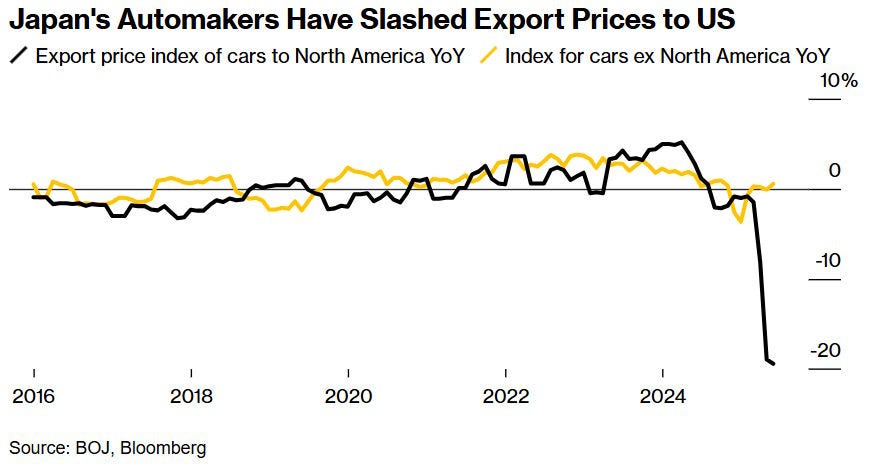
In cases like this one, foreigners are paying more of the cost of the tariffs. Trump and his people obviously like this result, since it means that they’re getting revenue from foreigners instead of from Americans.
But that said, studies tend to find that Americans end up bearing most of the cost of tariffs. This is from a literature review of studies of Trump’s tariffs in his first term, by Fajgelbaum and Khandelwal:
[E]mpirical work has found complete passthrough of tariffs to tariff-inclusive import prices (i.e., tariff-inclusive import prices rise one-for-one with the tariff changes)…The main takeaways from this research is that US consumers of imported goods have borne the brunt of the tariffs through higher prices[.]
American consumers like their imported goods and have lots of money to spend. And American producers often find it hard to diversify their supply chains.
Manufacturer price cuts like the one in the chart above can be temporary measures — companies choosing to take losses for a little while in the hope that the tariffs will be revoked. If the tariffs aren’t revoked, the companies may have to raises prices again, and then you’ll see inflation.
Possibility 3: Demand destruction is canceling out the taxes
So far I’ve focused exclusively on the microeconomic effects of tariffs — the price changes in specific markets, like the market for TVs or the market for cars. But inflation is a macroeconomic phenomenon. The overall inflation rate can change in ways that have little to do with the supply and demand for individual goods.
The simplest reason is what we call “aggregate demand”. If some sort of economic event scares people, they’ll pull back their spending and try to save money instead. This does two things: 1) it causes a slowdown in growth, because consumers are spending less, and because companies are investing less to meet consumer demand, and 2) it causes a reduction in inflation, because companies are forced to cut prices to maintain their sales to reluctant consumers. Here’s a little diagram of what that looks like:
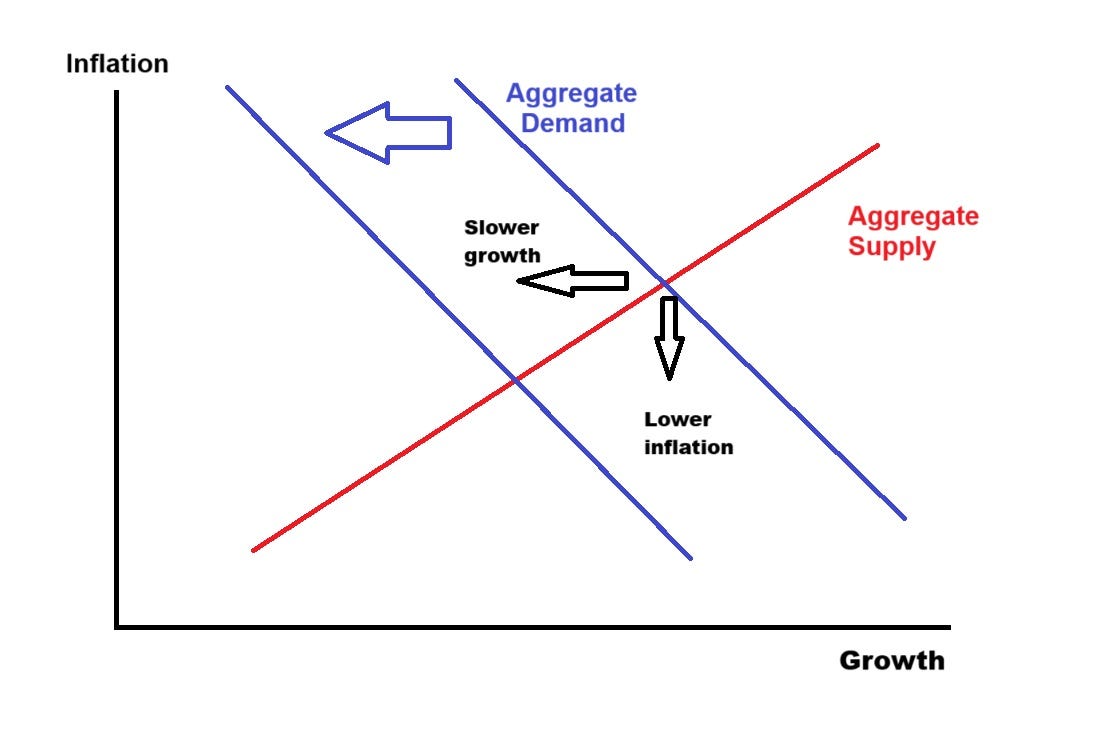
So it’s possible that Trump’s tariffs scared American consumers and American businesses, and that they’re pulling back on spending in general. If that’s the case, then the macroeconomic effect on prices from people being scared could be partially or even completely canceling out the microeconomic effect on prices from the tariffs themselves.
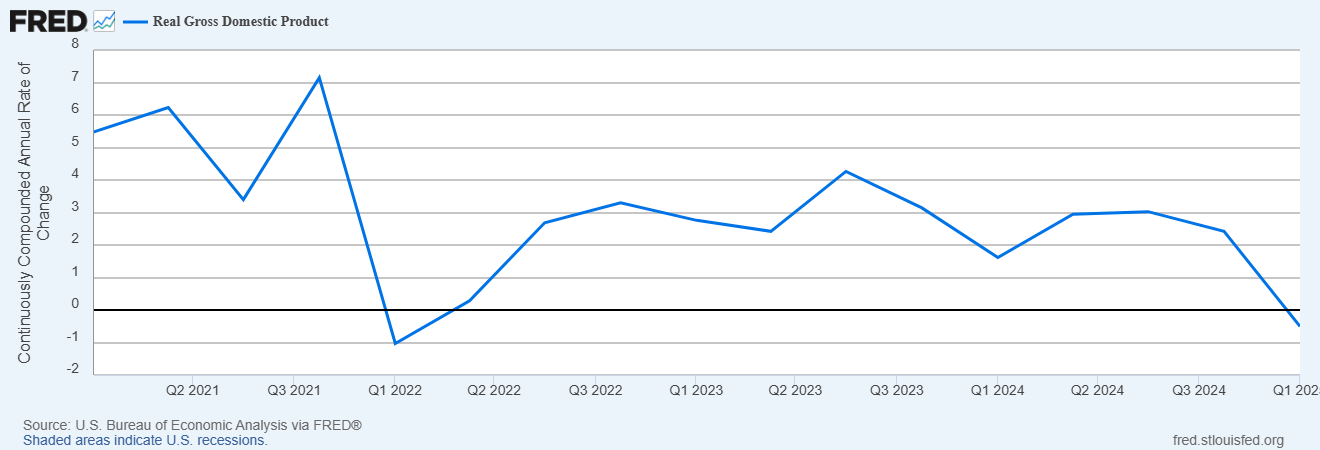
Is this happening? A good way of gauging this is to look at real economic activity; if tariffs are hurting aggregate demand, we should see a growth slowdown. In fact, we did see U.S. total GDP shrink in the first quarter of this year:
Some of this was probably from companies temporarily pivoting away from purchasing domestic goods so they could stock up on inventories before tariffs hit. But overall U.S. consumption did flatline, meaning that consumers were pulling back:
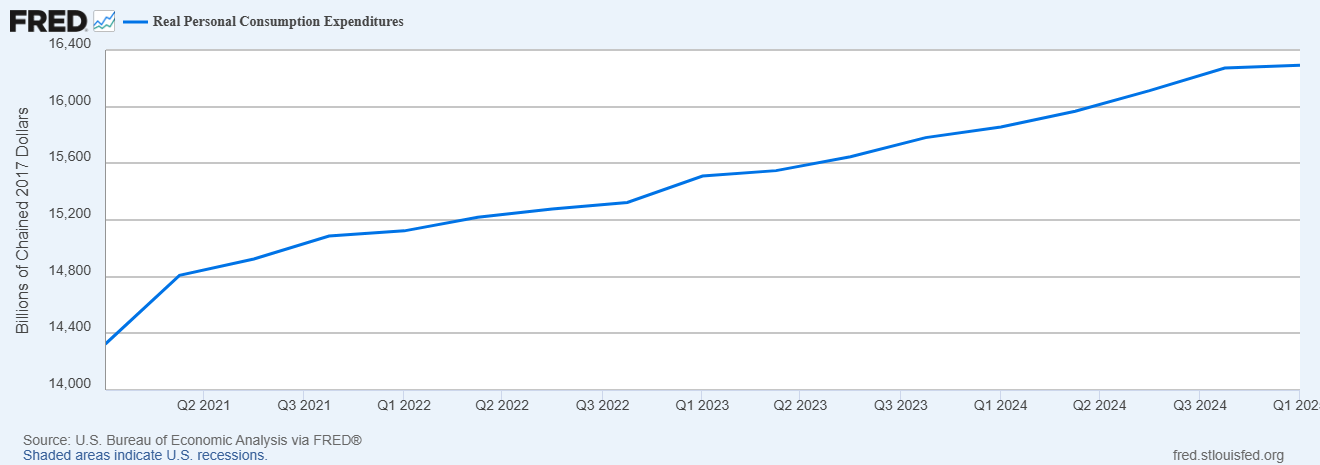
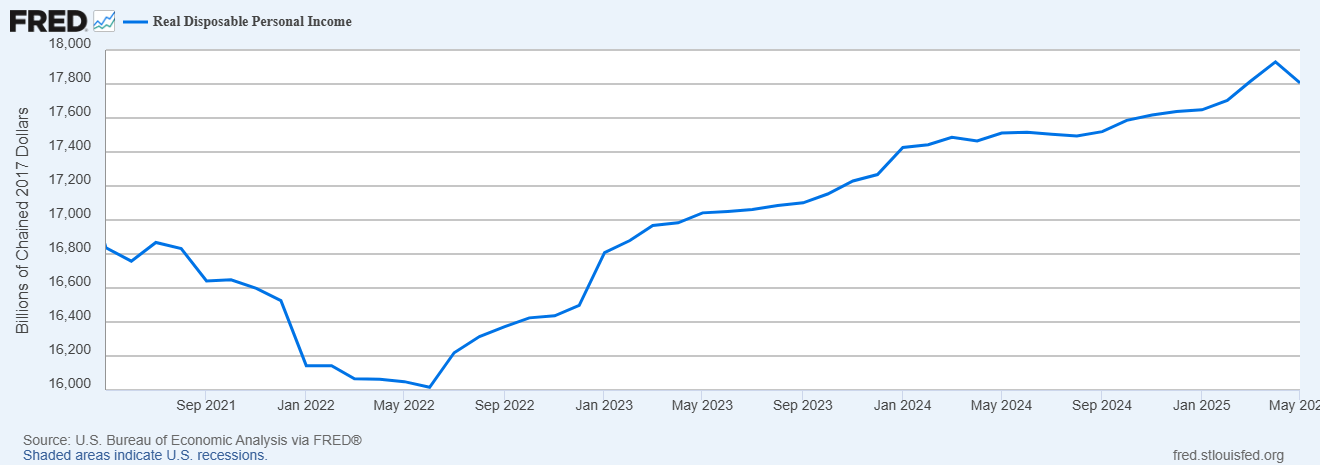
Now, the first quarter ended in March, before “Liberation Day”. So any demand slowdown on these charts would have to be induced by the fear of tariffs rather than by actual tariffs. But what we really need is to look at more recent (monthly) data. Here, we see that real disposable personal income actually fell in May:
Industrial production is slightly down. And the Atlanta Fed’s estimate of final sales to private domestic purchasers looks weak for Q2, though not yet at recession levels:
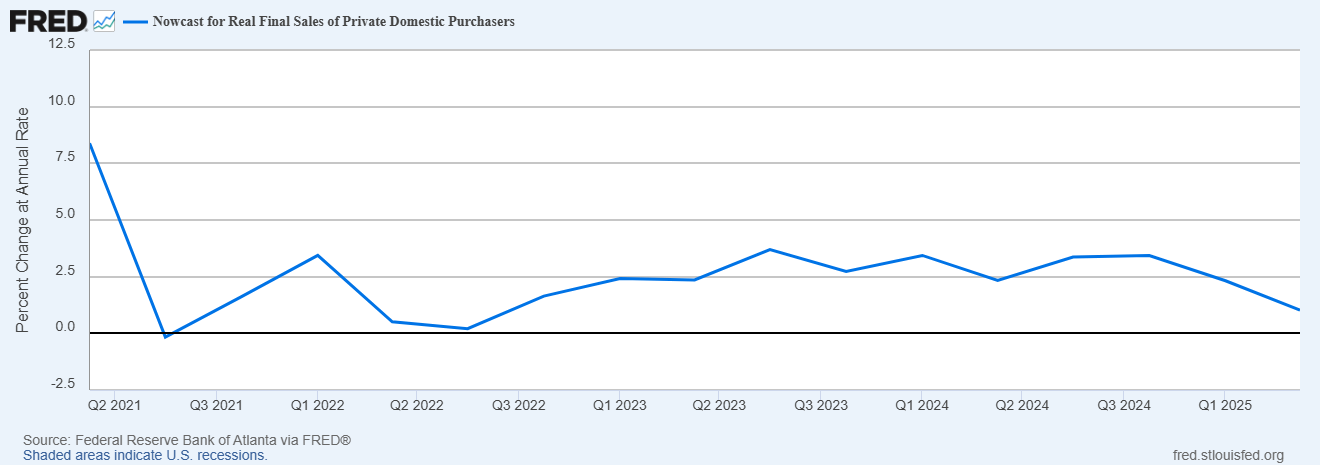
So that could indicate a growth slowdown from tariffs. But the labor market is still holding up, with unemployment still at a very low level, and the economy adding jobs at a slow but steady pace.
It could be that American consumers pulled back earlier this year when they became scared of tariffs, and now are just starting to pull back again as tariffs start to bite. And so the reduction in demand from that incipient growth slowdown could be partially canceling out the tax-induced price increases from the tariffs themselves.
Donald Trump is actually worried about a recession from his tariffs, which is why he keeps trying to pressure the Fed to cut interest rates. Rate cuts raise aggregate demand. But note that if Trump does succeed in bullying the Fed into cutting rates, that won’t just support the real economy — it’ll also push up prices. So Trump’s macroeconomic meddling could cause the inflation from tariffs to suddenly rise, as slowdown pressures stop keeping a lid on it.
So to sum up, there are a bunch of reasons why we haven’t seen inflation from tariffs yet. Only one of these — foreign producers eating the cost — is what Trump and his people would like to see. The rest are all bad news for the U.S. economy. In the coming months, we’ll get a better idea of what’s going on.
Trump also threatened a 50% tariff on Brazil, which actually runs a trade deficit with the U.S., if it doesn’t give in to various demands regarding its domestic politics.
One thing I gloss over in this section is that taxes don’t just cause changes in prices, but also changes in quantities. “Who ends up paying higher prices or accepting lower prices?” is a different question from “Who ends up buying less stuff or selling less stuff?”. These are actually two different ways that taxes hurt consumers and producers. And in general, they affect different sets of people — for example, in Trump’s first-term trade war, American consumers had to pay higher prices, but Chinese producers were also hurt because they made fewer sales. But in today’s blog post, I’m only talking about the price effects.