
America is an unsettled place. These days, it feels like every racial and religious group has reason to fear being singled out and persecuted, either with official discrimination or with outright violence.
Hispanic Americans — many of whom voted for Donald Trump — must now endure video after video of masked ICE agents storming buildings and carting away peaceable people, even some with U.S. citizenship. White Americans are subjected to an endless parade of stories about elite universities, publishers, and other institutions refusing to hire them no matter how qualified they are. Asian Americans were subjected to the terror of a wave of violent racist attacks a few years ago, even as they also hear about being kept out of the Ivy League. Black people have been somewhat less targeted for persecution in recent years than before, but still suffer some racist terror attacks, even as the Trump administration tries to scrub mentions of Black contributions from government communications. Muslim Americans suffered a wave of Islamophobic attacks in the mid-2010s, peaking around the time of Trump’s first election. Indian Americans, Haitian Americans, Somali Americans, and various other recent immigrant groups have all been the targets of xenophobia.
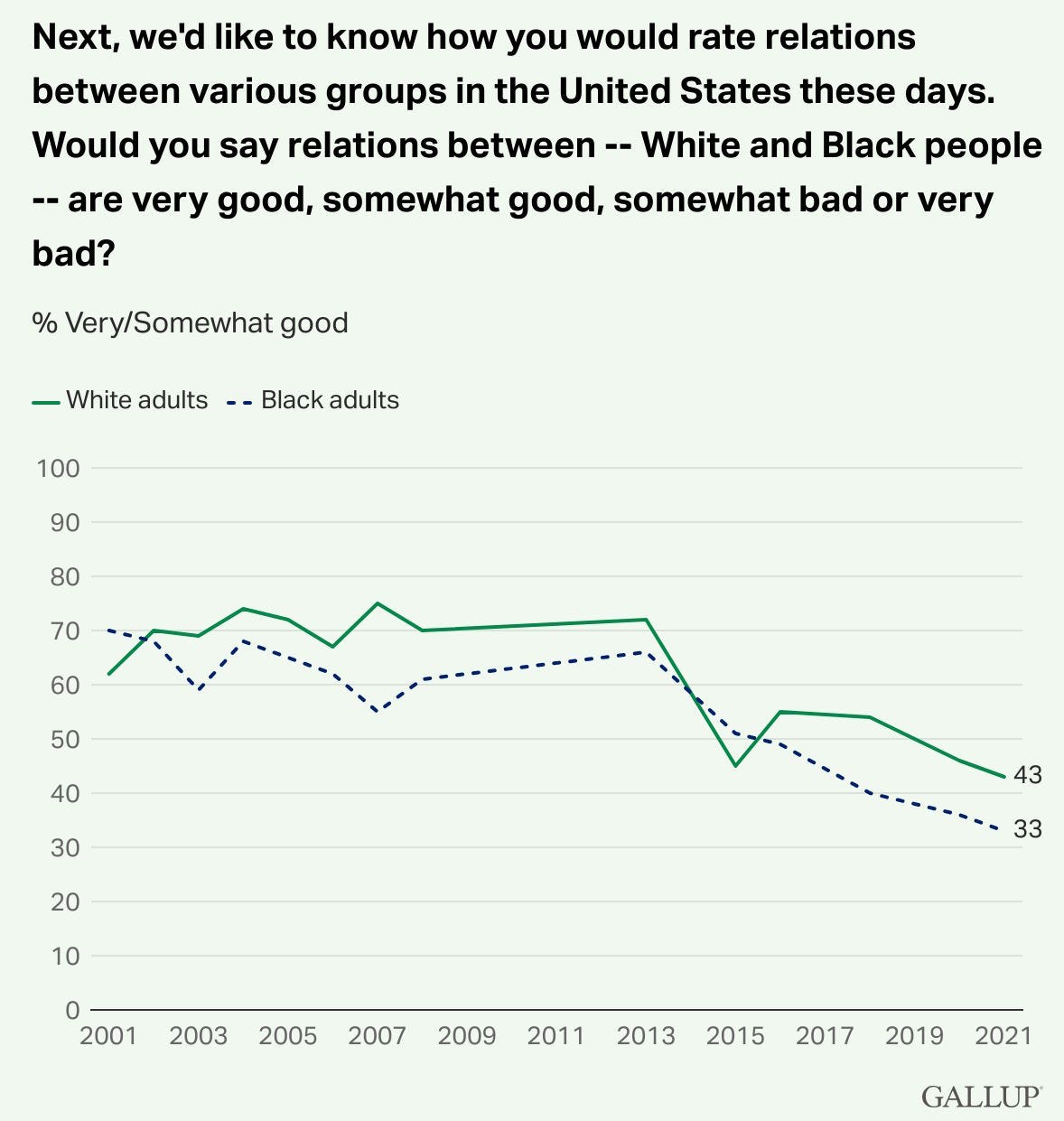
Americans keenly feel this general sense of racial, ethnic, and religious tension. Perceptions of race relations went into a steep long-term decline around a decade ago:
Jewish Americans1 have not been immune to this trend. In the 2010s, there was a wave of antisemitism on social media. In 2017, rightists at the infamous Charlottesville rally shouted “Jews will not replace us!”. And 2018 marked the deadliest antisemitic terror attack in the country’s history, when a white supremacist killed 11 Jews at a synagogue in Pittsburgh. There was also another less deadly synagogue shooting by another white supremacist in California in 2019. And in December of 2019, there were several attacks on Jews by a fringe sect called the Black Hebrew Israelites.
But despite these attacks, Jewish Americans could still tell themselves, even in the turbulent 2010s, that they were secure and accepted in their country. Surveys found that Americans were friendlier toward Jews than toward almost any other religious group:

This is probably not just lip service. Switching from face-to-face interviews to anonymous online surveys does NOT prompt Americans to express more antisemitism, as it would if people were just keeping their dislike of Jews under wraps for the sake of political correctness.
Jews also benefitted from not being at the center of any of the identity conflicts of the late 2010s. Although most Jews are racially White, their ancestors largely did not own any slaves, and they were not numerous or influential at the time of the founding of America; thus, they were able to partially dodge progressive accusations of white supremacy. And because they’re not a recent immigrant group, Jewish Americans also escaped the anti-immigrant backlash of the MAGA movement. At a time when conflicts over race and immigration made almost everyone in America feel threatened and unsettled, Jews were still able to feel relatively settled in their nation.
Then, of course, came October 7th, 2023. Hamas’ attacks on Israel, and Israel’s subsequent attacks on Gaza, rocketed the Palestinian cause from just one element in the left’s mosaic of issues to its central, defining cause. Although technically, opposition to the state of Israel is not the same thing as antisemitism, not all of the activists in the Palestine movement make such a clear distinction. Around the world, there has been a massive rise in antisemitic incidents — desecration of Jewish cemeteries and Holocaust memorials, vandalism of Jewish-owned businesses with no connection to Israel, attacks on synagogues, and so on.
The U.S. hasn’t been insulated from this wave. The FBI, which is unlikely to conflate anti-Israel sentiments with antisemitism (or at least, was unlikely to do this under President Biden), nevertheless recorded a 63% increase in anti-Jewish hate crimes from 2023 to 2024. The two people slaughtered in a gruesome execution-style killing in May at the Capital Jewish Museum in Washington D.C. ended up being Israeli embassy staffers, but the killer — who told the police “I did it for Palestine, I did it for Gaza” — couldn’t have known who they were. He just wanted to shoot someone at a Jewish museum, and assumed that this would strike a blow for Palestine.
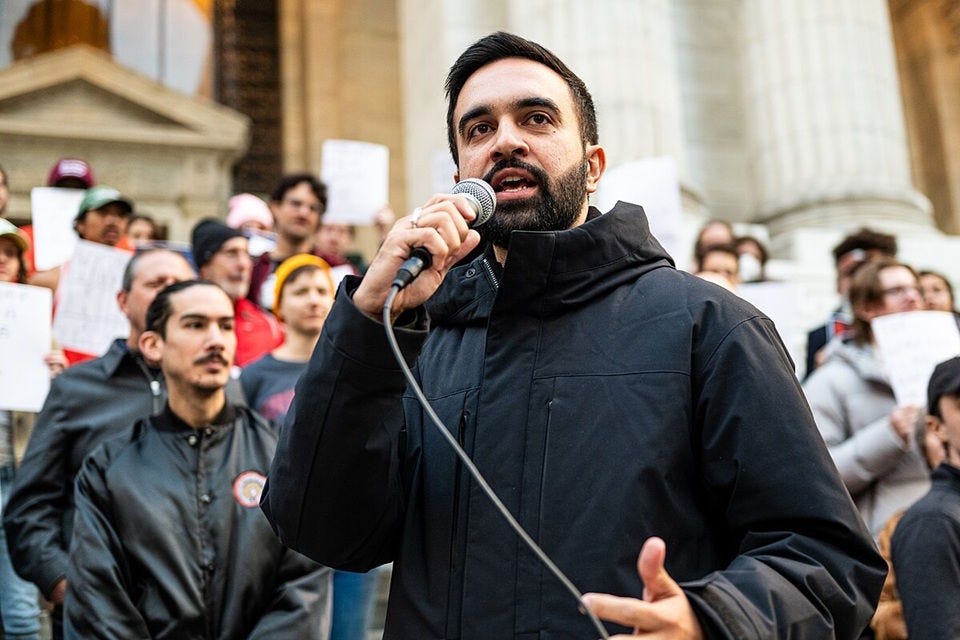
It’s hard to forget this iconic image, from a rally of the New York chapter of the Democratic Socialists of America on October 8, 2023 — before Israel began its reprisals on Gaza:

To some, this simply seems like the continuation of a very old pattern, in which each country inevitably becomes hostile to Jews after a temporary period in which it was safe and welcoming, eventually forcing Jews to flee. In March of 2024, Franklin Foer wrote an article for The Atlantic entitled “The Golden Age of American Jews is Ending”. He wrote:
Liberalism helped unleash a Golden Age of American Jewry, an unprecedented period of safety, prosperity, and political influence. Jews, who had once been excluded from the American establishment, became full-fledged members of it. But that era is drawing to a close…Americans maintain a favorable opinion of Jews…But the memory of how quickly the best of times can turn dark has infused the Jewish reactions to events of the past decade. “When lights start flashing red, the Jewish impulse is to flee,” Jonathan Greenblatt, the head of the Anti-Defamation League, told me…
Back in 2016…after [Trump] won, many Jews actually hatched contingency plans…An immigration lawyer I know in Cleveland told me that he had obtained a German passport, and suggested that I call the German embassy in Washington to learn how many other American Jews had done the same…
I [recently] saw signs of flight in Oakland, where at least 30 Jewish families have been approved to transfer their children to neighboring school districts—and I heard similar stories in the surrounding area. Initial data collected by an organization representing Jewish day schools, which have long struggled for enrollment, show a spike in the number of admission inquiries from families contemplating pulling their kids from public school.
I wouldn’t panic just yet. But I think there are multiple forces that are causing American Jews to feel unsettled — a perfect storm. These are:
Extremists looking for clout in a particularly turbulent time
The resurgence of antisemitic memes, driven by the rise of social media and foreign influence campaigns
Jews’ declining importance in the American elite
Jews are natural targets for the political extremes
If Jews are so well-regarded by the bulk of American society, why have we seen both rightists in Charlottesville and leftists in New York City holding up swastikas? The most obvious reason is also the most timeless: Jews are simply an easy target. They are very few in number — depending on your definition, there are only 15-20 million Jews in the entire world, and in most countries they form a tiny, almost insignificant minority of the population. Most Jews live in either America or Israel, but even in the U.S. they comprise only 2.4% of the population — and if you count only those who identify their religion as Jewish, it’s only 1.3%. Compare this to, say, Asian Americans, who are at least 6% of the population, and you can see how few Jews there really are.
These small numbers mean there’s less of a chance that attacking Jews will incur physical danger or invite reprisals. On top of that, Jews have a reputation — deserved or undeserved — as being peaceful people who won’t fight back if you hit them, scream at them, or vandalize their spaces.2
The 2010s gave rise to political extremists on both the right and the left in America. And political extremists often try to demonstrate their collective power. America’s rightists are constantly looking for a group to exclude — someone they can declare to be outcasts, so they can define who the “real Americans” are by contrast. America’s leftists — like all leftists — want to show that they’re part of a revolutionary movement, and that means being able to fight and overcome their enemies. Jews, with their small numbers and peaceful reputation, make a somewhat easy target for both of these impulses.
As of Trump’s second term, MAGA has clearly settled on immigrants as the ultimate outsiders to American society, and has even made a big show of standing up to leftist antisemitism in universities. But there are always fringe forces on the right who want to go after other enemies as well, and Jews are a tempting target. There were the Charlottesville marchers and the synagogue shooters of 2018 and 2019, of course. Tucker Carlson, one of the right’s biggest media figures, has had Holocaust deniers on his show. Online, the idea that Jews import immigrants in order to destroy White societies is commonplace, and under Elon Musk, X has largely stopped censoring those memes; Musk himself agreed with one such post, before publicly apologizing and saying he was “naive” about antisemitism.3
Leftists, meanwhile, tend to want to see themselves as the vanguard of a worldwide revolution against an oppressive dominant ideology; this is an inheritance from the early days of the socialist movement. The traditional enemy, of course, is capitalism, but this has proven to be a hard target; since the late 20th century, the world has generally realized that businesses buying and selling stuff is actually necessary for the masses to prosper, and experiments in abolishing capitalism continue to go poorly whenever they’re tried. Imperialism — meaning Western imperialism — is also a traditional enemy, but “anti-imperialism” is a hard sell in the U.S., where it usually translates into anti-Americanism.
“Zionism”, on the other hand, is a much easier target. Israel may punch above its weight in wars, but it’s no great power; opposing it will put you at little personal risk. In person, you’ll almost never actually meet a Zionist, much less get punched in the face by one. But because most establishment leaders in America support Israel’s continued existence, you can rail against Zionism and feel like you’re bravely rebelling against a hegemonic overlord. You can get your friends together and go push around people wearing a Star of David, which happens to be the symbol of Judaism, and also happens to be on the Israeli flag. And until the Trump administration started cracking down on people for pro-Palestine activities, there weren’t really any ramifications for doing this.
So anti-Zionism is — or at least, was — an easy sort of revolution. That’s probably why it became such a leftist “omnicause” in America and Europe, despite the right-wing leanings of Hamas itself. This flag, which has been floating around social media, kind of sums up the mood among activists:

One reason for the popularity of the Palestine cause on the left is that it makes for a great wedge issue. Leftists are always trying to overthrow the Democratic party establishment (this has been true at least since 1968). Unlike economic hobbyhorses like student debt relief and universal healthcare, Palestine was something that the Democratic establishment would always have trouble embracing — and so it allowed leftists to leverage youth rage and activism against graying party elders.
Palestine activism is far more popular among young Americans than among older ones. And so with the generational turnover, “anti-Zionism” is moving upward from street activism into the attitudes of prominent politicians. Zohran Mamdani, who just won the Democratic mayoral primary in NYC and is heavily favored to become mayor of America’s largest city, has declared that the Palestinian cause is central to his identity, and was a major reason he got into politics. He has defended the use of the phrase “globalize the intifada”, despite the fact that “intifada” uprisings often involve a lot of terrorism. After the October 7th attacks, before Israel’s reprisals, Mamdani released a statement that condemned Israel but failed to condemn Hamas.
Mamdani strongly denies that this has any antisemitic implications. Like most pro-Palestine activists, he draws a sharp distinction between antisemitism and anti-Zionism, essentially denying that the latter can contribute to the former in any way. And it’s worth noting that a substantial minority of New York’s Jews support Mamdani, and many just don’t care very much about Israel. But online, leftist jokes took a darker turn:

And some researchers have documented a pattern where Jews are subjected to a double standard, where they’re presumed to be “Zionists” unless they loudly and actively condemn Israel. (This is similar to the Islamophobic trope where people demand that regular Muslims proactively denounce radical Islam.)
So although anti-Zionism and antisemitism are not technically the same thing, and Israel doesn’t represent Jewish Americans, Jews who see this sort of activism gain purchase within the Democratic party can be forgiven for feeling unsettled.
The Protocols return
A second reason Jews are a target of the political extremes is simply the persistence of historical antisemitic memes. For many centuries, life in Europe and the Middle East was defined by the struggle for supremacy among the Abrahamic monotheistic religions. Christianity prevailed in Europe and Islam in the Middle East, but Judaism endured, stubbornly refusing to give up its older traditions. Jews were a persistent, visible, non-assimilating religious minority in both regions for hundreds of years; when there was a local impulse toward religious homogeneity, like the Spanish Inquisition, Jews would be the first and easiest target. (This impulse persists to the modern day.)
This process led to the development of a whole package of antisemitic memes. When you hear conspiracy theories about Jews controlling the media and the financial system, or being insular and self-dealing, you’re hearing the echoes of very old justifications for the persecution of religious minorities. Some of these are based around a grain of truth — Jews are overrepresented in knowledge industries, religious minorities do tend to form business and professional networks, etc. But antisemitic memes greatly exaggerate these tendencies, while others — like the “Protocols of the Elders of Zion”, or the various strains of Holocaust denial — are just pure fabricated conspiracy theories.
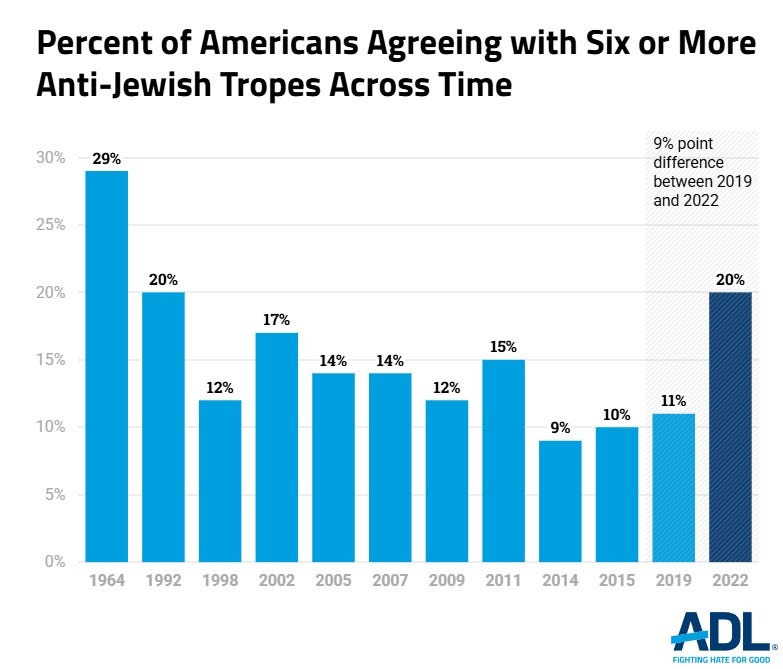
Memes are a bit like endemic diseases — they’re out there somewhere, even when you can’t see them, just waiting to come back into vogue. When American society started splitting apart in the 2010s, antisemitic conspiracy theories, having fallen out of fashion for decades, began to resurface:
Conspiracy theories are appealing to political extremists, of course. Holocaust denial theories, for example, are equally popular on the far right and the far left. But they also tend to be appealing to low-information people, who tend to be disengaged centrists.
Cohen (2024) dubs this pattern the “mainstream philosemitism” theory:
This paper offers a theory based on the learning of tolerance norms and information flow from elites to average citizens and outlines an account of the transformation of elite opinion from being antisemitic to philosemitic. The theory, mainstream philosemitism, suggests new hypotheses, with the major ones suggesting that mainstream liberals and conservatives in the mass public will evince lower levels of antisemitic opinion than moderates and individuals without a sense of ideological self-identification. Further the theory allows for the possibility that extremists of the right and left will be more antisemitic than mainstream liberals and conservatives. These hypotheses are tested using five data sets with nearly two dozen questions measuring attitudes toward Jews. Results overwhelming support the mainstream philosemitism theory.
Basically, antisemitism is at its weakest among people who do have a partisan or ideological slant, but who aren’t very extreme. In a post back in 2023, Matt Yglesias showed some evidence that antisemitic conspiracy theories are strongest not just among “alt-right” White people, but also among right-wing Black and Hispanic people — the latter being the kind of people whose politics aren’t strongly aligned with the standard U.S. political divisions.
What this means is that there’s a pool of swing voters who are more prone toward believing in antisemitic stuff. Extremists might think they can tap into that pool in order to boost their standing and escape their position on the fringes of politics.
The internet, and especially social media, gives them the perfect platform to do this. Perhaps this won’t come as a surprise, but there’s evidence that conspiracy theories spread faster online than they do via traditional media. This is from Schatto-Eckrodt et al. (2024):
Through a (semi-) automated content analysis conducted on a distinctive dataset comprising N = 8,020,314 Epstein-related posts posted on both established platforms (Twitter, Reddit) and alternative platforms (Gab and 4Chan), we demonstrate that conspiracy theories emerge early and influence public discourse well in advance of reports from established media sources. Our data shows that users of the studied platforms immediately turn to conspirational explanations, exhibiting skepticism towards the official representation of events. Especially on alternative platforms, this skepticism swiftly transformed into unwarranted conspiracy theorizing, partly bolstered by references to alternative news media sources.
In other words, the internet and social media allowed the political entrepreneurs of the 2010s — extremists on the right and the left — to grab old antisemitic conspiracy theories off the shelf and target them directly to the kind of low-information citizens who would be most susceptible to them.
We also should not ignore the effect of foreign influence here. The governments of countries hostile to America and Europe — Russia, Iran, and China — are always trying to probe at the cracks in Western societies, taking advantage of the openness of democracy to sow dissent and division.
To give just one small example, Israel’s recent strike on Iran caused dozens of “Scottish independence” accounts to suddenly go silent. It turns out they had all been bots, trying to encourage the breakup of the United Kingdom. As far back as 2018, researchers at the Anti-Defamation League estimated that 30% of the antisemitic accounts on Twitter were bots.
America’s enemies see the status of Jews in America as a weak point — a fissure that they can easily poke and widen. This has actually been true for a long time — the Soviet Union constantly tried to stir up antisemitism — but the internet gives these nations a much more effective and direct tool with which to execute this strategy. Iran has certainly been running this playbook, and Russia probably has as well:
[I]ranian state actors are intensifying their disinformation campaign on social media to spread discord and anti-Semitic tropes inside the U.S.…[W]ithin days of the conflict beginning last month in Israel and Gaza Twitter accounts linked to Iran were amplifying anti-Semitic messages in English, including the phrases “hitler was right” and “kill all jews” at a rate of 175 times per minute, according to analysis by Network Contagion Research Institute…
Iranian and Russian intelligence services often play off each other and borrow techniques, says Clint Watts, a former FBI agent who studies disinformation efforts online and is a fellow at the Foreign Policy Research Institute.
China is a latecomer to this strategy, but appears to be catching up:
And after the Oct. 7 attacks, what the CCP wanted users to see was a stream of anti-Jewish conspiracy theories…Weibo is one of China’s most popular video-sharing programs. Within days of the Oct. 7 Hamas attack, Chinese state TV broadcast the claim that America is controlled by a cabal of money-hungry Jews. Weibo then made sure the clip went viral.
Foreign bot accounts don’t get much attention on an individual basis. But there are a lot of them, and they add up, especially in terms of injecting memes and conspiracies into the discourse.
So basically, the internet allowed opportunistic actors — domestic extremists and foreign enemies — to resurrect old conspiracy theories, and those memes are now running rampant among a vulnerable populace.
Jews are not as special in America as they once were
There’s one final reason that Jewish Americans are probably feeling more threatened by antisemitism than in previous decades. The percentage of Jewish people in America has been declining steadily since the middle of the 20th century, from around 3.7% in the mid-1940s to 2.4% today — a one-third decline. In NYC, the drop has been even more stark, from over 28% a century ago to less than 12% today.
This gives Jews less demographic heft in America than before, especially in cities like NYC. Politicians like Zohran Mamdani don’t need to cater to the Jewish vote like they once did.
But perhaps even more importantly, Jews are losing their distinctive place among the U.S. intellectual elite. in the 20th century, Jews who fled persecution in Europe made up a substantial portion (though never close to a majority) of the American professional, academic, and media elite. Why this happened remains a mystery, but it made Jewish people important and influential in American society. You couldn’t have a surge of antisemitic attitudes without threatening the country’s supply of highly competent researchers, doctors, lawyers, engineers, and so on.
This is becoming less true every day. The Immigration and Nationality Act of 1965 created multiple channels for high-skilled immigration. Since then, America has been sipping at the gushing torrent of talent from Asia. In recent years, South Asia, Central Asia, and the Middle East have been sending a lot more people our way:
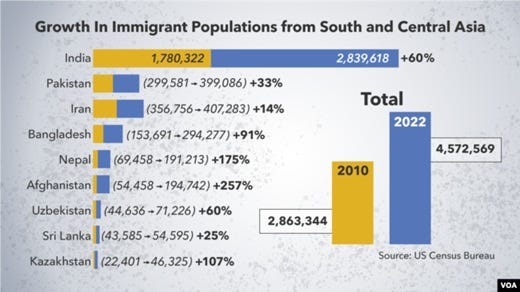
Unlike most of the waves of Jewish immigration, these newer immigrant groups are hyperselected — America gets the absolute cream of the crop from regions with vast populations.
What this means is that America’s elite is becoming slowly but steadily less Jewish. Jews won’t disappear from academia and the professions, obviously, but they’re no longer as critical a piece of America’s talent pool. A few decades ago, Jews were almost a majority at some elite New York high schools; now they’re a minority at those same schools, occasionally facing bullying from peers who associate them with Israel. Jewish students used to be a fifth of the Ivy League student body in the late 20th century; now they’re down to around 10%. In the Baby Boom generation, 30% of top U.S. academics were Jewish; that’s now down to around 4% for the younger generation.
This isn’t just the result of increased competition from skilled immigration. It’s also because Jews have declined precipitously in absolute numbers, due to extremely low fertility rates among the non-Orthodox. And as Jews got more affluent and felt more settled in America, they probably lost their hard-charging immigrant culture.
In purely economic terms, this isn’t a disaster for Jewish Americans; they may occupy a smaller percent of the U.S. elite, but on net they will benefit from having the cream of the crop of Asia and the Middle East working alongside them. This is what happened to Scottish Americans a century earlier, and it’s a natural part of the life cycle of elite U.S. minorities.
But in political terms, it means that in future decades, when Jewish Americans complain of antisemitism, politicians will feel less of a need to prioritize their complaints. Jews simply won’t be as crucial to the functioning of the nation as they used to be. This may have been why Mamdani felt politically safe when he refused to condemn the phrase “globalize the intifada”.
In other words, Jewish Americans had a really exceptional 20th century, but going forward they’ll just be one minority among many. Whether they feel accepted or secure in 21st century America will hinge less on their own accomplishments within the U.S., and more on whether 21st century America overall is a place where minorities of all stripes can feel accepted and secure. The antisemitism emanating from extremists and foreign influencers on social media must be defeated, of course. But even if it is, Jewish Americans face a more uncertain future.
Note: I was raised Jewish, though I no longer practice the religion.
And for what it’s worth, Jews’ tiny worldwide population means that there’s no distant powerful protector notionally looking out for Jews in any particular country — Israel punches above its weight, but it doesn’t loom in the distance like China or the Muslim Ummah. In practice, such distant protectors don’t really matter — China will not wreck your career if you discriminate against Asian Americans in Nebraska — but psychologically it could make a difference.
The parallels between Musk and Henry Ford continue to be remarkable. Ford allowed a series of antisemitic articles to run in his newspaper, the Dearborn Independent, before issuing a public apology two years later.