The Trump administration has just paused all visa interviews for all foreign students seeking to study in the United States. This means that until and unless that pause is lifted, the number of new students who can apply to come study in the U.S. is zero. Ostensibly, the pause is a short-term measure that will give the Trump administration time to set up a procedure to vet prospective students’ social media accounts for ideas it doesn’t like; interview scheduling could resume within days, or it could take longer.
This is important because it’s part of a more general attack on foreign students. Trump already forbade Harvard University from enrolling students from overseas, although the action was blocked by a court. This was part of a high-profile confrontation with Harvard over anti-white racial discrimination, but it also reflected Trump’s belief that international students are taking spots that ought to go to Americans. Bloomberg reports:
President Donald Trump said Harvard University should cap foreign student enrollment at 15%, ratcheting up his effort to force policy changes at the elite institution.
“I think they should have a cap of maybe around 15%, not 31%,” Trump said Wednesday at the White House. “We have people who want to go to Harvard and other schools, they can’t get in because we have foreign students there.”
Trump has the same attitude toward college spots that he has toward immigration and imports. To him, everything is just a lump of fixed size — a pie to be divided. In his mind, if you kick out immigrants, the number of jobs doesn’t go down — the jobs just get parceled out to native-born Americans instead. If you ban imports, Americans don’t consume less — they just buy American-made products instead. And if you kick out foreign students, the number of college spots doesn’t go down; American kids just get more.
Of course, Trump is wrong about that, as I’ll explain. But kicking out international students dovetails with a number of other Trump administration priorities. It allows them to strike out at left-leaning universities. It allows them to implement ideological tests for immigrants — something they want to do in general.1 It allows them to reduce the number of foreigners in the country, which they feel strengthens Western civilization.
And for the China hawks in the administration, it allows them to kick out the Chinese, whom they suspect of being spies:
The U.S. will “aggressively revoke” visas for Chinese students, Secretary of State Marco Rubio said Wednesday…“Under President Trump’s leadership, the U.S. State Department will work with the Department of Homeland Security to aggressively revoke visas for Chinese students, including those with connections to the Chinese Communist Party or studying in critical fields,” he said in a statement. “We will also revise visa criteria to enhance scrutiny of all future visa applications from the People’s Republic of China and Hong Kong.”
So kicking out foreign students is, in many ways, the perfect policy from the Trump administration’s point of view. The problem is, it’s a terrible policy. But like tariffs, this policy will immediately and needlessly hurt some parts of America, while also leading to a long-term erosion of American competitiveness, innovation, and general economic strength.
There are three basic ways that international students are important for the U.S. economy:
Their high tuition payments subsidize the education of native-born American students.
The money they spend in America helps keep the economies of small towns and cities going.
They are crucial for American innovation and technological strength.
International students subsidize American students, especially at state schools
American universities fund themselves five main ways: 1) government money, 2) alumni contributions, 3) investment income from endowments, 4) revenue from hospitals and other businesses, and 5) tuition. Tuition currently provides about 17.5% of the total overall, and almost a third for private nonprofit universities. Here’s data from 2020:
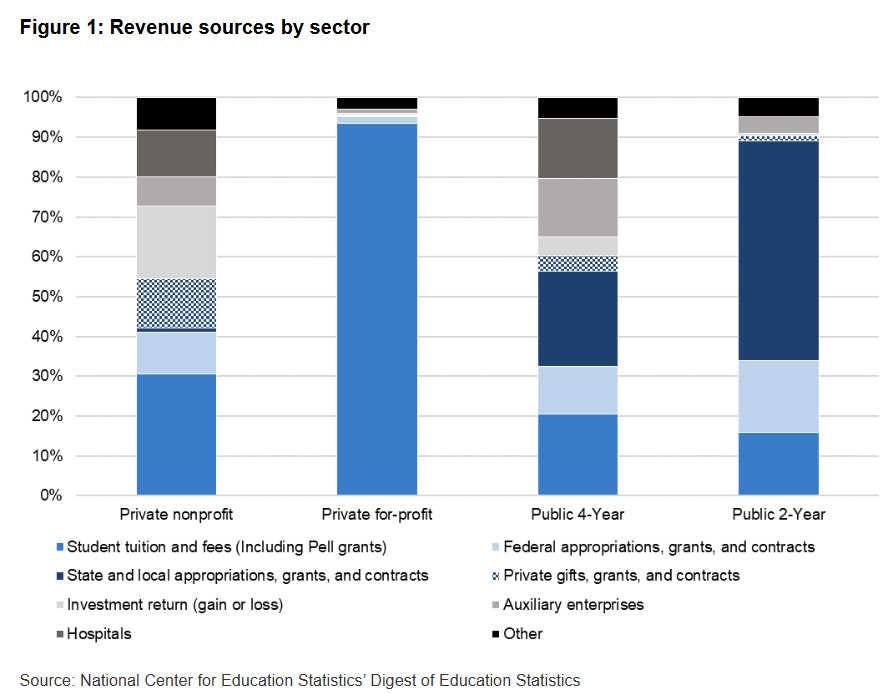
In fact, this is higher than in the past. In the Great Recession a decade and a half ago, states dealt with their budget woes by cutting support for public universities, and the money didn’t entirely come back once the recession ended. As government money receded, universities used higher tuition to fill the void.
When tuition goes up, American students and their parents understandably get mad. So universities found a group of students who would pay incredibly high tuition without complaining — international students. Foreign students pay out-of-state tuition, and they’re eligible for far fewer scholarships and government financial aid. So their tuition ends up being much higher. For example, at Texas A&M University, an international undergraduate student pays more than 9 times as much per credit-hour as an in-state undergraduate student. And that’s even before accounting for scholarships, grants, and other financial aid.
All this tuition money from international students allows American universities to pay for more spots for domestic students. In fact, you can see this effect in action. Shih (2017) looked at the effects of various exogenous shocks — baby booms in foreign countries that led to more international enrollment in the 90s, and then 9/11, when increased suspicion of international students led to a sudden drop in enrollment. He found that when more international kids attended a U.S. university, the number of spots for American students also rose:
I focus on a dramatic increase in international enrollment at U.S. graduate programs during the late 1990s, which suddenly reversed following heightened scrutiny of student visa applications in the aftermath of 9/11…The primary findings reveal that international students actually raise domestic enrollment. Preferred estimates indicate that 10 additional international students increase domestic enrollment by roughly 8…This positive effect also appears during the bust period…
At the margin universities can charge international students high prices and use the profits to subsidize the cost of enrolling more domestic students…I provide multiple forms of evidence that indicate cross-subsidization underlies the crowd-in effects. The positive impacts appear to be driven by foreign Master's students, who pay full-sticker price tuition…[T]he positive impacts are concentrated on domestic graduate students in academic programs, who require subsidies…[T]he crowd-in effects are most pronounced among public universities which prioritize enrolling domestic students, pricing tuition below cost for state residents, while also charging foreign students tuition rates between 2 and 3 times higher.
If you were to kick out all of America’s 1.1 million international students, Shih’s estimate would suggest that domestic enrollment would fall by 800,000. Even if it were only half or a quarter of that, that’s a substantial number of Americans who wouldn’t get the chance to go to college.
And the burden would fall hardest on state schools, for whom the difference in tuition between foreign and domestic students is highest, and who have already suffered the most from funding cuts. State schools are much more important for uplifting the American working class into the middle class than Harvard or MIT. So by kicking out international students, Trump is depriving the working class of life-changing educational opportunities.
International students are helping to save small-town America
Beginning in the late 20th century, America stopped being the world’s factory floor, and started being the world’s research park. As Enrico Moretti documented exhaustively in his book The New Geography of Jobs, beginning in the 1980s or thereabouts, two types of American towns began to do especially well compared to the rest: 1) big cities, and 2) college towns. These cities got more knowledge workers, more high-value industries, and more investment. And they enjoyed better health, more social cohesion, etc.
Most places in America simply can’t be big knowledge-hub cities like San Francisco, NYC, or Dallas. A lot of the country’s population lives in small cities and towns, and no matter how much housing we build in the cities, that basic fact isn’t going to change. In the past, factories dotted the landscape of the American countryside, supporting a distributed network of economic activity; today, high-value industries like IT, finance, entertainment, biopharma, and advanced manufacturing are increasingly concentrated in a few “superstar” cities. Trump’s tariffs, even if they do eventually go into effect, will not reverse that trend.
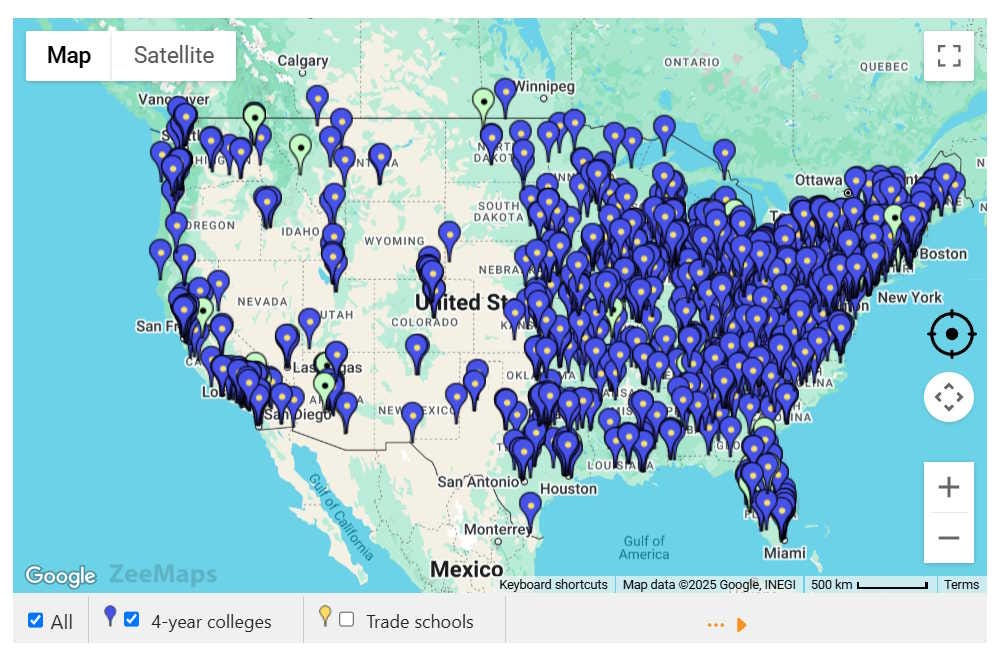
What does that leave for the rest of the country to do? There are still some manufacturing and service industries that thrive in smaller towns and cities, and of course there’s still agriculture and mining. But one big boon to America’s small towns has been the vast patchwork of universities that we built over the past two centuries. Here’s a map of every 4-year university and college in the country, which shows that they’re basically everywhere:
These universities support local economies by drawing in smart people to live and work in small cities and towns. Talented, educated people go to work at the schools themselves, and at companies affiliated with the universities. Abel and Dietz (2011) write:
[A]cademic R&D activities increase local human capital levels, suggesting that spillovers from such activities can raise the demand for human capital. Consistent with these results, we show that metropolitan areas with more higher education activity tend to have a larger share of workers in high human capital occupations. Thus, this research indicates that colleges and universities can raise local human capital levels[.]
And a number of papers have found that towns where the U.S. government gave land grants to universities are now richer than nearby places.
Human capital isn’t the only way this happens, of course — students also spend money in town, which spreads around the local economy and invigorates local service businesses. This is known as a local multiplier effect. Taking in students from out of state — including from out of the country — acts like an export industry for a town.2
John Austin, who has spent his career drawing up plans for the economic revival of the Rust Belt, identifies universities as one of the main forces revitalizing parts of the Midwest:
One economic engine for the revival of both large and small Rust Belt communities…is the presence of research universities and colleges….The only fast-growing non-extractive industry “boomtowns” in the Midwest/Rust Belt region were Morgantown, W. Va. (home to West Virginia University), State College, Pa. (home to Penn State), and Blacksburg, Va. (home to Virginia Tech)…The presence of higher education facilities has a positive impact on the relatively few places across the industrial Midwest with above-average incomes today.
And in one of my favorite blog posts of all time, Lyman Stone wrote about how the tiny town of Pikeville, Kentucky is doing much better than the surrounding areas of Appalachia, thanks to the presence of a small university:
Pikeville is a small city of under 10,000 people…When I say Pikeville is deep in Appalachia, I mean deep. You couldn’t get further into Appalachia if you tried…
In Pikeville, we can find a different source of economic strength [than the region’s traditional coal industry]: education…The University of Pikeville has been expanding rapidly…Now approaching a tripling of its size in just a few years, the University of Pikeville has drawn in literally thousands of new students, as well as faculty. And that’s not to mention the blue-collar workers who actually keep a university or hospital running day-in, day-out, or the increase in demand for construction driven by large university building projects…
It is not too much to say that the University of Pikeville is saving the city…[A]s Pikeville’s population grows, it is becoming more amenity-dense, which is a necessary precondition for lasting growth…Greater Pikeville’s birth rate is substantially higher than the rest of Pike County…
The success of small cities is based on their ability to draw people in with jobs, amenities, and low costs: universities serve as excellent incubators for at least the first two. Moreover, universities need not be public, nor enormous. UPIKE is a private school and isn’t huge. But university and government leadership have both invested in their communities, pouring energy and resources into assets: knowledge creation, civic organizations, institutions, reputational capital, etc. Furthermore, Pikeville’s success shows that post-industrial towns deep in the coal belt totally isolated from the large urban centers can nonetheless succeed.
It’s this kind of local, small-town economic success that Trump is directly assaulting when he tries to punish universities for being too politically liberal. Pikeville only relies on international students a little bit — they’re 6% of its student body. But to rob it of those high-paying students would cause this tiny Appalachian town unnecessary harm.
Even banning international students entirely wouldn’t cause a new Rust Belt and wipe these towns off the map. A few schools rely heavily on foreign students, but most only rely on them a modest amount. But depriving universities in small-town America of an important source of revenue and external spending would sap some of the vitality from the nascent revival of the Rust Belt.
International students (and researchers) power American innovation
So far, I’ve been talking mostly about the benefits of the money that international students pay. Thus, I’ve been talking about undergrads, Master’s students, and professional students. But there’s an incredibly important function that foreign PhD students perform, even though they don’t pay much in the way of tuition money. This is research.
American graduate schools operate on the model that Germany pioneered in the 19th century. PhD students are basically apprentices, working as researchers for poverty wages in exchange for mentorship and networking. During those apprenticeships, they do much of the actual legwork of research.
Right now, a huge percent of STEM PhD students in the U.S. are international students:
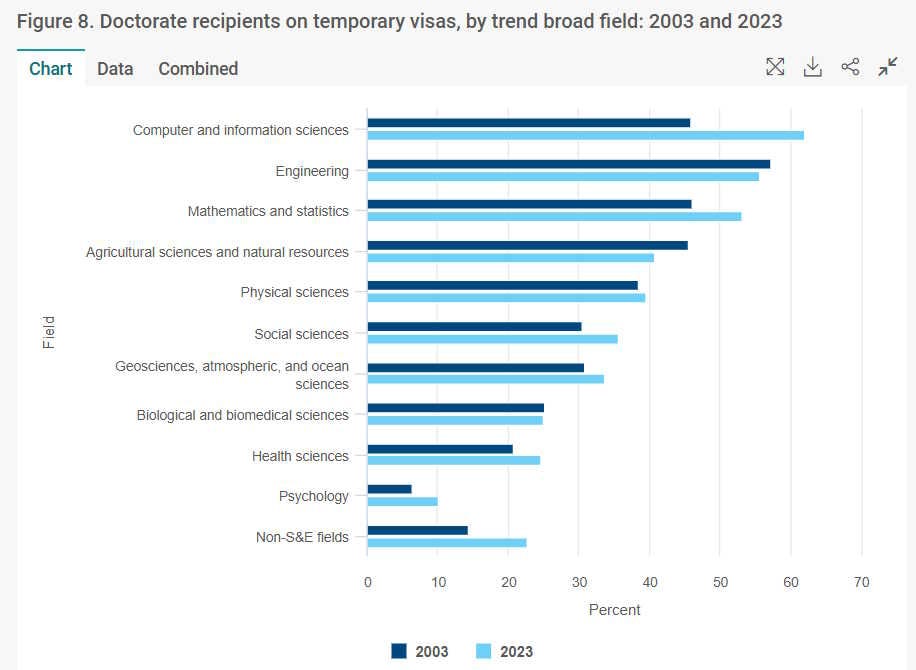
American computer science, engineering, math, statistics, and physical science are utterly dependent on international PhD students. Get rid of these students, and there will be no one to work in the nation’s top labs.
Trump, of course, thinks that if you get rid of these foreign students, American students will pop up to take their place. And sure, if departments wanted, they could grab random Americans off the street and say “Hey, you’re a PhD student now, get in the lab!”. And some would go. But quality would suffer.
So even if America’s top STEM labs do manage to find native-born replacements, the quality just won’t be there. Remember that America has 4.2% of the world’s population, so when we get STEM students from overseas, we’re taking talent from a much larger pool. Kick out the international students, and our talent pool will shrink by a factor of 24.
And it’s not just in university labs where foreign students are leaving their mark. The U.S. actually does a very good job of retaining foreign PhD students after graduation; about three out of four end up staying and working in America:
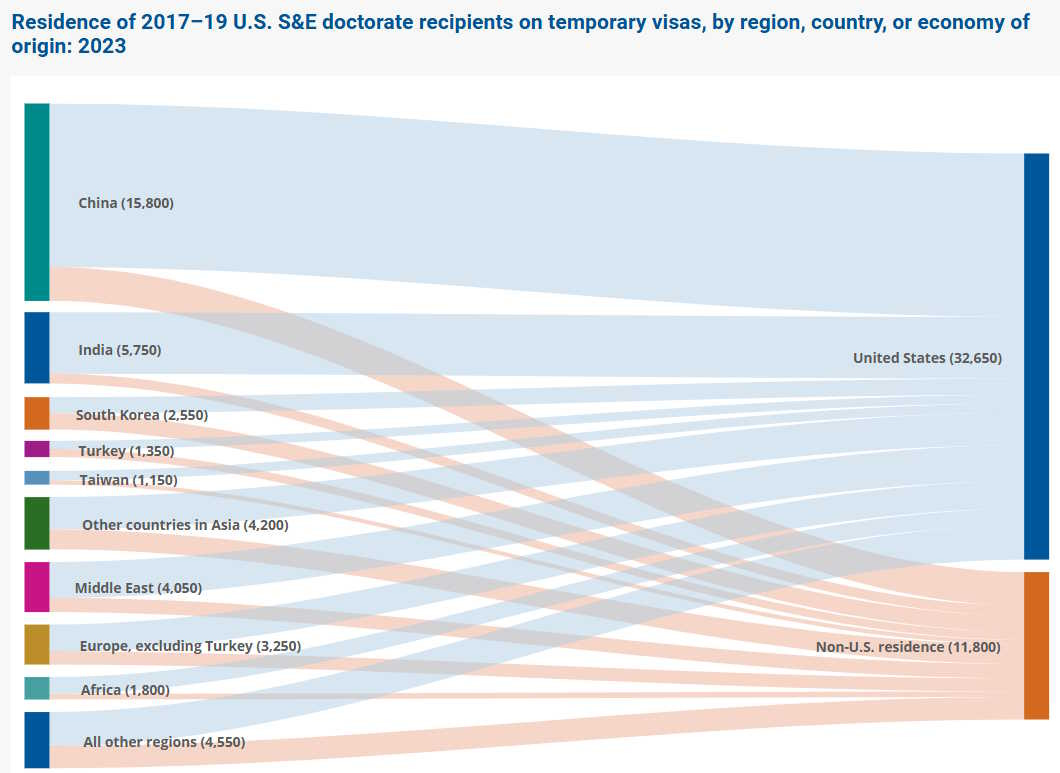
So by cutting ourselves off from foreign students, we’re cutting ourselves off from foreign researchers down the line.
In fact, this is only one way that the second Trump administration is prompting an exodus of talent. The Economist reports:
An exodus from the world’s scientific superpower beckons…In the first three months of the year applications by researchers based in America for jobs in other countries were up by 32% compared with the same period in 2024…Searches for American PhDs on FindAPhD…were down by 40% year on year in April. Interest from students in Europe has fallen by half…
Why is America losing its allure? The most straightforward reason is money, or the looming lack of it. Mr Trump’s administration has cancelled thousands of research grants…[A]t least $2.5bn-worth have been rescinded so far, leaving researchers without salaries and unable to pay expenses. Much more could be coming. The White House’s budget for 2026 aims to slash science spending. The…NIH…faces a nearly 40% cut. The…NSF…may lose 52%…
Funding is not the only issue. Many scientists, especially those who are citizens of other countries, are beginning to feel intimidated. In the first four months of 2025 at least 1,800 international students or recent grads had their visas revoked without explanation, only to have them restored again in April. Senior scientists report difficulty obtaining visas for incoming researchers, and have advised junior colleagues from overseas not to travel home, lest they be detained on their return.
This is very bad news. Immigrants are a huge and disproportionate force in American innovation; now their talent will go elsewhere. And as The Economist reports, even Americans are getting discouraged from STEM PhDs under the new regime, putting the lie to the idea that foreigners are taking those slots away from the native-born.
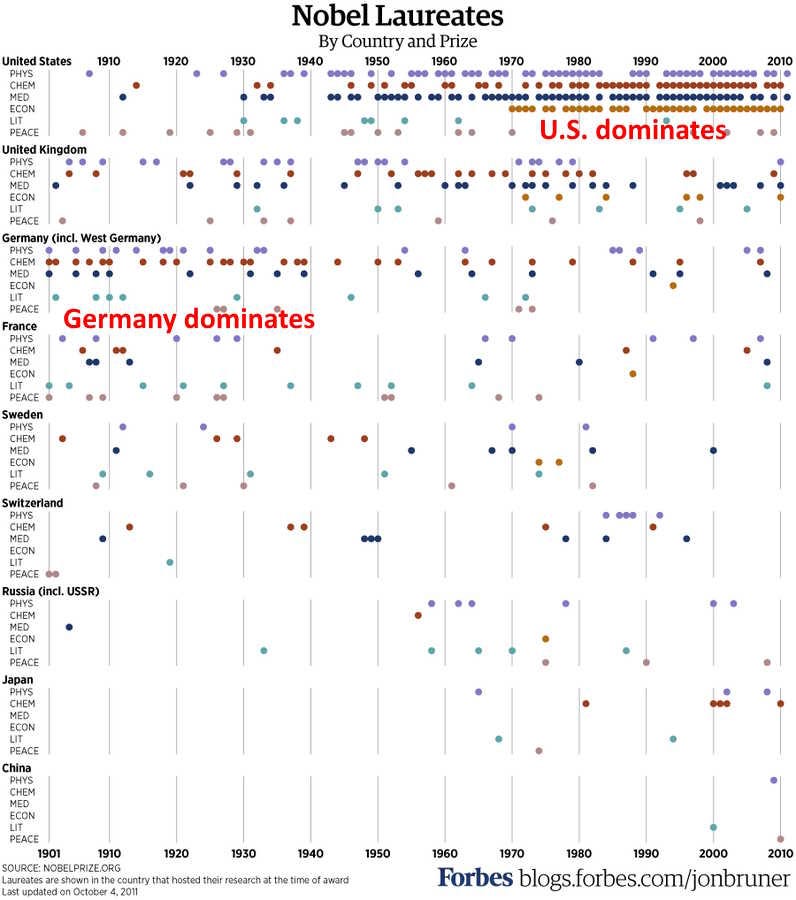
The most obvious comparison here, unfortunately, is Nazi Germany. When the Nazis came to power, Germany was still the world’s leading scientific nation. But the Nazis drove away Jewish scientists, as well as many non-Jewish scientists who didn’t like living under a totalitarian state.
Germany’s loss was, quite literally, America’s gain. You can just look at a chart of Nobel prizes and see where scientific leadership passed from Germany to America:
Today, most of the world’s top researchers are not Jewish. Increasingly, they are Chinese. For example, the think tank MacroPolo reports that as of 2023, more than twice as many of today’s top AI researchers were born in China than were born in the United States. But thanks to skilled immigration — much of it through a student pathway — the U.S. still had more top AI researchers working there than China. The reason is that the U.S. traditionally poached lots of China’s best researchers.
That looks likely to change now. STEM research careers in America are getting more and more difficult and dangerous for Chinese people. An increasing number of top Chinese scientists are fleeing America back to China, where they will undoubtedly help that country develop advanced weaponry. It has certainly happened before!
So while kicking international students out of America isn’t going to immediately smash the U.S. economy overall, it represents a corrosion of one of our key national strengths — our ability to serve as a research park for the smart people of the world. Voluntarily giving up that advantage is madness, even if it doesn’t immediately crash the economy tomorrow.
In fact, the U.S. has a very long history of ideological tests for immigrants, since fear of subversive foreign ideologies is always one of the four main motivations behind American nativism (the others being fear of overuse of welfare benefits, fear of job competition, and fear of demographic change). Early nativists were afraid of French-inspired revolutionaries. Later, fear of “papism” fueled anti-Catholic nativism. There was the Red Scare of the 20s, and another in the 50s. In fact, we still have laws on the books barring people from immigrating if they’ve been a member of a totalitarian party.
And of course, educating international students is an export industry for the U.S. as a whole, so if you want to reduce trade deficits, you probably don’t want to ban international students.