
The big news of the last couple of days is that India and Pakistan are at war. A terror attack by a (possibly) Pakistan-sponsored group drew Indian airstrikes in response. But unlike in 2019 when something very similar happened, the two countries didn’t immediately cool things down. Instead, there has been an increasing cycle of escalation, with airstrikes, missile strikes, shelling, aerial dogfights, and so on. A lot of people are still calling it a “standoff”, but by now it’s pretty obvious that it’s a war; no one is actually standing off.
(Update: Shortly after I wrote this post, the Trump administration announced that it had brokered a ceasefire between India and Pakistan. India agreed that there was a ceasefire, but denied that the U.S. had brokered it. Shortly after that, there were reports that the ceasefire had been violated.)
This post isn’t about the blow-by-blow of the conflict — if you want, you can follow the list that I made on X.1 Instead, I want to make a more general observation: We are slipping further and further toward a world of war.
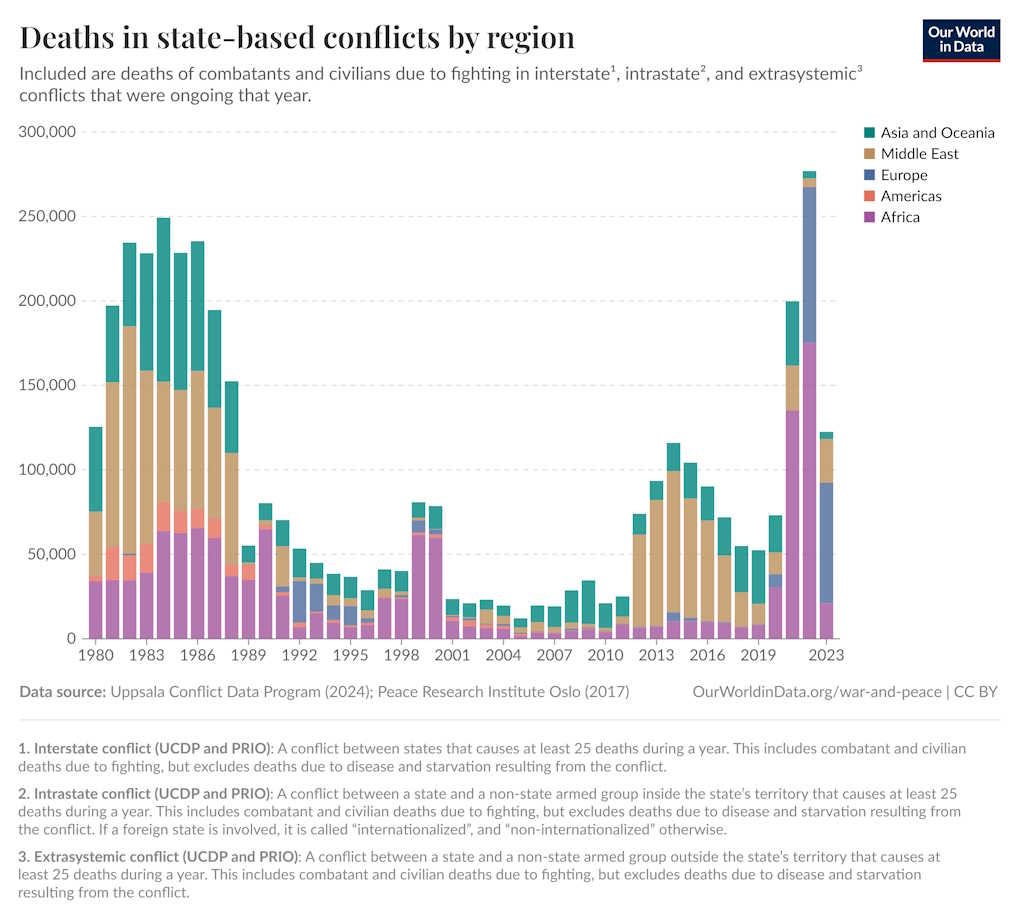
It’s a popular trope to say that war is always with us, but that’s true only in the vaguest, least informative sense. If you just count up all the countries where any kind of violence is occurring, the rate has increased only modestly over the last decade. But most of those are minor skirmishes and simmering conflicts with gangs and terror groups and little bands of ineffectual revolutionaries. When you look at estimates of the actual deaths in state-based conflicts, you can see that it took a big jump after the pandemic:
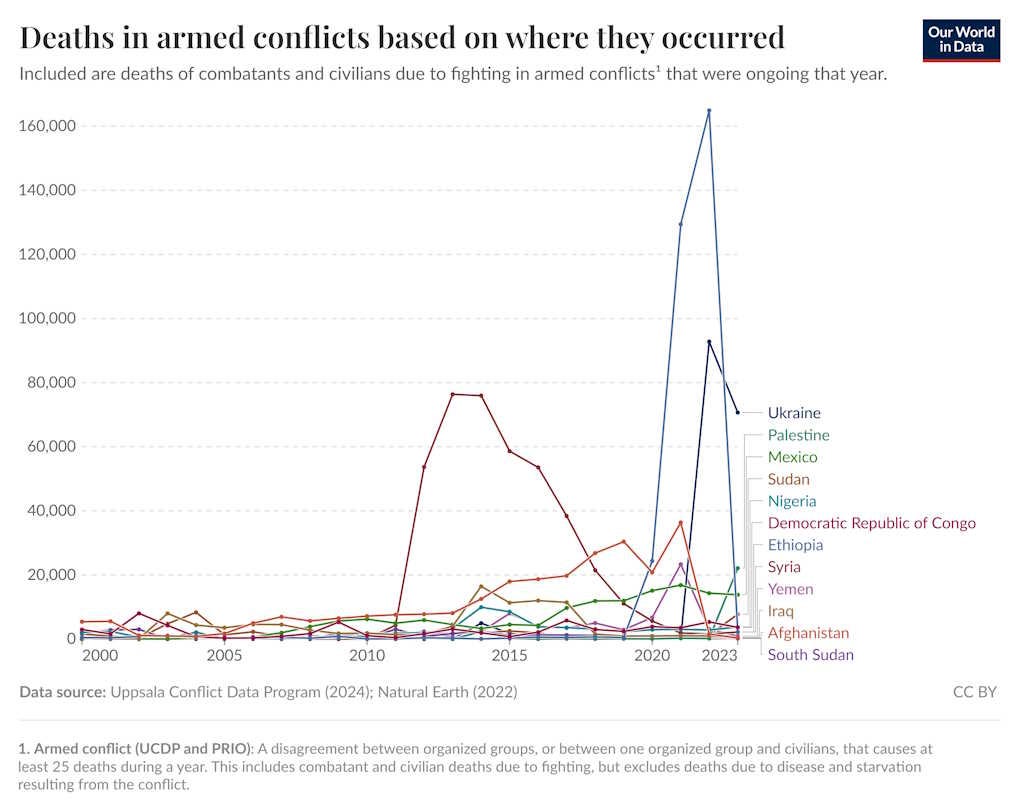
A chart of ten of the deadliest conflicts of the 21st century shows that deaths have been concentrated in recent years:
But to me, this data is less convincing than a single terrifying fact: Out of the world’s nine nuclear powers, four — India, Pakistan, Russia, and Israel — are now at war. (Update: Actually, if you count North Korea as being at war in Ukraine, it’s five!)
Even if India and Pakistan manage to climb down from the brink and avoid a protracted conflict, we should all still be unsettled. Russia and Israel are fighting non-nuclear enemies, which suggests that nuclear weapons can stabilize regions. But the fact that India and Pakistan, which are both armed with nukes, can fight each other to the degree they have — instead of climbing down like they did in 2019 — should worry us deeply.
This episode only reinforces what has been apparent for several years now — war is returning to our world. We’re slowly exiting a world of guerrillas and gangs and petty border skirmishes, and returning to the days when great powers clashed with each other regularly.
Ultimately, the reason for this is the end of Pax Americana. The power vacuum created by the decline of the global hegemon is prompting a scramble for power.
The end of Pax Americana means the world is up for grabs
In Europe, three of the last four centuries featured some kind of big “crisis” — a massive outbreak of war that destroyed the old power equilibrium among nations and ushered in a new one. The Thirty Years’ War in the early 1600s featured all of the region’s powers, and devastated the population of Germany. In the late 1700s and early 1800s there were the Wars of the French Revolution and Napoleonic Wars. And then of course in the early 1900s there were the World Wars. Other regions of the globe didn’t have such regular contests among regional powers, but they did have crises of their own — the fall of the Ming Dynasty in the mid-1600s, the Taiping Rebellion in the mid-1800s, the American Civil War, the Pacific Theater of World War 2, and so on.
This isn’t some regular clockwork cycle. The point is that over time, the stability of power relations seems to decay, both between nations and within them. This decay eventually results in a military contest to see where the new power lies.
What are the reasons for the buildup of instability? Technological changes, and the resulting economic changes, probably play the most important role. The introduction of large oceangoing ships, and later the industrial revolution, let European countries master the globe at the expense of incumbent Asian and Middle Eastern powers. But industrialization also created class conflicts that resulted in communist revolutions. Information technologies — the printing press, the telegraph, radio, etc. — fueled popular movements, ideologies, a national and class consciousness that led to major conflicts and upheavals.
In addition, hegemonic powers and ruling regimes sometimes grow ossified and ineffectual, for reasons that may owe as much to institutions as to technological change. The Ottoman Empire was unable to seize the opportunity of oceangoing colonialism. China’s Qing Dynasty closed itself off to foreign trade and missed out on the Industrial Revolution completely. These powers grew weaker and weaker, until one day they weren’t able to maintain their roles as regional hegemons.
In the 21st century, we’re witnessing both of these things. Technology has changed enormously since 1999. Smartphones and social media have given rise to decentralized mass movements, and seem to promote constant low-level unrest; so far, authoritarian countries that control social media have proven more immune to this unrest than democracies.
Meanwhile, drones are changing warfare at breakneck speed, leaving incumbent military powers scrambling to catch up, and offering opportunities for weaker powers to become stronger. The U.S., which led the way on so many military technologies in the 20th century, is now woefully behind on batteries, electric motors, and other electrical technology.
And U.S. hegemony, which had helped to stabilize much of the world from the 1940s until the mid-2010s, has now basically crumbled:
Here’s what I wrote in that post a year and a half ago:
Pax Americana died in stages over the last two decades; people have been writing about its death for a while now, and there were a number of factors that killed it. First there was the Iraq War, which was a clear-cut case of the U.S. starting a major international conflict rather than interceding to stop one…[T]he U.S. behaved like a revisionist power at a time when it should have been guarding the status quo…Iraq also weakened U.S. appetite for intervention.
At the same time, the U.S. was becoming militarily weaker. The War on Terror reoriented the U.S. military toward counterinsurgency and away from defeating enemy armies. The defense-industrial base was allowed to wither — in 1995, the U.S. could produce about 30 times as many artillery shells as it can now…This is a catastrophic loss of hard power, and it means that even a modest diversion of U.S. military resources…can largely remove the threat of U.S. intervention elsewhere.
Finally, a new great-power coalition arose that was capable of matching or exceeding U.S. power. China’s massive growth has given it a manufacturing capacity as great as the entire West combined, meaning that even if we could fix the problems with our defense-industrial base, we’d be outmatched in a protracted one-on-one fight.
The ultimate reason for America’s retreat, of course, is internal culture wars — but that’s really beside the point. Even if the U.S. wanted to be the world police, it no longer has the capability to do so. JD Vance pretty much put a fork in the era of Pax Americana when he declared that the India-Pakistan war was “fundamentally none of our business.” Even if the U.S. wanted to get involved, it’s not clear what leverage it would have over the combatants.
Another clear sign was Trump’s halting of attacks on the Houthi militia in Yemen. The Yemeni militia has managed to close off the Red Sea to international shipping via long-range missile and drone strikes. Both Biden and Trump have now tried and failed to get the Houthis to back off by striking them with missiles, and the shipping lanes remain effectively closed.
New technology is clearly a factor here — the weapons the Houthis are using to close the Red Sea are recent innovations. But America’s institutional weakness is also a big factor — because the U.S. allowed its defense-industrial base to wither away after the Cold War, it can’t produce the munitions to sustain the attacks on the Houthis, and it needs to husband its shrinking missile stockpile for a potential war in Asia.2
So Pax Americana is done. We have the multipolar world that lots of people yearned for after the Iraq war. But it turns out that a multipolar world doesn’t just mean that every country gets a voice and some increased influence on the world stage. It means that every country now has the opportunity to fight its enemies — to settle old scores, grab resources, or pursue conquest — without fear of intercession by an outside superpower.
Instead of the unipolar moment of the 1990s or the bipolar world of the 1980s, we’re getting something that more closely resembles the chaotic, shifting great-power alliances of the 1700s. Consider the following:
Under Biden, the U.S. was firmly aligned with Europe and Ukraine against Russia. Now under Trump, the U.S. has become much more hostile to Europe and much more friendly to Russia.
The U.S. and India are still generally partnered against China, whom India correctly regards as a huge threat. But America and China are both neutral on the India-Pakistan conflict.
Europe is wary of China but generally neutral, especially after its abandonment by the U.S. It’s also neutral on India-Pakistan.
India and Russia are generally aligned, even though Russia is even better friends with China than with India.
And this doesn’t even take into account the added complexities of the Israel-Iran conflict.
This is a world of complete geopolitical chaos. A lot of people complained about Pax Americana, but many of those same people are going to miss it now that it’s gone.
So now for the big question: Will all this increased conflict and chaos lead to another world war — a no-holds-barred contest between nations to see who will hold global power in the rest of the 21st century? In fact, we might already be in one. A year ago, I wrote about how world wars tend to sneak up on us:
In fact, although the official start date is September 1, 1939, it’s easy to make an argument that [World War 2] began long before that….In 1931-32, Japan seized Manchuria from China…In 1935-36, fascist Italy invaded and conquered Ethiopia…From 1935 through 1939, Japan and the Soviet Union fought an undeclared border war…From 1936 through 1939, Nazi Germany, fascist Italy, and the Soviet Union fought each other in a proxy war: the Spanish Civil War…In 1937, Japan invaded the remainder of China…In 1939, before the Soviet Union joined World War 2, it invaded Finland in what’s known as the Winter War…
So if you were living at any point in 1931 through 1940, you would already be witnessing conflicts that would eventually turn into the bloodiest, most cataclysmic war that humanity has yet known — but you might not realize it. You would be standing in the foothills of the Second World War, but unless you were able to make far-sighted predictions, you wouldn’t know what horrors lurked in the near future.
In case the parallel isn’t blindingly obvious, we might be standing in the foothills of World War 3 right now.
The Ukraine War, the Gaza War, and now the India-Pakistan war might be similar harbingers of what’s to come. A Chinese invasion of Taiwan might be the last shoe to drop. Although the Trump administration’s decision to ignore Europe and partially ignore the Middle East might help deter that invasion, it’s more likely that America just doesn’t have the ability to deter China at all anymore. Now that India and Pakistan have shown that conventional warfare between nuclear powers isn’t unthinkable, China might decide to try something similar.
Alternatively, one of these regional conflicts might eventually draw in the U.S. and China, and get them to fight each other. The European powers were dragged into World War 1 by their alliances, as were Athens and Sparta in the Peloponnesian War (the original “Thucydides trap”).
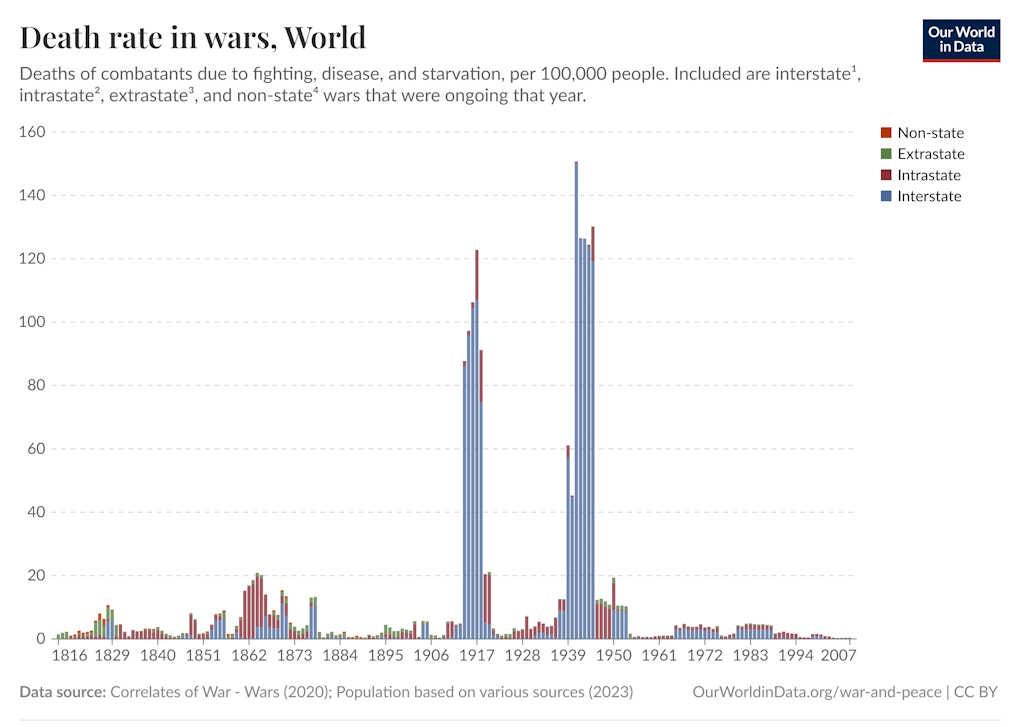
A world war would be a catastrophic outcome. In terms of violent deaths, nothing comes even close:
Some less apocalyptic scenarios
But I definitely don’t view a world war as being foreordained. In fact the 18th century analogy presents us with a small measure of hope. Despite all of the diplomatic maneuvering and shifting alliances in the late 1600s and 1700s, the great powers fought only a series of limited wars, and avoided the kind of blow-up that happened in other centuries.
A multipolar world is obviously dangerous for a number of reasons. Conventional wars break out more often. Nuclear proliferation starts to make a lot more sense under multipolarity, and while this is necessary for some countries, it increases the risk that someone, somewhere, will accidentally launch the nukes and kill many millions.
At the same time, multipolarity might discourage the kind of big coalitional warfare that was involved in the World Wars (and was almost involved in the Cold War). A confused world with a bunch of local conflicts is not as good as the peaceful era we just left, but it might be less dangerous than a world divided into two hostile blocs. The sheer confusion of not knowing who would be on whose side could delay World War 3, and the crisis of the century might end up just being a bunch of small, local conventional wars.
That’s about the most positive case I can make for where geopolitics is headed right now. The negative cases, unfortunately, are far more obvious.
But as I see it, the biggest danger isn’t the chaos of multipolarity itself — it’s the reestablishment of hegemony. A lot of the world really lucked out for 70 years after World War 2 — most of the time, the U.S. was an unusually liberal, tolerant hegemon. There’s no reason to think the next top nation will follow that example.
As for the economic effects of multipolarity, these are wildly difficult to predict, because there’s just so little precedent to turn to. Countries could turn to industrial policy, massive research spending, and competitive export promotion in order to get a leg up on their rivals. Trade agreements are probably going to continue to get more bespoke, byzantine, and bilateral.
For countries not embroiled in domestic conflicts over race and identity, high-skilled immigrants will become a highly sought-after group; I expect companies to compete more for the best and the brightest, especially now that America is essentially ceding the field.
Regarding global public goods like freedom of the seas, here I’m not super optimistic. China’s leaders show little inclination to embrace the role of oceanic protector. Attacks like those of the Houthis will probably become more widespread, with the tacit support of national governments — basically, the modern equivalent of the 18th-century privateers that we now remember as “pirates”. As for global cooperation on climate, pandemics, and so on, this will sadly be less likely, given the coordination problems and the suspicions involved.
The global financial system will also see significant disruptions from multipolarity. The dollar’s dominance is already looking shaky, but it’s not clear what an alternative reserve currency would be. China could do it, but it would require them to open their capital account, which would reduce the government’s control over the macroeconomy — something they’ve so far showed no inclination to do.
In any case, even under the best-case scenarios, a multipolar world is a world of much higher uncertainty. We’re stumbling into the crisis of the 21st century, and there’s no map to navigate by. Nor do we have the same caliber of leadership going into this crisis that we had a century ago. Ultimately that last fact is probably what worries me the most.
Be warned, there’s a LOT of disinformation on that list, even though I tried to find the most reputable sources I could.
If it were China protecting the sea lanes, the Houthis would be in deep trouble — China would simply use the need for munitions to stimulate its manufacturing industries, overwhelming the ragtag Yemeni militia.