Last July, as the presidential campaign was nearing its climax, I wrote a post trying to explain why some people in the tech industry had turned to the right:
Now, in the wake of DOGE, the whole country knows about the Tech Right. Most recently, Semafor’s Ben Smith wrote a story about the group chats that many of the folks in the Tech Right — including my podcast co-host Erik Torenberg and my college friend Balaji Srinivasan — use to talk to each other.
It’s an interesting story about how the internet has fragmented. In the 2010s, discussions like this might have happened on Twitter or other public forums; now, they’re held in the modern-day equivalent of a smoky back room.1 Ben’s article presents group chats as an important, world-changing phenomenon, but really I think they’re a return to the way the world used to be. In 1935, conservative business leaders would gather at a house, or club, or other private space to rail against the labor movement or the New Deal. Tech Right group chats are not really any different than that.
In fact, I see the return to small private forums as a healthy development for public discourse; public discussions almost always devolve into shouting matches between tribes of strangers, exacerbating social divisions. Filter bubbles aren’t so bad.
But like the conservative businessmen who railed against the New Deal in the 1930s, the Tech Right seems to be making little headway on their policy objectives. This might be because tech people are just bad at politics.2 But I think the Tech Right’s objectives simply didn’t align very well with the mood of the nation — or the priorities of Trump’s loyalists and his activist base.
What the nation wants doesn’t appear to be that similar to what the Tech Right wants, and those differences are proving more important as the euphoria of Trump’s victory fades.
Elon Musk’s foray into politics flamed out
The most prominent figure of the Tech Right, of course, is Elon Musk. In the days following Trump’s election, Musk emerged as a powerful and dynamic figure. Some even saw him as a co-president, a “shadow president”, or one of two “consuls” — basically, ruling alongside Trump as an equal. Musk’s peerless record as America’s most brilliant industrialist promised to give the MAGA movement a degree of competence it hadn’t enjoyed during Trump’s first term in office. And as Musk’s DOGE began to purge the government of progressive ideology and fire civil servants en masse, popular attention shifted to Elon as the administration’s main mover and shaker.
But the last two months have seen Elon’s star fall substantially, at least as far as this administration is concerned. First, DOGE’s firing blitz was largely stymied in the courts; government workers are mostly under contract, so they can’t just be fired at will. Musk’s calls to impeach the judges ruling against DOGE fell on deaf ears.
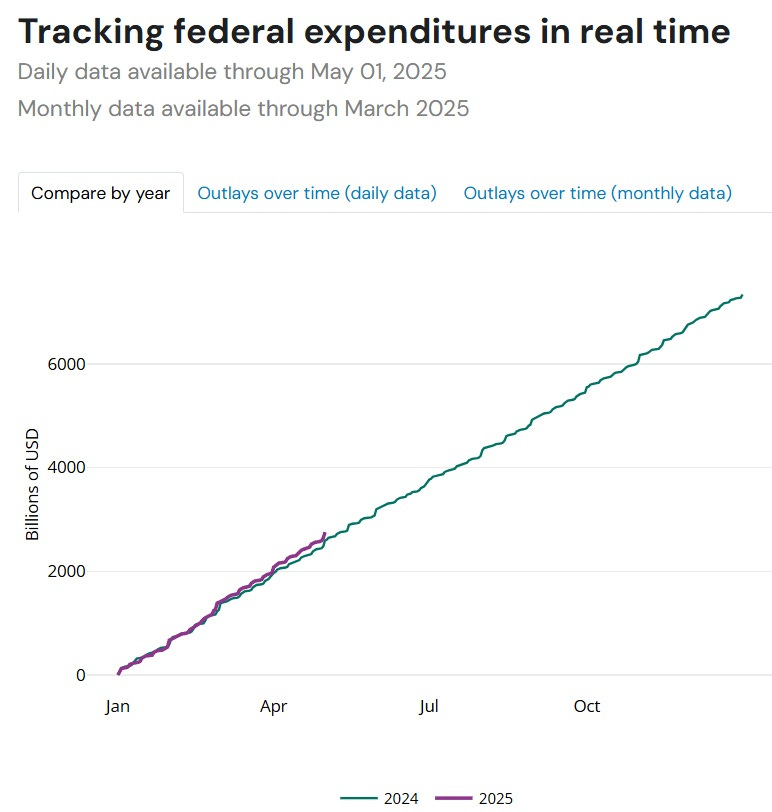
Then it turned out that DOGE hadn’t actually been able to cut government spending by an appreciable amount. Early promises of trillions of dollars in DOGE savings were cut down to a paltry $150 billion, and even that number will probably shrink more. In fact, the U.S. government is actually spending more this year than it did last year under Biden:
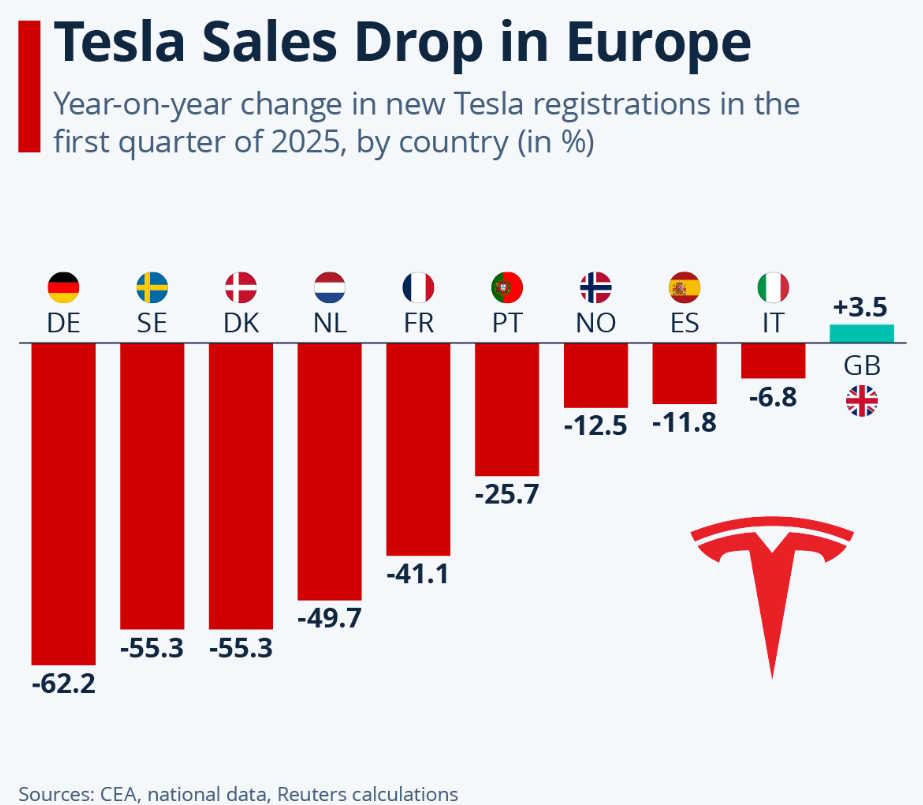
Even though Elon’s signature initiative mostly floundered, it tanked his reputation with the public. Protests against Tesla mushroomed all over the world, and some Teslas were even attacked and burned. Bernie Sanders started a “Fighting Oligarchy” tour, building grassroots energy against Musk. Tesla’s sales suffered globally, and absolutely cratered in much of Europe:
The company’s sales and profits suffered. It took a huge hit to its stock price, which had soared in the lead-up to the 2024 election:
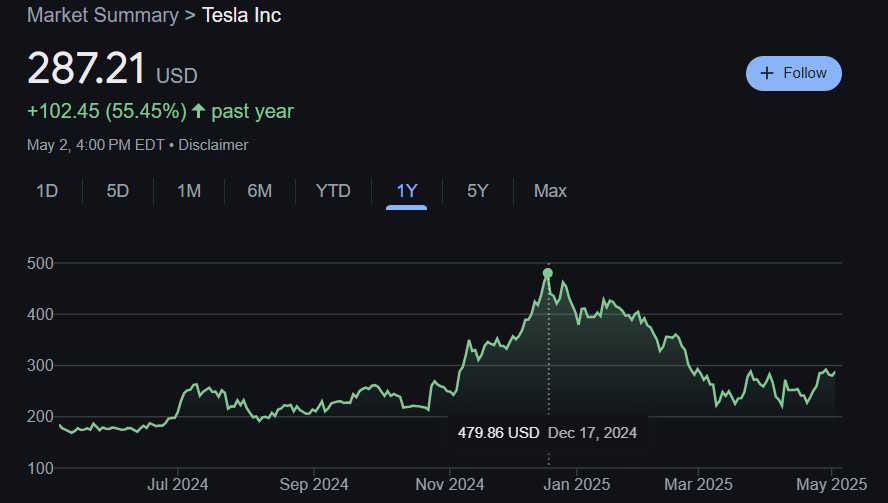
This resulted in Musk’s personal wealth falling by a third since Trump’s inauguration.
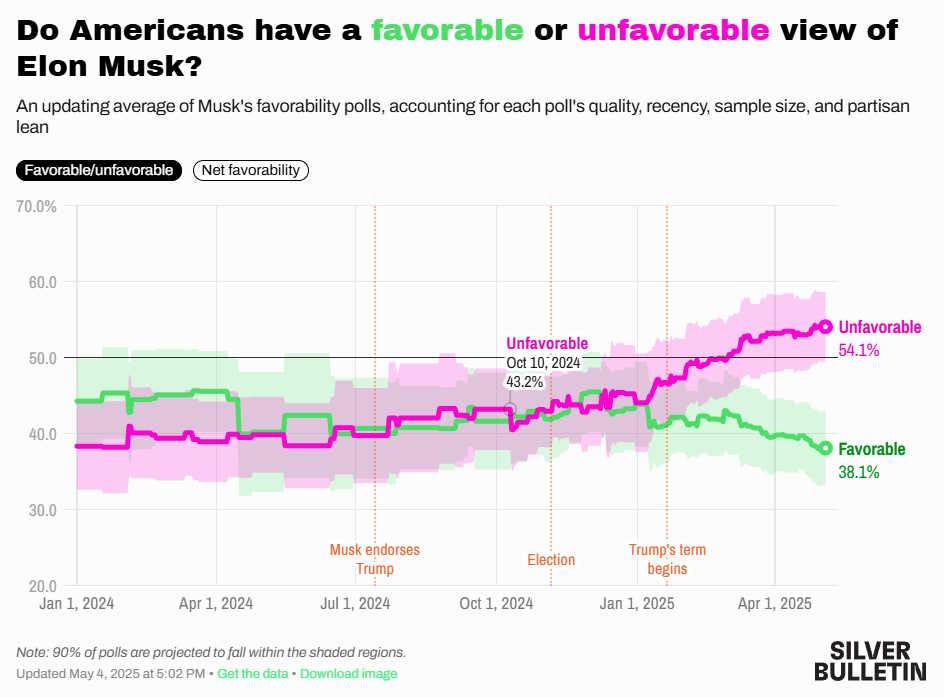
Meanwhile, Musk, once a beloved industrialist, became a widely despised figure in America:
Musk’s popular appeal was tested in a Wisconsin Supreme Court race in March. Elon campaigned heavily for the GOP candidate, declaring the election crucial to “the future of civilization”, and even handing out million-dollar checks to a few supporters. This backfired spectacularly. Musk’s candidate was crushed, by a margin more than twice as large as the other Republican on the ballot. Post-election polling found that Musk’s involvement actually hurt his candidate.
Then came the tariffs. Although Tesla makes more of its car parts in the U.S. than other auto brands, a significant number of its components are still imported, so its costs are expected to go up. Meanwhile, retaliation from China is likely to hurt Tesla’s sales in that country, giving its rival BYD a big advantage.
Elon tried to fight the tariffs, and failed. He publicly denounced Trump’s economic advisor Peter Navarro, calling him “Peter Retarrdo”, and called for a zero-tariff free trade zone between the U.S. and Europe. His cries fell on deaf ears.
If the Wisconsin Supreme Court race had exposed Musk’s lack of popular appeal, the tariff battle exposed Musk’s lack of political power within the administration. Soon stories were coming out about how almost everyone in the Trump administration hates Musk; it seems hard to believe these weren’t deliberately leaked to the press.
Following this string of setbacks, Elon has beaten a retreat, moving out of the White House and “stepping back” from DOGE to focus on running Tesla. The latter looks likely to absorb an increasing amount of his attention; the company’s board has reportedly started looking for a CEO to replace Elon at the helm.
It turns out that Elon was never really “co-president” or “shadow president” after all. Trump, the man with the cult-like popular following and the highest elected office in the land, was the single true boss of the MAGA movement. It also turned out that for all his skill in building companies, Musk was less effective at dealing with politics.
Why? The likeliest explanation is that Musk has spent his entire career dealing with the best and the brightest. When employees at Tesla or SpaceX prove not to be the very cream of the elite, Musk ruthlessly fires them. Thus, he lives most of his life surrounded only by smart and competent people.
But politics is simply a different animal. Dealing with geniuses all day simply does not prepare one to understand and connect with the masses; Trump has plenty of charisma, but when it comes to the average voter, Musk has much less. Musk is also used to being the absolute ruler of his workplaces, and the adaptation to a subordinate role was probably unfamiliar.
These two issues certainly don’t apply only to Elon. In fact, they’re general reasons why technologists’ forays into politics are typically so disappointing — and why the new Tech Right of the 2020s has so far been unable to make much headway.
The Tech Right has failed to accomplish most of its objectives
In my post about the Tech Right last summer, I identified a list of things that conservative tech businesspeople probably want out of the Trump administration:
Lower taxes and less regulation
Less antitrust action against tech companies
A more permissive attitude toward crypto
Fewer journalists attacking tech
An end to DEI and leftist activism
An end to “cancel culture”
A crackdown on antisemitism and anti-Asian crime
Trump is indeed pushing for big tax cuts (despite the ruinous effect this will have on the national debt). In fiscal terms, his tariffs will not be nearly enough to cancel these out — no tariffs would. But in terms of the deadweight loss that they inflict on industry, the harm from the tariffs could exceed the benefit from the income tax cuts — taxing people’s income doesn’t make them work much less, but taxing imports has a big effect on imports and costs.
The tech industry itself will likely be hit hard by Trump’s tariffs. Hardware companies like Tesla will have trouble sourcing components, increasing their costs substantially. Companies like Apple who design their hardware in America but manufacture it overseas will also take a hit; Apple CEO Tim Cook says the tariffs will cost his company nearly $1 billion this quarter.3 E-commerce companies like Amazon will suffer from more expensive imports, too; when Amazon protested by listing tariffs explicitly in their price breakdowns, Trump called Jeff Bezos and bullied him into changing the policy.
Most importantly, AI companies — which at this point includes almost every big tech company, and a large fraction of startups — will face higher costs for their compute, since data centers use tons of imported parts and components:
Trump’s trade levies will drive up the cost of constructing, equipping and operating the data centers that companies such as OpenAI, Google and Microsoft are racing to build to power AI development, according to executives and experts in AI and data center construction…Trump unexpectedly exempted computers, smartphones and the powerful semiconductors known as GPUs crucial to AI projects from his tariffs…but many ingredients of AI data centers such as construction materials, cooling equipment and backup generators are still subject to import taxes. And the exemptions do not appear to neutralize a 20 percent tariff that Trump levied on Chinese imports earlier this year.
So ultimately, Trump’s regime may well end up taxing tech more harshly than its predecessors.
As for antitrust, the Tech Right might have hoped that Trump would get rid of the Biden administration’s hostile attitude toward Big Tech. But instead, it’s looking like Trump is going to sustain the attack:
The Trump administration isn’t letting up on the tech giants…On Monday, the Federal Trade Commission will face off with Meta in court over claims that the social media giant snuffed out nascent competitors when it bought Instagram and WhatsApp. And on April 21, the Justice Department will argue that a federal judge should force Google to sell its Chrome web browser to limit the power of its search monopoly.
Both cases, which helped set into motion a new era of antitrust scrutiny, were filed during President Trump’s first term in office. They were advanced by the Biden administration, which also filed monopoly lawsuits against Amazon, Apple and Google’s ad technology business.
Investors in Silicon Valley and on Wall Street hoped that Mr. Trump might show technology companies more deference during his second term, as he promised to deregulate industries.…But so far, Mr. Trump’s appointees have promised to continue much of the scrutiny of the biggest tech companies, despite the industry’s hopes.
On crypto, Trump is certainly deregulating the industry. But the main kind of crypto he’s promoting is memecoins, which he and his family are using to enrich themselves, and which can also act as a slush fund by which people seeking Trump’s favor can pay him without sending cash directly.
Trump’s memecoin push is changing the nature of the crypto industry, and not in ways that necessarily benefit the Tech Right. Previous crypto booms were built on ICOs, web3, decentralized finance, smart contracts, and other innovations that allowed the creation of new tech companies. The current crypto boom is based entirely on memecoins, which are obviously either scams or vehicles for corruption. Not only do these memecoins produce nothing of value, they also don’t enrich the holders of Bitcoin, Ether, and other existing cryptocurrencies. In fact, those other cryptocurrencies tend to behave like tech stocks, so their value will probably suffer from Trump’s tariffs.
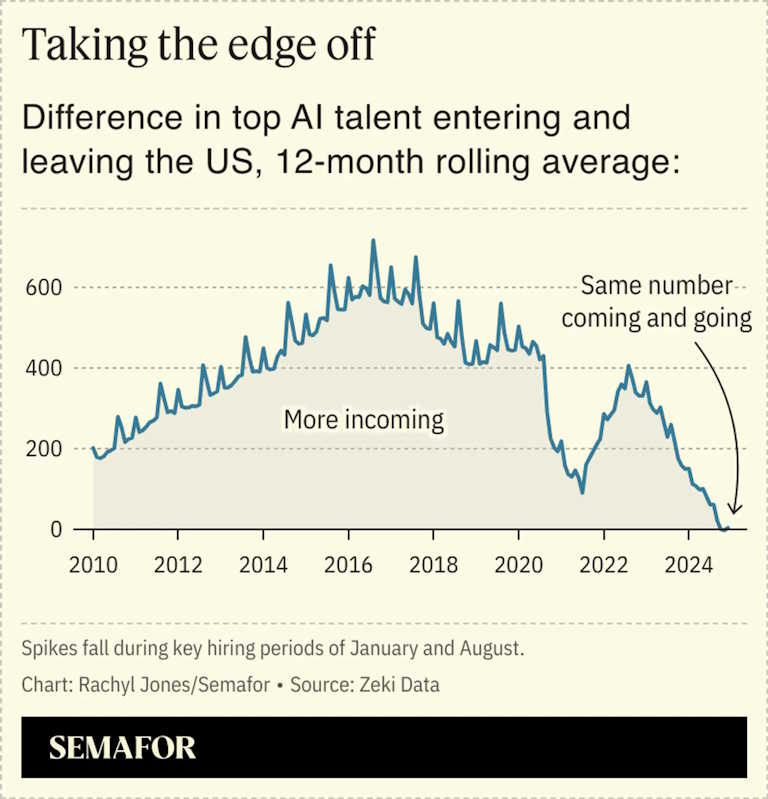
Meanwhile, Trump’s crackdown on H-1b visas risks depriving tech companies of some of the engineers they depend on to function. And his generally unfriendly and threatening attitude toward immigrants of all types has contributed to an exodus of AI researchers, such that these key researchers are no longer moving to America on net:
In the cases of tariffs, antitrust, and H-1bs, the tech industry’s economic interests ran counter to the will of the masses — or at least, the will of the MAGA base. Trumpism is still a fundamentally populist movement, driven by popular rage at elites; tech businesspeople and tech companies are America’s most wealthy and (arguably) most high-status elites.
On a few issues, the Tech Right is getting what they wanted. Trump’s administration is intent on deregulating artificial intelligence, rescinding a Biden executive order on AI safety, and planning a raft of other efforts to boost AI innovation. But whether those efforts will outweigh the exodus of AI researchers and the increased data center costs from tariffs remains to be seen.
In other words, on most economic issues, Trump’s policies are going to hurt the Tech Right folks who supported him. Trump’s populist voter base, and loyalists like Navarro, are simply more important to the President than some nerds out in Silicon Valley.
On cultural issues, of course, Trump has delivered. He has cracked down on DEI in the government, and tried to stamp it out in government-funded institutions; this has probably made it easier for corporations to follow his lead. He has also attacked the left-antisemitism of the Palestine movement (though he has ignored the rising tide of pro-Hitler antisemitism on the hard right), and cracked down on leftist activism. And Trump’s victory in 2024 took some of the power away from “cancel culture” on the left.
These culture-war victories will doubtless satisfy the members of the Tech Right who care primarily about combating “the left”. But for those who put pocketbook issues first, Trump’s economic policies may be enough to drive them back toward political neutrality. There’s no reason to think tech businesspeople should be politically very different than other businesspeople, who are currently souring on Trump. Already there are signs of dissent within Tech Right circles, as more pragmatic members clash with more ideological ones.
The big lesson here, I think, is that our intuition from previous decades is still correct: Tech people simply aren’t that good at politics. Their expertise lies in managing cold hard symbols rather than the passions of the masses, and they’re used to relating to genius engineers instead of working-class voters. They live in a world where functionality, rather than popularity, wins the day. And that world isn’t Washington, D.C.
It’s too early to tell, of course, but my sense is that the Tech Right gambit isn’t looking like a great idea. The attitude of political quietism that tech businesses adopted in the past — and which many still adopt — was probably a better strategy overall.
Ben is nice enough to quote me on the subject. Thanks, Ben!
A notable counterexample is Garry Tan and GrowSF, who have been fairly effective at electing a moderate majority on the San Francisco Board of Supervisors.
This is only about 4% of Apple’s profits, but there’s probably worse to come.