Today’s post is about something that’s nerdy and technical, but also incredibly dangerous and terrifying. Usually, Americans can get by perfectly well without ever thinking about the intricacies of international finance and the bond market. But these things actually have the power to devastate America’s economy like nothing else. Our fabled prosperity is like a town built on the back of a giant sleeping dragon, and the dragon’s name is “international finance and the bond market”. Normally, we go about our business in peace, not even thinking about the dragon slumbering beneath our feet. But if one day it wakes up, we could all burn.
It may be waking up right now.
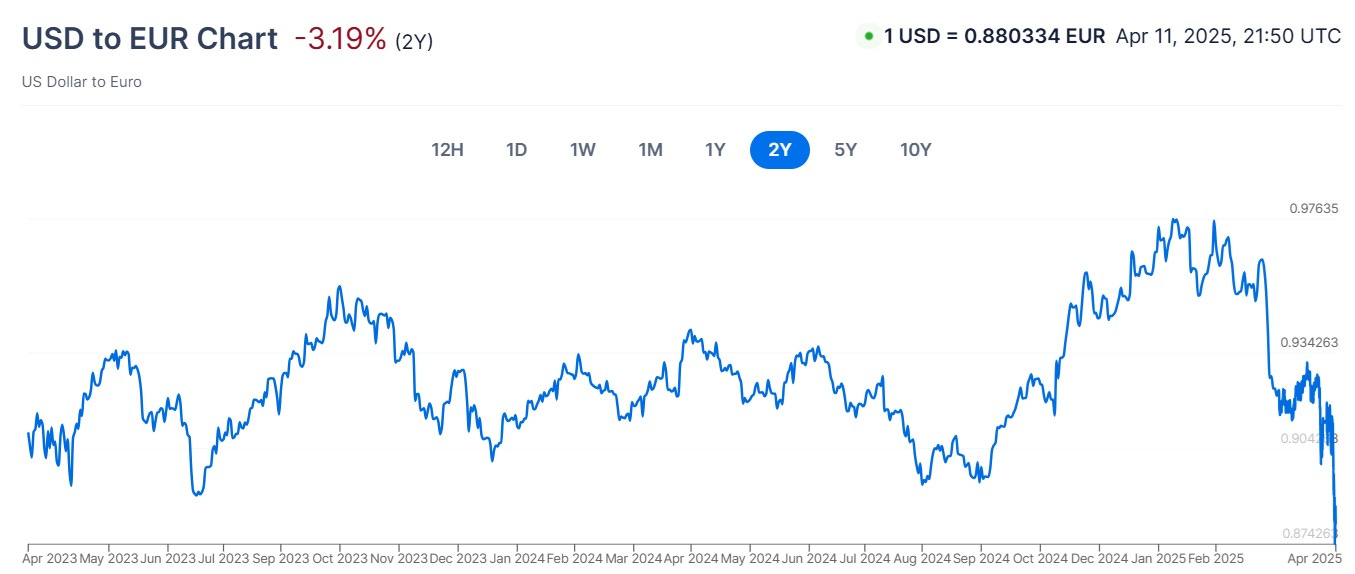
The chart you see above is the U.S. dollar to euro exchange rate. When Trump took office, one dollar could buy you about 0.97 euros. Today, it can buy you only 0.88 euros. The dollar is absolutely plunging, at least as of this writing.
It’s important to realize that this is not typical for a trade war. Usually, when you put up tariff barriers, your currency gets stronger, not weaker.1 That’s how it went when Trump put up tariffs against China in his first term.
That’s not what’s happening now, though. What’s happening now is that a bunch of investors are selling large amounts of U.S. bonds and other assets:
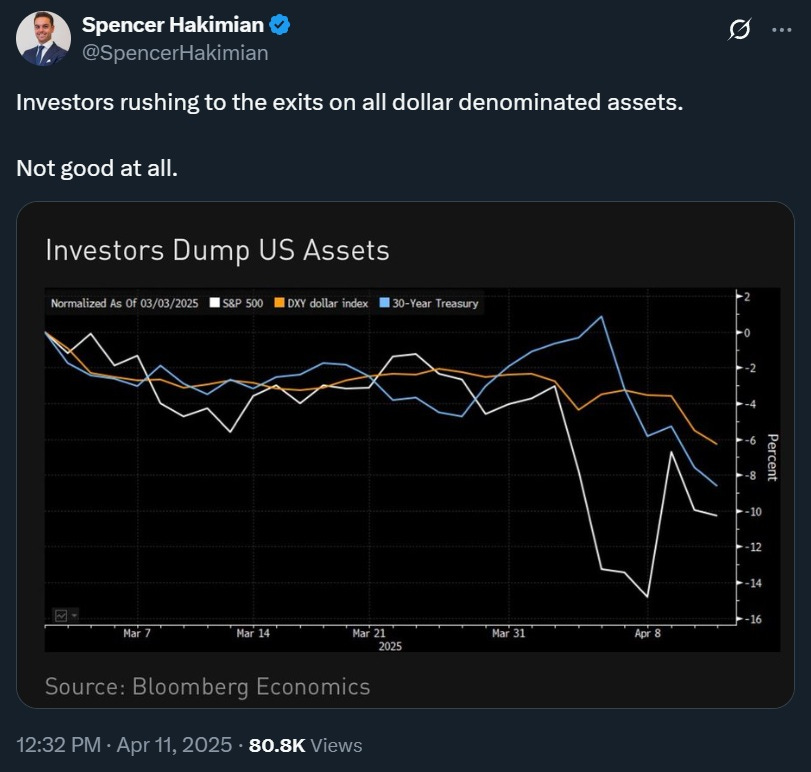
The dumping of these assets weakens demand for the dollar, because people are taking the dollars they get from selling the U.S. assets and swapping them for other currencies or commodities — euros, yen, gold, etc. — so that they can invest elsewhere. Thus, the dollar is going down. This effect is so strong that it’s overpowering the normal effect of tariffs — by a lot.
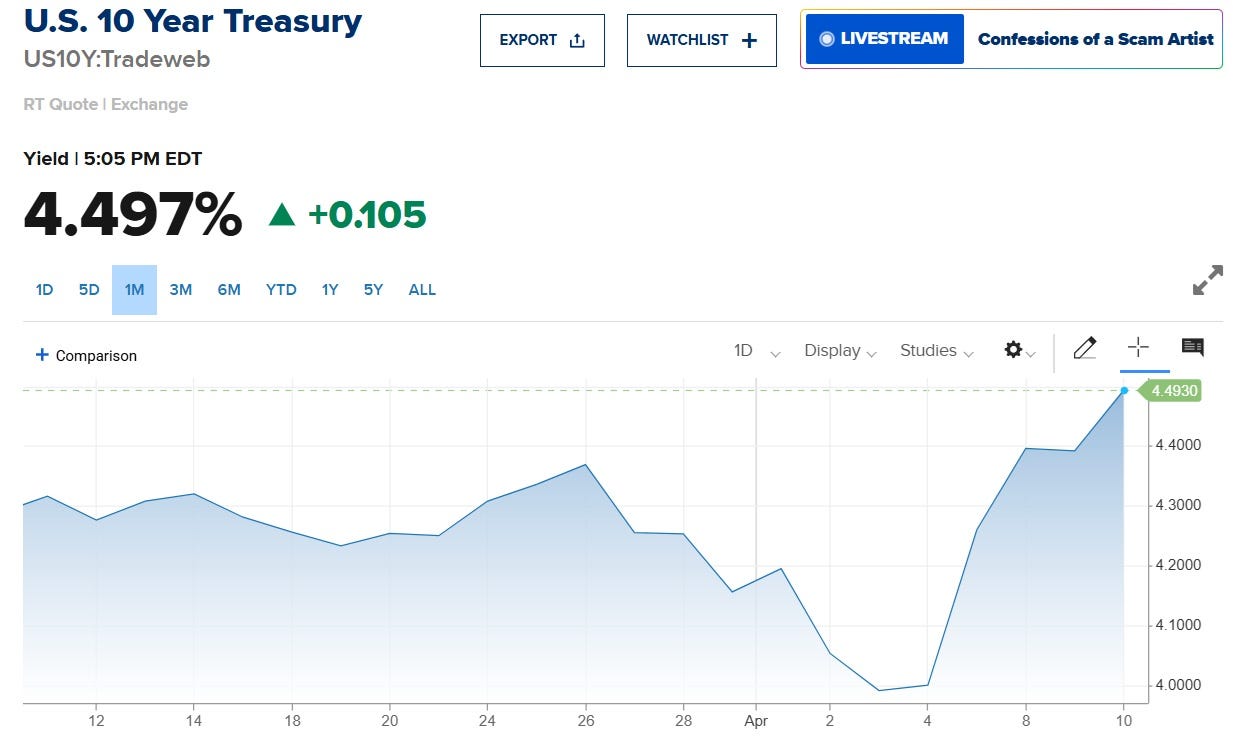
When people sell a lot of U.S. bonds, as they’re doing now, the interest rate on those bonds — called the “yield” — goes up.2 Yields on 10-year U.S. Treasury bonds from 4% to about 4.5% since April 4:
Now, it’s helpful to understand that U.S. bond yields going up while the dollar goes down is actually a highly unusual and scary situation.
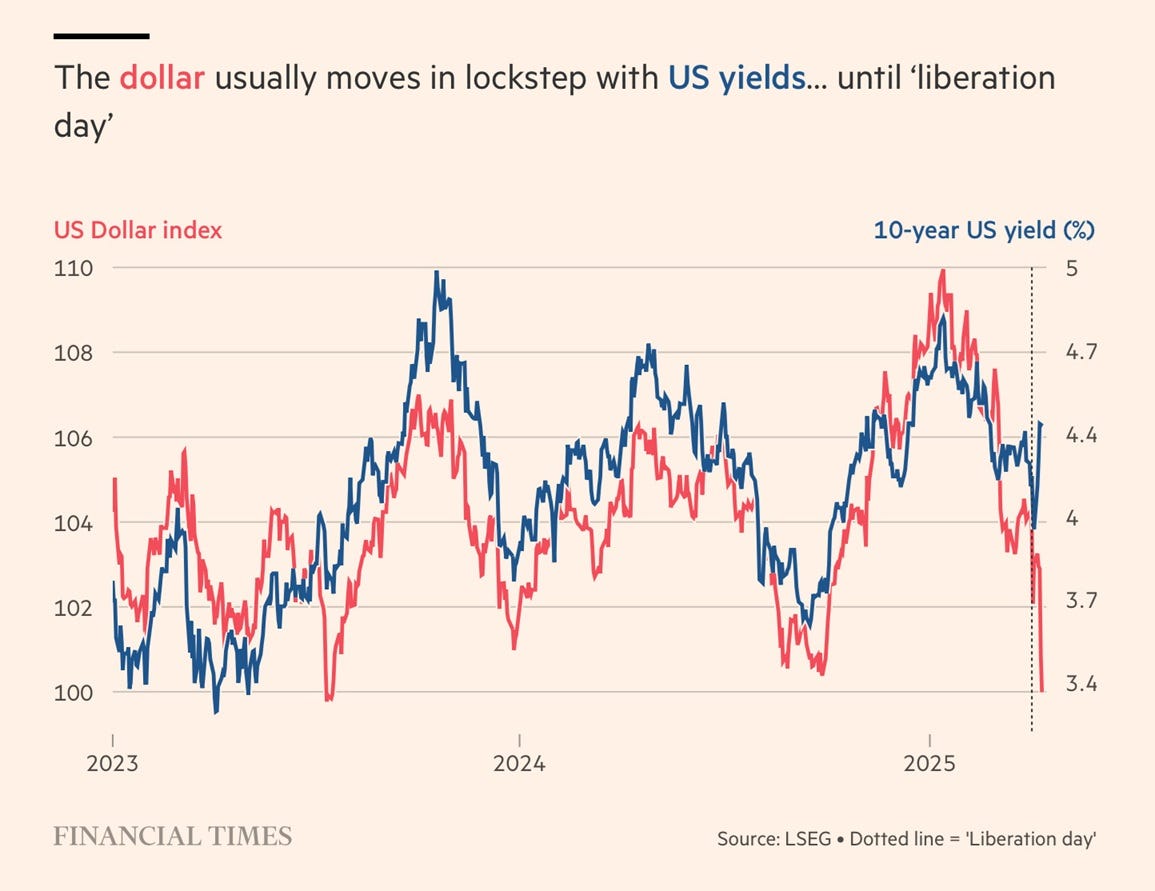
Usually, Treasury yields and the dollar move together, because usually, when investors look at U.S. government bonds, they don’t ask “How risky is this bond?” — instead, they only ask “How much money will this bond pay me?” When yields rise (because of Fed policy or economic conditions), investors buy more Treasuries in order to get those higher returns, and this buying drives up the dollar. When yields fall, investors sell, and the dollar goes down. So yields and the dollar move in the same direction.
But ever since Trump announced his “liberation day” tariffs, that long-standing correlation has suddenly and dramatically reversed:
What’s going on? Why are investors dumping America’s bonds? One reason has to do with the intricacies of financial trading. The Economist has a good explainer on this, and Allie Canal has a good thread about it as well. Basically, Trump’s tariff announcements — and his later partial walk-back — caused a lot of volatility in markets, which caused a lot of Wall Street traders’ bets to blow up. That meant the traders had to raise cash in order to pay back loans they had taken out in order to make those bets. And the easiest way to raise cash quickly is to sell Treasury bonds. So this was probably part of what was going on.
But this doesn’t explain the fall in the dollar. Normally, when Treasuries get sold off, people park their money in cash, instead of moving it overseas. This time, a bunch of investors actually pulled their money out of America entirely.
In other words, for the first time in many decades, the U.S. has experienced capital flight. And if it continues, the consequences for the U.S. economy could be absolutely dire.
Suddenly, the world is treating America like a developing country
Capital flight is something that typically happens only in developing countries (also called “emerging markets”). It usually has dire consequences. When their currencies crash, countries are forced to halt imports, making their consumers suddenly poorer and fueling inflation. When their interest rates rise, countries experience economic recessions, and they may even come under pressure to default on their debts. Basically, when investors start stampeding for the exits, it’s bad news.
We don’t yet know whether this outflow of money will turn into the kind of mad, panicked stampede that abruptly brings many countries to their knees, or whether it’s a temporary, limited movement. But what’s undisputable is that this is a strikingly new development.
Usually, when economic times are bad, people rush to buy Treasuries instead of selling them. Even in the financial crisis of 2008, when it was the U.S. economy that was crashing, investors all over the world rushed to move their money into America, because Treasuries were considered the safest asset in the world. So yields went down, and the dollar went up:
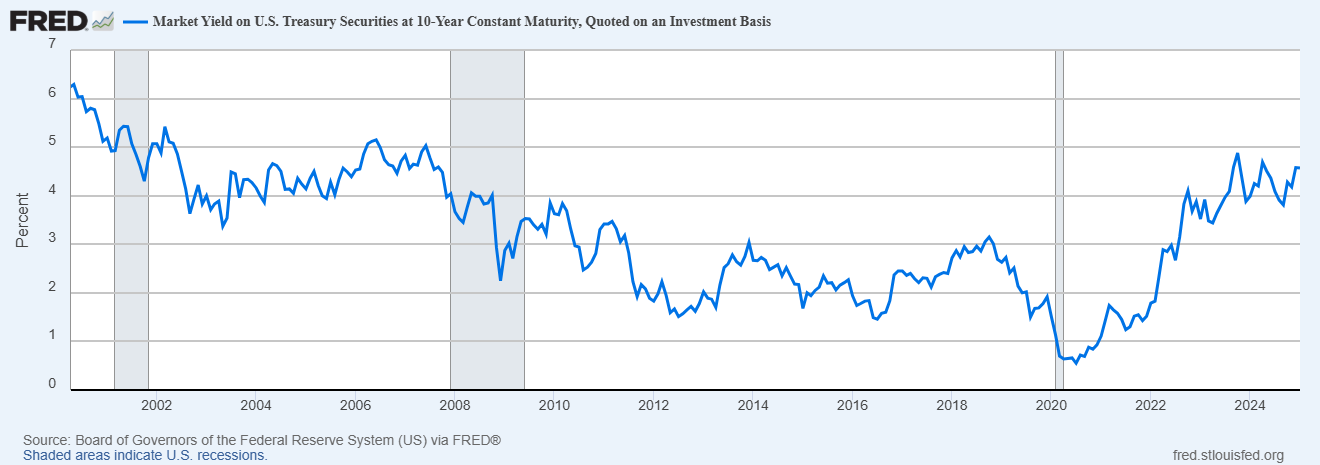
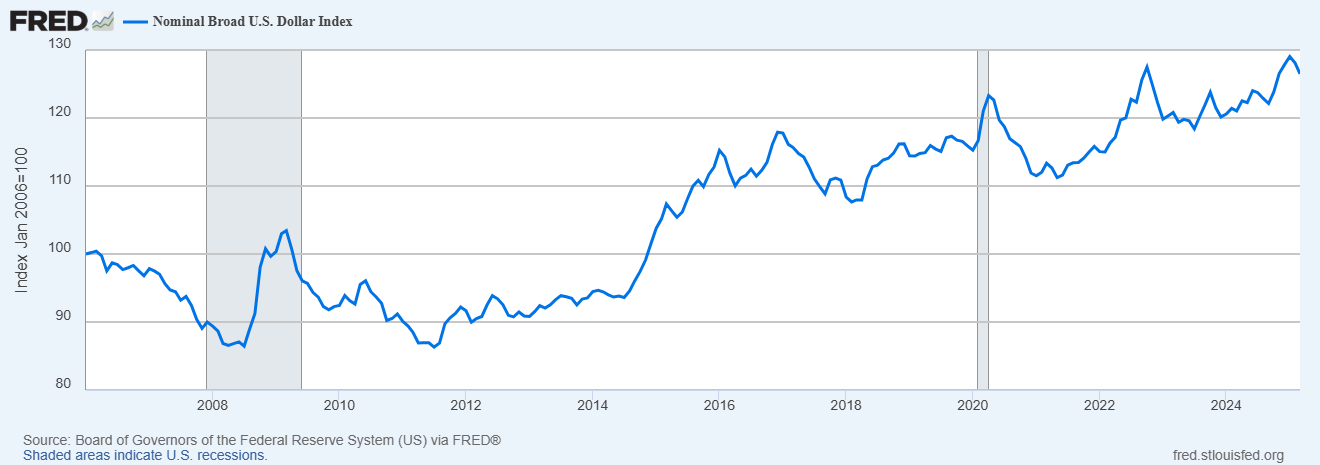
Such was the awesome power of America’s reputation for safety and stability that even an American economic crisis caused people to flee to the safety of U.S. government bonds.
That’s not happening this time, though. This time, investors are responding to a U.S. economic crisis by looking around for the exits. The most likely reason is that investors have begun to see U.S. government bonds as a risky asset instead of a safe one. And the obvious reason is Donald Trump’s economic policies. Bloomberg explains:
Billed on Wall Street as so rock-solid safe they’re risk-free, US Treasury bonds have long served as first port of call for investors during times of panic…But now, as President Donald Trump unleashes an all-out assault on global trade, their status as the world’s safe haven is increasingly coming into question…
[In recent days,] investors have often dumped 10- and 30-year Treasuries — pushing prices down and yields up — at the very same time they frantically sold stocks, crypto and other risky assets…They are trading, in other words, a little like a risky asset themselves. Or, as former Treasury Secretary Lawrence Summers says, like the debt of an emerging-market country…
Investor confidence in US bonds can no longer be taken for granted…Treasuries and the dollar get their strength from “the world’s perception of the competence of American fiscal and monetary management and the solidity of American political and financial institutions,” said Jim Grant, founder of Grant’s Interest Rate Observer, a widely followed financial newsletter. “Possibly, the world is reconsidering.”…“Treasuries are not behaving as a safe haven,” said ING rates strategist Padhraic Garvey…“The here and now is painting Treasuries as a tainted product, and that’s not comfortable territory.”
Investors are putting their money into countries that look safer and more stable — especially Europe, but also Japan and the UK. They’re also putting money into gold, which traditionally rises in value as an international currency in times of global financial anarchy. European investors appear to be the biggest sellers, but some of those are probably also Chinese investors (including the Chinese government) trading from European accounts.3
To be honest, I don’t blame the world for starting to think of the U.S. as a developing country. Trump’s “liberation day” tariffs are the kind of boneheaded unforced error that rich countries rarely make — the only recent analogues might be Brexit and the short-lived economic policies of Liz Truss in the UK, and even those honestly pale in comparison.
On top of that, the U.S. is embarking — indeed, it has already embarked — on an unsustainable borrowing binge:
Unsustainable deficits raise the possibility that a government will eventually try to get out of those debts not by fiscal austerity, but by intentional inflation (which erodes debt), or even by a sovereign default. Either of those actions, which are typical of developing countries, would hurt Treasury buyers, and so both encourage buyers to demand a risk premium.
On top of all of that, Trump has acted every bit like the typical quasi-authoritarian developing country pseudo-dictator — holding military parades in his own honor, arbitrarily disappearing innocent people to foreign torture dungeons, using government power to persecute his political enemies, engaging in unprecedented corruption, trying to overturn free and fair elections, and so on. And the U.S. has largely blown up its key alliance with Europe, pursuing a partnership with the gangster state of Russia instead. As Blackrock’s Larry Fink eloquently put it, “The United States, post WWII was a global stabilizer. We are [now] a global destabilizer.”
If foreigners think we’re an irresponsible, chaotic rogue state, perhaps it’s because we’ve begun to act like one.
But anyway, capital flight isn’t just a vote of no confidence. It has the potential to do massive damage to the U.S. economy, both in the short term and the long term.
Capital flight hurts the real economy
First of all, capital flight could cause — or at least exacerbate — a U.S. recession. Long-term Treasury rates also affect the rates that companies have to pay to borrow money. When companies find it harder to borrow, they won’t invest as much, meaning they won’t hire as many workers. That will hit the real economy and raise unemployment.
It’ll also raise the rates that homebuyers have to pay on their mortgages, which will discourage people from buying houses. This is already starting to happen:
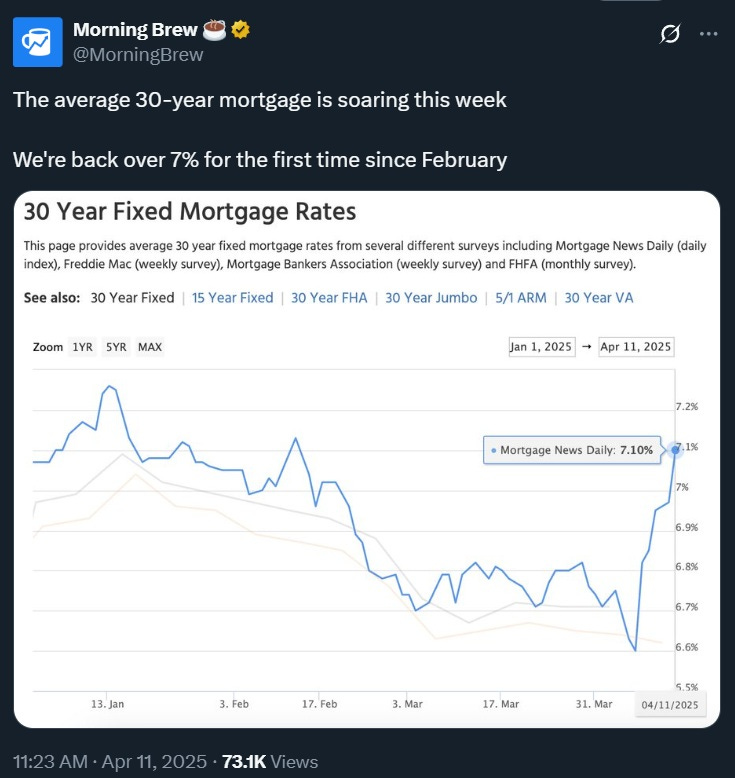
Traditionally, mortgage borrowing is a very important driver of the business cycle.
Consumer sentiment is plunging, with even Republicans looking much more pessimistic:
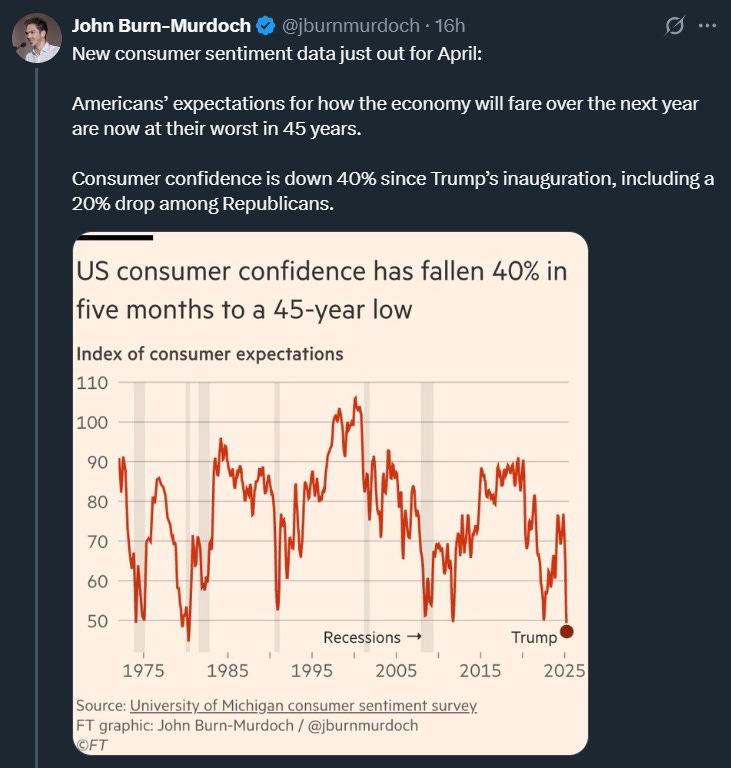
That’s probably mostly because of the tariffs; the threat of capital flight probably hasn’t even registered much yet. But that just means the impact of higher corporate borrowing costs and mortgage rates will come on top of the pain from the tariffs.
That’s just the short-term pain. In the long term, if capital flight continues, it will end the dollar’s status as the world’s reserve currency. Permanently reduced demand for Treasuries will raise borrowing costs for American companies and homebuyers not just today, but for many decades to come. This would include the end of our so-called “exorbitant privilege” — the lower borrowing costs that come from having the reserve currency — as well as from a new risk premium being added to the yield on Treasury bonds.
And because many banks — both in the U.S. and abroad — hold lots of Treasuries, a sudden drop in the price of U.S. government bonds4 could damage their balance sheets and cause them to pull back on lending to the real economy. We could be looking, in other words, at the end of the U.S.-centric global financial system that we’ve been living under all our lives. That would make it harder for the whole world to borrow money and conduct international trade, because there’s no ready replacement for the dollar — the yuan isn’t fully tradable, gold is in limited supply and has a volatile price, Bitcoin behaves like a risky tech stock, and the eurozone just isn’t as big or financially stable as America.
Ironically, as Neel Kashkari of the Minneapolis Fed points out, this could accomplish Trump’s goal of eliminating America’s trade deficit. If the dollar weakens, America will be able to afford fewer imports, and U.S. exports will be cheaper. But this is a bit of a monkey’s paw sort of situation — as I argued at length after “liberation day”, there are worse things in the world than trade deficits. If we balance our trade by making ourselves poorer, that’s not a good thing.
But the really big economic pain — the thing that collapses America’s economy entirely — could come from Trump’s response to capital flight.
Trump might respond by making things even worse
What will Trump do in response to capital flight? What he should do is resign. Failing that, what he should do is to drop all tariffs on all countries other than China, make a deal with China to reduce tariffs from the current incredibly high levels, and promise to follow economic policies similar to those of his first term — in addition to fiscal austerity. If he did all of that in short order, I suspect the Treasury market would calm down, capital flight would end, and things would go back to normal.
Instead, I suspect Trump will do something more like what he used to do as a businessman when his debt went bad — look for a cheap bailout, and if one doesn’t emerge, declare bankruptcy.
First, I think Trump will probably look for a cheap bailout. If foreigners are headed for the exits, there’s only one entity with the ability to bail out the U.S. government, and that’s the Fed. If the Fed printed a bunch of money5 and bought long-term Treasury bonds — that’s called “quantitative easing”, or QE — it would bring long-term interest rates back down and perhaps avert a short-term economic crisis. So Trump could try to exert pressure on the Fed to do this, perhaps replacing Fed Chair Jerome Powell with one of his lackeys when Powell’s term is up in 13 months.
But there’s one big problem with that strategy: inflation. Printing a ton of money to fund government deficits is probably what causes inflation to spiral out of control in developing countries. Japan got away with it, but only because A) it had lots of factors pushing it toward deflation, and B) it never had much capital flight. If Trump were to try printing money to replace fleeing capital, it would likely just cause even more capital to flee the country, requiring even more Fed money-printing to push yields back down. It’s hard to see how that wouldn’t result in spiraling inflation.
The other thing Trump could do is to declare bankruptcy — i.e., to have the U.S. default on its sovereign debt. He has already shown disturbing tendencies to think in this direction, claiming back in February that “fraud” meant that the U.S.’ debt was less than the official number. And then there’s the fact that Trump declared bankruptcy quite frequently back in his days as a businessman — it does seem to be his natural instinct.
Capital flight could make a sovereign default seem like a more attractive option — at least, to Trump and his apparatchiks. Capital flight causes higher Treasury yields, which raises borrowing costs for the government, increasing interest costs as a share of GDP. Those costs are already soaring, so further increases due to capital flight might cause Trump and his people to conclude that there’s no way the U.S. can ever pay down its debt.
But whether or not it would let Trump feel like he “solved” the debt problem, a sovereign default would be an absolute nightmare for regular Americans. A default makes a country immediately poorer, and then reduces growth in the long term:
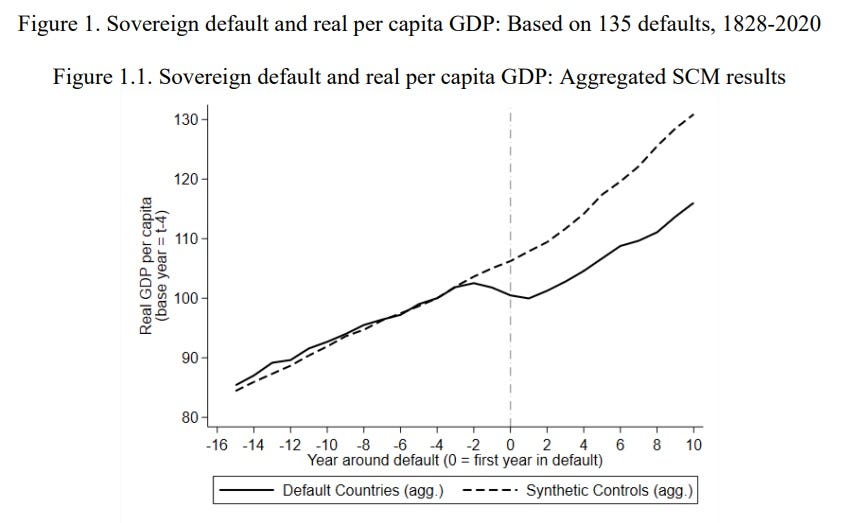
In fact, research by Kenny et al. suggests that “defaults initiated by external trade shocks and politics are especially punishing.” The average effect of default includes foreign bailouts by bigger, richer countries in the aftermath; no such bailout would be forthcoming for the U.S.
The true nightmare scenarios for capital flight, therefore, are 1) Trump-induced hyperinflation, and 2) Trump-induced sovereign default. These are the actual things that would collapse American prosperity, cause a calamity larger and longer-lasting than 2008, and possibly even knock America permanently out of the first rank of nations.
Recent experience has shown that while Trump sometimes pulls back in response to negative market signals, he doesn’t completely pull back, and he’s always planning his next boneheaded move. If the people of the world decide they’ve had enough of this joker, and pulls their money out of America, I worry that Trump will respond with even more destructive moves.
This happens because tariffs cause your demand for foreign goods to go down, meaning fewer people have to swap, say, dollars for euros. Demand for euros goes down and demand for dollars goes up, so the dollar gets more valuable against the euro. That’s how it usually goes.
“Yields go up” is the same as saying “interest rates go up”. It’s also the same as saying “bond prices are going down”, because bond prices and yields move in opposite directions. Suppose you have a bond that pays $1000 in 5 years. If the price of the bond falls today, that means it will climb more in order to reach its terminal price of $1000 in 5 years. That price appreciation is part of the yield. The other part is the coupon rate — the amount that the bond pays to its holders in interest every month.
It’s also possible that China’s anger at the U.S. over tariffs is causing it to dump the dollar in retaliation — a possibility long feared as a consequence of a trade war. The notion that China depends on America for demand for its products and America depends on China for demand for its bonds was sometimes called the “balance of financial terror”. China might be retaliating for Trump’s rejection of Chinese goods by rejecting American bonds.
Remember that when yields go up, bond prices go down, and vice versa.
Yes, I know it doesn’t actually physically print the money.