
As it happens, I’m sitting in Japan right now, talking to my Canadian friend Tim about American politics. We’re talking about how a Republican President who just won a slim but solid electoral victory is using his questionable mandate to do insane foreign policy stuff and revoke Americans’ civil liberties, who might also use it to gut Social Security, and whose policies might eventually end up tanking the U.S. economy.
Twenty years ago, I was doing the exact same thing. That time, the Republican President that Tim and I were discussing was George W. Bush. Two years after that conversation, Democrats had stymied Bush’s attempt to privatize Social Security and taken back control of Congress. Four years later, a Democrat had won the Presidency, and proceeded to end the Iraq War, put the economy back on a more-or-less solid footing, and partially restore America’s damaged international reputation.
How did the Democrats pull that off? Part of it was simply that Bush screwed up so badly, on so many fronts, that Americans eventually got fed up with his whole brand. But part of it was that Democrats knew how to take advantage of the opportunities that Bush’s failures offered them. They stood up for 20th century liberalism — for the stabilizing foreign policy of the pre-2001 period, civil liberties, the New Deal social insurance system, and the fundamentally capitalist U.S. economy.
They did not respond to the madness of the Bush era by unleashing madness of their own. It was a center-left, New Deal liberal resistance, and it succeeded wildly.
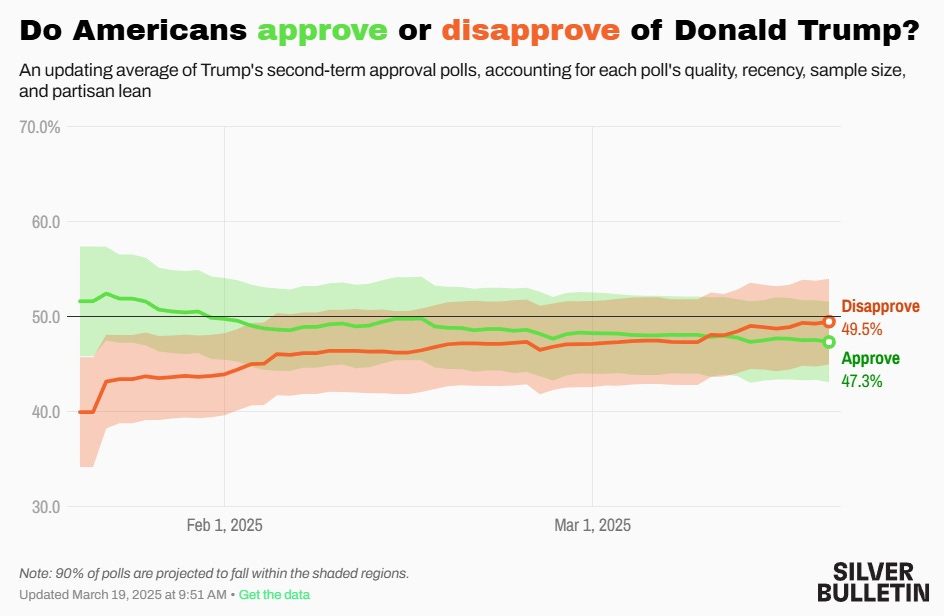
Right now, Democrats are having a big internal debate on how to resist Donald Trump. Already, Trump’s approval ratings are starting to sour, as Americans see the economic devastation wrought by his tariffs:
The economy is probably the main driver of this swing. But Americans are also souring on Trump’s foreign policy of bullying Ukraine and cozying up to Russia:
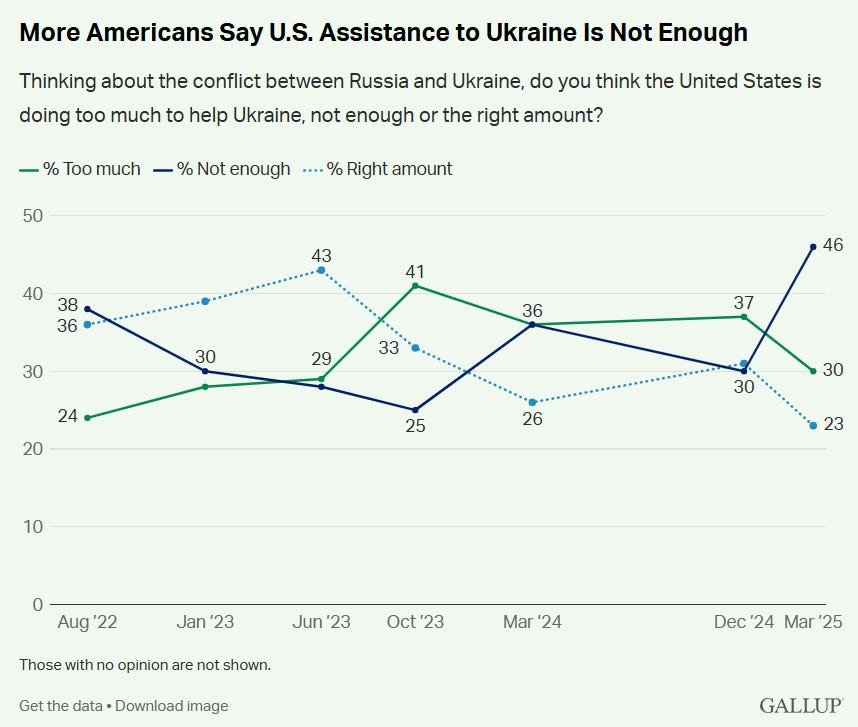
It’s tragic that America had to actually elect Trump in order to realize the dangers of his isolationist ideology. But the realization could give Democrats the opportunity to fight back, as they did successfully against Bush.
There’s just one big problem with that. Unlike two decades ago, the Democrats’ brand has been severely tarnished. A recent CNN poll found that the Democrats’ favorability has fallen to 29% among the American public. In a recent Michigan focus group, most Trump voters felt some buyer’s remorse, but only one out of 13 said they wish they could go back and switch their vote to Harris. People are rapidly souring on Trump, but Democrats so far seem incapable of capitalizing.
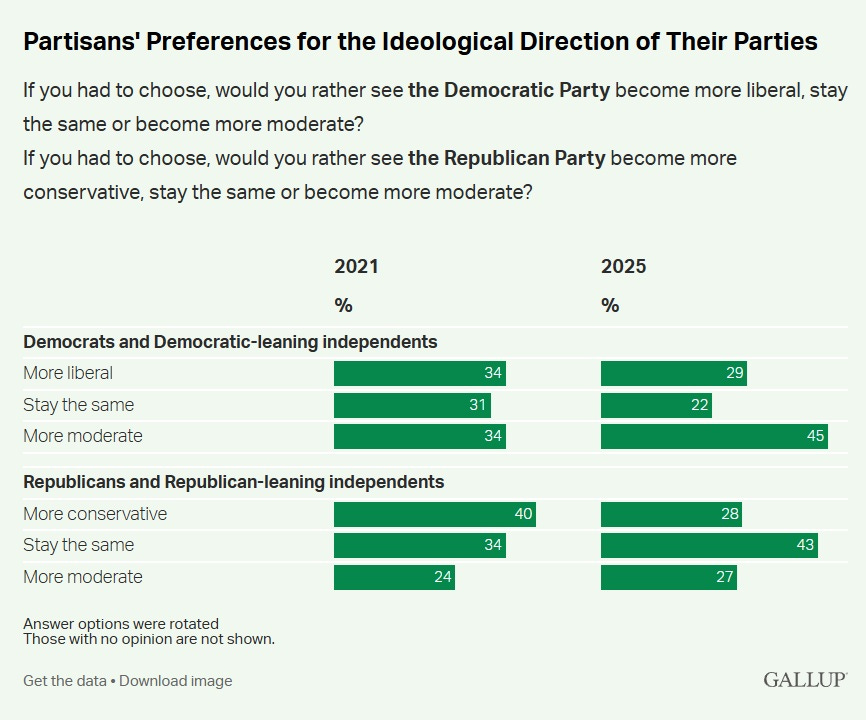
Even more frustratingly, there seem to be two different reasons people are mad at Democrats. On one hand, people seem to want the Dems to be more moderate:
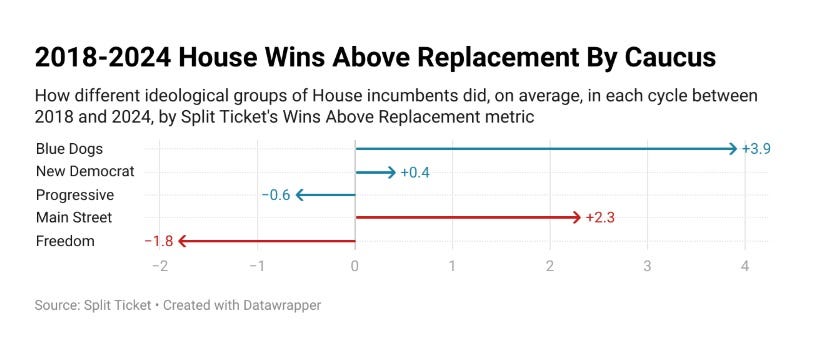
And moderate Democrats have been winning elections more easily, including in 2024:
On the other hand, people clearly want the Democrats to stand up to Trump and fight harder to stop him from doing whatever he’s doing:
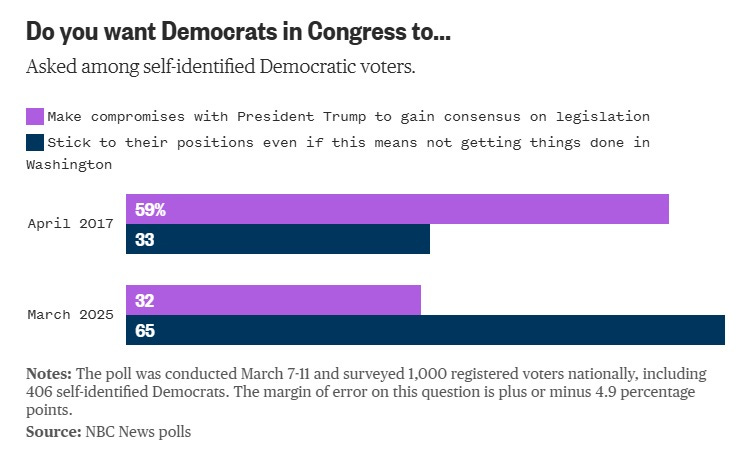
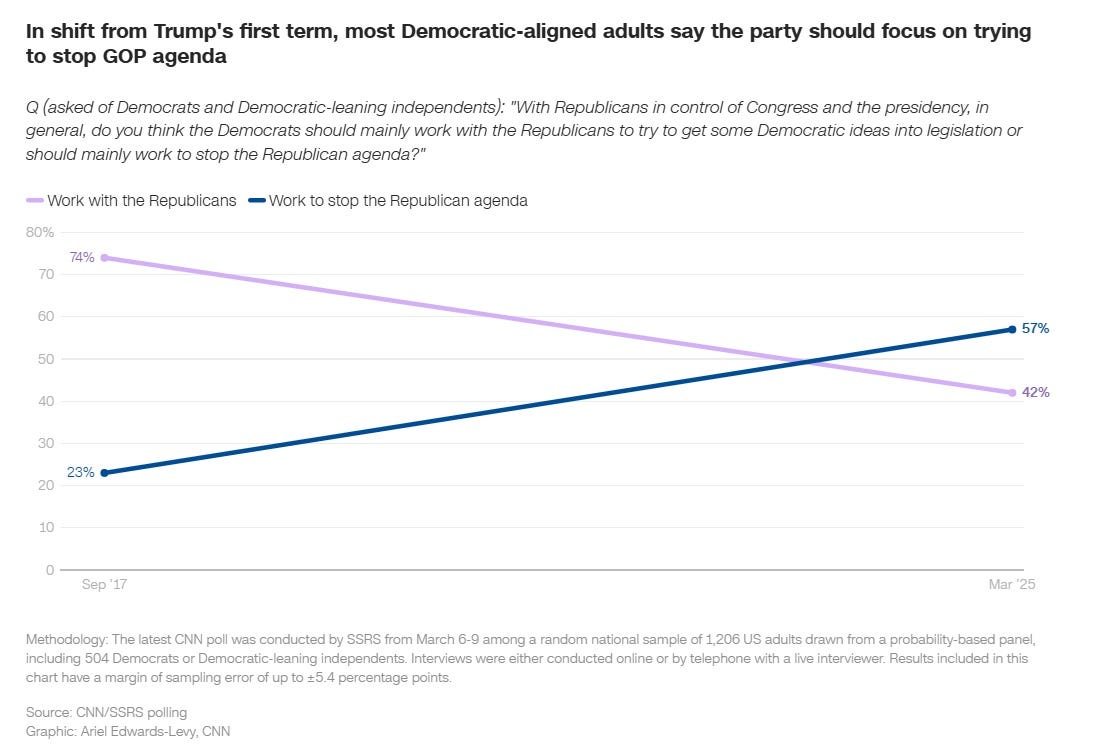
In fact, these two desires — for Dems to move to the center and for Dems to fight harder against Trump — seem to coexist right alongside each other. Patrick Ruffini has called this “combative centrism”:
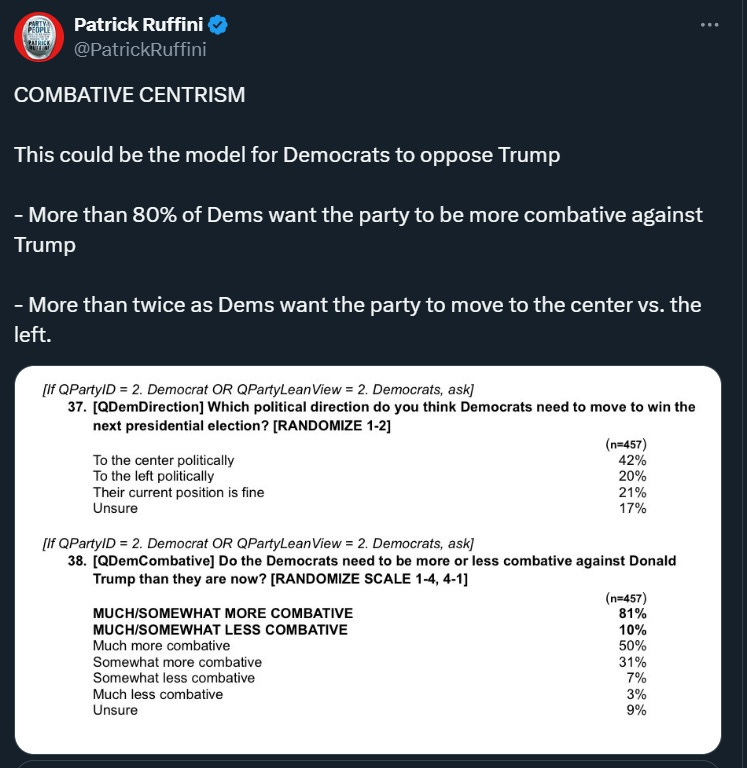
To many progressives, this must seem like a contradiction. To fight Trump harder, in their minds, means to stand up more strongly for progressive causes — trans rights, DEI, depolicing, and a more permissive attitude toward asylum-seekers. To compromise on those ideas, by definition, would be to accommodate or compromise with Trump…right?
The flaw in this thinking is that the issues most Americans care most about — the things they want Democrats to fight Trump hardest on — are not necessarily the same things progressive activists care about. The axes of “moderate vs. progressive” and “fight vs. compromise” simply don’t line up.
What kind of things do most Americans want Democrats to fight Trump harder on? One obvious one is the economy. In a recent interview with Eric Levitz — which, by the way, I recommend reading in full — political data scientist David Shor showed a chart from a poll taken in February, about which issues voters trusted Democrats on vs. Republicans:
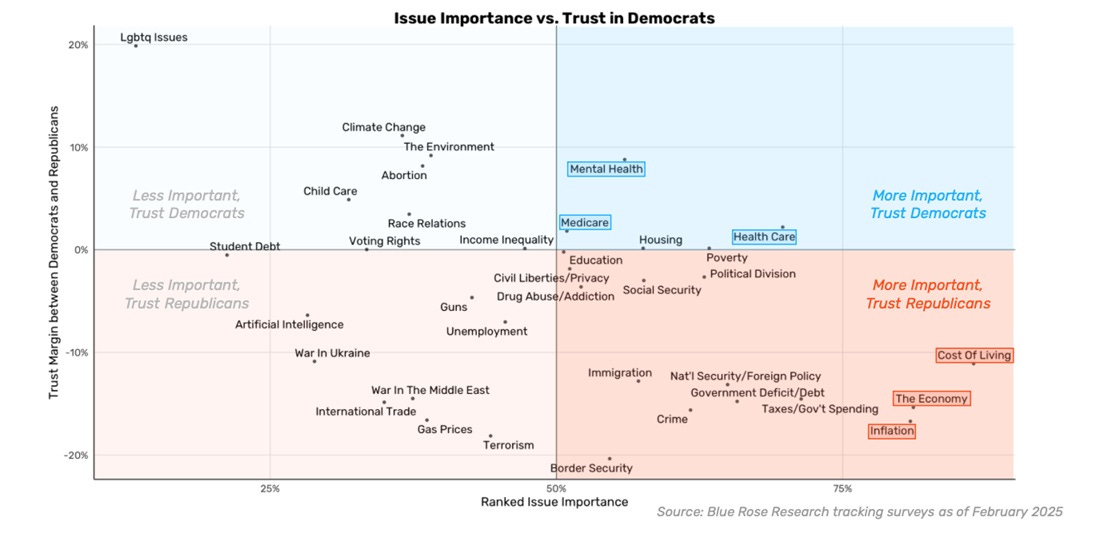
Note that the issues that voters say are most important to them, and the issues they trust the Republicans more on, are the same issues: the economy, cost of living, and inflation. Voters really care a lot about economic issues, especially related to living costs, and until recently they believed that Trump and the GOP would serve them better on that front. In another recent interview with Ezra Klein (which I also recommend reading in full), Shor shows that economic concerns basically trump everything else for voters:
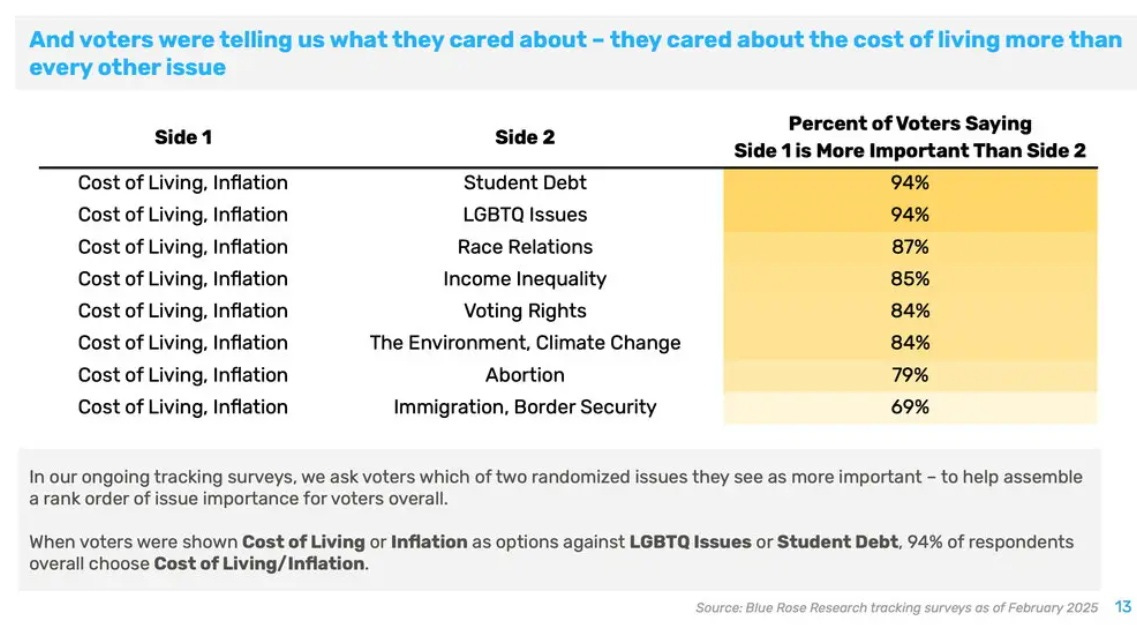
Trump’s approval began to turn downward when he started willfully smashing the U.S. economy with tariffs. Those tariffs threaten to raise the cost of living even more, while also hurting the economy and the job market. It makes sense that voters would want Democrats to fight back against that economic arson.
There are also a bunch of other issues that might not have figured as strongly back in February, but could be very important if current trends don’t reverse. These include Trump’s defiance of the judiciary and due process, DOGE’s destruction of state capacity, and Elon Musk’s attacks on Social Security. It makes sense that people would want Dems to fight to prevent the President from acting like a dictator, preserve entitlements, and restore the basic functioning of the state.
OK, so what issues do voters want Democrats to moderate on? In two words, the answer is “cultural issues”. I strongly agree with this tweet:
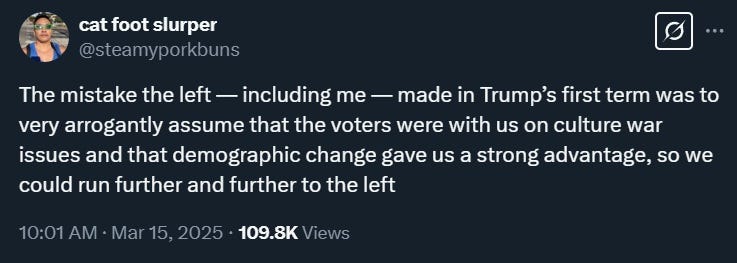
As for which cultural issues Dems need to moderate on, I see four possible answers here:
Policing and crime
Immigration and border security
DEI and race
Trans issues
First, policing and crime. Shor’s chart shows that this is a fairly important issue on which voters trust the GOP more. In fact, most Dems moderated on this issue very quickly after 2020; Biden boosted funding for police by hundreds of millions of dollars, and tried to do even more through the legislative process, while most blue cities elected leaders who promised to be tough on crime. This was all good, and probably contributed to the big drop in crime in Biden’s term.
But it wasn’t enough. The long shadow of 2020, when prominent Democrats like Kamala Harris and Alexandria Ocasio-Cortez gave their full-throated support to the “defund the police” movement, continues to hang over the Democratic party. Democrats essentially squandered the tough-on-crime reputation that they had built up over the 1990s and 2000s.
In order to restore that reputation, Dems need to be consistently vocal about the crucial importance of police in the nationwide fight against crime. And having prominent Democrats claim that police aren’t the way to fight crime, and that welfare state expansions can do just as good a job, is distinctly unhelpful.
Now on to immigration and border security. This was probably America’s second-most-important issue in 2024 (after the cost of living), and it’s still an issue where Trump gets high marks from the public:
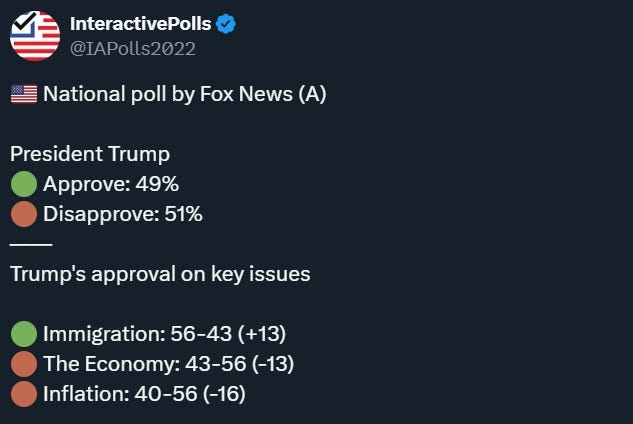
It makes sense that Trump should get Americans’ approval on immigration. Americans like immigration and immigrants, but they really don’t like would-be migrants flouting their laws by entering illegally to request asylum. Since Trump took office, illegal border crossings have plummeted to the lowest levels of the 21st century. Even though Trump has betrayed Americans on the economy, he has delivered at least one thing they actually want: fewer asylum-seekers penetrating the border.
Democrats seem perfectly capable of moderating on immigration; in fact, they already did it in 2024. Biden implemented many Trump-like restrictions on asylum-seeking that he had previously scorned, and the Democrats lashed out at Republicans for blocking a tough border bill. Some progressive activists still believe that migration is a human right, but these appear to a smallish minority. So on immigration, Dems probably just need to continue what they were doing in 2024.
On DEI stuff, I see only mixed evidence that Americans as a whole think the Dems are too extreme. But what’s much more certain is that the pro-DEI rhetoric and actions of the Biden administration ultimately didn’t help win over minority voters. 2024 was no white backlash — instead, white voters voted about the same between 2016 and 2024, while it was minority voters who (partially) abandoned the Dems:
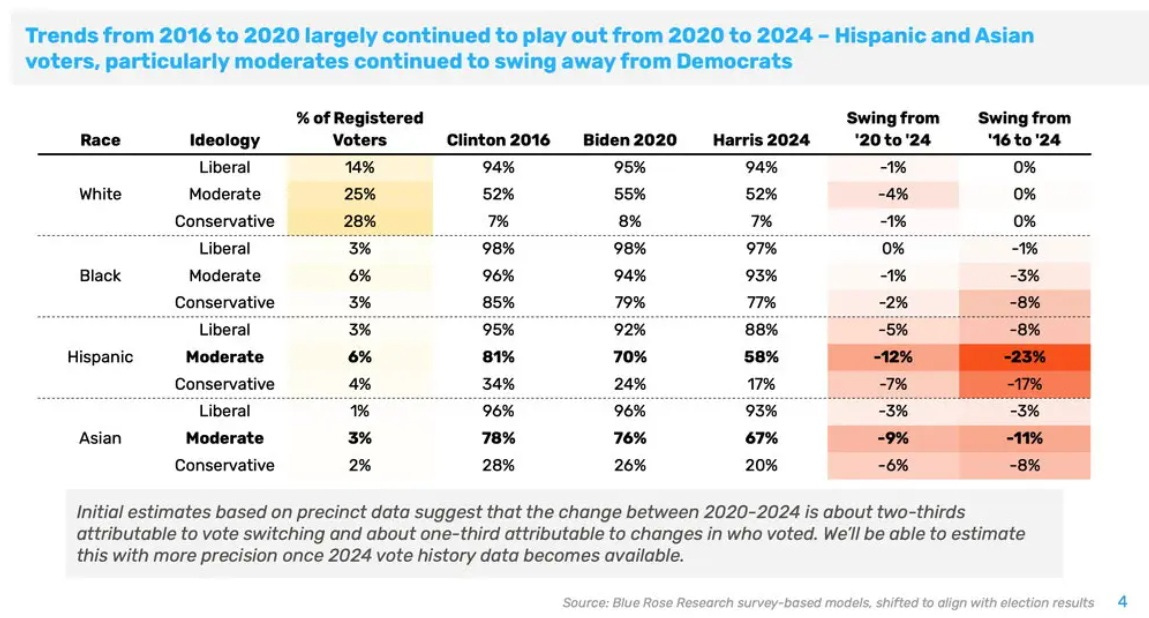
Identity politics — including government promotion of DEI initiatives and programs, and including the whole progressive cultural shift toward an Ibram Kendi-style version of discriminatory “antiracism” as the best medicine for racism — just isn’t winning black or Hispanic votes. It’s time to scratch that approach and try something else. In fact, I’m pretty optimistic that Dems will be able to do that, given the rapid success of the pushbacks against DEI programs and mandatory DEI statements, which began well before Trump was elected.
Trans issues, I think, will be the big sticking point. On one hand, it’s the cultural issue where Americans seem to most strongly oppose the progressive agenda. On most policy questions, Americans are unfavorable toward the positions favored by trans activists. And on essentially all of these questions, they have become even more opposed to the activist position over the last few years:
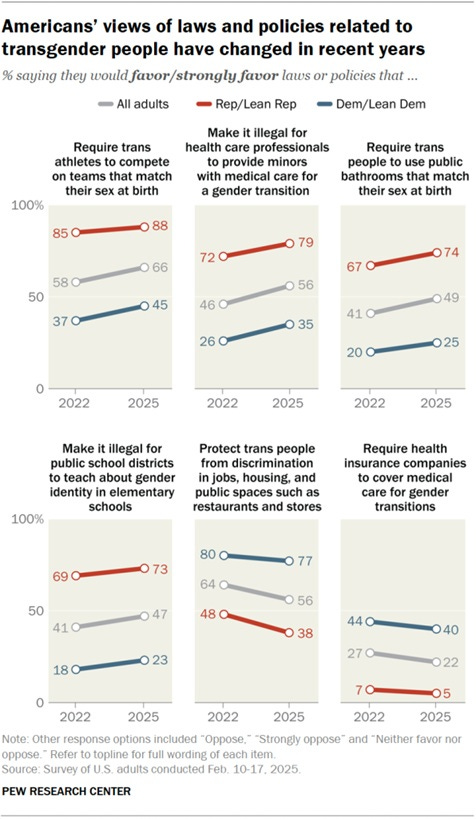
On some polls, the percent of Americans who oppose trans athletes in women’s sports is much higher even than this.
But on the other hand, most progressives have come to see the trans movement as a civil rights movement — a struggle for equal rights for a marginalized group. Civil rights movements are fundamentally not about what’s popular, but about what’s morally right. No one wants to be the modern equivalent of the “white moderate” that Martin Luther King, Jr. excoriated in his “Letter from a Birmingham Jail”.
This means that although it might seem like trans issues are small potatoes compared to things like DEI and policing, they’re actually a much harder nut to crack. No one thinks anarchy in the streets and mandatory diversity statements are fundamental civil rights — they’re just policy ideas that some progressive activists thought would help black people. As soon as it became apparent that black people wanted more cops on the street and diversity trainings don’t help black workers get ahead, it became possible to ditch those ideas while still remaining fully committed to the goal of helping black people in the U.S.
Trans issues are different, because they involve questions of fundamental rights. Does a kid with a penis really have the right to change in a girl’s locker room, just by identifying as a woman? Does a 12-year-old really have the right to decide whether to take puberty blockers without parental consent? And so on. The nation, so far, says “no”, while activists say “yes”. And there’s no law of the Universe saying that those two positions will ever converge.
So I predict that while trans issues might not seem to affect nearly as many people as other cultural issues, and while they don’t particularly seem like matters of life and death, they will continue dividing the Democratic party for many years.
But in any case, it’s clear that fighting hard against Trump means very different things to progressive activists than it does to the general public. For progressives, cultural issues are the thing to fight for in America, and to moderate on these would mean surrender:
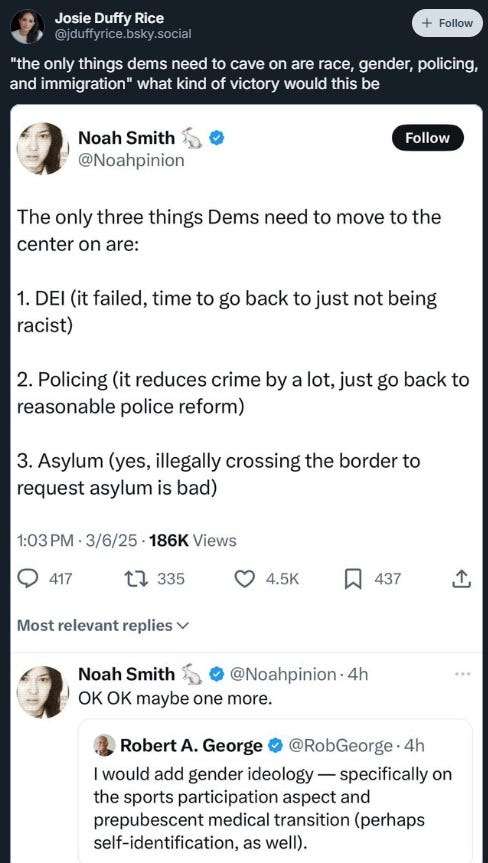
But for most voters, there are a lot more important things to fight for than depolicing, DEI statements, or permissive asylum policy. Trump isn’t just threatening the vision of social progress that many on the left entertained in the 2010s; he’s threatening the very civil liberties, national security, and prosperity that make progress possible.
“Combative centrism” is more than a political tactic; it’s based on deeply rooted values. It’s the idea that the fundamental tenets of 20th century liberalism — free speech, due process of law, democracy, and so on — are good and valuable things worth defending from regimes like Donald Trump’s. That was the strong platform that allowed the Democrats to plant their feet and topple Bushism in the 2000s; it is just as strong of a platform today.