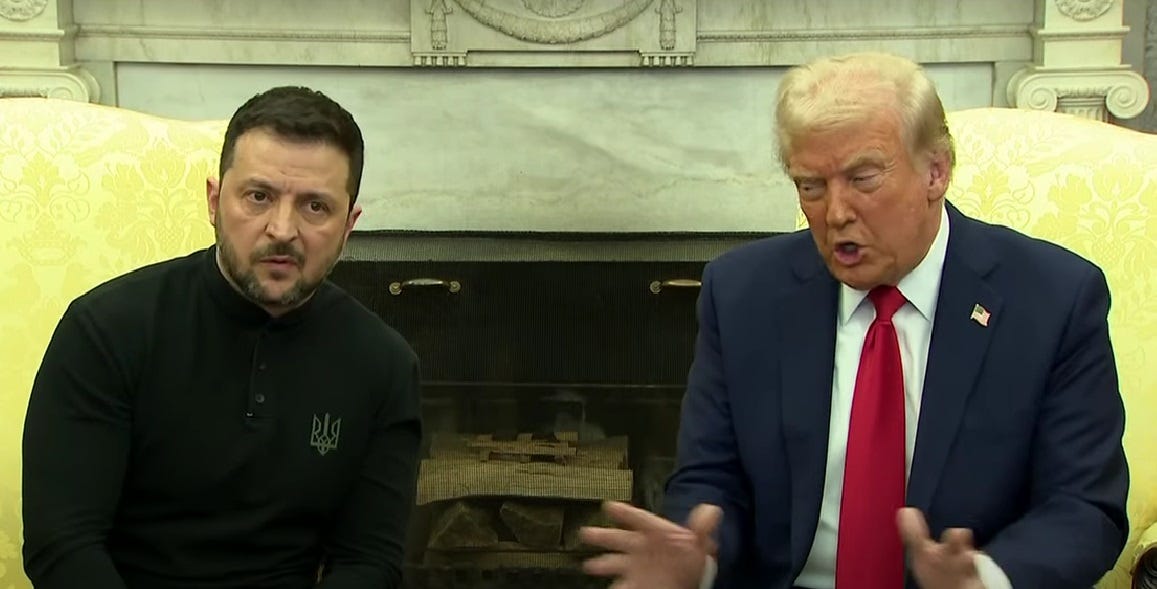
Over the past two days, almost everyone I know has been talking about Trump’s disastrous meeting with Ukraine’s President Volodymyr Zelensky in the Oval Office. Almost everyone I’ve talked to about it is a conservative or a centrist. Absolutely no one thought the meeting went well. A couple of people said that Zelensky should have been less combative and more obsequious; no one praised Trump’s or JD Vance’s actions. Everyone is uneasy. Some are downright scared.
The MAGA apparatchiks are out in full force on social media, bellowing “America First!!”, praising Trump for what they think was a show of strength, and denouncing Zelensky at maximum volume. Republicans whom Trump has cowed into submission admitted the meeting was a disaster, but blamed the Ukrainian leader for failing to show Trump proper respect. But deep down, everyone who isn’t fully in the tank for Trump knows that this was a dark moment in American history.
Anyway, I encourage you to watch the whole meeting, if you have time. If you don’t have time, just watch the most important segment at the end, starting at around 43:00 in this video:
I’m not sure if there has ever been an event like this; I certainly have never seen one. The ostensible purpose of the meeting was for Zelensky to sign a deal in which Ukraine offers mineral rights in exchange for U.S. aid. But as the meeting goes on, it devolves into Trump and Vance aggressively berating Zelensky for what they claim is his failure to show proper respect and gratitude for U.S. aid. I’m sure that heads of state shout at each other and insult each other all the time behind closed doors, but I’ve never seen it done openly like this, in front of camera crews.
Immediately after this astonishing encounter, Trump announced that U.S. aid to Ukraine may now be halted completely.
Basically, I think there are three things we should take away from this disastrous event:
It’s now clear that the U.S. has chosen a set of leaders who are deeply immoral, and who cannot be expected to obey any norms of common decency.
U.S. foreign policy has changed dramatically from what it was from 1945 to 2024; the U.S. is now effectively a gangster state. It’s not clear whether this can ever durably revert back to the way it was.
Trump’s meeting with Zelensky also emphasizes how clumsy his administration is, and how they’ve already started making mistakes.
America is now being led by its least moral individuals
I’m going to talk about the geopolitical and domestic political implications of Trump’s Zelensky meeting in a bit, but first I want to place Trump and Vance’s contempt for Ukraine in the context of something else that’s been bothering me more and more recently — a general collapse of America’s public morality.
The world is not made up of heroes and villains, like in Star Wars or a Marvel movie. Instead, like the Game of Thrones universe or a dark edgy comic book, the world is made up of antiheroes and villains. The kindest person you ever meet will have some moments of cruelty in their life; even the most upright and honest bend the rules once in a while; even people fighting for noble causes will have times when they’re selfish, arrogant, and greedy.
And yet even so, there are enormous moral differences between individual human beings. There are people for whom greed, selfishness, and cruelty are not occasional lapses, but a way of life. There are true villains in this world. Everyone knows this on some level, and we’ve organized large parts of our societies around trying to police the true villains and keep them from attaining power. But society is always at a disadvantage, because villains work around the clock; people who crave power and dominance spend all of their waking hours trying to get it, while normal, flawed people can only spend part of their time policing them.
If normal people were heroes, it would be easier to keep villains out of power. But normal people are antiheroes — they will kowtow to power when sufficiently threatened, they will take a bribe if it’s sufficiently large. Every man has his price, and the villains have deep pockets.
And the villains have a lot of practice using normal people’s flaws to divide them. When society is politically divided, power-hungry people exploit those divisions to rise to the top — we tell ourselves “He may be a bad guy, but he’s a bad guy on my side.” At least Hitler will fight the communists; at least Stalin will keep the capitalists at bay.
And like a movie antagonist who says “We’re not so different, you and I,” real villains are always screaming at the top of their lungs about the tiniest flaw in the moral character of their opponents. If Star Wars were real, the galactic internet would be flooded with screeching tirades about Han Solo’s criminal past, how Princess Leia got her position through nepotism, or how Luke Skywalker once made out with his sister.
Americans who pay attention to the news — conservatives and liberals alike — are slowly starting to realize that the people we’ve put in charge of our country are among our morally worst.
The Trump administration was probably responsible for allowing Andrew Tate and his brother Tristan, two online influencers who are being prosecuted for human trafficking in Romania, to leave that country and stay in the U.S. (Tate has also been accused of multiple rapes and assaults in the UK). Here is a video where Andrew Tate describes beating up women. Some quotes from the video:
“Here’s a little move. When I’ve got you by the neck and you start annoying me, trying to resist, and I just BOOM! And then I grab you by your neck again. Then what the fuck you gonna do, when your face is collapsed, and your fucking cheekbones broken, you ain’t gonna do shit but cry!”…
“I don’t even have to fuck you. Forget the sex part, that’s a distraction. My dick can stay in my pants, I’ll just start beatin’ the shit out of you, how about that, we walk in the bedroom, I start kicking your ass…Bet you cry then!”
And so on. This man has been lionized by MAGA media, including Tucker Carlson, Donald Trump Jr., and Benny Johnson. Elon Musk has endorsed Tate for prime minister of the UK.
If this shocks or surprises you, it really shouldn’t. It has been almost a decade now since everyone heard a tape of Trump talking about grabbing women “by the pussy”. Trump’s first nominee for Attorney General, Matt Gaetz, had to withdraw because of allegations that (among other things) he had sex with a 17-year-old; he was once investigated for human trafficking. Many other Trump nominees have been accused of sexual assault, sexual harassment, and so on.
Nor is sexual misconduct the only sort of immorality the MAGA movement has defended. There’s also financial fraud and corruption. Trump just halted the fraud prosecution of Chinese crypto magnate Justin Sun, who bought a bunch of Trump’s memecoins, thus pushing up their price and adding enormously to Trump’s personal fortune (something I warned about in a post a month ago).
This doesn’t mean I think America’s past leaders were paragons of virtue. Many had skeletons in their closet. Bill Clinton and Joe Biden both had rape allegations against them! But what seems to be different in the old days is that the American people cared more. Clinton lost massive amounts of popularity in the 1990s for having an affair with his intern. Even the KKK lost much of its membership in the 1920s when prominent Klan leader D.C. Stephenson raped and murdered a girl.
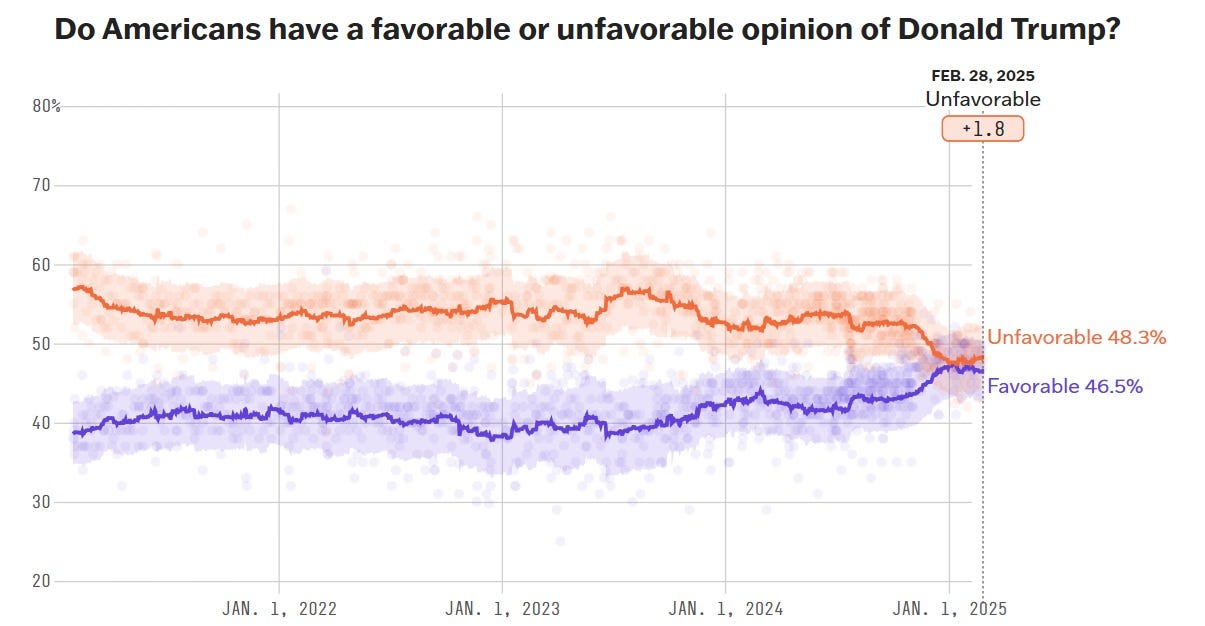
Nowadays, it seems like nothing Trump or his allies do can move the needle on public opinion. Ron DeSantis spoke out against Andrew Tate, and Matt Gaetz was forced to drop his bid for Attorney General, but Trump’s popularity is still near its all-time high:
A lot of this is just that it’s hard to extract the signal from the partisan noise these days. Both sides scream “scandal!!” at the top of their lungs on social media day in and day out. Yes, some scandals are real while some are made up. But it’s often hard for regular people to tell which is which. Should you care about Hunter Biden’s laptop or Benghazi more than Trump’s Russia connections and rape accusations? In the old gatekept media world of the 1970s or 1980s, broadcast TV stations and big newspapers would sort through the piles of accusations and tell a trusting public which ones were worth getting mad about; now it’s just a constant free-for-all of competing accusations.
I think a large part of America’s public moral collapse is that we’ve simply become numb to scandal.
Still, the video of Trump and Vance berating Zelensky is obviously not fake. You don’t have to believe in any conspiracy in order to see America’s leaders bullying a man whose country is in desperate danger of conquest and brutalization. You don’t have to decide which TikTok influencers to trust in order to see America turning away from a country that was invaded and turning toward the invader. You can see the arrogant, petulant tone of America’s President and Vice President — their bullying, crude demands for mineral wealth, their insistence that anyone who wants their help grovel before them and kiss the ring. You can see JD Vance shouting in Zelensky’s face, accusing him of not saying “Thank you” (even though Zelensky has thanked the U.S. many, many times). You know that invading other countries is wrong, and you know what bullies look like.
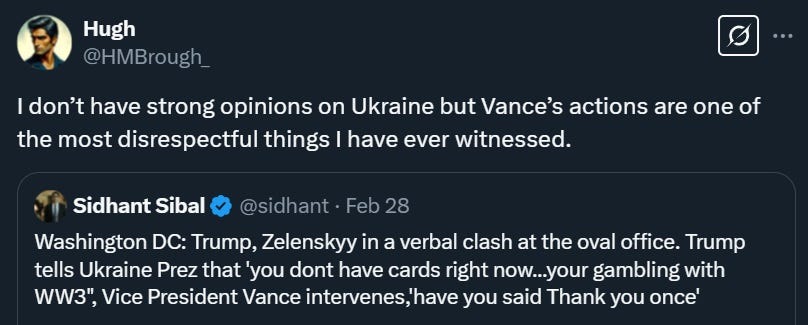
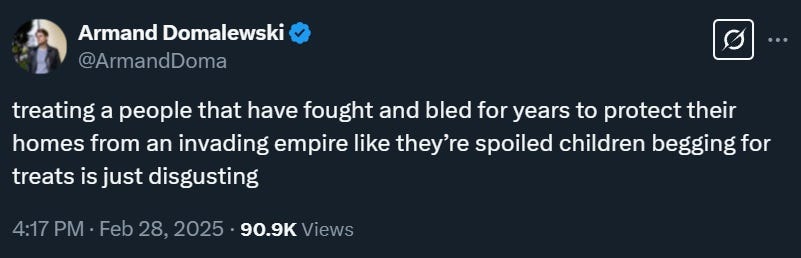
Even though the constant noise of partisan scandal accusations, that moral clarity shone through for many observers. Here is just a small sampling from X:
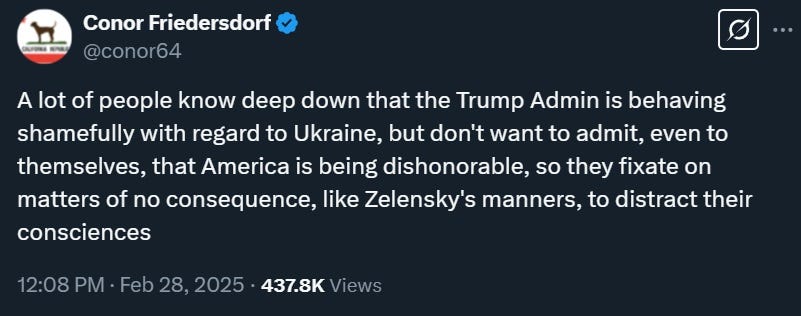
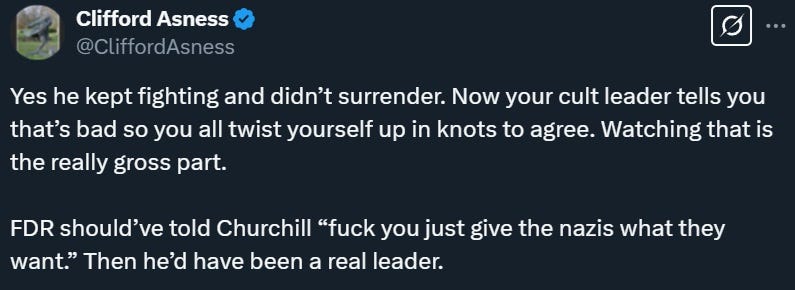
In fact, there are a few small signs that the galloping immorality of the Trump movement is finally beginning to anger some conservatives, and even a few MAGA types. Here’s Dave Portnoy, founder of Barstool Sports:
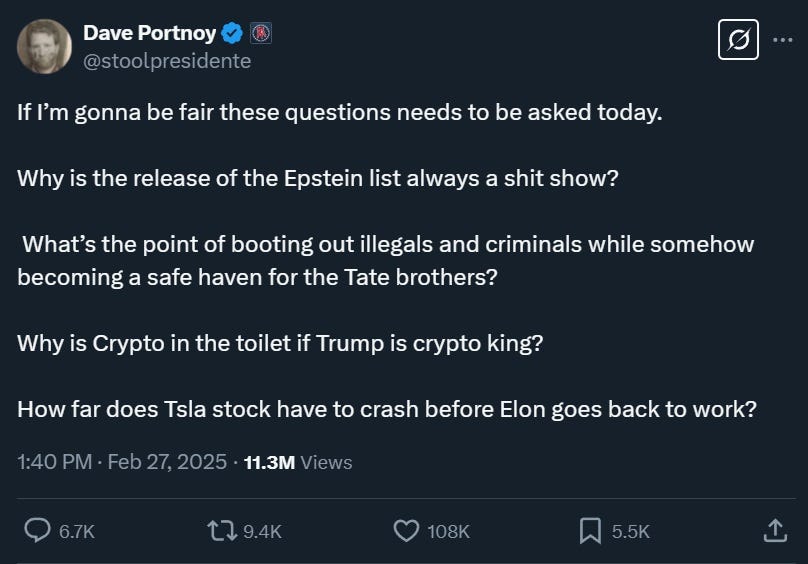
Now, for the record, I don’t think these small rumblings of dissent will mushroom into a general conservative rejection of the MAGA movement, or of Trump himself, on moralistic grounds. That’s totally unrealistic in the days of hyper-polarized negative partisanship. Most of the Trump supporters who will be made uneasy by all this obvious immorality will conclude that despite it all, we need Trump to root out wokeness and stop the invasion through our southern border, and so on. “Yes, he’s a scoundrel, but he fights our enemies”, and so on. And come on, isn’t Hunter Biden just as bad, and Zelensky should have worn a suit, and yada yada. No force in American politics is as powerful as the imperative to stick with one’s partisan team.
But for a few people, I suspect this will be the straw that finally breaks their willingness to tolerate infinite moral outrage from the Trump administration. Public morality has diminished and shriveled in America, but it has not yet completely died. Perhaps over time, if and when Trump keeps this up, that number will grow.
And regardless of how many people will realize it, the increasingly obvious fact is that America is now ruled by some of its least moral individuals. In addition to being repugnant, that should be a source of worry. Norms provide a guardrail on policy — leaders often shy away from doing extremist things like throwing critics in prison, cracking down violently on protests, or interfering with elections because of norms. When you know your leaders are people who don’t have those guardrails, the risk that you’ll end up with a destructive, extremist policy are simply higher.
That’s where America is right now.
U.S. foreign policy is now focused on extraction and bullying
The second big lesson of Trump’s Zelensky meeting is that America’s foreign policy has irrevocably shifted. The U.S. is out of the business of defending the free world, defending the inviolability of national borders, and defending democracy.
First and foremost, we now know beyond a shadow of a doubt that America’s current leaders are trying to realign their country to be friends with Russia. The Trump administration wouldn’t let Reuters or the Associated Press cover the Zelensky meeting, but they did admit a journalist from TASS, the Russian news service. The U.S. also voted against a recent UN resolution condemning the Russian invasion of Ukraine, siding with Russia and a handful of autocracies. And last week Defense Secretary Hegseth ordered U.S. Cyber Command to cease all anti-Russia planning.
Note that all of these things happened before Trump’s meeting with Zelensky. It’s thus very likely that Trump’s people had already made up their minds about shifting American policy in a pro-Russia direction, and that what happened in the Oval Office was not actually a decisive moment.
Why exactly America is deciding to flip its allegiances and side with Russia instead of with the democracies of Europe is an open question. In a post last week I offered two theories:
The U.S. might want to form an “alliance of autocracies” with Russia and China to jointly combat global woke ideology, limiting the U.S.’ sphere of influence to North America as part of the bargain.
The U.S. might be trying to pull a “Reverse Kissinger” maneuver, in which Russia goes from a Chinese ally to a position of neutrality between the U.S. and China in the coming contest over Asia.
I don’t think the Zelensky meeting tells us much about which of these theories is true. And there are alternative possibilities as well — Trump and his people might simply instinctively side with Russian values over European ones. But in any case, I think it’s now incontrovertible that the Trump administration wants very badly to make friends with Russia — or at least to move it to a position of neutrality.
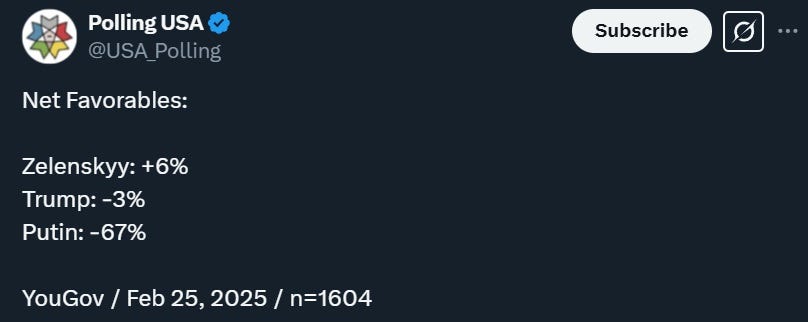
Whether that will work is an open question. But the American people definitely recognize that Russia is the villain in the saga of the Ukraine war. Even though Zelensky’s popularity plunged among MAGA types after Trump denounced him, Americans are still very strongly opposed to Vladimir Putin:
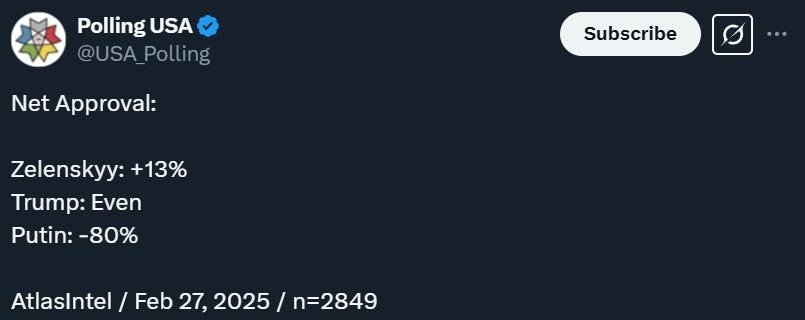
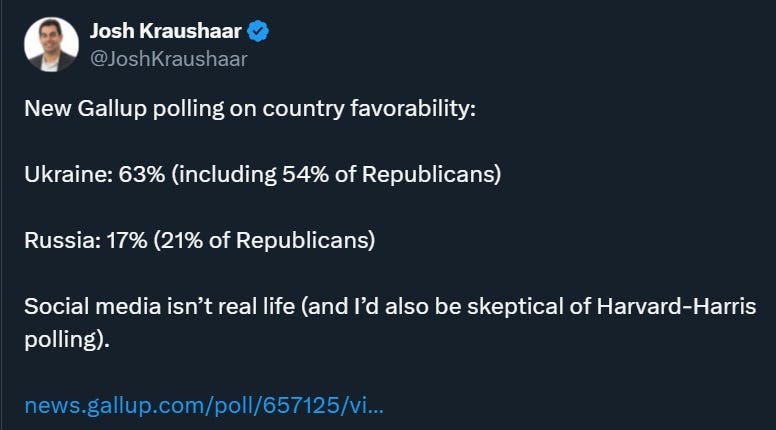
So I suspect that when a lot of people see Russia’s leaders praising Trump and Vance, they’ll have a negative reaction:
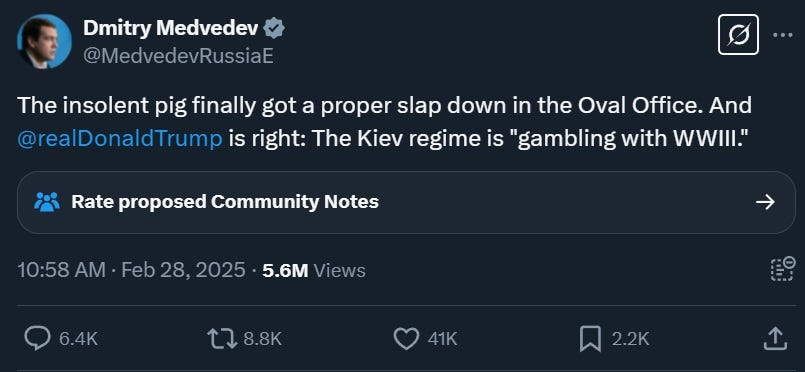
Trump & co. will have an uphill battle to fight in order to get America to think of Russia as their friend. Stranger things have happened, of course — when we allied with Stalin in WW2, we temporarily rebranded him as the friendly “Uncle Joe”. Partisanship is the most powerful force in American politics, and if Trump tells Republicans Putin is their friend, most will believe it. But some won’t, and Independents are probably not going to be happy either.
But Trump’s treatment of Zelensky, and his tolerance of Putin’s invasion, also illustrate a deeper and more important shift. America’s foreign policy is now fundamentally extractive, focused on forcing weaker countries into making economic concessions. Trump’s insistence that Ukraine surrender mineral rights to the U.S. in exchange for aid was the traditional action of a Great Power extracting value from a client state — the same type of thing the USSR did to the Warsaw Pact nations during the Cold War.
For eight decades after World War 2, the U.S. defended the postwar geopolitical and economic order based on norms. That’s gone now. Under Trump, America acts like a gangster demanding protection money.
This fact has not been lost on the Asian countries trying to decide whether to side with the U.S. or China:
Asian perspectives of the US have shifted from a country once perceived as a force of “moral legitimacy” to something akin to “a landlord seeking rent,” Singapore’s defense chief said on the sidelines of an international security meeting…Ng Eng Hen said in a round-table discussion at the Munich Security Conference that assumptions undertaken in the years after the end of World War II have fundamentally changed.
This is why Trump’s betrayal of Europe is a huge boon to Chinese power in Asia, whether Trump and his people realize it or not. The U.S. has lost its moral edge over China; swing states like Singapore and Indonesia, as well as U.S. allies like Japan and Korea, now see the U.S. as just another extractive gangster. That makes them more favorably disposed toward China, which is also an extractive gangster, but has more hard power than Trump’s America.
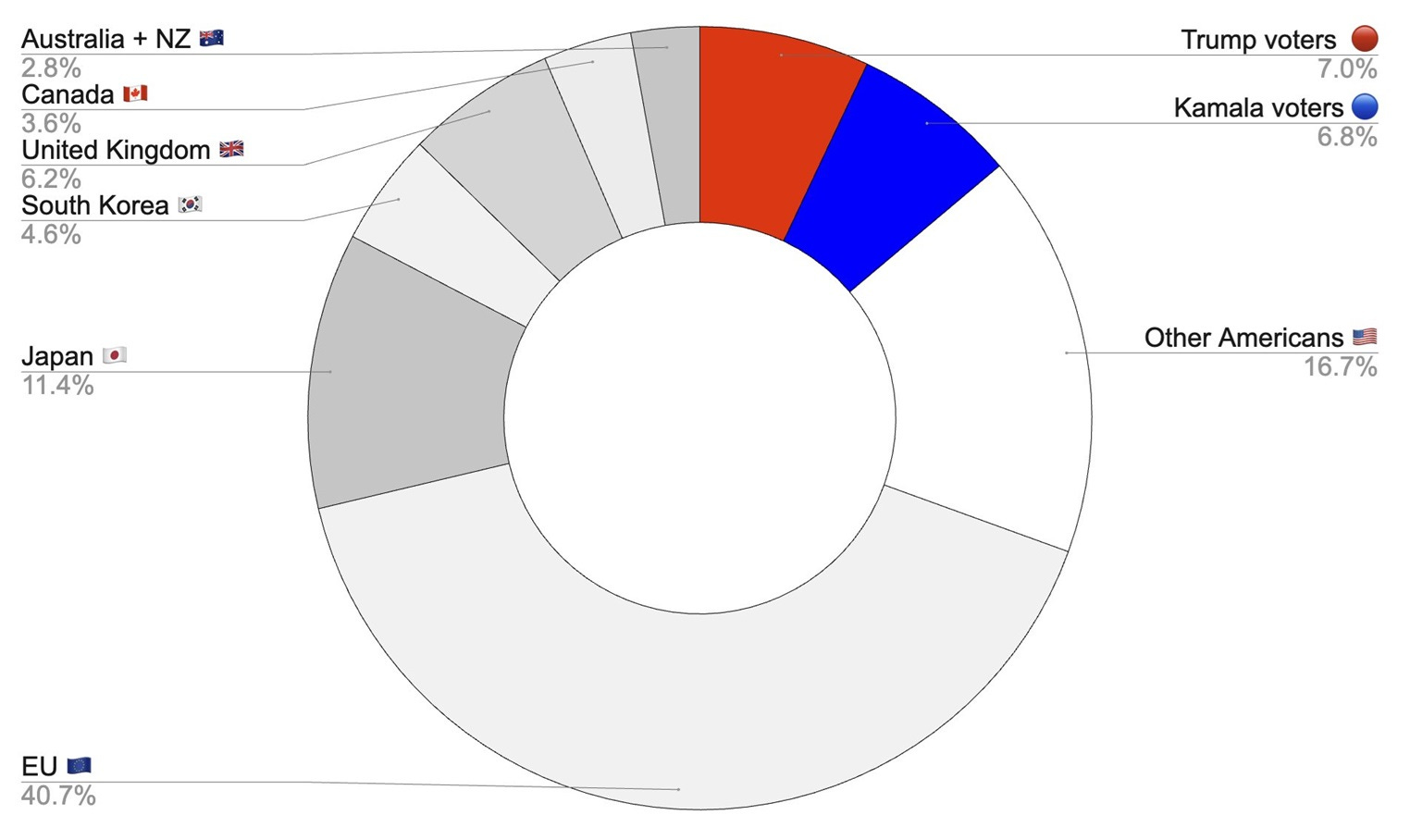
A few people on the right are starting to wake up to this danger. One of them is Balaji Srinivasan, who noted that the number of Trump voters is tiny compared to the number of people the U.S. will alienate with Trump’s recent moves:
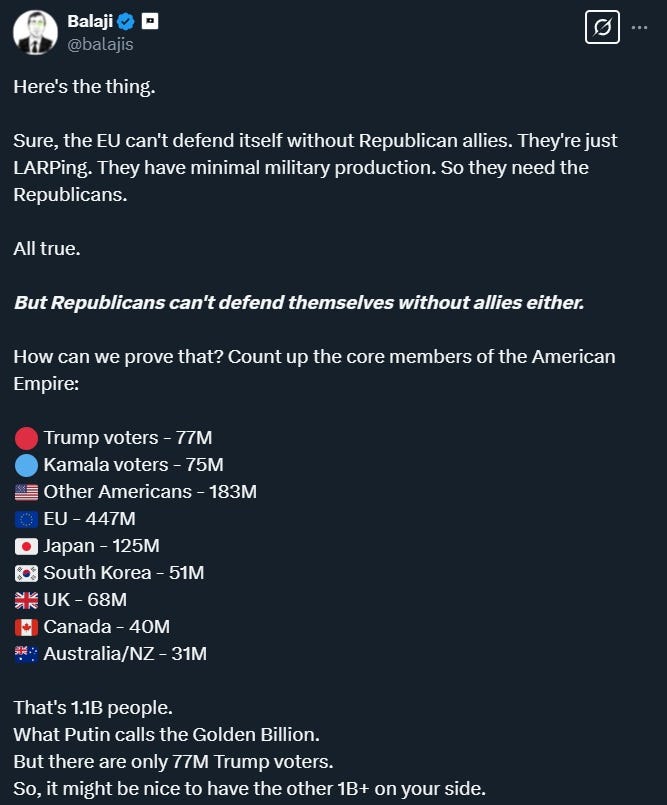
And he illustrated the issue with a nice chart:
And in another series of tweets, he wrote:
There is a strong argument that Ukraine is THE climactic battle of the Thucydides Trap. That is: the big war between the US and China is actually between their proxies Ukraine and Russia. And this settlement — to this war — determines the next world order. Because there won’t be a fight in Taiwan if NATO is defeated in Ukraine. Taiwan will just surrender to China because they know they won't get reliable Western military support. And so will everyone else. So, this may be the decisive moment when terms get negotiated with the China/Russia group for the next however many years. That means that even if you think Ukraine was a disaster and Zelensky is a dummy, you don’t want NATO to be catastrophically defeated in Kiev like it was in Afghanistan. That would be bad for Democrats, Republicans, Europeans, Japanese — just about everyone under the US security umbrella.
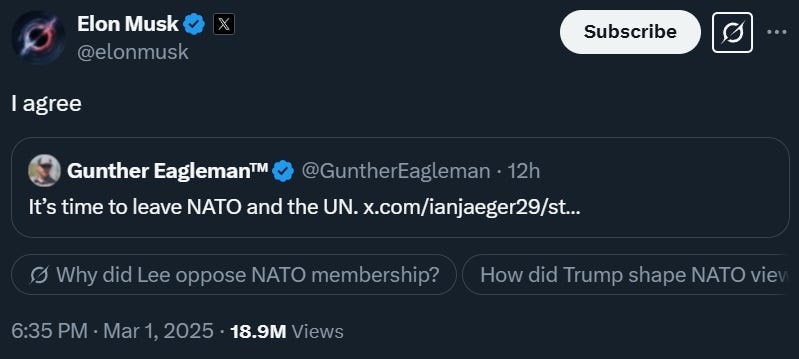
It’s good to see some folks on the right waking up to this reality. But either Elon Musk isn’t quite there yet, or he has very different priorities from Balaji:
In any case, America’s abrupt turn from moral beacon and defender of the free world is unsurprising, given the fundamental immorality of the Trump administration. If you have the morality of a gangster, you will behave like a gangster.
Trump and his people are going to screw up
So far, this is all very bad news, both for America and for the world at large. It reinforces things I’ve been saying for a while — that Asian democracies need their own nuclear deterrent, that Europe has to remilitarize, and that Americans need to realize that their leaders are selling them out to their enemies.
But if there’s one silver lining here, it’s that the Zelensky meeting was not a smooth display of competence on Trump’s part. The spectacle of Trump and his lackeys shouting threats and demands at an earnest little guy whose country is being invaded and destroyed was not a P.R. coup for the administration. It displayed an instinctive, overly aggressive, ham-handed approach — the attitude of a bunch of people drunk on their own power, feeling untouchable enough to have a little fun pushing a foreign leader around on live TV.
This was probably an unforced error for the Trump administration, and I expect it to lead to another downtick in Trump’s approval ratings. But the real question is what happens when Trump and his people start to apply the same level of brash overconfidence to domestic policy that they’re applying to foreign policy.
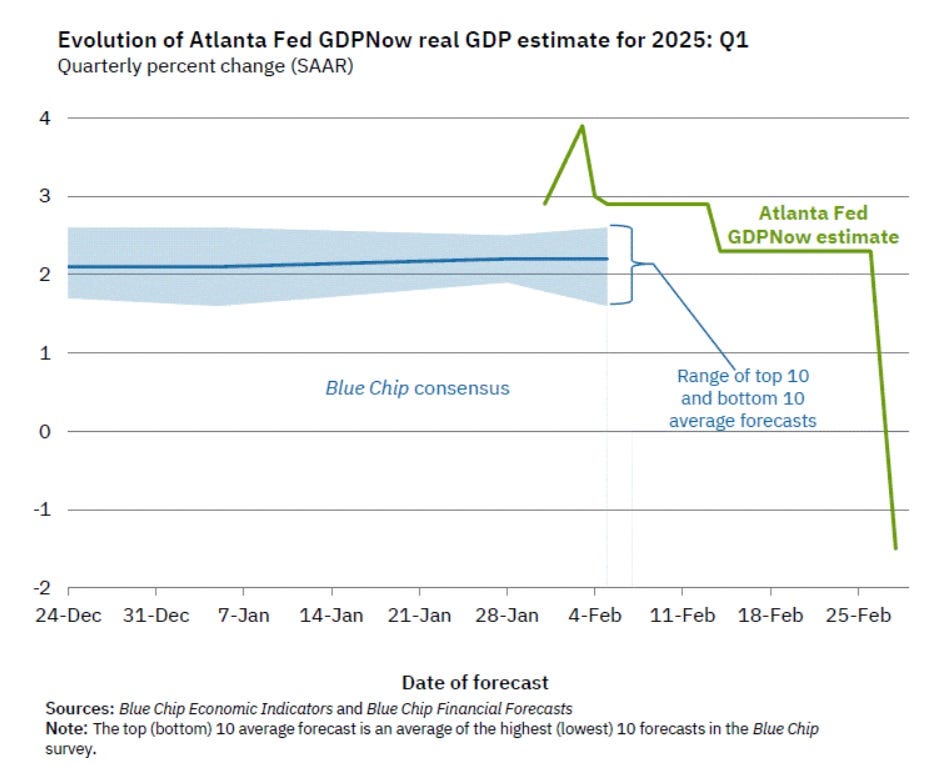
In fact, this has already happened, with tariffs and tariff threats. The Atlanta Fed now expects the U.S. economy to shrink in the first quarter of 2025 — a stunning reversal from recent expectations for continued growth:
More and more people in the business community are getting worried about Trump’s tariffs. This is from Politico:
“Forty-three percent of Americans said in a recent survey that they were seeing the tariff threats feed into higher prices. Key benchmarks of consumer sentiment this month showed expectations for future inflation have ticked up. And the stocks of some key companies like Walmart have taken a hit in recent weeks on expectations of higher import costs,” Victoria reports.
The prospect of major and sweeping tariffs — as Trump has repeatedly declared are on the table — has been spooking economists and financial titans for months, who have warned that Trump is risking a spike in inflation all over again. But the alarms are starting to get louder. Billionaire Ross Perot Jr. told Bloomberg last week that the threat of tariffs is “a big concern,” and hedge fund manager Steve Cohen said at a conference in Miami that “tariffs cannot be a positive.” The threats have only added more stress to investors, many of whom were already worried about the frothiness of U.S. stocks.
And this is from Semafor:
“A difficult time to invest.”
“Everybody’s paralyzed.”
“I’m sorry I can’t be particularly positive.”
“The chaos that is reigning right now is causing everyone to sit on their hands.”
That’s Citadel CEO Ken Griffin, ON Semiconductor CEO Hassane El-Khoury, Franklin Templeton CEO Jenny Johnson, and Nasdaq Private Market CEO Tom Callahan on the world of Donald Trump right now. Their comments over the past week capture a growing disquiet among business leaders, a month into a presidency that many of them had cheered…CEO optimism is fading as Trump pushes ahead with trade restrictions, while business-friendly deregulation has yet to materialize. US consumer confidence in January recorded its biggest one-month decline since November 2023. The US stock market, long Trump’s preferred proxy for economic might, is lower than it was before his inauguration, trailing major indexes in Europe, China, Mexico, and Canada — all targets of the president’s planned tariffs.
Unless you believe conspiracy theories about Trump intentionally sabotaging the U.S. economy at the behest of China and Russia, this is just an unforced error born of arrogance, recklessness, and a poisoned right-wing information ecosystem. As best I can tell, Trump and his inner circle seem to believe that anyone warning them about the negative effects of their policies are just woke libs who can be disregarded.
Feeling invincible and listening only to your yes-men is a classic recipe for overreach. The truth is that not all gangsters are created equal — some are patient and wise, while some are reckless and overaggressive. The Oval Office meeting with Zelensky should push our assessment of the Trump administration a little bit in the direction of the latter. And the negative effects of tariff threats on the economy and financial markets should add yet another bit of evidence. We know Elon is a hyper-competent guy, but he may be working at cross purposes from the rest of the administration — and beyond Elon, the Trump movement might just not have that many people who really know what they’re doing.
These guys are already starting to screw up.