
Today let’s talk about partisan politics. Not the most fun topic, but an important one.
This is not a nonpartisan blog. I focus mostly on analyzing the world to figure out what’s going on, because that’s what I enjoy the most, and that’s where I think I add the most value. But I don’t hesitate to share opinions or take political sides. And I don’t make any secret of the fact that I want the Democrats to win.
This is not because I view the Democrats as “my team” — I view America, the country, as my team. Nor do I want the Republican party to die; I want it to be a sane and reasonable conservative party that does sane and reasonable things when it wins elections. The problem is that right now, the Republicans are neither sane nor reasonable, because they’ve been hijacked by ideologues and isolationists with autocratic impulses. That’s bad for the country. So I want Democrats to mount a credible, effective opposition to Musk and Trump.
The problem with that is that over the past 12 years or so, the Democrats have also become less sane and reasonable than they were before. They’ve become obsessed with divisive identitarianism, unpopular culture wars, and paralyzing proceduralism. They’ve let an out-of-touch extremely-online educated class dictate their attitudes and language, and they’ve let some of the big cities they run fall into disorder and decay. Their drubbing at the hands of Trump in 2024 was no accident.
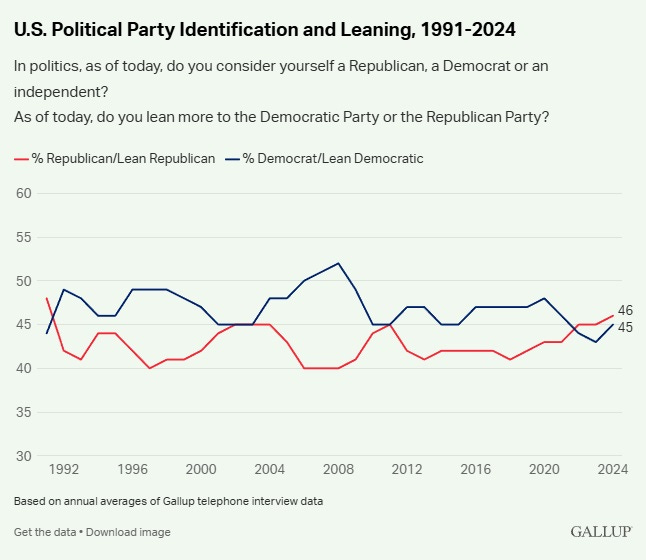
This doesn’t mean I view the two parties are equivalent; even if the Dems didn’t change an iota from 2024, I would still want them to defeat Musk and Trump. But the harsh reality is that if they don’t change, they probably won’t defeat Musk and Trump. Dems are rapidly losing ground with Hispanic voters, Asian voters, and even some Black voters, while failing to win back a matching number of White voters. For decades, more Americans called themselves Democrats than Republicans; that has now reversed.
Democrats are even starting to lose ground with the younger generation, with both young men and young women calling themselves more socially conservative.
Democrats are simply no longer America’s majority party. That’s particularly shameful and galling, given all the bad things Trump has done.
Right now, a few Democrats are allowing themselves to indulge in the complacent fantasy that Trump and Musk will be so horrible that their movement will collapse on its own and drive everyone back to the Dems. Yes, Trump and Musk will make mistakes — indeed, they are already making mistakes — and yes, this will give their opponents crucial openings to seize upon. But it won’t happen automatically, and if Dems don’t make some big changes, it’ll be difficult to capitalize on those errors.
So anyway, here’s a sketch of what I think the Dems will need to do. My three basic ideas are:
Present a sane alternative to Trump’s inflationary policies
Defend democracy and freedom of speech against Trump/Musk overreach
Ditch the progressive baggage of the 2010s, and focus on the common good
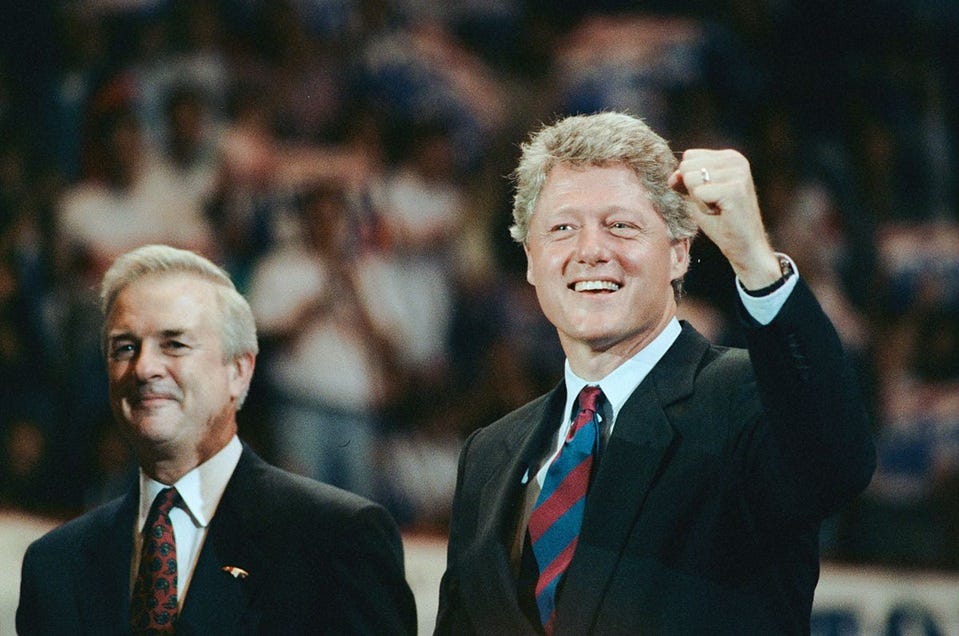
Most of these approaches have been used successfully by Democratic politicians in the recent past — most notably by Bill Clinton in 1992. In fact, recapturing the spirit of 1992 is a good general summary of how Dems ought to think about how to recover from the disaster of 2024.
Become inflation hawks and deficit hawks again
As I like to say, macroeconomics is the natural predator of foolish regimes. Trump beat Harris in part because Americans were mad about inflation, but he came into office without a credible plan to actually end inflation. And already, inflation is creeping back up:
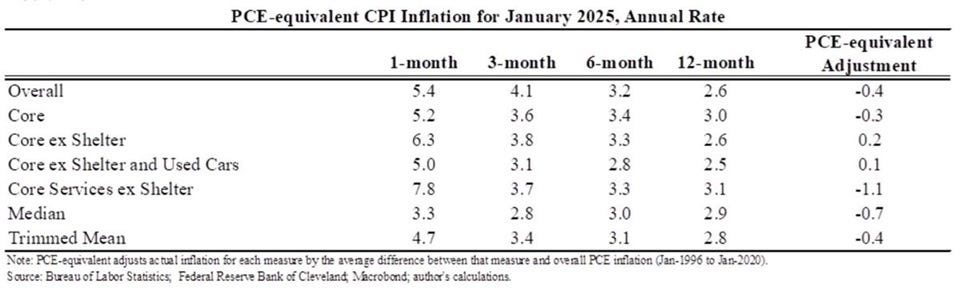
There may be some natural forces pushing inflation up here — decoupling from China and the reorganization of supply chains. But one culprit is probably inflation expectations, which are now rising. Remember that when people expect more inflation, it often becomes a self-fulfilling prophecy.
Americans are expecting more inflation because Trump is doing stuff — or promising to do stuff — that causes inflation. Trump constantly calls on the Fed to cut interest rates. Lower interest rates raise inflation. Trump has either implemented tariffs or threatened tariffs. Tariffs raise inflation. Trump has promised huge tax cuts, which will inevitably lead to huge government deficits. And so on. Trump is just a very inflationary kind of leader.
In 2021-22 we discovered — or rediscovered — that inflation is really bad for regular Americans. It lowers real wages and raises the cost of living.1 It erodes the value of bonds, which represents a lot of old people’s savings. It creates uncertainty and makes people feel angry about the economy.
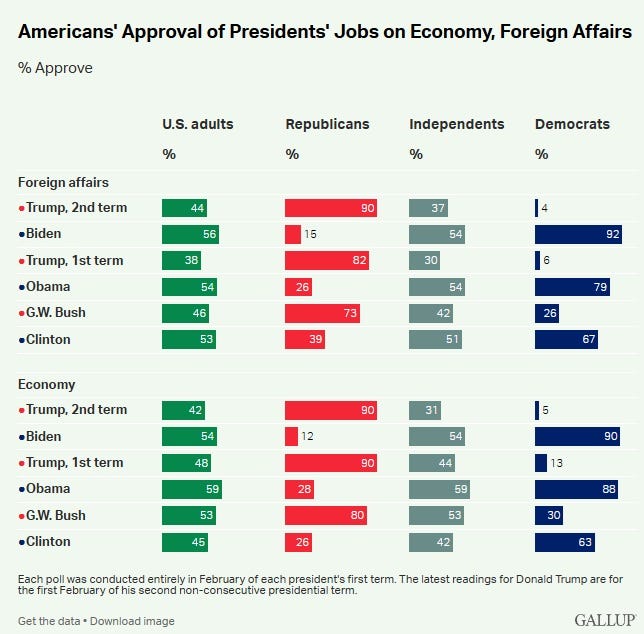
And Americans are already getting angry. Trump’s approval rating on the economy is rapidly beginning to sour, and is now more negative than for any recent President at the start of their term in office:
Meanwhile, consumer sentiment is falling again, and some people are citing Trump’s tariffs as the reason they expect more inflation:
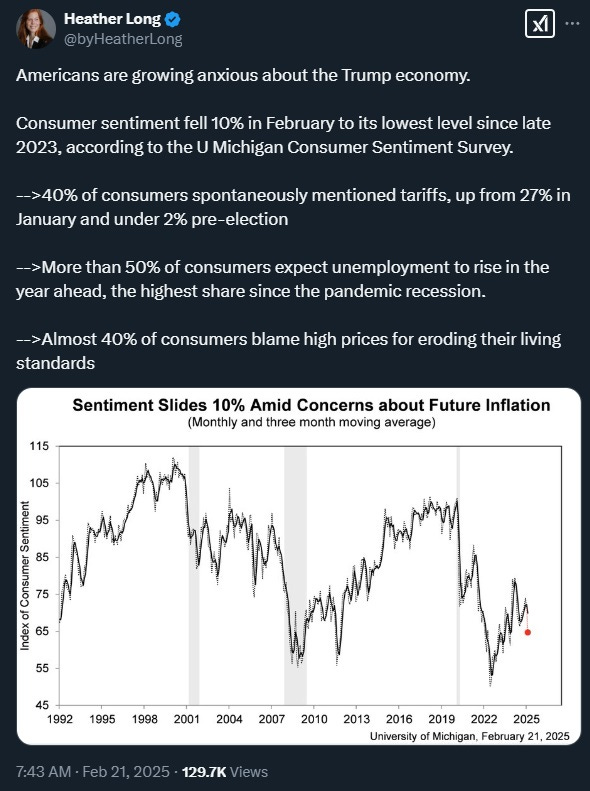
So as I wrote last week, Trump’s economy is already in trouble. But how can Democrats capitalize on this?
First, they need to understand which policies fight inflation — and which don’t. During Biden’s term, Democrats declared that industrial policy would produce a supply boom in America that would bring down inflation. This was always hogwash.2 Industrial policy is good for some things — national security, technological leadership — but it isn’t an inflation-fighting policy, at least in the short and medium term. And subsidies for household spending items — food, gasoline, child care, education, health care, etc. — actually make inflation worse. Price controls, meanwhile, are just about the worst idea, and will go over like a lead balloon.
So Democrats need to avoid the temptation to claim that they’ll fight inflation by relying on either their old favorite hobbyhorses or new progressive nonsense. Americans will see right through that, especially because it’s mostly just a promise to return to Biden’s policies — which people associate with high inflation.
Instead, Democrats need to promise things that will actually reduce inflation:
They should promise to end all tariffs on countries other than China.
They should promise to end Trump’s attacks on the Federal Reserve, and let it keep interest rates as high as they need to be to keep a lid on inflation.
They need to promise to cut the deficit.
This last one is important, and will be the most difficult. On one hand, Americans are very much in favor of cutting the deficit, and this desire has grown in recent years as deficits have stayed worryingly high:
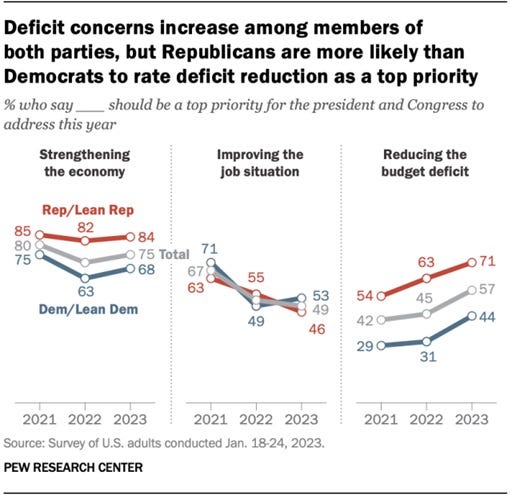
But as you can see, Democratic voters care less about reducing deficits than Republicans do. And the American electorate notoriously tends to oppose both tax increases and cuts in big-ticket spending items, which are the only two ways to actually cut the deficit.3
So the key on deficit reduction is just to keep saying “Cut the deficit”, and then leave the actual specifics until after you win the election. If Dems do win in 2028, there are good plans available that will spread the pain around and make sure no one gets hurt too much by deficit reduction.
There is a precedent for this — 1992, when Bill Clinton ran on cutting the deficit and won, and then kept his promise. Democrats need to hearken back to that approach, and add lower tariffs (except on China) and Fed independence into the mix.
Of course, inflation and the deficit aren’t the only economic issues Dems can run on; they will also probably be able to harness the anger of large numbers of workers laid off by Elon Musk’s DOGE.
Fight for democracy and free speech
Both democracy and free speech are, in fact, in great danger from the Trump/Musk administration.
Trump denied the result of the 2020 election, claiming that Democratic votes were fraudulent. It seems highly likely that either he or whoever succeeds him as the GOP nominee in 2028 will try to the same trick if they lose. With DOGE giving Trump and Musk total control of the federal bureaucracy, their ability to overturn an election loss could be even greater than in 2020.
Meanwhile, there are indications that Musk, despite rhetorically defending free speech, is preparing to use the government to crack down on criticism of himself and Trump. He recently claimed that the hosts of the news program 60 Minutes should be put in prison for “deliberate deception”:

And he has issued a variety of lesser threats against various other journalists.
Musk’s DOGE is in the process of establishing total control over the federal bureaucracy. That will enable him and his allies to launch investigations of, or lawsuits against, any and all critics, if they choose to do so. Already there are some signs that the MAGA people may use this power:
Democratic Rep. Robert Garcia vowed Thursday that he would not be “silenced” after receiving a letter from the Department of Justice demanding he explain remarks critical of Elon Musk…Garcia shared the letter he received from Ed Martin, the top federal prosecutor in Washington, who has repeatedly threatened to investigate President Donald Trump’s opponents and critics…Garcia…called Musk…a “dick” and urged Democrats “to bring actual weapons to this bar fight.”…Martin wrote in the letter that the “bar fight” remarks could be interpreted as “a threat to Mr. Musk”[.]
So Democrats would seem to be in a good position to stand up for democracy and free speech, against the forces of autocracy and government censorship.
But doing this will require some big adjustments.
On democracy, Democrats have to adjust their thinking about what is a threat and what isn’t. After 2020, Dems made the bizarre choice to focus less on what Trump had just tried to do, and more on low-level long-term issues like gerrymandering, voter ID laws, etc.
This was a bit ridiculous, for several reasons. First, gerrymandering has been there since the founding of the republic, and in fact it’s probably less of a problem now than it used to be. Second, voter ID laws are common around the world, including in robust democracies like Canada, France, and the Netherlands, and there’s strong evidence that they don’t harm turnout at all. And third, as a practical matter, Democrats benefit from lower turnout in today’s political environment. Meanwhile, what Trump did and tried to do in 2020 was a clear and present danger to democracy, but Democrats mostly ignored it, leaving it to a centrist alliance led by Joe Manchin to actually pass a law designed to discourage similar acts in the future.
Meanwhile, Democrats have themselves flirted with censorship of free speech. This sometimes takes the form of proposed laws criminalizing “hate speech” or “misinformation”; the latter of these is exactly what Elon Musk is trying to do to 60 Minutes. In the 2024 campaign, Kamala Harris’ running mate Tim Walz said “There's no guarantee to free speech on misinformation or hate speech”.
Democrats can’t stand up for America’s basic values if they don’t believe in those values themselves. The great freakout over “misinformation” and “fake news” has to end — these are certainly a problem in the age of social media, but they won’t be solved by criminalizing speech.
In the coming years, as Trump and Musk inevitably fall prey to the autocratic temptation, Democrats will need to stand up as the defenders of democracy and freedom. This means they’ll have to defend the electoral system as it existed in previous decades, rather than pushing for long-term changes that they think would give them an advantage. And it means they’ll have to abandon their own occasional impulses toward totalitarianism.
One other thing Democrats can do is to bash Trump for coddling dictators abroad. Bill Clinton used this line of attack successfully against George H.W. Bush, but it’s far more applicable to Trump. Under Trump, the U.S. just voted against a UN resolution condemning the Russian invasion of Ukraine — an obvious attempt to either cultivate a global alliance of autocracies and/or to court Russia’s favor specifically. Either way, Americans tend not to like it when their leaders support totalitarians abroad, and the Dems should go after Trump on this.
Ditch the progressive baggage of 2014-2021
There is no indication that Democrats lost in 2024 because they moved to the center and lost their base. In fact, polls show that Democratic voters want their party to be more moderate:
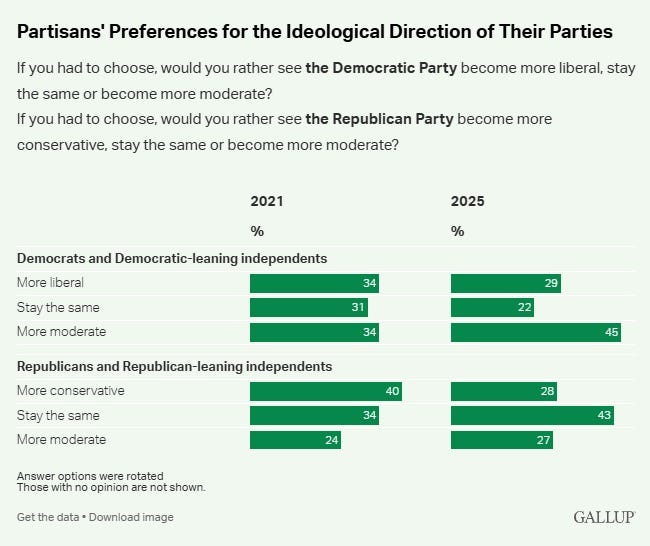
What does meaningful moderation look like? The only major substantive policy issue where voters seem to think Democrats are too extreme is immigration. Democrats need to make it clear that the U.S. is a nation of laws, and that crossing the border illegally to request asylum — the source of the huge disorderly flood of quasi-illegal immigration during the Biden years — won’t be tolerated, period. That will remove Trump’s biggest issue from the board.
But moderation goes far beyond big substantive policy issues — it’s a deeper issue of what kind of nation Democrats want America to be. The 2010s progressive notion that America is an inherently racist entity that has to be re-founded on “antiracist” principles has to be simply discarded. No such re-founding will happen — if the U.S. is fundamentally transformed, it will be along right-wing, authoritarian lines. And if it ever did happen, it would be a totalitarian nightmare anyway. So it’s important that the U.S. not be fundamentally transformed — that we continue to be the freedom-loving, liberal nation that we generally were in the years before the 2010s.
I thought Harris did a decent job of hearkening back to the American tradition of freedom at her 2024 convention. But it was too little, too late — it has to be only the beginning of a long process of Democrats unambiguously reclaiming patriotism, the flag, freedom, etc. Very few Americans want Trump to be a dictator, and even fewer want Elon Musk to be our emperor. This gives Democrats an opening to promise to restore the America that most Americans remember from their youth.
How can Democrats make that promise credible? Most of this is about rhetoric and signaling, and once again, Bill Clinton shows the way. When progressive activists attack Democrats for not sufficiently supporting their unpopular causes, Democrats need to push back loudly and firmly, just as Clinton did in a famous encounter in 1992:
Another important bit of signaling is language. Perhaps the most annoying progressive behavior is the constant attempt to get Americans to change the language they use. Sometimes this is relatively benign, as when the clumsy “African-American” was replaced with “Black”. Sometimes it’s absurd and degrading, as when activists tried to replace “Hispanic” and “Latino” with “Latinx”, offending vast numbers of Latinos in the process. And sometimes it’s just creepy, as when a number of progressive-dominated institutions started saying “birthing people” instead of “mothers” in an attempt to be more inclusive of trans people.
The biggest problem with this sort of language game isn’t that it’s unfair to less-educated people who are less capable of keeping up with the latest lingo (although that’s certainly true). The problem is that Americans don’t like being told how to talk. They correctly recognize that progressive language demands are fundamentally a power game, and they don’t like being dominated in their daily lives. America is a freedom-loving nation, and the freedom to speak how you like is an important one, even when the First Amendment isn’t directly involved.
So my suggestion to Democrats is: Ditch all language games. Not most, but all. Never introduce any bill that orders a language change, no matter how reasonable it might be on the merits. When giving speeches and putting out documents, try not to use any term that Bill Clinton wouldn’t have used in 1992. Not only will this send a powerful signal that Democrats are abandoning the more annoying parts of 2010s progressivism, but it will allow them to loudly ridicule Trump for demanding that everyone call the Gulf of Mexico the “Gulf of America”.
After a bruising and confusing decade of unrest, Americans crave stability and normalcy. Trump and Musk could have given it to them, but they’re not doing it — instead they’re upending American institutions, American foreign policy, and perhaps eventually American democracy itself as part of an ideological crusade to stamp out progressive attitudes that were already on the decline. That continued chaos gives Dems an opportunity to be the party of normalcy — of low inflation, fiscal responsibility, democratic elections, free speech, tolerance, and cultural moderation. To do that, they need to hearken back to the spirit of 1992.
Those are almost the exact same thing, but I find that using various different terms for the same thing helps to explain it to different audiences.
It was hogwash for at least three reasons. First, Democrats’ industrial policy was moderately successful, but it didn’t actually include the land-use deregulation, and it included a whole bunch of onerous contracting requirements (union labor, minority-owned contractors, “environmental justice”, etc.) that limited the size of the manufacturing boom it was able to produce. Second, it takes a long time to build factories and have them start producing stuff — in the short term, the labor demand and materials demand created by a construction boom actually increases inflation. And third, when an economy is at full employment, industrial policy can only lower inflation by increasing productivity — which Biden’s industrial policy wasn’t really geared toward doing.
No, DOGE-style efficiency savings will not do much of anything. The numbers are tiny.