
Over the past 35 years, Americans have become used to a particular cycle of macroeconomics and presidential politics. First, a recession will strike during a Republican President’s term in office, and disgruntled voters will bring in a Democrat to fix things. This happened when Clinton came in after the recession of 1991 (which was more severe than people tend to recall), and when Obama got elected after the financial crisis hit in 2008. It might be a stretch, but you could even think of Biden’s election after Covid as an example of this. Anyway, the second part of the cycle happens when the economy recovers under the Democratic President, and the nation turns its attention back to culture wars once again — and brings in a Republican, because America is a fairly socially conservative place. This is what happened in 2000 with Bush, and in 2016 with Trump.
This cycle neatly explains why the economy typically does better under Democrats1:
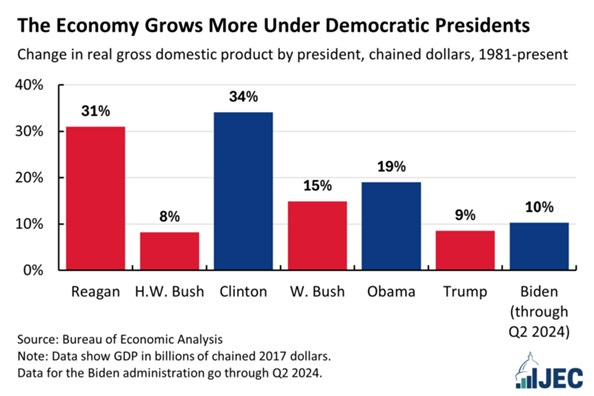
A little bit of this is probably due to Democratic policies, like Obama’s stimulus. But the most important reason for the pattern, I think, is just that Democrats tend to get elected when the economy is bad, and the economy tends to bounce back on its own.
At first glance, Trump’s election in 2024 might seem to break this pattern. Despite steady growth, a good labor market, Americans were still extraordinarily pessimistic about the economy. Some of that might have been simply displaced anger over sociocultural issues, but some of it was probably just lingering anger over the inflation of 2021-22, which reduced most Americans’ purchasing power. For the first time since 1980, people brought in a Republican, rather than a Democrat, to fix things.
But this isn’t 1981, and Trump isn’t Reagan. There are three big differences:
Unlike in 1981, inflation had already come down by election day. This leaves little further room for improvement.
Trump’s policies are looking much more inflationary than Reagan’s, for a number of reasons.
Unlike in 1981, the U.S. economy is strong, and is thus more likely to surprise on the downside.
The national debt is becoming a huge problem, for the first time since the early 1990s.
Not all of this is Trump’s fault, obviously. Some of Biden’s policies created underlying inflationary pressures that Trump now needs to do the hard work of cleaning up. The enormous national debt, which is now incurring skyrocketing interest costs, is only partly from Trump’s first term — most of it was built up during previous administrations. And like some of his Republican predecessors, Trump happens to be coming into office at the peak of the macroeconomic cycle.
So the deck is a bit stacked against him. But so far, Trump’s proposed policies — big tax cuts, tariffs, and yelling at the Fed to cut interest rates — look exactly what America doesn’t need in order to keep inflation down and growth high.
So Trump is in danger of piling self-inflicted wounds on top of existing bad luck. As a result, the Trump economy could end up as a severe disappointment. Already, warning signs are flashing.
The national debt is a huge problem again
I’ve been warning for a couple years now that the national debt was about to become a problem again. For two decades, Americans didn’t worry much about the debt, because interest rates were low. If interest payments are low, you basically don’t even notice debt piling up, because it doesn’t do anything — it just sort of sits there as a number in Microsoft Excel.
But when rates go up, you have to start rolling over your debt at those higher rates. When a 10-year Treasury bond matures, the government has to go out and borrow more money in order to pay the principal on that bond. So the interest it pays on that little slice of debt immediately jumps from whatever the rate was on the old Treasury bond to whatever the Treasury rate is today. If rates are higher today than when the old bond got issued, then there’s a sudden jump in the federal government’s monthly interest payments.
That’s happening to the U.S. right now, and it’s happening fast. Interest rates started going up three years ago, and the average maturity of the national debt is about 6 years. Every day, more of that debt is rolled over at the new higher rate of over 4%, and the government’s interest costs go up and up.
Here’s a chart that should scare the crap out of you:
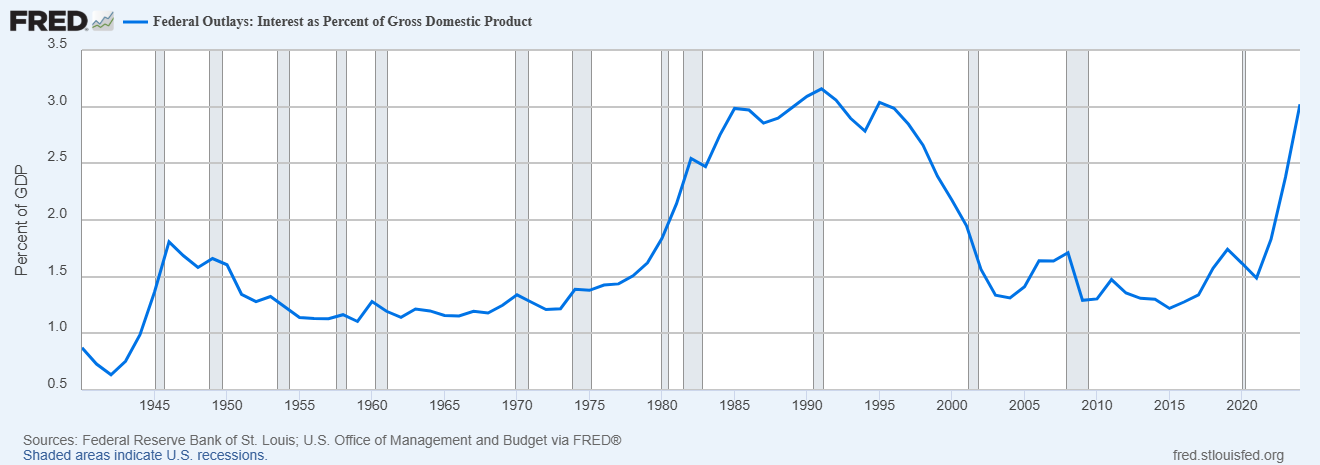
The federal government’s interest costs are now back to the all-time highs of the 80s and early 1990s, and still rising. They’re going to rise more, because we’ve been rolling over our national debt at higher interest rates for less than three years now, and the average maturity is six years. Which means we’re about to roll over a LOT more debt, meaning that interest costs will keep climbing — blowing past the record they set in the 90s.
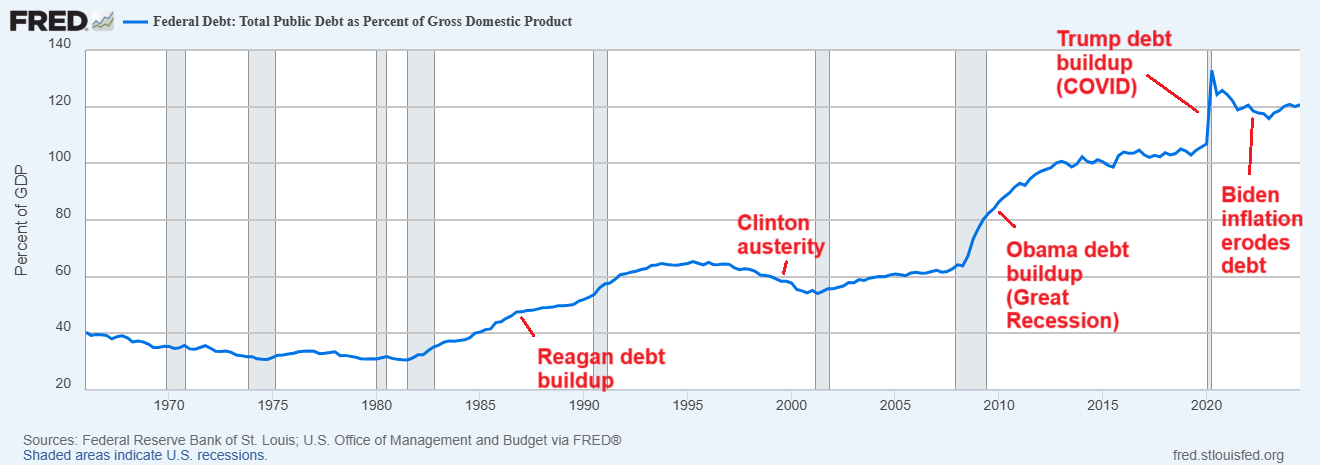
The reason interest costs will rise above 90s levels isn’t that interest rates are higher now than they were then — in fact, they’re slightly lower now. It’s that the government has a lot more debt now. Basically, our debt has doubled as a percent of GDP since the last time debt became a problem:
Just for fun, here’s a chart of debt as a percentage of GDP times the interest rate on 10-year Treasury bonds — a rough approximation to how much of our GDP we’d have to pay if we rolled over all of our national debt at today’s interest rates:
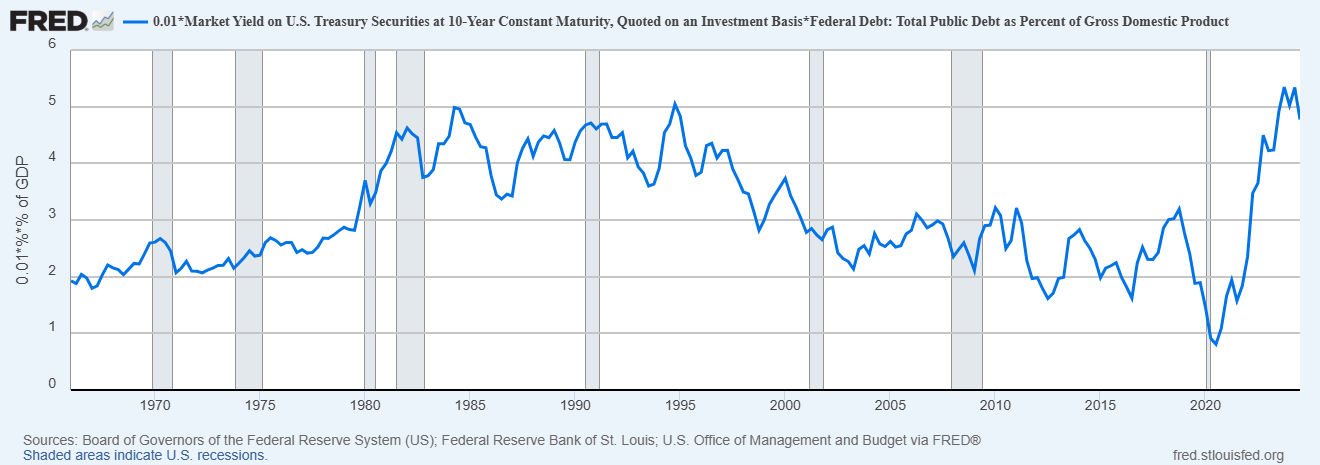
This number isn’t a lot higher than the 90s, but it is higher. The worst is yet to come.
What’s wrong with higher interest costs? Well, how are you going to pay that extra money every month? You can pay for it with tax hikes and spending cuts — i.e., fiscal austerity — but nobody likes that, right? OK, so there are two other options. First, you can borrow to cover the interest payments — like paying your credit card balance by using another credit card. Eventually that makes your debt explode to infinity (or actually, until people just stop lending you more money and you’re forced to default). The other thing you can do is raise inflation.
Inflation erodes debt — look at how debt-to-GDP actually fell under Biden, even though Biden ran high deficits every year.2 If you cause a bunch of inflation by having the Fed print a bunch of money (or keep interest rates low despite rising inflation, which is actually the same thing), you can erode the debt without having to pay it back. Of course, as we just found out during the Biden years, Americans really hate inflation — it reduces their real incomes, it reduces the value of their savings, and so on.
Of course, businesses know full well that inflation erodes debt. So if the U.S. keeps borrowing more and more money just to cover its interest costs, they know that at some point that will end (when lenders realize what’s going on and stop lending money to the government). And they know that at that point, the government will probably use inflation to erode the debt, as typically happens in Latin American countries. So knowing that, businesses will see a huge unrestrained increase in debt as a reason to get ahead of the game and start raising prices now. Thus, debt can cause inflation inadvertently, even if the Fed doesn’t start printing a ton of money.
In other words, inflation — or a sovereign default — is the end result of unrestrained government borrowing.
Trump inherited a huge stock of debt from his predecessors, but his proposed policies will make the situation even worse. Even now, House Republicans are planning to extend Trump’s tax cuts from his first term, only partially offset by spending cuts:
House Republicans released a budget plan Wednesday that sets the stage for advancing many of President Donald Trump’s top domestic priorities, providing for up to $4.5 trillion in tax cuts and a $4 trillion increase in the debt limit so the U.S. can continue financing its bills.
The budget plan also directs a variety of House committees to cut spending by at least $1.5 trillion while stating that the goal is to reduce spending by $2 trillion over 10 years.
If they go through with this, it’ll preclude any possibility of paying for rising interest costs through austerity. Instead, it’ll mean the U.S. government will be borrowing to pay its monthly interest bills. That will set us up for higher inflation — maybe soon, maybe down the road.
Inflation is back, and Trump isn’t helping
In fact, this might not even be hypothetical. There are signs that inflation is already rising under Trump. Headline CPI inflation has inched back up to 3%:
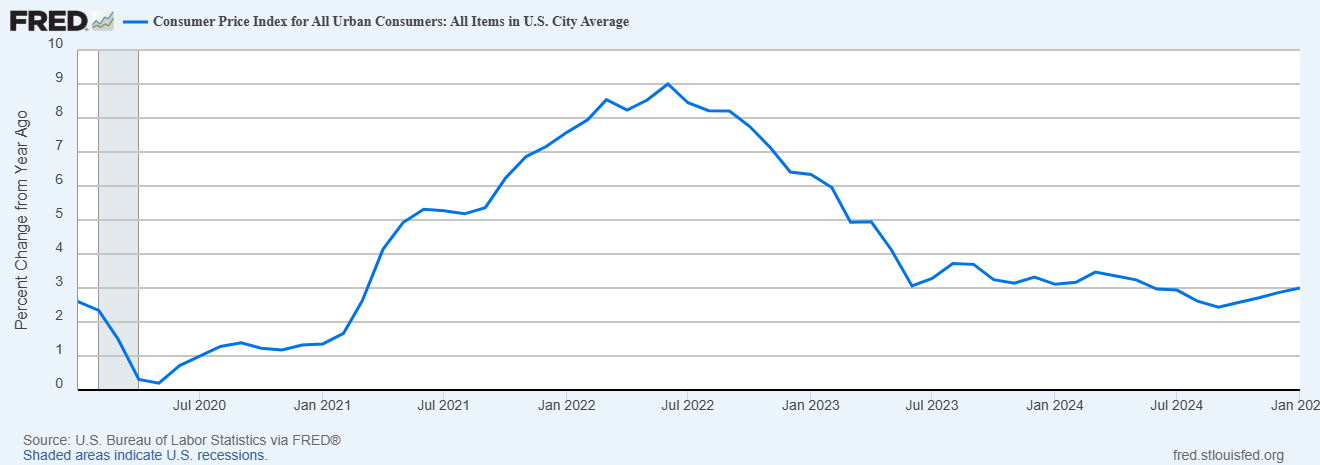
(This is measured year-over-year, so seasonal effects shouldn’t be an issue.)
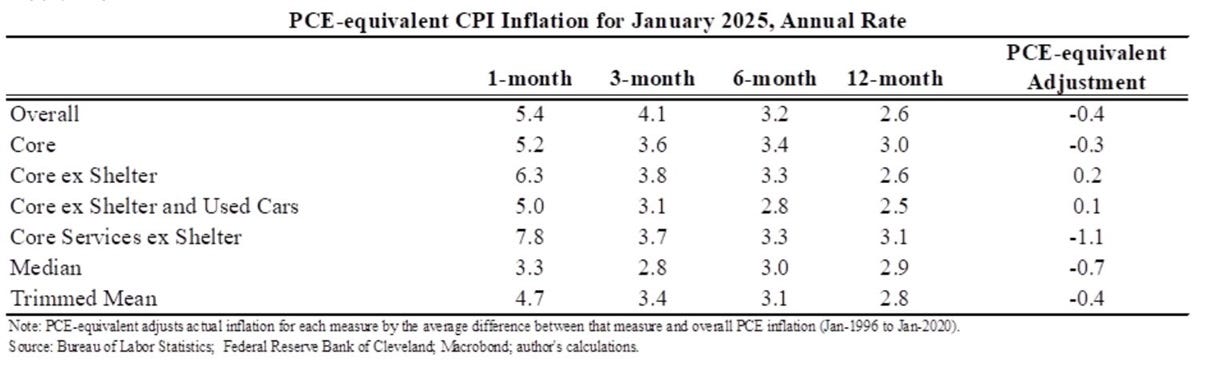
There are lots of other inflation measures, but basically they’re all showing upward pressure in the last month:
Even more worrying is a sudden jump in inflation expectations. The 5-year breakeven inflation rate — a measure of financial markets’ expectations of inflation over the next 5 years — has gone from 1.9% to 2.6% since September:
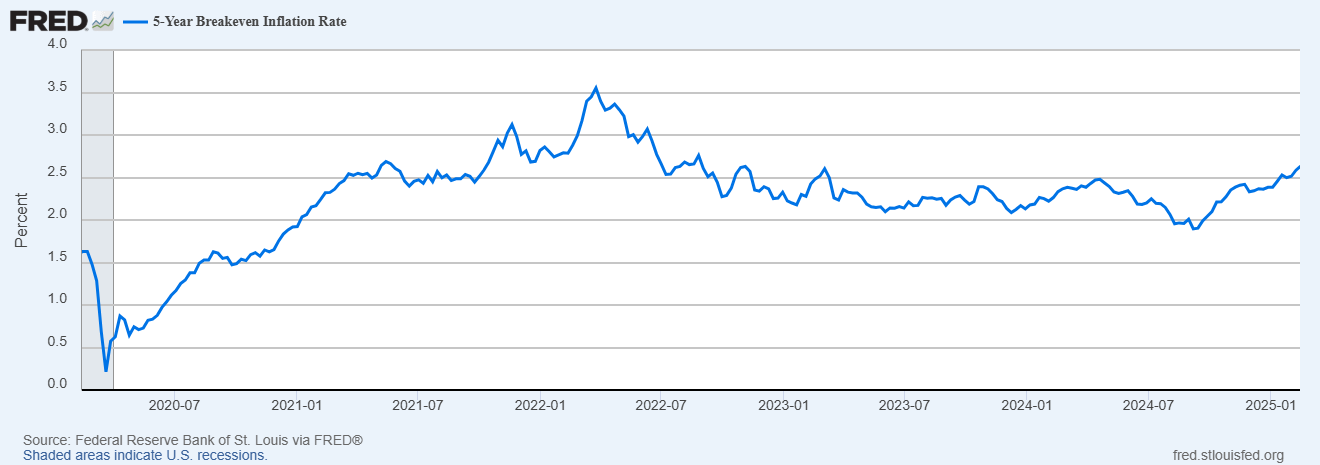
2.6% isn’t super high, but this measure of expectations almost never goes very high. It was 2.5% throughout the middle of 2021, even though actual inflation ended up going to 9%. So a small increase in this measure can be scary.
Meanwhile, survey-based expectations of inflation have shown a sudden spike since Trump took office, returning to levels last seen in 2023 or late 2022:
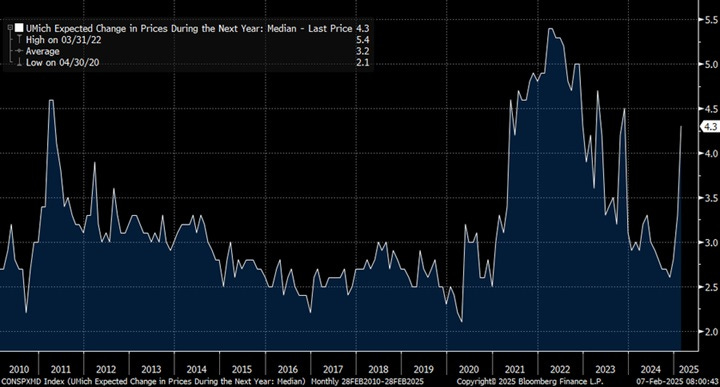
There aren’t many obvious supply-side pressures on inflation. Oil prices aren’t up. Supply chains aren’t stressed. Thus, it’s likely that the increase in inflationary expectations is due to expectations about U.S. policy changes — i.e., people probably think Trump is going to raise inflation.
The most obvious reason for this is debt, as I talked about in the previous section. Debt is high and interest costs are exploding, and yet Trump wants to do a ton of tax cuts and borrow even more money to pay for them. That probably means higher inflation down the road, to erode the debt.
In fact, Trump is signaling that this is exactly what he wants to do. Trump has been shouting for the Fed to lower interest rates. And given the behavior of DOGE, it’s far from clear that the Fed will retain the independence necessary to ignore the President’s exhortations. Lower interest rates will make the debt easier to carry — i.e., it’ll lower monthly interest payments. But lower rates also cause inflation. So this is just a way of using inflation to reduce the U.S. government’s debt costs.
Finally, there are tariffs. Tariffs raise prices on a bunch of stuff, either directly (by taxing imports of consumer goods) or indirectly (by raising U.S. producers’ costs). That’s a negative supply shock, which raises inflation while lowering growth. It can also increase inflationary expectations, which, as I mentioned, can translate into actual inflation. In fact, even empty threats of tariffs can raise inflationary expectations and cause inflation, if people decide there’s a good chance the next threats won’t be empty ones.
So a lot of stuff Trump is doing — tax cuts, pressuring the Fed to lower interest rates, and threatening tariffs — is inflationary. Realistically, there’s no way that DOGE, or congressional spending cuts, are going to offset all that. Americans may be starting to realize this; some measures of consumer sentiment are beginning to fall again.
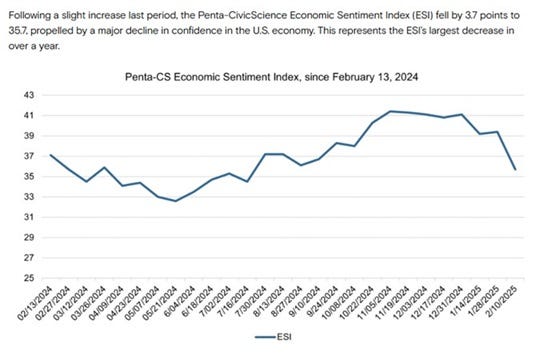
And Americans say they’re unhappy with Trump’s efforts to fight inflation so far:
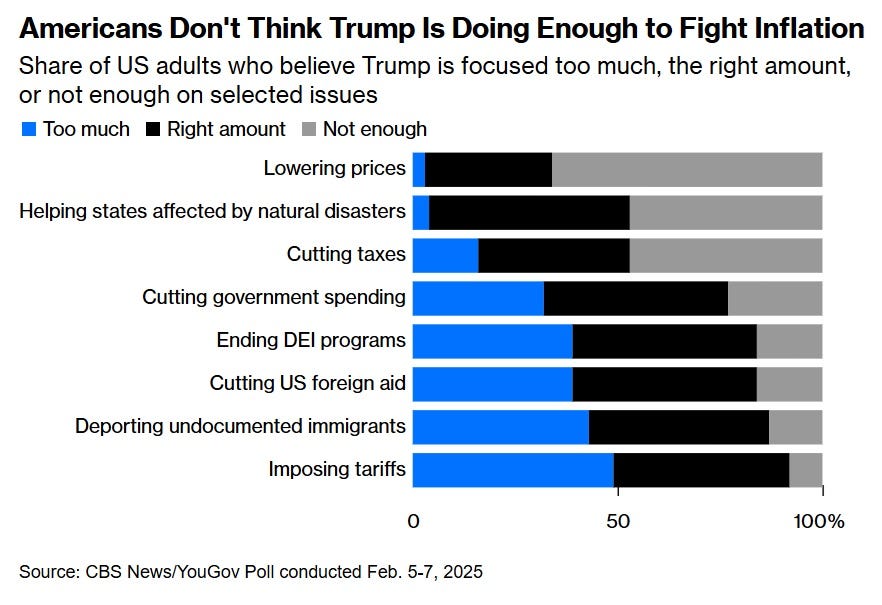
So there are lots of signs that a return to higher inflation may be in the cards for Trump’s second term.
The real economy is still strong…for now
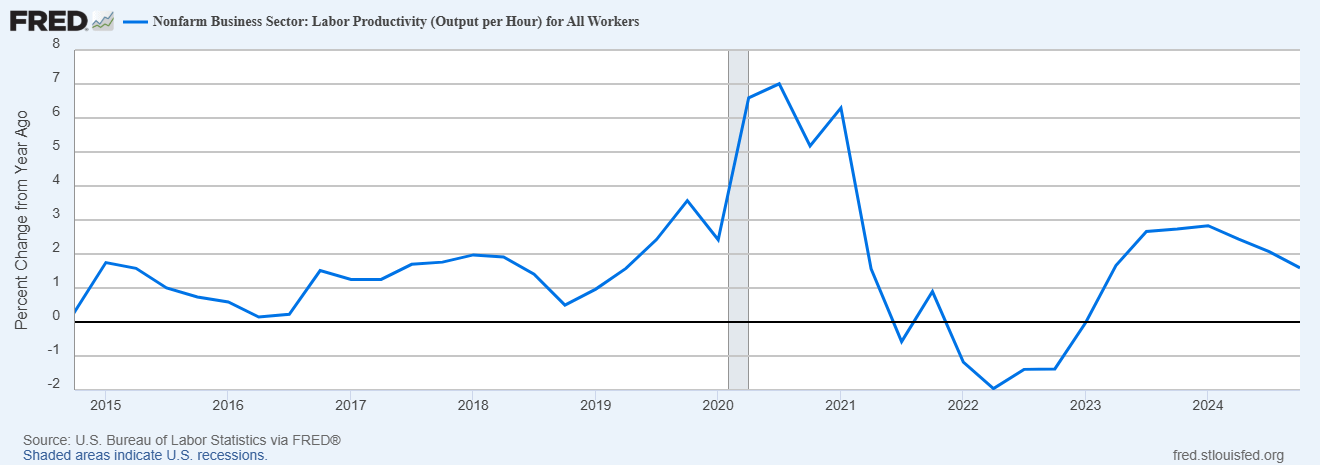
In the Biden years, the U.S. had inflation, but it didn’t have stagflation like in the 1970s — the economy kept growing strongly even as prices got a bit out of control. Strong growth and high employment could continue in the upcoming years, even if Trump does end up causing prices to rise. In fact, U.S. productivity growth — the underlying “engine” of GDP growth — continued to look pretty good in 2024:
And a financial crisis doesn’t look like it’s in the cards — private-sector debt costs are low despite high interest rates, profits are strong, and consumer demand looks robust. The job market is still great. The yield curve — a number that usually (though not always) predicts recessions — has un-inverted, which should let us breathe a sigh of relief.
But if Trump makes the wrong policy move — actually implementing high tariffs, or trying to default on the debt, or some other harebrained thing — it could spook companies and cause a deterioration in economic fundamentals. And many of the policies Trump is already doing — tariff threats that raise uncertainty for businesses, pauses on permitting for cheap solar and wind energy, abrupt cutoffs of various government grants and payments — aren’t particularly good for growth. Of course, tax cuts boost growth a little bit, and Trump’s support for fossil fuels could help a little too. Overall, though, uncertainty and chaos are bad for business, and Trump brings a lot more of those than Biden did.
Thus, there’s downside risk in the economy. And given how highly valued stocks are — price-to-earnings ratios are back in late 1990s territory — it might only take a small surprise on the downside to send markets tumbling.
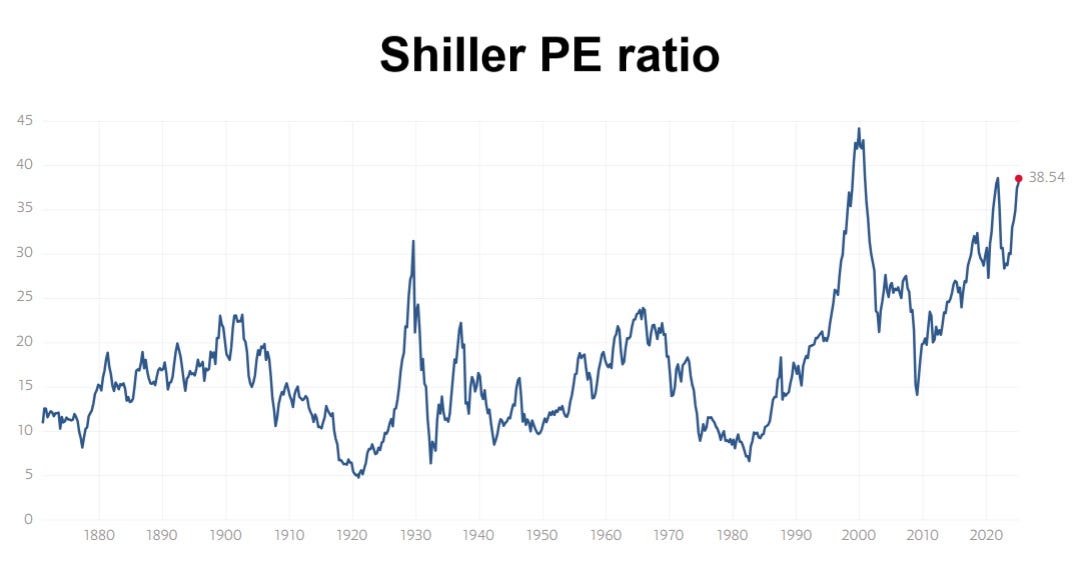
So although the real economy is still good right now, all the risk is on the downside. Even a mild downturn would increase the headaches for the Trump administration. Tax receipts would fall, making it harder to service exploding debt costs, and making inflation even more attractive as an alternative. This could result in at least a mild form of 70s-style stagflation, where a weak labor market combines with rising prices to degrade Americans’ purchasing power.
Donald Trump was brought back to the presidency in part to fix the economy. But unlike Ronald Reagan or Barack Obama, he doesn’t seem to be willing to do what it’ll take to fulfill that mandate. Meanwhile, he inherited a huge stock of debt that neither Reagan nor Obama had to deal with, along with high-ish interest rates. And like Bush, he inherited a real economy that’s at full employment, and thus has mostly downside risks from policy mistakes.
As I always say, macroeconomics is the natural predator of foolish regimes. Unless Trump gets serious about the debt and inflation, and cuts it out with the chaotic tariff threats, he could find himself facing a deteriorating economic situation and an increasingly angry American public.
The big exception to this pattern, of course, was Reagan, who was brought in when the economy was suffering from a prolonged bout of stagflation rather than a typical demand-driven recession. At least at that time, Republicans were trusted more on inflation than Democrats, because they had a reputation for believing in sound money and fiscal austerity. Reagan actually expanded the deficit by a huge amount, but ultimately inflation was defeated by a combination of A) interest rate hikes by Paul Volcker, and B) the breaking of the OPEC cartel and the crash in oil prices.
Here’s how that works. Debt is fixed in nominal terms — in other words, when you borrow $1 trillion, you have to pay back 1 trillion U.S. dollars. But if inflation is high, incomes and corporate profits and sales and everything else that the government taxes goes up in dollar terms — because a dollar is worth less now than before. So government tax receipts jump in dollar terms, and $1 trillion doesn’t look so hard to pay back anymore.