A Chinese company called DeepSeek recently released a series of large language models that are just about as good as the ones made by American companies like OpenAI and Anthropic, but cost less to make. Within much of the media and the tech community, this has been treated as an epochal event — a “Sputnik moment” for the AI race between the U.S. and China.
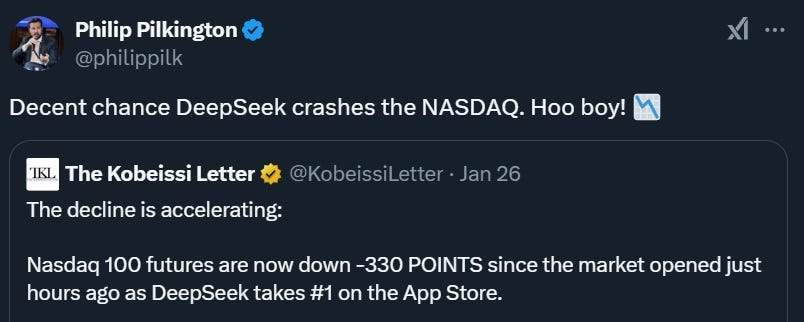
As with the L.A. wildfires three weeks ago, DeepSeek has led to an explosion of hand-wringing, shouting, bad takes, and other social media histrionics. Some people breathlessly proclaimed an imminent U.S. stock market collapse:
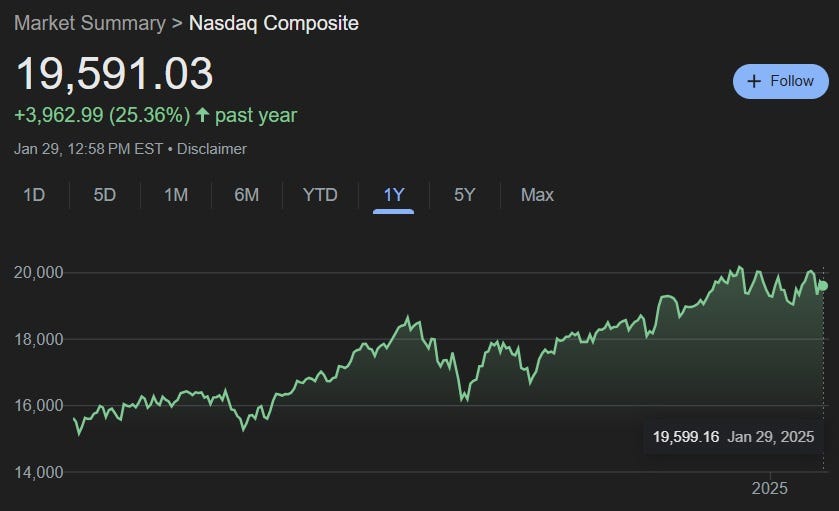
In reality, the Nasdaq is up about 25% for the year, and is at a higher level than it was two weeks ago:
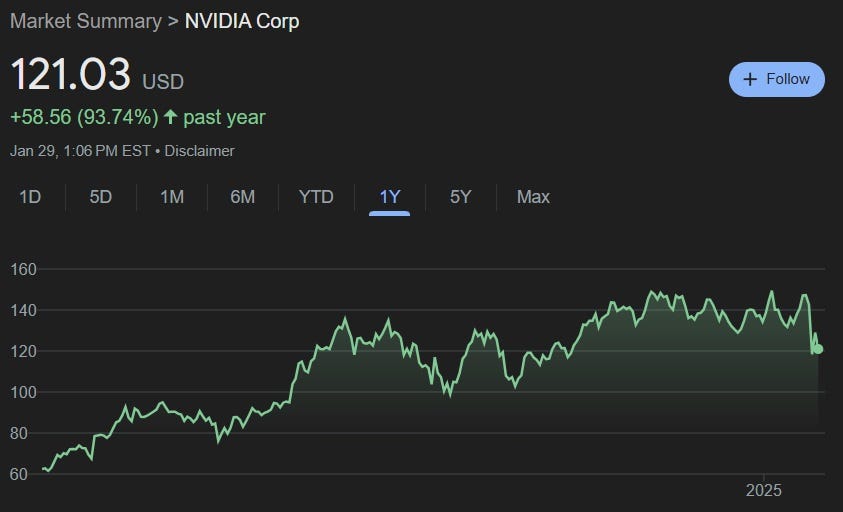
Nvidia stock did take a hit from the news. Nvidia sells GPUs, the chips that are used to train AI models. DeepSeek shows that AI models can be trained using fewer GPUs; this caused many investors to predict that Nvidia’s chips will be less needed going forward. Because Nvidia is one of the world’s most valuable companies, any significant drop will look big in dollar terms. But the company’s stock is only down to where it was last October; over the past year, as of this writing, it’s still up over 90%:
In fact, as many people have already pointed out, there’s a simple reason why more efficient ways of creating LLMs could actually increase demand for Nvidia’s chips. When something gets cheaper, people buy more of it. So if LLMs become cheaper to produce, people will rent LLMs for more tasks. This will require purchasing more chips — especially since newer models use lots of compute for inference (i.e., “thinking” about the answer to each question).1
Whether demand for Nvidia’s chips goes up or down depends on whether the increase in efficiency outweighs the resulting increase in demand for LLMs. It’s certainly true that previous increases in efficiency — which have been enormous — don’t seem to have harmed Nvidia’s valuation much.
Other people declared that DeepSeek would supercharge the global economy. A top macroeconomist declared that the Chinese LLM release would prove more important than the invention of electricity or the internal combustion engine:

Obviously it’s not possible to prove that statement wrong, but it seems highly unlikely, given that the model’s performance is about the same as that of other models — including other Chinese-made LLMs. The idea that DeepSeek is revolutionary is based on the fact that it can do the same thing for much cheaper. But while the company does seem to have made some real innovations here, Anthropic CEO Dario Amodei points out that they’re roughly in line with previous cost decreases. LLMs are a sector where costs have just been falling very fast — there’s no reason to think that DeepSeek represents such a unique structural break from that trend that we should compare it to the invention of fire or the wheel.
Finally, there were lots and lots of takes about U.S.-China competition. DeepSeek probably does have some relevance there, but the apocalyptic tone of much of the commentary here was overblown. There was a flurry of articles with titles like “Does China's DeepSeek Mean U.S. AI Is Sunk?”, while one prominent AI commentator declared that Facebook had sold out America by making its AI open-source:
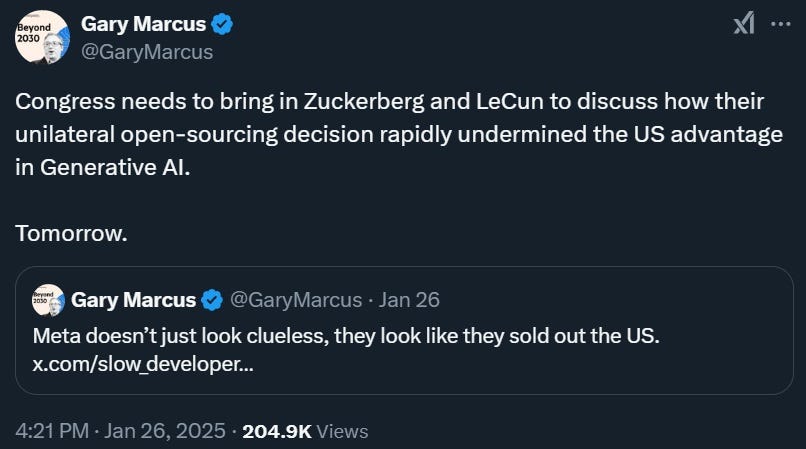
This is a bit silly,2 because DeepSeek itself is also open-source; if Facebook undermined America’s “advantage” in AI, then DeepSeek itself is undermining China’s. A more reasonable conclusion, as I’ll argue, is that there isn’t really that much national advantage here to undermine — keeping this sort of model proprietary is just not really as useful or feasible as in other areas of technology.
In addition to all of these overblown takes, there were lots of serious debates and speculation about DeepSeek. These included questions about what DeepSeek’s key technological innovations are, which chips it actually used to train its models, how much that training actually cost, whether and how DeepSeek evaded U.S. export controls, and so on. Not being an AI expert, I’m not qualified to evaluate those interesting debates.
But even without answering those tough questions, I think that there are some pretty obvious lessons a calm, rational outside observer can learn here, just from the fact that a random Chinese company managed to produce a frontier-level open-source LLM. As I see it, the key early takeaways are:
LLMs don’t have very much of a “moat” — a lot of people are going to be able to make very good AI of this type, no matter what anyone does.
The idea that America can legislate “AI safety” by slowing down progress in the field is now doomed.
Competing with China by denying them the intangible parts of LLMs — algorithmic secrets and model weights — is not going to work.
Export controls actually are effective, but China will try to use the hype over DeepSeek to give Trump the political cover to cancel export controls.
LLMs don’t have much of a moat
One cool thing about LLMs is that you can just see for yourself that the technology works. You can just go download DeepSeek from their website and ask it some questions, and compare it to Claude or ChatGPT or whatever. I wouldn’t necessarily recommend doing that, since DeepSeek will send your data to the Chinese government. But by this point a whole lot of AI people have tested DeepSeek very rigorously, and they’ve concluded that it’s about as good, or at least almost as good, as top-of-the-line models from companies like OpenAI and Anthropic. For example, DeepSeek’s R1 model — an “advanced reasoning” model that spends a lot of computing power generating each answer — is near the top end of the quality scale, somewhat slower, and relatively affordable:
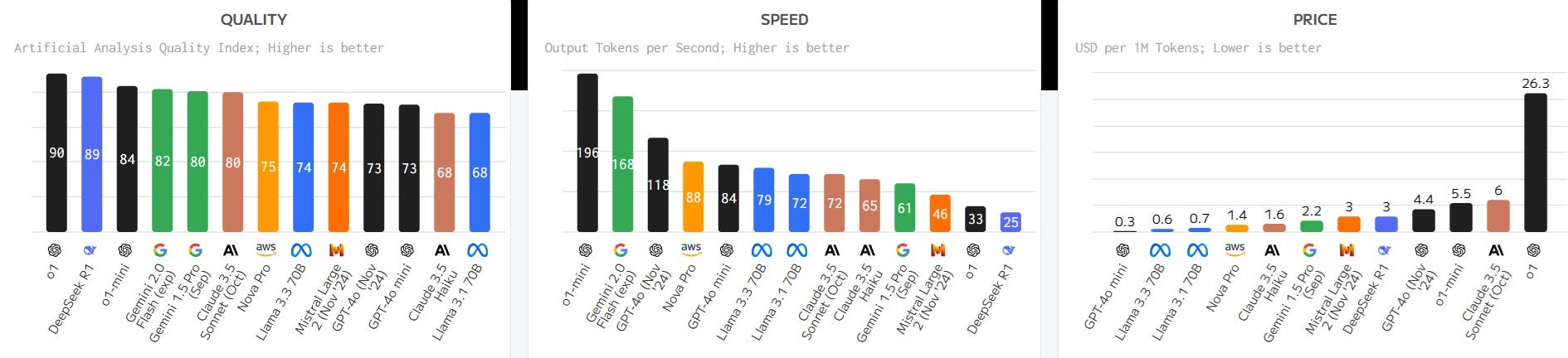
Whether DeepSeek is lying about what chips it used, or how much it cost, the fact is that they made it, and it works. DeepSeek isn’t some incredibly well-funded secret Chinese government lab or national champion company, either — it’s a spinoff from a hedge fund. That doesn’t mean a top-of-the-line LLM is easy to make — it’s not the kind of thing a kid in a garage can program over a weekend — but it’s also clearly not the type of technology that requires a national champion with all of the world’s best AI talent and tens of billions of dollars of capital.
Maybe that’s a lesson we should have learned already. After all, a number of American companies — not just OpenAI and Anthropic, but also Meta and Google — have all managed to make LLMs whose capabilities are in the ballpark of each other. But these are storied American companies with massive investments, famous founders, and trillion-dollar market caps. The fact that a hedge fund in China can replicate this achievement shows that a lot more people could make top-of-the-line LLMs if they wanted to. Renaissance Technologies or Jane Street could almost certainly do it if they wanted to.
In business lingo, a “moat” is something that keeps out competitors. You can’t just go make the next Instagram, because everyone is already on Instagram — its moat is a network effect. You can’t just go make the next ASML, because top-of-the-line semiconductor manufacturing equipment is incredibly hard to make — its moat is proprietary technology. That’s why Meta and ASML are incredibly valuable companies — they’re not just good at what they do, they have the ability to keep other people from copying them.
What’s the moat for the LLM-making business? It’s apparently not talent. Hedge fund quants are great at math (often better than AI researchers, to be honest), and there are a lot of them. They can learn the basics from research papers and open-source model documentation, and then they can play around with the math and try to improve on standard practice. What DeepSeek shows is that for a team of smart math folks, it’s not that hard to actually make some improvements on the state of the art, just by playing around, even if you don’t end up with something that dominates the competition in every regard.
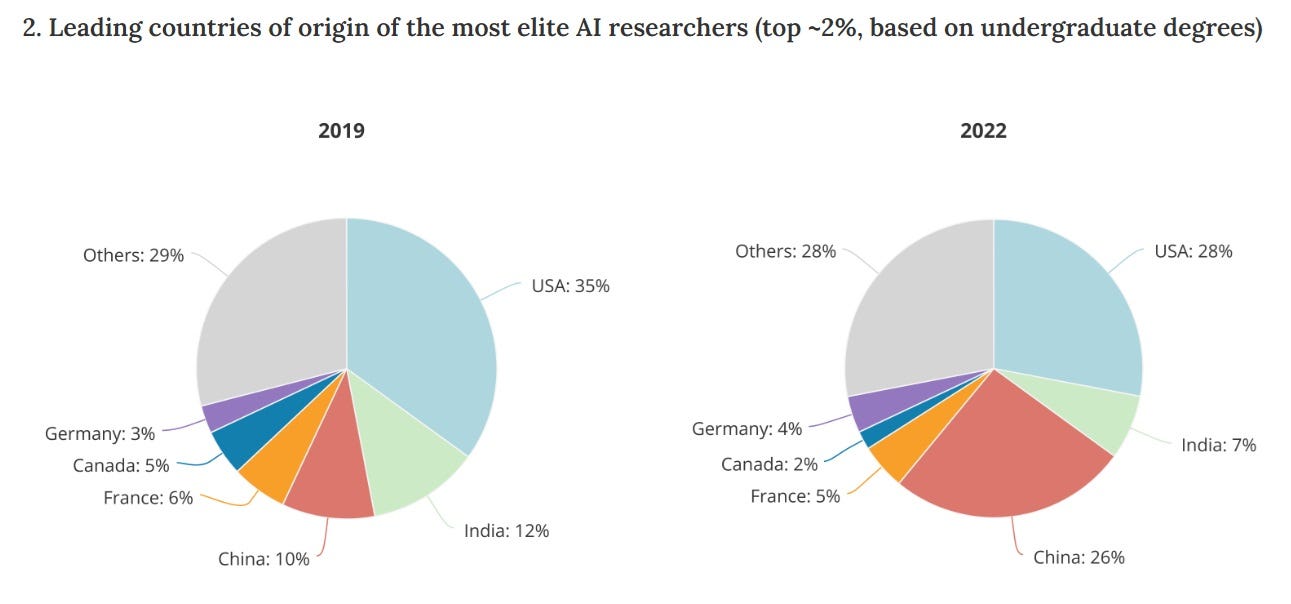
On top of that, there doesn’t seem to be much chance that the U.S. can hoard AI talent for itself. China is rapidly expanding its share of the world’s top AI researchers:
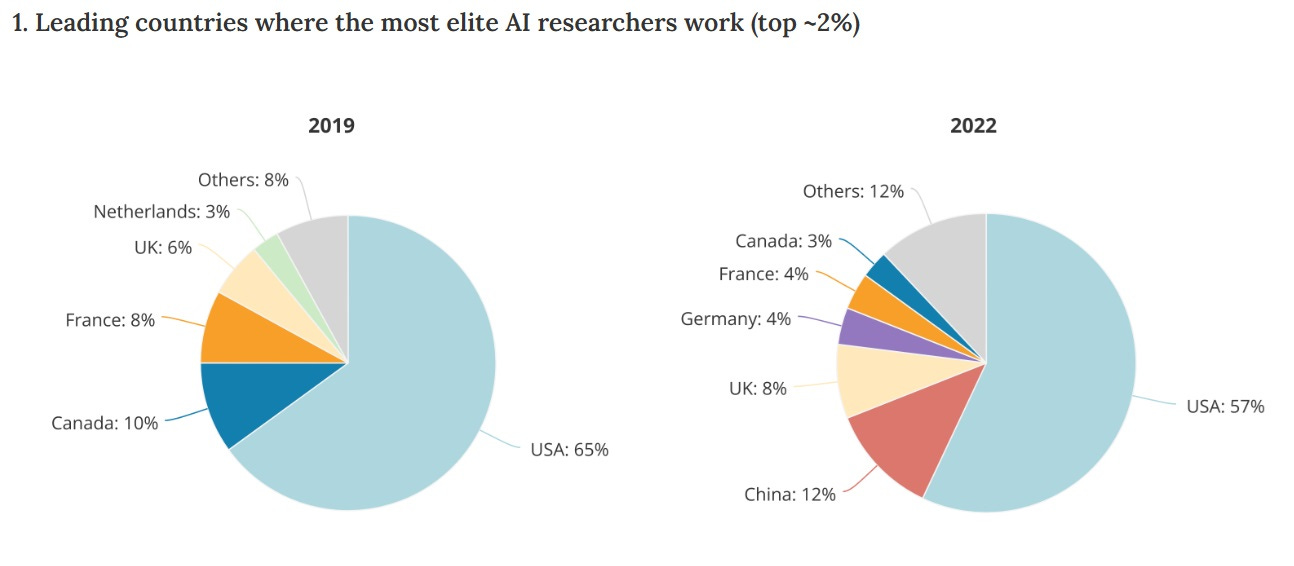
And more of these are staying to work in China — or going back to work in China — instead of working in the U.S.:
Nor does data seem to be a big moat. The internet — the main data source for LLMs — is public, after all. Some proprietary data does exist, but it’s apparently not that hard to grab it using an LLM’s API:
Microsoft’s security researchers in the fall observed individuals they believe may be linked to DeepSeek exfiltrating a large amount of data using the OpenAI application programming interface, or API…Such activity could violate OpenAI’s terms of service or could indicate the group acted to get around OpenAI’s restrictions on how much data they could obtain[.]
This is thought to happen through “distillation” — basically, having one LLM ask another LLM questions in order to train itself. So DeepSeek may have asked GPT a bunch of questions until it learned how to answer questions about as well as GPT. This is against GPT’s terms of service, of course, but terms of service provide a flimsy barrier against pretty much any kind of competitive activity, especially from overseas. But even if companies manage to erect barriers against this kind of data poaching, it seems likely that any well-funded company will be able to create a pretty good dataset — and the more valuable LLMs become, the more well-funded AI companies there will be.
Algorithms themselves also don’t seem to be much of a technological moat. It’s impossible for any AI company to copy another’s algorithm exactly — much of it depends on tweaks, workarounds, and kludges that exist only in the collective memory of a huge number of human employees. But what DeepSeek shows — and what the proliferation of other cutting-edge models should have already shown — is that a company with good talent can come up with its own unique set of tweaks, workarounds, and kludges in a reasonable amount of time and at a reasonable expense.
This is probably because LLMs are advancing so fast in general that there are a whole lot of different undiscovered ways to increase performance, and a new team can just discover a new set of solutions. It’s probably just a lot easier to invent a new, slightly different way to make LLMs good than to reinvent Extreme Ultraviolet Lithography machines or advanced jet engines. LLMs are still in their “let a million flowers bloom” stage.3
Note: I fully expect that in the coming weeks or months, we’ll learn that DeepSeek received a lot more help from the Chinese government, including research, espionage, and resources, than has yet been revealed. The obvious reason to think this is that the model’s pro-regime censorship seems almost perfectly locked down, which would probably require close cooperation between the company and the government; if they cooperated on censorship, they probably cooperated on other things as well. But this only strengthens the case that LLM companies don’t have much of a moat — if the Chinese government was willing and able to help a random hedge fund build a world-class LLM, then it’ll be willing and able to do the same for other companies too.
Anyway, many U.S. companies seem to hope that with effective export controls, hardware — access to the best GPUs in sufficient quantities — will act as their moat against Chinese rivals. It’s possible this could still work, as I’ll discuss in a bit. But hardware will certainly be no moat against other U.S. AI companies, who can all buy Nvidia’s GPUs just fine. And DeepSeek shows how easy it is for new companies to throw their hat in the ring and quickly zoom to the top of the charts.
In other words, the business of making LLMs looks likely to be a brutally competitive one, where technological advantages are short-lived, new entrants are common, and huge capital purchases can become wasting assets overnight. In other words, it may look more like the solar energy business than the traditional software business — a capital-intensive, low-margin business selling a largely undifferentiated commodity product.
In fact, it’s possible that the markets already realized this long before DeepSeek. China’s big AI release barely affected the stocks of Microsoft, Google, and Meta, suggesting that any lessons about the competitive structure of the LLM business had already been priced in. And it’s possible that DeepSeek itself knows it too, which might be why it chose to make its model open source instead of proprietary.
So if LLM companies are going to keep out the competition and make big profit margins, they might have to do it through things like apps built on top of LLMs, or helping companies use LLMs as a service, etc.
The “go slow” approach to AI safety is doomed
The second big lesson I see here is that the approach to “AI safety” taken by the Biden administration, and by a California bill that got vetoed, is just never going to work.
A little over two years ago, Joe Biden issued an executive order on AI safety. It was built around the idea of reporting requirements — companies building advanced AI models had to do various tests to make sure the models were safe, and report the results to the government. And last year, Scott Wiener and some other Democrats in the California state legislature passed an AI safety bill built around the idea of legal liability — if AI is judged to have caused a major disaster, the bill would have held companies liable.
Both of those efforts are now defunct — Trump cancelled Biden’s executive order, while Gavin Newsom vetoed Wiener’s bill. But those were tactical political losses that might be eventually reversed. The release of DeepSeek shows something deeper — the whole enterprise was doomed from the start.
The reason, of course, is that China isn’t subject to U.S. AI safety laws, and they aren’t likely to copy what we do. Reporting requirements and legal liability both slow down the progress of LLMs — the latter even more than the former — by imposing extra costs on LLM companies. The idea is to go careful and slow in developing this technology.
But the U.S. government can only slow down American models. If it does so, China and its AI companies will only be too happy to take advantage of this slowdown by seizing the technological lead for themselves. The Biden/Wiener approach to AI safety was implicitly crafted for a world in which the U.S. was the only country with cutting-edge AI; now that it’s not, the approach is nothing more than a way of handing the destiny of the technology over to the Chinese Communist Party.
This doesn’t mean the whole idea of AI safety is defunct. But it means that future efforts can’t be focused on doing things that slow down America’s AI progress while leaving China’s unperturbed. A new approach might focus on government-funded monitoring of AI alignment, or government-funded research into techniques for aligning AI with human needs.
Competing with China by denying them LLMs is not going to work
Lots of people are thinking about how the U.S. can stay ahead of China in the LLM race. How much military utility LLMs actually have is still an open question, but they might end up being helpful, so it makes sense to try to retain the U.S.’ technological edge.
But one approach — denying China the ability to create advanced LLMs — now seems destined to fail. This is the approach championed by Leopold Aschenbrenner in a long, well-read post last year entitled “Situational Awareness”. Aschenbrenner argued that LLMs will deliver a decisive military advantage, and so must not be allowed to fall into the hands of the Chinese:
Superintelligence will be the most powerful technology—and most powerful weapon—mankind has ever developed….Authoritarians could use superintelligence for world conquest, and to enforce total control internally…[O]nce the CCP wakes up to AGI it has a clear path to being competitive (at least until and unless we drastically improve US AI lab security)…
A lead of a year or two or three on superintelligence could mean as utterly decisive a military advantage as the US coalition had against Iraq in the Gulf War…And I think there’s a pretty clear path for China to be in the game: outbuild the US and steal the algorithms…[U]nless we lock down the labs very soon, I expect China to be able to simply steal the key algorithmic ingredients for AGI, and match US capabilities…Even worse, if we don’t improve security, there’s an even more salient path for China to compete. They won’t even need to train their own AGI: they’ll just be able to steal the AGI [model] weights directly.
In order to prevent China from stealing algorithmic secrets and model weights, Aschenbrenner recommends implementing “supersecurity” procedures at AI labs similar to those employed by the most secretive quant hedge funds.
DeepSeek shows that this idea has already failed. Distillation of American models apparently allows Chinese companies to effectively poach the secret sauce of American LLMs without stealing algorithms or weights. And even if distillation turns out not to have been pivotal in the creation of DeepSeek, the fact is that China now has its own research and talent ecosystem capable of creating new algorithms roughly as good as those of American companies.
Locking down American AI labs, as Aschenbrenner suggests, might result in a lucky break — if American companies happen to develop the (supposedly) all-important superintelligence before Chinese companies, locking them down could conceivably give the U.S. a critical brief advantage in the ensuing cyberwar.4
But DeepSeek shows why turning America’s AI innovation into a fortress is likely to hobble U.S. companies in the race to superintelligence. They open-sourced their model weights and published their algorithmic insights — insights that American researchers and other Chinese teams are already learning from. As Silicon Valley itself has demonstrated time and again, an open innovation ecosystem progresses faster than a closed one; if Chinese companies share all their findings and American companies hoard theirs, Chinese companies will reach superintelligence first.
So if America is going to retain any edge over China in the LLM field, it’s going to have to be through export controls and the hoarding of AI hardware, rather than through the hoarding of intangible assets like model weights and algorithmic tricks. Information, as they say, wants to be free.
DeepSeek doesn’t mean export controls have failed
DeepSeek’s achievements have emboldened opponents of the U.S. export controls that were aimed at holding back China’s progress in AI. The dominant narrative among these folks is that export controls have had a paradoxical effect, spurring China to be more innovative and more successful than it would have otherwise been. For example, Angela Zhang writes this in the Financial Times:
China’s achievements in efficiency are no accident. They are a direct response to the escalating export restrictions imposed by the US and its allies. By limiting China’s access to advanced AI chips, the US has inadvertently spurred its innovation…To reduce reliance on high-end chips from overseas, Chinese AI companies have experimented with novel approaches in algorithms, architecture and training strategies…DeepSeek-V3 embodies the success of this resourceful approach…[This] lays bare the limits of US export controls designed to slow China’s AI progress. While these measures may deliver short-term disruptions, their impact diminishes over time as China innovates to adapt…The inconvenient truth for US policymakers is that strict export controls have forced Chinese tech companies to become more self-reliant, spurring breakthroughs that might not have occurred otherwise.
And at Brookings, John Villasenor offers the same argument.
But while the export controls have certainly spurred great efforts on the part of Chinese researchers and policymakers, arguments like the ones above simply misunderstand the details of the situation. For one thing, DeepSeek was probably developed before export controls became really effective. Also, export controls affect aspects of China’s AI ecosystem that the release of DeepSeek doesn’t really showcase.
Lennart Heim and Sihao Huang explain:
Real export restrictions on AI chips only started in October 2023, making claims about their ineffectiveness premature…Export controls on hardware operate with a time lag and haven't had time to bite yet…China is still running pre-restriction data centers with tens of thousands of chips, while US companies are constructing data centers with hundreds of thousands. The real test comes when these data centers need upgrading or expansion—a process that will be easier for US firms but challenging for Chinese companies under US export controls. If next-generation models require 100,000 chips for training, export controls will significantly impact Chinese frontier model development. However, even without such scaling, the controls will affect China's AI ecosystem through reduced deployment capabilities, limited company growth, and constraints on synthetic training and self-play capabilities…
It is harder for export controls to affect individual training runs, and easier to for them impact a whole ecosystem. Crucially, restrictions on the most advanced chips can effectively constrain large-scale AI deployment (i.e., allowing large numbers of users to access AI services) and capability advancement. AI companies typically spend 60-80% of their compute on deployment—even before the rise of compute-intensive reasoning models. Restricting compute access will increase the PRC's AI costs, limit widespread deployment, and constrain system capabilities. Importantly, deployment compute isn't just about serving users—it's crucial for generating synthetic training data and enabling capability feedback loops through model interactions, and building, scaling, and distilling better models…
The compute gap between US and China—further widened by export controls —remains DeepSeek’s primary constraint. DeepSeek’s leadership openly acknowledged a 4x compute disadvantage despite their efficiency gains. DeepSeek Founder Liang Wenfeng stated: "this means we need twice the computing power to achieve the same results. Additionally, there’s about a 2x gap in data efficiency, meaning we need 2x the training data and computing power to reach comparable outcomes. Combined, this requires 4x the computing power." He added: "We don’t have short-term fundraising plans. Our problem has never been funding; it’s the embargo on high-end chips." [emphasis removed]
Anthropic CEO Dario Amodei also defends the effectiveness of export controls, and calls for beefing them up, directly rebutting the arguments of folks like Zhang and Villasenor:
Well-enforced export controls are the only thing that can prevent China from getting millions of chips…The performance of DeepSeek does not mean the export controls failed. As I stated above, DeepSeek had a moderate-to-large number of chips, so it's not surprising that they were able to develop and then train a powerful model. They were not substantially more resource-constrained than US AI companies, and the export controls were not the main factor causing them to "innovate". They are simply very talented engineers and show why China is a serious competitor to the US…
DeepSeek also does not show that China can always obtain the chips it needs via smuggling, or that the controls always have loopholes. I don't believe the export controls were ever designed to prevent China from getting a few tens of thousands of chips. $1B of economic activity can be hidden, but it's hard to hide $100B or even $10B. A million chips may also be physically difficult to smuggle…
[I]t appears that a substantial fraction of DeepSeek's AI chip fleet consists of chips that haven't been banned (but should be); chips that were shipped before they were banned; and some that seem very likely to have been smuggled. This shows that the export controls are actually working and adapting: loopholes are being closed; otherwise, they would likely have a full fleet of top-of-the-line H100's. If we can close [loopholes] fast enough, we may be able to prevent China from getting millions of chips[.]
So DeepSeek doesn’t actually demonstrate the failure of export controls, or the triumph of Chinese effort in the face of scarce resources. And export controls could still make a big difference. But opponents of export controls — China boosters and propagandists, ideological free traders, amoral industry types who want to sell to the Chinese market, and people who were just always skeptical of the policy — have pounced on the DeepSeek mania to falsely declare that export controls have been proven to fail.
Which is, of course, exactly what China’s government wants. Their hope is that by publicizing a big AI breakthrough, they can undermine support for export controls in America, giving Donald Trump political cover to cancel the policy.
Palmer Luckey expressed the frustration that many of us feel when we watch this dynamic unfold:
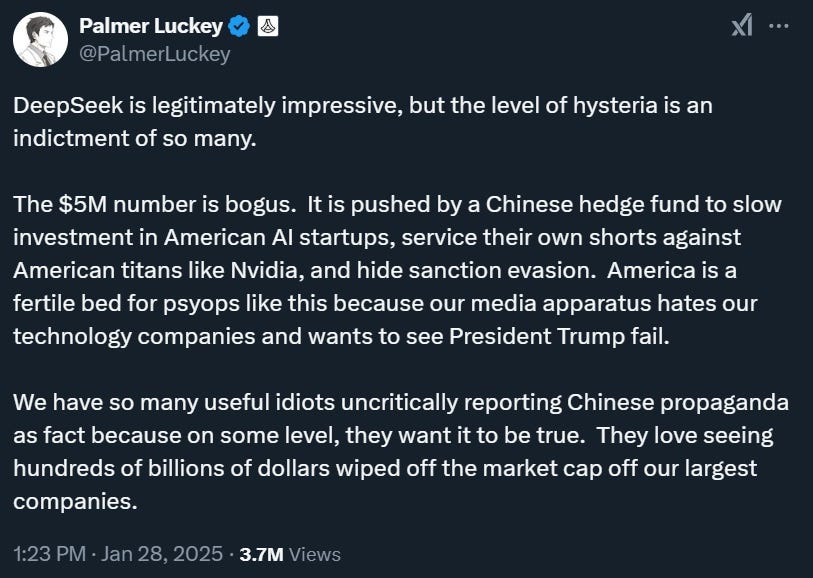
In fact, we’ve seen this movie before. Back in 2023, China’s SMIC came out with a 7nm chip, using equipment purchased before export controls on semiconductor manufacturing tools went into effect. Lots of people looked at this and declared that export controls had failed. Except then over the next year, it turned out that Chinese companies weren’t getting good yields, and that their phone production was suffering as a result, and that their next chip advances had been delayed (perhaps indefinitely), and that tons of Chinese semiconductor companies were shutting down.
Fortunately, the Biden administration didn’t fall for China’s PR push in 2023. I have a lot less confidence in the Trump administration, which seems far more predisposed to appease Xi Jinping.
But in any case, I think DeepSeek represents a real and important technological achievement in an important field. The Chinese engineers who made the breakthroughs deserve our respect, and their success shows the limitations of many American ideas about AI. It’s a legitimate “Sputnik moment”. But that doesn’t mean the U.S. should give up its strategy of maintaining a military-technological edge over China for the next decade, until deterrence stabilizes and tensions calm down.
This is sometimes called “Jevons paradox”, or a “rebound effect”. It’s actually the combination of two different effects — a substitution effect (people buy more of stuff when it gets cheaper) and an income effect (people buy more stuff in general when they get richer).
It’s also silly because Gary Marcus is a major AI skeptic, who spends much of his time saying that this type of model isn’t even very important or useful!
Mao actually said “Let a hundred flowers bloom”, but there has been considerable flower inflation since then.
The idea that the emergence of superintelligence would immediately lead to an apocalyptic cyberwar between the U.S. and China is, of course, pure science fiction. I see no reason to believe that a superintelligence breakthrough would cause war within a matter of months. Launching such a war would be too risky for everyone involved, so the U.S. would not do it. The clear precedent here is nuclear weapons, which the U.S. got in 1945 and the USSR only got in 1949. There were four years in which America could have preemptively nuked and destroyed the Soviet Union, but we didn’t. If the U.S. had a several-month lead or even a several-year lead over China in superintelligence, we would probably not try to attack and destroy China with it, because contrary to what you might read on X, we’re not insane warmongering psychos. And thus China would get superintelligence too, just as the USSR got the atom bomb.