There’s a popular perception that the U.S. presidency has become an “imperial presidency”. Part of this idea is that Congress is so hopelessly gridlocked that the President has begun governing by executive order — basically, an elected king. I don’t think this is true — at least, not compared to the past. Executive orders were more common in the early 20th century than they have been in recent years — Calvin Coolidge issued 215 a year and Herbert Hoover 242, compared to 55 by Donald Trump (so far), and 38 by Joe Biden. Even in terms of word count, we don’t see much change over the years.
As for whether executive orders have overreached in terms of their scope, that is definitely a concern (though it was also a concern a century ago), and I’ll talk about that later. But many modern executive orders are just one President revoking or canceling some executive order of the previous President — often some symbolic culture-war thing. Yo-yoing back and forth between conservative and progressive cultural stances isn’t necessarily the most stability-inducing thing, but it doesn’t make the President a king.
Donald Trump’s flurry of executive orders should be seen in this context. A bunch of what Trump did on his first day in office was just to cancel out stuff Biden tried to do. Ultimately, the effect on the nation won’t be noticeable. But in addition, Trump issued some orders that could have far-reaching consequences, and in a few cases they represent a broadened assertion of presidential power. Time has a good summary. Of course I’ll write more about these orders in the days ahead, but I thought I’d give some rapid reactions. The five main areas I’m going to focus on here are:
Immigration
Environmental review and permitting
Affirmative action and DEI
Energy policy
DOGE and the federal workforce
Canceling birthright citizenship is a terrible idea (and the U.S. isn’t being invaded)
Trump’s executive order on birthright citizenship is his most important, because it’s the biggest test of executive power by far. The 14th Amendment of the U.S. Constitution guarantees birthright citizenship:
All persons born or naturalized in the United States, and subject to the jurisdiction thereof, are citizens of the United States and of the State wherein they reside.
This is a common practice in the Western hemisphere, though it’s rare in the Old World. Immigration restrictionists have been wanting to go after this one for a while, and they finally decided to just go for it and see what happens.
Trump’s executive order says that visa holders — people here on O-1, H-1b, and so on — are not subject to U.S. jurisdiction, and therefore their kids are not citizens even if born in the U.S. (It also says the same about the kids of illegal immigrants.) It doesn’t revoke anyone’s citizenship; it applies only to future kids.
Trump’s EO is not declaring the Constitution null and void, but it’s asserting an interpretation of the text that has already been contradicted by the Supreme Court, way back in 1898. SCOTUS ruled that “subject to the jurisdiction” of the U.S. means that you’re under U.S. law, and visa holders are definitely under U.S. law, so there’s a good chance this executive order will be struck down. Already, states are launching a flurry of lawsuits against the order. (Update: A federal judge has already blocked this executive order, so we’ll see what SCOTUS has to say.) I’m no legal expert, but it seems pretty nonsensical to argue that green card holders are subject to U.S. jurisdiction, but O-1 holders aren’t.
Even if the order does get struck down, however, it’ll probably exert a chilling effect on skilled immigration. The chance to have a kid who’s an American citizen is one reason that the world’s most talented people come to America to work — often on an O-1 visa. Getting those people to work here is a national security priority, as well as a boon to the U.S. economy":
Now those people know that the citizenship of their future children is a precarious thing — a political football. This will probably exert a chilling effect on America’s ability to recruit top talent. The EO also seems badly written, in a way that could potentially be interpreted turn the kids of visa holders into illegal immigrants the moment they’re born (though I bet they’d find some fix for this).
What will the voters think of this move? Birthright citizenship is broadly popular, though not overwhelmingly so. A bunch of recent polls find support for birthright citizenship in the 60% range. But Americans are about evenly split on granting it to the kids of illegal immigrants. As usual, Americans like immigration in general, but really hate the idea that people are violating the country’s rules and getting away with it. It seems possible to me that Trump’s people added visa holders to the EO in order to give a conservative SCOTUS a face-saving way to split the difference — ending birthright citizenship for the kids of unauthorized immigrants, but keeping it for the kids of visa holders.
Anyway, I also think this order confirms a trend that I’ve been noticing since Trump’s first term: The MAGA movement is opposed not just to illegal immigration, but also to high-skilled legal immigration, especially immigration from India. The massive blowup on right-wing social media around Christmastime was all about Indians, and there continues to be a huge amount of hate directed specifically at Indians in right-wing circles. Elon Musk stood up for H-1b workers on X, but if there was any internal battle over it within the administration, his faction does not appear to have come out on top.
All in all, this is Trump’s worst executive order, for any number of reasons, and has the potential to do lasting harm to the fabric of the nation.
It’s also part of a suite of executive orders attacking immigration in general. A lot of this stuff — suspending asylum claims at the border, suspending refugee resettlement, reimplementing the “remain in Mexico” policy, and so on — is stuff that the American people wanted (or probably would want if they understood it). Many of these orders will be challenged in court, as they were in Trump’s first term; permanent resolution of these problems will require Congress to change the asylum law.
But Trump’s legal justification for these orders relies on his declaration that the wave of illegal immigration constitutes an “invasion”. Obviously, this is nonsense — it’s just a bunch of poor people looking for work, the same as it ever was. Declaring that this is an “invasion” seems like a clear recipe for executive overreach.
Restricting environmental review is great
If the birthright citizenship EO is Trump’s worst, the two orders on environmental review — basically, limiting NEPA — are easily his best.
Remember that NEPA and other environmental review laws (like California’s CEQA) are the most important kind of regulation holding back American development, be that housing, green energy, or reindustrialization. These are procedural requirements — even if a development project obeys every single substantive environmental law, NEPA allows NIMBYs to sue to force the developer to complete years of onerous paperwork for the courts before proceeding. This exerts a massive chilling effect on new projects, because developers know they’ll get sued and might have to spend years on paperwork.
To make matters worse, NEPA only applies to projects with government involvement, meaning that the U.S. government has specifically tied its own hands. This has been a huge barrier to industrial policy and the abundance agenda, but progressives have nevertheless fought permitting reform every step of the way, preventing Congress from acting. This resistance to any change in environmental review law has basically hamstrung progressives’ own ambitious project of state-led development, and called U.S. state capacity as a whole into question.
Enter Donald Trump, who has just used EOs to do some of the work that Congress has refused to. As usual, Thomas Hochman is the best source for details of NEPA-related policy:

Hochman explains:
[T]he two big permitting [orders] are the Unleashing American Energy and Declaring A National Energy Emergency EOs. Both are chock full of interesting ideas — and I'm proud to say that if you’ve been reading Green Tape, you will have already gotten a sneak peak of what several of these provisions were going to look like…
President Carter’s 1977 EO, which empowered the Council on Environmental Quality (CEQ) to issue binding NEPA regulations, has been revoked. NEPA will never be quite the same…
Trump has now effectively [ruled] that CEQ does not have rulemaking power…Carter's 1977 Executive Order 11991 is revoked outright…CEQ must propose rescinding its existing NEPA regulations and provide new, streamlined guidance within 30 days…Agencies must prioritize speed, efficiency, and "certainty," with expanded use of general permits and permits-by-rule…
Without those binding regulations in place, agencies are free to adopt much narrower definitions of terms like "significance" and “major federal action,” trim back their alternatives analyses, and treat factors like environmental justice or greenhouse gas emissions as optional rather than mandatory considerations. What’s more, obstructionists can no longer use CEQ regulations as the basis for litigation. All of this could serve to make the NEPA review process significantly less burdensome.
There’s much more detail at Hochman’s blog, so check it out.
Anyway, this is an important and much-needed move by Trump. I’ve been ranting for years now about how America went way too far with anti-development regulation in the 1970s, and left itself utterly unprepared to deal with the new challenges of the 21st century — the housing shortage, Cold War 2, the green energy transition, and reindustrialization. We froze our built environment in amber in the 70s.
Progressives had the chance to change all that when it become apparent that a 1970s-style world was no longer sufficient. They passed on that chance, and now it falls to conservatives to do what needs to be done. Fortunately, Trump is doing it. Whether that will translate into effective reindustrialization and/or abundance remains to be seen, but this is a necessary step in the right direction.
Canceling federal government affirmative action was probably an idea whose time had come
One of Trump’s most important executive orders is his cancellation of a 1965 executive order by LBJ, which banned the U.S. government from discrimination — racial and otherwise — in government contracting.
LBJ’s order might have seemed redundant at the time — after all, the Civil Rights Act of 1964 had already banned discrimination. But LBJ’s executive order created additional enforcement mechanisms within the federal government — instead of just banning discrimination and waiting for people to sue, it told the government to go “take affirmative action” to make sure there was no discrimination. In fact, the term “affirmative action” comes from a similar EO by JFK, which itself followed up on another similar one by Eisenhower.
Over time (ironically, under Nixon) non-discrimination came to mean something along the lines of “disparate impact”, basically establishing soft racial quotas — what we now think of as “affirmative action” for government contracting. Because government contracting affects so many parts of America’s economy and society, this made affirmative action standard practice throughout a fairly large swathe of American society.
Trump has now canceled LBJ’s executive order, meaning that affirmative action in government contracting is now gone. This has been one of the chief goals of the “anti-woke” movement, along with eliminating the disparate impact standard and getting rid of DEI. In fact, the same Trump order also gets rid of DEI departments in the U.S. government — all federal DEI employees have been placed on leave.
Why is this happening now, when conservative Presidents like Nixon, Reagan, and Bush — and Trump in his first term — refused to touch affirmative action? One obvious reason is that the DEI regime that was created in U.S. institutions after the summer of 2020 was far less tolerable than the “old” affirmative action regime that existed from 1965 to 2019. Wacky DEI training materials and compulsory DEI statements were the most noticeable features, but they were probably only the tip of the iceberg — more substantively, the years after 2020 probably saw the rise of quiet discrimination against white people in hiring, contracting, and promotion across large parts of America.
This was all in keeping with the idea that such discrimination was needed as an “antiracist” corrective against entrenched white supremacy. But you have to twist yourself into kind of a pretzel to believe that racial discrimination is necessary in order to implement an executive order banning racial discrimination.
So the likeliest reason Trump & co. decided not to go back to the “old” pre-2020 affirmative action regime is that the “woke” era convinced them that the policies of LBJ, JFK, and Eisenhower had always contained the seed of the post-2020 regime — that affirmative action was always just waiting for its chance to blossom into DEI.
But I think there may have been another reason as well. When the Supreme Court abolished affirmative action in college admissions back in 2022, it didn’t provoke much of a backlash at all — in fact, a majority of the American public agreed with the decision. I wrote a post about it:
Basically, I argued that two big things had changed since the 1960s and 1970s. First, affirmative action largely accomplished its job of building a Black middle class. And second, America’s increasingly kaleidoscopic diversity made it very difficult to determine what racial preferences should look like in principle. Colorblindness is far from a perfect alternative, but it’s just infinitely simpler than trying to adjudicate whether a half-Colombian, half-Bangladeshi American has been more or less disadvantaged than a half-Persian, half-Laotian American.
This is why I predict there will be little backlash to Trump’s ending of affirmative action in government contracting, or his cancellation of DEI. Few people on either side yearn to go back to the “old” pre-2020 affirmative action system; it was a compromise suited to its time and place, but the nation has moved on. As for what will replace it, that is still in flux, and Trump’s executive orders won’t be the last word.
Supporting fossil fuels is fine, but opposing green energy is foolish
Trump’s executive orders on environmental review were great, but another order of his is a big victory for NIMBYism and stasis. He’s basically stopped all wind development on federal land:
President Donald Trump signed an executive order that pauses wind energy development on federal lands and waters…The executive order temporarily stops offshore wind lease sales in federal waters and halts the approval of leases, permits and loans for both offshore and onshore wind energy projects…“We think the EO is likely to significantly curtail the U.S. offshore wind industry over at least the next four years,” Timothy Fox, managing director at the research firm ClearView Energy Partners, said[.]
This is not going to destroy the wind energy industry in the U.S., because almost all onshore wind projects are on privately owned land, not federally owned land. So red states, which tend to be in the interior of the country and are thus much more likely to rely on wind, are mostly safe. But it will probably kill most of the offshore wind industry, since the federal government owns most of the water offshore.
Currently, most offshore wind is in the Northeast, so blue states will be the most affected. Texas, Florida, and other gulf states have a lot of potential for offshore wind, and unless this executive order is rescinded or modified, they could be prevented from developing it. But because these red states tend to have a lot fewer NIMBYs, they can build their wind onshore, where it’s a lot cheaper anyway.
Why did Trump attack an important source of U.S. electricity? As far as anyone can tell, it’s some combination of A) pure emotional NIMBYism (NIMBYs think offshore wind farms look bad, because they think anything different looks bad), and B) culture wars. Unfortunately, America has decided to treat energy as a culture war, with green energy coded as progressive and fossil fuel energy coded as conservative. Biden initially placed some restrictions on fossil fuel development (before reversing most of these because of the Ukraine war), so of course Trump has to hit right back by attacking green energy.
This is part of an incredibly unfortunate pattern in America. Because Americans see energy technologies as fundamentally about climate rather than about abundance, they are at risk of losing the physical technologies of the future because of a stupid culture war:
Now, offshore wind is not that cheap of a technology — the future of energy is mostly solar, with some onshore wind. Blue states could build all the wind power they want, even under Trump’s executive order, by simply cracking down on their local NIMBYs and allowing wind farms on privately owned land. And because Trump’s executive orders make it easier to extract and use fossil fuels, America’s overall energy costs are unlikely to go up as a direct result of this order.
But it’s still a bad sign that Trump and his administration are still seeing energy through the lens of climate change and culture wars, rather than as something we simply need more of:
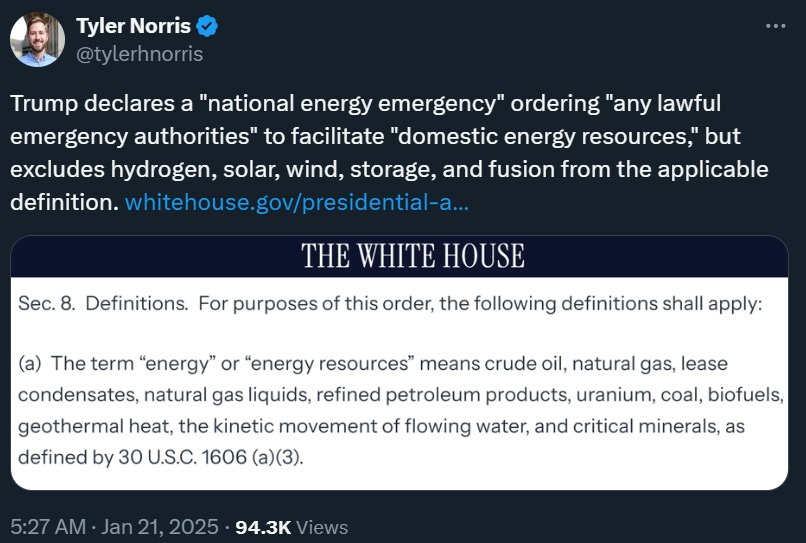
This is a self-defeating and childish way to think about technology, and it will make America a weaker nation.
DOGE looks fine, but drowning the government in a bathtub makes America weaker
Another group of important executive orders concerns the federal civil service. For months, everyone has been talking about DOGE — the Department of Government Efficiency, to be headed by Elon Musk and Vivek Ramaswamy. Now Ramaswamy is out, and Trump’s EO establishing DOGE makes it look pretty cosmetic:
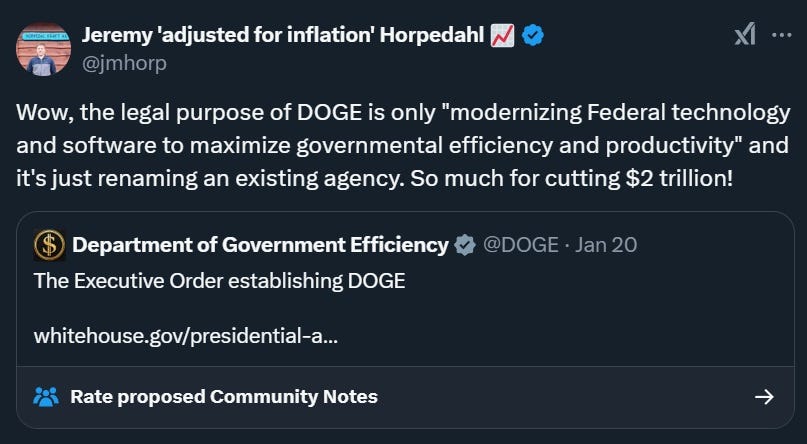
There’s plenty of speculation about DOGE having secret and sinister purposes. But while leaking of classified information via DOGE is certainly worth worrying about, a more parsimonious explanation is that the idea was always more than a little hot air. Musk and Ramaswamy constantly talked about cutting trillions in government inefficiency and waste, but every Republican talks about that, and it never happens. Maybe Elon could have come in and spent a few years in government, and executed his world-beating playbook for running an ultra-tight ship…but he’s got companies to run.
Instead, it looks like DOGE is going to just be a souped-up version of the U.S. Digital Service, conceived by Jen Pahlka in 2014, whose job is to modernize government software and improve the use of software by government employees. I’ve long said that the most important thing for DOGE was to get Elon a copy of Pahlka’s book Recoding America: Why Government Is Failing in the Digital Age and How We Can Do Better, and…well, maybe that’s exactly what happened.
A more foolish executive order is Trump’s freeze on federal hiring. He did this in his first term, too. It’s standard Republican virtue-signaling — a holdover from the days when Reagan made the civil service his chief enemy, and Grover Norquist said he wanted to drown government in a bathtub. But the problems with U.S. state capacity aren’t going to be solved by slashing the federal workforce — they’ll be solved by identifying and eliminating the regulations that stop the government and the private sector from doing their jobs. Scott Alexander had an excellent post about this a couple of weeks ago:


And back in 2023, I argued that cutting red tape would actually require a bigger federal workforce, in order to A) take some of the day-to-day job of administering laws away from lawyers and courts, which suck up far more labor and time, and B) hack through the mountain of regulations that we’ve saddled ourselves with:
Unfortunately, it seems Republicans still haven’t gotten this message. But there’s another interesting development here. Trump also issued an executive order weakening employment protections for federal workers. That might sound like a bad thing, especially when you realize that one reason for doing that is to replace left-leaning career civil servants with right-leaning political appointees.
Yes, doing that could reduce government competence — remember when George W. Bush’s political appointees bungled the Hurricane Katrina response? But at the same time, having a more ideologically balanced federal workforce might eventually make Republicans less wary of the civil service as an institution, and more willing to beef it up. (Then again, this could be cancelled out if Democrats grow to trust the civil service less, as they have stopped trusting the Supreme Court.)
In any case, I hope that the Republicans’ new allies in the tech industry all read Jen Pahlka’s book, and Scott Alexander’s blog, and understand that a smaller federal workforce isn’t necessarily what we need.