“Don’t wanna be a candidate/ For Vietnam or Watergate/ All I want to do is bicycle” — Queen
On their way out the door, the Biden administration made one more bizarre, inexplicable mistake. This Friday, both Biden and Kamala Harris tweeted declarations that the Equal Rights Amendment, which was proposed in the 1970s but never ratified, was “the law of the land”.
Biden and Harris are, of course, totally wrong.1 Their unorthodox strategy for changing America’s Constitution was swiftly defeated, when the National Archivist, Colleen Shogan, calmly refused to certify and publish the amendment. Biden and Harris were left looking a little like Michael Scott from the TV show The Office, standing in the middle of the room and shouting “I…declare…bankruptcy!!!”. It just doesn’t work like that.
This sad little episode reeked of all the same dysfunctions that bedeviled the administration for the last four years. It was a purely symbolic move, no doubt dreamed up not by Biden or Harris but by the young Warrenite progressive staffers who work for them. And even as a purely symbolic move it failed catastrophically, since it made a mockery of Democrats’ claim to be defenders of American institutions. It was popularism without popularity — the kind of ideological virtue-signaling calculated to please a “base” of progressive activists and D.C. insiders so small and so hidden from public view that most Americans are only vaguely aware they even exist.
So what did the Republicans do this week? Well, Trump launched a new cryptocurrency — a “memecoin” that immediately made Trump over $50 billion on paper (though a second, Melania-themed coin caused the Trump coin’s price to temporarily crash). Watching the President-Elect of the United States use his power and prestige to extract untold amounts of money from his own followers just days before his inauguration was dismaying to many crypto lobbyists, who have spent years trying to convince the country that their industry isn’t just a vehicle for scams.
Trump then spent the weekend attempting to save TikTok from shutting down, continuing his abrupt about-face on the Chinese government-controlled video app. “SAVE TIKTOK!”, he posted, promising to give the app a 90-day extension in order to give it more time to sell itself to a non-Chinese buyer (despite the app’s owners indicating they have no intention to sell), and offering to have the U.S. government take a 50% stake. This has naturally dismayed and angered many conservatives, who fought hard to ban the app. Even Elon is concerned.
Trump’s move likely isn’t about populism — the divestment bill is still very popular, and many of TikTok’s own users even wish the app would go away. Instead, it’s a sign that the incoming administration can be bought, even by its earlier sworn enemies. Naturally, Trump’s most hardcore fans on social media have all rapidly pivoted from screaming for a TikTok ban in 2023 to screaming against a TikTok ban today, underscoring the personality-cultish nature of the MAGA movement.
So as Trump prepares to take the reins, America’s people seem to be left with an unappetizing menu of movements to believe in — an out-of-touch elite pushing an unpopular ideology, or a grifting corrupt circus. Where does that leave us? What ideals do we have to guide us through the strange new world of the 2020s?
Americans have had it with progressivism…but is conservatism coming back?
Back in October, I wrote about the “vibe shift” — the sudden hard turn of Western societies away from the progressivism that defined the previous decade:
There are actually two points here — first, that many progressive ideals have become unpopular, and second, that many progressive policies have proven themselves ineffective.
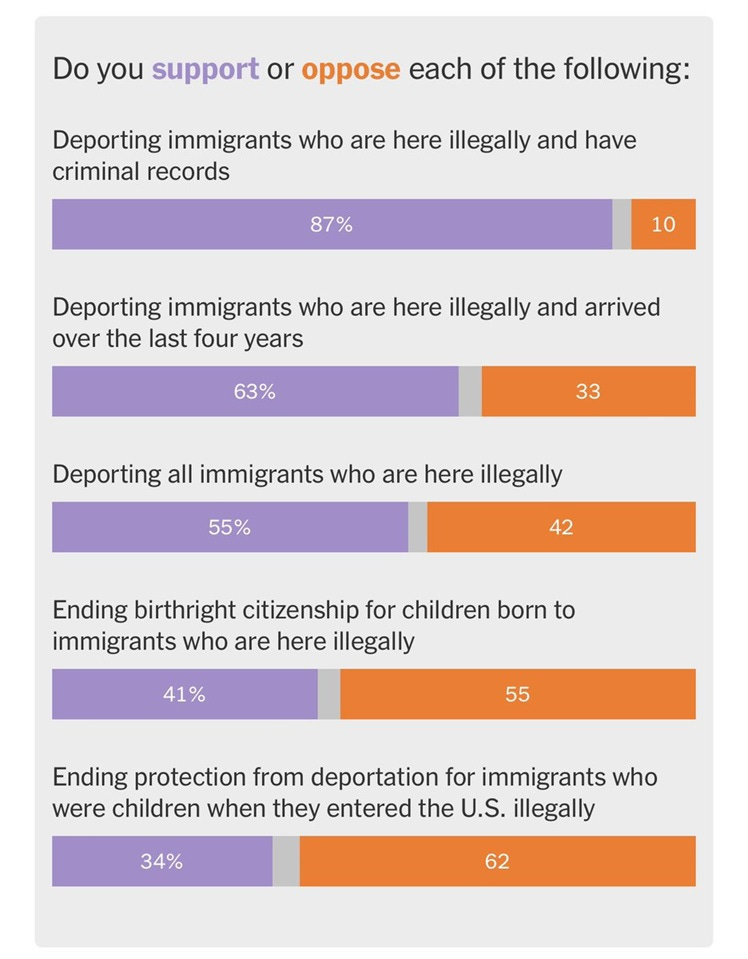
Let’s start with the unpopularity. A new New York Times poll found that while Americans are still generally pro-immigration, and while they don’t support some of Trump’s extremist policies (e.g. ending birthright citizenship), they do support mass deportation:
And the poll also found increasing skepticism of the trans movement:
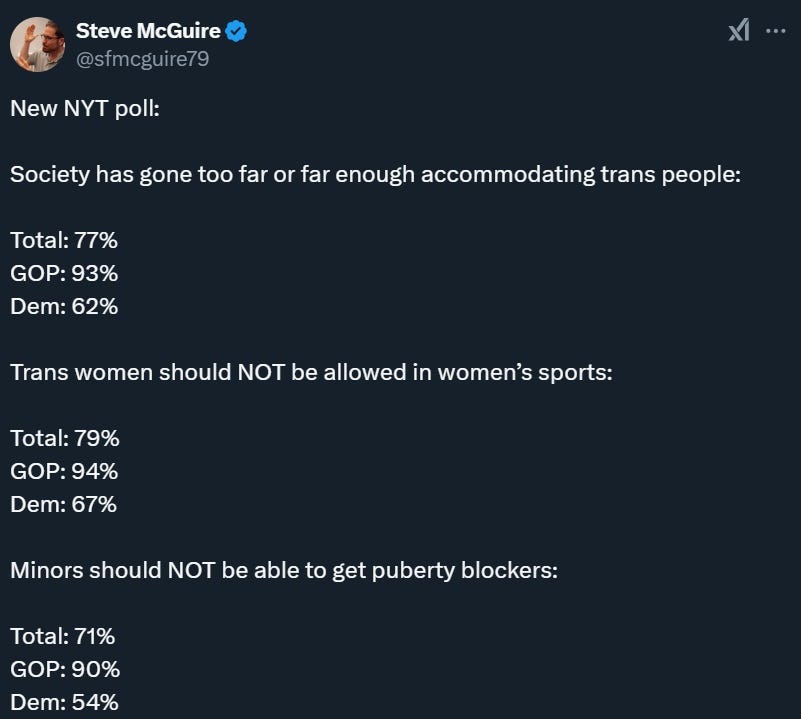
Note that solid majorities of Democrats oppose the Biden Administration’s policies on puberty blockers and trans athletes.
It’s hard to prove conclusively, but I suspect that underlying specific issue polls like these — and on other issues like policing, affirmative action, etc. — there’s a deeper rejection of the quasi-religious ideology that came to supplant 20th century liberalism in the imaginations of America’s progressives. Those include the idea that America is a nation founded on racism, that American politics are fundamentally a racial struggle for supremacy between whites and people of color, that corrective “antiracism” must be applied to every nook and cranny of American society, that immigration represents reparations for colonialism, and so on.
Most Americans, I think, would rather just have a normal country where people of different backgrounds and appearances live side by side instead of struggling for dominance, governed by more or less the same old ideals of freedom, non-discrimination, and equal opportunity that largely won out in the 20th century.
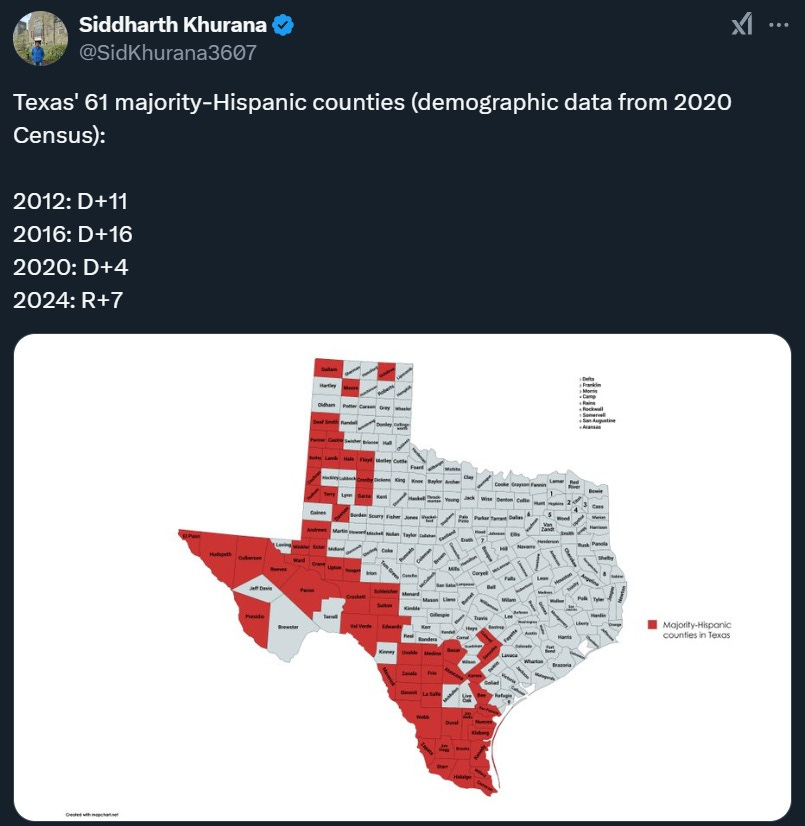
Meanwhile, Democrats’ hopes that identity politics would build a durable coalition of educated younger white people and nonwhite voting blocs appears to have been dashed. Hispanic and Asian voters are moving toward the GOP. This doesn’t exactly come as a surprise to someone who grew up in Texas:
Meanwhile, as Eric Levitz notes, young people are not the reliable constituency that Democratic strategists had believed:
AP VoteCast shows Harris winning voters under 30 by just 4 points in 2024 after Biden had won them by 25 — a development that suggests the youngest, newly registered voters were unusually rightwing last year…Meanwhile, election returns show that Democrats lost more ground between 2020 and 2024 in younger parts of the country than in older ones…Finally, the fact that the youngest zoomers are aberrantly conservative is also apparent in some states’ voter registration data. Voters 18 to 25 in North Carolina were more likely to register as Republicans than Democrats over the past four years, a break with that purple state’s historical pattern.
And the most progressive Democrats are doing the worst in elections, with stalwarts like Bernie Sanders and Elizabeth Warren actually underperforming Kamala Harris, while moderates outperformed.
Voters aren’t just rejecting a few progressive policies; they’re rejecting any leader associated with the progressive project. Interestingly, this shift seems to be happening in a lot of other developed countries at the same time.
And progressivism’s failure isn’t just a matter of public opinion, either; it has also failed on the substance. While Biden’s administration saw many economic successes, these were due to prudent centrist things like industrial policy and prudent macroeconomic management. Biden’s more progressive policies were largely failures. His student debt cancellation and health care subsidies exploded the deficit, while carrying out little actual redistribution. His stimulus spending was too large, exacerbating inflation. He sided with union leaders even when they were wrong. And worst of all by far, he did little to cut through the sea of red tape — environmental review laws, contracting requirements, and other regulations — that strangled a number of his policies.
Meanwhile, progressive governance at the city and state level has positively disintegrated, allowing chaos and disorder to flourish while building up huge amounts of debt and sending enormous amounts of taxpayer cash to ineffectual nonprofit organizations.
In sum, progressivism has basically run aground both as an ideology and as a governing approach. This is going to make it extremely hard for Democrats to pull off the kind of rapid turnaround they carried out in the mid-2000s, when they followed up their 2004 loss with midterm wins in 2006 and Obama’s election in 2008.
In the 2000s, Democrats responded to George W. Bush’s big mistakes — the Iraq war, Hurricane Katrina, and the financial crisis — by becoming more progressive. But unless Trump makes equally catastrophic errors — and let’s all hope he doesn’t — that trick will be hard to repeat. And because Americans have now tasted progressivism and found it largely not to their liking, the ideological shift that’s probably necessary in order to win back the nation’s trust won’t automatically be something that also turns out the Democratic base. And getting more organized — which in practice just means creating more progressive activist NGOs to do more pressure campaigns — isn’t the answer either, because those orgs are now known to be toxic.
For Democrats, this means both moderating their ideology and waiting for the GOP to screw things up. There really isn’t any other path back at this point. But that means falling back to the approach that Bill Clinton used in 1992 and Barack Obama used in 2008 — naturally frustrating for everyone who thought the country had moved decisively leftward since then, and that a new progressive economics had supplanted the old orthodoxy. The 2010s-era dream of a a leftward crusade has been dashed, and it’ll be a while before a new dream replaces it.
But while progressivism has run aground, there are few signs yet that true conservatism is making a comeback. When Americans say they want mass deportations, or that they don’t want trans athletes in women’s sports, we say that the nation is becoming more “conservative”, and that’s fine. But when I was young, conservatism was about much more than opposing the left — it represented a way of life and a set of values that has diminished severely in the decades since.
For example, when I was young, American conservatism was closely intertwined with Christianity — in fact, some called it a Great Awakening. But religiosity in America is now in steep decline:
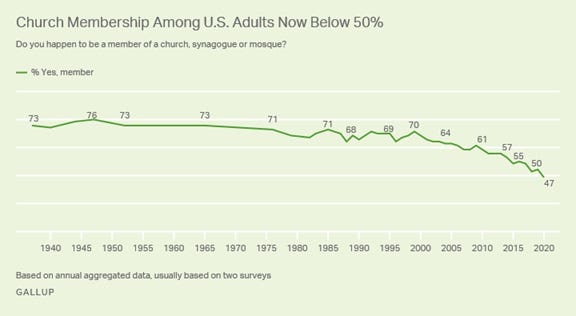
Family formation has cratered, as young people avoid marriage and fertility rates plunge. Some on the Right decry these trends, but some “manosphere” influencers tell their followers that marriage and kids are for losers. Perhaps a revival of religiosity in American could turn things around, but so far I don’t see one in evidence.
And what about belief in hard work? When right-wing influencer Chris Rufo declared that it’s possible to get ahead in America working a good honest job at Panda Express or Chipotle, he was attacked viciously by his own readers, many of whom declared that such work was beneath them, and most of which spun fantasies about how the modern economy makes it impossible for young men to get ahead. The right-wing base — or at least, its online mob component — appears to share the same disdain for work that we normally see from leftists.
Perhaps nothing demonstrates the anemic state of American conservatism better than the war in Ukraine. Supporting the Ukrainians should be a conservative cause — it’s a bunch of tough, self-sacrificing nationalists standing up to defend their homes and families (against a sworn enemy of America, no less). But the MAGA movement has somehow convinced itself that the valiant Ukrainians are weak, effeminate grifters, and that it’s the new Russian empire, with their videos of soldiers doing pushups, who represents manly virtue.
America is shifting to the right, yes. But it’s shifting rightward on issues defined by progressives. This is fundamentally still a backlash rather than a crusade. Unlike in the late 1970s and 1980s, there’s still not a conservative movement showing America a different way to live. Instead of Jesus and the USA, the modern right turns to crypto scams, “manosphere” influencers, online trolling, frog memes, and the cult of Trump.
And then there are the sensible centrists — myself among them. Since Trump got elected, a number of people affiliated with the Democrats have told me that I need to guide the party in a new direction, in cooperation with other writers like Matt Yglesias and Ezra Klein. They cite the “abundance agenda”, and industrial policy, as better directions for the Democrats.
I’m flattered, but I’m hardly up to that task — I’m a nerd, not an ideologue. I have thoughts on policy, and I can make a reasonably eloquent case when I need to, but I’m no movement builder. And although Matt and Ezra are great guys who are better at thinking about politics than I am, they’re fundamentally nerds like myself.
The abundance agenda is great, and I think it’s going to be broadly popular and successful going forward. Industrial policy is great if done correctly, and I think it’s probably going to succeed as well (though this will involve it being partially co-opted by the Right). But while these are smart policies, they don’t constitute a vision for a nation or a society. Yes, it’s great to have a cheap house, cheap energy, and cheap health care. Yes, it’s great for America to be able to defend itself and its allies against China and Russia, and it’s probably also healthy for us to diversify our economy and increase exports. But none of these things tell us how we ought to relate to our neighbors and countrymen.
If there is an ideology undergirding the abundance agenda and industrial policy, it’s that we’re all in this together. The reason we want Americans to have more houses and energy and stuff is that they’re Americans like us. The reason we want America to be able to defend itself against outside threats is that our fates and those of our countrymen are inextricably linked.
This, fundamentally, was the ideology that Franklin D. Roosevelt used to unite America during the dark days of the Depression and World War 2. And although we usually think of Reagan as the antithesis of FDR, there were echoes of the same idea in the patriotic sentiment and optimism that Reagan embodied.
Donald Trump’s second term begins today. He is no FDR and no Reagan, and I have little confidence in his ability to lead the nation. But during this term, America will celebrate its 250th birthday. Trump notwithstanding, perhaps that will be an occasion for a revival of the patriotism that underlies all successful societies — a reminder of what we owe each other as citizens of the same country. Perhaps that country can be something for us to believe in again, as it was in the time of our parents and our grandparents.
The original amendment stipulated that it had to be ratified within a certain time limit, and that limit long passed; several states that initially ratified it have since rescinded their ratifications; and courts have affirmed that the ERA is not the law of the land.