Back in April, Congress passed a bill that would force TikTok and other social media apps that are “controlled by a foreign adversary” to sell themselves to buyers in the U.S. or friendly nations. If the apps don’t sell, they can no longer be legally downloaded from app stores. This so-called “TikTok ban” — which isn’t really a ban, just a rule about corporate ownership — was set to go into effect one day before the next presidential inauguration.
TikTok’s Chinese parent company, ByteDance, had many months to sell TikTok, and would have doubtless find a willing buyer. Instead it refused. In fact, now TikTok is apparently planning to shut itself down completely, going far beyond the penalty that the U.S. law itself stipulates:
TikTok plans to shut off its app for U.S. users on Sunday, when a federal ban on the social media app could come into effect, The Information reported on Tuesday, unless the Supreme Court moves to block it…If TikTok shuts off for all U.S. users, the outcome would be different from that mandated by the law. The law would mandate a ban only on new TikTok downloads on Apple…or Google…app stores while existing users could still continue using the app for some time.
The reason, according to Bloomberg, is that Chinese officials really don’t want the TikTok app leaving their control:
Beijing officials strongly prefer that TikTok remains under the ownership of parent ByteDance Ltd., the people say, and the company is contesting the impending ban with an appeal to the US Supreme Court. But the justices signaled during arguments on Jan. 10 that they are likely to uphold the law.
As many observers have noted, this tells us two important things. First, it tells us that Chinese officials are the ones calling the shots with regards to TikTok. This should be no surprise, given that ByteDance is legally required to obey CCP directives.1
Second, the refusal to sell the app tells us that the Chinese government would rather see TikTok destroyed than see it fall into American hands. Notably, that same government put up little fuss back in 2020 when the U.S. forced a Chinese company to sell the gay dating app Grindr to an American company. Why shut down TikTok and leave untold billions of dollars on the table, instead of just selling the thing like Grindr was sold?
One possibility is that it’s an attempt to make young Americans angry, in the hopes that they’ll demand that Trump and Congress repeal the 2024 law. But a simpler explanation is that Chinese leaders simply think that TikTok, unlike other apps, is so important that they would rather destroy it than see it escape their control.
Why? Some supporters of the divestiture bill argue that TikTok will transfer Americans’ personal data to the Chinese government — something it has already admitted to doing in a few cases. Others are concerned with TikTok’s social harms. But the biggest concern is that by controlling the TikTok algorithm, the Chinese government might be able to propagandize America’s young people — and to silence Americans who say things it doesn’t like.
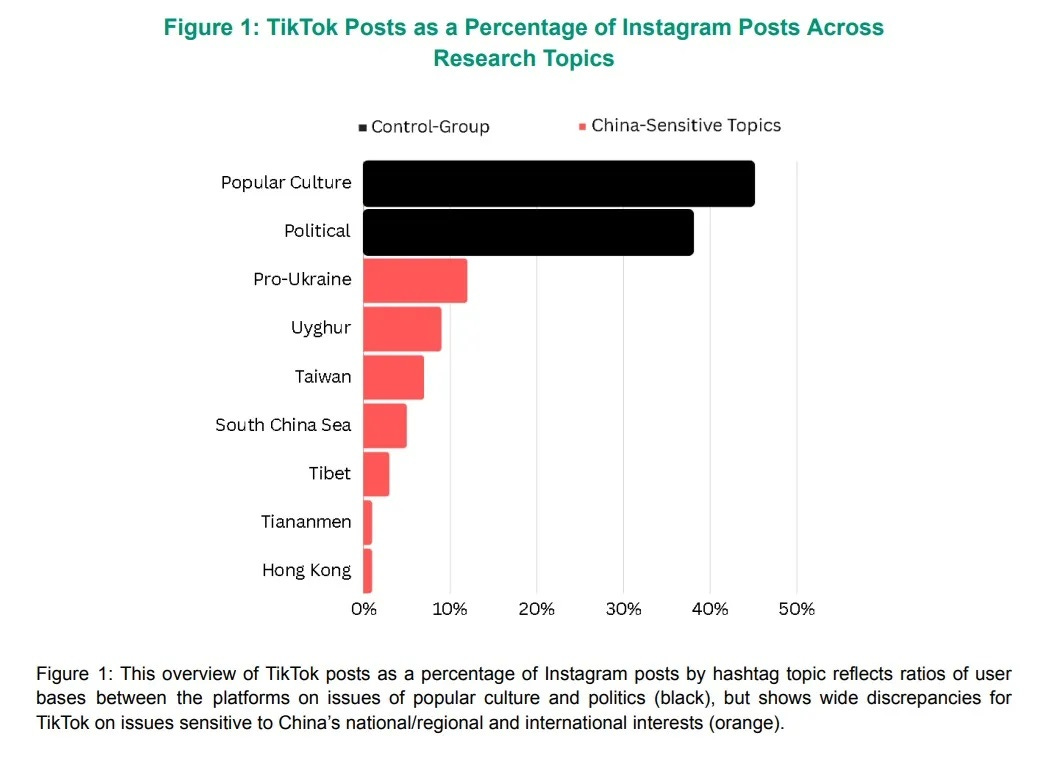
In fact, there’s some pretty strong evidence that TikTok already does exactly this. Rutgers University’s Network Contagion Research Institute has produced a number of papers about TikTok’s manipulation of information to suit Chinese government desires. The standard methodology is to compare topics on TikTok to similar topics on Instagram and YouTube. The NCRI people find that content on the different platforms is broadly similar, except where China-related issues are concerned. Here’s a chart from a paper back in 2023, comparing hashtags on TikTok and Instagram:
And this is from the abstract of a more recent study, which measured what types of content appear in people’s algorithmic feeds:
[Our] studies explored how TikTok, a China-owned social media platform, may be manipulated to conceal content critical of China while amplifying narratives that align with Chinese Communist Party objectives. Study I employed a user journey methodology, wherein newly 19 created accounts on TikTok, Instagram, and YouTube were used to assess the nature and 20 prevalence of content related to sensitive Chinese Communist Party (CCP) issues, specifically Tibet, Tiananmen Square, Uyghur rights, and Xinjiang. The results revealed that content critical of China was made far less available than it was on Instagram and YouTube. Study II, an extension of Study I, investigated whether the prevalence of content that is pro- and anti-CCP on TikTok, Instagram, and YouTube aligned with user engagement metrics (likes and comments), which social media platforms typically use to amplify content. The results revealed a disproportionately high ratio of pro-CCP to anti-CCP content on TikTok, despite users engaging significantly more with anti-CCP content, suggesting propagandistic manipulation. (emphasis mine)
In other words, the Chinese government is actively silencing the views of Americans who try to criticize that government. Somehow I doubt that the First Amendment’s protection of free speech was intended to protect the right of foreign governments to silence American individuals from speaking their mind in popular public forums. That would be a very strange definition of “freedom of speech”. Of course, I am no legal scholar, so I’ll have to wait on the Supreme Court to make that judgement, and abide by what they decide.
(Update: The Supreme Court has ruled unanimously that the law forcing TikTok to divest is constitutional and does not violate freedom of speech.)
One other thing to note is which prominent Americans have indicated their opposition to the TikTok divestiture bill. The most prominent opponent, of course, is incoming President Donald Trump, who may have been swayed by a billionaire TikTok investor, or might believe that the TikTok algorithm has been tweaked to benefit him. Another is Elon Musk, who has expressed opposition to the ban, consistent with pro-China positions on a number of other issues. In fact, Bloomberg reported yesterday that China was considering selling TikTok to Musk, although the company denied the report. Together, Trump and Musk might conceivably find some way to bring the CCP-controlled video app back.
So that’s where things stand. I think the outcome of the TikTok fight is important for several reasons. First, it’s part of China’s attempts to put increasing pressure on America, potentially in advance of a major conflict. And more broadly, it’s an important bellwether of whether liberal societies — defined as those who place paramount importance on individual freedom and dignity — have what it takes to survive and thrive in the 21st century, or whether the next epoch in human history will belong to the authoritarians.
The Chinese government is not our friend, and it is coming to get us
The heading of this section might sound inflammatory, or even warmongering. Some leftists will inevitably call it racist. But I think it’s important to understand the difference between the Chinese people and the Chinese government. The former are ambivalent toward America and hold a variety of positive and negative opinions, while the latter are practically obsessed with weakening or overthrowing the U.S.
After a recent trip to China, Dwarkesh Patel wrote:
In China, liberal pro-Western voices are often censored or shouted down. If I was the US President, and I wanted to win hearts and minds in China, here's what I'd do. In every single speech where I'm talking about China, I'd make a conspicuous effort to complement Chinese people, Chinese values, and Chinese culture…[S]howing our admiration for Chinese people and their achievements (who genuinely are fucking killing it everywhere where they're not held down by communism), undermines the central narrative of the regime - that the West is hell bent on holding Chinese people back, that they have no respect or understanding of their culture, and that the CCP is a necessary bulwark against these imperialists.
I think this is very wise, and probably the correct approach. China is a great civilization — not just for its ancient accomplishments, but for its modern-day ones as well. By manufacturing and exporting vast amounts of solar power, batteries, and electric vehicles, China has accelerated the transition to the era of green energy; despite its continued heavy use of coal, the country’s technological and industrial feats may eventually be what saves the world from the scourge of climate change. In fact, China is already highly innovative across a large number of fields. And as they reach a middle-class lifestyle, Chinese people are beginning to turn their talents toward more artistic and culturally creative pursuits as well, despite their government’s pervasive censorship. In general, I think Americans should try to increase cultural and interpersonal contacts with the Chinese people, to promote understanding and long-term friendship.
But at the same time, the people now in charge of China — Xi Jinping and his circle of loyalists — want the United States and its democratic allies to be weaker and poorer. I heavily recommend Rush Doshi’s book The Long Game: China's Grand Strategy to Displace American Order, in which he exhaustively combs through official Chinese documents, speeches, and communications, and concludes that displacing American power is at the core of the current leadership’s goals and vision for the world. It’s a dry book, but if you want something easier, there are a lot of other good books making the same general point — Bethany Allen’s Beijing Rules, Dmitri Alperovich’s World on the Brink, Susan Shirk’s Overreach, and so on.
The common thread in these books is that China’s leaders are readying their nation for a confrontation with the United States. Xi and his people see the U.S. as the main obstacle to achieving the level of international power and influence that they think China deserves — the only nation that’s capable of putting up a serious fight against Chinese global hegemony.
This is why trying to appease China simply won’t work. Some Americans comfort themselves with the belief that if we give the country’s leaders what they want — remove export controls and tariffs, cancel industrial policy and cede manufacturing industries to China, let China conquer Taiwan unopposed, and so on — then they will become satisfied and leave us alone. This obviously failed with Hitler, but the people who think it’ll work with China tell themselves that the Chinese have historically not been a warlike culture,2 and will be satisfied with Taiwanese “reunification” and a bit of fawning and praise.
This will not work. Put yourself in the position of a hawkish Chinese leader who sees America capitulate on Taiwan, on technology and manufacturing, and on every other current issue. Would you simply assume that any American threat to Chinese power was over, and that China could now go back to peaceful development, unconcerned with developments in the U.S.? No, you would not. You would correctly see perceive that your most important adversary had given you a temporary opening that you could exploit to weaken it for the long term. You would correctly assess that only American long-term weakness, rather than America’s short-term goodwill, would remove the threat posed by the U.S.’ inherent geographical, demographic, and technological strengths.
And so you would do everything you could to take maximum advantage of America’s moment of capitulation. You would try to weaken the U.S. economically, by grabbing up access to scarce minerals around the world and seizing control of key trade routes. You would try to weaken the U.S. geopolitically, by either subverting, dominating, or weakening America’s allies in Asia and Europe. And you would try to weaken America socially, by using propaganda to stoke racial and partisan divisions in American society.
One reason we know China is thinking about doing those things is that it is already doing a version of all of them. It’s trying to forcibly deindustrialize Germany and Japan with underpriced exports. It has successfully monopolized the refining and processing of a number of critical minerals, and is using export controls to deny these minerals to the United States. And TikTok, which has already been weaponized to suppress Americans’ criticisms of China, could easily be weaponized to stoke racial strife of the type that roiled America in the 2010s and the summer of 2020.
Nor are these even the most aggressive things China’s government is doing toward the U.S. and its allies! Here are a few others:
Chinese ships have been cutting internet cables in the Baltic Sea and near Taiwan, and in fact has developed technology specifically for the purpose of cutting undersea cables.
The FBI has revealed that Chinese hackers are “prepositioning” themselves to be able to swiftly destroy critical U.S. infrastructure.
China’s drone manufacturer, DJI, has weakened the “geofencing” of its drones in the U.S., making it easier for people to fly these drones over military bases. (Some Chinese exchange students at the University of Michigan were recently caught taking photos of training exercises at a U.S. military base, leading the university to cancel its exchange program.)
China’s hackers have penetrated America’s phone networks, meaning the Chinese government can listen to Americans’ phone calls and read their texts. Former U.S. National Security Adviser H.R. McMaster has said that this is part of laying the groundwork for a nuclear strike.
China is actively preparing for an imminent war in Taiwan, building fleets of purpose-built barges for landing an army on the island.
And so on. The Chinese government’s control of TikTok should be seen in the context of all of these other simultaneous aggressive, sinister activities. There is a concerted effort underway to weaken and compromise the U.S., including not just the Chinese government, security services, and military, but also major Chinese companies like DJI that are effectively controlled by the Communist Party. And every one of these activities is aimed at the same goal — to make sure that America no longer has the ability to challenge Chinese power.
Those who tell themselves that appeasement would cause China to halt these activities are, in my assessment, coping with their fears in a distinctly counterproductive way. They are essentially in the bargaining stage of grief — grief for the passing of the peaceful, stable world we knew in previous decades. In reality, no amount of slavish capitulation will make Xi Jinping cancel the whole-of-society effort he has initiated to subvert, weaken, and dominate countries that might potentially one day threaten his own country’s power.
China’s people are just regular people, and in the long term, when Cold War 2 is over, there will be opportunity for a deep and lasting friendship between Americans and Chinese folks. But at least for the next decade or two, China’s leaders have decided that the U.S., Europe, and the democracies of Asia need to be weakened, divided, subverted, and their power generally overthrown. Our only options are to resist that effort — hardening the U.S. economy, society, and alliance system against attempts to weaken it — or knuckle under and accept a poorer, more divided nation.
The fight over TikTok is a vivid illustration of that stark binary choice.
Can the individual still be paramount in a world of centralized, networked technology?
In fact, I think the battle over TikTok represents something even bigger than the struggle for national power between China and the developed democracies. It’s an early test of whether the new technologies of smartphones, social media, and AI have tilted the balance of power decisively in favor of dictatorships and away from open, liberal, tolerant societies.
There is no law of the Universe that says that liberal democracy has to win out over other forms of social organization. When Abraham Lincoln declared at Gettysburg that “we are…testing whether that nation, or any nation so conceived and so dedicated, can long endure”, he was explicitly acknowledging the possibility that democracy and liberty might not be able to endure — that they might simply be too fragile for this world.
In the 20th century, Lincoln’s question seemed to be answered. Totalitarian societies generally performed very poorly, while liberal democracies won all the big wars, outperformed their rivals in economic terms, and demonstrated broad global cultural appeal. But this was a very different result than in most previous centuries, where monarchy and other forms of dictatorship were the near-universal norm throughout the agricultural age.
It’s possible that the industrial age might have been a unique time period — a great happy accident in which new technology tended to empower regular individuals and disrupt existing power hierarchies. It’s also possible that the power of the U.S. in the 20th century was a great happy accident that saved the world from Nazi and Soviet domination and made liberalism look tough and effective. And it’s possible that with the rise of social media and China, both of those happy accidents have now run their course.
I’ve written about this quite a lot recently, because it’s one of my biggest worries. In late 2023, I worried that by forcing their own individual citizens to compete directly against foreign totalitarian governments in the marketplace of ideas, liberal democracies had tilted the playing field against their own fundamental values:
In a post last February, I hypothesized that the internet and the smartphone, once heralded as tools of liberation and individual empowerment, might actually represent a hyper-centralized panopticon that gives totalitarians unprecedented levels of surveillance and control over personal behavior:
In another post last May, I hypothesized that liberal democracy might be losing its economic value as an aggregator of information, with individual citizens instead wasting their efforts on zero-sum combat on social media and in the financial markets:
And in a post-election post in November, I argued that a combination of social media’s inherent divisiveness and China’s economic heft in a globalized economy had put liberal societies on the back foot:
All of these were just scary conjectures. But the fight over TikTok puts most of them to the test, because it lies at the intersection of the early 21st century’s big technological trends (the rise of social media, smartphones and AI) and the big geopolitical trend (the rise of China).
First and foremost, the TikTok fight will tell us a lot about whether modern liberal democracies have enough cohesiveness, determination, and state capacity to protect their citizens from foreign governments’ efforts at thought suppression. The America of the World War 2 era and the Cold War era would have certainly been up to the task. And today, India was perfectly willing to ban TikTok. But it’s possible that the U.S. has grown so divided and partisan, and its political class so spineless and passive, that it will be unable to follow through even on this one weak, belated defensive effort.
If TikTok does shut down, we’ll be able to see whether that has any beneficial effect in terms of combatting the misinformation that seems to have pervaded every facet of American thought. I’ve spent much of my adult life wading through misinformation and bullshit on Twitter, blogs, and other text-based media. But I’ve never seen anything like the pure, concentrated, weapons-grade bullshit that regularly goes viral on TikTok:
This isn’t just my casual impression, either; a bunch of studies have found that TikTok is rife with false information. How much of this is due to the design of the app itself, and how much is due to China and other players intentionally injecting misinformation into the platform, isn’t clear. But if TikTok shuts down, we should be able to observe whether Gen Z becomes better-informed about health, economics, and so on.
Conversely, if China does manage to get Trump and/or Elon to reverse the ban, it’ll tell us something about how power works in the 21st century. It’ll mean that “sharp power” — the use of economic leverage over key individuals and groups to influence policy across borders — is in the ascendance. It will let us know that in a globalized, networked world, power is de-localized — a totalitarian foreign government half a world away is also right there in our back pockets.
At the end of the day, TikTok isn’t actually a life-or-death issue for the U.S. or other democracies. But it represents the intersection all of the technological and geopolitical trends that threaten to make the 21st century turn out very different from the 20th. And so it’s important to watch how this fight turns out. I, for one, am hoping that liberalism has what it takes to get up off the couch one more time.
In fact, the Daily Caller claims to have information that a TikTok executive was forced to sign a loyalty oath to support the Chinese government’s “socialist system” and “national interests”.
You would be astonished at the number of smart people, especially in the tech industry, who have expressed this idea to me. Obviously it’s historically false — China has fought countless border wars throughout its history, as well as a number of the deadliest civil wars ever recorded. But what’s even more dismaying is how some people are placing their hopes for the free world in tired cultural stereotypes.