I spent much of the last four years cheerleading for President Biden’s industrial policies. I still don’t think that was a mistake. The CHIPS Act, the Inflation Reduction Act, and other Biden initiatives engineered the first boom in U.S. factory construction in my entire lifetime. And almost all of that investment was private investment — all it took was a few relatively small subsidies and some government guidance to prod companies to pour tens of billions of dollars into building chip factories, battery factories, etc.
TSMC Arizona, which was sort of the flagship test project for Biden’s policies, is now churning out advanced chips and achieving excellent yields. American battery manufacturing is soaring. Solar, too — under Biden, the U.S. has become third in the world in solar panel manufacturing, up from 14th place in 2017. These are all real, impressive accomplishments. We should not forget them — instead, we should continue, expand, and constantly improve the policies that made these things possible.
Biden began the Great Rebuilding of America, and he deserves to be remembered and praised for that.
But at the same time, Biden’s approach to industrial policy suffered from some deep, fundamental flaws that the administration stubbornly refused to acknowledge or correct. Roughly, Biden’s two big industrial failures were:
Prioritizing the power of special-interest groups over the good of the public
Refusing to address regulatory barriers that inhibit government action
These failures weren’t simple omissions or flubs — they were fundamental to the progressive economic ideology of groups and individuals that were highly influential within the Biden administration. These allies, which included the Roosevelt Institute, Elizabeth Warren, and a variety of other groups, served as key sources of ideas and personnel. They fundamentally failed to grasp several key facts about America’s current political and economic reality:
They failed to realize that building power within the Democratic party is not the same as building enduring power in America.
They failed to understand the degree to which the U.S. regulatory environment hobbles the government.
They failed to understand the economic implications of the transition from a deflationary environment to an inflationary one.
It will be up to the Trump administration, and to Republicans in general, to correct these flaws while preserving the successful parts. If they do this, it will be great, but it means that the fate of America’s reindustrialization is now in the hands of people who were largely skeptical of industrial policy in the first place. If you’re a Democrat or a progressive, that’s not the best outcome.
Too much “power”, not enough progress
No decision embodies the shortcomings of the Biden administration more clearly than the President’s blockage of Nippon Steel’s bid to acquire U.S. Steel. Before the election, this could be seen as a strategic move — an attempt to avoid a small but strategically placed working-class constituency in Pennsylvania. But doing this after the election has absolutely no political purpose — it’s a purely ideological move.
Diplomatically and geopolitically, blocking the acquisition was a huge mistake — a blatant, aggressive poke in the eye to America’s closest and most important ally in the most important region of the world. Biden’s executive order cites “credible evidence” that Nippon Steel “might take action that threatens to impair the national security of the United States”, without citing that evidence or specifying what those actions might be.
This is ridiculous. At a time when Chinese manufacturing is ascendant and the U.S. and Japan need to be cooperating closely on their joint reindustrialization, Biden’s decision treats an ally like a foreign enemy. This led most of Biden’s senior advisors to oppose his blockage of the deal:
Over the last several months, more than a half-dozen senior administration officials — including Sullivan deputy Jonathan Finer, Secretary of State Antony Blinken, his deputy Kurt Campbell, U.S. Ambassador to Japan Rahm Emanuel, Treasury Secretary Janet L. Yellen, Chair of the White House Council of Economic Advisers Jared Bernstein and top Commerce officials — argued against or expressed reservations about the position Biden ultimately took, said officials familiar with the deliberations.
Several aides stressed that Japan is the United States’ most crucial ally in East Asia and one of its most dependable, as the two nations have significantly strengthened a military alliance in the last few years. Sinking the deal could strain that relationship, they said. Japan, they noted, also tops the list of foreign country investment in the United States.
But in pure economic terms, the move is just as foolish. U.S. Steel is a dying corporation that has failed to invest in new capacity or modernize its technology for many decades now. Nippon Steel, a much healthier giant, promised to invest more, preserve union contracts, offer workers $5000 bonuses, issue various investment and employment guarantees, modernize American steel plants, and so on.
Because of this, many union steelworkers supported the deal. Here’s a story from Clairton, PA:
Hundreds of steelworkers stand in the 26-degree chill outside the local U.S. Steel plant at a pep rally of sorts, broadcasting their defiance and their desperation to the leaders that they believe have abandoned them…On this mid-December afternoon, the crowd claps and cheers as more than a dozen speakers demand that the government approve Nippon Steel’s proposed $14.9 billion purchase of U.S. Steel…The targets of their appeal include the White House, Congress — and their own union leadership…
“This incredible deal will solidify our jobs for decades to come,” Jason Zugai, a local United Steelworkers union leader, tells the crowd…[S]teelworkers from U.S. Steel facilities in Alabama, Indiana and Minnesota joined the Clairton rally by video link.
And here’s another story about grassroots union support for the deal:
Union leaders at the Irvin Works in West Mifflin say 95% of their members are in favor of the Nippon merger…The union leaders say they were initially skeptical of the deal, but support grew after they met with Nippon executives who visited the area during the summer. Nippon pledged to spend $1 billion to upgrade the 86-year-old hot strip mill at Irvin…The Japanese company executives met with West Mifflin Mayor Chris Kelly inside his garage.
"The people that own and operate Nippon Steel are the real deal," Kelly said. "They're genuine, they're compassionate, and I continue to — I did not interact with one person that said anything negative about Nippon, not one."…
The steelworkers and the mayor say without Nippon, the Mon Valley will be devastated with thousands of jobs gone.
The collapse of the deal will likely lead to steel plant closures.
In defense of Biden’s move, the Roosevelt Institute’s Todd Tucker wrote a thread in which he made some very vague arguments with little concrete evidence. He argued that steel production represents critical U.S. infrastructure, and accused Nippon Steel of being a bad actor that would renege on its commitments. Most absurdly, Tucker argued that Nippon Steel might eliminate steel production in America, despite the fact that Nippon Steel had offered the U.S. government a veto over any cuts in U.S. production capacity.
Everyone seems to agree, however, that the real reason Biden scuttled the Nippon Steel deal was that union leaders — in particular, United Steelworkers president David McCall — were against the deal. Even though the merger would probably have helped the union rank and file, and created more good union jobs, the fact that a union boss was suspicious of the Japanese led Biden to think that blocking the deal was a “pro-labor” move.
In one sense, this is another manifestation of how out-of-touch the intelligentsia of the Democratic Party has become. Just as progressive leaders confuse advocacy groups with the “communities” of people they claim to represent, Biden seems to have confused union leaders with union workers. It’s part of a pattern in which progressives refuse to engage with or appeal to the American public at large, and instead insist on engaging only through opportunistic middlemen who often fail to have the masses’ best interests in mind.
But it also represents a fundamental ideological orientation. The Roosevelt Institute and many of Biden’s other advisors seem to have bought into the idea of “a liberalism that builds power”, as expressed by The American Prospect’s David Dayen:
There’s something uniquely un-American about [supply-side progressivism]. “A liberalism that builds boils down to the idea that people can’t be trusted,” said [Marshall] Steinbaum. “Elites must make the sound enlightened decisions because they don’t trust democracy or politics.” Supply-side progressives like [Matt] Yglesias and [Ezra] Klein are skilled at detecting the structural problems in American government. They’re less concerned with the problem of power as an impediment to progress. And they’re certainly not interested in equalizing that power…
Most communities will gain from better jobs and opportunity, cleaner air, resilient supply chains, and a climate that isn’t spinning out of control. And they have even more to gain from equalizing the power dynamics that have pummeled their communities. So does a political system that has struggled with the disruptions of inequality and deindustrialization for the past half-century. Instead of trying to restart the bulldozers that outsourced and deregulated and got us into this mess, we can build a base for a mass politics, the only base that will sustain the generational effort of standing up a new economy.
Dayen’s prioritization of “power” conceals a rhetorical sleight of hand. Instead of progressive leaders’ power to get things done, he means activists’ and unions’ power to extract money and other concessions from progressives by blocking them from getting things done. The power Dayen envisions is not power over nature or the state or America in general, but power within the Democratic party and the progressive movement.
It was this same vision of “power” that led the Biden administration to hobble many of its own efforts with “community benefit” programs and other contracting requirements. These programs, which Dayen explicitly endorses in his article, often reached into the absurd:
In 2021, the Biden administration pledged it would build 500,000 electric vehicle charging stations by 2030. So far, it’s built seven…[I]nternal memos from the Department of Transportation obtained by the Washington Free Beacon, as well as interviews with those who are responsible for overseeing the implementation of the electric vehicle charging station project, say the delay is in large part a result of the White House’s diversity, equity, and inclusion initiatives…"These requirements are screwing everything up," said one senior Department of Transportation staffer who spoke on the condition of anonymity. "It’s all a mess."…
Shortly after taking office, the president signed an executive order mandating that the beneficiaries of 40 percent of all federal climate and environmental programs should come from "underserved communities."…In order to qualify for a grant, applicants must "demonstrate how meaningful public involvement, inclusive of disadvantaged communities, will occur throughout a project’s life cycle."…[T]he Department of Transportation notes it should involve "intentional outreach to underserved communities."…That outreach, the Department of Transportation states, can take the form of "games and contests," "visual preference surveys," or "neighborhood block parties"…
"These ‘public involvement’ requirements are impossible to quantify and even open builders up to lawsuits by members of the community where an electric vehicle charging station is set to be constructed."…all applicants for federal funding must in many cases submit reports that can total hundreds of pages about how they will pursue "equity" every step along the way…This leads to delays and increases costs throughout the construction process, one senior Department of Transportation official told the Free Beacon.
Mandating that the Department of Transportation hold a block party in order to build an EV charger is, frankly, silly. Once again, it’s emblematic of how out-of-touch the people who make these policies are — they have so little first-hand knowledge of underprivileged communities that they struggle to imagine how or where they might express their opinions about development. But it’s also indicative of a focus on veto power within the Democratic party and veto power over the state, instead of on building state power itself.
The problem with this approach is that it utterly neglects the question of how to make sure that power within the Democratic party matters at all. Trump and the GOP won the presidency and both houses of Congress this year. That means that every single Biden program is now in the hands of Trump and the Republicans, and people like David Dayen and David McCall are now shouting into the void.
Would a more effective Biden administration have won the election for Kamala Harris? It’s not at all clear. But it seems kind of important that an administration that promised to reduce inflation by building more supply via government action managed to build so little of that supply by the time election day rolled around:
Voters in swing states such as Pennsylvania and Nevada told POLITICO that Biden’s climate and energy policies didn’t rank as top-tier political issues, even as major clean energy projects unfolded in their states. And just days before Election Day, fewer than three in 10 voters said Biden’s big legislative accomplishments had improved their lives and communities…
Republicans have similarly lambasted the infrastructure law’s $42 billion effort to make fast internet service available to all Americans by the end of the decade. No households have been connected under the program[.]
More fundamentally, a focus on internal activist “power” undermines the case for the whole progressive project, by making the government uniquely incapable of getting things done. The central idea of progressivism is that government can do things the private sector can’t or won’t — public housing, public infrastructure, and so on. But when government hobbles its own ability to get things done by subordinating its power to that of a million activists and special interests, it gives the lie to that grand thesis.
Lakshya Jain spoke for many frustrated supporters of state capacity in a recent thread:
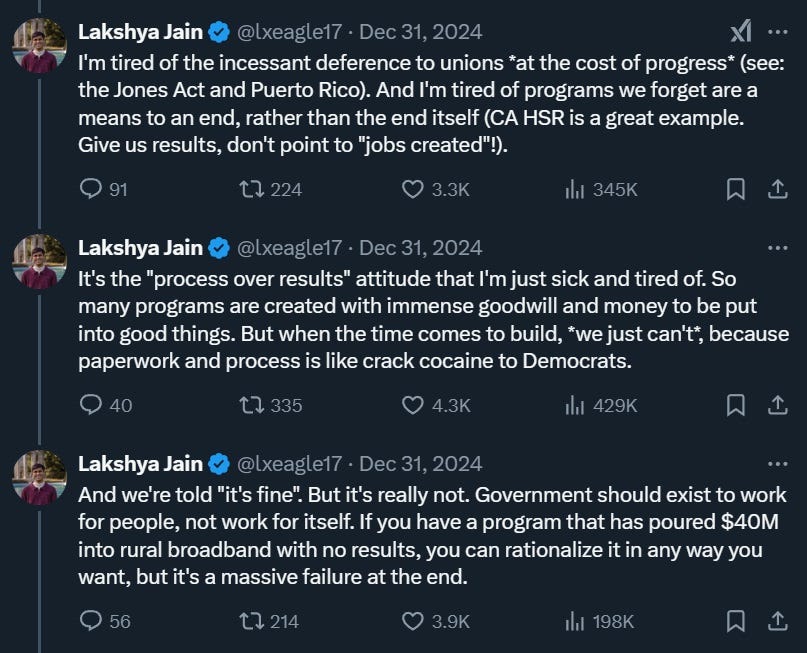
When the state ties its own hands out of deference to activist groups and union leaders, only the private sector can get things done. In all the years that Biden spent billions failing to give broadband to a single household, Elon Musk’s Starlink has made broadband cheaply available to millions of consumers in rural areas. Outcomes like this strengthen the arguments of the very neoliberals that the people at the Roosevelt Institute spend all day denouncing.
Matt Yglesias makes a persuasive case that the outpouring of regulation and procedural requirements that progressives championed back in the 1970s and 1980s had the effect of restricting state capacity more than it restricted the private sector:

He writes:
Some parts of the private sector really have become less regulated (airlines), while others have become more strictly regulated (housing), but what’s regulated most strictly of all is the public sector. And this overregulation of the public sector locks us into a vicious cycle. First, we make it very difficult for public center entities to execute their missions. Second, this leads public sector entities to develop a reputation for incompetence. Third, the low social prestige of public sector work leads to the selective exit of more ambitious people. Fourth, elected officials in a hurry to do something often seek ways to bypass existing public sector institutions further reducing prestige.
And what’s actually needed is not more money or more takes about how free markets are out of control or a new anti-growth paradigm.
What we need is a vigorous public sector reform campaign to increase the likelihood that, when elected officials want the government to do X, X occurs in a reasonably timely and cost-effective manner…
We used to be a country where…the government would just roll up its sleeves and do stuff: rural electrification, public pools, the interstate highway system, you name it…
Advocates of [public housing, for example,] seem to imagine a powerful state actor constructing high-quality housing developments at large scale. But even if you repealed the Faircloth Amendment and got HUD back in the business of financing government-owned projects, the reality is that federally funded housebuilding would be more expensive than private housebuilding, not cheaper. Federal grants trigger NEPA requirements that would slow things down in an effort to preempt litigation…A private builder can hire subcontractors who he deems reliable based on experience, reputation, and relationships, but a public builder would have to go through a low-cost bidder process. They would also run into domestic procurement rules that raise costs, and Davis-Bacon rules…
The result is that environmental rules, labor rules, and all kinds of other rules are much stricter for a public undertaking than a private one.
To reiterate: Many of America’s most stringent regulations only apply to the public sector. This allows progressive activists and special interests to have power over government initiatives, but it also ends up validating the neoliberal argument that the private sector is more effective than the public sector. In the end, the progressive activists and special interests end up grabbing a larger share of a shrinking pie, as Democrats fail at the ballot box and the idea of state capacity itself becomes discredited among the broader American public.
In the early 2010s, when the U.S. was still suffering from the Great Recession, this wasn’t so catastrophic — Obama’s stimulus might have built much less high-speed rail and other infrastructure than it promised but at least it provided Americans with a lot of jobs, at a time when jobs were in very short supply. Stimulus didn’t provide as many public goods as it would have in FDR’s day, but at least it was stimulus.
But in the Biden years, America didn’t need stimulus. Instead of a deficit of aggregate demand it had a surplus, as evidenced by out-of-control inflation. As I wrote back in July, the failure to understand this macroeconomic transition was part of what doomed the new progressive economics this time around:
In an inflationary environment, supply is the constraint, not demand. The Biden administration paid lip service to this realization when it called its green energy bill the “Inflation Reduction Act”. But when contracting requirements and procedural regulation prevented Biden’s government from actually building infrastructure, it turned supply-side progressivism into just another helping of demand-side stimulus — the checks got written and the jobs were provided, but the actual stuff didn’t materialize, so the impact on inflation was still probably positive by the time election day rolled around.
The rest is history. Trump won, and it will now fall to his administration to decide whether to fix the problems with Biden’s industrial policy, or to scrap those policies entirely. Axios recently reported on one Trump advisor who is thinking about how to do the former:
One big question now is how much of [Biden’s industrial policy] the new Trump administration will change or scrap…The man tapped to be President-elect Trump's top White House economist published a detailed critique of President Biden's industrial policies last February. It offers a sense of the strategies for reindustrializing the U.S. economy sought by those with the president-elect's ear…
Stephen Miran, Trump's designee to chair the Council of Economic Advisers, argued that industrial policy should focus on supply-side reforms that make it easier for companies to invest in factories, and be driven by demand from the defense industry…
"Bidenomics not only imposes onerous costs on industry in various ways — from incentives for unionization to special environmental restrictions — that raise the cost of production and work against the stated goal of expanding our industrial plant," Miran wrote for the Manhattan Institute, where he is an adjunct fellow…"A more robust form of reindustrialization would instead combine aggressive supply-side reform with demand support from defense-driven procurement," he wrote, "which would produce enormous positive economic spillovers."…
Among other specific policies he critiques as counterproductive are EPA rules governing chipmakers, the Davis-Bacon Act (which includes wage requirements for public projects) and Occupational Safety and Health Administration rules on worker safety that he argues go overboard.
The optimistic case is that Republicans like Miran remove many of the onerous barriers and requirements from industrial policy while keeping in place the subsidies that have prompted the massive flood of private-sector investment in chips, batteries, and other manufacturing industries. However, given that Miran has criticized industrial subsidies in general, I’m not optimistic that we’ll get this optimal outcome.
Instead, what sadly seems more likely is that Trump opts for a classic libertarian strategy, throwing the baby of industrial policy out with the bathwater of progressive kludgeocracy. The activists and union leaders and anti-neoliberal think tankers will have won their battle to squeeze power out of the Biden administration, only to lose the wider war. As a result, Biden’s legacy as America’s Great Rebuilder will be severely tarnished.