
I feel like I have a shrinking window to criticize Democrats and progressives before Trump takes over. Once the GOP dominates the presidency and both houses of Congress, their policies and their mistakes will (quite rightfully) take center stage, and long-term adjustments by the opposition will become a low-key, back-burner discussion. I’ve already criticized Democrats’ use of targeted racial appeals to try to win over minority voters, their focus on unemployment over inflation, their overreliance on the educated professional class, and their misgovernance of large cities. That’s a lot of criticism already! I don’t want to give the impression that I think Dems do everything wrong. But there’s one more thing I’ve been feeling like I should write about, and it’s about how Democrats relate to the progressive activist movement.
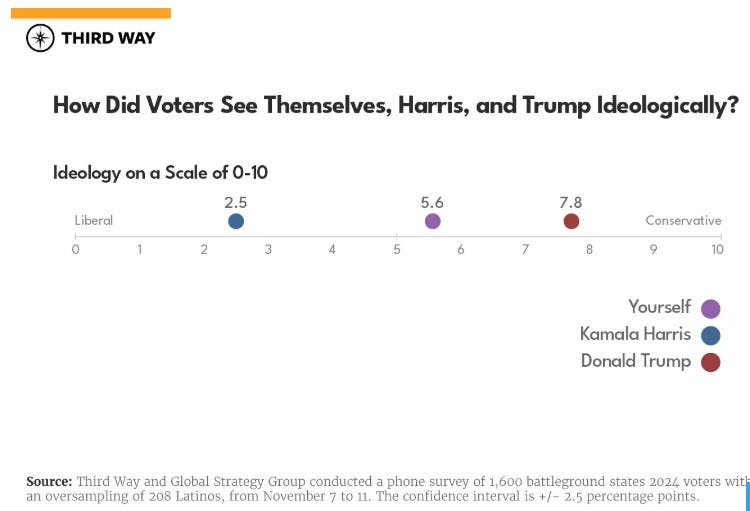
One interesting and very dismaying thing about the 2024 election was how despite Kamala Harris’ rhetorical move to the center, the American public thought of her as far to the left of them. Here’s a poll by Third Way:
Now, maybe Third Way are a bunch of centrists and we shouldn’t trust their polling. But here’s Blueprint 2024 with an even more damning finding:
Over 80% of swing voters who chose Trump believed Harris held positions she didn’t campaign on in 2024, including supporting taxpayer funding for transgender surgeries for undocumented immigrants (83%), mandatory electric vehicles by 2035 (82%), decriminalizing border crossings (77%), and defunding the police (72%).
For someone like me who strongly supported Harris and approved of her move to the center, this is absolutely maddening. The voters barely even registered Harris’ centrism at all; they just thought of her as a far left ideologue. Why?
One reason might be that Harris just didn’t have enough time to execute her pivot. She took over from Biden late in the election season, and only had a couple of months to define herself to a somewhat tuned-out electorate. Harris actually did run as an extremely “woke” candidate back in the 2019-20 primary season, praising the “defund the police” movement and saying other similar stuff. And her voting record as a senator was one of the most progressive. Personal reinventions take a very long time, and Harris just got started very late.
But I think another likely reason is that while Harris and the other Dems pivoted to the center in 2024, they didn’t do nearly enough to distance themselves from the progressive activist movement that dominated much of American social life in 2014-2021. Like it or not, social media has changed the game of politics — thanks to Instagram, TikTok, and X, the average American is in far more frequent contact with grassroots activists and ideological extremists than in 2008 or 1992. In those earlier times, the average voter’s most important contact with the Democrats was watching a politician on TV, or maybe reading an op-ed in the paper. Now, it’s being yelled at by an activist on social media.
Also, the progressive activists of the 2010s and early 2020s didn’t stay on social media. While both the Right and the Left became very extreme in the 2010s, there was an asymmetry in terms of people’s contact with the two extremes. Rightism stayed mostly online, occasionally spilling over into a mass shooting or some other high-profile terrorist attack (or the January 6th attack). But while progressive extremism lacked those fearsome and spectacular acts, it was far more pervasive — most Americans came into contact with it, in their workplaces or on the street.
I think it’s the memory of that era of grassroots, everyday extremism that some Americans were reacting against by voting for Trump. And to those voters, Democrats’ pivot to the center in 2024 probably seemed like an attempt to quietly memory-hole the progressive era instead of explicitly rejecting the harm that many Americans suffered.
The long shadow of summer 2020
This post was actually inspired by a conversation I had in San Francisco’s Chinatown the other day.
I was wandering through various shops, when one proprietor struck up a conversation with me, eager to tell me about the history of Chinese Americans and Chinatown. He started off by telling me about how in the days of the Gold Rush, White “cowboys” would kill Chinese miners for fun. “That’s part of American history you never learned in school!”, he said.
But then he suddenly switched to telling me about a much more recent piece of American history. He started talking about the summer of 2020, and how Chinese-owned businesses had suffered during the Black Lives Matter protests. He took great care to distinguish between the protesters themselves (“They were just expressing their beliefs, that’s fine”) and the looters who took advantage of the reduced police presence to ransack Chinatown’s jewelry stores. Then he told me about when the looters tried to invade and attack the homes above the stores, and how the residents threw furniture down the stairwells to block the looters from getting in. “That’s something you didn’t see on the news,” he said, in the same rueful voice he had used when talking about the murderous 19th century cowboys.
He was right. This was a piece of modern American history that I had almost totally missed, even though I lived through it. To me, the violence that accompanied the Floyd protests in summer 2020 was just another part of the general chaos of the pandemic. I never felt it was any threat. But to the people of Chinatown, desperately throwing furniture down a stairwell to stop looters from invading their homes, the summer of 2020 was an absolute terror.
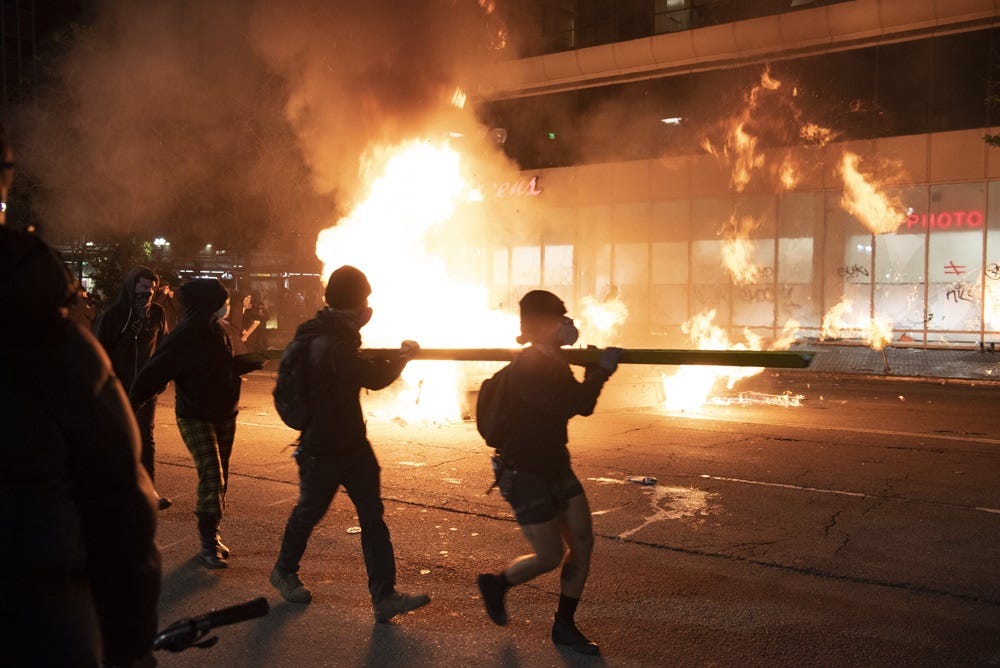
Almost no one died in the Floyd protests themselves — far fewer than died in the single-city riot in Los Angeles in 1992. But the reduced police presence and the general atmosphere of permissive chaos led to a massive wave of looting by people who probably had no particular interest in politics. Stores were smashed and burned. Across the country, the Floyd protests caused about $2 billion in insured damages, and the total cost was probably considerably higher.
For corporate chains, looting was just a cost to be written off. But for small independent businesses, being looted meant the loss of a family’s livelihood. And those small businesses tended to be disproportionately owned by minorities and immigrants. SF Chinatown’s jewelry stores were not atypical — across the country, Asian businesses were targeted for looting and destruction.
But it wasn’t just Asians. In Minneapolis, Latino and Black owned businesses often bore the brunt:
East Lake Street on the city’s south side has become a haven for minority-owned businesses, particularly African and Latino immigrant entrepreneurs who managed to thrive in this progressive Midwest city…But [as] the rage [of the Floyd protests] widened…some shopkeepers — watching the looters gather — retreated in despair as police vanished from the 3rd Precinct and chaos took hold…[Somali restaurant owner Abdishakur] Elmi and his restaurant supplier, Mohammoud Abdi, said the damage reminded them of their youth in Somalia, where they watched militants roam and the government lose control of the country…“We don’t have law and order,” said Abdi, 47. “This is not helpful to George’s family.”
Hmong businesses were hit hard as well. In Chicago, meanwhile, Mexican-owned businesses were attacked. The story was much the same in Los Angeles, where immigrant-owned and Latino-owned mom-and-pop shops were destroyed.
Here is a long report from the Wall Street Journal about small businesses that were looted across America in 2020, with plenty of pictures. It was all over the news, except I barely read about it — it was drowned out by the flood of stories about the protests themselves, conflicts with the police, the reaction of the Trump administration, and so on. In some sense I knew this was happening, but it felt far away, and property damage felt secondary to what at the time felt like it might be an incipient revolution in progress. I suspect many other members of the educated professional class felt the same. But to regular Americans — most of whom supported the Floyd protests themselves — the looting and disorder were a time of terror.
And unlike in the 1960s, when Democratic mayors and other politicians cracked down hard on rioting, Democrats in the summer of 2020 seemed to forgive and even embrace the chaos. When protesters in Seattle created an anarchist “autonomous zone” known as the CHAZ, some city councilmembers joined demonstrators on the front lines and called for defunding the police. That episode ended in the shooting of two innocent Black teenagers who were out for a drive in the CHAZ’s territory.
All across the country, Democrats declared their solidarity with the protesters and condemned the police — who can forget the image of Congressional Dems kneeling in some weird Ghanaian costume? And they either ignored or even downplayed the looting that followed in the protests’ wake. Here’s just one report from August 2020:
This week, Sen. Chris Murphy (D-Conn.) tweeted that “looting and vandalism is bad.”
Later, he deleted the tweet, saying it “mistakenly gave the impression that I thought there was an equivalency between property crime and murder.”
The farcical notion that to fight and condemn property crime would be a tacit endorsement of the murder of George Floyd came straight from extreme leftist activists. And yet here was this false equivalence being uttered by a prominent Democratic senator?
And the terror that the anarchy of 2020 unleashed against many of America’s minority populations didn’t end in 2020. All through 2021, there was a rolling wave of violent attacks on Asian Americans, many of them deadly:
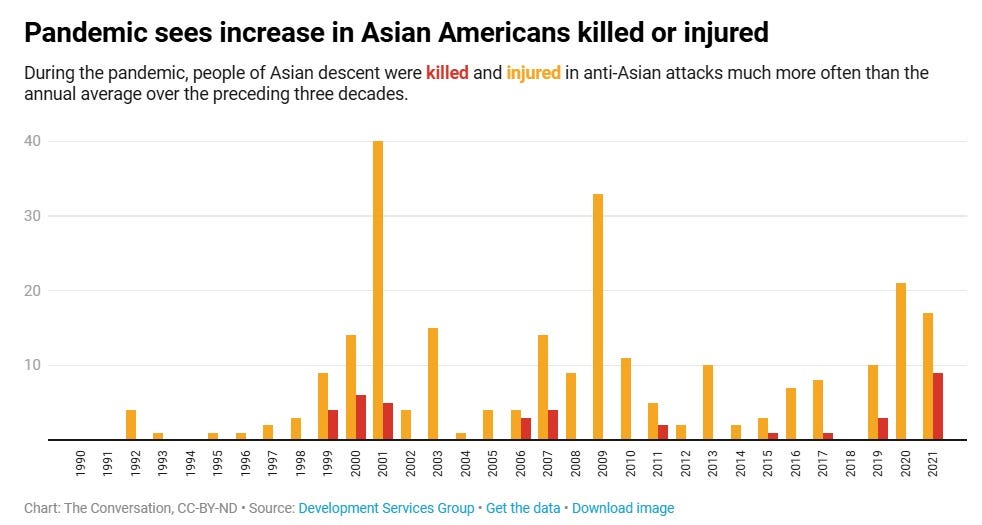
Reported hate crimes against Asian people jumped by more than a factor of 4, and many went unreported. Journalists like CeFaan Kim and Dion Lim documented the violence in detail.
Progressives attempted to blame the attacks on Trump’s rhetoric about Covid being a “China virus”. But most of the attacks happened in deeply progressive cities.1 Although racism was almost certainly involved in many cases, the obvious proximate cause was a breakdown in law and order in those cities cities. It’s a well-established fact that policing deters crime; without that deterrence, many violent people simply went after the easiest targets.
Despite some platitudes about “stopping Asian hate”, many progressives seemed callous to this wave of violence. When a man murdered 84-year-old Vicha Ratanapkadee on the street in San Francisco, Chesa Boudin, the city’s progressive district attorney, infamously labeled it as merely a “temper tantrum”. Asian voters were pivotal in Boudin’s eventual recall.
Progressives did not encourage the mass looting of minority-owned businesses or the attacks on Asian people. But all too often they excused or downplayed it, talking about declaring that property crime was unimportant compared to police abuses, advocating light sentences for the perpetrators of hate crimes, and so on. Joe Biden, who loudly argued against defunding the police and strongly condemned violence associated with the protests, was a notable but all too rare exception (and I suspect this might have been what allowed him to beat Trump in the 2020 election).
And having largely failed to condemn the violence in summer 2020, Democrats have largely failed to rectify their mistake by talking about it years later. It wouldn’t be too hard for Democratic politicians to tell people that they sympathize with what they had to endure from looting and hate crimes in 2020-21, and to call for more public order. They largely did this in the 1970s. This time, though, they have generally been silent, hoping that the country will simply forget that those terrors occurred, and that they’ll avoid the need to risk alienating the activist base.
But the country does not seem to have forgotten yet.
The Soft Blue Terror
Most Americans were not the victims of looting in 2020, or of hate crimes in 2021. Most sat safely in their homes, did their jobs, and carried on generally unmolested by street chaos during those years. But the average American did come into contact with progressive extremism in far less extreme ways during the years from 2014 up until now.
I’ve likened “woke” culture to a pseudo-Protestant religious revival, and I think that characterization is accurate. But religious revivals often involve a lot of extremism and intolerance. Alternatively, many conservatives draw parallels between the woke years and the Cultural Revolution in China. That parallel is obviously out of proportion — no one got disemboweled and eaten by America’s woke youth. America is a rich, largely peaceful society, and our cultural revolutions are soft, gentle, lazy affairs.
But the similarities between the two episodes are impossible to ignore. Both involved a general desire to redistribute status in society, with students especially eager to dethrone their teachers. In both cases, a radical ideology was used as a pretext to settle many personal scores. And like the Cultural Revolution, the French Revolution, or any other more extreme examples of unrest, America’s woke revolution in the 2010s devolved into a circular firing squad of preemptive denunciations and purity spirals.
Plenty of people did lose their jobs in the woke years, often for ridiculous reasons. A USC professor was fired for teaching students a Chinese word that sounded vaguely like a racial slur. Political analyst David Shor was fired for citing research showing that violent protests hurt Democrats at the polls. Very often, the people fired after progressive social media outcries were progressives themselves, often in academia or nonprofits. These represented targets of opportunity for the more extreme people in their circles. But even those people had to constantly worry about being denounced by someone even more extreme than themselves.
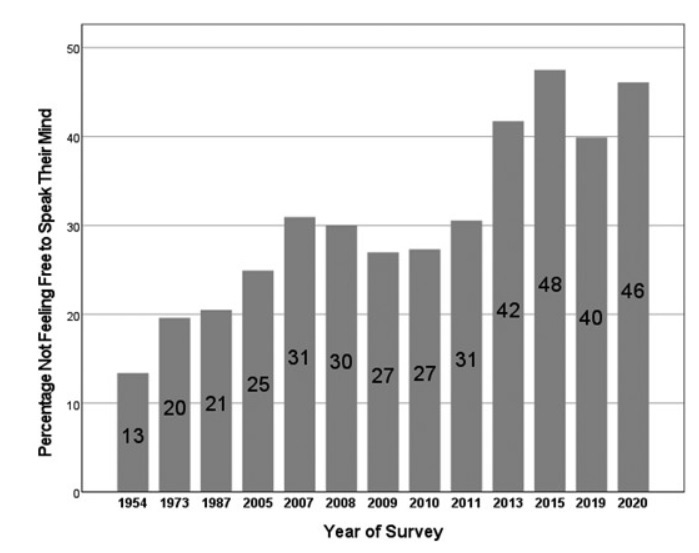
Losing your job should never be equated with being disembowled, but it is something to be feared. If I told you that I could call up your employer and get you fired if you made me mad, you would be scared of me, and rightly so. Actual mob-induced firings might have been few in number during the “woke” years — the estimate of the number of professors fired is only about 200 — but they were well-publicized, and everyone in progressive spaces knew they had to tread lightly or risk the wrath of the mob. The percentage of Americans who reported not feeling free to express their views increased sharply:
That general climate of fear probably contributed to the mental health crisis among young progressives. Although young people in general have become much less happy in the age of social media, the trend is far more pronounced among those who lean to the political left — especially young progressive women:
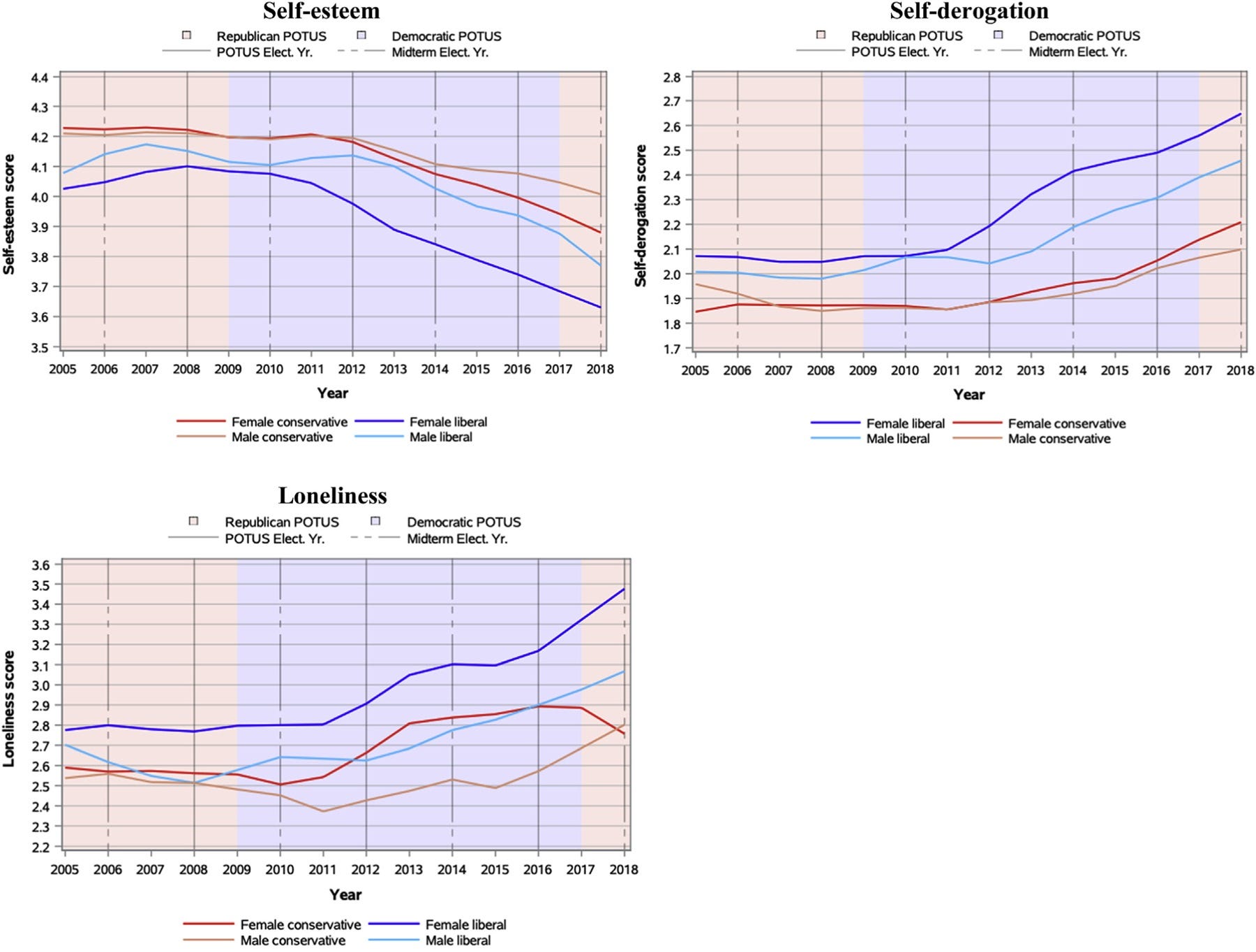
But it wasn’t just social media mob rule that made Americans feel oppressed by progressive culture over the last decade. As the years of unrest wore on, many businesses, universities, and government agencies responded by implementing DEI trainings and mandatory DEI statements. A Pew poll in 2023 found that 52% of Americans said that their workplace has DEI trainings or sessions, so it’s fair to say that a majority of Americans have had their lives touched directly by the DEI trend.
And those encounters were often highly negative. The trainings often involved materials that were, frankly, downright racist, characterizing many positive business traits (punctuality, rationality, hard work, etc.) as part of “white supremacy culture”. For many, these trainings felt like ideological struggle sessions designed to humiliate them, and there has been a wave of lawsuits. Mandatory DEI statements, meanwhile, often felt like enforced pledges of ideological loyalty; after a nationwide backlash, they are now being phased out at many institutions.
Although most Americans continue to support the idea of “DEI” in the abstract, its popularity has been falling as more people come into contact with what “DEI” really means in practice. And although DEI has a very poor track record of reducing actual bias in the workplace, there is some recent disturbing evidence that it succeeds in fostering a general climate of hostility. A recent working paper by the Network Contagion Research Institute finds evidence that “some anti-oppressive DEI narratives can engender a hostile attribution bias and heighten racial suspicion, prejudicial attitudes, authoritarian policing, and support for punitive behaviors in the absence of evidence for a transgression deserving punishment.”
I have to admit that personally, I didn’t realize how severe these trends had become at the time. I never worked for an employer that required a DEI training or statement, and my friends didn’t talk about it much at the time. I spent the years from 2015 to 2021 working for Bloomberg Opinion, a center-left publication with a laid-back internal culture. Only in the last two or three years have I begun to hear more frequent anecdotes about episodes of unrest and climates of fear within my friends’ companies and universities.
The years from 2014 to 2021 weren’t like the Reign of Terror of the French Revolution, or the Red Terrors that typically accompanied communist revolutions. But there’s a case to be made that many Americans — not all, perhaps not even a majority, but enough to make an electoral difference — experienced those years as a sort of Soft Blue Terror of constant politicization of daily life. That’s not enough to make anyone take up arms, but it was probably enough to swing some votes in 2024 — especially because most Democrats seemed uninterested in decrying that grassroots progressive culture.
How can Dems reproduce the Sister Souljah moment?
There’s this legendary moment during Bill Clinton’s presidential campaign in 1992 when he condemned a radical leftist activist called Sister Souljah. Souljah had responded to the L.A. riots by suggesting that black people could have a week in which they killed white people instead of each other. Clinton denounced this statement and other racist things Souljah had said, pointing out their similarity to things that white supremacists said about black people.
This moment, which was played up quite a lot in the media, probably did help convince a skeptical public that the Democratic party was not the party of black radicalism or leftist extremism. It became a popular model for how candidates can convince the world of their moderate bona fides. Barack Obama had a similar moment in 2008 when he denounced some of the extremist views of his former pastor, Jeremiah Wright.
Some media figures suggested that Kamala Harris should have her own “Sister Souljah moment by denouncing progressive extremism. But although Harris’ 2024 campaign was very centrist in tone, she never aggressively denounced the extremism in her own party. A moment like Clinton’s in 1992, or even Obama’s in 2008, might have helped cement her centrist pivot more firmly in voters’ minds, or at least provided a news story for the media to focus on. Instead, Harris seemed content to emit sunny centrist vibes without really acknowledging or repudiating the grassroots extremism lurking in her coalition.
But I wonder if a single “Sister Souljah moment” would actually cut it in this era of ultra-short news cycles and constant social media noise. In 1992, most Americans had never heard of Sister Souljah. But their political news was mediated by big TV stations and established newspapers, so when TV anchors and reporters told them that Clinton’s repudiation of a black-power activist was a big, defining moment, they believed it — and even more importantly, they repeated the story over and over.
In the 2020s, however, political news has been disintermediated — it’s the province of TikTok and X and Instagram instead of CBS and the New York Times. In that noise-filled climate, a single statement like Clinton’s criticism of Sister Souljah could go viral, but usually it will tend to get lost in the wash. For example, how many people even know that Donald Trump clarified his remarks about “very fine people” at the Charlottesville rally by saying this:
President Donald Trump, under pressure to explicitly denounce hate groups involved in the weekend’s deadly racial violence in Virginia, singled out white-nationalist groups by name for condemnation Monday after stopping short of doing so two days earlier.
“Racism is evil,” Mr. Trump said. “Those who cause violence in its name are criminals and thugs, including the KKK, neo-Nazis, white supremacists and other hate groups that are repugnant to everything we hold dear as Americans. We are a nation founded on the truth that all of us are created equal.”
I’m sure most Democrats saw Trump’s statement as inauthentic — but then again, I’m sure many Republicans saw Obama’s criticism of Jeremiah Wright as being inauthentic and defensive back in 2008. The real reason people didn’t hear about Trump’s statement condemning white supremacists was that in the social-media-driven environment of the late 2010s, it simply didn’t make the news, so it got lost. (To be fair, Trump’s constant parade of off-the-cuff inflammatory remarks tends to drown out his own more reasonable prepared statements.)
On top of that, far more Americans have had intimate contact with progressive extremism now than in past decades. In 1992, almost no voters even knew who Sister Souljah was before Clinton criticized her; in 2024, people encounter activists more radical and aggressive than Sister Souljah every day on social media. A prominent Democratic politician releasing one single condemnation isn’t going to outweigh that daily low-level experience.2
What Democrats really need is not a single big Sister Souljah moment, or even one per presidential campaign. What they need is a bunch of small Sister Souljah moments. They need a sustained campaign of criticism of progressive extremism, over a period of years. This shouldn’t be their primary focus, of course — criticizing the Republicans is job #1. But occasional, intermittent, repeated reminders that the extremism of the left isn’t what the Democratic party stands for would go a long way toward expunging the lingering distrust from the turbulent years of the 2010s.
Americans have long memories, and if they’re asked to forget the madness of the 2010s all on their own, it will take them many years. Democrats need to help that process to go faster, by making it clear that those years are well and truly behind us.
Obviously this is because Asian Americans mostly live in progressive cities. But it seems highly unlikely that there were many Trump fans running around doing violence in these areas.
Oddly, one of the most reasonable and level-headed expressions of this idea came from Cassie Pritchard, a leftist activist best known for saying that under socialism, Americans would have free cocaine but bananas would be banned.