Although I do think that Democrats should focus on pocketbook issues, it must also be said that Bernie Sanders’ favorite economic factoid is a complete and total myth.
Ben Krauss has already written a great post debunking this myth over at Slow Boring:
The claim that “60% of Americans live paycheck-to-paycheck” comes from a survey by the fintech company LendingClub. The company refuses to release its survey methodology, but we can get a general idea from its website, which says: “For those Americans, [living paycheck to paycheck] means that they need their next paycheck to cover their monthly financial outflows.” So what LendingClub is probably claiming is that around 60% of Americans don’t have enough cash in their bank accounts to live off of for one month.
But LendingClub’s survey is probably just flat-out wrong about this. The Federal Reserve does a very careful annual survey called the Survey of Household Economics and Decisionmaking, or SHED.1 This survey asks whether people have a “rainy-day fund” sufficient to cover at least three months of expenses. And it pretty consistently finds that over half of Americans do have such a fund. This is from the Fed’s 2024 report:
Some financial challenges, such as a job loss, require more financial resources than would an unexpected $400 expense. One common measure of financial resiliency is whether people have savings sufficient to cover three months of expenses if they lost their primary source of income. In 2023, 54 percent of adults said they had set aside money for three months of expenses in an emergency savings or “rainy day” fund—unchanged from 2022 but down from a high of 59 percent of adults in 2021.
If more than half of Americans have enough money to cover three months of expenses if they lose their job, then mathematically it cannot be true that 60% of Americans lack enough money to cover just one month of expenses.
Meanwhile, the extremely careful and detailed Survey of Consumer Finances, which comes out every three years, finds that in 2022, the median amount of money that Americans had in their checking accounts was around $8000. That’s enough to pay a month of expenses for most Americans, since most Americans don’t spend $8000 a month (the median income being less than half that much).
In other words, a number of government surveys just contradict LendingClub’s survey. Why does Bernie Sanders choose to believe a survey by a payday lender with a secret methodology, instead of multiple surveys by the U.S. government with transparent methodologies? I guess being a “populist” means having to seize on the most eye-catching catastrophic numbers you can find, even if those numbers are almost certainly fantasy. Lying about how the economy is awful seemed to work just fine for Trump, so maybe if Democrats do it too, it’ll help win elections? I’m not sure about that. But in any case, the truth is the truth, and the myth is a myth.
In any case, this is one of quite a number of myths that a lot of educated Americans enjoy repeating back and forth to each other. The reasons they do this vary — some myths are just fun, others are basically tribal or political loyalty oaths, while others probably have no reason for persisting other than the fact that society hasn’t bothered to really crack down on them yet. But the persistence of a whole lot of what we used to call “urban myths” shows how our modern information-rich environment is no proof against viral misinformation.
So here is a list of five other common myths that I hear a lot of people repeat:
“Exercise doesn’t make you lose weight”
“Pay and productivity have diverged”
“America’s education system is lagging the rest of the world”
“Japan doesn’t allow immigration”
“America spends more on defense than the next ten countries combined”
Plus a special secret bonus myth at the end!
Myth #2: “Exercise doesn’t make you lose weight”
It seems intuitively obvious that if you burn more calories than you consume, you will lose weight. And yet you see tons of articles claiming that exercise won’t help you lose weight.
This is a myth. We have plenty of evidence about exercise and weight loss, and the overwhelming consensus is that exercise does make you lose weight. A lot of this is really good research, too! You don’t have to rely on correlational studies like in lots of health science — you can just tell people to go exercise and see what happens.
What happens, on average, is that they lose weight! Bellicha et al. (2021) did a literature review, finding 12 systematic reviews or meta-analyses that included only randomized controlled trials — a total of 149 high-quality studies. Here’s what they found:
Exercise led to a significant weight loss (4 SR‐MAs, MDs ranging from −1.5 to −3.5 kg), fat loss (4 SR‐MAs, MDs ranging from −1.3 to −2.6 kg) and visceral fat loss (3 SR‐MAs, SMDs ranging from −0.33 to −0.56)…These findings show favorable effects of exercise training on weight loss and body composition changes in adults with overweight or obesity.
The paper also finds that exercise has no effect on weight maintenance, meaning that it’s just as easy for people to maintain their new, lower weights as it was to maintain the old, higher weight.
Now, 1.5 kg to 3.5 kg — 3.3 to 7.7 pounds — might not sound like a lot of weight. And compared to what you get with Ozempic, it’s not. But it’s better than nothing, and it’s only over a limited period of time — the studies ranged from 2 weeks to 12 months. If you keep at it for longer, you’ll probably see more results.
So why do so many people say that exercise doesn’t make you lose weight? A lot of the media articles on this topic seem to be filled with nonsense. For example, Julia Belluz and Javier Zarracina wrote an article in Vox in 2017 entitled “Why you shouldn't exercise to lose weight, explained with 60+ studies”. Here’s what they write:
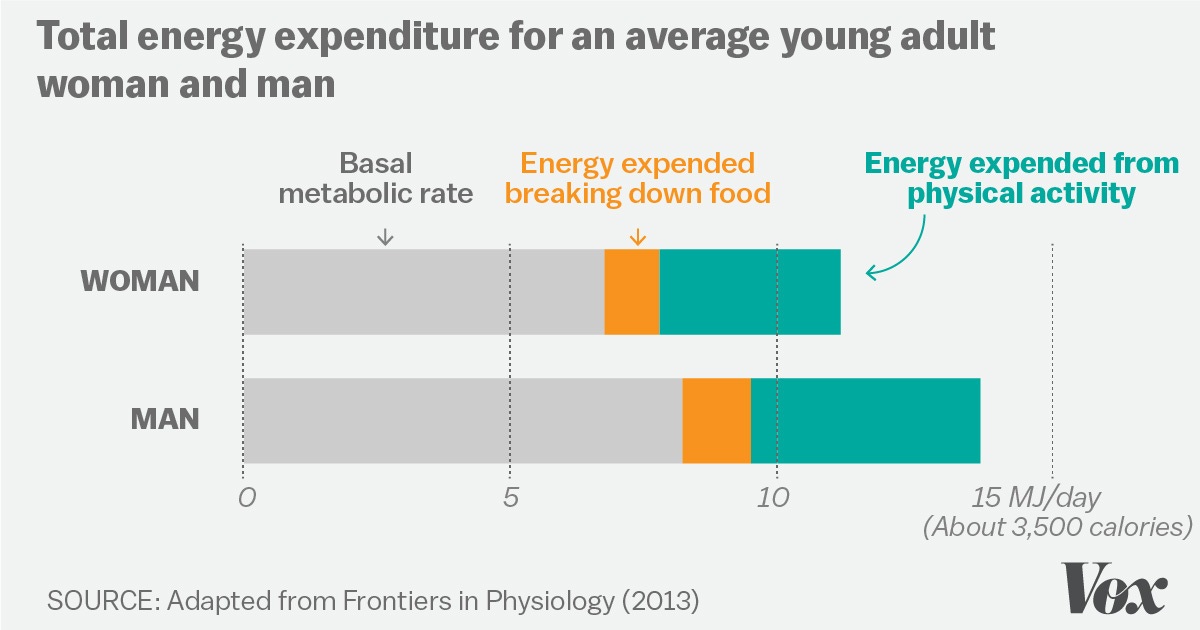
One very underappreciated fact about exercise is that even when you work out, those extra calories burned only account for a tiny part of your total energy expenditure.
"In reality," said Alexxai Kravitz, a neuroscientist and obesity researcher at the National Institutes of Health, "it’s only around 10 to 30 percent [of total energy expenditure] depending on the person (and excluding professional athletes that workout as a job)."
But 10-30% of energy expenditure is absolutely huge on the margin! If you start exercising and increase your total energy expenditure by 10%, that’s like cutting about 10% of your total calories! That’s big!
How big? In the very next section, Belluz and Zarracina say that you can lose 5 lbs a month by running an hour a day!
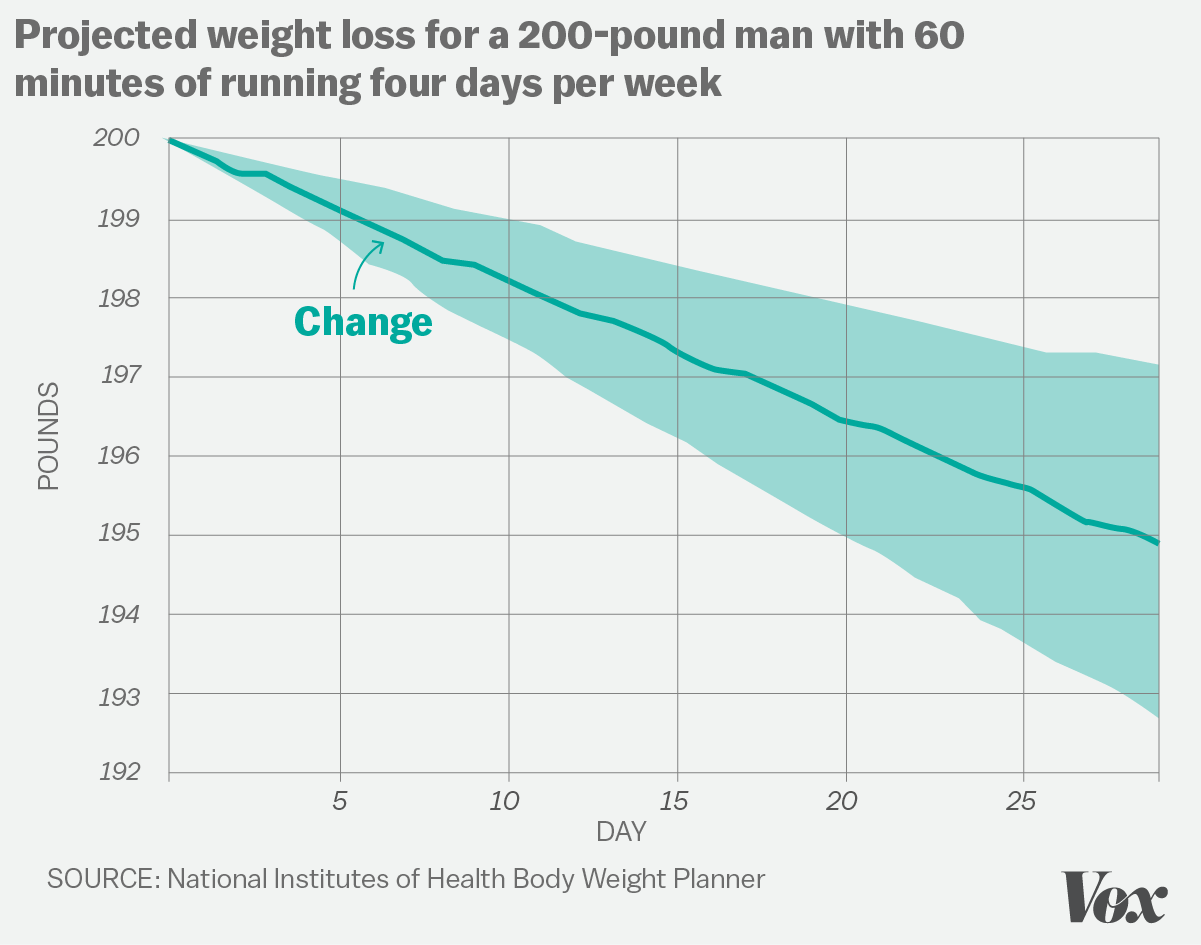
Using the National Institutes of Health Body Weight Planner — which gives a more realistic estimation for weight loss than the old 3,500-calorie rule —the NIH's Kevin Hall created this model to show why adding a regular exercise program is unlikely to lead to significant weight loss.
If a hypothetical 200-pound man added 60 minutes of medium-intensity running four days per week while keeping his calorie intake the same, and he did this for 30 days, he'd lose five pounds. "If this person decided to increase food intake or relax more to recover from the added exercise, then even less weight would be lost," Hall added. (More on these "compensatory mechanisms" later.)
So if one is overweight or obese, and presumably trying to lose dozens of pounds, it would take an incredible amount of time, will, and effort to make a real impact through exercise.
Are these writers pulling my leg here? 5 lbs. a month is a great rate of weight loss! Over the course of a year that’s 60 pounds!! Weight loss experts typically suggest losing 4 to 8 lbs per month. The simulation in the Vox article shows that you can do this through exercise alone!
Of course you shouldn’t try to do it through exercise alone — you should also diet or take Ozempic. But it’s kind of wild that an article claiming that exercise doesn’t make you lose weight has so much evidence that exercise is a great way to lose weight.
Myth #3: “Pay and productivity have diverged”
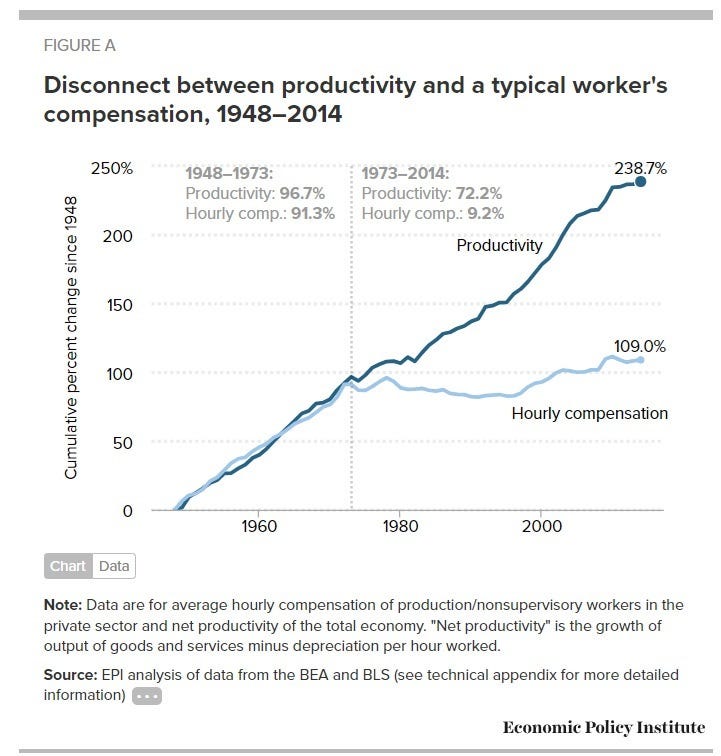
This extremely common belief comes from various left-of-center think tanks, especially the Economic Policy Institute, which publishes various forms of the following chart:
In a post back in June, I explained why this chart is extremely misleading:
Basically, the chart does two very misleading things. First, it uses different measures of inflation for the two lines, meaning they’re not directly comparable numbers. There’s just really no good excuse for presenting data this way.
Second, the productivity number is an average or mean, while the compensation number is a median or something close to it. When inequality grows, the mean grows faster than the median. So this chart mostly just reflects the fact that inequality of compensation between workers grew since 1980.
That inequality might be bad for society, but it doesn’t represent a divergence between pay and productivity. In fact, we don’t know what it represents. It’s possible that highly paid workers are being paid more than they deserve, and low-paid workers aren’t. That’s not clear. But this sort of unfair reallocation between workers wouldn’t represent a divergence between pay and productivity as a whole.
If low-end workers are getting exploited by their managers and executives, that’s obviously something we want to rectify in society, but it doesn’t mean that the economic principle that companies pay for productivity is broken — it just means they’re paying the wrong people. It’s a difference between workers being exploited by capitalist owners and workers getting exploited by their own bosses. Alternatively, there might not be any exploitation going on at all here — high-end workers might just have gotten a lot more productive since 1980, leaving everyone else behind and getting paid what they deserve.
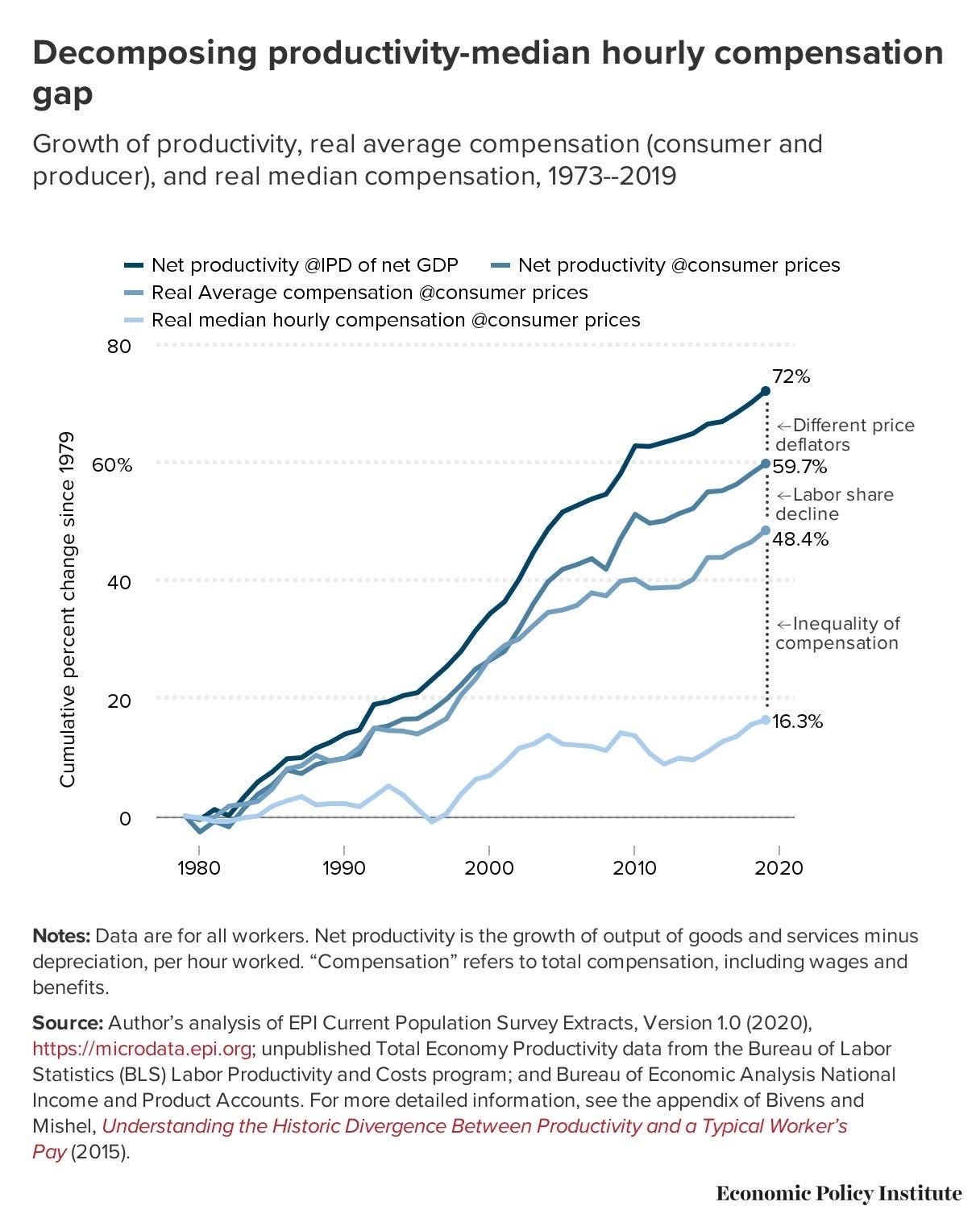
Anyway, when EPI decomposed their numbers into these various factors, here’s what they found:
The actual divergence between pay and productivity is the “labor share decline” — just a small piece of the total, and one that only appears since the turn of the century, not since 1980. But even this may be fictitious — an artifact of tax avoidance. Labor income gets taxed at higher rates than business income in America, so if you’re self-employed — as many rich people are — you can lower your tax bill by classifying some of your income as capital income instead of labor income. Smith et al. (2019) argue that the difference between the economic definition of labor income and the legal accounting definition is very large:
A primary source of top income is private “pass-through” business profit, which can include entrepreneurial labor income for tax reasons. This article asks whether top pass-through profit mostly reflects human capital, defined as all inalienable factors embodied in business owners, rather than financial capital. Tax data linking 11 million firms to their owners show that top pass-through profit accrues to working age owners of closely held mid-market firms in skill-intensive industries. Passthrough profit falls by three-quarters after owner retirement or premature death. Classifying three-quarters of pass-through profit as human capital income, we find that the typical top earner derives most of her income from human capital, not financial capital.
In other words, even the smallish piece of the “productivity-pay divergence” that’s explained by a fall in the officially measured labor share of income might very well be a mirage.
In sum, there is no reason to think pay and productivity have substantially diverged in America.
Myth 4: “America’s education system is lagging the rest of the world”
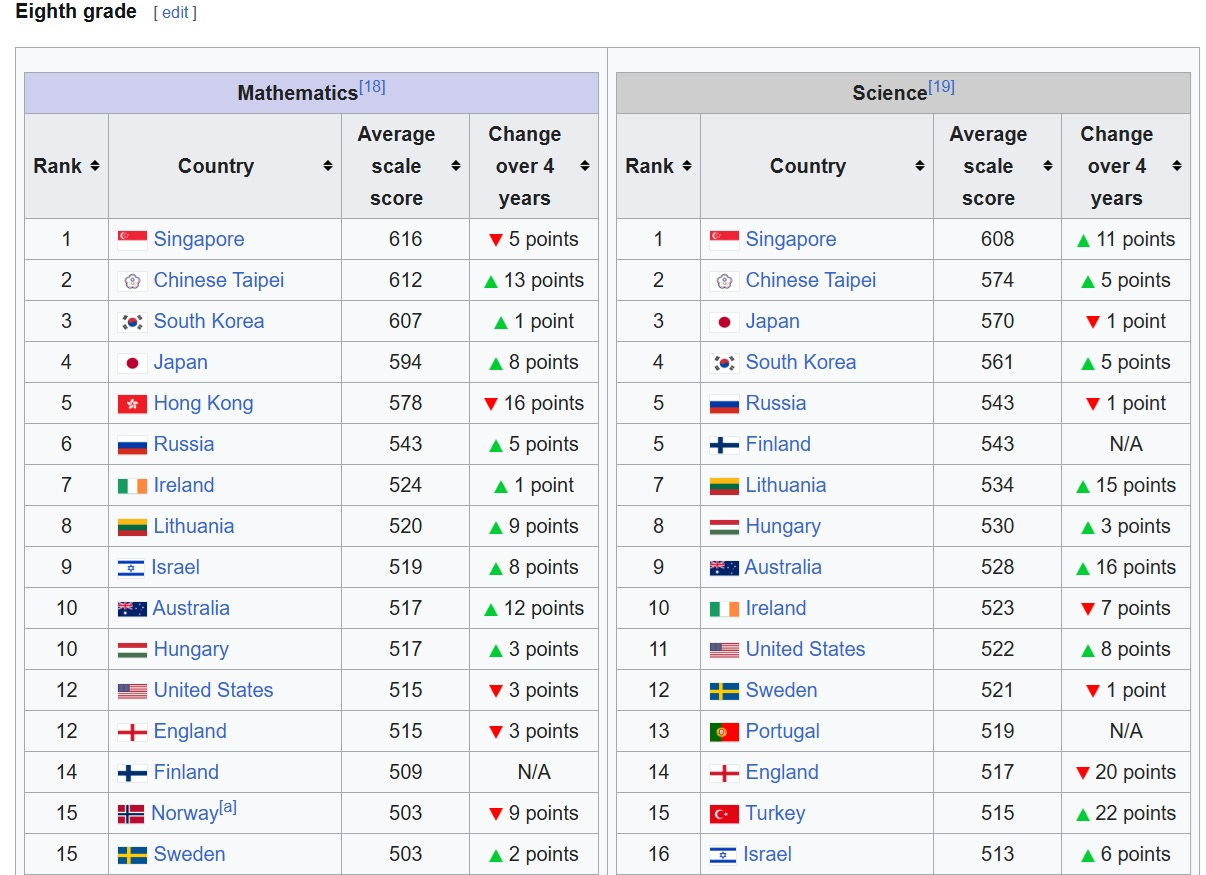
This is something I’ve been hearing my whole life, and I still see lots of news articles and regular folks making this claim. Except when you look at actual international test scores, the U.S. does OK. One test is the TIMSS, which focuses on math and science. Here, American eighth graders rank about 11th or 12th in the world — not stellar, but above average:
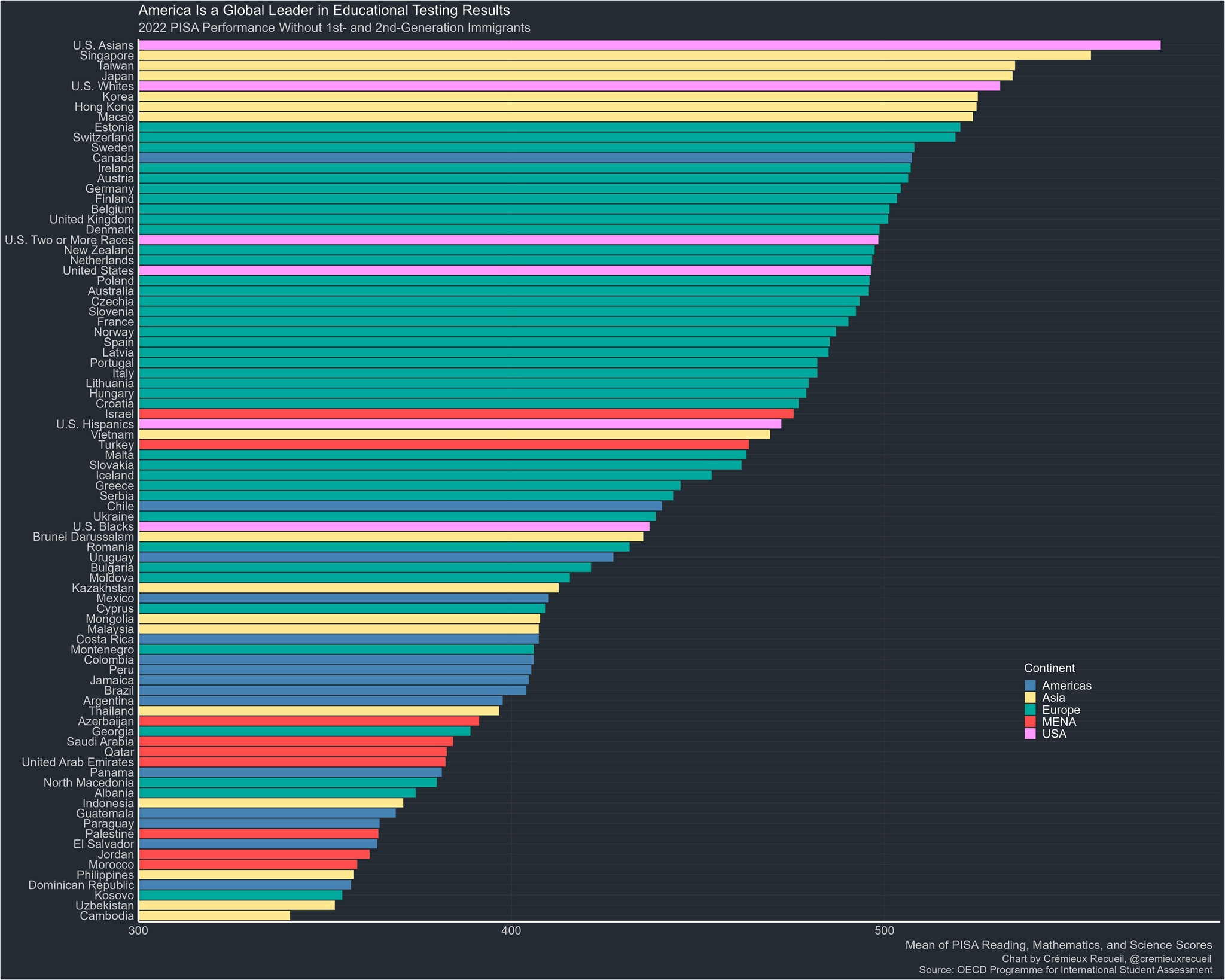
America does a little worse on the PISA test, which measures 15-year-olds on math, reading, and science. On math, Americans do lag the international average, but on science and reading, America still comes in above average — 16th and 9th place, respectively.
Also, when we talk about the “American educational system”, we’re not just talking about one system, but a whole bunch of them. American education is highly unequal. For example, when you break PISA results out by race, you find that Asian Americans dominate the entire rest of the world, White Americans do about as well as students from East Asian countries, and Hispanic Americans do about as well as Israeli and Vietnamese kids:
This shouldn’t make us complacent. But it should make us realize that the weaknesses of the U.S. educational system are highly concentrated — we don’t do an amazing job of educating Black Americans, but the systems that we use to educate the bulk of the American populace are producing pretty good results.
Myth #5: “Japan doesn’t allow immigration”
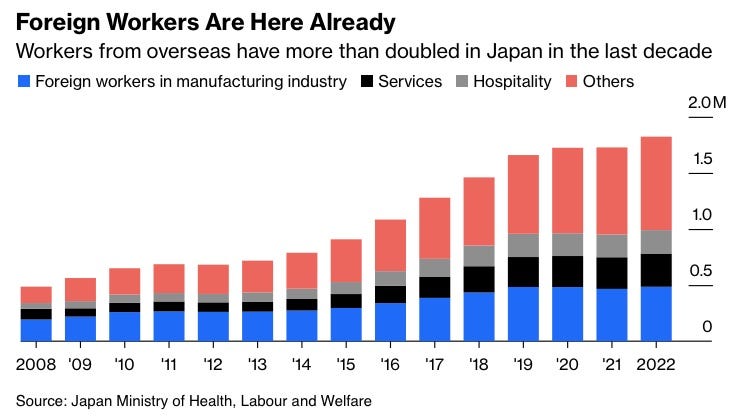
I’m a little reluctant to bust this myth, because I don’t want the type of people who subscribe to outdated national stereotypes to move to Japan. But it must be done anyway. The idea that Japan is a closed-off country that doesn’t take in immigrants was roughly true two decades ago, but a series of policy changes and attitude changes in the 2010s have opened the country up to large-scale immigration. The pandemic slowed but did not stop this trend:
The majority of these immigrants come from Vietnam and the Philippines, which is why if you go to Japan you might not visually recognize them. But they are there.
A policy overhaul approved Friday in Tokyo marked the latest sign that worker shortages in wealthy nations around the globe are spurring greater openness to foreign labor…On Friday, the government of Prime Minister Fumio Kishida said it would scrap the technical-training program, which currently has about 320,000 workers, and replace it with measures that openly declare the goal of bringing in foreigners to do jobs in industries lacking enough Japanese workers…The new rules establish 12 sectors in which workers with certain skills can come to Japan, bring family members and, in principle, stay as long as they want.
I’ve also heard some people claim that Japan doesn’t allow foreigners to become citizens. This is complete nonsense. If you live in Japan for five years or longer — even if you’re not a permanent resident! — you can apply for Japanese citizenship. You have to prove you can financially support yourself and speak Japanese, and you have to renounce your citizenship in any other country. In most ways, this is considerably easier than the naturalization process for the United States.
Myth #6: “America spends more on defense than the next ten countries combined”
You hear this one all the time. Constantly. Everywhere. You hear it from the Peterson Foundation, from Axios, from EconoFact.org. And yet everyone who says this is wrong.
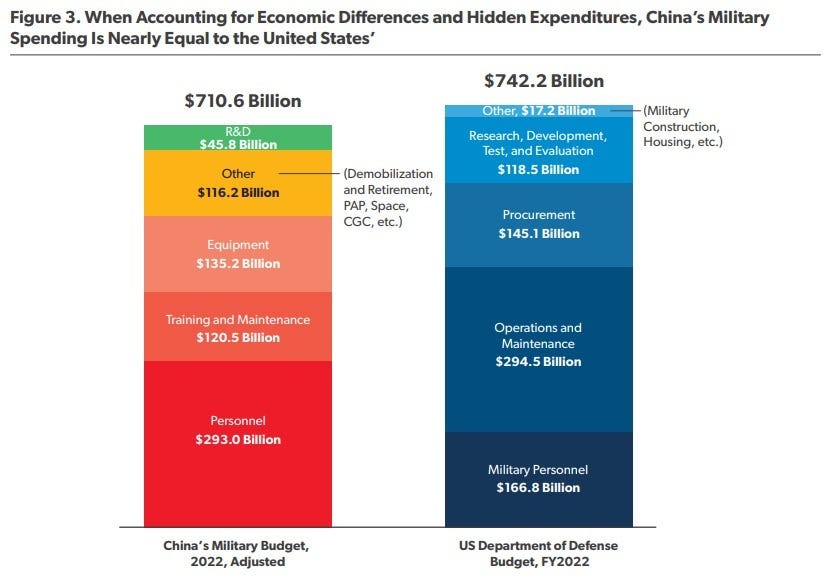
One reason it’s wrong is that America’s rivals — especially China — keep much of their military spending off the books. A recent AEI analysis notes that China doesn’t count its People’s Armed Police, its coast guard, its space forces, or its military R&D in its defense spending. These are all huge expenditures.
But on top of that, defense spending shouldn’t be measured at exchange rates — most military goods and services are not bought on foreign markets. Instead, military spending should be measured in terms of local prices. This method — called “military purchasing power parity” — is far from perfect, but it’s much less imperfect than pretending that if the U.S. spends 3 times as much on an assault rifle as China, America is outmatching China’s spending by a factor of 3.
When you account for both off-budget expenditures and differences in prices, you find that China spends about as much on its military as America does. Here’s AEI’s estimate:
So no, U.S. military spending isn’t overwhelmingly larger than other countries’.
Bonus Myth: “Ancient people couldn’t see the color blue”
This is a fun one, because I honestly can’t tell why anyone would want to propagate this myth — it’s just so random and silly. The idea here is that premodern people like the ancient Greeks didn’t have a lot of blue objects in their environment, so they didn’t have a word for the color, or even a concept that blue was a color at all.
This is obviously pretty silly, since the sky is usually blue, and the ocean is pretty blue too. But Matt Yglesias did the hard job of tracking down the linguistic science here, and found that Ancient Greek did in fact have words for blue:
What’s actually true, it turns out, is that different languages classify color very differently. In fact, this is true right up to the modern day. Give Japanese kids some crayons, and they’ll draw trees with the blue crayon. It’s the color we call “green” that Japanese people often have trouble identifying! (They also draw the sun as red, but that’s probably because the evening sun is more picturesque and easier to look at.)
One argument Yglesias doesn’t address is the idea that ancient Greeks called the sky “bronze”. This turn of phrase is sometimes cited to back up the claim that the Greeks couldn’t see blue. But while you might think of bronze as a sort of shiny brown, once it gets corroded, it becomes blue-green. Check out the header pic at the top of this post for an example!
So yes, the ancient Greeks did actually have lots of blue-green or bluish objects in their daily environment — old pieces of bronze.
Actually, bronze corrodes to blue because it has a lot of copper in it. I wonder if there are any other well-known copper objects that we think of as blue…
Did you notice that the Fed likes to make stuff that rhymes with “Fed”, even though “Fed” itself is not an acronym? The Federal Reserve Economic Database is FRED, and so on.