“Do you believe/ In what you see/ There doesn't seem to be anybody else who agrees with me” — Zero 7
Elections have consequences. And it seems likely that one of the consequences of the 2024 election is that the U.S. government will become less supportive of vaccination. RFK Jr., Trump’s nominee for Secretary of Health and Human Services, has been a notorious vaccine opponent for many years. This is from Jeffrey Flier in The Free Press:
For decades, RFK Jr. has been a vocal advocate of the anti-vaccine movement. He was founder and chair of Children’s Health Defense, an organization that campaigns against childhood vaccinations whose beneficial effects on children’s health are firmly established.
Most remarkable among his repeated claims is that childhood vaccination against measles, mumps, and rubella has caused the increase in autism. Just last year he said on Fox News: “I do believe that autism does come from vaccines.” This is long after the 1998 paper that advanced the idea was retracted as fraudulent in 2010. The author of the paper has been stripped of his medical license.
And many articles recount how RFK Jr. convinced many Samoans of his antivax ideas during a measles outbreak there in 2019, probably leading to a greater number of deaths. Now RFK Jr. is tapping various antivax types to help him staff Trump’s HHS. Meanwhile, Dave Weldon, Trump’s appointee to head the CDC, had had some antivax ideas of his own. And various prominent Trump supporters, like hedge fund mogul Bill Ackman, are also publicly skeptical of vaccination.
Despite the Covid vaccines being the crowning achievement of Trump’s first term in office, distrust of vaccines has now become a core part of the Trumpian ideology and movement. How much that will actually affect Americans’ access to vaccines is still unknown. Madison Czopek writes:
Vaccine law and policy experts told PolitiFact that Kennedy couldn’t unilaterally ban vaccines and that any effort to ban vaccines would probably face a legal battle. But Kennedy could still reduce how accessible they are for Americans, they said. And some of his power rests on whether Trump’s administration can get buy-in from other lawmakers and public health leaders, some of whom Trump could also appoint.
Kennedy could have those people act to limit vaccine access by revoking vaccines’ licenses or directing the CDC to change its vaccine messaging and recommendations, which would affect insurance coverage and medical practice[.]
Axios has more details on what RFK Jr. might do to inhibit vaccination in America. On a positive note, I would point out that Trump’s selection for Deputy HHS Secretary, Jim O’Neill, is very reasonable on the topic of vaccines. So I’m hopeful the institutional damage won’t be too bad.
Anyway, at this point I could write a soaring denunciation of the antivax movement, declaring it to be atavistic barbarism, lauding vaccines as the glory of scientific modernity, exhaustively listing study after study showing that vaccines are safe and effective, and warning darkly of the tragedies that will befall our society if we substitute New Age religion for science. And all that would be very true, and perfectly appropriate.
Instead, though, I feel like writing a fun meditation on the eternal war between cold hard reality and human social consensus.
Extant reality vs. tribal reality
Most of us think of reality as being extant in the world around us — that is, it doesn’t matter what we think or believe about reality, it just is there, and we have to deal with it. For example, my coffee table is extant — I can choose not to believe in it, but then I’ll bang my knee on it. I don’t like banging my knee, it hurts! So it behooves me to believe that the coffee table is just there, independent of any of my thoughts and feelings.1
But there are some situations where believing something is useful for reasons that have nothing to do with whether it’s real or not. For example, take belief in the afterlife. Even if the afterlife never exists, it may behoove you to believe in it. The belief may comfort you and motivate you throughout your lifetime.
An interesting case is when beliefs help to cement the unity of social groups. Having everyone in a group believe the same thing, even if its factually wrong, might enhance cohesiveness and cooperation within that group. Alternatively, believing something in the face of evidence might be a costly signal that could help people prove their loyalty to the group.
I wrote about this back in November 2020, when Trump was still trying to overturn the result of that year’s election:
Signaling in econ is basically when people jump through hoops in order to prove themselves. You might take a useless but difficult college course or math test, just to prove to future employers that you’re smart. Or you might get a tattoo to prove your loyalty to a yakuza gang, even though the tattoo would make it harder to get into a Japanese public bath or get a normal job. The fact that the signal comes with a cost is essential to separating the dedicated people from the posers.
Political lies could function similarly to the gang tattoos. By going on record as saying that we should seriously consider the possibility that climate change might not be real, you exposure yourself to a lifetime of ridicule. But that very exposure might prove that you’re the real thing, hardcore, really on the team, to a partisan audience who might otherwise be inclined to question your conservative bona fides. After all, if you were really a cuckservative or RINO, would you really have been willing to risk your reputation in the media world or in East Coast intellectual circles just to spread some FUD about climate change?…
Some political scientists have used signaling (or a close variant) to model personality cults. And my Bloomberg Opinion colleague Tyler Cowen has described Trump’s lies as loyalty tests for years.
A third case is when a group forces its own people to accept — or at least, to profess their acceptance of — something false, in order to prove that the group has power over its members. George Orwell talks about this in 1984, when he writes “The Party told you to reject the evidence of your eyes and ears. It was their final, most essential command.” Obviously, this was an allegory for the real-world Nazi and Soviet Communist parties.
These are all examples of what I like to call “tribal reality” — a belief that a group accepts for purposes of social dynamics, even though it conflicts with extant reality.
Antivax beliefs are, as far as I can tell, a case of tribal reality. The extant reality is that vaccines really work. When vaccines for diseases like smallpox, typhoid, and tuberculosis were introduced, deaths from these diseases went from incredibly common to incredibly rare:
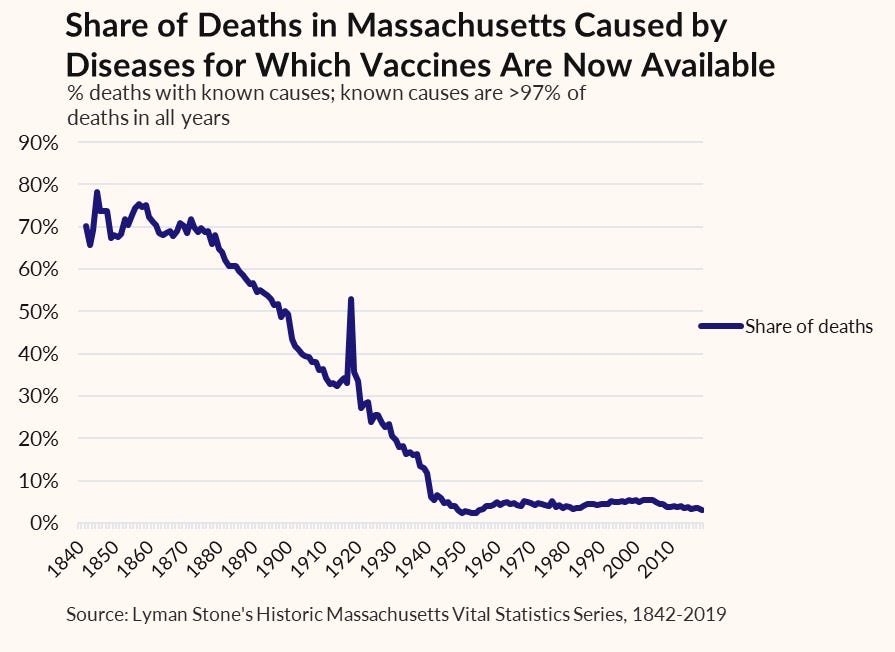
More recently, diseases like chickenpox, whooping cough (pertussis), measles, and polio have become much much rarer or even nonexistent; in each case, it’s shortly after the creation of a vaccine that the disease mostly goes away.
This is how we generally tell that technologies work — we use them, and we see that they work. This is how we know that refrigerators keep our food fresh, that pesticides kill bugs, and that fire burns things. Nobody is out there running a randomized controlled trial to see if fire is really what makes things burn.2 Vaccine efficacy is in the same category of “stuff that just obviously works”. But if you’re the kind of person who demands randomized controlled trials, there are vast numbers of RCTs showing that lots and lots of vaccines are effective.
The evidence shows that vaccines are safe, too. Here’s a meta-analysis of hundreds of studies of the set of vaccines recommended for Americans, which finds strong evidence against most of the harms that antivaxers worry about, and no evidence in favor of harms of any kind. That doesn’t mean no vaccine can ever cause health problems, and it doesn’t mean we’re 100% sure that all of our vaccines are 100% safe in every possible way. But it means there’s just no evidentiary basis for anything the antivaxers believe.
That doesn’t matter to the antivaxers, of course. You could have 600 studies showing vaccines are safe and effective, or you could have 600,000. It doesn’t matter how careful the studies are, how solid their methodology is, how many alternative possibilities and confounding factors they control for. Antivaxers will still continue to come up with new hypotheses for why vaccines might be harmful. They will continue to cast doubt and skepticism on the available evidence however they can, even when their doubts and questions have already been answered in the literature. They will continue to simply ignore the evidence and make claims that have already been debunked. They will do this in blogs, in podcasts, on social media, and now, at least for a while, some of them will do it from positions of power in the United States government.
And antivaxers definitely pay a price for asserting their tribal reality in defiance of extant reality. Communicable diseases are like my coffee table — if you don’t take proper precautions, you will bang your knee. In the recent Covid pandemic, the unvaccinated died at rates far, far higher than the vaccinated:
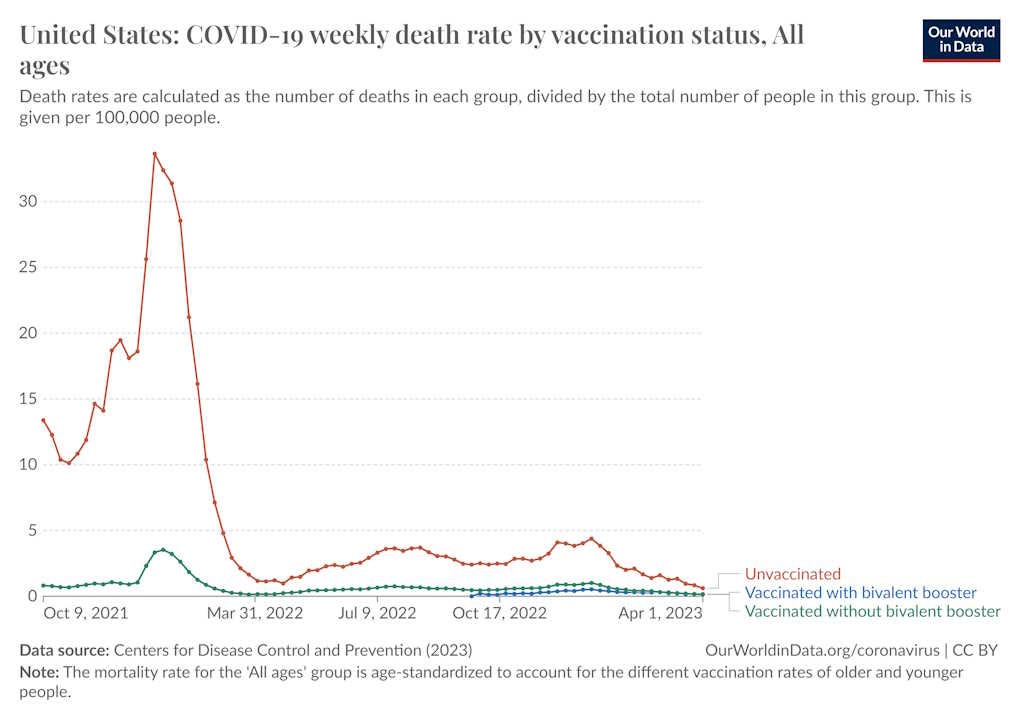
The same pattern was observed in every country that was studied, from Chile to Switzerland to England and many others. If you chose to refuse vaccines, you were at a higher risk of death.
Except for most people, the price was minor. Even for the unvaccinated, the death rate from Covid wasn’t that large, because Covid is not as deadly a disease as smallpox or typhoid fever was. So even if you refused to get vaccinated, you probably weren’t going to die. And by definition, the antivaxers still alive today didn’t pay much of a price at all. To the vast majority who survived, their decision not to get vaccinated probably seems vindicated.
So while some counterfactual beliefs carry very large costs,3 the personal cost of antivax beliefs isn’t typically that high in the modern age. In 1800s Massachusetts it would have been incredibly high. But thanks largely to the success of vaccines, you can now afford to not believe in them and probably not die.
On top of that, many of the costs of antivax beliefs are paid by other people. Vaccines work via herd immunity — the larger the percent of people who are vaccinated against a disease, the less the disease can spread. So when antivaxers choose not to get vaccinated, they become disease vectors, endangering others. This means they don’t bear the full cost of their actions.
In other words, the tribal benefits of antivax beliefs — movement cohesion, loyalty signaling, power signaling, or whatever — generally outweigh the personal costs for antivaxers. This is why no amount of studies and charts and rationality can convince them to abandon their beliefs.
I don’t have evidence for this, but I suspect that tribal reality becomes more important in a time of social unrest. In a time of unrest, everyone feels like they need a faction — a tribe, a gang, a movement, etc. — in order to keep them safe. This raises the social importance of creating cohesive, powerful groups with strong loyalty tests. In other words, unrest raises the benefit of tribal reality, while the cost of ignoring extant reality remains constant. So you get more extremism, more cults, and more kooky stuff like the antivax movement.
If my conjecture is correct, it means that the best way to curb the spread of harmful anti-scientific movements like antivax is to reduce social unrest. If Americans start thinking less about civil war and coups and racial power struggles and partisan hatreds and so on, there will be less social incentive to form factions around charismatic, counterfactual belief systems.
Hacking the consensus system
That’s my basic point, but I think things do get a bit more complicated and interesting than that.
So far I’ve been talking about “extant reality” as if it’s as plain and simple to see as my coffee table. But in fact, almost all of our knowledge of extant reality doesn’t come from direct observation; it comes from other people.
Consider the stars. It’s true that these are big gas balls light-years away, shining because of fusion reactions. But how do I know that? How do I know they’re not just holes poked in a black membrane that surrounds the Earth?
I know because I heard it from sources I trust. I read about the stars in books, watched TV shows about them, looked up info on Wikipedia. I trust those sources, so I believe I do know what the stars are. Of course I could theoretically verify most of that information myself — I did a little astrophysics back in my college days, and I’m a pretty resourceful guy — but it would be the task of a lifetime. So instead I just trust the scientific establishment to give me good information about the stars.
And the same thing is true of almost everything else I know, and almost everything you know. The number of facts we have the time to independently verify in our lives is very small compared to the number of facts we need to know. As Richard Feynman notes, the word “science” has multiple meanings — it refers to a technique for discovering extant reality, but it also refers to a set of facts that have been discovered, and to the institutional establishment that discovers those facts. The reason we conflate these three things is that we almost never have time to do the first kind of science, so we end up usually relying on the second and third.
Usually this system works quite well. But it’s vulnerable to being hacked. If you use politics, or religion, or propaganda, or some other method to get pretty much everyone in society to agree to something false, this agreement will feel just like any other fact to the majority of people.
For example, suppose that for whatever reason, a whole bunch of people wanted to claim that over-the-counter painkillers — acetaminophen, aspirin, ibuprofen — don’t help with headaches. They might create an ideology based on headache medicine denial, and spread it throughout universities and scientific journals. Eventually, through their control of the scientific establishment, they could suppress pro-aspirin viewpoints.4
A few brave souls out there would be fighting this new consensus regime, of course. They’d be doing aspirin trials on themselves and their friends, writing up the results on blogs and social media, writing iconoclastic books, doing the podcast circuit. But they’d be pilloried as cranks, exiled from the academic establishment, and their damage to the consensus would be contained.
This kind of organized false consensus would be extraordinarily hard to pull off, but it has happened before. Lysenkoism was real, as was the Catholic Church’s burning of Giordano Bruno. It’s not unreasonable to worry about it.
And in modern America, conservatives and Republicans are very worried about this. The reason is education polarization — the higher you go up the ladder of academic credentials, the more left-wing people are. And the scientific establishment is the ultimate expression of this trend; the professoriate has become overwhelmingly liberal (or leftist) in the past two or three decades:
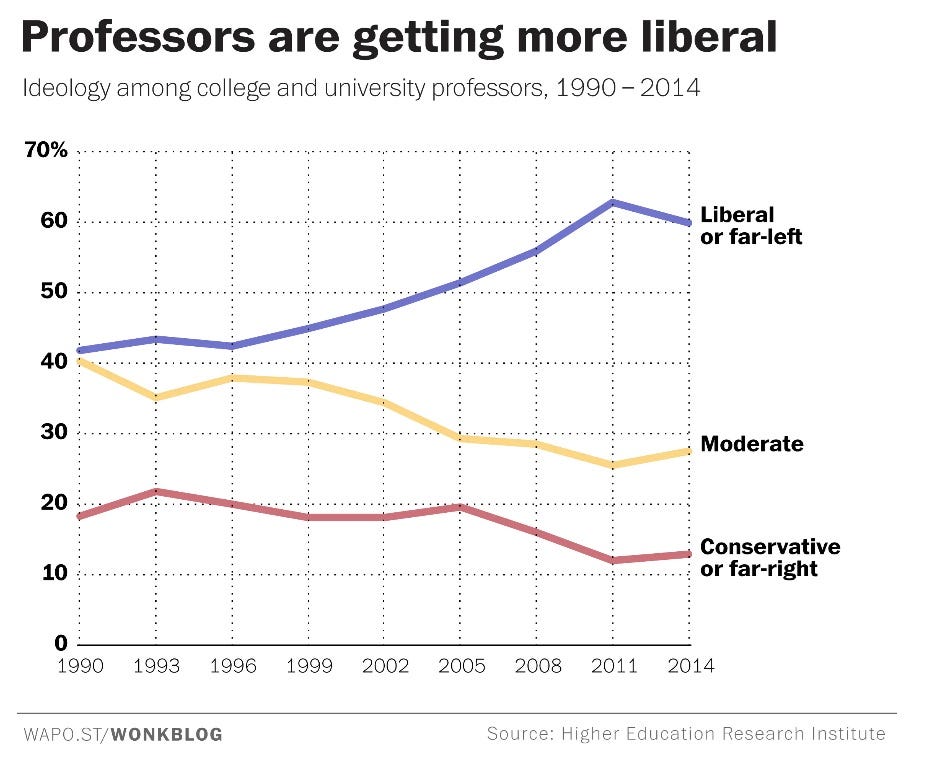
This doesn’t necessarily mean that the scientific consensus has been hacked by biased profs in order to make people believe progressive ideology. But a substantial number of Republicans are certainly afraid that this has happened, or will soon happen. You can see this in GOP voters’ increasingly negative feelings toward college professions, and their falling trust in science:
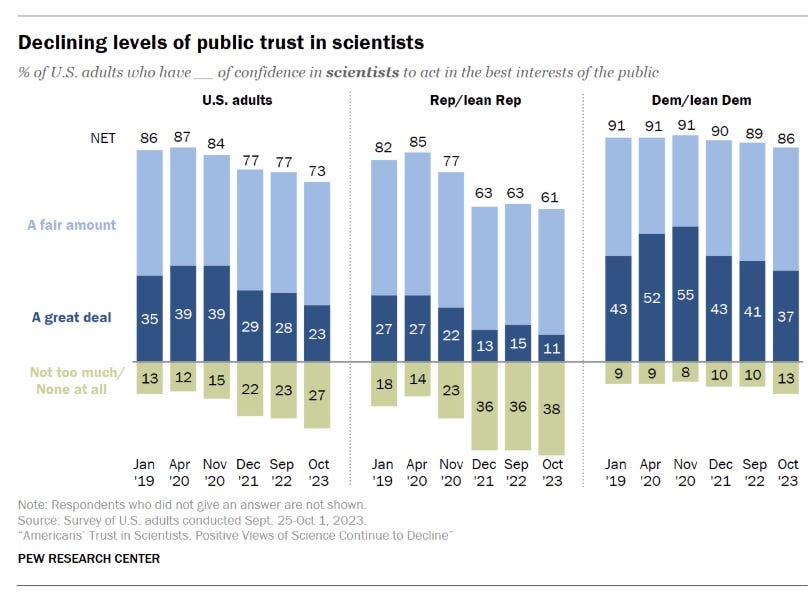
One effect of education polarization has been to crowd most of the nation’s cranks into one party — if you’re on a crusade against the scientific establishment, you should probably join Trump and the GOP. Remember that antivax ideas used to be more prevalent on the left, and RFK Jr. himself was even considered for a government role by the Obama administration. Now, though, if you want to say that science and the experts are all lying to you, the GOP seems like a much better bet.
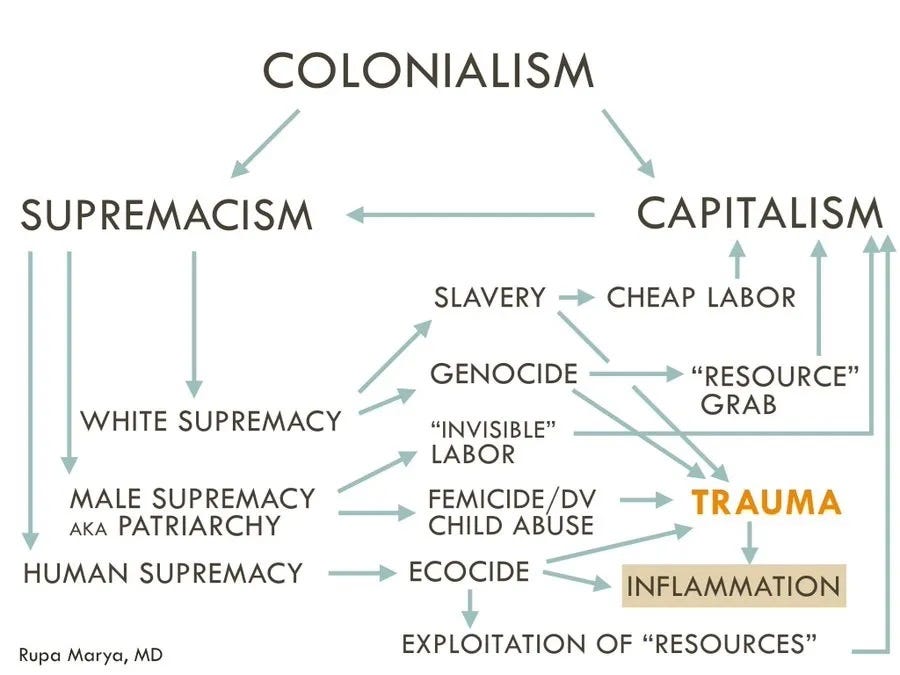
And to be perfectly honest, conservatives’ fears about the scientific establishment are not entirely unjustified. In recent years, progressive ideological nonsense has been popping up more often in elite scientific circles. Here is a flowchart that a UCSF medical professor tweeted about inflammation:
Or take the case of Jenny Bulstrode, a history lecturer at University College London, who published a paper claiming that the famous inventor Henry Cort actually stole a key metalworking technique from Jamaican slaves. The paper had no real evidence for this argument, and relied on sources that contradicted Bulstrode’s claims. But when challenged, the journal that published the paper released an editorial arguing that facts are less important than progressive politics:
[Bulstrode’s] critics return repeatedly to claims that politics must not direct historical research and interpretation. To make the case, as several of our correspondents have done, that ‘facts are facts’ (and that at bottom, Bulstrode is not adhering to what they see as the facts), is to deny a foundational tenet of humanities scholarship of the last several generations: That our perceptions of objectivity themselves derive from situated experiences. All historians necessarily select the conditions, actors and materialities that they find to be significant and thus, to constitute the events of the past.
We by no means hold that ‘fiction’ is a meaningless category – dishonesty and fabrication in academic scholarship are ethically unacceptable. But we do believe that what counts as accountability to our historical subjects, our readers and our own communities is not singular or to be dictated prior to engaging in historical study. If we are to confront the anti-Blackness of EuroAmerican intellectual traditions, as those have been explicated over the last century by DuBois, Fanon, and scholars of the subsequent generations we must grasp that what is experienced by dominant actors in EuroAmerican cultures as ‘empiricism’ is deeply conditioned by the predicating logics of colonialism and racial capitalism. To do otherwise is to reinstate older forms of profoundly selective historicism that support white domination.
These are, of course, classic cases of tribal reality. In fact, NPR’s CEO recently gave a TED Talk in which she argued that “our reverence for the truth might be a distraction that's getting in the way of finding common ground and getting things done” — an explicit articulation of the idea that the social benefits of tribal reality can outweigh the costs of ignoring extant reality.
But this idea has the potential to do great harm. In addition to whatever direct harms it forces people to incur,5 it poisons the system of trust that allows us to confidently access extant reality without getting out our test tubes and telescopes. Research from Alabrese et al. (2024) find that when people perceive scientists as political, they trust their scientific output less:
An experiment assesses the impact of online political expression on a representative sample of 1,700 U.S. respondents, who rated vignettes with synthetic academic profiles varying scientists’ political affiliations based on real tweets. Politically neutral scientists are viewed as the most credible. Strikingly, on both the ’left’ and ’right’ sides of politically neutral, there is a monotonic penalty for scientists displaying political affiliations: the stronger their posts, the less credible their profile and research are perceived, and the lower the public’s willingness to read their content.
The tribal reality being pushed in parts of progressive academia thus feeds the ascendance of right-wing tribal reality in the halls of government — and, probably, vice-versa. Even though general unrest in America is now fading, it has left its poisonous mark on our institutions, which are still acting like feuding tribes. What we need is a renewed simultaneous commitment to objectivity in science and to professionalism and expertise in the civil service. Tribal reality may have its occasional benefits, but I think it has gone way too far in America today. Just give me the damn vaccines, please.
For those of you whose parents also sent you to philosophy camp at age 13, this just means that realism, phenomenalism, and pragmatism are not in conflict in the vast majority of situations, and therefore we can afford not to think about which one of these philosophies we’re embracing as we go about our daily business of avoiding banging our knees on coffee tables.
Of course as soon as I write this, it’s going to turn out to be someone’s dissertation. Sigh.
The ultimate example of this might be European colonialism. Modern science didn’t displace traditional belief systems because people read a bunch of randomized controlled trials; it won out because European armies showed up and started mowing down local armies with machine guns and artillery. The rulers of countries all over the world realized that they needed to match the Europeans’ advantages in weaponry, which required adopting some close variant of the type of science and engineering that the Europeans had pioneered. This doesn’t mean that modern science is some kind of traditional European mysticism, no more or less true than indigenous systems of knowledge. Quite the opposite. European armies would not have had such an easy time colonizing most of the world if the Boxers had really been able to make themselves bulletproof. Modern science, by and large, simply works better than alternative traditional systems of knowledge, including European ones.
Interestingly, this false consensus against headache medicine would actually create evidence in favor of itself. There’s a thing called the “nocebo” effect, in which treatments fail because people believe they won’t work. If everybody who was anybody went around yelling that headache medicines don’t work, the nocebo effect would probably reduce their actual effectiveness. Something a little similar might happen for antivax ideas, too. Since vaccine effectiveness depends on herd immunity, antivaxers convincing a few people to go unvaccinated might end up reducing vaccine effectiveness even for the people who use them. Thus, tribal reality can sometimes actually bleed through to extant reality.
I doubt that many people are going to avoid taking anti-inflammatories or adjusting their diet because a kooky UCSF prof told them their inflammation is being caused by colonialism. And no one today will have their lives affected one way or another by false beliefs about who invented the process for turning scrap iron into bar iron. But when it comes to issues like trans medical care, politicized beliefs could potentially have more severe human consequences.