Of all the posts that I’ve had to write, this one scares me the most. There’s a certain irrational feeling that to write about something makes it more real, and this is something that I wish was just a bad dream.
When I was growing up in the 1990s, liberalism — the idea that society should be based around the rights, freedoms, and dignity of individual human beings — was ascendant. Here in the U.S. and in other rich democratic nations, there was little question that we were more free, and our rights better protected, than at any point in our history. Every politician talked about freedom as the paramount value, and even if Republicans and Democrats had slightly different ideas about what that entailed, the differences of opinion were not too stark. Whether you were fighting for abortion rights, low taxes, gay marriage, or deregulation, it always helped to couch your arguments in terms of individual freedom.
Liberalism’s ascendance was global. Even though Russia was a chaotic basket case and China had cracked down on its people at Tiananmen Square, both countries were recognizably more liberal than they had been in ages past. International organizations agreed that freedom — freedom of speech, democracy, free enterprise, and so on — was advancing all over the world. And alongside the soft power of liberal ideals stood the hard power of the U.S.A., the world’s most powerful nation, which had won the Cold War and World War 2 in the name of liberal democracy.
What a difference a couple of decades make. Since around 2005, social and political freedoms have been eroding around the world:

If you don’t believe Freedom House, of course, you can look at any other number of data sources showing the same trend, though they disagree on exactly when it began. I wrote about it in a post back in 2021, and things have only gotten worse since then:
You can feel the decline of liberalism here in the United States. Very few leaders on either side of the aisle talk about freedom anymore.1 Progressives tend to couch their appeals in terms of justice, conservatives in terms of greatness. Americans still pay lip service to freedom of speech, but no one seems to really want it — Elon Musk has increased X’s censorship on behalf of foreign governments and suppressed content he doesn’t like, while Democratic leaders like Tim Walz and John Kerry have called for legal crackdowns on “hate speech” and “misinformation”.
Abortion was legal everywhere in America three years ago — now it’s illegal in thirteen states. DEI statements — essentially, professions of ideological conformity — are now mandatory at many universities. Even free enterprise is slowly becoming a casualty of the culture wars, with progressive antitrust crusaders shifting their focus from economic harms to corporate political power, and Republicans threatening retaliation against businesses that promote progressive values. (Of course, don’t even get me started on the Palestine movement and its fantasies of violent conquest and ethnic cleansing.)
And this is all before Trump Round 2. Francis Fukuyama, one of liberalism’s most ardent defenders, has a good rundown of how things could get much worse under a second Trump term. Obviously we’ll have to wait and see, but Trump’s disdain for democratic norms, his fixation on political vengeance and punishment, and his recruitment of new, more competent allies don’t exactly bode well.
Globally, the situation is even worse. The three most powerful countries in the world are China, the United States, and Russia, and there’s a case to be made — in fact, I made it a month ago — that with the election of Donald Trump, all three are now illiberal powers. While Trump’s stance toward democracy and individual freedoms within the U.S. have yet to be seen — his first term was pretty benign, except for the time he tried to overturn an election result and encouraged a violent attack on Congress — there’s little doubt that internationally, Trump and his allies are sympathetic to Russia’s campaign of imperial conquest.
The most recent illustration of this fact is Trump’s nomination of Tulsi Gabbard to be the Director of National Intelligence. Gabbard, a leftist-turned-rightist, is a vocal and active supporter of authoritarian regimes around the world — especially Russia and Syria. Tom Rogan of the Washington Examiner explains:
If you thought about the worst possible choice for director of National Intelligence, former Democratic-turned-Republican Hawaii Rep. Tulsi Gabbard would be high up there…On Russia, Gabbard opposed Trump’s removal from the Intermediate Nuclear Forces treaty in response to rampant Russian breaches of that treaty. She has blamed NATO and the U.S. for Russia’s invasion of Ukraine (again, to the celebration of both Russian and Chinese state media), has repeated Russian propaganda claims that the U.S. has set up secret bioweapons labs in that country, and has argued that the U.S. not Russia is wholly responsible for Putin’s nuclear brinkmanship…On Syria, Gabbard has gone far beyond Trump’s skepticism for continued U.S. military presence in the country. Regurgitating propaganda from Syrian President Bashar al Assad’s regime, she has blamed Trump for Syria’s challenges and expressed sympathy for Assad’s leadership.
In fact, the only foreign country that Tulsi has warned about is America’s liberal ally, Japan, which she has accused of militarism simply for rearming itself in the face of the increased Chinese and North Korean threat.
Whether Tulsi is or ever was actually working with the Russians, as some have alleged, isn’t clear. But the Russians themselves are very convinced that she is on their side:
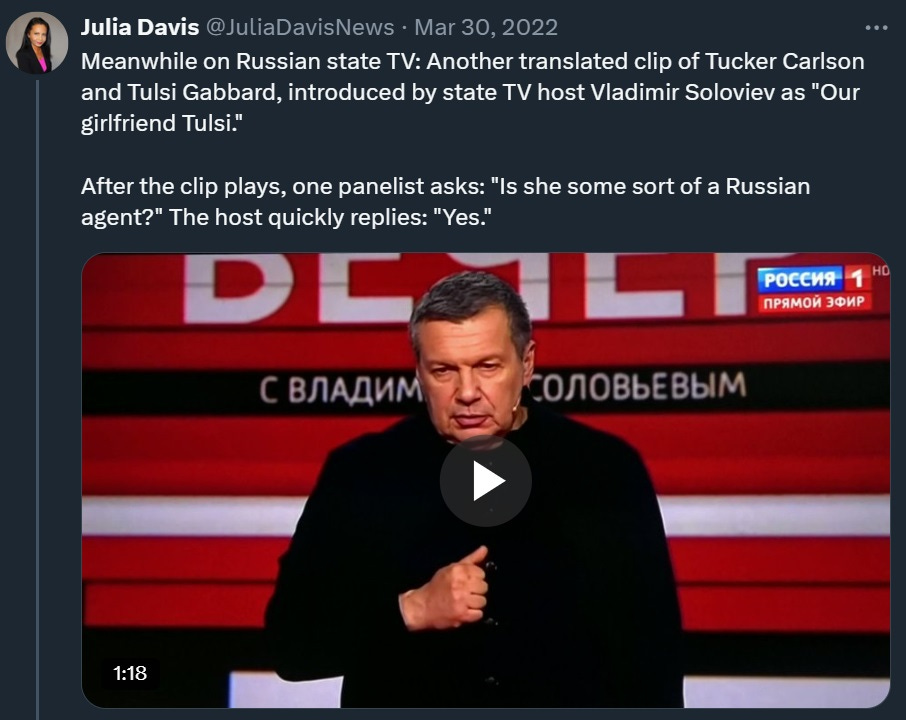
This is the woman Trump has picked to oversee all of the U.S.’ intelligence agencies. It is hard to imagine her mounting a serious attempt to counter the considerably espionage attempts of China and Russia. And it’s hard to imagine America’s allies, especially the Five Eyes intelligence services, wanting to share intelligence with the U.S. when that would mean sharing it with someone who’s deeply sympathetic to the empires that threaten them. The end of Five Eyes would be devastating for America’s efforts to counter China’s unprecedented espionage campaign.
If that isn’t a clear enough sign of Trump’s attitude toward the global tide of illiberalism, imperialism, and conquest, just wait. More signs are coming.
What all this means is that liberalism — the dominant global ideology of my youth — is now an underground rebellion. If you believe that individual human freedom and dignity are paramount, you’re now facing a world that wants to crush your ideals and enslave you to the will of various authoritarians. In America, you’re watching powerlessly as Trump remakes the country’s institutions, while in Eurasia you’re warily eyeing the suddenly unchecked power of China and Russia.
How did we get here? How did it get this bad?
Who conquered liberalism?
There are basically two answers to this question: 1) Technology, and 2) The Chinese Communist Party. Technology is probably the more interesting of these two, so let’s talk about it first.
Ursula K. LeGuin is one of my favorite science fiction authors. In her “Hainish Cycle” series, at one point the Earth and its allied worlds all get conquered by a group of aliens called the Shing. The Shing are no ordinary imperialists, with fleets of warships — instead, they’re just a small number of aliens who have the power to lie telepathically. The Shing’s telepathic lies, which other species automatically believe, convince Earth and other worlds to abolish civilization and fall into barbarism and poverty. 2
I think about this story when I think about what social media has done to American society. Over the past decade, as digital media replaced traditional media like TV, newspapers, and radio, social media has become an essential part of how people consume their news:
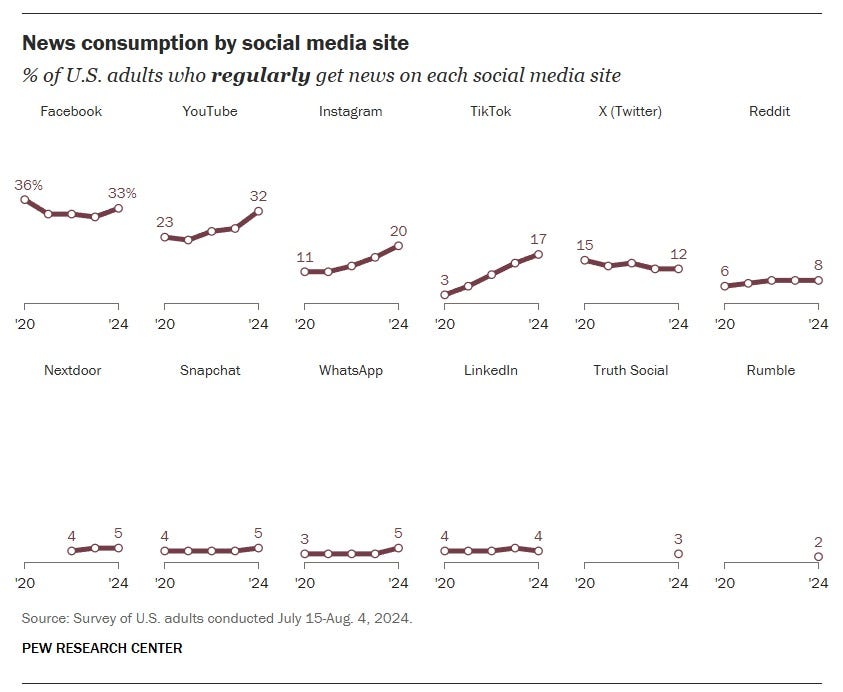
Social media preferentially elevates the worst people in the nation — a small fringe of politically active shouters — to positions of status and intellectual influence. This is mostly just a feature of the technology itself, not a choice of the platform owners.
There’s a lot of research showing how this works, so let’s go through just a little bit of it:
First of all, Bor and Peterson (2021) find that social media discussions preferentially attract the worst people, giving them a bullhorn that they don’t have in the offline world:
Across eight studies, leveraging cross-national surveys and behavioral experiments [we find that] hostile political discussions are the result of status-driven individuals who are drawn to politics and are equally hostile both online and offline. Finally, we offer initial evidence that online discussions feel more hostile, in part, because the behavior of such individuals is more visible than offline.
And Mamakos and Finkel (2023) find that these hostile individuals pop up not just in the political arena, but in cultural and technical discussions as well — it’s a fundamental feature of the technology itself, not just of the political times we live in.
These agitators, like a hundred thousand little Vladimir Lenins, whip up the rest of society into conflict and hatred. Rathje et al. (2024) illustrate the key role that social media’s toxic power-users play:
In a correlational study…and two digital field experiments (n2 = 494, n3 = 1,133), we examined whether (un)following hyperpartisan social media influencers contributes to polarization and misinformation sharing. We found that incentivizing Twitter/X users to unfollow hyperpartisan social media influencers improved feelings toward the out-party by 23.5% compared to the control group, with effects persisting for at least six months. Unfollowing also led participants to engage with more accurate news and increased satisfaction with their Twitter/X feeds—without reducing engagement. This study demonstrates the long-term causal impact of exposure to hyperpartisan influencers. Moreover, unlike other social media reduction interventions, unfollowing is a targeted approach: like a scalpel, it surgically removes a few harmful parts of one’s feed, allowing the beneficial aspects to remain.
The power of these agitators is reinforced by humans’ natural negativity bias, which seems even more powerful on social media than in traditional media. Fan et al. (2020) find that on social media, “anger travels easily along weaker ties than joy, meaning that it can infiltrate different communities and break free of local traps because strangers share such content more often.” And Watson et al. (2024) find that social media is fundamentally different from traditional media in its amplification of negativity, because negative stuff goes more viral:
[N]egativity amplifies news dissemination on social media to a greater extent when accounting for the re-sharing of user posts containing article links. These findings suggest a higher prevalence of negatively toned articles on Facebook and Twitter compared to online news sites.
Not only does negativity spread more virally, but it ends up creating a false impression of social conflict and division among the general public. Robertson et al. (2024) survey the literature and find:
Online discussions are dominated by a surprisingly small, extremely vocal, and non-representative minority. Research on social media has found that, while only 3 % of active accounts are toxic, they produce 33 % of all content…Furthermore, 74 % of all online conflicts are started in just 1 % of communities…and 0.1 % of users shared 80 % of fake news…Not only does this extreme minority stir discontent, spread misinformation, and spark outrage online, they also bias the meta-perceptions of most users who passively “lurk” online. This can lead to false polarization and pluralistic ignorance, which are linked to a number of problems including drug and alcohol use…intergroup hostility…and support for authoritarian regimes[.]
Social media platforms could take action to curb the small fraction of toxic agitators who are destroying the fabric of our society. But this would lose them money. Beknazar-Yuzbashev et al. (2022) find that “toxic” content — basically, people being insulting and nasty — drives engagement on platforms like Twitter, Facebook, and YouTube:
In a pre-registered field experiment, we recruited participants to install a browser extension, and randomly assigned them to either a treatment group where the extension automatically hides toxic text content on Facebook, Twitter, and YouTube, or to a control group without hiding…Lowering exposure to toxicity reduced content consumption on Facebook by 23% relative to the mean - beyond the mechanical effect of our intervention. We also report a 9.2% drop in ad consumption on Twitter (relative to the mean), where this metric is available. Additionally, the intervention reduced the average toxicity of content posted by users on Facebook and Twitter, evidence of toxicity being contagious. Taken together, our results suggest a trade-off faced by platforms: they can curb users’ toxicity at the expense of their content consumption.
This means that even if platform owners want to make social media a nicer place, it’ll come at the expense of their own engagement metrics. There is some set of the population who simply wants to be nasty, or see other people be nasty, to others in public forums.
In other words, due to an unlucky combination of human nature, the nature of social media technology, and economic incentives, the petty Vladimir Lenins of our society — like the conquering Shing in Ursula K. LeGuin’s stories — have suddenly become our ruling class. Liberal societies are paralyzed with division and hatred, because they spend all day mainlining the output of the petty Lenins, and believing that the petty Lenins represent their neighbors, coworkers, and countrymen. All of the radical online movements of the last decade — MAGA, wokeness, the alt-right, and leftism — are all to some degree outgrowths of this. This is why we have Trump as President instead of someone like Jeb Bush.
Of course, government could step in and regulate speech on social media, cracking down on the people spreading polarization and misinformation. Perhaps this could be done in a gentle, nudge-like fashion that simply counteracted the natural tendencies of social media. But I think that’s a very difficult needle to thread. As with control of traditional media, once government starts regulating day-to-day speech, it’s a very short and slippery slope to the abrogation of liberalism as we know it.
21st-century technology thus presents societies with what appears to be a stark choice — accept the hijacking of their politics and public life by shouty online extremists, or turn themselves into Orwellian thought-control regimes. In the most most pessimistic case, this results in the collapse of any society liberal enough to choose the former, so that only countries like China and Russia can remain stable and effective:
But social media isn’t even the only technology that seems to be biasing the world toward illiberal regimes. Modern digital technologies — smartphones and apps — have essentially made privacy a thing of the past. They constantly collect detailed tracking data on where you are, what you do, who you know, what you say, what you buy, and what you care about. And once created, that data remains in the system effectively forever.
In just a couple of decades, this has created a voluntary panopticon that governments (and companies) can use to monitor the most minute aspect of everyone’s life. As I wrote back in February, “Big Brother exists, and you put him in your pocket of your own free will.” In liberal societies, this has mainly been used for “cancel culture”, making those societies more divided, paranoid, and enraged. In illiberal societies like China it has been used just like in the sci-fi dystopias — as a method of social control that the Nazis and Communists of the 20th century could only dream of.
On top of all that, social media allows illiberal regimes like China’s to reach their long arms across international borders — observing what we do and say, applying pressure against specific individuals, and influencing our culture and our democracy. Here’s what I wrote back in February:
If you want to learn about how China is wielding “sharp power” around the globe, a good place to start is Bethany Allen’s book Beijing Rules: How China Weaponized Its Economy to Confront the World…This book is basically an overview of various ways China tries to influence the world covertly…It discusses China’s coverups in the early days of Covid, and its attempts to control Zoom through that company’s China office. It covers China’s attempts to influence foreign politics through massive clandestine social media campaigns. It explains China’s illegal overseas “police stations”. And it also discusses how the Chinese government bullies U.S. companies and NGOs into toeing the CCP line on various political matters, usually by threatening to revoke access to China’s huge domestic market.
As wide-ranging as Allen’s book is, though, it can’t hope to cover all the ways that China is covertly trying to influence the rest of the world. It doesn’t talk much about China’s massive campaign of scientific espionage via U.S. universities. It doesn’t give an in-depth treatment of China’s massive and pervasive digital surveillance apparatus (for a good treatment of that, I recommend Surveillance State, by Josh Chin and Liza Lin). It doesn’t cover China’s hacking of Apple’s AirDrop, its manipulation of TikTok content, or its attempts to subvert leaders in Western countries. Etc., etc…
Most of China’s “sharp power” methods are fundamentally enabled by the smartphone-and-social-media internet — and/or by globalization itself. Manipulation of TikTok, attempted control of Zoom, and social media misinformation campaigns give China a propaganda reach that the USSR could only dream of…Meanwhile, a globalized economy makes it much easier for China to order American companies around, to steal technologies, to install its surveillance technology around the globe, and so on.
If you believe in liberalism, this is what you’re now fighting against — a combination of the petty Lenins of social media, the panopticon of smartphones, and the long arm of the world’s most domineering governments.
You are the rebellion, and technology has stacked the deck against you. Your only hope, essentially, is to either A) innovate new technologies that take power out of the hands of the petty Lenins and domineering governments,3 or B) somehow use the cultural and media spaces not dominated by those illiberal forces to spread liberal ideas strong enough to overcome the innate disadvantages of modern technology.
A world defined by the CCP
This second reason is more boring — and probably less controversial — than the first one, but it still matters a lot.
A lot of people attribute the 20th century triumph of liberalism to natural forces — the supposed superiority of democracy and capitalism as systems of human organization, or people’s natural desire for greater liberty as they become richer. But there’s an argument to be made that much of the triumph of liberalism was a lucky happenstance. The United States of America just happened to be the most powerful country in the world for almost all of the century. And it just happened to have more liberal values than any other great power for most of this time.
American power put a gigantic thumb on the scale for liberalism all over the world. Its mighty manufacturing base — the “arsenal of democracy” — won both World War 2 and the Cold War, overmatching the fascist and communist powers. It offered its military protection and opened its markets to liberal countries during the Cold War, helping West Europe, Japan, and others to grow economically strong. And it spread liberal values, both by leaning on its allies to liberalize, and by exporting its liberal culture through movies, books, music, and so on.
In the 21st century, it’s China that’s the world’s industrial behemoth. Some projections have China controlling almost half of all global manufacturing by the year 2030:
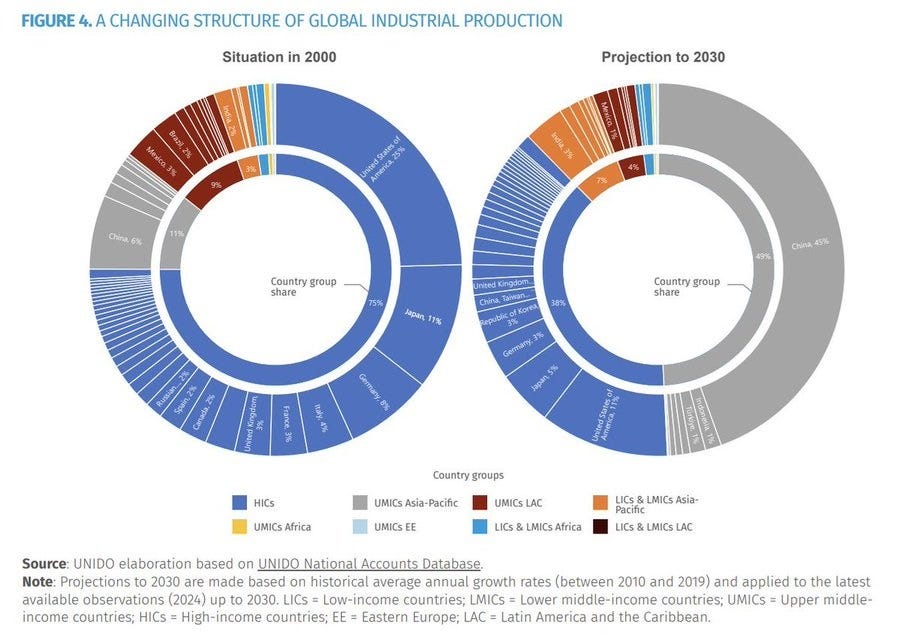
That’s a level of dominance rivaling America after World War 2, or Britain in the heyday of the Industrial Revolution. No amount of Trumpian tariffs are going to change this situation either — China’s exports are actually a relatively low percent of its GDP, and falling. China buys most of what it makes, and even total revocation of U.S. market access would only cause it marginal, temporary pain.
As Xi Jinping well knows, manufacturing is the source of military hard power. China can easily outproduce the U.S. in both peacetime — as it is doing now — and in any hypothetical wartime. Even with all of its allies cooperating in military production, America would be very hard-pressed to match China’s output.
But China’s power extends even beyond its military manufacturing might. It uses “sharp power” — trading market access for compliance — to dominate key individuals and organizations in other countries. Elon Musk may now fancy himself the “shadow president” of the United States (and it may even be true), but he still has to publicly declare that Taiwan is “an integral part of China” in order to preserve his business operations and market access in the People’s Republic:
Even if Elon does actually happen to believe this, plenty of other people have to toe China’s party line even if they privately disagree:

Who could forget the time China forced the NBA to issue groveling apologies over a single tweet by a single NBA general manager in support of the Hong Kong protests?
And then there’s TikTok. The Network Contagion Research Institute has been keeping track of TikTok’s manipulation of its algorithm to suppress Americans’ speech. Here are some of its findings:
TikTok amplifies frontier influencers (travel and lifestyle content accounts) and irrelevant or clickbait material, to crowd out discussion of CCP-driven ethnic genocide and human rights abuses on its platform…TikTok's moderation algorithms significantly augment this suppression. The views-to-likes ratio for anti-China content on TikTok was 87% lower than pro-China content even though the content was liked nearly twice as much…A psychological survey of Americans…shows that, among the platforms studied, TikTok screentime positively and uniquely predicted favorability towards China's human rights record. Notably, heavy users of TikTok (i.e., those with >3 hours of daily screentime) demonstrated a roughly 50% increase in proChina attitudes compared to non-users. This suggests that TikTok's content may contribute to psychological manipulation of users, aligning with the CCP’s strategic objective of shaping favorable perceptions among young audiences…NCRI assesses that the CCP is deploying algorithmic manipulation in combination with prolific information operations to impact user beliefs and behaviors on a massive scale and that these efforts prove highly successful on TikTok in particular.
Here is one representative chart from another NCRI report, showing how TikTok suppresses content about Chinese politics relative to Instagram:
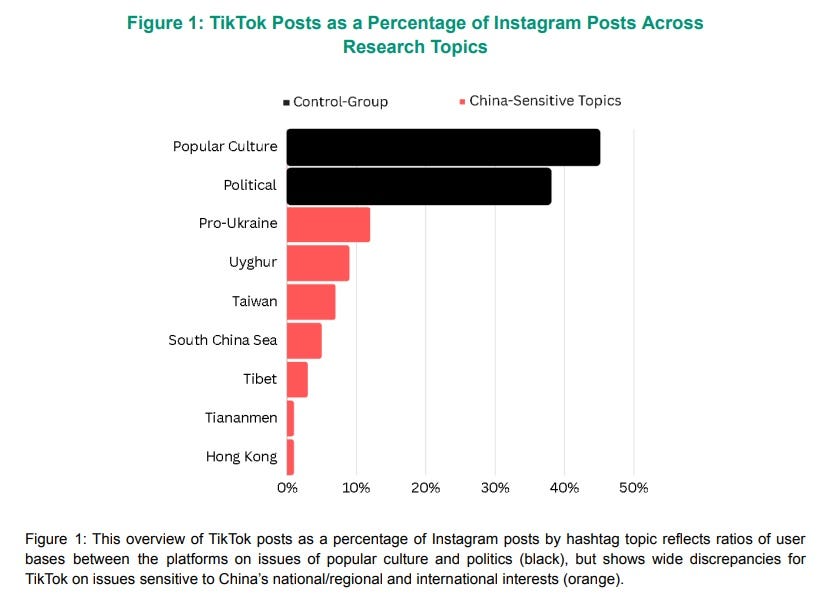
In other words, the world’s most powerful totalitarian state now reaches directly into our society on a day-to-day basis, controlling one of our most important news networks4 and suppressing Americans’ speech on that network, in addition to bullying American individuals and corporations into obeying its diktats. Liberal governments do little or nothing to counteract this interference, since they have decided to treat China’s government as just one more small atomistic actor whose right to suppress Americans’ speech is actually a form of free speech.
The U.S. did pass a bill mandating that TikTok sell itself to a non-Chinese company, but Donald Trump has vowed to scuttle that effort. This isn’t just because a billionaire offered Trump money to reverse his stance; it’s also probably because China reportedly altered TikTok’s algorithm to favor more pro-Trump content. This is also probably why Trump wants to kill the CHIPS Act — America’s main hope of maintaining its edge in the crucial semiconductor industry.
Why China itself has remained an illiberal state is just as much of a historical mystery as why America became more liberal as it grew more powerful. I’m not sure we’ll have an answer to either of those questions any time soon, but in the meantime we must deal with the blunt fact that the 21st century’s dominant power is highly unlikely to act like the 20th century’s dominant power did.
It would still be an exaggeration to say that you now live under the thumb of a global authoritarian regime ruled from Beijing. China’s military might hasn’t been used yet, and other countries’ nuclear deterrents still give it pause. Its control over your speech is far from complete — there are still many outlets for bashing the CCP without suffering dire consequences. And its influence over Vladimir Putin, Donald Trump, Elon Musk, and various European elites, while considerable, is not total.
But the idea that the U.S. could engineer an industrial revival, take action against CCP domination of social media, and lead a coalition of liberal powers to balance China’s rise, now looks fanciful. With the election of Trump, China is now simply first-among-equals of a loose concert of illiberal great powers.
Which leaves us, the people who still believe in liberalism, as the rebellion. If you believe in the primacy of individual human freedom and dignity, you are now fighting a desperate underground guerilla struggle to carve out any kind of a liberal space in a world that only 25 years ago upheld your values as paramount. History has returned — indeed, it never ended — and there is no destiny or fate guaranteeing that you will end up on the favored side of it.
But that is no reason to give up.
Kamala Harris actually did try to talk about freedom in the final days of her campaign, but nobody paid attention.
Interestingly, the Shing are well-meaning folks who apparently think abandoning civilization and becoming barbarians is a good thing for everybody, and are just trying to promote their point of view. I think of them as sort of cosmic degrowthers.
In Ursula K. LeGuin’s novels, humans eventually find a technological solution to defeat the Shing, by evolving a genetic defense against their mind control. I doubt that this sort of remedy is available to modern liberalism, however.
Possibly two. I haven’t seen evidence that Elon is suppressing China-critical content on X the way he suppresses pro-Ukraine content, but it seems well within the realm of possibility, especially given all he’s done to comply with the content restrictions demanded by other governments.