Well, that obviously didn’t go the way I would prefer.
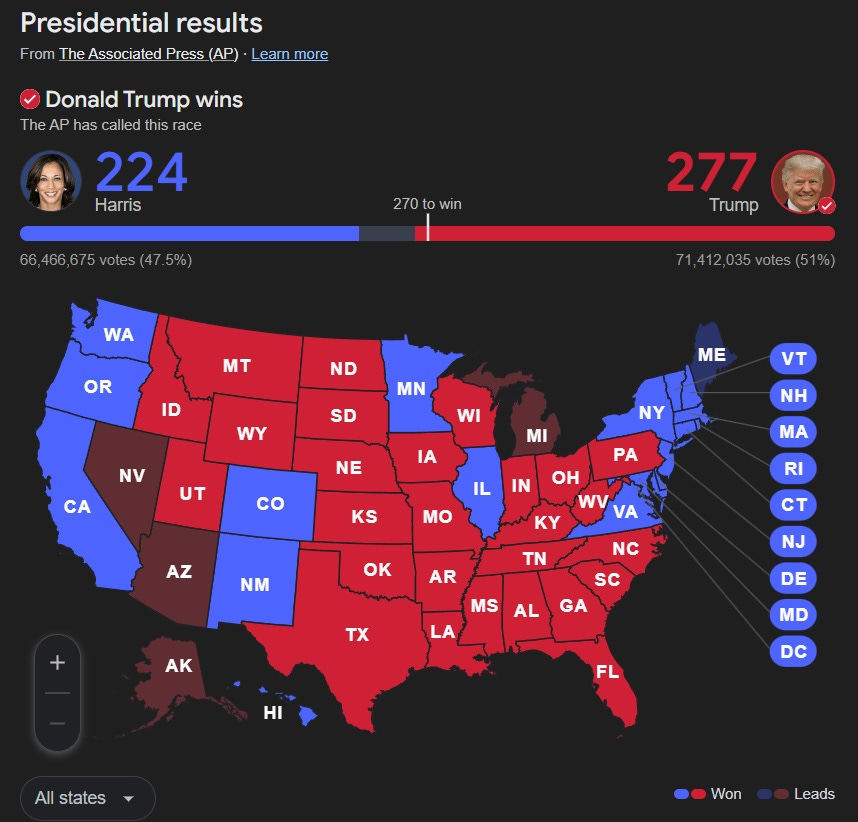
I’ve made no secret of the fact that I think Trump is a terrible choice for America, but there’s no denying that the American people have made their choice. Trump is currently projected to win every single swing state. He outperformed his 2020 performance in every single county in the country. He’s projected to win a solid majority of the popular vote — the first time a Republican has done so since 2004. I still don’t like the Electoral College as an institution, but you can’t blame it for this result like you could for 2016. In fact, Trump’s victory was part of a more general Republican landslide — the GOP took the Senate and improved its majority in the House. A map of political shifts between 2020 and 2024 shows almost solid red.
I suppose a small silver lining here is that we won’t have to spend the next two months enduring waves of “Stop the Steal” election denials, lawsuits, and threats to repeat January 6th. Democracy delivered Trump a victory, and so Trump has little incentive to attack democracy.
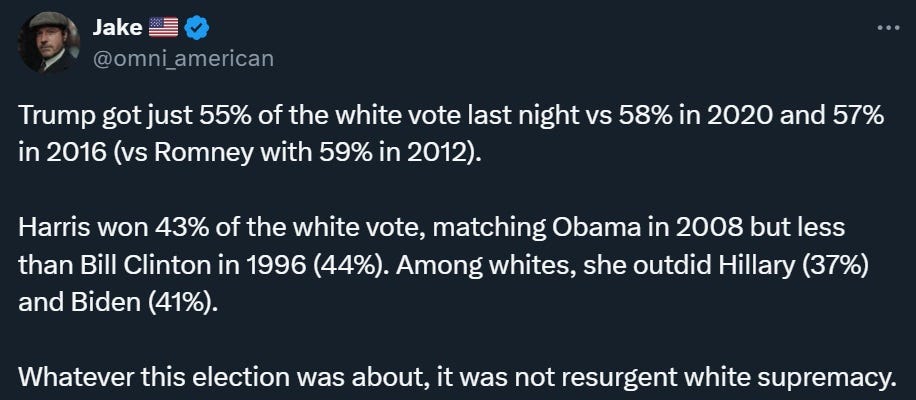
In fact, that silver lining might extend to the long term too. Trump and the GOP won because nonwhite voters and working-class voters — traditional Democratic constituencies — shifted his way. Dems still won Hispanic, Black, and Asian voters overall, but their margins fell significantly from previous elections, while actually improving with White voters:
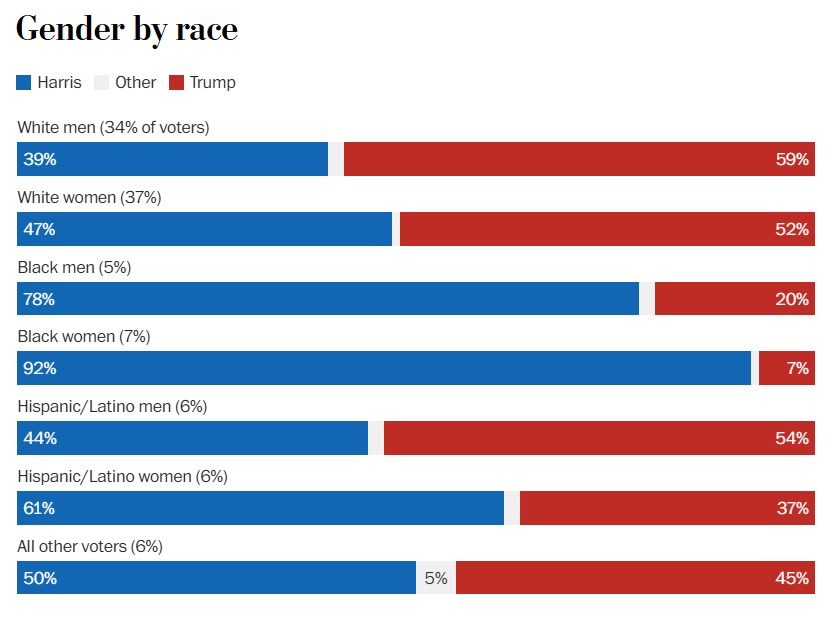
In fact, exit polls show Trump winning a solid majority of Hispanic men!
Update: Over at Matt Yglesias’ blog, Jed Kolko shows that heavily Hispanic areas swung harder toward Trump than any other parts of the country:
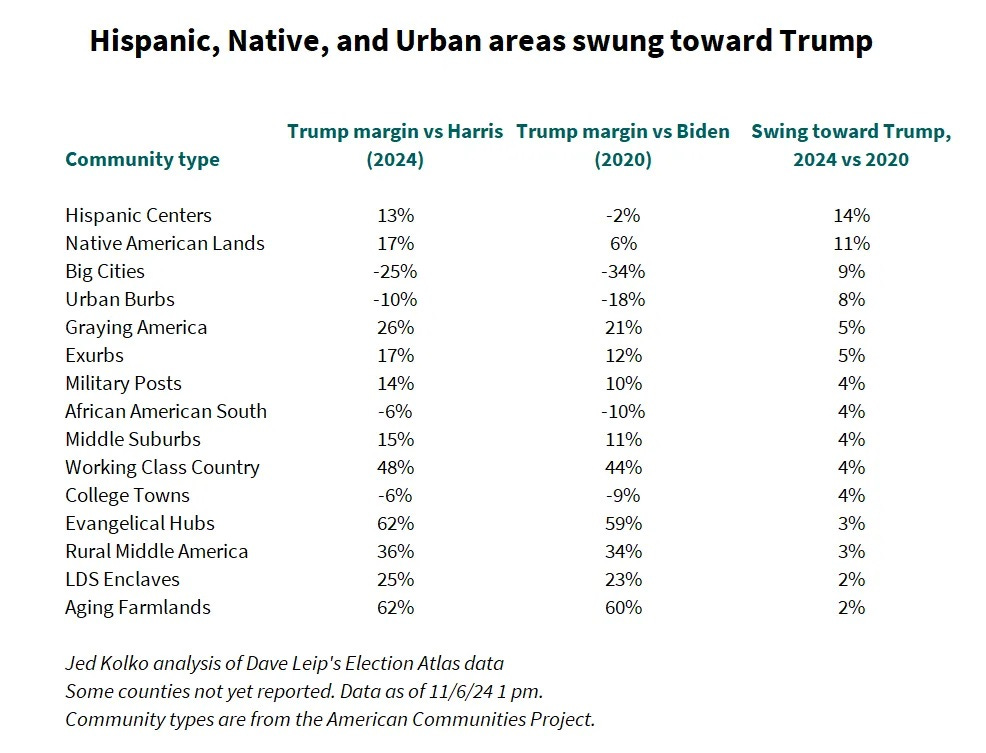
Ronald Reagan’s prophecy that Latinos would become Republicans is coming to pass.
Income has realigned as well. Democrats are now the party of the educated upper middle and wealthy class, but have lost their appeal to the middle and working classes:
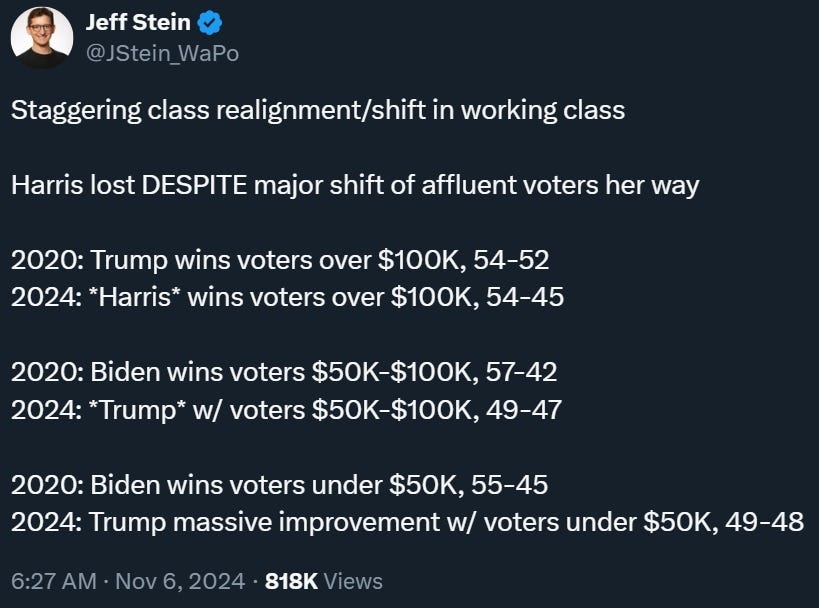
This largely destroys the narrative that nonwhite immigration will demographically drown White Americans under a tide of imported minority votes. In fact, it vindicates my guest poster Wally Nowinski, who observed that high-turnout elections like this one now help Republicans, because marginal voters — working-class Americans and Hispanic Americans — now lean to the right:
At some point, Republicans are going to realize this, and hopefully become less anxious about America’s racial future. Hopefully they will also realize that any attempt to make voting harder actually hurts them in the future, because the impact would fall disproportionately on their own base.
I expect these realizations to take some time to sink in, but ultimately their effect could be very salutary for American democracy. In the days of Nixon and Reagan, Republicans never worried about democracy itself — it was obviously on their side. Even in 2004, Republicans could tell themselves that we lived in a “center-right nation”. Now, Trump’s victory, powered by lower-income Americans and Hispanic men, will hopefully convince the GOP that democracy is still a game they can win.
A democracy needs both major parties to believe they can win via persuasion rather than by organized resistance, and 2024 showed that Republicans can still do that — even if the method of persuasion is one that I personally wish hadn’t worked so well.
If you want an optimistic take, there it is.
So what other important lessons can we learn from this disappointing election result? I didn’t title this post “Why Trump won”, because I don’t think I really have a convincing answer — I’m not a political scientist, or even a political pundit. In fact, there are probably a bunch of reasons, not just one.
Nor am I going to be one of those pundits who tells you that if only Democrats had listened to my policy priorities, things would have gone very differently. In fact, few Americans care about my own policy priorities. My top issues are industrial policy and pro-democratic foreign policy. I definitely don’t think emphasizing those more, or doing more of those things, would have propelled Harris to victory. (I don’t think they would have hurt; I think voters just don’t care.)
But I do think there are some important lessons that we can already learn from this election, especially at the intersection of economics and politics. In particular, I see three big ones:
Identity politics — viewing racial groups as homogeneous “communities” to be targeted with appeals to collective grievances — is not an effective way of winning over Hispanic (or, probably, Asian) voters.
People care about inflation more than about unemployment.
The educated professional class has become dangerously out of touch with the rest of the country.
Instead of writing all of these in one post, I’m going to split it into three, because I think the lessons are each very important. Today, since I’ve already shown the racial and class breakdown of the exit polls, I’ll talk about how identity politics is failing Democrats. Whether or not you think identity politics drove voters into Trump’s arms, it certainly hasn’t done an effective job of retaining Hispanic voters. The whole approach needs a deep rethink.
Americans are individuals, not extensions of racial “communities”
In the 2010s, there was a big debate over identity politics, with scholars like Francis Fukuyama warning that treating the American electorate as a balkanized set of racial collectives was undermining democracy. Stacey Abrams and other progressive writers pushed back against Fukuyama, arguing that all politics is identity politics, and so Democrats should continue focusing on racial appeals.
Abrams et al. were right in the facile, definitional sense that people’s personal identification with larger groups, movements, and ideas — rather than their own personal economic interests — drives much of their political behavior. After all, if human beings were rational calculating machines, they wouldn’t even vote, given the incredibly low probability that any election will be decided by a single vote.1
But the 2024 election — even more than the 2020 election — makes it clear that most Hispanic and Asian voters don’t want to be appealed to based on the racial group of which they’re supposedly a part. For example, lenient policies toward asylum seekers from Latin America don’t seem to have won over many Hispanics:
In Hidalgo County, in South Texas — a Mexican American stronghold that Biden won with 58% of the vote in 2020 — Vice President Harris and Trump were virtually tied early Wednesday, with Harris leading by less than half a percentage point…In Cameron County, at the southern tip of Texas' Rio Grande Valley, Trump led Harris, 52-47, according to early results. Biden won that county with 56% of the vote four years ago.
The whole notion that lenient policies on illegal and quasi-legal immigration would win inroads with Latinos was based on the idea that Hispanic Americans identify strongly with others of their same race. Political scientists call this the theory of “linked fate”.
Democrats clearly buy into this theory when they refer to racial groups as “communities”. This term has become ubiquitous in Democratic messaging — for example, Harris talked about her “economic agenda for the Latino community”.
But races are not communities. Our country is not like a segregated 1930-era city, where Black people live in a ghetto, Chinese people live in Chinatown, Italian people live in Little Italy, and so on. Hispanic and Asian Americans might share a sense of “linked fate” with others of their race, but it’s only one of many things they care about, and perhaps not even a major one.
The big exception, of course, is Black Americans, who continue to vote mostly like a racial bloc, despite Trump’s modest inroads with Black men. This has clearly influenced the Democrats’ view of how racial politics operates in America, and they’ve tried to apply the same mental model to Hispanics and Asians. This is explicit in California, where you hear the term “Black and brown” thrown around a lot.2
But it isn’t working. In fact, it’s backfiring. A recent paper by d’Urso and Roman found that use of the term “Latinx” actually made Hispanics vote for the Republicans in nontrivial numbers!
Group labels are political, but little theory and evidence explains how group labels shape politician evaluations…Latinos’ relationship with “Latinx,” a gender-inclusive label, is a theoretical test case. Using several datasets, we find: Latinos are less likely to support politicians who use “Latinx”…Latinos who oppose “Latinx” are less likely to support politicians who used or are associated with “Latinx”…Latinos in areas where “Latinx” is more salient are more likely to switch their vote toward Trump between 2016-2020[.]
One common interpretation of this result — and one the authors discuss — is that many Latinos are conservative, and that this makes them susceptible to “anti-LGBTQ+” labels. I’m highly skeptical of this interpretation. Outside small, highly educated, deeply progressive circles, who even knows that the purpose of the “x” in “Latinx” was to be trans-inclusive? Almost no one who is likely to be offended by the term is even aware of this.
Instead, what they hear is simply someone making up a weird label and applying it to them. It’s what sociologists call ascription — it’s someone making up a racial category for someone else and then stuffing them into it without their consent. The Occam’s Razor explanation for Hispanics’ dislike of “Latinx” is that it minoritizes them — it declares that they’re part of a special “community”, separate from other Americans.
Democrats’ purpose in assigning Americans to “communities”, of course, is not to exclude them, but to reward them — to hand them special prizes or favors via government policy. For example, the Biden administration had a whole policy oriented around giving government benefits specifically to “HSIs” — an abbreviation for “Hispanic-Serving Institutions”, i.e. colleges that a lot of Hispanic people tend to go to. Harris also had a plan for encouraging small banks to give Hispanic people more loans.
This is, fundamentally, a special-interest model of politics — it’s similar to the kind of quid pro quo that historically dominates much of urban machine politics. I’m not sure whether today’s Dems inherit their instinct for this kind of group giveaway from their old Tammany Hall days, but it’s recognizably similar to the way California cities hand out cash to favored nonprofits — especially because the programs are often targeted at colleges or banks or nonprofits or other organizations that claim to serve the racial “community” in question.
But there are notable downsides to this approach. First, unlike in a city, these targeted initiatives probably don’t make it through to the public consciousness. What Puerto Rican voter in Philadelphia even knows what the heck an “HSI” is? But more fundamentally, I think most Americans, including most Hispanic Americans, would rather be treated as individuals than as members of a racial “community”.
Identity politics and minoritization
Identity has many components. For my part, I identify as an American, a Texan, a liberal, a rabbit keeper, a writer, a nerd, a PhD holder, a science fiction fan, a Jew, a white person, a Lithuanian-American, and so on.3 If politicians primarily spoke to me as part of the “Jewish community”, I would be annoyed, because I don’t necessarily want to be defined by that component of my identity. I don’t reject it, but I don’t want to be reduced to it either. And if politicians tried to appeal to me with policies targeted through Jewish organizations to benefit Jews, I would simply not care. In fact, I would be a little conflicted about accepting any of those benefits, since it would pigeonhole me into prioritizing an identity that exists as only one component among many.
Even more fundamentally, being constantly minoritized — being told to think of myself as a Jew first and as an American second — would pressure me to shrink the circle of people that I consider part of my own in-group. Because I think of myself as an American first and foremost, I feel like there are 330 million other people who share my primary identity — 330 million people on my “team”. But if I were to think of myself first and foremost as a Jewish person, that would shrink my in-group to only 16 million, almost none of whom live near me. It would make me feel more isolated, and might even cause me to start questioning whether the 323 million non-Jewish Americans who live all around me have my best interests in mind.
In other words, being set apart from your fellow countrymen and neighbors is generally not a desirable thing, even if the reason is to put you on a pedestal.
I suspect many Hispanic Americans feel the same way. Talking to Hispanic folks (remember, I’ve lived most of my life in either Texas or California) and reading books like The Diversity Paradox, The New Americans?, and The Great Demographic Illusion, it seems clear that most would like to think of themselves as regular Americans — not to give up or forget their national origins or ethnic identity, but to prioritize their American-ness.
The progressive movement of the 2010s told us that this was a bad thing. “Assimilation” became a dirty word in progressive circles, and the University of California told their faculty not to call the U.S. a “melting pot”. The implicit assumption was that given the choice, people would like to prioritize their racial and ethnic identities, and that only forcible conformity pressure from American institutions — or from White people — was preventing people of color doing that. The Democratic party’s embrace of identity politics — its habit of targeting racial “communities” with encouraging rhetoric and specific material benefits — was seen as a way to counteract the pressures of assimilation.
The conservative counter-narrative was that race relations had been fine right up until progressives started making everything in America about race. Conservatives always send me the following chart:
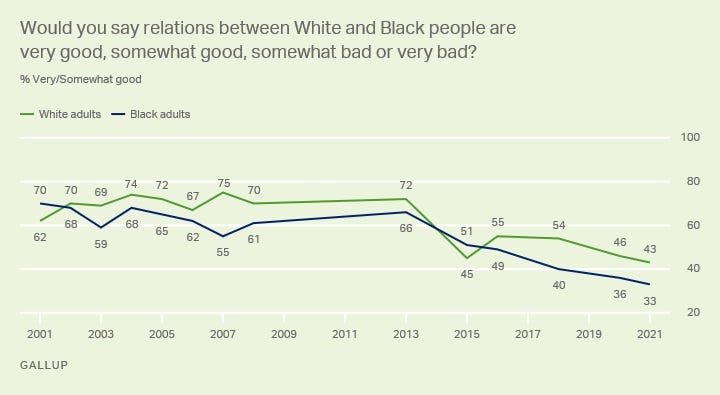
This is a powerful argument. If structural racism was really so entrenched before 2014, then why did two-thirds of Black adults say race relations were good? Essentially, the progressive story is that they were effectively bullied into saying this — or perhaps bullied into thinking it. The conservative story is that progressives created the decline in race relations by making everyone think about race all the time.
I suspect that neither of these stories gets it quite right, but that the conservative story is closer to the truth. Increasing the salience of racial divisions and racial conflict makes people mistrust their neighbors more. And although both sides were guilty of this in the 2010s, progressives were far more zealous and absolutist about it.
Essentially, the progressivism of the 2010s sought to turn American society into a sort of estate society, where people’s rights, privileges, and social roles would be mediated by their identity group. How your teachers and principals treated you, your relationship with the law, what colleges were available to you, what kind of parties you could go to, what jobs you could get hired for, how your bosses treated you at work, what kind of benefits you could expect from your government, and even how people walked past you on the street were to be determined by the race you were born into, rather than your own actions as an individual.
These race-based social relationships were to be enforced by a combination of DEI departments, lawsuits, social shaming, job loss, and so on. Ibram X. Kendi even suggested the totalitarian step of creating a constitutionally mandated “Department of Antiracism” to enforce race-based social relations at every level of society — all in the name of combatting “structural racism”, which Kendi couldn’t even define when asked.
Democratic party politicians never fully embraced this vision of the future, even in 2020-21. Some of these ideas were tried out in 2020-21, but they failed almost as quickly as they were tried, making basically everyone mad in the process. By 2024, Kamala Harris was tacking pretty strongly away from the racialized vision of America.
But that was too little, too late. People remember the individualistic Americanism largely prevailed in public life before 2014, and they remember the constant hyper-consciousness of race in 2014-21, and they know which one they like better. And although Democrats abandoned much of their woke rhetoric, the practice of targeting politics at specific “communities” has persisted. I suspect that it refreshes the bad memories of the racial conflicts of 2014-21.
All of this is a long-winded way of saying that Democrats’ racial targeting probably makes a lot of Hispanic people feel singled out and alienated in their own country, even if the purpose is to help them.
But that’s not all. Democrats’ identity politics flies strongly in the face of the narrative that has defined the American experience for many Hispanics.
The story of Hispanic voters is defined by the American Dream
To the extent that most Hispanic Americans do share a common experience, it’s the immigrant experience. Immigrants come to America seeking the American Dream of upward mobility and opportunity. And by and large, they achieve it. Their children tend to earn a lot more than they do, and their grandchildren earn even more.
This was the path that most immigrant groups have followed — the Irish, the Italians, the Lithuanians, the Chinese, and so on. For a while, people argued that Hispanics were different — that they would be permanently excluded from the American Dream. That turned out not to be true:
For many Hispanic Americans, their salient experience of America has not been one of racialized exclusion, but one of upward economic mobility and social inclusion. Economists have found that Hispanic incomes are converging to White levels across the generations. Once you control for the composition effect of new poor immigrants coming in, there’s strong income convergence across the generations:
We study the sources of racial and ethnic disparities in income using de-identified longitudinal data covering nearly the entire U.S. population from 1989-2015….[T]he intergenerational persistence of disparities varies substantially across racial groups. For example, Hispanic Americans are moving up significantly in the income distribution across generations because they have relatively high rates of intergenerational income mobility…
Hispanic Americans are moving up significantly in the income distribution across generations. For example, a model of intergenerational mobility analogous to Becker and Tomes (1979) predicts that the gap will shrink from the 22 percentile difference between Hispanic and white parents observed in our sample…to 6 percentiles in steady state…
Hispanics are on an upward trajectory across generations and may close most of the gap between their incomes and those of whites…Their low levels of income at present thus appear to to be primarily due to transitory factors.
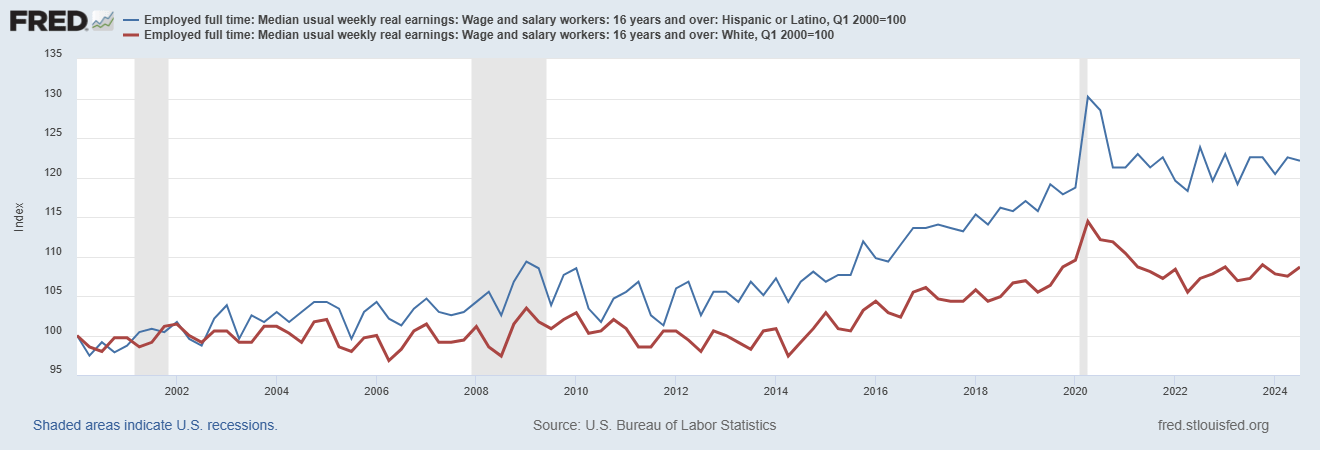
In fact, despite composition effects from continued immigration, Hispanic wages have grown faster than White wages in America since the turn of the century:
Surveys unsurprisingly have found widespread economic optimism among Hispanics for many years. Hispanics are climbing the ladder of education:
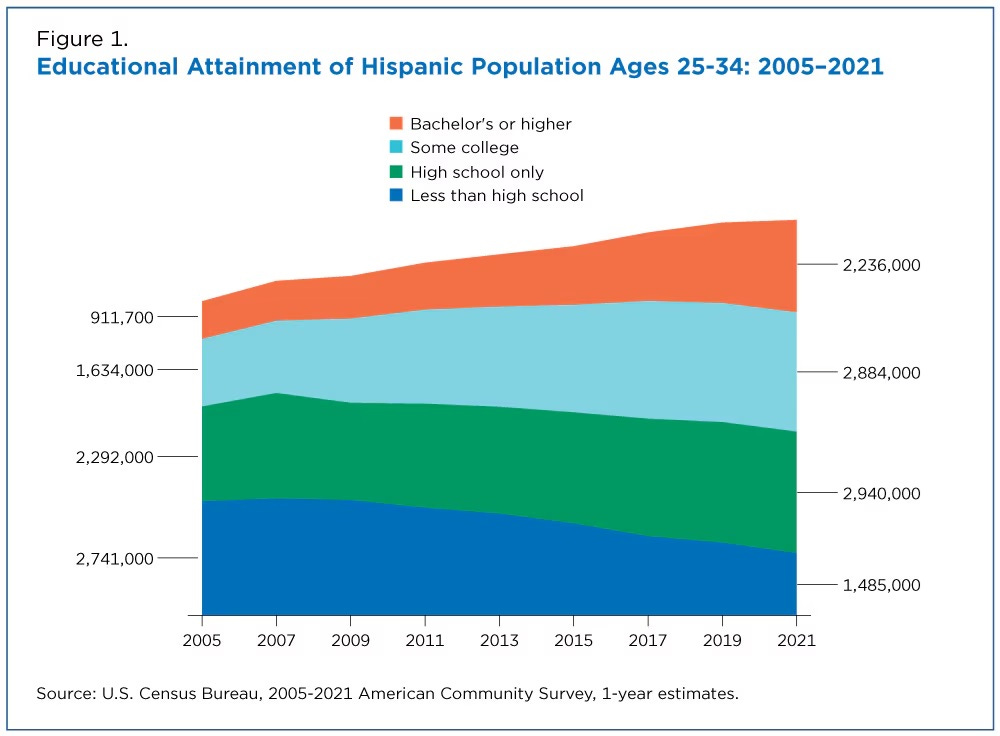
Hispanic homeownership is rising strongly. And Hispanics are starting businesses at very high rates:
New businesses owned by Latinos accounted for 36% of launches in 2023…As of 2023, Latino entrepreneurs have established a staggering five million businesses across the United States, collectively generating over $800 billion in annual revenue…The rapid pace of this growth is further highlighted by the fact that the number of Latino/a-owned businesses surged by 34% from 2007 to 2019.
In other words, Hispanic Americans’ economic path looks reasonably similar to that of Italian Americans or Irish Americans.
In the 2010s, it became taboo to even talk about these successes in some progressive circles. The University of California’s 2015 speech guidelines told faculty not to say “America is the land of opportunity”. This was deemed to be a racist utterance, since it supposedly minimized the economic exclusion that many minority groups have faced.
But the fact is, America is the land of opportunity, especially for immigrants and their children. Hispanic Americans, broadly speaking, have been prime beneficiaries of that upward mobility — they have worked incredibly hard, gone to school, started businesses, learned English, and done everything else they were supposed to do. And America has rewarded them with economic success and social integration.
Compared to that self-bootstrapped success, racial preferences — DEI, affirmative action, preferential government contracts, and so on — are basically a booby prize. Yes, in reality, those policies can sometimes help accelerate Latino achievement. But the mere fact that they’re on offer — and that Democrats seemingly view them as permanent policies instead of temporary ones — sends the message that Hispanics are a permanently racialized, excluded, marginalized group. This message is often explicit — when Democrats and progressives talk about “marginalized groups”, which they often do, that term is generally supposed to include Hispanics.
Being a marginalized group is simply not part of anyone’s American Dream.
The tricky part for Democrats is that this is an approach that has largely worked with Black voters — or at least failed to alienate them. It will be difficult for Democrats to convince themselves that Hispanic voters are not going to work the same, after spending so many years believing they would. But the 2024 election, and the trend of the last few elections, makes it clear that the two are not going to work the same.
After identity politics
Identity politics allows Democrats to hold on to a supermajority of the Black vote, so I suspect it will never go away. But the Black vote is a smallish and shrinking part of the electorate, and even there, the power of idpol may be fading a bit. Meanwhile, Hispanic voters, Asian voters, and Middle Eastern voters are the future. Those groups are all strongly upwardly mobile, and mostly descended from people who came to America voluntarily in search of the American Dream. And although ethnic studies professors and progressive activists will happily tell you all about the Chinese Exclusion Act and post-9/11 Islamophobia, it’s just not the case that Hispanic, Asian, and Middle Eastern Americans have anything that compares to the history of slavery and segregation.
The Democrats need to move away from identity politics. And switching to class-based politics, as some have suggested, won’t really help. Biden was probably the most pro-union and pro-worker President America has had since the mid 20th century, and yet some prominent unions refused to endorse Harris.
Instead, Democrats need to retool their message to be about American identity, as it was in the New Deal days, and as it arguably was for Clinton and Obama. I believe Harris actually took steps in the right direction, but not enough, and not nearly soon enough — and she was probably the wrong person to sell the idea. My advice is not to be discouraged, and to keep at it — Walter Mondale and Michael Dukakis both went down to crushing defeats with centrist, positive messaging, but then Bill Clinton eventually figured out how to make the approach work.
Republicans will eventually screw up. Trump is old, and he has a lot of foolish and bad people around him, and his economic policy program is kind of a dead end. At some point, America will once more call upon the Democrats to save them from Republican mistakes, as they did in 2008 and in 1992. Democrats will have an easier time rising to that inevitable summons if they leave the identity politics of the 2010s behind. Because that stuff just isn’t getting the job done.
Actually, what would happen is that the number of voters would shrink until it’s so small that a single vote had a high probability of being decisive, and voters would all randomize whether they went out and voted. This, of course, is a silly fantasy, since humans do not behave like this.
Note that “Black” is capitalized in this expression but “brown” is not. This is really the way that progressives write it! The reason is academic theory — “Black” is supposed to be an identity group that its members have chosen for themselves, while “brown” and “white” are theorized to be ascriptive terms imposed from outside. Although the crosstabs of the 2024 election do lend a bit of support to that distinction, the weird capitalization behavior is still fairly precious and out of touch. Note that in this blog, I capitalize “White” as well as “Black”, consistent with Bloomberg and the Washington Post. But sometimes I forget to capitalize them, because I also just don’t care about stuff like this very much, and I think the nation would be better off if we all cared less about stuff like this.
I tried to put these in rough order of importance, but really it’s situational.