This past weekend I went to a conference hosted by the Roots of Progress Institute. I’m not sure if I’ve ever been to an event where the ideals and ideas of the other attendees so closely aligned with my own. Pretty much everyone there was a techno-optimist like myself. Everyone was thinking and talking about how we could accelerate economic growth.
In the very long run, economic growth is everything. Global GDP has grown at about 2.68% since 1820. If it had grown at only 1.68% instead — just one percentage point less — the human race would be only 37% as rich as it is now, with a per capita GDP of about $6145 instead of $16,677. As Tyler Cowen writes in his book Stubborn Attachments, this means that if you can find some policy that will increase long-term growth, you should do it. The vast difference in the living standards our descendants will experience outweighs whatever small sacrifices we might make today. (That growth must include preservation of the natural environment.)
The most obvious growth policy, of course, is to avoid degrowth. The idea of intentionally forcing the economy to stop growing is a ridiculous, inhumane, unnecessary, and counterproductive proposition. Beyond that, there are plenty of suggestions for how to accelerate growth (while also keeping it sustainable) — research spending, deregulation, industrial policy, metascience, and so on. That’s what most of the discussion at the Progress Conference was about.
But even if we keep growing our living standards as fast as we can, there’s the specter that someday growth will peter out on its own. In fact, some top economists believe that growth will eventually slow — indeed, that it’s already slowing now, and that the factors behind the slowdown will only get more severe as time goes on.
Most notable among these is Chad Jones, a Stanford economist who is probably the premier theorist of economic growth working today.1 Jones gave a presentation at the Progress Conference called “The Past and Future of Economic Growth”, in which he argued that long-term growth will be constrained by the slowdown in human population — with AI scientists as the only way out.
So the future end of growth is our topic today. But before I get to Jones’ gloomy prediction, I want to cover another, different argument that I see a lot more often. Plenty of people will tell you that future growth will be constrained by scarcity of natural resources. That’s probably wrong.
“Infinite growth on a finite planet” isn’t a good argument
Sir David Attenborough, the man who writes and narrates a bunch of nature documentaries for the BBC, is fond of saying “Anyone who thinks that you can have infinite growth in a finite environment is either a madman or an economist.”
This statement seems simple, obvious, and self-evidently true to lots of people. One thing is infinite, the other is finite! A finite thing can’t support an infinite thing! Duh! If you don’t realize this you must be a dummy.
The usual riposte of pro-growth techno-optimists is something along the lines of: “Why should we only have one planet?” This is typically followed by paintings of Mars colonies, orbital cities, and so on. Occasionally it’s accompanied by references to the Kardashev Scale, which defines a civilization based on whether it can capture the energy of a planet, a star, or a whole galaxy. If economic growth requires infinite resources, well, go out and get infinite resources!
Those replies are well-intentioned — and I definitely support space colonization — but they largely miss the point. Economic growth doesn’t actually require us to keep finding and exploiting more and more resources. Often, growth means using fewer resources than before.
In fact, Attenborough’s favorite quote is originally due to an economist. The quote is usually taken to be a self-effacing statement that economists are similar to madmen — that they spend all day dreaming up models that bear little relation to observable reality. But there’s another possible meaning here too. In fact, infinite growth might be possible on a finite planet, because the way economists define “economic growth” is actually a bit different than the way most people casually use the term. So this might not be madness, but simply a case where economics teaches us to think differently.
Economic growth, in the way that economists use the term — and in the way it’s defined in official GDP statistics — does not actually mean growth in resource use. Economic growth means growth in the value of what we produce. Resource use is objective, economic value is subjective.
Let me give an example. Suppose I chop down ten thousand trees and burn them in a giant bonfire out in some empty field. There was no economic growth. I used up resources, but I didn’t produce anything anyone wanted. No one paid for the bonfire, so it didn’t enter into GDP. From an economic perspective, the resource use was wasted.
Now instead, suppose I take a sheet of paper and draw a picture of a rabbit. This isn’t just any picture — it’s so amazing and awesome that people all over the world are willing to pay thousands of dollars just to see it. This represents an enormous increase in economic value, for essentially zero resource cost. Economic growth is supercharged, without any strain on the planet.
Yes, that’s a silly, unrealistic example. But it’s meant to demonstrate what economists mean by “growth” — and what our GDP statistics actually measure. Growth doesn’t have to involve the exploitation of more resources — it can mean finding more valuable configurations for the resources we already have. In fact, economists have terms for this — “extensive growth” is growth from using more resources, while “intensive growth” means growth from using resources more efficiently.
And there’s not any theoretical limit on how much value we can produce by rearranging and re-rearranging the resources of our finite planet.2 In fact, in recent decades, growth in rich countries has looked less and less like “chopping down a bunch of trees”, and more and more like “drawing nicer pictures of rabbits”. In many rich countries — even ones that do a lot of mining, like Australia — economic growth has decoupled from the usage of many scarce resources.
For example, here’s a picture of economic growth versus carbon emissions for various rich countries:
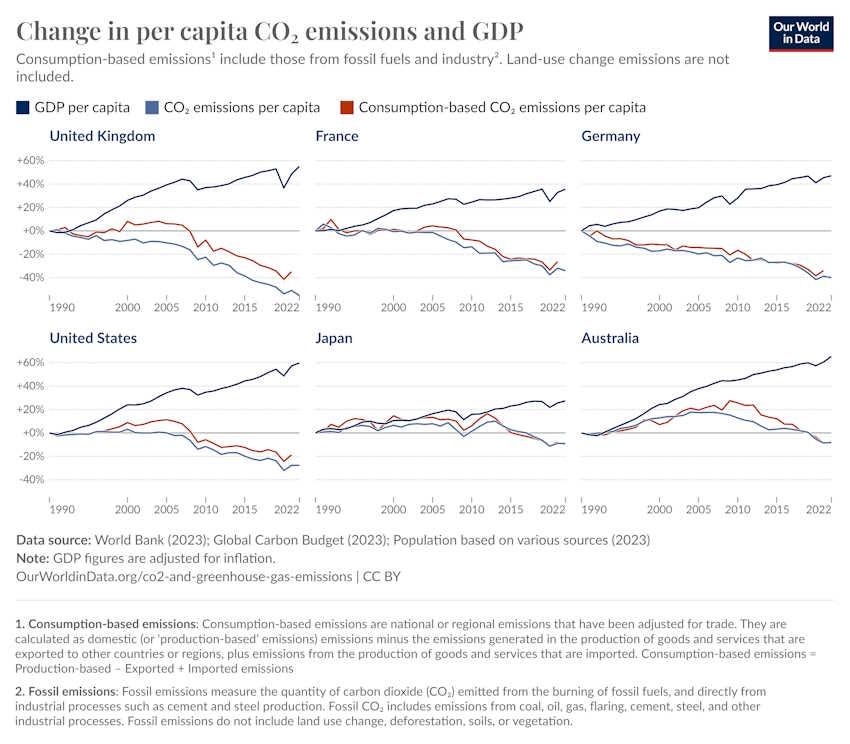
Growth has continued even as emissions have fallen. This isn’t a function of “outsourcing” emissions to developing countries, either — the red lines show consumption-based emissions, which takes all outsourcing into account.
Similar declines or stagnations in resource are visible for freshwater, various metals, and even energy itself. Deforestation in most of these countries has halted and gone into reverse. Consumption-based estimates aren’t available for many of these resources, so in some cases this could be due to outsourcing of resource use to poor countries. But the case of carbon emissions suggests that such outsourcing is rare.
A big reason for this is dematerialization. People are shifting their consumption from the physical world to the digital. For example, even as the U.S. economy has continued to grow, Americans now drive less than they did in 2004:
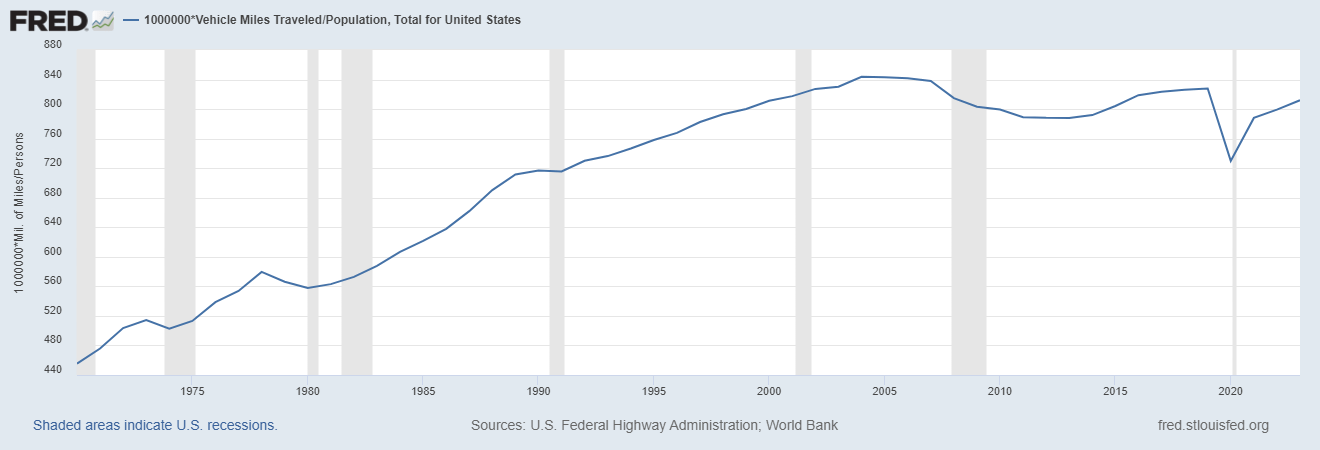
Leftist theories that capitalism “requires” constant increase in resource use have simply not been borne out.
In fact, you can imagine dematerialization going much, much further. Suppose we invent the Matrix — a simulated virtual world that feels every bit as good as reality, or even better. And then suppose we all put our bodies in pods, tended by AI robots. Within that virtual world, we could continue to achieve more and more — exploring virtual planets, having all sorts of adventures, etc. We could live lives so exciting, pleasurable, and fulfilling that anything we could do in the physical world pales in comparison. And within the Matrix, we would be constantly inventing even better ways to enjoy ourselves — in other words, continued economic growth.
All of the economic value created in that virtual world would be very real, because economic value is subjective. If your virtual self in the Matrix buys and eats a virtual sandwich, the GDP generated is every bit as real as if your physical self bought and ate a physical sandwich.
Of course, this might not happen. Matrix-like technology might not even be possible. Or people might not like living in virtual worlds, preferring the knowledge that what they’re experiencing is “real”, or not wanting to surrender the fate of their bodies to the AI robots.
But the point is that we can’t rule this out. So we can’t rule out infinite economic growth on a finite planet — or at least, growth so long-lasting that it looks effectively infinite from where we stand today.3
In fact, I made all of these points and more in a post back in 2012, in a rebuttal to the physicist Tom Murphy:
Chad Jones’s dismal science
So that’s the optimistic part of this post. Resource constraints might not matter. But Chad Jones’ disquieting research isn’t about resource constraints at all — it’s about idea constraints.
In 2020, along with Nicholas Bloom, John Van Reenen, and Michael Webb, Jones wrote a very influential paper called “Are Ideas Getting Harder to Find?”. In that paper, they noted that the number of people doing research4 in the U.S. has increased by a factor of 23 since the 1930s, while the rate of total factor productivity growth has remained the same or declined. Here’s a very famous chart from that paper:
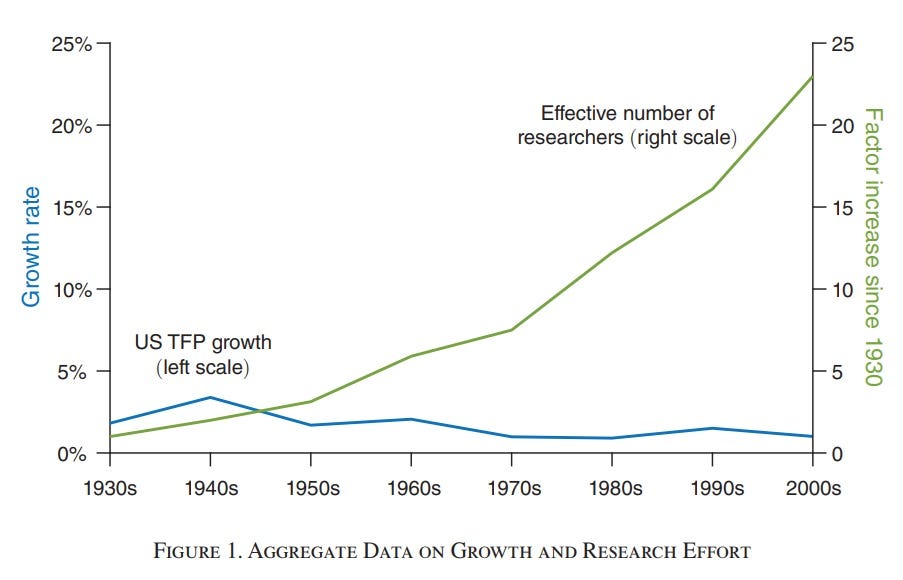
I suspect there is some degree of inaccuracy in this data — for example, I suspect that R&D tax credits and cultural factors have led some companies to reclassify a bunch of business activities as “research”. In 1930, a factory worker who found a better way to organize the tools on a factory floor wouldn’t have been called “research”; now, it might. But in any case, this is the best data we have for right now.
It looks like the U.S. economy is running in place — pouring more and more resources into research just to sustain the same rate of growth. Why would this be happening? One obvious — and ominous — reason would be if economists like Robert Gordon are right, and humanity has simply picked much of the low-hanging fruit of technology. Three centuries ago, you could discover the basics of physics by rolling little wooden balls down ramps. A century and a half ago, you could discover the basics of inheritance by growing pea plants at home. Now, breakthrough empirical science tends to require the aid of hugely expensive, complex, high-tech machines. Humanity can still make big, important discoveries; we just have to work increasingly harder and shell out increasingly more money to do it.
That’s the theory, anyway. In a follow-up paper in 2022 called “The Past and Future of Economic Growth: A Semi-Endogenous Perspective”, Jones formalized this theory. (This paper is very simple and readable, and yet the theory is very powerful.) Basically, if ideas get harder to find as you uncover more of them, the only way to sustain the same rate of growth of new ideas is to keep adding researchers to the workforce.
For a while you can do that by employing a bigger and bigger percentage of your population as researchers. But you can’t do that forever, since A) people need to do other jobs, and B) the percent of researchers is capped at 100%. After that, the only way to keep getting more warm bodies to throw at the increasingly difficult research problem is population growth — you need to actually just grow more scientists. So Jones’ model predicts that in the long run, the growth rate of ideas will be proportional to the rate of population growth.
Now here’s the really bad news: Population growth is declining fast, and will soon go negative. The UN already predicts global population to peak in the 2080s, and these projections keep getting revised down every year as fertility rates fall more than expected:
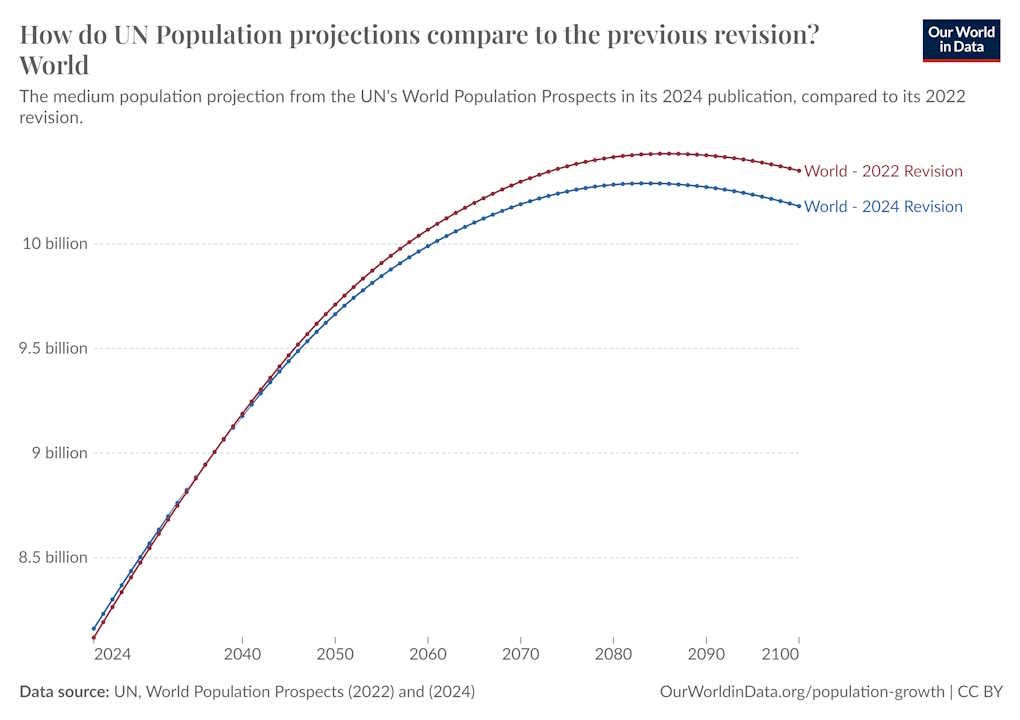
It’s not hard to incorporate this projection into Chad Jones’ growth model. In another 2022 paper called “The End of Economic Growth? Unintended Consequences of a Declining Population”, Jones shows that if population growth is negative, growth vanishes entirely and living standards stagnate completely. The combination of A) ideas getting harder and harder to find, and B) fewer and fewer researchers to hunt for ideas simply overwhelms humanity’s capacity to invent new useful technologies.5
In fact, it gets worse. In his presentation at the Progress Conference, Jones pointed out that much of the U.S.’ historical growth wasn’t actually from inventions or discoveries. A lot came from increasing education levels and sending women into the workforce:
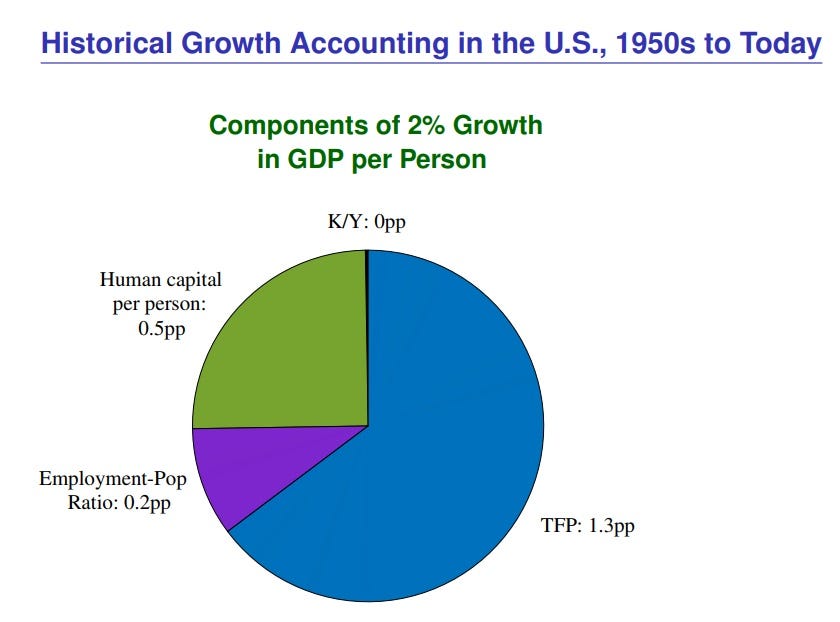
Both of these temporary boosts are now over. Female labor force participation is high and has plateaued. And college enrollment has topped out or even begun to fall.
And Jones argues that even the part of economic growth that’s due to TFP has some temporary boosts in it. We’ve increased the proportion of workers who do research, but we can’t keep doing that forever. Also, Jones argues that some of our TFP growth has been due not to new ideas, but to falling misallocation — better government policies that have made companies more efficient. That can’t go on forever either.
All of these factors, plus slowing population growth, lead Jones to forecast falling growth. And in fact, U.S. growth seems to be a little bit slower in the 21st century than it was in the 20th:
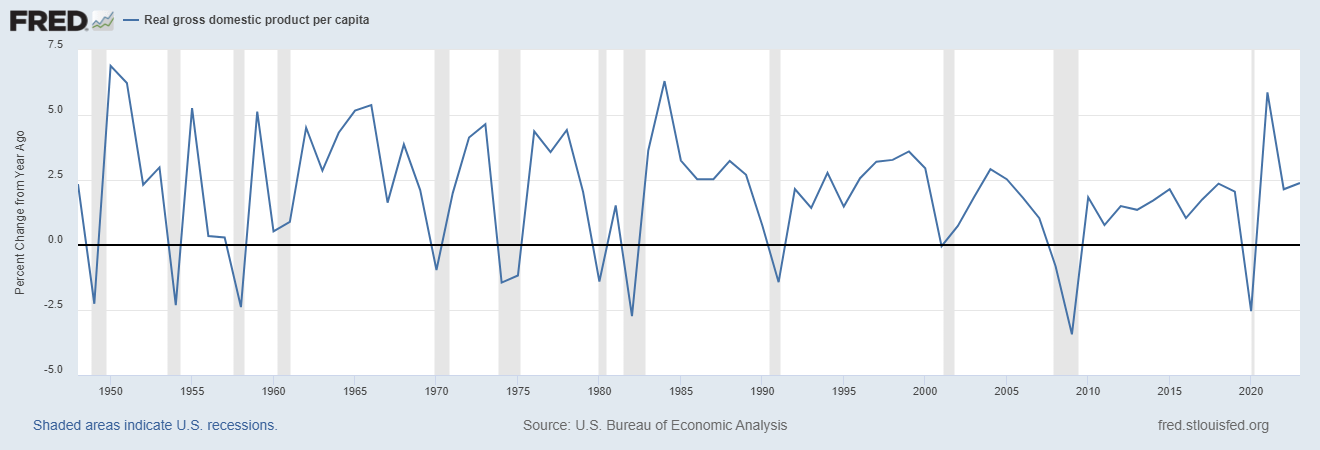
The headwinds may already be starting to take effect. If that’s true, we won’t see growth fall to a low level in 1000 years — we’ll see it fairly soon, perhaps this century.
Jones sees one main force that could save us from this fate: AI. Right now, AI is a research tool that humans use. But if AI gets better and becomes a substitute for human researchers, we can effectively just build more and more researchers to discover more and more ideas. The population constraint would become an investment constraint instead.
I don’t think Jones has explicitly modeled this all out yet (I’m sure he’s working on it), but he does have a 2024 paper about AI and existential risk that sketches out the basic principle. If we can create AI that does research on its own, we may be able to reach escape velocity as a civilization, going from flat or falling growth rates to rising growth rates — basically, a technological singularity, at least until AI stops getting better or runs out of things to discover.
But if that doesn’t happen — if AI never gets good enough to replace human researchers — then we could be headed for a world of much slower economic growth. Tyler Cowen’s very appropriate concern for future generations might be futile — we might simply be unable to sustain significant growth for much longer. (In fact, given falling fertility, we might not even create those future generations at all.)
A key question here is whether Jones’ core assumption is right — whether useful ideas really do get harder to find as time goes on. This may turn out to be wrong — the pattern of increased research spending and flat TFP growth that we’ve seen in the U.S. over the last century may be an anomaly, due to some combination of historical circumstance and data mismeasurement. It could be that scientific discoveries don’t follow a smooth curve, but a punctuated equilibrium, with the occasional huge discovery causing a burst of accelerated growth that lasts decades or even centuries.6
In fact, if AI research ends up being important, then AI would be exactly such a lucky “super-discovery”. The invention of modern science in the 17th century, or industrial labs in the late 19th century, might have been other such super-discoveries. Gordon’s notion of three distinct industrial revolutions — steam/railroads, electricity/combustion/plumbing, and computers/internet — could also be a case of periodic super-discoveries. After all, as Gordon showed, productivity growth did accelerate sharply in the early and mid 20th centuries:
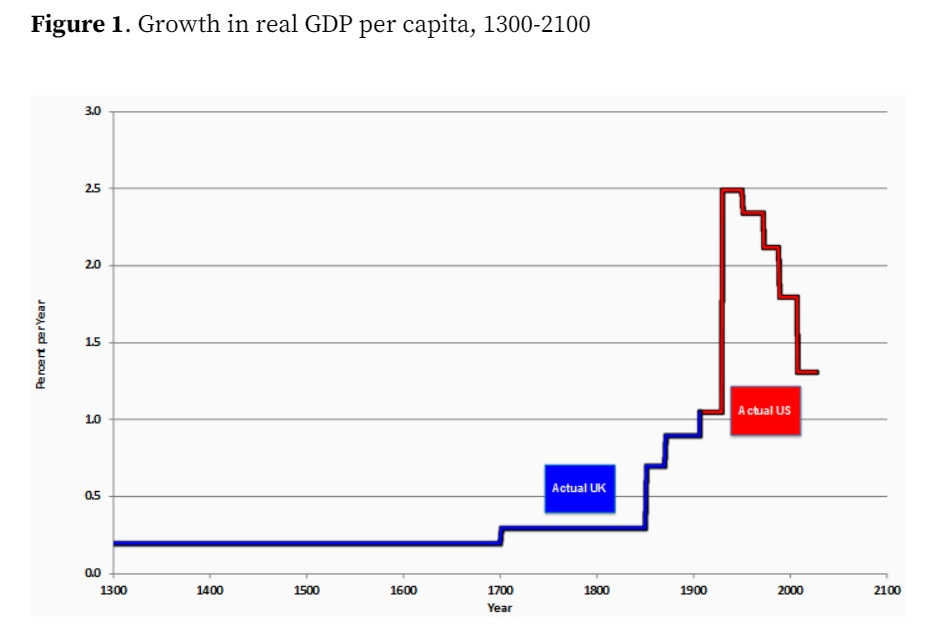
That doesn’t seem consistent with a smoothly falling rate of discovery.
We may now be living in the fading glow of those singular triumphs, scratching out the last scraps of the scientific and industrial revolutions as we hunt for the next big thing. AI may be that next big thing, or it may not.
In any case, I think it’s important for both economists and policymakers not to see growth as an automatic or eternal process. Just because we can calculate a percentage growth rate for the economy doesn’t mean there’s any natural force putting us on a smooth upward exponential. Yes, growth in the U.S. has been steady for a hundred years now, but that hasn’t been true in a lot of other countries; we might have just gotten lucky. In the future, we can’t rely on luck — we need to be doing everything we can to keep the rainbow of growth from reaching its end.
One time I told someone this, and he argued that since the number of possible configurations of the Earth’s particles is finite, the ability to always find more valuable configurations is physically limited. I replied that because the potential positions and momenta of those particles are uncountably infinite, there is no theoretical limit to the ability to move the particles into a more valuable configuration. I am not sure this was a particularly fruitful argument. But it was fun, so it produced (unmeasured) economic value.
Yes, eventually the Universe will decay into heat and we’ll all die. If you resort to “the heat death of the Universe” as your argument why growth is finite, I will consider you to have conceded the argument.
The authors actually measure “effective researchers”, which is the total amount of research spending divided by an estimate of researchers’ salaries. In reality, some of that spending is going to be on equipment rather than salaries, and this amount may be rising over time. That won’t really alter the basic conclusion of the paper, because even if you’re spending money on machines instead of humans, you still have to spend more and more to get the same results. It also won’t affect Jones’ theory in his follow-up paper, since there’s a limit to how much of our GDP we can spend on research equipment.
Jones offers a somewhat optimistic way out of this trap, if being richer makes people want to have more kids. So far, though, it looks like the opposite is true, except maybe at very high levels of income.
In fact, during his presentation, Jones did argue that the sudden stagnation of U.S. manufacturing productivity around 2008 isn’t consistent with a story of ideas getting gradually harder to find.