
According to current economic commentary, it’s all about “K”. Talk of a “K-shaped economy,” in which incomes and wealth are rising only for those at the top, has become ubiquitous. And rightly so. For high-income Americans who own a lot of stock, the past year has treated them pretty well. But for those who don’t, not so much.
However, too much of the commentary is marred by a sort of lazy cynicism. Too many of these commentaries rely on the casual assumption that it has always been thus. Or at least, that it was as true during the Biden years as it is now. But that’s not true. David Autor, Arindrajit Dube and Annie McGrew have documented that the Biden era post-pandemic economic recovery was the opposite of what we are experiencing now. In fact, during the Biden recovery wage gains for low-paid workers were much larger than for those further up the income scale. In fact, the pro-low-income worker tilt of wage gains during the Biden recovery was something we haven’t seen since the “Great Compression” of the 1940s. And that narrowing of wage gaps was due to special factors, including wartime wage policy and a rapid expansion of unions.
The chart below provides data to back up the observation that in going from the Biden Administration to the Trump Administration, we have traded an economy that disproportionately benefited low-income workers to one that disproportionately benefits the well-off (particularly those who own a lot of stocks). The graph plots the Atlanta Fed’s estimates for the rate of wage growth for two groups: workers in the bottom 25 percent of the wage distribution (blue line) and workers in the top 25 percent (red line).
During the Biden years of 2021 to 2023, low-paid workers saw consistently faster wage growth than high-paid workers. For example, in September of 2022, the wages of high-paid workers grew at an annual rate of 4%, but around 7.75% for low-paid workers as low-paid workers benefited from a tight labor market. The spread narrowed during the mid-2023 to mid-2024, as the economy slowly cooled in response to Fed interest rate hikes. By 2023 and into 2024, it was clear that the economy had achieved the desired “soft landing”: inflation was falling while employment stayed relatively strong.
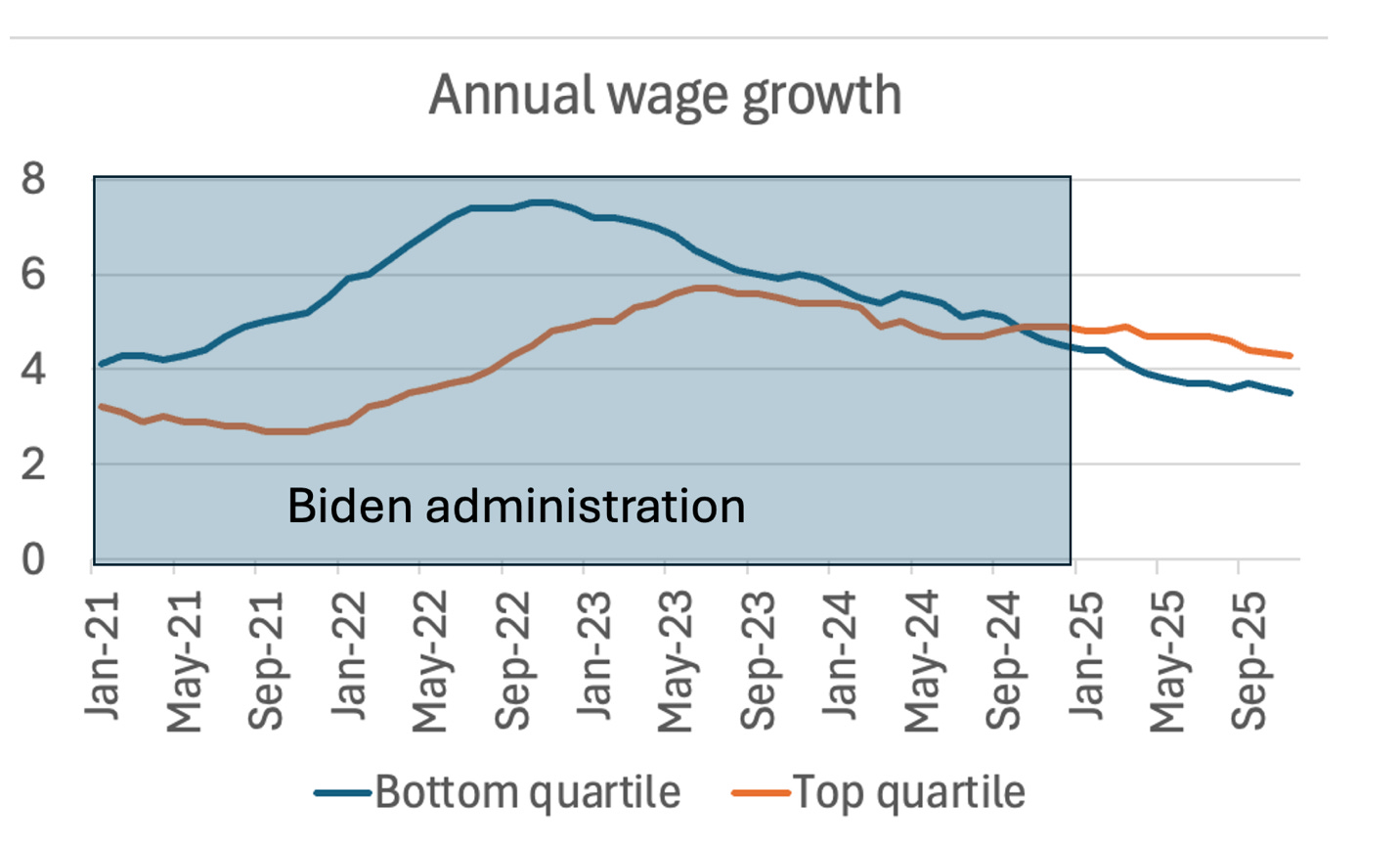
In late 2024, however, the wage gains of high-paid workers began to outpace those of low-paid workers, which are barely outpacing inflation.
So the K-shaped economy is a real but relatively recent development. Why is it happening?
The proximate cause of the K-shaped economy is a weak job market. As I’ve written repeatedly, the U.S. economy has not (yet) experienced mass layoffs. Employers have, however, become very reluctant to hire new workers. Gallup asks whether now is “a good time or a bad time to find a quality job”:
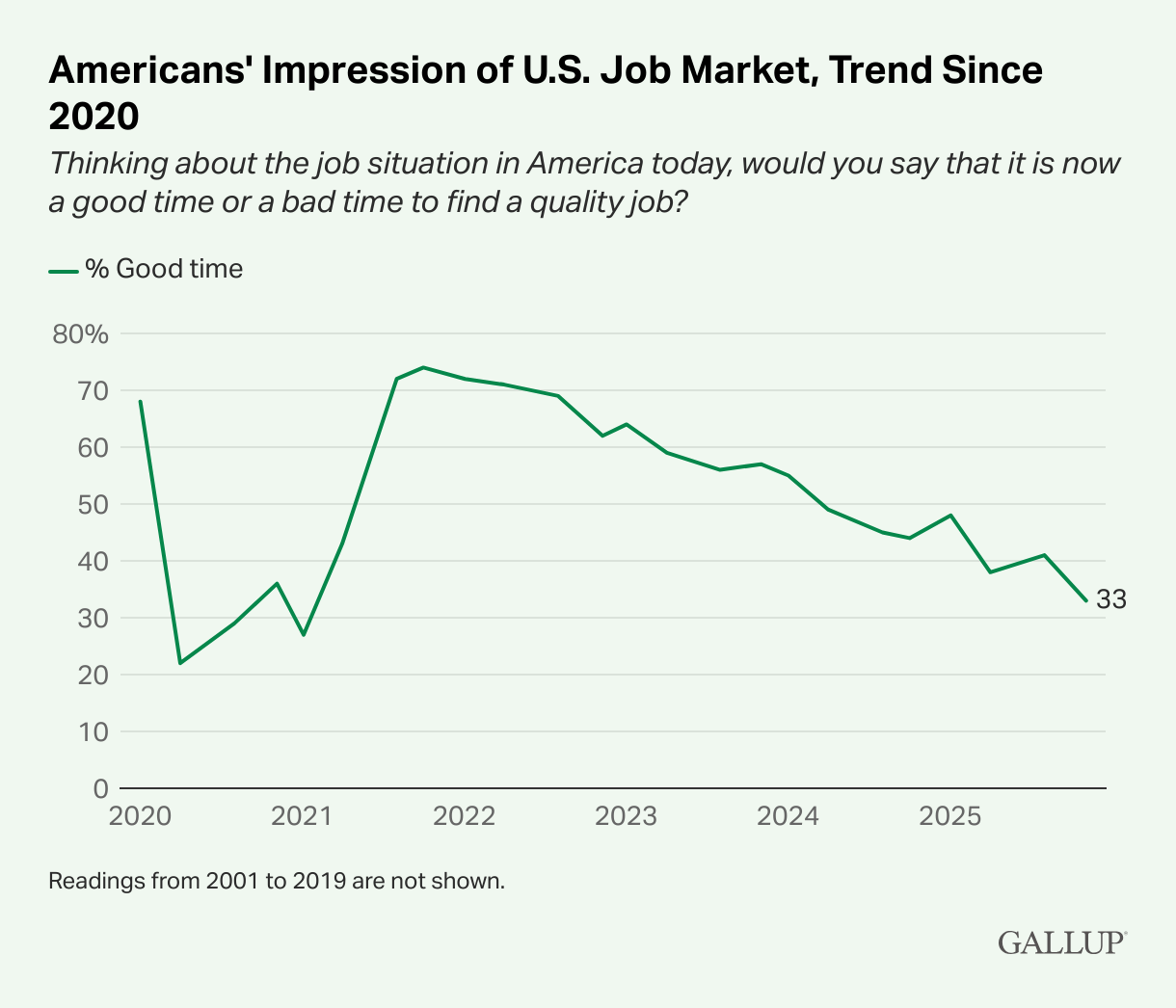
Gallup’s result, consistent with other surveys like the Conference Board, shows that Americans are very pessimistic about the job market. Trump may claim that we are economically “the hottest country in the world,” but the truth is that we last had a hot labor market back in 2023-4. At this point, by contrast, we have a “frozen” job market in which workers who aren’t already employed are having a very hard time finding new jobs, a sharp contrast with the Biden years during which workers said it was very easy to find a new job.
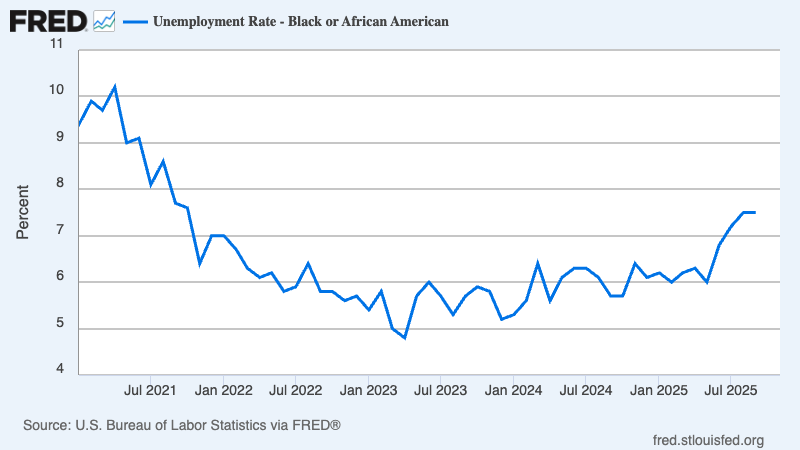
As the Biden years show, a strong job market is good for all workers, but particularly good for relatively marginalized workers – notably low-paid service workers and, on average, Black workers. Conversely, a weak job market is bad for all workers, but historically has been worst for relatively marginalized workers.
Again, the data bear this out. Overall U.S. unemployment has been gradually rising — it’s at 4.6 percent now, up from an average of 4 percent last year. But Black unemployment has been soaring since mid-summer 2025:
The question then becomes, who froze the labor market? And here it’s likely that Trumponomics bears much of the responsibility.
The key point about Trump’s tariffs and to some extent his other policies is that they keep changing, and nobody knows what will come next. This uncertainty makes businesses reluctant to make commitments, including the commitment involved in hiring new workers: If you hire workers based on current tariffs, what happens if the Supreme Court rules those tariffs illegal, or the Trump administration picks a different country or countries as enemies?
In this sense, then, Trump may be largely, though indirectly, responsible for the K-shaped economy. His tariff and other policies have created uncertainty that has paralyzed hiring. The fact that workers are finding jobs hard to get, in turn, has hurt the employment and wages of disadvantaged groups, including ethnic minorities and low-wage workers in general.
As I said, it’s important not to give in to the lazy cynicism that asserts, without checking the facts, that the K-shaped economy is a story that extends back through the Biden years. For that kind of cynicism all too easily becomes fatalism, a sense that nothing can be done. The truth is that none of this had to happen. What we learned during the Biden years is that economic policy that promotes full employment also promotes greater equality. And we can do it again. Let’s turn this K around.
MUSICAL CODA