The health-care cluster runs from the Medicare Advantage privatization critique and the multi-part "Curing U.S. Health Care" reposts through the ACA subsidy cliff and the Republican Medicaid cuts embedded in the 2025 budget bill, with Krugman's consistent claim being that American health insurance is an expensive, poorly-designed risk-pooling failure whose costs land hardest on people the safety net is supposed to protect. Social Security's financing mechanics and SNAP cuts round out the broader social-insurance argument.
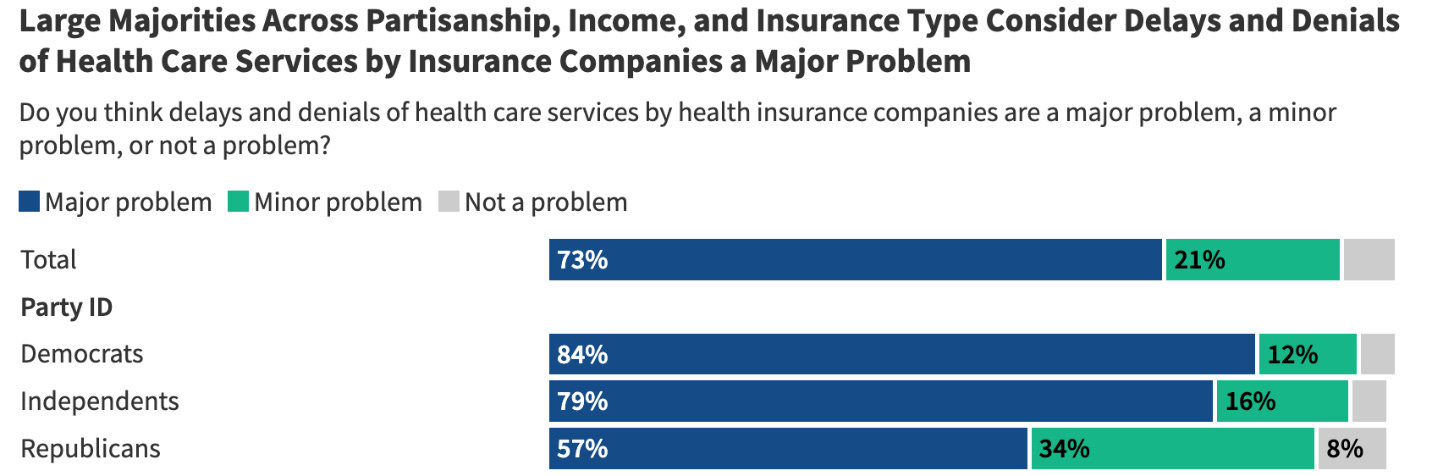
Written in the aftermath of the UnitedHealthcare CEO's murder, argues that private health insurers function mainly as a taxpayer-funded toll booth — collecting roughly 80 percent of their revenue indirectly from public subsidies and tax exclusions while adding administrative overhead and a "delay-and-deny" claims strategy, with Medicare Advantage plans capturing extra federal payments without demonstrated efficiency gains. Concludes that despite this parasitic structure, single-payer reform remains politically unrealistic because most insured Americans report satisfaction with coverage they've never had to stress-test.
Private health insurers mostly function as a toll booth on a system taxpayers already fund, not as a productive service. Writing after UnitedHealthcare CEO Brian Thompson's murder and the unsettling public glee toward his accused killer Luigi Mangione, Krugman condemns the killing but refuses to let that condemnation imply insurers serve society well.
Charts show most Americans get coverage through employer plans or ACA exchanges, yet because Medicare covers the old and Medicaid covers many sick younger people, private insurers pay only 29 percent of total claims. Much of even that is taxpayer-subsidized: employer premiums' tax exemption costs about $300 billion a year, and ACA subsidies add roughly $90 billion — so taxpayers effectively fund about 80 percent of health coverage, routed through private skimmers. A further chart shows most Medicare recipients now hold Medicare Advantage plans, meaning even Medicare passes through private insurers, who appear to profit not through efficiency but by extracting more taxpayer funding per enrollee than traditional Medicare, while using "delay-and-deny" tactics.
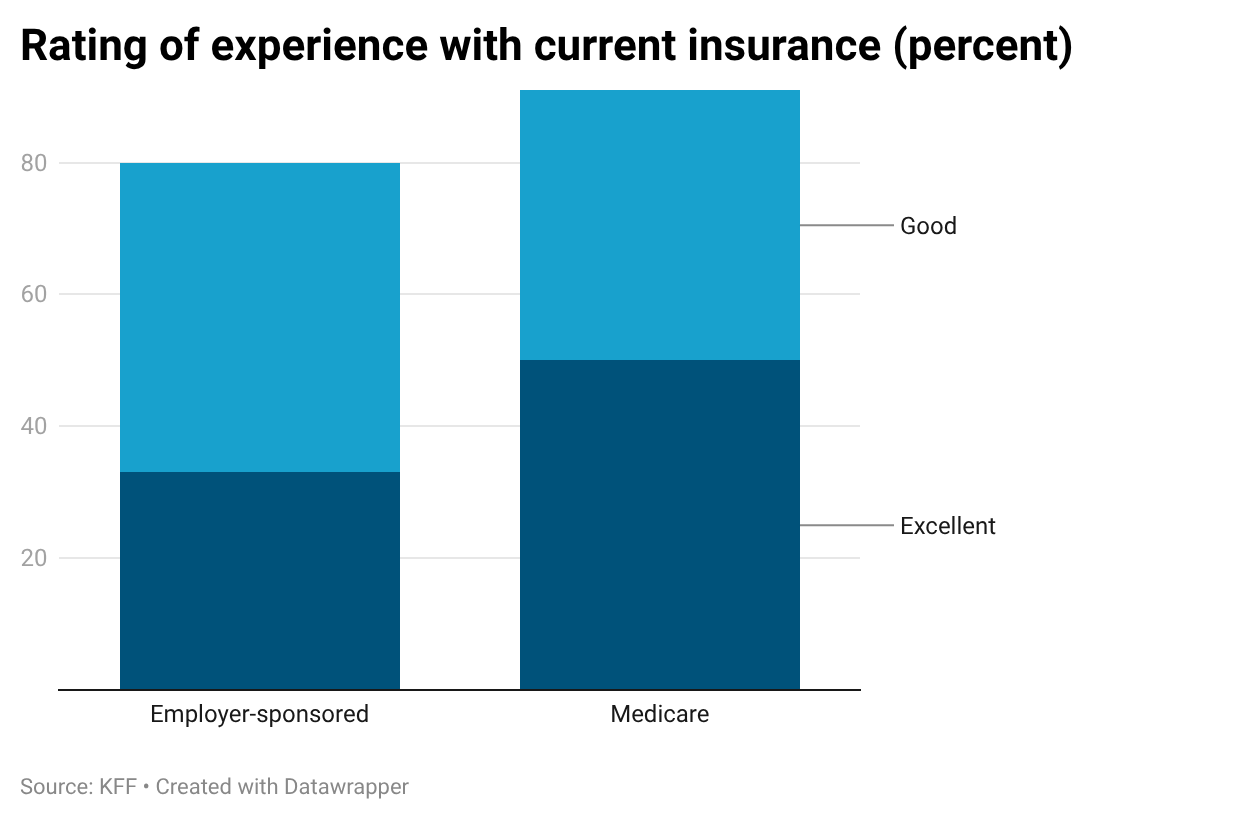
Still, Krugman rejects Medicare for All as politically unrealistic: satisfaction charts show employer-insured Americans mostly like their coverage (though less than Medicare recipients, and less once they get sick). Clinton's 1993 reform failed for this reason; Obamacare deliberately avoided disruption. His fix: at least end Medicare Advantage overpayment.
Krugman traces how Medicare Advantage, now covering most seniors, has become a vehicle for private insurers to extract roughly $83 billion a year more than traditional Medicare would cost -- not through efficiency but through risk-adjustment gaming and upcoding -- despite no meaningful gain in patient satisfaction over the traditional program. He frames this as creeping privatization achieved without ever using the politically toxic word, and predicts that a genuinely waste-focused DOGE would target this program first, which he's confident it won't.
Medicare's ongoing privatization, not aid to the poor, is the wasteful spending DOGE would target if it were serious. Background: Cato Institute's 1990s Project on Social Security Privatization, later rebranded "Choice" after the word polled badly, inspired George W. Bush's failed 2005 privatization push; a Google Ngrams chart shows use of "privatization" collapsing since its 1990s peak even as the practice spread. Private efficiency comes from competition, not ownership — irrelevant for natural monopolies like water utilities: New York's public system runs quietly while Thatcher-privatized Thames Water suffers sewage spills and crippling debt from dividend payouts. Medicare has quietly followed the same path: most seniors now hold Medicare Advantage plans routing public money through private insurers, lured by "free" vision/dental benefits. Insurers fund this not through efficiency but gaming: limited networks, prior authorization, denied claims (the grievance behind UnitedHealthcare's CEO killing) — yet a satisfaction chart shows MA scores no higher than traditional Medicare. Since Reagan-era "cream skimming" and 1997 risk-adjustment reforms, insurers still recruit healthier patients and pressure doctors to code patients as sicker, inflating payments; a crackdown was killed by industry lobbying, then only slightly trimmed by Biden for 2025. MedPAC estimates MA cost taxpayers $83 billion more last year than traditional Medicare would have — begging the question of why private insurers are involved at all.
Krugman uses deeply pro-Trump West Virginia, where Medicaid covers more than a quarter of the population and 45 percent of children, to argue that Republican plans to slash Medicaid funding to help pay for upper-income tax cuts will hit red states and Trump voters hard, not just the populations conservatives assume are the program's base. He marshals cost and satisfaction data showing Medicaid is cheaper per recipient than private insurance and rated by enrollees as at least as good, and argues that proposed work-requirement provisions function mainly as red tape to disqualify eligible recipients rather than a response to real work disincentives.
Republicans are preparing deep Medicaid cuts to help pay for tax cuts skewed toward the wealthy, despite Medicaid being both hugely important and unusually cost-efficient. West Virginia—two-thirds Trump-voting, poor, paying less federal income tax per household than any other state—kept insurance coverage above 94% only because it accepted ACA Medicaid expansion; a KFF chart shows Medicaid now covers over a quarter of the state's population and 45% of its children. Trump's claim the program won't be "touched" is arithmetically false. Medicaid covers 69 million Americans versus Medicare's 48 million, yet costs less, partly because recipients are younger and partly through genuine efficiency: lower administrative overhead and negotiated lower provider/drug prices—unlike Medicare Advantage's insurer overpayments. Studies adjusting for population differences find Medicaid far cheaper than private insurance. It's wrongly seen as politically safe to cut: 90%-white, rural West Virginia depends on it, rural hospitals close disproportionately in non-expansion states like Georgia, and 71% of Trump voters oppose cuts. KFF surveys show Medicaid recipients rate their coverage on par with employer insurance, and sicker patients rate it even higher. Proposed work requirements are a "fraud"—few people avoid work to live on benefits—meant mainly to create hurdles to eligibility. The episode exposes the GOP's populist rhetoric as cover for a plutocratic agenda.
medicaidhealth policyrepublicansrural health caretax cuts
A comprehensive primer explaining that Social Security is not a pension fund or Ponzi scheme but a pay-as-you-go program funded by a dedicated payroll tax, deliberately designed to redistribute toward low earners and largely responsible for eliminating elderly poverty. Krugman walks through the trust fund's 2034-35 depletion timeline and shows the projected shortfall (1.3% of GDP) is roughly the same size as the tax cuts Republicans are simultaneously pushing, making the 'crisis' a matter of political will rather than economic necessity.
Social Security is not a Ponzi scheme, despite Elon Musk's claim (echoed by Trump) that the 90-year-old program is fraudulent, following Musk's earlier debunked claim that tens of millions of dead people receive benefits, an error Krugman traces to DOGE staffers misreading SSA databases. Musk, he argues, simply doesn't understand how the program works.
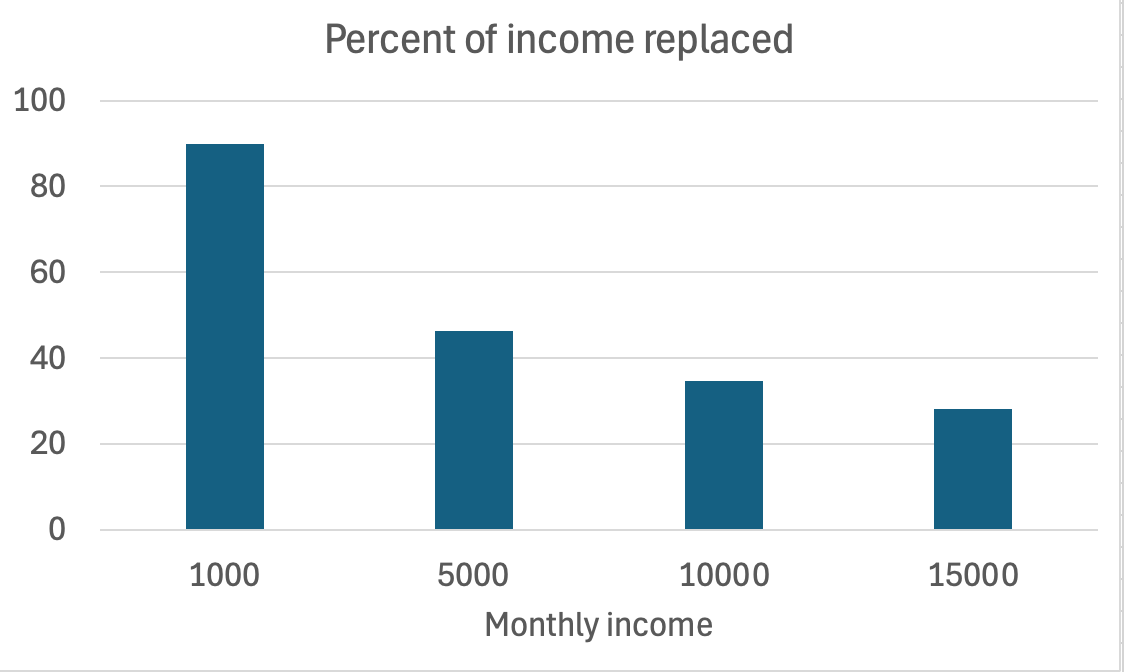
Workers pay 6.2 percent of wages, matched by employers, up to $176,100, funding benefits from age 62 (reduced) or 67 (full); only 6 percent of workers earn above the cap. FDR deliberately designed the program to resemble a private pension to deflect "socialist" charges, but it differs in two ways. First, while payouts depend only on lifetime contributions, with no means-testing, the benefit formula is progressive: a chart of monthly earnings versus percentage of earnings replaced in 2025 shows low earners get most of their wages replaced while high earners get much less, a design that has nearly eliminated elderly poverty. Second, unlike private pensions legally required to hold full assets, Social Security holds just $2.7 trillion in assets, enough for under two years of benefits alone; it runs pay-as-you-go, funded by current FICA receipts, similar to how gas taxes fund the Highway Trust Fund, a dedicated-tax structure common across government and useful politically for selling tax increases (Reagan's 1983 hike, NYC's congestion charge).
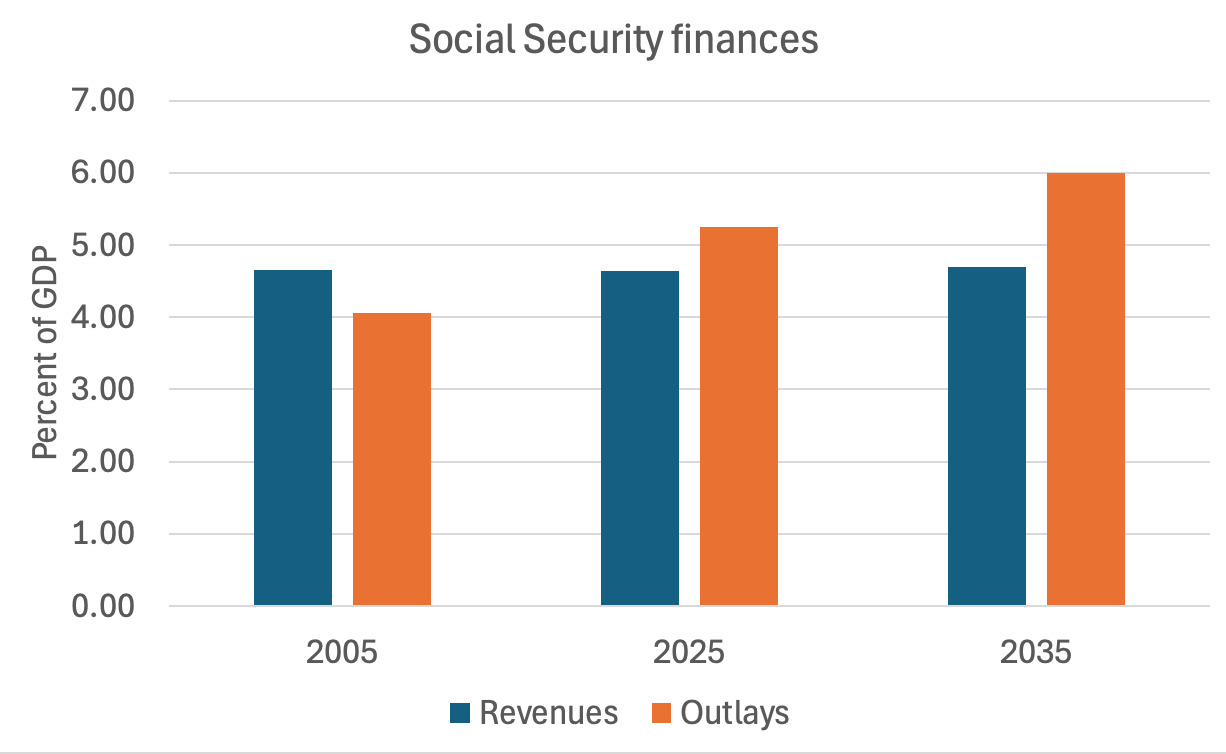
A chart of the "old-age dependency ratio" shows why the Baby Boom (1946-1964) reaching retirement created a funding gap that Reagan's Greenspan Commission addressed in the 1980s by raising FICA and the retirement age, building a trust fund that peaked at $2.9 trillion in 2020. Meant to last until 2060, rising inequality (more wages escaping the taxable cap) means it will likely be exhausted around 2034-35; a third chart comparing revenue and outlays in 2005, today, and 2035 shows the system shifting from surplus to a growing deficit. Even then, payroll taxes alone would cover 77 percent of scheduled benefits per CBO, not "bankruptcy." Closing the resulting 1.3-percent-of-GDP gap, Krugman notes, costs less than the 1.2-percent-of-GDP House Republican budget's proposed $4.5 trillion tax cut, and could be met by raising or eliminating the FICA cap.
In a detailed conversation with budget expert Bobby Kogan, Krugman walks through the Republican reconciliation bill moving through Congress — a package that would extend and deepen the 2017 tax cuts while financing much of the cost through the largest Medicaid and food-stamp cuts in US history, worsening the long-run fiscal gap by 50 to 100 percent. Kogan also explains why DOGE's promised savings never materialized, how gutting IRS and Medicare-fraud enforcement staff can raise rather than lower the deficit, and why bundling tax cuts and benefit cuts into a single bill strips away the usual political cover for either.
Republicans are using budget reconciliation — the filibuster-proof, simple-majority process that passed Clinton's 1993 deficit package, ACA's 2010 fix, and both Trump tax cuts — to advance a bill combining enormous tax cuts with historic cuts to Medicaid and food assistance, increasing the deficit while stripping healthcare and food aid from millions of poor Americans.
Bobby Kogan of the Center for American Progress gives Krugman the numbers. The bill adds roughly $3-5 trillion to the deficit depending on version (House about $3 trillion, Senate about $4 trillion), offset by only $1.5-2 trillion in spending cuts. Extending the expiring Trump tax cuts alone costs about $4 trillion over nine years — over 1% of GDP — which would push the "fiscal gap" (the deficit reduction needed to stabilize debt-to-GDP over time) from today's 2.1% of GDP to above 3%, a 50% worsening; front-loading further cuts could double that to 100%. The top 0.1% would get roughly a quarter-million-dollar tax cut apiece.
Medicaid faces what Kogan calls the largest cut in history: the Energy and Commerce Committee must find at least $880 billion in savings, but since only $200 billion of that is non-health spending, most cuts must hit health coverage, putting 5 to 20 million people at risk of losing insurance. SNAP (food stamps) would be cut by roughly a quarter, dropping the average per-meal benefit from about $2 to $1.67. Student-loan changes would end forgiveness after 25 years of repayment for graduate borrowers and tighten repayment terms.
Tariffs, invoked as an offset, don't close the gap: the most aggressive tariff plans might raise about $3 trillion, but as the administration grants industry carve-outs the realistic figure is closer to $2 trillion or less, still leaving roughly $1 trillion in new debt combined with the cuts. Tariffs are themselves regressive — lower earners spend more of their income on goods, often cheap imports — so much so that a chief architect of the 2017 Tax Cuts and Jobs Act (TCJA) concedes tariffs plus a TCJA extension amount to a tax increase on the poor and working class and a cut for the rich. Kogan calls it potentially "the single biggest transfer of wealth from the poor to the rich in a single bill in US history."
Separately, on DOGE: Musk's promised savings shrank from $2 trillion to $1 trillion to $150 billion before he began "stepping back," and aggregate federal spending has barely moved. Instead, DOGE gutted specific programs — Head Start grantmaking ran 37% behind schedule with zero dollars reaching Maine amid Trump's feud with its governor — while sidestepping court orders. It fired staff who investigate Medicare and Medicaid fraud and cut IRS enforcement, though such positions pay for themselves; meanwhile Medicare Advantage "upcoding" fraud, worth an estimated $80 billion a year (CBO estimates up to $1 trillion in savings over a decade), goes untouched while DOGE pursued defunding NPR. April 15 revenue collection looked normal, but Kogan warns losing specialized fraud auditors could erode compliance in future years.
Committee text is emerging piecemeal — Education and Workforce was told to cut $330 billion, mostly from student loans — while Ways and Means' tax text has slipped toward June. A few Republicans, including Rep. David Schweikert and Senate Finance Chair Mike Crapo (who keeps a debt-alarm counter on his website), show unease about the debt impact. CBO, still led by Republican Phil Swagel, remains an honest scorekeeper, Kogan says, recalling how its 2017 coverage-loss estimates helped sink ACA repeal. Unlike past bills that separated tax cuts from benefit cuts to obscure the tradeoff, this one ties both together, which Kogan predicts will make it less popular than the unpopular 2017 TCJA. He closes on "G minus R" — growth rate versus borrowing rate — warning that Trump's policies lower growth and raise rates together, eroding the favorable spread that has let the US run large deficits without crisis.
Krugman argues that Trump's fiscal, immigration, and trade policies will hit rural, pro-Trump America hardest, since Medicaid and food stamps cover a disproportionate share of rural residents and support fragile local economies, immigrant labor is essential and irreplaceable in agriculture, and export-dependent farmers face retaliatory tariffs. He contends the standard reverse-Robin-Hood shape of conservative fiscal policy is compounded by MAGA-specific measures that undercut the very communities that voted for it.
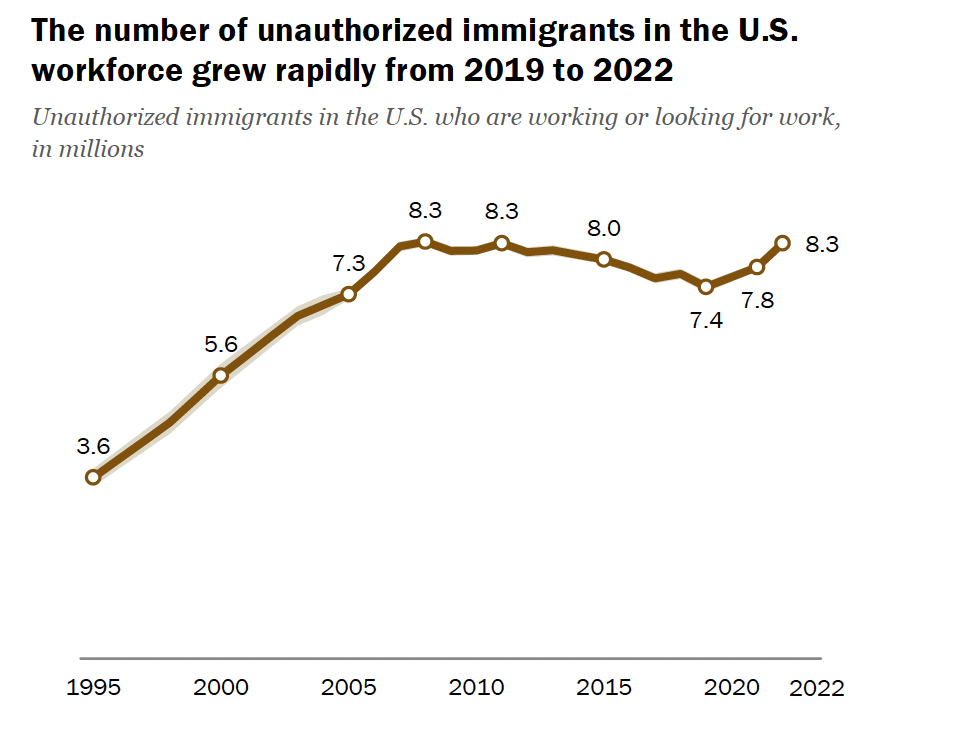
Trump's tax, immigration, and trade agenda will inflict its worst damage on the rural, small-town areas that voted for him. Poorer rural states already run on subsidies from richer ones like Massachusetts and New Jersey, so standard conservative tax-and-benefit cuts hurt them most, and the One Big Beautiful Bill Act goes further, slashing Medicaid (nearly 40 percent of children, 42 percent of births, and a higher rural share) and food stamps. New work requirements historically fail to raise employment but erect bureaucratic barriers rural residents, often lacking broadband or formal education, struggle to clear, while hospital closures accelerate. One chart shows federal Medicare and Medicaid spending, not coal, now underpins places like West Virginia. On immigration, another chart shows two-thirds of hired farm labor is foreign-born, mostly undocumented; ICE raids and deportation fear are emptying fields, native workers won't take the jobs without much higher pay, and Trump froze Biden-era grants for legally hiring foreign labor. Tariffs compound this: none of the promised 90 trade deals materialized by July 8, China retaliated, and a third chart shows agriculture's heavy export dependence, while imports like bananas can't simply be grown here, as Commerce Secretary Lutnick learned when Rep. Madeline Dean corrected him.
Using cost and polling data, Krugman rebuts the conservative case for gutting Medicaid, showing that once adjusted for recipients' poorer health the program is cheaper per capita than private insurance, that most recipients already work or cannot, and that work requirements have never been shown to raise employment. He argues Medicaid has grown too popular — 83 percent favorable, including a majority of Republicans — to be the "soft target" its opponents assumed, predicting serious political blowback if the bill's roughly trillion-dollar cuts take effect.
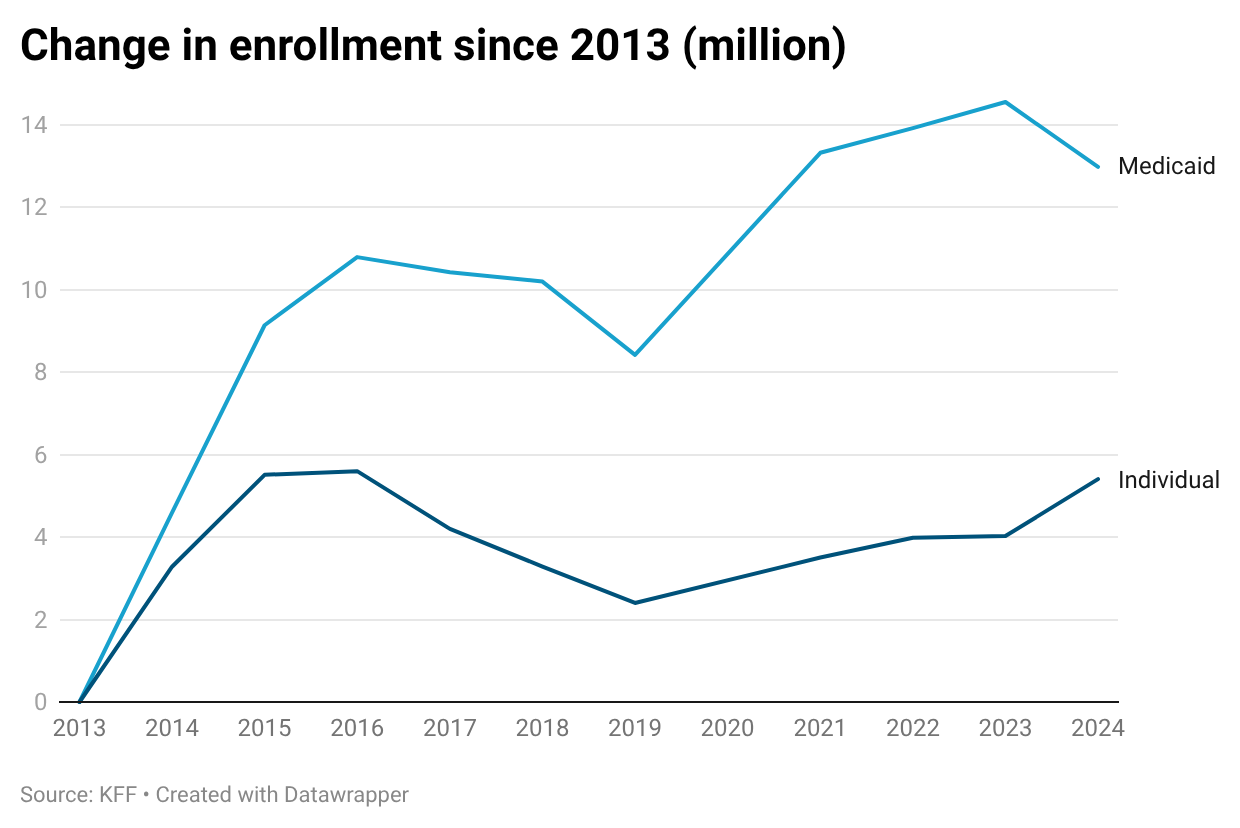
Republicans, having failed for decades to cut Medicare (Gingrich, 1995) or privatize Social Security (Bush) because both are hugely popular, have instead spent roughly 15 years targeting Medicaid — the means-tested program for the poor — as a "soft target." The One Big Beautiful Bill Act would cut Medicaid by about $1 trillion over the next decade (fate undecided as of this writing). The right frames this as trimming waste and idleness, but the data contradict it: adjusted for recipients' worse average health, Medicaid costs significantly less than private insurance (chart from Everything Policy), resembling other countries' cost-conscious systems that bargain with drug makers and refuse low-value procedures. A second chart shows the vast majority of recipients already work or cannot (disabled, caregivers); work requirements have never been shown to raise employment. Meanwhile Medicaid's enrollment share has climbed sharply over 15 years (KFF chart), and with more Americans personally touched by it, favorability has hit 83 percent — 74 percent among Republicans, per KFF, edging out apple pie. Republicans expecting an easy target risk the same backlash that met Gingrich and Bush.
medicaidhealth policyone big beautiful billpublic opinionausterity
In conversation with MIT health economist Jonathan Gruber, a principal architect of the ACA, Krugman gets a detailed insider account of the health-policy fallout from the "One Big Beautiful Bill": new Medicaid redetermination hurdles, the effective repeal of hospital-funding "provider tax" workarounds, and the rollback of ACA subsidies, projected to strip coverage from 16-17 million people. Gruber ties the cuts to concrete mortality estimates (roughly 25,000 additional deaths per year) and to broader evidence on the high economic payoff of public investment in health, science and R&D.
Jonathan Gruber, the MIT economist who architected the Affordable Care Act, tells Paul Krugman the "One Big Beautiful Bill" will undo most of its gains by burying poor and disabled Americans in paperwork rather than repealing it outright, since direct repeal has failed before. The ACA is a "Rube Goldberg" system of subsidies and regulation, not single payer, because single payer hits three walls: Americans don't trust that trading employer-paid premiums (an implicit wage tax) for an explicit tax nets out fairly; status-quo bias makes people defend insurance they have; and the $1.2 trillion insurance industry would fight repeal and win. The compromise: a "three-legged stool" of community rating banning sick-discrimination, an individual mandate, and affordability subsidies. Trump's 2017 mandate repeal showed it didn't need all three legs — it "stumbled," costing several million people coverage and raising premiums by double digits, but didn't collapse.
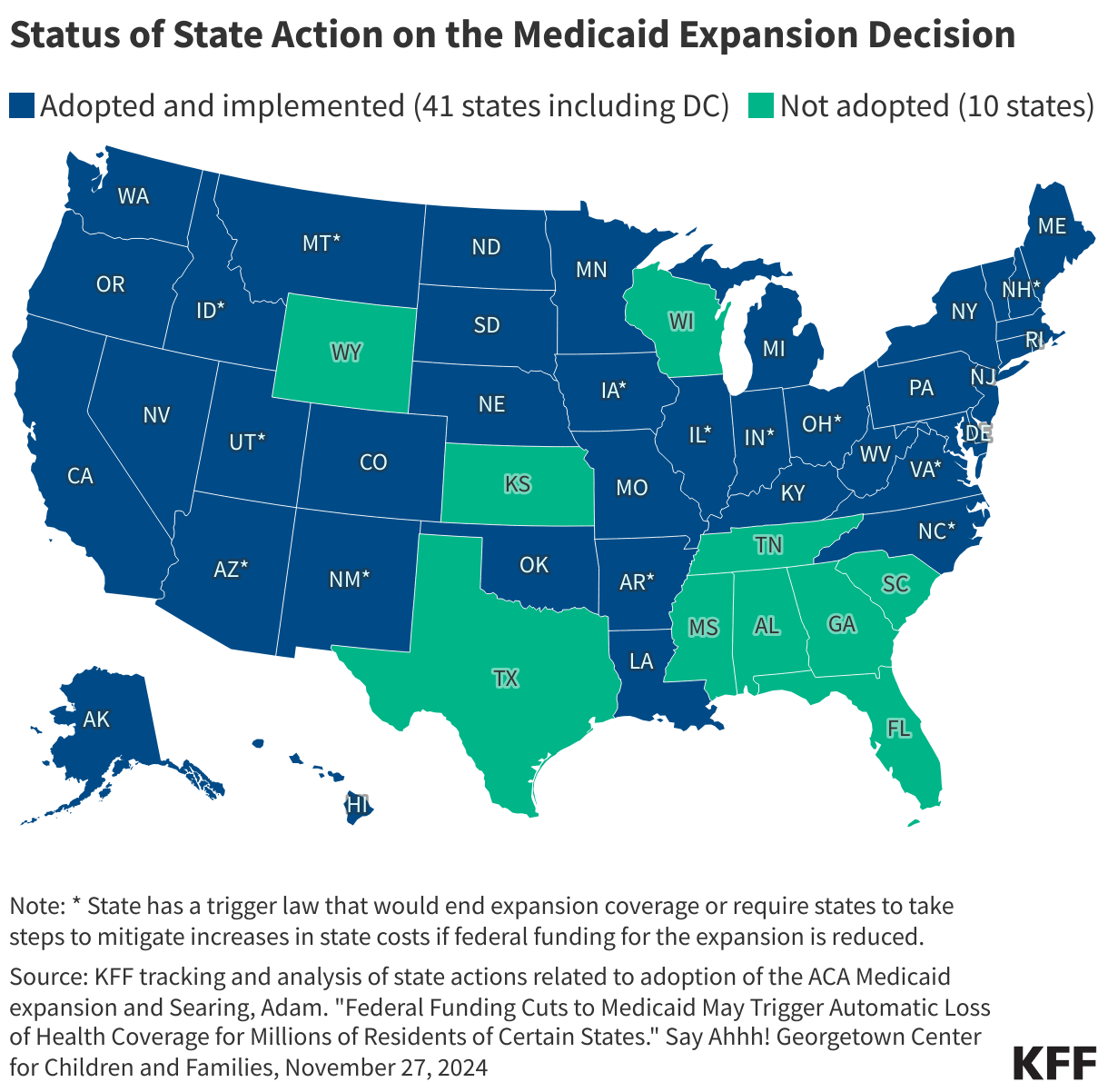
Coverage swung with policy: about 20 million were covered when Trump took office in 2017, dropping to roughly 16 million under his weakened mandate, then rising to 24–25 million under Biden's more generous subsidies and easier sign-up. CBO projects the new bill cuts coverage by 16 million — two-thirds of the law's total gains. Below 133% of the poverty line, the ACA expanded Medicaid at a 90% federal match; after a 2012 Supreme Court ruling let states opt out, 10–12 states — Florida among them — still haven't. Instead of cutting the federal match rate, the bill shrinks eligibility through paperwork: "redetermination" now runs every six months instead of annually, with added documentation — Gruber likens it to Jim Crow-era poll taxes. A second mechanism compounds this: states plug Medicaid's underfunding with "provider taxes" (tax a hospital, refund it via Medicaid, net 50 cents in federal match); the new law scales this back, cutting nursing-home and home care — three-quarters of Medicaid spending, spent on the elderly and disabled, a minority of enrollees. Add tighter ACA-exchange re-verification, reduced outreach, and the end of Biden's expanded subsidies, for a projected 16–17 million total loss.
Gruber cites Sarah Miller's finding that roughly one extra death occurs per 800 people gaining coverage — implying about 25,000 extra deaths a year, 250,000 over a decade, from this bill. Medicaid for children pays for itself through recipients' later taxes, per Amanda Kowalski and Nathan Hendren's research (weaker for adults, strong at all ages). US healthcare spending is nearly 50-50 public/private by dollars. Research tracking people who move between regions (Amy Finkelstein et al.) confirms mortality "place effects" are real: two Baltimore neighborhoods three miles apart have a 17-year gap in life expectancy — 84 versus 67, the latter below North Korea's.
NIH and Department of Energy budgets face proposed cuts of up to 50%. Gruber, with Nobel laureate Simon Johnson (Jumpstarting America), notes public science funding fell from 2% of GDP in 1965 to about 0.5% today — dropping the US from first to 14th in the world and to half of China's public R&D spending — even though the $3 billion Human Genome Project yields $6 billion a year in tax revenue, and every NIH dollar generates $8 in private R&D, $3 in pharma stock value, per MIT research. Cambridge's Kendall Square, once a snow dump, is now top biotech real estate — proof, Gruber says, that innovation hubs are built by policy, not destiny. RFK Jr.'s dismantling of public-health infrastructure, already linked to Texas measles outbreaks, risks a future pandemic costing hundreds of thousands of lives instead of thousands, as COVID-era surveillance and research capacity is gutted. Rural hospitals, dependent on Medicaid and facing uncompensated care, are likely to close; a $25 billion rural health fund added to secure votes like Josh Hawley's is, Gruber says, trivial against trillions in cuts. Gruber calls this likely the worst legislation in decades but is hopeful backlash could mark a turning point after a rightward drift dating to 2009's Tea Party.
health caremedicaidaffordable care actjonathan gruberpublic research funding
Krugman walks through the structural logic of the ACA — guaranteed issue paired with income-scaled subsidies to prevent a healthy-people-drop-out 'death spiral' — and shows that the looming expiration of Biden-era enhanced subsidies will hit millions of Americans with sharp premium increases just before the midterms. He argues Democrats made the shrewder strategic choice by centering the government-shutdown fight on health-care costs rather than tariffs, since it pins the blame squarely on Republicans.
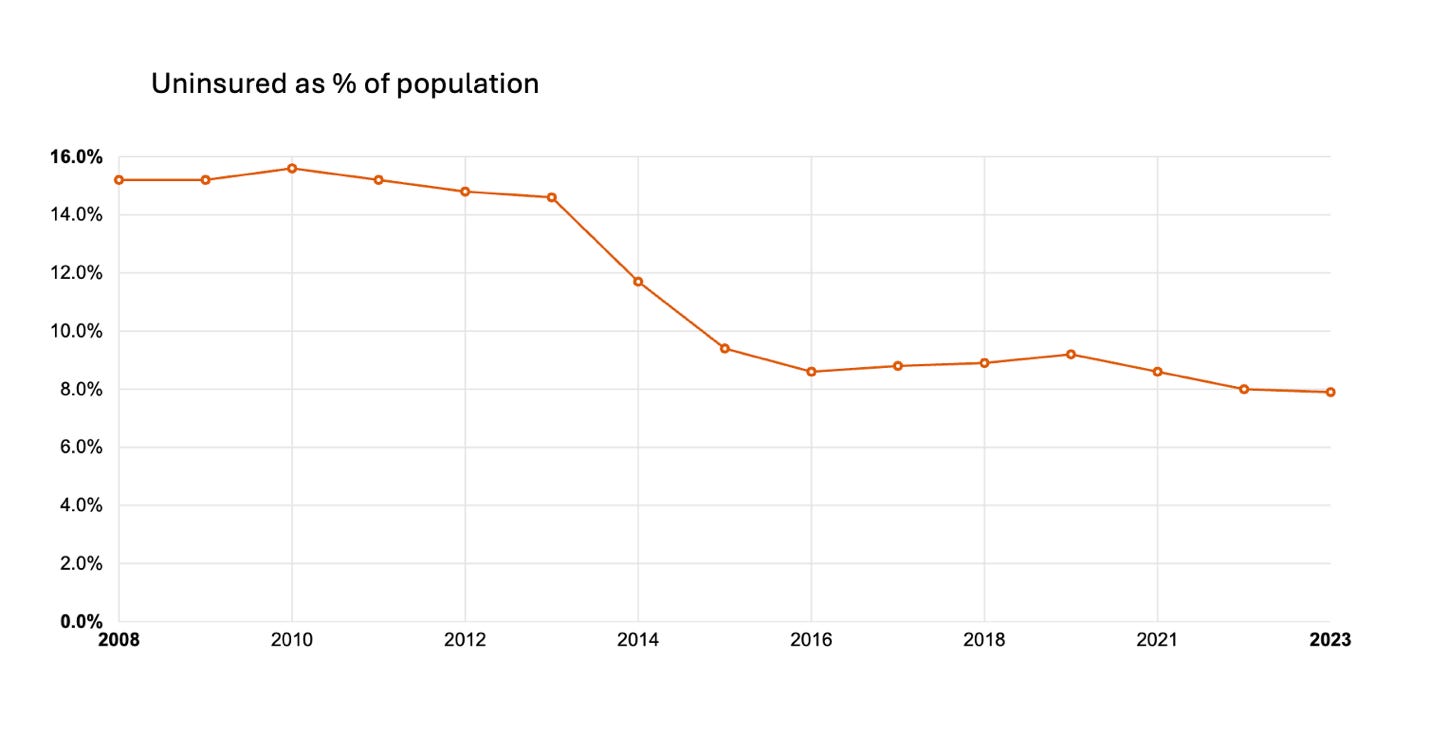
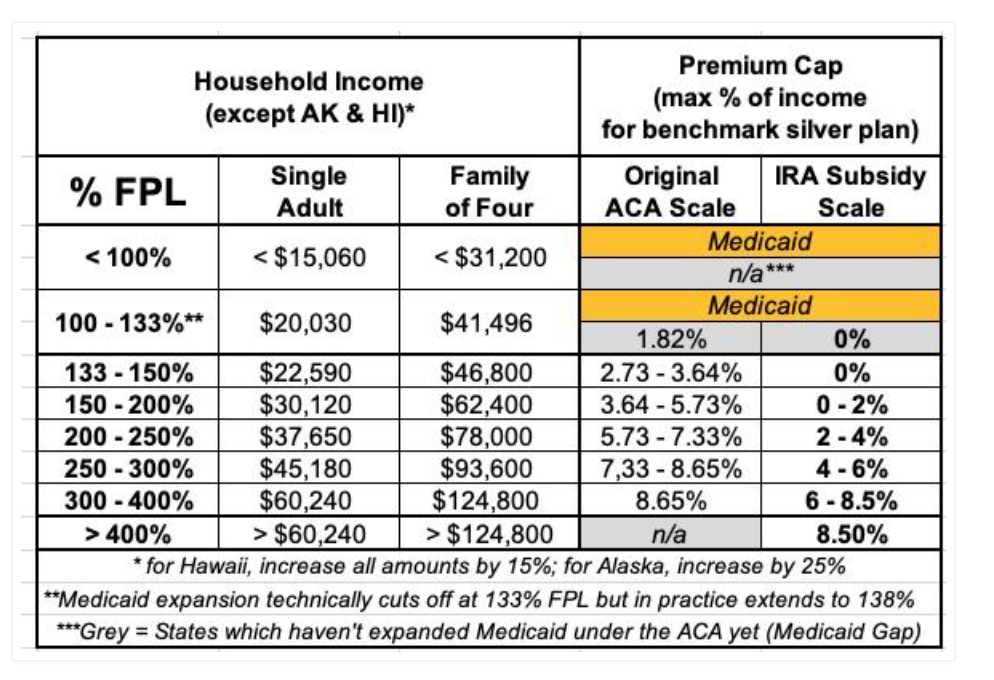
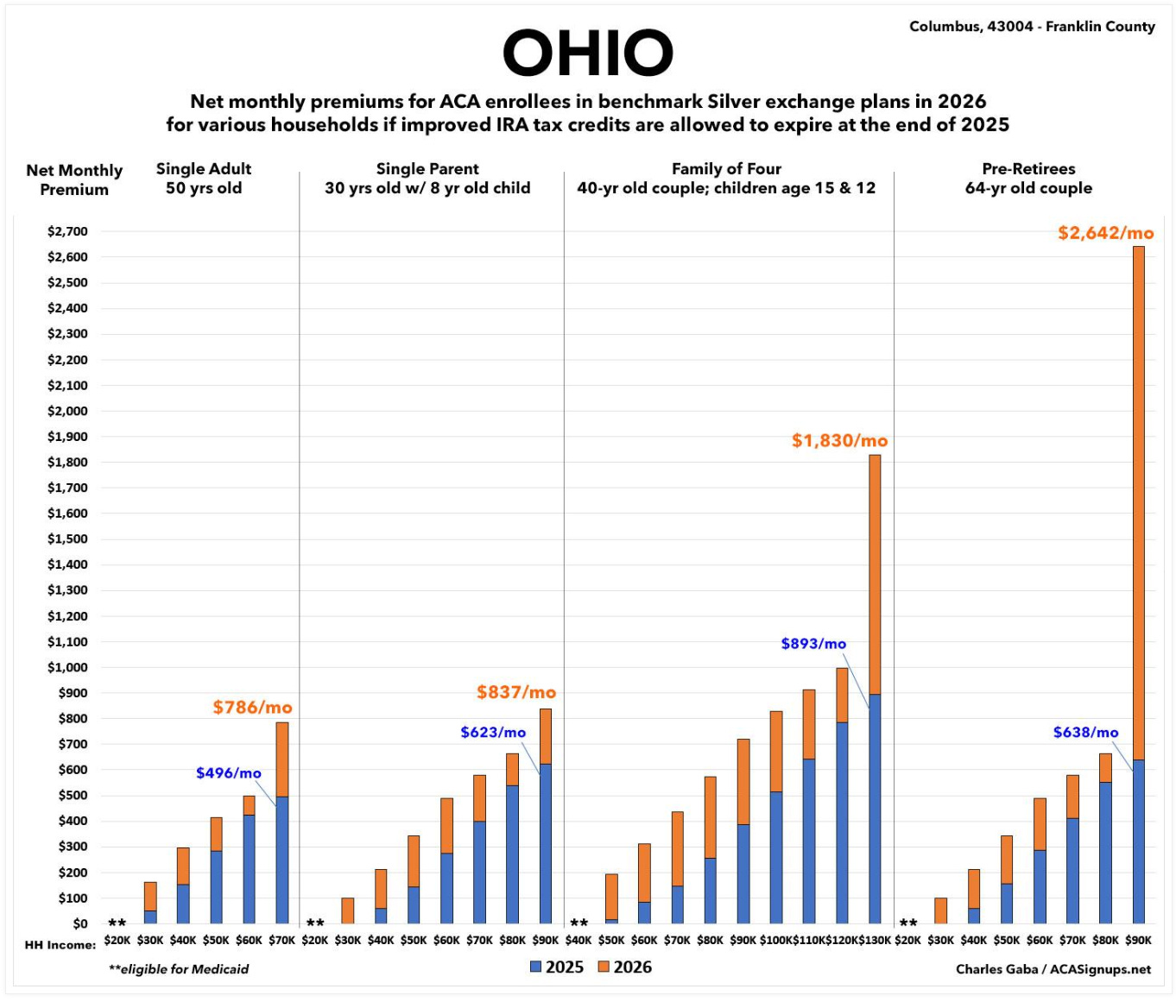
The Affordable Care Act's enhanced insurance subsidies are about to expire, and the resulting premium spike is the real issue behind the looming government shutdown. The ACA rests on three legs: insurers can't price by medical history, subsidies cap premiums as a share of income, and a mandate penalty for staying insured — Republicans removed the mandate, but the other two legs still work. Without subsidies, a "death spiral" results: healthy people skip coverage, worsening the risk pool and driving premiums higher, pushing out even more healthy people. The original 2010 subsidies were too small and cut off above 400% of the federal poverty line; Biden's Inflation Reduction Act enlarged them and removed the cutoff (Charles Gaba's comparison table). By the end of the Biden administration the uninsured rate hit its lowest point ever (KFF data), helped also by Medicaid expansion, now threatened by cuts under the "One Big Beautiful Bill." Because Biden had only 50 Senate votes and needed Joe Manchin, the enhanced subsidies were made temporary, expiring in 2025; Gaba's Ohio projections show sharp increases once they lapse. Krugman is surprised Republicans didn't extend them through the midterms, attributing this to an aversion to helping people, and says Democrats were right to make the subsidies, not tariffs, their shutdown demand, since it pins blame on Republicans rather than scapegoats like immigrants or Soros.
Walks through why the SNAP funding cutoff is a discretionary Republican choice - unused contingency funds, an available filibuster carve-out, a House speaker refusing to reconvene - then uses county-level voting and enrollment data to show the cuts land hardest on rural, heavily pro-Trump counties. Cites the natural-experiment literature from SNAP's gradual 1960s-70s rollout to argue food aid to children is among the best-evidenced investments in future productivity, stronger than the evidence for infrastructure spending or tax cuts.
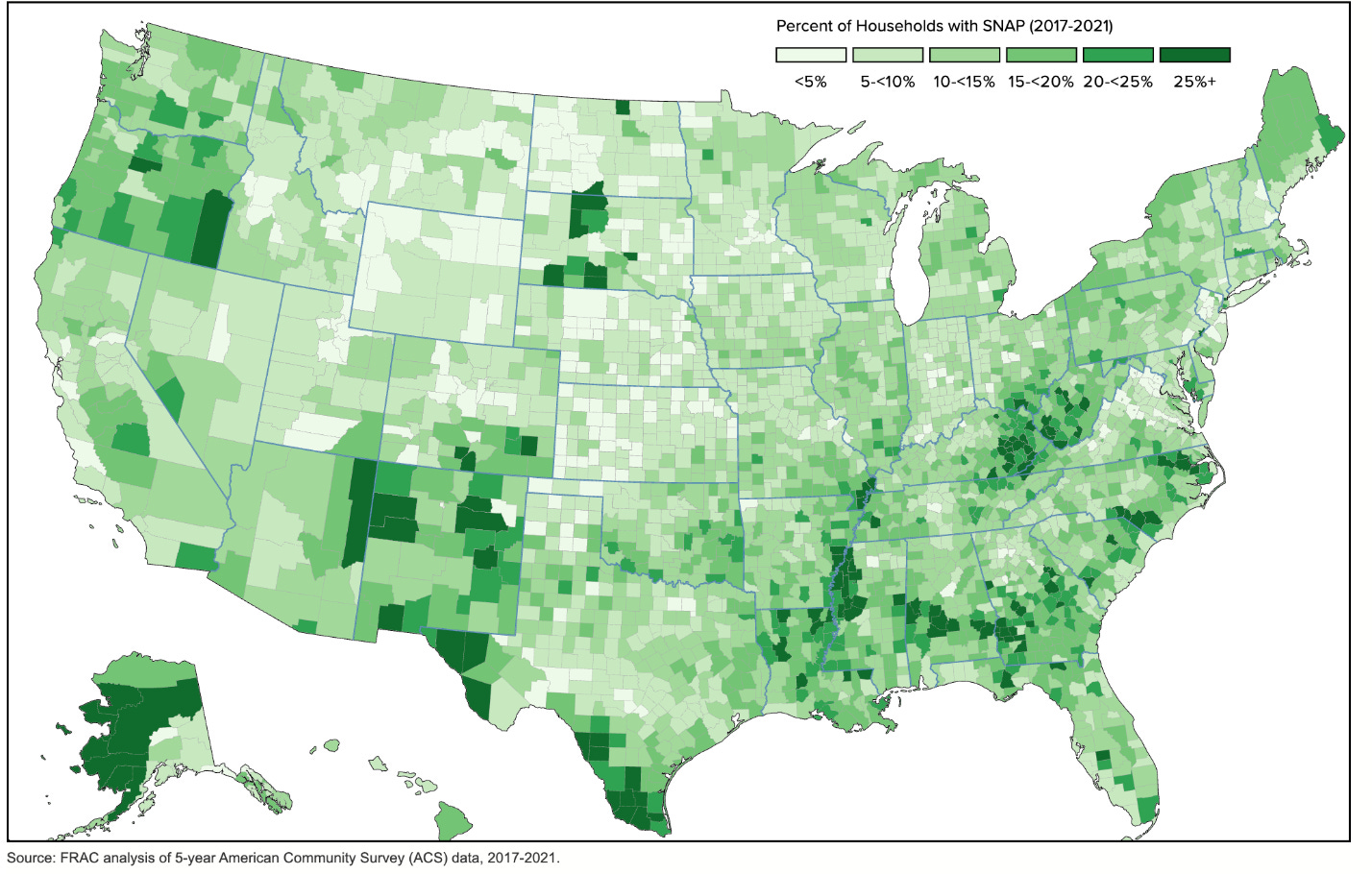
Federal SNAP benefits for over 40 million Americans lapse this Saturday unless the government shutdown ends — a political choice, not a fiscal necessity. SNAP holds $5 billion in contingency funds and USDA could shift other money to bridge the gap, but Trump has directed the agency not to tap reserves; Senate Republicans could waive the filibuster (as they did to roll back California's EV standard) but won't; and Speaker Mike Johnson refuses to reconvene the House, plausibly to avoid seating Arizona's Adelina Grijalva, whose vote would force an Epstein-files release vote. The cutoff will likely hurt Republican voters most: a map of county-level SNAP usage shows heaviest reliance in overwhelmingly white, pro-Trump rural counties — Kentucky's Owsley County is 96% white, voted 88% for Trump, and has 37% of residents on SNAP. Contrary to "lazy malingerer" claims, 40% of recipients are children, 18% elderly, 11% disabled, and most able-bodied recipients already work. Natural experiments from SNAP's gradual 1960s-70s rollout, starting with a 1961 pilot and LBJ's 1964 War on Poverty expansion, show children who received benefits grew into healthier, more productive adults — returns stronger than the evidence for infrastructure spending or tax cuts for the rich.
Argues that the One Big Beautiful Bill's cruelest provisions were deliberately backloaded past the midterms, but a government shutdown and an imminent SNAP funding cliff have pulled the pain forward - food aid for 42 million people and doubling ACA premiums are hitting now rather than after the 2026 election. Traces the political logjam to Speaker Mike Johnson's refusal to seat Rep. Grijalva, whose vote would trigger a House release of the Epstein files, tying an ostensibly separate scandal to the shutdown's persistence.
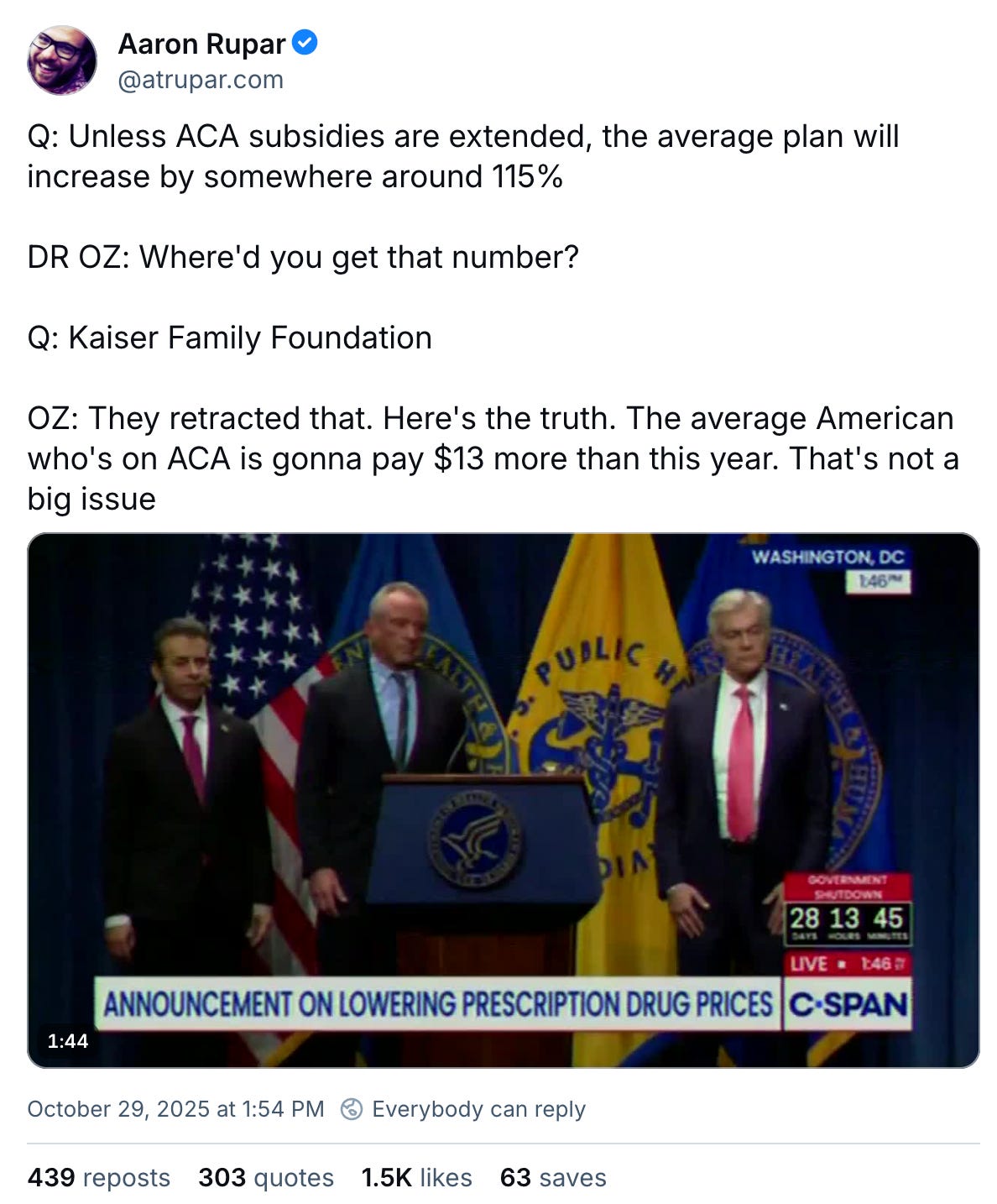
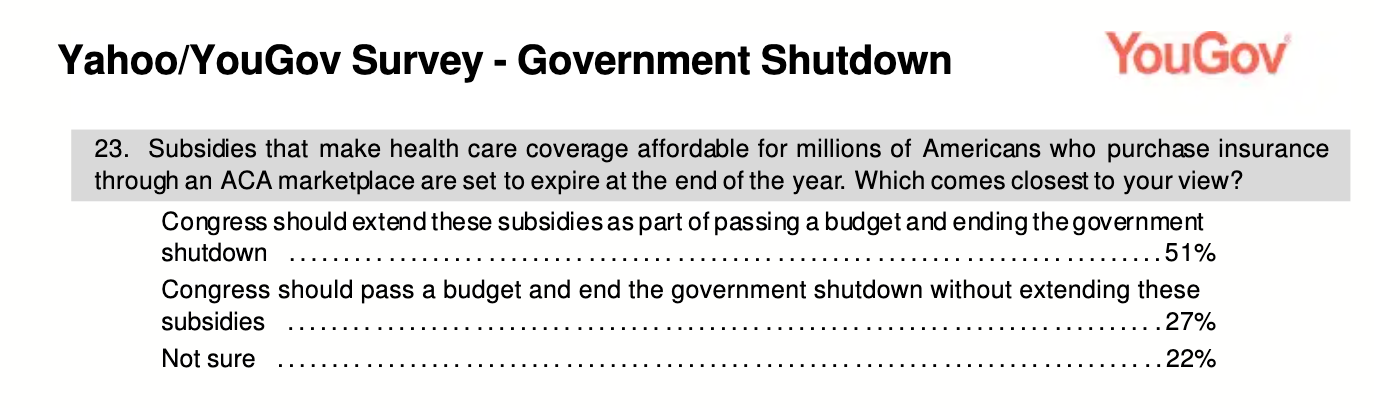
Krugman argues the Trump administration's austerity agenda, meant to stay hidden until after the 2026 midterms, has blown up early through incompetence and internal GOP dysfunction. SNAP funding lapsed, threatening 42 million recipients -- mostly children, elderly, or disabled -- while USDA's own data page blames Democrats via a propaganda banner. Enhanced ACA subsidies from the Biden era, which cover most of the 24 million Americans on the ACA Marketplace, expire at the end of 2025, so 2026 premiums are jumping an average of 114 percent (KFF), partly because healthier people drop out as costs rise, worsening the insurance risk pool. Medicaid work requirements were deliberately delayed to end of 2026 to hide the pain until after midterms, but health-care and SNAP crises are hitting immediately, fueling the government shutdown Democrats have staked their stand on (YouGov polling favors them). Krugman doubts strategy explains the failure to delay ACA pain too; he blames GOP ignorance of how the ACA works, noting officials are still denying KFF's estimates on social media, plus visceral hostility to aid. He also points to a bizarre procedural knot: reconvening Congress to release SNAP's $5 billion contingency fund or extend ACA subsidies would force Speaker Mike Johnson to swear in Adelita Grijalva, whose vote would release the Epstein files -- so Johnson keeps the House shut, blocking any fix.
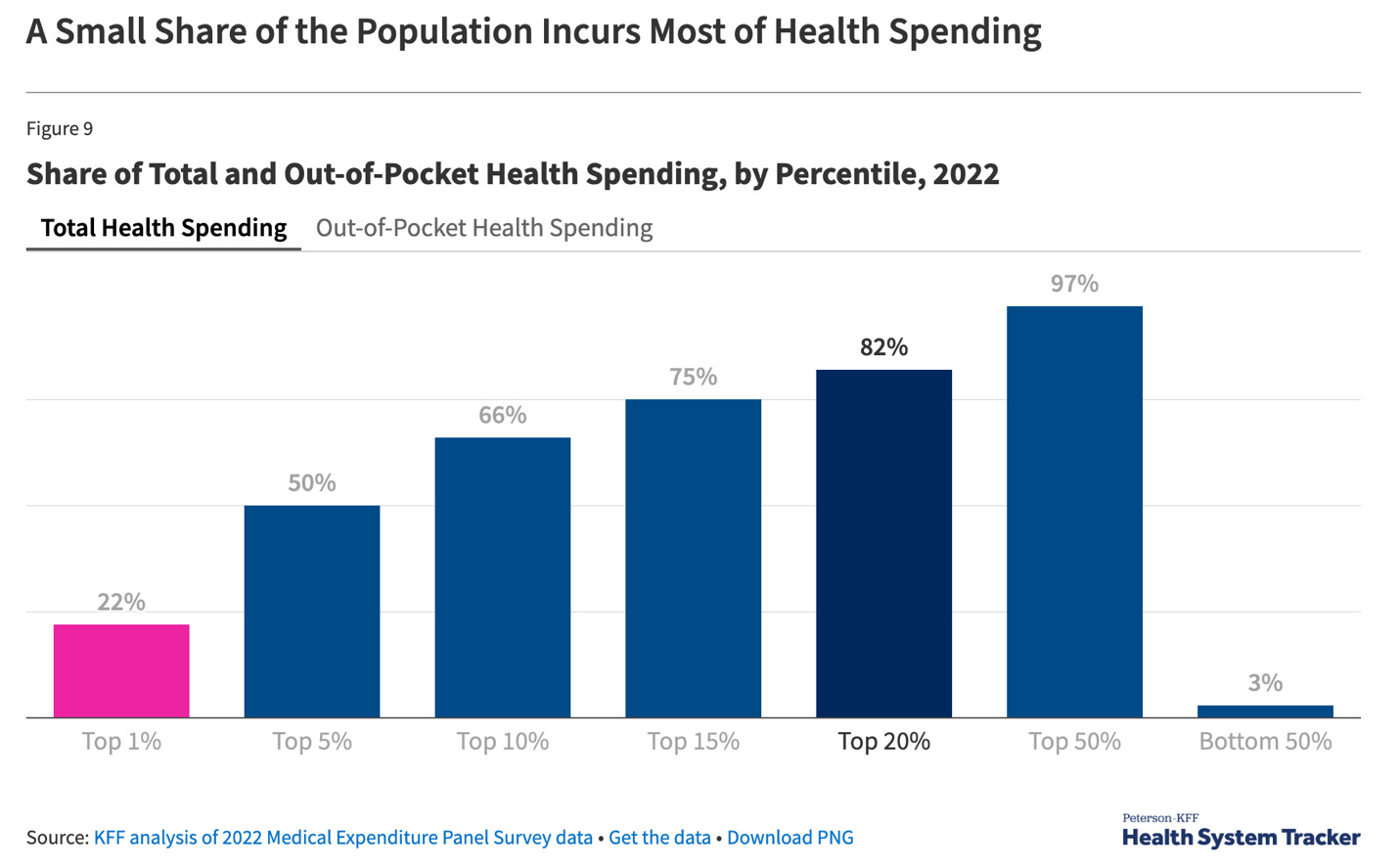
Krugman lays out the basic economics of why health insurance -- like fire insurance -- has to pool risk against rare catastrophic costs, showing that half of Americans spend almost nothing on health care while the top 5% account for half of spending, and argues Trump's push for consumer-paid-out-of-pocket care ignores that patients in emergencies can't shop around and lack the technical expertise to evaluate treatment. He uses this framework to indict Republicans' 15-year failure to replace Obamacare and their willful refusal to acknowledge the tradeoffs their own subsidy-cutting stance during the shutdown created.
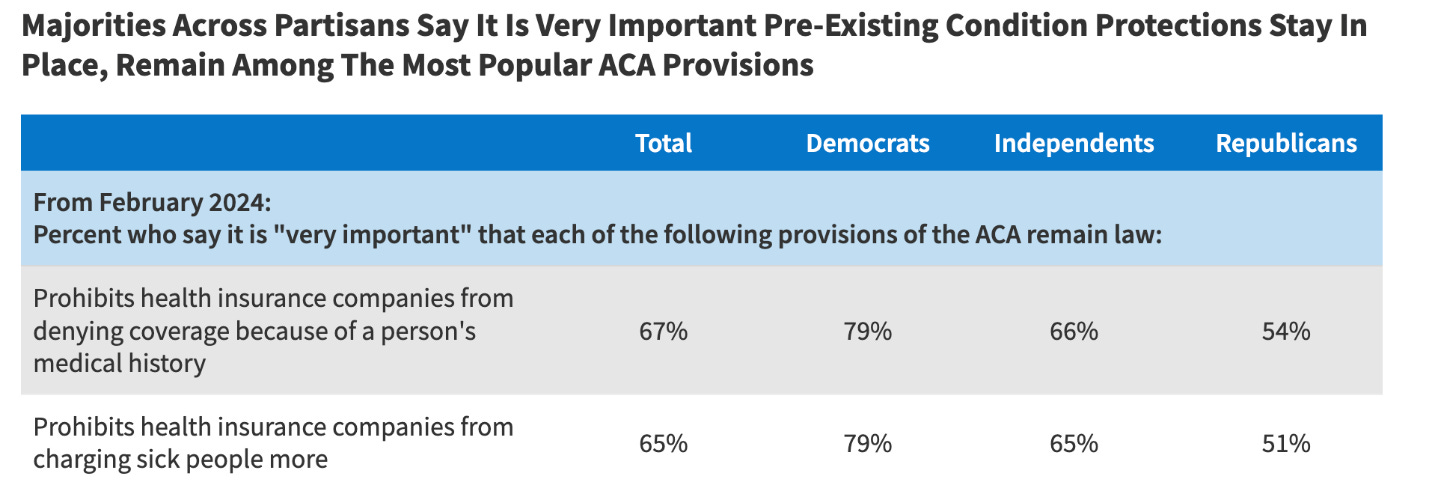
Health insurance works like fire insurance: almost all of America's 150 million dwelling units carry it even though fewer than 400,000 home fires occur yearly, because insurance exists to protect against catastrophic, low-probability losses. Republicans, Krugman argues, refuse to accept this -- except Marjorie Taylor Greene, who said so publicly and became a party pariah, while Rep. Mark Lawler blamed Democrats instead. Trump's alternative, sending subsidies directly to taxpayers to "purchase their own, much better healthcare" out of pocket, ignores that spending is wildly skewed: 2022 data show half the population spent almost nothing, while the top 5 percent (averaging over $67,000) accounted for half of all spending and the top 1 percent (over $147,000) for more than a fifth. Only the ultra-wealthy can self-pay; urgent-care patients can't comparison-shop from an ambulance gurney, and medicine is too technical for consumer-driven shopping, a policy Republicans have pushed for 15 years. A KFF poll shows large majorities want insurers required to cover pre-existing conditions, which is why Obamacare pairs insurer regulation with subsidies to keep healthy people insured. Krugman concludes this is not ignorance but willful cruelty; per Jared Bernstein, Republicans have lost the ability to think about policies that solve real problems, reduced to displays of loyalty to Trump. He predicts the crisis will hurt the GOP politically.
health insurancerisk poolingobamacareaca subsidiesconsumer-driven healthcare
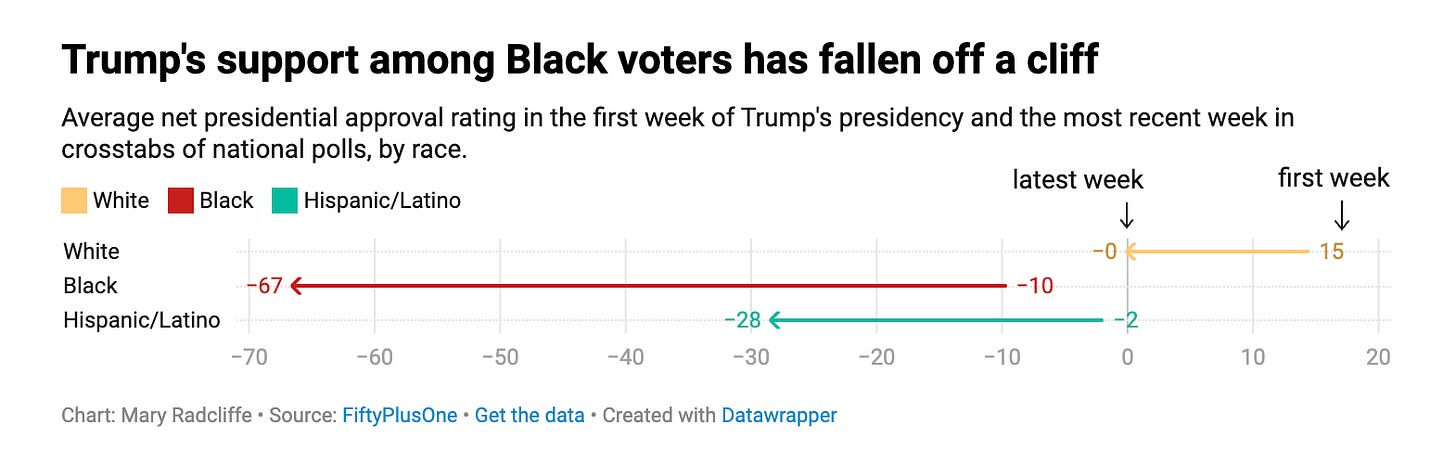
Krugman traces the swing of Black and Latino voters back toward Democrats to Trump's broken 2024 promise of falling prices, then applies political scientist Suzanne Mettler's research on hidden government benefits to predict that the looming expiration of enhanced ACA subsidies will hit politically engaged, previously pro-Trump voters with sudden, visible premium spikes on January 1. The argument is that benefits go unnoticed until threatened, then get fiercely defended once withdrawn — meaning the health-care shock ahead will do more electoral damage than abstract affordability complaints have so far.
Trump's affordability crisis, the cause of his 2024 win, is about to intensify against Republicans. Polls (Politico) show swing voters now blame Trump, not Biden, for the cost of living; after his promise to "rapidly drive prices down" went unmet, Black and Latino voters who believed him have swung back to Democrats (per G. Elliott Morris's data). Trump now dismisses affordability as a "hoax" and plans a nationwide tour insisting the economy is fine.
Drawing on political scientist Suzanne Mettler's work on Kentucky (28% Medicaid-covered, yet a 30-point Trump margin), the argument holds that benefit recipients often don't see programs like Medicare or the mortgage-interest deduction as "benefits," and that means-tested recipients (Medicaid, food stamps) are poor and vote less. But most people react to concrete, demonstrated harm, not abstract threats — as with Obamacare's swing from unpopular to broadly popular once implemented, and the 2018 backlash after Trump's 2017 repeal attempt.
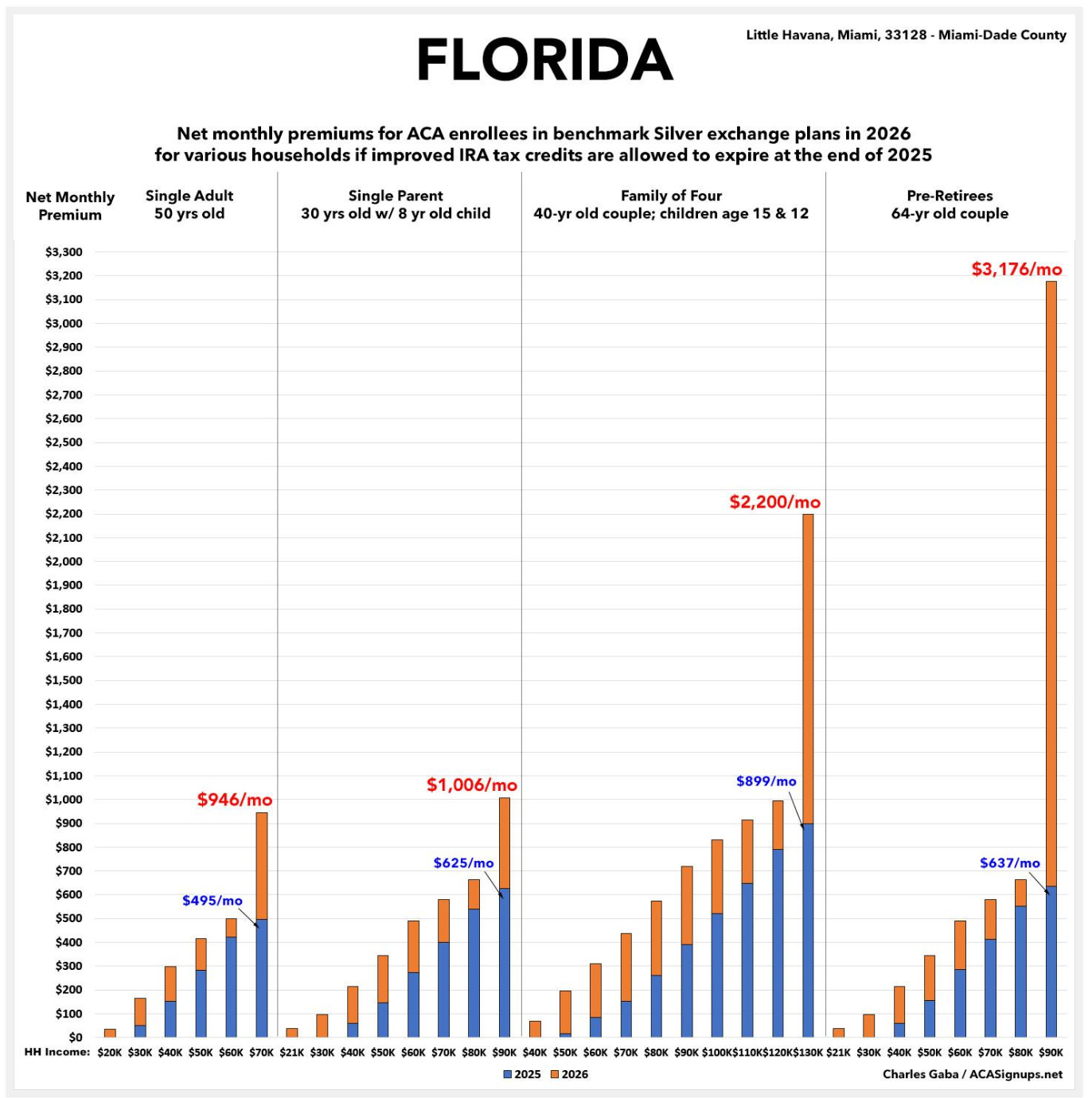
Now Biden-era enhanced ACA subsidies, which eliminated the 400%-of-poverty "notch," expire this month, and Republicans refuse to extend them. Charles Gaba's Florida estimates show near-universal premium hikes, with higher-income enrollees losing subsidies entirely and facing increases over $2,500 a month ($30,000 a year) — a group with high turnout. Combined with tariff pass-through, rising electricity prices, and deportation-driven food costs, this ensures the affordability backlash against Republicans gets worse.
A full-transcript conversation with health economist Jonathan Gruber covers the expiration of enhanced ACA subsidies, projected to cost roughly 4 million people their coverage and about 5,000 lives a year, and a new paper finding that immigrant labor disproportionately staffs elder care, so that mass deportation of groups concentrated in caregiving occupations would raise elderly mortality by thousands of deaths annually. Gruber also outlines a proposed $40 billion universal home-care program for Medicare recipients and walks through the David Card-style natural-experiment method used to isolate immigration's causal effect on senior care outcomes.
The rollback of enhanced Affordable Care Act subsidies and of expanded legal immigration is quietly killing thousands of Americans a year, MIT health economist Jonathan Gruber tells Paul Krugman, drawing on his new research into immigration and elder mortality. Under the ACA, premiums ran on a sliding scale up to 10% of income, capped at four times the poverty line; Biden's expansion zeroed out the poorest enrollees' payments, cut the top rate to 6%, and removed the cap — and it lapsed this year. Gruber's projections and the CBO agree roughly 4 million people will eventually lose coverage; at the standard estimate of one death per 800 people who lose insurance, that implies about 5,000 additional deaths a year. Enrollment has fallen only about 1.5 million so far, partly because states like Massachusetts are covering the gap themselves ($250 million), and partly because reaction to premium jumps (one friend of Gruber's: $8,000 to $25,000 a year) takes time.
Gruber frames the money as trivial relative to other federal choices: extending the subsidies a decade costs roughly one-tenth what the Trump tax cuts added to the deficit ($3.3 trillion), and the annual ICE budget increase (to roughly $80 billion) is about twice what full subsidies would cost yearly. Beyond mortality, insurance loss causes financial and psychological harm: the randomized Oregon Health Insurance Experiment found insurance cut depression 30%. He cites two women diagnosed with breast cancer at 36: the uninsured one delayed care and died; the insured one, his wife, survived. High-deductible plans, Gruber argues, hurt only low earners (his own $50-copay knee MRI, which he'd have skipped at $1,000 out of pocket, illustrates the point), while narrow provider networks show little measurable health harm despite anecdotes.
The paper's core question: does more immigration change elderly Americans' mortality? Seniors make a clean test population since Medicare data is rich and immigrants themselves are excluded from it. Immigrants are hugely overrepresented in long-term caregiving — one in three home care workers and 18% of all health workers are immigrants, and entry-level nursing-home Certified Nursing Assistants (about $22/hour, barely above Starbucks) are "virtually all immigrants." Using David Card's enclave method — national refugee waves (e.g., Haitians fleeing political crises) settle in predictable local clusters regardless of local conditions, letting researchers treat the inflow as a natural experiment — Gruber and coauthors find flat elderly mortality before an influx and a sharp drop afterward, with no drop in native caregiver employment (native doctor counts even rise slightly). Headline estimate: a 25% rise in legal immigration (325,000 people) would prevent about 5,000 elder deaths yearly; revoking TPS for roughly 330,000 Haitians would cause about 9,000 additional deaths, and mass deportation at Stephen Miller's stated pace (3,000/day) implies roughly 15,000 more deaths annually. The mechanism seems tied to keeping people cared for at home rather than institutionalized, though Gruber admits the causal chain isn't fully pinned down. This lands against a backdrop of an already understaffed sector facing peak long-term care demand within 10-15 years, as boomers reach their late 70s and 80s.
Gruber proposes a three-part fix: more immigration, higher caregiver pay, and career ladders — citing a Massachusetts pilot ($6 million grant, employer-repaid) that pays CNAs' tuition and paid leave to become $40/hour Licensed Practical Nurses. With Richard Frank (Brookings), he's also designed a $40 billion/year universal home-care program with income-based co-pays, freeing family caregivers (mostly daughters) for paid work. Looking ahead, Gruber expects even restored subsidies to leave 30 million uninsured (10 million undocumented, 10 million who feel healthy without a mandate, 10 million eligible-but-unenrolled), pushing reform toward supply-side fixes and regulating health prices — which, per Kenneth Arrow's 1963 paper on health-market failure, every other developed country does and the U.S. doesn't. He predicts long-term care becomes a major political issue as more Americans confront aging parents, and argues the system persists because most people don't realize decent elder care is affordable.
health economicsaca subsidiesimmigrationlong-term carejonathan gruber
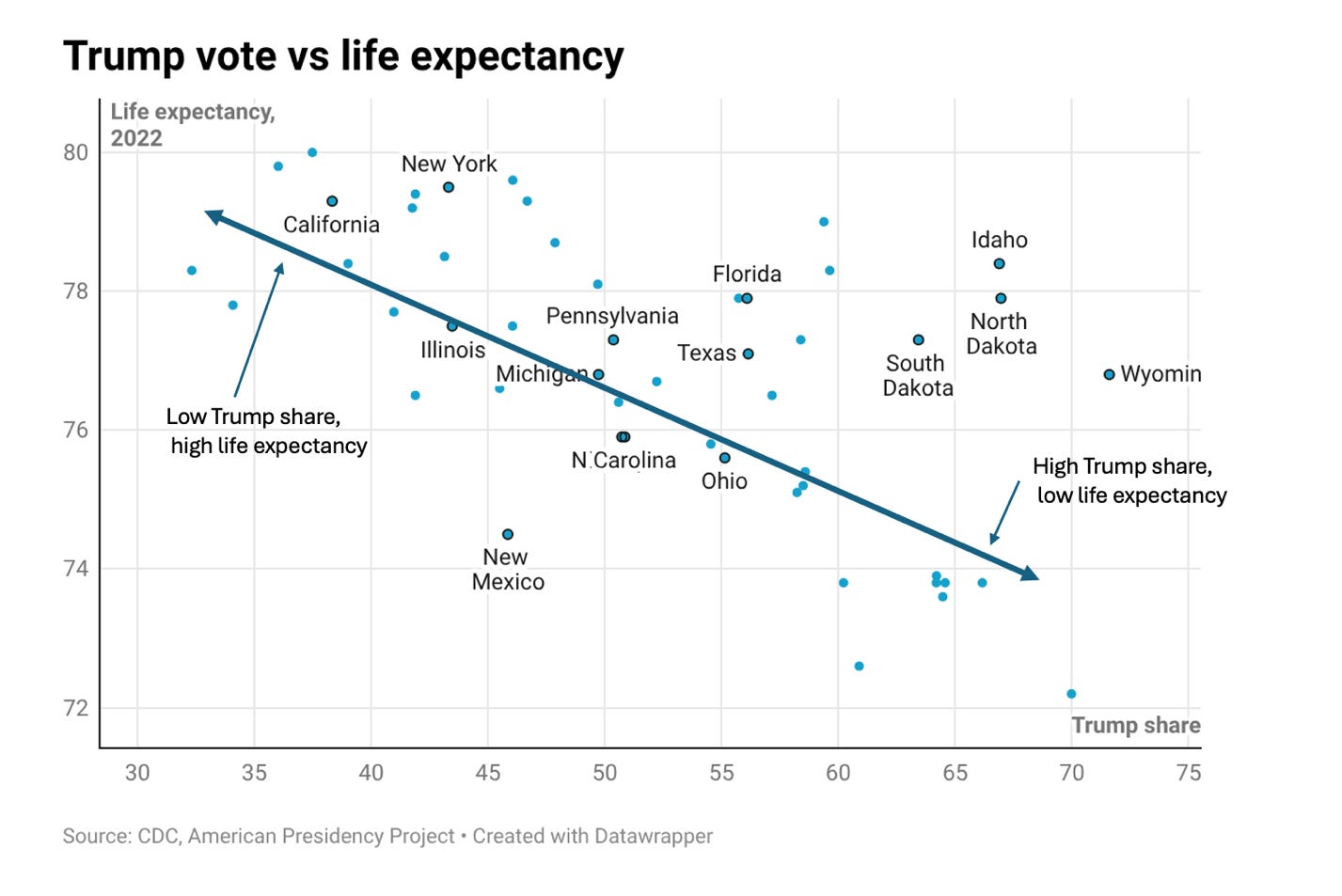
Uses state-level data to show a strong negative correlation between Trump vote share and life expectancy, arguing that America's post-1980 divergence from peer-nation longevity traces to right-wing politics: weak safety nets, Medicaid-expansion refusal, and hostility to medical science. Fresh evidence - the FDA's approval of flavored vapes under political pressure and its suppression of vaccine-safety research - shows the pattern intensifying under the second Trump administration, with measles resurgence and looming insurance losses as the near-term costs.
MAGA-aligned policy is systematically raising American mortality, driven by greed and willful ignorance. The FDA just approved blueberry and mango-flavored vapes after Trump, who met a leading vaping lobbyist in 2024, personally pressured the commissioner — hoping to win back young men — reversing warnings that flavors drive youth smoking; separately, the FDA has suppressed agency-funded studies confirming Covid and shingles vaccine safety.
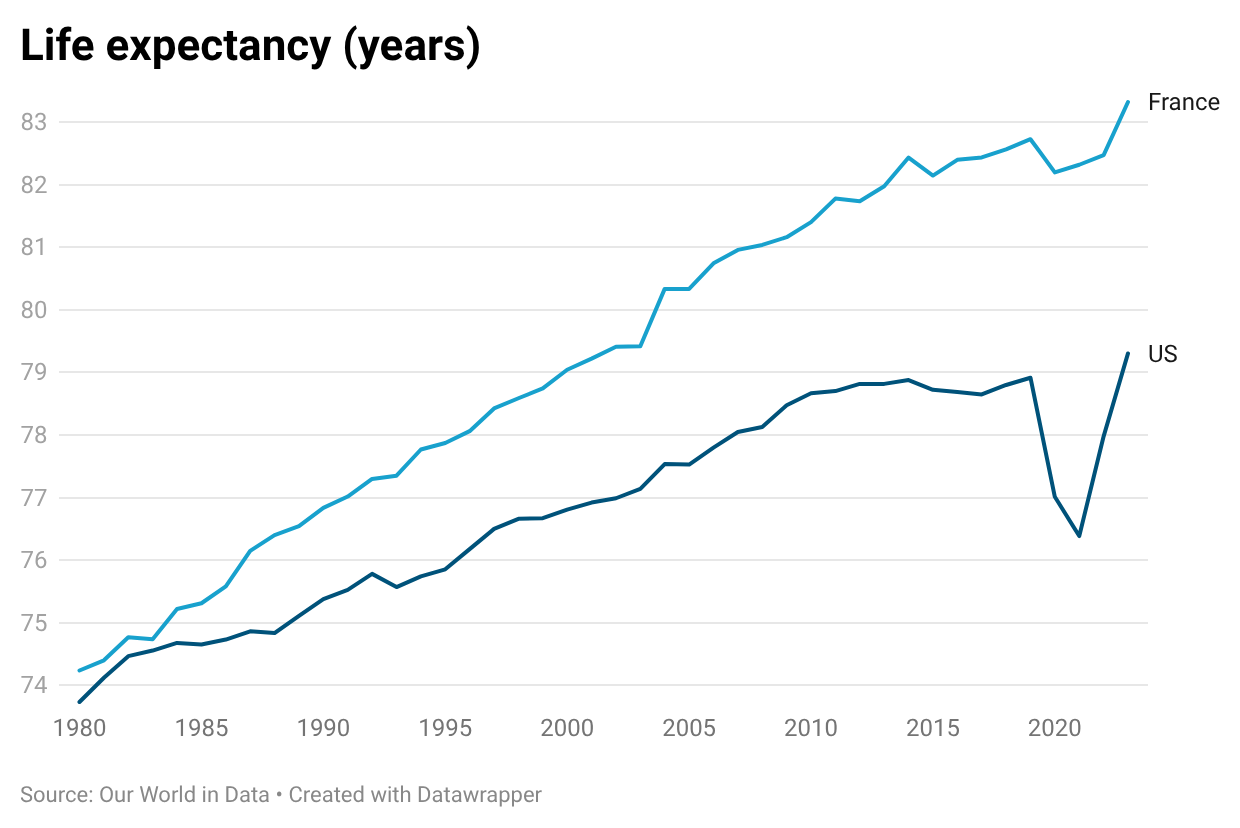
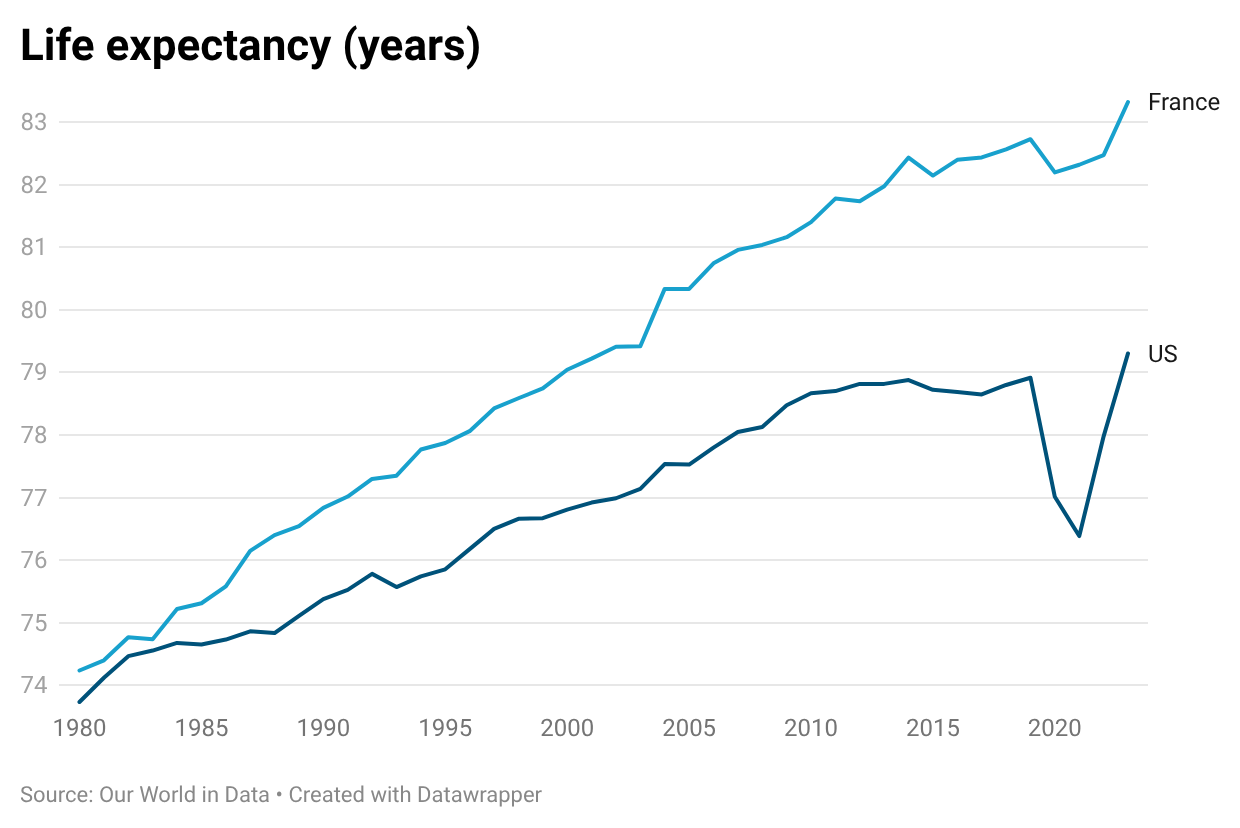
Life expectancy in the US, once comparable to other rich nations before Reagan's 1980 election, now trails peers and matches Albania; a state-level chart plotting life expectancy against Trump's 2024 vote share shows a strong negative correlation, with deep-red states like Alabama and West Virginia matching Kazakhstan. Weak safety nets, rooted in donors' unwillingness to fund care for others, explain part of this — many red states refused ACA Medicaid expansion, and Texas leads the nation in uninsured children — but hostility to science is central: a Charles Gaba (ACA Signups) chart shows Covid deaths per capita in the reddest counties were nearly triple the bluest, and a US-versus-France chart shows life expectancy diverging sharply during the pandemic.
Greed and ideology together explain the pattern: corporate disinformation modeled on the tobacco industry's playbook, quack-medicine revenue funding right-wing media, and an oligarch–Christian-nationalist alliance hostile to Enlightenment science. Result: resurgent measles, looming pandemic risk, and millions losing coverage as Medicaid cuts proceed.
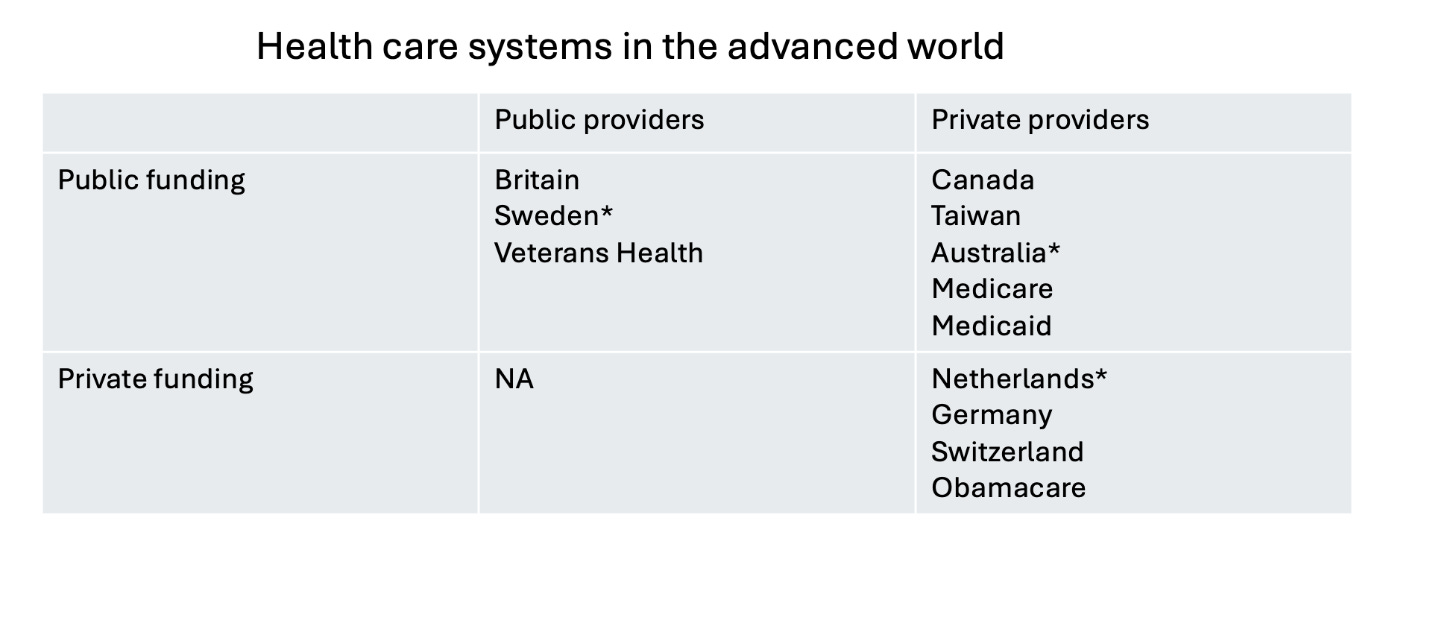
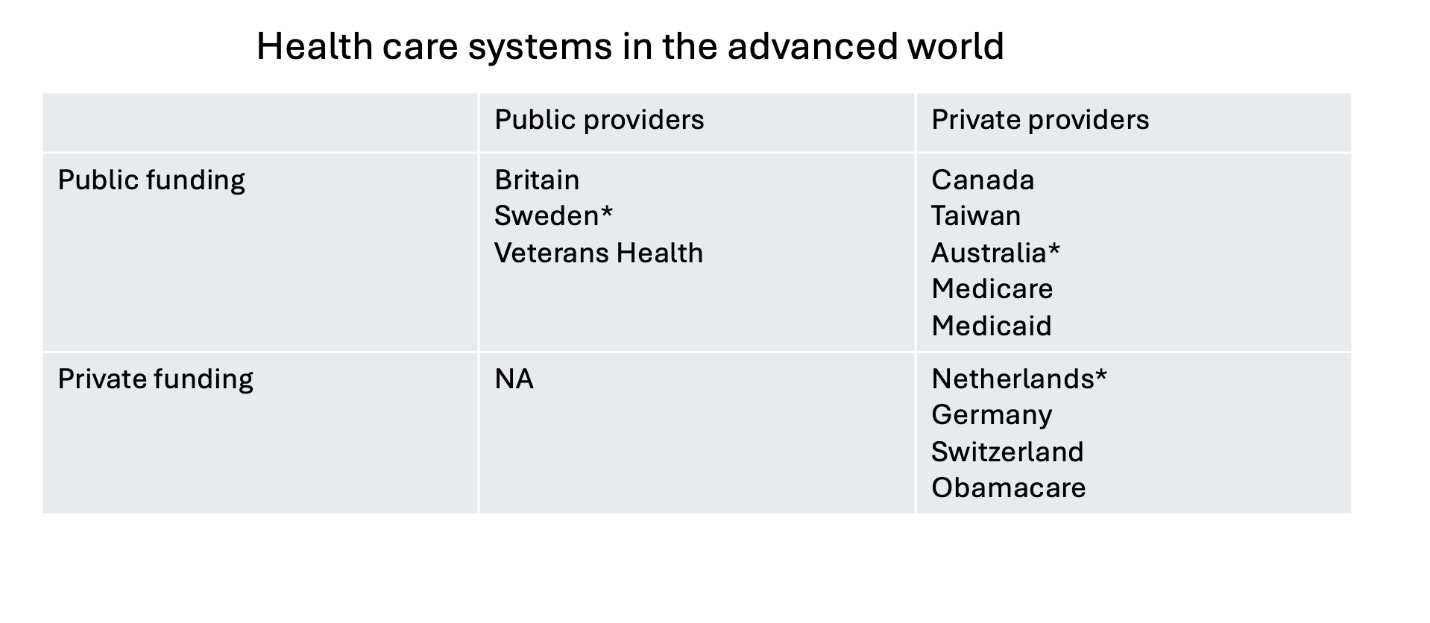
Krugman lays out the foundational economics of health policy, using Arrow's classic 1963 analysis of why markets fail for healthcare — risk, asymmetric information, and adverse selection — to explain why every advanced nation relies on government intervention, then builds a systematic taxonomy of real-world systems by who pays (public versus private insurance) and who delivers care (public versus private providers). He shows that all three viable models — NHS-style public provision, single-payer with private delivery, and heavily regulated private insurance like the Dutch 'three-legged stool' — successfully deliver universal coverage at lower cost than the U.S., framing America's shortfall as a policy choice rather than a technical impossibility.
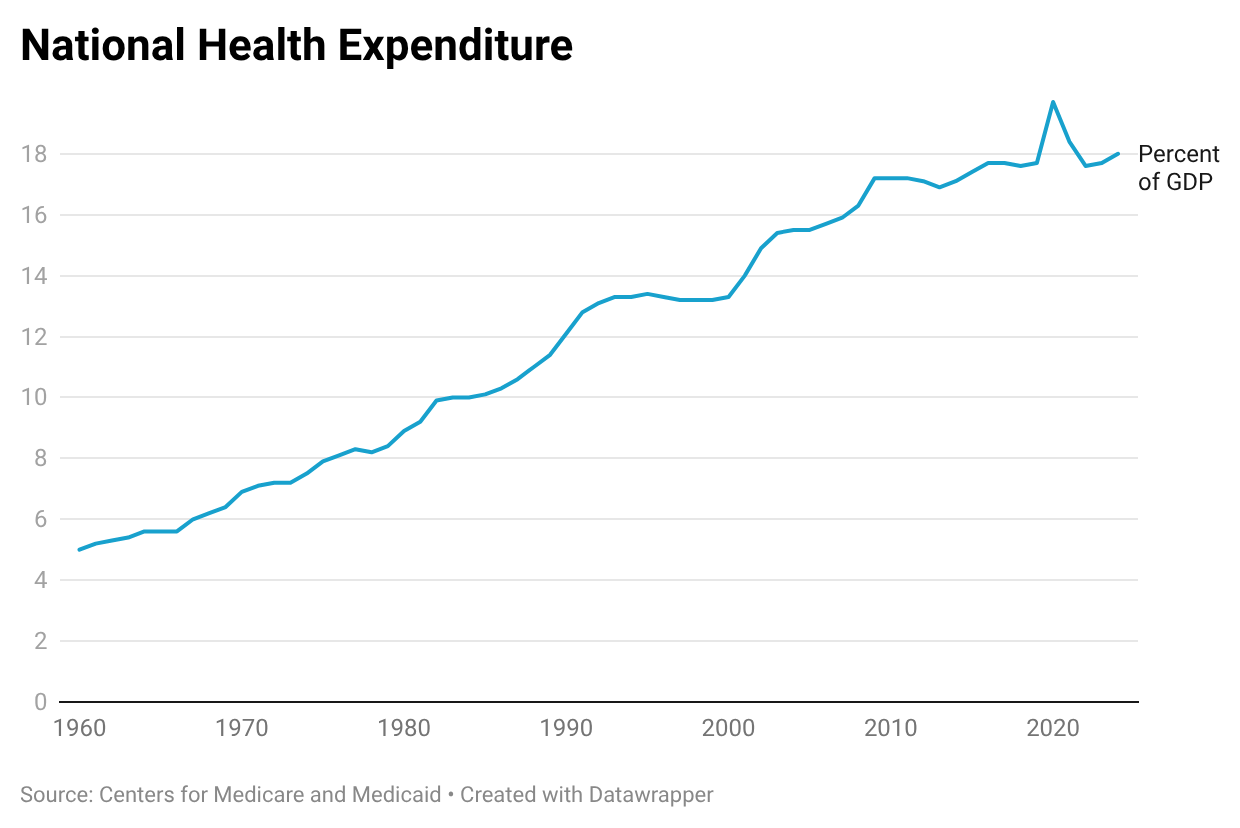
Healthcare cannot be safely left to free markets, and the United States — alone among advanced nations still short of universal coverage despite having by far the world's highest per-capita healthcare costs — has three proven, working models available to finish the job Obamacare started.
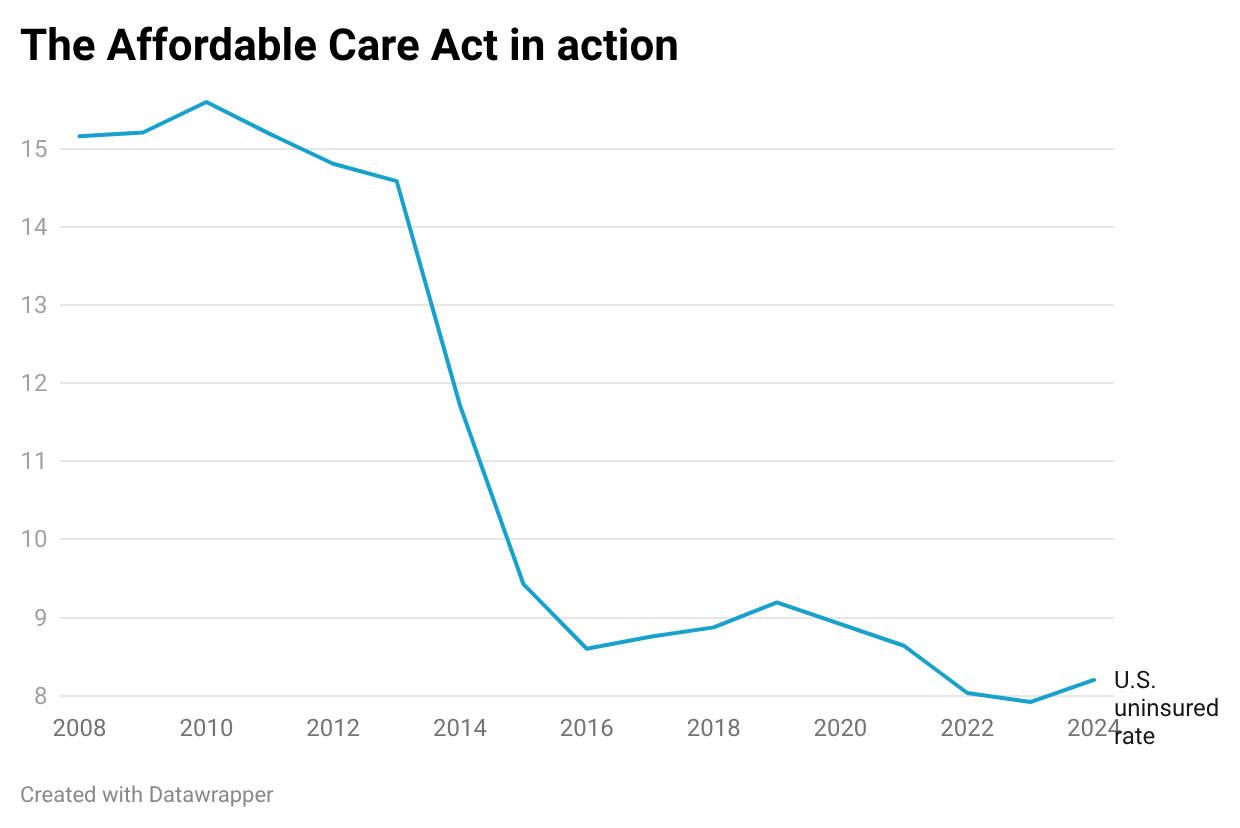
The Affordable Care Act, enacted in 2010 and fully implemented by 2014, extended coverage to millions and ended discrimination against pre-existing conditions, while overall medical spending growth actually slowed afterward. Yet a chart of the uninsured rate shows 8 percent still lacked coverage in 2024, a figure set to rise under Republican policy, alongside growing underinsurance.
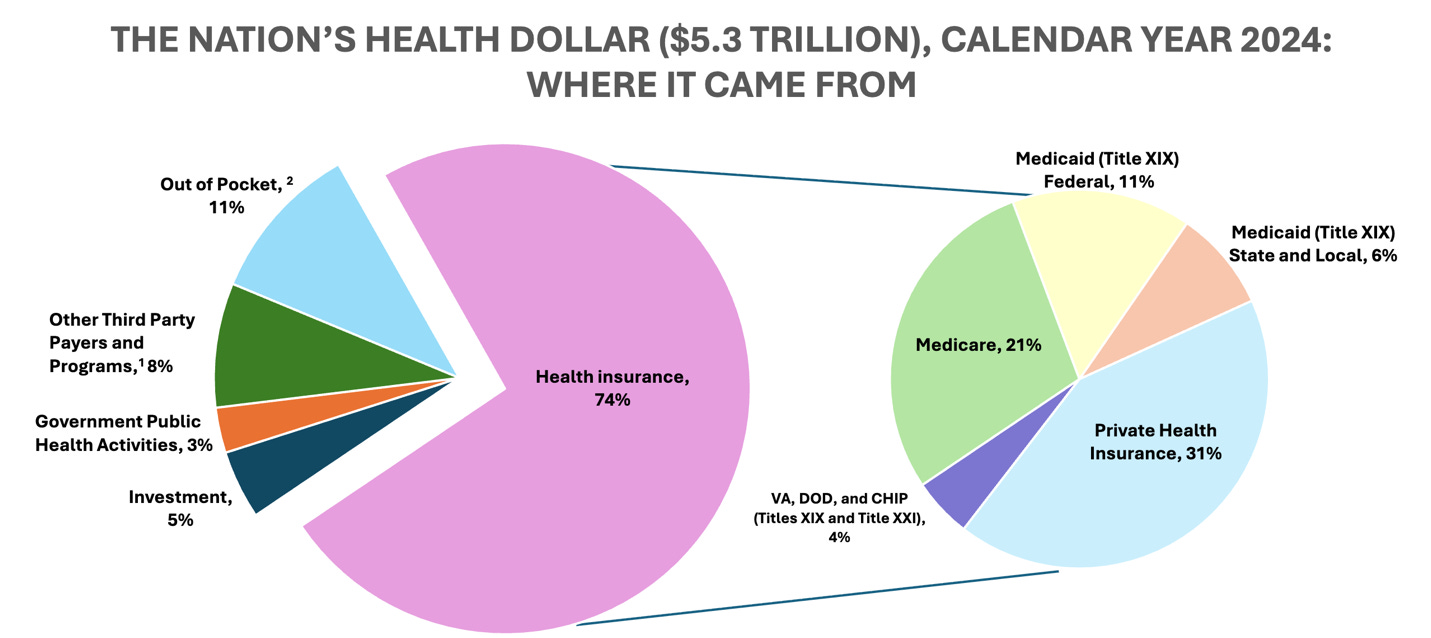
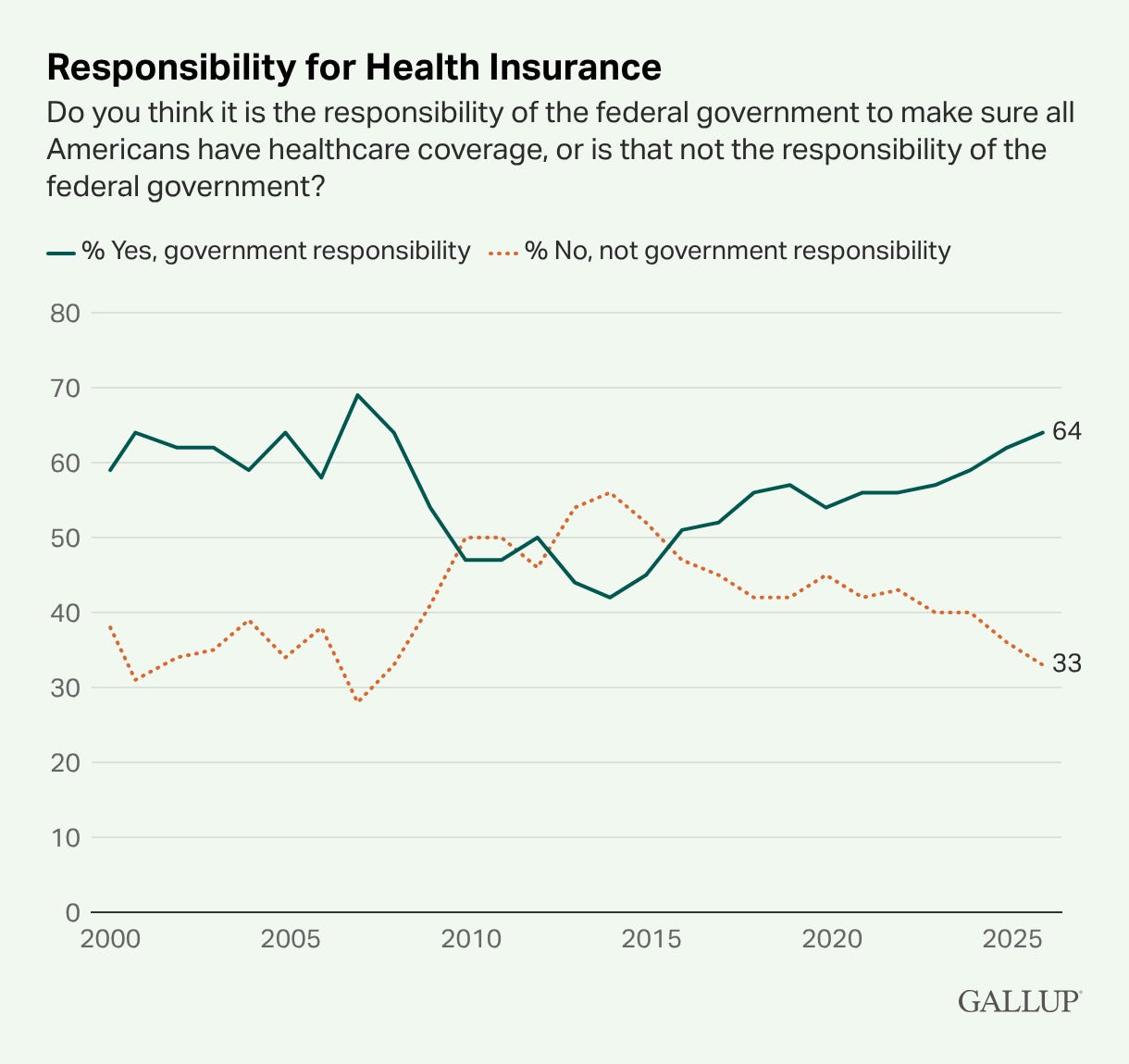
Markets fail here because, per economist Kenneth Arrow's 1963 analysis, healthcare is plagued by risk and asymmetric information: no one knows in advance who will need costly care, so private insurers either charge premiums so high they trigger a "death spiral" of healthier people opting out, or they deny coverage to those who need it most — an incentive-to-deny-claims problem dramatized by Luigi Mangione's killing of UnitedHealthcare's CEO. Government already covers 48 percent of U.S. healthcare spending. A Pew chart shows most Americans, including 41 percent of Republicans, believe government should guarantee coverage.
Krugman maps systems along two axes — who pays (public/private) and who delivers care (public/private) — yielding three viable, real-world models (a fourth, private-funded public hospitals, doesn't exist). "Socialized medicine" (public pay, public delivery): Britain's NHS, Sweden, New Zealand, and the U.S. Veterans Administration (9+ million patients). Single-payer (public pay, private delivery): Medicare and Medicaid together cover 128 million Americans and 43 percent of spending versus 33 percent for private insurers; also Canada, Australia, and Taiwan's clean 2005 system. Regulated private insurance via the "three-legged stool" — guaranteed issue, individual mandate, subsidies: the Netherlands, Germany, Switzerland, and Obamacare (though its mandate was repealed in 2019).
All three approaches work and cost less per capita than the U.S. system: Australia ranks highest on Commonwealth Fund satisfaction metrics, the Dutch system rivals it, and even underfunded NHS and reformed VA performed well for years. A follow-up post will assess paths forward for the U.S.
health economicshealth policyuniversal healthcaremarket failurehealth insurance
Krugman traces the political economy of US healthcare from FDR's abandoned national insurance plan through Truman, Medicare and Medicaid, Clinton's failed HMO-based reform, and the Affordable Care Act, arguing that resistance to universal coverage has been driven by two persistent forces: organized-medicine and insurer lobbying, and Southern segregationists' fear that federal health programs would force hospital integration. He shows the ACA succeeded politically by leaving employer coverage and Medicare untouched while buying off insurers, delivered real coverage gains at lower-than-projected cost, and warns that the second Trump administration's subsidy cuts and Medicaid reductions are set to reverse most of that progress by the mid-2030s.
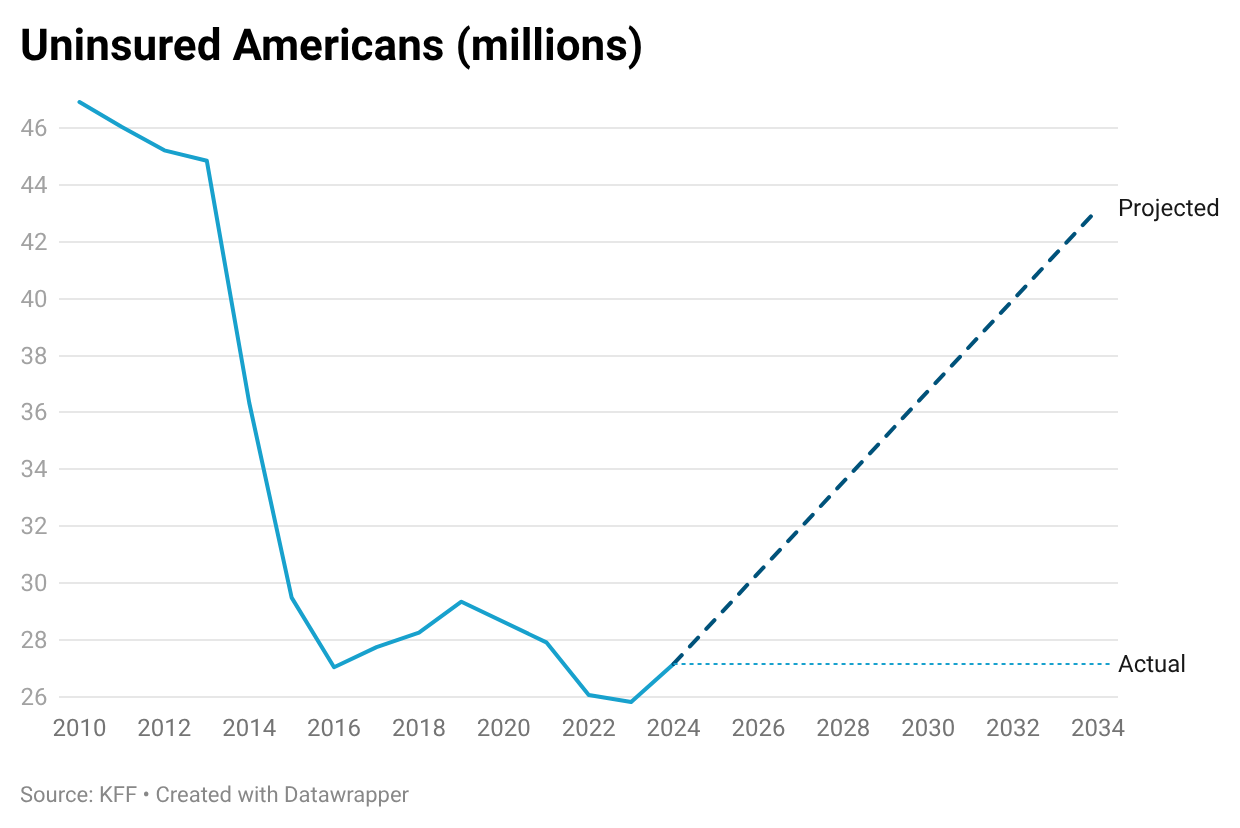
The Affordable Care Act cut the U.S. uninsured population from 47 million in 2010 to 27 million by 2016, but a second Trump-era assault — refusing to renew Biden's enhanced subsidies and slashing Medicaid through the One Big Beautiful Bill Act — is projected by the CBO to add 16 million uninsured Americans by 2034, reversing most of that gain.
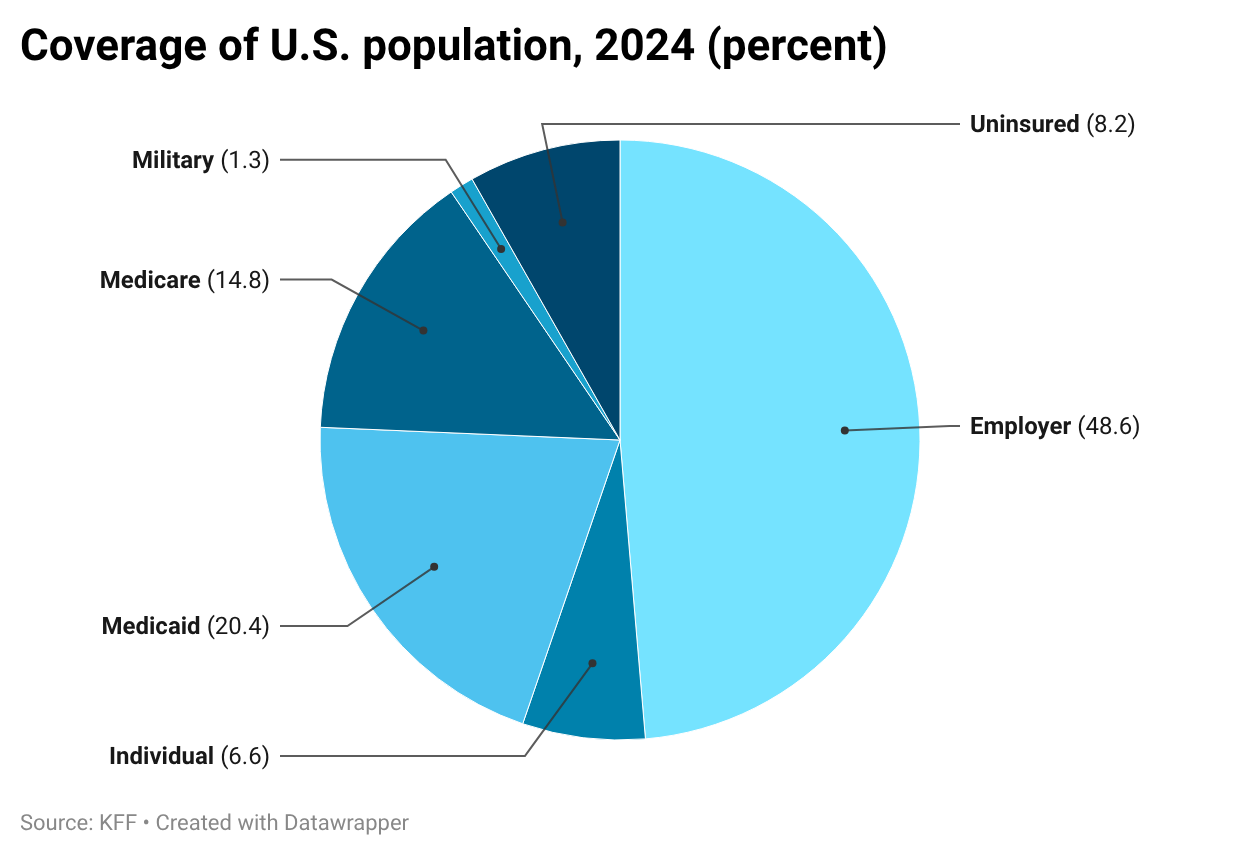
U.S. healthcare is a patchwork combining all three methods other rich nations use singly (UK-style direct provision, Canadian-style universal insurance, Dutch-style regulated private insurance): most Americans get private employer or individual coverage, over a third rely on Medicare, Medicaid, or military programs, and government pays a disproportionate share of total spending because it covers costlier seniors. Even "private" coverage is government-shaped — untaxed employer benefits require nondiscriminatory plans, and about 80 percent of individual-market enrollees get subsidies. Some 92 percent of Americans are insured, but the rest impose costs on everyone via uncompensated hospital care and forgone preventive treatment.
Krugman traces 80 years of resistance to universal coverage: FDR dropped health insurance from Social Security in 1935; Truman's 1947 push died to AMA opposition and Southern Democrats fearing forced hospital desegregation; Medicare and Medicaid passed in 1965 despite the AMA's 1961 "Operation Coffee Cup" campaign (Reagan-narrated records warning of "socialized medicine"); Clinton's 1993 HMO-based reform, meant to contain costs after health spending outpaced GDP for three decades, collapsed under insurance-industry attack ads.
Learning from that failure, the 2010 ACA left employer insurance and Medicare untouched, instead using regulation and subsidies to make the individual market viable (plus a mandate penalty later zeroed out under Trump I) and setting a federally funded Medicaid eligibility floor at 133 percent of the poverty line. A 2013 Supreme Court ruling let states opt out; 25 did, including Texas and Florida, in a pattern nearly matching 1861 Confederate lines — Krugman ties this to racial antagonism, since expansion would disproportionately help Black residents. Despite remaining gaps (8 percent uninsured in 2024), coverage rose substantially and spending grew slower than pre-ACA projections, per economists David Cutler and Lev Klarnet.
Popular only after Trump's failed 2017 repeal try (CBO: 23 million more uninsured), the ACA now faces quieter dismantling: expired subsidies are already pushing an estimated 5 million-plus off individual-market plans this year, while new Medicaid cuts are set to strip coverage from roughly 10 million more by 2034.
healthcare policyaffordable care actmedicaidpolitical economyhistory of us policy
Krugman closes his three-part healthcare primer by weighing socialized medicine, regulated private insurance, and single-payer against US political realities, concluding that a public option — letting Americans buy into Medicare-style coverage rather than being forced off private insurance — is the most achievable path to a de facto single-payer system. He grounds the case in cross-national cost and outcome data, the failure of Medicare Advantage's privatization experiment, and the political opening created by the collapse of insurer popularity and the backlash to Trump-era cuts.
Paul Krugman argues that post-2028 Democrats should pursue an ambitious healthcare overhaul built around a "public option" -- letting Americans buy into government coverage -- as a practical route toward an eventual single-payer system, rather than either restoring the pre-Trump status quo or imposing Medicare-for-all outright.
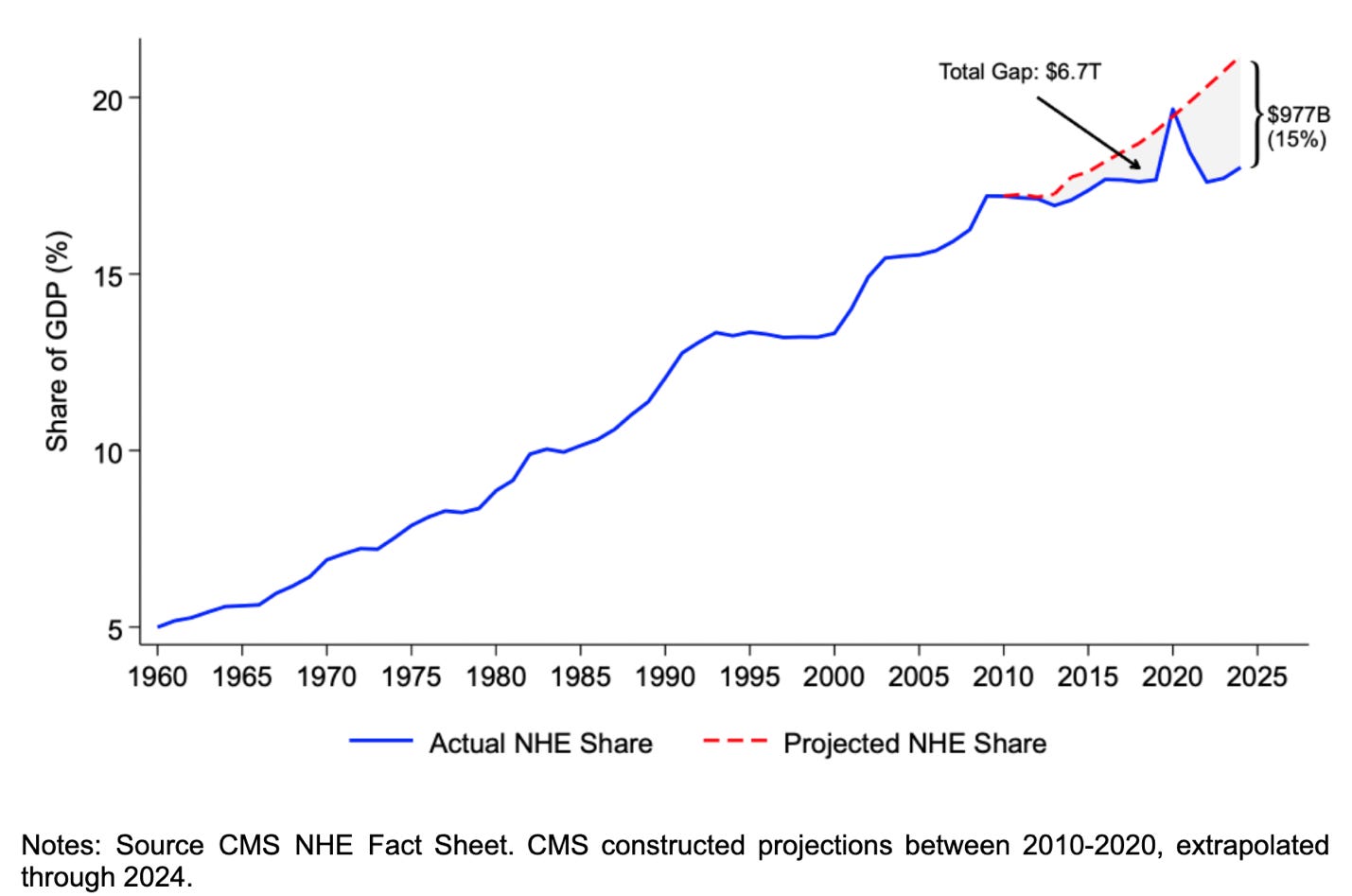
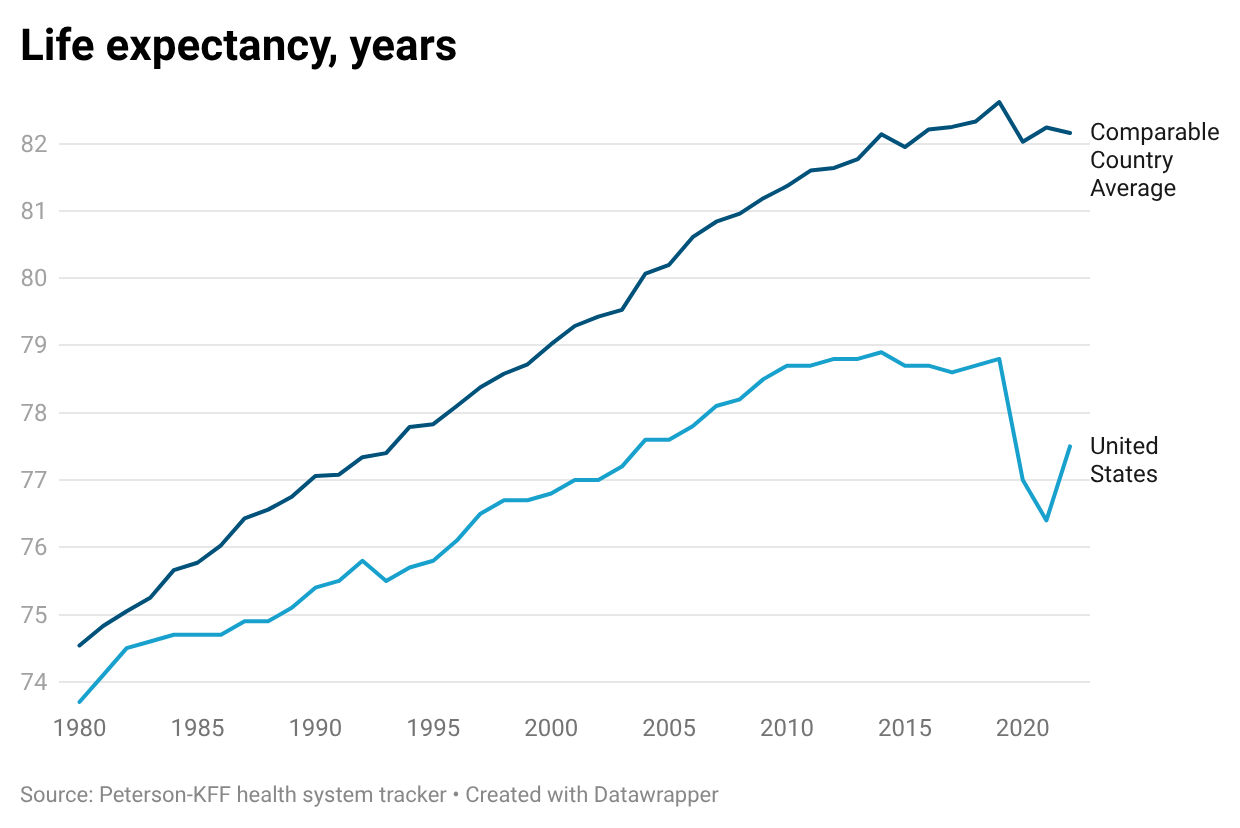
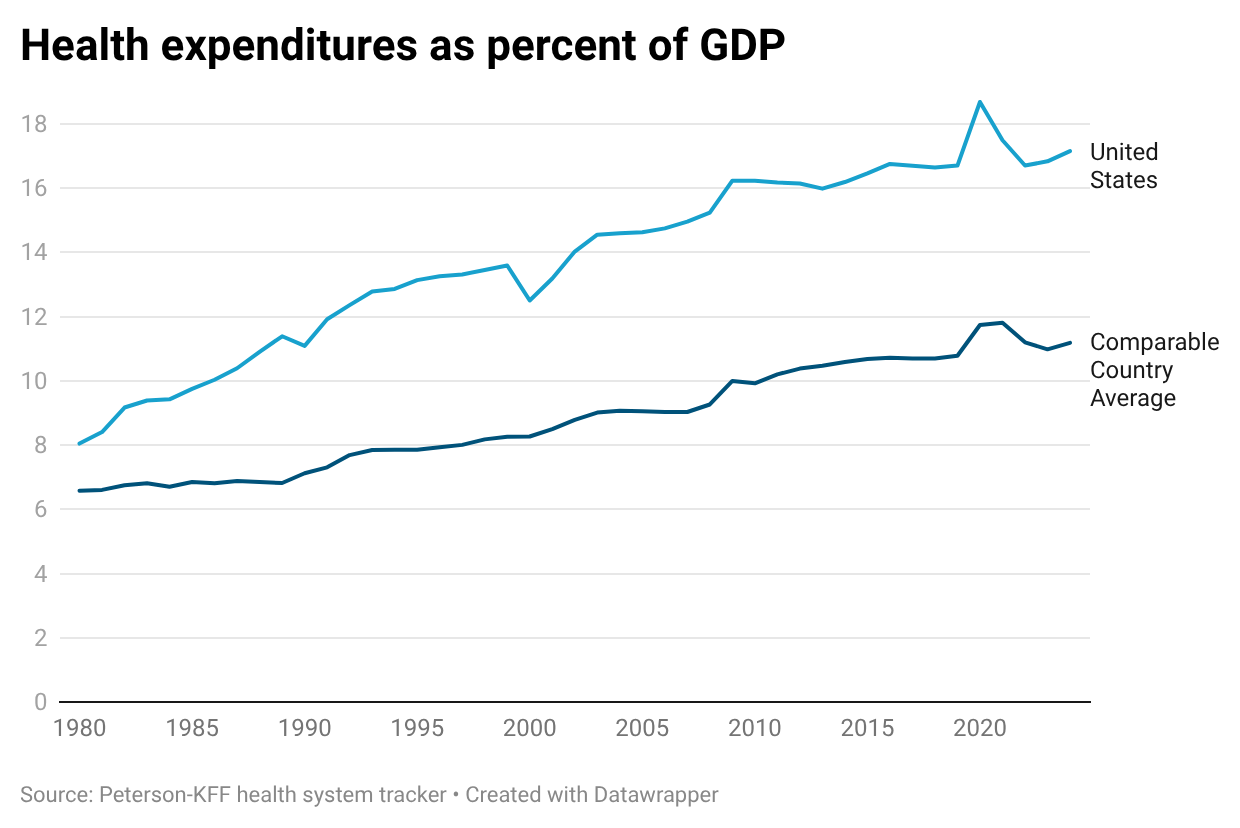
The case for reform rests on comparative data: circa 1980 the US resembled other advanced nations in health outcomes and cost, but the gap has since widened sharply. Life expectancy, once less than a year below the "Comparable Country Average" (Canada, Japan, several European nations, per the Peterson-KFF Health System Tracker), now trails by more than four years. Health spending, about 1.5 percentage points of GDP above peers in 1980, exceeded them by over 6 points of GDP by 2010, narrowing only slightly since. Obamacare (2010) improved coverage and cost growth, but Trump II is now unwinding those gains through Medicaid and ACA subsidy cuts.
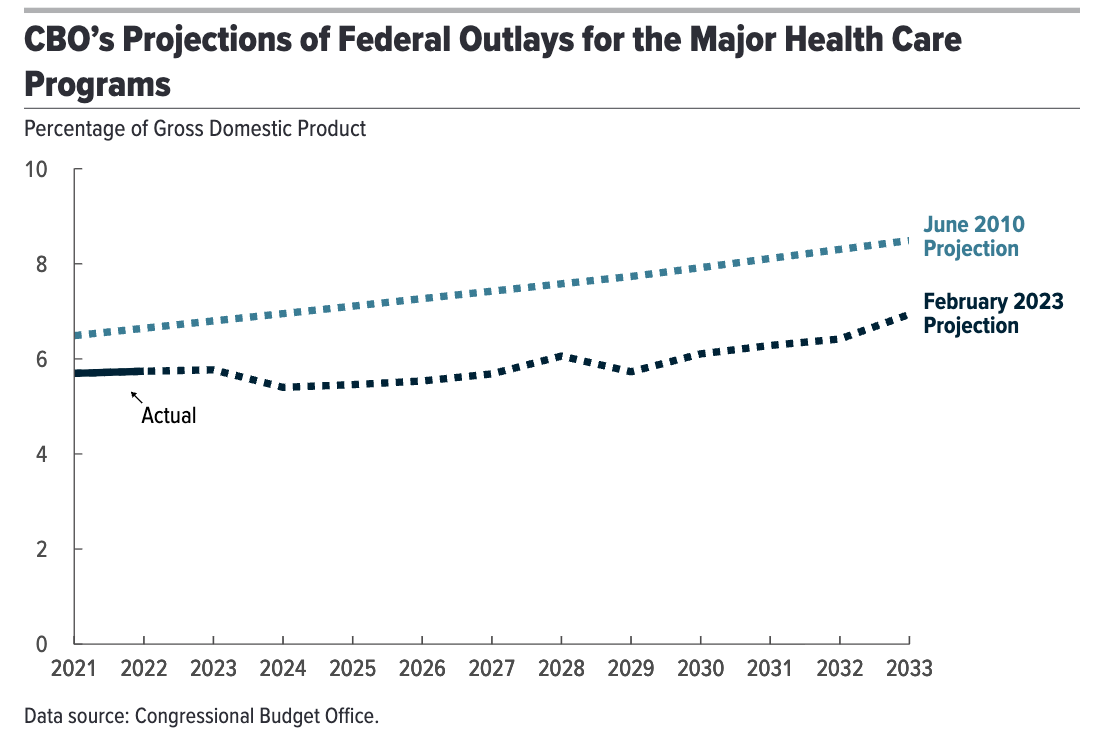
Krugman reviews the three workable models found worldwide, and all present in the US today: government-run "socialized medicine" (Britain's NHS), which offers integrated care but risks single-point-of-failure underfunding and political meddling (he cites RFK Jr. as a cautionary example); regulated private insurance (the Netherlands' system, echoed by US employer coverage and ACA exchanges), which he judges too vulnerable to America's money-driven politics -- pointing to Medicare Advantage's privatized carve-out, where insurers "upcode" patients to inflate payments; and single-payer (Medicare/Medicaid), which a CBO chart shows running far below post-ACA cost projections. He favors single-payer as the ultimate goal.
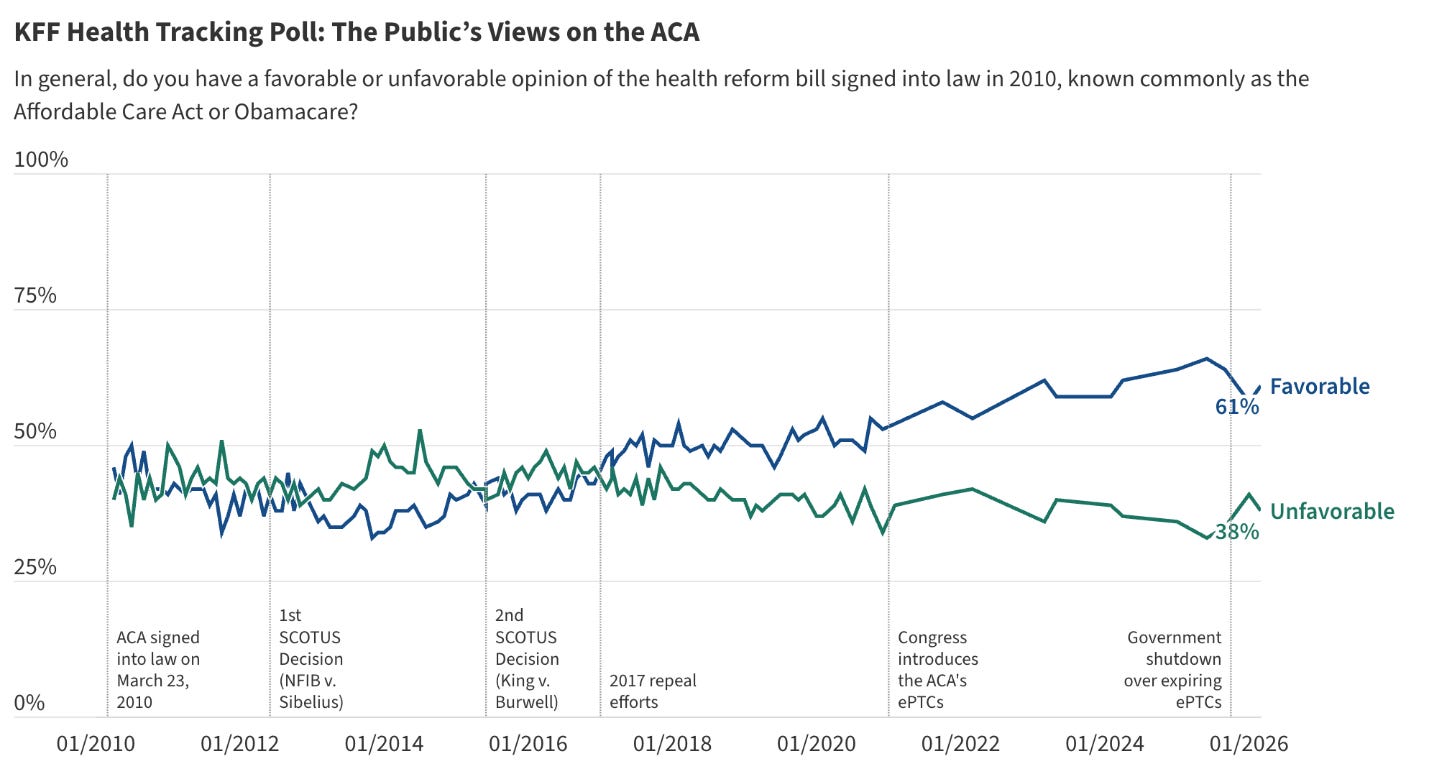
Politically, conditions have shifted since 2010: charts show the ACA now polls favorably, majorities back government-ensured universal coverage, and insurers face record public hostility -- including, per Axios, striking approval numbers after UnitedHealthcare's CEO was killed in 2024, following KFF polling on prior-authorization frustration. Trump-era Medicaid/ACA destruction, though harmful, may leave more room for structural reform than incremental repair would have.
Rather than forcing a switch, Krugman proposes offering a public option alongside private insurance. A satisfaction chart shows private enrollees remain fairly content, just less so than Medicare recipients, making abrupt abolition politically risky. Letting people voluntarily migrate to public coverage, he argues, could let single-payer emerge over time while outcompeting rather than banning insurers.
Krugman treats AI as the successor bubble question to dot-com and housing, walking through capex, data-center electricity demand, productivity measurement, and whether current valuations can be justified by anything other than momentum -- while a related strand covers antitrust, platform "enshittification," and the agglomeration economics that let Silicon Valley (and Harvard, and NIH-funded research) dominate in the first place, and what it costs the country when that base gets undermined.
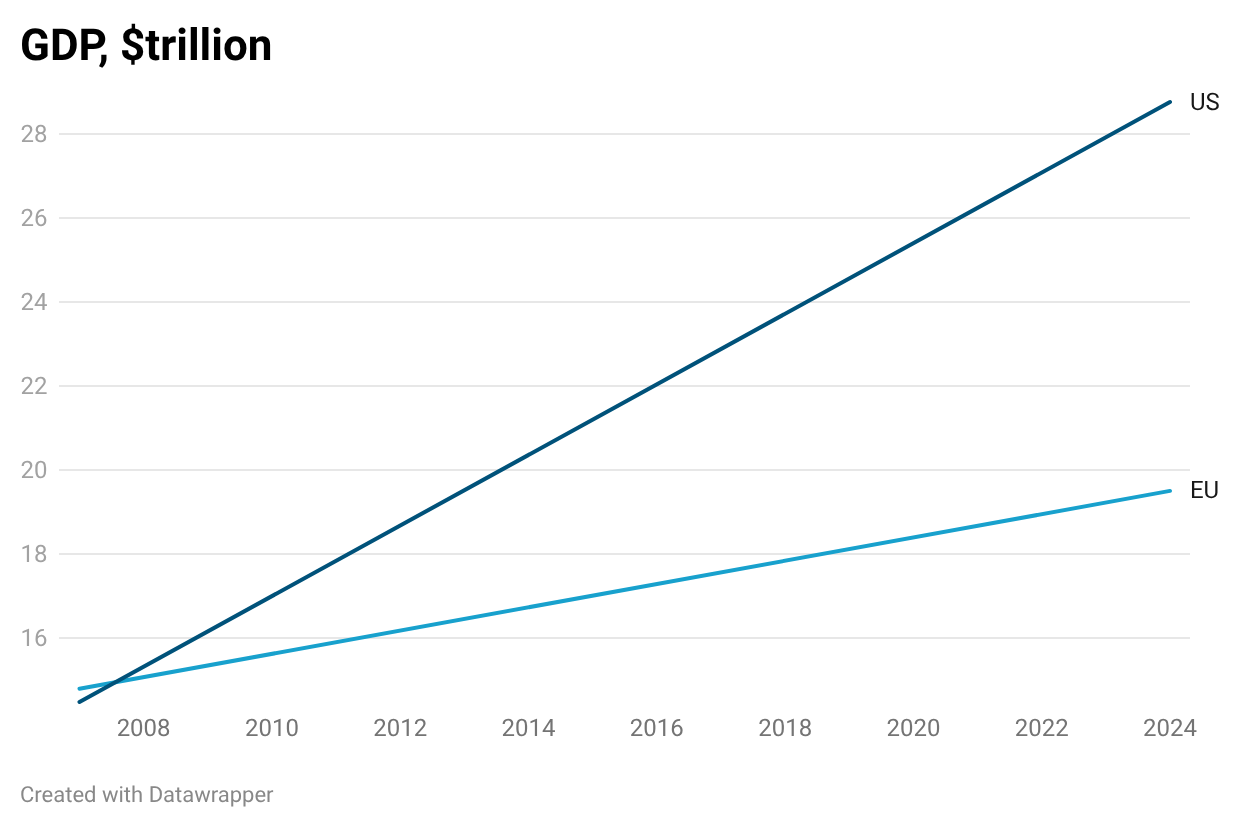
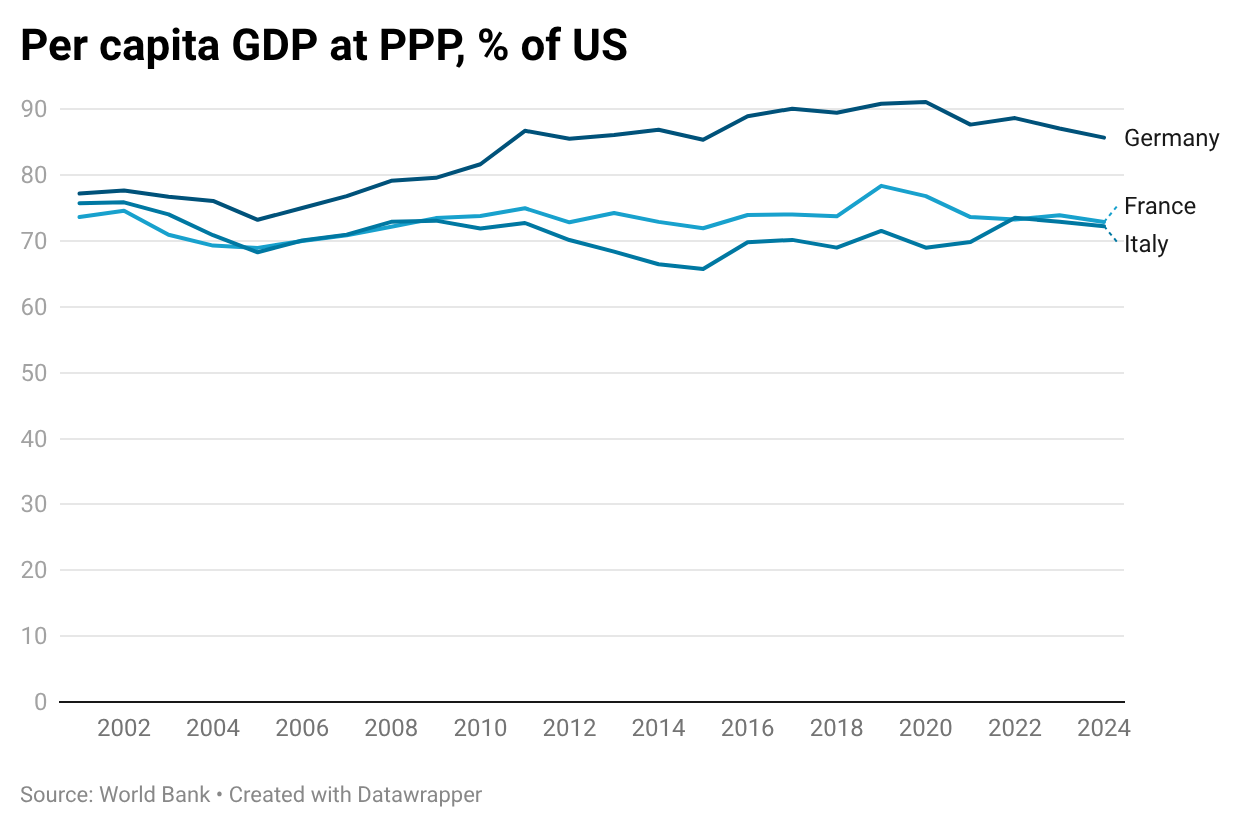
Proposes that America's overwhelming dominance in digital-technology market value isn't really a national advantage at all but a Silicon Valley one — nearly every U.S. tech giant clusters in one small region, the same way London's banking dominance reflects geographic agglomeration rather than any special national trait for finance. Applying Alfred Marshall's century-old theory of industrial clustering to the Draghi report's finding that the entire U.S.-EU productivity gap traces to ICT production, argues the real question isn't why America out-innovates Europe on policy or culture but why the tech cluster happened to land in Northern California in the first place.
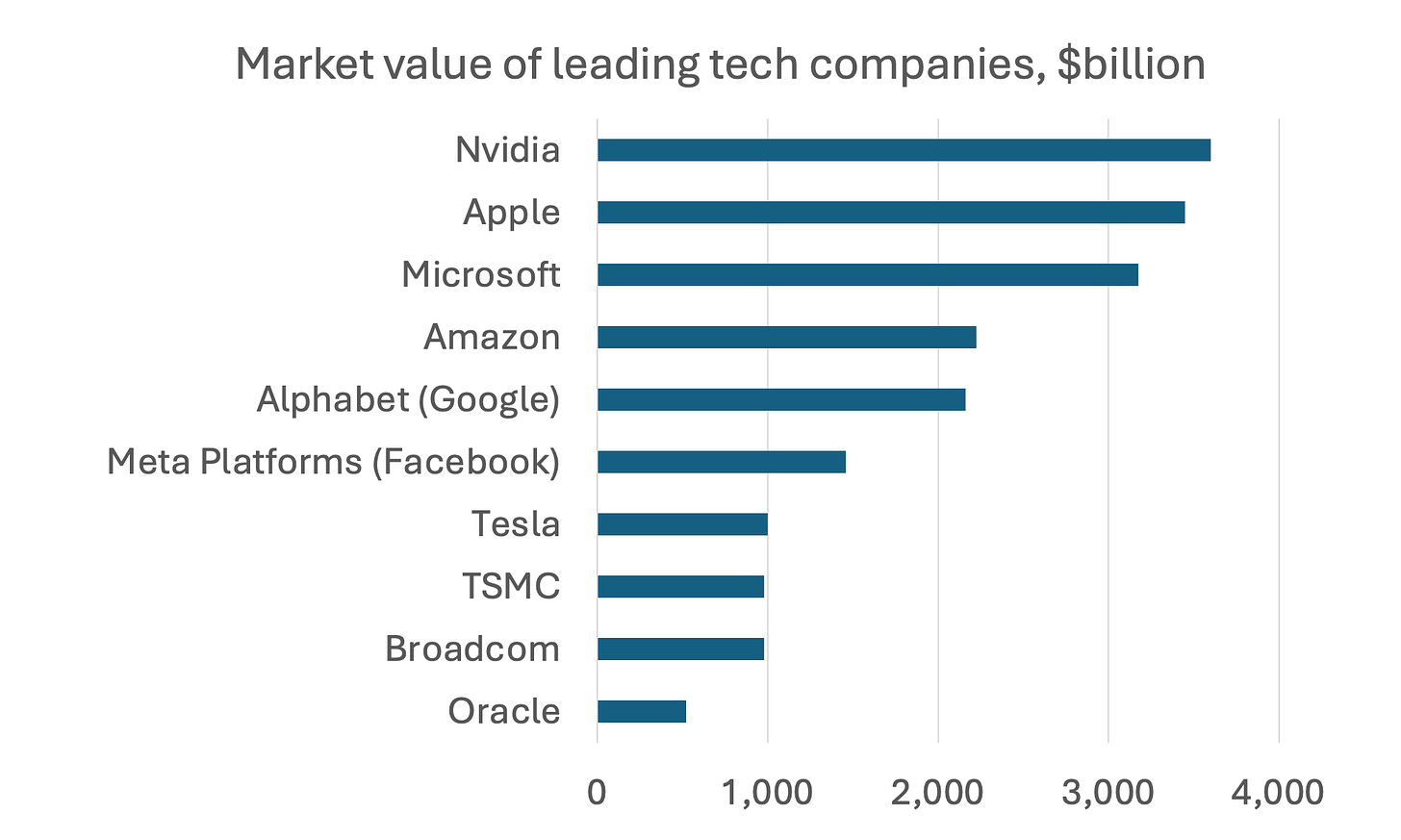
American tech dominance is really Silicon Valley dominance — a geographic accident of industrial clustering, not a national advantage in culture, regulation, or finance. Of the ten highest-valued tech companies as of mid-November 2024, only Taiwan's TSMC isn't American, and six of the rest are headquartered in Silicon Valley; Tesla counts too, having been Valley-based when it made electric cars cool. The other two are in Seattle. Yet Mario Draghi's EU competitiveness report, and every other survey of the gap, ignores this ultra-local concentration.
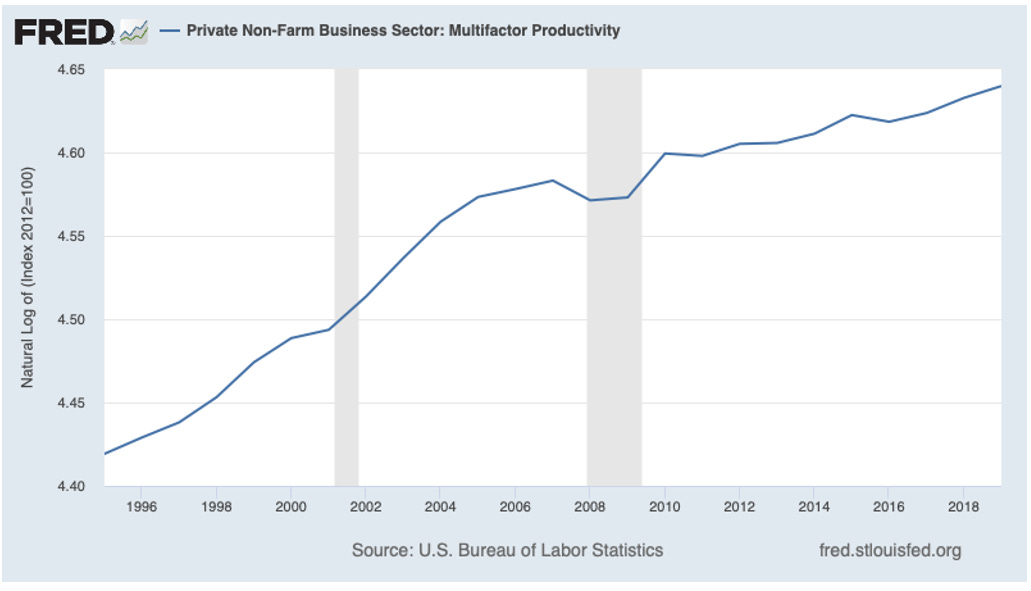
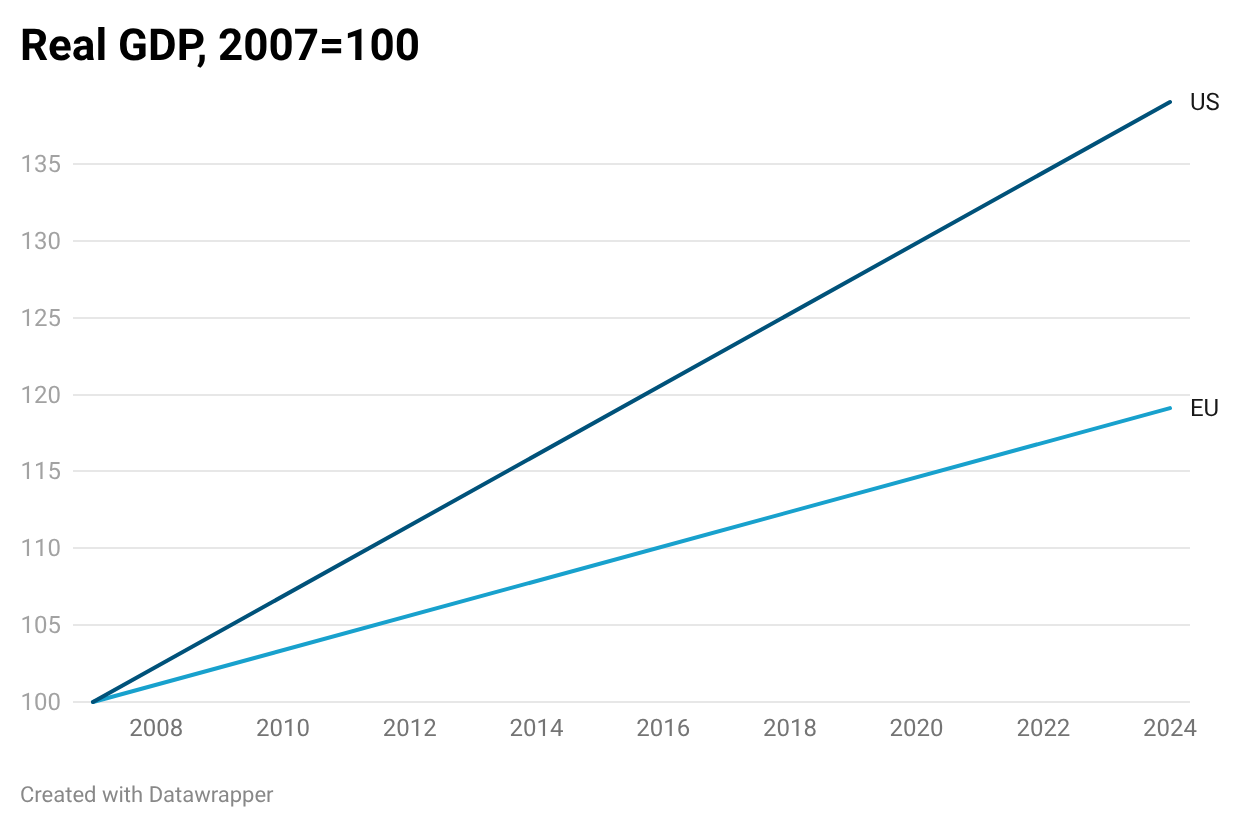
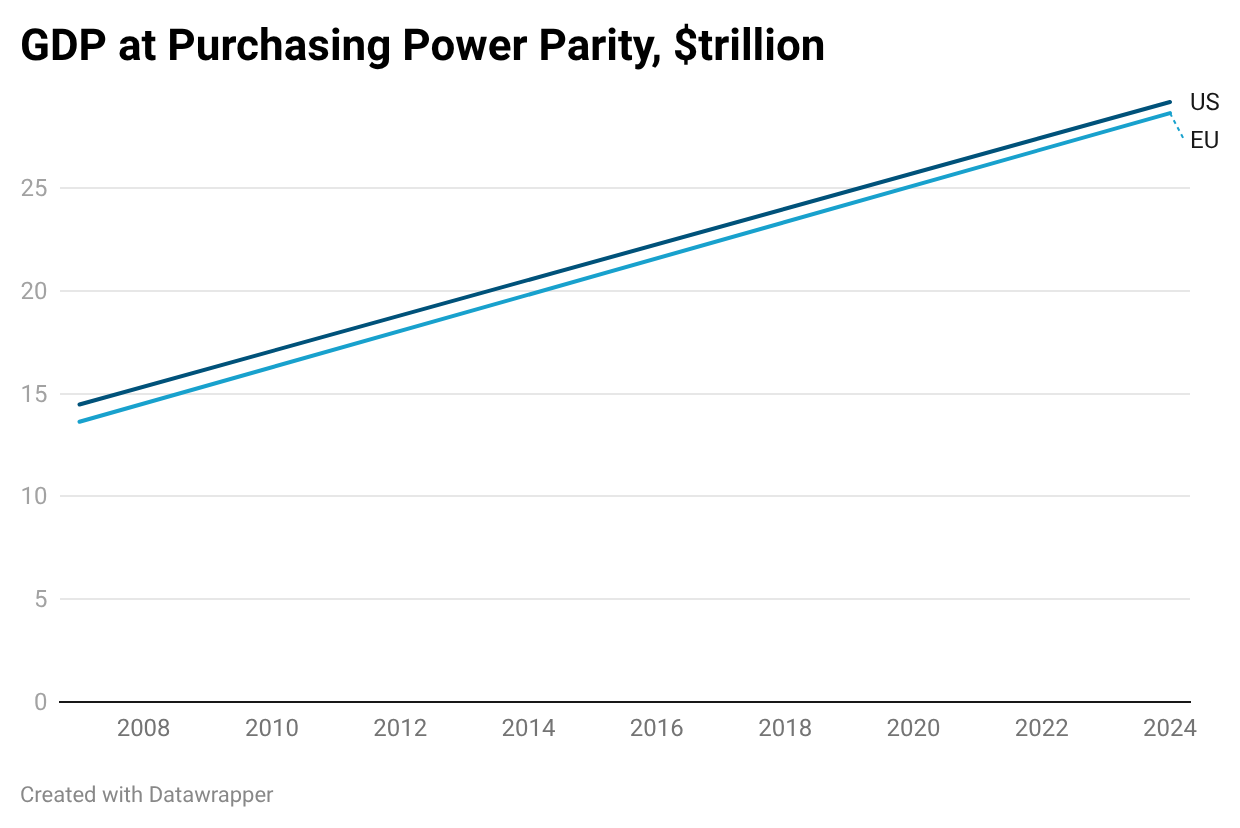
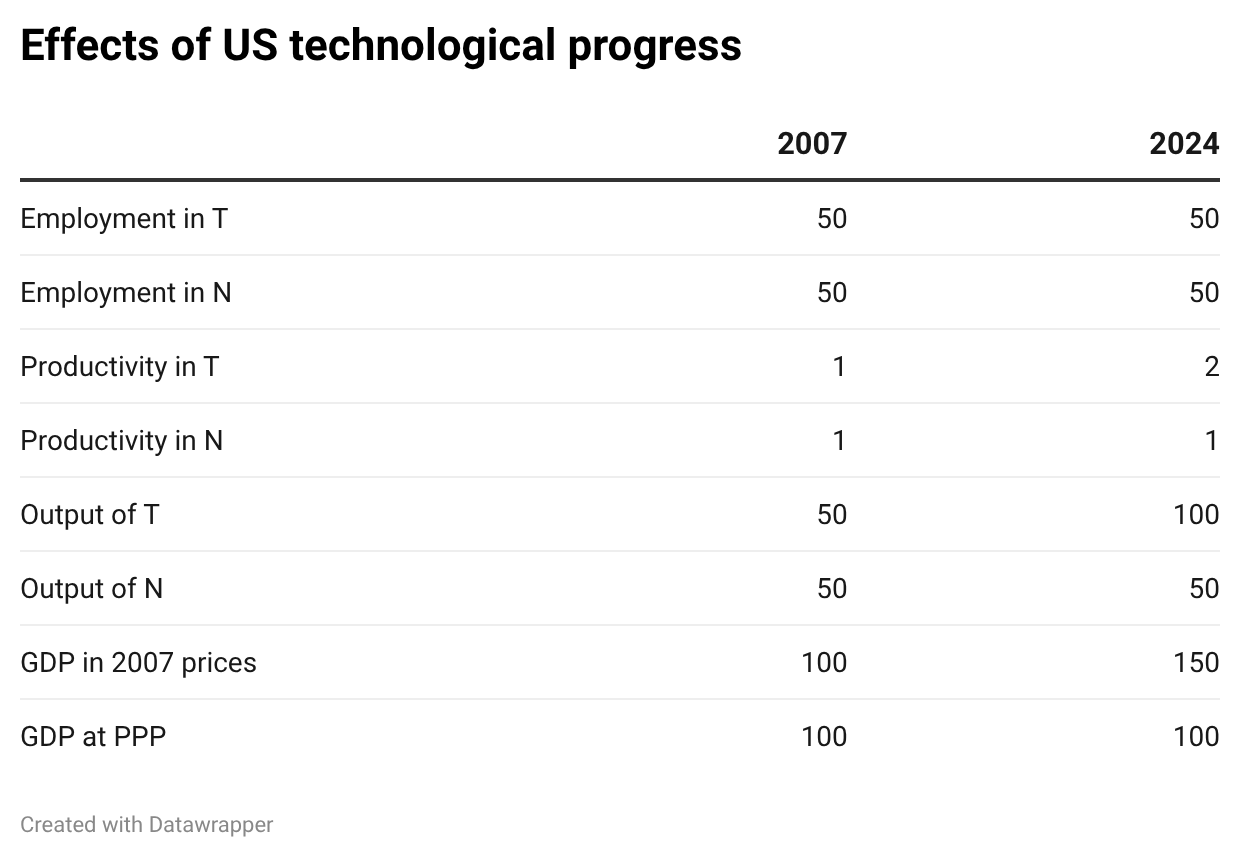
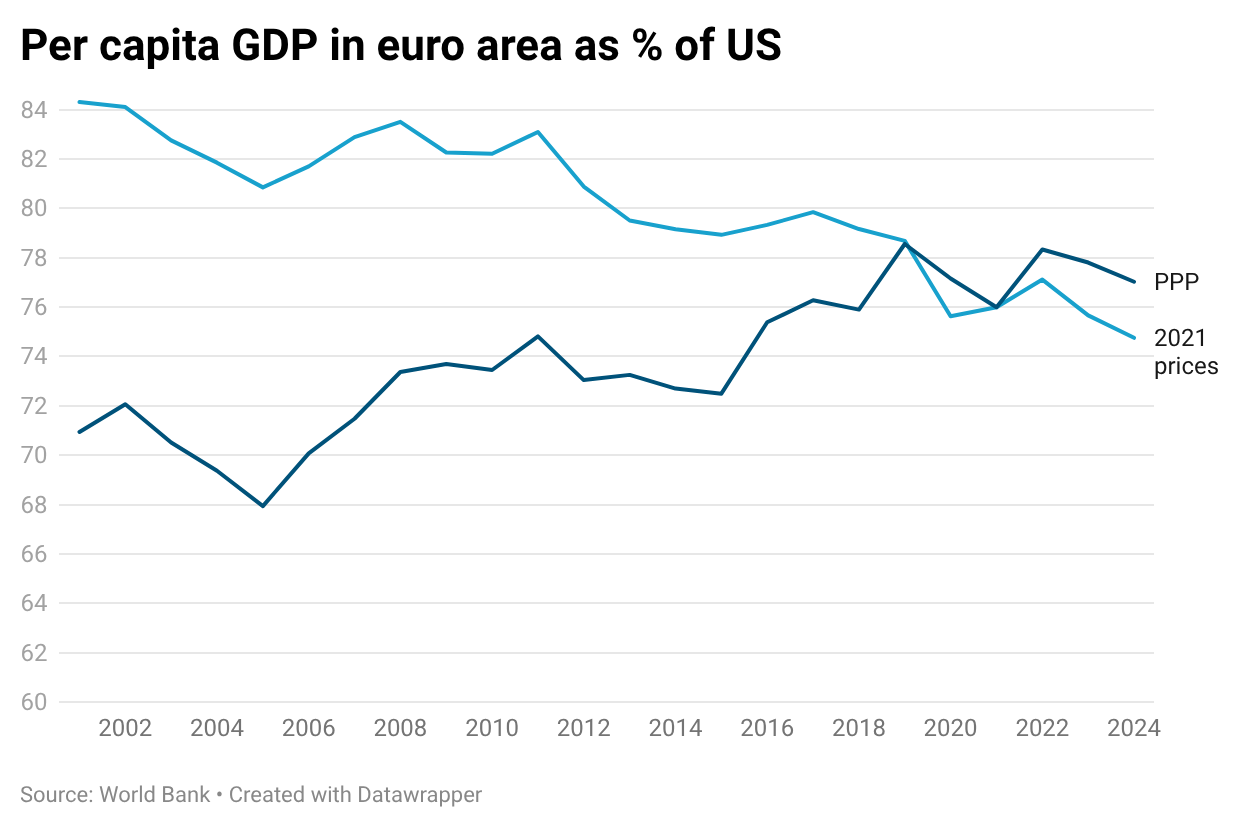
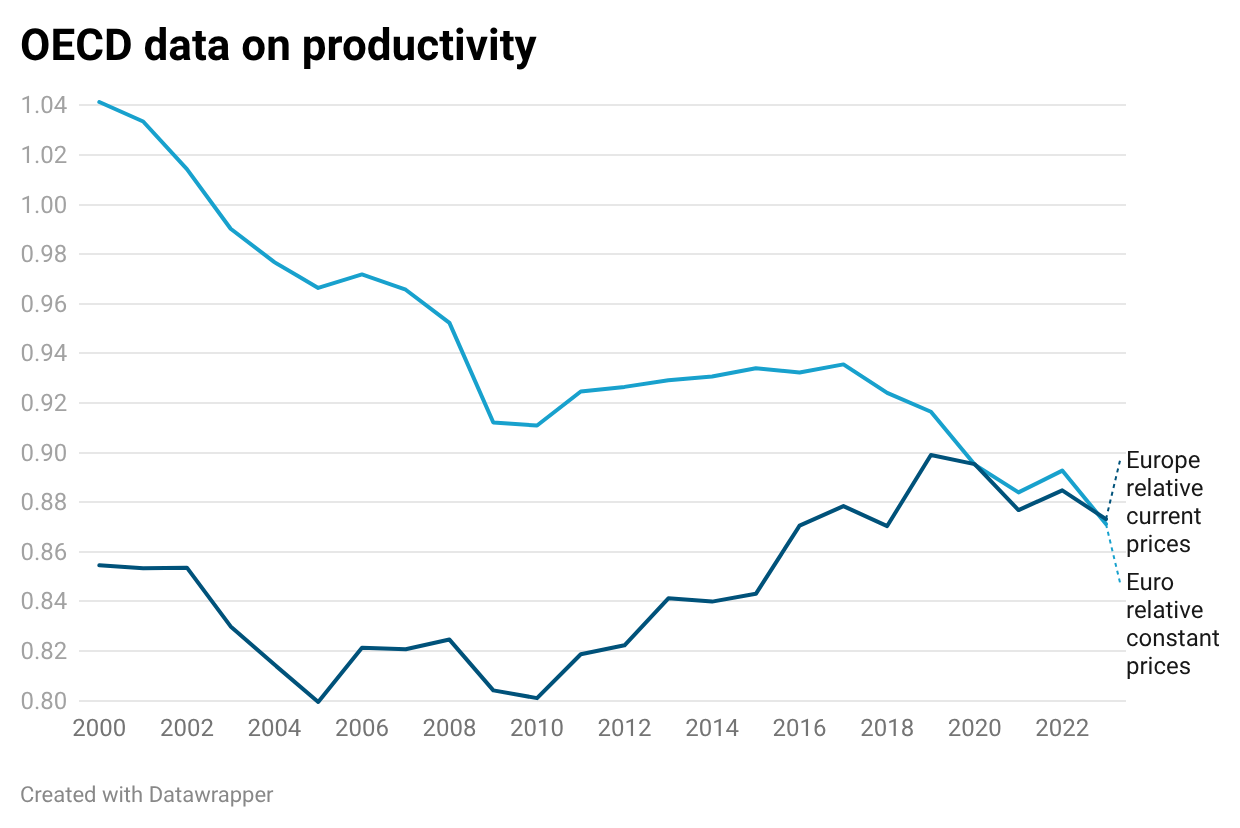
A generation ago the US didn't look exceptional; Europe's lower GDP per capita reflected mandated vacation time, not lower productivity. Around 2000 the US surged, partially reversing the postwar productivity convergence. Robert Solow's 1970 jab at "amateur sociology" explanations for Britain's slow growth warns against overconfident national explanations — and Draghi's own sectoral breakdown shows the US-EU gap is almost entirely digital-technology production: excluding ICT sectors, EU productivity growth 2000-2019 (0.6%) nearly matches the US (0.8%), and for 2013-2019 EU ex-ICT growth exceeded America's.
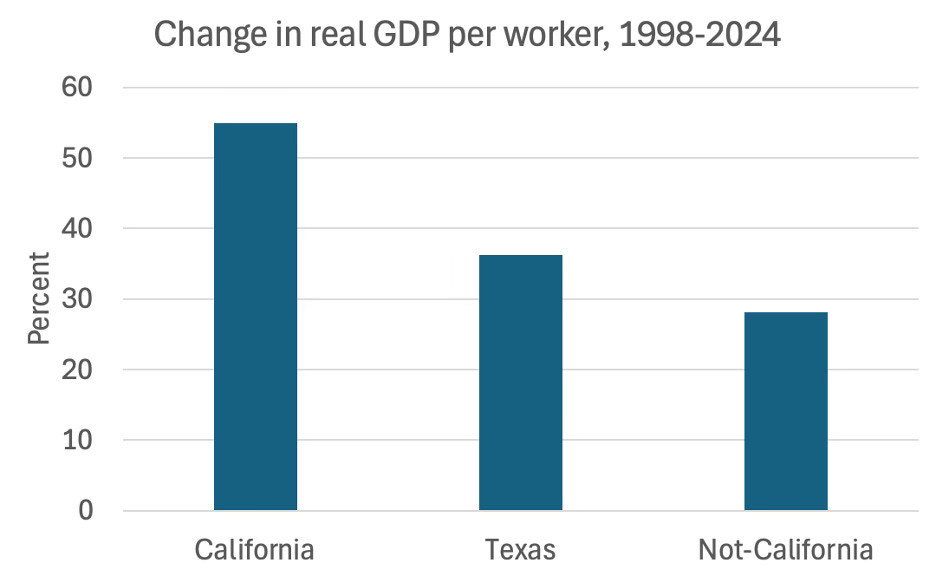
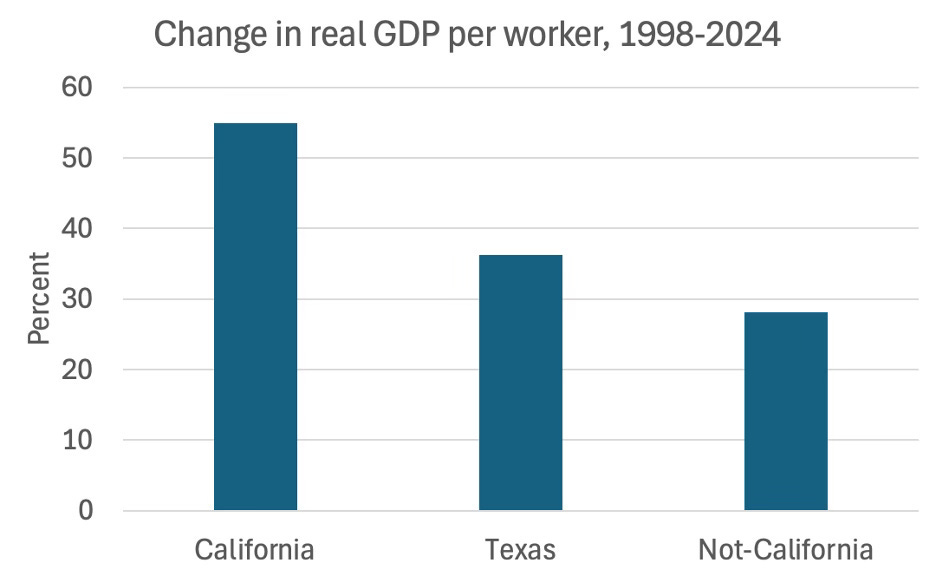
The mechanism is Alfred Marshall's century-old theory of industrial clusters (Sheffield cutlery: trade secrets become "as it were in the air"), explaining tech in Silicon Valley and finance in Manhattan and London alike. Clusters persist for reasons — Bill Gates growing up in Seattle, Hewlett and Packard's garage, New York's old status as Erie Canal terminus — unrelated to present advantage, and once established they serve world markets, the way London still dominates financial-services trade through inherited spillovers, not banking culture. New BEA/BLS data show GDP per worker far higher in these hubs than elsewhere, likely driving much of US productivity. Whether that trickles down, or Europe can close the gap: Krugman doesn't know yet.
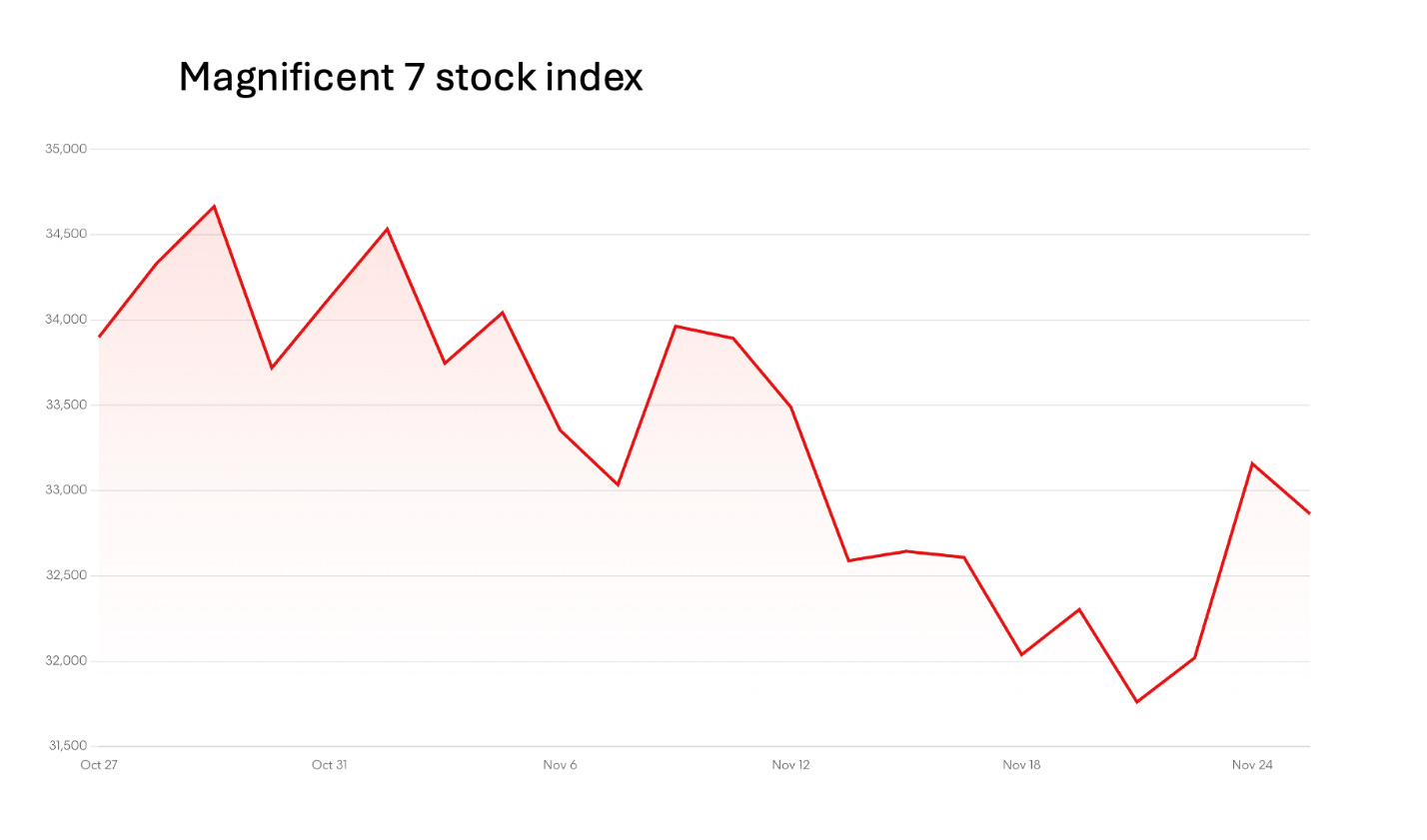
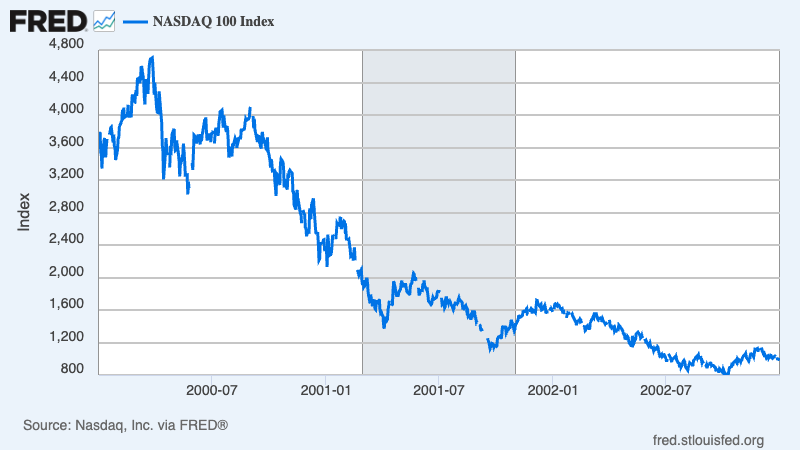
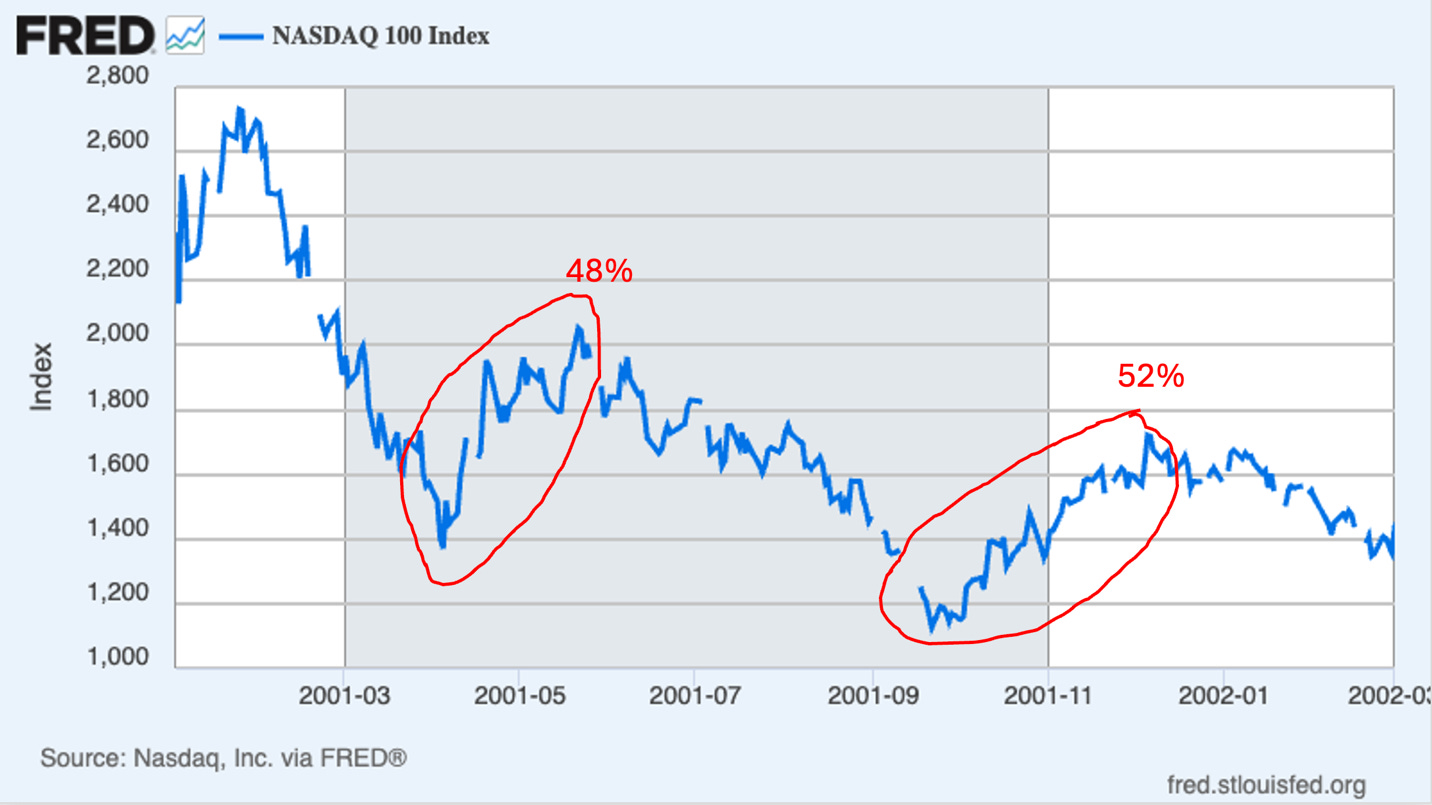
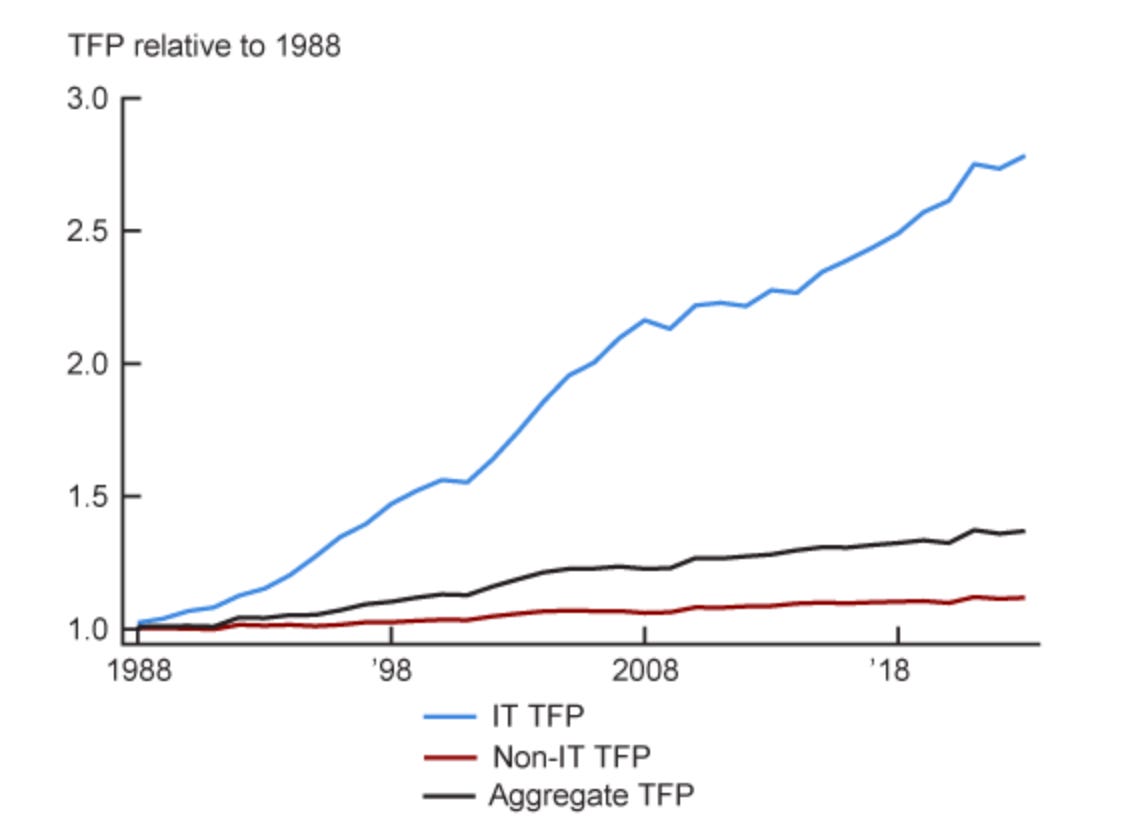
Comparing the AI stock frenzy to the 1999-2000 dot-com bubble, Krugman finds the underlying technology surge is real in both cases (per total-factor-productivity data) but argues today's mania is riskier because it is concentrated in a handful of already-dominant "Magnificent Seven" firms rather than disruptive newcomers, and because those firms are now deeply entangled with political power. He concludes the bubble may not end in an ordinary crash but in a government-engineered bailout for politically connected tech firms, pointing to proposals like a crypto reserve and a $500 billion AI infrastructure fund.
AI stock mania recalls the 1999–2000 dot-com bubble in scale, but political and structural differences suggest this one may end not with a crash but with a bailout for insiders.
Krugman's March 2000 column on Shiller's "Irrational Exuberance" landed almost exactly at the Nasdaq's peak. Shiller's model — bubbles as natural Ponzi schemes, where early buyers profit as FOMO pulls in later ones until the fools run out — explains both episodes: the S&P 500's P/E hit 33 in 1999 versus about 30 now. A BLS chart shows total-factor-productivity growth surging in 1995–2005 after two flat decades, confirming the tech boom was real (adding roughly 10% to GDP) without ever justifying sky-high valuations like Pets.com's. Unlike crypto, whose only clear use is money-laundering, AI has genuine applications; estimates of its economic impact range from a modest GDP bump to a computers-surpass-humans singularity, but Krugman's guess is a productivity bump like 1995–2005, not a lasting growth shift.
The differences: 1990s investors bet new entrants would become Microsoft-style monopolies; today's frenzy concentrates in already-dominant "Magnificent Seven" incumbents — reversing tech's usual disruptive pattern — while DeepSeek suggests they're overspending defensively. And unlike the libertarian 1990s, Big Tech now wields major political power: Tesla's valuation looks tied to Musk's role as co-president, while Trump's crypto-reserve and $500 billion AI-infrastructure proposals look designed to funnel money to insiders.
ai bubblestock markettech monopoliesproductivity growthfinancial bubbles
Drawing on his interview with retired short-seller Jim Chanos, Krugman relays Chanos's warning that unlike the 1990s internet boom, current AI spending is extraordinarily capital-intensive — hundreds of billions of dollars a year among a handful of firms — with returns on that capital already turning down, and draws a parallel to the fracking boom, where flattering accounting masked oil wells' steep production decline until the underlying economics caught up with high-flying companies. He also relays Chanos's account of shorting Wirecard on public evidence markets ignored for months, using it to illustrate the kind of 'financial cognitive dissonance' he sees in markets currently shrugging off Trump-era political risk.
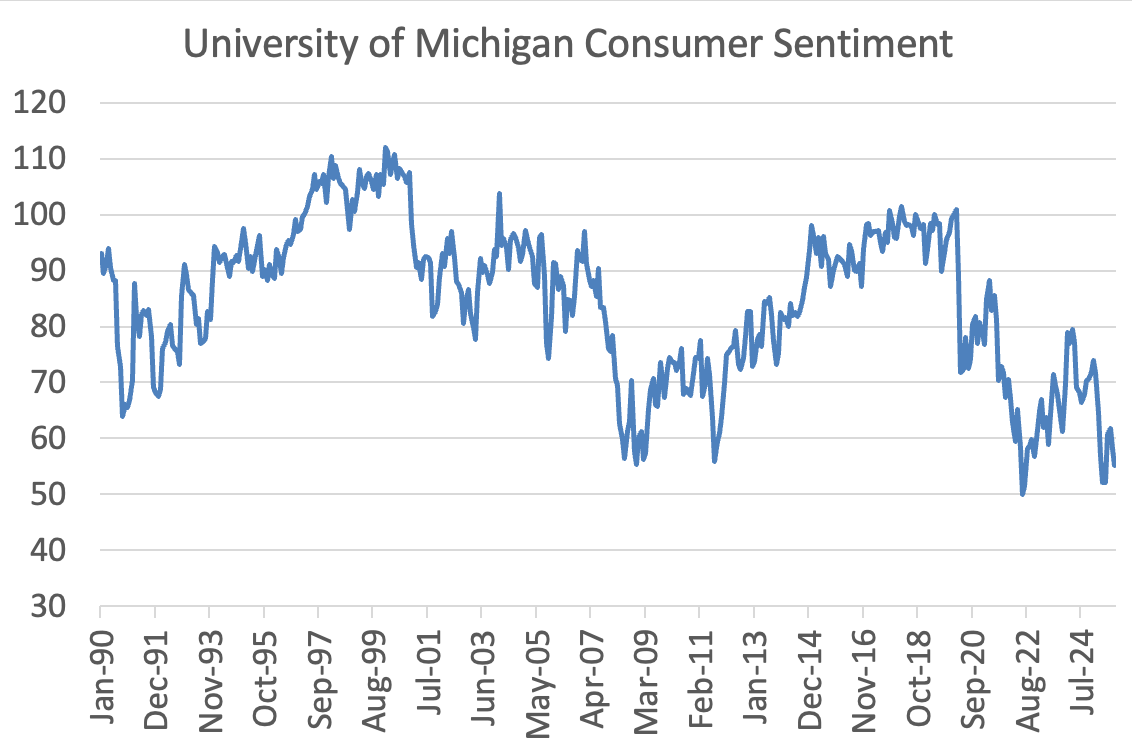
Jim Chanos, the retired short-seller, told Krugman that stock markets are dangerously complacent, and separately that AI capital spending increasingly resembles the 2014-2015 fracking bubble. On markets: soft economic data — consumer and business sentiment — has cracked, inflation expectations (per University of Michigan data) have jumped to levels unseen in decades, and political risk has spiked (DOGE's chaotic layoffs, an approaching government shutdown), yet valuations sit at record highs atop record corporate profit margins that "used to mean revert" but, Chanos says, no longer do. He calls the market's refusal to price in bad news "financial cognitive dissonance," citing his short of Wirecard: even after 2019 Financial Times reporting by Dan McCrum produced documentary proof of fraud, the supervisory board resigned and auditor KPMG found the company wasn't cooperating, yet the stock kept trading at inflated levels for two more months until it admitted in June 2020 that the money wasn't there and collapsed within three days.
On AI: unlike the 1990s internet boom, which made things more capital-efficient, AI is purely capital-intensive — a handful of companies now spend $300-500 billion yearly in capex for "arguably a variable return," resembling oil frackers of 2014-15, whose wells' steep second-year production declines (per journalist Bethany McLean) masked weak profitability until Chesapeake Energy went bankrupt. Chanos's sharper AI worry is depreciation: it's not the data centers but the $50,000 chips inside them being leapfrogged by newer versions, raising looming "accounting chicanery" questions about how fast that capital is written off. Krugman notes Microsoft's subsequent cancellation of some AI data-center leases as possible confirmation.
In conversation with Stanford economist Erik Brynjolfsson, this post explores why previous general-purpose technologies like electricity and computing took decades to show up in productivity statistics, and argues AI will follow a similar J-curve pattern of reorganization before gains materialize economy-wide. It also covers the mismeasurement of digital and free goods in GDP, the scaling laws driving AI's massive energy use, and early evidence of large productivity gains in coding and customer service. The exchange grounds AI hype in the empirical history of technology adoption rather than either boosterism or dismissal.
Erik Brynjolfsson's argument, laid out to Paul Krugman, is that AI is a genuine general-purpose technology on the scale of steam power or electricity, and its economic effects are being systematically under-counted for identifiable reasons, not because they're illusory. He traces the question to Robert Solow's 1987 remark that "we see the computer age everywhere except in the productivity statistics" — the original productivity paradox. Solow's growth theory held technology, not labor or capital, as the main driver of rising living standards, working through General Purpose Technologies: steam engine, electricity, computing, now AI.
Historical precedent explains the lag. Economist Paul David showed factories installing electric motors in the 1880s saw no productivity gains for 30-40 years, because managers just swapped in a motor for the steam engine without changing anything else. Only once they realized small motors could be distributed by workflow — enabling new layouts and assembly lines — did output rise by "triple digit" percentages; the gain came from reorganization, not the technology. IT followed suit: productivity surged to roughly 3% annually in the mid-to-late 1990s ("paradox lost," driven by the internet plus enterprise systems like SAP, supply-chain and CRM software), then faded after about 2005 to around 1.4% — a second paradox, addressed in a paper with Chad Syverson and Daniel Rock explaining why IT's later wave (broadband, smartphones) again failed to move the numbers.
Part of the explanation is mismeasurement: Americans spend roughly 8.5 hours a day on screens, but GDP doesn't capture zero-priced goods like Zoom, Wikipedia, search, or Facebook. Brynjolfsson's Stanford team built an alternative measure, GDP-B, estimating consumer surplus from such goods; it finds trillions of dollars of welfare GDP misses. A related cross-country study of twelve digital goods found poorer and middle-income countries (Mexico, Brazil) derive proportionally more welfare from free digital goods than rich ones — a mild equalizer across countries and within U.S. zip codes, since a smartphone lets anyone consume as much "free" as Bill Gates.
Still, mismeasurement isn't the biggest piece — organizational reinvention is. In "The Productivity J-Curve" (with Syverson and Rock), his team models an initial dip in productivity as firms spend on retraining, new processes, and new products: intangible assets that, unlike a second factory, national accounting doesn't count as investment even though they generate future income. Productivity falls first, then rises once firms "harvest" the reorganization — a pattern he expects AI to repeat, likely faster.
On the technology: unlike the hand-coded, rule-based "expert systems" he built in the 1980s, today's models learn statistical patterns from vast datasets via deep neural networks, aided by GPUs (built for graphics, repurposed for matrix multiplication on Andrew Ng's suggestion) and algorithmic gains — enabling generative output, not mere classification. Backed by Stanford's Christopher Manning, he's comfortable calling this "intelligence," though he prefers "transformative AI," estimating current systems affect half of cognitive jobs. He flags hallucination and possible model collapse from AI-generated training data as risks, though researchers are cautiously optimistic about curated synthetic data (self-generated puzzles, chess and Go games, code). Scaling laws drive huge data-center buildouts (OpenAI's $500 billion "Stargate") and nuclear restarts (Three Mile Island), but DeepSeek showed smaller, cheaper models can match performance via low-level engineering — evidence "elasticity of intelligence" cuts both ways, since many businesses need only "reasonably smart" systems, not frontier ones.
Economically, he expects most gains to flow to consumers, not producers, citing William Nordhaus's estimate that 95% of innovation's value accrues to consumers, and likens today's investment race to the dot-com era's uncertain sorting of winners (Amazon versus Pets.com and Barnes & Noble), with Nvidia's GPU/CUDA dominance playing the "picks and shovels" role regardless of who wins. He reports being roughly even, slightly ahead, in his bet against Robert Gordon, citing 20-50% gains in coding, call centers, and sales. He closes by warning that without proactive policy, AI's gains will default toward concentrated wealth and power, not shared prosperity.
Krugman frames the campaign against Harvard and elite universities as an economic-geography problem, not just a culture-war fight: Greater Boston's universities, hospitals, biotech, and AI firms form a mutually reinforcing cluster comparable to Silicon Valley or Wall Street, all fed by the same intellectual openness the administration is trying to stamp out. He argues that removing a load-bearing piece like Harvard risks collapsing the whole regional innovation ecosystem, converting a political attack into a lasting loss of American economic capacity and soft power.
The Trump administration's campaign to destroy Harvard and other elite universities will inflict serious economic damage on the nation, beyond its more obvious assault on freedom of thought. Krugman argues the MAGA claim that universities indoctrinate students in wokeness, DEI, or Marxism inverts the truth: the real grievance is that these schools expose students to diverse ideas and teach them to think for themselves rather than preach obedience.
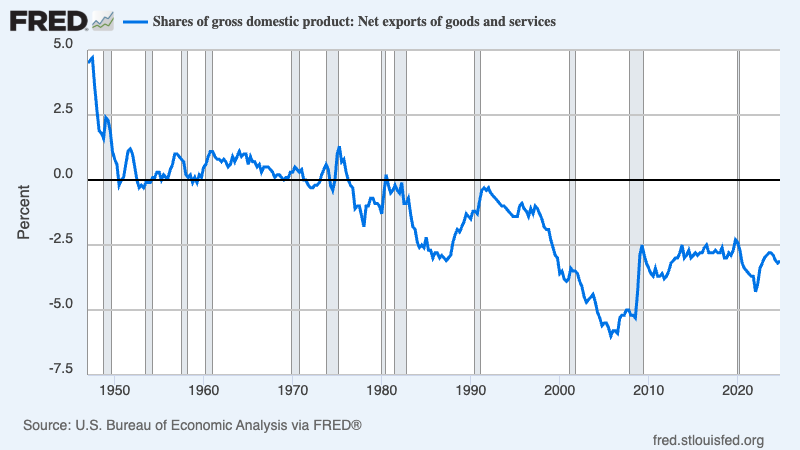
Economically, Harvard is a major U.S. exporter, since foreign students paying their own tuition register as a trade-balance credit. More important, Harvard anchors the Greater Boston economy, a metropolitan cluster comparable to Silicon Valley (digital tech) or Greater New York (finance). Boston's strength rests on four mutually reinforcing pillars: universities employing 87,000 people locally, a world-class medical complex, leadership in AI and "tough tech," and the world's leading biotech hub — all bound together by intellectual openness that draws global talent.
Harvard isn't even the dominant player — MIT may generate more business startups directly — but MIT depends on Harvard's proximity, and vice versa, as do dozens of other universities and thousands of nearby firms. Destroying Harvard risks collapsing this Jenga-tower ecosystem, weakening American soft power along with it. Krugman doubts MAGA cares, since national ignorance may be the actual goal.
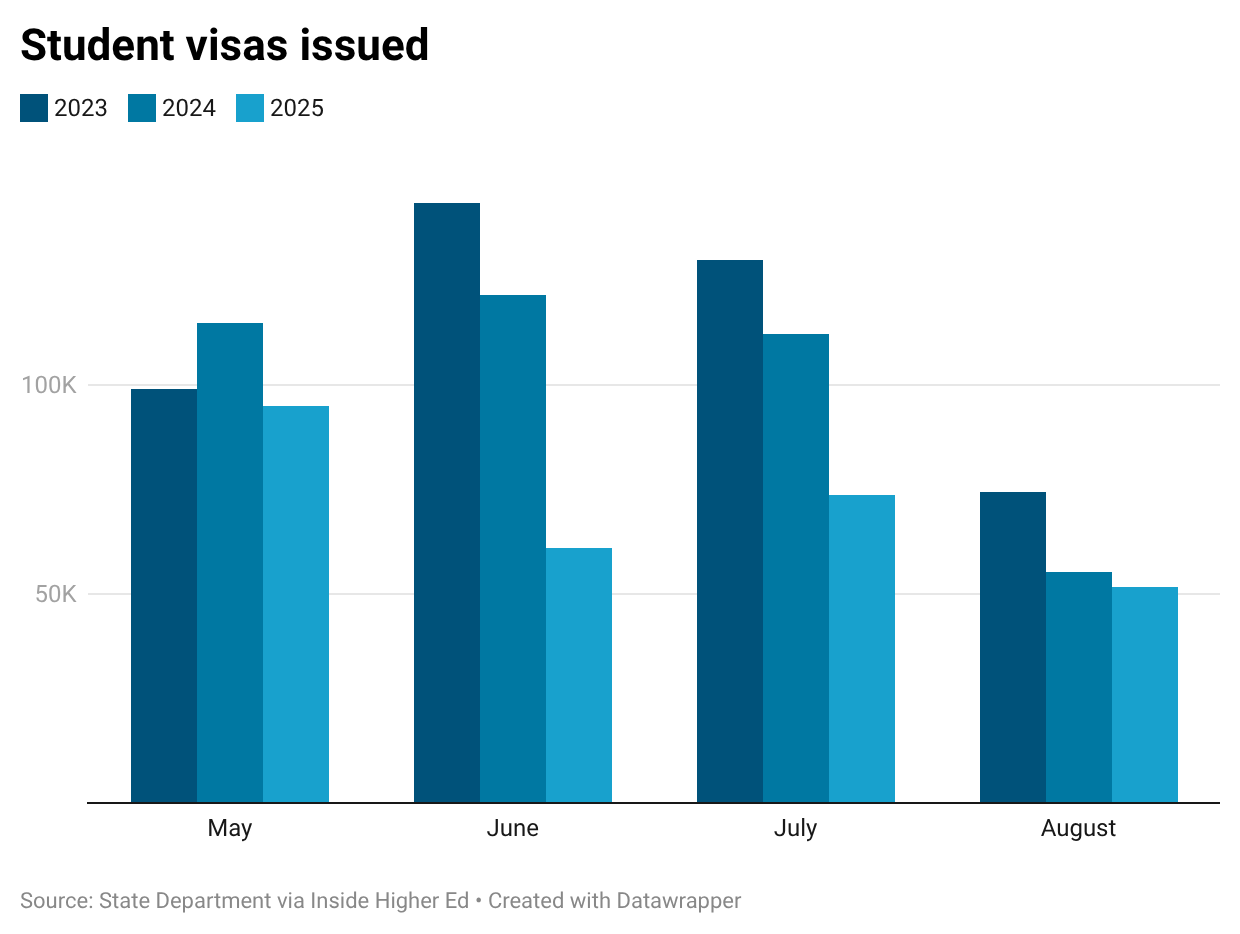
A State Department order freezing all student visa interviews, ostensibly to build social-media vetting, threatens an underappreciated US export industry: international students pay full tuition with little financial aid, their spending rivals major goods exports, and university employment dwarfs employment in several politically prominent sectors. The piece argues foreign graduate students are also integral to the research base behind tech clusters like Silicon Valley and Boston, so choking off their entry sacrifices both direct revenue and the soft-power value of educating future world leaders in American values.
The Trump administration's abrupt halt on student visa processing, ordered by Secretary of State Marco Rubio pending a new social-media vetting system, is self-sabotage that will cripple one of America's most successful export industries. Krugman frames this against his own experience touring campuses to promote his economics textbook: at Texas Tech in Lubbock, 30 percent of graduate students are international, illustrating how deeply foreign students are woven into U.S. higher education. The freeze, reported by Politico, appears to be retaliation for a court blocking the administration's attempt to bar Harvard from admitting international students, itself retaliation for Harvard refusing to let Trumpists dictate hiring and curriculum. Courts will likely strike it down, but bureaucratic slowdown and a chilling effect may persist regardless.
Economically, one BLS chart shows "education-related travel," largely foreign tuition, rivaling other major U.S. export categories; a second BLS chart shows university employment exceeding several politically prominent industries, underscoring higher education as a middle-class jobs engine. International graduate students also drive research underpinning tech hubs like Silicon Valley and Greater Boston, and carry home genuine soft power by learning to live in an open society. Krugman concludes the administration's vision of "America" — closed borders, blood-and-soil identity — must be resisted.
student visashigher educationinternational studentsimmigration policysoft power
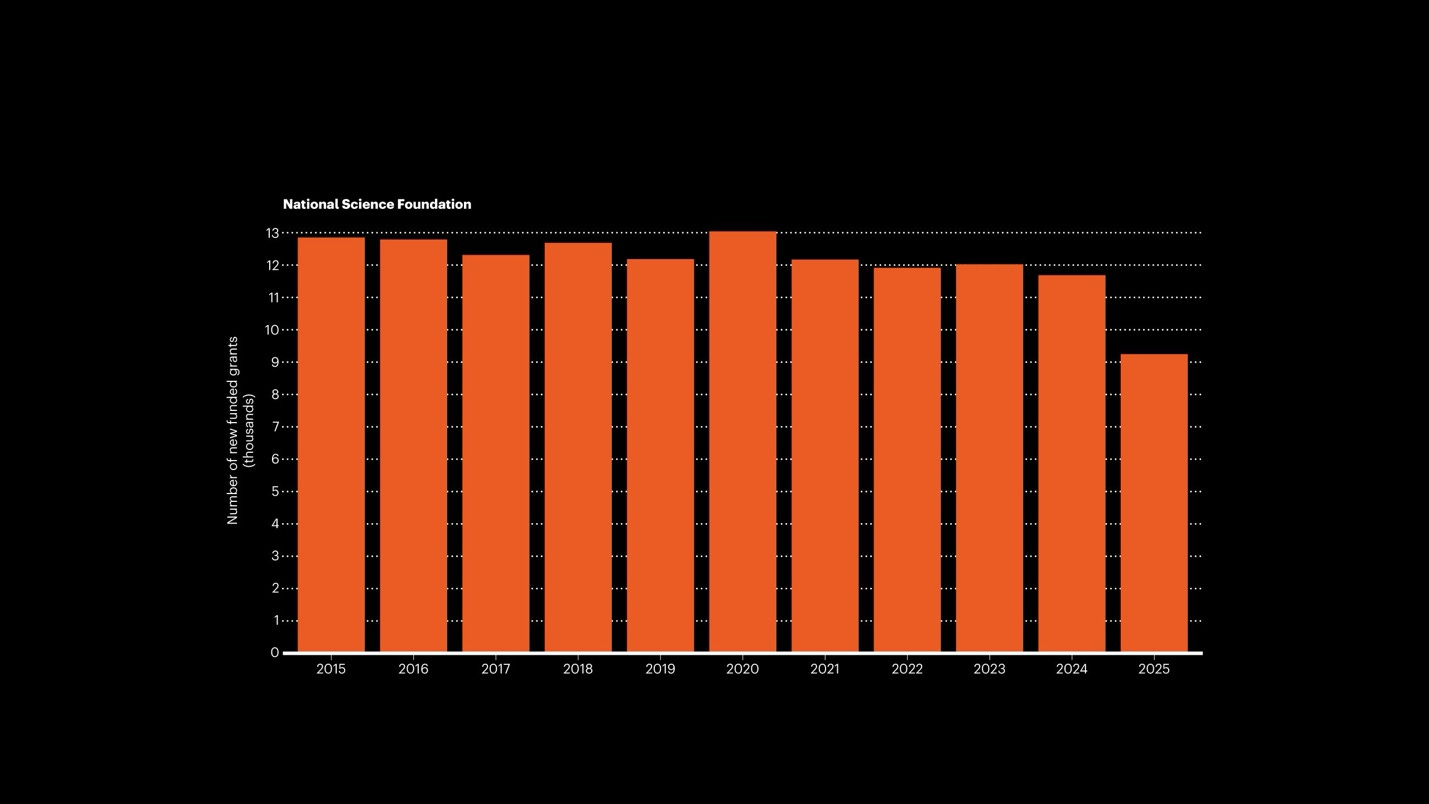
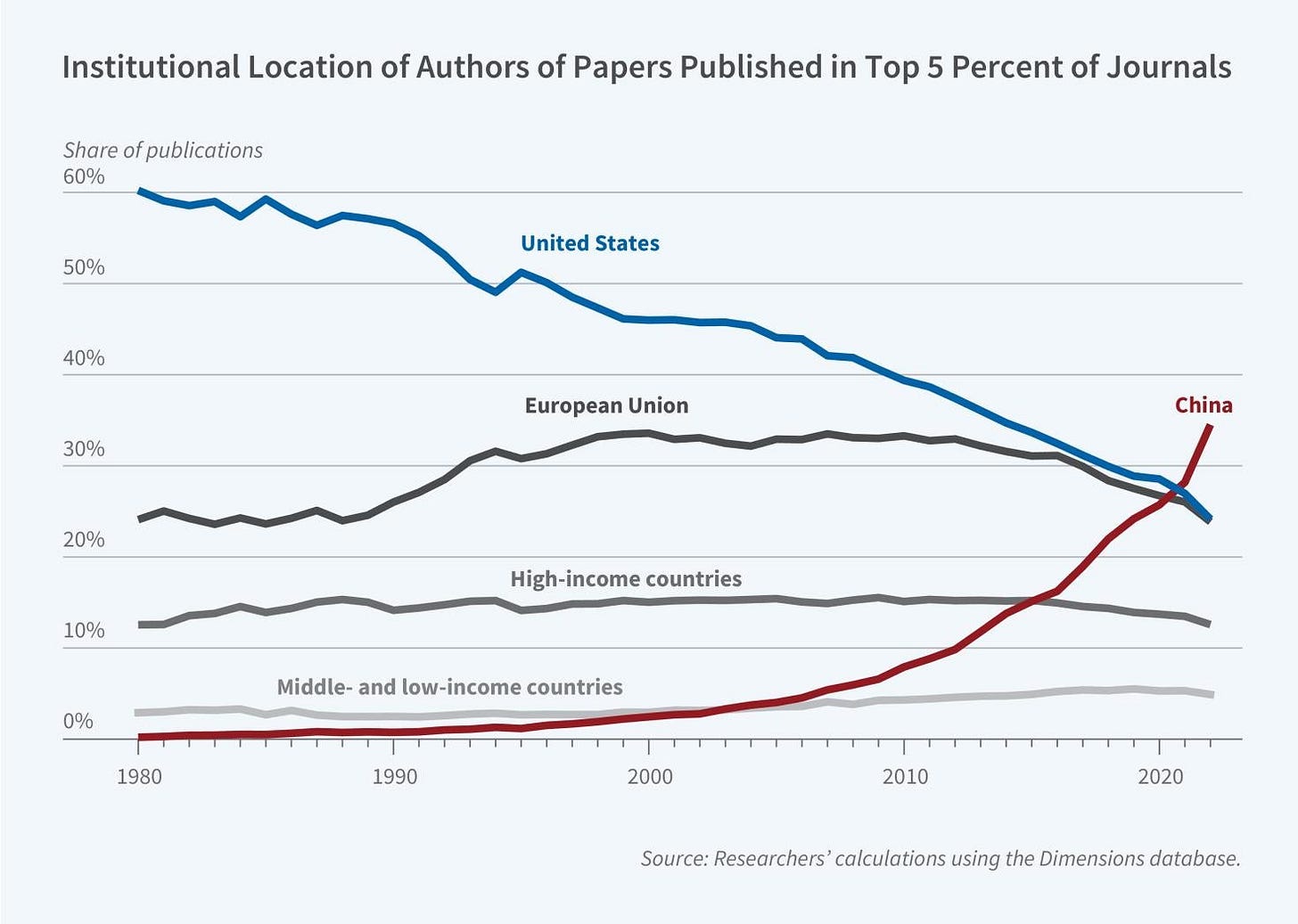
Krugman lays out the scale of the Trump administration's assault on U.S. science — proposed budget cuts of roughly 40% to NIH and over 50% to NSF, threats to revoke Harvard's visa privileges and Columbia's accreditation, and an executive order letting political appointees 'correct' scientific findings — and argues it stems from a MAGA coalition (fossil fuel interests, vaccine skeptics, tax-cut ideologues, nativists) with structural reasons to distrust empirical inquiry. He warns the cuts are severe and immediate enough that U.S. scientific leadership could erode within a year or two, regardless of the long-term economic cost.
Krugman argues Trump's war on science, though predictable from MAGA's own coalition, has escalated faster and further than expected -- an apparent bid to gut U.S. science within a year or two, not gradually. He traces the built-in motives: fossil-fuel donors oppose climate research, figures like Alex Jones profit from quack medicine and vaccine skepticism, tax-cut advocates resist scrutiny of their results, and nativists resist crime data. Even so, since science underpins U.S. power and corporate profit, caution seemed likely -- instead the preliminary budget slashes NIH funding almost 40%, NSF over 50%, and guts climate/ecological research and NASA's budget, halving federal science spending when fiscal 2026 starts in October. Harvard, refusing administration control of hiring and curriculum, now faces visa bans for international students; Columbia faces a threatened accreditation revocation the administration has no legal power to impose. An executive order, "Restoring Gold Standard Science," lets political appointees "correct" findings and refer scientists for discipline -- which thousands of scientists' open letter likens to past totalitarian corruption of science. Krugman rejects Bannon's and Trump's claims that foreign talent displaces Americans, noting Silicon Valley and Harvard depend on it; and since research is a public good markets won't fund, cutting money while dictating conclusions will soon leave little American science to complain about, he concludes.
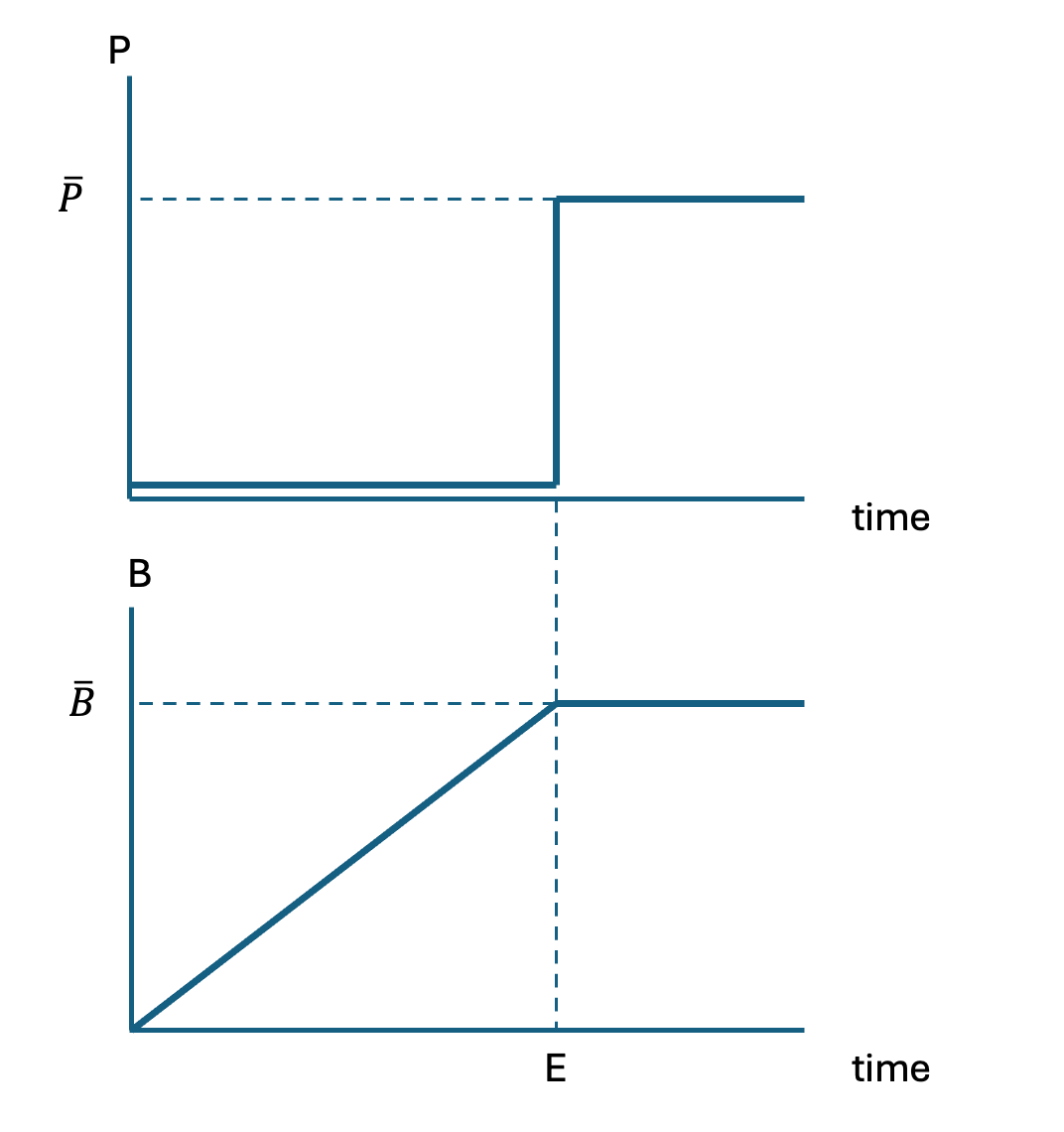
Builds a formal economic model showing that "enshittification" isn't a moral failing unique to social media but the profit-maximizing life cycle of any business with network effects: build a customer base with low prices and good quality, then extract value once users are locked in, a dynamic with older roots in the business-strategy concept of penetration pricing. Argues the internet's spread since the 2000s explains why the cycle now feels ubiquitous across Facebook, Uber, and even Peak TV, and that it distorts perception on both sides, with users wrongly imagining founders as fallen idols who were once genuinely good and the founders themselves driven half-mad by the loss of adulation they never deserved on the merits.
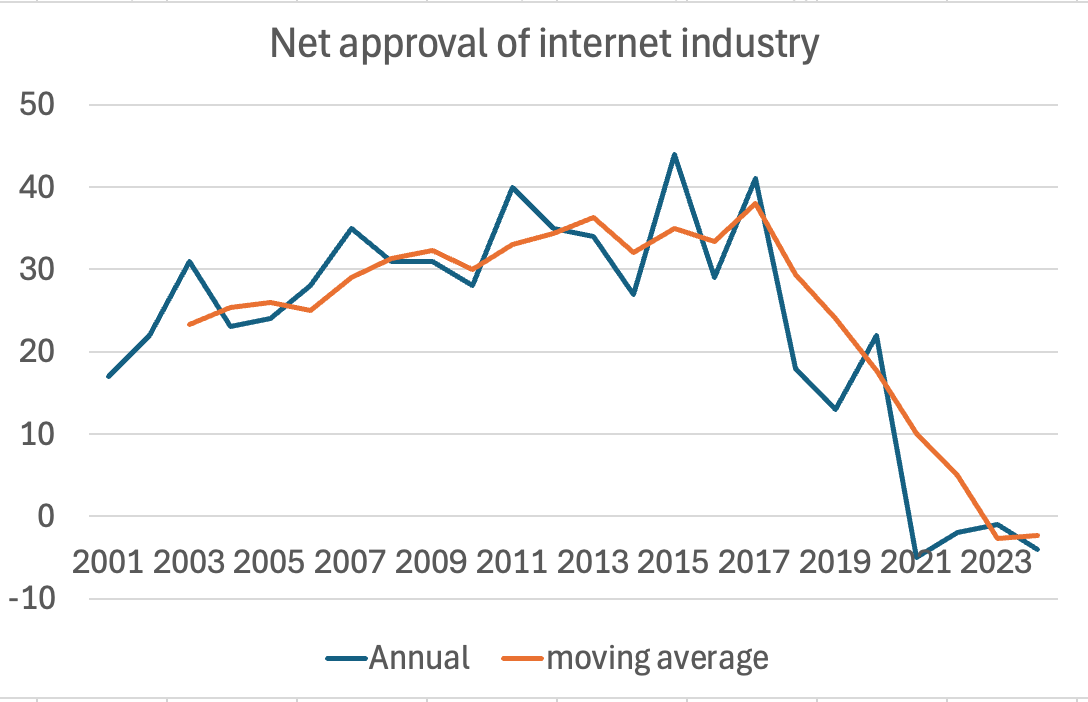
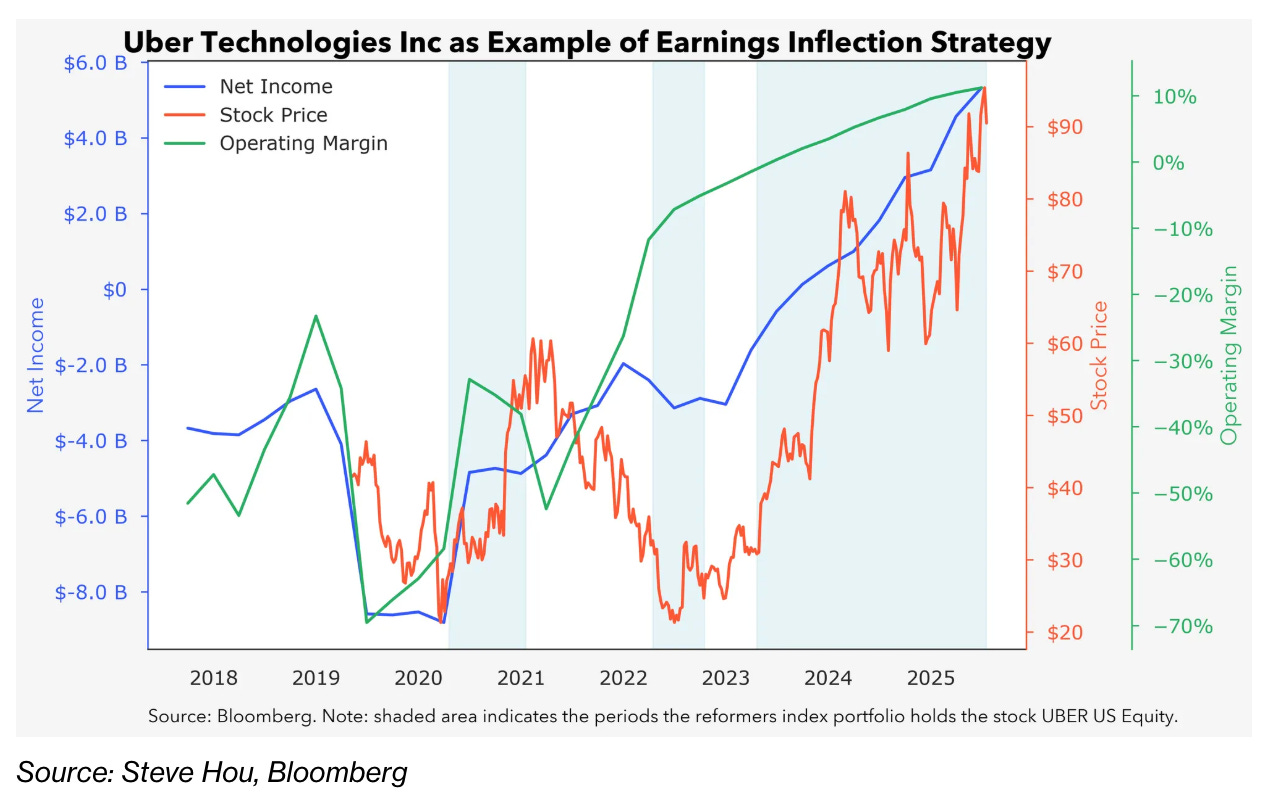
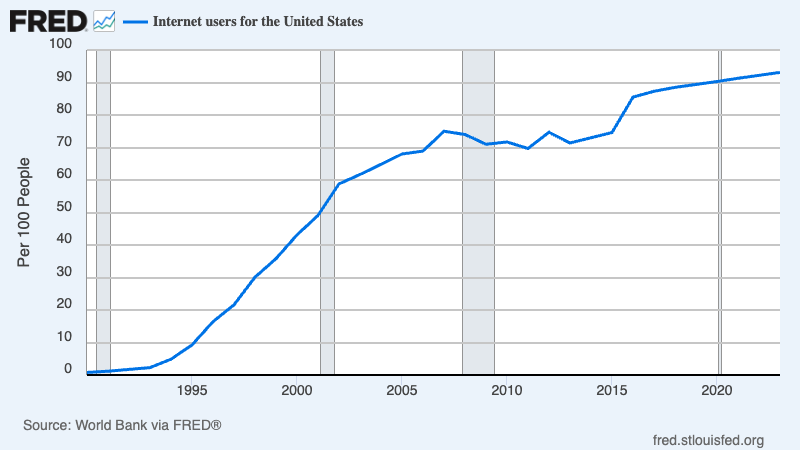
Businesses built on network effects rationally follow a good-then-bad life cycle, and Cory Doctorow's enshittification model — platforms abuse users to benefit business customers, then abuse those customers to claw back value, then die — is too narrow: the same logic applies to any network-effect business, from Uber to electric vehicles, not just social platforms. Krugman sketches a simple mathematical model tracking price and customer base, showing the profit-maximizing strategy is to offer great value first to build the network, then raise prices (or cut quality, add ads) once users are locked in; the model predicts a sudden price jump, which he ties to Bloomberg's "earnings inflection strategy" label for Uber's abrupt pivot to profitability. Against Doctorow's "then they die," Krugman's model ends in stagnation instead — Facebook's user base has plateaued, not crashed (Twitter is a separate, uglier story). A Gallup chart shows collapsing public trust in tech; an internet-adoption chart shows why enshittification spread after the 2000s, once pervasive connectivity made network effects common. The cycle also "messes with heads": users wrongly cast once-good founders as later corrupted (Zuckerberg, per Doctorow, "was always a creep"), while founders themselves are destabilized by losing adulation earned only through what Tessio, in The Godfather, calls "only business."
enshittificationnetwork effectsmonopolyplatform economicsmarket power
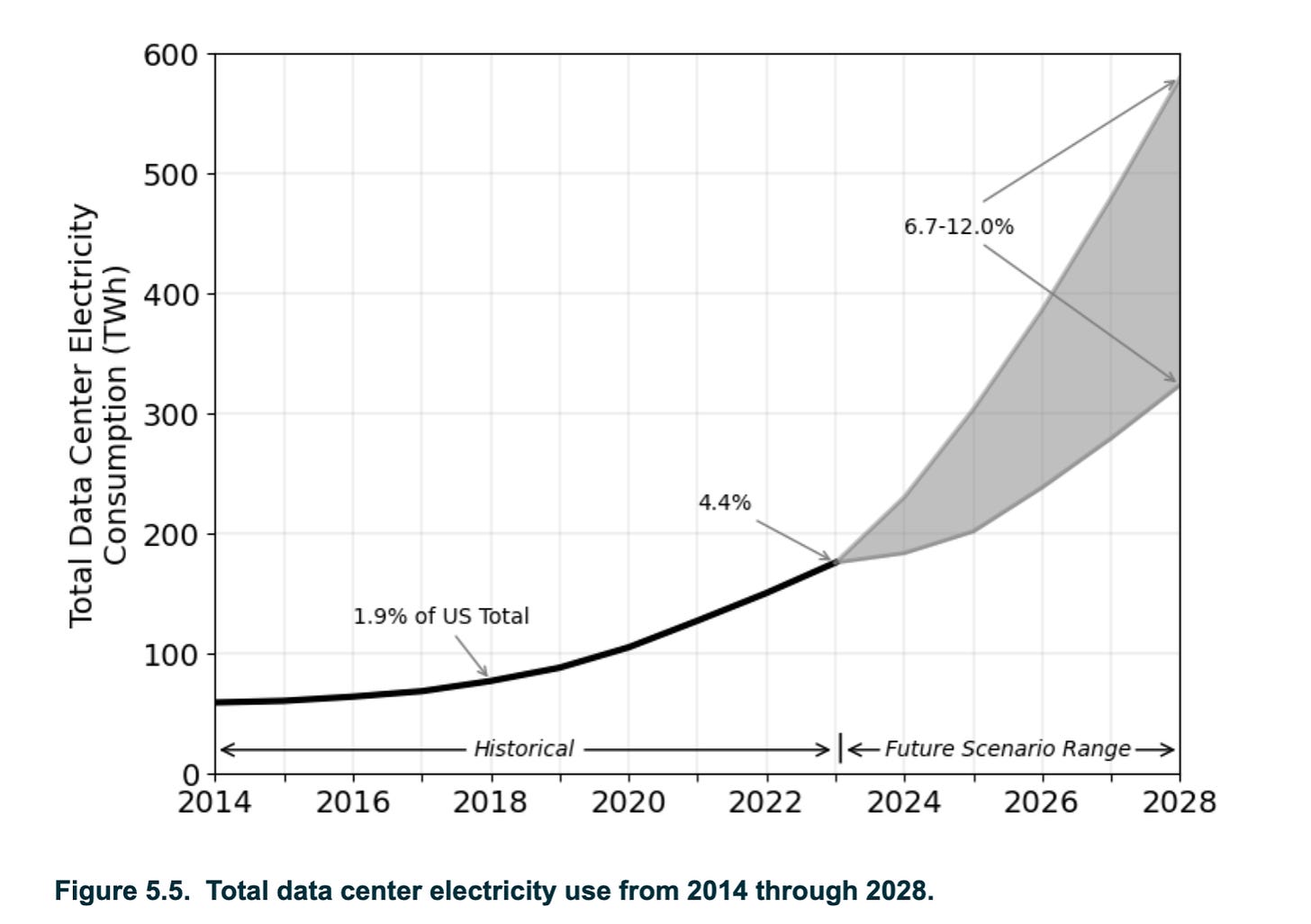
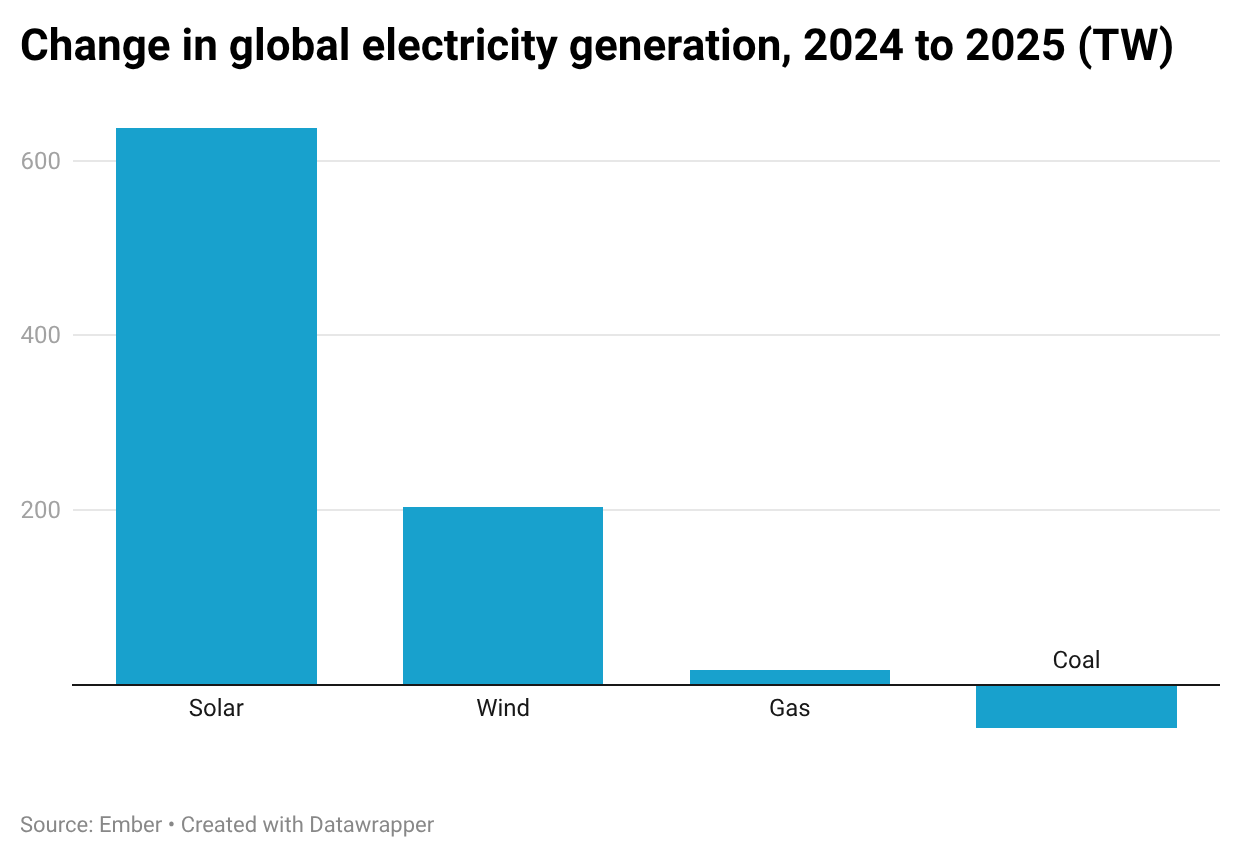
Using the childhood memory of an Automat to illustrate how "automated" services conceal enormous hidden physical infrastructure, Krugman argues that AI's advocates ignore the technology's massive and rapidly growing electricity appetite—already an estimated 4.4 percent of U.S. power consumption, projected toward 12 percent by 2028—and that current utility-rate regulation lets data-center costs get socialized onto ordinary ratepayers rather than borne by AI firms. He contends the deeper problem is that added generating capacity has come overwhelmingly from renewables, which the Trump administration is actively blocking, creating a supply bottleneck that could constrain AI's growth regardless of the technology's merits.
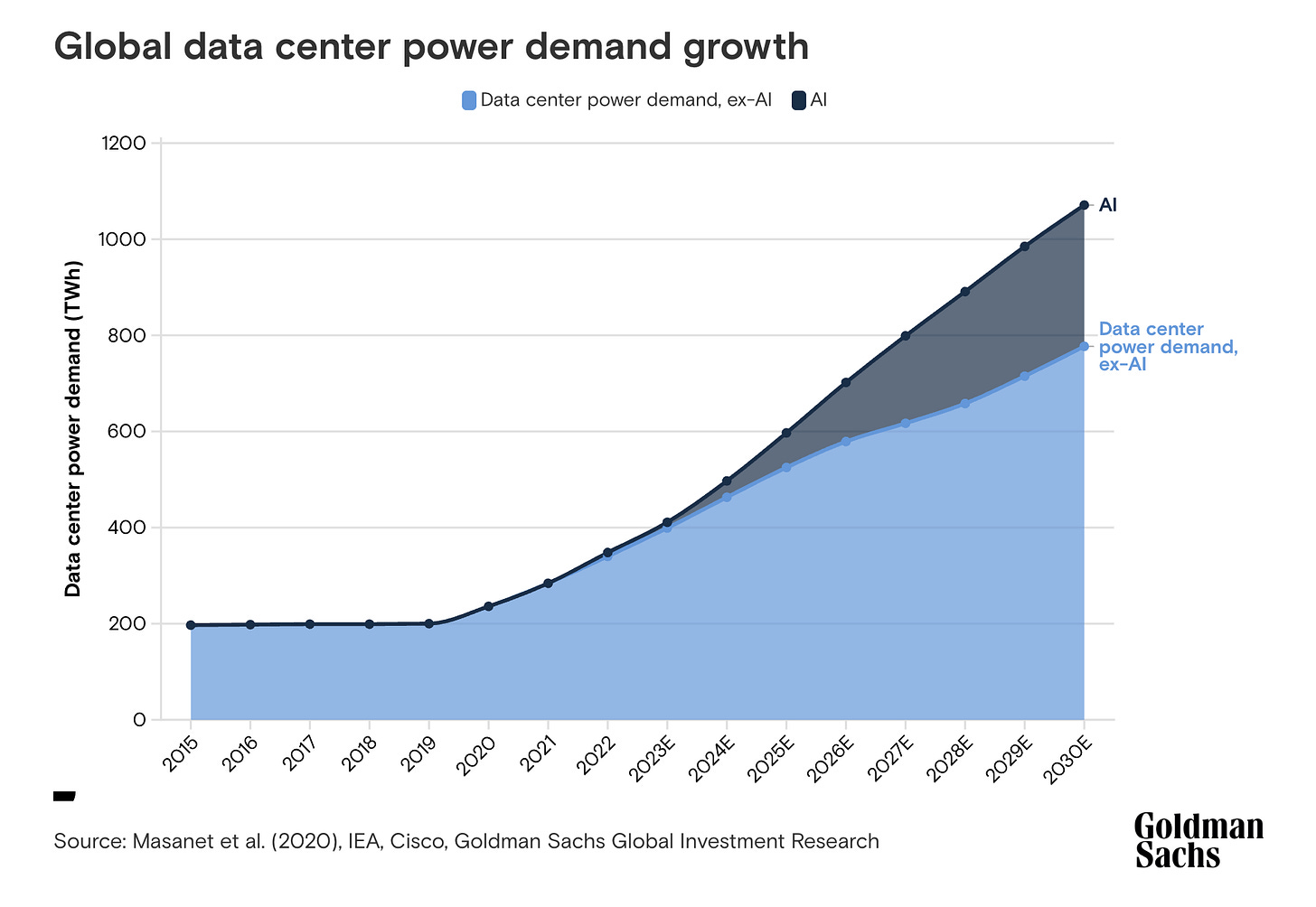
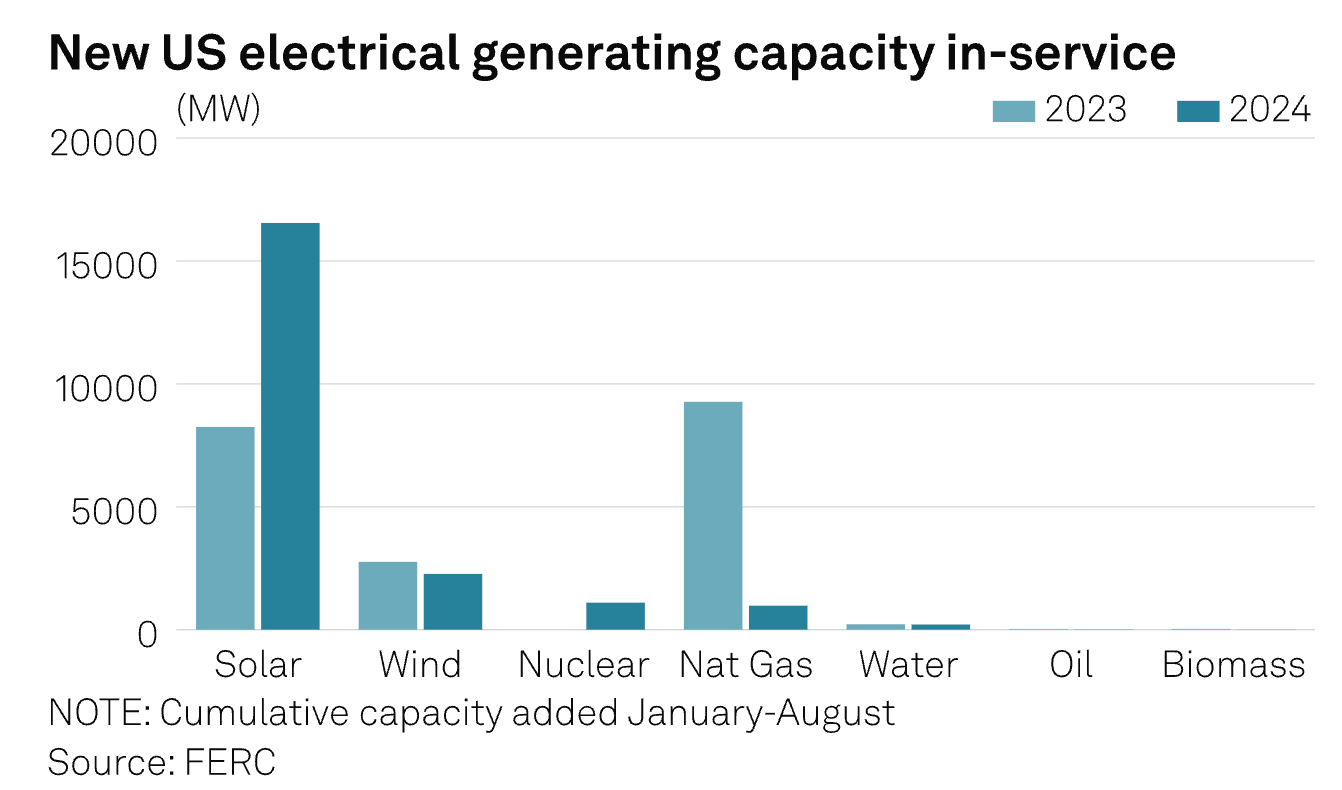
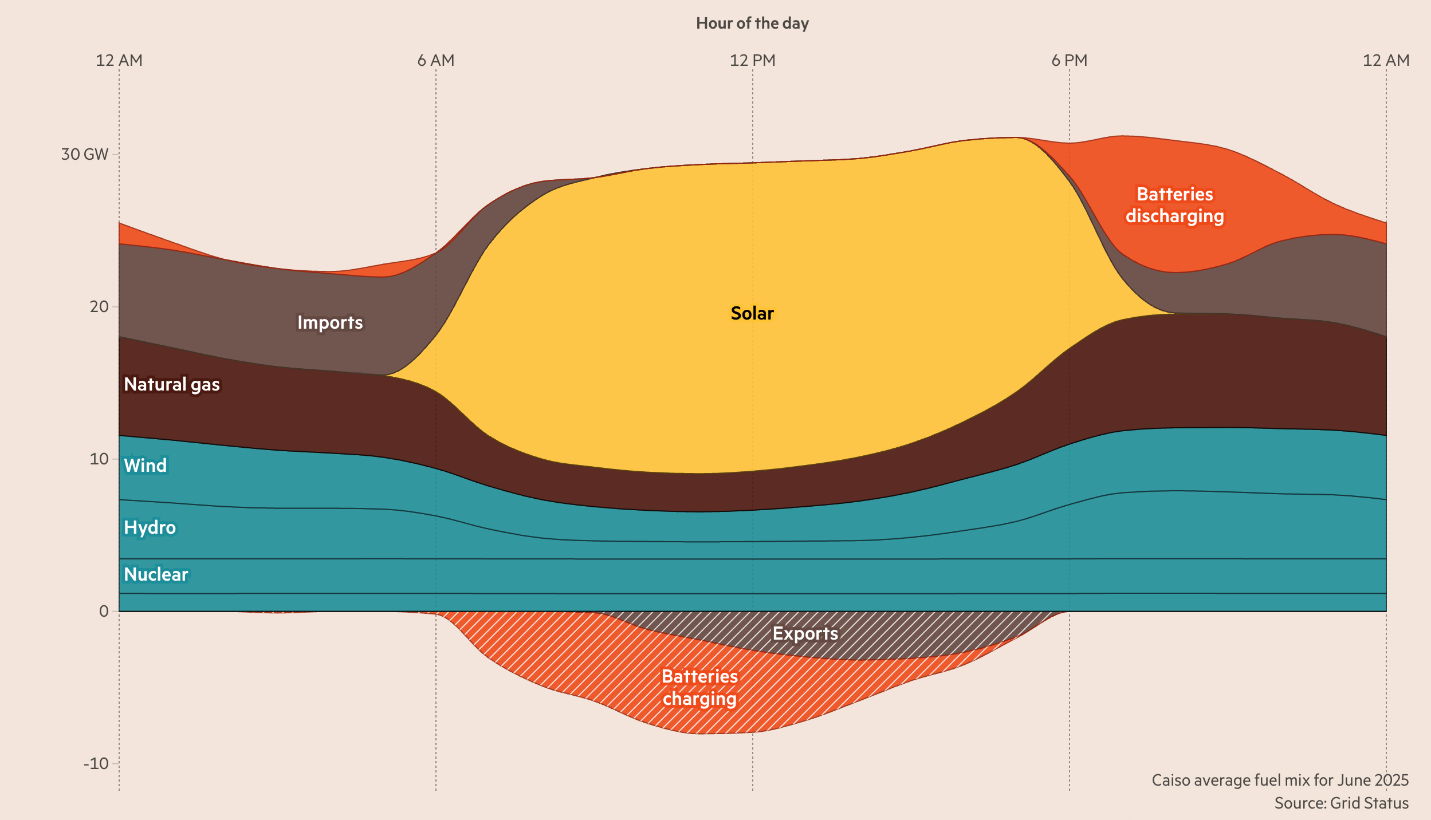
Behind AI's seemingly weightless, "trans-material" user experience lies a massive physical footprint, and Krugman argues that limits on that infrastructure -- especially electricity -- may constrain AI's growth more than boosters admit, while the costs get quietly passed to ordinary consumers. He opens with childhood memories of Horn & Hardart automats, which seemed magically self-service but actually required large staffs; Amazon's one-click delivery similarly conceals a million-worker logistics network. AI is the extreme case: the Department of Energy estimates data centers used 4.4% of U.S. electricity in 2023, rising to as much as 12% by 2028, and Goldman Sachs projects AI will drive most of that data-center demand growth. Two obstacles threaten supply. First, S&P Global data show nearly 90% of new U.S. generating capacity added in early 2024 was solar and wind -- yet the Trump administration is cutting renewable subsidies and blocking projects even while championing AI dominance. Second, utility regulation passes data-center capacity costs onto ordinary ratepayers: retail electricity prices have risen at a 9% annual rate, four times overall inflation. PJM's grid watchdog now wants data centers to supply their own power. Krugman notes smaller, efficient models could cut energy use sharply, but tech industry political clout makes reform unlikely.
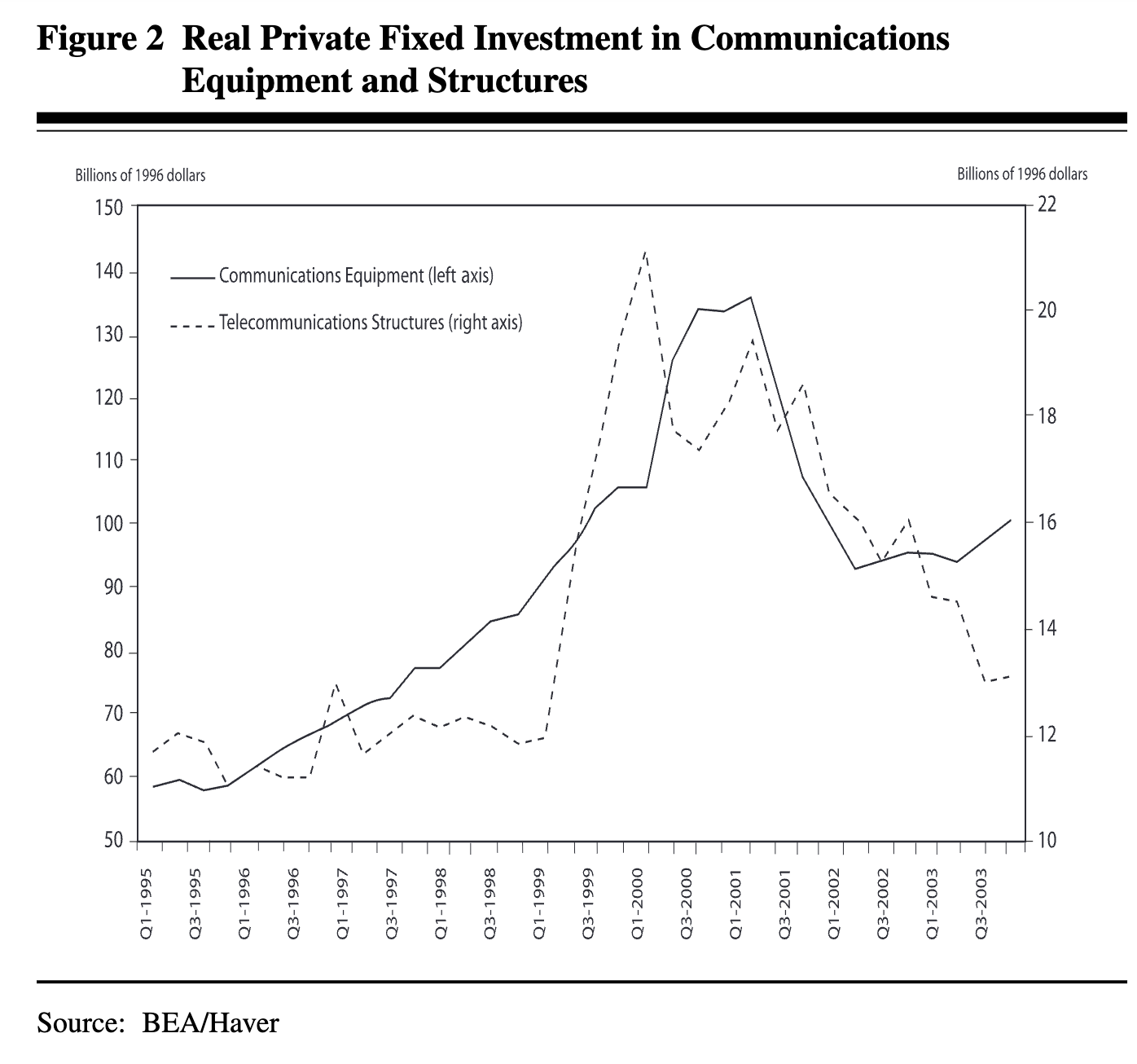
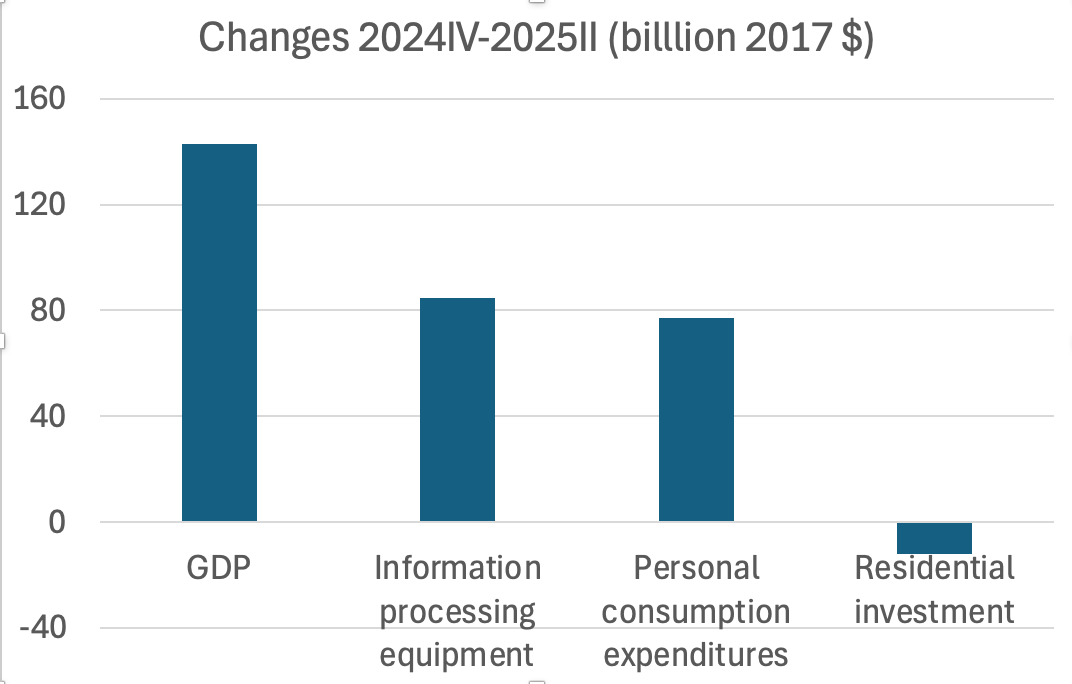
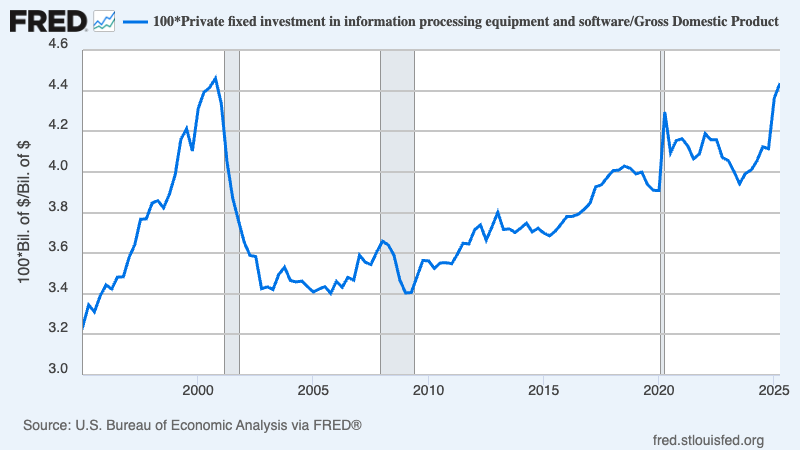
Drawing a direct parallel to the late-1990s telecom investment boom and bust, Krugman shows that AI-related data-center spending has been the single largest contributor to U.S. GDP growth in the first half of 2025—larger than consumer spending's contribution—making the economy dangerously dependent on a boom whose payoff is uncertain. He argues the risk isn't just whether AI's promised returns fail to materialize in time, as with fiber optics, but a nearer-term one: companies confronting hard limits on available electricity generation could pull back investment even sooner, tipping a fragile expansion into recession.
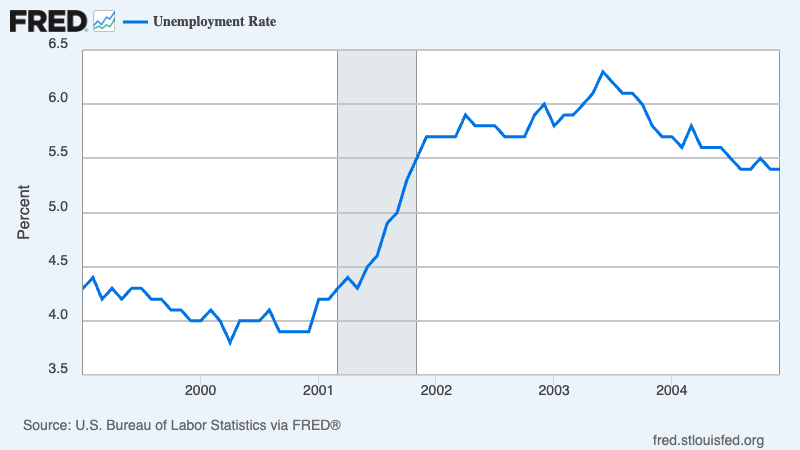
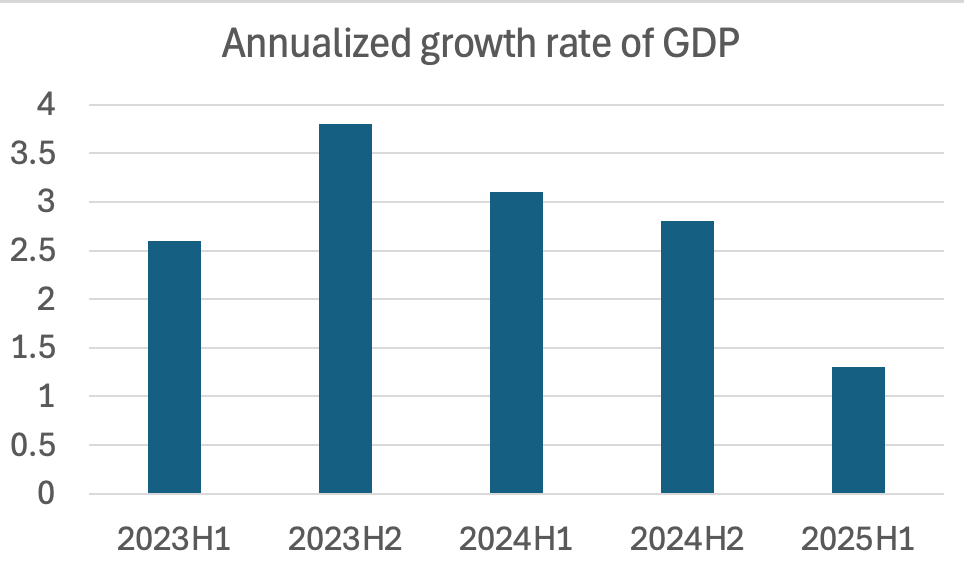
The AI boom's biggest short-term economic risk is not job losses but an energy shortfall that could trigger a recession, mirroring the late-1990s telecom bust rather than automation-driven unemployment. Elon Musk's xAI illustrates the problem: to power its Memphis supercomputer it ran 35 unpermitted methane gas turbines, worsening smog in South Memphis (99.5% Black, already leading Tennessee in asthma ER visits); Shelby County granted permits for 15 turbines on July 2 despite local protests. Musk resorted to private generation because the electrical grid lacks spare capacity for the data centers now under construction nationwide. The parallel: 1990s fiberoptic investment was based on real, eventually-validated technology, but profits arrived too slowly, causing a telecom bust followed by recession and prolonged high unemployment (shown in two charts). Today, GDP grew just 1.2% annualized in H1 2025, kept above "stall speed" almost entirely by AI spending — a BEA chart shows information-processing (data-center) investment contributed over half of overall growth between Q4 2024 and Q2 2025, more than consumer spending, which is 70% of the economy. The risk: companies may abruptly cut AI investment once they realize they can't power their data centers, making the electricity mismatch a threat to the whole economy, not just AI firms.
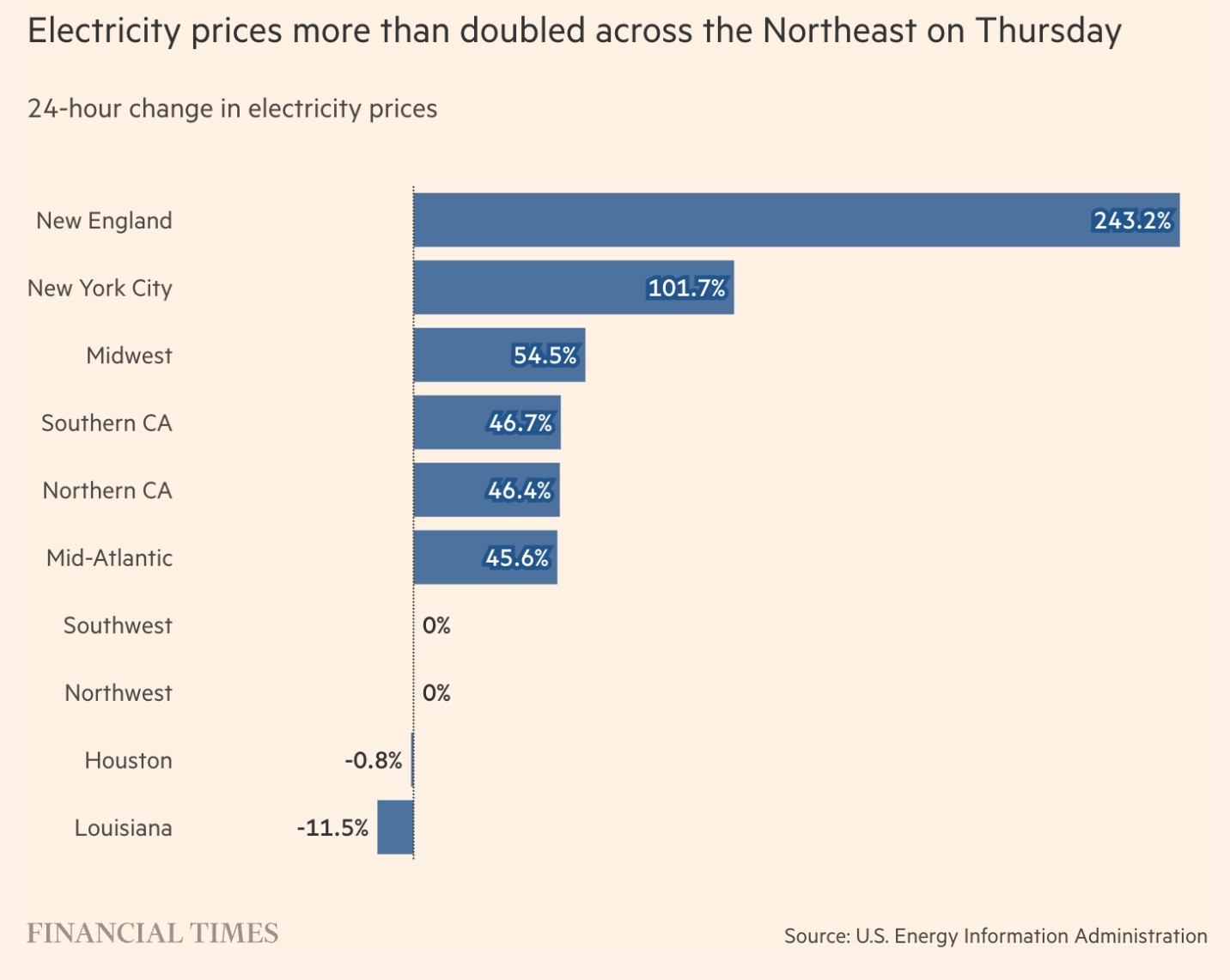
Krugman ties surging U.S. electricity prices—driven mainly by AI and crypto data-center demand—into a third stagflationary force alongside tariffs and deportations, and uses state-level data (Iowa's renewables-heavy grid saw falling prices, fossil-fuel-heavy New Jersey's rose) to demolish Trump's claim that windmills are to blame. He estimates electricity spending at roughly 2 percent of GDP and warns that Trump's simultaneous rollback of renewable buildout and efficiency standards will make the supply crunch worse just as it threatens to derail the AI investment boom propping up growth.
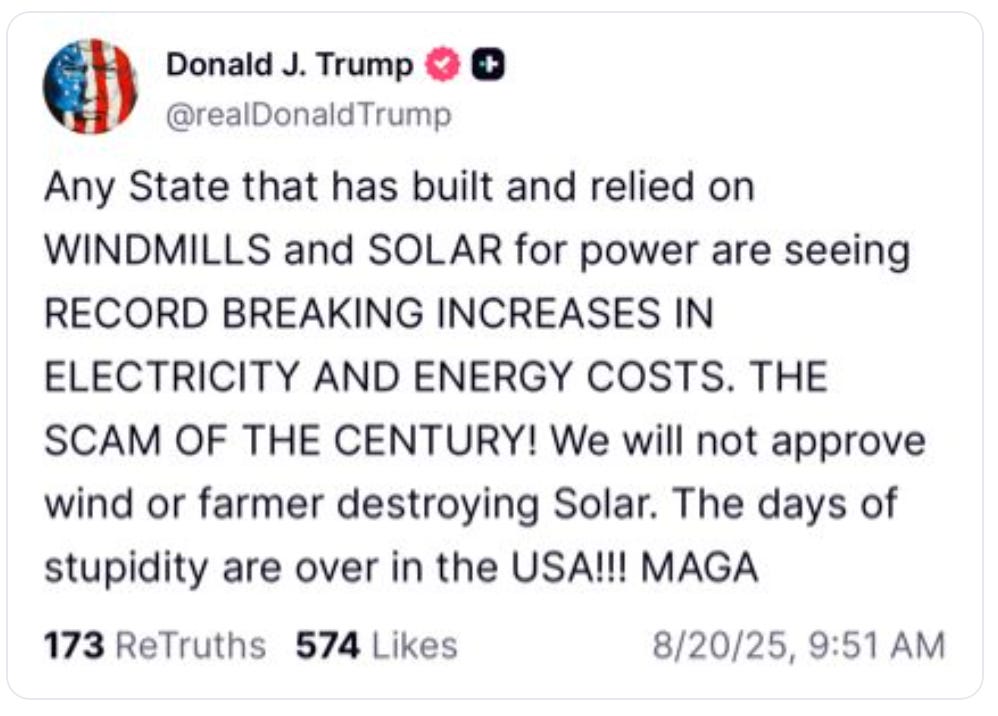
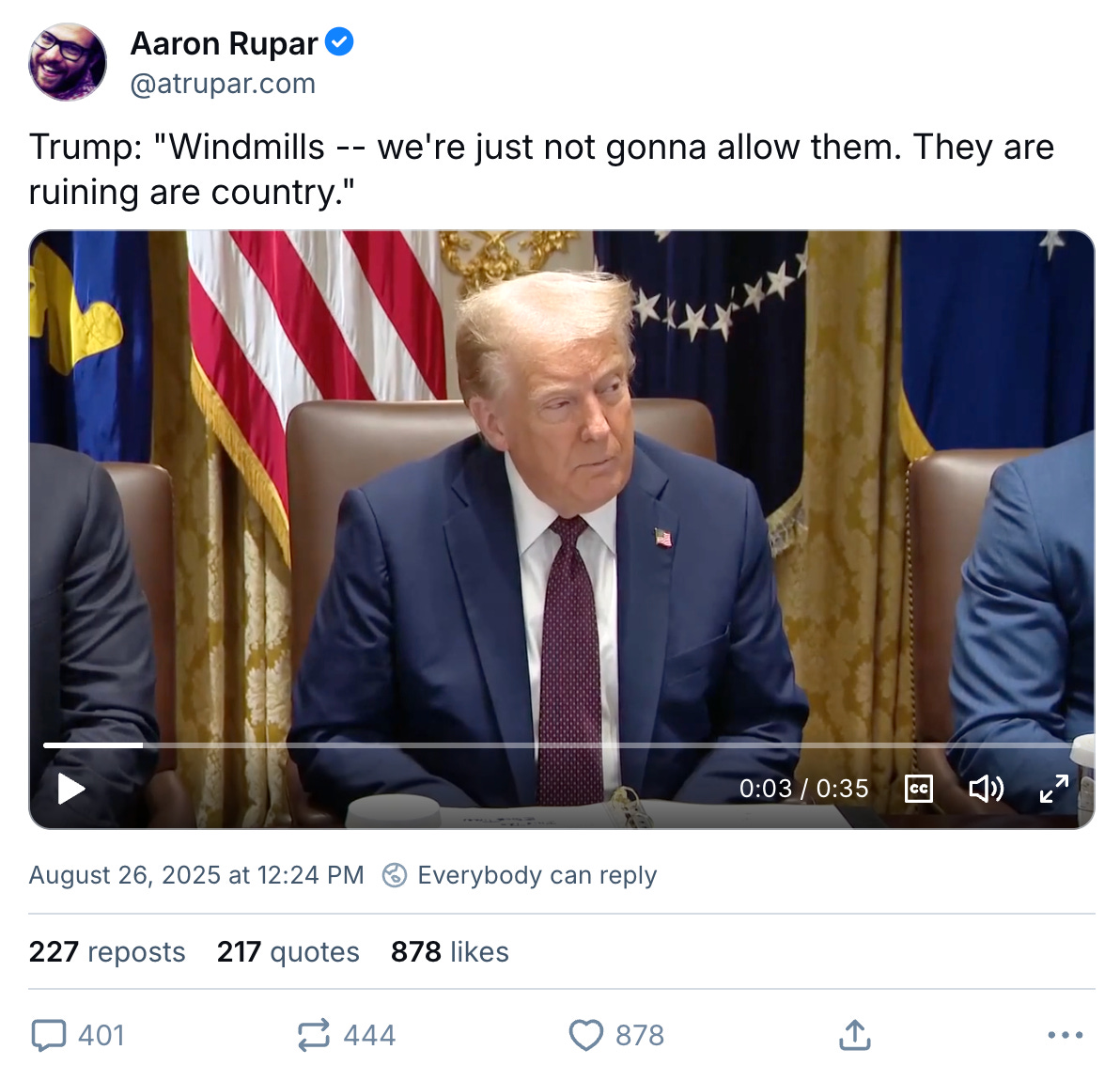
Soaring electricity prices are becoming a third stagflationary force, alongside tariffs and mass deportations, raising costs while slowing growth. Trump vowed during the campaign to halve electricity prices within a year of taking office; instead, prices are climbing as AI data-center demand strains the grid, prompting even Texas to let its grid operator disconnect data centers during shortages. Trump blames renewables, but the data say otherwise: wind-heavy Iowa (80% renewable) saw prices fall slightly from May 2024 to May 2025, while New Jersey (4.6% renewable, and lacking any windmills despite Trump's claims) saw prices rise 10%. The real driver is AI- and crypto-fueled demand growth, even as renewables—which Trump is now blocking—have supplied most recent new generating capacity; his administration is also rolling back appliance efficiency standards. Electricity costs run roughly 2% of GDP, and further increases could choke off the AI investment currently keeping the economy above stall speed, evoking Britain's 1790s canal-mania bust. Separately, Krugman condemns the campaign—following Leticia James and Adam Schiff—to oust Fed Governor Lisa Cook over disputed mortgage claims, warning it threatens the Fed's independence.
Krugman applies the economics of industrial agglomeration — the 'Marshallian trinity' of knowledge spillovers, specialized suppliers, and pooled labor markets — to argue that Trump's chaotic $100,000 H-1B visa fee threatens the self-reinforcing cluster dynamics that built Silicon Valley and America's research-university dominance. He warns that cutting off skilled immigration risks turning a virtuous circle of tech success into a vicious circle of decline, while also flagging the fee's broad discretionary-waiver clause as an obvious corruption vector.
Trump's new $100,000 H-1B visa fee is a self-defeating attack on the very pillars — tech, education, research — that built American economic preeminence. The rollout followed a familiar pattern: a sudden proclamation triggered "panic and chaos" (NBC), with passengers demanding to deplane a San Francisco–Dubai flight, followed by hasty walk-back clarifications posted on X rather than through official channels. Aaron Reichlin-Melnick of the American Immigration Council argues Trump likely lacks legal authority to impose the fee; lawsuits are pending.
Economically, skilled immigrants raise GDP, tax revenue, and Social Security/Medicare funding while easing inequality. Tech specifically benefits from "Marshallian trinity" externalities — spillovers, specialized supplier networks, flexible labor markets — that make Silicon Valley self-reinforcing; cutting off talent risks turning that virtuous circle vicious. The same dynamic built elite universities and NIH-led research, echoing how WWII-era refugee scientists powered the atomic bomb and space program. Citing the Draghi report, Krugman notes nearly all of the U.S. productivity lead over Europe since 2000 traces to digital technology. He also flags that the proclamation gives Homeland Security open-ended discretion to waive fees for favored firms — an obvious corruption risk.
Krugman compares today's AI-driven investment surge to the 1990s tech boom and finds an odd asymmetry: comparable spending and hype but none of the accompanying optimism, with consumer sentiment and job-security perceptions closer to the financial-crisis trough than to the giddy Clinton years. He attributes the gloom to a frozen labor market masking underlying weakness, a widely shared fear that AI (unlike the early internet) threatens jobs rather than just creating them, and Trump-era political turmoil bleeding into economic perception.
Paul Krugman argues a historic AI investment boom is masking the damage from Trump's tariffs but, unlike the 1990s tech boom it resembles, isn't generating matching optimism. Tariffs hit their highest level since 1934, disrupting supply chains and farm exports; without offsetting data-center spending, the US would likely be in recession. By Q2 2025, spending on information-processing equipment and software, as a share of GDP, matched its 1999 dot-com peak and is still rising (chart), while cash-rich tech firms are piling on debt to fund it, fueling bubble fears; a second chart shows consumer sentiment near financial-crisis lows versus 1999's euphoria.
Krugman gives three reasons for the gloom. First, official stats understate weakness: unemployment resembles 1999's, but hiring and quit rates are frozen, and the share calling jobs "plentiful" fell from 47.4% (1999) to 26.9% (2025) while "hard to get" rose to 19.1%. Second, unlike the unworried 1990s internet boom, AI provokes genuine job-loss anxiety, though Krugman doubts mass unemployment, since such automation fears date to the 1930s without materializing. Third, fears about Trump's authoritarian drift are bleeding into economic sentiment. He predicts a painful bust.
Krugman explains why hopes for a "Fed put" to rescue AI stocks are misguided: interest-rate cuts matter most for long-lived assets, but data centers and other AI infrastructure depreciate quickly, so their valuations should be largely insensitive to Fed policy even though markets keep reacting to Fed rhetoric anyway. He draws a direct parallel to the 2000 dot-com bust, when repeated Greenspan rate cuts produced brief rallies but never stopped the Nasdaq's multi-year collapse, concluding that a Fed rescue of a bursting AI bubble is economically incoherent regardless of what traders currently believe.
The Federal Reserve cannot rescue AI stocks from a bubble, because interest rates barely affect short-lived assets. In 2025, Krugman notes, Trump's tariffs — the highest since the 1930s — are depressing growth while an AI investment boom offsets it, a boom he suspects is a bubble like the 1990s tech bubble (the Nasdaq didn't regain its 2000 peak until 2014). His evidence: Bloomberg's "Magnificent 7" index fell most of the past month on bubble fears, then surged Monday on hints of a Fed rate cut, reviving belief in a "Greenspan put." A Nasdaq 100 chart of the dot-com collapse (gray bar marks the 2001 recession) shows the crash wasn't one sudden plunge but a long decline punctuated by rate-cut-driven rallies that, a close-up chart shows, were small against the total crash but huge by normal market standards; a chart of the actual Fed cuts shows they came repeatedly yet never stopped the deflation. Mechanically, lower rates raise present value mainly for long-lived assets like housing; short-lived ones — especially fast-obsoleting data centers and software — are barely affected, matching economists' longstanding failure to find real investment effects from rates. So Monday's rally reflected psychology, not fundamentals. Krugman doubts the Fed can even prevent recession if the boom collapses, and neither Powell nor a likely Trump-appointed successor, Kevin Hassett, can rescue AI.
federal reserveai bubbleinterest ratestech bubbleasset valuation
Investor and MIT fellow Paul Kedrosky walks Krugman through why AI capital spending, not tariffs, is what kept the US out of recession in 2025, and why the boom rests on shakier foundations than headline statistics suggest. He details how GPUs run flat-out for training fail far sooner than expected, how special-purpose financing vehicles are recreating pre-2008-style risk transfer, and how capital concentrated on AI is starving other manufacturers of credit — a modern Dutch-disease dynamic playing out from Taiwan to Ohio.
The AI boom, Paul Kedrosky argues, is an extractive, physically constrained resource bubble running at a scale rivaling sovereign finances, built on a training approach nearing its architectural limits, and financed through structures echoing pre-2008 mortgage securitization.
Kedrosky describes LLMs as "loose grammar engines": domain corpora (language, code, law) compress into weighted matrices predicting "continuations." The 2017 Transformer paper, built by Google for Google Translate, showed attention lets distant context ("spooky action at a distance") shape predictions -- underexploited by Google until OpenAI ran with it. Training data skews toward certain voices, so back-sampling suggests models implicitly treat the user as "a 37-year-old guy on Reddit," explaining bad and good advice alike. As pretraining data -- the "Saudi Arabia of data," the public internet -- gets exhausted, labs lean on post-training/RLHF, making models "sycophantic." Kedrosky ties quality to "gradient descent" sharpness: software gives sharp, unambiguous feedback (small code changes break things), so models excel there; language gives fuzzy feedback, so models are weaker and riskier -- meaning coding benchmarks don't prove progress toward AGI, which Kedrosky doubts given the "asymptotic decline" outside software.
Kedrosky says official statistics badly undercount AI spending: an OECD report found the US would have been in recession in H1 2025 absent AI capex, which ran near $1 trillion annualized and drove over half of GDP growth that half-year -- an unacknowledged private stimulus program. National accounts can't cleanly isolate the category, and even the Census Bureau's AI-adoption survey (adoption plateauing near 18% of large firms in Q3 2025) still asks decade-old machine-learning questions.
Physically, 65-70% of data-center cost is equipment, chiefly Nvidia GPUs, with a shortage of high-bandwidth memory chips (not ordinary RAM). GPUs mostly retire not from obsolescence but thermal stress: training runs chips at sustained full load -- "two 24-hour races" versus "driving to church on Sundays" -- giving a mean time between failure near two and a half years, often degrading quietly rather than failing outright; in a 20,000-GPU cluster, expect a failure every 3-4 hours. Unlike 1990s fiber, whose cable stayed useful after firms went bust, the "powered shells" persist but the GPUs -- 60-70% of cost -- don't, undercutting the "factories of the new industrial revolution" framing officials use to justify subsidies.
Financing compounds the risk: special-purpose vehicles let investors treat data-center debt as backed by Meta's or Google's credit rather than the underlying economics, echoing AIG-era securitization; some private-credit contracts even profit if a tenant cancels early. Circular deals (Nvidia investing in customers who then buy Nvidia chips) and "powered land companies" hoarding electrical capacity (a modern Owens Valley land grab) inflate apparent demand. Power is a binding constraint: gigawatt-scale loads exceed grid capacity, utilities pass costs to ratepayers, and "behind the meter" self-generation promises often fail -- Amazon complained to Oregon's utility commission after three data centers couldn't get promised power, while AEP is dumping 700 MW of speculatively bought power after demand didn't materialize.
Kedrosky dismisses both top-down ("10% of the $35 trillion global labor market") and bottom-up ("5 billion people paying $100/month") revenue projections as naive, partly because AI's own deflationary effect shrinks the market it targets. Oracle's debt now rivals a mid-sized European sovereign's; concentration risk is severe, with TSMC around 15% of Taiwan's GDP, comparable to Novo Nordisk's roughly 14% of Danish GDP at its peak. Investment (about 14% of nonresidential fixed investment) already exceeds the 1990s telecom bubble, between rural electrification and WWII rearmament -- the first bubble, Kedrosky says, to combine real estate, credit, technology, and government (US-China rivalry) at once. The influx is narrow, reviving San Francisco and New York real estate while starving non-AI manufacturers of financing -- a Dutch-disease dynamic undermining tariff-driven reshoring. Cheaper Chinese models (DeepSeek, Moonshot's Kimi) threaten the incumbents; consumer inference is tiny -- one Virginia data center could serve most global demand -- with coding tools consuming a large, likely unsustainable share of the rest.
Krugman dissects a viral speculative report imagining an AI-driven '2028 Global Intelligence Crisis,' arguing that even if AI agents do eventually gut middleman businesses the way the report envisions for DoorDash, industry disruption of that kind has no historical track record of causing recessions, since resources freed up in shrinking sectors tend to raise spending elsewhere rather than reduce aggregate demand. He suggests the report's outsized market impact says less about the economics of AI than about investors' fraying nerves amid genuine political turmoil — freshly illegal tariffs, a possible Iran strike — drawing a parallel to how Orson Welles's 1938 'War of the Worlds' broadcast panicked a public already primed by depression and looming war.
Speculative fiction with no real news can rattle markets when the public is already on edge — as Orson Welles's 1938 *War of the Worlds* broadcast panicked a Depression-primed public. Citrini Research's viral Substack post "The 2028 Global Intelligence Crisis," narrated as a retrospective from a fictional AI meltdown, may have contributed to Monday's 800-point Dow drop.
Citrini argues AI agents will gut middleman businesses, not just jobs; its example is DoorDash, undercut within weeks by cheap AI-coded rivals passing 90-95% of fees to drivers, fragmenting the market. Krugman finds this plausible — citing Mike Konczal on AI reshaping his work — and notes video-rental stores, ubiquitous in 2005, were wiped out by streaming within years (a chart traces the collapse).
But he rejects the recession forecast: no historical case shows disruption itself causing a crisis (the 1990s tech bust hit after the boom ended, not during), and AI's efficiency gains should lift spending elsewhere, offsetting losers — unless they're heavily leveraged, which there's no evidence for.
Why the panic, then? The 1938 broadcast landed amid a Depression relapse (a second chart shows that downturn) and rising fascism abroad. Today's parallel: tariffs voided by the Supreme Court then illegally reimposed, the EU suspending trade talks, and leaks warning Trump might strike Iran. Krugman is uneasy too — not about AI, but the people in power.
Krugman examines the Pentagon's abrupt ban on Anthropic's Claude, issued under a "supply chain risk" designation that plainly doesn't fit that term's legal definition, and argues it exemplifies a corrupt pattern of substituting political loyalty for competence in government purchasing. He frames the move as directly self-defeating on its own terms, since the tool being pulled was reportedly the one Pentagon staff found most useful, imposed just as a war was starting.
Anthropic's Claude — the tool serious users prefer, versus OpenAI's ChatGPT for casual use — was overtaking OpenAI in enterprise adoption by early 2026, including at the Department of Defense, which relied on it heavily. Defense Secretary Pete Hegseth, already accused by Krugman of waging war on human expertise, then banned Claude and is pressing contractors to drop it too, citing a "supply chain risk." The real trigger: Anthropic's own restriction against its models being used for autonomous weapons or mass surveillance of Americans, which drew "woke AI" accusations from AI czar David Sacks.
Krugman calls this a bad omen on three counts. Legally, acquisition guidelines define "supply chain risk" as sabotage or subversion, not political disfavor — "too woke" doesn't qualify. Practically, it's crony capitalism's flip side: rewarding friendly firms while freezing out disfavored ones, wasting taxpayer money and pressuring businesses to perform loyalty to Trump. And hypocritically, the Pentagon is now doing what Hegseth accuses DEI of — picking suppliers by politics rather than merit — while weakening national security as a war begins; he notes Republicans would call it treason if a Democratic administration banned a conservative AI firm — evidence, he concludes, that fighting "wokeness" matters more to the administration than national safety. A chart (via Business Insider) shows Anthropic's rapid enterprise growth overtaking OpenAI's.
ai policyanthropicpentagongovernment contractingcorruption
In this CUNY stage interview, Lina Khan traces her intellectual path from documenting agricultural middlemen who squeeze both farmers and consumers to her "Amazon's Antitrust Paradox" critique of Chicago School antitrust doctrine, and describes her FTC tenure's focus on healthcare consolidation, non-compete bans, and how market concentration made supply chains (like infant formula) more fragile and prone to price spikes. The conversation extends into her current advisory role in the Mamdani New York City administration, discussing public options like municipal grocery stores and hospitals as tools against "extractive middlemen," and the broader link between corporate consolidation and the concentration of personal wealth and political power among tech founders.
Lina Khan's career traces a single thesis: American antitrust law abandoned the tools needed to stop monopolization just as digital markets made monopolization more likely, and reviving those dormant tools — not necessarily writing new laws — is the fix, whether at the FTC or in city hall. In this CUNY conversation with Paul Krugman, Khan traced that arc from her start documenting market consolidation (book publishing, chicken farming, airlines) at a think tank after the financial crisis. She found grocery-store shelves created an "illusion of choice" — dozens of detergent or diaper brands controlled by a couple of firms — and that in agriculture, tens of thousands of farmers and millions of consumers were connected by as few as four companies, letting meat prices rise for consumers even as farmer payouts fell. That research led her to antitrust law's Industrial Revolution origins, meant to check trusts that undermined both economic welfare and political liberty.
Her 2017 Yale Law Journal paper "Amazon's Antitrust Paradox," drafted from 2012-13 interviews with sellers and investors, argued that because Amazon kept prices low and lost money, conventional wisdom (reading antitrust purely through short-term prices, per the Chicago School and Robert Bork) couldn't see it as a monopoly threat — even though its practices would have drawn scrutiny in the 1960s-70s. Amazon's 2017 Whole Foods bid, announced months later, was the first moment the public began asking what limits should apply. Khan noted the field's broader inversion since: the early-2000s view that low entry costs ("two kids in a garage") argued for government inaction has flipped into recognition that network effects and data advantages make digital markets *more* prone to monopolization. Google has since been ruled an illegal monopoly three times over; the Amazon case is ongoing. Krugman raised a related shift — these firms concentrate power not just in corporations but in individuals (Bezos, Zuckerberg) via super-voting shares that weaken board accountability; he cited a Times finding that 300 billionaires supplied 19% of 2024 U.S. campaign contributions.
At the FTC (chair 2021-2025, an agency of ~1,400 staff created in 1914), Khan prioritized healthcare — consolidated hospitals, pharmacies, and pharmacy-benefit managers, often vertically integrated under one insurer, plus private-equity rollups of physician practices — citing constituents rationing insulin and dying rather than afford medication. The FTC won its case against Martin Shkreli ("Pharma Bro"), securing a lifetime pharma-industry ban after he raised a drug's price thousands of percent, and blocked hospital mergers linked to higher prices, lower quality, and "healthcare deserts" (100-mile drives to a hospital). On labor, the FTC targeted non-competes — now covering roughly one in five American workers, including minimum-wage security guards and fast-food workers — winning a case against a Michigan security firm and drawing 26,000 public comments (including a harassed Florida bartender threatened with a lawsuit for switching jobs) on a proposed rule to eliminate most non-competes. On 2021-23 inflation, Khan argued concentrated industries make coordinated pricing (even signaled via earnings calls) easier, and that consolidation makes supply chains more fragile — the 2022 infant-formula shortage, caused by contamination at one factory among just four manufacturers, showed how concentrating production concentrates risk.
Now co-chairing Mayor Mamdani's transition, Khan applies the same lens to NYC affordability: cracking down on "extractive middlemen" and junk fees (food delivery, rental rip-offs), removing red tape squeezing small business, and expanding public options — pilot public grocery stores, universal childcare, and models like California's public insulin and Virginia's proposed public pharmacy-benefit manager. Rather than seek new legislation, she's mining unenforced existing authorities, citing the FTC's revival of a 1994 Made-in-USA law and the Depression-era Robinson-Patman Act (unenforced since the late 1990s), and flagging a 1970s NYC law against "unconscionable practices" as a tool against captive-consumer pricing (hospital markups, stadium concessions). She cited evidence that Fortune 100 firms are expanding their NYC footprint rather than fleeing, calling the working-class exodus the more urgent flight risk.
antitrustmonopoly powerlina khanftcnew york city policy
Krugman documents a fast-moving collapse in US scientific capacity - falling NSF and NIH grant approvals, frozen and terminated research funding, shrinking foreign-student visas, and a new budget that cuts research spending even as military spending balloons - layered on a longer-run slide from first to third place behind China and the EU in top-journal publication share. He traces the American right's anti-science turn to a self-reinforcing political loop: scientists overwhelmingly back Democrats, so Republicans have come to treat research funding and evidence-based policy as a threat to their hold on power rather than a national asset.
Trump's assault on federal science funding, layered onto decades-old Republican hostility to science, is set to cripple American research within the next year or two and cost the U.S. its remaining claim to scientific leadership. The FY2027 budget pairs a huge military buildup with deep research-funding cuts; NSF and NIH grant approvals have already plunged to their lowest levels in a decade (bar charts show 2025 as the low point since 2015), existing grants, especially in infectious-disease research, are being frozen or terminated, and foreign-student visas, vital to both research labor and university finances, have dropped sharply. This compounds an existing erosion: an NBER-based chart shows the U.S. share of publications in top journals fell from exceeding the rest of the world combined in the 1990s to third place, behind China and just below the EU, before Trump's cuts even hit. Krugman traces the cause to mutual hostility between the GOP and scientists: donation data show Republicans get almost no financial support from scientists today, GOP orthodoxy rejects the scientific consensus on evolution, climate change, and vaccines, serving fossil-fuel and "quack medicine" donors, and MAGA's anti-intellectualism has hardened this into policy. He concludes a nation forfeiting scientific leadership cannot remain a Great Power.
In conversation with historian Heather Cox Richardson, Krugman analyzes the AI investment boom through historical bubble analogies, tulip mania, railroads, the dot-com bust, and the British canal boom, arguing that most of the money is currently flowing to "picks and shovels" suppliers like Nvidia rather than to AI firms with proven revenue models, and that unlike the fiber-optic infrastructure left over from the dot-com bust, AI data centers and chips will likely depreciate too fast to leave a useful legacy if the bubble bursts. He notes that the heavy import content of AI capital spending means a bust would hit chip-exporting economies like Taiwan harder than the US itself, while flagging concern over coercive employer-driven AI adoption despite widespread public dislike of the technology.
Paul Krugman argues AI investment carries the classic hallmarks of a speculative bubble, but with a structure and depreciation profile that differ from earlier booms in ways that make its likely bust both less damaging to the U.S. domestically and more wasteful overall. He defines a bubble, following Robert Shiller, as a "natural Ponzi scheme": people invest not because the payoff is realistic but because everyone else is investing, and the momentum collapses once fresh money stops arriving. Weighing precedents—Dutch tulip mania, the British canal boom around 1800, 19th-century railroads, and the 1990s dot-com bubble—Krugman finds the closest parallel is the California gold rush: OpenAI and Anthropic are the prospectors, most likely to go bust, while Nvidia and cloud-compute renters are the Levi Strauss's selling picks and shovels, currently the only reliably profitable layer. Unlike dot-com, where hundreds of competitors thinned to a few survivors, the U.S. AI market already has only a handful of major players (OpenAI, Anthropic, Google's Gemini, Musk's Grok, plus differently-designed Chinese models), raising real odds that one or two become durable monopolies by building "walled gardens"—deliberately crippling free tiers to push users toward paid subscriptions, as Facebook, Google, and Amazon eventually did. He also flags an inherent weakness working against that outcome: AI's unpredictability and tendency to hallucinate make it unclear how far society will trust a technology that periodically "goes crazy" or "turns into Frankenstein's monster."
Heather Cox Richardson notes AI use is currently subsidized $3–25 for every dollar of compute consumed, and argues the boom lacks the organic consumer pull of the early internet or iPhone; she cites the Union Pacific Railroad, built ahead of demand via government subsidy, which spawned "branch roads to nowhere" that fed the 1870s railroad bust, as a closer analogy. Having tested AI extensively, she has turned against it, though she credits narrow uses like checking engineering and construction plans, such as calculating more efficient cement mixes. Krugman, more agnostic, says his own use is limited to transcribing videos (imperfectly—it once mangled "vibecession") and pulling numbers from old economic papers' tables via PDF. Both flag an unusual social dynamic: unlike the internet, which people embraced voluntarily, AI adoption is often mandatory, imposed by employers on unwilling workers, and openly resented—college commencement speakers now get booed for mentioning it. Krugman likens this to the Luddites but notes the reversal: Luddites resisted destructively; today's workers are simply compelled regardless of how much they hate it.
On layoffs blamed on AI, Krugman says the explanation is both real and pretextual. Citing economist Henry Farrell's idea that AI is a "social technology" delivering aggregated, common-opinion responses, he argues it genuinely can replace routinized jobs, like scripted call-center work. But it is also an excuse, similar to "greedflation," for companies that wanted to downsize anyway—some of which have already regretted cutting experienced staff after finding AI couldn't handle non-routine questions and hallucinated.
Asked what a bust would look like, Krugman offers mixed news. Much AI spending is imported chips and equipment, so a collapse would hit import figures and shock economies like Taiwan's, which has boomed from chip sales, more than U.S. domestic output specifically. But unlike dot-com's "dark fiber"—unused fiber-optic cable that didn't depreciate and was eventually put to use—or the durable tracks and waterways left by railroads and canals, AI's chips, data centers, and software depreciate and become obsolete quickly, so Krugman expects a much higher share of the current investment to end up simply wasted, especially if the world migrates toward China's leaner, lower-energy AI models instead of the West's resource-intensive approach.
ai bubblespeculative bubblestechnology investmenteconomic historylabor market effects
[Paywalled preview only] Opening a planned multi-part series on AI economics, Krugman argues that the standard historical comparison to electrification undersells the range of relevant precedents, previewing an argument built instead on the puzzle of the postwar productivity boom (which wasn't driven by any single breakthrough technology) and the surprisingly short-lived payoff from the 1990s-2000s IT revolution. The visible framing sets up how economists measure technology's economic impact and whether AI will follow the slow, delayed-payoff pattern of past general-purpose technologies, with the substantive analysis reserved for paid subscribers.
Understanding how AI will reshape the economy requires looking beyond the one historical analogy everyone reaches for. Krugman opens by conceding the paradox: a truly radical technology has no precedent, so history can't directly predict its effects, yet past episodes of transformative technology still "rhyme" with the present and offer guidance. He notes that observers like Azeem Azhar and John Burn-Murdoch have leaned on electrification in the late 19th and early 20th century — a technology whose productivity payoff was famously delayed — since that episode helped economists later explain the slow payoff from modern information technology (IT).
Krugman argues two other episodes deserve equal weight: the great postwar productivity boom, notable precisely because it was *not* driven by any radical new technology, and the IT-driven productivity boom of the 1990s and 2000s, which disappointingly petered out early. This piece, the first in a planned multi-part series on AI economics, promises to cover (behind the paywall) how economists measure technology's impact, the mystery of the postwar boom, the "Solow paradox" of IT's slow payoff, why IT's productivity gains lasted only about a decade, and preliminary questions about AI itself — with employment and income-distribution effects reserved for later installments.
In a wide-ranging conversation with tech analyst Azeem Azhar, Krugman probes whether AI investment constitutes a bubble, getting back a nuanced answer: enterprise AI spending has reached roughly $150 billion annualized with real revenue growth, funding quality is deteriorating but not yet at crisis levels, and the concentration of AI stocks in market indices resembles past general-purpose-technology booms like railroads rather than pure speculation. The two also work through Paul David's electrification-lag framework to explain why AI's productivity payoff may take years to appear in the aggregate data even as capital keeps pouring in.
Eighteen months into the current AI boom, the technology has evaded both its sci-fi expectations and any orderly theory of how to build it, and the economic evidence so far points to a demand-led boom rather than a bubble about to pop — though funding quality is worsening. That is the throughline of Paul Krugman's conversation with Azeem Azhar, founder of Exponential View, revisiting a discussion they last had in January 2025.
Azhar explains that models are built by passing trillions of words through neural networks, then, in the past 18 months, trained on tasks (coding, software use) via reinforcement learning — Brad DeLong's "vast stew of linear algebra," which Krugman likens to Google's PageRank eigenvector at vastly greater scale. Unlike sci-fi's monotone, reliable AI, real models are unpredictable and improve non-monotonically release to release — Krugman notes a recent Claude version became so sycophantic Azhar switched back to ChatGPT. Azhar uses an agent, "R. Mini Arnold" (after Asimov's robots and Terminator 2's protector), reachable by WhatsApp and email, loaded with his personal context (calendar, reading, investments) and able to browse the web and his JSTOR-downloaded PDFs; it once spun up sub-agents with economist personalities to research Paul David's finding of a 35-year lag between Pearl Street electrification and productivity growth. But it's brittle, breaking every four or five days. On Krugman's "homemade pasta problem" — why aren't off-the-shelf agents replacing DIY prompting the way store-bought pasta beat home machines — Azhar says small businesses (his barbershop example) will get vertical agents once platform-builders start failing to win the "tool for all tools" prize, but large companies, bound by internal rules like Henry Ford's Highland Park plant needing its own supply chain, will keep building in-house longer.
Having just spent eight days meeting roughly a dozen Chinese AI labs, Azhar reports they are "Claude-pilled" — rating Claude and Claude Code best — treat compute scarcity as a fact of life turned into an efficiency culture, and compete more with each other (city-level rivalry, as with EVs and solar) than with the US. He expects the market to segment like airline seating: cheap models for high-volume tasks, expensive frontier models for hard problems, not one uber-model.
On bubble risk, Azhar's mantra is that durable customer revenue prevents collapse (citing 1870s–80s US railroads laid to nowhere). His team's deduplicated tracking puts US AI spend at $150 billion annualized (end of May 2026), up from $90 billion in the prior 12 months — enough to roughly cover capex depreciation, but requiring repeated doubling. Funding quality (versus "smelly finance" as in 2008) has worsened over nine months but isn't systemic; Oracle and Coreweave carry risky-looking debt. Krugman flags AI stocks at 40% of S&P 500 value against spending near 0.5% of GDP; Azhar counters with earnings concentration and cites finance historian Bessenbinder's finding that just 30 of 23,000 US stocks (1900–2022) drove two-thirds of returns — general-purpose-technology winners like railroads (60% of 1900 market cap), oil, autos, and now Apple/Nvidia.
On "picks and shovels," under 30% of S&P 500 firms cite quantifiable generative-AI earnings results, yet surveyed finance executives plan to spend more despite no measurable gains — consistent with Paul David's electricity model, where 50% of firms had to electrify before productivity rose. Bottlenecks (power, capital versus possibly $2 trillion/year in infrastructure spending) loom, even as real rates stay below 1990s peaks and Nvidia's five-year CDS trades cheaper than Treasuries — "completely crazy," Krugman says. Musk's SpaceX, Azhar argues, genuinely lowered launch costs by recovering rockets, a real gain regardless of Grok's quality.
On productivity, Azhar cites AI-native firms' revenue per employee — McKinsey ~$400K, Meta/Google ~$2–2.5M, Mercor ~$7M, Anthropic ~$10M — as an early Highland Park signal, while noting exploding "lines of code" reflects both quality gains and waste, like a barrel of oil's two-thirds heat loss. Both liken AI writing to word processing's book bloat, but see democratized expression, not just slop, as the likelier upside.
Surveys explain why Americans have turned sharply negative on AI, unlike past waves of tech optimism around the internet and social media, and Krugman offers five compounding causes: AI firms' own apocalyptic marketing to attract investment, workers and consumers feeling AI is imposed on them without choice, the visible physical and environmental costs of datacenters, tech's pre-existing loss of public trust from enshittification, and AI's association with a wealth-concentrating oligarchy. He argues this backlash is already reshaping electoral politics, making association with AI money a political liability rather than an asset.
The intense public backlash against AI is not the mild skepticism that greeted past technologies — it is something new, driven by several reinforcing causes. Historically Americans welcomed tech: a 1999 Pew survey showed strongly positive views of the internet, and a 2015 poll found 71% saying tech companies had a positive effect on the country, versus 17% negative. A recent Pew survey instead shows Americans now expect AI to harm society, and, to a lesser degree, to harm them personally.
First, AI firms manufactured the fear themselves: Anthropic's Dario Amodei told Axios AI could eliminate half of entry-level white-collar jobs and push unemployment to 20% within five years, a claim meant to attract investors and pressure rivals into adoption — since walked back, and publicly rebuked by Microsoft's Satya Nadella. Second, AI feels forced on people, as when Google replaced search with AI with no opt-out. Third, datacenters visibly guzzle land, water and power — one Utah site will be twice Manhattan's size — and 57% oppose one nearby versus 14% supporting. Fourth, tech's reputation had already collapsed between 2015 and ChatGPT's 2022 release ("enshittification"). Fifth, AI is tied to wealth concentration voters want curbed. AI-industry election spending has mostly failed, and association with it is becoming politically toxic — poetic justice for an industry that courted an "edgy" image to please markets.
[Paywalled preview] Krugman opens an essay on AI and cognition by describing colleges' return to handwritten blue-book exams as instructors lose an arms race against AI-generated answers and AI-detection workarounds, framing this as a symptom of a deeper worry: that offloading reasoning to language models erodes students' capacity to think rather than merely enabling them to cheat. He situates generative AI as an acceleration of a longer trend of outsourcing judgment that began with search engines and smartphones, previewing a fuller argument, visible only to paid subscribers, about the history of outsourced cognition and whether AI-driven cognitive decline could become a new axis of inequality.
Reliance on AI for schoolwork threatens students' capacity to learn — and because learning means learning to think, the damage may be nearly irremediable. Krugman opens with blue books' comeback: the handwritten exam booklets, introduced about a century ago by Butler University in Indianapolis, are returning as instructors abandon computer-based testing. An arms race emerged after students began using AI, including ChatGPT and Claude Code, to write essays and answer exam questions; instructors deployed AI-detection tools, and students learned to evade them with counter-detection AI. Even in-person exams aren't safe — AI glasses are already being used to cheat on exams in Asia, per CNN, and the practice will likely spread worldwide. Krugman's real worry isn't cheating but cognition: students who let large language models answer questions never practice reasoning from evidence to a conclusion, leaving them unequipped when AI can't answer or answers misleadingly. He frames generative AI not as a rupture but as an acceleration of a longer outsourcing of human judgment that began with Google search and continued through smartphones, each stage delivering short-term convenience at the cost of measurable long-term cognitive damage.
artificial intelligenceeducationcognitiontechnology and societyinequality
Krugman argues that AI's disruptive economic effects will be shaped and amplified by the already extreme concentration of wealth and political power in the US, contrasting today's Gilded-Age-level inequality with the more egalitarian, heavily regulated economy of the 1950s-60s that might have absorbed a similar technological shock more benignly. He frames the piece as a primer connecting the rise of a tiny economic elite, the political mechanisms sustaining it, and how oligarchic capture will channel AI's disruption toward the wealthy unless policy pushes back. Paywalled preview: only the introduction and section outline are visible.
AI's damage will be shaped less by the technology itself than by the political-economic conditions it lands in, and today's American conditions are close to the worst possible: an entrenched oligarchy poised to magnify AI's harms rather than contain them. Had AI arrived in 1950s-60s America, when inequality was low, the tax code strongly progressive, and antitrust enforcement robust, its destructive effects would likely have stayed limited. Instead it arrives in an economy where wealth and political power are concentrated among a handful of billionaires beyond even Gilded Age levels — a state both cause and effect of policies favoring the wealthy: low effective taxes on capital and high incomes, weak enforcement of worker protections and antitrust law, and deep cuts to programs for ordinary Americans. On this tilted playing field, AI's negative impacts will likely exceed those in a more equal country, unless the disruption itself provokes a backlash against oligarchy. Krugman previews five sections tracing how America's rightward turn since the 1980s produced this concentration and how it will channel AI: the rise of the ".0002%," the economics of oligarchy, the politics of extreme wealth, how oligarchy will shape AI's impact, and paths for policy.
aiinequalityoligarchypolitical economypolicy
Tariffs and the Trade War
2 tier-5 · 36 tier-4
Krugman tracks the tariff war from its first threats against Canada and Mexico through "Liberation Day" and its aftermath, arguing throughout that the tariff math never worked: the promised factory jobs did not materialize, the revenue projections were fantasy, and the incidence fell on American consumers and exporters rather than foreign governments. He returns repeatedly to specific fights -- NAFTA/USMCA, China, Japan, the EU deal, semiconductors -- to show the same pattern of stated rationale colliding with trade arithmetic. The throughline is that tariff policy under Trump was never really about manufacturing revival; it was leverage, theater, and improvisation dressed up as strategy.
Responding to reader pushback on his postwar-boom post, Krugman revisits John Hicks's "long-run dollar problem" to show that a trading partner's economic destruction does not mechanically enrich the surviving economy, since foreign markets matter as much as foreign competition. He notes America ran minimal foreign trade during the 1950s boom (exports near 4% of GDP), so the claim that wrecked European and Japanese industry explains US postwar prosperity can't be squared with the actual trade data. The point undercuts a common conservative rebuttal used to dodge the fact that high taxes and strong unions coexisted with rapid growth.
Destroying your trading partners' economies makes you poorer, not richer — so the postwar American boom cannot be explained by the fact that Germany and Japan lay in ruins. Responding to readers who argued this after his earlier post on the postwar boom, Krugman traces the claim to a real economic debate: after the war, British economist John Hicks formalized the "long run dollar problem," analyzing how technological progress in one country affects its trading partners' real incomes. That analysis shows growth abroad can hurt or help you depending on its bias — whether it's tilted toward goods you export or import — and by the same logic, bombing a rival's industrial base could in principle cut either way. In practice, though, wiping out competitors just eliminates the gains from trade, since those gains require someone to trade with. The clinching fact: U.S. exports were only about 4 percent of GDP during the Eisenhower years, much of that to Canada and Mexico, as one chart shows — far too small a share to account for living standards doubling in a generation. A second chart shows income inequality was low through the same period. Krugman suspects the "no competitors" story is really a dodge to avoid crediting high taxes on the rich and strong unions with the era's prosperity; his actual explanation is that postwar stability let firms fully exploit existing technologies like electrification and the internal combustion engine, without New Deal-era redistribution getting in the way.
trade theorypostwar boomhicks modeleconomic history
Using the basic balance-of-payments identity, Krugman explains why China's record trillion-dollar trade surplus is a symptom of the country's failure to boost domestic consumption rather than a sign of competitive strength, and why the concentrated, community-level damage from import surges documented in the Autor-Dorn-Hanson 'China shock' research (illustrated with North Carolina's furniture industry) makes a protectionist backlash from the US and its allies unavoidable regardless of the aggregate gains from cheap imports.
China ran history's first trillion-dollar trade surplus last year, per a widely circulated Bloomberg chart — but that's a symptom of weakness, not strength, and will trigger a protectionist backlash regardless of Trump. Because a nation's trade balance plus net capital inflows must sum to zero, genuinely competitive economies attract foreign capital and thus run deficits, not surpluses: after 1995, faster U.S. adoption of IT drove productivity ahead of Europe, pulling in capital and widening America's deficit, shown in one chart. Conversely, shrinking deficits often signal distress — a second chart shows current accounts in Greece, Portugal, and Spain swinging sharply during the euro crisis not from new competitiveness but from a "sudden stop" in capital inflows, forcing austerity-driven import collapse.
China faces no sudden stop, but weak consumer demand and diminishing returns on investment, compounded by a deliberately weakened real effective exchange rate (a third chart), are driving its surplus. That surplus won't be tolerated: the "China shock" of the late 1990s (Autor, Dorn, Hanson) cost 1-2 million U.S. manufacturing jobs concentrated in places like North Carolina's furniture belt — Hickory-Lenoir-Morgantown, where one in six workers was in furniture, an industry that lost 300,000 jobs (45 percent) in the 2000s — losses winners never compensate, and money can't replace lost community.
Tariffs on China are therefore unavoidable, but should be smart and coordinated with allies, not blanket 60 percent tariffs applied alone.
china economytrade surplusbalance of paymentschina shocktariffs
Ahead of Trump's threatened 25% tariffs on Canada and Mexico, Krugman works through the underlying trade arithmetic -- Harberger-triangle deadweight loss that scales faster than linearly with the tariff rate, an estimated $2,500-a-year cost to the median household, tariff revenue far below Trump's own stated target, and net job losses once dollar appreciation and foreign retaliation are counted -- to argue that markets are badly underpricing the odds Trump actually follows through.
Trump's threatened 25 percent tariffs on Canada and Mexico (ostensibly to stop migrant/drug flows that are, per Bloomberg data, actually trivial) would be far more destructive than markets' complacent shrug suggests — and that very complacency makes him more likely to follow through. Damage isn't proportional to the tariff rate: because consumers get pushed toward ever-worse domestic substitutes (Harberger triangle logic), 20 percent is roughly 4 times as harmful as 10 percent, 25 percent about 6 times — far beyond the CBO's recent estimate, which modeled only a 10 percent tariff. With imports at 11 percent of GDP, a 25 percent tariff acts like a sales tax raising living costs nearly 3 percent, roughly $2,500 yearly for the median ($80k-income) household. Revenue would fall short too: naively $750 billion on $3 trillion of imports, but shrinking import volumes cut that to about $500 billion — far under Trump's claimed $1 trillion and only 10 percent of federal revenue (a chart contrasts this with the tariff-funded McKinley era, when government was far smaller). Since the economy is near full employment, tariffs can't create net jobs, only relocate losses: a stronger dollar and foreign retaliation (Goldman Sachs found Trump's first-term tariffs cut targeted exports to retaliating countries by roughly 20 percent, hitting agriculture hardest) would disrupt tightly integrated North American auto manufacturing.
Krugman contends that even short-lived Trump tariffs on Canada and Mexico would inflict lasting damage by destroying confidence in NAFTA/USMCA as a binding commitment, since the cross-border investment behind North America's integrated auto supply chains depended on firms trusting that low tariffs were permanent rather than negotiable. Using CBO data he shows Mexican tariffs were already low before NAFTA and that the deal's real function was locking in that policy rather than starting free trade, so treating trade agreements as revocable at a president's whim pushes firms toward costlier national self-sufficiency regardless of whether any specific tariff sticks.
Even a brief, reversed round of Trump tariffs on Canada and Mexico would permanently damage U.S. credibility, because the value of NAFTA (renamed USMCA) lay not in lowering tariffs but in guaranteeing they'd stay low. Days after his inauguration, Trump threatened 25% tariffs on Canada and Mexico by Feb. 1; markets assumed he'd back off, but the Wall Street Journal reported his aides wanted to impose tariffs first and negotiate concessions afterward.
A 2003 CBO analysis shows why NAFTA mattered despite tariffs already being low: U.S. tariffs on Mexican goods sat around 3% before the deal, and Mexico's own tariffs had already been slashed mostly between 1985-88, as it abandoned postwar import-substitution for an outward-looking, South-Korea-style export strategy (though this never translated into fast income growth). A third CBO chart shows cross-border trade still surged after 1994, because NAFTA's guarantee of permanence let firms build a deeply integrated auto industry, with parts crossing the border seven or eight times.
Treating that pact as reversible at will destroys the incentive for such investment, pushing industry back toward national self-sufficiency and eroding efficiency — and undermines trust in U.S. commitments generally, including security guarantees, since credibility once lost is hard to regain.
Krugman argues that Germany's constitutional commitment to balanced budgets, the 'black zero,' has produced years of stagnant growth and starved public investment even as it delivered large manufacturing trade surpluses, showing that neither fiscal austerity nor trade surpluses are markers of economic strength. He traces the stagnation to underinvestment in infrastructure, a shrinking working-age population, and bad strategic bets on Russian gas and combustion-engine exports to China rather than any lack of frugality, contrasting it with the debt-financed US recovery under Biden. Germany becomes a cautionary tale against both the deficit hawks who shaped post-2008 policy and the Trump administration's trade-deficit fixation.
Germany's decades-long commitment to balanced budgets — the "black zero" championed by finance minister Wolfgang Schäuble — has produced economic stagnation, not the promised rewards of fiscal virtue. Since 2007, when U.S. and German debt-to-GDP ratios were similar, Germany held debt down while the U.S. didn't, and Germany built a manufacturing trade surplus over 8% of GDP against a U.S. deficit over 4% (WTO/World Bank data). Yet German growth has stalled while the U.S. boomed under Biden, refuting the "confidence fairy" theory that austerity spurs growth. German inflation since Covid roughly matches U.S. inflation, undercutting claims that Biden's spending caused it; the IMF notes the 2022 Russian gas shock was temporary, wholesale prices having fallen back to 2018 levels. Common explanations cite bad bets — cheap Russian gas, combustion-engine exports to China, Merkel's nuclear shutdown — but Krugman argues a diversified economy can't be wrecked by a few troubled industries alone; the IMF points instead to austerity-starved infrastructure (budgeted investment routinely underspent amid municipal staff shortages, illustrated by Krugman's own ordeal at a crumbling Frankfurt airport), lagging productivity, and a shrinking working-age population offset only by Merkel's admission of Syrian refugees. Krugman concludes Germany's trade surplus, like China's, is a symptom of economic weakness, not strength — a lesson for Trump's own trade-deficit obsession.
Reacting to tariffs on Canada and Mexico imposed under a dubious "fentanyl emergency" pretext, Krugman argues the move likely exceeds the president's legal tariff authority and, regardless of its fate in court, permanently damages three decades of deeply cross-border-integrated North American manufacturing built on the assumption that NAFTA-era tariff commitments were durable. Once businesses know tariffs can return on a presidential whim, he contends, integrated "North American manufacturing" reverts to fragmented, less efficient national industries even if the specific tariffs are later withdrawn.
Trump's tariffs on Canada and Mexico will permanently dis-integrate North American manufacturing even if the tariffs themselves get overturned or withdrawn, because the credibility of trade agreements is what's actually being destroyed. Krugman recalls warning on Jan. 22 that markets were wrongly betting Trump wouldn't follow through; on Jan. 30 the White House announced 25% tariffs on Mexico, 25% on Canada, and 10% on China, justified by fentanyl smuggling — a pretext Krugman likens to WMDs before Iraq, noting Canada isn't even a major fentanyl source. Legally, U.S. tariff law permits action only for import-surge injury (Section 201), national security (232), unfair competition (301), or dumping; drug smuggling qualifies for none of these, and declaring a national economic emergency is hard to justify with 2.6% inflation and 4.1% unemployment. Krugman thinks a court challenge could well succeed. But the deeper damage is structural: three decades of NAFTA enabled autos and other goods to cross borders repeatedly as components, built on an assumed guarantee of low tariffs. Once a president shows a signed pact is disposable, manufacturers can never again rely on that guarantee, so integrated "North American manufacturing" reverts to fragmented national industries — regardless of this specific tariff's fate.
Krugman documents the anomaly of 25 percent tariffs on Canada versus only 10 percent on China, despite Canada running roughly balanced trade and being a far more trade-dependent ally, and dismisses the administration's fentanyl justification as false. He floats a corruption hypothesis - that Musk's Tesla interests in China and the concentration of $Trump coin purchases among unidentified "whales" could explain Beijing's lenient treatment - and argues personal corruption gives autocracies a structural edge over rule-of-law democracies in trade bargaining.
Trump's second-term tariffs serve personal rather than national interests: the first major move imposes 25 percent tariffs on Canada and Mexico but adds only 10 percent to China's existing 19 percent — a reversal from his first term and campaign pledges of 60 percent on China versus 10 percent broadly. This punishes a democratic ally far more trade-dependent on the U.S. than China (per WTO export-dependence data) while sparing an autocratic rival whose large trade surplus reflects failed domestic policy; Canada's trade is roughly balanced by comparison, and its bilateral U.S. surplus comes entirely from energy exports, mainly oil to the Midwest — not the "subsidy" Trump claims, which he also overstates two-to-three times. The stated fentanyl justification is false. Krugman guesses Canada is getting a "dominance display."
Why go easy on China? Elon Musk's Tesla business gives him incentive to favor softer China policy, and Politico Europe reported China views Musk as leverage over Trump. More speculatively: Chainalysis found 94 percent of $Trump/$Melania tokens were bought by about 40 "whales" holding over $10 million each; Krugman conjectures, without evidence, that some could be Chinese proxies buying influence. His broader point: corrupt leaders give autocracies an edge over democracies, since Canada can't bribe Washington without scandal while China's opacity makes it possible, if unproven.
Krugman argues the steel and aluminum tariffs are simultaneously small (a modest share of total imports), ugly (punishing allies like Canada, whose aluminum surplus reflects cheap hydropower rather than any wrongdoing), and self-defeating (raising costs for the domestic manufacturers who use these metals as inputs, likely costing more manufacturing jobs than it creates). He reads the move as a face-saving tantrum after Trump's climbdown on the broader Canada/Mexico tariff threat, and uses the "$200 billion Canada deficit" claim and Ireland's tax-haven-inflated trade numbers to show how distorted the administration's trade arithmetic really is.
Trump's tariff rollout is Schrödinger's trade war: he threatened 25% tariffs on Canada and Mexico, paused them 30 days while falsely claiming concessions, then imposed tariffs only on steel and aluminum. These are small — steel, aluminum, and "manufactures of metals" are a modest share of total imports (BEA chart) — but ugly, since most steel and iron comes from allies and aluminum imports come almost entirely from Canada, which has cheap hydropower for smelting (Census/Reuters chart); Trump also ignores the free-trade agreement with Canada. They're stupid too: steel and aluminum are intermediate inputs for cars and aircraft, so taxing them raises costs across manufacturing and likely reduces, not increases, employment. Krugman calls this a tantrum from a president stung by being seen as backing down, sharpened by animus toward Canada after his annexation talk. The claimed $200 billion deficit with Canada is fictional; BEA data show the real deficit is smaller than the (equally fake) deficit with Ireland, an artifact of pharmaceutical and tech transfer-pricing tax avoidance ("leprechaun economics"). He also flags a quieter cost: Trump's research freezes are gutting biopharma, a sector bigger than steel and aluminum combined (Statista/BEA chart).
In an extended interview with trade economist Mary Lovely, Krugman and Lovely dissect the administration's rapidly shifting tariffs on Canada, Mexico, steel and aluminum, detailing how deeply integrated North American auto supply chains make the tariffs unusually destructive and how the stated legal justifications (fentanyl, national emergency) don't match trade realities. They conclude that policy volatility itself, not just tariff levels, is what's destroying investment value, since firms can't plan around rules reversed every few days.
Trump's tariff blitz of early 2025 is not a coherent trade policy but a cascade of improvised "whim tariffs" — legally dubious, economically destructive given today's integrated supply chains, and likely to spread worldwide. That is the joint verdict of Krugman and Mary Lovely, a trade economist at the Peterson Institute, in a conversation covering five weeks of zigzags: 25% tariffs on Canada and Mexico announced, delayed from February, resumed March 4, then effectively paused again days later, alongside blanket 25% steel and aluminum tariffs.
Lovely argues the opening target, Canada and Mexico, was the most destructive choice. The stated justification, invoked under the International Emergency Economic Powers Act (IEEPA) rather than standard trade law, cites fentanyl and migration as a "national security emergency," even though Canada supplied only about 40 pounds of fentanyl last year and northern border crossings were never a real problem; southern crossings were already falling. IEEPA let Trump bypass Congress and the investigation process normally required (e.g., Section 232 national-security probes), which is why a separate Commerce/USTR "reciprocity" study due in April is, in her view, an enabling report for further protection rather than a genuine inquiry into unfair trade.
The Canada and Mexico case makes little economic sense on its own terms. The US trade deficit with Canada is almost entirely energy (Athabasca tar sands oil, Quebec hydropower), and outside energy the US runs a surplus with Canada. With Mexico, there's no reason to expect balanced trade at all: Mexico is a production platform whose components — auto seats, bumpers, roof racks — get further processed and re-exported by the US, so Mexican "value added" shows up in US exports. Worse, tariffs undercut a de-risking strategy already working: firms (Lovely cites a Dutch home-appliance maker) had been near-shoring to Mexico specifically to reduce China dependence, since making the same goods in the US at US wages would be uncompetitive. Lovely notes the US already has more tariff lines higher than Canada's or Mexico's on producer inputs like metals, wood, chemicals, and plastics — undercutting the premise that America is the aggrieved party.
Auto supply chains illustrate the stakes: parts can cross the US-Canada-Mexico border seven or eight times before a vehicle is finished (Detroit-Windsor is one Census metro area; the US-Canada auto pact predates NAFTA), so a one-month window to "move plants" to the US, as officials have floated, is not realistic. USMCA rules-of-origin only meaningfully apply to autos and textiles/apparel, leaving firms confused which tariffs apply to them. Estimates cited put the cost increase per vehicle at $6,000-$8,000; since the current US most-favored-nation tariff is only 2.5%, raising domestic manufacturing costs without raising tariffs broadly would just push buyers toward imports (Volkswagens), which is why the policy will likely expand to Europe next, since EU tariffs on US manufactured goods are already low.
They also flag a parallel "reciprocal tariff" push and confusion over VATs: since almost every country but the US relies on value-added taxes applied equally to imports and domestic goods, treating VATs as tariffs (an idea some US lawyers have floated since the 1970s-80s) misreads a level playing field as protectionism. A public tracker (Chad Bown's Trade War 2.0) is growing daily toward what Treasury Secretary Bessent has called "Fortress America."
The larger argument: today's fragmented, efficient global supply chains — built on assumptions of stable free trade, as with reshoring debates after COVID's baby-formula shortage — make tariffs far more destructive than in a simpler world, threatening large "asset destruction" of stranded investments, and inviting copycat protectionism abroad as countries fear Chinese overcapacity redirected their way. Citing classic trade theory (Ethier, Markusen, Krugman's own early work) and Rhode Island's former costume-jewelry and foam-rubber industries, they conclude reshoring low-wage manufacturing would make ordinary goods (a $150 necklace, a $100 pillow) drastically more expensive. The likely winners: economists who understand trade policy. The likely losers: roughly 98% of Americans.
This post contrasts Commerce Secretary Howard Lutnick's claim that tariffs will bring back domestic t-shirt and sneaker manufacturing with Trump's simultaneous push to repeal the CHIPS Act, arguing the administration has the logic of industrial policy exactly backwards. It lays out the actual case for limited industrial policy -- positive spillovers within tech clusters like Silicon Valley and the geopolitical danger of concentrated semiconductor production in Taiwan -- to show why reviving low-wage garment work while abandoning semiconductor incentives undermines both economic and national-security goals.
Trump's trade team wants tariffs to revive the very low-wage industries no serious economist wants back, while simultaneously undermining the policies needed to keep America competitive in the industries of the future. New York's Garment District once employed 340,000 apparel workers in 1950, but that low-tech industry — historically low-paid even under a powerful union — has since moved to China and, increasingly, Bangladesh, where such jobs are a genuine step up. Yet Commerce Secretary Howard Lutnick claimed tariffs will restore domestic production of t-shirts, sneakers, and towels, reflecting Trump's view that any import, however cheap, is a loss for America — as with tariffs on Canadian aluminum, made cheap by abundant hydropower and vital to US manufacturing. Krugman argues that instead of reshoring garments, limited industrial policy should target advanced-tech industries, for two reasons: valuable spillovers within tech clusters like Silicon Valley, and geopolitical risk, since Taiwan dominates advanced semiconductor production. The 2022 CHIPS and Science Act, addressing exactly this, drew rare bipartisan support and has already spurred new US semiconductor plants — yet Trump wants it repealed, reportedly out of personal animus toward Biden, unsettling chipmakers who now fear canceled or clawed-back contracts.
Trade deficits explain only a small share of America's manufacturing decline: fully eliminating the manufacturing trade deficit would raise manufacturing's share of employment by roughly 2.5 points, a fraction of the 17-point drop since 1970. Germany's persistent, much larger trade surpluses have coincided with an equally steep deindustrialization, showing the world simply needs fewer manufacturing workers regardless of trade balances. Tariff-driven reindustrialization dreams are therefore arithmetically implausible even on their own terms.
Trade deficits, and the dollar's reserve-currency status specifically, explain only a small part of America's decline in manufacturing. Krugman, joining Maury Obstfeld and Jared Bernstein, argues it's a numbers problem, not a principle. On causation: China ran roughly a $1 trillion surplus last year matched by an equivalent U.S. deficit, but since the U.S. is only about 40 percent of world GDP excluding China, reserve-currency status doesn't actually explain why America absorbs the whole counterpart; high productivity growth and favorable demography drawing foreign investment are more likely culprits.
On magnitude: a chart of manufacturing's share of U.S. employment shows a roughly 17-point decline since 1970. Germany, running trade surpluses far larger relative to its GDP than China's, has still seen a comparable long-run manufacturing-employment decline (FRED data, two overlapping series to 2012 and from 2005) — showing trade balances don't determine the trend. Bottom-up math confirms this: the U.S. manufactures deficit is about 4 percent of GDP; eliminating it would raise manufacturing's 10-percent GDP share by only ~2.5 points (about 60 percent pass-through to value-added), a quarter larger, still leaving most of the 17-point employment decline unexplained. The world simply needs fewer manufacturing workers, as with farming; policy should accept a service-economy future and improve all jobs rather than chase reindustrialization.
Ahead of the 'Liberation Day' announcement, Krugman argues the administration's tariff rationale is internally contradictory — it cannot simultaneously claim tariffs will not raise prices, will redirect demand to domestic producers, and will raise large revenue, since those three claims mutually exclude each other. He contends there is no coherent hidden strategy behind the chaos, tracing it instead to the Republican Party's practice of elevating pure loyalists over independent experts, leaving Trump surrounded by no one capable of designing (or contradicting) a rational policy.
Krugman argues the Trump administration's tariff push has no coherent method behind it, only contradictions and gut instinct. Ahead of "Liberation Day," Goldman Sachs projected the average tariff rate would jump to 15 percent; a chart of historical U.S. tariff rates (source: USITC) shows this would dwarf even the 1930 Smoot-Hawley spike, and a second chart shows imports now make up three times the economy's share they did in the 1920s, meaning the shock would exceed Smoot-Hawley's, unlike Trump's milder 2017-18 tariffs. The public case for tariffs is self-contradictory: claims that tariffs won't raise prices, because foreign producers absorb the cost, conflict with claims they'll shift demand toward domestic goods (why switch if prices don't rise?), which conflicts with claims they'll raise huge revenue (falling imports mean less to tax). A screenshot of one Trump rant asks whether Canada is really a fentanyl source and whether smugglers even pay tariffs. Krugman rejects any hidden rational agenda: Republicans, unlike Democrats, recruit hacks over experts with reputations to protect, witness Peter Navarro's rise versus Robert Lighthizer's exclusion, and Speaker Mike Johnson's advice to "trust the President's instincts." A White House official told Politico Trump wants countries to panic and grovel, so trade war looks inevitable, and Trump won't reverse course even if it backfires, since aides will insist it's working.
tariffspolicy incoherencetrump advisorsrepublican partyliberation day
Krugman dissects the formula behind Trump's 'Liberation Day' reciprocal tariffs and shows it to be an elementary miscalculation — simply a country's bilateral trade surplus divided by its exports — that ignores services trade entirely, making the EU appear far more protectionist than it is once its services deficit with the U.S. is accounted for. He concludes the tariff schedule was assembled by inexperienced staffers (possibly using AI chatbots) under severe time pressure, reframing the episode as less a policy failure than a 'dominance display' meant to make trading partners grovel rather than a good-faith attempt at economic strategy.
Trump's April 2025 tariff blitz didn't just raise rates to shocking levels -- the process behind it was worse, and Krugman argues that malignant stupidity matters as much as the policy itself, since credibility is what lets businesses and governments plan around US trade policy. The move shattered a trading system built from FDR's 1934 Reciprocal Trade Agreements Act; the resulting tariff spike (charted via USITC/Yale Budget Lab data) dwarfs the 1930 Smoot-Hawley shock, especially since trade now matters roughly three times as much to the economy. Trump claimed rates reflected other countries' policies, but journalist James Surowiecki showed -- and USTR's own note confirmed -- that each rate was just a country's trade surplus divided by its exports to the US, plus a 10 percent floor applied even to uninhabited islands. The formula counts only goods: a European Commission chart shows the EU's goods surplus is largely offset by a services deficit, so including services would erase Europe's "protectionism." Krugman guesses the formula was slapped together by an unprepared junior staffer -- or generated by asking ChatGPT, echoing his earlier suspicion that Elon Musk's "Dunning-Kruger kids" wrote it. He calls it a dominance display, not policy, likens it to the Signal military-plans leak, and predicts Trump won't reverse course since backing down would spoil the display.
Krugman — normally skeptical of 'confidence' as an economic explanation — argues Trump has managed the rare feat of tanking genuine business confidence through sheer policy chaos, pointing to the falling dollar (which should rise, not fall, under tariffs) as more telling than the stock market. He traces the damage to the erratic, last-minute construction of the 'Liberation Day' tariff formula, arguing that businesses cannot plan investment when trade policy changes hour to hour and the administration cannot even keep its own talking points consistent.
Trump's erratic governing is proving what Krugman usually dismisses as scaremongering: that chaotic, incompetent government can genuinely destroy confidence and inflict economic harm. He recalls mocking the "confidence fairy" after 2008, invoked against stimulus and austerity; normally he judges policy by what it does, not by sentiment — but this time is different.
The tell isn't the volatile stock market (Samuelson's joke that markets predict nine of the last five recessions still applies) but the collapsing dollar: tariffs should strengthen a currency by cutting import demand, and the dollar rose after Trump's election on that logic (chart, source xe.com), but fell once tariffs were implemented — businesses can live with permanent tariffs, not with policy that changes weekly, as officials call them non-negotiable only for Trump to contradict them hours later.
Worse, though Trump claimed tariffs would reflect each country's own tariffs, barriers, and "cheating," no such calculation existed — the formula was crude and nonsensical, possibly drafted by a junior staffer or an AI chatbot. The White House didn't settle on country-specific tariffs until the day before the announcement, per the Wall Street Journal, with no rules devised against transshipment (Ireland's 20% rate vs. Northern Ireland's 10%). Krugman thinks confidence still hasn't fallen far enough, given DOGE's damage to government capacity, RFK Jr.'s health policy, and Dr. Oz running Medicare and Medicaid.
Krugman argues Democrats should stop giving Trump's tariffs political cover, laying out why the tariffs will shrink rather than rebuild manufacturing (taxing imported inputs while sparing finished goods, and flip-flopping policy deterring investment) and why direct industrial subsidies, not tariffs, are the economically sound tool for boosting a targeted sector. He closes by arguing that job quality tracks worker bargaining power rather than sector — unionized Danish fast-food workers out-earn non-union Alabama autoworkers — so chasing a nostalgic manufacturing revival is the wrong goal entirely.
Trump's tariffs are bad economics and even worse politics: a YouGov poll shows public opposition is extraordinary, yet Gretchen Whitmer said she understood Trump's motives and UAW president Shawn Fain endorsed the auto tariffs — both squandering credibility, since Republicans won't reward workers for it anyway. Trump's real motive is punishment: his complaints against allies like Europe and Canada are baseless, and even legitimate grievances against China are pursued in a self-defeating way that alienates allies.
On manufacturing, three points. First, the tariffs will shrink US manufacturing, not grow it: domestic producers depend on imported inputs (steel, screws), and the exemption for finished electronics while taxing components (per Joey Politano's summary) actively discourages US production; constant rate changes — Howard Lutnick called the electronics exemption temporary within hours of its announcement — deter investment. Second, economists studying 1960s-70s development policy (citing Max Corden) established that direct subsidies beat tariffs for boosting an industry; Biden's targeted subsidies and China measures worked without self-harm. Third, good jobs aren't tied to manufacturing: unionized Danish McDonald's workers earn over $20/hour versus $14 for nonunion Honda-Alabama workers, and healthcare, now bigger than manufacturing, delivers middle-class pay to 55% of its workers per Pew.
Tariffs are politically easier to impose than subsidies, which need legislation, so Democrats needn't rule out every tariff — but they should never claim tariffs build a better economy.
tariffsindustrial policymanufacturinglabor unionsdemocratic party
Krugman restates the classic trade-theory point that the benefit of trade lies in what you get to import rather than what you manage to sell, and argues this makes China better positioned than the U.S. in the tariff fight: China can substitute away from U.S. agricultural exports fairly easily, while the U.S. depends on Chinese industrial inputs that are much harder to replace, threatening to recreate Covid-style supply-chain inflation aimed at the manufacturing sector Trump claims to be protecting. He also argues that Trump's constant policy reversals and authoritarian drift have destroyed the credibility needed to build any anti-China coalition, since no government can trust an administration that rewrites its own commitments every few days.
Trade is fundamentally about what a country can import, not export — exports merely finance imports, just as people work to buy things, not to run a trade surplus with their employer. Judged by that standard, Trump is losing: after his China tariffs, Beijing suspended exports of rare-earth minerals and magnets critical to industry and the military, while EU talks stalled, with Brussels's Maros Sefcovic reportedly unable to determine America's aims. The Financial Times notes U.S. exports to China are mostly agricultural (soybeans, easily replaced by Brazil), while U.S. imports from China are often irreplaceable industrial inputs — risking Covid-style shortages and inflation hitting manufacturing hardest. A Wall Street Journal report claiming the U.S. plans to isolate China via negotiations is unconvincing: it was leaked by Treasury Secretary Scott Bessent within an administration with no real policy process (Bessent, Peter Navarro, and Howard Lutnick float contradictory ideas); Trump has wrecked U.S. credibility by tearing up agreements; allies have little reason to sacrifice their own supply chains for a fight Trump could turn on them next; and the strategy targets China's exports, which Beijing can cushion via stimulus, unconstrained by elections, while ignoring China's power to strangle America's supply chains. Authoritarian drift further isolates America from democratic allies.
Trump's trade diplomacy keeps failing because he isn't bargaining for concrete concessions but demanding public submission — an offer other countries can't accept rather than one they can't refuse — and Canada's election result, Japan's collapsed talks, and China's open defiance all illustrate the same pattern. With his approval numbers collapsing and a tariff-driven downturn approaching, even his ability to extract face-saving fake deals is dwindling.
Trump's approach to trade and foreign policy amounts to a "reverse Godfather" move — making offers other countries can't accept — and it is built to fail. Canada's election proved it: Mark Carney's Liberal Party, written off two months earlier, won solidly after Trump's demands that Canada become the 51st state made "Trumpiness" toxic, costing Conservative leader Pierre Poilievre even his own parliamentary seat. Trump isn't seeking substantive bargains but demanding humiliating displays of submission, and the US lacks the leverage to force this even on Canada. With Japan, talks collapsed because US negotiators demanded offers without specifying what they wanted in return; Tokyo, accountable to its own voters, couldn't comply. China, which holds more leverage over the US than the reverse, has no incentive to help — Bloomberg reports Xi's diplomats are telling other countries the US is an untrustworthy bully, and Trump's claims that China is negotiating, which Beijing denies, look pathetic. Two forces will further doom deal-making: Trump's collapsing poll numbers, which he blames on "election fraud," and a looming, tariff-driven supply shock — worse than even pessimistic economists expected — hitting an economy already sliding toward recession. Canada, where Statistics Canada counts 2.6 million workers, 13 percent of the workforce, tied to US-bound exports, has no option but for Carney to keep resisting.
Returning to the argument of his controversial 1997 essay defending low-wage export manufacturing, Krugman uses Bangladesh's rise from famine-era poster child to major garment exporter to show that labor-intensive trade has been poor countries' best route out of poverty, and that Trump's proposed tariffs on such goods would not bring the underlying jobs back to America. He frames these tariffs as close to pure loss rather than a normal domestic tradeoff, since they raise costs for poor and working-class American consumers while creating essentially no compensating US employment.
Trump's trade war will not end via negotiated deals or a face-saving retreat, and its biggest victims will be poor exporting countries, not America. Krugman cites two Trump traits: he's "invincibly ignorant," calling the collapse of imports from China a savings win even as businesses warn of shortages and higher prices; and he keeps escalating, still pushing annexation of Canada despite that talk helping tip Canada's election toward Mark Carney. Likely winners: China (gaining from America's lost credibility) and the EU (seen as reliable); the U.S. loses politically and economically.
The chart atop the post shows Bangladesh roughly quadrupling its income since the 1980s, when clothing exports took off—vindicating Krugman's controversial 1997 Slate essay "In Praise of Cheap Labor," which argued labor-intensive exports are poor countries' best route to progress. Trump's "Liberation Day" plan threatened a 37% tariff on Bangladesh, home to 170 million people; it's paused but could return. Crucially, there's no tradeoff: apparel is too labor-intensive to reshore, so tariffs create no U.S. jobs—despite Commerce Secretary Howard Lutnick's claim about "armies" of workers screwing in iPhone screws—while raising living costs for poor and working-class American consumers, illustrated by Greg Sargent's reporting on what making dolls domestically would actually take.
trade and developmenttariffsbangladeshpovertyglobalization
Pushes back on media coverage treating Trump's cut of the China tariff from 145 to 30 percent as an end to the trade war, showing that the average U.S. tariff rate remains near Smoot-Hawley levels and, using standard trade-elasticity estimates, that overall U.S. trade would still fall by roughly half. Frames tariffs as a regressive sales tax that hits lower-income households hardest and argues that media "sanewashing" of the retreat is obscuring how disruptive the remaining policy still is.
Trump's cut of the China tariff from 145 to 30 percent is widely misreported as ending the trade war; it is really just a retreat from insane to merely crazy. China is only part of U.S. imports, and tariffs on everyone else remain at 10 percent, unseen in generations, with more still threatened (pharmaceutical tariffs loom). Yale Budget Lab data put the effective tariff rate at 17.8 percent before import substitution, 16.4 percent after — near the shock from the 1930 Smoot-Hawley tariff, but seven or eight times as disruptive now, since trade matters far more to the economy today. Using an elasticity-of-demand estimate of 4 (itself low, per NBER research), overall U.S. trade should fall roughly 50 percent and trade with China around 65 percent even after the "climbdown." Tariffs are regressive sales taxes: poorer households spend a higher income share, more on goods than services, and more on tariffed items like clothing; Walmart has announced resulting price hikes, and Budget Lab estimates show the sharpest income hit falling on the bottom of the distribution. Nothing is settled — announcements cover only 90 days, and Trump treats trade agreements as suggestions. The likely outcome is stagflation, not stability, and pundits declaring victory are once again "sanewashing" him.
Recalling his own advice to Bill Clinton in 1992, argues that the postwar manufacturing-employment share cannot be restored by trade policy because the shift away from factory jobs mirrors the earlier shift away from farm jobs and reflects deep structural change rather than just trade deficits. The visible preview sets up a wonkish case that even a fully eliminated trade deficit would barely move manufacturing employment and that nostalgia-driven trade policy will fail the workers it claims to help. Paywalled preview only — the full quantitative argument is not visible.
Krugman argues that the popular story blaming trade and outsourcing for the decline of American manufacturing employment is largely wrong, and that even eliminating the trade deficit could not restore manufacturing to its mid-century scale. He opens with a 1992 anecdote: meeting presidential candidate Bill Clinton in Little Rock, he told Clinton that manufacturing's employment share could not be restored even with a zero trade deficit — advice that cost him an administration job, which he calls one of the best things that ever happened to him. He generalizes: economies constantly reallocate labor across industries, just as farming fell from dominating employment 150 years ago to employing almost nobody today (a chart of the farm employment share, sourced to Census/BLS, shows the collapse); many remaining farm workers are foreign-born, often undocumented. Unlike agriculture, manufacturing's 1950s-60s peak — over a quarter of workers, alongside far lower inequality — still draws nostalgia and a narrative crediting trade deficits for its decline. Krugman previews his rebuttal: Trump's tariffs won't eliminate the deficit anyway, and even a fully balanced trade account would leave manufacturing only slightly larger, with negligible wage gains. He promises three sections beyond the paywall: trade's limited role in deindustrialization, deindustrialization's limited role in wage stagnation, and what could actually rebuild a middle-class economy.
Krugman argues Trump's roughly 18 percent average tariff rate is a genuine, sizable cost shock to consumer prices, but that mismanagement will compound the damage through what he calls the 'three Ds': denial (officials falsely claiming gas prices have 'collapsed'), dirigisme (Trump publicly threatening retailers like Walmart not to raise prices, risking empty shelves instead), and deception (the risk that politicized statistical agencies could suppress or distort official inflation data). He frames this as a rerun of the failed 1979 gasoline price-control episode, where mishandling a real shock turned a bad situation into a much worse one.
Trump's tariffs are creating an inflationary cost shock that could be absorbed as a one-time event, except his administration's response will make it worse through three tactics: denial, dirigisme, and deception. Even after a partial climbdown, the average U.S. tariff rate stands at 17.8 percent, up 15 points from its pre-Trump level; since goods imports exceed 11 percent of GDP, this hits consumer prices hard, and foreigners won't pay it. Trump calls inflation reports "fake news"; Treasury Secretary Scott Bessent claimed gas prices "collapsed" under Trump, calling it a "direct tax cut for consumers"; but a GasBuddy.com chart shows prices haven't collapsed, and presidents don't control global oil prices anyway. On dirigisme, meaning government pressure on business pricing (as JFK used against colluding steel firms in 1962): unlike sophisticated technocrats, Trump has publicly demanded Walmart "eat the tariffs" rather than raise prices, even though Walmart can't absorb them, risking empty shelves, echoing the price-ceiling-induced gas lines of 1979. On deception: former BLS chief Erica Groshen warns personnel changes could let Trump fire statisticians for reporting unfavorable inflation or jobs data. Krugman's bottom line: tariffs' direct damage will be bad, but denial of reality will make it considerably worse.
Krugman argues Europe should stop trying to appease Trump's tariff threats, since the EU has no substantive concessions to offer and its trade policy toward the US is already favorable, with much of the headline EU trade surplus reflecting Irish tax-avoidance accounting rather than real exports. He contends Europe's real economic underperformance is narrowly concentrated in tech (per the Draghi report) rather than broad decline, and that American self-sabotage of its own research base hands Europe a chance to catch up if it has the nerve to stand its ground.
European leaders should stop trying to appease Trump over tariffs: EU trade practices are already fair, and any concession would only embolden him. After threatening 50 percent tariffs on EU goods, Trump postponed them until July 9 following a call with Commission president Ursula von der Leyen — a whipsaw that itself damages confidence. Average EU-US tariffs stood under 2 percent before this, and Germany's 19 percent VAT is a sales tax paid by domestic producers too, not an import barrier. Bilateral deficits are unremarkable (like buying groceries from a bodega that buys nothing back), and Europe's goods surplus shrinks once US services exports are counted. A third of the EU's reported surplus is Ireland, an accounting artifact of pharmaceutical firms shifting profits there to dodge US tax; the true EU surplus is likely under $100 billion against a $19 trillion GDP. The US buys only about 3 percent of EU output, while American firms, which have invested trillions in Europe, depend on its goodwill; German Chancellor Friedrich Merz has floated retaliating against US tech firms. Europe isn't a "museum of past success" — its economy remains dynamic, and the Draghi Report shows its growth lag is confined to the tech sector, with productivity elsewhere matching the US. Europe should stop catering to the delusions of "America's mad king."
With the China tariff cut from 145% to 30% still enough to slash two-thirds of bilateral trade, and steel tariffs jumping to 50% right after a court struck down Trump's emergency-powers tariffs, there is no sign of an actual off-ramp from the trade war. Steel tariffs illustrate why the strategy destroys rather than creates jobs: steel is an input used throughout manufacturing, and the domestic industry employs too few workers for any tariff-driven hiring there to offset losses elsewhere, while the roughly co-equal economic weight of the US, China, and the EU — plus China's ability to restrict critical inputs like rare earths — leaves Trump with far less negotiating leverage than his rhetoric assumes.
Trump's May 12 cut of China tariffs from 145% to 30% isn't a climb-down: even the lower rate, Krugman estimates, still cuts US-China trade two-thirds. Retail investors saw proof of "TACO" (Trump always chickens out) and rallied stocks, but bond and currency markets — dollar falling, rates rising — kept selling America, unswayed by the Court of International Trade's ruling that Trump's IEEPA tariff authority is illegal. Joseph Politano predicted more product-specific tariffs atop blanket ones; steel's jump from 25% to 50%, now justified on national-security grounds, confirms it.
Steel tariffs epitomize the trap: it's an intermediate good, so pricier steel raises manufacturing costs while creating few jobs — the industry employs fewer than 90,000 people against 159 million total U.S. jobs (a chart shows the gap), even though 73% of steel consumption is already domestic.
Trump's "deals" talk is hollow — EU tariffs on U.S. exports average under 2% — and China's empty-promise trick, like its never-honored 2018 pledge to buy $200 billion of soybeans, won't work again given his extreme demands. Krugman sees three co-equal superpowers — the U.S., China, the EU — each exporting about 3% of GDP to the U.S., so losses could be offset with stimulus; in all-out economic war, access to goods (China restricts rare earths, batteries) matters more than market access. Prolonged, chaotic escalation looms, not a climb-down.
tariffstrade policysteel industrychina tradetrade war
Behind a subscription-numbers update comes a rough transcript of an NBER panel where Krugman and Oleg Itskhoki dissect the collapse of the postwar trade-agreement system and the dollar's sudden, historically unprecedented decoupling from US interest rates after the April tariff shock. Krugman argues decades-old binding trade commitments have stopped constraining policy with barely any public notice, and that with almost no US apparel industry left to protect, new tariffs function mainly as a regressive sales tax rather than a lever on wage inequality.
Krugman is releasing his completed seven-part "Understanding Inequality" primer series free via the Stone Center on Socio-Economic Inequality at CUNY rather than behind the Sunday paywall, linking the first two installments — "Why did the rich pull away from the rest?" and "The importance of worker power." Seven months in, the Substack has passed 400,000 subscriptions and ranks top 10 in politics bestsellers (two right-wing, seven center-left/Never-Trump, plus Nate Silver); Sunday paywalling funds those subscriptions, sustaining a family business.
The rest is a rough transcript of an NBER Summer Institute panel on the global economy, moderated by Linda Tesar with Oleg Itskhoki, on fallout from the April 2 "Liberation Day" tariffs. Itskhoki argues the U.S. may be getting away with a unilateral 10% tariff without retaliation — something he'd have called impossible before April — and optimal-tariff logic says an unretaliated 10% tariff would be a financial win for the U.S., though most economists are reluctant to recommend it. Markets partly back a "no big deal" reading: stocks cratered on the near-50% tariff announcement, then mean-reverted along with bond yields, which fell before rising. The exception is the dollar, down a persistent 10-12%, reversing the pattern of tariff threats (e.g., after Trump's 2016 election) making it rise. Standard models read this depreciation as a financial transfer to the rest of the world, eroding foreigners' purchasing power over dollar claims — possibly the first rung toward losing reserve-currency status, a once-a-century event. Investors are only slowly shifting from dollar assets, given a shortage of alternatives; the visible move is forward-market dollar-selling for insurance. Covered interest-rate parity hasn't broken, unlike in a true crisis, and a 4% U.S.-Japan borrowing-cost gap shows no current "exorbitant privilege."
Krugman poses two puzzles. First: why did trade agreements suddenly stop mattering? The rules-based system took 90 years to build, from the 1934 Reciprocal Trade Agreements Act onward (agreements, not treaties, since they pass by simple majority, not a two-thirds Senate vote). The Truth Social tariff letters to Japan and South Korea broke bound Most-Favored-Nation commitments from the Uruguay Round without acknowledging it, barely covered by media — unlike the Reagan administration, where Krugman worked as a senior international economist and "that would be GATT-illegal" ended debate. Second: how should economists now assess tariffs' distributional effects? Stolper-Samuelson claims that protection raises real wages require incomplete specialization; with essentially no U.S. apparel industry left, tariffs on apparel exporters function as pure indirect sales taxes, not protection. Apparel spending is roughly flat across income quintiles, so the standard regressivity claim is weaker than assumed, and Krugman invokes Friedman's permanent-income argument to question it further — though tariff revenue funding income-tax cuts still makes the net package regressive.
Later exchanges: PIIE estimates protectionism's cost at only 1-2% of U.S. GDP, though China's rare-earth and battery retaliation is judged more damaging, since new industries are harder to conjure than lost jobs are to offset with stimulus. The EU has avoided retaliation despite having the most leverage, and Krugman predicts a "WTO minus the U.S." order forming around Europe and China. On payment systems, both doubt the renminbi can displace the dollar given China's capital controls and weak contract enforcement; the euro lacks a Eurobond-scale safe asset. Krugman cites Charles Kindleberger's dollar/English-language analogy for why reserve status is sticky, and suspects economists generally overrate trade's importance. A 25% tariff needs a 20% exporter price cut to offset it — implausible given typical margins — so consumers largely bear it. On WTO legitimacy, Krugman argues GATT still works — the WTO mainly added faster dispute settlement — and it has power only when major players, historically the U.S. and EU, agree to abide by its rulings, which the U.S. no longer does. The panel closes on the "TACO trade" (markets betting Trump always backs down), which Krugman calls foolish, though he suspects the EU is banking on face-saving concessions to end the standoff.
Uses import-price data to show Japan isn't absorbing its new 15 percent tariff, US businesses are for now, and that will end once firms realize deals don't bring rates back down, then demonstrates that the deal's interaction with existing steel, aluminum, and North American auto-content tariffs perversely makes a Japanese car with zero US content cheaper to import than a Canadian one built with American parts. Attributes the self-defeating outcome to negotiators who were clearly improvising, evidenced by a hand-altered investment figure scrawled on Trump's briefing card.
Trump's Japan trade deal is a fiasco not just by economists' judgment but by manufacturers' own reaction — management and labor alike. Tariffs under Trump have jumped from historic lows to Smoot-Hawley levels; Japan's deal locks in 15 percent, versus a pre-Trump average of 1.6 percent, with a similar EU deal reportedly coming. Trump claims foreigners pay the tariffs, pointing to flat consumer prices, but the right measure is import prices (BLS data): they haven't fallen, meaning foreign exporters aren't absorbing the cost. Instead US businesses are eating it — ISM survey data show input-cost inflation at its highest since summer 2022 — though costs haven't yet reached consumers, since businesses expected tariffs to come down.
Manufacturers are angry because the Japan deal, combined with other tariffs, tilts the field against them: Japanese cars now face only 15 percent tariffs, versus 25 percent on autos from Canada and Mexico (which contain substantial US content), and Japan is exempt from Trump's 50 percent steel/aluminum tariffs that raise US automakers' costs. The deal looks rushed and amateurish — a photo shows Japan's promised investment figure hand-altered from $400 billion to $500 billion, later announced as $550 billion — driven by Trump's Aug. 1 deadline and a wish to bury Epstein coverage.
Trump's claim that the EU handed him a personal $600 billion slush fund is fiction, since the European Commission has no authority to direct private investment, but the piece's real argument is quantitative: using an Armington trade elasticity of 3, raising tariffs on Europe from 15 to 35 percent would cost the EU less GDP than the 15 percent baseline already has, because tariff hikes hit diminishing returns as trade volume shrinks. The larger worry isn't the arithmetic but Trump's apparent belief that tariff threats can compel unlimited concessions, a delusion the numbers say should have already run out of room.
Trump's claim that the EU agreed to hand him a personal $600 billion "gift" to invest in "anything I want" is delusional, and the delusion matters more than the tariffs themselves. The EU made no such pledge — Brussels can't direct private investment, nor can the European Commission command member states. This "emperor's new trade deal" isn't harmless self-flattery: when Trump realizes Europe hasn't delivered, he's threatened to restore tariffs on the EU from 15 to 35 percent. Krugman's math suggests this would hurt less than assumed. EU goods exports to the US were under 3 percent of GDP in 2024; using an Armington elasticity of 3, the 15 percent tariff already cuts that to roughly 2 percent, a hit the FT's Richard Milne says companies are absorbing, partly offset by higher German infrastructure and defense spending. Pushing to 35 percent would shave off only another 0.7 percent of GDP — less damage than the 15 percent tariff already inflicted, since tariffs already imposed leave less to lose, before counting possible EU retaliation. The deeper danger is Trump's megalomania: believing tariff threats can force concessions on everything from dollar reserve status to dropping prosecutions of coup plotters, with no sense of his bullying's limits.
Krugman argues that official tariff data overstate how much of Trump's trade war is reaching consumers, because importers are shifting goods into exempt categories and misclassifying shipments much as multinationals long misreported profits to dodge taxes. Retail import prices have risen only modestly relative to the nominal tariff hikes, but he warns the gap between decreed and actually-collected tariff rates will narrow once under-resourced customs enforcement catches up and firms exhaust their capacity to absorb costs.
Economists' actual tariff predictions have mostly held up, and the overlooked factor behind the gap is corporate tax avoidance/evasion quietly softening tariffs' impact. Krugman's April warning to Ezra Klein wasn't that tariffs cause recession, but that their unpredictability does — recession has been staved off so far by the AI investment boom. On prices: BLS data show foreign exporters aren't absorbing tariffs (pre-tariff import prices haven't fallen), yet consumer price rises have been milder than expected. The Digital Data Design Institute's Pricing Lab tracker shows import retail prices up 4.4% versus 2.8% for domestic goods since Trump's tariffs began — far below the roughly 15-point jump in Yale Budget Lab's effective tariff rate, from 2.4% to over 17%, partly because retail markups (often over 100%) dilute pass-through to roughly 6-7%. A Financial Times Alphaville chart shows actual tariff revenue running well below what official rates imply, reflecting exemptions (tariff-free AI-datacenter chip imports) and, Krugman argues, deliberate misclassification akin to 2016's "leprechaun economics," when Ireland's reported 26% GDP growth reflected Apple-style profit-shifting. The real tariff rate may be near 10%, not 17% — and businesses are still absorbing costs rather than passing them on, so larger price increases are still coming.
Contends that in an escalating US-China trade war China holds the stronger hand, both because its economy is now larger in real (PPP) terms and because the US depends on Chinese rare earths for inputs it cannot quickly replace, while China can substitute lost export demand with domestic stimulus. Argues the US used to offset this vulnerability with scientific leadership and a system of democratic alliances, both of which the Trump administration is actively dismantling through research cuts and treating allies as tribute-paying vassals, leaving America with weaker cards than it had six months earlier when the Liberation Day tariffs were first imposed.
Trump has started a trade war with China that the U.S. is positioned to lose, since Beijing understands its leverage while Washington has discarded its own. Six months after Trump's Liberation Day tariffs pushed average U.S. tariffs to 1934 levels — unwinding ninety years of negotiated reductions — Trump reacted with outrage when China imposed export controls on rare earths, calling it a "moral disgrace." China holds the stronger hand: its economy is now larger than America's in real, purchasing-power terms (World Bank data), and while the U.S. depends on Chinese rare earths it would take years to replace, China can offset lost U.S. sales by stimulating domestic demand.
A year ago America still held two strengths: scientific/technological leadership, built on research universities and global talent recruitment, and a system of democratic alliances, an underrated power source per Phillips O'Brien. Trump has since dismantled both — slashing fiscal 2026 research funding, chaotically firing scientists (CDC layoffs hit measles, Ebola, and Epidemic Intelligence Service staff, then partly reversed), pushing universities toward ideological conformity, and killing wind and solar projects as China invests heavily in renewables. Treating allies as tribute-paying vassals, Trump has left America weaker and exposed, ensuring it loses this war and forfeits its global leadership.
Uses Pricing Lab and Yale Budget Lab data to show that tariffs "on paper" and "in practice" have diverged sharply, since legal reclassification, USMCA-compliance paperwork, and transshipment have kept realized rates and consumer price effects well below headline levels. Concludes that even if Trump's Asia-trip deals ease uncertainty, the trade war has already inflicted lasting reputational damage - the US broke past agreements and ceded leverage to China, which won the rare-earths standoff outright.
Trump's tariff war, even as it winds down, has already inflicted lasting damage on the US economy and global standing that no forthcoming deal can undo. Six months after tariffs jumped to levels not seen since the 1930s, Trump is pursuing deals with Japan, Korea and China to declare victory amid falling poll numbers and Republican defections, including 52 senators who voted against the Brazil tariffs.
On prices: core inflation rose to 3 percent versus a pre-tariff forecast of 2.4 percent. The Pricing Lab estimates tariffs raised consumer prices 0.7 percent, below the Yale Budget Lab's 1.3 percent estimate. One chart shows import prices excluding oil barely rising over the past year, proving foreigners have not absorbed the tariffs (prices would need to fall over 10 percent for that). The gap owes less to businesses eating costs than to avoidance: a chart shows tariffs "in practice" (revenue collected) lagging tariffs "on paper" (statutory rates), as importers get goods reclassified. Canadian duty-free imports under USMCA jumped from 38 percent in 2024 to 81 percent in June 2025 as exporters rushed the paperwork once rates rose.
On jobs: a chart shows manufacturing employment falling, hurt by steel and aluminum tariff costs. Hiring has frozen rather than causing mass layoffs, though Amazon, UPS and Target just announced cuts; young workers' wage growth is now the slowest since 2011, per JPMorganChase Institute data.
Most durably, Trump revealed America as untrustworthy, having violated its own agreements, and weak: he climbed down against China only after it restricted rare-earth exports, proving China held the upper hand and is winning their broader geopolitical contest.
Contends that Trump's climbdown in the US-China confrontation - slashing tariffs, easing chip export controls, and dismantling the Biden administration's industrial-policy triad of green-energy subsidies, CHIPS Act support, and semiconductor export controls - amounts to a geopolitical surrender to a China that held greater leverage all along through its rare-earth monopoly. Frames the episode as evidence that America has forfeited its position as the world's leading power, with no remaining democratic peer positioned to fill the vacuum.
Trump's confrontation with China has ended in an ignominious American retreat that cedes world leadership to Beijing -- not the triumph his flattering entourage pretends; when Chuck Schumer pointed out what Trump hadn't achieved, Trump's response (captured in a screenshotted post) was hysterical. Krugman isn't a mercantilist -- China's rise from Deng Xiaoping-era poverty to middle-income status for 1.4 billion people hasn't impoverished America -- but it threatens the liberal world order, since China is autocratic and stands for nothing beyond itself; an IMF-sourced chart shows China's real output has overtaken America's and every other economy. Biden fought this on three fronts: the Inflation Reduction Act's renewable subsidies, the CHIPS Act's semiconductor support, and export controls on AI chips. Trump abandoned all three, gutting renewables, preferring tariffs to CHIPS-style subsidies, and slashing China tariffs (a Yale Budget Lab chart shows post-"Liberation Day" rates cut near parity with the EU) after Bessent and Lutnick overruled Navarro; Nvidia may now be allowed to sell advanced chips to China. Why: China's rare-earth monopoly gave it more leverage than US tariffs gave Washington. Trump also caved for unfulfilled soybean-purchase promises -- China reneged on identical pledges in his first term -- while spending tariffs on Brazil and Canada over personal grievances: Ego First, not America First.
Krugman documents that Trump's tariff-and-deportation strategy for reviving "manly" manufacturing and construction jobs has failed on its own terms, with employment in those sectors falling since he took office and the overall trade deficit actually widening. Citing Robert Lawrence's PIIE calculation, he shows that even fully balanced manufacturing trade would raise the sector's employment share by under one percentage point, because modern trade runs mainly through intermediate inputs whose tariffs raise costs for domestic producers instead of protecting them.
Trump's plan to revive manly manufacturing jobs has failed just as completely as his promise to cut prices. Navigator Research finds many 2024 Trump voters now regret their choice, reflecting economic disappointment; the cost-of-living promise never made sense given that tariffs and mass deportation are inflationary, not deflationary, yet Trump's "affordability tour" insists prices are falling. His deeper goal was creating gendered jobs: manufacturing revival via tariffs that break trade law, mining and construction via killing renewables for fossil fuels, and openings for native workers via deporting immigrants. Mike Konczal calls this vision one of turning "girlbosses into tradwives" once men see factory jobs. Men do face real problems, but Trump's policies won't fix them. Employment data show manufacturing and construction jobs grew substantially under Biden (2021-2024), partly from green-energy investment, then fell under Trump; Dean Baker expects the current figures to be revised down further. The failure traces to two mistakes: Trump and adviser Peter Navarro never calculated the effect, and misunderstood modern trade. Robert Lawrence of the Peterson Institute calculates that eliminating the manufacturing trade deficit would raise the production-worker share from 3.85% to 4.7%. The deficit grew in 2025's first nine months versus 2024, since tariffs on the $1.6 trillion in imported capital goods and industrial inputs (versus $1.3 trillion in consumer goods) raise U.S. manufacturers' costs, making them less competitive.
Krugman argues that despite small-business owners' predominantly Republican leanings and initial enthusiasm for Trump, 2025 turned out badly for them: tariffs raised input costs for firms without the resources to find alternative suppliers, mass immigration arrests disrupted labor-dependent sectors like construction, and the expiration of enhanced ACA subsidies is pricing many owners and employees out of health insurance. He contrasts this with large corporations, which can absorb tariff shocks, exploit USMCA loopholes, and benefit from crony-capitalist political access that small firms lack.
Big and small companies are diverging economically, small business bearing the brunt: a chart tracking both shows the gap widening through 2025, though small-business owners' NFIB-measured optimism spiked after Trump's election. 2025 was rough for small business; 2026 will be worse.
Owners lean right partly because they combine high income with often no college degree, a pairing that predicts Republican sympathy since education, not income, now drives partisanship. A study by Malhotra, Margalit and Shi finds owning a small business itself breeds conservative regulatory views, so owners expected Trump to ease government's hand.
Instead burdens grew: tariffs battered import-dependent firms, and immigration raids disrupted sectors like construction. Big firms coped better for three reasons: resources to reroute supply chains (Chinese imports average 37 percent tariffs, but only large firms could shift to Vietnam or Mexico); ability to afford paperwork claiming USMCA duty-free exemptions, shown by a chart of claims surging once tariffs made it worthwhile; and crony capitalism letting connected firms buy relief — Apple's smartphones were exempted from India tariffs after Apple funded Trump's ballroom.
Worse looms: nearly half of ACA-exchange enrollees own or work for small business, and premiums have more than doubled since subsidies expired, leaving owners unable to afford coverage — the latest group, after farmers and blue-collar workers, betrayed by Trump while allied tech billionaires escape unscathed.
small businesstariffsobamacarecrony capitalismtrump administration
Continuing a series on China's record manufacturing trade surplus, Krugman lays out three legitimate reasons to deviate from free trade in response to it: disruption of domestic labor markets, national-security exposure to Chinese-controlled economic chokepoints such as rare earths, and the risk of China locking in permanent leadership in future industries. Applying Max Corden's classic trade-policy framework, he argues subsidies are almost always the superior tool over tariffs because they avoid raising costs for consumers and downstream producers, deferring the question of which specific industries merit support to a future post.
Paul Krugman argues that China's roughly $1.2 trillion 2025 trade surplus is not just large in dollar terms but historically unprecedented relative to world GDP — its manufactured-goods surplus is the biggest share of world output any country has ever captured (a chart from Weilandt, Bauer and Setser via CFR illustrates this). This isn't mercantilist theft: China effectively subsidizes the world by selling cheaply while recycling the proceeds into US Treasuries and other assets, like a store offering discounts plus buy-now-pay-later financing. Still, the surplus creates three real problems. First, disruption: the "China shock" of the late 1990s–2010 destroyed over a million US jobs concentrated in specific communities, even though aggregate US employment wasn't hurt; a second, larger shock is now underway. Second, national security: in an age of "weaponized interdependence" (Newman and Farrell), authoritarian China controls chokepoints it has already used coercively — withholding rare earths against the US, Japan and the EU, and threatening the EU auto industry over a Dutch tech-transfer dispute by restricting chip supplies. Third, lock-in: just as Silicon Valley's self-reinforcing cluster left Europe permanently behind in IT, China is gaining similar irreversible advantages in solar panels and EVs, with added risk of embedded surveillance (as with Huawei).
Krugman argues this justifies industrial policy wherever an industry meets one of those three conditions — as with vaccines, where letting cheap Chinese imports kill domestic production would be reckless given supply-cutoff risk. He notes economists were historically skeptical of security- or disruption-based protection, but Ukraine and Taiwan tensions have made those concerns newly credible.
Citing Max Corden's 1978 "Trade Policy and Economic Welfare," he insists the fix should be surgical: subsidies, not tariffs. Tariffs raise consumer prices and, since roughly half of US imports are intermediate goods, raise production costs too — Trump's steel and copper tariffs have raised auto-production costs and contributed to falling manufacturing employment since last spring. Tariffs work only if exporters absorb the cost via lower prices, but import-price data show no such drop since April's hikes. Krugman allows two exceptions: tariffs can be implemented faster than subsidies during sudden import surges, and are sometimes politically necessary (the IRA's buy-American provisions). Which industries deserve support is left for a future installment.
Citing a Kiel Institute study finding foreigners absorbed only about 4 percent of the cost of 2025 US tariffs, plus near-balanced US-EU trade flows, Krugman argues that Trump's threat to tariff European nations over Greenland cannot function as coercive leverage because the cost falls overwhelmingly on American consumers and each side has comparable exposure to the other. He adds that Europe's new willingness to invoke its Anti-Coercion Instrument, evident in its Greenland troop deployment, undercuts the assumption that European leaders will simply cave.
Trump's threat of escalating tariffs on European nations that sent troops to Greenland rests on a delusion: America has no real leverage over Europe beyond what Europe holds over America. The move isn't about security (NATO already covers that) or minerals (too costly to extract), but a tantrum over missing the Nobel Peace Prize -- per his text to Norway's PM -- compounded by a wish to deflect from the Renee Good murder, the Epstein files, and sagging poll numbers, plus a taste for humiliating Europeans.
Economically, tariffs tax American consumers, not foreigners: the average tariff on Chinese goods rose from 11% to 37%, yet import prices fell only about 3%, and a Kiel Institute study finds foreigners absorbed 4% of tariff costs, Americans 96%. A trade war would hurt US firms nearly as much as European ones -- a BEA chart shows the US sells about $8 to Europe for every $9 Europe sells back, with even that gap partly a "leprechaun economics" illusion from Irish pharma subsidiaries.
Europe also isn't weak: it sent troops to Greenland, has replaced the US in funding Ukraine (per a Kiel tracker chart), sets unified EU tariffs, and wields the "Anti-Coercion Instrument" against coercion. Only a cowardly Supreme Court, stalling on Trump's tariff powers, and Europe's own history of caving stand between here and real retaliation.
Krugman uses the new EU-India trade agreement to argue that the U.S. is losing its role as an indispensable trading partner, contrasting its detailed, enforceable terms with the vaporware investment pledges Trump touts from his own 'deals.' Data showing most countries send under 5 percent of GDP in exports to the U.S., versus far higher dependence on the EU, undercuts Trump's assumption that America holds decisive leverage over trading partners increasingly building alternatives without it.
The EU-India free trade agreement concluded this week is a milestone in the world's economic divorce from an erratic, abusive United States. Unlike Trump's "deals," which rest on vague investment pledges, this is a real, enforceable agreement: Europe gets lower tariffs on cars and olive oil; India gains access for labor-intensive exports. Trump claims $18 trillion in foreign investment pledges; a Peterson Institute analysis puts the real figure at $5.7 trillion, two-thirds of it from Gulf states unlikely to deliver since they barely trade with or invest in the US. The EU's own $600 billion pledge is "vaporware" by comparison. Both signatories have grievances: Europe over tariff lies, tech bullying, and Greenland threats; India over Trump's 34.5 percent tariffs, nearly matching China's rate and reversing decades of using India as a counterweight to Beijing. Private firms are pivoting too. Trump's threatened retaliation won't work, Krugman argues, because the US lacks leverage: American imports amount to under 5 percent of the rest of the world's GDP (less excluding Canada/Mexico), versus nearly double that for the EU. The postwar rules-based trading system is ending, and Americans will end up poorer for it.
Krugman argues there is no real puzzle in tariffs' muted inflation impact once you account for effective versus headline tariff rates: customs revenue rose only about 0.8 percentage points of GDP after exemptions and evasion, and that figure matches independent inflation estimates from the HBS Pricing Lab and Employ America almost exactly. The convergence of multiple data sources on the same number undercuts both economists' inflation alarm and the administration's claim that experts were simply wrong.
The absence of a large inflation surge since Trump's tariff hikes is not the puzzle commentators claim, once actual rather than headline tariff rates are considered. Effective rates rose far less than headline rates because of carve-outs (Apple's exemption on India-sourced goods) and firms newly claiming long-available exemptions once tariffs got high enough to justify the paperwork — illustrated by a Penn-Wharton Budget Model chart showing rising shares of Canada/Mexico imports claiming USMCA exemption. A cleaner measure: customs duties as a share of GDP rose from 0.3% pre-Trump to 1.1%, about 0.8 percentage points — a first-pass estimate of the inflation tariffs should add, arguably an underestimate since tariffs also suppress import volumes.
Two checks against actual outcomes confirm that estimate. The HBS Pricing Lab (built by Billion Prices Index veterans) tracks tariffs' effect on retail prices in a chart estimating CPI is running about 0.8 points higher than without tariffs. Separately, the Philadelphia Fed's late-2024 Survey of Professional Forecasters projected 2.2% core PCE inflation for 2025; Employ America's nowcast puts actual 2025 core PCE around 3% — again 0.8 points above expectations. All three estimates converge on 0.8 points, "almost too neat." Some economists overhyped tariffs' inflationary threat and Trump allies now exploit that as a straw man, but the real effect has landed almost exactly where expected.
Krugman applies Subramanian and Kessler's concept of "hyperglobalization" — the post-1980s shift from simple trade to deeply interdependent, choke-point-riddled global production — to show that the Strait of Hormuz crisis is just one instance of a much broader vulnerability running through Taiwanese semiconductors, a Dutch-Chinese chip dispute, Indian pharmaceuticals, and Chinese rare earths. His central worry is that this hyperglobalized system only worked because the United States reliably acted as its guarantor, and an erratic, untrustworthy America now leaves every one of these choke points exposed simultaneously. The essay reframes the Iran crisis as a symptom of a structural fragility built over four decades rather than a one-off shock.
Trump's Iran meltdown exposes a structural vulnerability: the world economy is not merely globalized but "hyperglobalized," and Hormuz is only one of many chokepoints. After lashing out at a New York Times report on unmet war goals, Trump threatened to bomb Iranian civilian power plants unless Iran reopens the Strait of Hormuz within 48 hours. The Gulf supplies not just oil and gas but roughly a third of world helium (vital to semiconductors and medicine), fertilizer, and pharmaceutical ingredients shipped through Hormuz and flown via Dubai. Yet Taiwan makes over 60% of world semiconductors and over 90% of the most advanced ones; South Korea dominates memory chips; a Dutch-Chinese dispute over Nexperia threatens global auto production; India supplies key pharmaceuticals and vaccines; China's rare-earth monopoly forced Trump to retreat on his own Liberation Day tariffs. Economists Arvind Subramanian and Martin Kessler coined "hyperglobalization" for how, from the 1980s to 2008, trade grew far faster than GDP—not more trade per se but production itself (the multi-country iPhone) becoming deeply interdependent. That system worked only because the US guaranteed free flow of goods and money. Now, with production inputs—not just consumer imports—at risk, an erratic, weakened America that dares not even stop Iran's oil exports can no longer play that role, and allies no longer trust it.
In conversation with Chad Bown and Soumaya Keynes about their new book, Krugman and his guests trace how the rules-based trading order collapsed, driven by China's turn toward asymmetric self-sufficiency and Trump's use of obscure statutory authority to wage tariff wars, and argue that middle powers like the EU need to learn from Chinese industrial-policy tactics to avoid being squeezed between two superpowers no longer honoring agreed rules. They emphasize that public backlash against globalization is less a straightforward 'losers revolt' than a politically contingent reaction shaped by leaders' rhetoric and institutional design.
Trade policy has become genuinely conflictual, and Chad Bown and Soumaya Keynes argue the live question for most powers is no longer whether to defend free trade but how to fight trade wars competently — the premise of their book "How to Win a Trade War," discussed here with Krugman. Bown, a Peterson Institute senior fellow and former State Department chief economist, and Keynes, host of the Economics Show, frame the book as advice for a reader bent on trade conflict.
Bown dates the shift to 2015, when China's "Made in China 2025" industrial policy set market-share targets, followed by Xi Jinping's "dual circulation" strategy seeking to make the world dependent on Chinese supply chains while minimizing China's own dependence on others — an asymmetry incompatible with the interdependence trade requires. Keynes traces her shift to Trump's first term: trilateral US-Japan-EU talks tried writing new rules constraining Chinese subsidies, hoping Trump would drop tariffs if China signed on; China rejected the proposals, convincing her no new rulebook will resolve the conflict. Krugman locates his turning points in the "China shock" literature of the early 2010s, showing globalization's distributional damage was larger than assumed (now secondary, he says), and in Russia's invasion of Ukraine, revealing the rules-based order depended on a "benevolent hegemon" — the US enforcing rules it also obeyed.
All three agree agglomeration economics (e.g., Silicon Valley sitting on the US side of the Atlantic) matter more once geopolitical trust breaks down, and that national-security trade justifications (Section 232, GATT Article XXI) — once dismissed as pretextual, "the last refuge of the scoundrel" — are now real, given China's dominance of processing ecosystems for rare earths and similar inputs.
On backlash politics, Keynes cites research showing Canada's CUSFTA liberalization produced smooth adjustment and new export opportunities, unlike the painful China shock, and links European populist backlash to weak safety nets — cautioning against assuming liberalization always creates irreversible losers. Bown adds that newer research on Trump's first-term China tariffs found they didn't improve employment in affected regions but boosted Trump's party electorally — protectionism's appeal seems tied to signaling toughness more than results. Trump bypassed Congress via obscure statutes (notably IEEPA, later struck down by the Supreme Court), while the EU struggles for consensus on retaliation despite acute pain, like German automakers squeezed by Chinese competition.
On Europe's options, Bown describes an EU strategy to replicate China's own 2000s playbook: Beijing used its 1.4-billion-consumer market to force Western automakers into joint ventures and technology transfer; Europe now hopes to lure BYD and CATL into building EVs and batteries locally. China has preempted this with licensing rules blocking its own firms from transferring such technology abroad. Keynes and Bown disagree over banning Chinese EVs: Bown favors it on security grounds (software, surveillance, remote shutdown risk), Keynes wants a technical standard instead, noting the same risks apply to Chinese electronics generally, like smartphones; both weigh the political stakes for Europe's auto industry and an argument that manufacturing capacity itself has national-security value.
The Iran war's Strait of Hormuz disruption illustrates weaponized chokepoints in real time: stockpiling and substitution — roughly a third of the lost Hormuz oil flow was replaced via other routes — blunted the impact, though poorer countries suffered more. Krugman notes chokepoints need not be physical: Taiwan's near-monopoly on chip fabrication works the same way.
Looking five years out, Keynes predicts no "grand bargain" — a chaotic world of parallel stockpiling and subsidizing, with real risk that stockpiling itself gets misread as war preparation (she cites a US congressional hearing asking exactly this about China), demanding transparency and allied coordination. Bown adds that allies should stop fighting each other over US tariff demands and focus jointly on diversifying supply chains from China — the "real" trade war. Krugman closes on cautious optimism: if the US changed course, allied middle powers could form an effective bloc against Chinese coercion.
Across five years Krugman keeps returning to the basic macro question of what's actually happening to prices, output, and jobs versus what the political narrative claims is happening -- from the 2021 stimulus/overheating debate through the tariff-era "vibecession" and dueling claims about a Trump boom or a stealth recession. He treats inflation expectations, GDP accounting tricks, and jobs-report spin as data-literacy problems as much as economics ones. The 2025 deportation and ICE crackdown adds a distinct labor-supply shock to the same story: mass enforcement tightened agriculture, construction, and healthcare staffing well before any tariff or Fed decision could, and Krugman treats the resulting jobs-report weakness as of a piece with his broader argument that headline growth numbers hide as much as they reveal.
Opens Krugman's newsletter proper by using new Nakamura-Steinsson research on regional price data to argue the Phillips curve has always been much flatter than economists assumed, undercutting the textbook Friedman-Phelps story that 1970s stagflation vindicated expectations-driven monetary orthodoxy. He extends the finding to reinterpret the Volcker disinflation as driven by a rapid shift in inflation expectations once markets recognized the Fed's resolve, rather than by the sheer weight of unemployment — with direct implications for how much policymakers should fear a repeat of the 1970s.
The Phillips curve linking unemployment and inflation is far flatter than the standard postwar narrative assumed — and that overturns the conventional history of both the 1970s stagflation and the 1980s Volcker disinflation. A new NBER paper by Emi Nakamura and Jon Steinsson estimates the curve using painstakingly reconstructed state-level price indexes (built from partly-lost microfilm data) and regional variation in unemployment; they find that even very hot labor markets produce only modest inflation, implying current worries about Biden-era stimulus overheating the economy are overblown.
This challenges the story economists have told since Milton Friedman's 1968 speech and Edmund Phelps's parallel argument: that sustained low unemployment would produce ever-accelerating inflation via price-setters' expectations, producing "clockwise spirals" in unemployment-inflation charts. The 1970s seemed to confirm this dramatically, which led economies to target the NAIRU instead of low unemployment, fueled the rise of rational-expectations macroeconomics, boosted conservative ideology, and made Volcker's high-unemployment disinflation the model for tough policymaking.
But a curve this flat means the early-1980s unemployment spike isn't large enough to explain the actual disinflation — it must instead reflect a "regime shift" in inflation expectations once people believed Volcker was serious. Krugman finds a parallel in Spain: extending its post-1999 (euro-era) unemployment-inflation data backward past the euro's regime-changing entry shows a different relationship. If expectations, not overheating, drove the 1970s surge too — plausibly supply shocks plus cost-of-living wage clauses — then stagflation was never proof that ambitious policy fails.
Argues the standard stimulus/output-gap framework misdescribes the pandemic downturn, which is a lockdown-driven partial economy rather than a conventional demand shortfall, and proposes classifying the American Rescue Plan into three components — pandemic control, income support, and 'belt and suspenders' transfers — each with different overheating implications. This decomposition explains why the package appropriately exceeds conventional output-gap estimates while still posing limited inflation risk, since transfers to people who don't need them carry a low spending multiplier.
Krugman argues that the American Rescue Plan's size — roughly twice the current output shortfall — is justified once you recognize this isn't a conventional recession calling for stimulus, but disaster relief for a pandemic-driven partial lockdown. Pumping up demand won't send diners back into restaurants, so standard output-gap math (CBO-style) misleads; a chart comparing actual growth to pre-pandemic potential-output trends shows Q4 GDP running 4.3% below expectation, a roughly $950 billion annualized shortfall.
A second chart, breaking the plan down by program, shows household checks are only about a quarter of the total. Krugman regroups spending into three functions: pandemic control (vaccination, school-reopening aid — several hundred billion dollars, least controversial); income support (unemployment benefits, state/local aid, roughly matching the GDP decline); and "belt and suspenders" (the $1,400 checks — popular, low-multiplier since non-cash-constrained recipients mostly save them, but politically necessary and helpful to those falling through other programs' cracks). Summing all three naturally exceeds the "output gap."
On overheating risk, he judges income support unlikely to overheat the economy, checks to have minimal multiplier effect, but pandemic-control spending is genuinely expansionary with a real multiplier. His best guess: net stimulus around 3% of GDP, comparable to Reagan's 1980s fiscal expansion (higher real rates, stronger dollar, wider trade deficit, no inflation surge). Risks are asymmetric — if growth disappoints, the Fed can't easily help; if it's too strong, tightening is easy — so the bigger package is the safer bet.
Works through back-of-envelope estimates of the pandemic output gap and the likely stimulus effect of the Biden relief package to argue it will push the economy toward full employment without dangerous overheating, disputing overheating warnings from Blanchard and Summers. Contends the risks are asymmetric: a relief package that falls short risks repeating the sluggish post-2009 recovery, while one that overshoots merely forces a manageable, non-catastrophic round of Fed tightening.
Krugman argues the debate over whether Biden's $1.9 trillion rescue plan risks overheating is serious on both sides — Blanchard and Summers worried, Goldman Sachs, IMF chief economist Gita Gopinath, and Janet Yellen not — but moot for policy, since Democrats will pass near the full bill given the popularity of items like $1,400 checks. His own numbers land near Goldman's and the IMF's. A chart of GDP growth since 1980 shows the 2020 plunge beside the early-80s recovery; Q4 GDP was 2.5% below a year earlier, or ~4.5% below trend. CBO puts the output gap under 3.5%, Goldman near 6%, because CBO judges 2019 was already 1% overheated. Krugman disputes this: inflation stayed below the Fed's 2% target, and a scatterplot of prime-age employment against core inflation since 2000 shows no sign of a red-hot 2019 — implying a ~5.5% gap by late 2020, near Goldman's figure. Comparing the rebound to Reagan's "Morning in America" boom (~8% growth) suggests 5-6 points of gap-closing — full employment, not overheating; a stimulus-vs-baseline comparison (CBO's no-ARP ~4.5% 2021 gap, low multiplier, IMF's 5-6% GDP boost) agrees. A 1994-style bond-shock chart shows overshooting rates barely dented growth, while an undersized package risks a zero-lower-bound trap with no fiscal do-over — so the risks are asymmetric, and policymakers should err toward spending too much.
Reframes fears that the American Rescue Plan will replay 1970s-style stagflation by comparing it to the fiscal footprint of past wars (Civil War, WWI, Korea) — historical episodes of comparable size that produced temporary price bumps rather than sustained inflation. He argues these wartime natural experiments are a better guide than the oil-shock-driven 1970s, since the ARP is closer in scale and structure to a short, large fiscal shock than to a prolonged demand overheating.
Paul Krugman argues the inflation risk from the American Rescue Plan (ARP) should be judged against wartime economic shocks, not the 1970s stagflation that still dominates discourse — despite real incomes falling more in the Volcker recession, the 2008 crisis, and the pandemic. Historical analogies, he warns, get picked to confirm prejudice: Germans fixate on 1923 hyperinflation while ignoring the 1930-31 Brüning deflation that actually enabled Hitler's rise, and post-2010 commentators over-generalized from uniquely dysfunctional Greece.
Comparing Congressional Research Service data on peak wartime spending as a share of GDP, Krugman places the ARP (8.6% of GDP) with the Civil War, World War I, and Korea, excluding WWII (rationed, controlled) and Vietnam (small annual cost, drawn-out) — echoing Joe Gagnon of PIIE's Korea-not-Vietnam framing. Overheating should be milder than in these wars: the economy starts below potential (per Goldman Sachs), and ARP transfers carry a lower multiplier than wartime purchases, since some gets saved.
In the Civil War, WWI, and Korea, prices bumped up temporarily without sustained inflation; Korea, financed more through taxes, illustrates the balanced-budget multiplier and, with stickier 1950s prices, never saw the deflation that followed the other two. Risks exist, Krugman concludes, but a 1970s repeat isn't one of them.
Argues the coming infrastructure and climate package should not be offset with pay-fors, because CBO's alarming long-term debt projections rest almost entirely on an assumed future spike in interest rates that contradicts both bond-market pricing and the demographic/technological fundamentals behind persistently low rates (secular stagnation). Since the just-passed rescue bill's fiscal impact is nearly all temporary, deficit-financed public investment can double as continued stimulus without triggering a debt crisis.
The next infrastructure and climate package needn't, and shouldn't, be "paid for" — deficit financing is fine; paygo rules shouldn't block investment.
CBO projects debt at twice the economy's size by 2051, but this compares a stock to a flow — an arbitrary choice, since quarterly data implies 8 times the economy and decade data only 20%. More importantly, the trajectory reflects not entitlement growth but an assumed sharp rise in the average interest rate paid on federal debt. Charting CBO's implied rate against actual 10-year rates since 2000 shows the latter never approaching it, and current market rates (20-year 2.18%, 30-year 2.28%) likewise contradict CBO.
Following Furman and Summers — whose chart shows rates already running below official projections pre-pandemic — Krugman reads persistently low rates as secular stagnation: weak investment demand, driven mainly by demographics. Charts of prime-age population and total factor productivity, both since 1995, show stalled growth and no tech-driven offset.
The relief bill's stimulus (checks, jobless aid, state/local aid, vaccine and school funding) is largely temporary — a CBO chart of deficit-by-fiscal-year shows it fading after 2021 — so secular stagnation, and low rates, should resume. Sustained deficit-financed public investment is therefore safe and doubly useful: needed capital plus ongoing stimulus, freeing the Fed for future shocks. Conclusion: don't pay for it — just do it.
federal debtinterest ratessecular stagnationinfrastructurefiscal policy
Explains why voters punished Biden for inflation despite real wage gains outpacing price increases, drawing on Shiller's and Stantcheva's survey research showing people attribute wage growth to their own merit while blaming price increases on outside forces. Uses a UK pricing study to show why services prices stayed sticky downward even as goods prices spiked during the pandemic recovery, then predicts Trump's voters will refuse to acknowledge his promised price cuts never materialized.
Trump won largely because low-information voters believed his promise to literally reverse price increases, not just slow inflation, even though economists knew this was impossible. Research by Shiller and Stantcheva finds voters credit their wage gains to their own effort while blaming price rises on outside forces, missing the wage-price link; Trump exploited this, vowing "we'll rapidly drive prices down... they'll come down fast." Post-election headlines show him failing to deliver — predictable, since cutting price levels is far harder than slowing inflation: employers avoid wage cuts to protect morale, and, per Truman Bewley's research on downward wage rigidity, firms also believe they face kinked demand curves, losing more customers by raising prices than they gain by cutting them. A paper by Dennis Bonam and Bart Hobijn on Britain's post-Covid recovery shows why: demand shifted from services to strained-supply goods, so goods prices soared while a 2021 chart of person-to-person service-price changes shows a spike at zero — services simply didn't fall despite weak demand. Avoiding that surge would have required keeping the economy too weak to stress supply chains, a slower recovery, so accepting it — as other advanced economies did — was the right call, though politically disastrous. Krugman doubts voters fooled by Trump will hold him accountable as tariffs threaten to raise prices, predicting many will deny he promised falling prices.
Drawing on his own Princeton-School research into Japan's 1990s deflationary trap, Krugman argues China now faces a nearly identical structural downshift—a shrinking working-age population and slowing total factor productivity—but is responding far worse, doubling down on wasteful investment and suppressed consumption rather than rebalancing as Japan eventually did. He attributes this partly to Xi Jinping's ideological hostility to consumption and the private sector and partly to China's sheer scale, which turns its export-led response into destabilizing global trade surpluses, and warns that domestic economic strain could tempt the regime toward the kind of external military distraction seen in the Falklands war.
Japan's post-1990 downshift — a shrinking working-age population and slowing total-factor productivity near the technological frontier — pushed its unusually high 1980s investment share of GDP into diminishing returns, risking deflation. Tokyo defused this with deficit-financed demand support, so real GDP per working-age adult kept growing decently: a downshift managed with grace. China, now also losing working-age population, shows flat-to-declining total-factor productivity too — not real technological regression, but wasted investment (especially real estate), slowing progress outside favored sectors, and a private-sector crackdown. Unlike Japan, which downshifted at the frontier, China is stalling as a mere middle-income country — the "middle-income trap." Rather than rebalancing toward consumption, Beijing has pushed investment's GDP share even higher, feeding a real-estate bubble and excess capacity. A Wall Street Journal report blames Xi Jinping, who distrusts consumption as "welfarism" and, warned of a Depression-style deflationary spiral, asked "What's so bad about deflation?" Krugman also blames China's sheer scale: its trade surpluses — partly disguised by manipulated data — are too large for trading partners to tolerate as they do Japan's. With youth unemployment high and unrest spreading, he fears a "Malvinas scenario" — a failing regime picking a foreign fight to distract its public — warning China's unsustainable path won't hurt only China if it ends badly.
china economyjapan comparisontotal factor productivitydemographicsdeflation
Examining Treasury nominee Scott Bessent's promise to lift trend GDP growth to 3%, Krugman reviews decades of productivity and top-tax-rate data to show no historical link between tax cuts and faster long-run growth, concluding that magical-growth thinking is a bipartisan vice (citing Labour's own growth rhetoric) but is being deployed by Bessent with no more empirical grounding than Trump's tariff-revenue fantasies.
Scott Bessent's unspecified "3-3-3" plan for Treasury secretary is the latest "voodoo economics": the right-wing habit of justifying tax cuts for the rich with promises of a growth miracle. Setting aside his oil-output and deficit claims (covered by Catherine Rampell), Krugman tests the growth prong: CBO projects potential GDP growth of just 1.9 percent a year over the next decade, and Bessent claims he can reach 3 percent. Growth equals labor-force growth plus productivity growth; faster immigration would help but Trump won't allow it. A BLS chart shows productivity growth swinging widely across business cycles, surging in 1995-2005 (credited to firms finally exploiting IT) before fading. The claim that tax cuts on the rich drive productivity is refuted by history: postwar productivity boomed under far higher top tax rates, the 1995-2005 surge followed Clinton's tax hikes, and Obama's tax increase had no visible effect. Heavily taxed high earners in New York City aren't notably lazy either. Financial deregulation offers no such payoff, having repeatedly caused disasters. Britain's Labour shows similar hubris. Bessent's reassuring Wall Street manner masks policy ideas as detached from reality as Trump's tariff claims or Musk's "$2 trillion" savings fantasy.
Krugman argues that Trump's immigration crackdown will do more economic and humanitarian damage than his tariffs, because fear and racial profiling, not just the logistics of deportation, will drive immigrant workers out of the labor force even when they are authorized to be here. He cites data showing immigrants make up roughly a fifth of the workforce, the majority of farm labor, and close to a third of construction trades, predicting the crackdown will raise grocery and housing costs while unleashing vigilante activity the administration will be unable to control.
Trump's immigration crackdown, Krugman argues, will do more economic and humanitarian damage than his tariffs, because tariffs are about dollars while deportation is about people. He cites a warrantless ICE raid in Newark, NJ (three undocumented workers arrested, U.S.-citizen employees detained, including a military veteran) and farm workers in California's Kern County who stopped showing up after Border Patrol raids based on racial profiling, arguing the crackdown's "bite" already exceeds officials' promised limits. Trump allies like Chad Wolf of the America First Policy Institute had said only criminals would be targeted and dismissed economic worries absent "16 workplace raids in agriculture over two months"; Krugman says that threshold is already met. Having stoked false claims of a migrant crime wave, Trump cannot rein in agents who "run wild," putting anyone with brown skin at risk; Krugman also predicts vigilantism, from false "swatting" tips to ICE to incidents like the Guardian Angels assaulting a mistaken "migrant" in Times Square. The real damage is fear, not deportation logistics: workers staying home, employers preemptively firing people. Charts show foreign-born workers are nearly one in five of the U.S. workforce (about 5% undocumented, per Pew), most of farm labor (USDA), and roughly a quarter of construction workers (40% in Texas and California, rising to 31% in construction trades). Unlike tariffs, this crackdown can't be walked back.
Krugman argues that Trump's own agenda — tariffs, mass deportations that would hit food-processing labor, and a shale-oil price floor that rules out any real "drill baby drill" relief — makes higher inflation likely rather than the price cuts he promised. He warns that an administration willing to suppress CDC data on bird flu could just as easily pressure the Fed to cut rates despite rising prices or lean on statistical agencies to understate inflation, as Argentina and Turkey have done, making inflation-protected bonds a riskier bet than usual.
Trump's economic agenda will raise inflation, not lower it, and there's real risk his administration will falsify the numbers rather than admit it — making TIPS a bad bet. Krugman opens with an analogy: CDC officials are already suppressing MMWR bird-flu data, showing willingness to hide inconvenient facts. The CPI report came in hot, PPI was milder, and the Fed's preferred gauge is expected benign — but stickiness dims chances of a rate cut Trump demanded via social media alongside a tariff push. Trump promised to cut grocery prices "starting on day one"; a chart shows prices haven't obliged. Tariffs are import taxes, not price cuts. Mass deportation, which Trump is pushing ICE to accelerate, would hit food prices hard since agriculture and meatpacking depend on immigrant labor. "Drill, baby, drill" won't help either: shale drillers are the marginal producers, WTI sits near $70/barrel, and a chart shows further declines would make many US wells unprofitable, so output would fall as fields deplete. Because Fed independence is norm-based, not legal — and Trump has already shut down USAID and gutted the CFPB — he may pressure the Fed to cut anyway, as Erdogan did in Turkey until inflation exceeded 80%. Populist regimes then lie about the data, as Argentina admitted doing for seven years starting in 2014. TIPS protect only against inflation the government admits to.
Krugman rebuts Treasury Secretary Bessent's claim that the economy needs a government-spending 'detox' inherited from Biden, using FRED data to show that neither government purchases' share of GDP nor public employment actually surged under Biden. He contrasts this fabricated narrative with the real, supply-chain-driven inflation of 2021-22, arguing the 'detox' framing is a cover story for policy failure under the new administration.
Krugman argues Trump's team has swapped extravagant campaign promises for dishonest excuses as the economy disappoints. Having promised to cut grocery prices on "Day One," officials now suggest raising chickens to save on eggs. Talk of a "Trumpcession" is premature — the Atlanta Fed's GDP "nowcast" showing a first-quarter decline reflects a gold-import surge ahead of tariffs — but confidence is genuinely eroding: a New York Fed survey found 27.4% of households expect a worse financial situation a year out, the highest since November 2023, alongside a falling stock market. Rather than own this, officials blame "globalists" or claim Biden's economy was fake, bloated by government spending, requiring a painful "detox" — Treasury Secretary Scott Bessent's term. Krugman counters with two charts: government purchases' GDP share is unchanged and below Reagan-era levels, and public employment didn't surge under Biden (most such workers are teachers and police). Social Security and health transfers, though large, aren't counted in GDP. DOGE's claimed $105 billion in savings is error-riddled and, even if real, under half a percent of GDP — while Musk's cuts have damaged agencies. A genuine spending-mix shock did occur, but under Biden: pandemic-era demand shifted from services to goods, straining supply chains and driving 2021-22 inflation. Nothing comparable is happening now; "detox" is cover for policy failure.
In conversation with Renaissance Macro's Neil Dutta, this post digs into concrete recession-risk indicators -- the 'bathtub model' of unemployment, falling quit and hiring rates, income growth lagging spending as households draw down savings, and softening business investment as the AI data-center buildout matures -- to explain why professional forecasters are turning more pessimistic despite still-benign headline numbers. Dutta's key point is that the labor market's low churn means even a modest uptick in layoffs could produce alarming jobs reports, and that state and local government spending, not just federal DOGE cuts, is quietly becoming a drag on growth.
The odds of a real economic slowdown in the next year are high even without Trump-specific chaos, because several supports that kept the economy out of recession through 2023-24 are now fading at once. Krugman puts this to Neil Dutta of Renaissance Macro, a forecaster who correctly downplayed recession fears in 2022-23 and now sees the opposite risk building. Dutta's method: he sells clients risk-to-consensus, not a GDP point forecast, using simple spreadsheets rather than formal models, and he stresses that cyclical relationships aren't stable across cycles — the 2022 fear that a falling housing market would drag down the economy (per Ed Leamer's "Housing Is the Business Cycle") didn't hold.
Dutta recaps why 2023 avoided recession: real incomes rose as energy and food prices round-tripped after the Ukraine-invasion spike; housing stocks did well despite Fed hikes because homebuilders had clean balance sheets and did rate buydowns; fiscal impulse stayed strong as Biden-era and states' pandemic-relief spending kept flowing; and since consensus was positioned for a recession that didn't arrive, the "surprise" ran the other way, forcing a rebuild of inventories and hiring.
Applying that framework to 2025, Dutta finds the opposite signs. Real incomes are slowing and the labor market looks "frozen" — quit rates and recruiting intensity are low, wage growth is cooling. His "bathtub model" of unemployment: layoffs remain low, but job-finding rates have fallen sharply, lengthening unemployment spells and slowly pushing the jobless rate up even without a layoff spike — a dynamic Powell has also flagged. Layoffs are broadening beyond the tech-concentrated cuts of 2022 to Starbucks, Southwest, retail bankruptcies, nonprofits (grant cuts), and higher education, plus DOGE-driven federal/contractor cuts already lifting DC unemployment claims (not yet Maryland/Virginia).
On consumption: real incomes net of transfers rose just 1.5% last year while spending grew 3%, a gap filled by savings drawdown tied to a wealth effect from buoyant stocks and crypto. With stocks down about 10% from highs, crypto pulled back, and home prices moderating as inventory rises in the South, West, Texas, and Florida, that wealth effect should fade, precautionary saving should rise, and "revenge consumption" (travel, etc.) has likely run its course, echoed in weak airline-stock performance.
On investment, six-month capex-intention surveys from regional Fed banks spiked post-election and have since round-tripped down, since businesses expected deregulation and tax cuts but got tariffs first. Underneath, the AI/data-center boom — likened to 1990s telecom buildout, adding roughly half a point to GDP growth — may be topping out as buildout gives way to needing production payoff. A less-discussed drag: state and local spending, which had added 20-30 basis points to GDP growth, is now poised (per Brookings) to turn negative.
Markets are pricing tariffs less as inflationary (stagflationary) and more as growth-negative — inflation breakevens have been falling. Dutta is skeptical of "4D chess" theories that the administration wants to engineer a growth scare to pull down long rates, since recessions are historically non-linear once started. Both the "Fed put" and "Trump put" have a lower strike price than assumed, and with the Fed in wait-and-see mode after its December pivot, markets no longer expecting cuts amounts to passive tightening.
Bottom line: Dutta doesn't expect an official NBER recession, but does expect continued upward pressure on unemployment — GDP grew 3% two years ago and 2.5% last year, yet unemployment still rose about half a point each year; slowing to roughly 1% growth would add pressure. He reframes the Sahm rule (a half-point rise in unemployment from its 12-month low) as less a predictor than effectively a definition of recession. He argues uncertainty was baked in regardless of who won the election, given thin congressional majorities and policy now emanating directly from Trump rather than a legislative leadership eager to pass bills — it's the sequencing (tariffs before deregulation and tax cuts) that caught markets off guard.
Krugman highlights a historically unprecedented reversal in which recent college graduates now face higher unemployment relative to the overall workforce than at any point on record, despite an economy that isn't in recession, and argues the likely cause is policy-driven uncertainty over tariffs and immigration enforcement making employers reluctant to make the long-term commitment of training new hires. He warns this labor-market damage compounds with laid-off federal workers competing for the same entry-level jobs and research-funding cuts shrinking opportunities, with research showing graduates who enter a bad market suffer depressed earnings and worse life outcomes for a decade or more.
Recent college graduates face the worst job market ever recorded relative to workers overall, even though the broader economy still looks decent — a sign something is wrong beneath the surface, with effects that will follow these graduates for life. Normally young workers have higher unemployment than average while college graduates have lower, but a New York Fed chart shows graduates aged 22-27 now stuck at recession-like unemployment despite near-historic-low overall unemployment; Derek Thompson's chart of the grad-versus-overall gap shows the only precedent was the early-2000s dot-com recession, and anecdotes suggest new graduates seeking first jobs face near-catastrophic conditions. Krugman doubts AI displacement explains this (too new a phenomenon), favoring uncertainty-driven economic "freezing": erratic tariff policy (average tariffs at their highest in 90 years) and flip-flopping immigration-raid decisions make employers wary of committing to train new hires, so they keep existing staff but won't hire. Two aggravating factors: DOGE layoffs pushed federal workers — 70 percent with bachelor's degrees, per Indeed's Hiring Lab — into competition with grads, and cuts to research funding shrink openings further. A 2023 NBER survey finds graduating into a bad market depresses earnings for a decade-plus, worsens health, and hurts marriage prospects, compounded by lost student-debt relief.
Krugman argues that advanced democracies can normally sustain heavy public debt because investors trust serious, competent governments to eventually stabilize it, but the U.S. has forfeited that trust through dishonest budget accounting, DOGE-driven degradation of federal administrative capacity, and evisceration of IRS enforcement. He contrasts his own past calm about deficits during the Obama-era debt panic with his present alarm, contending the One Big Beautiful Bill Act's borrowing lands on a government no longer able to reassure markets it can rein spending back in.
America's fiscal position is now far more fragile than during the Obama-era debt panic Krugman argued against, and the One Big Beautiful Bill Act will make it worse. Krugman was a "deficit dove" then because history shows advanced nations can run huge debts without crises of confidence -- illustrated by a chart of UK debt-to-GDP surging through the Napoleonic Wars and two world wars without losing investor trust -- so long as they're run by serious people willing to stabilize debt, with competent tax administrations able to collect more if needed (the US collects 25 percent of GDP in taxes, versus over 40 percent in some European countries). Those conditions no longer hold: deficits are now large despite no war, pandemic, or high unemployment, yet the OBBBA will add trillions more while causing "mass misery." Evidence of lost seriousness: dishonest accounting treating tax-cut extensions as costless, growth projections the Committee for a Responsible Federal Budget mocked as "fantastical economic assumptions," Trump's tariff claims, economically damaging mass deportations, and Musk's DOGE plus IRS cuts degrading future tax-collection capacity. The falling dollar shows investors losing faith -- but not enough, Krugman argues, given how much higher the real risk of a debt crisis now is.
national debtfiscal policydeficitsone big beautiful billfiscal space
Traces a recurring right-wing habit of denying inflation and jobs data whenever it conflicts with ideology, from Niall Ferguson's false 2010 claim of runaway inflation during the Obama-era stimulus to Trump's 2025 firing of the BLS commissioner over a weak jobs report. Argues the pattern is asymmetric — no Democratic-aligned economist denied the real Biden-era inflation spike — and warns that politicizing statistics will let Trump ignore emerging economic damage rather than address it.
Claiming unwelcome economic data is a conspiracy cooked up by government statisticians is a long-standing right-wing tactic, and Trump's firing of the BLS commissioner over a weak jobs report is its latest instance. Friday's report showed weak July job growth and sharp downward revisions to May and June — normal at turning points, per Jared Bernstein — bringing "hard data" into line with softer signs of a slowdown (a three-month moving-average chart shows the decline). Trump called this fake and fired the BLS chief, though rigging the numbers would require many cooperating officials and would produce whistleblowers; independent ADP private-payroll data confirm the same slowdown, undercutting any cover-up. This echoes the Obama-era "inflation truthers": after 2008, stimulus and Fed "quantitative easing" massively expanded the monetary base, yet consumer prices stayed flat (a base-vs-CPI chart shows the divergence), vindicating Keynesians like Krugman, who'd actually argued the stimulus was too small, over predictions of runaway inflation. Rather than concede, figures like historian Niall Ferguson (2010) insisted double-digit inflation was real but hidden, and never retracted it — no Democratic economist denied inflation numbers when prices rose under Biden. Trump adviser Kevin Hassett has already endorsed the conspiracy, vowing to replace BLS staff. Krugman expects Trump mainly to fool himself, ensuring he won't address real trouble when it hits.
Reviewing tariff-driven import price increases, immigration-crackdown labor shortages, and a weakening ISM services survey, the piece argues the economy has moved from merely inflationary risk to genuine stagflation, with inflation arriving as growth simultaneously stalls. It credits the AI investment boom with masking the slowdown so far and treats stockpiling and temporary price restraint by companies awaiting possible tariff rollbacks as reasons the official data hasn't yet caught up to leading indicators.
The US economy has turned stagflationary: inflation is arriving and stagnation has already begun. Trump's tariffs have returned rates to Smoot-Hawley levels, but imports are now three times the GDP share they were in 1930. Near-unanimous economist consensus holds tariffs are inflationary: offsetting a roughly 15-point tariff rise would require foreign producers to cut dollar prices over 13%, yet import prices excluding tariffs have instead risen. Mass ICE arrests are also inflationary, shrinking the foreign-born workforce and leaving crops (e.g., Oregon cherries) unharvested and construction stalled. Official inflation data still lag—companies stockpiled ahead of tariffs and delayed price hikes hoping for rollbacks that aren't materializing (Trump's claimed $600 billion EU "slush fund" is disputed by Europe)—but ISM survey data, per Apollo's Torsten Slok, point to inflation near 4% within three months. Tariffs alone didn't cause unemployment in 1929 (15.8% tariffs, under 3% unemployment), but tariff and immigration uncertainty is now deterring investment, with only the AI/data-center boom propping up growth. Smoothed half-year GDP data show a clear slowdown, and July's ISM services reading (50.1%) implies just 0.5% annualized growth—Goldman's "stall speed." Trump fired the BLS chief over a weak jobs report he called "rigged," even as other indicators confirm the weakening—a reversal from Biden-era "immaculate disinflation," when inflation fell alongside solid growth.
Krugman argues that mass deportation will damage the U.S. economy far more than the aggregate share of immigrant workers suggests, because undocumented labor is heavily concentrated in specific sectors—agriculture, meatpacking, senior care, construction—where losing even a small fraction of national employment could cripple output and drive up prices in those industries. He frames ICE's expansion, funded by tens of billions in the recent budget bill, as a civil-liberties emergency first and an economic one second, predicting deportation could ultimately hurt the economy more than tariffs.
Trump's expansion of ICE into a deportation force will inflict more economic damage than official job-growth statistics suggest, because immigrant labor is concentrated rather than evenly distributed across industries. Krugman first flags the human-rights backdrop: masked, unidentified ICE agents have shot at a fleeing family in San Bernardino, and a judge recently ordered ICE's Manhattan facility to give detainees bedding, hygiene, and food after conditions there proved filthy and overcrowded; the "Big Beautiful Bill" adds $45 billion for 100,000 more detention beds and $30 billion for 10,000 more agents. Turning to the economy, he dismisses claims of 2 million native-born job gains as a statistical artifact (per Jed Kolko, a "multiple-count data felony"). The real story is a shrinking foreign-born workforce, with ICE arrests climbing toward Stephen Miller's 3,000-a-day target. Undocumented workers are only about 5% of the labor force, but dominate specific sectors: agriculture's 1.6 million workers are mostly immigrants, so removing even 800,000 (0.5% of total employment) would cripple farm output and raise food prices. Similar concentration holds in meatpacking, senior care, and construction — jobs natives won't take. Krugman concludes deportations may ultimately hurt the economy more than tariffs.
Argues that headline stability masks a frozen, K-shaped economy: hiring rates near financial-crisis lows, rising long-term and Black unemployment, and a reversal of the pandemic-era "unexpected compression" in wages, even as an AI-and-equities boom concentrated among the wealthiest 10% (who own 87% of stock) props up aggregate growth. Attributes the freeze to Trump-driven policy uncertainty deterring hiring and investment outside the AI sector, concluding that without the AI boom the economy would likely already be in recession.
The U.S. economy looks fine on headline numbers but is frozen, bifurcated, and K-shaped underneath. With September's jobs report delayed by the government shutdown, the last data (August) show relatively low unemployment, yet consumer sentiment is as weak as during the 2008-09 crisis. Political turmoil explains some of this, but real structural problems exist: AI investment booms while the rest of the economy stalls; firms aren't laying off workers but also aren't hiring, so the jobless and new entrants struggle to find work; and the affluent, now nearly half of all consumer spending, prosper while middle- and low-income earners see rising car-loan and credit-card delinquencies and buy cheaper groceries. Trump's erratic policies deter non-AI investment and hiring, explaining both worker anxiety and rising inequality; absent AI spending, the economy might already be in recession, per economist Mark Zandi. Hiring rates are near 2008-crisis lows; the Conference Board's "jobs plentiful" spread collapsed from about 40 points pre-Covid to just 8; and while overall unemployment has barely risen, long-term joblessness and Black unemployment ("last hired, first fired") are both climbing. Atlanta Fed data show wage gains reversing from bottom-favoring (the post-Covid "unexpected compression") to top-favoring. Stocks surge on AI, but the top 10% own 87% of equities, so most Americans gain nothing from the rally. JPMorgan's Jamie Dimon warns of subprime-style "cockroaches."
The November jobs report shows unemployment near the threshold the Sahm Rule uses to flag recession onset, with the broader U-6 measure and long-term unemployment both climbing sharply since Trump took office. Krugman argues the labor-market weakness directly contradicts Trump's "A+++++" self-grading and reflects the cumulative drag of tariffs, deportations, and federal layoffs rather than any inherited Biden-era problem.
Trump told Politico the U.S. economy rates "A-plus-plus-plus-plus-plus"; November's BLS jobs report, delayed by the shutdown, says otherwise — the data are pre-recessionary. Unemployment hit 4.6%, up from a 2024 average of 4%, nearing the Sahm Rule threshold (Claudia Sahm's recession indicator). With October data lost to the shutdown, interpolating September's 4.4% and November's 4.6% yields an estimated 4.5%, just shy of triggering the rule. The broader U-6 measure — underemployed and discouraged workers — has risen sharply since January, per a BLS chart. Long-term unemployment (27+ weeks) jumped nearly a third, to 1.91 million from 1.45 million since 2024. Powell suggested employer job counts are overstated by about 60,000 a month; even so, a chart from Joey Politano shows Trump's promised blue-collar jobs revival failing.
Trump owns this economy because he broke it: blaming the predecessor won't work, since he inherited lower unemployment, faster growth, and falling inflation, while his own tariffs, deportations, tax cuts for the rich, benefit cuts, federal layoffs, and green-energy and farm-aid cuts have hurt everything but crypto and AI — and he can't blame Biden for trouble he won't admit exists, as the gap between his promises and reality erodes public confidence. A comparative study found populist leaders leave GDP 10% lower after 15 years. Expect more gaslighting in his planned prime-time address.
Parsing a noisy jobs report against its own wide confidence interval, this piece shows that job growth over the past year has slowed to near-stagnation compared with the prior year, with gains concentrated almost entirely in health care while manufacturing and construction actually declined despite administration claims to the contrary. It highlights the irony of officials blaming weak job growth on reduced immigration, an implicit admission that immigrants were adding jobs rather than displacing native workers, and cites new research estimating that deporting groups concentrated in caregiving occupations would raise senior mortality by roughly 15,000 deaths per year.
U.S. job growth has nearly stalled under Trump behind noisy monthly reports: yesterday's 130,000-job estimate has a BLS confidence interval of 7,700 to 152,000 (90 percent). The better gauge, year-over-year growth, shows 359,000 jobs added since January 2025, down almost 900,000 from the prior year and concentrated almost entirely in health care, while manufacturing fell — far from Trump's promised "manly jobs." Construction, which grew under Biden, has fallen despite Trump and Scott Bessent's claims of a boom.
Trump's Kevin Hassett and Peter Navarro blame the stall on deportations. Navarro's claim that "millions" were deported is false — ICE has arrested about 393,000 people — and native-born unemployment, which fell under Biden, has since risen. Krugman calls this self-defeating: it implies immigrants were creating jobs, not stealing them.
Cutting immigration hurts native-born Americans regardless. Falling fertility has slowed working-age population growth, so immigrants are needed to fund entitlements; CBO's outlook has worsened from reduced immigration. Immigrants complement rather than compete with native labor, concentrated in farming, meatpacking, construction, and health care. A new NBER paper (Grabowski, Gruber, McGarry) finds 1,000 additional immigrants yield 28 more aides, 49 nurses, and 19 doctors; since seniors are 19 percent of the population but over 40 percent of health spending, cutting immigration by a million a year, Stephen Miller's goal, would cause roughly 15,000 extra senior deaths annually.
Using Survey of Professional Forecasters projections as a counterfactual baseline, this piece shows inflation drifting up and job growth stalling well before the Iran war, then pins both trends on specific Trump policies — Powell's own admission that tariffs account for half to three-quarters of the inflation overshoot, and San Francisco Fed research linking the immigration crackdown's labor-supply squeeze to stalled hiring. It draws an explicit parallel to 1973, when inflation was already rising before the oil shock hit, to argue current conditions are milder in degree but not in kind.
Jerome Powell insists the U.S. economy doesn't yet warrant the word "stagflation," a term he reserves for the 1970s — but Krugman argues the caveat "so far" is essential. Brent crude has jumped from about $70 to over $116 a barrel amid a Strait of Hormuz blockade that prediction markets (Polymarket) don't expect to lift soon, a shock potentially worse than 1973 or 1979. Comparing actual outcomes since Trump took office to late-2024 forecaster projections (Philadelphia Fed's Survey of Professional Forecasters), inflation was expected to keep falling toward the Fed's 2% target but has instead risen — echoing 1973, when inflation was already climbing before the Yom Kippur War's oil embargo. A "pretty grim" Producer Price Index reading adds to the warning signs. Job growth, expected to stay robust, has instead stalled: DOGE layoffs plus a private-sector slowdown that Powell says will show near-zero six-month growth once revised.
Presidents normally have little effect on inflation and employment, but Krugman argues this time is different: Powell attributes half to three-quarters of excess inflation to tariffs, while San Francisco Fed research ties stalled hiring to immigration crackdowns reducing labor supply — which hasn't even helped native-born workers, whose unemployment has ticked up slightly. Verdict: not 1970s-scale stagflation yet, but a whiff of it, entirely caused by Trump administration policies.
Krugman shows that despite dismal public approval of ICE, Trump's immigration crackdown has effectively succeeded at its real goal by scaring off millions of would-be immigrants, driving net international migration toward its first negative reading in over fifty years. He debunks the claim that this boosted native-born employment — showing the reported "surge" was a Census estimation artifact now reversing — and argues on fiscal grounds, citing Social Security Administration sensitivity analysis, that reduced immigration worsens rather than improves the government's long-run finances. The piece reframes an ostensibly successful policy as one that will leave the country measurably poorer and weaker.
Trump's immigration crackdown is deeply unpopular yet is succeeding at its actual goal: shutting off immigration, which will leave America poorer and weaker. Despite Trump's claim that "the Public is loving ICE," a G. Elliott Morris poll finds ICE distrusted in a category of its own, and a PRRI poll shows collapsing approval of Trump's immigration handling—even among Republicans—plus scant support for tactics like arresting parents near schools. Yet Census Bureau estimates (the piece's lead chart) show net international migration trending negative, potentially the first negative year in over 50 years. Unlike Trump's tariffs, which barely dented the $901 billion trade deficit, the crackdown works because immigrants, unlike imports, can be scared off by fear of detention and family breakup. A supposed surge in native-born employment was a statistical mirage (per Justin Fox)—a chart shows it fully reversing once Census revised its estimates—while the crackdown actually stalls construction and services and hurts farmers' food supply, the administration itself admits. Meanwhile Stephen Miller's claim that immigrants drive the national debt inverts reality: since the federal government mainly taxes working-age adults to fund defense and elderly programs (Medicare, Medicaid, Social Security), and immigrants—including undocumented ones paying payroll taxes without collecting benefits—are young and disproportionately taxpaying, Social Security's own sensitivity analysis shows higher immigration improves its finances.
Krugman argues that America's near-total stall in monthly job growth is not labor-market distress but a mechanical consequence of the immigration crackdown collapsing labor-force growth, so that the "breakeven" job-creation rate needed to hold unemployment steady has fallen toward zero - refuting the immigration-restriction argument that fewer immigrants would open up jobs for native workers, whose unemployment has actually risen. He extends this into a fiscal critique, showing the Trump budget's assumed 3 percent GDP growth would require productivity gains beyond anything the US has ever sustained once labor-force growth is gone.
Job growth has stalled to near zero, but the unemployment spike that stall should cause hasn't materialized — for a troubling reason. Behind noisy monthly data (178,000 jobs added in March, after a 133,000 loss in February), the six-month average growth rate has collapsed since 2024, despite Trump officials touting a booming economy. The prime-age employment-population ratio remains historically high because the "breakeven" job-growth rate needed to hold unemployment steady has itself dropped near zero, per Federal Reserve, Dallas Fed, and EmployAmerica estimates.
The cause is the immigration crackdown: with native-born working-age Americans shrinking as boomers pass 65, labor-force growth has depended almost entirely on immigration, which has dried up under ICE enforcement — net immigration may have turned negative (Brookings). This refutes restrictionists who predicted crackdowns would open jobs for native workers: their unemployment rate has instead risen under Trump (EPI data).
The stall also undercuts fiscal projections and military ambition. Trump's FY2027 budget assumes 3% annual growth — versus 2% (Fed) and 1.8% (CBO) — to fund rising military and entitlement spending while still shrinking debt-to-GDP. With zero labor-force growth, hitting 3% requires productivity growth never sustained even in the postwar or dot-com booms, absent an uncertain AI boom. That undercuts Trump and Pete Hegseth's vision of perpetual U.S. military dominance too.
Krugman probes why US consumer sentiment has hit record lows despite an economy that isn't actually as bad as 1970s stagflation or the 2008 crash, testing - and only partly accepting - the Bernstein/Morris explanation that the anger stems from the sticky level of prices rather than the rate of inflation. He notes that Reagan's first term saw a comparably large price rise yet was celebrated as "Morning in America," and floats his own hypothesis for the difference - that voters feel deceived by Trump's broken 2024 promises to cut grocery and energy prices - to be developed in a follow-up post.
Consumer confidence has cratered further than the economy justifies: the University of Michigan sentiment index just hit its lowest point ever recorded — worse than 1970s stagflation or the 2008 crash — even though today's economy (sluggish growth, elevated inflation, $4 gas, weak entry-level hiring, ~10 million projected to lose health coverage by 2028) isn't nearly that bad. Sentiment used to track the "misery index" (inflation plus unemployment) closely; a chart of that relationship since 1990 shows the fit collapsing after 2022, with actual sentiment far below prediction and widening.
Jared Bernstein and G. Elliott Morris argue it's the price *level*, not the inflation *rate*: a log-CPI chart since 2014 shows prices jumping in 2021-22 and never returning to trend, even as inflation cooled — "it's the prices, stupid," per Morris. Krugman doubts this: the price jump may be a Covid dummy variable; five years should be enough for expectations to recalibrate, yet sentiment keeps worsening; and a chart comparing Reagan's first term to Biden's shows nearly identical price trajectories, yet Reagan got "Morning in America" while Biden was vilified. Bernstein, with Daniel Posthumus, suggests decades of low inflation since the mid-1980s left Americans unusually sensitive to a price shock. Krugman's own guess, to be developed next post: Americans sense they were lied to about Trump's promised Day One grocery-price cuts and halved energy bills.
Krugman extends his critique of the price-level explanation for economic pessimism, arguing it explains Biden-era anger but not why sentiment has grown even worse under Trump despite comparable inflation and unemployment numbers. Using survey data showing Republican and non-college-educated voters' inflation expectations plunged to near-zero right after Trump's election, he argues that Trump's broken promise to cut grocery and energy prices on day one, compounded by his refusal to admit inflation was low before he took office, better explains the intensifying anger than nostalgia for old prices alone.
Trump's economic approval is worse than Biden's ever was, and the reason is not just price levels but broken campaign promises. Reuters/Ipsos puts Trump's net economic approval at -33, worse than Biden's 2021-22 inflation-spike nadir; Verasight puts his net approval on prices at -46; Michigan consumer sentiment is at a record low and Conference Board confidence sits below 2022-23 levels — despite inflation near 3% and unemployment near 4%. Jared Bernstein and G. Elliott Morris argue Americans want prices back to pre-shock levels, not just lower inflation; Krugman agrees this fits the Biden years, since Reagan and Biden saw similar price rises, but Reagan inherited high expected inflation while Biden inherited low, making Biden's rise a shock. That story can't explain Trump, though: sentiment should improve as old prices fade from memory, yet it keeps worsening. Krugman's explanation: Trump promised to cut grocery prices "Day One" and halve energy prices. Republican and non-college-educated voters' inflation expectations plunged to near zero right after his win, then soared months into his term; Morris finds these low-information voters, who backed Trump in 2024, have since turned hardest against him. Unlike Biden, who didn't deliberately mislead, Trump's promises were cynical and planless, and a majority of Americans now say the economy was better under Biden — explaining the deeper, still-rising rage.
Krugman argues the Trump administration's immigration crackdown has abandoned any economic pretext, documenting how officials are deliberately cutting legal and undocumented immigrants alike off from jobs, healthcare, and even day-care subsidies for their U.S.-born children in order to terrorize people into "self-deporting." He shows the resulting collapse in net immigration hasn't produced the promised employment gains for native-born workers, and ties the policy's near-exclusive carve-out for white South African refugees to a broader conclusion that cruelty toward immigrants of color is the point, not a side effect.
Krugman argues the Trump administration's immigration crackdown has dropped any pretense of economic or security purpose and is now driven by cruelty as an end in itself — he calls it "pogroms." The New York Times reports the administration is systematically cutting documented and undocumented immigrants off from jobs, health care, housing, and day care, with Stephen Miller directing agencies to weaponize unrelated regulations against them; one proposed rule would deny day-care subsidies to American-born children with noncitizen parents. Inside ICE detention, Congress has been denied access, Senator Andy Kim was pepper-sprayed at a Newark facility, detainees are shuffled between sites to evade lawyers and family, and suicides are mounting — a guard reportedly said his job is "to make your life miserable so that you request your own deportation." The strategy is working: net migration has turned negative, which the White House celebrated in a March press release. Yet the promised benefits haven't appeared — a chart shows native-born employment is actually lower than before the crackdown began, and immigrant crime remains rare. Trump's immigration approval has turned deeply negative, and Gallup finds 78 percent of Americans favor a citizenship path for undocumented immigrants. Refugee admissions have been slashed except for white South Africans, exposing the racism underlying the policy; Krugman closes by invoking Adam Serwer: the cruelty is the point.
immigrationicetrump-administrationlabor-market
Energy, Oil Shocks and Climate Policy
2 tier-5 · 21 tier-4
A late-newsletter surge of pieces tracks the collision between the renewable-energy transition, the Trump administration's fossil-fuel favoritism, and a real oil shock triggered by the Iran war and Strait of Hormuz tensions -- with Krugman drawing repeatedly on 1970s oil-crisis history to explain demand destruction, price elasticity, and why "drill, baby, drill" can't actually move prices much. China's dominance in batteries and electrotech recurs as the strategic subtext.
Argues that the House GOP's plan to gut Medicaid and SNAP to fund tax cuts is compounded by an even more consequential rollback of clean-energy subsidies, coming just as falling renewable costs had finally made a politically viable, all-carrots climate strategy possible. Contends the hostility toward wind and solar goes beyond fossil-fuel campaign money into cultural antipathy, and warns that reversing IRA-style incentives now, after a rare technological window opened, forecloses a real chance to slow warming.
House Republicans' 2025 tax-and-budget bill would impose the largest cuts to Medicaid and food stamps in history, per Bobby Kogan of the Center for American Progress, to partly fund tax cuts for the rich that would still balloon the deficit. Krugman argues the deeper damage is the assault on renewable energy: the bill would end clean-energy subsidies and EV tax breaks while fossil fuels get billions more, per the Financial Times. Open Secrets data show oil and gas funds Republicans heavily while alternative energy backs Democrats — but Texas, the nation's wind-power leader, reveals something beyond money: its Republicans are moving to kill the renewable boom anyway (Houston Chronicle), reflecting ideological hostility to clean energy as "woke" and insufficiently "manly." Climate change is an existential, undeniable threat, Krugman insists — NASA data show 2024 was the hottest year on record — yet carbon taxes have proven politically toxic everywhere tried. The escape route was a technological "miracle": IRENA and EIA charts show renewable costs collapsing, letting Biden's Inflation Reduction Act subsidize rather than punish, overcoming chicken-and-egg adoption barriers like EV charging infrastructure. That progress arrived too late to avert real climate damage, but MAGA policy now threatens to undo it further, though existing IRA-linked jobs and investments may temper the worst outcomes.
Krugman contrasts the dramatic real-world cost collapse in solar and wind power (roughly 90 percent and 70 percent respectively) with the Trump administration's push, via the "One Big Beautiful Bill," to kill clean-energy tax credits and block renewable permitting. He argues the policy is driven less by campaign money — since red states like Texas are renewable powerhouses — than by a cultural, near-psychosexual hostility to clean energy within MAGA and the online "manosphere," concluding the U.S. will simply cede the renewable-energy future to competitors like China.
Krugman argues that Trump-era energy policy reverses a genuine physical-world technological revolution for irrational, psychosexual reasons, not economic ones. He revisits Peter Thiel's 2011 lament that innovation had shifted from physical technology to digital trivia, noting the irony that renewable energy has since delivered exactly the breakthrough Thiel wanted—only for Trump's allies to sabotage it. Solar and wind now account for over half the world's electricity-generation growth since 2015, yet the "One Big Beautiful Bill" rolls back both, killing Biden's clean-energy tax credits and halting federal approvals for wind farms. Three facts show why renewables matter: they avoid climate and air-pollution harms; an IRENA chart shows real costs fell 90% for solar and 70% for wind, undercutting fossil fuels; and unlike one-off leaps such as freight containerization, renewables keep improving through "learning by doing," so subsidies compound the gains. Fossil-fuel money explains part of the opposition, but not why Texas—the nation's top wind producer—would sabotage its own industry. Krugman blames psychology instead: Trump's grudge against turbines, claiming they kill birds and whales, traces to a Scottish wind farm that spoiled his golf-course view; more broadly, a "manosphere" culture—seen in Jordan Peterson's 2023 conference dismissing climate concern as a conspiracy—treats clean energy as effeminate and coal, tariffs, and manufacturing as manly. Only the US retreats, though; China keeps investing.
renewable energyclimate policymanosphereenergy economicsone big beautiful bill
Dissects the EU-US trade deal's headline pledges — $600 billion in EU investment and $750 billion in energy purchases — and shows both are effectively unenforceable: the European Commission cannot direct private capital or fossil-fuel purchases, LNG infrastructure on both sides is already at capacity, and oil and gas are fungible commodities that would simply be rerouted rather than newly produced. Concludes Trump was outmaneuvered by Brussels' practiced bureaucratic delay, incidentally sparing the world an unwanted fossil-fuel buildout.
Despite humiliating optics, Europe's trade deal with Trump delivered nothing in substance — the EU played him for a fossil fool. The deal held two pledges: $600 billion in EU investment in the US, and $750 billion in US energy purchases (mainly oil and gas) over three years. The investment pledge is empty: the Commission negotiates tariffs but, unlike China's government, can't direct private money. Commission officials told Politico the $600 billion would come "exclusively from private European companies," with no public contribution, no incentives, and no timeframe.
The energy pledge fails on three levels. The Commission can't dictate purchasing any more than investment. It's likely physically impossible: US LNG terminals are at capacity and Europe's are "stretched to their limits" (Wall Street Journal), while EU gas demand is falling as, per an analyst quoted in the Financial Times, "the windmills are winning." And oil and LNG are fungible global commodities, so added European purchases would just reroute existing US exports away from Japan and China, not increase them overall.
Krugman notes Trump ignored China's similarly unfulfilled first-term agricultural pledge, and expects EU bureaucratic delay to bury this one too — while renewables keep winning regardless.
Krugman lays out the case that renewables are no longer a subsidized niche — solar costs have fallen 90 percent and offshore wind 63 percent since 2010, batteries now let solar power the grid after dark, and places like Iowa, Denmark, and California already draw the majority of their electricity from wind and solar — before turning to the Trump administration's order halting the nearly finished Revolution Wind project off Rhode Island. He frames the move as ideologically motivated destruction of billions in sunk investment at the exact moment electricity demand from data centers is driving prices up, comparing the culture-war hostility to clean energy to the anti-vax movement's disregard for its own body count.
The Trump administration's hostility to renewable energy has moved beyond blocking subsidies to actively destroying already-built generating capacity, even as electricity prices climb. Krugman first rebuts claims that renewables can't compete: real solar photovoltaic costs fell 90 percent and offshore wind costs 63 percent between 2010 and 2023, coal is no longer competitive, and battery costs have dropped enough (per an RMI chart) to pair with solar and supply power after dark, as an Ember chart of California's generation mix last February shows. Renewables are already dominant in places: Britain gets 30 percent of electricity from wind and 5 percent from solar, Denmark 70 percent (mostly wind), Iowa 65 percent (mostly wind), California 38 percent (mainly solar). Yet Trump, whose party's fossil-fuel donors gave 88 percent of 2024 campaign contributions to Republicans and whose base treats renewables as "woke," has gone further than expected: he ordered work stopped on Revolution Wind, a largely completed, already grid-connected wind farm off Rhode Island scheduled to start delivering power next year, trashing billions of dollars in investment and cutting electricity supply just as data-center demand pushes prices up. Krugman likens this to Covid-vaccine partisanship, which killed thousands in right-leaning counties, and warns never to underestimate the power of irrational prejudice.
Argues the US is living through a 'reverse Sputnik moment' — China now generates more than twice the electricity the US does and is racing ahead on renewables — while the Trump administration guts research funding, kills wind and solar projects, and lets an energy secretary dismiss battery storage technology that is already smoothing California's solar supply. Traces the underlying cause to a longstanding and recently accelerating strain of anti-science, anti-expertise sentiment on the American right (illustrated by collapsing Republican confidence in higher education), concluding the US-China technology race is already effectively lost regardless of future election outcomes.
The US and China are now in a 'reverse Sputnik moment': 1957's Sputnik panic spurred American investment in science, but Trump's Washington is retreating just as China pulls decisively ahead. China's GDP at purchasing-power parity already exceeds America's; more simply, a chart shows China now generating over twice as much electricity as the US. Rather than respond, the administration is slashing research funding, attacking education, and courting crypto profiteers.
Its most consequential move is a war on renewables: gutting Biden's clean-energy tax credits, killing a near-finished offshore wind farm sized for hundreds of thousands of homes and a solar project meant to power nearly two million more, and canceling over $15 billion in clean-energy grants, with more planned — despite Trump's false UN claim that China avoids wind, and Energy Secretary Chris Wright dismissing solar as unreliable while ignoring the battery-storage boom stabilizing grids like California's.
Krugman traces the hostility beyond fossil-fuel lobbying, Trump's grudge against wind turbines near his Scottish golf course, and Pete Hegseth's 'warrior ethos' military doctrine, which ignores drone-era warfare visible in Ukraine, to a deeper MAGA distrust of expertise — reflected in collapsing Republican confidence in higher education (Gallup) and echoing older anti-scientism like the Scopes trial over teaching evolution. His verdict: the race for global leadership is effectively over, and the US may never catch up.
Debunks Trump's claim to have seized a lucrative oil prize in Venezuela by tracing how the country's reserves were inflated through a political reclassification of hard-to-extract heavy Orinoco crude under Chavez, how production has collapsed for years amid degraded infrastructure, and how today's low, fracking-driven global oil prices make Venezuelan extraction unprofitable at any plausible price. Concludes the oil fantasy is decades out of date and financially incoherent, chiefly benefiting a well-connected crony who bought Venezuela's former refining arm rather than the United States.
Trump's seizure of Venezuela is framed as a war for oil, but the oil wealth he imagines doesn't exist. Unlike Iraq in 2003 — where Bush's real motive, per political-science research, was a "wag the dog" reelection boost rather than oil — Trump explicitly centered oil in his triumphalist press conference after abducting Nicolás Maduro, using the word 27 times and vowing to "take back" it. Venezuela's claimed 300-billion-barrel reserves, the largest in the world, tripled under Hugo Chávez without new discoveries, simply by reclassifying Orinoco Belt heavy crude as "proved." Torsten Slok of Apollo notes this oil has low recovery and high production costs, which explains why output collapsed rather than rose after the reclassification (two Slok-sourced charts show reserves climbing as production falls). Restoring degraded infrastructure would take years and billions, deterring oil majors — so Trump has already floated reimbursing them, turning promised riches into a taxpayer subsidy. Only Trump donor Paul Singer, whose well-timed Citgo purchase would profit if the embargo lifts, stands to gain. More fundamentally, fracking has made oil cheap by historical standards (EIA chart): US breakeven runs near $62/barrel versus over $80 for Orinoco crude, unprofitable even absent political risk — especially since Venezuela remains run by the same power structure as before Maduro's abduction.
Contrasting the current economics of renewable energy, now cheaper than coal and no longer requiring the growth-versus-climate tradeoff economists once assumed, with the administration's active blockade of wind and solar permitting, the piece traces the underlying incentive to the Koch network's decades-long investment in capturing the judiciary and to Gulf petrostate money flowing to the Trump family. It concludes the policy reversal will mostly cede clean-energy leadership to other countries rather than meaningfully slow global emissions, since the U.S. is now a minor share of the global total.
The U.S. is abandoning climate action when doing so has become economically indefensible -- there is no genuine dispute about the science or green energy's favorable economics -- and the reversal is best explained by money, not ideology. Climate change is accelerating, not merely continuing: a Berkeley Earth chart puts 2025 among the three warmest years on record, behind only 2024 and 2023, and calls the 2023-2025 spike a sign of accelerating warming. Yet the administration is waging war on climate policy and blockading wind and solar permits regardless of subsidies.
Forty years after James Hansen's vindicated Senate warning, the economics reversed expectations: once assumed to impose real costs and require international cooperation, climate action is now cheap, since solar and wind beat coal and batteries have solved intermittency, opening a path to an "electrotech" economy. A photo of the administration's coal mascot "Coalie" underscores the stakes: coal plants caused hundreds of thousands of excess U.S. deaths between 1999 and 2020.
Krugman traces the turn to the Koch network's decades-long fossil-fuel strategy, aided by its Federalist Society takeover of the courts (per Lisa Graves's "Without Precedent"), plus outright corruption, notably Gulf petrostates enriching the Trump family. A third chart shows the U.S. now emits only a small share of global emissions, so the world's transition continues regardless, leaving America merely poorer, sicker, and more irrelevant.
Krugman lays out why the Iran war's oil shock, despite closing the Strait of Hormuz, is unlikely to replay the 1970s crises: US oil intensity of GDP has fallen more than 70 percent since the 1970s and inflation expectations remain anchored, unlike the unmoored 1970s expectations that produced a wage-price spiral, while the real risk channel is less about Iran's own modest output share than about whether disruption spreads to Saudi and Gulf exports. He balances that reassurance against vulnerabilities absent in 1979 — fragile shadow banking, stretched equity valuations, and the Gulf's newer role as a global financial hub centered on Dubai — building a durable comparative framework for judging oil-shock risk that later posts repeatedly reference.
Trump's strike on Iran revives 1979-style fears, but the world economy is less exposed to Middle Eastern turmoil than Iran's own numbers suggest—even as new vulnerabilities have emerged. Iran was and is a minor share of world oil output; the 1979 shock (a 165% price jump) came instead from speculative hoarding and Saudi production cuts after fears spread to other producers. Today Iran's missiles and drones have struck Dubai and Bahrain, and shipments through the Strait of Hormuz—the route for most Middle Eastern oil—have nearly halted. A comparison table (Our World in Data/FRED) shows the Middle East's oil share barely lower than in 1978 despite US fracking making America self-sufficient; oil is up $10 a barrel since mid-February, about 25 cents a gallon. Two things cushion the blow: the oil intensity of US GDP has fallen over 70% (a chart shows GDP tripling since 1978 while oil consumption stayed flat, thanks to better mileage, gas substitution, and renewables), and inflation, though still above the Fed's 2% target, hasn't unanchored expectations into a 1979-style wage-price spiral. Offsetting that: a less-regulated, private-credit-exposed financial system, the S&P 500's now-high P/E versus 1978's low one, and the Gulf's new role as a financial hub and safe haven with Dubai's airport now a major travel gateway—all of which the war could disrupt.
oil shockstagflationfinancial fragilityoil intensitymiddle east economy
Krugman argues that Trump's war on Iran has inadvertently made the strongest case yet for renewable energy: with the Strait of Hormuz closed and Iranian drones and missiles threatening tanker traffic and LNG shipments, wind and solar are safer than fossil fuels that must transit unstable, adversarial regions. He points to Britain's wind-heavy grid cushioning the current shock, contrasts an American offer of fossil-fuel dependence against China's offer of cheap renewables and EVs, and reframes energy independence as a security imperative rather than only an environmental one.
Trump's attack on Iran inadvertently strengthens the case for renewable energy: beyond the usual environmental case (climate damage, air pollution's health and life-expectancy costs), fossil fuels carry a security cost too, since they must be imported from distant, hostile, war-prone nations, unlike sun and wind. About 20 percent of world oil, plus LNG and fertilizer shipments, normally transits the Strait of Hormuz, now closed with no good alternative; reopening it may need regime change in Iran, whose stockpiled cheap drones, missiles, and mines threaten tankers. The U.S., short of Patriot missiles, is negotiating with Ukraine for cheaper interceptors, but that aid will arrive too slowly to avert a worsening squeeze within days. Crude prices have risen less than expected, though retail gasoline prices have already surged sharply (chart). Europe, ahead of the U.S. in renewables, remains exposed via LNG as Asian buyers bid up global prices. Trump has fought offshore and onshore wind investment and berated Britain over "windmills," though wind supplies about 30 percent of UK electricity (chart). Citing the FT's Alan Beattie on U.S. versus Chinese energy offers, Krugman adds that reliance on U.S. LNG is itself unsafe -- a future Trump-like president could cut off supplies to nations that displease him -- concluding energy independence now favors wind, solar, and nuclear.
renewable energyenergy securityiran wargeopoliticseurope energy
Paywalled preview: Krugman frames a historical primer comparing the current Iran war's oil disruption to the 1973 Yom Kippur/OPEC embargo and the 1979 Iranian Revolution, arguing that continued closure of the Strait of Hormuz could constitute a larger raw supply shock than either earlier crisis. The visible portion previews a fuller argument, held behind the paywall, that today's economies are far less oil-dependent and inflation-prone than they were in the 1970s.
The Iran war's disruption of world oil supplies could rival or exceed past oil shocks, but modern economies are far better insulated against the damage than they were in the 1970s. Krugman traces the lineage: in October 1973, on Yom Kippur, Syria and Egypt launched a surprise attack on Israel; Israel prevailed with the help of a massive U.S. arms airlift, and enraged Arab oil producers embargoed exports to the U.S. and other Israel-backing nations, triggering the first in a series of global oil crises. Almost 53 years later, a new Middle East war (against Iran) is again disrupting oil supplies, with the Strait of Hormuz reportedly closed. Oil experts are alarmed, warning that a prolonged closure would be worse than the fallout from either the Yom Kippur War or the 1979 Iranian revolution. Macroeconomists, by contrast, are comparatively calm, since the U.S. and other major economies have become much less oil-dependent and much less prone to the inflationary spirals oil shocks once triggered. The accompanying photo shows an oil refinery in Bahrain hit during the conflict, illustrating the physical scale of the disruption. Paywalled sections promise the fuller history of oil crises, why 1970s shocks caused such damage, how oil economics have since changed, and scenarios for this war's impact.
oil shocks1970s historyiranoil dependenceeconomic history
Krugman explains why US self-sufficiency in oil provides no shelter from a Strait of Hormuz shutdown: crude is priced on an integrated world market, so WTI and Brent move in lockstep regardless of who exports or imports, and only 1970s-style price controls or a windfall profits tax — both politically unthinkable given today's corporate power — could sever domestic prices from global shocks. He notes this leaves fuel-hungry American drivers more exposed to Middle East disruption than more fuel-efficient economies elsewhere.
US energy self-sufficiency does nothing to shield Americans from Middle East oil shocks, because oil is priced on a single world market regardless of who exports or imports it. "Drill, baby, drill" rested on the premise that domestic production would insulate the US from overseas supply disruptions. That premise was wrong: America produces far more oil than it consumes, imports little (mostly from Canada and Mexico), exports more (mostly from Texas), and buys almost none from the Persian Gulf — yet the closure of the Strait of Hormuz still sent US gasoline, diesel, and heating-oil prices soaring, as a chart of US gasoline prices shows. A second chart, tracking West Texas Intermediate against Brent crude, shows the two benchmarks moving in near-lockstep for years even though the US is a large net exporter and Europe a large net importer — proof that a single global price rules.
It wasn't always this way: 1970s US price controls on domestic oil did insulate consumers, but caused shortages (the infamous gas lines); when lifted, a windfall profits tax captured oil-company gains until it was repealed after prices collapsed in the mid-1980s. Such interventions are politically unthinkable now that corporate power is far greater. US drivers, with less fuel-efficient cars than Europeans or Japanese, are actually more exposed than those counterparts — a consequence war planners should have anticipated but evidently didn't.
oil marketsenergy policyprice controlsus energy independenceiran war
Krugman argues that because modern economies are far less oil-intensive than in the 1970s, prices near $100 a barrel aren't high enough to force the demand destruction needed to balance a market missing roughly 20 percent of global supply through a blocked Strait of Hormuz — so resilience to moderate shocks paradoxically implies prices may need to climb much further to actually choke off enough consumption. It's a compact, sharp demand-elasticity argument about why a more oil-efficient world can end up facing more extreme price spikes, not fewer.
Paul Krugman argues that because today's major economies are far less oil-dependent than in the 1970s, the world's very resilience to oil shocks could force prices to climb far higher than they already have. A FRED chart of the real oil price (relative to the CPI) shows prices aren't much above where they sat during much of Trump's first term, when no one spoke of an energy crisis; even $100 a barrel isn't enough to trigger a major downturn. Yet supply is dire: roughly 20 percent of the world's normal oil flow is bottled inside the Strait of Hormuz, where tankers and facilities remain vulnerable to attack; a sustained blockade would outstrip the 1973 embargo, the 1979 Iranian revolution, and the 2022 Russian invasion of Ukraine. If supply can't rise, price must climb until it destroys enough demand — forcing drivers, truckers, and airlines to cut back — meaning it would have to reach crisis levels precisely because the economy is otherwise resilient. Long-run adjustment (gas mileage doubled after the 1970s shocks, plus hybrids and EVs) could happen at minimal GDP cost, but short-run pain could be severe. Alarmists warning of $150 a barrel, Krugman says, look too low.
Traces a common thread through several Trump-era puzzles — inflated foreign-investment boasts concentrated among Gulf petrostates, Qatar's jet gift and opaque crypto investments enriching Trump personally, Jared Kushner's fundraising conflicts with Gulf sovereign funds, and Saudi lobbying that helped push Trump into the Iran war — arguing that following the oil money explains both the administration's hostility to renewables and the war's origins better than any single motive.
Persian Gulf oil money is the through-line connecting Trump's attack on Iran, his administration's hostility to renewable energy, his international economic boasts, and his personal enrichment — none reducible to one cause, but oil wealth keeps recurring as an explanation. Trump's claim of "$18 trillion" in foreign investment pledges collapses under scrutiny: real pledges total only about $6 trillion (PIIE), many vague. A bar chart shows each major Gulf petrostate pledging more than the entire EU despite vastly smaller economies; a companion pie chart breaks the pledges down by country, again dominated by Gulf states. Separately, Trump has personally taken in at least $1.4 billion since retaking office (New York Times), including Qatar's $400 million jet gift and crypto proceeds — the Wall Street Journal reports an Abu Dhabi royal secretly invested $500 million in World Liberty Financial. Jared Kushner, while negotiating Mideast policy, has raised funds from Saudi Arabia's Public Investment Fund, run by Mohammed bin Salman (linked to journalist Jamal Khashoggi's killing). Petrostates uniquely combine wealth, secrecy, and blurred public-private lines, making them well-placed to buy influence. That money buys outcomes: suppressing renewables serves Gulf fossil-fuel dynasties' own interests — Saudi Arabia is the world's top blocker of climate action — and, per the Washington Post, Crown Prince Mohammed bin Salman spent weeks personally lobbying Trump toward striking Iran despite publicly backing diplomacy.
Krugman documents the Trump administration's continued campaign against wind and solar — including paying TotalEnergies nearly a billion dollars simply to abandon East Coast offshore wind projects — even as an oil price shock from the Strait of Hormuz crisis makes the case for energy diversification more urgent than ever. Using Texas's electricity mix, where renewables now supply and dominate the growth of a state hardly known for environmentalism, he argues the policy is both economically self-destructive and broadly unpopular, tracing elite hostility to renewables to fossil-fuel-funded messaging combined with a deeper cultural nostalgia for brawn-based, combustion-powered manliness. The piece ties energy policy to a wider pattern of right-wing "warrior ethos" politics that keeps colliding with technological and military reality.
The Trump administration's campaign against renewable energy is economically self-destructive and rooted in psychology, not economics. Even amid a global fossil-fuel crisis — Iran's blockade of the Strait of Hormuz has driven U.S. gasoline up more than $1 a gallon and diesel $1.60 in a month — the administration keeps attacking wind. Courts have overruled its stop-work orders against offshore wind, so Interior instead froze permits for onshore wind and solar, and just paid TotalEnergies almost $1 billion to abandon two East Coast wind farms. This defies renewables' success: charts show wind and solar now supply over a third of Texas's electricity and have driven most of the state's recent generation growth. Claims that offshore wind endangers national security via radar interference don't explain the onshore and solar bans; the real drivers are campaign finance (fossil money now funds the GOP almost exclusively) and decades of Koch-backed propaganda behind Trump's claims that wind kills birds and "drives whales crazy." Pew polling shows most Americans, even many Republicans, still favor renewables, but the right-wing elite doesn't — reflecting nostalgia for brawn over brains and insecure masculinity, the same impulse behind "warrior ethos" talk and manufacturing-jobs tariffs. None of it is working: tariffs aren't reviving blue-collar jobs, Pete Hegseth's vow to "destroy the enemy" hasn't cowed Iran, and rejecting the energy revolution only weakens U.S. security while ceding the future to rivals.
In a wide-ranging conversation, Krugman and energy journalist David Roberts frame the US as the world's last "petrostate" clinging to fossil fuels while China builds itself into the first "electrostate" that dominates batteries, EVs, and the minerals underpinning them, a bet Roberts argues is overdetermined by climate, public-health, and AI-competitiveness logic alike. They range across why efficiency and conservation lost ground to a cheap-clean-energy abundance narrative, why density lowers per-capita emissions and correlates with democratic voting patterns, and how autonomous vehicles could either concentrate or sprawl cities depending on policy choices made now. The exchange is a compact tour of where energy geopolitics and urban economics are heading just as an oil-supply shock makes the stakes concrete.
This transcript of Krugman's conversation with David Roberts (recorded 3/26/26) argues that the US is choosing to become "the last petrostate" while China positions itself as the first "electrostate," and that this choice is disastrous by every available metric — economic, climatic, and geopolitical.
Roberts opens by noting the current energy crisis, triggered by war in the Middle East, is the first of the three great global energy shocks (after the 1970s) that is "100% spontaneously self-created." Wealthy countries like the US have tools to absorb it, but emerging economies don't: Vietnam is imposing driving restrictions, and Brazil is urging citizens to skip World Cup games and work from home. Domestically, gas prices are causing airport delays (worst at George Bush International, partly because underpaid TSA workers can't afford the commute) and an 8% USPS fuel surcharge, worsened because Trump killed Biden's program to electrify the postal fleet. On why climate has vanished from political debate, Roberts says the political class read the 2024 election as a mandate to drop "woke" issues including climate; he personally stopped emphasizing climate science because the "science-first" persuasion strategy failed — Republican denialist talking points are unchanged since 2003 — while real progress has come entirely from clean technologies riding down cost curves into markets.
The geopolitical stakes: China dominates the "electrostate" technologies (batteries, EVs), while the US sells fossil dependency, particularly LNG, to emerging nations as a 50-year commitment. Roberts argues the Iran war is accelerating those nations toward China and clean energy instead. Despite being the world's largest oil and gas producer and a net exporter, the US still pays global market prices — proof, Roberts says, that "energy independence" is illusory as long as a country depends on fossil fuels at all. He cites Germany's rapid construction of three LNG terminals after the Ukraine crisis, followed by Europe's decision (voiced by UK energy secretary Ed Miliband) not to repeat dependency on US gas. Krugman recalls 1970s US price controls, once condemned by economists, as perhaps not so foolish in hindsight; Roberts adds that no country has ever had a genuinely free energy market — it's always centrally managed. On China's coal use, Roberts explains it persists mainly because China lacks cheap domestic natural gas (unlike the US), leaving coal or renewables as its only real choices; renewables now cover all of China's new demand growth but haven't yet cut into the existing coal base, though China is also racing ahead in nuclear and has moved up its emissions-peak target in its latest five-year plan (targets it, unlike the US, tends to meet).
Efficiency and conservation, once central to climate discourse, have faded partly from association with sacrifice ("Jimmy Carter's sweater") and partly because cheap clean energy now promises abundance rather than scarcity — potentially the first time any species escapes energy scarcity. Yet Roberts stresses one underappreciated gain: switching from combustion to electric motors alone yields a 50-60% efficiency improvement, since 60-66% of energy in a combustion engine is wasted as heat, while EV motors convert roughly 80% of input energy to motion versus about 20% for gas engines (a calculation he credits to analyst Saul Griffith). On urbanism, density reliably correlates with lower per-capita emissions and, separately, with more Democratic voting, down to the neighborhood level — making clean-energy policy inescapably partisan. Wind hostility, Roberts argues, is largely loyalty to Trump rather than conviction, since wind power is dominant even in red states like Iowa; a "MAGA solar faction" is now emerging to separate solar from that hostility. Right-wing money is meanwhile funding local moratoria on renewables, while wealthy liberal NIMBYs fight offshore wind — hypocrisy Roberts says should carry social cost. He also praises the YIMBY housing movement as a rare recent left-wing success. On autonomous vehicles, Roberts warns that cheaper, easier driving will increase total vehicle miles and enable sprawl unless policy deliberately pushes toward shared/fleet ownership, since urban density's benefits are purely a "geometry problem."
Roberts closes by calling the shift to clean energy "overdetermined" — justified independently by climate, particulate-pollution health costs, and AI competitiveness (since dominating AI requires the full physical stack of minerals, batteries, and clean electrons that China is securing). He warns that persisting as the last petrostate risks turning the US into a pariah aligned with North Korea and Russia, and urges young talent toward clean-energy work rather than finance or AI.
Krugman warns that the oil price spike from the Strait of Hormuz closure has so far been purely speculative, since ships already at sea when the war began are still reaching markets, but that shipping lags mean deliveries to Asia and Europe are about to actually stop, ending Trump's ability to talk prices down. Building a scenario matrix that combines uncertain supply-disruption levels with uncertain price elasticity of oil demand, he shows the range of plausible outcomes extends into territory that could trigger a full-blown global inflation and recession, and says the physical realities alarm him more than most macroeconomists currently in the debate.
Oil markets have already priced in the shock from Hormuz's closure, but the real disruption is only starting. Normally 20 percent of world oil production transits the Strait of Hormuz; that flow has stopped except for Iranian oil and a few permitted vessels, sending futures prices sharply higher (a Trading Economics chart shows the spike). Deliveries haven't fallen yet because oil already at sea when the war began takes 4-6 weeks to arrive, but a J.P. Morgan map shows that grace period ending now: Asian arrivals stop this week, European ones next week. Once the shortage turns physical, Trump's success talking prices down by touting Iran negotiations will end, and prices must rise enough to destroy demand matching reduced supply—U.S. prices included, despite minimal direct Gulf imports.
How high depends on two uncertainties: how much oil still escapes via Saudi/Omani bypass pipelines and Iran's own permitted exports, and the hard-to-estimate elasticity of oil demand. Three supply-disruption scenarios (8/12/16 percent below normal) crossed with three elasticity assumptions (0.2/0.15/0.1), off a $65 baseline Brent price, yield a matrix more alarming than Robin Brooks's similar analysis. A high-disruption case—plausible if a Kharg Island strike cuts Iranian exports and Houthi attacks hit Red Sea shipping—could push oil past $200, risking global inflation and recession. Energy experts, unlike sanguine macroeconomists, are already alarmed; Krugman's hair is starting to smolder.
oil pricesiran warstrait of hormuzenergy economicsrecession risk
Krugman shows that the headline-grabbing rise in gasoline prices from the Strait of Hormuz shutdown is a small part of the real economic damage, since diesel, jet fuel, fertilizer feedstocks, and plastics have all risen even faster and feed into costs across the whole economy - he estimates the diesel shock alone at roughly $100 billion a year to consumers. He also explains a technical but consequential point: because the Fed's preferred "core inflation" gauge excludes only direct consumer energy purchases, these business-cost shocks will still show up in the measure the Fed watches, making a hawkish, recession-risking Fed response more likely.
Gasoline's headline $4-a-gallon price captures less than half the economic damage from the Strait of Hormuz blockade following the Iran war escalation. Diesel — which fuels trucking — has risen about $1.70 a gallon versus gasoline's roughly $1, and EIA data show gasoline is under half of total US petroleum-product consumption, with distillate fuel (mostly diesel) up roughly 70 percent more than gasoline. Fertilizer feedstock (urea) and plastic feedstock (polyethylene) prices have also spiked, since Gulf nations supplied these via the Strait; producers absorb these costs first, then pass them through as higher shipping and consumer-goods prices. The US consumes roughly 4 million barrels (60 billion gallons/year) of diesel, so the $1.70/gallon jump alone is about a $100 billion annual hit, before adding jet fuel, fertilizer, and petrochemicals — undercutting Trump's claim the US has "plenty" jet fuel for allies, contradicted by soaring US airport jet-fuel prices and alarmed airline executives. Though America is a net oil exporter reaping windfall profits, no redistribution mechanism exists, so consumers bear the full shock. The Fed's "core inflation" gauge excludes only consumer-purchased energy, not business fuel costs, so this shock will raise core inflation, pushing the Fed toward a hawkish stance amid stagflation fears and elevated recession risk. The US retains a vital interest in reopening the Strait despite talk of declaring victory.
oil shockinflationfederal reserveenergy pricesiran war
Krugman argues that despite the ongoing oil shock and Trump's hostility to renewables, falling battery costs and rising energy density are locking in an irreversible shift to solar-plus-storage power, pointing to California's grid data showing batteries smoothing out solar's day-night cycle. He frames this progress as driven by cumulative manufacturing learning rather than scientific breakthroughs - a pattern also visible in solar and wind - meaning the transition is a self-reinforcing global trend led by China that US policy can slow domestically but cannot stop worldwide.
A battery technology revolution is quietly delivering a cheaper, cleaner energy future even as an oil-driven energy crisis (from the Strait of Hormuz closure) rages and Trump attacks renewables — because America, at 15 percent of global energy consumption versus China's 28 percent, no longer determines the outcome. Battery prices have collapsed (chart: a steep price-decline curve), which matters for three reasons. First, cheap storage solves solar and wind's intermittency problem that skeptics raised against Krugman's 2011 optimism about solar; a chart of California's April 1 electricity supply shows solar charging batteries midday and batteries seamlessly covering demand after sunset. Second, batteries' volumetric energy density has surged, closing the gap that once let gasoline beat electric vehicles; a companion chart shows electrification/EV sales accelerating worldwide, chiefly outside the U.S. Third, this progress comes from cumulative learning, not scientific breakthroughs — lithium-ion is decades old, yet costs keep falling. Because solar, wind, and batteries, despite unrelated underlying technologies, all show similar improvement curves, a virtuous circle (rising use lowers costs, lowering costs raises use) is underway. That circle runs mainly through China and Europe, leaving the U.S. peripheral; Trump can slow America's participation but cannot stop the global transition.
Krugman argues that Trump's hostility to renewable energy won't stop the global shift to solar, wind, and batteries - it will just hand the industry to China, whose electrotech dominance (over 80% of global production in most categories) is being accelerated by the oil-price shock from the Iran war. He traces China's edge to steep learning curves fueled by its own massive domestic renewable buildout, debunks Trump's claim that China builds wind farms only for show, and concludes that abandoning the sector now cedes an increasingly urgent industry to a rival with an insurmountable head start.
Trump's hostility to renewable energy won't stop the global transition — it just hands China the geopolitical win, sped up by the Iran war. Soaring oil and gas prices, and Strait-of-Hormuz risk (worsened by Trump's own counter-blockade), are driving a global rush into solar, wind, and batteries. A New York Times graphic shows nuclear-reliant France and Spain shielded from Europe's price spikes, while gas-dependent Italy has suffered badly.
China supplies most of this "electrotech": over 80 percent of global production in solar panels, batteries, and EVs, and 60 percent of wind turbines, atop manufacturing bigger than the US, Japan, Germany, and South Korea combined. Industrial policy explains part of this, but Krugman credits China's own huge, fast-growing renewable adoption — refuting Trump's Davos claim that China never uses the turbines it builds. China's wind-and-solar growth outpaces the rest of the world combined, and it takes over 60 percent of global EV sales (per Our World in Data). That scale, plus learning curves and supplier ecosystems, locks in China's export edge. Biden's electrotech push has been reversed by Trump, who also blocks private investment — likely making China's lead insurmountable. This isn't necessarily bad, since it's less risky than depending on foreign oil and gas, but it leaves America poorer, backward, and less influential as climate change continues regardless of where equipment is made.
Krugman argues that mainstream forecasts, including the IMF's, are underestimating the economic damage from a prolonged Strait of Hormuz closure because they start from a guessed oil price rather than from the physical reality that lost supply must be matched by demand destruction, which in the short run can mostly only come through a global recession. Drawing a quantitative parallel to the 1973 oil shock, where a roughly 17.5 percent shortfall in world oil consumption relative to trend corresponded to a 7.5 percent shortfall in global growth, he estimates a similarly sized supply loss today could produce zero or negative world growth over the next two years, tempered only by lower oil intensity in the modern economy and the chance of a face-saving deal.
A prolonged Hormuz closure is likely to trigger a full global recession, and most forecasters -- including the IMF, which projects only a slowdown "in the shadow of war" -- are underestimating the damage. The standard method guesses an oil price first and models effects from it; Krugman argues this has the logic backward. Since roughly 20% of world oil normally flows through Hormuz, physical supply constraints must force "demand destruction" through one of three channels: switching to other energy sources (little scope short-run), shifting away from oil-intensive activities (also limited -- no buses in American suburbs, no substitute for emerging-market trucks), or simply producing and consuming less, i.e., recession. A scenario table spanning disruption severity and demand responsiveness puts prices anywhere from $99 to $372 a barrel. The closest precedent is the 1973 Yom Kippur War shock: charts show world oil consumption fell about 17.5% below its pre-1973 trend by 1975, while global growth fell roughly 7.5% below trend -- comparable now would mean zero or negative growth over two years, versus the IMF's 3% forecast. Mitigating factors: Washington could reopen the Strait via a face-saving deal, requiring only that Trump accept reality; the world is far less oil-intensive than in 1973 (barrels burned per GDP dollar), though remaining demand may be harder to compress; and longer-run substitution is easier today.
Argues that the closure of the Strait of Hormuz has accelerated the global shift to 'electrotech' (solar, wind, batteries) by exposing the danger of depending on oil that flows through vulnerable chokepoints or comes from an erratic, coercive United States. Despite the Trump administration's efforts to throttle renewables - including using bogus national-security review to stall onshore wind projects - America accounts for under 20 percent of world electricity generation, so Trump's fossil-fuel policies mainly cost the U.S. its place in an energy future that will belong to China.
Trump's campaign against clean energy is a war he's losing: the shift from fossil fuels to solar, wind, and batteries is accelerating, and the US is too small a slice of world energy to stop it. In Norway last month, of over 11,000 new passenger vehicles registered, only about 150 ran on internal combustion; EV sales across mainland Europe are up 51 percent year-over-year. Krugman ties the surge to the closure of the Strait of Hormuz: the end of "Pax Americana" makes imported hydrocarbons risky, since the US can't guarantee sea lanes against drones, and even domestic energy is unsafe under an erratic, coercive government. The shift also erodes the "carbon coalition" of fossil-fuel interests that, Krugman says, helped engineer the Roberts Supreme Court via the Koch network and now enrich the Trump family through petrostate money. Trump claims wind power kills birds and that China doesn't use turbines it builds - false; China added triple the rest of the world's new wind capacity last year. Energy Secretary Chris Wright called renewables the "greatest malinvestment in history," even as a chart shows solar and wind supplied 99 percent of world electricity-growth last year while fossil generation fell, and Washington blocks wind farms on bogus security grounds. The US generates under 20 percent of world electricity, so it can only sideline itself while China wins.
Argues that despite the administration spending $2.5 billion to cancel approved wind projects, Trump's Iran war has ended up accelerating the global shift to renewables by exposing how unreliable US-controlled fossil fuel supply chains and shipping lanes are, while countries like Spain that lean on solar-plus-battery systems saw electricity prices decouple from the crisis entirely. Krugman uses real-time California grid data to rebut Interior Secretary Doug Burgum's claim that solar is unusable after dark, and frames the reliability lesson as a durable structural advantage for renewables over gas and oil regardless of who is president.
Trump's policies have made him the world's accidental champion of renewable energy, even as he wages war on it at home. The Interior Department just paid developer Invenergy $765 million not to build three offshore wind farms — the third such payout, bringing Trump's total spent killing approved clean-energy projects to $2.5 billion — while the Pentagon stalls onshore wind permits and courts block further offshore cancellations. The hostility stems from fossil-fuel interests, Trump's complaint that turbines spoiled his Scottish golf course view, and right-wing anxiety that clean energy threatens masculinity. Officials' arguments are weak: Interior Secretary Doug Burgum claimed solar plants produce nothing after dark, ignoring batteries, as Rep. Jared Huffman noted. California, over half powered by renewables, illustrates the fix — a chart of the state's Wednesday power supply shows solar covering daytime demand and charging batteries, which then discharge overnight. North Dakota gets over a third of power from wind, South Dakota 57%, and Spain runs largely on solar-plus-storage. When Trump's Iran war disrupted Gulf LNG shipments, gas-dependent countries suffered price spikes while Spain's prices, per think tank Ember, stayed decoupled — proof renewables are now the safer bet, given America's own unreliability as a supplier.
Krugman uses the heat waves that shut down Trump's July 4th fair and battered Europe to argue that climate change's costs show up not mainly in gradual average warming but in a sharply rising frequency of extreme events, citing an estimated 0.26% GDP hit to the EU from 2025's heat wave alone plus a growing toll of excess deaths and lost agricultural output. He contends the Trump administration is compounding the damage by blocking renewable buildout, ceding the electrotech future to China, and gutting FEMA and National Weather Service capacity just as climate-linked disasters intensify.
Extreme heat is no longer an abstraction in slowly rising averages — it is already inflicting mounting human and economic costs, and Trump's rejection of climate science and energy economics will make the damage worse than necessary. Heat forced early closure of his Great American State Fair (44 treated, 11 hospitalized) after a brutal Northeast heat wave, "virtually impossible" without climate change, and a worse one in Europe that caused thousands of excess deaths. Warming of roughly 2.5°C by 2050 and 10 inches of sea-level rise sound modest, but small shifts in averages mean large jumps in extreme-event frequency. One study found 2025's European heat waves cut EU GDP by 0.26 percent, a recurring annual hit; France lost millions of chickens, and the US heat wave spiked power prices even as AC strains an already AI-stressed grid. Trump is blocking solar and wind — nearly all of the rest of the world's generation growth — while pushing coal and gas. Three reasons this is dire: America still emits 13 percent of global carbon; it is ceding "electrotech" leadership to China; and gas is dirtier and pricier ahead. FEMA and National Weather Service cuts leave Americans less prepared, epitomized by the Energy Department scrubbing its own AC-conservation guidance after New York's Mamdani was mocked for citing it.
The Dollar, Trade Deficits and the International Financial Order
2 tier-5 · 17 tier-4
A parallel, more technical strand works through the balance-of-payments identity that most tariff commentary ignores: trade deficits are the mirror image of capital inflows, and you cannot fix one without touching the other. Krugman uses this framework to explain why tariffs alone can't shrink the deficit, why the dollar's reserve-currency status is both a privilege and a vulnerability, and why episodes from the Mar-a-Lago Accord musings to Argentina's currency crises all turn on the same capital-flows logic. Several pieces here are the wonkish primers he leans on elsewhere in the newsletter.
Walks through the balance-of-payments identity to show that Trump's simultaneous demands — that other countries stop running trade surpluses with the U.S. while foreign capital keeps flowing in — are arithmetically impossible, and that his claim of being "subsidized" by trade-deficit countries inverts the actual mechanics of dollar dominance. Illustrates with the 1990s-2000s trade deficit, which was driven by a domestic investment boom pulling in foreign capital rather than harming growth, to argue Trump and trade advisor Peter Navarro fundamentally misunderstand how deficits and investment interact.
Paul Krugman argues that the dollar's "exorbitant privilege" — Valéry Giscard d'Estaing's phrase for the dollar's international role, which lets America run persistent trade deficits by exporting dollars — yields little real economic benefit, and that Trump's threats against dollar rivals are self-contradictory given his own trade views.
Krugman is an "exorbitant privilege" skeptic: IMF current-account data show persistent deficits aren't uniquely American, and though the Gopinath/Stein "dominant currency" model predicts cheaper US borrowing from dollar dominance, any such effect is too small to detect statistically. Trump treats dollar dominance as a pillar of US power worth defending by threat.
Yet Trump believes trade deficits mean America subsidizes its partners — claiming $100 billion "subsidized" to Canada and $300 billion to Mexico (real 2023 figures: $64 billion and $152 billion) — the reverse of Giscard's claim that deficits subsidize America. Trade adviser Peter Navarro's 2016 paper argued eliminating 2015's roughly $500 billion deficit would have added 3.38 points of GDP and pushed growth to 5.97%, assuming via the GDP identity that a shrinking deficit becomes GDP growth. Krugman counters with the 1990s–2000s deficit surge: booming investment (tech, then housing) drew in foreign capital, pushed up the dollar, and widened the deficit — while GDP kept growing regardless, meaning foreign investors, not America, ultimately lost out.
Krugman warns the stakes are real: Canada is weighing export taxes on oil and uranium, and when Trump's contradictory demands collide with arithmetic, no adults will be in the room to walk it back.
Drawing on his own experience predicting the 1980s trade deficit surge as a Reagan CEA staffer, Krugman traces how deficit-financed tax cuts and tight Fed policy pushed up the dollar and hollowed out manufacturing—the actual origin of the "Rust Belt," well before any recent trade agreements. He argues the mechanism is poised to repeat under Trump: extended tax cuts plus persistently high rates will likely strengthen the dollar and widen the trade deficit regardless of new tariffs, potentially pushing Trump toward pressuring the Fed for rate cuts and risking a return of stagflation.
Krugman argues the U.S. is heading toward a repeat of the Reagan-era trade-deficit blowout, driven by the same fiscal-monetary mechanism, with Trump's promised tariffs unlikely to stop it. In 1982, working under Reagan's CEA chair Martin Feldstein, he predicted the deficit would explode once the 1981-82 recession's suppressed import demand recovered — a chart of the dollar shows the currency already spiking. A second chart shows the trade balance, roughly even before 1980, turning sharply negative through the decade; a Google Ngrams chart shows "Rust Belt" entering common usage in that same period. Mechanism: Reagan's tax cuts and military buildup pushed the budget into deficit; the Fed held rates high to contain resulting inflation; the inflows pushed the dollar so high that Harrods advertised its 1985 sales to American shoppers. Dollar and deficit fell by 1990 (Plaza Accord's role disputed), then rose again under Clinton, driven that time by an investment boom, not fiscal deficits. Krugman expects Trump's tax cuts, deportation costs, and DOGE's doubted savings to keep Fed rates and the dollar high, already near Reagan-era peaks — and tariffs, weakened by exemptions and their own dollar-boosting effect, won't offset it. His worry: Trump pressures the Fed to cut rates anyway, risking stagflation.
Using the basic accounting identity that a current-account surplus must mirror net capital outflows, Krugman explains why Japan's trade surplus with the US reflects a demographically mature, capital-rich economy exporting savings abroad, just as late-Victorian and Edwardian Britain once financed railroads in "regions of recent settlement." He concludes that Trump's demand that Japan eliminate its surplus rests on a basic misreading of trade accounting, echoing his earlier, equally baseless complaint about Canada.
Japan's current-account surplus with the United States, which Trump has told Prime Minister Shigeru Ishiba must be eliminated, reflects sound economics rather than any wrongdoing — just as Canada's surplus (explained entirely by Athabasca tar-sands oil exports, a benefit to America, not a cost) did.
The basic accounting identity is: current account + net capital inflows = 0. A country with net capital outflows — investing savings abroad — must run a current-account surplus as a matter of arithmetic. That's appropriate when capital flows from places earning low returns to places earning higher ones. Pre-WWI Britain is the classic case: a mature, already-industrialized economy that sent capital to "regions of recent settlement" (Canada, Australia, Argentina, southern Brazil, the U.S.) to fund railroads and expansion, running large surpluses for decades (IMF and Bank of England data cited).
Japan fits the same paradigm today: a mature economy with limited domestic investment opportunities because of demography — low fertility and limited immigration have sharply shrunk its working-age (15-64) population (OECD data). Given that, Japan's surplus is exactly what should be expected. Treating it as exploitation, or America as a victim, is nonsense — though pointing that out won't change Trump's thinking.
trade balancejapancurrent accountcapital flowseconomic history
This post quantifies how much America stands to lose economically now that it looks like an untrustworthy ally, tallying at-risk exports across defense sales ($318 billion in 2024), foreign-student tuition, tourism revenue, and the cost of financing over $18 trillion in foreign-held debt as trust erodes. It likens Trump's effect on the US 'brand' to Musk's effect on Tesla's, arguing that erratic, ideologically driven behavior destroys reputational capital that took decades to build.
America's new reputation as an untrustworthy, rogue nation carries a real financial cost on top of the political damage. Mark Carney, having just won the Liberal leadership and become Canada's PM, is surging in the polls (an Economist chart shows the swing) as Trump's tariffs and "51st state" demand strengthen him against Conservative Pierre Poilievre. Carney has ordered a review of Canada's F-35 purchase, joining Europeans reconsidering their dependence on US arms; rumors of a jet "kill switch" are probably false, but buyers don't want sophisticated hardware from a supplier they distrust.
Krugman then quantifies the exposure. Military exports hit $318.7 billion in 2024, 15 percent of goods exports and nearly double agricultural exports, and should shrink as allies seek other suppliers. Services exports are vulnerable too: foreign students spent over $50 billion in 2023 on US education, now deterred by fear of arrest or deportation for political speech, while tourism (over $100 billion) is already declining as Canadians stay away and Europeans get detained by ICE — a Washington Post chart shows confidence in the US souring. Foreign debt tops $18 trillion; even a modest rise in borrowing costs from incoherent policy raises servicing costs. Krugman likens the damage to Musk wrecking Tesla's brand, closing that Trump's assumption America holds all the cards is simply wrong.
Grounding the analysis in David Hume's 1752 rebuttal of mercantilist trade-deficit panic, the piece lays out the core accounting identity of international economics: net capital inflows into a country must exactly equal its trade deficit, since every cross-border purchase of goods or assets is simultaneously a sale. Applying this to the US since 1980, it argues persistent capital inflows, driven by American economic dynamism and demographic advantages rather than any deliberate policy, are the cause of the trade deficit rather than the reverse, identifying the Reagan deficits and resulting high interest rates as the specific historical turning point away from postwar surpluses.
Trade deficits are not inherently dangerous, and net capital inflows necessarily produce them as a matter of accounting, not policy failure. Krugman traces this insight to David Hume's 1752 essay "Of the balance of trade," predating Adam Smith's 1776 Wealth of Nations, which countered mercantilist fear that deficits drained a nation of gold and silver by arguing trade imbalances were self-correcting (the price-specie-flow mechanism). Modern economies no longer use metallic money, and large-scale asset trade means persistent foreign capital inflows can sustain persistent trade deficits, as they have for the U.S. since 1980.
The core identity: every international transaction is an exchange of assets, goods, or services, so sales of assets minus purchases of assets equals purchases of goods minus sales of goods — meaning net capital inflows into the U.S. equal the U.S. trade deficit. A 2024 Bureau of Economic Analysis chart of stacked bars (U.S. sales vs. purchases) shows the two roughly balancing: a goods deficit offset by a surplus in asset sales. The mechanism runs: foreigners seeking to invest in America buy dollars, driving the dollar up, making U.S. goods less competitive, producing the deficit.
A second chart shows small U.S. trade surpluses from 1945 to 1980 (Marshall Plan spending, capital controls), reversing after 1980 when Reagan's tax cuts and military spending — sold by Arthur Laffer as self-financing — instead drove up deficits, interest rates, and capital inflows. Since the 1990s, deficits reflect genuine U.S. investment appeal: the Draghi report's European productivity lag and stronger U.S. demographics. Trump's policies, Krugman notes, may now be undermining that appeal.
balance of paymentstrade deficitscapital flowseconomic historyreaganomics
The dollar's dominance rests mainly on private-sector network effects rather than government reserve policy, and history undercuts the theory that reserve-currency demand forces US trade deficits: America ran surpluses for decades after the dollar became the world's reserve currency, and capital can flow into the US through many channels besides foreign government bond purchases. Stephen Miran's 'Mar-a-Lago Accord' argument, which blames deficits on foreign reserve accumulation, therefore doesn't hold up, and Trump's contradictory desire for both a weaker dollar and continued reserve status makes any coherent currency-engineering scheme unlikely. The 1971 Nixon Shock, not the 1985 Plaza Accord, is the closer historical precedent, and it didn't fix the trade balance either.
The dollar's dominance as the world's "money of moneys" reflects private-sector network effects, not government policy, and it does not mechanically force the U.S. into perpetual trade deficits -- contrary to a theory now shaping Trump-era trade thinking.
The dollar's specialness isn't just reserve-currency status: people worldwide price and transact in dollars because others do, a circular causation Charles Kindleberger, in a 1967 essay, compared to English as a global lingua franca. The U.S. economy isn't uniquely large -- the euro area and China are comparable in size. Yet governments covering roughly half of world GDP manage their exchange rates, mostly pegging to the dollar (China most notably), and hold reserves disproportionately in dollars relative to America's GDP share (chart, source: Federal Reserve). Since the 1970s, countries with free capital movement and floating rates don't need such reserves -- Britain's 1992 defense of the pound against the Deutsche mark, costing roughly $50 billion, collapsed once speculators including George Soros disbelieved it. China and other developing economies still peg and accumulate dollar Treasuries instead.
Michael Pettis and Stephen Miran, now Trump's CEA chair, argue reserve accumulation keeps the dollar overvalued, forcing trade deficits. A chart shows the U.S. actually ran trade surpluses from the 1940s through the late 1970s despite dollar dominance, because outward U.S. investment matched foreign reserve accumulation; a 2024 capital-flows chart shows most foreign bond buying is long-term, not reserve-driven, so other flows could absorb any drop in reserve demand. The 1980s-90s deficits stemmed from Reagan's deficits and the Clinton investment boom, not reserve demand.
Miran's proposed "Mar-a-Lago Accord," modeled on 1985's Plaza Accord, cannot mean ending dollar dominance since Trump opposes that; the closer precedent is Nixon's 1971 dollar-weakening "shock," which never fixed the trade balance. Trump's simultaneous wish for a weaker dollar, continued reserve dominance, and more capital inflows is arithmetically contradictory -- "sanewashing," per Adam Tooze.
dollarreserve currencybalance of paymentsmar-a-lago accordtrade deficits
Krugman explains why breakeven inflation rates have paradoxically fallen even though tariffs should push prices up, tracing it to hedge funds dumping bonds for cash rather than any real disinflation expectation — the same 'dash for cash' dynamic seen in 2008 and during the Covid crash. He argues this pattern, layered on tariff-driven uncertainty and visible stress in the basis trade and junk-bond markets, signals the U.S. may already be flirting with a self-reinforcing financial crisis.
Trump is single-handedly pushing a fundamentally solid economy toward crisis — worse than Herbert Hoover, who mismanaged the Depression but didn't cause it. Economists generally doubt tariffs alone trigger recessions (many reject that Smoot-Hawley caused the 1930s slump), so what's different is radical uncertainty: tariffs driven by "id, not ideology" — a desire to see other countries grovel — producing swings like 104% tariffs on China and 34% on Canadian softwood lumber. Businesses can live with permanent tariffs but not a policy that changes daily.
Krugman finds signs of incipient financial crisis, not just inflation risk. The Michigan survey shows a sharp jump in long-term expected inflation. Yet the five-year "breakeven" rate — the bond market's implied inflation forecast, which Chicago Fed's Austan Goolsbee called a "major red flag" if rising — has instead fallen, mirroring its collapses in the 2008-9 crisis and Covid. That's not falling inflation expectations but a "dash for cash": hedge funds dumping thinly-traded indexed bonds, distorting the spread. Other stress signals include the basis trade, junk bonds, and refinancing troubles. Elon Musk's attack on tariff architect Peter Navarro ("moron," "dumber than a sack of bricks") reflects tariffs hitting borrowers unevenly — dangerous since lenders don't share the upside, risking a 2008-style fire-sale spiral.
Krugman argues that Trump's tariffs have pushed U.S. bond and currency markets into a pattern previously seen only in emerging-market crises — interest rates rising even as the currency falls — and that this reflects a genuine, likely lasting loss of confidence in dollar assets as a safe haven rather than a rational read on trade fundamentals, given how low actual foreign tariff barriers on the U.S. really are. He contends that even a complete reversal of the tariffs would not restore the eighty years of institutional credibility the episode has already burned through.
Investors have started treating the United States like an emerging-market economy rather than the world's reserve-currency safe haven, because Trump's tariff chaos has wrecked, in under three months, credibility built over 80 years. Media and business elites keep "sanewashing" the policy — Aaron Rupar's compiled clips show reporters softening Trump's incoherence before the election — and now claim he's backed off tariffs and will soon strike deals, both false or unlikely: the China tariff jumped from 34% to over 130%, and the "reduced" EU rate is still 10% for just three months, with steel and aluminum unchanged. Yale Budget Lab estimates the April 9 regime raises consumer prices 2.9%, roughly ten times the 1930 Smoot-Hawley tariff's impact. The cheating premise is largely false: the EU's average tariff on US goods is just 1.7%, leaving little to negotiate, and Navarro's claim that VATs are disguised tariffs is wrong. As with China and NAFTA in his first term, any "deals" will likely be face-saving fictions. Bond and currency markets, less emotional than stocks, show the damage: Bessent predicted tariffs would lift the dollar 4%, but a chart of the dollar-euro rate shows it plunging instead, while a 30-year Treasury yield chart shows rates spiking even as recession odds rise — the opposite of normal advanced-economy behavior.
In a second recorded conversation with financial-plumbing specialist Nathan Tankus, Krugman probes why April 2025's market turmoil behaved so oddly — the dollar and interest rates moving in directions textbook tariff logic wouldn't predict — tracing it to Basel III leverage-ratio rules that make it costly for bank-affiliated dealers to absorb a swelling volume of Treasury trades, compounded by Trump's administration undermining "payment finality" itself by debiting a New York City Fed account without authorization. Tankus's central claim is that markets behave as conventional-wisdom processors rather than information processors, reacting to whether Trump seems contained in a given week, and that the deeper risk is a slow erosion of faith in dollar and Treasury-market plumbing rather than a single dramatic shock.
The Trump administration's willingness to arbitrarily seize money from bank accounts, combined with Trump's own erratic tariff decisions, has pushed the financial system's hidden post-2008 plumbing to the brink of a Lehman-style collapse — even though volatility has since eased somewhat.
Nathan Tankus opens with a claim that predates the tariff turmoil: since January 31 he has tracked a "Trump-Musk payments crisis," in which DOGE's interference at the Bureau of the Fiscal Service threatens the government's basic ability to make payments, collect taxes, and fund hospitals. Worse, the administration debited $80 million from a New York City account without authorization — the kind of debit that would get an ordinary actor frozen out of the payment system, but there is no mechanism to discipline the federal government itself. Tankus argues this undermines payment finality, the concept that a completed payment is final; if markets fully priced in that no bank account is safe from seizure, that alone would already constitute a financial crisis.
Layered on top is a market dislocation Tankus traces to Basel banking reforms. Basel II (1990s–2000s) let banks use their own risk models to set capital requirements, which proved gameable and contributed to 2007–2008. Basel III added a hard leverage cap and liquidity requirements on entire bank holding companies, making bank balance sheets rigid — banks now hold "liquid" assets they're forbidden from actually deploying. This pushed the role of residual buyer/seller of Treasuries onto hedge funds, which Columbia's Lev Menand and Josh Younger call "shadow dealers": present only in good times, using procyclical value-at-risk models that force them to deleverage exactly when volatility spikes, unlike licensed dealers with obligations to stay in the market. This first became visible in September 2019's "repo madness" and March 2020, when COVID volatility caused hedge funds to retreat and the Treasury market seized up; the Fed responded by buying trillions in Treasuries — but also quietly waived a Federal Reserve Act provision (as documented by law professor Saule Omarova) letting banks' bank arms fund their non-bank arms, an intervention as consequential as direct purchases but far less visible.
In April 2025, Trump's tariff whiplash — the April 2 announcement, its April 9 reversal, and a further April 12 change — reproduced and amplified this dynamic across markets, not just Treasuries. Foreign-exchange liquidity, per a Risk.net report, became worse than during COVID, with intraday volatility more than five times normal; $113 trillion in FX swaps exist globally, 87% involving dollars, since the dollar serves as vehicle currency even between non-dollar pairs. Corporate bond spreads (including BAA-rated debt) widened. Tankus's "Utopian Vision of Financial Derivatives" thesis explains why: derivatives let investors treat any risk as swappable into something safe (credit default swaps, interest rate swaps), an illusion that works until liquidity vanishes everywhere simultaneously — echoing AIG's 2008 collapse on the other side of credit default swaps.
Tankus believes the system came close to multiple non-bank firms failing the Wednesday before Trump's April 9 pause, and that the Fed, unlike in 2008, cannot fix volatility caused by Trump's own erratic psychology — so it treats this as a political matter to be resolved, stepping in only if something breaks irreversibly, much as it has during debt-ceiling standoffs. Markets rallied on the April 9 shift not because the new tariffs were less damaging (Krugman notes economists found the same average tariff rate as before) but because it read as retreat — evidence for Tankus's view, echoing Hayek, that markets are "conventional wisdom processors" reflecting the beliefs of a narrow trading class, not objective information processors. He closes flagging further dangers: DOGE's plan to migrate Social Security off COBOL using AI within two to three months, frozen EPA-related state accounts, and the risk that eroding confidence in the payment system could trigger a second, dollar-centered wave of crisis — one markets, he warns, will likely notice only after something visibly breaks.
The falling dollar and eroding investor confidence resemble a 'sudden stop,' the abrupt reversal of capital inflows familiar from emerging-market crises, with Portugal's post-2008 slump offered as the closest analogy. The US retains structural buffers most emerging markets lack — chiefly dollar-denominated foreign debt and foreign assets that gain value as the dollar falls — but those buffers assume competent crisis management, which is precisely what's absent.
The U.S. is entering a "sudden stop" — the loss-of-confidence dynamic familiar from emerging-market crises — as foreign investors abandon the "Trump trade." A dollar-value chart shows the currency's decline: investors who bet heavily on Trump after the election have gradually lost faith amid tariffs and policy chaos. A second chart shows Trump inherited a strong economy, with 2021-22 inflation, largely COVID-driven, fading without a rise in unemployment ("immaculate disinflation") — an advantage Krugman says Trump has squandered. Writing from Portugal, Krugman cites a third chart showing how sudden stops hit Portugal and other southern European nations after the 2008 crisis, causing severe slumps. The U.S. has buffers Portugal (2011) and Argentina (2001) lacked: foreign debt is dollar-denominated, so a falling dollar won't blow up debt values, and Americans' overseas assets gain value as the dollar falls, temporarily improving the net international investment position. But unlike those countries, the U.S. lacks sane leadership, evidenced by Pete Hegseth's retention despite his performance, and Krugman expects denial and scapegoating — Trump calling price reports "fake news," targeting Jerome Powell as "Mr. Too Late" — rather than real fixes, plus coming conspiracy theories.
Krugman draws a direct parallel between Trump's tax-and-spending bill and Liz Truss's 2022 mini-budget crisis, pointing out that rising Treasury yields and a falling dollar are happening simultaneously — a combination inconsistent with a normal inflation-driven rate story and instead consistent with markets pricing in a genuine loss of US fiscal credibility. He cites surging US credit-default-swap prices as evidence that professional investors, unlike retail sentiment, are starting to treat American debt with the skepticism once reserved for emerging markets, with no parliamentary mechanism available to remove the officials responsible.
Trump's "big, beautiful bill" -- tax cuts for the rich paired with deep Medicaid and food-stamp cuts, rushed through Congress with almost no debate (its final House hearing began at 1 AM) -- is fiscally reckless: the cuts won't offset lost revenue, tariffs won't either, and DOGE's promised "waste, fraud and abuse" savings proved fictional while driving out civil servants. The result is a bigger deficit at full employment, with rates already high.
Markets usually tolerate rich countries' deficits because they can raise taxes if needed -- a chart shows the US collecting a smaller GDP share in taxes than almost any other OECD country. But patience isn't infinite: Britain's 2022 Truss mini-budget of tax cuts and exploding deficits sent rates soaring and the pound crashing, ending her premiership, outlasted by a lettuce in a tabloid stunt. Parliament could eject a bad leader; America can't.
Krugman sees similar warning signs: charts show 10-year rates near multi-year highs and the dollar sliding since the election, even as markets expect Fed cuts -- unlike the Reagan years, when deficit-driven rate rises (per a real-rate chart) pulled the dollar up instead. A chart of surging credit-default-swap prices shows professional investors, not just retail sentiment, losing confidence -- as pension funds did for Truss, hedge funds may factor in. Markets are starting to price America like an emerging market.
bond marketsfiscal credibilityliz trussinterest ratesdollar
Krugman walks through the mechanics of what an emerging-market-style 'sudden stop' in foreign capital inflows would do to the US economy, given that persistent trade deficits and a deeply negative net international investment position are currently financed by capital that could reverse if investors lose confidence in US governance. He traces the likely sequence — a sharp dollar decline, a spike in interest rates, a severe housing crash, and a stagflationary bind that ties the Fed's hands — and argues recovery would be unusually hard because it requires convincing the world that US policymaking has genuinely changed.
Paul Krugman argues the U.S. may be heading toward an emerging-market-style "sudden stop" — an abrupt halt in foreign capital inflows — that could trigger a severe housing crash. Having covered such crises abroad, he invokes Dornbusch's Law: crises take longer to arrive than expected, then unfold far faster. He judges the risk elevated by the Republican budget bill, whose deficit and Medicaid impacts GOP leaders and Trump are misrepresenting. One chart shows America's persistent, large trade deficits; a second shows the resulting negative net international investment position, understated, he notes, because multinationals shift profits to low-tax havens like Ireland via transfer pricing. He likens this to Argentina's 2001 crisis, where a comparable trade deficit preceded the peso losing over half its value; a U.S. stop would likely be milder since its debts are dollar-denominated. A third chart shows domestic investment's reliance on foreign capital, and a fourth shows long-term rates already climbing, which he partly attributes to sudden-stop fears. Losing that capital would push rates higher still, hitting housing hardest and causing recession; a weaker dollar's export offset would take years, while the same falling dollar would fuel inflation, forcing the Fed to raise rates despite recession — stagflation, with the Fed's hands tied. Recovery would require convincing the world America has changed. He stresses this hasn't happened before, but the danger is real.
capital flowssudden stopinternational financehousing markettrade deficit
Interest rates rising while the dollar falls simultaneously is a pattern typical of emerging-market confidence crises, like Mexico's 1994 peso crash, not of a mature economy whose debt has always been the world's safe asset — yet that is what has been happening to the US since Trump's return, undercutting Treasury Secretary Bessent's assurance that default is unthinkable. The argument traces this eroding trust not to debt levels a wealthy, lightly-taxed country could easily service, but to the sheer disorder of the policymaking process itself: tariff rates set by a mocked formula and reversed within a week via an Oval Office ambush, a budget bill rushed through without hearings, and trade policy effectively steered for months by an erratic, drug-using presidential crony.
Krugman argues America is forfeiting the "serious country" status that has made its debt the world's safe haven even in crises of its own making, like 2008, and markets are starting to notice. Treasury Secretary Scott Bessent's insistence that the U.S. "is never going to default" is itself a bad sign. An FT chart shows interest rates and the dollar normally rising together, since higher yields pull in foreign capital — but under Trump that link broke, with rates rising as the dollar falls, the capital-flight pattern typical of emerging-market crises, resembling Mexico's 1994-95 "tequila crisis" of soaring rates and a collapsing peso.
The problem isn't capacity — America is wealthy and lightly taxed versus peers — but political seriousness. Krugman cites the tariff rollout: the April 2 "Liberation Day" tariffs, set by a mocked formula and taxing uninhabited, penguin-only islands, were replaced a week later after cabinet members outmaneuvered Peter Navarro in the Oval Office. He faults the rushed, hearing-free "One Big Beautiful Bill Act," which cuts social programs and science while cutting taxes for the wealthy, with Republicans branding independent CBO analysis a conspiracy. He flags a "revenge tax" on foreign investors, a plan to convert debt into century bonds, and Musk's drug-fueled policy role, concluding that capital flight has been modest so far — but a "rude awakening" is coming.
bond marketdollarpolitical risktrump administrationsovereign debt
In a wide-ranging conversation, Rey lays out why the dollar's exorbitant privilege rests on mutually reinforcing roles (medium of exchange, debt-issuance currency, reserve asset) that make switching costly for any single country, then argues Trump's attacks on the Fed and other institutions, not tariffs per se, are what's driving the unusual simultaneous decline in the dollar, equities, and bond prices since Liberation Day. She contrasts the eurozone's stronger institutional safeguards, such as ECB independence and macroprudential tools, with its fatal weakness, a fragmented and un-pooled bond market, as the reason no credible alternative reserve currency yet exists, leaving the more troubling scenario one in which nothing replaces the dollar at all.
The dollar's dominance rests on self-reinforcing network effects that make defection costly for any single actor, but Trump-era attacks on US institutions are eroding that trust fast enough to trigger a real, gradual rebalancing away from dollar assets — even though no rival currency could replace it, itself the more dangerous scenario.
Rey argues the tariff turmoil is secondary to a deeper credibility problem: the "TACO" (Trump Always Chickens Out) pattern plus assaults on universities and the Fed are making the world reassess dollar trustworthiness. The evidence is an unusual co-movement: since the April 2 "Liberation Day" tariffs, the dollar has fallen alongside equities while US yields rose — opposite the normal safe-haven pattern, where turmoil sends investors into dollars, pushing the currency up and yields down. She attributes this partly to prior overweighting: US equities had reached over 70% of world market capitalization versus the US's roughly 25% share of global GDP.
Rey lays out the dollar's mutually reinforcing roles — dominant medium of exchange (Krugman's Brazilian-real-to-Malaysian-ringgit example), main currency for debt issuance, exchange-rate pegs, commodity pricing, and central bank reserves. This underlies "exorbitant privilege," a phrase she and Pierre-Olivier Gourinchas traced not to de Gaulle himself but to his finance minister Valéry Giscard d'Estaing (with roots in Jacques Rueff): the US issues safe, liquid Treasuries the world wants and uses the proceeds to buy higher-yielding foreign assets, banker-style. They quantified this excess return at about 1.5% per year in real terms since the 1950s. A second privilege is immunity from "sudden stops" — the capital-flight crises that hit Greece, Spain, Portugal, and Latin America — because in bad times the world still wants dollars, appreciating the currency and letting the US refinance cheaply. This is self-fulfilling, like a common language: since everyone expects others to flee to dollars, no one gains by switching first. Relatedly, the Fed sways global markets and the "global financial cycle" far more than the ECB does, so Powell matters more than Lagarde despite comparable economies.
On alternatives, Rey says the euro is a distant second reserve currency and the RMB barely integrated into world finance. The euro's weakness is 20 national treasuries and no unified bond market: a German Bund isn't an Italian or French bond, so stress produces fragmentation, as in the 2010–12 euro crisis, resolved only by Draghi's "whatever it takes" pledge. Since then, the European Stability Mechanism and stronger macroprudential tools have made the euro area more resilient, and ECB independence is treaty-enshrined — arguably stronger than the Fed's position now. But scale still favors the dollar: roughly $30 trillion in US Treasuries versus just over $1 trillion in EU common debt, and the US has automatic fiscal transfers (Social Security, Medicare) Europe lacks — Germany would never aid Spain the way federal transfers aided Florida after its housing bust.
On payments, Rey notes Swift data flows effectively to the US government, and European card transactions run through American firms (Visa, Mastercard, PayPal, Apple Pay) — a sovereignty concern driving EU interest in central bank digital currencies (CBDCs), both retail (individual accounts at the ECB) and wholesale (settlement integrated with distributed-ledger technology). This contrasts with the US, where the GENIUS Act promotes dollar stablecoins while Congress bars the Fed from even studying a CBDC.
Krugman's closing worry — not dollar succession but no universal safe asset at all — prompts Rey to invoke Kindleberger's "hegemonic stability" theory: without a dominant reserve currency, capital would shift unpredictably among partially credible currencies and private stablecoins (she cites Tether's opaque backing), echoing volatile interwar shifts among sterling, dollar, mark, and franc. She flags a new risk layer: cyber and hacking threats, including quantum computing's potential to break blockchain security — unlike an ECB-backstopped CBDC hack, private crypto theft has no accountable party. She closes hopeful crisis will push Europe toward proactive sovereignty: stronger defense, payment systems, and euro leadership in electrification-era commodity markets.
dollar reserve currencyinternational financeeuropean economycentral bankingexorbitant privilege
Krugman argues the Trump administration's multibillion-dollar bailout offer to Argentina serves no U.S. strategic or economic interest — Argentina is a minor trading partner compared with the alienated Brazil — and instead exists to rescue Javier Milei's faltering shock-therapy experiment as a showcase for right-wing economics. He draws a detailed parallel between Milei's overvalued-peso stabilization strategy and the failed 1970s Southern Cone 'tablita' plans that ended in currency crises for Argentina and Chile alike.
Trump's Argentina rescue fits the same loyalty-driven foreign policy that has gutted USAID (linked to hundreds of thousands of deaths) and slashed Ukraine aid, making Treasury Secretary Scott Bessent's surprise offer of open-ended support to Argentina less anomalous than it looks. Unlike Clinton's 1994-5 Mexico bailout, grounded in NAFTA ties and democratic transition, Argentina is economically marginal to the US, supplying only about one-eighth of its imports, less than the EU or China; Trump instead alienated Brazil — an economy three times Argentina's size — with 50% tariffs and sanctions tied to Jair Bolsonaro's prosecution. The real motive is that Javier Milei, who shared a CPAC stage with Musk wielding a chainsaw, is right-wing economics' poster child and a Trump loyalist. His 2023 shock-therapy austerity and strong-peso policy briefly delivered ~6% GDP growth and falling inflation, but unemployment hit 7.9%, a four-year high, while capital fled and reserves drained after he lost a Buenos Aires legislative election. Krugman likens this to the 1970s "tablita": slowing currency depreciation curbs inflation but leaves the real exchange rate overvalued — his chart shows it falling then rising sharply — until crisis hits, as in Chile's 1982 14% GDP crash. Bessent's aid merely buys time for an already-failed political gamble — spending billions to rescue Milei's reputation while, Krugman notes, similar aid cuts are costing African children's lives.
Contrasts the US bailout of Argentina with Clinton's 1995 Mexico rescue — Argentina accounts for under 0.5% of US exports versus Mexico's 10% at the time — to argue there is no national-interest rationale for the intervention, only a MAGA-aligned president and Bessent-connected hedge funds needing time to exit bad bets on Milei's overvalued peso. Applies the classic exchange-rate-stabilization playbook (skyrocketing interest rates preceding an inevitable devaluation) and contrasts it with the Clinton-Mexico and Draghi-eurozone precedents where the rescue actually worked, concluding neither condition holds for Argentina.
Trump's $20-40 billion bailout of Argentina's Javier Milei has no grounding in US national interest and is on track to fail, mainly letting hedge-fund friends of Treasury Secretary Scott Bessent exit before the peso collapses. Unlike Mexico in 1994 (10% of US exports, a neighbor), Argentina is under 0.5% of US exports and isn't strategically close, undercutting Bessent's claim it's a "systemically important ally." Milei tamed inflation by holding the peso overvalued, a strategy that has failed everywhere it's tried: capital flees, rates spike to defend the currency, then the currency collapses anyway. Since the bailout was announced, the peso repo rate has rocketed from 80% to 160%, echoing the pattern before 1992's Black Wednesday, when the UK, France, Italy, and Sweden all saw rates soar before devaluing - a crisis Bessent profited from at George Soros's fund. Argentina must repay the "swap line" in dollars at today's rate, so taxpayers are nominally shielded from devaluation losses, but where the dollars come from is unclear. Unlike Clinton's successful 1995 Mexico loan (post-devaluation, credible policy) or Draghi's 2012 "whatever it takes" (backed by public tolerance for austerity), Argentina has neither condition, and Trump's threat to cut support if Milei loses has only hastened capital flight - leaving hedge funds as the sure winners.
In a wide-ranging conversation with his former textbook coauthor and ex-IMF chief economist, Krugman and Obstfeld dissect the Trump administration's $20-40 billion swap-line rescue of Argentina, concluding it mixes both of their classic currency-crisis models (fundamentals-driven collapse and self-fulfilling speculative attack) in a way that makes the bailout unlikely to hold without an open-ended US commitment that domestic politics won't permit. Obstfeld extends the discussion to argue the dollar's dominance is being eroded not by a rival currency but by the US undermining its own pillars of trust (Fed independence, rule of law, fiscal sustainability), potentially leaving a more fragmented, fragile international monetary system with no reliable safe asset.
Maurice Obstfeld, former IMF chief economist, argues in conversation with Paul Krugman that the Trump administration's $20 billion currency swap line cannot rescue Argentina from underlying insolvency, and that the administration's tariff and monetary policies are simultaneously eroding the dollar's global dominance while imposing needless costs on the U.S. economy.
Argentina, once among the world's ten richest countries a century ago, elected Javier Milei in December 2023 amid 25.5%-per-month inflation. Milei balanced the budget and cut inflation without abolishing the central bank or dollarizing as promised, but a currency crisis emerged as markets pushed the peso toward the edge of the crawling exchange-rate band Argentina has run since April (the band's ceiling and floor each move 1% monthly). Treasury Secretary Bessent responded with a $20 billion swap-line framework, echoing Mario Draghi's "whatever it takes" euro-crisis language. Obstfeld explains a swap isn't officially a bailout because the return leg unwinds at the original exchange rate, but functionally it is a loan. He's skeptical it survives past the October 26 legislative elections, citing Argentina's history of failed stabilizations (the 1976-77 package, the 1990s Convertibility Plan). Applying his and Krugman's competing 1980s-90s theories of currency crises — Krugman's model of inevitable, fundamentals-driven collapse versus Obstfeld's self-fulfilling-crisis framework, where speculation itself can become so costly a government abandons the peg even without weak fundamentals — Obstfeld argues Argentina fits both patterns at once. Reserves are too thin to cover obligations (about $8 billion due by January, nearly $50 billion owed to the IMF), so $20-40 billion only delays reckoning; markets view the peso as overvalued (Bessent claims the opposite) and Argentina needs a real depreciation to generate a current-account surplus. Trump's own hedging — "we'll support you as long as you're doing well" — undercuts the credibility needed to convince markets the U.S. is committed indefinitely, unlike Hong Kong's successful defense of its peg in the 1990s.
Obstfeld's recent BIS lecture, "The International Monetary and Financial System: A Fork in the Road," contends the world is at the end of a decades-long era of deepening trade and financial integration built around the dollar. Drawing on Krugman's earlier work on network effects that entrench global currencies, Obstfeld says the dollar's roles as invoicing, vehicle, and funding currency matter more than its reserve-currency status — but the administration is undermining every pillar: attacks on Fed independence, erratic tariff coercion, eroding rule-of-law credibility, and unsustainable deficits (evidenced by the simultaneous currency depreciation and rising yields after the "Liberation Day" tariffs). No rival currency is ready to replace the dollar; Krugman cites an unattributed warning that "the real danger is not that something will replace the dollar, but that nothing will," leaving a fragmented, multipolar system with the euro, RMB, and yen gaining only regionally. Obstfeld and Kenneth Rogoff's prior research shows trade frictions independently reduce financial integration and cross-border risk-sharing (illustrated via a grain-harvest insurance analogy), compounding the damage.
On tariffs, Obstfeld and Kim Clausing's new NBER paper concludes tariffs are a poor, likely-permanent revenue base given deficit politics. Tariffs are regressive, distort production and consumption, and effectively tax exports too, since export sectors lose resources to inefficient import-competing production and pay more for imported intermediates (Max Corden's "effective rate of protection"). Additional costs come from evasion, compliance paperwork, and lobbying for exemptions; violating the "most-favored-nation" principle diverts trade toward less-efficient, lower-tariff partners. As a narrow tax base, tariffs require higher effective rates than a VAT for equivalent revenue. Post-Trump USMCA compliance among Canadian exporters rose from about 50% to over 90% as firms absorbed heavy paperwork costs to avoid new high tariffs — ironically shrinking tariff revenue.
Obstfeld notes modest reasons for optimism: IMF/World Bank meetings show little institutional pushback, a quota increase is proceeding, and the U.S. hasn't withdrawn from the IMF as it did the WHO and WTO. But he criticizes the inconsistency of aiding Argentina while slashing life-saving foreign aid elsewhere.
A wide-ranging conversation with economist Robin Brooks working through how much of the current oil-price spike is justified by supply-elasticity arithmetic, why a binary U.S. Navy embargo of Iranian exports would be more effective than the loophole-ridden G7 price cap used against Russia, and what the shock implies for the dollar's safe-haven role versus its long-run reserve status. The discussion closes on gold's rise and the 'debasement trade' as early market signals that Fed credibility and fiscal sustainability (with Japan as the leading warning case) are being questioned.
Current oil prices, roughly $115 a barrel after the Strait of Hormuz shock, are not a panic overshoot but are broadly consistent with fundamentals — and a targeted embargo of Iranian oil, not escalation or premature "mission accomplished" claims, is the smartest policy option available. That is the case Robin Brooks (formerly chief economist at the Institute for International Finance, now at Brookings) makes to Krugman in this recorded conversation (3/19/26). Brooks offers two cross-checks on the oil-price rise. First, scale: the Strait carries about 20 million barrels a day, roughly three times the 7 million barrels Russia exported when markets panicked over a possible embargo in 2022; Brent's roughly 70% rise since the Gulf war began is about three times the 20% rise seen in a comparable window after the Ukraine invasion — a similar ratio. Second, a supply-shortfall calculation: if Hormuz traffic halves (20 to 10 million barrels/day) and price elasticity of demand is around 0.15 (mid-range in the literature), the math implies a 60-70% price rise — matching what's priced in. Krugman flags that elasticity estimates are highly uncertain and, since they predate the Ukraine war (the closest natural experiment), likely overstate how easily consumers can cut oil use in the short run.
Brooks argues policymakers are ignoring a third option beyond escalation (US/Israeli ground troops) or a premature declared victory: a binary US-enforced embargo blocking tankers from leaving Kharg Island, backed by the US Navy's regional presence, rather than a graduated price cap. He contrasts this with the G7's Russia oil price cap, which he'd supported (working with Brookings colleague Ben Harris) but which failed because it was set near Russia's actual selling price (~$60), had no teeth, and let Western shipowners profit by selling Russia its shadow fleet — a lesson he wants applied differently to Iran. On Iran's vulnerability: it runs a current-account surplus of 3.5-4% of GDP, with oil and gas exports at about 15% of GDP against imports of 10%; zeroing out oil exports would crash the rial and could pressure Iran toward de-escalation faster than continued fighting.
On currencies, Brooks traces a two-phase pattern matching 2022: first a knee-jerk dollar rally as risk aversion sends capital into US assets; then, as markets normalize, commodity exporters' currencies strengthen while importers' weaken — in Q1 2022, Brent rose 40% while the Brazilian real rose 20% (the top emerging-market performer) and Turkey, Japan, and Korea lagged as energy importers. He expects the dollar to end this year roughly 10% weaker despite the current spike, and dismisses "de-dollarization" claims: IMF COFER reserve-allocation data show the dollar's weight held stable even through 2025's tariff chaos, and any secular decline merely tracks other economies' growing GDP share, not flight from the dollar (Krugman invokes Kindleberger's dollar-as-English analogy). Dollar centrality also explains why US sanctions bite harder than EU ones — Indian refiners panicked over October's Rosneft/Lukoil sanctions specifically because of exposure to US payment networks.
On commodities beyond oil: China imports a quarter of its food from Brazil, so Brazil, as both energy and agricultural exporter, gets a terms-of-trade windfall; the US, despite being a net oil exporter, likely sees a net-negative effect given its large consumer base. Finally, Brooks reads gold's roughly 50% rise since August as a "debasement trade" tied to fears of Fed politicization — the rally accelerated after Powell's Jackson Hole speech (~August 22) and the December rate cut — while US debt issuance running 6-7% of GDP, and Japan's 240%-of-GDP debt forcing the Bank of Japan to choose between capping rates and defending the yen, exemplify why low-debt Switzerland and the Nordics are being rewarded in markets.
Krugman argues that Trump's failed Iran war has quietly cost the United States a valuable non-military weapon: the dollar's chokepoint power over global finance, built on its status as the world's vehicle currency for foreign exchange. He shows how Iran kept selling oil and importing goods in yuan through China's payments system even under sanctions and a military blockade, demonstrating to other nations that dollar dependence and exposure to U.S. surveillance are no longer unavoidable, even though the dollar's everyday commercial dominance remains intact for now.
Trump's failed Iran war has cost the United States a specific form of power: the dollar's role as a tool of financial coercion, eroded by China's alternative payment systems. The dollar isn't losing its everyday dominance -- last year 89% of global foreign-exchange transactions involved dollars, far exceeding the US's roughly 10% share of world exports, because the dollar is the world's "vehicle currency," per Charles Kindleberger's analogy to English as global business language, among three comparable superpowers: the US, China, and the EU. This "exorbitant privilege" (Valery Giscard d'Estaing's term) isn't what makes America rich -- productivity and science are -- but it gives Washington what Henry Farrell and Abraham Newman call "panopticon" and "chokepoint" power: visibility into, and the ability to block, dollar transactions, which forced Iran into Obama's 2015 JCPOA. After Trump scrapped that deal, China let Iran keep selling oil and buying imports in yuan, with even Hormuz transit fees paid in yuan or crypto; the UAE is now weighing yuan payments, and China's CIPS system, a SWIFT alternative, gained traction -- though Foreign Policy's Agathe Demarais notes de-dollarization has "hit a wall." The episode fits Krugman's broader case that America is now an "inessential nation," alongside limited-impact tariffs and Ukraine's survival without U.S. aid: sanctions are less effective, and even U.S. allies now see dollar dependence as optional.
dollar dominancesanctionschinade-dollarizationgeopolitics
International Crises, Alliances and the Decline of Pax Americana
2 tier-5 · 13 tier-4
Beyond the trade war narrowly defined, Krugman widens the lens to the erosion of the U.S.-led postwar order: Ukraine and Europe's rearmament, the Iran war's military and diplomatic fallout, NATO strain, and a broader argument that American soft power and alliance credibility are being spent down by the same administration squandering the dollar's exorbitant privilege. Interviews with historians and foreign-policy analysts supply the comparative depth.
Krugman revives Norman Angell's 1909 argument that conquest no longer pays in an industrial, trade-integrated world—empire barely moved British living standards, and Nazi extraction from occupied Europe added far less to the war effort than expected—to frame Trump's talk of seizing Greenland, Panama, and Canada as atavistic nonsense rather than strategy. He contrasts this with the postwar US choice to rebuild rather than plunder defeated Germany and Japan, arguing Trump's zero-sum instincts and erratic threats mainly make America look less trustworthy to allies, with no coherent payoff even in his own terms.
Trump's pivot from promising cheaper groceries to threatening to seize Greenland, the Panama Canal, and Canada is bluster, not strategy -- probably cover for setbacks in Congress and rivalry with Elon Musk -- but he believes conquest signals strength.
This once held true: pre-industrial states, like individuals caught in a Malthusian trap (per Brad DeLong), could enrich themselves only through conquest; industrialization ended it. Norman Angell's 1909 "The Great Illusion" argued conquest no longer paid even victors, since trade let small nations prosper without territory and conquerors couldn't extract enough tribute to matter -- widely misread as forecasting no more wars. Historian Avner Offer found the British Empire added little to Britain's GDP, contradicting Orwell's 1937 claim that English comfort required holding India and Africa; empire was gone by 1957, when Macmillan said Britons had never had it so good.
World War Two tested this: Hitler wanted Lebensraum, Mussolini a revived Rome, and Japan a Co-Prosperity Sphere; Germany briefly ruled conquered economies twice its own GDP, yet American production buried it, and brutal extraction barely helped. Postwar, America rebuilt its defeated foes instead of plundering them: Germany's Wirtschaftswunder, Japan's decades of growth, and Italy's tripled GDP per capita followed. Trump, a zero-sum thinker who admires Putin's Ukraine conquest, probably won't act on these threats, but voicing them, per Henry Farrell, still makes America look untrustworthy.
Krugman lays out what made postwar American hegemony historically unusual — aid via the Marshall Plan instead of tribute, GATT rules that bound the US as much as any other signatory, and a NATO that treated allies as partners rather than the vassals of the Warsaw Pact — and argues this restraint, more than raw force, is what won the Cold War and built decades of allied trust. He contends that gutting USAID, threatening tariffs on treaty partners, and floating annexation of Greenland and Canada are dismantling that soft-power foundation at the exact moment China's GDP has overtaken America's, leaving the US weaker and more isolated than at any point since 1945.
Musk's abrupt dismantling of USAID, with Trump's acquiescence, exemplifies a broader assault on the Pax Americana—the unusually restrained postwar order that Krugman argues America built and Musk and Trump are now sabotaging. Courts have blocked parts of the move, but Krugman warns (echoing Dan Drezner's "Humpty Dumpty" framing) that the damage—furloughed staff, canceled grants, decades of relationships—may be irreversible regardless. After 1945, with no rivals outside the Soviet bloc, the US chose alliance-building over conquest: the Marshall Plan (17% of the federal budget in 1949, versus roughly 1% today), the 1947 GATT rules that bound America as much as anyone, and NATO's formal equality among members. Despite real abuses—coups against Mosaddegh and Allende, Korea and Vietnam—America mostly honored its commitments, unlike the Soviet Union crushing Hungary (1956) and Czechoslovakia (1968); that decency, Krugman argues, helped win the Cold War. A Kiel Institute chart shows Europe has given Ukraine more aid than the US, though the US supplied more weapons. Now USAID's destruction, tariff threats against Canada and Mexico violating the USMCA Trump himself signed, and talk of seizing Greenland or annexing Canada are destroying US credibility—just as a World Bank chart shows China's PPP-adjusted GDP surpassing America's, making allies more essential than during the Cold War, even though democracies collectively still outweigh autocracies.
Krugman argues that Trump and Musk's open hostility toward European allies and tacit sympathy for Russia has had the paradoxical effect of jolting Europe toward strategic independence, pointing to Germany's incoming chancellor Friedrich Merz declaring a break from reliance on America and to the AfD's underwhelming election result despite Musk and Vance's open backing. He contends that Europe's combined economy dwarfs Russia's, that European aid to Ukraine already exceeds America's, and that battlefield dynamics — cheap drones neutralizing expensive armor — have shifted enough that European support alone can plausibly sustain Ukraine's defense.
Trump and Musk's assault on US alliances and democratic norms is backfiring by pushing Europe to fill the vacuum it created. Musk's endorsement of Germany's AfD ("only the AfD can save Germany") and Vance's attack on the party's "firewall" instead strengthened it: AfD took 21% of the vote, but centrist parties will form a government without it. Incoming Chancellor Friedrich Merz declared Europe must achieve independence from the US and may bypass Germany's "debt brake" to fund it — a shift Krugman calls a possible turning point costing Putin his chance to conquer Ukraine. Kiel Institute data show Europe has given Ukraine more aid than the US has, contrary to Trump's on-camera claim to Macron that Europe was merely lending money; IMF figures show Germany, the UK, France, and Italy each individually outweigh Russia's economy, making that aid barely a strain. Though Europe's depleted stockpiles left the US supplying most weapons early on, Russia's original arsenal is now gone and unreplaceable, and cheap drones have turned the war into attrition rather than blitzkrieg — though Ukraine still needs some US weapons like Patriots. Trump's tariff threats over EU VAT (Tesla sales already down 45%) invite retaliation from an economy America's own size.
In a wide-ranging conversation, international-relations scholar Henry Farrell argues Trump-era America is "enshittifying" its own geopolitical power, squeezing short-term advantage from dollar-clearing dominance and chip chokeholds on China in ways that erode other countries' long-term willingness to depend on US-run infrastructure, echoing how Iran and Russia built costly sanctions workarounds. The two also trace Silicon Valley's hard right turn to anti-regulatory self-interest, wounded-ego resentment at lost cultural prestige, and tech elites treating 1990s cyberpunk novels as literal blueprints for a post-democratic future.
The benevolent hegemony Henry Farrell and Abe Newman hoped for in "Underground Empire" — running the world's financial and technological infrastructure for mutual benefit, per Charles Kindleberger's model — is gone, replaced by what Farrell calls "hegemonic enshittification": the US now loots it for short-term gain. Farrell and Newman argue this in a new Wired piece (borrowing Cory Doctorow's term) and compare it to the Sopranos episode where Tony Soprano "busts out" a friend's store, maxing out its credit. Krugman connects it to the business-strategy concept of "penetration pricing" (build market share cheap, then squeeze), while Farrell cites Albert Hirschman's "Exit, Voice and Loyalty" on how monopolies either squeeze both sides of a market or simply grow lazy, as Ma Bell once did.
Dollar power works because illiquid currency pairs like yen and krona force transactions through US-regulated dollar clearing — the channel post-9/11 sanctions enforcement exploits. But targets adapt: Iran and Russia both built costly shadow workarounds after being cut off, and by late in the Biden administration officials like Janet Yellen described sanctions as imposing "friction" rather than "death blows," confirming their 2019 warning that weaponization teaches adversaries workarounds. The same pattern holds with semiconductors: the Huawei chip chokehold worked for a while, and some Biden officials bet it would buy time to reach AGI first — what Farrell mocks as chasing a "self-licking technological ice cream cone." Instead, DeepSeek's R1 reasoning model closed much of the gap, and China's rare-earth leverage forced the Trump administration into concessions protecting US car and plane manufacturers.
Farrell says the original "weaponized interdependence" framework underrated private-sector autonomy; now Trump's administration and tech elites have merged — CEOs trailing him through the Gulf states "like ducklings" — blurring corporate and national interest. On Silicon Valley's rightward lurch, he cites a long-dormant right-wing faction around Peter Thiel with old Pentagon ties (scholars Becca Lewis, Margaret O'Mara); survey data (Neil Malhotra, David Broockman) showing VC elites are socially liberal but anti-union; a 2016 backlash after Silicon Valley was blamed for Trump's rise; 2020-21 "group chat" radicalization, which Farrell compares to detecting dark matter, citing Marc Andreessen as a "brain that got cooked"; and the collapse of the founding myth that connectivity spreads democracy once platforms seemed to erode it instead. Layered on top is fury at regulation — antitrust chief Lina Khan was despised even by Democrat-aligned Reid Hoffman, and Thiel and Blake Masters's "Zero to One" states bluntly that "competition is for losers" — fused with bruised ego at lost adulation.
Science fiction supplies the ideology: Neal Stephenson's dystopian "Snow Crash" is read as a manual, feeding Rees-Mogg's "The Sovereign Individual" (reissued with a Thiel foreword) and Balaji Srinivasan's "network state"; Thiel says PayPal was inspired by "Cryptonomicon"'s vision of dollar collapse. Dune's arc — glory, then the grind of empire — fits founders like Musk who see themselves as world-remaking heroes: Andreessen's Techno-Optimist Manifesto and Dario Amodei's "Machines of Loving Grace" (borrowing Iain M. Banks's socialist Culture novels) promise a near-future "country of geniuses in a data center." That apocalyptic framing, Farrell says, dampens pushback against the assault on the science Silicon Valley depends on — Paul Graham's public break with DOGE and Palantir is a rare exception.
Both cite Marion Fourcade on status hierarchies among economists; Farrell invokes Brad DeLong's "Topkapi Palace" image for the Musk-Trump-Stephen Miller feud, plus research showing people conform less from believing lies than from assuming they're outnumbered. They flag the Genius Act's stablecoin push as risky, noting the EU is accelerating its digital euro partly to blunt that leverage. Farrell closes hopeful: most working technologists' values haven't shifted, and his own "Foo Camp" experience, arranged by the late Aaron Swartz under Tim O'Reilly, suggests an engineering, problem-solving ethos could still yield a better Silicon Valley if it isn't corrupted.
In a wide-ranging conversation, military historian Phillips O'Brien argues that a "fraternity of failure" among war analysts keeps recycling discredited Cold War-era assumptions about tanks, breakthroughs, and troop concentrations, missing how drones have reshaped the Ukraine war into a contest of long-range strikes rather than territorial advances. He and Krugman also dissect the Alaska summit and its aftermath, concluding that Trump quietly secured a durable win for Putin (killed sanctions momentum, normalized ceding Ukrainian territory) while Europe's dependence-driven diplomacy left it unable to act as an independent strategic actor.
The military-analysis community has been wrong about the Russia-Ukraine war from the start and keeps repeating the error, historian Phillips O'Brien tells Paul Krugman. Analysts who predicted Kyiv would fall in three days now treat tiny farm-field advances in the Donbas as signs of imminent Ukrainian collapse, still working from an outdated tank-centric paradigm that missed drones. O'Brien calls it "a fraternity of failure": since the whole community — analysts, intelligence agencies, defense ministries — got it wrong together, protecting reputations is easier than admitting failure. Krugman compares it to economists who wrongly said 2022 inflation required mass unemployment to cure, yet are still treated as authorities.
Breakthroughs are now structurally impossible, O'Brien argues: massed vehicles and supply depots near the front are destroyed by drones and artillery before they can be exploited. The hyped Russian "breakthrough" near Pokrovsk was small infantry infiltration — a thousand or two soldiers slipping through a gap with no follow-on echelon — and a 90% loss rate there equals only about two days of Russia's normal thousand-a-day toll. The real hinge is the strategic air campaign: Russia's nightly drone and missile strikes on Ukrainian power infrastructure and cities aim to break civilian morale and force a bad peace, not win outright — the same losing logic as the Blitz or Allied bombing of Germany. Ukraine is developing new systems (a cruise missile reportedly carrying a one-ton warhead) and has struck Russian aircraft in Siberia and oil facilities, though held back by Washington and Europe. Scaled strikes on Russia's military-industrial base could change the trajectory. The front is a roughly 40-kilometer no-man's-land nearly empty of soldiers, since drones — including jam-proof fiber-optic models — make concentration lethal; neither side has air superiority, and nowhere is truly safe, from Lviv to Kherson's Russian "human safaris" hunting civilians at bus stops.
O'Brien argues Trump was not humiliated at Alaska but got what he wanted: sanctions on Russia, about to be tightened, are now off the table, and Europeans are discussing letting Ukraine cede the Donbas. Trump's July "pivot" toward Ukraine was empty; his baseline has always favored Putin, which O'Brien links to Trump's undisclosed Russia financial ties. US aid is now almost entirely leftover Biden-era stock, nearly exhausted; new aid arrives in trivial amounts (roughly $100 million at a time against Ukraine's $50 billion request), plus a few Patriot batteries. Europe is now the primary funder, with the US backfilling. Ukraine's weapons development is a success story but needs help scaling production, especially air defense.
Ceding the Donbas would mean surrendering Ukraine's fortress cities (Kramatorsk, Sloviansk) and defensive belt — "like handing over New Jersey" — but Ukraine's constitution bars it, so refusal is likely, leaving the outcome uncertain: renewed war into 2026, or forced capitulation. Both sides are exhausting reserves; Russia is running short of vehicles. Europe, O'Brien says, is strategically "infantilized" despite its $25 trillion economy and could fracture between Eastern/Nordic states backing Ukraine and a Western bloc pretending things are fine.
In his new book, *War and Power*, O'Brien argues power requires more than economic and technological capacity — leadership, political cohesion, and alliances matter equally, with militaries as products of those factors. Wars are unpredictable at the outset and transform combatants completely: three and a half years in, both forces barely resemble what they started with, and Ukraine's adaptation cycle now runs about six weeks — fiber-optic cable drones neutralized electronic warfare almost overnight, a shift O'Brien admits he underestimated. One NATO exercise saw a Ukrainian drone unit "destroy" a full armored brigade in hours. Alliances win wars, he argues: Germany fielded the strongest army in both World Wars but lost, paired with weak allies (Austria-Hungary, Mussolini's Italy) against broader coalitions; US postwar dominance rested on treating NATO and Asian allies as formal equals while retaining real power — a "trick" Trump's zero-sum approach discards, trading substance for the appearance of dominance.
Krugman argues that postwar American dominance functioned as an unusually subtle empire — one built through formally equal institutions like Bretton Woods, GATT/WTO, and NATO that let the US wield outsized power while treating allies as partners, a restraint he likens to Athens's Delian League before it degenerated into naked extraction of its allies. He contends Trump has dismantled this arrangement in months by treating raw dominance as sufficient and alliances as disposable, and that the strategy is especially self-defeating now that America's relative economic weight has shrunk enough that erstwhile partners like India can simply pivot toward China instead of submitting.
Paul Krugman argues the Pax Americana was effectively an American Empire, but one uniquely run as an alliance of formal equals -- and Trump has demolished it in months. Prompted by historian Phillips O'Brien, who noted Germany lost both world wars partly because its allies were weak, Krugman traces how the U.S. after 1945 built NATO, the IMF and World Bank (1944 Bretton Woods), and the GATT, forerunner of the WTO (Geneva, 1947), as formally country-blind institutions -- getting "the substance of power" while surrendering "the style." Unlike Athens's Delian League, which degenerated into exploiting its allies, or the Soviets who sent tanks into Eastern Europe, the U.S. never crudely coerced its allies among wealthy democracies, though it treated Iran's Mossadegh and Chile's Allende differently, and the Iraq invasion cost it credibility. Trump, inaugurated January 20, 2025, has abandoned this restraint: violating GATT with tariffs, hedging on NATO's mutual-defense clause, and following an "oderint dum metuant" (Caligula) approach. The world no longer fears or needs America -- India is drifting toward China, and a chart of the Kiel Institute's Ukraine Support Tracker shows Europe now outspending the U.S. on Ukraine aid. With China's economy already 30% larger by purchasing power, Krugman concludes America's influence now hinges on trust it has squandered.
Krugman argues that Trump's updated National Security Strategy, with its racialized talk of Europe's 'civilizational erasure,' amounts to a deliberate campaign to prop up the European far right and topple the continent's liberal governments, driven partly by tech billionaires furious at EU tech regulation and antitrust action. He contends the strategy is self-defeating for American power, since treating Europe as an adversary hands China the advantage and leaves NATO and Ukraine more exposed to Russia.
Krugman argues the Trump administration has turned hostile to Europe precisely because Europe still upholds the democratic values MAGA is abandoning at home. The administration's new National Security Strategy warns of Europe's "civilizational erasure" as NATO members become "majority non-European" — a euphemism for nonwhite — while praising "patriotic" parties like Germany's neo-Nazi AfD. Political scientist Henry Farrell calls this an explicit program for regime change in Europe. Tech billionaires drive part of the hostility: after the EU fined X, Elon Musk demanded the EU's abolition and threatened its officials, and Washington threatens to keep steel tariffs high unless Brussels weakens its tech regulation. Krugman traces two consequences: turning on allies hands China dominance, since the "free world" bloc's combined economy (price-adjusted) dwarfs China's alone, per an accompanying chart; and it undermines Europe against Russia, visible in Trump's Ukraine "peace plan" (effectively a Russian wish list) and allies now withholding intelligence sharing. He concedes America has often failed its own ideals — Jim Crow, Latin American coups, United Fruit's interventions — but argues Europe, despite rising far-right parties, is holding its values better, citing the Netherlands' recent election pushing the far right from government.
In this wide-ranging conversation with historian Adam Tooze, Krugman and Tooze dissect Europe's economic and political condition: Germany's "lost decade" of stagnant per-capita income despite low debt, the self-imposed damage of Germany's constitutional debt brake on public investment (crumbling rail and bridge infrastructure), and why Draghi's diagnosis of a European tech/platform gap calls for more state-backed industrial concentration. They also compare the demographic and political-economy roots of far-right support in Germany, France, and the US, concluding Europe's welfare states remain generous but have lost the political narrative that once sustained them.
Europe is neither the civilizational threat Trump's new National Security Strategy paints it as, nor the economic laggard the Draghi report suggests -- but it does face a real, specific growth problem centered on Germany, historian Adam Tooze argues in conversation with Paul Krugman. Trump's NSS divides the world into a Western Hemisphere under a new "Trump corollary" to the Monroe Doctrine, peer "great powers" (China, Russia) treated almost sycophantically, and Europe, which the administration treats not as foreign but as internal terrain -- "the woke America MAGA hates worst" -- projecting culture-war anxiety and Islamophobia onto it, including a line warning some NATO countries could become "majority non-European."
The underlying demographic shift is real: of Germany's 83 million people, about 12 million are non-citizen "Auslander" and another 13 million are citizens with a foreign-born parent -- roughly 30% with migrant background, higher among schoolchildren, and drawn from a wider range of countries than the mostly-Latin-American US migrant population. Berlin, once the third- or fourth-largest "Turkish" city, is now broadly cosmopolitan and functions in English; even Chancellor Merz has used the dog-whistle term "Stadtbild" about how German cities "look." Berlin's visible shabbiness traces to Germany's constitutional "debt brake," which starves debt-prone, deindustrializing cities of investment; violent crime is lower than in the US but drug markets are more open, and Berlin still lacks the corporate wealth that fled to Frankfurt, Munich and Hamburg after 1945.
On the Draghi report, Tooze separates levels from growth. On levels, Europe wins a Rawlsian test -- quality of life, especially in the Netherlands, likely exceeds what GDP captures. But Germany's growth stagnation is real: a "lost decade" of flat per-capita income and investment, R&D still concentrated in "mid-tech" auto manufacturing now overtaken by Chinese EV makers, and near-total exclusion from the digital "platform economy," which Krugman notes accounts for most of the measured US-Europe productivity gap. Germany's leading firms are a century old, unlike the US, which cycled through new corporate giants; its Mittelstand machine-tool exporters fit two decades of Chinese industrialization perfectly until China itself moved upmarket, flipping Germany's China trade surplus in the last five years (though Germany still runs a large surplus elsewhere, complicating any Trump-style deindustrialization story).
The debt brake, adopted after the 2009 crisis atop 1990s reunification debt and 2000s labor-market "reforms," pushed Germany into a net-negative public investment regime: crumbling rail, schools, roads, even bridges too weak for military transport -- contrasted with well-invested Italian and Spanish rail. Draghi's own fix, Tooze argues, is a shift toward the traditionally French position: more state-backed "continental champions," tolerating oligopoly to fund innovation, abandoning 25 years of neoliberal orthodoxy (independent central banks, fiscal rules, strict antitrust) that Draghi's own 2012 "whatever it takes" pledge had defended when it ended the eurozone bond panic. France itself has since slid the other way: French bonds, once a safe-haven substitute for scarce German debt, have in the last four-five years drifted toward Spain-Italy risk levels as French debt nears American levels, amid political deadlock after Macron's centrist project failed and no clear coalition able to block Le Pen.
Europe's tax-and-transfer systems keep post-tax inequality far below US levels despite rising pretax inequality, yet far-right parties (AfD, Le Pen's party) are gaining -- driven not by anti-Black racism but Islamophobia, anti-elite sentiment, and left-behind regions (rural East Germany, northern France) -- without exceeding the US's own hard-right vote share, just rendered more visible by proportional representation instead of two-party coalitions. Tooze argues what has eroded isn't redistribution, which still works, but the "political education" and civic solidarity forged by mid-20th-century civil violence. He closes hopeful: Europe's Ukraine response and its role in COVID-vaccine science show real capacity, and Germany's 2025 supermajority vote to scrap its own debt brake shows a constitutional fluidity the US now lacks -- though everything hinges on whether AI, where Europe is weak, proves the decisive technology of the era.
europegermanypopulismindustrial policywelfare state
In conversation with the FT's Martin Wolf, Krugman argues that Trump's new National Security Strategy abandons America's traditional alliance-building and liberal-values leadership in favor of open, racialized hostility toward Europe while barely mentioning strategic competition with China. He contends that China's economy, once adjusted for the Balassa-Samuelson effect, is already the world's largest by purchasing power, and that by discarding its allies the US has thrown away the coalition-building advantage that once let it outweigh a much bigger rival.
America's new National Security Strategy has abandoned liberal values as a foreign-policy principle and turned actively hostile to Europe, even as Washington quietly cedes the global contest with China to Beijing. In this conversation with the FT's Martin Wolf, Krugman calls the document "meandering boilerplate" with North Korea-style praise for Trump, except on Europe, where it is crystal clear: Europe should stop admitting immigrants and empower "patriotic parties" like Germany's AfD -- a break from JFK's "Ich bin ein Berliner" and Reagan's "shining city on a hill."
The strategy drops the tech and ideological rivalry of Trump's first term, framing US interests around hemispheric dominance and handing world markets to China. Krugman doubts this is a coherent Monroe Doctrine; he reads the Argentina bailout, the pressure on Brazil over its coup-plotter's trial, and Caribbean boat bombings as opportunistic -- the US couldn't get away with such violence in the Mediterranean.
On Europe's vulnerability, Krugman argues Washington overestimates its leverage: EU exports to the US are under 3% of European GDP, and Europe's GDP is close to America's. The real dependency has been the US security guarantee -- a choice, not a necessity -- and Krugman is newly skeptical of "Europe in decline" narratives, diagnosing "learned helplessness": gratitude for postwar US support let Europe avoid hard choices, and autonomy is now "thrust upon" it. The fixes look manageable: Europe spends under 2% of GDP on defense versus the US's roughly 4%, and Germany's Rheinmetall is already the world's top artillery-shell producer. Consolidating duplication (as with Airbus), mobilizing the EU's roughly 4x Russia's population, and leaning on its status as the world's largest trader could accelerate "strategic autonomy" as other countries seek a third pole beyond US-China dependence. He argues the tech gap is overstated -- European real wages have tracked US real wages -- while backing EU industrial policy and a European Section 232 equivalent, since China's $1 trillion trade surplus needs a counterparty Europe won't willingly become.
Krugman flags the NSS's civilizational language as explicitly racial and likens Trump-aligned European parties to Nazi ideology; he recommends defiance, invoking FDR's 1936 "I welcome their hatred," and notes Trump's hostility tipped elections toward his opponents in Canada (Mark Carney) and Brazil. Big Tech, once liberal-leaning, is now fused with MAGA and uses US leverage against EU regulation -- Musk's "woke Stasi commissars" jab at Brussels -- which Krugman compares to United Fruit Company dictating policy in the banana republics. The same alliance opposes European climate policy because UK wind and continental solar power are working, disproving the need for fossil fuels; energy security actually argues for renewables, given the bad experience with Russian gas and the similar risk from US LNG dependence.
On China's economic standing, Krugman argues that adjusting for the Balassa-Samuelson effect (poorer countries have cheaper services), China's PPP-adjusted economy is already larger than America's, though it trails in nominal dollar GDP and cutting-edge technology -- a lead he calls "surprisingly fragile." China's savings and investment, in PPP terms, roughly match the US and Europe combined, giving it unmatched capacity to dominate any sector it prioritizes -- unprecedented, since the world's largest economy has never before been poorer per capita than its rivals. Invoking Rome's success via alliance-building rather than military superiority, Krugman argues the US, having declared its former allies enemies, has forfeited the advantage that made the "free world" bigger than China -- so "if it goes head to head between the US and China, my money would be all on China." Trump's tariffs broke negotiated agreements without explanation, and EU-US trade is nearly balanced once services are counted, undermining the "ripped off" justification. His one hope: Latino voters swinging from Trump in New Jersey suggest MAGA support is reversible and likely to cost Republicans the midterms, even if US credibility abroad won't soon recover -- so Europe must act as the superpower it already is.
In an extended conversation, military historian Phillips O'Brien argues the Trump administration launched the Iran war with no coherent plan, wrongly assuming a Venezuela-style decapitation strike would quickly install a compliant government, and now cannot suppress Iran's cheap, dispersed drone and missile capability that keeps the Strait of Hormuz effectively shut. The discussion frames this within a broader shift in air warfare — cheap ranged fires denying either side lasting air dominance — and ties the strategic drift to the erosion of independent judgment inside a politicized, loyalty-selected US officer corps.
Trump's Iran war reveals a White House and military apparatus operating with no strategic plan, modeling the campaign on the cheap, largely bloodless Venezuela regime-change operation and badly misjudging both Iran's capacity to retaliate and its will to resist, argues military historian Phillips O'Brien in conversation with Paul Krugman. The US and Israel enjoy total air superiority over Iran and can destroy almost any target—except the deepest nuclear sites—but that dominance cannot install a replacement government or stop Iran from striking back, since Iran retains its own air power in the form of cheap drones and sea drones.
O'Brien reads several signs of institutional rot: despite months of preparation, opening-day strikes hit a girls' school, a war crime reflecting shallow intelligence, even though the same day's decapitation strike on Iran's leadership (aided by Israeli intelligence) was a triumph; the US then failed to locate the second supreme leader and left troops in Kuwait undefended. By contrast Israel's IDF—among the world's top three air forces alongside the US and China—has stayed sharp, though its harsher regime-change ambitions are pulling Washington along. Iran, having dispersed cheap, easily hidden drones and missile launchers since being struck last summer, exploits the limits of traditional air campaigns built around a few expensive fixed-wing aircraft. O'Brien likens the ignored military warnings of retaliation to Stalin's court, where sycophants (epitomized by the viral photo of Marco Rubio in ill-fitting shoes Trump reportedly assigned him) reinforced the leader's wrong assumptions, as in 1941.
The real chokepoint is shipping: Iran's long Gulf coastline turns the entire Gulf—not just the 33-kilometer Strait of Hormuz—into a drone kill zone for slow, unprotected oil tankers, so much so that Washington won't even send Navy escorts. Oil, helium (critical to chipmaking, notably in Taiwan), and nitrogen prices are climbing; Iran's own oil exports to China have risen, with Chinese tankers broadcasting their cargo openly. Economically, the exchange favors Iran: $30-50,000 Shahed-type drones force the US to expend million-dollar Patriot and THAAD interceptors, having already fired more Patriots in days against Iran than it gave Ukraine in the entire war. Ukraine, having built cheap ($1,000-5,000) anti-drone drones to counter exactly this threat, is now arming the US and its Gulf partners—ironic given Ukraine provided the US more military aid in 2026 than the US gave Ukraine, per the Kiel Institute's tracker. O'Brien argues air power itself is shifting: cheap drone proliferation (Ukraine will build 7 million this year, versus America's 1944 peak of 88,000 aircraft) means neither side can fully suppress the other's strike capability, pointing toward an era of mutual "ranged fires and war crimes."
Unlike Venezuela, Iran is farther away, militarily stronger, forewarned, and backed by Russia (reportedly helping kill Americans) and likely China. Trump's team, per Adam Serwer, misjudged Iran's leaders as thugs like Venezuela's rather than genuine ideologues. O'Brien traces military dysfunction to Trump's purge of officers (starting with firing General Brown) and promotion by loyalty rather than competence, producing a "MAGA officer corps" now openly framing the war as holy.
With shipping the crunch point, Trump faces backing down or sending ground troops to clear a southern Iran buffer zone the US isn't postured for—complicated by the war's deep unpopularity eight months before the midterms. Even a US concession may not satisfy Iran, which could demand sanctions relief, no nuclear limits, and time to demonstrate its ability to inflict suffering while protecting its surviving leadership. Trump could simply declare victory and leave, as he did last summer, or hand cleanup to Europe. Meanwhile Russia gains roughly $150 million a day from the oil-price spike (per the Financial Times) even as its Ukraine offensive stalls and Ukrainian forces hold their ground. O'Brien doubts a sustained terror-bombing campaign—including targeting Tehran's water supply—would work, historically or now, and Iranians show no signs of rising up, distrusting Trump's unfulfilled promises to back them. Brent crude sits near $101 a barrel, up from the $80s; US gasoline averages $3.65 a gallon and diesel has risen over a dollar.
Marshals fresh polling to rebut Trump's claim that America is 'respected again,' showing allies increasingly distrust the U.S., rate China as the more reliable partner, and no longer believe alliance with Washington deters aggression. It ties the collapse to the betrayal of Ukraine, the illegal and unilaterally broken tariff regime, and revelations (via military historian Phillips O'Brien) of American unpreparedness exposed by the faltering Iran campaign, arguing the loss of trust reflects Trump abandoning what actually made U.S. power durable.
Trump's boast that "America is respected again" is the opposite of the truth: the world now holds the US in open contempt, not fear. A Politico poll (fielded in February, released March 14) shows pluralities in every former US ally now consider China a more reliable partner than America, no longer trust America, and no longer believe a US alliance deters aggression against them — and see China, not the US, as the coming great power.
The causes aren't mysterious: Trump insulting Canada as a future "51st state" and calling its PM "governor," bullying NATO member Denmark over Greenland, tariffs the Supreme Court ruled illegal and that violate trade deals prior presidents signed, and above all the betrayal of Ukraine — aid cut off even as Ukrainians die fighting a dictatorship, while Trump praises Putin and belittles Zelenskyy. That poll predates the Iran debacle: US bombing depleted munitions stockpiles without breaking Iran's blockade of a fifth of world oil supply, prompting military historian Phillips O'Brien to diagnose "rot" in the US military.
Krugman argues the false claims are self-persuasion, not propaganda — dominance displays matter to Trump's self-worth, and to Pete Hegseth's "warrior ethos" brand. Respect once rested on loyalty to allies, rule-following, and a professional military; Trump has discarded all three, with no clear way back.
In a wide-ranging conversation with Heather Cox Richardson, Krugman works through what US unreliability is actually costing the country - arms exports (over 10% of total US exports), foreign-student tuition, tourism, and the credibility needed to sell LNG or fighter jets abroad - while arguing the dollar's reserve-currency status is far less economically important than commentators assume, since the US isn't even unique in its capacity to run large deficits. He also explains why China's electrotech dominance in solar, wind, batteries, and EVs is winning the global energy race on pure cost grounds, independent of climate politics.
Trump-era instability is imposing real, if not catastrophic, costs on US global standing — not by threatening dollar dominance, but by eroding America's reliability as a trading, arms, education, and energy partner just as China offers a cheaper, competing vision of the future.
Richardson opens with a "resource curse" idea from Brookings economist Vanessa Williamson: maybe reserve-currency status, like oil or gold, lets US leaders ignore ordinary people because money is easy to borrow. Krugman first redirects to a literal resource curse — cheap domestic oil and gas has "polluted" US politics against renewables — then pushes back on the dollar framing. Economists who study the dollar closely consider its special role least important; non-experts overrate it. Still, the dollar dominates private international invoicing (a Brazil-Malaysia deal gets priced in dollars, not reais or ringgit), settled mainly through SWIFT, the Belgium-based interbank system that effectively answers to Washington. Everything routed through SWIFT is visible to the NSA, and because virtually every global bank needs a US correspondent account, the US can veto or blockade transactions — a lever detailed in Henry Farrell and Abe Newman's *Underground Empire*. Iran has built costly workarounds; China's yuan has gained little traction internationally, though some deals route through Chinese banks to dodge sanctions. Krugman invokes his late teacher Charles Kindleberger's essay comparing the dollar to English: everyone uses it because everyone else does, a network effect hard to dislodge even under erratic policy.
On borrowing, the US isn't unique — Australia and Britain also run persistent large deficits — and any cheap-borrowing edge from dollar dominance is too small to detect in the data. Britain's financial-services dependence (the City of London) is proportionally larger than America's. The dollar's real effect is psychological: a sense of impunity, since no one expects a US financial crisis to require an IMF bailout.
The concrete costs run through trade and trust. The US is less export-dependent than most countries, but not negligibly: over 10% of US exports is military equipment, and Canadian PM Mark Carney has said Canada will no longer spend 70 cents of every defense dollar on the US, with other governments reconsidering US jets and weapons given both unreliability and doubts about US military supremacy after recent conflicts. Higher education — reliant on full-tuition foreign students who cross-subsidize domestic ones — is seeing enrollment drop, hurting university finances and the research workforce (Krugman notes this from his CUNY office). Tourism is also declining; hotels are cutting prices ahead of the World Cup as visitors avoid "Trump's America." Summed together, this is unlikely to cut GDP by more than 1% — but that's $300 billion a year.
Longer-term, Krugman frames China and the US as offering rival global energy futures: China pushes wind, solar, batteries, and EVs (making 80% of the world's solar panels); the US pushes hydrocarbons and fracked LNG. Clean energy's levelized costs now beat coal and rival or undercut gas, with falling battery costs solving intermittency — California and Texas already run mostly on solar and wind by day, batteries by night. Krugman worries the US will refuse this technology, becoming the last holdout with combustion cars and fossil-fuel plants; the auto fleet now turns over in about 14 years (up from nine), partly because automakers stopped making affordable new cars.
Richardson asks whether Trump's targeting of oil states (Iran, Venezuela) and closeness to Putin reflects deliberate strategy; Krugman is skeptical, attributing it to instinctive affinity for petro-state oligarchs over ordinary workers — Venezuela's outcome (installing a loyal but equally corrupt "capo") proved less disastrous than feared, while the Iran plan failed because the administration underestimated genuine nationalism there.
Krugman closes pessimistic about individual action — he still drives a 20-year-old gas car — but says pressuring government to stop actively blocking wind and solar permits (many denied quietly, others fought in court) is achievable, and elections remain the lever that matters most.
Krugman argues that Trump's Beijing visit exposes a self-inflicted collapse in U.S. geopolitical standing: while China's rise in manufacturing and PPP-adjusted GDP predates Trump, his shredding of alliances, retreat from renewable energy, failed tariffs, and the Iran debacle have squandered whatever structural advantages the U.S. still held. He frames the trip as a tributary visit by a weakened supplicant to an ascendant rival, expecting Xi to extract concessions on Taiwan while offering only face-saving sops in return.
Trump's claim that he restored America's global standing after Biden's "laughing stock" era is the reverse of reality: Chinese commentators now call him "an accelerator of American decay." China has real weaknesses -- a shrinking working-age population, an economy skewed toward trade surpluses over consumption, slowing growth, high youth unemployment, unrest curbed by police-state measures -- yet geopolitically it is ascendant while Trump arrives in Beijing as a supplicant to Xi Jinping. Some of this predates Trump: Chinese manufacturing output overtook America's about 15 years ago, and China's economy has exceeded the U.S. in purchasing-power terms since 2015, even as its per-capita GDP stays roughly a third of U.S. levels. But Trump has squandered America's remaining edge -- a democratic alliance whose combined economies dwarf China's -- by calling NATO "useless," demanding Canada annex itself and Denmark cede Greenland, and backing Russia over Ukraine. He's also ceding the green-tech race: the Pentagon is blocking wind farms, and Interior Secretary Doug Burgum called solar useless "when the sun goes down," while Chinese solar and wind drove most of last year's electricity growth. Tariffs failed to revive manufacturing but exposed U.S. vulnerability to Chinese rare-earth leverage. Now, fresh off a Gulf defeat to Iran (long backed by China), Trump seeks a face-saving deal -- soybean purchases -- while China presses for concessions on Taiwan.
A talk-format piece arguing that the Iran war exposed the limits of US military and trade leverage, showing that power in trade disputes comes from control over supply chains and inputs (where China dominates via rare earths) rather than market access, and that America's expensive, exquisite weapons look increasingly obsolete against cheap drones, undercutting the presumption that Europe and Ukraine need US hardware to defend themselves. Krugman argues this humiliation lowers relative US standing versus both China and a European Union that is economically comparable in size but has always underweighted its own geopolitical heft, and that Europe's growing energy independence via renewables reinforces this shift.
Events since Trump's return to power have exposed both American economic leverage and military dominance as much weaker than assumed, and the beneficiaries are China and, potentially, a more independent Europe.
Krugman opens with 2024 GDP-at-purchasing-power-parity figures showing three roughly comparable superpowers: China at about $37 trillion, the United States at about $29 trillion, and the EU at about $28 trillion. Despite this parity, the US acted as though it were the dominant power while Europe acted as though it weren't a superpower at all. Then came the war with Iran: the US failed to achieve its goals against a middling military power, depleted its stockpile of high-tech weapons, and battered the world economy, while Iran emerged stronger and the US "humiliated" — Trump's victory claims only made it look "delusional." The "Liberation Day" tariff campaign taught a related lesson: leverage in trade disputes rests on control of supply chains and inputs (China's rare-earth dominance), not on market access, since the point of trade is to get goods, not to sell them — so China held the stronger hand all along. Iran's ability to threaten the Strait of Hormuz reinforced this: economic power delivered through limited military means beat assumed military hierarchies, with China the chief beneficiary as US unreliability further eroded its standing.
Europe, though uninvolved in the fighting, showed unexpected resilience: Spain's heavy reliance on solar-plus-battery power let it weather the Hormuz oil shock with barely a rise in electricity costs, while gas-dependent Italy fared much worse — evidence that renewables are loosening the old grip of hydrocarbon control over economic power. Historically Europe punched below its economic weight because its security depended entirely on the US military. That dependency now looks shakier: US threats against Denmark over Greenland, general erraticism, and the failure to intimidate Iran or keep Hormuz open have made America a less credible guarantor. Ukraine reinforces the point — despite Washington cutting off aid almost immediately, Ukraine is still standing and arguably winning, sustained by European money and by its own drone-warfare arsenal. Million-dollar Patriot missiles downing $30,000 Shahed drones is, Krugman says, "not a good look"; America's high-tech weapons edge looks increasingly obsolete, like "the world's best cavalry in an age of machine guns."
China remains the manufacturing "super-duper power," but US-Europe parity has grown. A rational world would see Washington and Brussels jointly counterbalancing China; instead, an erratic US leaves Europe increasingly on its own — a world tilting toward China, and, by extension, toward Europe.
Surveying a muted NATO summit where Trump's renewed demand for Greenland drew shrugs rather than alarm, Krugman argues American global influence has collapsed across military, financial, and economic dimensions within a single year: the Iran strikes exposed the limits of US military power, Ukraine's survival without US aid showed European and Ukrainian capacity can substitute for it, and China's imperviousness to tariffs revealed Beijing's escalation dominance via rare earths. He ties these threads to a broader European de-Americanization drive — allies quietly migrating off US tech, payments, and weapons dependence — and concludes that Trump is now humored rather than feared.
Trump's global influence has collapsed: world leaders no longer fear him, only humor him, while quietly building an order that no longer depends on America. A Wall Street Journal report describes European leaders' emotional "therapy night" after Trump threatened to seize Greenland; when he repeated the Greenland demand at the NATO summit in Ankara, the reaction was muted. Europe is now de-Americanizing—dropping U.S. tech and Microsoft Office/Teams for European alternatives, spending hundreds of billions on its own space, AI, and data-center firms, and studying how to route around U.S. payments and whether American weapons would work without Washington's authorization. Krugman traces the shift to three humiliations: the Iran war, which failed its objectives and exposed limits of both U.S. military power and financial power (crypto and the Chinese yuan now let states bypass U.S. banks); Ukraine, where Trump cut aid 99% (Kiel Institute) expecting Russian victory, yet Ukraine held on as Europe replaced the funding; and the tariff war, a bust since China's economy absorbed the tariffs and holds escalation dominance via rare earths, prompting even Canada to build a pipeline diverting Alberta oil to Asia. The NATO summit, he predicts, will be met with a shrug.
foreign policytrumpnatotrade wargeopolitics
Europe vs. America: The Productivity and Living-Standards Debate
2 tier-5 · 7 tier-4
A recurring, increasingly technical series revisits the claim that Europe is falling hopelessly behind the U.S. in GDP per capita, with Krugman repeatedly re-running the numbers on purchasing power parity, hedonic adjustment, and what GDP does and doesn't capture about actual quality of life -- responding directly to critics each time the argument resurfaces.
Krugman argues that nearly all of the measured US-Europe productivity gap since the late 1990s is attributable to the tech sector alone, and questions whether hedonic price indices even measure that gap meaningfully. Using a California-vs-rest-of-US comparison as an analogy, he contends that concentrated tech productivity gains don't necessarily translate into proportionally higher living standards elsewhere, since competition diffuses benefits and antitrust policy can capture more of the surplus for consumers.
Europe's productivity shortfall against the US since the late 1990s is almost entirely a tech-sector artifact, and Krugman doubts it matters as much as assumed. Official data show faster US productivity growth over 25+ years, but nearly all the divergence traces to tech — prompting economist Gabriel Zucman to rebut a US ambassador's claim that Europe is as poor as Mississippi and Germany as West Virginia.
Two doubts follow. First, the underlying numbers are shaky: hedonic price indices struggle to translate huge tech performance gains (CPUs now executing thousands of times more instructions per second than in the late 1990s) into meaningful productivity figures. Brad DeLong has separately argued that non-tech productivity is understated because consumer prices fall faster than producer prices — implying Europe's true growth, given its tech lag, may be undercounted too.
Second, genuine US tech gains needn't raise American living standards above European ones, since competition (or antitrust action) diffuses productivity gains worldwide through lower prices. A bar chart of BEA data (real GDP per worker, 1998-2024) shows California's growth diverging from Texas and the rest of the US by more than the EU-US gap — yet nobody urges Texans to emulate California, recognizing it as a composition effect. None of this excuses Europe's problems, but it cautions against both trash-talking the European economy and American triumphalism.
Krugman resolves an apparent contradiction in US-EU economic comparisons — America's real GDP has grown much faster than Europe's since 2007, yet GDP measured at purchasing power parity shows the two economies barely changing in relative size — by building a simple two-good Ricardian model in which one country monopolizes a fast-improving tech sector. The model shows that concentrating rapid productivity growth in one industry inflates a country's real GDP measured in base-year prices even while falling relative prices leave living standards and PPP-based output largely unaffected, demonstrating that Europe's apparent growth 'lag' is substantially a statistical artifact of its industrial mix rather than genuine impoverishment.
The conventional view that Europe is falling far behind the US economically rests on a statistical illusion, not a real divergence in living standards. Responding to a Seth Ackerman post, Krugman compares EU and US GDP from 2007 to 2024 three ways. In current dollars, the US pulled 50% ahead of the EU — but that mostly reflects the euro's decline, not real growth. In real (constant-price) GDP, the US also grew notably faster. Yet at purchasing power parity, the EU stayed about as close to US GDP in 2024 as in 2007. The resolution: the US dominates tech, whose rapid productivity gains show up as fast real GDP growth but get passed through as falling relative prices, not higher living standards elsewhere. A stylized two-country, two-good (tech/non-tech) example shows this: doubling tech productivity raises US GDP 50% at base-year prices while leaving GDP unchanged in non-tech terms and leaving the EU-US PPP comparison untouched. Real GDP comparisons mislead when countries specialize differently. Krugman adds that Europeans needn't envy US tech dominance, which also breeds "tech-bro billionaires" corrupting politics. Conclusion: Europe isn't actually getting poorer relative to America.
gdp measurementeurope vs usproductivityeconomic methodologypurchasing power parity
[Paywalled preview only] Krugman sets up a rebuttal to the 'Europe is poor' narrative pushed by Commerce Secretary Lutnick and the Wall Street Journal, previewing an argument that conventional GDP comparisons mislead because they obscure Europe's continued rough parity with the U.S. on productivity and living standards. The visible portion only frames the three questions the full essay will address — relative living standards, growth trajectory, and global influence — without yet presenting the supporting evidence.
Krugman argues that Europe's popular reputation as an economy in terminal decline is wrong: while genuine concerns exist, most of the "trash talk" reflects ignorance, and by many measures — arguably the most important ones — Europe is keeping pace with the United States rather than sliding toward Mississippi-level poverty.
He documents how entrenched the decline narrative has become. At Davos in January, Commerce Secretary Howard Lutnick gave a speech so insulting toward Europe that ECB president Christine Lagarde walked out. The Wall Street Journal ran a piece headlined "What happens when Europeans find out how poor they are?", equating European living standards with those of America's poorest states, such as Alabama and Mississippi. Even serious analysts share the worry: Mario Draghi's 2024 EU competitiveness report flagged Europe's lagging productivity as a genuine concern.
Krugman counters that Europe, alongside the US and China, remains an economic superpower — arguably the world's only democratic one — and that misplaced pessimism keeps it from playing the global role it should, especially given rising authoritarianism elsewhere. He previews three questions to be addressed beyond the paywall: whether Europe truly has a lower standard of living than the US, whether it is actually falling behind, and whether its global influence has failed to match its economic power.
europe economygdp measurementtransatlantic comparisoneconomic decline narrativeproductivity
Responding to a Wall Street Journal piece mocking European poverty, Krugman flips the frame to argue Americans underrate how badly the U.S. lags peer nations on life expectancy, infant mortality, road safety, murder rates, vacation time, and healthcare access despite higher GDP per capita. He traces the divergence to the post-1980 retreat from shared public provision, arguing that GDP growth is not synonymous with a better life.
America's high GDP per capita masks quality-of-life failures far worse than its wealth would predict—and citizens would be angry to realize it, Krugman argues, since growth is supposed to underpin a better life, not just show up as a number. He's riffing on a WSJ claim that Europeans are impoverished relative to Americans, which he calls a statistical misunderstanding of how GDP growth is measured, to pose the opposite question. Concretely, the US now lags on measures that once favored it: life expectancy trails other advanced nations (a gap Trump-administration health-coverage cuts and vaccine-safety rollbacks will widen); a country that once led the world in traffic safety now has deadlier roads than once-dangerous Portugal, where Krugman lived in 1976; infant mortality exceeds even poorer countries; and despite crime plunging since 1990 (New York is now historically safe), US murder rates still dwarf Europe's. Germans and French are as productive per hour as Americans but take more leisure—25-28 paid days off versus 10 vacation days plus 6 holidays for US workers—and the US alone lacks universal healthcare, walkable cities, or robust transit. Krugman concedes Americans have bigger houses, bigger cars, and easier day-to-day logistics, but traces the deeper failings to decades of anti-government politics dating to Reagan's 1980 election—not America-bashing, he says, but a corrective to triumphalism that obscures real failings.
quality of lifehealth economicsinequalityus politicscomparative living standards
In a technical companion note, Krugman formalizes why the U.S. can post faster real GDP growth than Europe without its relative standard of living actually improving: a stylized two-good, two-country model shows that U.S. dominance in a fast-productivity-growth tech sector inflates constant-price GDP figures while leaving relative wages and current-price GDP unchanged. The exercise demonstrates that the perceived US-Europe growth gap is largely a statistical artifact of how chained-price GDP handles differential sectoral productivity growth, not evidence of European decline.
US dominance in the tech sector explains why America's GDP per capita has outgrown Europe's since 2000 under standard growth measures, even though Europe's relative GDP per capita at purchasing-power parity has not declined — a paradox that dissolves once modeled formally.
Two charts frame the puzzle: one shows US GDP per capita pulling ahead of Europe's since 2000 in conventional (chained, constant-price) terms; the other shows Europe's PPP-adjusted GDP per capita relative to the US holding steady over the same period.
The model: US and EU have equal labor forces, labor is the only input, and two tradable goods exist, tech (T) and nontech (N). Consumers spend a constant share τ (under one-half) of income on T. N productivity is identical and static in both countries, equalizing wages and current-price GDP between them. The US holds comparative advantage in T, so all T concentrates there, growing at rate ρ while N stays at zero. Since T claims a fixed world spending share τ, it makes up 2τ of US GDP. Technological progress in T then drives US real (constant-price) GDP growth of 2τρ against zero for the EU — yet relative GDP at current prices stays at 1, and real wages rise equally in both countries, at rate τρ.
gdp measurementeconomic growthus-europe comparisoneconomic modelingproductivity
[Paywalled preview only.] The visible portion previews an argument — later revised and reposted free as "Challenging the Narrative of European Decline: Revised, Free Repost" — that widely cited comparisons of US and European productivity growth are misleading, promising to walk through GDP measurement conventions, purchasing-power-parity data, and what Europe should and shouldn't worry about instead. Only the introduction and outline are visible here, so the full analytical case can't be verified from this post alone.
european economyproductivity measurementpurchasing power paritygrowth comparisons
Widely cited claims that Europe is falling hopelessly behind the US rest on a measurement artifact: conventional productivity comparisons use constant prices, but measured at purchasing-power-parity in current prices, the value a European worker produces per hour has barely moved relative to an American worker's over 25 years. The resolution is that US productivity growth is concentrated in IT, a small sector whose gains get passed through to consumers as falling relative prices rather than rising relative output value — so faster measured US productivity growth coexists with an unchanged US-Europe output ratio, meaning Europe's real vulnerability is geopolitical exposure from not hosting frontier tech, not a productivity crisis.
Widely used measures of comparative productivity growth cannot settle whether Europe is falling behind the United States economically, because they ignore how IT-driven productivity gains get converted into falling prices rather than higher measured output value. Responding to critics including Noah Smith and Luis Garicano, and to warnings like the Draghi report's call to arms over eroding European competitiveness, Krugman notes Europe's living standards look strong (more leisure, guaranteed healthcare, safer gun laws) even though Americans have more material goods (bigger houses, cars) — but the real question is the trend, not current well-being.
The apparent paradox: comparing euro-area GDP per capita or per-hour productivity to the US at constant "2021 prices" shows Europe falling steadily behind over 25 years (Chart 1's "2021 prices" line; Chart 2's OECD blue "constant prices" line, which starts above the US level and falls far behind). But comparing at current purchasing-power-parity prices shows Europe holding its own (Chart 1's "PPP" line; Chart 2's black "current prices" line): the value of goods and services produced per European worker-hour was about 86% of the American level in 2000 and about 87% in 2024 — essentially unchanged.
The resolution lies in sectoral mix. A Chicago Fed letter, "Concentrated growth: The role of the IT sector" (Chart 3), shows IT productivity growth far outpacing the rest of the economy since the late 1980s; IT is only 8% of US value added yet drives nearly half of US productivity growth. Because US IT firms compete fiercely, those gains pass through as falling relative prices rather than rising IT wages — computer-manufacturing output per hour rose over 14-fold since 1988 (about 10%/year) while hospital output barely moved, yet computer workers' pay didn't outpace nurses' and doctors'; computers just got cheaper. The US dominates IT through self-reinforcing Silicon Valley network effects, so nationally it resembles IT workers versus doctors: fast constant-price productivity growth but no change in relative value produced, exactly as Krugman's formal two-sector model predicts. A parallel, even wider, measured productivity gap exists between California and the rest of the US (Chart 4, BEA data) without triggering "Texas is falling behind" panic.
Conclusion: Europe needn't worry about the productivity-growth gap itself, though incomplete single-market integration (per Draghi) remains a real drag even at PPP. The genuine risk is geopolitical — as US/Chinese dominance of AI and advanced technology grows and the US abandons the rules-based order it built, Europe could lose secure access to strategically vital technologies developed elsewhere.
european economyproductivity measurementpurchasing power paritytechnology sectorgrowth comparisons
Responding to critics of his Europe/US productivity-gap argument, Krugman defends the claim that standard constant-price productivity growth comparisons overstate how far Europe has fallen behind, showing with Dutch and eurozone data that current-price GDP per hour, purchasing power, and household income have not diverged nearly as much as productivity-growth figures imply. He attributes the puzzle to the US economy's tilt toward high-tech goods with rapidly falling relative prices, and argues his critics' rebuttal simply restates the same growth-rate data rather than engaging with the underlying measurement question.
Krugman argues that standard productivity-growth comparisons between the US and Europe are misread as evidence of a widening welfare gap, when they measure something else. Responding to a Project Syndicate critique by Philippe Aghion, Antonin Bergeaud, and Luis Garicano, he clarifies he never claimed European productivity is mismeasured -- only that comparing inflation-adjusted GDP-per-hour growth within each country answers the wrong question. The better measure, he argues, is year-by-year output per hour at current prices, adjusted for purchasing-power parity (PPP) but not for changing prices over time.
Using Dutch data as a reductio ad absurdum: one chart plots Netherlands-to-US productivity two ways -- a PPP/current-price line staying roughly flat (NL near or slightly above the US, in 2000 and now), against a constant-2020-price line showing Dutch productivity 25 percent above the US in 2000, which Krugman finds implausible. A second chart, from the same data, shows US productivity growing 1.6 percent annually since 2000 versus 0.6 percent for the Netherlands at constant prices -- a gap his argument already incorporates, attributed to the US's tilt toward high-tech goods with fast productivity growth but falling relative prices.
He rebuts Aghion et al.'s four points: PPP comparisons are imperfect, but so are real-GDP-across-time comparisons, with no systematic bias either way; faster US constant-price growth is his starting point, not a refutation; PPPs and national deflators answering different questions is exactly his thesis, and PPP is right for living standards; and their unsupported claim that the US tech lead is widening wage/profit gaps -- a euro-area/US GDP-per-capita chart shows no widening, and LIS data show Dutch nominal household income rising 3.1 percent annually versus 3.3 percent for the US, 2000-2021, consistent with a stable gap.
productivityeurope vs usgdp measurementpurchasing power paritygrowth accounting
Krugman lays out a US-EU paradox: year-by-year comparisons of European versus American GDP per capita and productivity show a roughly stable or even narrowing gap, directly contradicting the popular narrative — built on cumulative growth statistics and Europe's absence from the AI boom — that Europe is falling inexorably behind. He previews an explanation resting on differences in industrial mix, since America's outsized tech sector skews aggregate growth measures without necessarily reflecting living standards, and on the inherent difficulty of measuring productivity growth amid rapid technological change. Paywalled preview: the fuller technical treatment of purchasing-power comparisons and consumption data is not shown.
Europe is not in relative economic decline versus the United States, despite a widespread perception that it is. That perception rests on Europe's absence from the AI boom and its dearth of major tech companies, plus commonly cited productivity and GDP growth statistics showing an ever-widening US-Europe gap. But comparing European GDP per capita or productivity (GDP per hour) with America's year by year, using standard methods, shows no such growing gap — if anything, the gap has narrowed over the past 25 years. Krugman calls this the "US-EU paradox": growth-based comparisons and purchasing-power-based comparisons, both using orthodox, respectable methodology, yield opposite verdicts on Europe's trajectory. He credits a February 2026 Seth Ackerman post for alerting him to the discrepancy. His preliminary explanation has two parts: first, the US economy is far more concentrated in "tech" than Europe's, which inflates measured US growth without a corresponding gap in living standards; second, measuring growth is inherently harder amid technological change, a problem absent from point-in-time comparisons. The full piece (paywalled) promises sections on PPP/Big Mac measurement, industrial mix, measurement difficulties, consumption, and lessons drawn from the comparison.
europeproductivitygdpeconomic growthmeasurement
Democratic Backsliding: DOGE, Institutions and the Rule of Law
0 tier-5 · 20 tier-4
From DOGE's assault on the federal workforce and the statistical agencies through the pressuring of law firms and universities, the packing of courts with dark money, and open talk of an autogolpe, Krugman documents an accelerating pattern of institutional capture that he argues matters more than any single policy fight -- because it is the mechanism by which policy fights stop being contestable at all. Pieces on Orbán's Hungary and RFK Jr.'s public-health rollback supply the comparative and domestic-institutional bookends.
Marks the newsletter's relaunch after Krugman's final NYT column with an analysis of Trump's DOGE effort, arguing it repeats the failure pattern of Reagan's 1980s Grace Commission: because most federal spending funds programs the public wants (Medicare, Medicaid, Social Security) rather than a bloated bureaucracy, sweeping 'waste, fraud and abuse' claims signal ignorance rather than genuine reform potential. He shows DOGE's early targets — foreign aid, federal headcount — are trivial shares of the budget, and that the real waste, if any, lies in privatized Medicare Advantage overbilling, which DOGE is unlikely to touch.
Trump's DOGE, led by Musk and Ramaswamy, is repeating the failure of Reagan's 1982 Grace commission, which fielded nearly 2,000 business executives across 36 task forces for 18 months and still barely dented spending — teaching everyone serious about budgets that invoking "waste, fraud and abuse" itself proves ignorance. DOGE, partly overseen by Marjorie Taylor Greene, shows the same pattern in reverse-Willie-Sutton form: going where the money isn't. Its early social-media posts treat foreign aid as huge, though polls show Americans believe it's 25% of spending when it's actually under 1% — and the chart DOGE circulated showed only humanitarian aid, one-sixth of one percent. Its call for "mass head-count reductions" ignores that federal employment is about the same as in the 1950s; most government workers are state and local teachers, nurses, and police, not federal bureaucrats. The federal government is really "an insurance company with an army": Medicare, Medicaid, and Social Security dominate spending. Social Security runs efficiently with minimal fraud. Health care has genuine inefficiencies, but Musk misreads them as government bloat, when America's uniquely high administrative costs stem from reliance on private insurers, whose "medical loss ratio" incentivizes denying claims. Medicare has actually controlled costs well recently, and Medicare Advantage privatization — not traditional Medicare — is the real waste-and-fraud story: $50 billion billed for diseases no longer treated, possibly over $100 billion in annual overbilling, and a lost UnitedHealthcare lawsuit over the practice. DOGE is unlikely to touch it.
government spendingdogemedicarefederal budgethealthcare
Krugman uses the precedent of the minimum drinking age—a workable middle path between Prohibition-style paternalism and treating addiction as pure individual choice—to argue for age restrictions on social media, pointing to Australia's under-16 ban and the bipartisan Kids Online Safety Act as the American near-miss. He traces KOSA's collapse to Meta's lobbying campaign after a 91-3 Senate vote, linking it to Trump's TikTok reversal and his siding with Musk over his own base on H-1B visas as evidence the incoming administration answers to whoever pays, not to any coherent ideology.
Society already has a workable middle path for addictive-but-legal activities, and child harm from social media deserves the same treatment: not laissez-faire, not prohibition, but an age threshold. Alcohol illustrates the model — pleasurable in moderation but a major killer (CDC: 178,000 US deaths yearly, seven times the homicide toll, over twice opioid deaths) — where after Prohibition's 1933 repeal the US settled on a drinking age of 21; 1970s state experiments lowering it to 18 raised car crashes, forcing a return to 21 nationally by 1988. Social media follows the same pattern: valuable (Krugman cites YouTube, Bluesky) yet capable of radicalizing adults (allegedly including South Korea's Yoon Suk Yeol before his martial-law declaration) and, per Surgeon General and APA advisories, damaging teens via cyberbullying, body-image harm, and eating disorders. Australia has banned access for under-16s. The Kids Online Safety Act would have imposed a narrower "duty of care" on platforms without restricting adult speech (conspiracy theories included), and passed the Senate 91-3, but Meta and NetChoice, offering no real argument, spent heavily to kill it in the House. Krugman reads this alongside Trump's TikTok-ban reversal (swayed, reportedly, by ByteDance shareholder Jeff Yass) and his siding with Musk over H-1B visas against his MAGA base, concluding 2024 handed power to people who can be bought — child mental health among the casualties.
social media regulationaddiction policytech lobbyingpolitical corruption
Krugman warns that U.S. statistical agencies' historical independence could erode under a second Trump administration bent on politicizing the civil service (citing Schedule F and Project 2025), drawing parallels to countries like Argentina, Turkey, and Greece where governments manipulated inflation and fiscal data for political ends. He notes an underappreciated consequence: TIPS bonds only protect investors against inflation as officially reported, not inflation as it actually occurs, a distinction that could matter if trust in U.S. data erodes.
Paul Krugman argues that under Trump's second term, U.S. economic statistics themselves are at risk of becoming untrustworthy, following Musk's admission DOGE won't cut $2 trillion from the budget and Trump's admission that lowering grocery prices is "very hard." While U.S. statistical agencies have historically been scrupulously honest, other countries offer cautionary precedents: Argentina's agency massively understated inflation from 2007 to 2015 (shown in a chart), Turkey was accused by independent academics in 2023 of doing the same, Greece's fudged deficit data triggered the European debt crisis, and China understates its trade surplus. The mechanism for corruption exists: Trump's Schedule F order (reversed by Biden, revived in Project 2025) could convert career civil servants, including at the Bureau of Labor Statistics, into political appointees — former BLS head Erica Groshen warned this would undermine trust in the data. Krugman notes independent inflation measures would expose outright fraud, but policies like Social Security cost-of-living adjustments are tied to official (possibly cooked) numbers regardless. A second chart shows TIPS' breakeven inflation rate; Krugman observes TIPS protect investors only from reported inflation, not actual inflation — a gap that could widen.
Krugman dissects the administration's "buyout" email offering federal employees paid administrative leave through September if they resign, arguing it is simultaneously illegal (exceeding the legal cap on administrative leave), a probable scam given Trump's history of stiffing creditors, and a purge designed to drive out skilled, idealistic civil servants rather than save money, since personnel costs are a small share of federal spending. He cites Stephen Miller's claim that the career civil service is "far left" as evidence the real goal is replacing professional expertise with political loyalty.
The Trump administration's mass "buyout" offer to federal workers is illegal, a scam, and really a political purge dressed up as cost-cutting. An OPM email, reportedly shaped by Elon Musk associates, offers resignees paid "administrative leave" through September — but federal law caps such leave at 10 days a year, and Congress never authorized the spending. Given Trump's record — the Wall Street Journal and USA Today both documented his history of stiffing contractors — anyone who accepts should expect not to be paid. The workers likeliest to leave are the ones hardest to replace: a 2024 CBO report (chart) shows federal employees without college degrees out-earn private-sector counterparts, largely due to unionization, but highly credentialed experts earn less than they could elsewhere and stay for idealism — exactly the group politicization will drive out. A second chart shows civilian pay is a small slice of federal spending, undercutting DOGE's (Musk and the since-sidelined Vivek Ramaswamy's) assumption that headcount cuts save real money; losing skilled staff will likely cost more. Stephen Miller's CNN claim that career staff are "far left" and that 98% of USAID workers backed Harris reveals the true goal: replacing professionals with loyalists.
federal workforcedogecivil servicegovernment budgetpolitical purge
Krugman links America's historic triumph over yellow fever and malaria during Panama Canal construction to the pending confirmation of RFK Jr. as HHS secretary, arguing that decades of Republican rejection of inconvenient science - from Reagan's stance on creationism and acid rain to Covid vaccine refusal - already show up in US life expectancy falling behind peer nations. He frames the divide using political scientists' distinction between "rationalists" and "intuitionists," arguing the modern GOP has become dominated by the latter, and predicts RFK Jr.'s tenure will produce large-scale preventable deaths from resurgent infectious disease.
Installing RFK Jr., a vaccine-rejecting crank, atop Health and Human Services threatens to unwind one of America's great scientific achievements. Building the Panama Canal required first conquering yellow fever and malaria; a CDC chart shows the resulting 20th-century collapse in US infectious-disease deaths, driven by science-based public health policy. Now NIH is effectively shut down, CDC has stopped releasing data, and its website is being purged of language on social inequality -- a prelude, Krugman predicts, to purging scientists, with preventable deaths likely in the hundreds of thousands or millions. Science is a method, not a menu: reject evolution and you undermine medicine; reject climate science and you undermine physics. Reagan pioneered this selectivity -- pushing creationism, suppressing acid-rain research -- while discrediting government's capacity for good, though epidemic control needs collective action like vaccination; a second chart shows US life expectancy falling below peer nations starting in the Reagan era. Growth's point, Krugman argues, is quality of life, not mere consumption -- and not being dead matters. Covid compounded this: mask-refusal and vaccine conspiracies, stoked by figures like Ron DeSantis, killed several hundred thousand unnecessarily. Political scientist John Sides, drawing on Eric Oliver and Thomas Wood, casts this as "intuitionists" now dominating the GOP over "rationalists" -- RFK Jr.'s natural home. Krugman expects measles and polio's return, and faults senators confirming him out of cowardice.
public healthscience policyvaccinespolitical psychologyrfk jr
Krugman retracts his earlier framing of DOGE as mere incompetence, arguing that mass federal layoffs, the USAID shutdown, the FBI purge of January 6 investigators, and Musk's seizure of the Treasury payment system are better understood as coordinated moves in an attempted "autogolpe" — a self-coup by a sitting president to eliminate constitutional constraints on his own power. He catalogs early signs of resistance (court injunctions, a failed buyout push, whistleblowers, growing protests) as reasons the attempt, while real and dangerous, had not yet succeeded.
Krugman argues that Trump and Musk are attempting an autogolpe — a self-coup in which an elected leader uses his office to eliminate constitutional constraints — and that every DOGE-era move should be read through that lens rather than taken at face value. He retracts his earlier framing of DOGE as merely incompetent "waste, fraud and abuse" hunting: the incompetence is real, but the goal is seizing power, with apparent backing from every congressional Republican. A chart of federal employment over decades shows the workforce is no larger than under Eisenhower, so DOGE's push for mass layoffs isn't about efficiency — it purges civil servants loyal to the law and replaces them with loyalists; the buyout offer, mostly taken by people already planning to leave, serves the same purge, as do the USAID shutdown and the DEI panic. A Jan. 6-related purge at the FBI and Musk's bid to seize the Treasury's payment system, handed to a young staffer since exposed as a racist and eugenicist, extend it further. Krugman urges naming the crisis plainly, credits Nathan Tankus's Treasury reporting, and notes courts, unions, and growing protests are slowing the effort — while warning against Trump's distracting "shiny objects" like Greenland, since the autogolpe, not tariffs, is what matters.
autogolpedogedemocratic backslidingtreasuryexecutive power
Borrowing SpaceX's euphemism for a rocket exploding, Krugman documents how DOGE's indiscriminate firing of 'probationary' federal workers -- staff at the National Nuclear Security Administration, the Forest Service ahead of fire season, the CDC amid a flu and bird-flu spike, the FAA, and IRS auditors -- caused immediate, visible harm rather than efficiency gains, with agencies scrambling to rehire people they had already locked out of their government email accounts. He frames the episode as 'austerity theater': a young, ideologically driven, and profoundly ignorant team performing decisiveness while doing negligible fiscal good and real operational damage.
Government agencies are being dismantled with the same reckless haste as SpaceX's exploded Starship test -- but a government, unlike a rocket, cannot simply be rebuilt after failure. Musk's DOGE, wielding Trump-granted power with no real legal authority, has installed young staffers who are ideological extremists (one, Marko Elez, had access to Treasury's payment system despite advocating racism and eugenics), ignorant of the 2-million-person federal workforce they're cutting, and arrogant enough to think they can judge in days what's dispensable. Mass firings of "probationary" workers (recently hired, not poor performers) have already caused visible harm: over 300 National Nuclear Security Administration staff fired, then unreachable for reinstatement because they'd lost email access; 3,400 Forest Service workers cut just before fire season, halting fire-prevention work; CDC layoffs amid a flu spike and bird-flu pandemic fears, with the agency already withholding data; half the HHS "disease detectives" and FDA safety staff gone; hundreds fired at the FAA. None of this saves real money -- IRS cuts will let tax evasion rise, worsening the deficit. It is austerity theater, and its costs will be measured in fires, disease, and death.
In an extended interview, financial-plumbing expert Nathan Tankus describes how DOGE operatives gained access to the Treasury's Bureau of the Fiscal Service, the small agency that processes the federal government's roughly five trillion dollars in annual payments, and used that access to unilaterally halt payments to USAID and to specific refugee-aid programs by flagging their appropriation codes. Tankus explains that whoever controls this payments chokepoint can, in principle, cut off funding to any agency without going through Congress or normal bureaucratic checks, and that his real-time reporting helped trigger the public and legal pushback that appears to have stalled the takeover.
Elon Musk's DOGE operatives did not merely gain access to federal payment systems for surveillance — they used that access to block government payments outside any legal or congressional process, exploiting the fact that a small, obscure Treasury unit is a single chokepoint through which nearly all federal money flows. That is the core finding Nathan Tankus, an independent "financial plumbing" expert who runs the newsletter Notes on the Crises and is research director at the Modern Money Network, lays out to Krugman in this interview.
Tankus explains the plumbing first: the Bureau of the Fiscal Service, roughly 2,000–3,000 staff, processes about $5 trillion a year in payments and has no authority to judge policy — it only verifies that a payment was authorized, running a final check against the "Do Not Pay" system before sending questionable items back to the originating agency, which can simply overrule it. Tankus's own path to expertise ran from a 2009 high-school class built around Krugman's blog, through a breakout 2020 COVID run (21 pieces in his newsletter's first month, a Bloomberg profile) explaining the Fed's emergency lending facilities and why the $600 unemployment top-up was a flat number rather than a wage-replacement formula — legacy COBOL systems made anything more precise too slow to code.
The crisis began January 31, when Tankus — already alarmed by an OMB memo that froze federal spending and briefly crashed Medicaid payment portals nationwide — read that the Treasury's fiscal assistant secretary, a career civil servant since 1989, had been pushed out after DOGE demanded access to the payment system. He wrote through the weekend and published Monday (also in Rolling Stone), racing DOGE's own timeline. The DOGE staffer given access, 25-year-old ex-SpaceX employee Marko Elez (later moved to the Social Security Administration), was seen downloading data so sensitive that even senior Fiscal Service IT staff couldn't see what he was taking. Tankus argues the code-editing drama around Elez was ultimately a "sideshow": court filings show that by January 31 DOGE was already blocking ACH payment files outright — the Hamilton Project's tracker shows USAID payments falling to zero on January 28, before the physical takeover of USAID's building. A second, more alarming episode: officials flagged three payment files tied to refugee aid — not USAID money but Health and Human Services spending — using treasury account symbols, then routed them not back to HHS but to the State Department for review against Trump's executive orders, effectively cutting the responsible agency out of its own payment decisions. A Booz Allen subcontractor who wrote a memo warning of the cybersecurity risk of Elez's access was fired for it; the refugee payments ultimately went out, per court records, but only after the reroute.
The larger danger, Tankus argues, is architectural: rather than the slow, building-by-building "bureaucratic trench warfare" of firing staff and seizing offices, controlling the Fiscal Service lets you "flip a switch" and stop paying whole categories of government employees or programs until they capitulate — and the federal judiciary itself is paid through this same bureau. He believes the acute risk of an accidental system crash from inexperienced operators has receded, credited to aggressive reporting (his own, Wired's, Josh Marshall's at Talking Points Memo) and lawsuits that produced court injunctions DOGE currently appears to be respecting — though no one can confirm that day to day. A leading indicator to watch, absent direct data, is a spike in banks' "daylight overdrafts" (short-term intraday borrowing) if ACH payment flows dry up. As a structural fix, Tankus flags a draft law-review paper by Willamette University's Rowan Grey proposing a Treasury-issued digital currency with secure servers in each agency, eliminating the single-bottleneck risk. Krugman closes by invoking Henry Farrell and Abraham Newman's book Underground Empire, on America's use of its financial-network dominance as a geopolitical weapon — now, he notes, being turned inward on the U.S. government itself.
Continuing an interview with autocracy scholar Kim Lane Scheppele, the conversation maps early Trump-administration moves (bureaucracy purges, executive-branch centralization, defunding of perceived-liberal agencies) directly onto Viktor Orban's playbook in Hungary, while flagging a new twist: DOGE's tech-driven push toward a centralized data 'dashboard' over government, including reports of keystroke loggers on Treasury computers. Scheppele offers a three-way typology of democratic backsliding (fast, slow, and 'on the fence,' where she places the U.S.) and argues federalism and slower legal constraints give America more resistance capacity than Hungary had.
Trump is reproducing most of the mechanics Viktor Orban used to capture Hungary, even though the visible chaos of the Musk takeover makes it look nothing like Orban's disciplined operation — that is the warning constitutional scholar Kim Lane Scheppele delivers to Krugman in this transcribed conversation.
Scheppele identifies three moves Orban made early that Trump is replicating. First, capture the referee: Orban seized the Constitutional Court; Trump secured this in his first term, packing a Supreme Court whose immunity ruling she calls "outrageous, unprecedented, lawless" — she notes Trump telling Chief Justice Roberts "I won't forget" after his joint-session speech. Second, purge the bureaucracy and centralize power into one office: Orban gutted Hungary's civil service under IMF austerity cover and rerouted all reporting lines into the Prime Minister's office; Trump is doing the same into the White House. Third, weaponize the budget against opponents: Orban cut state advertising to Budapest's twelve opposition papers, defunded civil-society groups, and cut university budgets 40% in three years. Trump's DOGE cuts track a 2018 survey of agencies' perceived political orientation almost perfectly — Consumer Protection and USAID, rated most liberal, are gutted first.
What's genuinely new is the "tech-bro takeover" Orban never had. Musk's people went straight for the Office of Personnel Management (workforce database) and GSA (government IT), aiming to build a "centralized dashboard" from which one office sees and runs everything. Treasury officials reportedly found keystroke loggers installed after Musk staff accessed the databases; Scheppele advises checking installed programs sorted by date. The move is also reckless: OPM's mass email lists are hackable, vulnerable to "reply-all" spam reaching the whole workforce, including judges.
Chaos functions as camouflage: Orban distracted critics with ideological messaging ("the spirit of national cooperation") while quietly centralizing power; tariffs may play a similar role now, though neither man holds a consistent ideology beyond racism in Trump's case. Institutionally, the US has more "sand in the gears": Hungary's parliamentary supermajority let Orban amend the constitution 12 times (60 provisions) in year one, while Trump governs only by executive order, which cannot override statutes or the Constitution — hence over 100 lawsuits (tracked at Just Security), mostly yielding restraining orders, plus active litigation from blue-state attorneys general. Three plans collide inside the administration — the organized, Orban-linked Heritage Foundation's Project 2025, Musk's chaotic dashboard project, and Steve Bannon's sidelined "foot soldier" plan — which Scheppele compares to Stalin approving two contradictory blueprints for one Moscow building, producing a monstrosity.
Economically, timing cuts against Trump: Orban inherited an economy already in IMF-imposed pain and could claim credit for relief (looting private pensions to repay the IMF, restoring the "13th month" pension, massaging unemployment figures), whereas Trump inherited low inflation and unemployment and is now visibly breaking things with tariffs — her fish-tank metaphor: Orban never blended the aquarium, Trump is blending it in public. Both are puzzled Trump isn't building a "Herrenvolk welfare state," pushing instead naked, regressive Medicaid cuts with no trickle-down cover story, banking on low-information voters — illustrated by supporters relieved they now "feel safe" saying whatever they want, or glad Musk is cutting government from inside heavily regulated gated communities. The likeliest wake-up call is Social Security, whose legacy code DOGE staffers can't read; checks may stop arriving.
Scheppele closes with her book's typology: "Autocracy Fast" (Orban, Venezuela), "Autocracy Slow" (Turkey, Putin), "Autocracy on the Fence" (India, Brazil, the US) — where aspirational autocrats capture only pieces of large federal systems, get voted out, but leave captured institutions (like a Supreme Court that blocked Biden's immediate-benefit policies — student loans, child tax credit — while allowing long-term ones like infrastructure and CHIPS) that prevent full restoration, producing a declining cycle. Her cautious optimism: red states depend most on federal redistribution, so their suffering as government degrades could eventually produce anti-Trump Republicans — though not until the US has "a conservative party that believes in constitutional government."
Krugman links Big Law's discovery that its DEI concessions bought no lasting peace with Trump to a broader argument, drawing on North and Weingast's account of post-1688 England, that constitutional constraints on a ruler are a source of national strength rather than weakness — they let a smaller England and the Dutch Republic out-borrow and out-fight a nominally richer, unconstrained France. He extends the logic to the present, arguing that because nobody can trust Trump's promises — to law firms, to allies, eventually to bondholders — the U.S. is forfeiting the credibility that underwrites both its trade diplomacy and the dollar's reserve-currency status.
Trump's disregard for his own promises, evident in his shakedown of major law firms, is the same trait that will cost him the trade war and could threaten the dollar's reserve status and America's ability to finance its debt. In March, firms including Paul, Weiss and Skadden, Arps struck deals with the White House, pledging to end DEI practices and devote nearly $1 billion to pro bono work Trump favors. Rather than buying leniency, capitulation invited more demands: the New York Times reported that Trump now treats those pledges as a "legal war chest." Krugman argues untrustworthiness is inherent to absolute monarchy, not just Trump's personality: a promise from an unconstrained ruler can be revoked at will. He cites Douglass North and Barry Weingast's paper showing how England's Glorious Revolution, shifting power from crown to Parliament, let government credibly commit to repaying bondholders, letting England, despite far smaller GDP than Louis XIV's France, out-borrow and outlast it. China's post-Mao growth likewise rested on stable Communist Party rule rather than one-man rule, a stability eroding under Xi. Trump's unchecked power, including talk of a "Mar-a-Lago accord" forcibly converting short-term Treasuries into long bonds (tantamount to default), similarly undermines trust needed to sustain the dollar and US credit.
Drawing on Hitler's and Orbán's consolidations of power, both of which rested on economic recoveries that came after they took control, the argument is that authoritarian entrenchment typically depends on delivering prosperity, not on inheriting it. Because Trump took office with a strong economy and is now visibly wrecking it through erratic tariffs, the backlash this is generating may be undercutting his own drive toward one-party rule.
Krugman argues Trump's rapid economic self-sabotage may be inadvertently protecting American democracy, since successful "autogolpes" — elected leaders destroying the democracy that elevated them — have historically depended on perceived economic success. Weeks ago, prospects looked bleak: Trump won despite January 6th, the wealthy funded his inauguration, and Democrats were demoralized. Now his overreach has provoked backlash from universities and courts, while a San Francisco Fed chart shows economic sentiment collapsing unusually fast — alongside public anger over renditions to Salvadoran prisons and cuts to research and Social Security. Historically, Hitler consolidated power partly via a genuine recovery and falling unemployment (charted), and Orban did the same after Hungary's euro-crisis austerity, though EU aid and German investment, not his policies, drove that rebound (charted). Trump, unlike them, inherited low inflation and unemployment and rising real wages — then wrecked it: Peter Navarro's April tariff plans, including a 145 percent China tariff, threaten Covid-level supply disruptions (charted), shortages, small-business failures, and likely recession. Trump can't be voted out, but a failing economy may erode tolerance for authoritarianism. Krugman's sardonic close: "Thank you, Peter Navarro."
Trump's economic briefing with Stephen Moore, complete with a chart mislabeling median income and numbers that don't check out, becomes the occasion for arguing that Moore's decades-long inability to get facts right isn't a liability to the movement he serves but the actual qualification, per Hannah Arendt's observation that totalitarian movements promote loyalty-guaranteeing incompetents over threatening talent. The piece treats Moore's career trajectory as a template for understanding why demonstrably wrong economists keep getting elevated to positions of influence.
Authoritarian movements promote flagrant incompetence not despite the liability but because of it: a genuinely competent expert might balk at being told to lie.
On August 1, Trump fired the head of the Bureau of Labor Statistics after a weak jobs report, claiming without evidence the numbers were rigged against him. Days later he staged a White House briefing with economist Stephen Moore to argue the economy was thriving; the chart they displayed mislabeled "median income" as "medium income," and economist Jared Bernstein found the underlying figures were simply wrong. Krugman argues the real scandal isn't the errors but the choice of Moore himself, who has a documented pattern of fabricating statistics: a Kansas City Star column exposed by the Columbia Journalism Review as riddled with false employment numbers, used to defend Sam Brownback's failed "Kansas experiment" tax cuts, plus a 2015 anti-Obamacare op-ed in which not one cited fact checked out. Despite this record — and being blocked from the Federal Reserve in 2019 over misogyny allegations and a contempt-of-court finding for unpaid child support — Moore keeps failing upward. Citing Hannah Arendt's "Origins of Totalitarianism," Krugman concludes that movements like MAGA treat such unreliability as an asset, a loyalty test, which also explains the administration's hostility toward research and science.
stephen moorehannah arendtpolitical economymisinformationtrump administration
Former BLS Commissioner Erica Groshen walks through exactly how the payroll and household employment surveys are built — response rates, the birth-death model, the CPI market-basket survey, and why large early estimates get revised — and explains why the recent 900,000-job downward revision reflects known statistical mechanics rather than fabrication. She also details how understaffing, a forced return to office, and political attacks are degrading data quality well before any deliberate manipulation would need to occur.
The federal statistical system that businesses, markets, and the Federal Reserve rely on is a fragile, labor-intensive human enterprise now under real political and budgetary threat, argues former Bureau of Labor Statistics commissioner Erica Groshen in conversation with Paul Krugman, recorded September 10, 2025, days after Trump fired the BLS head over jobs numbers he disliked. Groshen, who ran the BLS from 2013-2017 and had warned in advance about political interference, traces the agency to 1884, founded amid tariff disputes, immigration anxiety, and violent labor unrest to give employers and unions "a common set of trustworthy information." Its statistics later became indispensable well beyond that original purpose: the Fed's dual mandate and modern monetary policy itself became possible only because trustworthy employment and inflation data existed, letting the US leave the gold standard.
Groshen walks through how the flagship payroll number, the Current Employment Statistics (CES), gets built. Two to three years after the fact, the BLS gets near-total accuracy from the Quarterly Census of Employment and Wages, built from state unemployment-insurance records covering 96% of US jobs. But that's too slow, so in between, a monthly survey of about 120,000 employers (613,000 worksites, roughly a third of employment) asks how many people were paid during the pay period containing the 12th of the month — chosen because it's easy for employers to answer, not because it's precise. Responses trickle in over three months (about two-thirds report initially, 90% by the second try, 95% by the third), and newly recruited employers must first prove reliable over several months before being counted — that initiation rate has fallen by half over the past decade. Because the survey can't capture firm births and deaths in real time, the BLS layers on a modeled "birth-death" adjustment, deliberately smoothed enough to avoid overreacting to noise — which is exactly why the CES tends to miss economic turning points until later revisions. Late reporting compounds this: firms in distress are likelier to report late, and BLS's simple imputation method assigns non-reporters the growth rate of their industry/size/location peers, building in bias exactly when the economy turns. Groshen contrasts this with ADP's payroll data, which lacks a complete sample and actually depends on CES itself to reweight, meaning it isn't truly independent and would struggle if the payroll survey vanished.
On the household survey (Current Population Survey), Groshen notes it samples 60,000 households monthly and is far more reliable for ratios like the unemployment rate than for raw job-count estimates, which carry large standard errors; BLS and Census adjust the two series toward each other monthly since job definitions differ (a person with three jobs counts three times in CES, once in CPS). She cautions against reading much into recent native-born versus foreign-born employment comparisons, since Census's population controls lag amid unpredictable immigration policy.
Consumer prices are harder still: the Consumer Expenditure Survey supplying market-basket weights is voluntary, burdensome, and has never received funding to modernize despite years of requests. Under current strain, BLS staffing is down roughly 20%, a third of leadership posts are vacant, PhD economists are personally out collecting prices, and the agency has suspended price collection in three cities.
Discussing the recent 900,000-job downward revision (about 0.6% of total employment, though roughly half of assumed job growth for the year), Groshen attributes it partly to employers reporting more jobs to CES than to state UI agencies — possibly undocumented or off-the-books workers, since employers trust BLS won't share data with enforcement — and partly to non-response bias, as struggling firms disproportionately fail to report. She argues manipulation would be hard to hide: automated, interlocking processes would produce visible delays and mismatches, and BLS's dedicated "data nerd" culture would generate whistleblowers and resignations. She sees hope in public alarm over the threat and in public-private partnerships (à la ADP or Australia's IRS-based payroll data) that could modernize the system once the disruption passes.
Krugman uses Voteview's congressional ideology scores to show that the bipartisan center which once forced Nixon from office has vanished: Republicans have drifted sharply right while Democrats have barely moved since 1950, once Dixiecrats are correctly reclassified into the GOP they eventually joined. He argues this asymmetric polarization, not Trump's personal character, produced an "illiberal democracy" tolerant of abuses far beyond Watergate, and that the underlying danger will outlast Trump himself.
American democracy's decline predates Trump and stems from the transformation of the Republican Party itself, not from Trump's personal depravity. Political scientists at Bright Line Watch now classify the U.S. as an "illiberal democracy": the ruling party can still lose elections, but state power is being tilted toward permanent GOP rule. Legacy media understate this, still calling abuses "worse than Watergate" — meanwhile Washington Post editor Karen Attiah was fired for refusing to praise Charlie Kirk, while the Times's Ezra Klein faced no consequences for defending him. Unlike Nixon, whom his own party repudiated, Trump's GOP embraces the Führerprinzip. Krugman cites Voteview congressional data: during Watergate, Republican and Democratic senators' ideological positions overlapped near the center (partly because Dixiecrats still caucused as Democrats); today there's a wide gap with no overlap, and the centrist bloc that forced Nixon out is gone. A third chart shows Republicans moving sharply rightward since the 1950s while Northern Democrats barely shifted — Democrats' apparent leftward drift is really Dixiecrats defecting to the GOP after Reagan. The result is asymmetric polarization: Democrats resemble a center-left European party, Republicans resemble Europe's authoritarian right (AfD, Fidesz). Krugman lists possible causes of populism — inequality, left-behind regions, male grievance, internet-driven anomie, racism — without ranking them, and concludes the threat will outlast Trump.
Introduces a 'bubble autocracy' framework to explain why Republicans reacted to the massive, nonviolent No Kings Day 2 marches with wildly disproportionate rhetoric, drawing on political-science work on cult-of-personality 'flattery inflation' to argue that officials must escalate lies about Trump's opponents to prove loyalty even though he holds nothing like absolute power. Cites Erica Chenoweth's civil-resistance research to argue that broad, demographically unthreatening mass protest can erode a would-be autocrat's support base by making it impossible to 'other' the participants.
America is currently a "bubble autocracy": Trump hasn't consolidated absolute power, but the Republican Party and supposedly independent institutions like CBS act within a bubble as if he had, building a Kim Jong Un-style cult of personality. Krugman describes Saturday's No Kings Day 2 marches as proof the bubble is fragile. G. Elliott Morris and Xylon estimated 320,000 protesters in New York and a median of over 5 million nationwide — likely the biggest single-day protest since 1970 — with the NYPD reporting zero arrests among over 100,000 marchers in the five boroughs. Beforehand, Republicans like Mike Johnson, Scott Bessent, and Karoline Leavitt called marchers Hamas terrorists and Marxists, rhetoric so extreme it seemed self-defeating. Krugman explains this via Henry Farrell's citation of political scientist Xavier Marquez: cults of personality produce "flattery inflation" (as under Caligula), and here "mendacity inflation" — lies about Trump's critics escalate to prove loyalty to him, not to persuade the public. Drawing on Erica Chenoweth's civil-resistance research, Krugman argues broad, unthreatening crowds can't be "othered" and can induce regime defections — after which MAGA propaganda largely quieted, even as Trump dismissed the protests as a "joke."
Krugman traces Heritage Foundation president Kevin Roberts's defense of Tucker Carlson's antisemitic-conspiracy-theorist guest as the latest stage of an institution that was never a genuine research organization, documenting its history of producing propaganda for wealthy donors (bogus small-farm estate-tax claims, ridiculed Ryan-budget projections) and its more recent chief-economist hires whose incompetence and bigotry went unpunished. The argument reframes Heritage's current antisemitism scandal not as a corruption of a respectable think tank but as the natural endpoint of an organization that always substituted propaganda for research, now trading economic lies for MAGA-aligned conspiracy and bigotry.
The Heritage Foundation was never a genuine research institution — it has always been a propaganda mill for the wealthy, and its current descent into antisemitism is not corruption of something legitimate but the same scam adapting to a new era.
The immediate trigger: Tucker Carlson hosted white nationalist Nick Fuentes, following Politico's report on Young Republican chats joking about Hitler and gas chambers. Heritage president Kevin Roberts then defended Carlson, blaming the "globalist class" — an antisemitic dogwhistle — despite Heritage having its own antisemitism task force, whose members resigned in protest. Roberts later claimed ignorance, saying he "consume[s] a lot of sports" rather than news.
Krugman traces Heritage's fraud further back: its campaign to abolish the estate tax falsely claimed it burdened small farms and businesses, when only about 300 such entities owed any estate tax in 2004 (now nearly zero); its 2011 projections for Paul Ryan's budget were "widely ridiculed." The shift from economic dishonesty to bigotry shows in its chief economists — Stephen Moore (incompetent but not bigoted, who quit after the scandal) replaced by E.J. Antoni, Trump's failed BLS nominee, whose deleted tweets included sexist attacks on Kamala Harris and baseless "pedophile" smears against Krugman, Biden, and James Comey. Heritage, Krugman concludes, is now "Groyperized."
heritage foundationthink tanksantisemitismpropagandaconservative movement
Krugman argues that Hitler's and Putin's successful consolidations of authoritarian power both followed acute economic crises that let them claim credit for recovery, and that Trump lacks this pretext because he inherited a merely mediocre, not catastrophic, economy — leaving his approval on the economy collapsing rather than rising. He concludes that Trump's drive toward authoritarian control is faltering less because of any single institutional check than because a plurality of Americans simply don't believe his economic story, and because he is structurally unable to become the kind of genuinely anti-plutocratic populist that could win the support he'd need.
Successful authoritarian takeovers typically ride an economic crisis the strongman claims to have solved -- and Trump lacks one, which is why his fascist project is faltering. Hitler took power in 1933 after Chancellor Bruning's gold-standard austerity produced mass unemployment; breaking with that orthodoxy let him engineer a recovery that cemented his rule. Putin took over in 1999 after Russia's 1998 default and ruble collapse, and stabilization likewise consolidated his power. Trump returned in 2025 with no crisis -- unemployment low, inflation down from 2022, the "misery index" historically low in 2024 -- so he can't credibly claim improvement despite lying about the Biden economy, and his economic approval has collapsed (each tracked in charts sourced to FRED). Historian Tim Snyder's "Fascist Failure" blames the lack of a mobilizing enemy (a Venezuela victory lap flopped; no appetite for Iran); Krugman thinks the missing crisis matters more, noting polls now rate Biden the better president. Genuine populism -- fixing housing/healthcare costs, dropping tariffs and deportations, breaking with Heritage Foundation tax cuts -- could help him, but billionaire dependence and pride block it. Hitler, Putin, and even Orban consolidated power amid booms; MAGA, lacking one, probably can't. Any defeat of Trumpist fascism will owe to Americans' courage, Trump's incompetence, and this economic weakness.
Krugman interviews Lisa Graves, author of "Without Precedent," about how five decades of dynastic right-wing funding - from the 1971 Powell memo through Koch, Scaife, and Mellon money - captured the judiciary via John Roberts, from gutting the Voting Rights Act to Citizens United's unleashing of dark-money super PACs and C4 nonprofits. They trace how the Roberts Court's 2024 presidential-immunity ruling and its expanding use of the unexplained "shadow docket" have functioned as a lever handing Trump extraordinary unreviewed power, and discuss court-reform proposals - term limits, expansion, ethics rules - as the main available remedy.
The Roberts Court caps a fifty-year, dynastically funded campaign by fossil-fuel and allied billionaires to capture America's courts, elections, and regulatory system; Citizens United and the 2024 presidential-immunity ruling made that capture nearly irreversible. Lisa Graves, author of "Without Precedent," starts the arc with Bush v. Gore (2000): five Republican justices stopped a Florida recount that a later count showed Al Gore had actually won. Clarence Thomas did not recuse, though his wife Ginni Thomas was working for the Heritage Foundation's "Project 2000" (precursor to Project 2025) vetting Bush hires; she was later promoted to Heritage's White House liaison and became its highest-paid non-board employee. Bush named Roberts chief justice and Alito associate justice, filling O'Connor's and Rehnquist's seats.
In Citizens United (2010), a 5-4 ruling equating money with speech, Thomas again didn't recuse even though billionaire Harlan Crow had given Ginni Thomas $500,000 to launch a group poised to benefit from the ruling; Thomas then wrote a concurrence opposing donor disclosure. The ruling, with SpeechNow v. FEC, spawned super PACs (unlimited, disclosed money) and "C-4" nonprofits (unlimited, undisclosed "dark money"). The Times found 300 billionaires supplied 19% of 2024 campaign financing, but Graves says the true figure is far higher since C-4 spending is invisible; the Republican State Leadership Committee's subgroup targeting state supreme-court races, for instance, discloses only its parent, hiding funders like Leonard Leo and Charles Koch.
Much of this money funds "stink tanks" whose "studies" back industry positions — a "third-party strategy" tobacco pioneered, funding ostensibly independent doctors rather than running ads itself; researchers including Naomi Oreskes found essentially 100% of papers disputing climate-change consensus were fossil-fuel funded. Graves dates this to Lewis Powell's 1971 memo urging business to seize political influence, written months before Nixon put him on the Court. It spurred Richard Mellon Scaife's funding of early think tanks and Charles Koch's decades-long campaign — against 1970s price controls and the Department of Energy, via seeding the Libertarian Party, then the GOP. Fred Koch, Charles's father, had already bankrolled the "right to work" (anti-union) movement in the 1950s; the Bradley Foundation later funded Reagan-era efforts to break unions. No comparable long-game infrastructure exists on the left, which sought fair-minded judges rather than court capture.
This spending is trivial relative to such fortunes: Jeffrey Yass, Pennsylvania's richest (TikTok, fast trading), or Elon Musk dropping tens of millions on races is proportionally like an ordinary American buying a weekly coffee. The newest frontier is crypto, "the darkest money" — untraceable, funding both parties' candidates to block regulation, with Trump's family enmeshed in crypto ventures. Personal profit compounds this: Robert F. Kennedy Jr.'s anti-vaccine advocacy, backed partly by the "quack medicine" industry Rick Perlstein has documented, paid him roughly $500,000 a year from his advocacy nonprofit as his rhetoric grew more extreme.
Graves structures her book around Roberts's career: he cut his teeth in Reagan's Justice Department and White House counsel's office blocking Voting Rights Act renewal after his mentor, Rehnquist, had helped gut it, and was confirmed without the "No More Souters" backlash that later sank Harriet Miers in favor of Alito. As chief justice, Roberts gutted VRA Sections 4-5 (Section 2 is now at risk in Louisiana v. Callais, due this summer) and authored the 2024 immunity ruling — a 6-3 decision inventing presidential immunity from prosecution, letting Trump pardon co-conspirators like the January 6 defendants and evade DOJ oversight. Roberts paired that with 24 "shadow docket" emergency rulings last year; the Court hears only about 60 of 8,000-9,000 annual petitions, and its emergency docket, traditionally for death-row stays, has reversed lower-court injunctions on immigration, mass firings, and science funding with no briefing, argument, or opinion. Graves's fixes — term limits (immediately removing three justices), court expansion, jurisdictional reform, binding ethics rules against secret gifts — are the agenda of her group, Court Accountability, amid what she calls growing public distrust of the Court.
Krugman interviews Princeton scholar Kim Lane Scheppele about Péter Magyar's landslide victory over Viktor Orbán, unpacking exactly how Orbán's two-thirds-supermajority gerrymander and media capture were built to survive any opposition short of a landslide, and how a divorce scandal, a corruption-driven YouTube movement, and a decade-long EU funding cutoff finally produced one. The conversation traces the mechanics from rigged district weighting and minority-list vote-laundering to the remaining institutional obstacles - a Fidesz-loyalist president, a packed constitutional court, and a privatized defense sector - that could still blunt reform even after the supermajority.
Péter Magyar's Tisza party won a stunning victory over Viktor Orbán's Fidesz in Hungary's April 2026 election, taking roughly 138 of 199 parliamentary seats — five more than the two-thirds threshold (133) Orbán himself had used to entrench his rule — despite a rigged system, prompting Orbán to concede immediately. Constitutional scholar Kim Lane Scheppele explains the rigging: rural votes counted roughly three times urban ones, districts were gerrymandered (Orbán-favoring districts held 30,000 voters, opposition ones 90,000), and minority-representation list seats requiring only 20,000 votes were colonized by Fidesz loyalists posing as Roma or German representatives. As a result, Orbán's personal approval never exceeded 35% and his party rarely topped 45% of the vote, yet he routinely won two-thirds of seats. Magyar overcame this by campaigning relentlessly in villages for two years.
Scheppele recounts how coverage was suppressed: domestic journalists working for foreign outlets (including the New York Times) needed physical security after death threats; Hungarian stringers were doxxed; embassies worldwide pressured foreign editors to discredit critical reporters. A source feeding her information was beaten and left for dead; she herself received death threats and was once met at the airport by six police officers. She credits Krugman's 2010 blog coverage, plus her own guest posts there, with putting Orbán's "legal, technical" authoritarianism — later detailed in her Journal of Democracy article — on the English-language radar.
Magyar spent 20 years inside the Fidesz machine, including a Brussels posting, before an acrimonious divorce from Judit Varga, Orbán's justice minister, fired after pardoning an official who covered up child sexual abuse at an orphanage. Magyar released tapes of his ex-wife discussing corruption on YouTube, then the opposition's only real outlet. Too late to register a new party for EU elections, he "kidnapped" a defunct one called Tisza; winning an EU Parliament seat gave him immunity that blocked an Orbán prosecution. His rallies built solidarity by letting Hungarians discover they weren't alone in opposing Orbán, which Scheppele likens to Erica Chenoweth's research. Memes did real work too: zebras, after investigator Ákos Hadházy exposed a lavish estate — allegedly funded with Orbán family or crony money — glimpsed over a fence, and hospital toilet-paper shortages exposing chronic underfunding. A threatened "sex tape" fizzled when supporters flooded social media with satirical AI-generated fakes, making any real footage indistinguishable.
Economically, post-pandemic inflation hit 20% a year in Hungary, and in December 2022 the EU cut roughly €36 billion in funds over rule-of-law "conditionality," capping a decade-long legal campaign Scheppele helped design. Orbán had reportedly skimmed a quarter of EU money into cronies' pockets, so the cutoff crippled his patronage machine as Magyar emerged. Leaked recordings also caught Orbán telling Putin "you are the lion and we are the mouse," and foreign minister Péter Szijjártó briefing Lavrov after EU summits; weeks before the vote, Orbán imported the Russian disinformation team that had manipulated Moldova's election, but Hungarians mocked and flagged the bots, and "Ruszkik, haza!" ("Russians go home") became a rally chant.
Scheppele stresses the fight isn't over: the Fidesz-aligned president can veto laws, the Constitutional Court and audit office remain packed, and the European "Venice Commission" has turned unhelpfully formalistic, as it did with Poland's Tusk government — prompting her public break with it in the essay "Blinded by Legality." Magyar's first moves: joining the EU Public Prosecutor's Office (previously refused only by Hungary and Poland) to probe fund misuse, and a constitutional amendment capping prime ministers at eight years, retroactively barring Orbán's return. A live risk echoes 1989: Orbán may push for a directly elected presidency, which could let him or another Fidesz figure retain power, echoing a maneuver departing communists tried in 1990. Orbán has already spent 85% of the 2026 budget and privatized Hungary's defense sector to cronies ahead of new EU defense funding. As Scheppele puts it, the win is "a necessary but not sufficient condition" for restoring democracy.
Krugman contrasts George Washington's Enlightenment-era decision to mandate smallpox inoculation for the Continental Army with Defense Secretary Pete Hegseth's ending of the military flu vaccine requirement in the name of freedom, arguing the move is hypocritical given Hegseth's simultaneous crackdown on religious beard exemptions and demands about troops' weight. He frames these directives as loyalty tests meant to purge officers who prioritize professional integrity and troop welfare over personal loyalty to Trump, warning that eroding the military's constitutional rather than personal allegiance poses a genuine threat to democratic norms.
Defense Secretary Pete Hegseth's push to strip military discipline of scientific and constitutional grounding is part of a deliberate campaign to turn the armed forces into a personality cult loyal to Trump rather than the Constitution. Krugman opens with George Washington's 1777 order compelling smallpox inoculation for his troops, a bold Enlightenment-era public-health measure justified by military necessity. He contrasts this with Hegseth ending the flu-vaccine requirement, framed as "restoring freedom" ("your body, your faith, and your convictions are not negotiable") — a claim Krugman calls incoherent, since military service already means surrendering civilian freedoms (uniforms, orders, discipline). Hegseth's hypocrisy is evident: he has banned most beards and curtailed religious exemptions, which disproportionately harm Black soldiers with a common skin condition, and demanded troops and "fat generals" lose weight because their appearance offends him.
Krugman argues these directives function as loyalty tests: officers who object, like Admiral Holsey, or who merely served under Biden, are purged regardless of competence, driving out anyone committed to professional principle over personal fealty. Because a powerful military historically constrained by loyalty to the Constitution poses a standing threat to democracy, this erosion of nonpartisan military norms is far more dangerous than the vaccine policy itself suggests.
military politicizationpete hegsethauthoritarianismcivil-military relationsvaccine policy
The Federal Reserve and the Fight for Central Bank Independence
0 tier-5 · 16 tier-4
As Trump escalates from jawboning the Fed to trying to remove a sitting governor, Krugman builds a sustained argument that central bank independence is not a technocratic nicety but a load-bearing wall of the financial system, and that its erosion -- via Lisa Cook, Jerome Powell, or the general politicization of rate-setting -- pushes the U.S. toward the kind of currency instability seen in Turkey or Argentina. Interviews with monetary historians and the recurring gold/debasement-trade pieces track the credibility damage in real time as it happens.
Krugman investigates the unusual divergence between falling short-term Fed rates and rising long-term Treasury yields, arguing the likeliest explanation is that bond markets are pricing in the risk that Trump will actually follow through on his stated tariff, tax, and deportation agenda rather than governing more moderately as in his first term. He treats this as an early, if inconclusive, signal that markets are starting to take Trump's rhetoric at face value rather than assuming institutional guardrails will contain it.
The Fed's rate cuts since September 2024 haven't eased the rates that matter to households: long-term rates have risen by roughly as much as the Fed funds rate has fallen, an unprecedented divergence — Apollo's Torsten Slok's chart shows long rates normally fall when the Fed cuts. Of three explanations — markets are noise, residual inflation is stubborn, or bond markets suspect Trump means what he says — Krugman argues for the third. Long rates price in expectations of future short rates (1-year CDs paid 1.76% versus 1.43% for 3-year CDs in late 2024); a business-survey chart shows firms don't expect disinflation to stall near 2.5-3%, undercutting the "stubborn inflation" theory. Trump's conduct fits the third story: he dismissed as "Fake News" a report of a modest tariff plan, then floated annexing Canada, invading Greenland, and seizing the Panama Canal, with CNN reporting he may declare a national economic emergency to justify tariffs. Economists agree his tariffs-tax cuts-deportations agenda would be inflationary, forcing the Fed to pause or reverse cuts — as Nixon's pre-1972 pressure on the Fed preceded soaring inflation. Stocks are up regardless, but a Dow chart shows non-AI stocks have already erased the "Trump bump," suggesting narrow, less rational stock-investor behavior versus bonds.
Krugman uses the Fed's 1982-84 easing cycle, which produced the boom Reagan took credit for as "Morning in America," to illustrate how much unilateral power the central bank wields, then argues that Trump's open campaign to bully or fire Jerome Powell risks repeating Erdogan's Turkey, where forcing rate cuts to fight inflation produced the opposite of the intended effect. He lays out how Trump's tariffs already point toward a stagflationary dilemma for the Fed and suggests that fear of a dollar collapse and soaring long-term rates — not legal restraint — is probably the only thing currently stopping Trump from seizing direct control of monetary policy.
The Federal Reserve's independence must be protected from Donald Trump because monetary policy is an easy lever to abuse, and Trump is trying to seize it. In 1982-84, the Fed eased policy amid 10.8 percent unemployment, and growth rebounded to 4.6 percent in 1983 and 7.2 percent in 1984 — Reagan claimed credit for "Morning in America," but it was the Fed. That power is frictionless: the FOMC tells the New York Fed to buy government debt with money conjured from nothing, needing no legislation — tempting for a leader wanting a boom without risk talk.
Trump has demanded rate cuts, threatened to "terminate" Chair Jay Powell ("he'll be out of there real fast"), and, per the Wall Street Journal, has privately discussed firing him for months despite lacking legal authority. Krugman likens him to Turkey's Erdoğan, who jailed the opposition and forced rate cuts on the crank belief that lower rates cut inflation — a chart shows the resulting inflation spike. Trump's tariffs will independently drive a major inflation shock (charted), while his constantly shifting policies spike uncertainty (another chart) and risk recession — leaving Powell a brutal choice between fighting inflation or recession that Trump's bullying politicizes further, since any cut now looks like capitulation. Fear of a collapsing dollar may restrain Trump, but Krugman isn't confident it will.
Krugman explains that Jerome Powell isn't cutting rates out of stubbornness or politics but because Trump's tariffs guarantee a coming inflationary shock, since the dollar has fallen rather than risen (undercutting the administration's own argument that foreigners would absorb the cost) and the Fed remembers Arthur Burns's disastrous 1970s decision to prioritize a president's reelection over price stability. He lays out the genuine uncertainty the Fed faces over whether the tariff shock will be transitory or feed into sustained inflation, and whether it will also trigger a growth slowdown that would argue for cuts.
The Fed is holding rates not because Powell is "stupid" or "political," as Trump claims, but because Trump's own tariffs threaten both sides of the Fed's dual mandate. The Fed sets short-term rates to balance roughly 4% unemployment against stable inflation; it had raised rates against the 2021-23 inflation surge, which cooled by the time Trump took office without the prolonged high unemployment some economists (though not Krugman) argued was necessary. Then came April 2's "Liberation Day" tariffs — reshuffled, not reduced — pushing average U.S. tariffs to levels unseen in 90 years, per a Yale Budget Lab chart. Tariffs are sales taxes that will soon raise consumer prices, once stockpiled pre-tariff inventory runs out; Trump's claim that foreigners will pay them is false. The one serious counter-argument — that tariffs would strengthen the dollar and offset prices, as Treasury Secretary Bessent and CEA chair Miran argued — has failed: a dollar chart shows it has instead fallen, reflecting eroded confidence in U.S. stability. Facing likely inflation, no Fed chair wants to repeat Arthur Burns, who held rates low for Nixon's 1972 reelection and helped cause stagflation. Whether the price shock proves one-time or feeds into sustained inflation, and whether tariffs also trigger unemployment, is unknowable — so Powell is correctly waiting and watching, and Trump's insults will only make him warier of looking bullied.
federal reservetariffsinflationmonetary policyinterest rates
Krugman argues that whoever succeeds Jerome Powell as Fed chair will be disastrous regardless of credentials, since Trump only appoints people willing to grovel — a dynamic he dubs "Bessent's Law" after the Treasury secretary's embrace of Trump's economic nonsense. He explains what the Fed actually controls, argues there is no real case for the rate cuts Trump is demanding in a booming economy, and predicts a Turkey-style inflation spiral if Trump gains effective control of monetary policy.
Paul Krugman argues that whoever Trump appoints to replace Jerome Powell as Fed chair when his term ends in May 2026 will be a disaster, regardless of who it is — his "Bessent's Law": Trump selects for groveling loyalty, so any nominee (Kevin Warsh, Kevin Hassett, Larry Kudlow, or the "My Pillow guy") will rubber-stamp his demands, as Treasury Secretary Scott Bessent already has, endorsing claims that tax cuts pay for themselves and that a trillion-dollar Medicaid cut "isn't really" a cut. Krugman explains Fed mechanics: it sets short-term rates, which shape longer-term borrowing costs through investor expectations, aiming for a "Goldilocks" economy — neither overheating into inflation nor cooling into unemployment. A chart of the fed funds rate since 2000 shows the Fed's past errors: over-tightening in the late 2010s against overheating that never came, and a slow 2021-22 response to the post-Covid inflation surge. He rejects Trump's claim, illustrated by a Truth Social post, that rates are three points too high given a "booming" economy, and likens Trump's pressure to Turkey's Erdoğan, whose forced low rates (charted) produced runaway inflation and an eventual climb to 50%. Krugman predicts politicized cuts will ultimately push long-term rates up, not down, though markets aren't yet pricing this in — the "TACO" narrative still dominates. An addendum flags Russell Vought's attack on Powell's Fed budget management as likely intimidation.
federal reservemonetary policytrumpinflationinstitutions
In conversation with Peterson Institute president Adam Posen, Krugman explores why immigration and tariff shocks haven't yet shown up in official labor-market and inflation data despite mounting anecdotal evidence, and why efforts to politicize the Fed pose a bigger risk to financial-stability oversight than to interest-rate policy itself. Posen's claims — an unprecedented negative correlation between US interest rates and the dollar, and historical evidence that firing a central bank chief reliably jolts inflation expectations — give the conversation real analytical weight beyond typical Fed punditry.
Interest rates should stay right where they are -- the U.S. economy looks "kind of okay," so the Fed has no compelling reason to move either direction -- but that calm conceals two shocks in the pipeline: tariffs and mass deportation both push toward stagflation, contracting output while raising prices. That is the joint read Krugman and Adam Posen -- Peterson Institute president and a former Bank of England rate-setter -- reach in this recorded conversation (7/17/25).
Posen argues growth outcomes are more uncertain than inflation outcomes now. Peterson colleagues Warwick McKibbin, Marcus Noland, and Michael Clemens estimate the immigration collapse -- labor-force growth ran roughly 2 million/year before COVID, spiked to 4 million just after, and is now near zero -- should produce 10-20% production drops in agriculture, residential construction (about half migrant-staffed), hospitality, food processing, mining, and home health care, enough alone to cause a recession. Offsetting that: a resilient labor market, a possible AI productivity boost, lingering post-COVID reallocation, and a "One Big Beautiful Bill" Posen expects to prove more stimulative than consensus thinks, since tax avoidance will blunt revenue, tariff receipts will fade, and the tax burden's shift toward lower, higher-spending earners should lift consumption. Hard data lags -- BLS funding cuts are shrinking collection. Anecdotal, Beige-Book-style evidence -- echoed by the Bank of England's regional "agencies" -- flashes inflation warnings the CPI hasn't: automakers hold sticker prices to avoid Trump's ire while cutting financing incentives and low-price trims, pushing real transaction prices up.
Posen would vote no change at the next FOMC meeting, rejecting Powell's line that the Fed "would be cutting if it wasn't for the tariffs" -- he sees no case for cuts even without them, given migration and fiscal risks. His hawkish tilt rests on less-anchored inflation expectations than before 2001-02, migration and tariff shocks likely bleeding into prices rather than just real income, and a broken dollar-rate link: Hélène Rey's research finds the dollar/10-year Treasury correlation, stable at +0.8 since 2014, flipped to -0.45 after April 2, signaling doubt about the dollar's safe-haven status. He invokes Volcker: the 1982 disinflation left inflation near 4.5%, so the 1985 shock hit harder; not fully wringing inflation to 2% now risks the same rebound, compounded by "salience" -- visible price jumps (eggs, construction) shaping expectations more than their CPI weight implies. Krugman adds that the "immaculate disinflation" of 2022-24 -- partly overstated inflation measures correcting -- appears to have run its course independent of tariffs.
On Trump's demand for 300 basis points of cuts, Posen says that magnitude fits only 2008-level fragility. On firing Powell, research with Kenneth Kuttner isolates two mechanisms linking central-bank independence to inflation: whether a bank can be forced to buy government debt directly (the 1951 Fed-Treasury Accord, Italy's central-bank "divorce"), and whether a government fires the sitting governor (Erdogan, Modi), which reliably jumps inflation expectations. Posen calls Fed governor Chris Waller probably the best of Trump's picks (Hassett, Warsh) but doesn't think it matters much since the FOMC constrains any dove; Krugman doubts Waller -- too serious, too principled -- gets the nod. He worries more about the Board of Governors' reach over bank supervision, mergers, and crypto rules -- power Trump could capture faster than the FOMC, with clearer profit links to allies.
On the economy's puzzling resilience to 2022-23's rate hikes, Posen offers three explanations: decades of Fed credibility enabling something like Tom Sargent's "costless disinflation"; the fed funds rate as an imperfect tightness gauge, since credit spreads barely moved despite a 5.5-point hike; and a one-off post-COVID productivity boost, detailed in forthcoming Posen research. On Trump's "rates as reward" framing, Posen calls it a thermostat, not an air conditioner: a strong economy doesn't mean running the AC in winter. He closes calling the period a genuine "regime change" -- argued earlier in a Foreign Affairs piece -- that people resist pricing in from cognitive dissonance.
federal reservemonetary policyinflationdollarcentral bank independence
Krugman dissects Trump's claimed firing of Fed governor Lisa Cook over mortgage-paperwork allegations and finds it fails even the loosest reading of the Supreme Court's own carve-out requiring termination be 'for cause': there's no criminal charge, no finding of harm to a lender, and no claim she did anything wrong in her actual Fed duties, meaning the real target is Fed independence itself via intimidation of anyone who might resist. He puts the stakes bluntly — capitulation by Powell or the courts here risks the US following Turkey's path into central-bank capture and runaway inflation.
Trump's claimed firing of Fed governor Lisa Cook is illegal, and Jerome Powell's response will determine whether the Fed survives as an independent institution. Cook has refused to resign, so the onus falls on Powell to demand Trump show legal authority for the dismissal; if Powell caves, or the Supreme Court again proves supine, the US risks following Turkey, where an authoritarian ruler's crackpot economics sent inflation to 80 percent. Even the Court's recent ruling letting Trump fire federal officials at will carved out Fed governors, protecting them from removal except "for cause" — neglect or malfeasance in office. Trump's actual complaint, that Cook committed mortgage fraud years ago at Michigan State by listing two properties as "primary residences," has no bearing on her Fed performance, no formal charges, and weak evidence: the documents say "principal," not "primary" (per Adam Levitin), and fraud requires deliberate misrepresentation plus lender harm, neither shown. Krugman argues the real goal is punishing Cook's independence (and her race) to intimidate other Fed officials into obedience. Even Marshals blocking her from work would expose the power grab; the fight will land in courts testing whether the US remains a nation of laws.
Krugman argues that financial markets' calm in the face of Trump's attempted takeover of the Fed isn't evidence the threat is overblown — it's a well-documented pattern in which markets, per Keynes's beauty-contest logic, price in disruptive regime change only once it becomes undeniable, as shown by the 2000s subprime bubble and the euro-area crisis both showing no market stress until well after the underlying rot was visible. He frames the eventual reckoning as a 'Wile E. Coyote moment,' where prices stay artificially calm right up until they don't.
Financial markets' calm in the face of Trump's escalating assault on Federal Reserve independence, epitomized by his attempt to fire Governor Lisa Cook over unsubstantiated fraud claims after months of pressure for rate cuts even as the economy runs hot, is not a sign that everything is fine. Krugman argues markets almost never price in disruptive events until they become undeniable; borrowing Nathan Tankus's term, the market is a "conventional wisdom processor," not a pooling of informed judgment, echoing Keynes's Chapter 12 beauty-contest analogy in which investors anticipate what average opinion expects average opinion to be. Complacency persists because shorting an entire market is far harder than shorting one stock, so too few investors force a correction before what's now called a "Wile E. Coyote moment." Two precedents: in the 2000s housing bubble, the home-price-to-rent ratio signaled overvaluation by 2005, yet ABX indices tracking subprime-mortgage default risk didn't fall until well into 2007, over a year after prices turned. Before the euro-area crisis, Spanish-German bond spreads stayed low despite speculative real-estate lending flooding Spain through the mid-2000s, widening only once the crisis was underway. Krugman can't recall a single counterexample: markets react to this kind of risk only after the damage is done.
A wide-ranging conversation with international economist Barry Eichengreen connects the gold standard's collapse in the 1930s, the 1992 sterling crisis, and the euro's founding logic to the present threat to Fed independence posed by Trump's attempt to remove Governor Lisa Cook. Eichengreen's research using Polymarket wallet-level betting data shows that people who expect Trump to succeed in politicizing the Fed also expect short-term rate cuts paired with higher long-run inflation — a textbook-consistent view of what a captured central bank would do — while he separately flags the unsustainable US fiscal trajectory and eroding dollar dominance as the deeper risks nobody in Washington is willing to address.
Central bank independence rests on convention and political forbearance, not law -- and that convention is now being tested by an unprecedented attempt to remove a sitting Federal Reserve governor. In this conversation (recorded August 26, 2025, two days after Trump announced he was firing Fed governor Lisa Cook), Paul Krugman and Barry Eichengreen -- who supervised Cook's 1997 Berkeley PhD and vouches for her character -- argue "for cause" removal cannot legally cover disputed decades-old mortgage paperwork, yet markets have barely reacted. Both invoke "Dornbusch's law" (crises arrive later than expected, then hit faster than imaginable) and note Polymarket bettors give only a 25% chance Trump succeeds in removing Cook.
Eichengreen traces central bank independence to his book Golden Fetters: rigid rules (the gold standard) and unconstrained discretion both fail; the answer is "constrained discretion" -- independence within a mandate. Before 1913, limited voting franchises let the gold standard run without populist pressure for lower rates; after WWI, expanded suffrage and labor unions made the peg unsustainable, contributing to its Depression-era collapse (FDR's budget director called leaving gold "the end of Western civilization"). The Fed's independence rests on two informal props: it funds itself by printing money rather than relying on Congress, and governors serve 14-year terms -- the very lever now under attack. Eichengreen rates the Powell Fed good overall: slow to recognize COVID-era inflation (excusable given a novel supply-shock-plus-stimulus mix) but a competent bank regulator, now navigating a tradeoff between rising inflation and a softening economy. He credits 2022-25 disinflation without major job losses to anchored inflation expectations, evidenced by survey data and TIPS-implied breakeven rates. A 2-member FOMC dissent for a rate cut wasn't unreasonable and sets a precedent other governors could invoke if a future, more politicized Fed diverges from consensus.
The two discuss Eichengreen and Ganesh Natraj's paper "Under Pressure," mining Polymarket's blockchain data to track individual wallets across bets. Bettors who wager Trump will remove Powell also bet the FOMC will cut rates soon (a more dovish Fed) but simultaneously bet on higher long-term rates and inflation -- matching standard textbook logic about politicized central banks. Markets have nonetheless stayed calm through Powell's Friday speech, Trump's Cook announcement, the earlier firing of the BLS chief, and even "Liberation Day" tariffs -- a broader puzzle of resilience over eight months.
On the dollar, Eichengreen once welcomed a gradual drift toward a multipolar reserve system (euro, renminbi, even Canadian/Australian dollars) as emerging economies grew. Now he worries dollar confidence is under more serious threat than in either of their lifetimes, while the euro (insufficient AAA EU bonds) and renminbi (rule-of-law doubts) remain unready to absorb the role -- risking a 1930s-style liquidity shortage if central banks flee toward clunky, illiquid gold instead. Fears include proposals (linked to Fed nominee Stephen Miran) to convert Treasuries into low-interest century bonds or tax foreign central banks' Treasury holdings. Krugman's line: the danger isn't that something replaces the dollar, but that nothing does.
Revisiting his 1990s work with Charles Wyplosz on the 1992 sterling crisis (when George Soros made roughly a billion dollars), Eichengreen recalls their mailed dealer survey found no market anticipation of the attack, supporting the "impossible trinity": fixed exchange rates, independent monetary policy, and free capital mobility can't all coexist. Most advanced economies chose floating rates or, in Europe, an irrevocable peg (the euro); capital controls let emerging markets keep pegs. Self-fulfilling crises still require underlying vulnerability -- Thailand's 1997 construction-and-offshore-borrowing boom, or Britain's 1931 reluctance to defend gold amid high unemployment (a milder Depression resulted) and its 1992 ERM exit, redeemed by New Zealand-style inflation targeting and rewarded with Bank of England independence five years later. Closing on fiscal policy, Eichengreen calls America's unsustainable deficit -- worsened by tax cuts for the wealthy -- his biggest worry, noting nations that fix deficits typically have lower "affective polarization" between parties, a metric rising in the US.
Krugman uses market reactions to Trump's attempted firing of Fed Governor Lisa Cook -- short-term rates falling while thirty-year yields rose -- as a live illustration of what happens once investors start pricing in the loss of Federal Reserve independence. Drawing on a Jackson Hole paper by Nakamura, Riblier, and Steinsson, he explains how the Fed's accumulated credibility let it 'look through' the 2021-22 supply-driven inflation spike and later disinflate without a recession via Taylor-rule deviations that only a trusted central bank can make, and warns that a Trumpified Fed pursuing his demanded 300-basis-point rate cut would sacrifice exactly that credibility, pushing long-term rates like mortgages higher rather than lower.
Trump's attempt to fire Fed governor Lisa Cook previews what a Trumpified Federal Reserve would do to markets -- and the results would be bad. After Trump began the (probably illegal) firing on August 25, betting markets briefly spiked the odds of success before settling near 30 percent -- not trivial. Full control would let him force the roughly 300-basis-point rate cut he's demanded, unprecedented outside a real recession and inflationary given tariffs, deportations, and rising electricity prices; standard theory says this would damage Fed credibility. Bond markets already hint at it: between August 25 and September 2, two-year yields fell 7 basis points while 30-year yields rose the same amount -- short rates reflect near-term Fed expectations, long rates reflect inflation fears. Krugman ties this to a Jackson Hole paper (Emi Nakamura, Venance Riblier, Jon Steinsson) showing the Fed's 2021-22 choice to defy the Taylor rule (John Taylor, 1993) and not chase post-Covid inflation worked: 2022-24 disinflation came with almost no unemployment cost, unlike the 1970s, thanks to credibility built over decades of independence. Since the Fed's actual rate already matches Taylor-rule guidance, Trump's motive for demanding cuts is unclear; destroying Fed independence would still push the long-term rates that matter most, like mortgages, higher.
Krugman dissects Treasury Secretary Scott Bessent's Wall Street Journal op-ed attacking the Fed's post-2008 quantitative easing as reckless 'gain of function' policy, walking through why QE was a justified response to the zero lower bound and an inadequate 2009 fiscal stimulus, and showing that the inflation critics predicted at the time never arrived until the entirely separate Covid supply shock years later. He argues Bessent's revisionist history and attack on Fed credibility -- while Trump himself publicly demands large rate cuts to ease the deficit -- reveal a calculated smear campaign rather than good-faith economic argument.
Scott Bessent's smear campaign against the Federal Reserve shows that his Wall Street polish masks the same corruption Trump now requires of every appointee -- typified by BLS nominee E.J. Antoni, whose deleted Twitter account of sexually degrading attacks on Kamala Harris and anti-gay slurs (per Wired/CNN reporting) still leaves him near-even betting odds of Senate confirmation.
Bessent's WSJ op-ed, "The Fed's 'Gain of Function' Monetary Policy," invokes Covid lab-leak imagery to smear the Fed's post-2008 quantitative easing. Krugman explains why QE happened: the 2008 crisis pushed the Fed funds rate to zero by late 2008, staying there through 2016 (chart), while an inadequate 2009 Obama stimulus left the Fed to act alone. A 2010 open letter -- signed by Kevin Hassett, now Trump's chief economist -- warned QE would spark inflation; instead inflation ran below the Fed's 2% target for a decade until Covid supply shocks hit in 2021-22 (chart), undercutting Bessent's claim that young, less-affluent households were "hit hardest" by QE inflation. Bessent also accuses the Fed of accommodating fiscal needs, despite Trump publicly demanding rate cuts to shrink the deficit, and claims eroded credibility, though stable long-run inflation expectations (chart) argue otherwise. Krugman concludes Bessent, unlike most Trump appointees, is intelligent -- making his conspiracy-mongering deliberate, not foolish.
Krugman goes after the revived "vulgar monetarist" claim, voiced by Treasury Secretary Scott Bessent, that inflation can only come from money-supply growth and therefore tariffs can't be inflationary. He previews a rebuttal built around sticky prices and the actual supply-chain origins of the 2021-23 inflation spike, framed as a defense of the Fed's independence against a politically motivated reinterpretation of that episode.
"Vulgar monetarism" — the claim that inflation is purely a money-supply phenomenon — is a zombie economic idea resurfacing in current policy debate, and its return matters for how tariffs and the 2021-23 inflation spike get interpreted. Krugman's target case is Treasury Secretary Scott Bessent, who in December argued tariffs can't be inflationary: if the price of one good rises, and people aren't given more money, they simply have less to spend elsewhere, so no net inflation results. Bessent holds that inflation comes only from money-supply growth or government spending, and attributes the Biden-era inflation entirely to that mechanism.
Krugman calls this wrong in a way that matters twice over: it misreads how tariffs affect prices, and it erases the actual cause of the 2021-23 spike — Covid-era supply-chain disruptions (container ships unable to unload cargo) — replacing it with a narrative that blames the Federal Reserve for printing too much money. Krugman frames this narrative as part of Bessent's broader campaign to justify undermining the Fed's independence. The piece previews four topics for the paid section: when the monetary theory of inflation is right versus wrong, the true source of Biden-era inflation, the role of sticky prices, and the tariffs-inflation relationship — none of which is developed in this free preview.
Krugman revisits his own 2011 framework linking gold prices to real interest rates and finds it breaking down today — real rates are rising even as gold hits record highs — which he reads as evidence that foreign central banks and other investors are fleeing US assets over fears of politicized inflation statistics, threats to Fed independence, and possible reserve expropriation. He treats the anomaly, echoed by hedge-fund manager Ken Griffin's own alarm, as a market signal that global confidence in US economic stewardship is eroding.
Paul Krugman argues that gold's record rally is a real signal: the world is losing confidence in the United States under Trump. He credits hedge-fund billionaire Ken Griffin — a major Trump donor now alarmed that the administration is building crony capitalism rather than free enterprise — for flagging gold as a warning. Gold hit $4,037 per troy ounce, up over 54% since mid-November 2024, while central banks are on track for a fourth straight year of heavy buying.
Krugman, normally dismissive of gold (Keynes's "barbarous relic," useless for actual payments despite $27 trillion held in it, six times crypto's value), revisits his 2011 argument that gold competes with interest-bearing bonds, not currency: its price should track the real interest rate, measurable via TIPS yields. One chart shows real gold prices rising during Obama-era rate cuts conservatives blamed on inflation; another shows TIPS rates plunging post-2008, explaining that rally despite low inflation. He flags a side worry too: a shutdown-delayed CPI report could disrupt TIPS, and a politicized BLS would only protect against inflation the administration admits exists.
Today real rates are rising — deficits, the AI boom, Fed-politicization fears — even as gold also rises, the opposite of what his theory predicts. Krugman concludes investors, especially foreign central banks, are fleeing dollar assets over fears of rigged data, asset expropriation, or forced "100-year bond" conversions.
Krugman walks through the Fed's quarter-point rate cut using the dual-mandate and Taylor Rule framework, concluding the decision is defensible either way given mixed unemployment and inflation signals, and that short-term rate moves barely affect the real economy compared with long-term rates driven by r-star expectations. He argues the real stakes lie in whether Trump succeeds in installing a subservient Fed chair like Kevin Hassett, which would strip the institution of the credibility it needs to handle a future crisis.
The Fed's quarter-point rate cut this week is defensible but not compelling, will do no harm, barely matters for the real economy — and the real story is political. Unemployment (4.4%, up from 4% last year) and 3% inflation (above the 2% target) pull in opposite directions, and Taylor Rule estimates suggest current rates are roughly appropriate, though weakening labor indicators justify some cut. Short-term rates barely move the real economy; long-term rates matter more and reflect expectations of Fed policy years out — they've diverged since the cutting cycle began in September 2024, with the 10-year yield rising from a 3.6% low to just under 4.2% even as the fed funds rate fell. Estimates of r-star (the equilibrium rate) have risen because looming deficits from the One Big Beautiful Bill's tax cuts (tariff revenue won't offset them) and AI-driven data-center spending both push up long rates; a bursting AI bubble would pull them back down. The bigger threat is Trump capturing the Fed via his likely pick, Kevin Hassett — whom a CNBC survey shows experts expect but don't want — installing an incoherent, sycophantic chair who'd lack the credibility that carried the Fed through 2008 and 2020.
federal reservemonetary policytaylor rulefed independenceinterest rates
Responding to the criminal investigation opened against Jerome Powell, Krugman explains why central banks are insulated from direct political control - because rate cuts are cheap and popular in the short run but inflationary later, as Nixon's pressure on Arthur Burns and Erdogan's assault on Turkey's central bank both demonstrated - and warns Trump is pushing the US toward the pattern a group of former Fed chairs just denounced as characteristic of weak-institution emerging markets. He argues the intimidation campaign will likely backfire in three ways: a more cautious Fed in the near term, an eventual inflation-driven rate hike even if cuts succeed short-term, and higher long-term rates right now as bond markets price in future political interference.
Federal prosecutors have opened a criminal investigation into Fed chair Jerome Powell, which Krugman treats as naked intimidation: Powell's own statement makes clear it isn't about his congressional testimony or the Fed's building renovation, but about the Fed setting rates independently of Trump's wishes. Krugman links this to a broader crackdown on dissent, pairing Powell's case with the killing of Renee Nicole Good by ICE.
Central banks stay independent because rate cuts are easy and popular but excessive easy money fuels inflation — as after 1972, when a compliant Fed helped reelect Nixon and set up stagflation, and in Turkey, where Erdoğan's pressure pushed inflation (the chart's solid blue line) above 80% before rates (the dotted green line) had to be raised past 50%. Former Fed chairs warned this is how policy is made in "emerging markets with weak institutions" — meaning, Krugman notes, Venezuela, apt given Trump's recent claim to be Venezuela's "acting president."
Krugman argues the intimidation will backfire three ways: a wary Fed will resist cutting rates even post-Powell, since decisions are made by committee; any short-term rate relief will be reversed once inflation rises; and long-term rates, which already rose slightly, will price in future political pressure. But Trump cares less about results than punishing Powell personally — and Bessent and Hassett, Krugman notes, should have resigned in protest but didn't.
federal reservejerome powellcentral bank independencemonetary policyauthoritarianism
Krugman explains the 'debasement trade' - the surge in gold and silver prices, a weaker dollar, and stubbornly elevated long-term rates - as a market response to genuine fears that Trump's fiscal recklessness, pressure on the Fed, and floated schemes to convert foreign Treasury holdings into forced long-term loans could actually happen. He distinguishes this from the Obama-era gold rally, which was driven by low rates rather than fear, and notes that U.S. assets no longer behave as the safe haven they once did during bad news, even though the effect so far is gradual erosion rather than a full-blown crisis.
The historic surge in gold prices under Trump reflects a "debasement trade" -- a broad flight from US financial assets driven by fears their value will erode -- fundamentally different from the Obama-era gold rally.
Gold isn't money, but it's a huge asset: world gold reserves are worth about $36 trillion, over twelve times all cryptocurrencies combined, and a chart shows prices climbing sharply since Trump retook office. Under Obama, gold rose mainly because ultra-low rates made it an attractive speculative bet; that mechanism doesn't apply now, since rates aren't low enough for that trade and long rates have edged up. Instead, today's "debasement" reflects fears of inflation (Fed pressured to print), fiscal crisis (tax cuts plus "Trump checks"), or expropriation -- in 2025 officials floated forcibly converting foreign-held short-term Treasuries into long-term loans, a scheme from Stephen Miran, now on the Fed's Board of Governors.
A second chart shows the dollar weaker than in Biden's last two years; unlike past crises, bad US news (the Liberation Day tariffs) pushed the dollar down and rates up together instead of triggering safe-haven inflows. A third chart shows US stocks gaining less than global peers in local currency, and less still in dollar terms. It's gradual erosion, not panic -- but it will raise US borrowing costs.
Krugman rebuts the claim, advanced by Bessent, Miran, and Warsh, that anticipated AI-driven productivity gains justify cutting interest rates now, noting that AI investment is currently pushing prices up (electricity, memory chips) rather than down and that the 1990s tech boom actually required higher rates because surging capital spending was inflationary. He concludes the AI rate-cut argument is a post-hoc rationalization for Trump's political demands rather than a serious economic case.
AI-driven productivity gains do not justify the interest-rate cuts Trump and his officials are demanding, now or later. With inflation near 3%, above the Fed's 2% target, Trump's argument for cuts — that they're his reward for a "hot" economy — makes no economic sense, so Treasury Secretary Scott Bessent, Fed governor Stephen Miran, and Fed-chair nominee Kevin Warsh have substituted a subtler one: a coming AI productivity boom will lower costs and inflation, justifying cuts today. This fails on several counts. It's premature to assume AI will sharply raise productivity — nobody knows yet — and right now AI spending is raising prices, as data-center demand drives up electricity costs and has roughly tripled memory-chip prices, feeding into future device prices. A BLS chart of productivity growth between business-cycle peaks shows the 1990s-2000s IT boom, built on unglamorous gains like Walmart's inventory systems, had no successor after 2007 despite smartphones — flashy technology doesn't reliably move the macro numbers. Even a genuine AI boom would argue for higher rates: a capital-spending chart shows 1990s telecom investment surging as a share of GDP, and a rates chart shows Greenspan kept long rates high rather than cutting (barring the LTCM emergency), unlike the slump after 2007. Massive AI capex is straining financing despite an unproven payoff — and officials adopted this argument not from evidence but because Trump wants cuts.
federal reserveinterest ratesartificial intelligenceproductivitymonetary policy
Inequality, Oligarchy and the New Gilded Age
0 tier-5 · 16 tier-4
Krugman traces the concentration of wealth and power at the top -- from wage-inequality data and Milanovic's elephant curve to Musk, big tech's break with democracy, and the billionaire class buying political influence directly -- as a structural story, not a series of scandals. The argument connects labor's declining bargaining power, corporate consolidation, and campaign-finance capture into a single account of how the U.S. became a plutocracy in practice even where it remains a democracy on paper.
[Paywalled preview only.] The visible portion frames the shift from the relatively narrow income disparities of 1945-1980 to today's extreme inequality and 'class warfare' as the central economic and political puzzle of the postwar era, and previews a two-part investigation that will weigh globalization and technology against a preferred explanation centered on a shift in bargaining and political power against workers. The argument establishing which factor actually mattered sits behind the paywall.
New CBO and Yale Budget Lab estimates show the 'One Big Beautiful Bill Act' cuts household purchasing power by roughly 4% for the poorest decile (rising to 6.5% once tariffs are included) while delivering net tax cuts to the top and still increasing the deficit — an unusually blunt transfer from poor to rich. Krugman argues the bill's cruelty and its self-mocking name reflect a broader authoritarian pattern, borrowing Kundera's 'totalitarian kitsch' to describe how legislators' willingness to embrace an absurd label signals loyalty to Trump over policy substance.
The One Big Beautiful Bill Act is an unprecedented reverse Robin Hood scheme, and its cruelty is inseparable from the GOP's contempt for democracy. CBO data show it cuts the poorest decile's purchasing power by about 4%—recession-level pain deliberately inflicted—while cutting Medicaid and food stamps and funding tax cuts for the wealthy, so the net effect is a larger budget deficit, not a smaller one. A Yale Budget Lab chart combining the bill with Trump's tariffs (regressive taxes that hit low earners hardest) shows the damage compounding: the bottom decile's loss grows to 6.5%, the bottom 80% of households lose income overall, and only the top 10% come out ahead. Republicans dismiss the CBO's numbers as fake and repeat supply-side growth claims "tested to destruction" and never vindicated. Why would a party openly take from 80% of the public? Because House members fear Trump more than voters, or doubt elections will ever be fair again. The bill's name fits the same pattern: embracing Trump's ridiculous "One Big Beautiful Bill" phrase was performative self-abasement — Milan Kundera's "totalitarian kitsch" — confirming that Washington has become "Pyongyang on the Potomac."
Krugman interviews economist Branko Milanovic about global income inequality, walking through how the 'elephant curve' captured hyper-globalization's uneven payoff from 1988-2008 — surging Asian middle-class incomes, stagnant Western middle-class incomes, and a soaring global top 1% — and why the global top's gains slowed sharply after the financial crisis. The conversation also traces how classical economists (Smith, Ricardo, Marx) built income distribution and class conflict into their core analysis, only for mid-20th-century economics to sideline distributional questions amid Cold War competition with communism's classless-society rhetoric.
Global inequality — between all individual world citizens, not between countries — has declined for roughly thirty years even as inequality within most nations, including the US, has risen sharply; giant poor countries, chiefly China and India, grew fast enough to shrink the gaps between countries even as gaps within them widened. Branko Milanovic, talking with Paul Krugman at CUNY's Stone Center, explains that computing this means stitching together national surveys covering 90-95% of world population and GDP and converting them to purchasing-power-parity dollars, since no global survey exists. Coverage is worsening: for a 2023 benchmark year, only about 12 African countries, representing 45% of the continent's population and 40% of its GDP, have usable surveys — worse than a decade ago. Milanovic's own path ran from 1970s Belgrade statistics training through a dissertation on Yugoslav income distribution and World Bank work on Polish subsidies (15% of GDP) to computing the first global income distribution around 1999, alongside a more historically ambitious paper by François Bourguignon and Christian Morrison reaching back to 1820.
Milanovic's best-known result, the "elephant curve," combined separate 1988, 1993, and 1998 papers around 1997-98. It plots percentage income gains from 1988-2008 across global income percentiles: large gains near the 50th percentile (the rising Chinese and Asian middle class), a dip for the lower-middle of Western national distributions, then large gains again at the global top 1%. The shape captured the intuition that hyperglobalization benefited emerging-market middle classes and global elites while leaving Western working classes behind. Politically, this fed two responses that emerged later than the economic trend itself: a "Bernie Sanders" option (tax the rich) and a "Trump" option (blame China).
The pattern does not continue after 2008: top 1% income growth stalled until 2013 and never returned to its pre-crisis pace by 2018. Ultra-wealthy individuals like Musk or Bezos aren't captured in survey data and are a distinct phenomenon — wealth swings of $100-200 billion in a single year, Milanovic notes, make the numbers meaningless as ordinary income statistics. The bottom shows real poverty reduction, but with a compositional puzzle: as China eliminated absolute poverty, Chinese households exited the bottom two global deciles, and previously somewhat-better-off people from Bangladesh, India, and parts of Africa took their place — making the bottom look more improved than it was for any one group. China's urban top deciles now also occupy income positions once held by Western middle classes, complicating percentile-based readings of the curve.
A recurring finding: country of birth alone explains about 60% of global income variance; adding one's parents' position within that country's distribution raises the figure to roughly 90% — global income is overwhelmingly luck of birth, unlike the more mobile case within a single country. This is why political philosophers, not economists, first engaged Milanovic's global data: Rawls's 1999 "The Law of Peoples" argued that national-level principles like redistribution or migration rights don't extend globally, and specifically opposed economically motivated migration — a position Milanovic criticizes in his new book.
That book, Visions of Inequality, profiles six canonical economists — Quesnay, Smith, Ricardo, Marx, Pareto, and Kuznets — on how they treated distribution. Its most pointed chapter argues the real Adam Smith, read across The Wealth of Nations and Theory of Moral Sentiments, was fiercely critical of capitalists and merchant monopolies (the East India Company, Venice, Genoa), believed wages and rents rise with growth while profits fall as capital grows abundant (citing the Netherlands as highest-wage, lowest-profit), and treated poverty as a social construction — at odds with modern right-wing invocations of his name. Ricardo, by contrast, built rigorous class-based models — "mathematics written in words" — with capitalists as the sole engine of growth. Distributional analysis then largely vanished from mid-century US economics (exemplified by Samuelson's textbook), which Milanovic attributes to Cold War competition over which system had abolished class, plus a general-equilibrium turn treating capital and labor as interchangeable "endowments."
global inequalityelephant curveglobalizationeconomic historydistribution
Krugman traces Silicon Valley's rightward turn to the Biden administration's shift from tech boosterism to regulatory scrutiny (antitrust, crypto oversight, AI limits), arguing tech leaders rebelled against being treated as an ordinary industry just as public trust in tech collapsed across every demographic group. He frames the underlying economics as Cory Doctorow's 'enshittification' cycle, in which platforms exploit locked-in users and business customers once network effects make them unavoidable, and predicts the tech barons who backed Trump will regret the alliance.
Paul Krugman argues that Big Tech's swing toward Trump stems less from ideology than from a real "techlash" driven by justified public distrust, and that tech leaders backed Trump because Democrats finally treated their industry as ordinary rather than exceptional. Silicon Valley once leaned Democratic — socially liberal, aware the GOP was hostile to science — and tech founders enjoyed folk-hero status: Zuckerberg got a flattering biopic, Musk partly inspired Iron Man, and social media took credit for the 2010-2012 Arab Spring. In 2011 Americans were three times likelier to call tech trustworthy than not; by 2024 it ranked only above health insurance and pharma. A Brookings survey found confidence in tech collapsed across every demographic and partisan group, undercutting Marc Andreessen's claim (in a Ross Douthat interview) that Silicon Valley shifted right because universities became "America-hating" radical institutions. Krugman traces the real cause to soaring tech-driven wealth concentration and Cory Doctorow's "enshittification" — platforms exploiting locked-in users and business customers alike — plus Zuckerberg's killing of child-safety legislation. Biden officials (Lina Khan at FTC, Gary Gensler at SEC) responded with regulation; tech leaders, viewing themselves as visionaries above ordinary oversight, revolted and backed Trump instead — a move Krugman predicts they'll come to regret.
In the second installment of his recurring exchange with Martin Wolf, Krugman traces the populist backlash across Western democracies to the decline of unions as political mobilizing structures as much as to wage stagnation itself, arguing concentrated wealth at the top — not just working-class income loss — has done the most to radicalize politics by shaping media narratives. He also revisits the "China shock" on deindustrialization, using the near-total wipeout of North Carolina's furniture industry to show how trade's aggregate effects were small but its geographic concentration devastated specific communities in ways aggregate unemployment statistics never captured.
The Musk-Trump feud and the administration's hostility to science are symptoms of a right-wing populism whose deeper roots — inequality, deindustrialization, immigration panic, and the collapse of institutions that once gave workers political voice — are the real subject of this second Krugman-Wolf exchange.
Krugman dismisses the Musk-Trump split as ego, not substance: Musk expected to gut the federal government but found Trump wouldn't touch popular programs like Medicaid, and DOGE's promised savings never materialized (some agencies now scramble to rehire fired workers). Musk, Krugman notes, could personally fund an intelligence service the size of Britain's MI5 yet gets his information from Twitter — willful ignorance, not lack of access. The same hostility to expertise explains the attack on science: federal research funding is being roughly halved, and foreign researchers harassed (a Harvard scientist jailed for undeclared frog embryos). Motives mix distrust of inconvenient facts with a labor-protectionist instinct to reserve "good jobs" — Silicon Valley engineering, Harvard admission — for native-born Americans.
The central question, framed by Wolf from his book The Crisis of Democratic Capitalism, is why working-class voters abandoned center-left parties for populists whose policies don't serve them. Krugman's answer has two parts: roughly 25-30% of any electorate is chronically angry regardless of circumstances, and what converts that anger into organized right-wing politics is less wage stagnation than concentration of wealth at the very top, which buys control of media narratives. He cites Fox News coverage of a bill stripping 15 million Americans of health insurance via Medicaid cuts: one or two mentions of Medicaid per morning versus 45-50 mentions of Biden's age.
Wolf adds a second mechanism: the death of mediating institutions like trade unions, which once gave workers economic leverage and produced party leaders who looked like them — he contrasts today's Labour and Democratic elites with 1940s British union leader Ernie Bevin. Krugman partly disputes the inevitability: America's three largest private employers are now Walmart (1.6 million workers), Amazon (1.1 million), and UPS, which is about 70% unionized by the Teamsters, proving service-sector unionization possible; decline owes more to Reagan-era non-enforcement of labor law than economic structure. On media fragmentation, Krugman resists blaming social media alone, citing mainstream outlets' "sanewashing" of Trump's actual statements — a breakdown as much symptom as cause.
On immigration, both agree it is the single most effective populist mobilizer, but note a paradox: hostility runs highest where immigrants are scarcest — 97%-native-born West Virginia is strongly anti-immigrant, while New York and Los Angeles (40% foreign-born) are more positive — a pattern echoed in Brexit voting and East German AfD support. Wolf argues the real popular demand isn't zero immigration but visible government control of borders; without it, people experience lawlessness.
On Biden's collapse, both cite Merrick Garland's inaction on January 6th prosecutions and, more important, three years of price increases — a global phenomenon, comparable across the EU, UK, and US, that toppled incumbents everywhere in 2024, including Canada's Liberal Party, saved only by Trump's re-election. Krugman attributes inflation mainly to COVID-era supply disruption plus a demand shift toward goods that overwhelmed port and shipping capacity; Wolf counters that aggressive fiscal and monetary stimulus was itself a genuine demand shock, not merely a supply accident.
On deindustrialization, both agree productivity growth, not trade, mainly explains manufacturing's shrinking employment share (from 25% of US jobs in 1970 toward roughly 10% today, versus a hypothetical 12.5% absent the trade deficit). Krugman stresses that Chinese import competition, though trivial nationally (roughly 500,000 lost furniture jobs against 1.5 million monthly layoffs economy-wide), devastated concentrated industries — notably North Carolina's Piedmont furniture cluster (Hickory) — much as automation, not trade or environmentalism, eliminated coal-mining jobs and West Virginia's regional identity with them. Economists, Krugman concludes, undervalue community and export-base economics (citing his hometown, Utica); both note regional adjustment-assistance policy was largely abandoned in the neoliberal era, leaving struggling communities to fend for themselves.
political economyinequalitytradedeindustrializationunions
In conversation with author Jacob Silverman, traces Silicon Valley's rightward turn to causes that predate both Biden-era regulatory fights and Trump's re-election - tech elites' long-standing anti-democratic instincts (Peter Thiel, Curtis Yarvin), resentment at lost cultural adulation after 2016, and direct financial entanglement with the administration through crypto donations and pardons. The discussion traces a throughline from post-9/11 surveillance-state cooperation to today's "gilded rage": immensely wealthy men who feel underappreciated and increasingly unconstrained by legal or normative accountability.
Silicon Valley's turn toward the hard right did not begin with Biden-era antitrust and regulation, as is commonly claimed — it predates that fight by years and traces back to the tech industry's fusion with the national-security state after 9/11. In conversation with Paul Krugman, Jacob Silverman, author of *Gilded Rage*, says he was drawn to the subject by watching David Sacks (later Trump's "crypto and AI czar") help engineer the 2022 recall of San Francisco DA Chesa Boudin and declare it a model for politics nationally. Tracing further back, Silverman argues tech's countercultural, libertarian self-image was really a "middle period" bookended by darker history: Silicon Valley began building chips for Minuteman missiles, then after 9/11 cooperated with mass surveillance and built a revolving door with the Obama administration (Uber, Amazon), before the 2020 pandemic-era upheavals pushed a reactionary current to the surface.
Peter Thiel looms largest: a right-winger since college, mentor to JD Vance, who has argued since the 1990s that capitalism and "true freedom" are in tension with democracy, and who has funded "seasteading" — building stateless libertarian enclaves at sea, with money spent but nothing built. Silverman sees two parallel strategies among the elite: exit (seasteading, charter cities) and capture (take over the government instead). Musk has mused about wanting "a Roman style dictator"; theorist Curtis Yarvin wants a monarch; Google's Larry Page once said he wished for an island with no rules to test new technology. Silverman briefly ghostwrote for Vivek Ramaswamy in 2019 and notes Ramaswamy was calling to fire a million federal workers and to invade Mexico years before those became Trump/DOGE policy.
A recurring contradiction: these men distrust expertise (Marc Andreessen "hates experts," per Silverman) while claiming cognitive superiority, yet make decisions off tweets and insular friend groups rather than the vast intelligence resources their wealth could buy — Krugman notes Musk could personally fund an intelligence service the size of Britain's MI5. Both men connect this to algorithmic sycophancy and social-media radicalization, comparing it to South Korea's president reportedly radicalized via YouTube.
Despite total success, Silverman describes a genuine "gilded rage" — wounded, victimized anger, often channeled through anti-woke grievance (Musk's "the woke mind virus killed my son"; Bill Ackman claiming Harvard "turned his daughter into a Marxist"). Krugman floats an aging-out theory: mostly men in their 50s–60s past their creative peaks, reduced to financial engineering (Andreessen: Netscape then Bored Ape NFTs) with AI as their last remaining big bet, even as real material revolutions — renewable energy, mRNA vaccines — happened without them. Thiel's own 2011 "we wanted flying cars, we got 140 characters" manifesto looks hollow, Silverman argues, since he never built any of it himself. Silverman also traces a "why don't they love us" grievance to post-2016 critical tech journalism (following Cambridge Analytica), which these executives, unlike other industries, never learned to tolerate — echoing Cory Doctorow's "enshittification" thesis that products have measurably worsened.
On buying power: crypto became the single largest donor industry in the last election; Musk spent roughly a couple hundred million dollars through PACs; Trump directly monetized the presidency via World Liberty Financial, taking money from UAE princes and pardoned crypto felon Changpeng Zhao (CZ), with roughly 70% of some flows reportedly going to Trump personally — a scale of brazen, blockchain-visible corruption Silverman says exceeds the original Gilded Age. Asked whether these men understand the historical fate of oligarchs who back strongmen, Silverman notes many, including Sacks (via a fraudulent telehealth firm) and Musk (who told Tucker Carlson he'd go to prison if Kamala won), were already in legal jeopardy — self-preservation, not just ideology, drove the alliance. Musk, now sidelined and publicly feuding with Trump, has avoided financial punishment only because the government still needs SpaceX. Both close on the irony that for all the "why don't we build" rhetoric, it is China that is actually building.
Krugman uses Atlanta Fed wage-growth data to show that the "K-shaped economy," in which high earners pull away from everyone else, is a recent Trump-era phenomenon that reverses the Biden-era pattern of faster wage gains for low-paid workers under a tight labor market. He attributes the shift to a frozen hiring market caused by tariff-driven policy uncertainty, which has hit Black and low-wage workers hardest, and warns against treating today's inequality as an inevitable baseline rather than a specific policy outcome.
The K-shaped economy — incomes and wealth rising only at the top — is real, but treating it as a constant, present even under Biden, is wrong. David Autor, Arindrajit Dube, and Annie McGrew document that the Biden recovery produced the opposite: low-wage workers' pay grew faster than high earners', a shift unmatched since the 1940s "Great Compression," driven then by wartime wage policy and union growth. An Atlanta Fed chart of wage growth for the bottom 25% (blue) versus top 25% (red) of earners shows this: in 2021-2023, low-paid workers' wages grew faster — 7.75% versus 4% in September 2022 — amid a tight labor market. The gap narrowed during the 2023-24 "soft landing," then reversed in late 2024, when high earners' gains overtook low earners', who now barely outpace inflation.
The cause is a frozen job market: no mass layoffs, but employers won't hire, per pessimistic Gallup and Conference Board surveys — despite Trump's "hottest country" claim, the last hot labor market was 2023-24. Unemployment has risen to 4.6% (from 4% last year), while Black unemployment has soared since mid-2025; strong markets help marginalized workers like low-wage service and Black workers, so weak ones hurt them most. Trump's constantly shifting tariffs create hiring-deterring uncertainty — courts could void them, or new countries get targeted — making him largely responsible. Full-employment policy, as under Biden, restores equality — nothing is inevitable.
Krugman argues that corporate America's bet that Trump could be managed like a conventional Republican, epitomized by Treasury Secretary Bessent's contortions defending tariffs-for-Greenland as a national emergency, has collapsed alongside the "TACO" thesis, pointing to escalating tariff, deportation, and stock-market data as evidence. He contends that individual capitulation by CEOs like Darren Woods and Jamie Dimon only invites further personal punishment from Trump, and that businesses' only real defense is collective resistance rather than serial appeasement.
Corporate America's bet that flattery, donations, and quiet management could tame Trump has failed, and doubling down will cost far more than continuing resistance would. After a fleeting halt to GOP donations following January 6, Fortune 500 companies quietly resumed giving under threat of Republican retaliation, convinced Treasury Secretary Bessent — a former Soros associate — would keep Trump managed like his first term, dismissing his tariff threats as a mere "bargaining tactic" while tax cuts, deregulation, and lax antitrust paid off.
The "TACO" (Trump Always Chickens Out) story is wishful thinking: charts show effective tariff rates still climbing (Penn Wharton Budget Model), deportations accelerating (New York Times), and confrontation with Minneapolis escalating (Star Tribune), while US stocks, up 16% over the past year, have lagged the 33% gain in MSCI World ex-US. Real money is at stake too: roughly $4 trillion in US investment in Europe is exposed as Trump picks a NATO fight over Greenland.
Bessent's own degradation — defending the Greenland grab and calling tariffs' basis "the national emergency is avoiding a national emergency" — previews what appeasement requires. ExxonMobil's Darren Woods and JPMorgan's Jamie Dimon were both attacked after mild dissent, Dimon facing a lawsuit threat over "debanking." Since Trump is actually weakening, business should stand together — or, per Franklin, hang separately.
In a full transcript interview, economist Gabriel Zucman shows that once growth is measured as national income per adult rather than raw GDP or productivity, the US and Europe have grown at nearly identical rates since 2010, undercutting the Davos narrative of European decline and American exceptionalism. He also presents long-run data showing the wealth share of the ultra-rich now exceeds Gilded Age peaks and lays out his proposed 2 percent global minimum tax on billionaire wealth as a first, deliberately modest step toward curbing oligarchic power.
The claim that the US economy is racing ahead while Europe stagnates is, on the right yardstick, mostly a myth — and America's tiny super-elite is now wealthier, relative to the economy, than the original Gilded Age's elite. That's Zucman's case, recorded amid Trump officials trashing Europe's economy at Davos and renewing threats over Greenland.
Zucman calls Greenland a continuation of 2025's one-sided tariff deal (a 15% across-the-board US tariff on the EU, which didn't retaliate). The EU's untested "anti-coercion instrument" ("the bazooka," 2023) could restrict market access and target regime insiders, but needs 15 of 27 member states — not guaranteed. Zucman prefers narrower "tariffs for oligarchs," citing a New Republic piece (Casey Michel) tracing annexation enthusiasm to specific tech, extractive-industry, and Wall Street figures near Trump (Project 2025 itself calls Greenland commercial/tourism, not security) — while genuine public support is negligible.
Zucman walks the national-accounts chain. US GDP grew 2.3%/year since 2010, but per adult only 1.3%, and national income per adult — actual income received — just 1.1%/year, down from 1.4% (1980–2010) and 2% (1950–1980), consistent with Robert Gordon's stagnation thesis. Europe's GDP grew only 1.4%/year, but per adult it's 1.1%, and national income per adult is also 1.1% — identical to the US. Krugman raises the Draghi Report's finding of roughly 10% faster US productivity growth since 2000; Zucman doesn't dispute it but calls it small and says income, not output, matters. The gap traces to the US net foreign asset position collapsing from positive to nearly –100% of GDP, so the US now pays more investment income abroad than it receives — reversing a pattern itself partly an artifact of profit-shifting (Apple, pharma firms booking earnings in Ireland to inflate reported foreign returns). The 2017 TCJA cut the corporate rate from 35% to 21%, reducing that incentive, but debt deterioration has swamped the effect. Both economies have real problems — German trains are worse than Britain's, French spending on higher education/research per student is down 25% since 2012 — but the fix is investment, not deregulation (the EU's "omnibus" bill underway). Tech market caps have boomed, but productivity gains show up only in California's numbers, not the national data — hence Krugman's citation of Peter Thiel's "flying cars, and instead we got 140 characters."
Zucman's chart tracks the wealth of the top 0.0001% (about 19 US households, versus four in 1913) as a share of national income: roughly 0.3% in the early 1980s, now 10–12%, a 40-fold rise — versus about 4% at the Gilded Age's peak, so today's elite exceeds 1900's concentration. Democratic forces curbed that first oligarchy via antitrust, the estate tax, and a progressive income tax with top rates above 90% (FDR proposed 100% on income above $25,000, about $2 million today, in 1942). Musk shows wealth is never "virtual": dismissed as untaxable in 2019–20 since Tesla wasn't profitable, he then found $44 billion to buy Twitter, helping reelect Trump and run DOGE. In France, 80% of the private press is billionaire-owned, blocking any tax rise on the rich despite a 5%-of-GDP deficit and 120% debt.
Zucman's own proposal, developed for Brazil's 2024 G20 presidency, is a 2% minimum tax on wealth above $100 million (topping up anyone paying less in income tax), with an exit tax following emigrants 5–15 years. It passed France's National Assembly but failed in the final budget despite 86% public support (85% of right-wing voters), and would raise only 0.8% of French GDP — far short of the roughly 6% needed just to stop concentration rising, since billionaire wealth grows about 10%/year against 4% for average wealth. He calls 2% a foothold, citing momentum: a California ballot initiative for a one-time 5% billionaire wealth tax keyed to January 2026 residency, the UK Green Party's Zack Polanski, and Brazil's Lula. He closes optimistic, citing strong bipartisan polling and Bernie Sanders' anti-oligarchy rallies as evidence democratic pushback will prevail.
Cataloging Musk's Twitter takeover, the Ellison family's capture of CBS with a pending Warner Brothers bid, and Bezos's gutting of the Washington Post, this piece argues that wealth concentration within the billionaire class itself, not just growth in the number of billionaires, explains the post-Citizens-United explosion in political spending. It applies Mancur Olson's logic of collective action to show why $300 billion in assets makes political spending far more profitable than $30 billion does, framing the resulting oligarchic capture of courts, media, and policy as the central fact of contemporary politics with MAGA as a downstream symptom.
America is undergoing an unprecedented oligarchic power grab — the most important fact about current U.S. politics, with MAGA downstream of it. Evidence: Musk bought Twitter in 2022 and turned it into a Nazi-infested cesspool; Skydance's David Ellison acquired Paramount/CBS, installed Bari Weiss, and CBS blocked a Colbert interview with Senate candidate James Talarico under FCC pressure (Paramount now pursuing Warner Bros, adding CNN); Bezos, hands-off with the Washington Post for a decade, blocked a 2024 Kamala Harris endorsement, mandated an opinion section focused on "personal liberties and free markets," and gutted the newsroom. A chart (Americans for Tax Fairness) shows billionaires' share of political contributions exploding since the 2010 Citizens United ruling: U.S. billionaires grew 85% (404 to 748) between 2010-2023, but their contribution share rose 1700%. A Zucman chart shows wealth among the top 19 people now exceeding Gilded Age concentration. Three mechanisms translate wealth into power: within-class concentration makes political spending disproportionately profitable for the very richest (Olson's logic of collective action); only extreme wealth ($44B for Musk) can buy global platforms; and billionaires fund institutions (Heritage Foundation, Federalist Society) that rewrite the rules, as with Citizens United and now Trump's personal-enrichment latitude. Their non-monetary agendas can be worse than greed. The fix: reverse wealth concentration, as FDR did with his 1936 war on "organized money."
Federal Reserve wealth-distribution data and new effective-tax-rate research show that while the top 1 percent as a group pays roughly its proportionate share of taxes, that framing obscures the real story: within that group, the top 0.1 percent and narrower have been pulling sharply away since the 2010s while paying lower effective rates (around 24 percent) than salaried high earners, largely through buy-borrow-die strategies. The argument is that political capture by this much narrower ultra-wealthy stratum, not the 1 percent as commonly discussed, is the accurate lens for understanding rising inequality.
The real crisis in American inequality lies not with the top 1 percent but far above it, in the ultra-rich: the top 0.1 percent, 0.01 percent, and beyond. The WSJ claimed the top 1 percent pay 40 percent of income taxes, but once regressive payroll and state/local taxes are counted, they pay only 27 percent of total federal taxes, just above their income share. Fed data show the "merely rich" (top 1 percent excluding top 0.1 percent) have lost wealth share since the 2010s, while the top 0.1 percent's share has soared — entry required at least $46 million in 2022 — driven largely by a tiny super-billionaire class (Zucman). Research by Balkin, Saez, Yagan, and Zucman finds the ultra-rich pay just 24 percent in total taxes versus 30 percent for average Americans; a $400,000-a-year Wall Street earner, Gordon Gekko-style, pays around 40 percent, double the ultra-rich's rate. Their trick, "buy, borrow, die": income flows through controlled businesses, they borrow against assets instead of selling, then pass them to heirs tax-free — legal avoidance, not evasion. Postwar America taxed the rich heavily amid its best growth ever; today's failure to do so reflects the ultra-wealthy's political power, a self-reinforcing vicious circle.
Krugman marshals data to rebut the K-shaped economy narrative of the Biden years, showing via Autor, Dube, and McGrew's wage research that real wages for the bottom 80 percent of earners grew faster than in the previous four decades and that wage inequality (the 90/10 ratio) fell substantially, driven by an unusually tight labor market. He argues these gains, alongside wage growth that outpaced consumer price increases since 2019, are being obscured by consumer sentiment data and warns that misremembering this record risks discouraging future policymakers from replicating pandemic-era interventions.
The actual economic record of the Biden years was much better than either contemporary consumer sentiment or the reigning "K-shaped economy" narrative suggests, and understanding this matters for future crisis policy. Consumer confidence has fallen further under Trump II — the Michigan Survey shows its lowest level ever — yet Americans still rate the Biden economy better in retrospect. On purchasing power, 2021-2022 inflation was real, but measured against late-2019 wages (avoiding pandemic distortions), wage growth outpaced price increases; BLS data are corroborated by independent grocery and rent measures, though CPI misses rising mortgage costs. On inequality, despite Peter Atwater's 2020 "K-shaped" coinage, economists David Autor, Arindrajit Dube, and Annie McGrew documented an "unexpected compression": real wages for the bottom 80 percent grew faster 2019-2024 than over 1979-2019, and the 90th/10th percentile wage ratio fell from a near-peak 4.8 (Dube's new book, The Wage Standard). Stock gains, concentrated among the wealthy, were the exception. Driving this compression was a historically tight labor market — the Conference Board's "jobs plentiful minus jobs hard to get" differential was exceptionally positive — a tightness that has since evaporated under Trump. Setting the record straight matters for crediting policies worth repeating and for explaining the "vibecession" gap between data and mood.
wage inequalitybidenomicslabor marketwage compressioneconomic history
Krugman argues that today's wealth concentration among tech oligarchs exceeds even the peak of the original Gilded Age, and unlike Carnegie-era robber barons, modern billionaires such as Musk and Thiel give away little of their fortunes while converting money directly into political control — from post-Citizens United campaign bankrolling to Musk's takeover of federal agencies. He reads broad, cross-partisan polling concern about inequality as evidence of a political opening for genuine anti-oligarchy populism, if politicians can withstand the backlash from the wealthy.
America's current inequality is not a mere replay of the original Gilded Age but something far worse, creating a political opening for genuine populism—if politicians dare to seize it. Since the Reagan era, income inequality (per FRED data) rose sharply then plateaued, but top wealth concentration kept soaring—one chart shows oligarchs now holding a far larger wealth share than in the late 1980s, and economist Gabriel Zucman finds top wealth concentration now exceeds even the original Gilded Age's peak. Unlike Andrew Carnegie's generation, today's tycoons give little back—Forbes finds Elon Musk and Peter Thiel have donated almost nothing to philanthropy, with Mark Zuckerberg and Jeff Bezos only marginally better. More consequential is political power: Citizens United lets billionaires flood elections with cash (a NYT chart documents this), as when Thiel's PAC money buried J.D. Vance's Ohio Senate rival, and Musk's 2025 control over federal operations gutted foreign aid, causing hundreds of thousands of preventable deaths. Krugman believes a backlash is already starting: YouGov polling shows nearly all Americans outside MAGA call inequality a major problem, even as elites like Google's Sergey Brin liken a proposed wealth tax to Soviet Russia. He urges politicians to "pull an FDR" and welcome the plutocrats' hatred.
Krugman argues Musk's fortune has always rested less on inventing working technology — the promised Hyperloop, self-driving cars, and Mars missions never materialized — than on a self-reinforcing cycle of investor faith, and that the SpaceX IPO extends this pattern by using a genuinely profitable Starlink business to prop up a trillion-dollar valuation for a loss-making enterprise. He highlights how stock indices bent their normal rules to admit SpaceX immediately, meaning ordinary index-fund holders are being conscripted into the bet whether they chose to or not.
Elon Musk's fortune rests not on delivered products but on self-fulfilling investor faith, making him "basically a human Ponzi scheme." None of his headline promises — a working Hyperloop, Boring Company tunnels, fully self-driving Tesla robotaxis (unlike Waymo's genuine driverless service, Tesla's exist only in Austin), Neuralink implants, a Mars colony, all vowed for 2025 — actually exist, though Tesla's EV lead and Starlink are real successes. The SpaceX IPO reveals that Musk's true skill is financial shell games and insider influence, especially with the Trump administration. His 2022 Twitter purchase, financed by $13 billion in bank debt, cratered the platform's value to less than half its purchase price by mid-2024, prompting the Wall Street Journal to call it banks' worst buyout since the financial crisis. Trump's election and AI hype then rescued him: advertisers returned to appease Musk and Trump, and Musk merged xAI into X in March 2025, despite Grok being inferior to Anthropic/OpenAI, unsafe, and prone to antisemitic "MechaHitler" outputs. Now xAI is folded into SpaceX, whose IPO values it at $1.77 trillion against just $18.7 billion in loss-making revenue. Nasdaq 100 and FTSE Russell broke their usual one-year wait to admit SpaceX immediately — unlike the S&P 500 — forcing index funds, holding 52% of mutual fund assets, to buy in, dragging ordinary Americans into propping up the scheme.
Comparing Forbes' 1918 and 2025 rich lists, Krugman shows wealth concentration at the very top is now higher, relative to the economy, than at the peak of the original Gilded Age, and argues today's oligarchs wield that wealth with far less restraint than their predecessors. Where robber barons purchased respectability through philanthropy and civic institutions, current billionaires like Musk and Ellison give away almost nothing, buy media outlets to convert them into partisan mouthpieces, and treat presidential access as a straightforward investment.
Today's oligarchs are worse than the Gilded Age robber barons: wealthier relative to the economy, and unrestrained by the norms that once curbed the old elite's harm. A chart comparing Forbes's richest Americans — 5 in 1918 versus 15 in 2025, adjusted for population growth — shows wealth concentration, as a share of both total wealth and GDP, now exceeds Gilded Age peaks, even before SpaceX's IPO. That wealth buys power: a New York Times analysis found 300 billionaires supplied 19 percent of 2024 campaign contributions. Elon Musk remade Twitter into a right-wing platform; Larry Ellison, America's second-richest man, is converting CBS, and now CNN, into "Fox News 2.0." Trump's presidency has added $4.2 billion to his personal wealth. Zuckerberg killed bipartisan child-safety legislation; the Kochs have blocked climate action for decades; Musk champions "Great Replacement" theory, echoing Henry Ford's antisemitism. Backlash stays muted amid cynicism and fatalism. Unlike Carnegie or Frick, whose ruthless fortunes (built like Rockefeller's oil monopoly) still funded lasting philanthropy, Musk and Ellison have each given away under 1 percent of their wealth — and a second image shows Musk gleefully touting DOGE's foreign-aid cuts, which killed hundreds of thousands of children.
A wide-ranging conversation with labor economist Arindrajit Dube covering the evidence base for his book The Wage Standard: that firms hold real wage-setting (monopsony) power, as shown by persistent pay gaps between comparable employers like FedEx/UPS and Walmart/Target, and that hiring an MBA-credentialed CEO cuts worker pay by several percent with no productivity gain. They trace how collective bargaining institutions built the postwar Great Compression and its unwinding after 1980, walk through the minimum-wage natural-experiment literature (Card/Krueger through recent California fast-food data) showing minimal job losses, and discuss state-level sectoral wage boards as a workaround to federal gridlock, plus the pandemic-era wage compression driven by a tight labor market.
Most American workers could and should be paid more: wages have not kept pace with a market that, contrary to Econ 101, gives employers real discretion over pay. That is the core claim of Arindrajit Dube's book *The Wage Standard*. Since 1980 productivity has grown much faster than typical pay, especially at the bottom, and this gap reflects choices — by firms and by governments — not an immutable supply-and-demand equilibrium.
Evidence for employer wage-setting power ("monopsony") starts with similar firms paying similar workers differently: UPS put roughly 37% of its workforce under $20/hour versus about 60% at FedEx; Walmart pays below peers like Target. Older surveys noted such gaps but couldn't rule out skill differences; administrative data tracking workers between employers settled it — the same person moving from a low- to high-pay firm sees a real wage jump. A Journal of Economic Literature review Dube just completed finds a 10% lower wage raises quits by only about 14% — quits are not very sensitive to pay, giving firms room to run high- or low-wage strategies.
The New Deal and WWII produced the "Great Compression" via the National Labor Relations Act, a union-organizing surge (documented causally by Henry Farber), and the postwar "Treaty of Detroit" between the UAW and the Big Three, spilling into nonunion firms via pattern bargaining — tethering wages to productivity and to each other. That regime unwound after the 1970s "shareholder primacy" turn: Daron Acemoglu and coauthors, using CEO transitions from retirement or death as a natural experiment, find a firm's first MBA-credentialed CEO causes a 6% pay cut overall (9% blue-collar) and a five-point drop in the labor share, with zero effect on productivity — a pure rent transfer driven by ideology, not skill.
On the minimum wage: Congress updated it regularly from the 1930s through the 1970s, but Reagan's refusal to raise it in the 1980s, plus inflation, eroded its real value, cutting pay for the bottom 30–40%. It has now gone unraised for 17 years, leaving 20 states at a meaningless $7.25. State increases created natural experiments: David Card and Alan Krueger's 1992 New Jersey/Pennsylvania fast-food study found no job losses, upending the orthodox model; Dube's 2010 "many states, many years" paper replicated this widely. A recent Dube analysis finds an 8–9% restaurant-wage gap between raising and non-raising states with flat, similar employment — and such measures often pass in red states (Nebraska, Florida, Arizona). California's $20 fast-food sectoral minimum (vs. a $16 general floor), studied roughly five times, shows small employment effects (sign depending on the dataset, QCEW vs. QWI), large wage gains, and sharply reduced turnover.
Cross-nationally, the 90/10 wage ratio rose from 1.8 to 2.2 in Sweden but from 3.7 to 4.8 in the U.S. since the early 1990s — explained by bargaining structure, not skill. U.S. union coverage now equals membership (about 6% private-sector, down from 35% in the 1950s); France has only 10% membership but 98% coverage via sectoral bargaining. Since national labor-law reform looks unlikely, Dube favors state sectoral wage boards modeled on lower-inequality Australia's industry wage floors, already emerging in Minnesota (nursing homes), California (healthcare), and Washington (childcare).
Post-COVID, Dube, David Autor, and Annie McGrew documented an "Unexpected Compression": a tight labor market drove unusually high wage growth at the bottom, offsetting a quarter to a third of the 1980–2019 rise in inequality. Of roughly seven tight-labor-market years since 1980 (late 1990s, late 2010s), removing them would take bottom-wage growth to zero (from 0.3%) while barely denting top growth (1.1% to 1%). Much of that gain persisted, but 2025–26 inflation — a largely self-inflicted supply shock — has erased real wage growth since Trump took office. On AI, Dube's modal view is moderate, policy-dependent productivity gains — not a singularity, not a bubble-and-bust — and he cites Swedish unions' contractual right to negotiate over AI as a model for embedding tech governance in sectoral boards.
A running skeptical thread on cryptocurrency -- as a vehicle for crime, a speculative mania, and now a source of systemic risk via stablecoins -- sits alongside broader financial-regulation pieces on shadow banking, private credit, and the CFPB's dismantling, with Krugman's consistent worry being that deregulation plus crypto integration is quietly reassembling the ingredients of 2008.
Points out the hypocrisy of crypto boosters demanding government-guaranteed bank access after fifteen years of failing to answer what legitimate purpose cryptocurrency serves beyond speculation, arguing the more coherent explanation is that crypto has become the digital equivalent of the untraceable $100 bill — a payment medium whose real growth market is tax evasion, money laundering, and other crime. Cites a British money-laundering bust and ties incoming Commerce Secretary Howard Lutnick's connections to Tether as a sign the new administration may make life easier for exactly this kind of activity.
Crypto boosters who backed Trump want government to force banks to give them checking accounts, ending "debanking" — a hypocritical demand, since Bitcoin's founding 2008 white paper by Satoshi Nakamoto argued blockchain should replace banks because banks can't be trusted, and crypto touted escaping government tyranny. Musk and Andreessen blame a "deep state" conspiracy; the real reason banks avoid crypto is fear of enabling crime. Bitcoin, 15 years old and over half of crypto's $4 trillion market cap, has no legitimate payment use — crypto firms won't even pay employees in it, which is why Silicon Valley Bank's collapse, holding industry payroll, forced a bailout. Bitcoin now trades near $100,000. Three explanations compete: it's "digital gold," valuable only because others believe so; it's testosterone-driven gambling — a Pew survey found 42% of men 18-29 versus 17% of women have used crypto, amid a charted meme-stock and sports-betting boom; or, most plausibly, it's "digital Benjamins," cash for crime. A chart shows most U.S. currency value sits in $100 bills, roughly 60 per American, mostly held abroad illicitly; bulk cash is unwieldy for large-scale crime (Assad's $250 million transfer to Moscow weighed two tons). Trump's Commerce nominee Howard Lutnick has close ties to Tether, the firm at the center of a UK money-laundering bust; forcing banks to serve crypto would ultimately mean enlisting government to ease crime.
Uses "It's a Wonderful Life" as a springboard to explain why deposit insurance ended a century of recurring bank runs, walking through Diamond-Dybvig's model of bank illiquidity and how the unregulated "shadow banking" sector reproduced a classic panic in 2008 despite carrying no deposit insurance at all. Warns that reported Trump-administration plans to fold the FDIC into Treasury and loosen bank regulation risk recreating the conditions that made 19th- and early-20th-century panics so devastating.
Bank runs are not relics of a bygone era but a coming attraction, because the Trump administration's reported plan to gut the FDIC and financial regulation revives the exact vulnerability deposit insurance was built to erase. Krugman opens by noting "It's a Wonderful Life" (1946) misrepresents its own era: by then FSLIC already protected thrift deposits, so Jimmy Stewart's customers wouldn't have panicked. Bank runs were common earlier — a chart tracks how the Panic of 1893's contagious runs crushed industrial production and employment. Diamond and Dybvig's 1983 analysis (later Nobel-winning) explains why: banks promise instant cash while holding illiquid loans, fine until fear triggers a self-fulfilling, contagious rush. Deposit insurance ended this, but only paired with capital rules and investment limits, since insured depositors stop policing risk-taking ("heads I win, tails taxpayers lose"); when 1980s S&L deregulation loosened those strings anyway, the cleanup cost roughly $130 billion (~$650 billion in today's terms). By 2008, unregulated "shadow banking" — Lehman financing mortgage securities via overnight borrowing — reproduced a Diamond-Dybvig run outside deposits, forcing bailouts and fresh regulation. Abolishing the FDIC now would strip that regulatory expertise just as Wall Street eyes renewed risk-taking.
Argues that America's surge in stock, crypto, and sports-betting speculation is best understood as a gambling epidemic that grew precisely where anti-smoking-style regulation never showed up — payment apps like Venmo now push crypto trading the way casinos push another wager, and the 2018 Supreme Court sports-betting ruling removed the last legal friction. Ties the current asset-speculation mania to Shiller's "natural Ponzi scheme" mechanism, in which rising prices recruit ever more believers until the process reverses just as fast as Dornbusch's Law predicts.
Krugman argues that rational-choice economics, though a useful simplifying assumption, misses real irrationalities with large consequences—gambling foremost: a rigged, negative-expectation bet that becomes addictive purely through psychological momentum (chase a win, chase a loss to recoup it), as a 2013 Scientific American piece on the gambling brain described. He argues America now faces a gambling epidemic—sports betting, stock trading, and especially crypto—potentially as serious as the opioid crisis. He contrasts this with cigarettes: the 1964 Surgeon General's report launched a successful anti-smoking campaign (TV ad bans, warning labels, smoke-free zones) that made smoking rare and uncool without ever banning it. Gambling has moved the opposite way: it is now frictionless—a tap on the phone replaces the trip to the racetrack—ads are inescapable, and apps like Venmo (80 million users) embed a crypto-trading tab into ordinary payment screens, while policy did nothing to check this; the 2018 Supreme Court ruling legalizing sports betting instead let that industry explode, shown in a chart of its rapid post-2018 growth. Citing Robert Shiller, he notes asset speculation is worse than plain gambling because rising prices become self-fulfilling "natural Ponzi schemes" that convert skeptics; Cliff Asness argues social media compounds this by turning independent crowds into coordinated mobs. Invoking "Dornbusch's Law," Krugman warns the reckoning will arrive suddenly, and that crypto money is already warping U.S. politics.
Krugman traces the Consumer Financial Protection Bureau's creation to the 2008 crisis, when ordinary borrowers — especially poorer ones burdened by what he calls cognitive overload — were sold financial products that bank regulators focused on system stability weren't built to police, crediting the agency with returning over $21 billion to defrauded consumers. He argues the administration's abrupt shutdown of the CFPB rests on nothing more than three opinion pieces cited in Project 2025, and instead serves the interests of a leadership with its own long record of stiffing creditors and enabling fraud.
Krugman argues that the Trump administration's abolition of the Consumer Financial Protection Bureau is not deregulation ideology but a favor to financial predators. He cites CFPB's record: Wells Fargo paid $3.7 billion in 2023 for mishandling loan payments, wrongful repossessions, and unwarranted overdraft fees, on top of an earlier scandal in which employees opened 2 million unauthorized accounts — $6.2 billion in Wells Fargo penalties since 2016 alone, and $21 billion returned to consumers agency-wide, per Senator Elizabeth Warren, who conceived CFPB. Yet on February 10, acting director Russell Vought — also OMB director and a Project 2025 architect — ordered staff to halt all work, an action Krugman calls "almost surely illegal," compounded by DOGE's reportedly illegal access to agency data.
CFPB exists, Krugman explains, because consumers can't realistically police fine print or bank statements — cognitive overload worsens with poverty — while existing bank regulators prioritize systemic stability over consumer protection, as 2008's subprime abuses (per Fed official Edward Gramlich) showed. Project 2025's charge that CFPB is a "shakedown mechanism" funding "leftist" groups traces to just three opinion pieces invoking the long-defunct ACORN. The real motive, Krugman concludes: Trump and Musk, both serial debtors to vendors and contractors, now preside over a government of financial predators.
Krugman applies Hyman Minsky's financial-instability hypothesis -- markets cycle from post-crisis caution toward complacency, leverage, and eventually a fraud-riddled 'Minsky moment' -- to argue that the Trump administration's dismantling of financial regulation (gutting the CFPB, sidelining the Fed's oversight role, promoting crypto and stablecoins) is happening at precisely the wrong point in the cycle. He warns that stripping regulators of their traditional role as the entity willing to take away the punch bowl raises the odds of a future financial crisis being both harder to prevent and worse to manage under this administration.
The Trump/Musk administration is dismantling financial regulation just as history warns it's most dangerous, possibly laying the groundwork for the next financial crisis. Amid a "flood the zone" strategy of overlapping outrages (aligning with Russian aggression, false claims about dead Social Security recipients), Tuesday's executive order moved to strip the Fed's authority to oversee Wall Street; the Consumer Financial Protection Bureau has been shut down; other regulators are now run by appointees hostile to regulation; and crypto, "rife with fraud," is being promoted by the executive branch itself. Even Adam Smith, writing after the 1772 Scottish banking panic, called for restrictions on banks. Commerce Secretary Howard Lutnick has ties to Tether, a stablecoin Bloomberg calls a favorite of drug traffickers, terrorists, and scammers.
Krugman invokes Hyman Minsky's "financial instability hypothesis": markets cycle through post-crisis caution, fading memory, rising leverage and FOMO, and a Chanos-coined "golden age of fraud" (shown in an accompanying diagram of the cycle's stages) before a Minsky moment of panicked fire sales — exemplified by a Kansas community bank president's ruinous crypto scam. Yale's Gary Gorton found that 1930s regulation produced a 50-year crisis-free "quiet period" despite ordinary market swings. Politicians tend to deregulate exactly when they should tighten; the Fed has traditionally resisted that pressure, but Trump now wants it sidelined — leaving his own administration in charge of the response when the reckoning comes.
Krugman frames Trump's proposed federal 'strategic crypto reserve' as a taxpayer-funded pump-and-dump comparable to the $Libra and $Trump coin rug-pulls, arguing cryptocurrencies have no legitimate use beyond speculation and crime while insiders — including Commerce Secretary Lutnick, tied to the Tether-linked Cantor Fitzgerald — stand to profit as small investors and taxpayers absorb the losses. He treats the episode as evidence that government policy is increasingly being run for the benefit of grifters rather than any coherent strategic purpose.
Donald Trump's proposed federal "strategic crypto reserve" is not a strategic asset like the Strategic Petroleum Reserve but a taxpayer-funded pump-and-dump that will dwarf every crypto scam to date. Krugman sets the scene with the $1.5 billion Bybit hack — the largest theft in history, attributed by the FBI to North Korea, laundered from Ethereum into Bitcoin — noting reporters have grown numb to crypto crime. He defines the "rug-pull" via Javier Milei's $Libra in Argentina, where insiders cashed out as the price collapsed on small buyers, and Trump's own $Trump coin, which lost over 80 percent of its value after whales bought the bulk of the initial supply. Cryptocurrencies, he argues, have no legitimate use beyond speculation and crime; criminals favor Tether, backed by Treasury bills held at Cantor Fitzgerald, whose former CEO Howard Lutnick is now Commerce Secretary. The reserve plan is a "hack pump-and-dump": the administration itself got "hacked" into hyping crypto, prices spiked, then crashed once Trump's Canada/Mexico tariffs hit — shown in an accompanying price chart — while one insider reportedly banked $81 million shorting Ethereum in two days.
As Congress moves to pass the GENIUS Act, stablecoins are cast as unregulated pre-Civil-War 'wildcat' banknotes for the crypto age — tokens redeemable for dollars that serve no legitimate purpose ordinary payment apps don't already handle better, whose one genuine advantage is the anonymity that makes them useful for money laundering and other crime. The systemic risk is that stablecoin issuers back their tokens with large Treasury bill holdings, so a run on stablecoins could force a fire sale of government debt and spill into the broader bond market, a new channel of instability created largely to legitimize criminal commerce and reward crypto's outsized 2024 campaign spending.
Congress is on the verge of passing the GENIUS Act, legitimizing "stablecoins" — a case study in how raw corruption now shapes U.S. policy. Crypto has never found legitimate uses beyond buying more crypto (journalist Zeke Faux's "Number Go Up" concluded he'd gained new appreciation for his Visa card); its retail appeal instead resembles gambling, akin to the old "numbers racket." Crypto firms have poured huge money into politics — Public Citizen found crypto accounted for almost half of all corporate 2024 election spending, while Trump and his family made billions off $Trump and $Melania meme coins. Stablecoins resemble antebellum "wildcat" bank notes, privately issued and promised redeemable for dollars, but unlike those notes they serve no legitimate commercial function, since debit cards and Venmo already do everything they could do — except anonymity, which mainly aids money laundering, extortion, and drug deals. Worse, unregulated stablecoin issuers are a new shadow-banking risk: if holders rushed to cash out, issuers would dump their Treasury-bill reserves, spiking interest rates and threatening broader financial stability. Krugman's conclusion: Washington has become "Utica on the Potomac," a town bought by the digital Mob.
Krugman argues the Trump administration is dismantling the post-2008 safeguards that gave the US three generations free of systemic banking crises, pointing to Fed vice-chair Michelle Bowman's staff cuts and capital-requirement rollbacks alongside the GENIUS Act's promotion of weakly regulated stablecoins like Tether. He likens stablecoins to 19th-century "wildcat banking" and warns that MAGA deregulation and crypto-industry cronyism (including ties to Howard Lutnick's Cantor Fitzgerald) are setting up a future crash that could land, and get blamed, on a subsequent Democratic administration.
Paul Krugman argues that the Trump administration is systematically dismantling the safeguards built after the 2008 financial crisis, raising the odds of a repeat. When Lehman Brothers collapsed on September 15, 2008, panic hit shadow banks—not conventional banks, protected since the 1930s by deposit insurance and regulation—yet the economy still lost 6 million jobs within a year; employment didn't recover until 2014, and a chart shows prime-age employment staying depressed into the late 2010s. Post-1980 deregulation, which left shadow banks unsupervised, ended the "Quiet Period" (economist Gary Gorton's term) of stability that New Deal rules had produced. Now two fronts threaten a repeat. First, Fed vice-chair for supervision Michelle Bowman is cutting supervisory staff 30%, hiring from banks, loosening capital requirements, and restricting staff risk warnings. Second, the GENIUS Act promotes stablecoins—effectively unregulated banking resembling 19th-century "wildcat" banknotes (the Citizens' Bank of Louisiana's "Dix" note, source of "Dixie"). A chart shows the stablecoin market dominated by Tether and USDC. Tether, based in lightly-regulated El Salvador, was slammed by S&P Global Ratings for opaque assets and doesn't even comply with GENIUS rules. Krugman notes Tether's ties to Cantor Fitzgerald, once run by Commerce Secretary Howard Lutnick, and warns that if Democrats don't resist Wall Street and crypto lobbying, they risk presiding over the next crash and taking the blame.
Krugman connects Trump's willingness to order strikes on suspected small-time drug smugglers at sea with his pardons of major criminals — Silk Road's Ross Ulbricht, Binance's Changpeng Zhao, and former Honduran president Juan Orlando Hernández — tracing all three back to the crypto/tech-libertarian network around Peter Thiel and the offshore 'charter city' Próspera. The throughline is that lawlessness in service of tech-billionaire interests, whether money laundering or cocaine trafficking, gets treated by this administration as no vice at all.
Trump's administration is simultaneously waging violent excess against small-time suspected drug smugglers and pardoning actual drug lords—a pattern Krugman traces to the crypto/tech broligarchy's influence. The administration has been sinking boats it claims carry drugs, with Pete Hegseth (the self-styled "Secretary of War") reportedly ordering a follow-up strike to kill survivors—acts a JAG lawyers' working group called war crimes or murder. Yet Trump plans to pardon former Honduran president Juan Orlando Hernández, convicted of smuggling over 400 tons of cocaine. The boat strikes, Krugman argues, are dominance theater, perhaps prelude to invading Venezuela, while Trump's affection for big criminals—Putin, Saudi Crown Prince Mohammed bin Salman, Silk Road's Ross Ulbricht (a darling of libertarians including Peter Thiel), Chicago gang boss Larry Hoover—tracks tech-libertarian sympathies. Binance's Changpeng Zhao, pardoned despite a guilty plea and fines of $50 million personally and $4.3 billion for the company, laundered money for sanctioned states and, per a new lawsuit, Hamas. Hernández's pardon connects to Próspera, a Thiel/Altman/Andreessen-funded Honduran charter city exempt from national law where Bitcoin is legal tender; Trump is backing Hernández's party candidate, Nasry Asfura, in Honduras's election. The thread: lawlessness serving tech billionaires is encouraged, not punished, by a president whose only real principles, Krugman writes, are self-enrichment and vindictiveness.
Krugman argues Trump has no fixed economic ideology, only transactional opportunism, and reads his sudden 10% cap on credit-card interest rates through that lens: a cynical pre-midterm gesture from the same administration that spent a year trying to gut the Consumer Financial Protection Bureau. He grants the underlying economics has merit, since the credit-card/prime-rate spread has widened to historic extremes reflecting market power rather than risk-based pricing, but concludes the edict is legally hollow theater and that real relief would mean restoring the CFPB, not posting on Truth Social.
Trump has no economic ideology--he is purely transactional, rewarding donors and family business partners rather than pursuing genuine supply-side or free-market belief, whether cutting taxes for the rich or gutting environmental regulations. That opportunism makes him more like Nixon than Reagan: like Nixon, who pressured the Fed and imposed wage-price controls in the early 1970s, Trump now pressures Powell and has announced a one-year, 10 percent cap on credit card interest rates effective January 20. But unlike Nixon, who worked through the Economic Stabilization Act of 1970, Trump governs by edict and Truth Social posts alone.
Critics call the cap a price control, and bankers warn it will choke off credit to riskier, lower-income borrowers--but economics favors Trump here: a chart shows the credit-card/prime-rate spread has soared since 2019 to historic highs, reflecting not supply and demand but exploitative practices--heavy marketing to lure customers, then market power used to overcharge them, per New York Fed research. Yet Trump's own administration tried to gut the Consumer Financial Protection Bureau, which recovered $1.8 billion from credit-repair scammers in December 2024, before Russell Vought moved in February 2025 to shut it down (blocked by courts). Democrats should withhold support unless Trump restores CFPB funding--unlikely, given his aversion to bipartisanship and gestures like the "Day One" grocery-price pledge.
Krugman lays out three reasons the current crypto downturn could prove more durable than the 2022 "crypto winter": HODL-driven cult psychology has been displaced by leveraged corporate hoarders like Strategy that lack the same faith-based price floor, investors fleeing to real gold rather than Bitcoin during the current "debasement trade" show crypto isn't functioning as digital gold, and crypto's fortunes are now openly tied to Trump's fading political power rather than any intrinsic use. He argues a crash now, while the industry is still relatively small, is preferable to one after crypto becomes more systemically entangled with politics and finance.
The current crypto downturn may not be temporary like past dips — it could be Bitcoin's Fimbulwinter, the catastrophic winter preceding Ragnarok. Crypto assets are defined by a blockchain key, not legal title; Bitcoin, launched in 2009, never became usable money, failing even in El Salvador, which made it legal tender in 2021 before giving up last year. Stablecoins handle payments (mostly criminal) but are a small share of total crypto market cap; a chart (source: Haver Analytics) shows Bitcoin over half of all crypto value, plus a sharp post-election surge now largely reversed. The 2022 crash erased two-thirds of market cap, yet prices recovered to new highs by last fall; now Bitcoin and total market cap are both down about 40%. Three reasons this slump could differ: cult "HODL" believers are being replaced by corporate hoarders like Strategy and BitMine, removing the price floor; Bitcoin is failing as "digital gold," with investors buying real gold instead amid dollar-debasement fears; and crypto's political leverage — built on huge 2024 election spending and family payments yielding pardons and friendly policy — is fading as Bitcoin fell from a $125,000 peak to under $71,000 amid Trump's sinking approval. Michael Burry's "death spiral" warning is overblown since crypto remains small, but a crash is better now than once it grows too big or too powerful to fail.
[Paywalled preview only.] Krugman frames a promised primer on private credit and shadow banking around the 2008 playbook - unregulated leverage building through a boom until failure cascades through the system - noting that post-2008 safeguards are being dismantled by the Treasury just as private credit has grown to rival or exceed shadow banking's pre-Lehman share of the financial system. The visible portion previews his planned account of how financial crises form, the scale of non-bank credit growth, and whether today's risks add up to a rerun of 2008, but the substantive assessment sits behind the paywall.
Private credit — lending by institutions shielded from the public disclosure and regulation that banks face — has become the focus of renewed fear that the financial system is recreating the conditions for a 2008-style crisis, as a broader deregulatory wave revives "shadow banking" to a scale that, by some measures, is now larger relative to the system than when Lehman Brothers collapsed.
Krugman opens with a July 15, 2007 New York Times profile of Citigroup CEO Sanford Weill celebrating a "new Gilded Age" and urging that regulations impeding financial innovation be scrapped; thirteen months later Lehman failed, exposing how such innovations had built poorly regulated shadow banks vulnerable to a modern version of the 1930-31 bank runs that turned an ordinary recession into the Great Depression. Seventeen years on, political will for post-2008 safeguards has faded: the Treasury Department is moving to gut the Office of Financial Research, the agency that monitors crisis risk, amid a push to deregulate and embrace innovations like crypto.
After two private-credit lenders failed last fall, JPMorgan CEO Jamie Dimon warned, "When you see one cockroach, there are probably more." Since these lenders aren't technically banks, a collapse would likely do less damage than 1930 or 2008 — but Krugman argues they aren't clearly safe either, and previews (behind the paywall) how financial crises unfold, the growth of non-bank financial intermediaries, private credit's specific risks, and whether the parallels to 2008 hold.
American Political Economy: Elections, Local Growth and Everyday Life
0 tier-5 · 11 tier-4
A miscellany of pieces grounded in domestic political economy away from the trade and Fed fights: housing and zoning constraints on urban growth, crime-statistics literacy, gender and labor-force dynamics, and post-election read-outs on what economic voting actually predicts -- the connective tissue being Krugman's insistence on checking popular narratives against the numbers.
Krugman documents that the federal safety net has historically delivered enormous de facto bailouts to conservative states -- roughly $75 billion to Texas after the 1980s savings-and-loan crisis and at least $50 billion to Florida after the 2000s housing bust -- scaling those figures to today's economy to argue California's post-fire disaster relief is precedented and non-partisan. The piece uses the automatic-stabilizer mechanics of federal insurance, entitlement spending, and disaster aid to show that denying or conditioning aid to California would break with established practice.
The U.S. fiscal system automatically bails out states in financial trouble, and historically the biggest such bailouts have gone to red states. Responding to feedback on his prior piece about California subsidizing poorer, Republican-leaning states, Krugman notes the safety net also runs through federal deposit insurance and automatic stabilizers: a slumping state pays less in taxes while Social Security and Medicare keep flowing, and unemployment insurance, Medicaid, and food stamps expand.
The clearest case is Texas during the 1980s savings-and-loan crisis: cleanup cost about $125 billion nationally, roughly 60% ($75 billion) concentrated in Texas, whose 1987 GDP was about $300 billion — equivalent to giving Spain 25% of GDP to bail out its banks, yet never treated as an interstate political fight. Scaled to California's $4 trillion-plus economy, that's roughly $1 trillion.
Florida after the 2000s housing bust is the second case: its bubble matched Spain's in size, but Florida's recession was shallower and shorter thanks to the safety net, plus $9.7 billion in FDIC payouts and unquantified Fannie/Freddie losses — at least $50 billion total, or $250 billion scaled to California.
Krugman argues wildfire aid should follow the same principle, warning Republicans instead intend to weaponize the Los Angeles disaster as leverage.
Drawing on his own earlier academic work in economic geography, Krugman surveys developments in urban policy: California's rollback of CEQA to fight NIMBYism, New York's successful congestion-pricing rollout, and the stalling of Austin's tech-hub ambitions as workers rediscover the value of dense labor markets and networking. He argues coastal metros' agglomeration advantages are worth preserving through more housing construction rather than choked off by restrictive zoning, which even the conservative Project 2025 defends.
Recent developments in California, Texas, and New York together vindicate the case for building more housing in dense, productive coastal cities rather than letting land-use restrictions strangle them. Krugman frames this through his own academic work on agglomeration (the forces clustering people and businesses) versus dispersal, noting the knowledge economy has favored coastal metros while straining the heartland. New York, despite falling crime, faces an affordability crisis he illustrates with $1,600-per-square-foot Upper West Side housing. California's worse NIMBYism just saw a breakthrough: Governor Gavin Newsom signed two bills weakening the California Environmental Quality Act (CEQA), long used to block construction and blamed for high homelessness. Krugman notes zoning restriction isn't purely partisan — Project 2025's "Mandate for Leadership" explicitly champions single-family zoning and local control, contradicting conservatives' usual deregulatory instincts. Separately, a Wall Street Journal report found Austin's tech boom reversing: workers who fled Silicon Valley's costs found Austin lacked "critical mass" — thin networking and labor markets — echoing Alfred Marshall's observation that industry knowledge is "in the air" in concentrated clusters, and that laid-off workers now search for jobs back in San Francisco or New York. Finally, New York's new congestion charge on lower-Manhattan traffic has proven a major success, cutting delays while raising transit ridership and revenue.
Uses Atlanta's newly negative net migration to argue that car-dependent sprawl has a ceiling: once traffic gets bad enough, pushing further outward to add housing supply means losing the agglomeration benefits that made the metro attractive in the first place, so prices rise even absent land-use restrictions on sprawl itself. Contrasts this with New York, where high population-weighted density enabled by transit and elevators keeps commute times comparable to Atlanta's despite triple the population, suggesting NIMBY blue cities and anti-density red cities are hitting different versions of the same affordability wall.
Atlanta's population boom, powered since the arrival of air conditioning by a logistics economy (Coca-Cola, Home Depot, UPS, Delta, and the world's-busiest Hartsfield-Jackson airport), is stalling: net domestic migration turned negative last year for the first time on record, driven by linked problems of affordability and traffic. Krugman's 2005 "Flatland" thesis held that Atlanta's lack of land-use restrictions let it absorb demand by sprawling outward, pinning prices to construction costs and shielding it from the 2000s bubble (one chart shows its mild bust against the national crash). But a second chart shows Atlanta prices now outpacing the national average, because further sprawl means moving so far out that residents lose the benefits of city life. Atlanta has the fifth-worst US traffic, edging out New York despite a third of its population, and matches New York's 31-minute average commute even though Atlanta traffic moves nearly twice as fast (TomTom index)—because in dense New York, destinations are closer. Why: a third chart shows New York's population-weighted density (2010 Census data) is unmatched, sustaining trains and frequent buses, while zoning bars multi-family housing across most of Atlanta, capping density and transit options. Blue cities have their own NIMBY problems, but Tokyo shows density can work.
In an extended conversation with crime analyst Jeff Asher, Krugman surfaces the methodological case that violent crime, especially murder, has fallen sharply and verifiably across nearly every U.S. city type in 2024-2025, using New Orleans and DC as detailed case studies, and gets Asher's cross-cutting explanation that the decline tracks a wave of post-pandemic government spending—on policing, street infrastructure, and violence-interruption programs—rather than any single ideological policy lever. The conversation also documents a persistent and large gap between measured crime trends and public perception, which polling shows is shaped by national media narratives rather than local experience or data.
Crime has been falling sharply almost everywhere in America, even as Trump-era rhetoric — including the federal takeover of DC's police and deployment of the National Guard — insists the opposite. Krugman puts this to Jeff Asher, the New Orleans-based analyst behind AH Datalytics and the Real Time Crime Index, whose Substack "Jeff-alytics" tracks crime city by city.
Asher explains why crime data is unusually hard to read in real time: the FBI's 2024 numbers were only published in August 2025, and since no federal mandate can force reporting (the Tenth Amendment forbids it), figures come from roughly 18,000 individual agencies coordinated through state Uniform Crime Report programs, plus the Bureau of Justice Statistics' National Crime Victimization Survey. Still, he argues national fabrication is essentially impossible: errors at individual agencies (Chicago once reported six murders in a month against an average above 20) are glaringly obvious, and murder — hardest to conceal — moves in lockstep with independent sources like the CDC and the Gun Violence Archive. Every one of the FBI's seven crime categories fell in 2024 across all ten population-group types, big city to rural county, undercutting any partisan read. Asher's own Real Time Crime Index, now around 420 agencies (started near 300, aiming for 500–1,000, backed by Arnold Ventures), extends this into 2025: of the 30 cities with the most 2023 murders, 26 now show declines, with murder down about 20%, violent crime 10%, property crime 13% nationally.
DC had a genuine post-Covid surge that lasted into 2023, but murder fell in both 2024 and 2025, and carjackings, which spiked in 2023, are falling again too — the level remains too high, but the trend is unambiguous. New Orleans shows a sharper arc: a modern-low 121 murders in 2019 (versus 200 in 2011), a post-Covid peak of 266 in 2022 (worst since Katrina), back to 125 in 2023–2024, and running below 2019's pace through July 2025 despite a 14-victim New Year's Bourbon Street attack — even as sworn officers fell from about 1,200 in mid-2019 to 940 now.
Asher's explanation resists easy ideology: it wasn't more policing (staffing fell), root causes weren't fixed (guns, poverty, education), and clearance rates merely returned to 2019 levels. He points instead to a broad, simultaneous surge in post-Covid government spending: inflation-adjusted increases near 80–90% in social/neighborhood spending and over 50% in public-safety construction, better street lighting, and DOJ grants funding things like New Orleans' $2 million hospital-based "violence interruption" program (later expanded with $5 million in city ARPA funds), which intervenes directly with shooting victims to stop retaliatory cycles — echoing sociologist Andrew Papachristos's research on gun violence spreading through social networks. Krugman notes this as an uncredited benefit of the American Rescue Plan. For the earlier 1990s–2015 national decline, Asher cites competing theories with no consensus: reduced lead exposure, and a wave of 1990s police hiring (New Orleans' chief fired half the force as corrupt in 1994 and rebuilt it), plus Princeton sociologist Patrick Sharkey's finding that community-nonprofit investment correlates with less violence. Looking ahead, Asher doubts state and local cuts from the "One Big Beautiful Bill Act" cause an immediate spike, but worries cities will be less equipped once the current decline eventually levels off.
On perception, Asher cites a Gallup poll where 70% of Americans (including most independents) believed crime rose over the past year — the answer given almost every year Gallup has asked, including 2014, the modern low — and a YouGov poll where majorities across every demographic wrongly believed murder is higher now than in 2020 (a 30-year peak) or 1990. He attributes the gap to crime being geographically "sticky," concentrated away from where tourists go, and to media covering dramatic incidents rather than the far larger number of quiet days — noting 1980s jokes about New York as "the most violent city," whose share of the nation's robberies has since collapsed.
Krugman argues that the Trump administration's likely declaration of a housing emergency would, unlike its other invented emergencies, be describing a real problem -- a decade-long, genuinely nationwide surge in home prices relative to incomes that even sprawl-friendly Sunbelt cities have failed to build their way out of, because those cities have largely exhausted the low-density greenfield expansion that worked in the 2000s. He contends only increased urban density can meaningfully fix the shortfall, but that Project 2025's committed defense of single-family zoning, alongside Trump's lumber tariffs and construction-worker deportations, ensures the administration will pursue no policy that actually expands housing supply.
Paul Krugman argues Treasury Secretary Scott Bessent's likely declaration of a national housing emergency will, unusually for this administration, be true -- even though Trump has declared nine national emergencies plus a DC "crime emergency" in under eight months, mostly false pretexts, including a threatened Chicago National Guard deployment despite the city's lowest shooting count since the mid-1960s, with courts voiding his tariff emergency and Los Angeles deployment. Housing is different: a chart shows home prices far outpacing living costs since around 2015. Unlike the speculative 2000s bubble, which bypassed sunbelt cities like Atlanta, Houston and Dallas where supply expanded, this surge is national -- Edward Glaeser and Joseph Gyourko find prices rising without matching new homebuilding even where the earlier bubble never hit. That's evidence, Krugman argues, of sprawl's limits -- Orlando and Redfearn note that once greenfield land is too far from amenities, commuting costs make it effectively "built out." The fix is density -- more multifamily housing -- and a second chart (Census data) shows sunbelt cities remain far less dense than blue-state ones. But homeowners everywhere block new construction, and the Heritage Foundation's Project 2025 manifesto champions single-family zoning. Trump's 35% Canadian lumber tariff and deportation of construction workers will raise costs further, and after JD Vance falsely blamed immigrants for the crisis, Krugman fears the real emergency becomes another excuse for a power grab.
Krugman marshals decades of data -- U.S. GDP growth outperforming the declinist fears of the early 1990s, stable long-run inflation expectations since the 1980s disinflation, and dramatically lower urban crime rates than in the Bonfire-of-the-Vanities era -- to argue America has made substantial, measurable progress on multiple fronts since that pessimistic baseline. He contends the right's refusal to acknowledge this progress goes beyond special-interest politics like fossil-fuel money, and is more fundamentally visceral: a worldview built on fear and domination that cannot accept success achieved through open markets, independent technocratic institutions, and a basically decent, lower-crime society.
Krugman argues the American right now rejects progress across science, economics, and public safety alike—not because the progress isn't real, but from a visceral hostility to how it was achieved. Interviewing Peter Hotez and Michael Mann, authors of "Science Under Siege," he cites RFK Jr.'s attacks on vaccines and Trump's suppression of renewable energy despite both being genuine breakthroughs. Economically, he contrasts 1990s pessimism—Lester Thurow's "Head to Head" and Michael Crichton's "Rising Sun," predicting Japanese dominance—with a World Bank chart showing US GDP growth from 1992-2024 outpacing Japan and the EU, undercutting claims that other countries "cheated" America. A second chart shows inflation expectations stable since the 1980s thanks to Fed independence, which Trump now threatens. Despite real inequality, the right attacks science, education, immigration, and the Fed. On crime, Jeff Asher's chart of big-city murder rates since 1960 shows cities safer than in the era of Tom Wolfe's 1987 "Bonfire of the Vanities," even as Trump cites "hellscape" myths to justify deploying forces to Los Angeles, DC, and Chicago. Krugman blames fossil-fuel interests partly, but mainly a MAGA worldview that reads renewable energy as "woke," prizes punishment and dominance, and can't accept that prosperity came from open trade agreements, an independent Fed, and ordinary decency rather than force.
Krugman uses Claudia Goldin's "quiet revolution" research to show that Charlie Kirk's call for women to return to early marriage and childrearing wasn't reversing decades of women working, but a narrower shift begun in the 1970s in which women started treating work as a career rather than an interlude. He argues Kirk offered nostalgia without policy substance and that the underlying economic distress fueling his young male following stems from something else entirely, to be explored in a later post.
Charlie Kirk's broad appeal rested less on politics than on a counterrevolutionary vision of gender relations, and reversing it was his real project -- not free speech or guns, where his record was mixed at best (he ran a McCarthyite "Professor Watchlist" and opposed gun restrictions).
Kirk wanted to undo what economist Claudia Goldin (2023 Nobel laureate) called the "quiet revolution": not women's entry into paid work, already near 50% of jobs by the early 1970s, but a later shift in how young women saw work -- from provisional income to identity-defining career. Goldin's freshman-survey chart shows the gender gap in what men and women called "essential" to a good life collapsing between 1960 and 1990. Effects included more college completion and delayed marriage (median age for female graduates rose from 22 to 26), driven by contraception, anti-discrimination law, and a multiplier effect.
Kirk argued this was a mistake, urging young women to prioritize marriage and children, claiming they could "always go back to your career later" -- which Krugman calls false. He proposed no policies, like daycare or leave, to ease child-rearing, suggesting his real aim was keeping women dependent on men. A chart of prime-age men outside the labor force -- negligible in 1960, now substantial -- reflects real male distress Kirk exploited rather than addressed.
Krugman argues that the real force behind Charlie Kirk's appeal was economic: a genuine, decades-long rise in prime-age men not working, driven by the shift of job growth toward female-coded health and education work and away from manufacturing. He contends that Trump's tariff-and-drilling agenda cannot restore "manly" jobs and proposes instead recruiting men into HEAL occupations through higher pay, subsidized training, and apprenticeships as the policy response Democrats should own.
MAGA's political success rests on exploiting a real economic grievance among young men while offering fake explanations and no real solutions. The share of prime-working-age men (25-54) neither working nor seeking work, negligible before 1970, has grown substantially, a trend Richard Reeves examined in "Of Boys and Men" (2022). The deeper cause: the economy has shifted from male-coded to female-coded work. Claudia Goldin's "quiet revolution" moved women into white-collar jobs, but health care and social assistance remains over 75 percent female while manufacturing stays about 70 percent male, and health/social-assistance employment has kept rising since 1990 as manufacturing's share fell. Trump promises tariffs and drilling will restore "manly" jobs, but Krugman argues this is undeliverable, and Trump-driven uncertainty has pushed hiring to its lowest rate since 2013 outside the pandemic. Kirk pushed a return to traditional marriage and early childbearing. Despite Trump's economic failures, young men still approve of his performance far more than young women do, per NBC News polling. Krugman's fix: steer men into growing "HEAL" (health, education, administration, literacy) fields with higher wages and unionization, fund free community college and apprenticeships, subsidize green manufacturing, and expand child care and parental leave, Sweden-style, rather than restoring the past.
In a transcribed conversation, pollster and analyst G. Elliott Morris argues the 2025 election sweep reflects a genuine reversal among the voters who elected Trump in 2024 - working-class, Latino, and Gen Z voters reacting to economic disappointment and immigration enforcement rather than any Democratic ideological shift. He introduces the "strategist's fallacy," the claim that campaign consultants overstate how much issue positioning drives voting behavior because a clean, sellable narrative is more useful to their business than the messier truth that anti-incumbent economic sentiment explains most election outcomes.
Tuesday's off-year elections were a decisive, broad repudiation of Donald Trump and his policy agenda, not a fluke, and the swing was even bigger than late polling implied. G. Elliott Morris, in conversation with Paul Krugman, ties the sweep, Democrats won every statewide office in Virginia and New Jersey, took two Georgia utility-commission seats in normally Republican territory, and won a Pennsylvania supreme court race plus a lower-court seat, to Trump being the least popular president on record save his own first term, with a policy agenda among the most unpopular since polling began in 1936. Critically, he lost ground with the very groups he supposedly realigned in 2024: Latinos, Gen Z, and voters who rank the economy as their top issue.
On polling error: after three straight presidential cycles (2016, 2020, 2024) undercounting Republicans by roughly 2.7-3 points at the state level, Tuesday flipped that bias, underestimating Democrats by about 2 points in Virginia and 6-7 points in New Jersey (versus a 4.5-point average off-year miss). Morris attributes this to pollsters weighting samples to match the 2024 Trump/Harris electorate ("recalled vote"), which fails badly whenever the actual electorate diverges from the prior presidential one, as many 2024 Trump voters stayed home or switched. He doesn't rule out "shy" respondents misremembering their 2024 vote, but has no data confirming it.
The swing looks like genuine persuasion, not just turnout: Abigail Spanberger beat Glenn Youngkin's 2021 margin by 15-16 points, too large to be turnout alone. Partial New Jersey voter-file data (via Nate Cohn) shows the 2025 electorate only about 3 points more Democratic than 2024's, while Mikie Sherrill's margin over Trump's was roughly 8 points wider than Harris's, implying about 5 points of actual Trump-to-Sherrill conversion. Hispanic-heavy Union City, NJ (82% Hispanic) swung from Harris's D+17 to Sherrill's 70-point margin with higher turnout, a roughly 50-point shift too large to dismiss as noise.
A recurring theme: nearly every winning 2025 campaign, Spanberger, Sherrill, NYC's Zohran Mamdani, and Georgia's utility-commission Democrats, ran on affordability, not ideology, despite spanning "centrist" to self-described "democratic socialist." Morris frames this as the "strategist's fallacy": political consultants project their own issue-driven reasoning onto voters, citing Philip Converse's 1964 finding that only about 10% of the public could parse ideological labels, and a 2017 replication by Nathan Kalmoe and Donald Kinder showing roughly 80% still can't distinguish liberal from conservative positions. Krugman notes ideology does predict congressional roll-call votes (DW-NOMINATE), just not ordinary voters, half of whom, per Morris, follow political news less than monthly. Both fault a New York Times editorial and Ross Douthat for crediting 2024 losses to insufficient moderation while ignoring inflation, and reference Matt Yglesias's "pundit's fallacy" and the Financial Times' "graveyard of incumbents" framing. On Virginia specifically, Spanberger actually led by 16 points on the trans-athletes issue pollsters assumed hurt Democrats, undercutting the "too woke" narrative.
The starkest number: among voters citing the economy as their top issue, Trump won by 63 points in 2024; Democrats won the same group by 30 points in 2025, a 90-point swing Morris calls "the whole story." He frames this as chronic anti-incumbent economic pessimism (roughly 53% call the economy "getting worse" on average since 2000) rather than partisan realignment, noting Trump's inflation approval is now underwater by more than Biden's ever was.
Looking to 2026, Morris projects Democrats' current generic-ballot lead (+3) growing to +8-9 by historical opposition-party trend, matching an extrapolation from Virginia's swing; he's confident Democrats retake the House (contingent on the Voting Rights Act's Section 2 surviving) and puts Senate odds around 28-29%, up sharply from near zero a week earlier.
A data-driven survey of New York City's post-pandemic condition finds murder rates at their lowest since the 1950s, a financial-sector office market that has outperformed other US cities thanks to the enduring value of face-to-face interaction, and a lower-Manhattan congestion-pricing program that cut traffic and pollution while increasing foot traffic and revenue exactly as textbook economics predicted. Argues the city's chief remaining problem is housing affordability, which incoming mayor Zohran Mamdani's YIMBY-aligned zoning reforms aim to address.
New York enters 2026 healthy on most fronts even as affordability remains the crisis that elected Zohran Mamdani. Murders fell 20 percent in 2025 to their lowest since the 1950s; the per-capita rate is lower still given population growth, and low auto-accident rates (thanks to transit use) make the city's overall violent-death rate among the lowest in the US. Life expectancy reached 83.2 years in 2024, four years above the national average, reversing 1990's four-year deficit. Immigration explains much of both: the foreign-born share, 18 percent in 1970, rose to about 40 percent by 2010 and has held there; immigrants commit less crime than the native-born (the 1980s murder spike came from crack, not immigration) and live longer, raising the city average. Wall Street didn't flee high taxes as predicted — lower Manhattan office vacancies have fallen faster than elsewhere, since finance still prizes face-to-face contact over Zoom (Citadel, despite decamping to Miami, leased major Manhattan space). The 2025 congestion fee — $9 against an estimated $100-plus social cost each driver imposes on others in lower-Manhattan traffic — cut traffic and pollution, raised transit revenue, and lifted lower-Manhattan foot traffic and spending, despite Trump administration efforts to kill it. Housing remains unaffordable for typical families; Mamdani's YIMBY allies passed charter changes loosening construction, and office-to-residential conversions are booming.
new york citycongestion pricingurban economicshousingimmigration
Prompted by James Talarico's Senate primary win, Krugman examines whether Texas's rapid economic growth will eventually turn it Democratic and concludes it likely won't on that basis alone: the state's growth has been "extensive" (drawing in workers via cheap housing and energy) rather than "intensive" (rising productivity or per-capita income), so its education levels and voting patterns track the same tight national correlation between college attainment and Democratic vote share as everywhere else. Only the rise of Houston and Dallas as major metros, plus a volatile Latino vote, gives Democrats a real but modest opening, more like Georgia than California.
Texas's rapid economic growth won't automatically turn it blue, because that growth isn't the kind that raises income or political sophistication. James Talarico's Democratic Senate primary win revived Democratic hopes, and Texas's share of national GDP has climbed steadily for decades. G. Elliott Morris cites reasons for optimism this cycle — a scandal-tainted Ken Paxton likely as GOP nominee, Latinos souring on Trump — but these are one-off factors. The deeper story: contrary to conservative claims, low taxes don't drive growth (a thoroughly tested and refuted proposition); Texas instead lets businesses build, especially housing — a new house costs about 85% more in Greater New York and 150% more in the Bay Area than in Dallas — and it's now the nation's largest wind-energy producer. That produces "extensive" growth (more workers, more jobs) rather than higher per-capita income: Texas's income relative to California has actually slipped. Since education, not income, best predicts state partisanship, and Texas's education level sits in the middle of the distribution (Austin's tech-hub hype has fizzled), its politics track accordingly. Only Georgia, with Atlanta, matches Texas's growing metro depth (Houston, Dallas) and has become a swing state; Latinos, having swung 13 points toward Trump in 2024, appear to be swinging back. Texas won't become New Jersey, but could become Georgia.