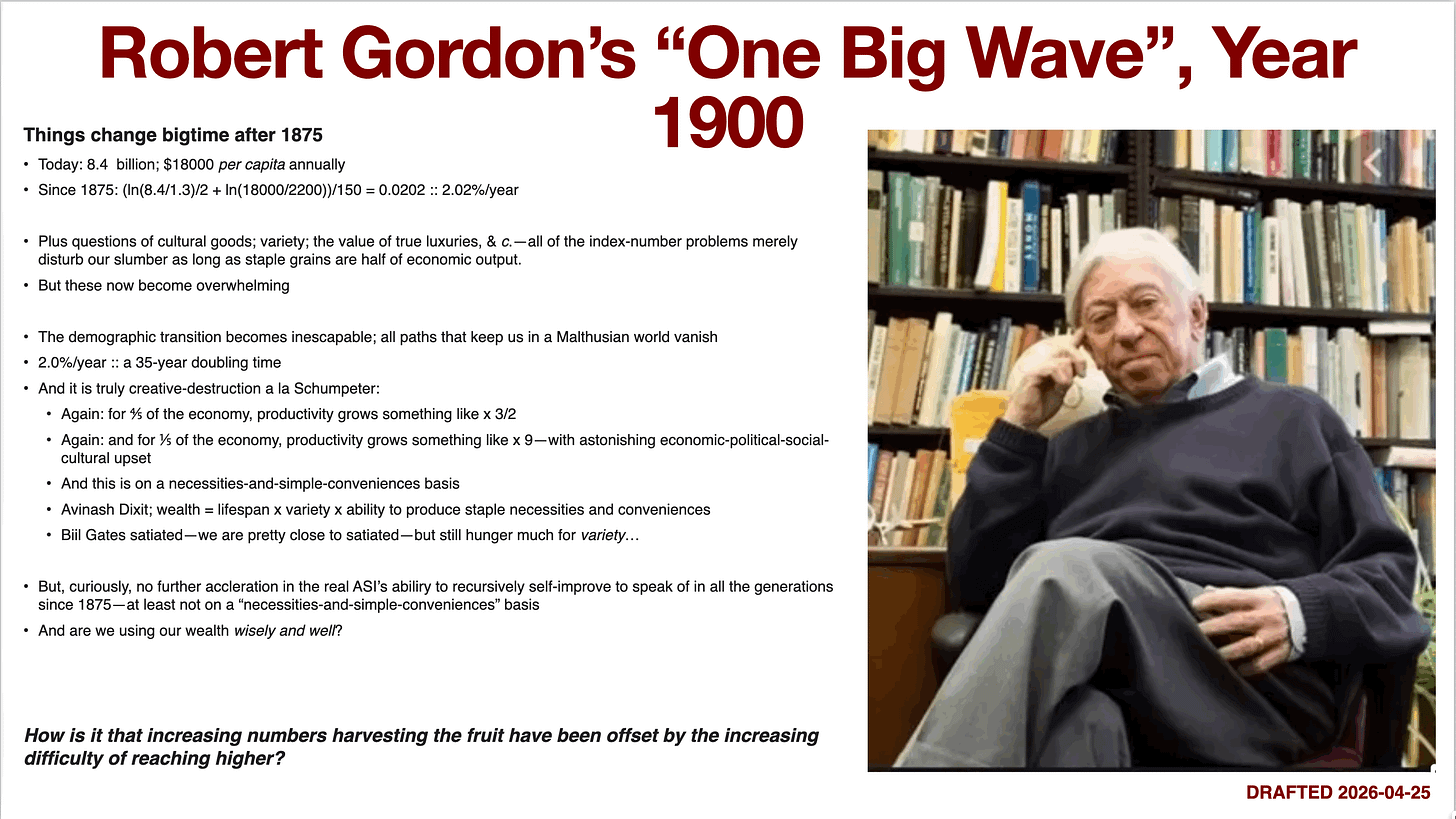
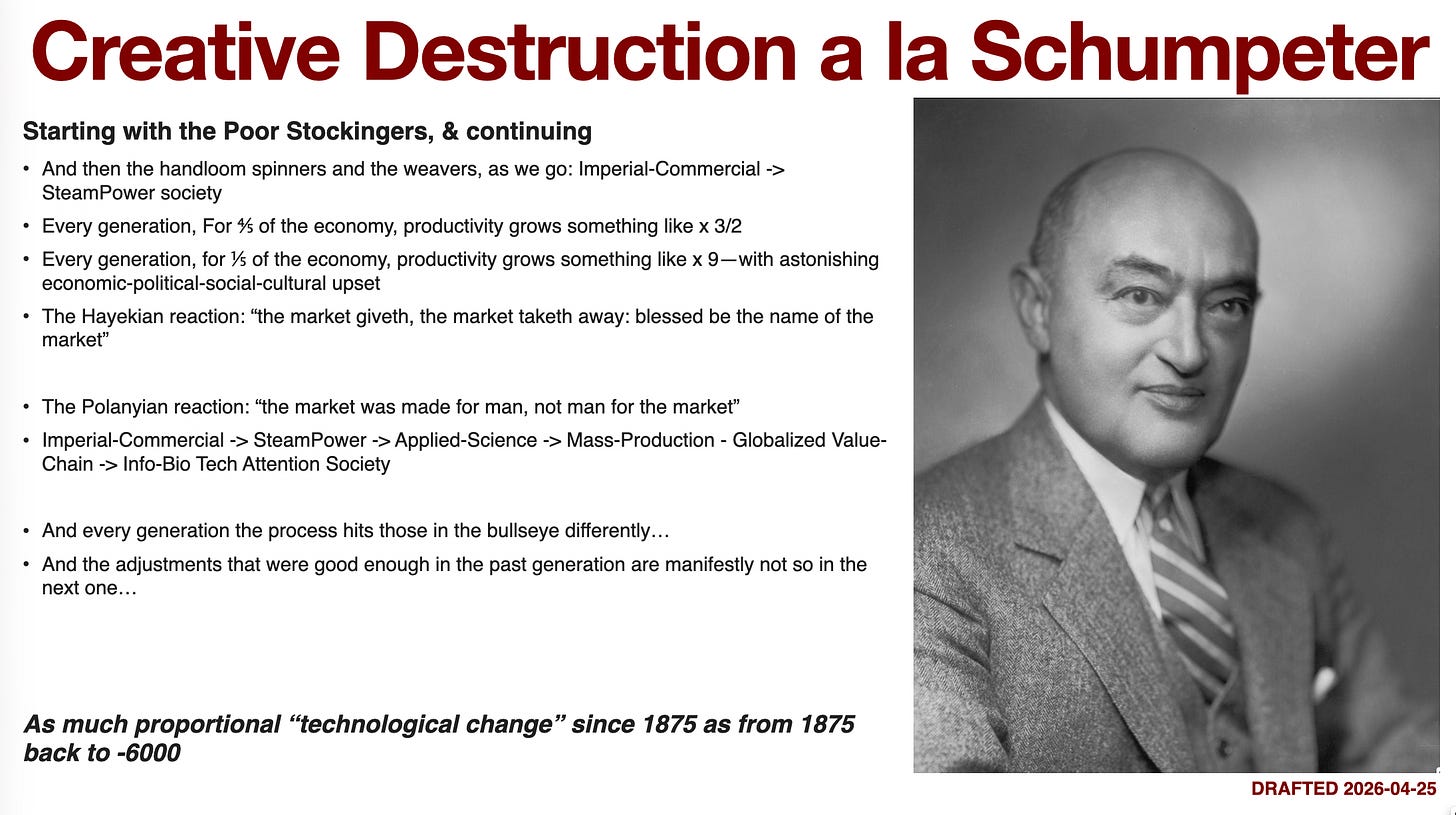
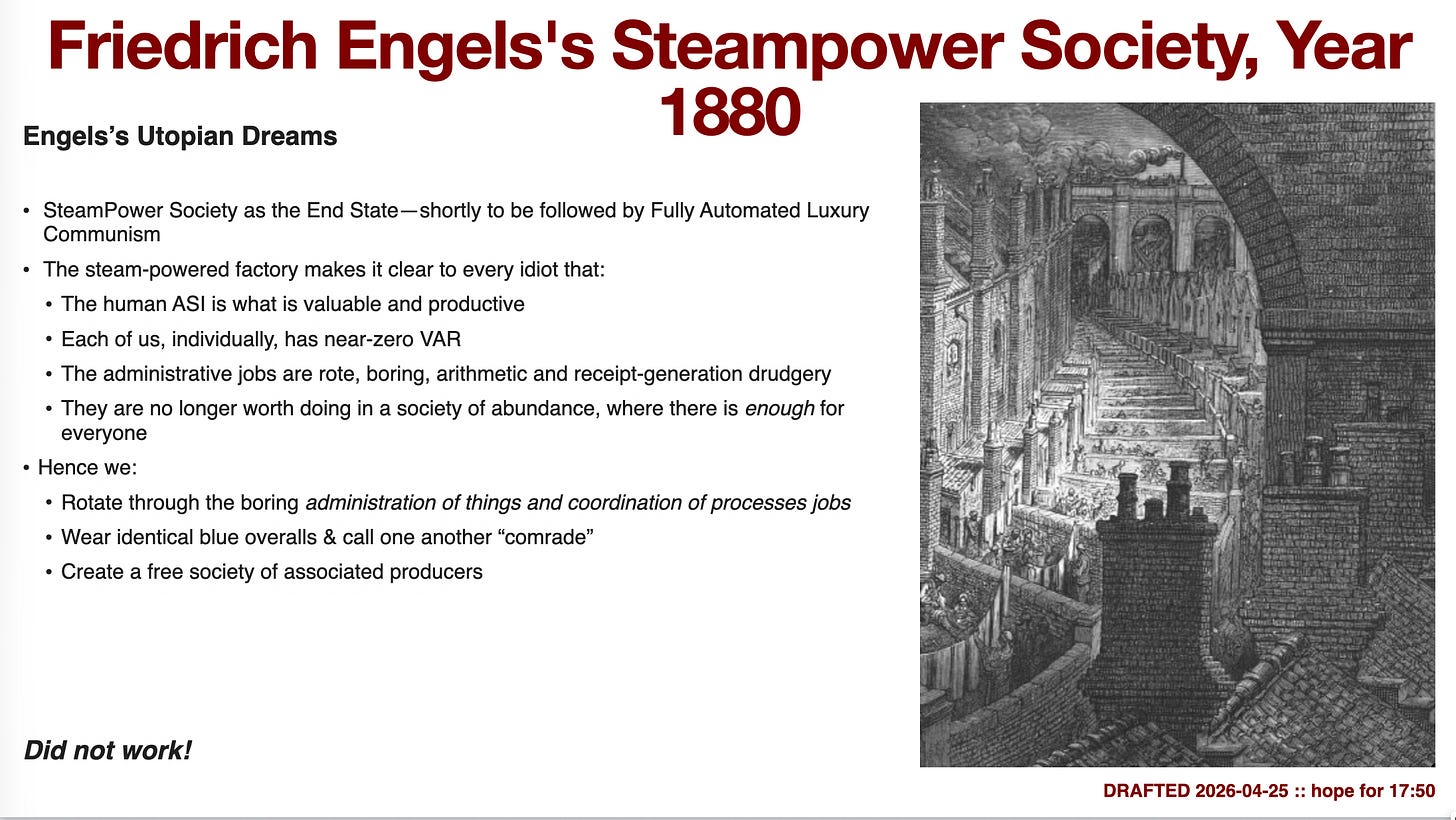
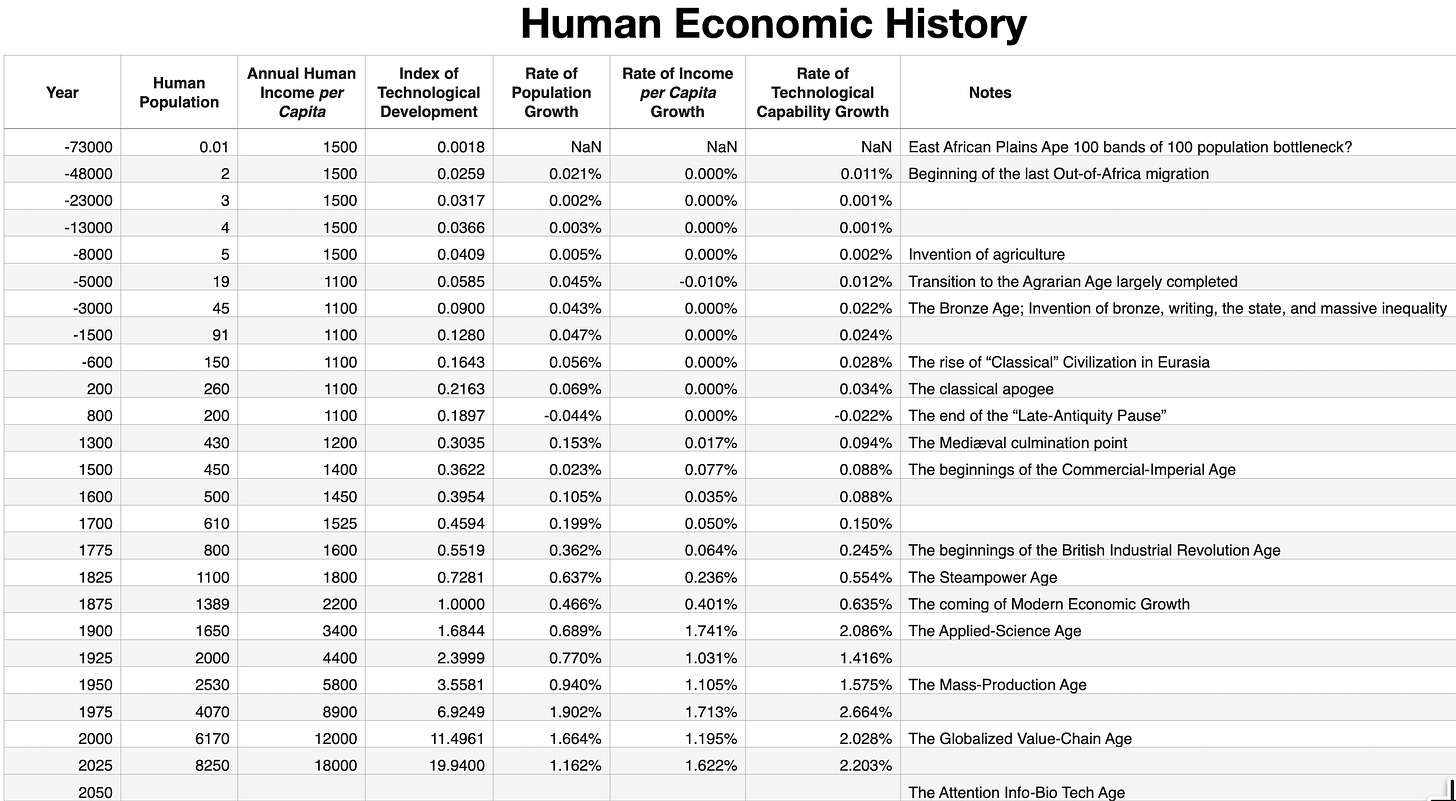
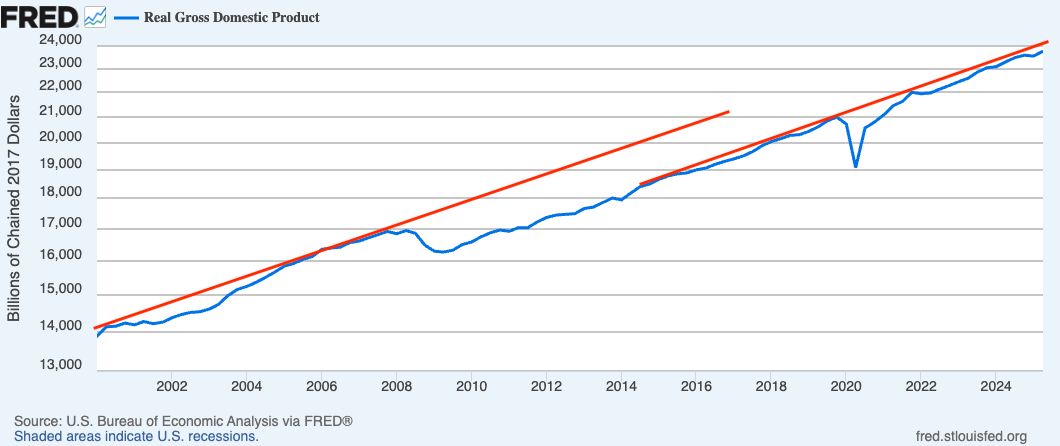
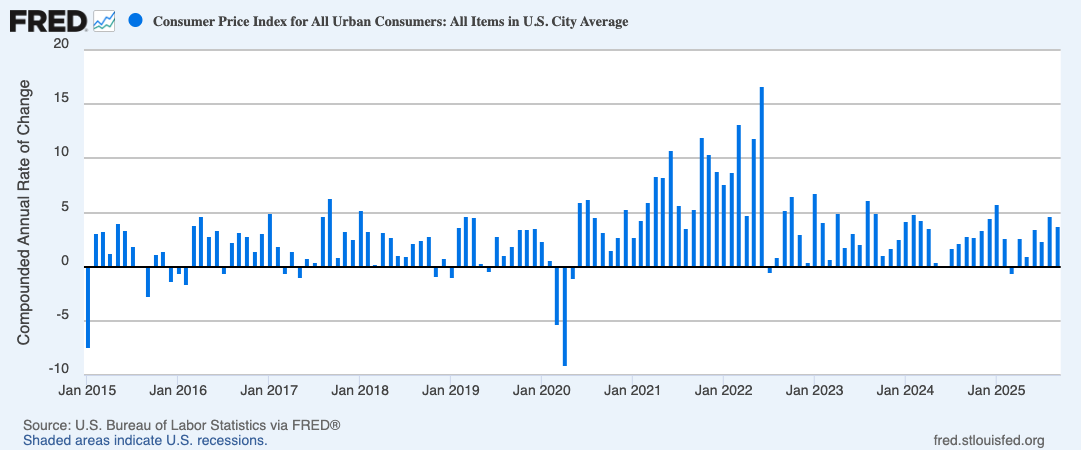
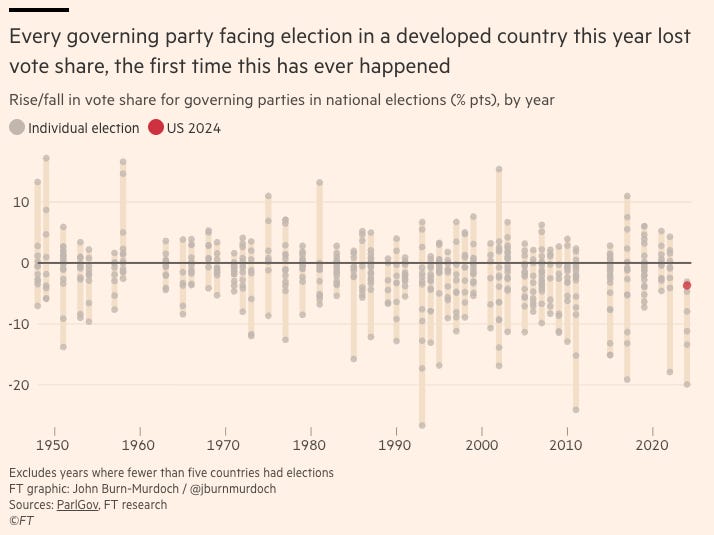
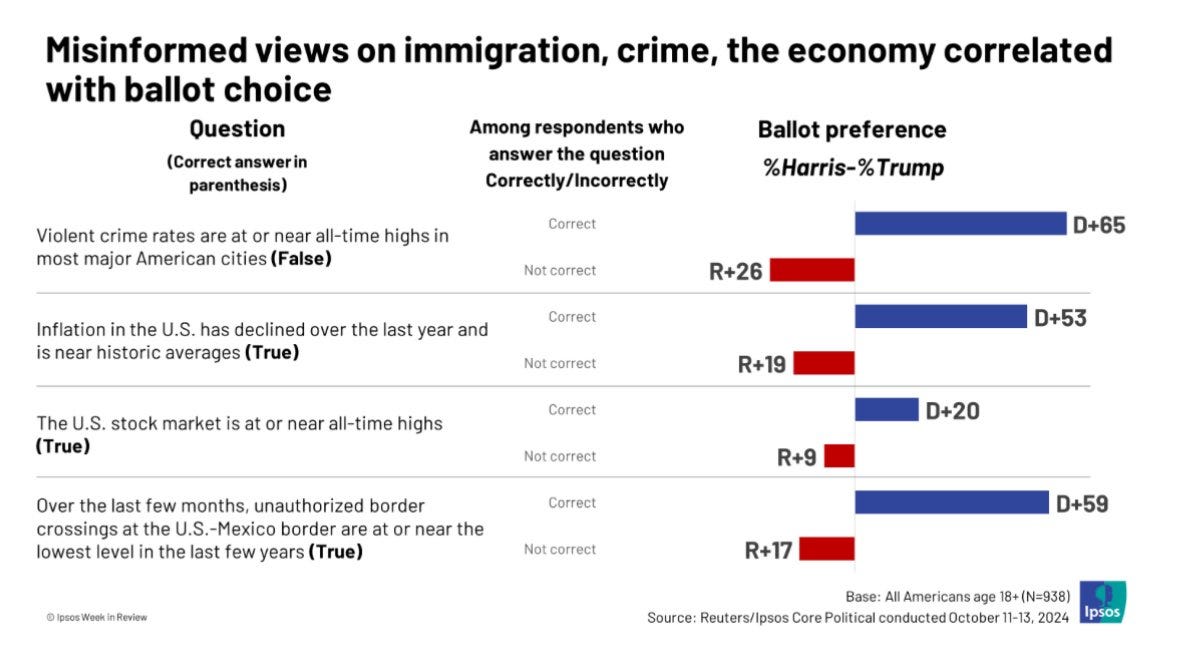
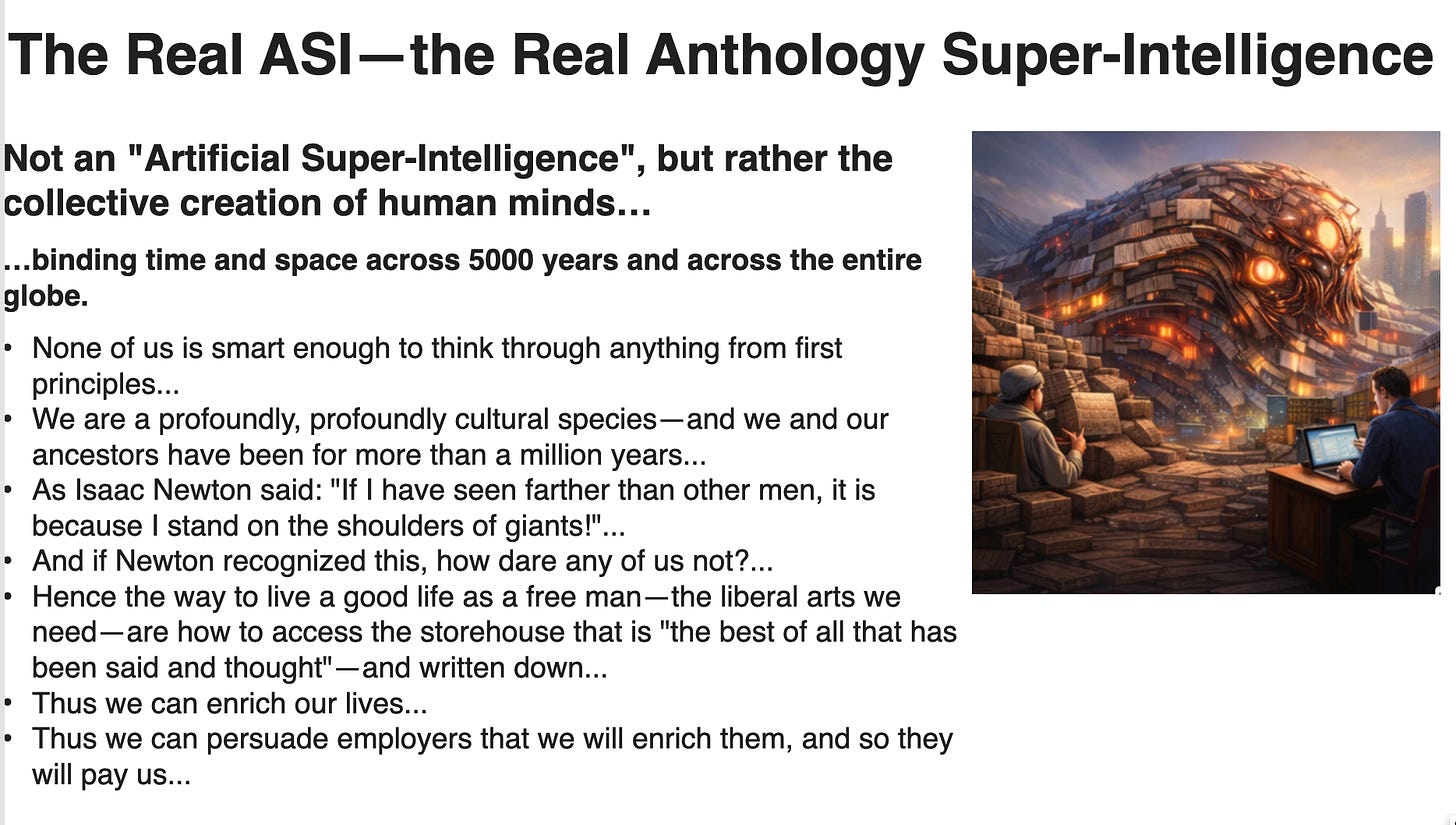
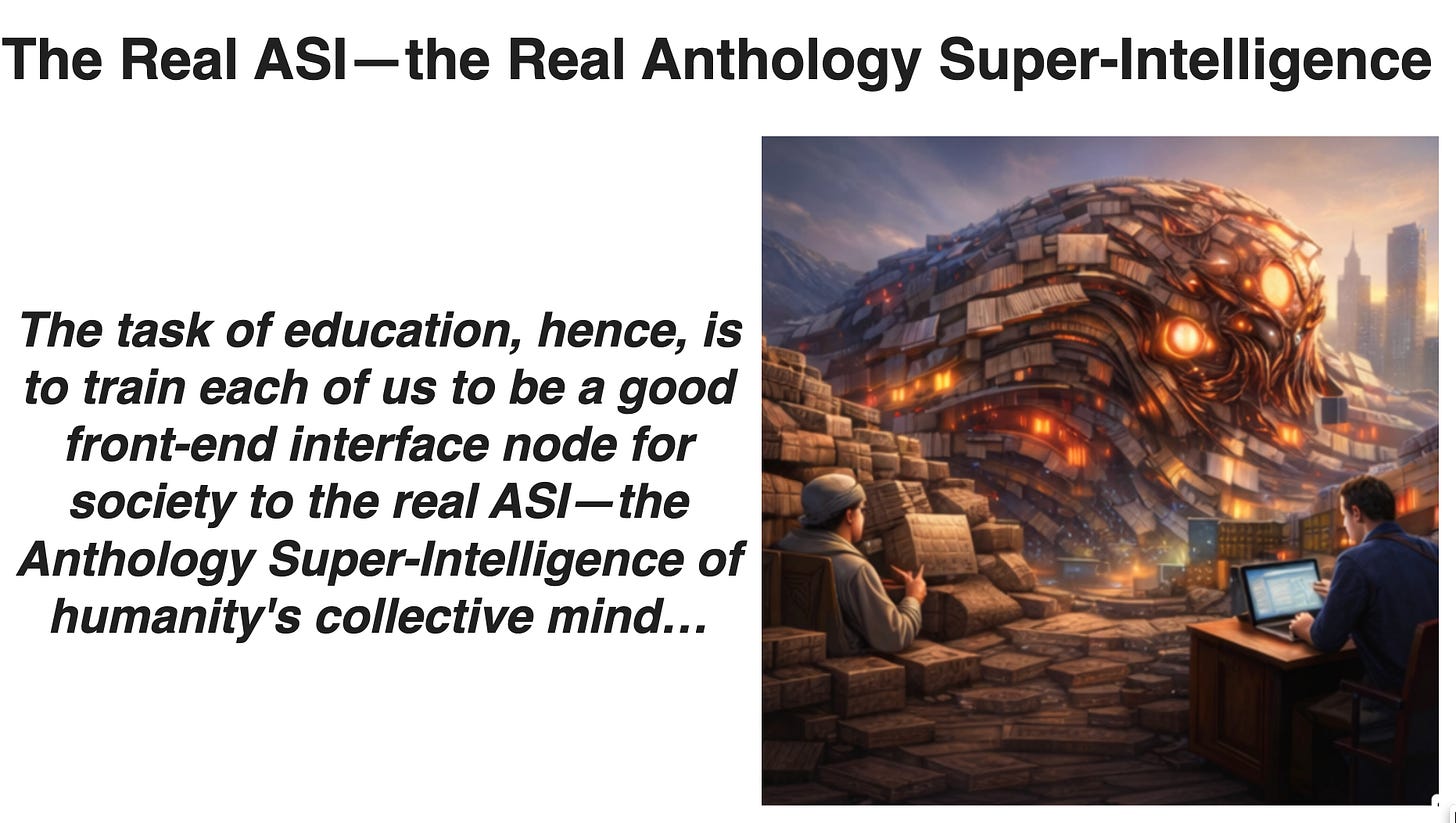
This is DeLong's home turf - the spine of *Slouching Towards Utopia* and his 2026 Hicks Memorial Lectures. The throughline is a quantitative framework for very-long-run growth: his "index H" of deployed technological capability, the Malthusian trap that swallowed pre-1500 progress into population rather than living standards, and the discontinuous 1870/1875 break onto Kuznets's ~2%/year path where roughly one-fifth of the economy is leveled and rebuilt every generation. He insists civilization runs on a division of labor far exceeding any legitimate authority's reach (the "Globalization Problem"), that the agrarian age was a "society of domination," and that humanity's real superpower was never individual genius but the collective "anthology intelligence" built from cumulative culture. Stage theories, deep prehistory, and the contingency of the modern growth miracle recur throughout.
DeLong reads the 1848 chapter of Harold James's Seven Crashes to argue that the failed Revolutions of 1848 nonetheless produced the institutional foundation of the modern world—and wishes James's book had existed before he wrote Slouching Towards Utopia, since it motivates his 'pseudo-classical semi-liberal Belle Epoque order.' The 1840s polycrisis (potato famine, disease, financial collapse, doctrinaire laissez-faire) exposed the ancien regime's political economy; though the revolutions were crushed, elites did not attempt the post-1815 reactionary clock-rollback. Instead, channeling di Lampedusa's Leopard ('if everything is going to stay the same, everything has to change'), modernizers like Napoleon III (Credit Mobilier, the Cobden-Chevalier free-trade treaty) and Bismarck (social insurance alongside anti-socialist repression, railroads, the gold standard) engineered adaptive governance that harnessed market energies and Schumpeterian creative destruction while preserving elite hierarchy. DeLong calls the resulting 1871-1914 order 'pseudo-classical' because it was brand-new rather than time-honored, and 'semi-liberal' because it rested on inherited hierarchy and concentrated property as much as on freedom. This produced Keynes's 'economic El Dorado,' whose interconnections also made it fragile, ending in 1914; yet its multilateral, central-bank-anchored statecraft was partly resurrected after WWII.
The failed Revolutions of 1848 paradoxically produced the institutional foundations of the Belle Époque by forcing European elites to recognize that preserving their position required modernizing the economic order rather than rolling it back. Drawing on Harold James's *Seven Crashes: The Economic Crises That Shaped Globalization*, DeLong argues that the 1840s polycrisis — famine (the Irish potato blight, which Amartya Sen would call a man-made famine driven by doctrinaire laissez-faire), grain riots in Germany and France, financial collapse, and epidemic disease — destroyed the credibility of the *ancien régime*'s political economy without destroying the regimes themselves. Old orders regained control, but unlike after Napoleon's defeat in 1815, they did not attempt to roll the clock back.
Instead, elites quietly absorbed the lesson encapsulated in *The Leopard*'s Tancred: "If everything is going to stay the same, everything has to change." What followed in the 1850s and 1860s was adaptive governance, not reaction. James describes figures like Napoleon III and Bismarck as "modernizers who built a world in conformity with a new logic" — one that harnessed market energies and Schumpeterian creative-destruction to sustain elite authority while transforming its material basis.
Napoleon III pioneered "Bonapartist" economic statecraft: he created the Crédit Mobilier to mobilize savings for infrastructure, negotiated the 1860 Cobden-Chevalier free-trade treaty with Britain, and tied economic modernization to social control. Bismarck suppressed radical socialism while building the blueprint for modern welfare states through social insurance schemes, and unified Germany through railways, tariffs, and financial modernization alongside "blood and iron." Neither was a genuine classical liberal; DeLong labels the resulting order "pseudo-classical semi-liberal" — pseudo-classical because it was brand new despite claiming ancient authority, and semi-liberal because it gloried in hierarchical subordination and concentrated property ownership in a hybrid old-landed-aristocracy/new-industrial-plutocracy class.
By the 1870s this order produced the Belle Époque (1871–1914), which Keynes in *The Economic Consequences of the Peace* called an "economic El Dorado" — the gold standard (adopted widely from Britain's 1844 initiation) anchored international finance; tariff walls fell; the Great Exhibition of 1851 celebrated industrial progress; capital flowed from London, Paris, Berlin, and Vienna to Buenos Aires, Bombay, and New York. New institutions — limited liability corporations, expanded central bank functions, public banks, stock exchanges — mediated rising capitalism rather than leaving it unchecked. The institutional turn catalyzed by 1848 was, DeLong argues, what made this possible.
The contradictions proved fatal: gold-standard interconnectedness transmitted panics transnationally; imperial competition intensified after the 1880s; Social Darwinism replaced religious justifications for inequality; labor movements demanded redistribution; and the shift from Steampower Society to Applied-Science Society (the Second Industrial Revolution) destabilized what had been dynamic equilibrium. In 1914 the system collapsed. Yet its legacy persisted — Keynes himself in 1919 urgently called for restoring the Belle Époque order, warning that failure would bring "that final civil war between the forces of Reaction and the despairing convulsions of Revolution." Elements survived into the post-World War II liberal order: multilateralism, managed globalization, central banks, the New Deal synthesis. The pragmatic, semi-liberal, adaptive statecraft born of 1848's fears, DeLong concludes, is part of the lineage that has made the modern world function better than it otherwise might — and today's debates about globalization's winners and losers and populist backlash are distant echoes of the same dilemma Napoleon III and Bismarck faced.
DeLong reflects on his Berkeley American economic history course, arguing there is no single Grand Narrative for the U.S. economy but thirteen distinct episodes/facets (frontier conquest, slavery, mass production, New Deal, Silicon Valley, neoliberal collapse, etc.) that should function as a 'filing cabinet' of historical analogies. Drawing on Dan Davies and Machiavelli, he frames history's value as a cheap library of mental models to riffle through, and asks how to design an exam that trains students to build that analogy-generating index. A useful pedagogical and methodological reflection on American economic exceptionalism and the practical use of history.
American economic history resists a Grand Narrative — and embracing that mess is the honest approach, leaving students with an archive of arresting analogies to draw on between 2025 and 2075.
The course resolved into thirteen facets: frontier conquest-settlement; slavery and Jim Crow; the shift from resource frontiers to education, industrial, and technological frontiers; American dominance over Second Industrial Revolution technologies; immigration; the transformation of women's opportunities through feminism; the mass-production economy; the New Deal political-economic order that managed and distributed its fruits; the rise of Silicon Valley; the rise and fall and rise of inequality with fewer channels for upward mobility; the shift to a globalized value-chain economy alongside the shift from the New Deal to the Neoliberal Order; the 2008–2010 legitimacy crash of that Neoliberal Order; and the coming Attention/Info-Bio-Tech economy.
Across all thirteen, exceptional America — exceptional for good (a Shining City on a Hill) and ill (a dystopian Valley of Hinnom) — was shaped by the interaction of four forces: situation, markets, institutional arrangements, and government policies. The authority for treating history as practically useful goes back to Thucydides, who wrote that his account would be "a treasure for all time" for those who seek a true picture of the past and what human nature makes likely to recur.
Dan Davies supplies the cognitive mechanism: history furnishes ready-made mental models to rifle through cheaply, and the constraint that they describe things that actually happened exercises rudimentary quality control. The shared frustration — also Machiavelli's, whose *Discourses on Livy* was written for precisely this reason — is that people accumulate the stories but never build the index. The piece closes by asking what exam design would compel students to do that indexing work.
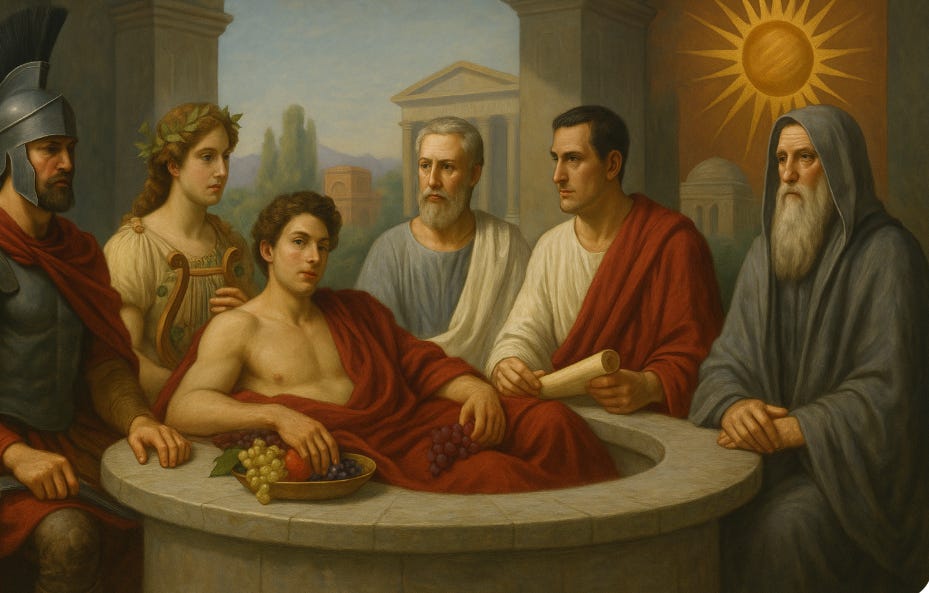
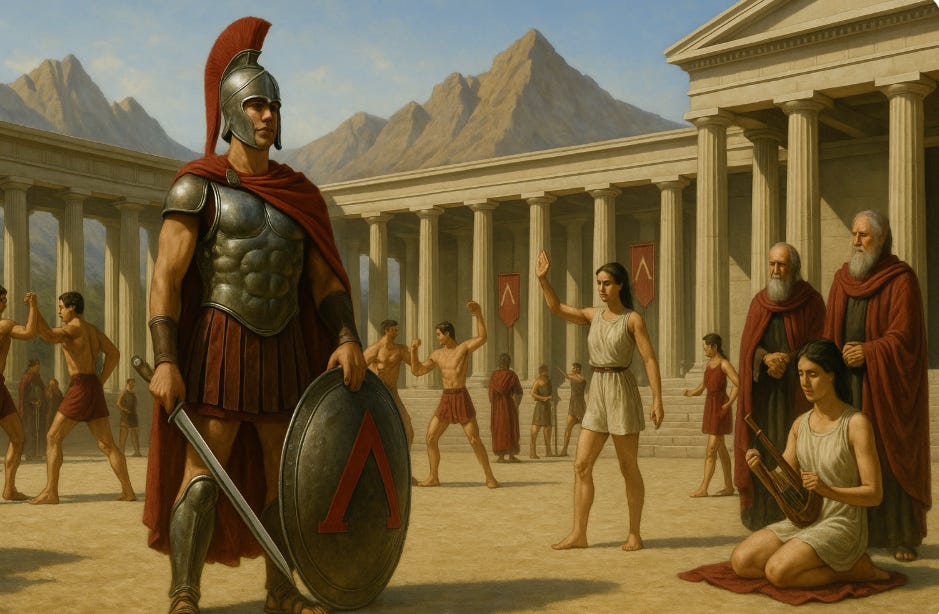
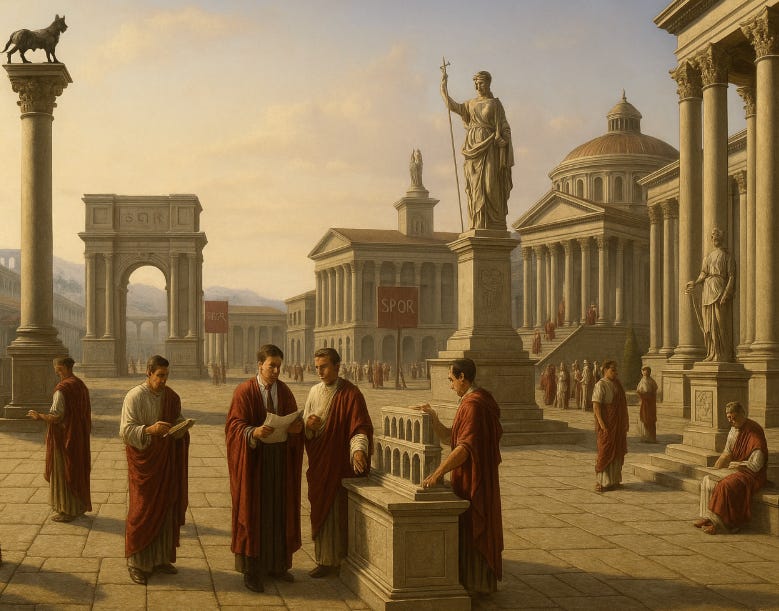
DeLong's draft lecture notes survey the classical archetypes of 'utopia' and ask what economic growth has to do with any of them. He distinguishes five Greek and Roman reference points—Sparte (rigid martial order), Arkadia (pastoral simplicity), Sybaris (abundant luxury), the Athenai (free speech and democratic contest), and Roma (collective civic purpose)—stressing that each historical original barely resembled the ideal its name now evokes; they survive as 'intellectual shorthand' for aspirations: order, simplicity, pleasure, freedom, purpose. He deliberately uses estranging Greek spellings to make these figures strangers. He then runs through the dystopian inversions (Zamyatin, Huxley, Orwell) and Rand's Galt's Gulch as a gated 'utopia' for self-styled Übermenschen. The economic core: scarcity precludes utopia, but once 'enough' is reached, visions fracture between Promethean technological mastery (which slides into Sybaritic hedonism) and an Epicurean-ascetic management of desire (Le Guin's Dispossessed). He centers Keynes's 'Economic Possibilities for Our Grandchildren'—prosperity as necessary but not sufficient—and Aristotle's suspicion of wealth-getting beyond household need. His closing thesis: with science and humanity as an 'anthology intelligence,' the problem of scarcity is easier to solve than the problem of what we truly want.
Prosperity is a necessary but insufficient condition for utopia — economic growth solves the problem of scarcity more readily than it resolves the deeper question of what human beings actually want. DeLong organizes his lecture around six classical archetypes that serve as intellectual benchmarks for competing visions of the good life, none of which were ever fully realized even by the societies whose names they bear.
Sparte stands for collective order — equality enforced through terror, slavery of the Helots, militarism, and state-approved music, a vision Platon's _Politeia_ reproduces but which DeLong calls dystopia mislabeled as utopia: the sheer scale of Sparte's society-of-domination over its helot population required it to be what it was or vanish, infecting the quality of life even for its elite. Arkadia, romanticized by Virgil from a marginal, mountainous Greek backwater whose peace owed more to geographic irrelevance than philosophy, stands for pastoral sufficiency — utopia as contentment rather than surplus. Sybaris is the anti-Sparta: abundant luxury and commerce, a vision where wealth is not sin and the good life is enjoyed rather than endured. The city of the Athenai embodies the classical liberal ideal: _parrhesia_ (fearless candor as civic duty), a marketplace of ideas, democracy for male citizens. But Athens was also an empire — "a soft society-of-domination within the walls, but a hard one outside"; grain for Athenian bread arrived from Thrake, Makedonia, Sikelia, and Skythia worked by serfs and slaves, and Sokrates was executed by the same democracy that idealized free speech. The Roman Republic adds a fifth type: collective self-government through the churn of assemblies, senatorial deliberations, and magistracies, though the Comitia Centuriata weighted votes so heavily by wealth — 18 centuries for senators and knights, 80 for first-class infantry, 90 for classes two through five, one century for the propertyless proletarii — that voting stopped once any measure reached 97 centuries, and outcomes mostly served a handful of aristocratic families. The Roman Empire provides a sixth, distinct archetype: cosmopolitan order under the Pax Romana, roads, aqueducts, and the rule of law integrating peoples and markets from Britain to Egypt, from Spain to Syria. Edward Gibbon judged the Antonine Dynasty — the Empire's third — the era when "the condition of the human race was most happy and prosperous." For those who distrust the messiness of collective self-government, this cosmopolitan stability is itself the utopian prize.
Six views of “utopia”SparteArkadiaSybarisThe city of the AthenaiRoma
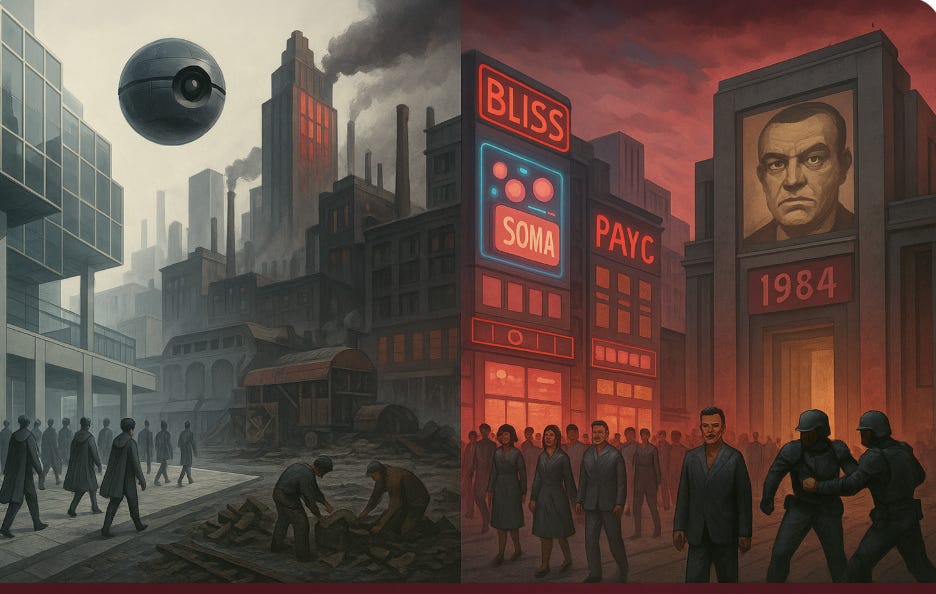
The dystopian literary tradition runs these archetypes to their extremes: Zamyatin's _We_ takes Spartan order into mechanized nightmare; Huxley's _Brave New World_ delivers Sybaritic pleasure via genetic caste and psychological conditioning; Orwell's _1984_ deploys the technological state purely for power preservation. Ayn Rand's Galt's Gulch in _Atlas Shrugged_ inverts the collectivist dystopias — utopia as gated community for self-defined "makers," a neo-Nietzschean fantasy DeLong notes is seductive to Silicon Valley libertarians. Marx, despite protesting otherwise, offered a utopian horizon: classless and stateless communism where "the free development of each is the condition for the free development of all." Crucially, this was supposed to arise _inevitably_ from the dialectic of history — making Lenin's and Stalin's attempt to shortcut that process the founding error; like Sparte, Marxist utopia became justification for dystopia. Post-WWII Western Europe produced the most plausible variant: social democracy — universal healthcare, high wages, low inequality — DeLong's "Thirty Glorious Years." Silicon Valley updates Sybaris for Moore's Law (UBI, life extension, AI-augmented minds) but risks deepening inequality rather than dissolving it.
Dystopias…We, Atlas Shrugged, Brave New World, & 1984
On whether growth bridges or bars the way to utopia, DeLong identifies several positions. The Promethean-technological view, traceable to Francis Bacon's ambition to effect "all things possible," treats material satisfaction as only a beginning. Le Guin's _The Dispossessed: An Ambiguous Utopia_ (1974) takes the opposite stance: her anarchist moon-colony engineers its citizens to treat acquisitiveness as vice and find satisfaction in sufficiency and solidarity, arguing happiness requires managing desires downward rather than satisfying them upward. Keynes, in "Economic Possibilities for Our Grandchildren" (1930), envisions prosperity liberating humanity from the "money-motive" so it can pursue "the art of life itself," but warns against abandoning accumulative mentality prematurely: "for at least another hundred years we must pretend to ourselves… that fair is foul and foul is fair; for foul is useful and fair is not." Aristoteles of Stagire adds a class note: a gentleman must understand economic affairs well enough to manage his household, but excessive interest in commerce and money-lending is "narrowing" and "not in accordance with nature" — a detailed account of such matters "would be crude."
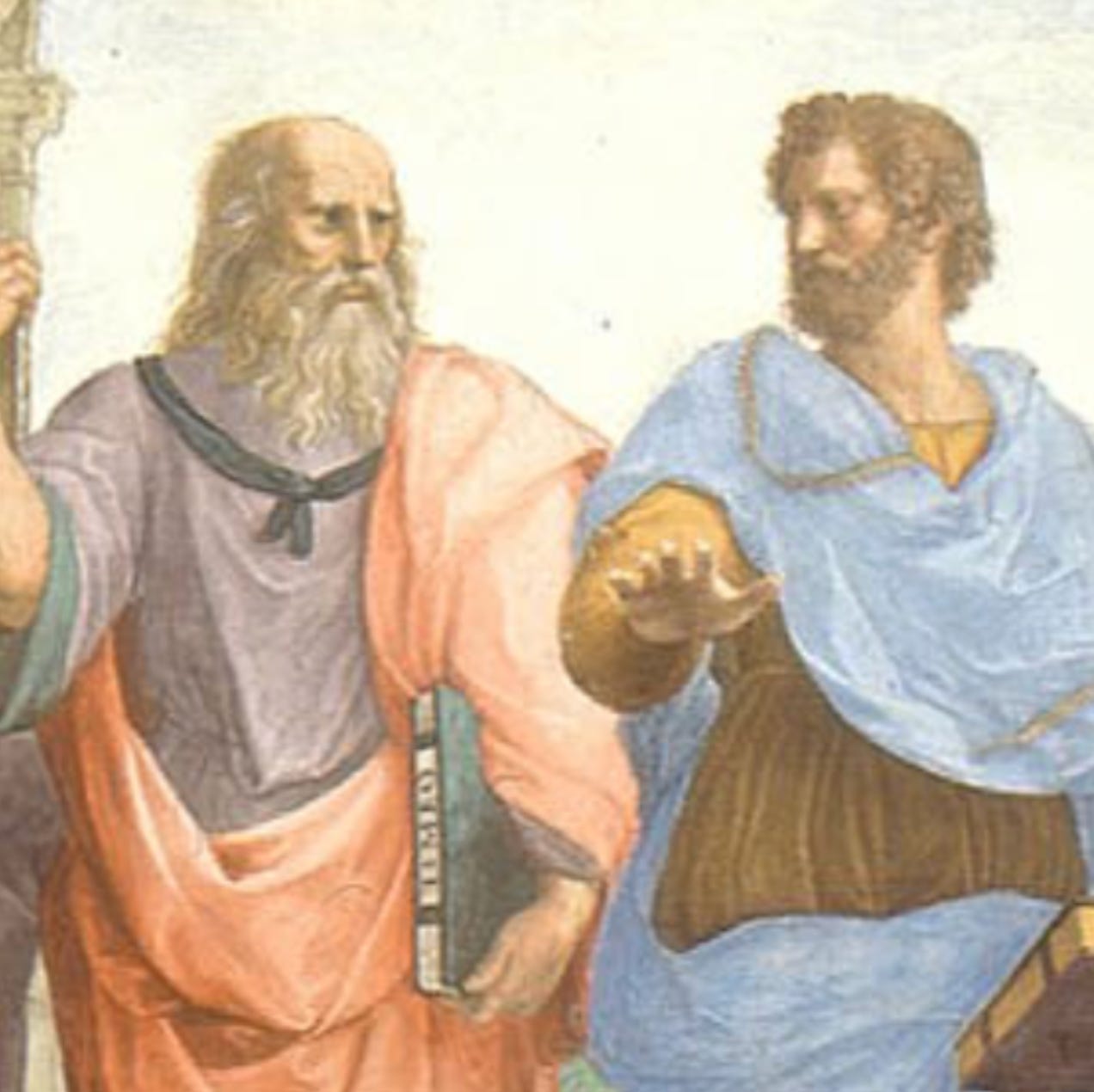
LeGuin: The DispossessedLoppy & Maynard...Platon of the Athenai and Aristoteles of Stagire
The conclusion opens onto a final, unresolved reference. Sparte for order, Arkadia for simplicity, Sybaris for pleasure, the city of the Athenai for freedom, Roma for collective purpose — each stands for a different vision of the good life, even though none was ever realized in this "Fallen Sublunary Sphere." And then DeLong names one more: Yerushalayim — "the city of peace, or is it the foundation-stone, the bedrock, of dusk, of work finished, of the time of rest, of things completed?" The real lesson, he suggests, is that with the scientific method and humanity as an anthology intelligence, scarcity is the easier problem. The harder one is knowing what we truly want.
A complete lecture essay tracing how post-1500 merchant and industrial capitalism transformed slavery into racialized, market-driven plantation brutality, and how 'race' was invented as the ideological device to reconcile slavery with Enlightenment rights. DeLong argues the prime beneficiaries were middle-class consumers of cheap sugar, cotton, and tobacco, and closes with Claudia Goldin's striking point that the Civil War cost more than enough to have bought every enslaved person's freedom plus land. Self-contained and substantive.
Racial ideology was not a cause of plantation slavery but its post-hoc rationalization: once capitalism and Enlightenment notions of individual freedom coexisted, societies needed a new justification for an institution that was simultaneously becoming more profitable and harder to defend, and race provided it.
The underlying logic is ancient. Whenever a wealthy core demands commodities, peripheral actors who cannot compete through exchange turn to coercion. Skythian horse-lords enslaved Black Sea populations to grow wheat for Athens in the 5th century BCE; British and Northern U.S. industrial economies did the same with cotton in the American South after Native Americans were expelled. As slavery scaled from household to absentee plantation, its brutality intensified structurally: owners who never saw the violence wrote terse letters demanding higher returns, and the overseer role selected for maximally brutal individuals -- the only kind who could thrive in a position of unlimited extraction with zero accountability.
Before 1500, slavery was treated as misfortune -- a matter of circumstance, not essence. Aristotle's claim that some non-Hellenes were "slaves by nature" was a rhetorical flourish, not dominant ideology. But as contractual, market-oriented societies valorized individual freedom and equality, the old logic of enslavement-by-circumstance became unsustainable. Societies faced a choice: eliminate slavery, as Britain eventually led the world to do, or double down. Because profitability was growing -- amplified a further order of magnitude by SteamPower -- most doubled down, constructing racial ideology to declare Africans inherently suited to bondage. The principal beneficiaries were not plantation owners but middle-class consumers in industrial economies whose cheap sugar, cotton, and tobacco rested on that violence.
The American bill came due in the Civil War (1861-1865): 400,000 Union dead, 300,000 Union maimed, 300,000 Confederate dead, 250,000 Confederate maimed. Lincoln's Second Inaugural captured the moral arithmetic: "every drop of blood drawn with the lash shall be paid by another drawn with the sword." Claudia Goldin calculates the war's treasure cost exceeded what it would have taken to purchase every enslaved person at peak 1860 market prices and grant each freed family 40 acres plus a mule -- yet Reconstruction's failure returned 5,000,000 people to caste serfdom for a century anyway.
DeLong endorses Marcella Alsan's economic-history finding that the tsetse fly is a deep determinant of African underdevelopment: by killing cattle, it foreclosed the plow, draft power, manure, carts, and roads, and thus surplus-generating agriculture, political centralization, and dense states—while raising slavery's incidence and the share of farm labor done by women. Using a climate-based Tsetse Suitability Index as an instrument, Alsan finds large effects within Africa and none outside it; her counterfactual Africa has half the indigenous slavery and nearly double the precolonial population. DeLong sets the stage with the Bantu expansion and the African Humid Period, then raises the worry that frames the piece: the African-development literature is overcrowded with equally elegant, equally instrumented grand causal claims—Acemoglu-Johnson-Robinson's institutions, Sachs's malaria, Nunn's slave trade, Engerman-Sokoloff's factor endowments—yet 'history can only be truly causally explained once,' so they cannot all be right. He flags how index construction can leak unobserved channels and calls causal inference 'a controlled hallucination,' while still judging Alsan correct.
The tsetse fly—not colonialism, not geography in any simple sense—is the deepest structural cause of Africa's pre-colonial institutional divergence. That is the thesis of Marcella Alsan's 2015 *American Economic Review* paper, which DeLong summarizes and critically engages. By killing cattle while leaving wild game unharmed, the fly rendered plow agriculture impossible across vast swathes of the continent, collapsing the entire biotechnological package—dung fertilizer, wheeled transport, road networks, surplus agriculture—that underlay state formation everywhere in Eurasia.
Alsan's instrument is a TseTse Suitability Index (TSI) built from entomological, laboratory, and climate data. Its explanatory power holds only within Africa—outside the continent the same index predicts nothing, satisfying a core placebo test. A one-standard-deviation rise in TSI is associated with: a 22-percentage-point drop in the likelihood an ethnic group had large domesticated animals; 7-point drop in plow use; 9-point drop in intensive cultivation; 19.5-point rise in female agricultural labor share; 12-point rise in slave use; 8-point drop in political centralization; a 46% reduction in population density by 1700; and a 28% drop in intensive farming. Simulated counterfactuals produce a continent with half the indigenous slavery and nearly double the pre-colonial population. The TSI also negatively predicts current economic performance even after controlling for colonizer legal-origin effects.
DeLong finds the thesis "completely convincing" in its core mechanism—cattle absence → no plow → no surplus → no centralized states → heightened vulnerability to enslavement and colonial extraction. The Bantu expansion, beginning around the Benue River Valley borderlands (southeastern Nigeria/western Cameroon) after c. −1500, spread agriculture and iron but was blocked or deflected wherever tsetse habitat prevailed; trypanotolerant breeds like the N'Dama opened a "green highway" through the Lake Victoria–Tanganyika–Malawi corridor to the Cape.
Three methodological worries temper the endorsement. First is the literature-crowding problem: Acemoglu-Johnson-Robinson's institutions thesis, Sachs's malaria hypothesis, Nunn's slave-trade channel, Engerman-Sokoloff's factor endowments, and now Alsan's trypanosomal barrier all claim the deep determinants of African poverty, all wielding convincing instruments—but history can only be causally explained once and there is only so much variation to distribute. Second is a leakage problem distinct from that: Alsan constrains the model to route high-TSI effects through the cattle mechanism, but the model may instead be capturing the effects of the slave trade, of malaria, or of the absence of navigable rivers—correlated unobserved variables for which the model offers no separate outlet, so the computer attributes their influence to the cattle story by default. Third is TSI construction bias: the choices embedded in building the index—temperature and humidity thresholds, spatial smoothing, historical climate imputation—are inevitably informed by the researcher's prior knowledge of outcomes, making it not hermetically sealed from what it is meant to instrument. DeLong calls even the best causal inference "a controlled hallucination." The next research frontier he identifies: tracing how tsetse-driven institutional absences shaped the specific form and intensity of colonial extraction—forced labor, cash-crop regimes, and infrastructure investments falling hardest on societies without centralized states or surplus agriculture—and how that path runs forward to present-day inequality.
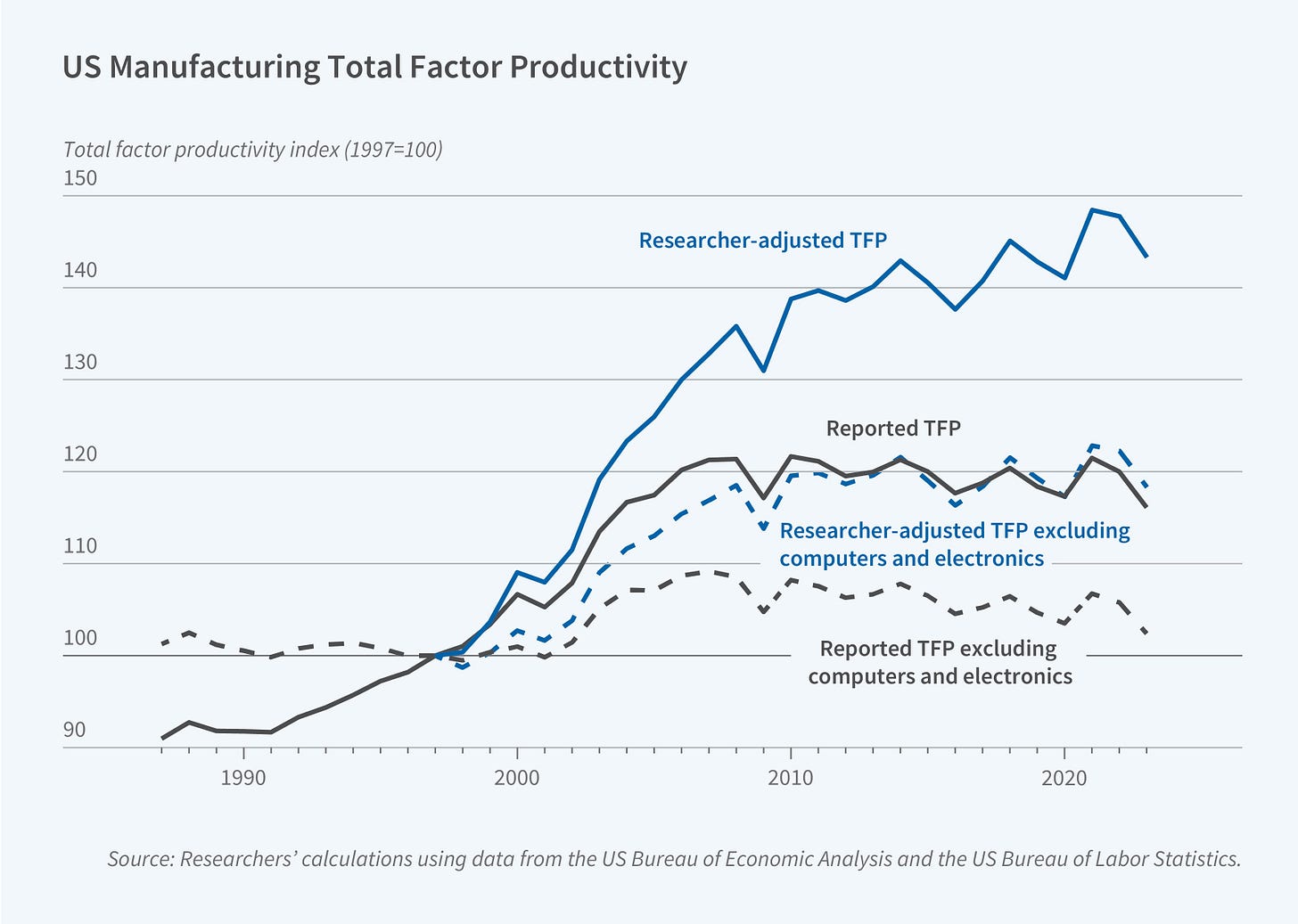
Drawing on a McKinsey Global Institute study showing fewer than 100 'standout' firms drove two-thirds of productivity growth across Germany, the UK, and the US, DeLong argues that technological dynamism is led by a handful of risk-taking firms rather than gentle diffusion, and that the US wins by reallocating resources toward the vanguard. He builds a policy case for subsidizing standout firms' expansion, grounded in the firm as imperfect satisficing bureaucracy (Kodak, Boeing) rather than rational profit-maximizer. A substantive industrial-policy argument with original framing of the firm's five roles.
Productivity growth in leading economies is not a story of broad diffusion but of extreme concentration: a handful of audacious firms drag the rest into a more productive future, often unwillingly. McKinsey Global Institute research led by Jan Mischke tracked 8,300 companies across Germany, the UK, and the US in retail, automotive and aerospace, travel and logistics, and computers and electronics between 2011 and 2019. Fewer than 100 "standout" firms account for two-thirds of the sample's total productivity growth. The US had 44 standouts against only 14 stragglers; the UK ran 30 to 25; Germany had 13 standouts and 16 stragglers. Crucially, the US derived half its productivity growth from reallocating labor away from stragglers toward standouts — a resource-reallocation channel the other two economies underused.
Before drawing implications, DeLong introduces a five-role taxonomy of the modern large firm: (1) technology-forcer — agent that introduces and diffuses new technologies; (2) production-network orchestrator — key node enabling value creation across suppliers, customers, and partners; (3) investment vehicle — repository for capital seeking returns; (4) casino roulette wheel — arena for speculation on future prospects; (5) meme-stock symbol — pledge of econo-cultural allegiance. The first three are clearly useful; the fourth is a toll extracted from those with the gambling drive; the fifth is merely weird. DeLong argues the technology-forcer role is the most important for growth — and the MGI study makes it appear even more crucial than he had previously appreciated. Canonical examples: Ford's assembly line, IBM's mainframe dominance, Intel's microprocessor revolution, Toyota's lean production, Apple's smartphone market creation, and Amazon's relentless pursuit of logistics efficiency. None are incremental improvements; all are seismic sector-level shifts forced on competitors.
The wage-spillover channel from these firms to broader society is, however, weak — vanishingly small at the level of the individual firm. The bulk of gains accrue within the firm to its workers and shareholders. The mechanism that matters is competitive emulation: when a standout pioneers a new model, rivals must imitate or die. Walmart's supply-chain mastery in the 1990s forced Target and Kmart to transform retail logistics; Japanese just-in-time manufacturing became the global standard. Here the social returns to innovation can far exceed the private returns captured by the pioneer.
The standard economist's case against intervention — that the firm internalizes its social returns and no externality exists — rests on the assumption of rational profit-maximizing firms. DeLong rejects this as fiction. Firms are sprawling social systems riven with principal-agent problems, informational bottlenecks, and bureaucratic inertia. Kodak had every financial incentive to embrace digital photography by the 1980s yet failed because R&D and accounting operated at cross purposes. Boeing's short-run shareholder-value drive produced the 737 MAX debacle. The true foundation of the anti-intervention case, DeLong argues explicitly, is not profit maximization but a lack of state capacity to take a longer view than a satisficing firm under financial-market pressure — and that is a highly contingent claim.
Policy implications follow: subsidy should target standout firms — not only their innovation but their expansion — rather than spreading best practices among laggards. Silicon Valley's blend of public research funding, venture capital, and permissive regulation is a potential model. The US advantage over Britain and Germany reflects labor mobility, deep capital markets, and a culture tolerant of failure — not laissez-faire ideology alone. Europe's rigid labor markets and incumbent-preservation instincts inhibit standout emergence and scaling. DeLong closes by raising an open question he leaves unanswered: "And what about the laggard firms?" — signaling a known gap in the policy framework.
A lecture making 'property' and 'exchange' strange: the belief that something stays 'mine' when I'm not guarding it, and the leaps from possession to reciprocal gift-exchange to one-shot market trade to a fluctuating-price market economy, are contingent socially-constructed institutions rather than natural propensities. DeLong threads Doug Jones on handaxes, Adam Smith's truck-and-barter, and the decentralized-knowledge case for markets (valid only for rival/excludible goods, and silent on distribution), capped by Aristotle, Locke, Rousseau, and Engels on property. A reference-quality piece in his economic-history-of-institutions vein.
Property and exchange are not natural features of the world but invented social technologies peculiar to humans — and understanding their strangeness reveals why markets work and why they require constant institutional maintenance. The animating provocation is that "ownership" — the belief that something remains *mine* even when I am not present, growling over it — is cognitively bizarre, and that the further steps from ownership to reciprocal gift-exchange to one-shot arms-length market trade are each, in turn, another enormous and contingent leap.
Doug Jones's hypothesis locates the origin of property in the Acheulean hand axe, roughly 1,000–986 thousand years ago: you wouldn't make a labor-intensive tool and abandon it, nor tolerate the strongest individual simply seizing it. Some proto-notion of artifacts-as-personal-possessions must have emerged as a social relationship. Linguists supply corroborating evidence — possession language ("the estate *went* to Reginald") repurposes spatial-motion vocabulary for abstract social space, suggesting property concepts are built on neural machinery evolved for tracking physical location, a point supported by Carolyn Parkinson and Thalia Wheatley's 2013 neuroscience research and Barbara Tversky's *Mind in Motion* (2019).
Adam Smith identified a "propensity to truck, barter, and exchange" as the species-defining root from which the division of labor grows. Because no dog ever made "a fair and deliberate exchange of one bone for another," the capacity for negotiated reciprocal trade is, for Smith, uniquely human and the engine of modern prosperity. DeLong accepts the insight while pressing past it: calling it a propensity is description, not explanation, and EvoPsych "just-so stories" add little. More importantly, even granting the propensity, the remaining leaps are vast. Property itself sits light-years from gift-exchange; gift-exchange sits light-years from one-shot market trade; fixed "just price" markets sit light-years from a dynamic price economy where fluctuating prices are luck rather than exploitation. Each transition requires legal, political, and cultural institutions to uphold what is not a natural inevitability. Diana Gabaldon's *Outlander* — set thirty years before *The Wealth of Nations* and only one hundred miles north of Smith's Kirkcaldy — depicts a world of clan loyalty, aid, and robbery, not truck-and-barter.
Once assembled, the market system's power lies in decentralizing decision-making to actors with local knowledge no central planner could match. Markets work best for *rival and excludible* goods — where consumption is zero-sum and access can be gated by price. In those domains the coordination is real: property rights, contract enforcement, and price signals link farmers, manufacturers, and consumers into a productive web. But market outcomes reflect bargaining power and existing property arrangements, not justice — abundance is distributed by the rules of the game, which are themselves the products of history, law, and politics.
Four philosophers bracket the contested normative terrain. Aristotle (*Politics* II) defends private property as more productive than communal ownership while insisting it be used for the common good. Locke (*Second Treatise*) grounds property in labor and self-ownership — mixing one's effort with nature creates a right. Rousseau (*Discourse on Inequality*) calls property a "group societal hallucination" and the first enclosure act the founding crime of civil society. Engels (*Origin of the Family*) reads private property as a historical development intertwined with patriarchy and class domination — the overthrow of mother-right being "the world-historic defeat of the female sex." These traditions remain live contestants over what markets are and whether their distributional consequences deserve celebration or condemnation.
A full draft Harvard guest lecture sweeping from Gesher Benot Yaaqov tool-making through grain-importing classical Athens to post-1848 industrial divergence, framing all of human history around the 'Globalization Problem': civilization needs a division of labor that vastly exceeds any legitimate authority's reach, yet its gains are grossly uneven. A landmark, free-to-read synthesis of DeLong's economic-history project (the 'three Horsemen' of divergence, the post-1848 churn), with lasting reference value.
Humanity's superpowers — collaborative knowledge creation and division of labor — have driven globalization from stone tools to the assembly line, always distributing prosperity unequally and leaving a governance deficit no single authority can close. Since 1848, they have also produced perpetual social revolution, widening inequality, and existential risk.
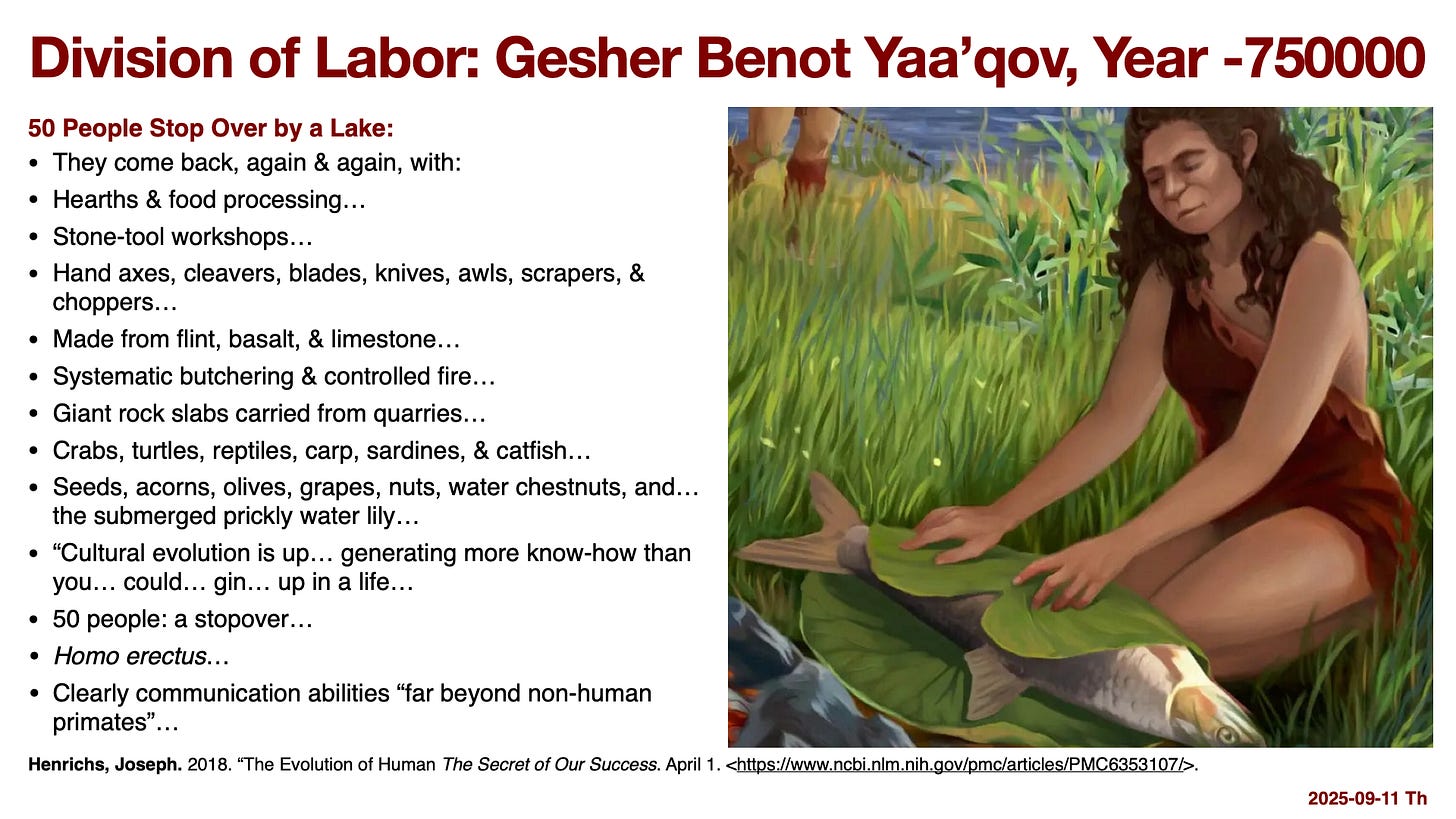
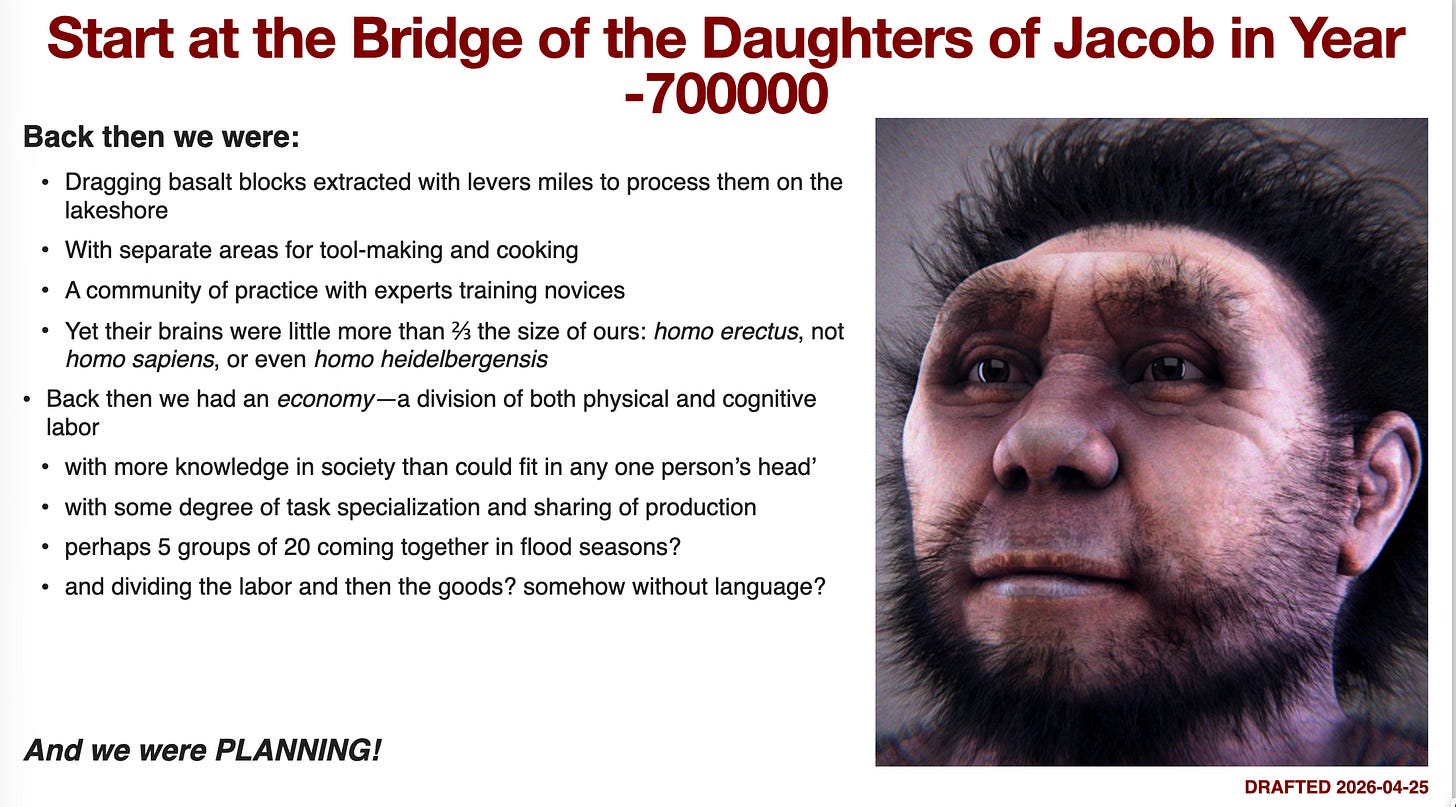
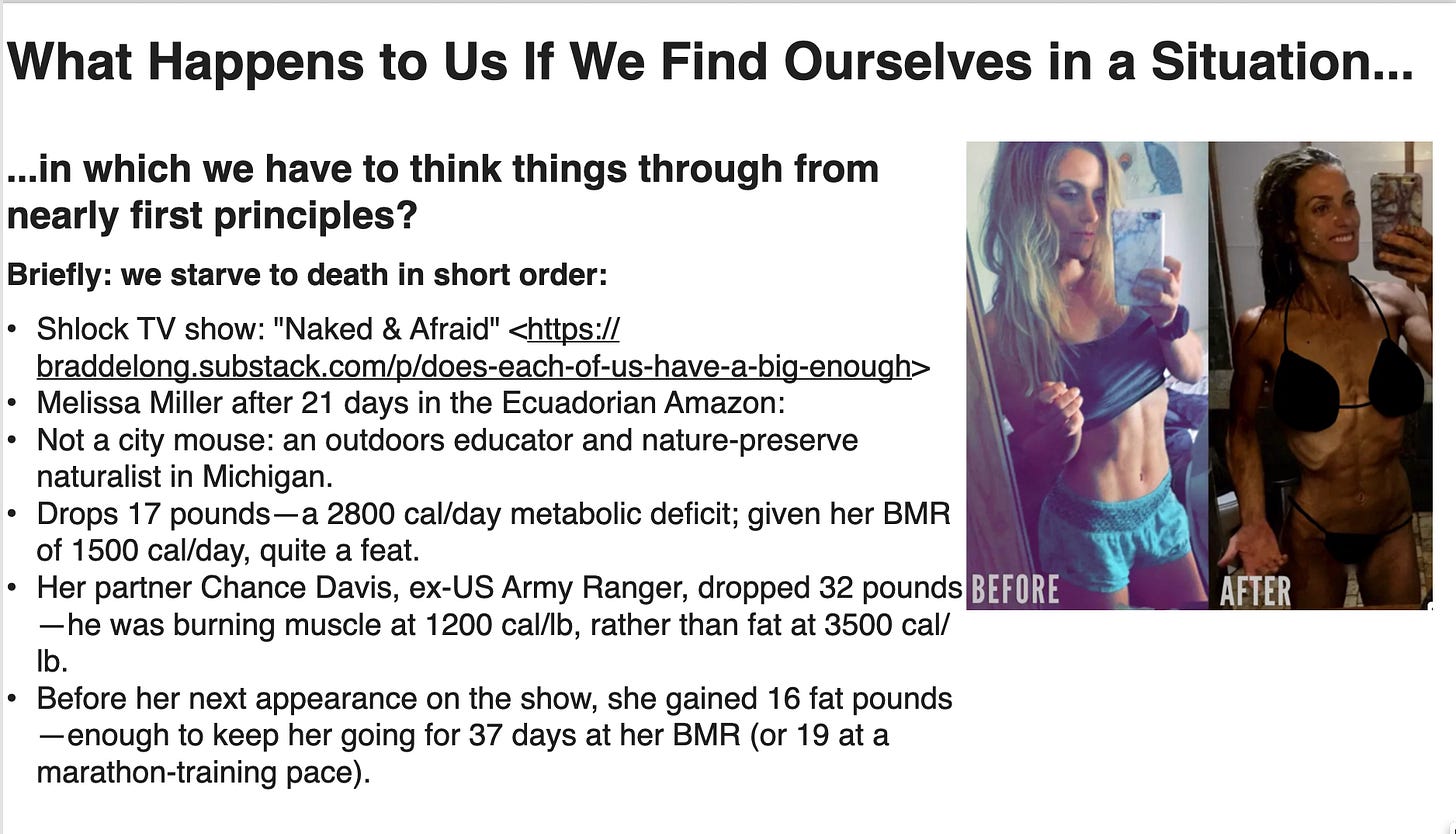
Stripped of civilization, homo sapiens fails: Melissa Miller on "Naked & Afraid" loses 17 pounds over 21 Amazon days at a 2,800-calorie daily deficit above her 1,500-calorie BMR. The superpower is cultural capital, visible 750,000 years ago at Gesher Benot Ya'aqov: ~50 homo erectus built fires, worked stone tools, and ate crabs, turtles, carp, sardines, acorns, and water chestnuts — each requiring distinct preparation — implying inter-generational knowledge transmission no other primate achieves.
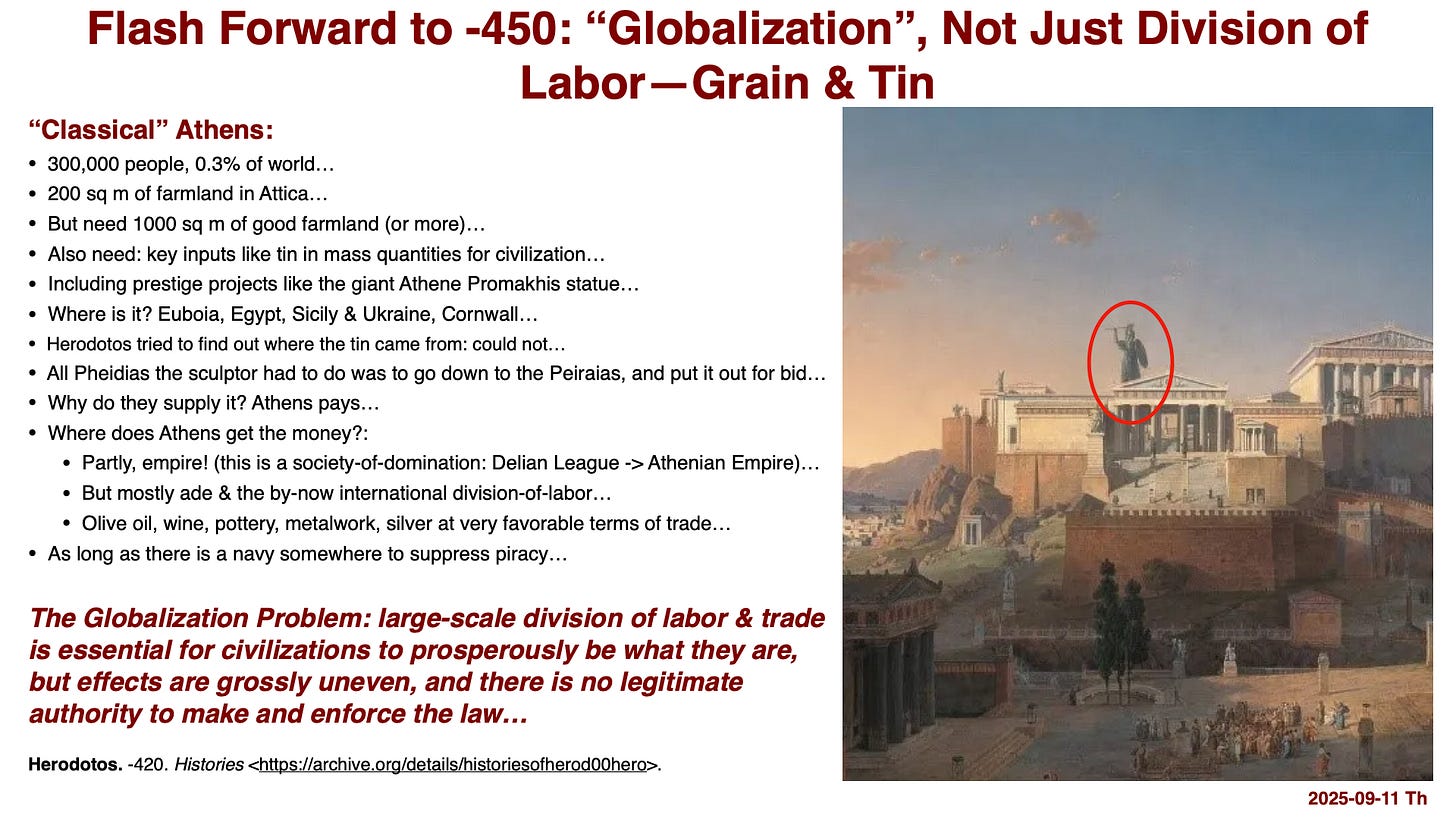
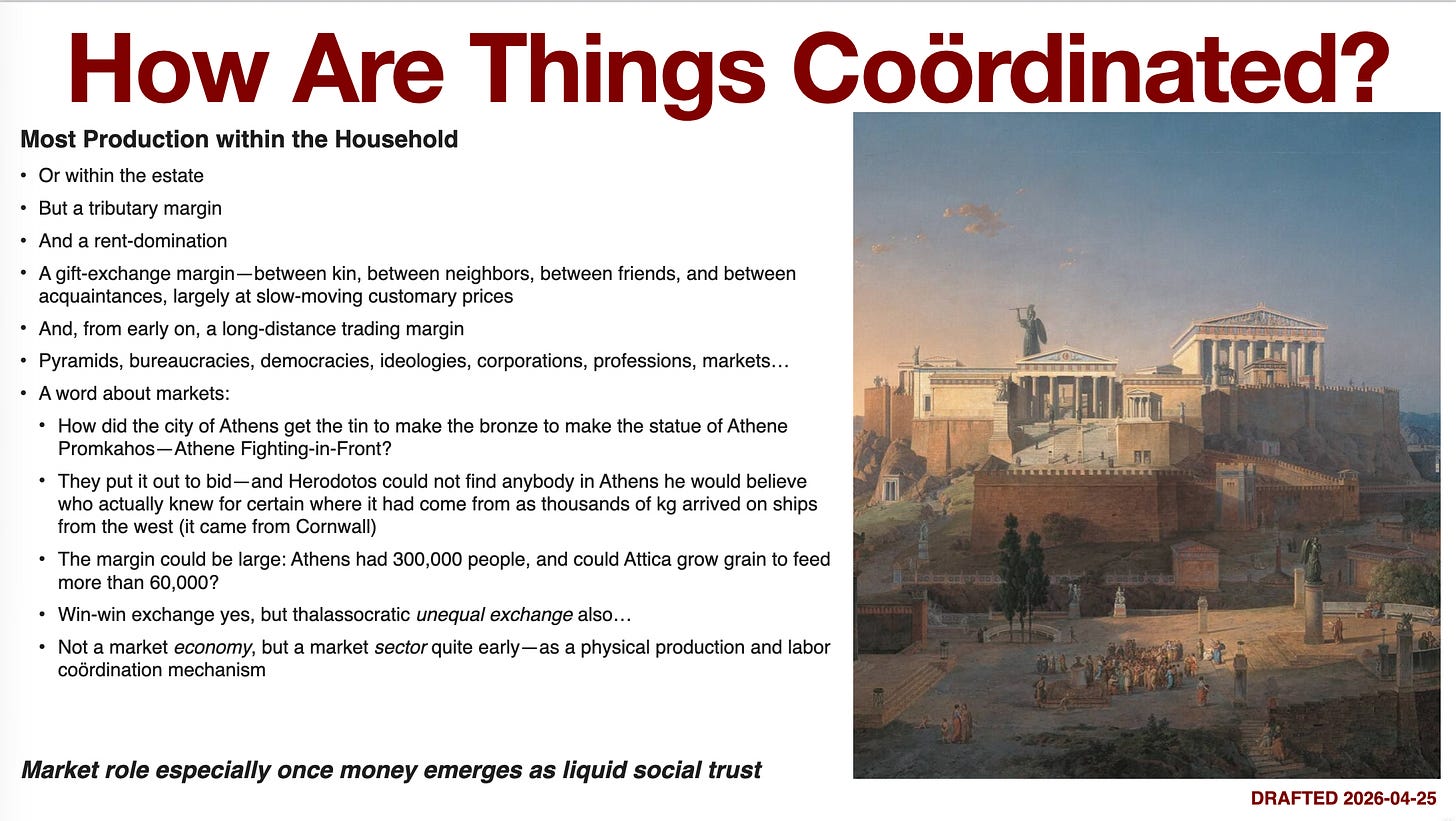
By 450 BC, Athens (300,000 people, 0.3% of global population) showed the Globalization Problem fully formed: Attica fed only 60,000; grain came from Euboea, Egypt, Sicily, and Ukraine. Pheidias sourced tin for the bronze Athena Promakhis by bidding at Piraeus — partly through Delian League tribute (alliance turned domination) but mainly through trade. Large-scale division of labor is essential to civilization but effects are grossly uneven (slavery in Ukraine, glory for Pericles), and no authority can enforce law across that span.
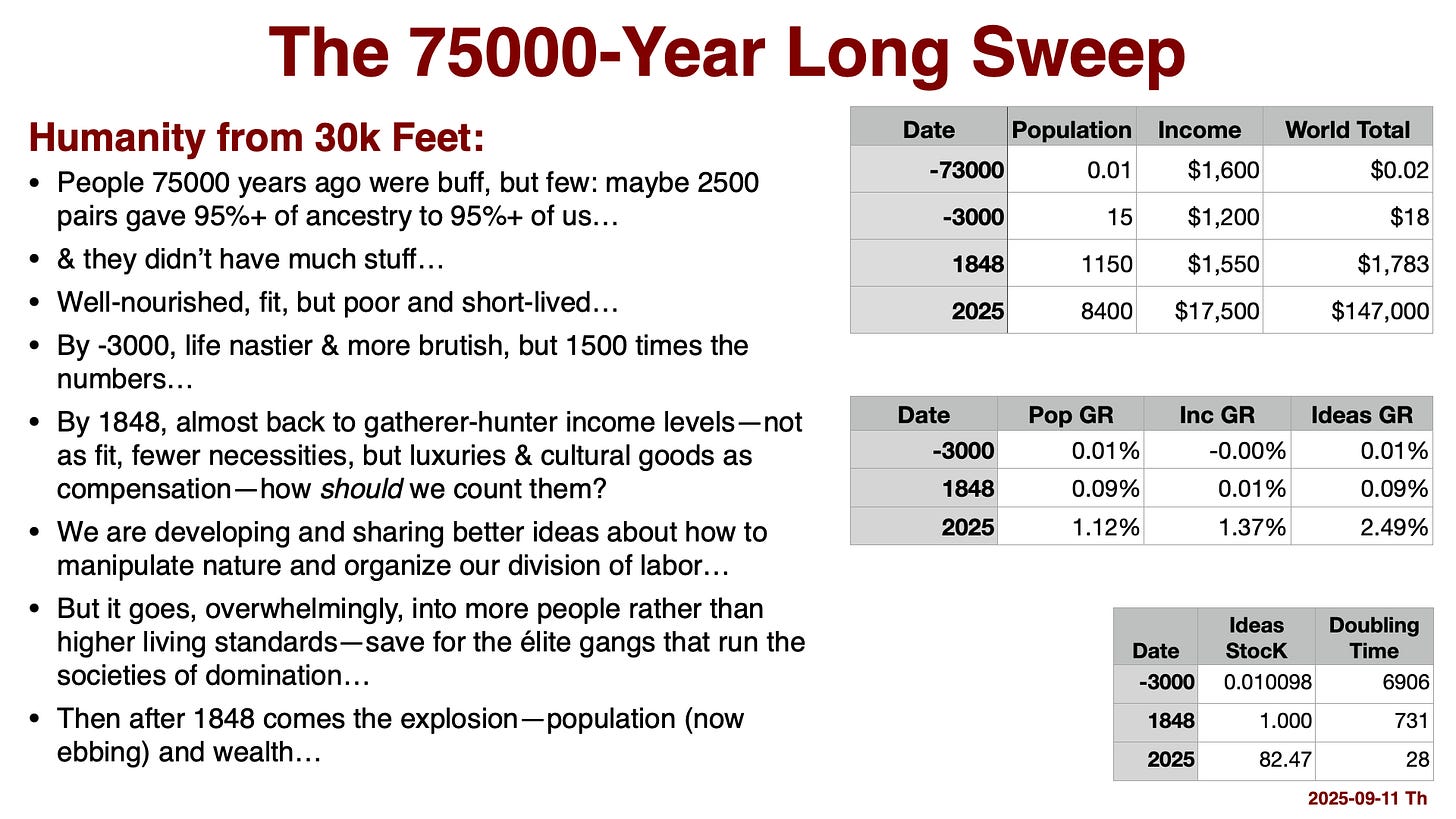
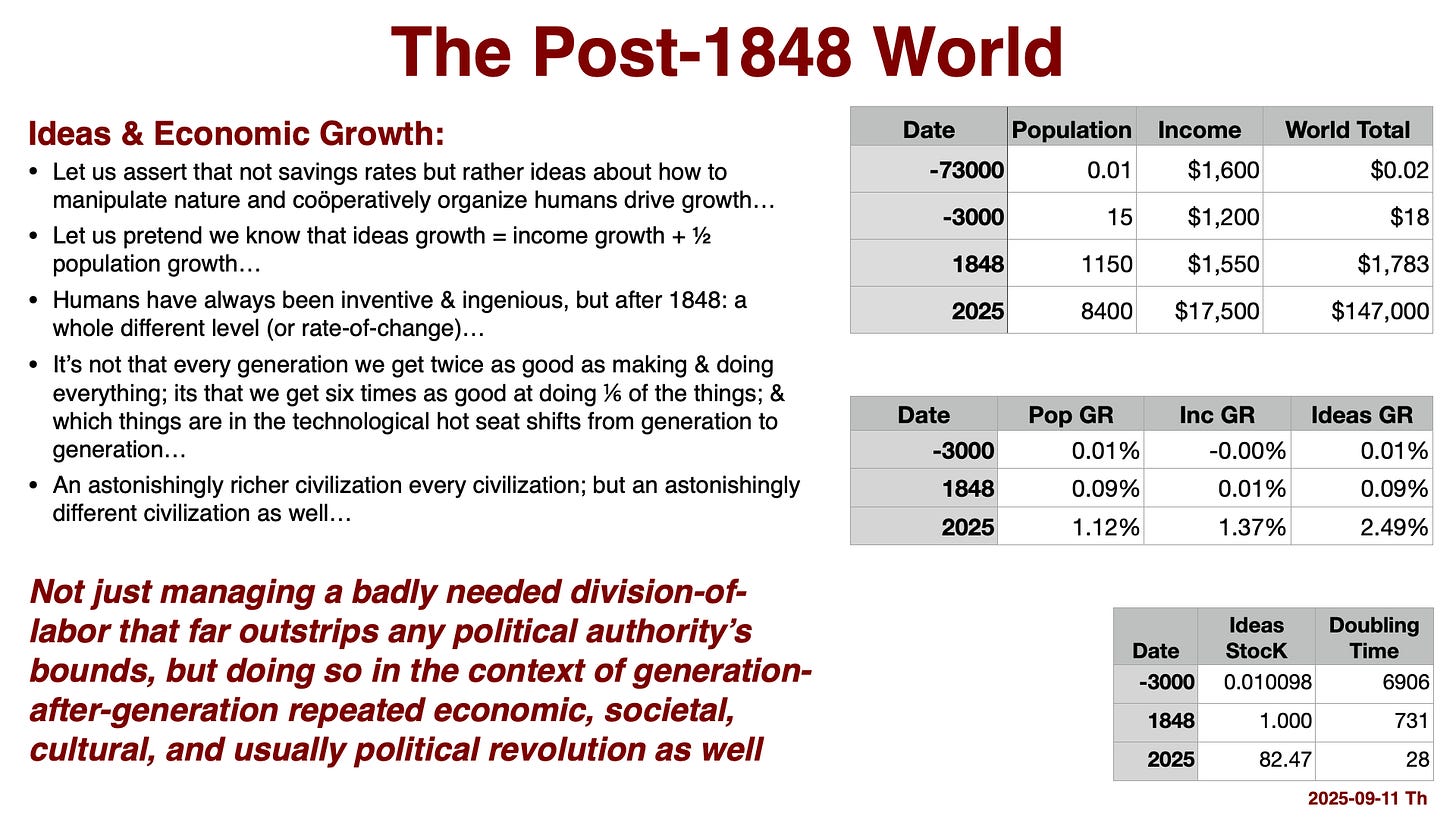
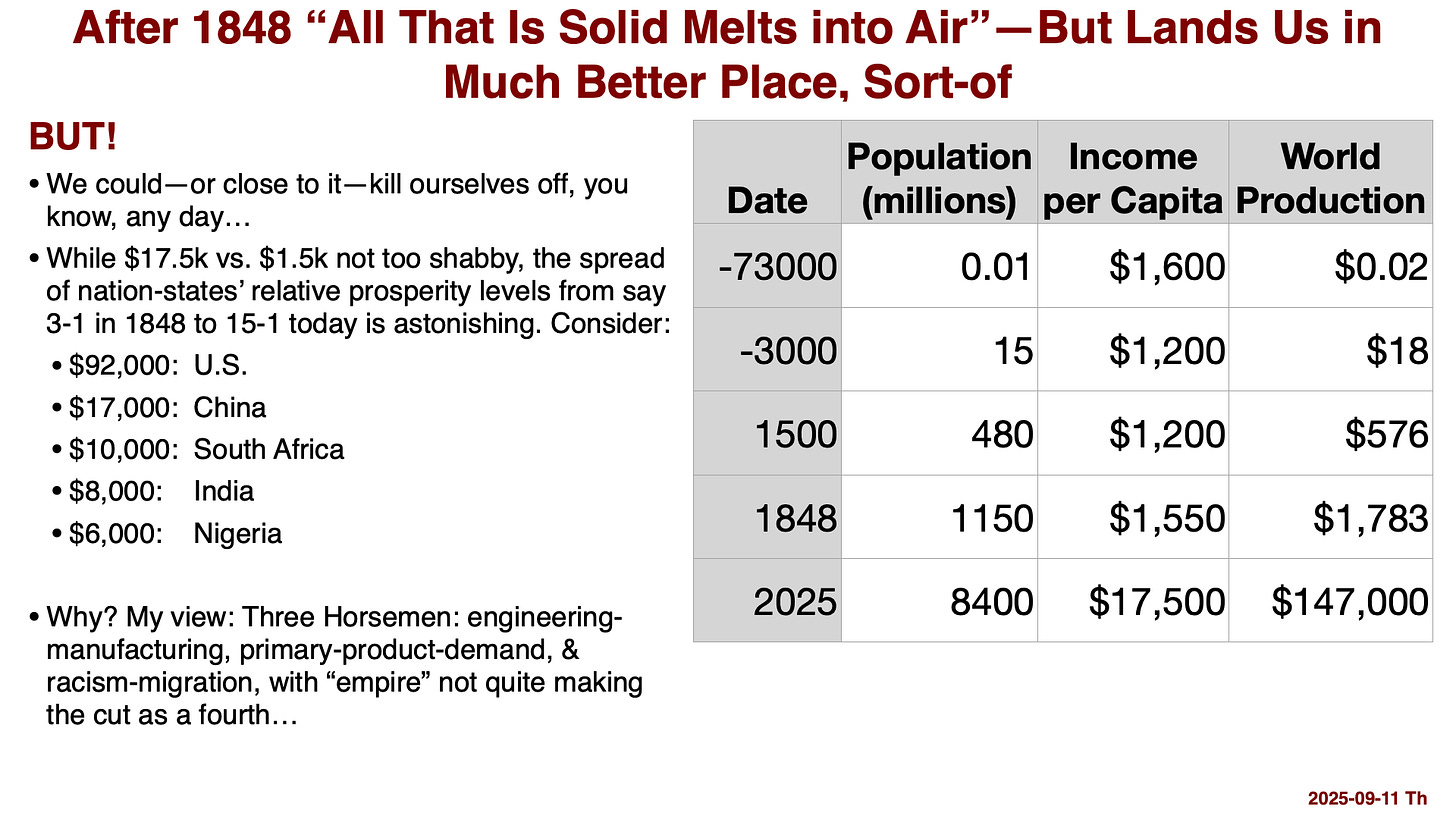
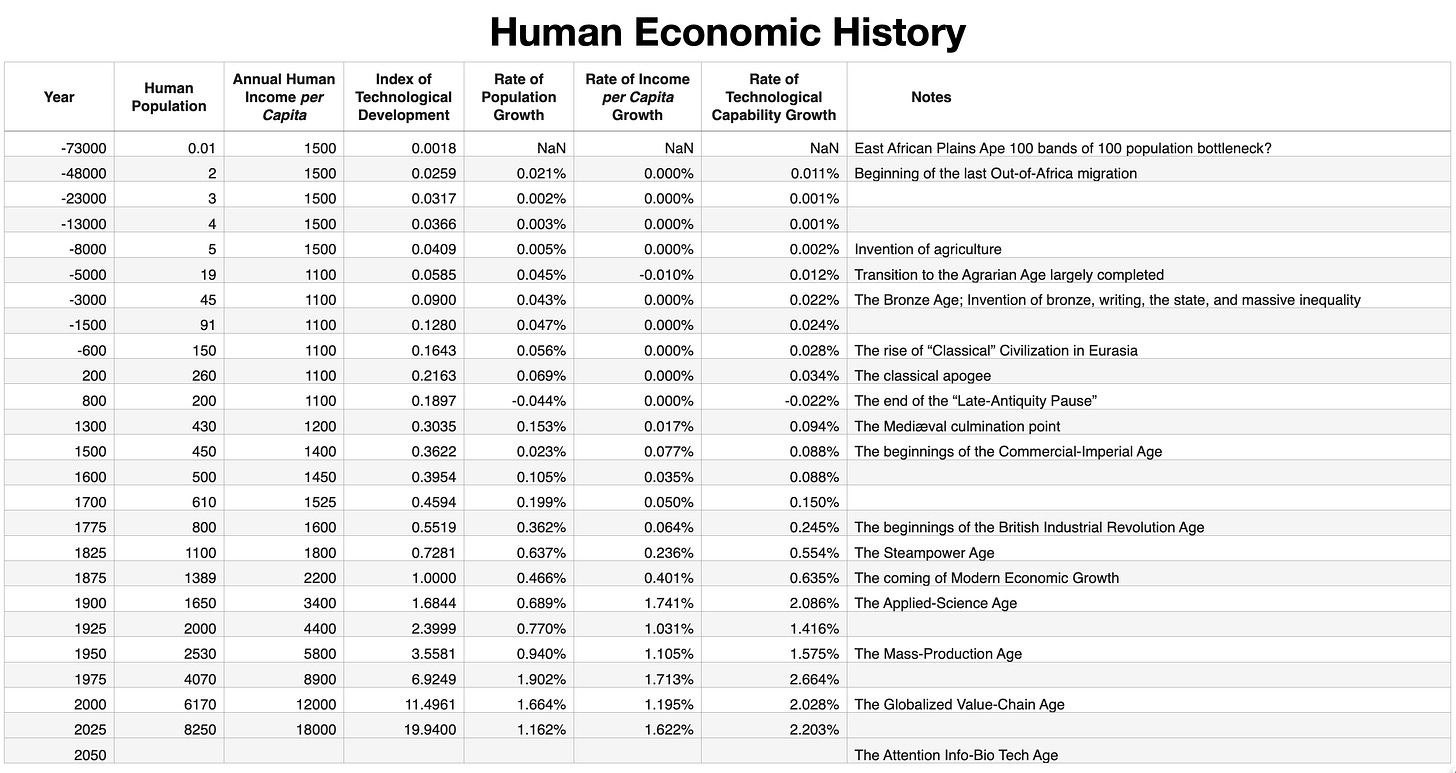
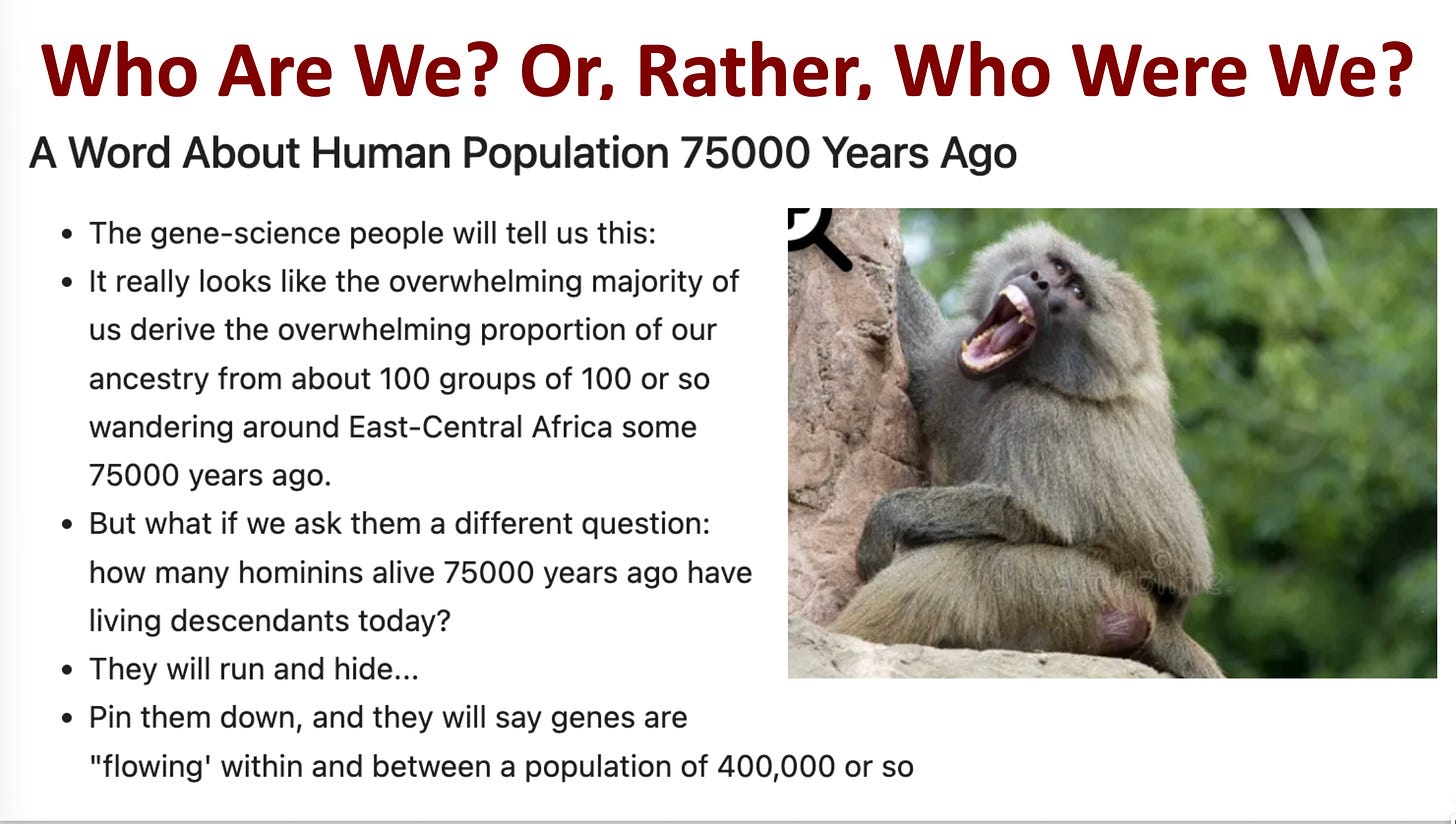
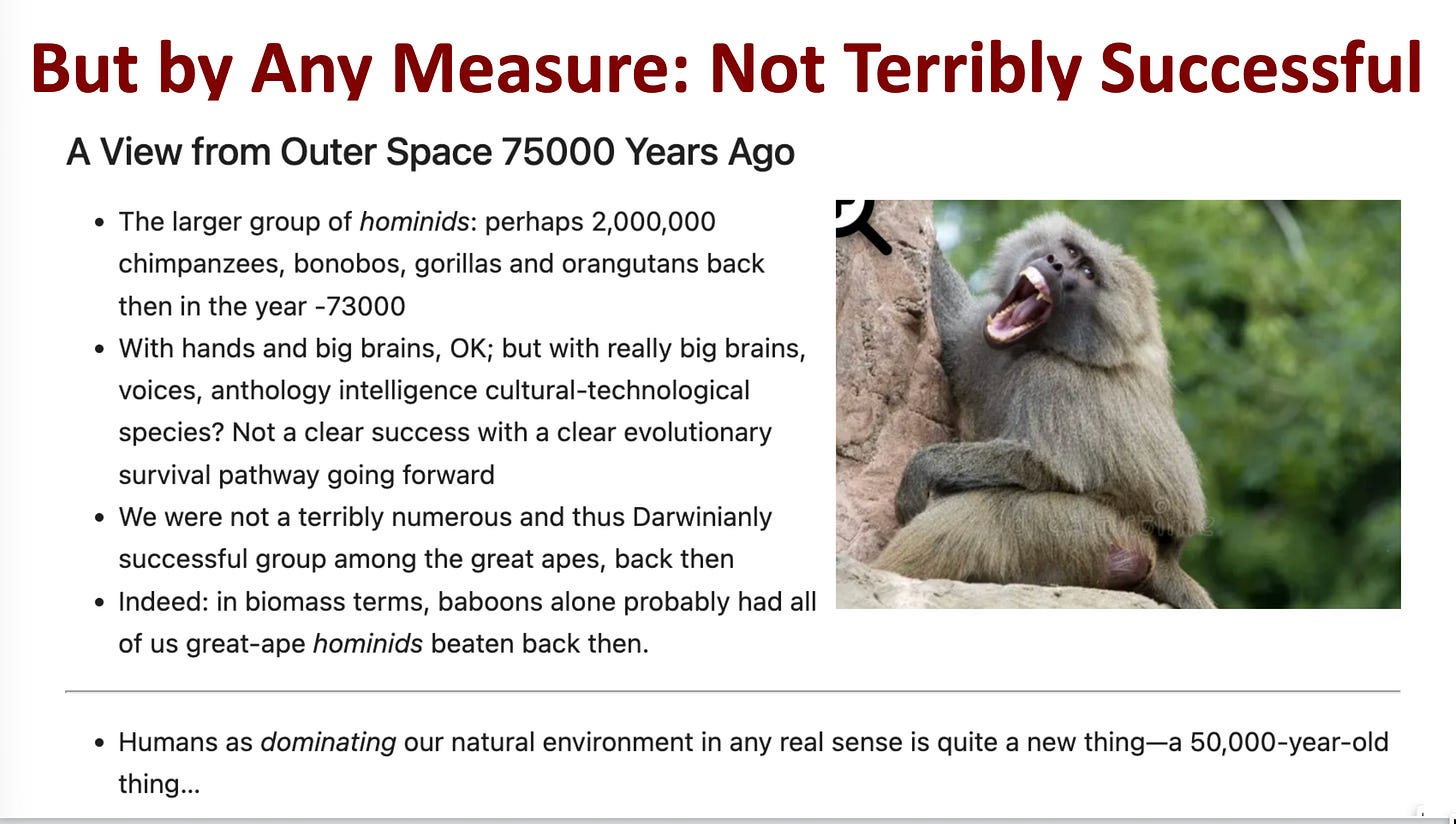
Malthusian logic dominated 75,000 years of history; by 1848 average incomes had barely recovered to hunter-gatherer levels. Post-1848 innovation accelerated, yielding a perpetually novel civilization: each era feels alien to the prior generation, and modern globalization orchestrates constant economic, social, cultural, and political revolutions, not merely a division of labor beyond political reach. Global average income rose from $1,500 to $17,500, yet the richest-to-poorest gap widened from 3-to-1 to 15-to-1: U.S. $92,000, China $17,000, South Africa $10,000, India $8,000, Nigeria $6,000. Three "Horsemen" explain the divergence: engineering and manufacturing prowess, primary-product commodity exposure, and racism and migration politics; empire is a candidate fourth but falls short. Nuclear weapons always lurk — folly or malice could end civilization tomorrow.
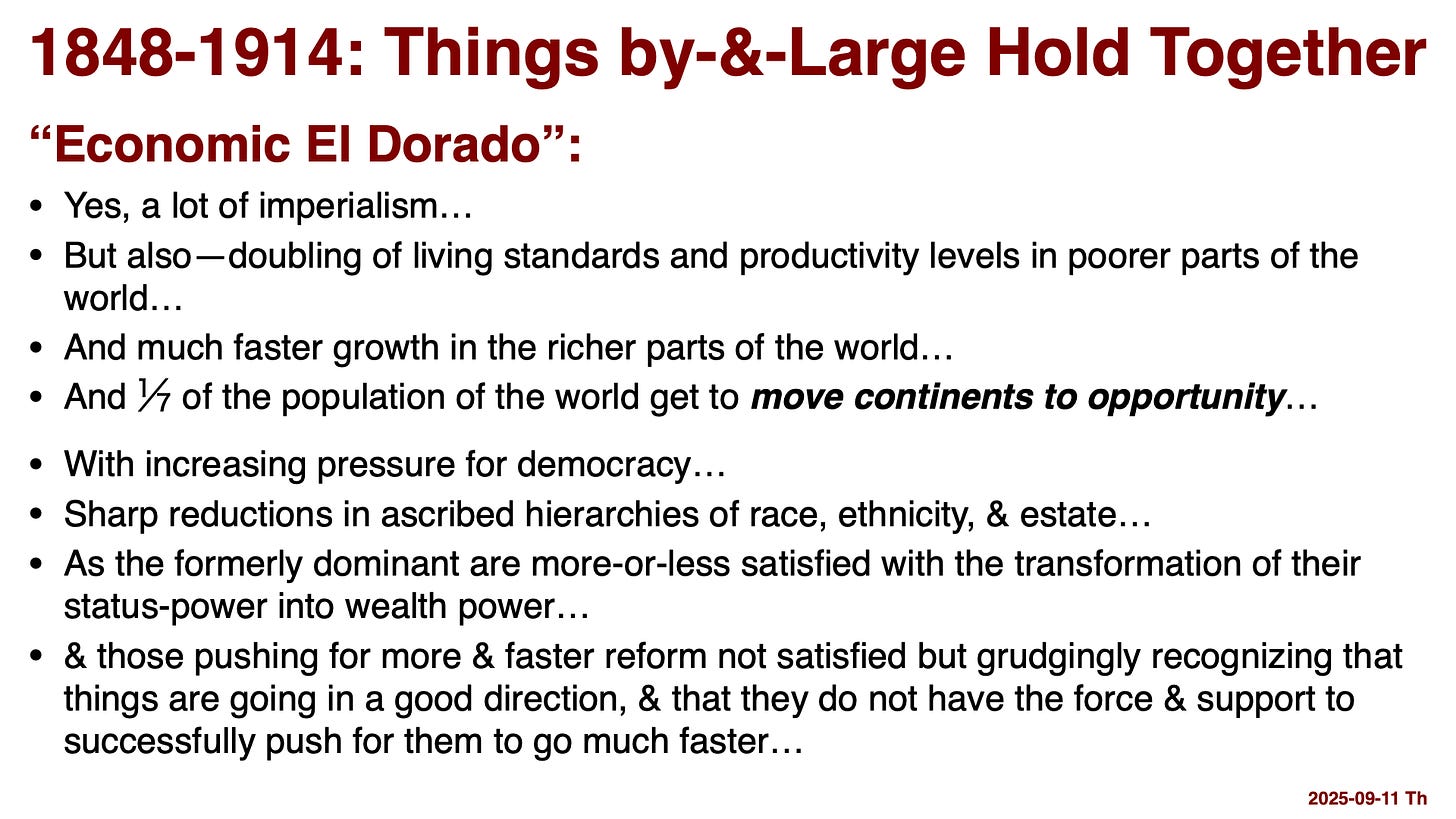
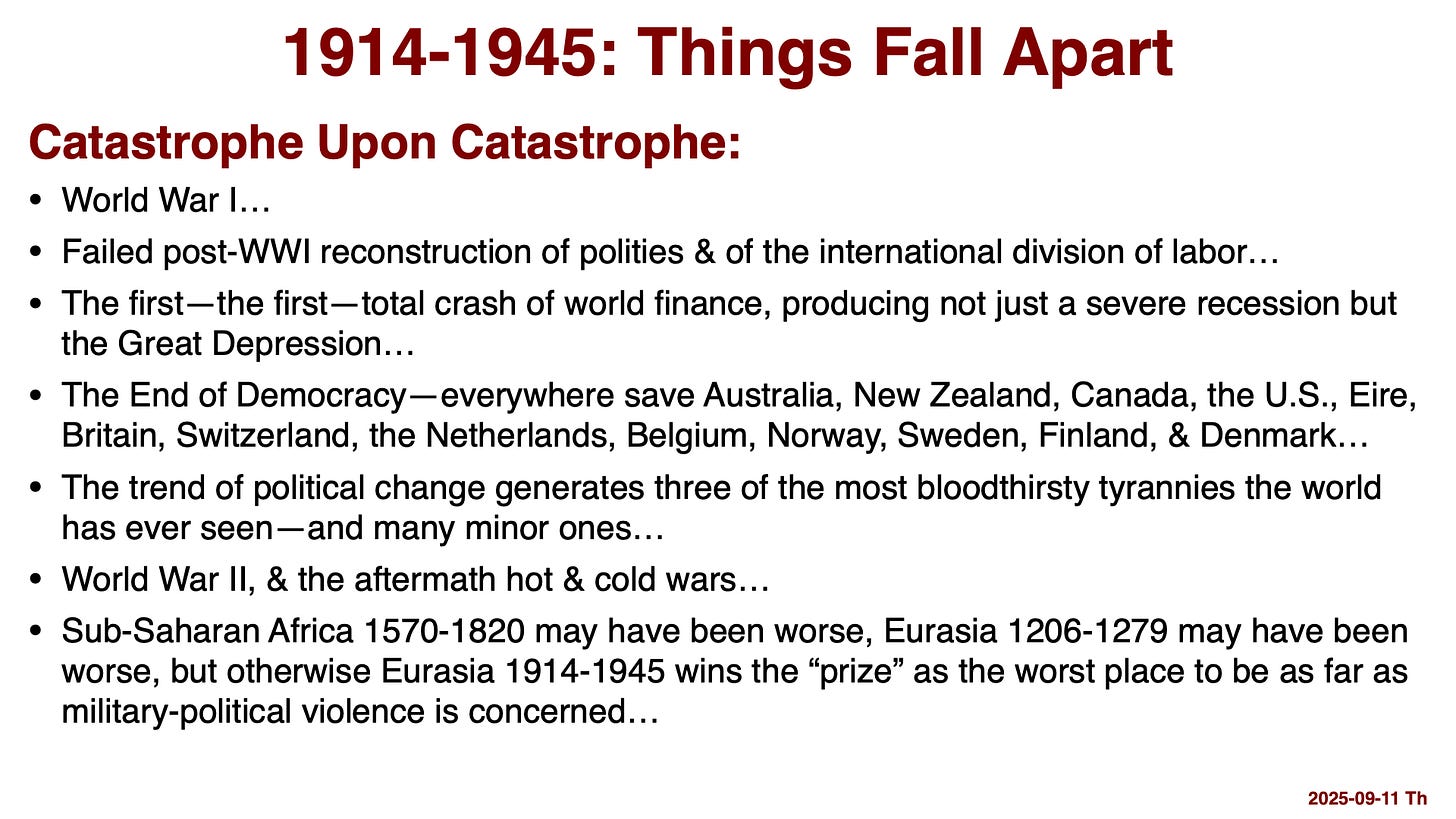
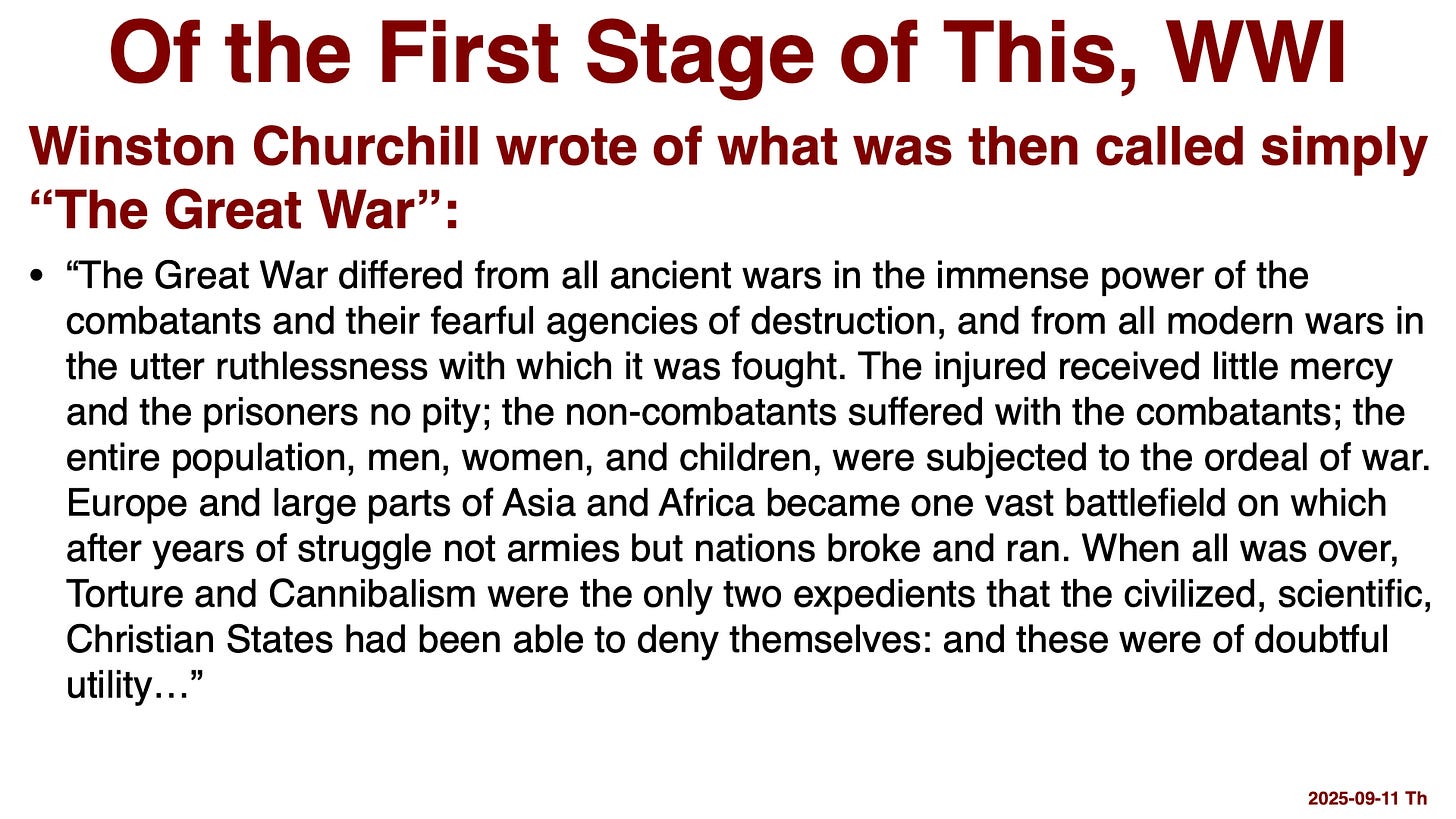
Post-1848 divides into three acts. In 1848–1914 — Keynes's "Economic El Dorado" — living standards doubled even in poorer regions, one in seven people moved continents, and pressure for democracy eroded rigid social hierarchies; dominant classes were mollified by converting status-power into wealth-power while reformers grudgingly accepted the arc was bending. Then: World War I, failed reconstruction, the Great Depression. Democracy survived only in Australia, New Zealand, Canada, the U.S., Ireland, Britain, Switzerland, the Netherlands, Belgium, Norway, Sweden, Finland, and Denmark; elsewhere Stalin, Hitler, and Imperial Japan emerged. Only two comparable analogues exist: Sub-Saharan Africa 1570–1820 and the Mongol Storm. Possibly — a qualified claim — even compared to later horrors including Mao's Great Leap Forward famine, Eurasia in 1914–1945 was the worst time and place to be. After 1945, humanity tries again.
economic historyglobalizationdivision of laborSlouching Towards Utopiainequality
Using the survival show 'Naked & Afraid' as a hook, DeLong argues that an individual human brain, even an expert's, is insufficient to keep a person alive naked in the wilderness against the daily caloric math. The throughline from Acheulean handaxes to today is that human evolutionary advantage was never solo genius but pooled memory, collective 'anthology' thinking, and a division of labor embodied in tools no one could make alone. It matters as a vivid grounding of his recurring 'Anthology Super-Intelligence' thesis about the collective human mind.
Individual human brains are insufficient to compensate for our physical deficits against nature — our real advantage is collective intelligence and the cumulative tools it produces. DeLong makes this case through the reality show "Naked & Afraid," where contestants are dropped into wilderness with minimal gear and proceed to starve despite being surrounded by mammals thriving in the same environment.
Melissa Miller, an outdoor educator with a magna cum laude B.A. from the University of Michigan specializing in primitive trapping, fire-making, plant identification, and blade use, lost 17 pounds over 21 days in the Ecuadorian Amazon — a daily caloric deficit of roughly 2,800 calories against an estimated BMR of 1,500. The caloric breakdown exposes the full cost of active survival: simply hunkering down and fasting at BMR would have cost about 9 pounds of fat; actively trying to find food and avoid becoming food cost her roughly 8 additional pounds on top of that. Her partner, former Army Ranger Chance Davis, fared far worse: 32 pounds lost in the same period, because he lacked fat reserves and had to burn muscle (which costs 3 pounds to yield the caloric energy of 1 pound of fat). The psychological damage lasted beyond the show — Davis gained 70 pounds in a single month afterward because prolonged hunger had made him physically reactive and compulsively driven to eat and stockpile food. Both contestants also relied on a ~20-person backstage crew including on-site medics who administered IV saline, rangers who verified plant IDs, and rapid medevac capability — conditions far better than true wilderness survival. Miller's main lesson: before her next appearance she gained 16 extra fat pounds, giving her 37 days of BMR reserves, because no amount of skill could keep two individuals in caloric balance against the Amazon.
DeLong traces human brain expansion across evolutionary time — ardipithecus at 350cc five million years ago, australopithecines at 450cc by 3.5 million, homo habilis at 650cc with Oldowan tools by 2.5 million, homo erectus at 950cc with Acheulean handaxes and endurance running by 1.8 million, homo heidelbergensis at roughly 1,000cc with controlled fire and complex spear-based hunting by 600,000 years ago, and finally homo sapiens at 1,350cc with symbolic culture, composite tools, and long-distance exchange networks. Yet even our full-sized brains fail the individual survival test.
The resolution: selection did not favor solo genius but pooled memory, anthology thinking-power, and the division of labor that lets tools embody millennia of collective problem-solving. Miller could master knife use; she could not make a knife from scratch. Our edge was never individual cleverness — it was the group mind and its accumulated toolkit.
human evolutioncollective intelligenceanthology super-intelligencedivision of laboreconomic history
A draft Econ 196 lecture giving DeLong's signature quantitative framework for modern growth: since 1870, every ~30 years about 1/5 of the economy quintuples in productivity (5.4%/yr) while 4/5 inches forward, doubling average productivity each generation through successive leading-sector 'modes' (steam, applied-science, mass production, value chains, now AI/info-bio). He extends it to argue the liberal-arts intelligentsia is now the displaced fifth caught in the Schumpeterian wave. Original framing, rich sourcing (Marx, Shalizi, Klaas, Slouching Towards Utopia), high reference value.
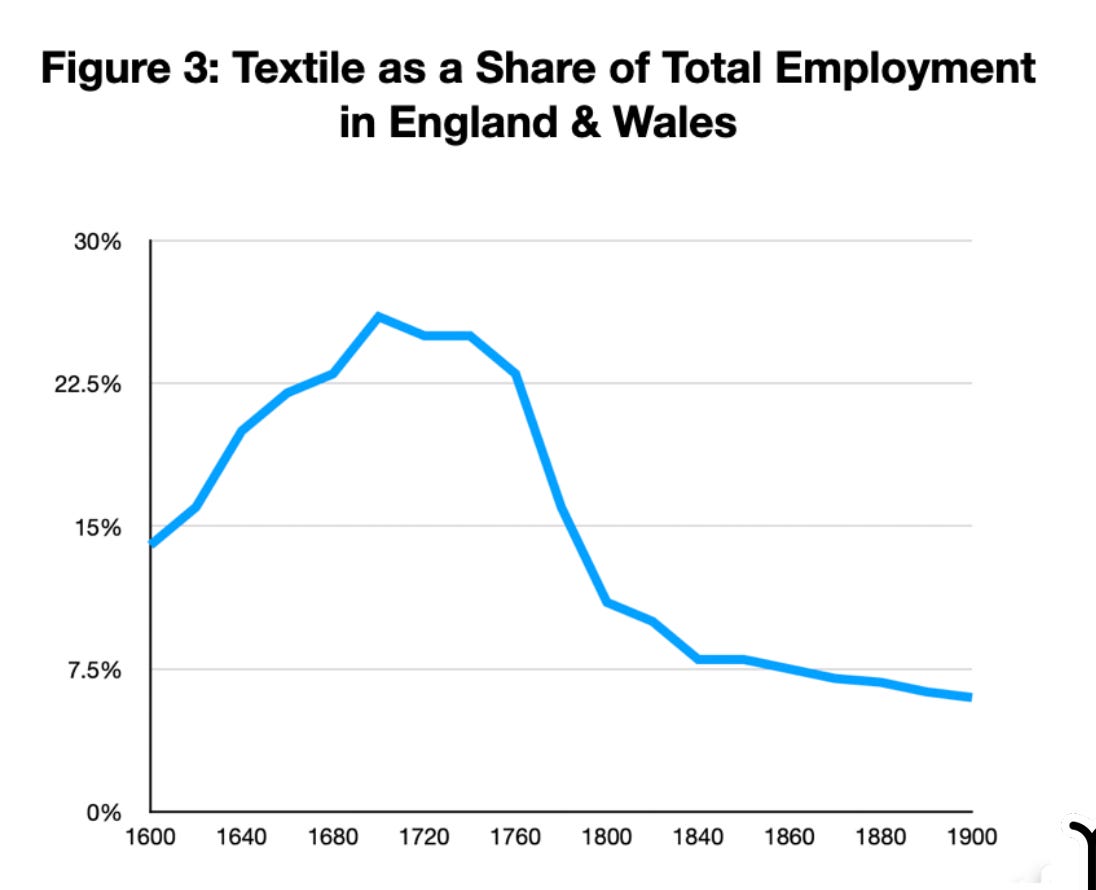
Since 1870, modern economies have grown not by smooth glide but by puncture: every thirty years, roughly four-fifths of the economy improves technology and productivity by about 25% (around 0.8% per year), while one-fifth quintuples in productivity at roughly 5.4% per year. The result is that average productivity roughly doubles each generation — but it is a different, partially overlapping fifth of the economy that undergoes the explosive leading-sector transformation in each successive wave. These waves hit faster and more completely in today's rich countries; in poor countries the transformation is slower and incomplete — yet life in poor countries is still substantially transformed relative to 150 years ago.
The historical sequence runs: Steampower, Applied-Science, Mass Production, Globalized Value-Chain, and now Attention Info-Bio Tech. Before 1870, the same dynamic existed but ran at roughly a century per cycle, confined to the Dover Circle Plus — the 400 miles around the port of Dover, plus New England, the coastal Mid-Atlantic, and the American Midwest and Ontario. Outside that zone, the Columbian Exchange and the coming world market offered a roughly 50 percent potential productivity gain, but nearly all of it was eaten by Malthusian population growth. DeLong's Slouching Towards Utopia plots the modern cadence: 1870→1903 (industry and globalization), 1903→1936 (mass production), 1936→1969 (mass consumption and suburbanization), 1969→2002 (microelectronics). Each wave reshaped social order and stressed political institutions.
Marx and Engels observed the mechanism in the 1848 Communist Manifesto: constant revolutionizing of production swept away "all that is solid," destroyed national industries, and created global interdependence within a century. Cosma Shalizi (2010) makes the parallel explicit: the Industrial Revolution was the Singularity, completed by 1918 — exponential transformation of technology, ecology, and mentality, producing vast inhuman systems (markets, bureaucracies) that treat people like straw dogs. Slouching Towards Utopia adds a point that runs deeper than displacement: even those doing identical tasks in identical places as their 1870 predecessors find that others now pay much less for what they do or make — relative income pressure falls on the non-displaced majority too, not only on the exposed fifth. Brian Klaas (Fluke, 2025) frames the inversion: pre-modern life combined local instability (plague, famine) with global stability (you stayed in your parents' social role); modernity reversed this — daily routines feel stable while the macro-framework convulses across generations.
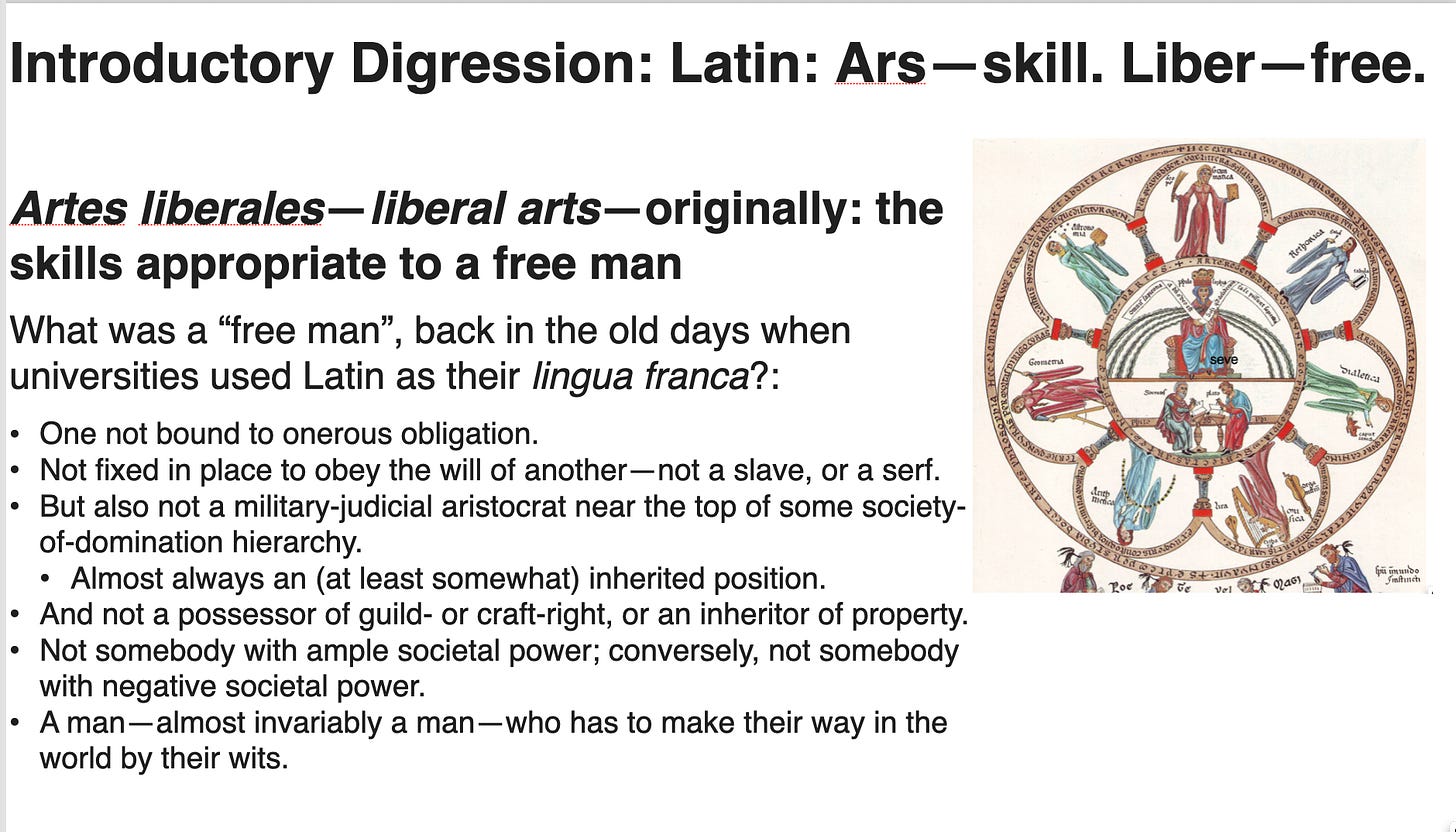
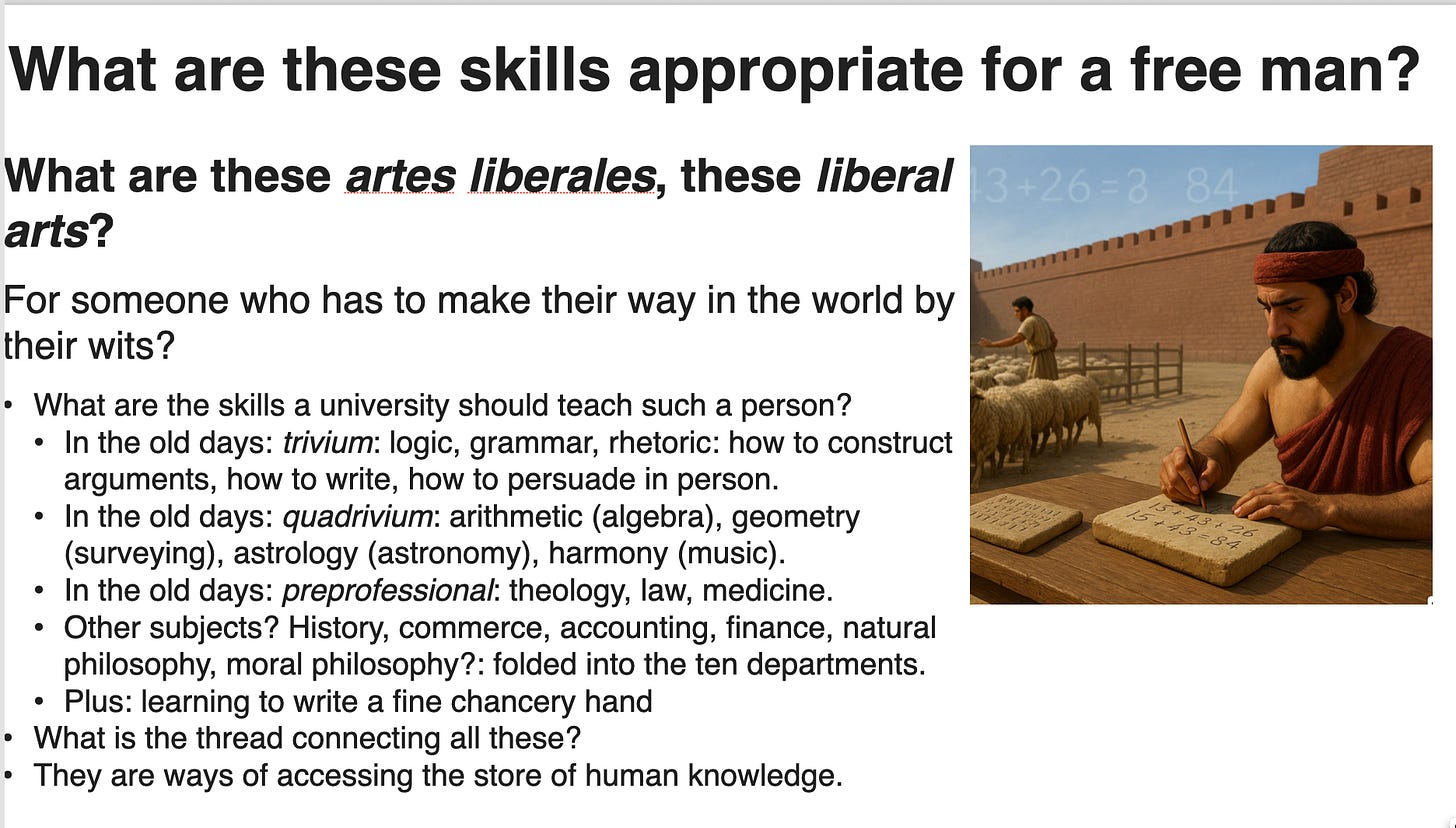
DeLong qualifies Klaas: most people experience partial change — some producer-role shift, some new consumption patterns — with roughly one-fifth of their life as consumers genuinely upended, mostly for the better. The unlucky fifth whose jobs fall inside the leading sector face real incomes cut to about one-quarter of expectations if they resist the wave; they gain substantially if they pivot. The current leading edge runs through prompts, context engineering, evaluation, and synthesis. Intellectuals — those living by the artes liberales, wit rather than property or hereditary status — now constitute that exposed fifth. DeLong's prescription: survival means turning judgment, clarity, and taste into leverage over machines and markets. The stockingers who became General Ludd's army in the 1770s are the template.
economic historySchumpeterian growthcreative destructionSlouching Towards UtopiaAI displacement
Replying to a nostalgist's claim that 1870-1914 uniquely combined freedom, prosperity, and cultural vitality, DeLong argues the Belle Époque felt golden because expectations surged far beyond a narrow, brittle reality--low-30s life expectancy, ~20% global literacy, thin franchise--which is precisely why 1914 was so shattering. A solid economic-history corrective, though most of the empirical detail sits behind the paywall.
The Belle Époque's golden reputation derives from expectations that surged far beyond actual prosperity — DeLong's verdict in response to Bohumilo, who argues on social media that 1870-1914 stands as civilization's unsurpassed peak: WWI destroyed a superior order of high culture, hard money, and stable international relations, and humanity (or, "lets be frank, the West") has never since combined freedom, prosperity, and cultural vitality at the same scale.
DeLong is explicit: "This is not right in many ways; but, still, right in one important way." The one right way concerns the civilizational *delta* and expectations. The rate of improvement was real, compounding progress felt genuine, the international order seemed stable — and that mix of real gains plus overconfident optimism made 1914's rupture so devastating. Those expectations of forward momentum were never recovered after the Great War.
Where Bohumilo is wrong is at the level of absolute prosperity. Material prosperity in 1914 was narrow, fragile, and uneven. Vast numbers of people were short-lived, hungry, poor, and illiterate — globally and in the west, which directly rebuts the West-centric framing. Around 1900, average life expectancy sat in the low 30s; the world did not surpass 40 years until well after mid-century. Global adult literacy barely exceeded one-fifth in 1900, with mass literacy arriving mostly after 1950.
economic historyBelle Epoque1870-1914World War Istandard of living
Rebutting the Landsburg/Slatepitch claim that 'nothing happened' before 1800, DeLong lays out his signature index H of deployed-and-diffused technology—average income per capita times the square root of population—which reveals steady pre-modern capability growth that Malthusian population dynamics swallowed into population rather than living standards. He tabulates millennia of growth rates and 'mode of production' thresholds (each a rough doubling, or √2-ing before 1500) culminating in the discontinuous 1870 jump to 2.1%/yr Modern Economic Growth. A landmark statement of his economic-history measurement framework with high reference value.
Per-capita income flatlined for most of human history not because capability stagnated but because population absorbed every productivity gain. Index H — average income per capita times the square root of population — strips out that Malthusian feedback and reveals steadily rising technological competence across the full span of human history.
H is a proxy for the global stock of deployed-and-diffused useful knowledge. The square root of population balances resource scarcity against labor productivity; doubling H means average income doubles at fixed population. DeLong dismisses capital intensity as a competing explanation, citing Solow (1956, 1957): the capital stock/annual-output ratio has been close to 3 since shortly after the invention of agriculture. Capital intensity matters for cross-section comparisons between societies but plays no significant role in the long-run trajectory — so H need not account for it.
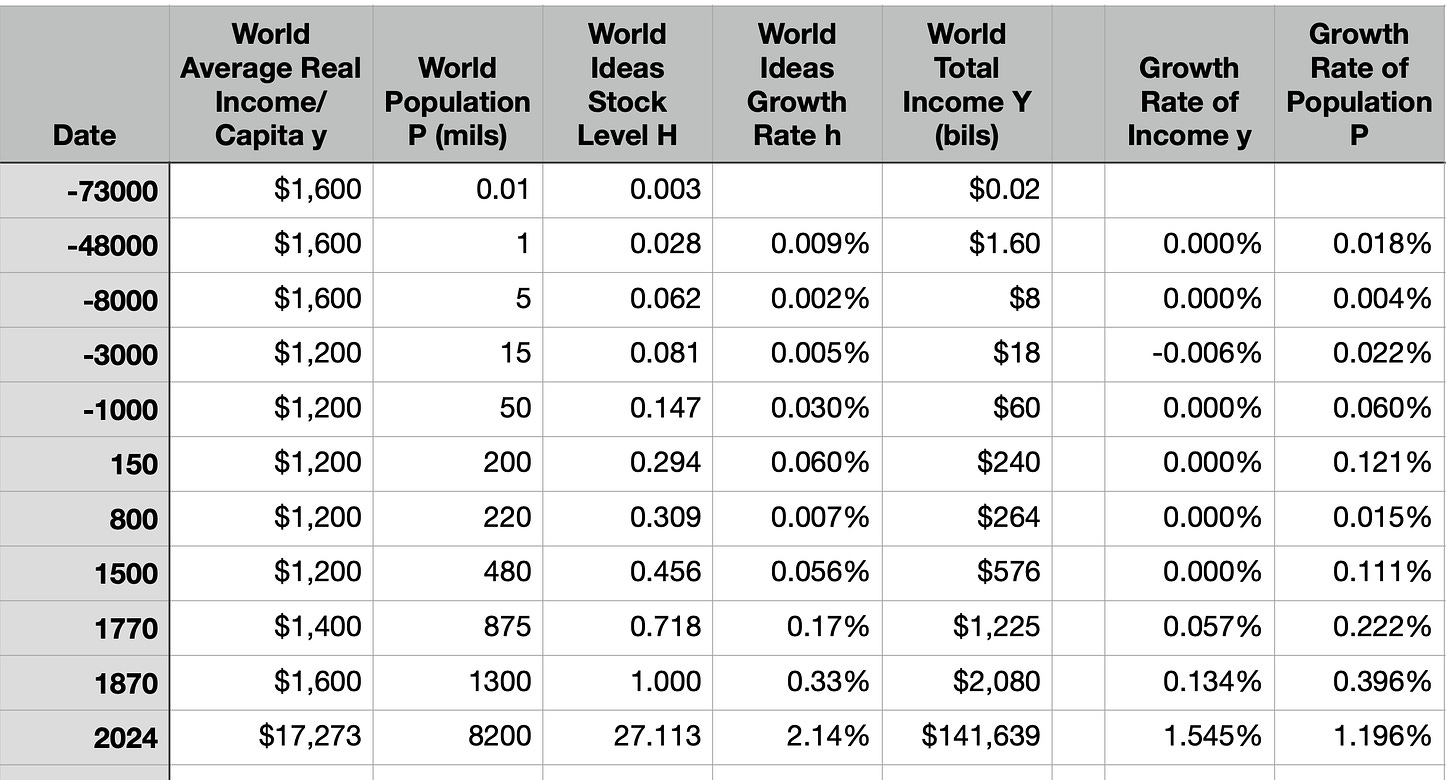
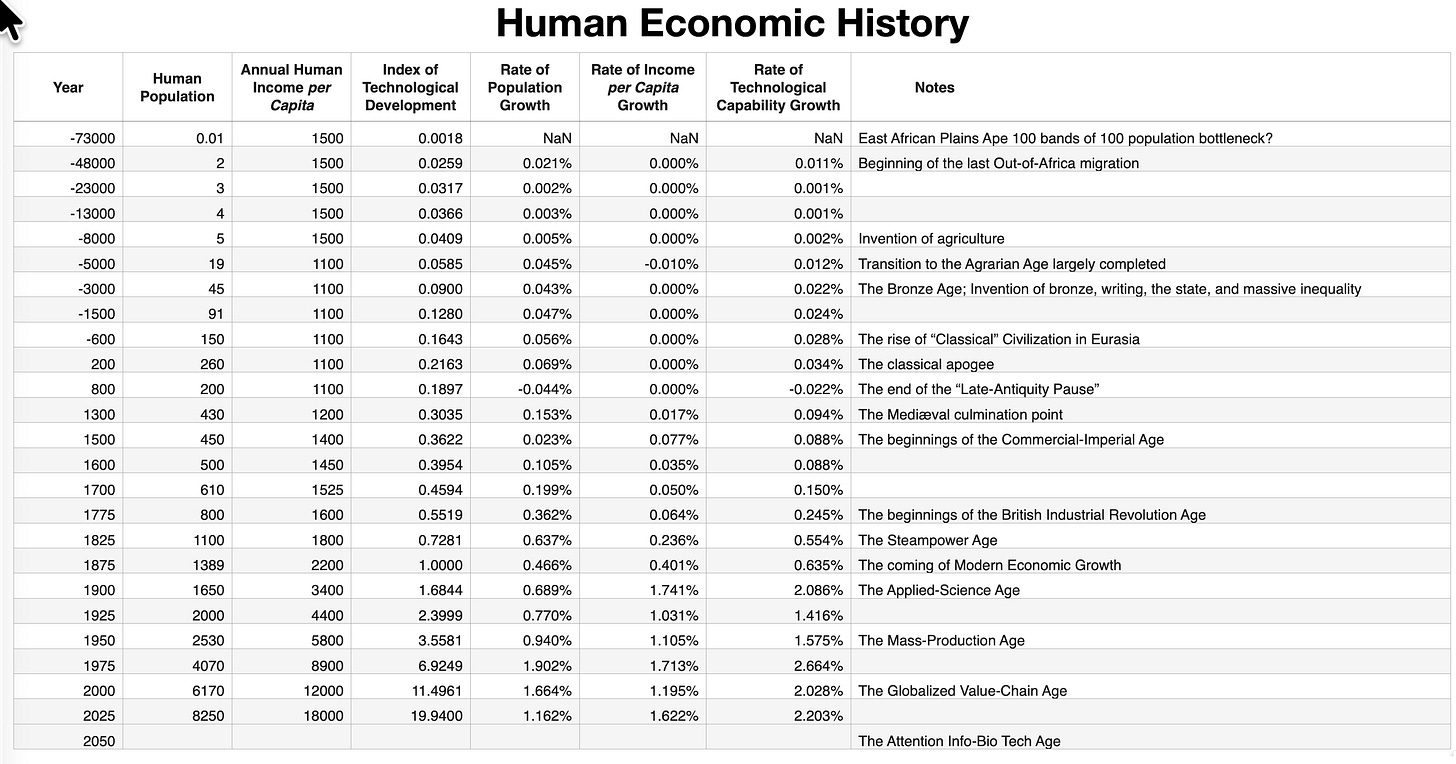
The growth-rate series, era by era: post-bottleneck African expansion 0.009%/yr (−73000 to −48000); Out-of-Africa Paleolithic 0.002%/yr (−48000 to −8000); Early Agrarian 0.005%/yr (−8000 to −3000); Literacy-Bronze 0.030%/yr (−3000 to −1000); Axial-Iron 0.060%/yr (−1000 to 150); Late-Antiquity Pause 0.007%/yr (150 to 800); High Medieval 0.056%/yr (800 to 1500); Imperial-Commercial 0.17%/yr (1500 to 1770); Industrial Revolution 0.33%/yr (1770 to 1870); Modern Economic Growth 2.1%/yr+ after 1870. In level terms H rises from 0.003 at the population bottleneck to 1.0 by 1870 and 27.1 by 2024. The decisive watershed is 1870, when the growth rate jumps discontinuously from roughly 0.45%/yr to at least 2.1%/yr.
DeLong proposes reading these epochs as modes of production, each age boundary marking roughly a doubling of H (or a √2 increment for finer pre-1500 divisions). This replaces the "asian-ancient-feudal-capitalist-socialist" taxonomy with one grounded in Marx's hand-mill/steam-mill dictum: the forces of production determine the superstructure. He adds that before 1500 smaller quantitative productivity gains carried larger qualitative effects on social organization — so the coarser bracketing used for the modern era would undersell pre-modern discontinuities.
Three dimensions remain unquantified: luxuries, cultural goods, and technologies of domination. They are central to answering whether pre-steam history was empty, but no defensible index for them yet exists.
economic historyvery-long-run growthMalthusindex HSlouching Towards Utopia
Engaging Greg Clark's "Farewell to Alms," DeLong concedes the Malthusian treadmill held for biophysical necessities tied to reproductive fitness (flat living standards, four inches of skeletal stunting, ~0.08%/yr population growth) but argues it did NOT hold for technology, luxuries, culture, or means of domination—which Clark conflates. He derives his index H of human technological competence (0.08 in -3000, 1 in 1870, 27 today) along the necessities dimension. An original framework that is core to his Slouching Towards Utopia / long-growth project, with references and his own model.
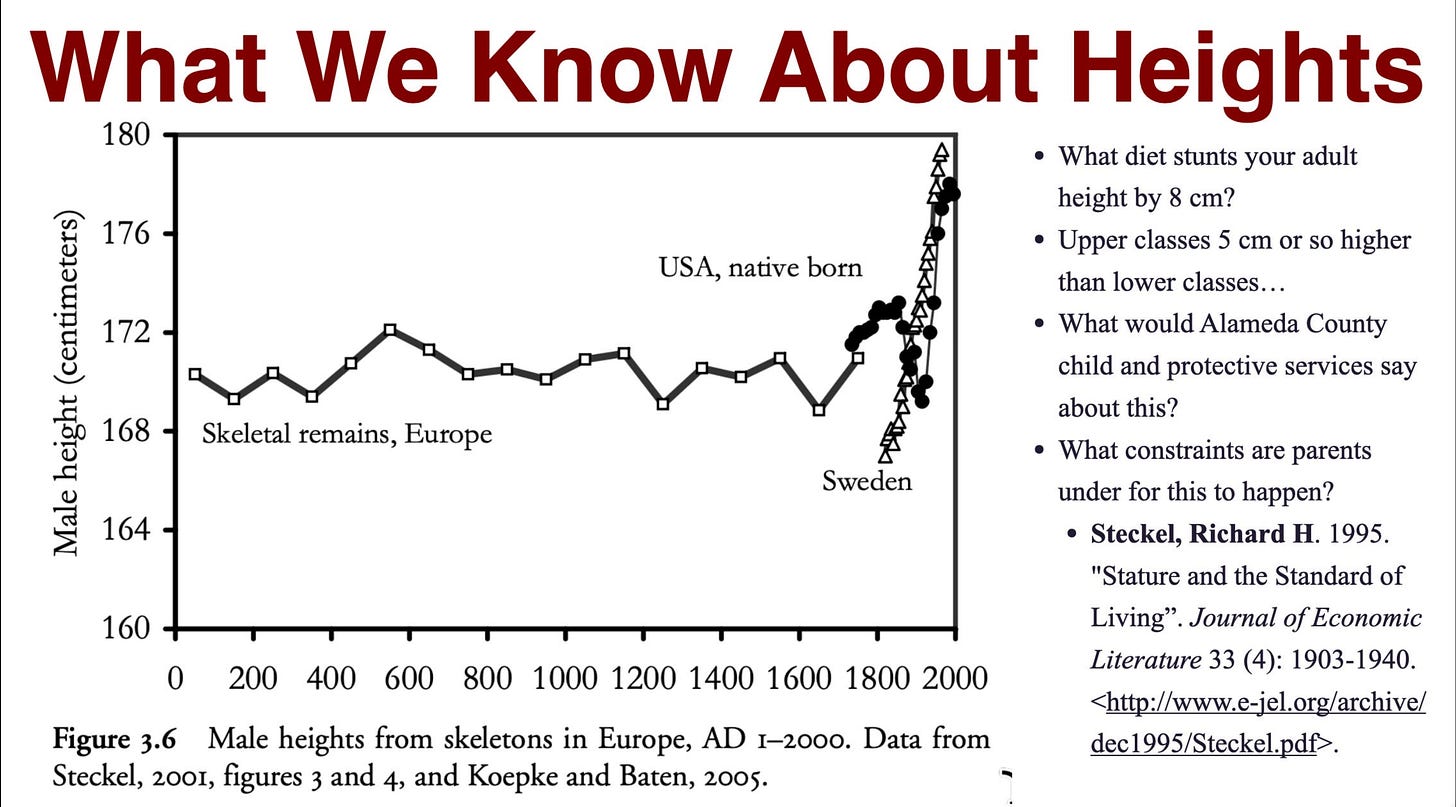
The Malthusian treadmill is real for necessities but not for technology, luxury, culture, or — crucially — domination. Greg Clark's *Farewell to Alms* is right on one of its two major claims: from -3000 to roughly 1900, typical living standards measured in reproductive-fitness necessities were close to subsistence with no upward trend. The evidence converges: world population grew from ~15 million to ~500 million at just 0.08%/year average, against the ~1.4%/year an unstressed pre-industrial patriarchy produces. The gap implies continuous nutritional stress. Skeleton data confirm it — four inches of height stunting across the millennia.
Biophysical poverty, however, is not total wealth. DeLong identifies four dimensions: (i) necessities and conveniences affecting reproductive fitness; (ii) luxuries; (iii) culture and its value; and (iv) — framed explicitly as a *disvalue* — the development and deployment of technologies of domination, which since -3000 enabled an elite to extract roughly one-third of crops and crafts through force and fraud. Domination is a harm, not an advancement. Culture is similarly ambivalent: entertainment and meaning on one side, ideological brainwashing on the other (Gilgamesh's opening lines declare the king two-thirds god, inducing acquiescence the way Calvera's shearing logic does).
DeLong declines to quantify (ii), (iii), and (iv) because a prior normative question remains unresolved: should they be valued as powers to command nature and organize humans productively, or as enabling humanity to live wisely and well? The two frameworks yield different answers, so he defers all numbers to a future date.
For dimension (i) alone, he constructs an index H of Human Technological Competence. The key assumption: resource-scarcity is half as salient as technology in fueling productivity (at a constant capital-output ratio), which motivates indexing H as roughly proportional to potential necessities consumption per capita times the square root of population. Result: H = 0.08 in -3000, 0.3 at the Han-Parthian-Roman peak around 150 CE, 1 in 1870, and 27 today — a 12.5-fold gain from -3000 to 1870, then a 27-fold gain since. The luxuries, cultural, and domination dimensions remain unquantified.
economic historyMalthusianismGreg Clarklong-run growthindex H
Responding to Razib Khan on Yamnaya ancestry, DeLong argues the Indo-European expansion was a cultural/institutional revolution (mobility, steppe pathogens, scaled patriarchy, male-line dominance) rather than a biological transformation, since all living humans differ at only ~0.1% of sites. He extends this to deep prehistory, suggesting cumulative culture—not genes—has driven human capability since Homo erectus, reinforcing his 'Anthology Super-Intelligence' theme. A rich, original synthesis of population genetics and economic-historical method.
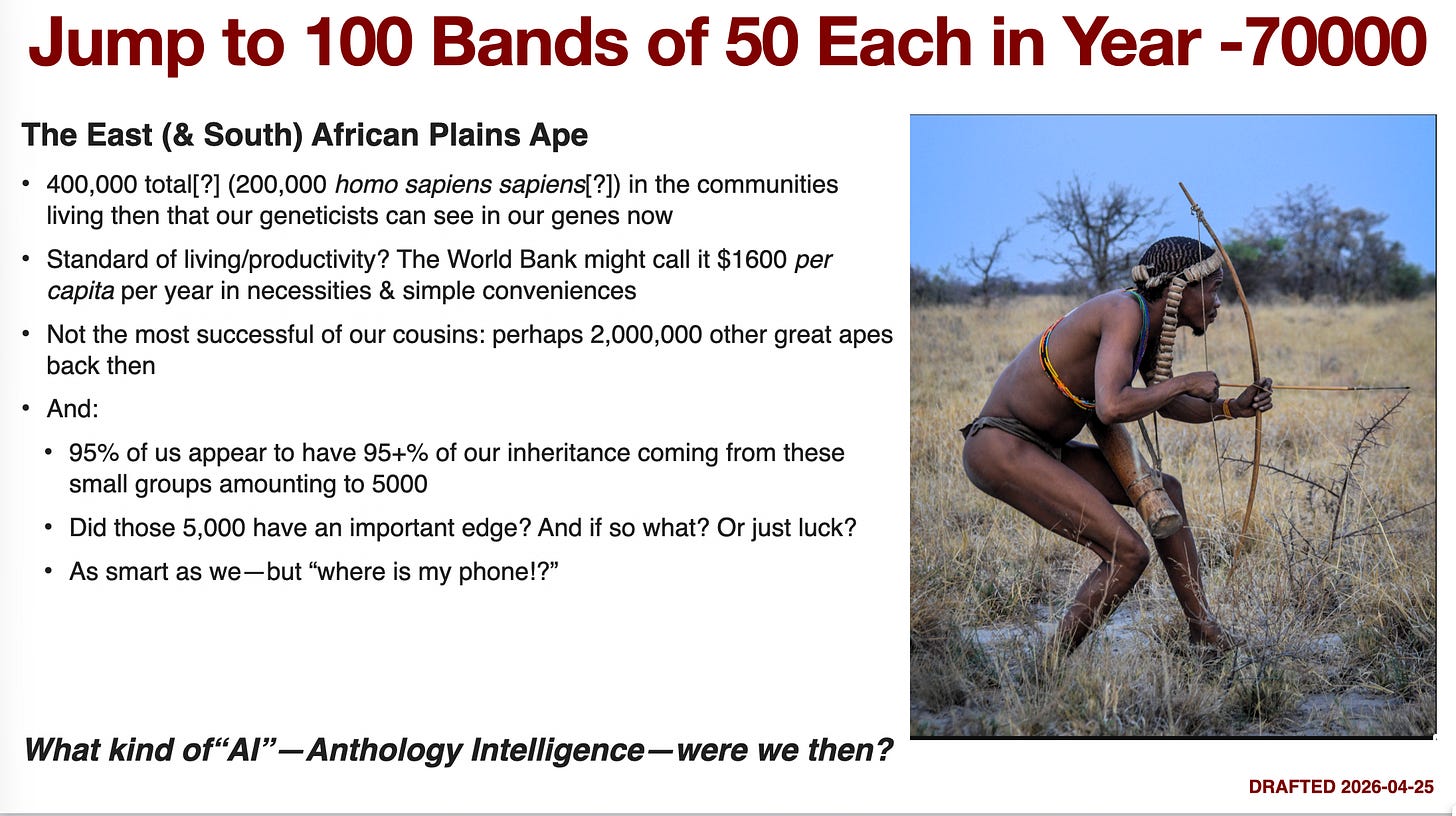
The Yamnaya expansion 5,000 years ago is an institutions and culture story, not a biology or evolution story. Razib Khan estimates that 1/12 of all human genes today trace back to roughly 10,000 nomads on the Pontic Steppe — nearly half of Northern Europeans' ancestry, 20–40% of Southern Europeans', up to 35% among some South Asian Brahmin groups — and DeLong accepts the ancestry arithmetic. What he rejects is the "genetic rewriting" interpretation: whether your Yamnaya-descent fraction is 50% or 10%, your genes do the same thing.
What the Yamnaya actually spread was their cows, the disease burden of the steppe, their patriarchy, their language — Khan notes he writes these posts in a descendant of the Yamnaya language — and their cultural technology across a range running from the North Cape to Ceylon, from Mongolia to Cape Trafalgar. Their expansion nearly replaced Northern Europe's megalith-builders, overthrew the Minoans, and erased the memory of the Indus Valley Civilization. The male-line dominance visible in Y-chromosome data reflects some mix of female choice, sexual enslavement, and conquest; the proportions are unknowable.
The claim that Yamnaya genes mattered is further deflated by a comparative nucleotide-diversity table. Two random humans differ at 0.1% of sites; two Out-of-Africa humans at 0.07%; two KhoeSan at 0.12%. By contrast: two baboons from the same troop differ at 0.25%; a human and a baboon at roughly 6%; a human and a chimpanzee at roughly 1.2%. All Homo sapientes sapientes are extremely close cousins. Meaningful biological change requires going back hundreds of thousands to millions of years — the hominin sequence from Ardipithecus (5 Ma, 350cc) through Homo erectus (1.9 Ma, 1000cc) to behaviorally modern humans (from 100 ka). Even late Homo erectus had cumulative cultural evolution already running, illustrated by the 750,000-year-old Gesher Benot Ya'aqov site in northeastern Israel-Palestine where they controlled fire, quarried quality basalt with levers, butchered elephants, caught nine fish species, and may have roasted seeds into popcorn.
The Yamnaya explosion should be understood as a key inflection point in the growth of distributed, cumulative human cognition — what DeLong calls the collective human mind, "the true ASI, the true Anthology Super-Intelligence."
YamnayaIndo-Europeanpopulation geneticscultural evolutiondeep history
On Austen's 250th birthday, DeLong reads her novels as a window onto a 'curious institutional interregnum' (c. 1795–1815) where the English landed gentry collected rents through neither warrior power nor productive contribution, yet faced no jacquerie—because fiscal-state capacity, legal architecture, parish relief, and a self-policing moral economy of reputation legitimated an unjust distribution long enough for the factory age to arrive. He layers five lessons (economic history, moral psychology as preference formation under constraint, the marriage market as portfolio optimization, the absence of revolution, and free indirect discourse as moral education), making it a landmark fusion of economic history and literary criticism.
Austen "reigns supreme," Henry Oliver argues, because no other novelist addressed three questions still central to modern life — how to live well in a commercial society, what constitutes moral education, and who to marry — while inventing the technique of characters overcoming inner rather than externally imposed problems.
DeLong offers five analytical lenses. First, economic history: the £2,000 yearly income sustaining Mr. Bennet's idleness persists because England's Glorious Revolution settlement, the Bank of England, and normalized public borrowing gave the state fiscal capacity to keep order without violence. Edmund Burke was terrified, warning that "sophisters, economists, and calculators" would destroy social order — yet England's taxation legitimacy and a less acute harvest-fiscal shock defused revolutionary potential. Second, Austen's moral economy is policed through reputation, balls, letters, and shame rather than dungeons. Heroines learn perspective-taking — Lizzie rereads Darcy's letter, Emma perceives her cruelty to Miss Bates, Elinor acts prudently while feeling deeply — comedy with a spine: preference formation under social constraint. Third, the marriage market is portfolio optimization under legal friction: women hold wit and judgment but face primogeniture and entail; public dances are noisy type-inference markets; elopements are negative shocks; good outcomes require correcting biased priors.
Fourth, the absence of English jacquerie is itself an analytical argument. Inequality is visible — Longbourn's park against the Lucases' scrap, Lady Catherine's condescension about west-facing windows — but compensating institutions held: parish relief, evangelical movements, the yeomanry, and a national mythos of gradual ordered liberty. The thesis: legitimacy and capacity can stabilize an unjust distribution long enough for technological change — the steam and factory age — to reassign rents and moral narratives. Rentier gentility enjoyed a century of grace before capital justified wealth.
Fifth, Austen perfects free indirect discourse. Ian Watt in The Rise of the Novel names Emma (1816) its supreme example — the reader inhabits Emma Woodhouse's progressive self-revelation while a dispassionate narrator maintains the social frame, combining Defoe's psychological closeness with Fielding's irony. Watt adds that Austen completed Fanny Burney's challenge to masculine prerogative: feminine sensibility was at a genuine advantage in the novel form. A coda: the rents sustaining Longbourn were entangled with naval power and colonial extraction — violence Austen elides, but the reader must not.
Great Novel criteria, following Rick Gekoski: language quality, resonant complexity, universality, memorableness, credible arcs, conflicts that force change, purposeful point of view, deliberate pacing, vivid description, dialogue carrying subtext — producing rereadability and a felt internal shift. "A Great Novel is not a formula. It's a durable machine for seeing."
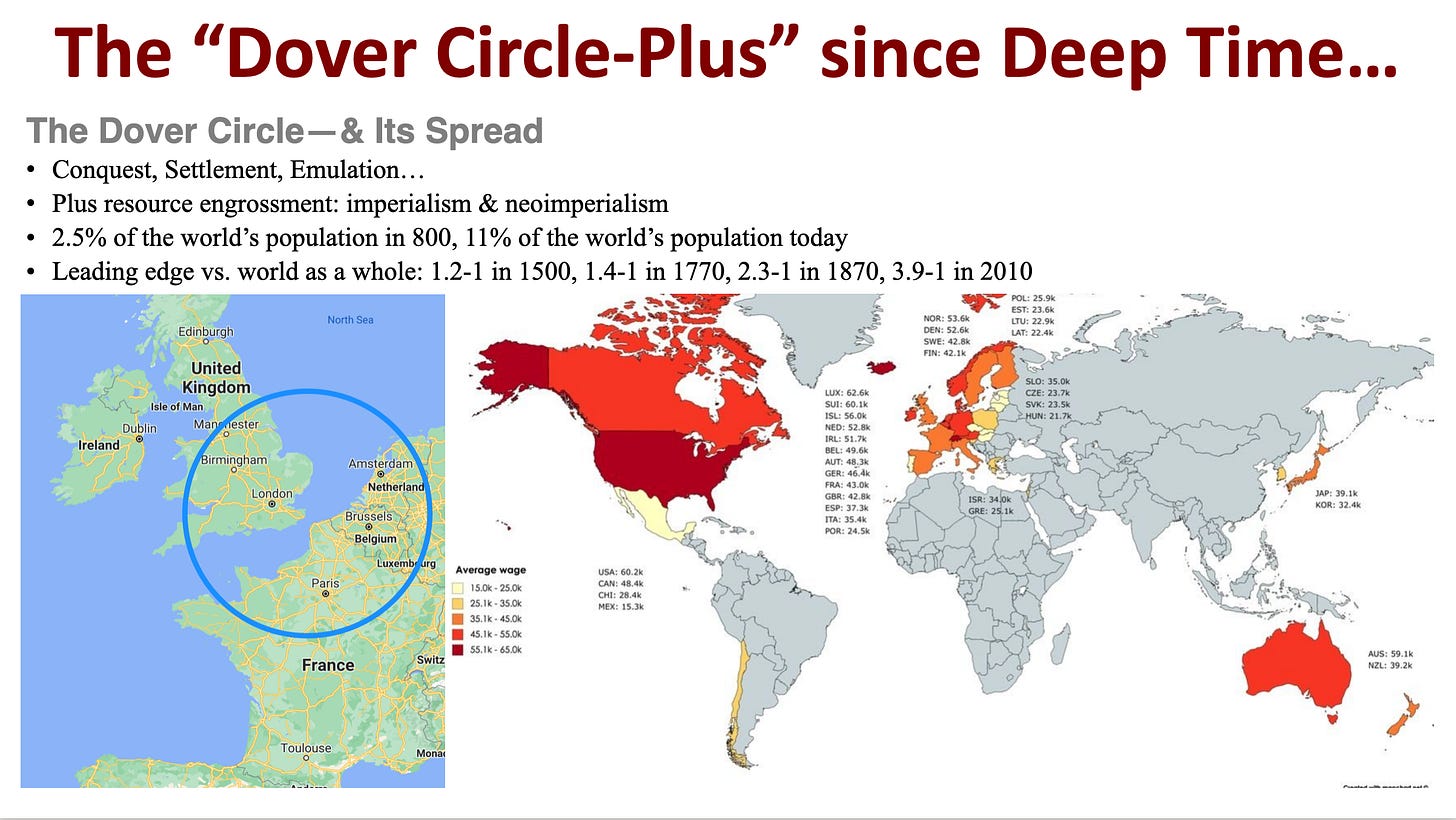
DeLong argues that 'the West' is a fake, discontinuous category (citing Ian Morris's wandering 'Western core' and the post-WWII Harvard Redbook's invented torch-relay genealogy) and proposes 'Dover Circle-Plus' instead: the societies descended from or emulating a 300-mile circle around Dover after 1500. He grounds the Dover Circle's post-1500 takeoff in five structural elements (Henrich on cousin-marriage/diffuse sociability, Berman on law binding the powerful, durable proto-nation-states, self-governing merchant cities, Crone on weak society-of-domination), yielding a reusable framework for periodizing the origins of modern growth.
The label "Western Civilization" is an anachronistic ideological construction, not a genuine historical continuity; the accurate descriptor for the economies that grew rich after 1500 is "Dover Circle-Plus" — those that originated in, received mass settlers from, or deliberately emulated economic patterns developed within roughly 300 miles of Dover, England.
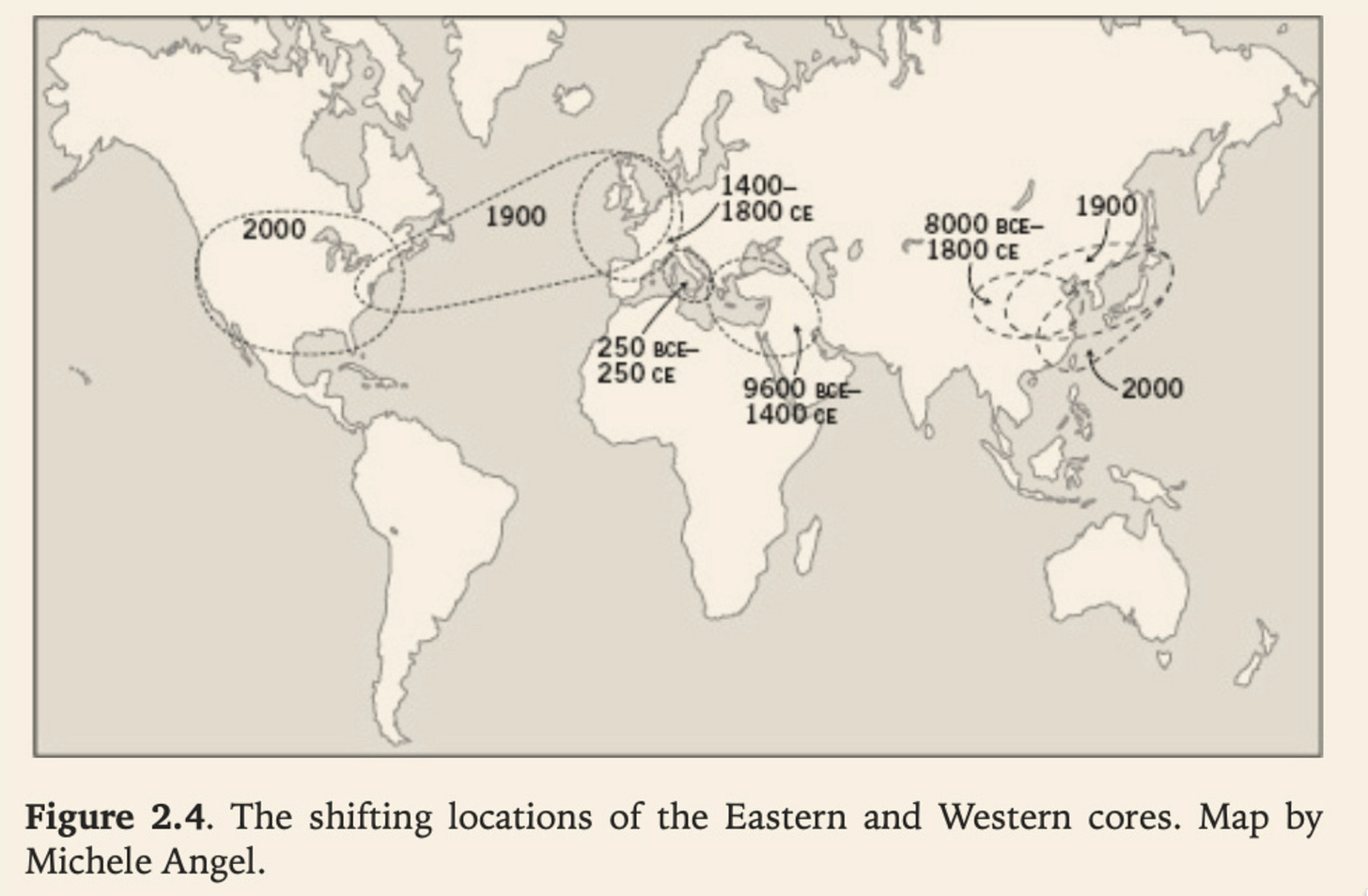
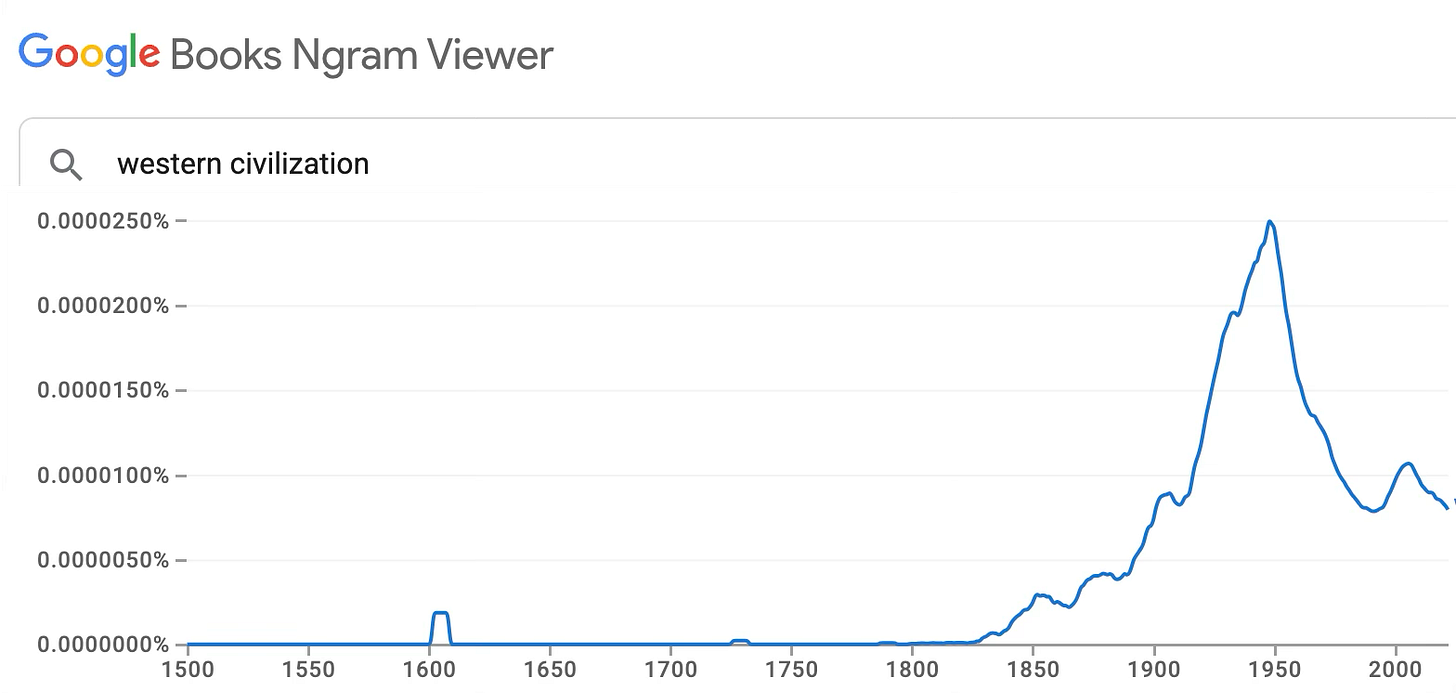
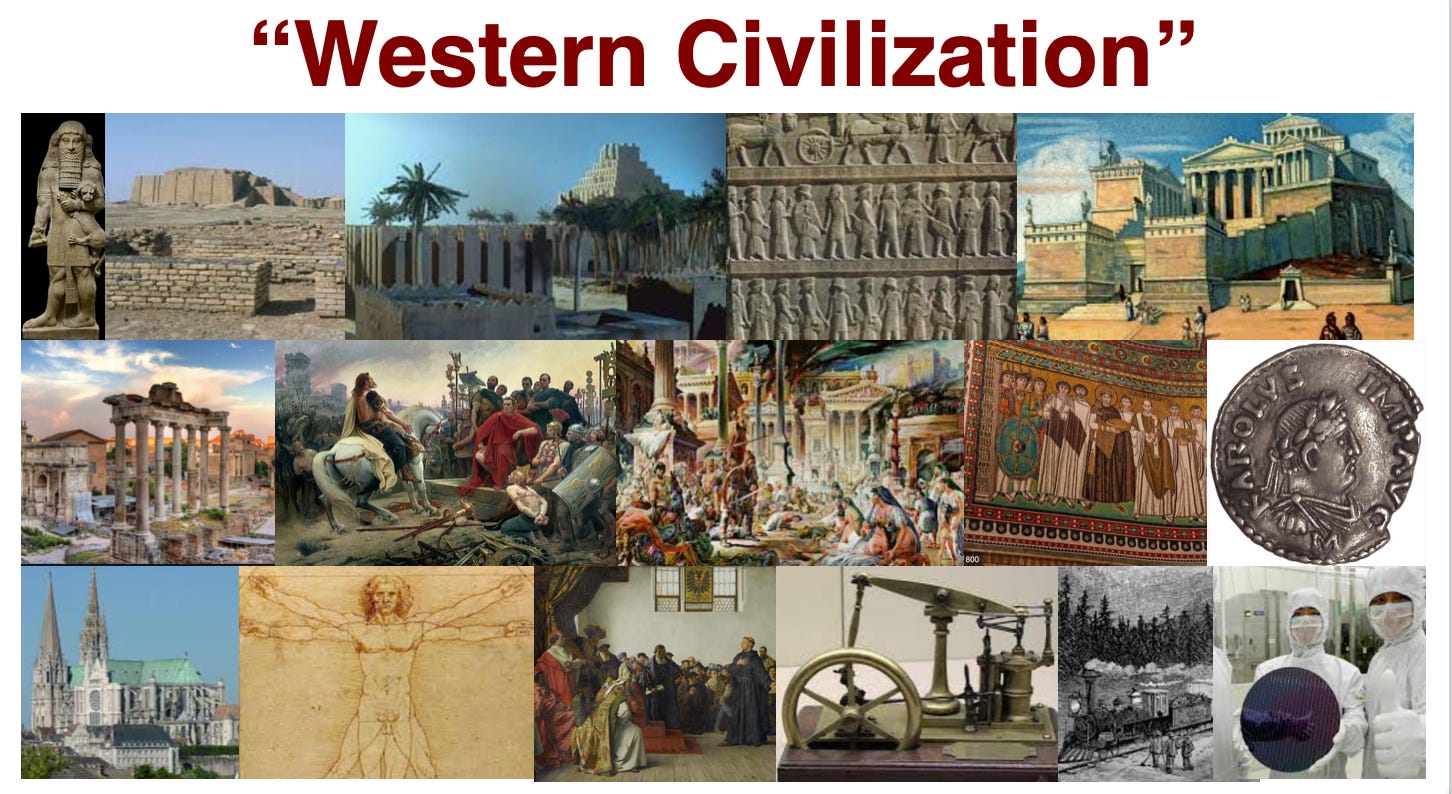
"West" barely registers as a term before 1840, by which point Spain, Portugal, Italy, and southern France were already outside the rich-country club. "North Atlantic" was more accurate for the early 1800s but misfits by 1960. "Global North" fails on New Zealand, Australia, Singapore, Hong Kong, and Chile. Ian Morris (Stanford) maps the "Western" civilizational core from −9600 to the present and what that map shows is a moveable feast: an original quadrant of Basra–Tbilisi–Ithaka–Thebes gives way to Italy around −250 to 250, reverts, then in 1400 jumps to Western Europe, and by 2000 has migrated entirely to the continental United States. The Eastern core (Yellow River and Yangtze valleys) shows genuine political, cultural, and genetic continuity throughout by contrast. DeLong concludes that the "Olympic torch relay" narrative — Gilgamesh to Athens to Rome to Christendom to the Enlightenment and on to democratic capitalism — amounts to selecting pictures you like from history and calling them yours.
"Western Civilization" as a curriculum peaked in 1950s America. Judith Shklar's 1989 Haskins Lecture dissects Harvard's Redbook general-education program: its authors wanted to immunize students against fascism by presenting it as an aberration from a "good West," constructing a fake but usable past for the post-WWII New Deal Order rather than reckoning with what Europe had actually done between 1940 and 1945.
Matthew Yglesias argues there is real teaching value in the Western intellectual inheritance — the history of proto-constitutionalism in England and the classical republics, the Plato-to-Rawls philosophical lineage, and religious freedom arising from the specific circumstances of the Protestant Reformation. DeLong agrees that this content matters, but substantially disagrees with Yglesias's characterization that radical criticism has come to dominate American campuses; DeLong says he has evidence to the contrary.
Genuine continuity in the Dover Circle can only be traced reliably from around 800 — Charlemagne (son of Pippin the Short, capital at Aachen), crowned Emperor by Pope Leo II, began concentrating interesting developments between Stockholm and Sevilla. Around 1500 the circle held a narrow advantage of roughly 1.1× other high Eurasian civilizations in ocean navigation and gunpowder, not in governance or culture; the Ottomans still besieged Vienna in 1688 and the Omani expelled the Portuguese from East Africa. Five structural features explain Dover Circle's eventual breakout: (1) the medieval church's war on cousin marriage created diffuse sociability beyond kin (Joseph Henrich); (2) the pope-emperor struggle established law as binding even on the powerful (Harold J. Berman, Law and Revolution, 1983); (3) competition among durable proto-nation-states drove governmental effectiveness; (4) a rural-military aristocracy left cities self-governing, making merchants near-equals of warriors; and (5) fragmented elite factions produced exceptional institutional plasticity (Patricia Crone). Dover Circle's lead reached only 1.4× in 1770. France failed in Mexico and struggled badly to conquer Algeria in the 1800s. Not until 1880 and the machine gun did Dover Circle-Plus armies achieve systematic dominance — with exceptions: Ethiopia repelled Italy, Afghanistan repelled Britain and Russia. The final expansion was as much soft power as hard.
A full essay arguing that modern science emerged and persisted in early modern Europe not from unique genius but from a self-reinforcing bundle: fragmented competing elites that raised the payoff to being right, an artisan-instrument culture that forced an interventionist epistemology, religion's ambivalent-but-often-positive charter and institutional homes, print networks that made debate public and portable, and institutions (academies, journals, nullius in verba) that lowered the cost of stable belief. The thesis is that persistence, not discovery, is what distinguished Europe from prior efflorescences (Hellenistic, Islamic, Chinese). A rich, original, heavily-referenced synthesis with lasting reference value.
Modern science as we know it emerged in early modern Europe not because Europe invented curiosity or genius, but because between 1543 and 1687 — from Vesalius's *De Humani Corporis Fabrica* and Copernicus's *De Revolutionibus* to Newton's *Principia* — Europe assembled a bundle of mutually reinforcing forces that made empirical curiosity about nature pay. The Royal Society's motto *nullius in verba* ("take nobody's word") named the stance; what made it stick was a specific political economy in which the payoff to being right exceeded the payoff to elaborating sacred texts or advancing elite power.
Five forces composed the bundle. First, elite fragmentation: early modern Europe lacked a unified military-bureaucratic ideology; kings, popes, dukes, merchants, and universities competed for position. Patricia Crone called it "a different pre-industrial society *because* it was an unsuccessful one." This polycentrism lowered the cost of dissent and raised the expected value of novelty — an astronomer with more accurate ephemerides, a physician with a better anatomical atlas could each find patrons where another court or faith said no. Second, a craft and instrument culture embedded an interventionist epistemology: lens-grinders, clockmakers, and surveyors learned by making, testing, and fixing, a habit David Landes traced to clocks as the canonical example. The gold-standard analogy here is the randomized controlled trial: empowerment via deliberate action, the mutual information between actions and outcomes. This is the actual epistemological core of science — an infant tied to a mobile kicks for the pure delight of making it move. Third, Latin Christianity ambivalently but often positively authorized inquiry through the "Book of Nature" metaphor and built institutional homes — Jesuit schools, Protestant seminaries, academies. Fourth, the printing press turned specialized controversy into public culture and, through periodicals like the *Philosophical Transactions*, established recurrent venues for priority claims and replication. Fifth, institutions lowered the cost of stable belief and offered careers that anchored communities of practice beyond any single hero.
The Newton-Boyle-Hume triangle exposes the epistemological complexity. Newton, whom Keynes called "the last of the magicians," maintained a portfolio broad and non-hierarchical — mechanics, theology, and alchemy reasoned from any systematic premises he could find; his closest nods to empirical concordance, "the apple and the moon agree pretty nearly," are rhetorical and sparse. Boyle, "the first of the scientists," staged experiments, recruited witnesses, and made the public search for evidence a lauded social practice. Hume, the empiricist *par excellence*, remains the deepest puzzle: his account of causation is observational regularity — patterns of succession — not intervention and control. The empowerment-via-deliberate-action model is absent from Hume's epistemology even though it is now recognized as science's actual causal core. William Whewell framed the underlying shift as normative, not merely methodological: a transition from trust in the mind's internal powers reasoning from theologically sacred premises to dependence on external observation of nature — a change in how to argue, what counts as victory, and when to concede.
Earlier efflorescences — Hellenistic science, Islamic mathematics (where Eric Chaney argues creative work flourished near expanding frontiers but stalled once borders froze and inquiry re-centered on theology), Chinese engineering — each had intellect and instruments but hit institutional ceilings. Europe had the analogous bundle to Britain's coal-steam-cotton system for industrialization: problem-rich crafts, mathematically minded natural philosophers, many competing patrons, and a print infrastructure that made debate public. Path dependence then locked it in — instruments improved, textbooks codified, journals rewarded verification — stabilizing savantry into a civilizational habit.
history of scienceeconomic historyScientific Revolutioninstitutionselite fragmentation
A hoisted 2023 piece presenting DeLong's formal four-equation Malthusian model and a Python simulation rebutting Rafael Guthmann's claim that pre-modern 'supercycles' of rising/falling incomes disprove Malthusianism. The key analytic move: a purely Malthusian economy with random shocks already generates centuries-long upswings and collapses, so observed efflorescences (Bronze Age, Classical Greece, Rome) are consistent with, not counterevidence to, Malthusian dynamics. A substantive model exposition with lasting pedagogical value.
Pre-modern economies were genuinely Malthusian, and the centuries-long "supercycles" of rising and falling living standards that critics point to as evidence against Malthusianism are exactly what Malthusian dynamics produce in the wild.
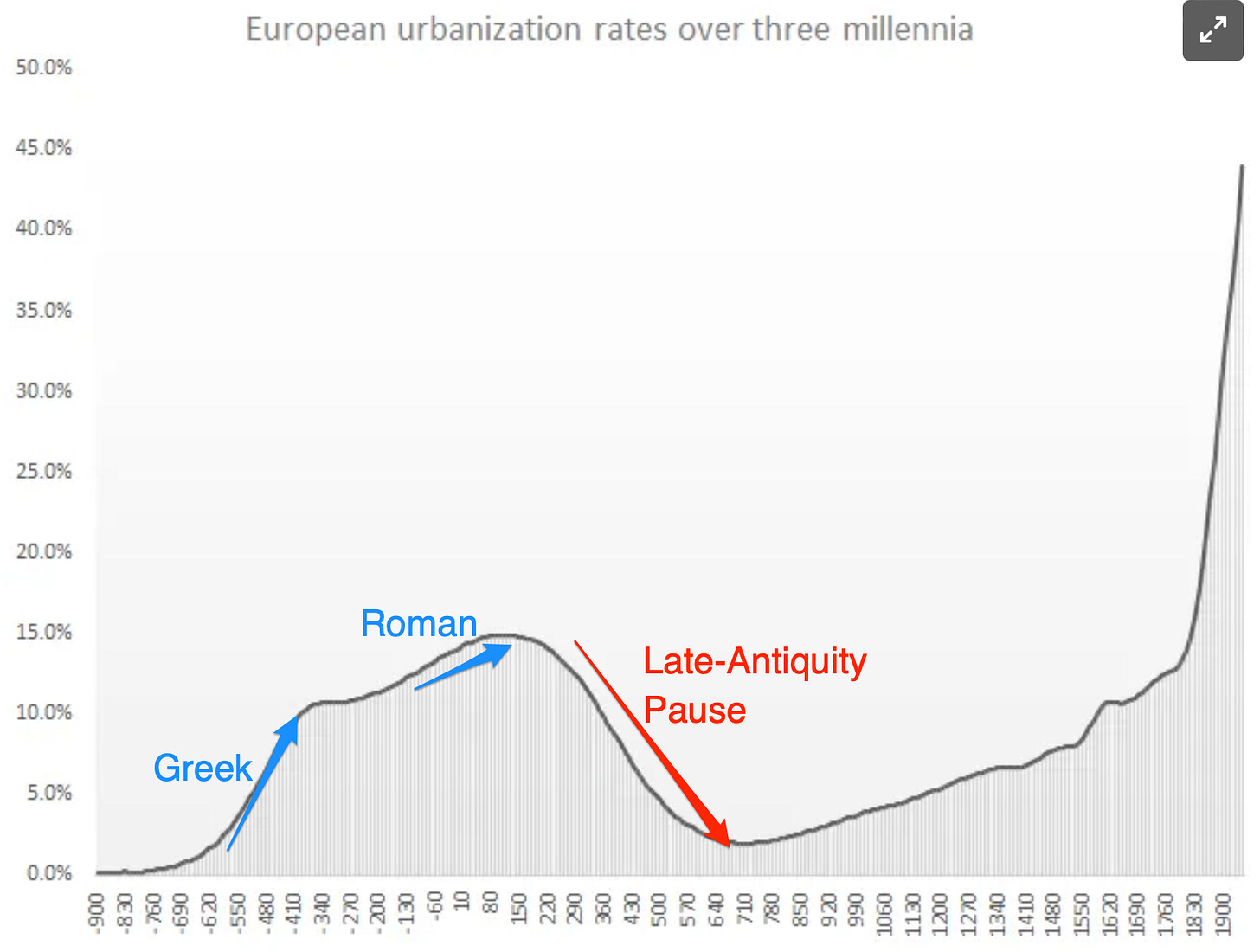
Rafael Guthmann argues, using urbanization rates (share of Europeans in cities of 5,000+) as a proxy for living standards, that Western history featured three major economic supercycles: the Bronze Age Near East (~3000 BCE, collapsing in the late second millennium BCE); the Classical Greek and Roman efflorescence (~700 BCE to 150 CE, followed by the Late-Antiquity Pause to 700 CE); and the medieval-early-modern ascent culminating in the Industrial Revolution. Guthmann takes these multi-century swings as proof that no Malthusian subsistence floor was operating. DeLong disputes the inference, not the data.
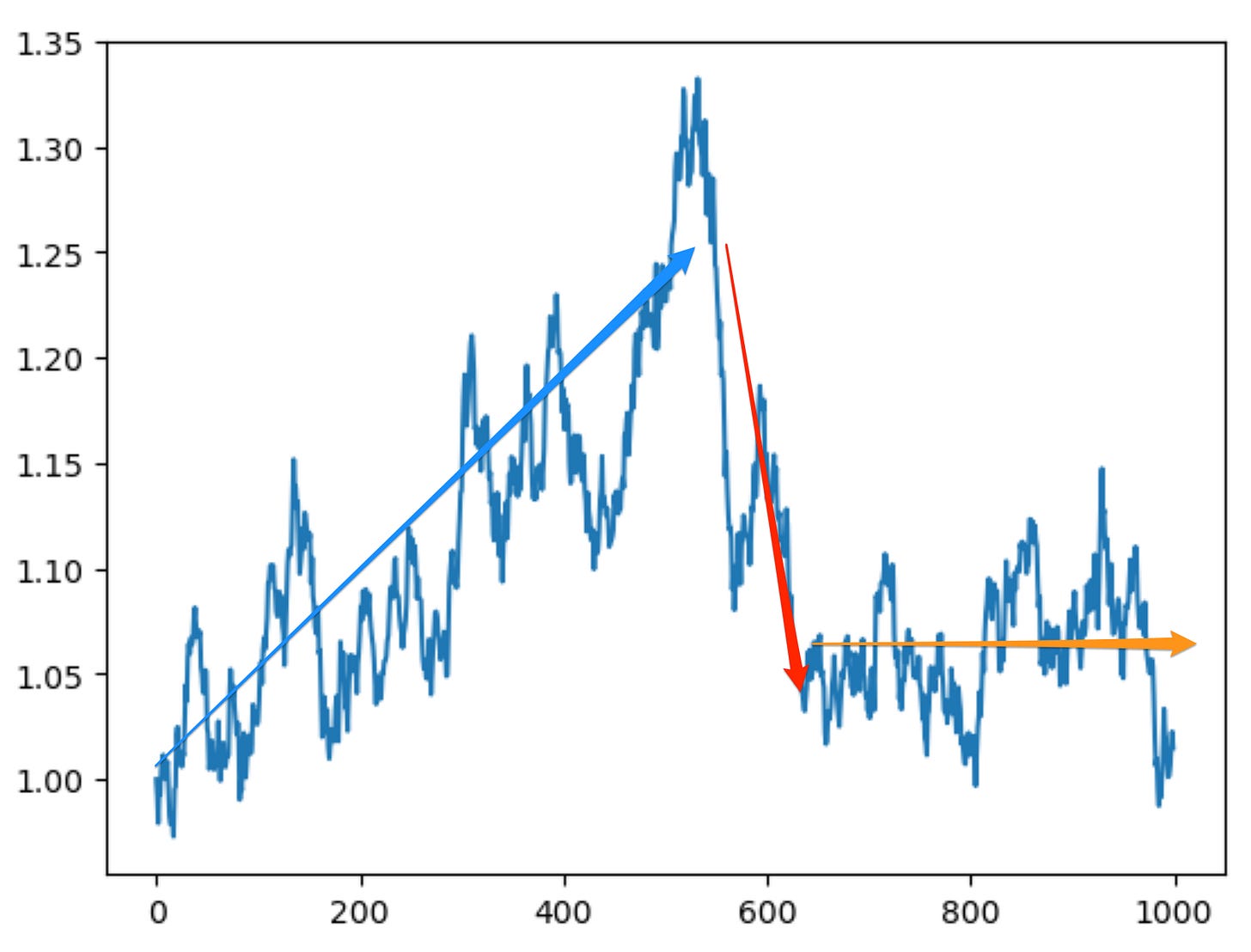
The model: technology grows at h = 0.0005 (5% per century); living-standards growth equals technology progress minus population pressure divided by γ = 2; population grows proportionally to how far incomes exceed subsistence, with sensitivity β = 0.25 — meaning incomes 40% above subsistence produce 1% annual population growth, doubling in three generations. A Python simulation with these parameters and only random shocks (plagues, good harvests, mild winters) produces exactly the supercycles Guthmann sees — a 500-year rise followed by a sudden crash and a 400-year plateau — from pure noise. This establishes the first step of DeLong's argument: noise alone can generate the apparent patterns.
The second step: DeLong explicitly concedes that more than random noise was operating in the Classical, Hellenistic, and Roman efflorescences. Real mechanisms — cultural tastes for luxuries that divert spending from fertility-boosting consumption, customs like late female first marriage or female infanticide, and the imperial peace that raises returns to capital investment — can sustain centuries-long income gains and generate big expansions in urbanization and specialization, even cultural "miracles" like Classical Greece riding a genuine economic wave. The Malthusian return to baseline can take up to half a millennium.
But none of these mechanisms breaks the underlying feedback: higher incomes eventually call forth more people and more resource stress. What the pre-1870 world never produced was sustained, compounding gains for the broad population as a normal condition rather than an episodic exception.
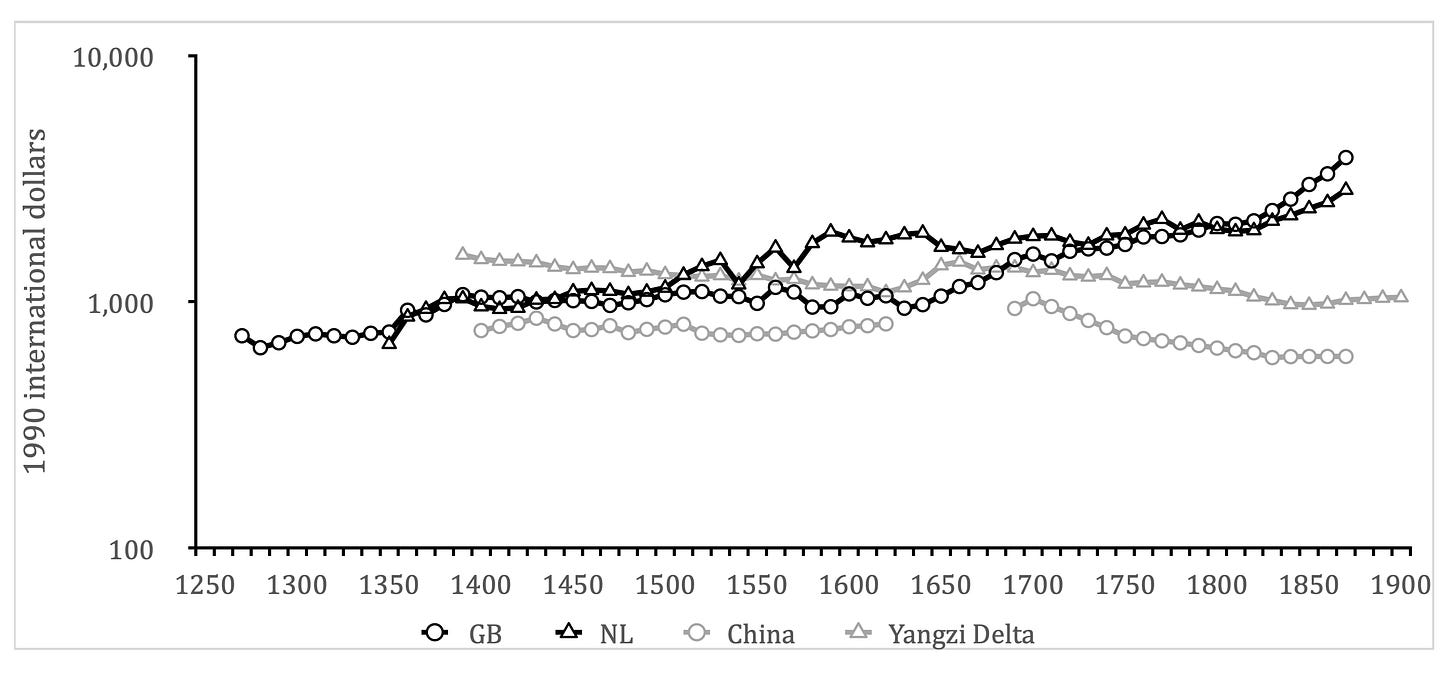
DeLong's compact synthesis of why there was essentially no growth in median living standards before 1500: slow (~5%/century) technological progress was offset by population growth driven by patriarchy's demand for surviving sons, leaving humanity Malthusian-trapped while elites of 'thugs-with-spears' captured the surplus. The post doubles as a teaching artifact for his Econ 196 course, with a ranked reading list and discussion questions, making it a strong reference statement of his core Slouching-Towards-Utopia thesis.
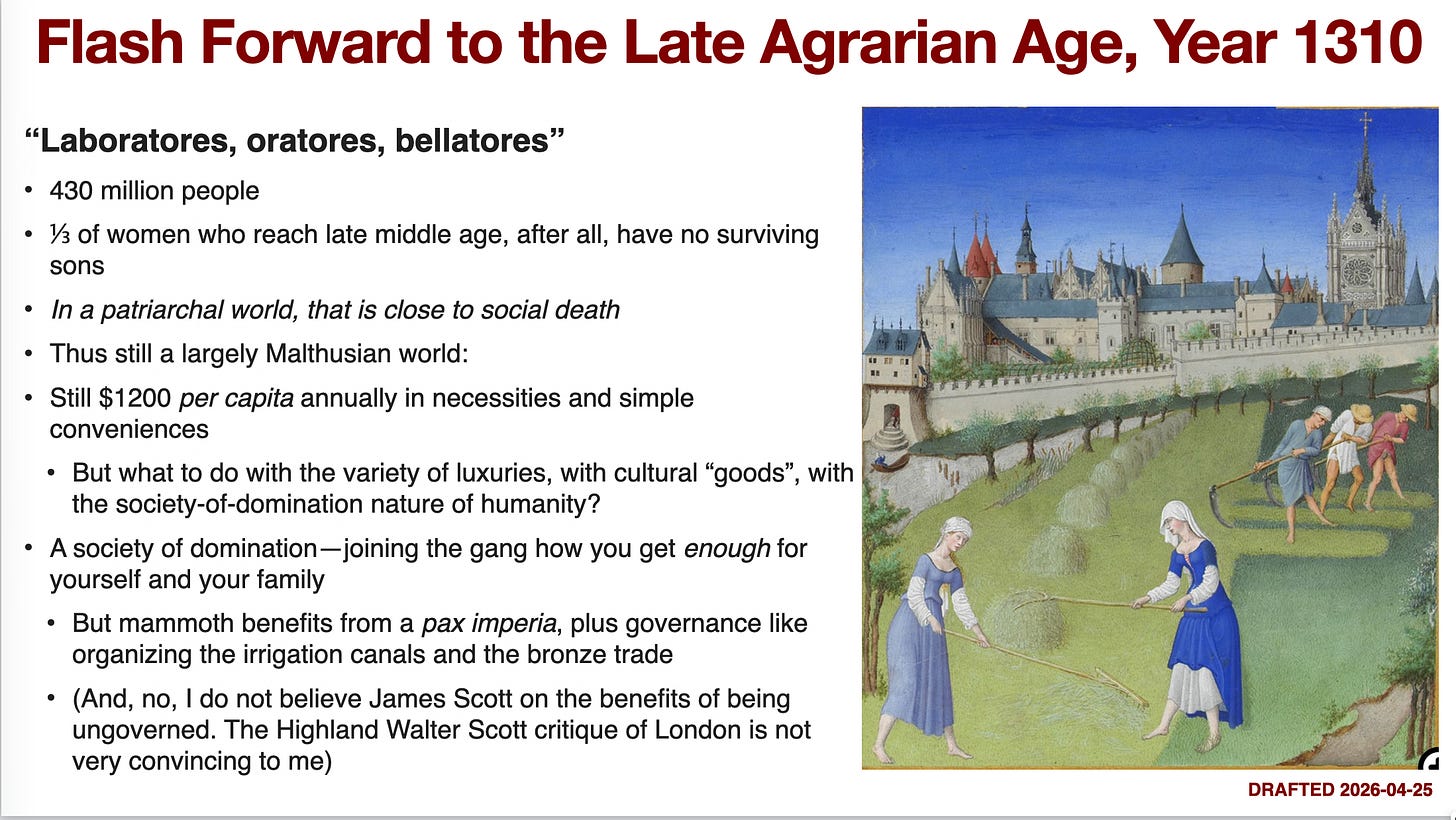
Before 1500, typical human material living standards barely moved—the median person in 1500 lived no better than in -3000, despite millennia of technological, artistic, and imperial progress. DeLong's explanation is the Malthusian trap: pre-1500 technology advanced at roughly 5% per century, far slower than the ~10% per century population growth that any surplus resources reliably triggered. People's strong desire for children, combined with patriarchal structures that made reaching late middle age without surviving sons near-social-death for women—and substantially so for men—ensured that extra resources translated into more births rather than higher living standards. Under slow-growth demographic conditions, one-third of humans would end up without surviving sons, sustaining this pressure. "Subsistence" was partly sociological: Malthus saw patriarchy (raising female marriage age), monarchy, and orthodoxy as the mechanisms keeping fertility below the biomedical floor.
General scarcity made governance predatory: politics reduced to elites-with-spears elbowing out rivals and extracting from everyone else, warping knowledge production toward ideas useful for grabbing rather than true ones. Technological progress was structurally slow too: innovation requires numerous educated minds with leisure to communicate across space and time—the "anthology intelligence" that only materialized post-1875, powering 2% annual technological growth.
DeLong's Econ 196 reading sequence opens with a humanistic overview—his own 2024 "The Great Agrarian-Age Vine-&-Fig Tree Shortage"—then pivots to quantitative readings: Clark's *A Farewell to Alms* ch. 3 (Living Standards), and four DeLong Substack pieces: "Ensorcelled by the Devil of Malthus" (2023), DAY 3 LECTURE NOTES on Malthusian logic, simulation lecture notes, and "Guesstimating Typical Living Standards" (2023). A Guthmann–DeLong debate is included on whether pre-modern economies were truly Malthusian; Chatterjee & Vogl's 2018 *AER* paper asks where Malthusianism still applies. Clark chs. 4–5 (Fertility, Life Expectancy) are reserved as workhorse background. Six pre-class discussion questions probe: why land generates diminishing returns; whether fertility or mortality is the key demographic margin; how luxury demand or marriage-age norms can raise living standards without escaping the trap; how elite and mass living standards diverge within Malthusian systems; whether Guthmann has the better of DeLong on Malthusian scope; and what conditions over the next twenty-five years could revive Malthusian relevance globally.
DeLong's graduate-lecture notes on why pre-1600 techno-economic progress was so slow and why a tenfold technology gain from -8000 to 1600 went almost entirely into multiplying population rather than raising non-elite living standards (the Malthusian trap). He works through four readings, Morris on quantifying 'social development,' Kremer's population-drives-ideas endogenous-Malthusian model, the Finley-Temin debate on whether market models apply to Rome, and Henderson et al. on geography and path dependence. It matters as a substantive teaching synthesis of how to model very-long-run growth.
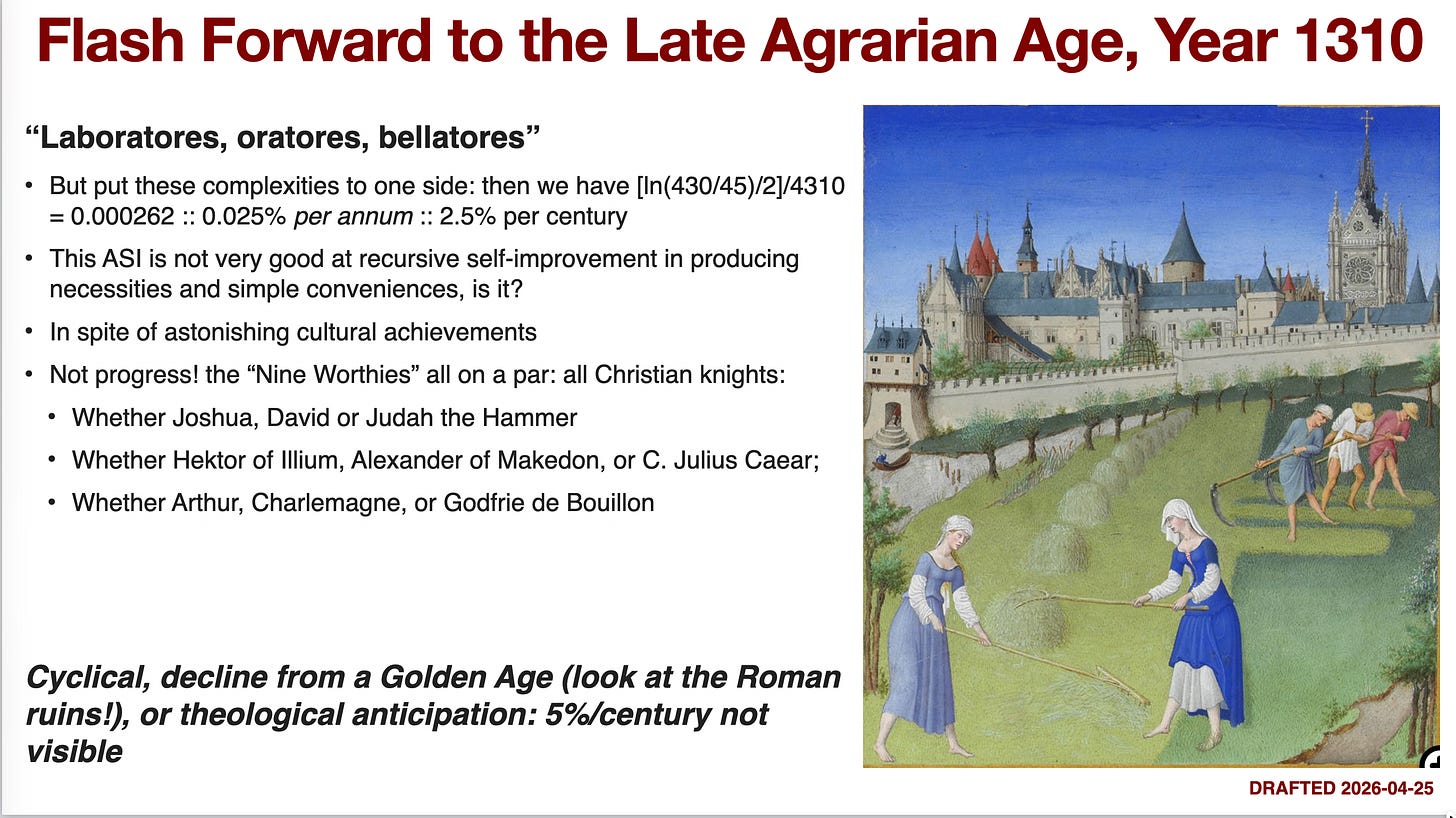
The Malthusian agrarian age held the growth rate of humanity's technology stock below 3% per century — and progress was not guaranteed, as the post-Roman-Han dark age shows. The rate then rose: 8% per century from 800–1600, 20% from 1600–1775, 80% through the Industrial Revolution, and 2% per year since. Four readings interrogate why.
DeLong's technology index follows a specific formula: technology-stock growth = output-per-capita growth + ½ × population growth, embedding the judgment that ideas are twice as salient as resource scarcity. By this measure, living standards today are 16x preindustrial; correcting for consumption variety and lifespan raises the ratio to roughly 640x (3,200x for the richest tenth) — a quantitative gulf DeLong treats as a qualitative break.
Ian Morris builds two scalar development indices — "East" and "West" — from energy capture per capita, city size, war-making capacity, and information technology across 15,000 years. DeLong rejects the binary as Procrustean and proposes the "Dover Circle" instead: the North Atlantic basin and its appendages, rejecting any continuity from Ur of the Chaldees to modern Los Angeles as a coherent "West."
Michael Kremer's 1993 QJE paper derives from nonrival ideas plus Malthus a prediction that population growth should be proportional to population level. Data from one million B.C. to 1990 largely confirm it, establishing a baseline any richer story must beat.
The Finley–Temin debate asks whether the early Roman Empire operated as a market economy. Finley said no: exchange was embedded in status and politics. Temin's counter-evidence — circulating coins, supply-and-demand price movements, interest-rate structures, long-distance commodity flows — is deliberately self-limiting: he does not claim Rome had Walrasian general equilibrium with Arrow-Debreu securities. His diagnostic is that Finley's vocabulary, applied to 18th-century Holland, would equally mis-describe that economy — making it an obviously wrong frame.
Henderson, Storeygard, and Weil use satellite night-light data to show that physical geography (soil quality, ruggedness, coastal and river access) explains roughly half the global variation in economic density and about a third within countries. Splitting geography into agricultural versus trade advantages reveals path dependence: early developers urbanized on good land; late developers clustered on coasts once transport cheapened. The four readings together supply a toolkit for modeling why the agrarian age stayed poor.
DeLong's framing essay places vibe-coding inside his model of Schumpeterian creative destruction since 1875, where each generation one-fifth of the economy is leveled and rebuilt to do 5x as much, with knowledge workers now in the bullseye as many white-collar tasks turn out to have surprisingly low Kolmogorov complexity. Paul Ford's crossposted NYT piece supplies vivid first-person testimony of doing six-figure software work for a $200/month subscription. It matters for embedding a striking practitioner account in a coherent economic-history framework of labor transformation.
AI is catalyzing Schumpeterian creative destruction among knowledge workers on the same generational cycle that has, since 1875, leveled one-fifth of the economy while leaving four-fifths to grow incrementally. This generation the bullseye is white-collar information work: tasks that look creative but turn out to have "surprisingly low Kolmogorov complexity."
DeLong's key analytical distinction drives the labor-market split: experts become 10× as productive, while novices become merely "good enough to cobble along." Which categories shrink and which expand depends on demand elasticity — whether the cost collapse triggers Jevons's Paradox (cheaper → more consumption → net job growth) or simply destroys employment.
Paul Ford's firsthand account gives this abstraction teeth. "Vibe coding" — prompting AI like Claude Code, which got dramatically better in November 2025 — lets Ford spend a half-hour a day completing projects shelved for a decade. A website he'd have paid $25,000 to commission, he rebuilt himself; a data conversion he'd once have billed at $350,000 (product manager, designer, two engineers including one senior, four to six months of work) now runs on a $200/month Claude plan.
The AI-generated code is "not as good as handcrafted, bespoke code," Ford concedes, but it is "immediate and cheap" — sufficient for most users who just need things to work. Ford sees vast latent demand: billions of dashboards, reports, and trackers people need but can't budget; that unmet market is the Jevons upside. The drag is real — every six months another AI shift forces costly product resets — and Ford acknowledges he is "less valuable than he used to be."
Using Watt's marketing coinage of 'horsepower' and Jevons's Paradox, DeLong asks whether AI makes a given kind of worker 'coal' (cheaper-to-use complement whose demand rises) or 'horse' (substituted away), arguing software coding has so far been Jevons-paradoxical. He generalizes to a 5,000-year story of becoming efficient at producing Not-Raw-Food, concluding the binding constraint on the AI transition is distributional and institutional, not technological. It matters as a clean conceptual frame for thinking about AI's labor effects.
Whether AI makes workers richer or redundant depends on which side of Jevons's Paradox they sit on — the coal side or the horse side. James Watt coined "horsepower" purely as marketing: mine owners understood horse-teams, not foot-pounds per second, so Watt standardized at 550 foot-pounds per second (derived from watching a mill horse walk 2.4 rpm on a 12-foot-radius wheel pulling ~180 pounds-force) and sold engines as horse-replacers fueled by coal instead of oats. Rising steam-engine efficiency (Newcomen ca. 1750: 0.5%; Watt 1800: 2%; Corliss 1850: 10%; steam by 1900: 20%; today's fossil-fuel plants: 40%) made coal cheaper per unit of work and expanded coal demand enormously — coal barons won while horse breeders lost, with U.S. farm equines falling from 26,493,000 in 1915 to 700,000 a century later.
Programming has been Jevons-paradoxical so far: each tooling wave (switches → Fortran → C → JavaScript → "vibe coding") lowered the cost of useful software and raised demand for people who could wrangle it. But Jevons's Paradox requires elastic demand, no regulatory brake, and genuine new uses — it cannot operate without limit. The deepest historical precedent is that humanity spent ~20% of its collective budget on Not-Raw-Food in 3000 BCE and only ~5% today; freed resources funded everything else and the non-farmer workforce quintupled. Even so, ensuring that the resulting "something elses" paid decently and carried status proved elusive.
DeLong's three-bullet synthesis draws a crucial temporal distinction. In the short-to-medium run, AI-complementary occupations — software engineering, many forms of analysis, some medicine and design — look like coal: rising productivity expands the range of tasks they tackle and can increase demand. Over longer horizons, however, any given task bundle risks going horse-like as basic needs saturate and capital-intensive substitutes mature. This has already happened to agriculture, to many forms of manufacturing, and to clerical work; knowledge work has no magical exemption from the same fate. The binding constraints are therefore distributional and institutional, not technological. Humanity's accumulated knowledge plus tools to access it — what DeLong calls "anthology superintelligence" — can already sustain extraordinarily rich, varied lives. The hard question is who gets how much of which kind of life under what rules. Technology keeps expanding the feasible set, but without deliberate institutional design it does not guarantee that the gains will be fairly shared, or that workers whose "coal" just became vastly more productive will actually see their portion of those gains.
DeLong revisits Acemoglu-Johnson-Robinson's 'Colonial Origins' paper as 'a true rabbit and a true duck'—elegant and influential, yet hiding heroic assumptions inside its instrumental-variable design (either prosperity structurally degrades governance, or 17th-century settler mortality measures modern institutions better than direct observation). He uses it to argue, Heckman-style, that only those with a fully specified structural model have warrant to make 'causal' claims. A substantive methodological critique in economic history and the philosophy of empirical inference.
The famous Acemoglu, Johnson, and Robinson (2001) "Colonial Origins of Comparative Development" (AER 91:5) rests on an elegant chain: European settlers who survived their colonies built inclusive, pro-growth institutions; settlers facing lethal disease burdens (yellow fever and such) built extractive ones instead; those early institutional differences persisted; and therefore colonial-era European settler mortality serves as a valid instrument to identify the causal effect of institutions on prosperity. AJR's headline result is that institutional differences explain roughly three-quarters of income-per-capita variation across former colonies, and that geography, latitude, and disease burden become irrelevant once institutions are controlled for.
DeLong argues the IV design conceals a structural contradiction it never resolves. Without a fully specified model, the instrument smuggles in one of two deeply uncomfortable claims: either prosperity exerts a strong *negative* causal effect on governance quality — which contradicts everything political science and history tells us — or 17th-century settler mortality is a better gauge of what modern institutions actually do than present-day analysis by experts who can observe those institutions directly. Neither implication is defensible, yet the non-structural framing hides both from view.
The episode converted DeLong into a "Heckmanite": only researchers who have a structural model in mind, even if not formally on the table, have genuine warrant to make causal claims from statistical procedures.
DeLong argues that the deep foundations of the human economy—spatial division of labor, long-term planning, and cumulative culture—are not modern or even Homo-sapiens inventions but Pleistocene facts hundreds of thousands of years old. His evidence: a hornfels quarry at the Jojosi Dongas in KwaZulu-Natal, where for over 100,000 years (c. 220,000–120,000 BP) knappers traveled deliberately to extract one specific stone and carried the blades elsewhere—'managers of a supply chain,' requiring spatial division of labor, temporal planning, knowledge transmission, and institutional trust. Five hundred millennia earlier, pre-sapiens hominins at Gesher Benot Yaʿaqov controlled fire, cooked fish, used medicinal plants, and quarried basalt with levers—crossing Henrich's 'Rubicon' of cumulative culture long before language, markets, or money. From this DeLong develops his 'five magics' of prosperity and reframes intelligence: the real 'AI' is 'Anthology Intelligence,' the band as a single distributed mind, and the real 'ASI' is the 'Anthology Super-Intelligence' that writing later globalizes. This distributed, culturally-transmitted knowledge—not prices or property—is the deepest substrate of the economy. A draft chapter of Enlarging the Bounds of Human Empire and basis for his Oxford Hicks Lecture.
Humanity's defining economic capacities — spatial division of labor, multigenerational knowledge transmission, and long-term supply-chain planning — predate Homo sapiens sapiens by hundreds of thousands of years and are Pleistocene facts, not products of a late "cognitive revolution."
Two sites anchor the argument. At Gesher Benot Ya'aqov (Bridge of the Daughters of Jacob), a Jordan River ford five miles north of the Sea of Galilee, hominins almost certainly late Homo erectus or Homo heidelbergensis were active from around 800,000 years ago — 550,000 years before our subspecies appeared. They maintained fire intentionally over extended periods; cooked large carp from ancient Lake Hula (possibly the earliest known hominin food processing); selected specific medicinal plant species, predating previous pharmaceutical evidence by over 700,000 years; quarried and hauled high-quality basalt from a distant outcrop using teams and levers; and managed a diet spanning elephants, deer, gazelle, freshwater crabs, nine fish species, acorns, olives, grapes, water chestnuts, and more. As Joseph Henrich writes in The Secret of Our Success, this is cumulative cultural evolution already "up and running" — far more know-how than any individual brain could accumulate in a lifetime. The knowledge was distributed across minds, encoded in practice, transmitted through demonstration and apprenticeship.
Half a megannum later, at Jojosi Dongas in KwaZulu-Natal's eroded Drakensberg foothills, Manuel Will and collaborators published in Nature Communications evidence of a hornfels quarry operated from approximately 220,000 to 120,000 BCE — 5,000+ generations. Hornfels flakes into superior long, thin, resharpable blades. Dolerite and quartz were immediately available on site; the knappers ignored both, walked deliberately to the hornfels outcrop, made blades, and carried them elsewhere. The site was a dedicated extraction workshop, not a camp — a supply chain requiring spatial division of labor, temporal planning, cross-generational knowledge transmission, and institutional trust that the network would persist.
The crucial analytical step is not to assert the spatial dimension but to show why Jojosi establishes it where GBY could not. GBY's achievements — fire, fish, medicinal plants — could in principle be explained as purely local knowledge: a band's accumulated understanding of one particular place. A hornfels quarry deliberately visited over 100,000 years, with the product systematically carried elsewhere, cannot be explained that way. It requires a cognitive map in which particular places have particular properties worth traveling to obtain, and an economic logic that the camp is better served by dedicated procurement journeys than by improvising with inferior local rock. This is the spatial dimension of collective intelligence — what Jojosi adds that GBY alone could not establish.
DeLong presents the underlying structure as a chicken-and-egg problem, stated in compressed form: division of labor requires knowledge (you cannot specialize in hornfels procurement without knowing hornfels is worth procuring), but knowledge creation equally requires division of labor (no individual can personally accumulate a useful knowledge base from scratch). The Anthology Super-Intelligence — not Artificial but Anthology, the distributed multigenerational collective mind — is the explicit solution to this circularity. Once a group stores knowledge socially across minds and generations while coordinating specialized activities across space, the basic architecture of the human economy exists. Everything else is elaboration.
DeLong names five magics of human prosperity. The first two are operative at these sites: individual tool use (eyes, hands, a planning brain) and Anthology Intelligence at band scale. Writing (c. 3000 BCE) extends the ASI to all of recorded civilization — a singularity jump. Markets extend spatial coordination beyond personal networks. Science gives the ASI self-correction, filtering confident errors and the ideologies of domination that pre-scientific accumulation embedded.
The standard narrative places these capacities' origins at 40,000–50,000 years ago. Both sites show that is wrong about the origins: sustained intentional fire use and deliberate spatial supply chains require exactly the socially transmitted multigenerational knowledge systems the cognitive revolution was supposed to have introduced. The revolution amplified capacities already operating hundreds of thousands of years earlier. As Johan Fourie concludes: we are different because of our economic function, and that function is older than almost anything else we can name about ourselves.
economic historyprehistorydivision of laborcumulative culturecollective intelligencehuman evolution
The 'modern economic growth' installment of the Hicks lecture, marking 1875 as the genuine break onto Kuznets's path of sustained compounding growth and Gordon's 'one big wave' of transformative technologies, with US and German trend labor-productivity growth rising toward ~2%/year and doubling times falling from a century to ~35 years. It documents the US overtaking Britain by 1870 and the structural shift from rare to normal growth in output per head, supplying the quantitative pivot of the whole stage-theory narrative.
Labor productivity in the North Atlantic core shifted after 1875 from roughly 0.5–1.0 percent per year to 1.8–2.0 percent, cutting doubling times from a century to 35 years. World output per capita rose from roughly $3,000 in 1875 to about $18,000 today — a factor of six compounding at 2 percent annually, against 0.6 percent in the early Industrial Revolution and 0.03 percent in the agrarian age. U.S. and German real GDP per capita each roughly doubled between 1870 and 1913; Robert Gordon calculates U.S. output per hour rose by a factor of eight between 1870 and 1970.
The enabling mechanism was the invention of routinized invention: engineering schools (MIT, Germany's Technische Hochschulen, land-grant universities producing ~5,000 U.S. graduates per year by 1913) and corporate R&D labs (Menlo Park, then GE, Westinghouse, BASF, Bell Labs). Tesla's AC polyphase system at Niagara Falls cut effective energy costs by an order of magnitude; factory reorganization from line-shaft to per-machine electric-motor layouts yielded 30–50 percent productivity gains. Nathan Rosenberg stressed that most of this "progress" was not stroke-of-genius invention but incremental improvement and learning-by-doing in operation and maintenance — steam engines broke constantly, and sustaining them required routinized human capital: engineers who could do thermodynamics and anticipate failure modes. Britain, despite Maxwell's pre-eminence in electromagnetism, substantially fumbled the transition to second-wave R&D-intensive industries.
Measured GDP understates the true welfare gain. William Nordhaus estimates the doubling of global life expectancy — from 30–35 years in 1875 to 73 today — is on the same order of magnitude as all measured consumption gains; his "price of light" exercise finds welfare gains of 100–1,000× that price indices miss. Dixit-Stiglitz variety effects, Romer's non-rival ideas, and Varian's consumer-surplus estimates for unpriced digital services all point the same direction: true welfare growth substantially exceeds the recorded 2.65 percent annually.
The demographic transition follows inescapably. In 1875, global fertility was 5–7 births per woman almost everywhere; today it is below 2.4 globally and 1.2–1.6 in East Asia and much of Europe. Countries at 6–7 births in 1960 — South Korea, Iran, Mexico, Brazil — fell to or near replacement within a single lifetime. The cascade spread outward from the North Atlantic: France in the late 18th century, Britain and Scandinavia in the 19th, Southern and Eastern Europe in the early 20th, East Asia and the Americas in the late 20th. Oded Galor's unified growth theory frames this as a once-and-for-all fertility decline triggered by the productivity takeoff itself.
Schumpeterian creative destruction distributes the 2 percent average very unevenly. William Baumol warned that stagnant sectors — haircuts, nursing, live performance — would see rising relative costs precisely because they lack transformative productivity growth, while one-fifth of the economy in each generation runs at 5–6 percent annual gains. U.S. agricultural employment fell from ~40 percent in 1900 to under 2 percent today; manufacturing from roughly one-third in 1950 to under 10 percent. In 1910, roughly one million telephone operators connected calls by hand; electronic switching eliminated almost all those jobs by the 1970s. David Autor, David Dorn, and Gordon Hanson document precisely why: routine, codifiable tasks are the first eaten by computers and robots.
The question of who cushions the blow is fundamentally contested. Barry Eichengreen's "Great Compression" names the mid-20th-century settlement — union density above 30 percent, wage norms, progressive taxation — that kept distribution relatively equal as the pie grew. Since the 1980s those arrangements have eroded: U.S. union density collapsed to under 10 percent and the top 1 percent's income share rose from roughly 8 to over 20 percent. The ideological fault line runs between Friedrich von Hayek — the market giveth and taketh away, and to temper its judgments invites inefficiency and tyranny — and Karl Polanyi's Great Transformation: a self-regulating market is a political construction that tears apart social fabric, always calling forth a protective double-movement of legislation, social insurance, and political mobilization to blunt its sharpest edges.
Friedrich Engels, extrapolating from the steam mill of 1870, expected scarcity's end to make hierarchy pointless, converging on rotating administration and creative labor for all. He was wrong twice. Alfred Chandler shows management in multidivisional firms (U.S. Steel, GE, BASF) became a high-skill, high-rent profession as organizational complexity grew. And democratic politics settled on mixed economies: the postwar left in OECD countries oscillated in the 30–45 percent vote-share band, and Thomas Piketty documents rising top income shares and wealth concentration since the 1980s. What emerged is High Modern Capitalism — 2–3 percent annual productivity growth, states at 30–50 percent of GDP, and democracy coexisting uneasily with inequality and recurrent crisis.
The prehistory installment of the Hicks lecture, opening 700,000 years ago at Gesher Benot Ya'aqov where late Homo erectus already ran a cognitive and physical division of labor — a recognizable economy without language. DeLong develops the 'anthology intelligence' thesis (gossip and information-sharing welding bands into a collective mind), works through the gatherer-hunter-to-farmer Malthusian transition and the living-standard anchors ($1,600 then $1,200/capita), and derives the strikingly slow ~0.007%/year pace of technological self-improvement from -70,000 to -3,000.
Seven hundred thousand years ago, late Homo erectus at Gesher Benot Yaakov — a Jordan River crossing whose Crusader-era name, given by the Nunnery of St. Jacques, survives in Hebrew as "Bridge of the Daughters of Jacob" — already operated a recognizable economy. Archaeologists find basalt quarried miles away, dragged to the lakeshore for tool-making in dedicated workshop areas, with separate fire-keeping zones for cooking. Anthropologist Joseph Henrich stresses the food variety assembled there: prickly water lilies harvested underwater far offshore, numerous fish species, nuts, berries, and animals — more ecological knowledge in active use than any single brain could hold. What emerges is a cognitive division of labor alongside a physical one, among communities of perhaps five bands of 20, sharing results peacefully and training novices without language as we know it. DeLong calls this an Anthology Intelligence (AI): the emergent cognitive capacity of the group far exceeding any individual member.
Jump to -70,000. A lecture slide shows a Khoesan hunter; DeLong notes the bow is anachronistically superior and the brightly colored textiles are a product of late-1800s German chemical engineering, but otherwise the image offers a reasonable picture of gatherer-hunter life at that date. Total population of Homo sapiens sapiens and related groups (Neanderthals, Denisovans, and genetically visible "ghost populations") was perhaps 400,000, but only around 5,000 individuals in roughly 100 Eastern and Southern African bands contributed 95%+ of present-day heredity. Their likely edge: full linguistic facility — the ability to speak of past, future, or counterfactual. Evidence is humans' near-irresistible propensity to gossip, which means what one person knows rapidly propagates through their entire social network, making even a small band an information-pooling AI.
By -15,000 humans had spread to all parts of the world. By -7,000 farming had begun, but per-capita living standards fell from a guessed $1,600 to roughly $1,200 — farmers are shorter, less nourished, and nutritionally deficient. Easier lives produced more surviving infants; rising population then hit Malthusian constraints on farmland and erased the surplus — what Jared Diamond called "the worst mistake in the history of the human race." Settlement does upgrade the group: freed from carrying everything, sedentary communities accumulate tools and build environmental memory aids, reducing generational knowledge loss. The Anthology Intelligence becomes an Anthology General Intelligence (AGI).
To measure the pace of advance from -70,000 to -3,000, DeLong constructs a technology index. Per-capita income alone is rejected because it ignores scale; total societal income is rejected because it would imply individuals are not independently productive — wrong, since more hands and brains do make lighter work. Resources are judged roughly half as salient as ideas: not zero, but not equal to ideas either. The index therefore grows at per-capita income growth plus one-half population growth. With population rising from ~5,000 to 45 million and income falling from $1,600 to $1,200, the formula [ln(45/0.005)/2 + ln(1200/1600)] / 67,000 yields 0.007% per year — less than one percent per century. Much of even that advance was local knowledge: figuring out how to live in the specific environments humans were migrating into, not general intellectual progress. An AGI supposedly capable of recursive self-improvement was barely improving at all.
The methodological core of the Hicks lecture: because humans are storytelling animals, everyone inevitably arrives at a stage theory, and DeLong catalogs the teleological two-stage versions (Acemoglu, McCloskey, Polanyi, Rostow) and faults them for treating 'us' as the inevitable end-state. He draws Hicks's bottom-line lessons — we were very lucky, the market system was a halting tendency not an inevitability, fixed-capital industrialization needed both science and financial deepening — and frames the project of building a better, less teleological inductive stage theory. Shorter and more setup-heavy than the substantive installments.
Stage theories of economic history are unavoidable: humans are narrative animals who cannot think without a through-line, so every serious theorist produces one.
John Hicks's 1969 *Theory of Economic History* offered a sophisticated multi-stage model tracing the path from a custom-and-command economy to the modern fixed-capital exchange-based market economy, with the market progressively dissolving less flexible social forms at each stage. Simpler two-stage variants proliferate: Acemoglu's extractive→inclusive institutions, McCloskey's aristo-heroic→bourgeois virtues, Polanyi's embedded→disembedded (with major costs as property rights crowd out all others), and Rostow's takeoff→mass consumption. All are strongly teleological, treating "us" as the endpoint — a distortion that produces bad history.
From his model Hicks drew several conclusions. First, luck: we have been very lucky, and the process has gotten farther than it had any right to. Market spread was always a tendency, never an inevitability — halting, geographically patchy, and subject to real reversals: the post-1200 BC Bronze Age collapse that made Greeks forget how to write; the post-Song retreat of China's iron production; the post-200 CE Late-Antiquity Pause. Second, fixed-capital industrialization required both science arriving from left field and unusual financial-deepening institutions to sustain illiquid long-horizon investment. Third, wage growth was unlikely without either exhaustion of the W. Arthur Lewis rural labor surplus or unions strong enough to enforce rent-sharing. Fourth, the beginning, development, and future of this process was always a dicey political-sociological question. Fifth and finally, economists should look to history and political economy, not to Y=f(K,L) and (K/Y)*=s/(n+g+δ). DeLong closes by proposing to construct a better, less teleological stage theory built from historical snapshots rather than endpoint reasoning.
The agrarian-age installment of the Hicks lecture: with writing and bronze at -3000, humanity becomes a true 'anthology superintelligence,' yet most societal energy goes into organizing gangs of domination (thugs, accountants, propagandists who take a third of the crop) rather than productivity, keeping recursive self-improvement to roughly 0.026%/year through 1310. DeLong wrestles seriously with measuring living standards under domination (luxuries, variety, cultural goods, the Dixit framing) and stresses that ancient and medieval civilization was sophisticated and accomplished, just inept at advancing the technological stock.
From around -3000, agrarian civilization locked humanity into a "society of domination" that suppressed recursive technological self-improvement for over four millennia — and ideology, not just coercion, was the central mechanism.
The year -3000 brought bronze tools, writing, and the state simultaneously. Writing transformed humanity into a collective superintelligence that speaks across space and time, compressing accumulated knowledge from the whole of history. But the state brought extraction: thugs with spears and their tame propagandists took a third of the crop and a third of crafts. Gilgamesh of Uruk — declared by his propagandists to be 2/3 god and 1/3 man — exemplifies the ideological fix: divine sanction for the ruler's position, with "pay your taxes or the gods will be angry" as the operative message. This propaganda directly suppressed productive effort; anyone who tried to raise productivity simply made themselves a softer target for the gang. Joining the gang was, in a Malthusian world of scarcity, the rational path to securing enough for your family.
Standard-of-living calculations across this era are fraught. DeLong adopts "ability to produce necessities and simple conveniences" as his numeraire. The estimated $1,200 per capita annually for agrarian civilization looks 25% below the gatherer-hunter standard (~$1,600), but Avinash Dixit's model corrects this: true wealth equals quantity of necessities multiplied by variety of producible commodities multiplied by lifespan. Civilization added variety, longer lives, luxuries that dodged Malthusian population pressure, and a vast expansion of cultural goods — novels, beliefs, stories — constituting a supervening layer of real value. Athens with 300,000 people in a region that could feed only 60,000 illustrates the market's organizational power: it sourced tin from Cornwall without any single person knowing the full supply chain, paying good prices at Peiraieus and letting the market figure out the rest.
By 1310, world population reached 430 million (up from 45 million in -3000), yet per-capita necessities held at ~$1,200 — yielding average improvement of 0.026% per year (2.6% per century). Patriarchal Malthusian pressure explains the stagnation: women faced a 1-in-7 lifetime childbed mortality risk, and roughly 1-in-3 of those who survived to late middle age had no surviving son — near social death in a patriarchal order — so couples with resources kept having children to hedge that risk. DeLong explicitly dismisses James Scott's case for the benefits of being ungoverned as "the Highland Legend, the Highland critique of London society" and states "I think Thomas Hobbes had it more right." Two Malthusian escape hatches had not yet opened at 1310: the first would come post-Black Death, when depopulation combined with the western European marriage pattern to partially relieve the trap; the second in the 1700s, when changing French property-division customs reduced the patriarchal penalty of having only daughters.
The Nine Worthies of medieval Europe — three Jews (Joshua, David, Judah Maccabee), three pagans (Hektor, Alexander, Julius Caesar), three Christians (Arthur, Charlemagne, Godfrey of Bouillon) — all depicted as Christian knights — illustrate the era's worldview: history was cyclical or in decline, and a better world would come from heaven, not from human progress. And yet agrarian civilization achieved genuine excellence in art, culture, and military organization: Caesar conquered Gaul's 15 million people with 40,000 men in a decade, and ended with the conquered ruling class eager to suppress revolts on his behalf. The failure was specifically cumulative technological self-improvement — slow not from lack of sophistication but because the society of domination gave people little incentive to try, and every incentive not to stand out.
A core Hicks-lecture installment that frames the lecture's purpose (why Hicks turned from neoclassical synthesis to economic history and stage theories), critiques teleological two-stage theories, and then quantifies the acceleration of human 'recursive self-improvement' from prehistory through the agrarian age into the commercial-imperial and first-industrial eras. It develops DeLong's signature arguments: the anthology-intelligence framing, Crone's view of Europe as a failed society-of-domination, Allen's cheap-coal/high-wage story, Jevons's Paradox and Nightmare, and a vivid SteamPunk-Oxford counterfactual of arrested 1875 technology.
The modern escape from Malthusian poverty was a fragile, improbable near-miss, not the end-state of an inevitable teleological process, and the neoclassical synthesis cannot explain why because it forecloses the central question of whether decentralized economies deliver what Adam Smith promised. John Hicks helped build that synthesis — alongside Samuelson, Solow, Friedman, and Stigler — then concluded by career's end it was a dead end. His 1969 *A Theory of Economic History* drew two substantive conclusions: fixed-capital industrialization required both science arriving "from left field" and unusual financial-deepening institutions making investors tolerate illiquid stakes; and the system was very unlikely to deliver general wage increases until W. Arthur Lewis labor-surplus exhaustion, or until unions enforced rent-sharing for a labor aristocracy. Hicks also stressed that progress was fragile: the post-−1200 late Bronze Age collapse (Greeks forgot how to write), the post-Song retreat of China's iron production, and the post-200 Late-Antiquity Pause — by 750 CE, both Europe and China mourned themselves as unworthy descendants of Hellenistic, Roman, and Han predecessors — all showed the process could reverse.
Everyone winds up with a stage theory. Among the two-stage variants DeLong surveys: Acemoglu's extractive → inclusive institutions; McCloskey's aristo-heroic → bourgeois virtues; Karl Polanyi's embedded → disembedded economy; Michael Polanyi's customary → mercenary+fiduciary institutions; Rostow's takeoff → drive to maturity → age of mass consumption. All treat the present as inevitable endpoint — a source of bad history.
DeLong reads collective cognition through three stages. Late *Homo erectus* bands at −700,000 at the Bridge of the Daughters of Jacob already pooled more knowledge than any single brain held — an AI (Anthology Intelligence). By −70,000, ~400,000 modern humans amplified this through an irresistible gossip impulse. Farming around −7,000 was a welfare decline — farmers shorter, less nourished, ~$1,200 per capita against the hunter-gatherer $1,600 — but settling upgraded the collective mind to AGI (Anthology General Intelligence): tools and memory aids no longer limited to what could be carried. Writing at −3,000, arriving with bronze and the state, created an ASI (Anthology Super-Intelligence), binding knowledge across space and millennia.
DeLong's technology index — per-capita income growth plus half the population growth rate — yields: −70,000 to −3,000, 0.007%/century; −3,000 to 1310, 2.6%/century (population 45→430 million, income flat near $1,200); 1310 to 1775, five times faster (population 430→800 million, income recovering to $1,600). The Athens case shows powerful market sectors existed early within agrarian domination economies. Athens sustained 300,000 people while Attica's farmland could support only 60,000. Perikles embezzled the Delian League treasury — city-states had shifted from contributing ships to money, then Perikles diverted the funds — building the bronze Athena Promachos and converting the League into an Athenian Imperial Thalassocracy. The tin for the bronze came from Cornwall; Herodotus couldn't find anyone in Athens who knew where it came from, but the market did.
The Industrial Revolution delivered 0.6–1.0% annual productivity growth against a pre-1500 ceiling of ~0.05%. Jevons's Paradox (as taught by Williamson and Clark) is distinct from Jevons's Nightmare: earlier GPTs — movable-type printing, the caravel — had limited aggregate growth impact because price elasticity of demand was less than one; the more capable a sector became, the smaller its weight in total production. Jevons's Nightmare is the coal-depletion problem Jevons identified in 1865: British output rose from 10 million tons/year in 1800 to ~80 million tons by mid-century, but shaft depths were lengthening and seam quality falling. Robert Allen argues Britain's cheap coal plus expensive labor created incentives to invent labor-substituting machinery that would have been unprofitable elsewhere. DeLong attributes roughly one-third of 1775–1875 growth to the geological lottery (glaciers scraped overburden off British, Ruhr, and Belgian seams), one-third to in-gathering world manufacturing into the North Atlantic "Dover Circle," and one-third to genuine ASI recursive self-improvement running twelve times the agrarian pace. Without a demographic transition — pre-industrial infant mortality ran 200–300 per 1,000, life expectancy in the low 30s — Malthusian arithmetic would have absorbed any surplus. The lecture closes with a "SteamPunk Oxford" counterfactual: 8 billion people in 2026 on 1875-level technology, air unbreathable from coal smoke, no electrification or internal combustion. Most multiverse branches probably landed there. We escaped, but barely.
A rich Hicks-lecture installment tracing the succession of post-1875 economic regimes — steam-power to applied-science to Fordist mass-production/New-Deal order to the neoliberal globalized value-chain economy — each with its own growth pattern and pattern of disruption. DeLong argues the mid-century mass-production/social-democratic alignment was a lucky, contingent constellation (FDR, the Depression, the war), not a natural equilibrium, and that as creative destruction shifted into IT, logistics, and finance, the old compromises cracked and the neoliberal order did worse at turning the ~2% growth engine into broadly legitimate life-trajectories.
Five successive "modes of production" since 1875 have each run roughly 2% annual recursive self-improvement of the aggregate human applied-science intelligence while repeatedly failing to construct a political settlement that turns that compounding into legitimate, widely shared security. The central paradox is set by Keynes's portrait in The Economic Consequences of the Peace of "the inhabitant of London in 1914": a person who could telephone goods to his door, invest globally, and travel freely across Europe — an "economic El Dorado" unprecedented in history, with trade roughly doubled as a share of world GDP since 1870 and capital flows from Britain and France running at 3–5% of GDP annually. Yet Keynes confesses that he and his class treated militarism, imperialism, and nationalist rivalries as mere background noise in their newspaper. Aggregate growth at 1.5–2% per capita did not buy political acquiescence because Ernst Gellner's "wrong address" problem intervened: the mail of political mobilization went to nation and sector, not class.
The applied-science age (1870–1970) transformed the breadth and pace of growth: US labor productivity averaged ~2%/year from 1890–1972; France and West Germany clocked 4–5% during the trente glorieuses; world GDP per capita in Maddison's data tripled from ~$2,000–2,500 to over $7,000 (today's prices). Paul David's electrification work illustrates why gains were delayed: productivity from electric motors did not materialize until firms redesigned factories away from the single line-shaft layout — a decades-long process before the payoff arrived. Haber-Bosch nitrogen fixation (now supplying roughly half the nitrogen in human proteins per Vaclav Smil) and germ theory drove analogous welfare gains. Mass production then emerged as a specific organizational layer on top of that applied-science substrate. DeLong insists on a three-way analytical distinction: mass production is a technological-organizational regime compatible with fascism, Stalinism, or social democracy; social democracy is an ideological-programmatic project possible without advanced manufacturing; and the New Deal order is the contingent US institutional settlement — unions in leading sectors, patchwork welfare state, Keynesian demand management — that happened to align all three for 1945–1973 partly because FDR was elected in 1932 rather than some Hooverite or proto-fascist alternative.
The regime broke when oil prices quadrupled in 1973–74 and doubled again in 1979–80. Union wage norms and cost-of-living escalators amplified the inflationary shock; Bretton Woods had already collapsed in 1971–73. US labor-productivity growth fell from 2.5–3.0%/year in the golden age to barely 1–1.5% between 1973 and 1990. The resulting Neoliberal Order of Globalized Value Chains — Volcker shock, Reagan-Thatcher deregulation, PATCO broken in 1981, China's WTO accession in 2001 — kept aggregate global growth near 1.8–2%/year but hollowed out industrial cores: US manufacturing employment fell from 19.5 million in 1979 to ~12 million by 2019; world trade as a share of GDP rose from ~30% to ~60% between 1985 and 2008. Simon Kuznets's rueful 1960s typology — four kinds of countries: rich, poor, Japan (the one that improbably climbed from poor to rich via disciplined late-industrialization), and Argentina (which had every factor-endowment advantage in 1900 and contrived to miss every boat) — encoded apparently permanent development trajectories. After 1990 that equilibrium unraveled rapidly as China went from ~$2,000 to ~$16,000 per capita in a generation while Argentina kept finding new ways to disappoint.
Now the info-biotech-attention regime is arriving, and E.P. Thompson's "awesome condescension of posterity" — his phrase from The Making of the English Working Class for confident historians who dismissed the skilled stockingers whose livelihoods were destroyed by new stocking frames operable by unskilled boys or women — applies in reverse. DeLong argues that knowledge workers are the new stockingers, and the economists who normally condescend to historically displaced workers are now themselves the displaced. The Clever Hans analogy captures the mechanism: Clever Hans was the horse that could "count" because its audience gave subtle cues and applauded when it stopped at the right number; AI systems are millions of Clever Hanses generating answers at industrial scale while humans pattern-match ("ah, that one!"), becoming the reinforcement-learning environment for their own tools. The single unifying thread DeLong identifies for the current Schumpeterian episode is the externalization of human cognition into artifacts that operate at non-human scale and speed, while political and social institutions for steering that cognition lag behind by decades — the same structural lag that has undermined every prior regime since 1875.
The closing installment of DeLong's 2026 Hicks Memorial Lecture refuses to deliver the promised inductive conclusion, instead passing the task to younger scholars: build a stage theory that integrates growth with distribution, ties technology to politics, and is explicit about contingency. It surveys the half-dozen existing stage theories (three-stage, Kondratiev-Schumpeter, Marx, Rostow, Polanyi, 'orders') and argues none is adequate, making this a programmatic statement of what economic history should aim at.
No single stage theory yet adequately captures 250 years of modern economic growth — and building the right one is the assignment DeLong hands to the next generation in this 2026 Sir John Hicks Memorial Lecture at All Souls' College, Oxford. The empirical baseline is remarkable: world GDP per capita has risen more than tenfold since 1820 (twentyfold in the North Atlantic core, per Maddison), life expectancy in rich countries has gone from 35–40 to 80-plus years, literacy has risen from a minority accomplishment to a near-universal baseline, and the share of humanity in World Bank "extreme poverty" has fallen from 70–80% to under 10%. Growth rates themselves have shifted: 0.05% per year in the agrarian age (1,500 years to double living standards), 0.5–1.0% in the early steam era, 1.5–2.0% in the applied-science and mass-production age, and roughly 2.0% world-average since 1980.
Yet the experience has never felt smooth. English weavers were thrown out by power looms doubling output between 1780 and 1830; peasant smallholders were displaced by tractors as agriculture's labor share fell from 80% to under 5% in the industrial core; Detroit autoworkers watched manufacturing's U.S. employment share drop from 28% in 1960 to under 9% by 2010; routine clerks whose occupations vanished in one generation. Alongside these: 25–30% unemployment in the Great Depression, 10–15% inflation in the 1970s, a doubling of the top 1% income share since 1980, and crises in 1997, 2001, 2008, and 2020. Six existing stage theories each capture something real but none is quite right: the 1960s agrarian-industrial-post-industrial schema; Kondratiev-Schumpeter long waves; Marx-Engels class struggle; Rostow's stages of growth; Polanyi's double movement; and the "orders" periodization (liberal 1870–1914, interwar breakdown, Keynesian-New Deal 1945–1973, neoliberal 1980–2008, and now something unlabeled). DeLong's own seven-stage caricature — agrarian Malthusian, commercial-imperial, steam-power, applied-science, mass-production/New Deal, globalized value-chain/neoliberal, info-biotech-attention — is, he concedes, only a useful caricature.
A correct stage theory must do three things better. First, integrate growth and distribution: the same 2–3% growth rate produced relative equality in Sweden 1950–1980, rising top shares and stagnant medians in the U.S. 1980–2020, and explosive catch-up in China. It must take Kuznets's inverted-U hypothesis on inequality seriously, then reconcile it with the Piketty-Saez evidence that top shares rebound when political constraints loosen. Second, link technology and politics tightly: connect the 40% manufacturing share of German GDP in 1913 and the Ruhr coal-steel complex to Weimar's political possibilities and the rise of Nazism; connect the 35% unionization rate and 90% top marginal tax rate in the U.S. in 1960 to New Deal stability; connect the 8–9% manufacturing employment share and 20% top-income share in 2010 to neoliberal fragility. Barry Eichengreen's work on exchange-rate regimes and Charles Maier's work on social coalitions are sketches in this direction. Third, be explicit about contingency: the euro could have been designed with different rules; China could have remained semi-autarkic after 1978; Reagan might never have broken U.S. unions; 2008 might have turned out like 1929–1933.
The payoff is improved judgment: knowing that the second industrial revolution's 3% U.S. labor productivity growth did not prevent the Depression, that the postwar golden age's 2.5% did not prevent stagflation and the Bretton Woods collapse, and that neoliberalism's 2% did not prevent 2008 should make one less inclined to treat growth as a magic wand. DeLong admits he once believed stage theory was nearly complete; he no longer does. The work that remains should guide policy on taxes and transfers, antitrust and IP, climate policy, migration, attention and data, and what society owes to workers whose jobs the next general-purpose technology vaporizes.
DeLong runs the Drake Equation with optimistic early terms to derive a chilling implication: if visible civilizations are rare, their average visible lifetime L may be only ~1000 years, implying powerful forces cut civilizational life short. He sets this against the extrapolation of 2%/year growth toward Bel-Air-for-everyone incomes, arguing the Great Filter likely lies in bootstrapping a robust civilization, not in life or intelligence, and that this makes long-run governance and existential-risk reduction central economic variables. A speculative but substantive draft chapter linking growth theory, deep history, and existential risk.
The Fermi Paradox, run through Drake Equation arithmetic with generous assumptions, implies that technological civilizations last no more than roughly a thousand years — and that should reorder every priority.
The Drake Equation links detectable civilizations N to: star formation rate R* (~1/year), planet-bearing fraction fₚ ≈ 1, habitable planets nₑ ≈ 1, life fraction fₗ ≈ 1, intelligence fraction fᵢ, industrialization fraction f_c, and visibility duration L. Setting fᵢ and f_c each at ~3% gives N ≈ 0.001 × L. The sky is silent — no megastructures, no beacons, no galactic internet — so N ≤ 1, implying L ≤ 1,000 years.
Alongside this, 2% annual growth compounded over centuries produces global average incomes of ~$400,000/year by 2200 and over $150 million per person by 2500 — Bel-Air mansions as the human average. That trajectory implies a Singularity: recursive AI, radically altered humans, planetary engineering. If it were easy, the galaxy should be full of post-Singularity entities. Its silence implies the path hits cliffs — pandemics, nuclear war, climate collapse, misaligned AI, totalitarian lock-in.
Sandberg-Drexler-Ord (SDO) object that honest log-uncertainty across Drake terms spans ~200 orders of magnitude: each of fₗ, fᵢ, f_c could be 0.00000003 rather than ~1, making expected L a billion years rather than a thousand. DeLong concedes, but applies the principle of insufficient reason: there is roughly one chance in three that L really is small, which should powerfully motivate action to lengthen it.
DeLong is unconvinced that life or basic intelligence is the rare step. Evolution has independently produced sophisticated cognition in corvids, cetaceans, cephalopods, elephants, and great apes. The bottleneck is civilization: high-bandwidth symbolic communication, cumulative technology capable of reshaping a planet, and institutional scaffolding that doesn't collapse back into primate-band politics. Human demographic history illustrates the point — 75,000 years ago our ancestors totaled ~400,000 hominins. Ecological dominance is ~50,000 years old; agriculture and writing under 15,000; the industrial revolution 250 years old; radio visibility ~100 years. The galaxy would have filed Earth under noise for almost all of this time. The hard step is bootstrapping a civilization powerful enough to be astronomically visible and robust enough not to be destroyed by its own tools.
Three conclusions follow. First, default trajectory may not be "2% growth to utopia" but a few centuries of transformation followed by a regime change — possibly one that writes present humans out of history. Second, existential-risk governance is growth theory's most load-bearing variable: a 50% reduction in the probability of self-destruction this century is in expected-value terms vastly more important than a 1% gain in long-run growth. Third, near-Bel-Air average incomes under plutocratic concentration would be an extraordinarily wasteful dystopia. Existential-risk reduction, institutional design, and equitable distribution are survival technologies, not luxuries.
A substantive crosspost-interview on the Great Divergence: Broadberry and Gupta's grain-wage data show India and Britain at similar living standards around 1600, with Indian real wages falling below half of Britain's by 1750 and agricultural decline beginning before colonialism (extraction, not investment, under British rule). The conversation marshals evidence on state fiscal capacity (a Chinese taxpayer worked 2 days/year vs. 17-20 in Britain), the European marriage pattern and urban mortality as Malthusian brakes, caste limiting technological diffusion, and dates the China-Europe divergence (Yangzi Delta) to ~1700. DeLong adds a useful five-channel framework for sources of productivity and prosperity. Strong reference value for economic history.
The Great Divergence between Northwestern Europe and the rest of the world was already underway well before the Industrial Revolution — and, critically, before European colonialism can take the blame for Asia's decline. Bishnupriya Gupta and Stephen Broadberry use grain-wage data (day wages converted to food purchasing power) to show that in 1600 living standards in India and Britain were roughly equal. By 1750, Indian real wages were less than half of British wages. Figure 1 (Gupta 2025) tracks this collapse across grain, cloth, and a general consumption basket. India's agricultural productivity had been falling since the 1650s, and by the late colonial era, yields per acre were below their 1600 levels — lending some substance to nostalgia for Emperor Akbar's reign (1556–1605). The East India Company took Bengal in 1757, but India was already a century into economic decline. Gupta draws the clear conclusion: colonialism was extractive and offered no growth stimulus, but it did not cause the initial fall.
Figure 1: Indian wages, measured as the purchasing power of grain, cloth, and a general “consumption basket” ( Gupta 2025 )
India's famous Mughal court splendor and booming textile trade were misleading signals. Textile weavers were a small fraction of the population, and "India's economic decline begins during the time of booming textile trade." Agriculture — the big story — was collapsing. Indians also earned far less silver than the British; British wages commanded many more goods on international markets, and a middle class was forming in Elizabethan England. Gupta and Broadberry explicitly argue against reading this British advantage as a side-effect of American silver flooding European markets. Instead, they point to structural differences already in place: Britain had a large sector specializing in trade, banking, insurance, and manufacturing that made it a "high-productivity" economy on foundations independent of New World bullion. Figure 2 (Broadberry & Gupta 2015) shows Indian per-capita GDP drifting steadily below Britain's from the seventeenth century onward.
Figure 2: Indian per-capita incomes and GDP as a fraction of Britain’s ( Broadberry & Gupta 2015 )
On China, Broadberry notes that China as a whole was already behind Britain in late medieval times — making any whole-country comparison an unfair one that stacks the deck against Europe. The right unit is the Yangzi River Delta (modern Shanghai's region), the most economically dynamic corner of imperial China. GDP per capita data (Figure 3, Broadberry & Zhai 2025) places even the China–Europe divergence, on this favorable comparison, at around 1700 — later than Renaissance-era theories but still well before the Industrial Revolution. This directly contradicts Kenneth Pomeranz, who placed the parting of ways deep into industrialization.
Figure 3: GDP per capita estimates for Britain, the Netherlands, China and the Yangzi Delta ( Broadberry and Zhai, 2025)
Outside Northwestern Europe, the global pattern is near-universal stagnation punctuated by crashes; Britain and the Netherlands alone show sustained gains from the Black Death onward. Explanations offered: later marriage and smaller families in Northwestern Europe reduced Malthusian pressure on gains; high urban mortality and frequent warfare (Voigtlander and Voth) suppressed population growth in London and Amsterdam with a similarly perverse but effective result. Fiscal capacity mattered enormously — Debin Ma calculates that in early-nineteenth-century China a person worked two days a year to pay taxes; in Britain the figure was 17–20, reflecting small European states' ability to extract and invest. Mughal India showed the same low-tax pattern. Gupta adds that India's caste system constrained technological diffusion in ways European craft culture did not. Proximate factors are identifiable, but no agreed framework yet exists for ranking the fundamental forces.
Today, China's aggregate GDP per capita remains well below Western Europe's, but Beijing and Shanghai — each exceeding 20 million people — have essentially closed that gap with comparable European cities, shifting the field's attention from the Great Divergence to the Great Convergence.
Great Divergenceeconomic historyIndiaMalthusian trapstate capacity
DeLong reposts Mark Koyama's review of the late Nick Crafts's macro economic history of Britain, which traces the successive regimes of British growth: early industrial lead, relative decline behind the US and continental Europe through institutional path dependency and craft-union rigidities, and partial Thatcher-era recovery into the ICT wave. The review distills Crafts's quantified, growth-theory-driven account of why Britain forged ahead, fell behind, then fought back. A solid guided tour of a landmark economic-history achievement, valuable for British long-twentieth-century context.
Britain's long growth trajectory from the Industrial Revolution to the 2008 financial crisis is best understood through institutional path dependency: early industrial leadership created legacies that later became constraints.
The Industrial Revolution was real but narrow: TFP growth ran at 0.4% per year from 1770 to 1850, concentrated in a few sectors, with steam's benefits only diffusing broadly through the economy in the second half of the 19th century. Modest but sustained per-capita gains during rapid population growth were nevertheless revolutionary in long-run perspective.
Late Victorian and Edwardian Britain largely escapes a charge of economic failure — competition limited managerial inefficiency across most sectors, railways excepted. The failures were of omission rather than commission: more could have been done to invest in R&D and support basic science (p. 99). The interwar period planted the seeds of decline: TFP growth was significantly slower than in the US; new industries failed to establish a strong export position; 1930s protectionism and cartelization kept profits high while suppressing long-run productivity growth.
The postwar decades were Britain's deepest relative failure despite fast absolute growth. West Germany's coordinated market economy generated high investment and wage restraint through corporatist unions; Britain's craft-union inheritance could not internalize those gains and resisted new technologies. Around one-third of the 1950s economy was cartelized; three-quarters saw price fixing. Britain's exclusion from the EEC until the 1970s kept protective barriers high, sheltering inefficient firms. High marginal tax rates and weak corporate governance encouraged managers to take salaries as in-kind benefits, deterring innovation. Industrial policy aimed to pick winners but "it was losers like Rolls Royce, British Leyland and Alfred Herbert who picked Ministers" (p. 91).
Recovery after 1979 came through Thatcherite reforms: raised product-market competition, reduced distortions, and curbed union power — positioning Britain to capture ICT productivity gains in the 1990s.
British economic historyNick Craftsindustrial revolutionvarieties of capitalismTFP growth
DeLong's flagged 'most important thing': 75,000 years ago humans were an evolutionarily marginal great ape (perhaps 10,000-400,000 individuals, vastly outnumbered by lions, elephants, and antelope), whose big brains, imitation-driven culture, and ultrasociality looked like costly gambles akin to the Irish elk's antlers. Drawing on Heath, Henrich, and Gould, it argues our dominance rested on a narrow, contingent, lucky path rather than any obvious Darwinian edge. A rich, original synthesis on cultural evolution with strong reference value.
Human dominance of the planet was not a foreordained evolutionary outcome — at 75,000 years ago our lineage looked marginal by every ecological measure, and the path to 8.4 billion ran through a bottleneck so narrow it might easily have closed.
The backstory begins around 10 million years ago with Nakalapithecus Nakayamai, a jawbone found in Kenya positioned close to the last common ancestor of gorillas, chimpanzees, and humans. A broader Hominoid superfamily had reached an "Ape Peak" of roughly 5 million individuals 15–10 million years ago across tropical Africa and Eurasia. Climate cooling shrank tropical forests and drove niche divergence: gorillas to mountain forests, chimpanzees to mosaic woodlands, orangutans to Asian canopies, and humans to the East African plains.
The population numbers at 75,000 years ago are stark. The broadest "us" — Homo Sapiens Sapiens plus Neanderthals, Denisovans, and ghost interbreeding populations — totals roughly 400,000, outnumbered 4-to-1 by lions, 40-to-1 by elephants, and 2,000-to-1 by antelope. The tightest genetic count is starker: more than 90% of living humans derive over 90% of their genomes from a founding pool of 5,000 or fewer breeding pairs (~10,000 individuals). At that scale the ratios go gonzo — 160-to-1 by lions, 1,600-to-1 by elephants, 80,000-to-1 by antelope. Individual unfitness reinforced evolutionary marginality: dropped naked into the wild — as the reality show Naked & Afraid demonstrates — even the most physically fit humans lose half a pound per day and face death within months. The Irish Elk parallel is deliberate: Megaloceros Giganteus carried a 12-foot antler span, which Gould's 1974 analysis shows was a runaway sexual-selection feature — individually advantageous, species-vulnerable. Our 1400cc brains might have seemed equally overengineered.
Joseph Heath's synthesis (Henrich vs. Harari) identifies four distinctively human capacities — intelligence, language, ultrasociality, and cumulative culture — noting none could have evolved independently in just 80,000 generations. Henrich's candidate "tweak" is imitativeness: human infants copy procedures mindlessly without needing to understand them, letting cultural techniques compound across generations. Cultural conformity then drove self-domestication, converting cooperativeness into a gene-culture coevolution feedback loop.
Today's reversal is total: 8.4 billion humans, 200,000 times the lion population, 15,000 times elephants, 80 times antelope; humans are 34% of mammal biomass, domesticates 62%, all wild animals a residual 4%. Raccoons and coyotes are now actively self-domesticating, exploiting the concentrated food flows and shelter humans generate. Whether the sub-10,000 bottleneck founders were merely a Galton-Watson branching accident or a cognitively distinctive cohort, DeLong states plainly: we do not know.
DeLong's 'key insight': the sense of unprecedented rupture felt by intellectuals like Adam Tooze is not itself new but the recurring experience of whoever lands in the bullseye of Schumpeterian creative destruction, which since 1875 arrives every generation. He offers a reusable quantitative frame: each wave lifts four-fifths of the economy ~50% productivity with intact lives while obliterating and rebuilding one-fifth (e.g. the Silesian weavers), and the twenty-first-century twist is that knowledge workers are now the targeted cohort. An original, durable framework with lasting reference value.
The reason literate intellectuals feel AI represents an unprecedented historical rupture is not that rupture is new — it is that this time they personally are in the bullseye. DeLong takes Adam Tooze's anxiety as his representative case: at a Berlin panel, Tooze felt like "the mad uncle crying fire," unable to play familiar historical tunes, with Nordhaus's (2021) vision of the "euthanasia of the labouring classes" — AI wholesale displacing human labor — running in his head. What finally patched things together for Tooze was Thomas Mann's 1924 preface to *The Magic Mountain*, which describes the pre-WWI world as already legendary and sundered by a "deep chasm" — prompting Tooze to ask whether the 20th century and all its precedents have not similarly become legend, inaccessible as guidance for now.
DeLong's rebuttal is that this very sense of rupture is ancient: the Renaissance (printing press, the discovery that the Nine Worthies were not all medieval Christian knights, Machiavelli's crisis of honesty), Bacon and Campanella on technology as total transformer, the *novus ordo seclorum* of the American and French revolutions, Marx's "all that is solid melts into air" — each generation in the bullseye has felt the same. What changed around 1875 is tempo: ruptures that once arrived every century or two now arrive every generation.
The 1775–1875 textile wave illustrates the pattern's severity. Roughly a third of all non-agricultural work in the world was destroyed; the real price of garments fell perhaps 90%; hand-spinners, stockingers, and handloom-weavers who persisted in the old way saw their incomes collapse proportionally. The Silesian weavers of the Hungry 1840s — immortalized in Heinrich Heine's 1844 poem cursing God, king, and fatherland — were one such destroyed cohort. Thomas Mann's sanatorium bourgeois of the Belle Époque were another: people for whom the pre-1914 world became as legendary by 1924 as 1875 had become by 1925.
The structural rule DeLong extracts: four-fifths of any economy see productivity rise ~50% with minimal disruption; one-fifth sees a ~ninefold productivity surge paired with total obliteration of existing skills, roles, and identities, rebuilt from scratch. The twenty-first-century twist is that the next fifth is the knowledge class itself — people whose jobs consist of synthesizing, explaining, and teaching the very history that is now dissolving beneath them.
Europe's post-1500 economic breakthrough was a historical anomaly produced by the failure of its medieval elites to stabilize an agrarian society-of-domination equilibrium, DeLong argues in lecture notes synthesizing three readings on the Great Divergence. From Allen's 'Great Empires' chapter he takes the claim that the Ottoman, Russian, Mughal, and above all Chinese empires were highly successful civilizational projects whose very success as extraction machines left them without the discontented sub-elites that drive transformation; their lack of an Industrial Revolution reflects missing specific triggers, not failure. From Crone's 'Oddity of Europe' he takes the argument that medieval Latin Christendom was a failed traditional society—feudal, fragmented, weak on kinship, unusually urban—whose inability to find a stable equilibrium made further transformation unavoidable. From Wyman's The Verge he takes the 1490–1530 'critical juncture,' when a flexible credit culture financed mutually reinforcing complexes of exploration, gunpowder war, printing, and state-building. Contingent access to coal, late marriage, high wages, and imperial profits did the rest. Six discussion questions follow.
Europe's post-1500 commercial-imperial breakthrough was the product of a specific failure: medieval European elites never achieved the stable agrarian-empire equilibrium every other Eurasian high civilization did. That failure alone explains little; DeLong adds contingent factors — coal access, late female first marriage, high wages, and imperial profits — that together pushed the unstable outlier into modernity.
Patricia Crone argues most Eurasian societies converged on large agrarian empires with capstone states, dense kinship, and effective surplus extraction. Medieval Latin Christendom failed by those standards — fragmented, feudal, weak on kinship, unusually urban-bourgeois. Rather than stabilizing into empire, it generated territorial states, overseas colonies, capitalism, and novel thought deployed by competitive sub-elites. Inability to find a pre-industrial equilibrium made further transformation unavoidable.
Robert Allen's "Great Empires" chapter reframes Asian performance: the Ottoman, Mughal, Chinese, and Russian empires were administratively sophisticated and long-lasting, admired by Enlightenment Europe through Du Halde's Jesuit-sourced account of China. Their lack of an Industrial Revolution reflected success — they had solved the agrarian problem so well no discontented elite had incentive to drive transformation. Nineteenth-century Asian deindustrialization was not civilizational stagnation but an "acid bath" when stable gunpowder empires were opened to the global market by caravels and cannon.
Patrick Wyman locates the mechanism in a 1490–1530 critical juncture when six forces — exploration, state-building, gunpowder warfare, printing, sophisticated finance, and religious upheaval — collided and amplified each other. Europe's flexible credit culture funded high-risk projects: Columbus's Atlantic venture and Vasco da Gama's Portuguese seaborne empire — syndicated spice-fleet investment backed by royal charters, caravels, and cannon — were joint ventures between cash-starved monarchs and profit-hungry syndicates led by figures like Luis de Santángel and Genoese financiers. Aldus Manutius's press, a competitive capitalist bet, produced a genuine information revolution: millions of books, cheaper text access, infrastructure for Reformation polemics and scientific exchange. After 1530, a Europe-centered world system was imaginable in ways it had not been in 1490.
great divergenceeconomic historysocieties of dominationoddity of europegunpowder empirescommercial-imperial age
DeLong sketches a draft lecture arguing that humanity is already its own superintelligent AI: a globe-spanning, time-binding, hypersocial 'anthology intelligence' assembled over five million years of biological and cultural evolution. Provoked by Doug Jones's chart on human energy expenditure and body fat (linked to the high demands of large brains and infant care), he leans on Joseph Henrich's thesis that humans are not much smarter than other apes individually but mature slowly, keeping brains plastic long enough to absorb vast cumulative culture—culture running back at least to the 750,000-year-old Gesher Benot Ya'aqov site, well before language. The post is mostly a twelve-section outline tracing the argument from cosmic origins through Miocene apes, bipedalism, brain expansion, the cultural ratchet and time-binding (Korzybski, Tomasello), the Neolithic and literacy revolutions, Adam Smith's system of natural liberty as a trust technology, and the industrial 'phase transition' to today's internet-era global brain. A concluding summary restates the thesis: markets, gift-exchange, writing, and bureaucracy give humans cognitive divisions of labor unrivaled by any other species, yet the collective superintelligence we have built may be powerful without being wise.
Humanity already possesses a superintelligent entity — not a future AI but the collective, cumulative, self-reinforcing cognition DeLong calls "anthology intelligence," assembled across millions of years of biological and cultural evolution. The piece is a course-outline draft tracing how a middling primate became the planet's only time-binding, hypersocial superorganism. "Time-binding" — Alfred Korzybski's term — names the accumulation, transmission, and compounding of knowledge across generations, and functions as the piece's master concept throughout every section.
The biological scaffolding begins in the Miocene ape radiation (Dryopithecus, Oreopithecus, Sivapithecus) and runs through the bushy hominin tree of Sahelanthropus, Ardipithecus, and the Australopithecines before arriving at the traits that mattered: bipedalism freed the hands, enabling Acheulean toolmaking, and brain volume expanded from roughly 400 cc to 1,400 cc under social-brain, ecological-intelligence, and sexual-selection pressures. A Pontzer et al. (2016, Nature) chart comparing total energy expenditure across humans, chimpanzees, gorillas, and orangutans (adjusted for body mass) shows humans as a high-energy outlier who also carry far more body fat — especially women, whose reserves meet the extreme caloric demands of gestating and nursing. That metabolic upgrade underwrote prolonged neural plasticity. Joseph Henrich's The Secret of Our Success (2016) supplies the mechanism: humans are not dramatically smarter than other apes in head-to-head problem-solving, but our brains remain plastic far longer, absorbing vast cultural information. By 750,000 years ago at Gesher Benot Ya'aqov, Homo erectus communities were maintaining hearths, cooking, manufacturing composite tools from distant quarries, and catching nine fish species — cultural species status predating language by hundreds of thousands of years. In the next 300,000 years brain volume expanded to 1,200 cm³ (Homo heidelbergensis), and distinct tool traditions began varying between populations, signaling diverging cultural lineages.
The Neolithic Revolution (12–10 kya) tripled or quadrupled food supply for early adopters and reduced infant mortality as nomadism receded. But Malthusian population pressure filled the surplus: preventative checks, including female infanticide, and positive Malthusian checks kept living standards near subsistence. Cohen and Diamond's counter-argument — that agriculture may have been "the worst mistake in the history of the human race" — is cited in Section VI as a load-bearing counterpoint to the Neolithic-as-boon framing. Writing (7–4 kya) extended collective memory and enabled reliable transmission of knowledge alongside ideology and useful lies, but produced little acceleration before 3000 BCE. Adam Smith's insight that "truck, barter, and exchange" and the system of natural liberty — secure property, alternatives in exchange, decentralized coordination — extend the anthology-intelligence mechanism into markets, enabling a division of labor in nature-manipulation unmatched by any other species, supplemented by gossip, bureaucracy, and gift-exchange as trust technologies.
Section VIII identifies the modernity singularity as a phase transition in energy and information. Science functions as institutionalized time-binding — peer review, replication, and the cumulative archive ratchet knowledge upward in ways no individual brain sustains. The Anthropocene frames humanity as a planetary force operating feedback loops — climate, existential risk — that the global brain may or may not be wise enough to navigate. The Internet and the Noösphere represent the culmination of globe-spanning anthology intelligence, both the promise and the peril of hypersociality at planetary scale.
Section IX registers counterpoints: cultural progress has been genuinely bushy — dead ends, lost civilizations, contingency throughout — and hypersociality breeds ethnocentrism alongside cosmopolitanism, cooperation alongside conflict in a persistent paradox of large-scale coordination. The conclusion leaves open whether the collective superintelligence humanity has already built is superwise or merely more powerfully superstupid.
In a self-described unfinished draft toward his global economic-history course, DeLong argues that economic history begins not with markets but with the biocultural evolution of mind—specifically humanity as an 'anthology intelligence.' Surveying evidence that complex cognition evolved independently in birds, mammals, and octopuses, he leans on Suzana Herculano-Houzel's claim that cortical-neuron count drives intelligence, and notes crows rival chimps with a fraction of the neurons because avian brains are denser and faster—unsettling assumptions of human uniqueness. Following Joseph Henrich, he proposes that humans are not vastly smarter individually than chimps or elephants; our real edges are hypersociality, hands, and language, which let us become a cumulative-culture 'collective brain' now 8.4 billion strong. He lays out five facts economic historians must grapple with—the brain's energetic cost, the evolution of trust, language as cognitive technology, the collective brain, and listening/speaking as economic infrastructure—and argues growth is fundamentally the acceleration of cumulative culture. He closes by suggesting that, since tool-using intelligence evolved repeatedly, it is unlikely to be the Fermi Paradox's Great Filter.
Economic history begins not with markets but with the biocultural evolution of a collective, language-using, hypersocial mind — and individual human intelligence is far less exceptional than we assume. Drawing on Yasemin Saplakoglu's Quanta reporting and Suzana Herculano-Houzel's neuron-counting work, the piece opens with a puzzle: a crow weighing 1 kg with a 10-gram brain performs cognitively on par with a 50-kg chimp with a 400-gram brain. The resolution lies in neuron density and size, not gross brain mass.
The ostrich is the key worked example. An ostrich (110 kg) has a larger brain than a crow (35 g vs. 10 g) yet only 2 billion total neurons and roughly 0.5 billion cortical neurons — one-third the crow's cortical count — because ostrich neurons are physically larger and more of the brain's capacity is consumed controlling a bigger body. Herculano-Houzel argues cortical neuron count, not brain mass, is what drives intelligence. By her logic, if an ostrich had crow-sized neurons and the same cortex-to-total ratio, it would possess chimp-level cortical neurons. Bird brains also benefit from shorter average inter-neuron distances, yielding faster signal transmission — a clock-speed advantage that helps explain why crows and parrots plan, use tools, pass mirror tests, and understand cause-and-effect. Intelligence, moreover, evolved at least twice independently: the mammalian neocortex and the avian dorsal ventricular ridge (DVR/pallium) developed in different orders and regions, and octopus cognition is independent of both.
The implication for human self-regard is deflationary. Humans have roughly 16 billion cortical neurons — only three times the chimp's 6 billion, and crows appear to match chimps with just 1.5 billion. What makes Homo sapiens the protagonist of the Anthropocene is not individual cognitive power but three co-evolved traits: hypersociality, cumulative culture, and language. Following Joseph Henrich's The Secret of Our Success (2016), the "ratchet effect" — each generation building on the last — requires not mere imitation but active teaching, joint attention, and "overimitation" (Tomasello, 1999). This is what separates a chimpanzee's termite stick from a Hadza bow. The ratchet is already visible at Gesher Benot Ya'aqov 750,000 years ago: fire-maintenance, complex tool manufacture from transported stone slabs, fishing, and diverse plant processing — cumulative cultural evolution predates agriculture by hundreds of thousands of years. The "Machiavellian intelligence" hypothesis (Byrne and Whiten, 1988) adds that neocortex size was driven by social navigation — alliances, reputation, the politics of not being exiled — not solitary reasoning.
Hypersociality produced something specific: the biocultural evolution of altruism, fairness, and punishment at societal scale, which were preconditions for markets and states, not consequences of them. Language is not merely information transfer but a cognitive technology for coordinating minds, transmitting norms, and constructing shared fictions. The market price system is, in the end, just another language — a code for coordinating plans — a point Hayek (1945) recognized when he described markets as mechanisms for transmitting information, without noting that the mechanism presupposes a species that evolved to encode, decode, and act on verbal and symbolic signals. As Henrich's Tasmanian case shows (2004), when social networks contract through isolation, toolkits regress; the "collective brain" — the network of minds linked by social learning — is the real driver of innovation rates. Joel Mokyr's The Gifts of Athena (2002) makes the same point for the Industrial Revolution: the Royal Society, the Encyclopédie, and the patent system mattered as much as any individual invention.
The Neolithic Revolution should therefore be read as culmination, not rupture. The archaeological record from Blombos Cave (symbolic art and ochre processing) to Göbekli Tepe (monumental ritual construction before settled agriculture) documents tens of thousands of years of incremental ratcheting-up of cognitive and social complexity. Economic historians who treat agriculture as a sharp break misread the evidence. The final coda extends the argument to the Fermi Paradox: since tool-using intelligence has now evolved independently in birds, mammals, and cephalopods, it is probably not the Great Filter — which narrows the list of candidates for why the universe appears empty of interstellar civilizations.
economic historyevolution of intelligencecumulative culturejoseph henrichcollective intelligencefermi paradox
DeLong reconstructs the youngish Niccolò Machiavelli's 1500 diplomatic mission to the French court of Louis XII—thirteen years before The Prince—as a formative, humiliating education in realpolitik. Florence's Signoria sent Machiavelli to explain away Florence's role in the military fiasco at the siege of Pisa, but gave him no plan, half the pay of his partner, and instructions so vague yet micromanaging they 'bordered on sabotage.' Walking through the surviving letters, DeLong shows the pair chasing the traveling court across France while broke—buying horses, clothes, and servants on credit—repeatedly begging the Signoria for money and for higher-status ambassadors, since French aristocrats viewed jumped-up middle-class clerks with contempt. Florence's senior ambassadors abandoned them; Cardinal d'Amboise proved unreliable; and Louis XII kept pressing for plans they were not authorized to give. The crux comes in Letter XII: well-digested arguments and moral appeals are 'not even listened to,' because the French 'are blinded by their power and their immediate advantage' and respect only those who are well-armed or able to pay—dismissing weak Florence as 'Ser Nihilo,' Sir Nothing. Reduced from negotiator to Cassandra, Machiavelli draws the lessons that would mark his later thought.
Statecraft without resources is theater — Machiavelli's 1500 diplomatic mission to the French court of Louis XII demonstrates, through 28 dispatches over five months, that good arguments count for nothing when a state lacks money and military power. Florence sent its junior secretary to explain away the military disaster at the siege of Pisa, where French-led forces had collapsed, and to preserve the Franco-Florentine alliance. The mission was doomed before it began: Machiavelli received half the daily pay of his senior partner Francesco della Casa (four lire versus eight), instructions so micromanaging they left no room for improvisation, no letter of introduction to Cardinal d'Amboise, and no credit to fund couriers or horses.
The logistics chronicle alone is damning. Arriving in Lyons on July 28, 1500 to find Louis XII already departed, the two envoys were forced to buy broken-down horses with their own diminishing funds and chase the court across central France — Montargis, Fontainebleau, eventually Blois and Nantes — while repeatedly begging Florence for reimbursement. The formal ambassador, Lorenzo Lenzi, simply refused to accompany them to audiences and returned home; his colleague Francesco Gualterotti had already vanished. When they finally reached the king in mid-August, they had no authorization to propose any plan — only to deflect blame. Louis XII demanded a concrete decision; they stalled. The reply from Florence, when it arrived, could not be delivered because the king was recovering from a hunting accident in which his horse fell on him and sprained his shoulder. Alongside these frustrations, Machiavelli attempted to obtain justice for Florentine merchant Bartolommeo Ginori, who had been robbed by lancers under Louis de Luxembourg, Comte de Ligny — an episode illustrating how French court power preyed on Florentines with impunity.
Cardinal d'Amboise, the king's chief minister and the man Florence had counted on as its principal protector, proved unreliable. He interrupted Florentine defenses mid-speech and pressed a concrete grievance: the republic owed Louis XII 38,000 francs for Swiss mercenaries deployed on Florence's behalf, and France would treat non-payment as a permanent breach. By Letters XIII–XV (September 4), Machiavelli named Robertet as the only French court figure who had remained Florence's friend — but warned that even he would be lost "unless we sustain his friendship with something more substantial than words." The French court called Florence "Ser Nihilo" (Signor Nothing), attributed its military failure at Pisa to bad government rather than French indiscipline, and made clear that the only currency that bought influence was money or armed force.
Letter XII, written in late August, is the intellectual crux. Machiavelli's own diagnostic conclusion — not a reply from any courtier — is stated flatly: "Well-digested letters or arguments will not be of service — they are not even listened to." Recalling Florence's good faith, its past sacrifices, or its loyalty to France was idle; the court was "blinded by their power and their immediate advantage, and have consideration only for those who are either well armed, or who are prepared to pay." Unable to negotiate, Machiavelli pivots to strategic reconnaissance: psychological profiling of Louis XII and Cardinal d'Amboise, intelligence on army movements, assessments of the bribe-worthiness of French captains. From these dispatches emerges a structural diagnosis — France's centralized monarchy, loyal ministers, and national troops motivated by honor contrast sharply with Italian fragmentation, mercenary dependence, and the factional chaos inside Florence's Signoria. Middle-class Florentine clerks offering well-digested arguments rank nowhere in that calculus.
By December 12, 1500, when Florence finally released Machiavelli with a terse "Bene valete," the experience had calcified a set of propositions he would formalize thirteen years later in The Prince: that political power flows from force and discipline rather than legitimacy or justice; that mercenary armies are a structural liability; that military self-sufficiency is the only reliable guarantor of independence; and that a weak state — no matter how virtuous its arguments — will be dismissed, robbed, and called nothing by those with armies and treasuries behind them.
machiavellirenaissance diplomacyrealpolitik originsflorence vs francelouis xiiweak-state diplomacy
DeLong argues that human language evolved as much for coordination as for truth-telling, and that this reframing makes bullshit, herding, and charismatic authority look like coordination technologies rather than cognitive defects. Responding to Emanuel Derman's question about when lying and BS-artistry first appeared in human social evolution, he contends that once a group must act together under deep uncertainty—'we all need to go down to the waterhole at the same time, or the lions will eat us'—the capacity for BS emerges as both lubrication and hazard. He marshals Mercier and Sperber (reasoning as social persuasion), Chwe's Rational Ritual (public ritual as a common-knowledge device), and Schwartzberg, arguing that collective intelligence is an emergent property of argumentative institutions rather than the summed wisdom of individual skulls; individuals are poor lone Bayesians precisely because cognitive herding keeps groups aligned. Weber's charismatic authority becomes one way groups hack the problem of acting quickly under uncertainty, with attendant pathologies. DeLong frankly concedes this remains a bibliography plus inchoate hunches rather than a coherent thesis.
Human language evolved primarily as a coordination technology rather than a truth-telling device, and this origin makes bullshit, herding cognition, and charismatic authority structural features of group life — not bugs.
The argument begins with Emanuel Derman's question about when lying and BS artistry entered human social evolution. DeLong's answer: from the start, because getting a band to the waterhole simultaneously — before lions pick off stragglers — requires a common plan more than accurate individual beliefs. Once language serves coordination, the potential for manipulation is enormous and endogenous. Hugo Mercier and Dan Sperber confirm that human reasoning is primarily social and persuasive, not a solitary truth engine. Michael Chwe's *Rational Ritual* (2001) treats public speech and ritual as devices for creating common knowledge about focal points — what everyone is prepared to act on — not truth transmission. Melissa Schwartzberg frames institutions and argument as organized disagreement toward workable decisions.
Collective intelligence, when it appears, is an emergent property of good argumentative contexts and institutions — not the sum of individual skulls. This is the home terrain of Ed Hutchins, Andy Clark, Alvin Goldman, Philip Kircher, Hélène Landemore, and Henry Farrell. Weber's charismatic authority fits the same logic: a shortcut for acting together under uncertainty, with all its pathologies — including, DeLong notes, today's Republican Party.
DeLong closes admitting the connection between coordination, bullshit, distributed cognition, and charisma feels central to understanding how societies work or fail — but he has only a bibliography and hunches, not a coherent thesis.
What the Machines Actually Are - LLMs, Stochastic Parrots & the Anthology Super-Intelligence
9 tier-5 · 24 tier-4
DeLong's single most insistent theme is a deflation of the "BRAINS!!!" frame around large language models. Across these pieces he argues that GPT-class models are kernel-smoother / interpolation "function machines" - "Clever Hans at scale," next-token predictors with no world model - and that anthropomorphizing them is projection, not observation. The constructive counter-frame, built with Cosma Shalizi and Henry Farrell, is that LLMs are a *cultural technology*: a new, lossy, natural-language front-end to what he calls the "Anthology Super-Intelligence" (ASI) - the five-millennia collective corpus of human knowledge stored in writing, catalogs, markets, and institutions. Markets and bureaucracies are the original "slow-AI shoggoths"; LLMs are the latest and fastest. The payoff is a calibrated skepticism: useful, not conscious; an interface, not a mind.
A long, ambitious review of Dan Davies's 'The Unaccountability Machine' that reconstructs Stafford Beer's management cybernetics—accountability sinks, variety attenuation/amplification, the Viable System Model—as an alternative to economics' maximizer framing for governing large opaque systems. DeLong weaves in Adam Smith's invisible hand as a 'slow-AI,' the Lawson Doctrine's failure, Farrell's Vico-vs-Kafka fork, and the claim that any single-objective maximizing system 'goes bonkers' without a higher-level red handle. A landmark synthesis tying information-flow theory, the firm, neoliberalism's failures, and AI anxiety together.
Modern societies have built vast interlocking organizational systems that produce catastrophic outcomes nobody intended, and the intellectual toolkit of economics is worse than useless for diagnosing or fixing this. DeLong reviews Dan Davies's *The Unaccountability Machine* (Profile Books, 2024), arguing that Davies's revival of post-WWII "management cybernetics" — rooted in Stafford Beer's work and Norbert Wiener's founding concept (from Greek *kybernētikos*, "good at steering a boat") — offers a more honest framework than either the AI-utopian game-theory bespelling of institutions or the Nick Land-style technocapitalist surrender.
Davies's central concept is the "accountability sink": organizational structures that deflect responsibility so thoroughly that catastrophic decisions emerge while every individual component protests they didn't mean it. Examples span Purdue Pharmaceuticals addicting Americans to opioids, banking crises where "few individual bankers are found at fault," and politicians blaming the Deep State. The mechanism is informational, not moral. Beer's Viable System Model holds that every organization must perform five functions — operations, regulation, integration, intelligence, and philosophy (soldiers / quartermasters / battlefield commander / reconnaissance / field marshal, or musicians / conductor / tour manager / artistic director / Elton John) — and failure comes when information flows between these layers are neurotic: too thin, too dense, or too irrelevant for those who must decide. The two tools for managing informational complexity are *attenuation* (throwing away variety — a thermostat reduces cage temperature to "too hot / too cold" matched to "heater on / heater off") and *amplification* (building richer feedback loops so the control mechanism can actually see the environment). The danger is attenuation done badly, which means pretending the world is simpler than it is.
The deeper pathology Davies identifies is the Friedman shareholder-value doctrine, which replaced a post-WWII oligopolistic "technostructure" (Galbraith's term) — in rough cybernetic balance — with a single-objective maximizer. Viable systems fundamentally seek stability, not maximisation: on any given day managers spend far more time talking to customers and employees than to investors, and if freed from financial-market discipline they could act on what they hear. But any maximizer needs a higher-level system watching over it: there must be a "red handle" to pull, a mechanism by which the decided-upon can signal intolerability upward — without that corrective, the maximizer discards the information that eventually destroys it. The inverse failure mode is over-centralization. Gabriel García Márquez praised Fidel Castro for reading two hundred pages of news each morning and personally overseeing how bread is baked and beer distributed; Jacobo Timerman snarked that Castro's remarkable reading speed notwithstanding, thirty years after the revolution he still hadn't organized bread baking and beer distribution. Where corporations suffer from too much maximization and too little information variety, Cuba suffered from too much centralization and too little delegated feedback — the cybernetic pathology is symmetric.
The economics indictment extends to the Hayekian claim that market prices carry sufficient information bandwidth to self-regulate. The Lawson Doctrine (Britain, late 1980s) held that a current-account deficit arising from private-sector decisions was "benign and self-correcting." It wasn't — Black Wednesday (1992) destroyed Conservative economic credibility for two decades. The cybernetic explanation: the self-regulatory mechanism lacked bandwidth to process the imbalance in time. Economists missed this because the information-theory concepts needed to formalize "long and variable lags" (Shannon, Wiener, 1940s) post-dated the socialist calculation debate that cemented economics' self-confidence in the 1920s. On targets specifically, Davies argues they should measure the outcome you actually care about, not a proxy believed to correlate with it — targets are an information-reducing filter, and using proxies means the true goal drops out of the information set. "Teaching to the test" is a 180-degree misdescription of a phenomenon that ought to be called "not testing for the outcomes you want."
DeLong situates all of this within Henry Farrell's "Vico vs. Kafka" fork: can humans grasp the totality of what they have collectively built, or are they fated to subsist inside machineries they cannot understand? Davies takes the Vico prong — the systems are built from human information flows and are therefore in principle comprehensible and reformable — against AI rationalists who think game theory can bespell institutions into equilibrium, and against Land-school accelerationists who celebrate technocapital's autonomous "invasion from the future." DeLong endorses this but notes the book stops short of a complete action program. Economics retains a residual role as a local optimization toolkit — Keynes's ideal of the economist as a competent technician, "like a dentist" — but cannot supply the governing philosophy of any viable system operating autonomously at scale, because any top-level system designed as a constrained optimizer will eventually go bonkers when the environment changes along a dimension it discarded.
cyberneticsDan Daviesneoliberalismcomplex systemshistory of economic thought
A crosspost of Angus Bylsma's review of Kindleberger's 'The World in Depression,' centering the hegemonic-stability thesis ('the British couldn't and the United States wouldn't' stabilize the world economy) and praising the book as thick international synthesis akin to Tooze's 'Crashed.' DeLong's stake is direct: he and Eichengreen wrote the 2012 foreword, and the review updates their hegemony-falters diagnosis for a 2025 where the US actively rebels against benevolent hegemony. Substantive economic-history review with strong present-day relevance.
The Great Depression was not a single event but an interlocking sequence of global crises spanning a decade, and the failure that produced it was structural — a hegemonic void in which Britain could no longer stabilize the international economy and the United States would not. This is Charles Kindleberger's central claim in *The World in Depression 1929–1939* (1973), and his target is both Milton Friedman's monetarist account (that Federal Reserve errors caused the Depression) and Paul Samuelson's Keynesian dismissal of it as a series of accidents. Kindleberger's answer, via Perry Mehrling's distillation, is that "market instability overwhelmed the capacity of policymakers to act." The three specific failures were: keeping markets open for distressed goods, providing counter-cyclical long-term lending, and discounting in crisis.
The narrative begins with WWI's aftermath — inter-allied debts, the Dawes Plan, the growth of U.S. foreign lending, and monetary stabilization in Britain and France — then moves through the global agricultural depression (Australia as a case study) into the 1927–29 U.S. boom, built on automobiles and a simultaneous expansion of both domestic and foreign lending. Kindleberger contrasts this with 19th-century Britain, where foreign and domestic lending were held in "continuous counterpoint," and reads the simultaneity of both expansions as a premonition of their simultaneous post-1931 collapse. The 1929 crash itself occupies only nineteen pages; Kindleberger calls it less interesting in itself than for "starting a process which took on a dynamic all of its own." President Hoover's May 1930 declaration that the worst had passed "could not have been more wrong." A crawling deflation set in — one Kindleberger insists "had nothing to do with the money supply" — while the Fed did far too little to prevent it from spreading worldwide.
The Depression went fully global in 1931 with the Credit-Anstalt collapse: the failure of Austria's largest bank triggered a currency run that international central-bank coordination could not arrest, cascading into bank failures across eastern and central Europe. Kindleberger then traces the full arc through the deflation of 1931–33, the boom of 1933–37, and the often-forgotten 1937 recession (which affected only the extra-European world, since Europe by then had entered "military Keynesianism"). His famous Kindleberger spiral chart — showing the implosion of world trade in a tightening web — makes the anti-protectionism argument visually: when nations protected national private interest, "the world public interest went down the drain."
The book's internationalist politics are inseparable from its author's biography. Kindleberger wrote it deflated by the "Crime of 1971," his internationalist dollar-system vision shattered by national priorities — making *World in Depression* as politically motivated by its 1970s moment as Charles Maier's *Recasting Bourgeois Europe*. As a work of synthesis, the reviewer places it beside Adam Tooze's *Crashed* (2018) as parallel exercises in "thick description" — tracing how the interlocking crises of the long 2010s lock together internationally the way Kindleberger traced the 1930s. Both books foreground not merely global reach but transmission mechanisms and local feedback loops that a country-by-country approach obscures.
The 2012 reissue came with a foreword by DeLong and Barry Eichengreen arguing Kindleberger had already foreseen how American willingness for benevolent hegemony would falter — diagnosing the Eurozone crisis as U.S. dysfunction plus European Mandarins unwilling to step up. That diagnosis is itself now dated: the U.S. today actively rejects hegemonic responsibility. The closing worry is whether faster central bank action could compensate if a comparable spiral began, given the absence of functioning global institutions and the fraying of swap-line certainty. *The World in Depression* gives no grounds for optimism.
Large language models are not brains but flexible interpolative functions mapping prompts to continuations, DeLong argues, cavilling at Scott Cunningham's 'Inside the Brain of Claude' and its framing of LLM behavior as reasoning, planning, and metacognition. Because the training set is sparse—any twenty-word string has under a 0.1% chance of having been written before—the model must interpolate, and the 'Deep Magic' lies in that interpolation, not in thought. He illustrates with a failure: asked to fetch the archive.org URL for a specific 2008 Bondanella edition of Machiavelli, ChatGPT confidently returned a different 1882 edition, did not retrieve the right book, and had no idea it had failed. Borrowing Cosma Shalizi's 'you can do that with just kernel smoothing,' DeLong holds that the interpolation view sets right expectations and avoids five harms of anthropomorphizing: fruitless sentience debates, misdirected expectations, policy confusion, research-funding misallocation, and fear of malevolent gods. LLMs are powerful autocomplete engines needing human curation—useful for drafting and brainstorming, not truth-seeking or judgment.
Large language models are not brains — they are kernel-smoother interpolation functions mapping prompts to statistically plausible continuations — and treating them as brains actively corrupts our ability to understand, regulate, and design around them.
The argument opens as a cavil against economist Scott Cunningham, who summarized the 2025 Anthropic mechanistic-interpretability paper "On the Biology of a Large Language Model" by Jack Lindsey, Wes Gurnee, Emmanuel Ameisen et al., and concluded that Claude exhibits "planning," "abstract reasoning," and "metacognition." The rebuttal is that Cunningham errs at the very first word of his title — "Brain" — and that the anthropomorphic frame makes even the paper's legitimate "how" findings near-useless for understanding "why" LLMs behave as they do. The core model: LLMs are flexible functions trained to minimize prediction error across massive text corpora. The training domain is sparse — by the time a string of words reaches twenty tokens, there is less than a 0.1% chance it has ever appeared verbatim before. For exact matches to training data, the function returns the memorized continuation; for everything else, which is nearly everything, it interpolates. The "Deep Magic" of LLMs is the sophistication of that interpolation process and the shape of the training data, not anything resembling cognition. Cosma Shalizi is cited on how astonishing it is that so much results from what is, mathematically, kernel smoothing.
A concrete ChatGPT failure drives the bridge to the "BRAINS!!!" critique. Given a University of Chicago citation — Machiavelli's *Prince*, translated by Peter Bondanella, 2008 Oxford University Press — and asked to retrieve the book from Archive.org, ChatGPT returned `https://archive.org/details/historicalpoliti02machuoft` (the 1882 Detmold translation, Volume 2), not the correct URL `https://archive.org/details/niccolomachiavel00nicc`. The failure is three-layered: (a) it tried to retrieve the wrong book, (b) that wrong URL also failed to deliver any book at all — a screenshot shows the browser serving the wrong content entirely — and (c) it had no idea it had failed at all. The direct claim is that the "BRAINS!!!" frame "provides no way to even think about how such a set of errors might be a possible thing an LLM might do." An interpolative function producing a statistically plausible-looking archive path rather than a verified one is entirely predictable within the correct model; a brain that understood the task would neither make this error nor remain oblivious to it.
Five harms follow from the brain metaphor: (1) anthropomorphization generates fruitless debates about sentience; (2) misdirected expectations cause disappointment at hallucinations and arithmetic errors — behaviors wholly consistent with an interpolator; (3) policy confusion produces bad regulation; (4) research funding gets misallocated; (5) fears concentrate on malevolent-god scenarios rather than the real risks of bias, misinformation, oligopoly, and labor disruption. The interpolative-function view, by contrast, sets accurate expectations (drafting and brainstorming tools, not truth-seekers), clarifies that human curation and oversight are structurally required, and guides better prompt engineering. Prompt engineering itself is simply steering a statistical function by constructing inputs that elicit useful outputs from a training corpus laced with noise and shitposting.
large language modelsinterpolation vs reasoninganthropomorphismkernel smoothingchatgpt hallucinationai policy
A full crosspost of Cosma Shalizi's landmark essay reframing LLMs, via Alison Gopnik's 'cultural technology' thesis, as a new form of information retrieval and social technology rather than minds—parametric probability models that interpolate from the digitized corpus, mediating relationships between users and prior authors. Drawing on Barzun's House of Intellect and the Newell-Simon 'complex information processing' origins of AI, it argues these tools dispense stored intellect, not creative intelligence, with distinctive social failure-modes we don't yet understand. A reference-grade framework that DeLong calls a better statement of his own view.
Large language models are not minds or agents: they are cultural and social technologies for information retrieval, and treating them otherwise is myth-making that impedes clear thought. This is the central thesis of Cosma Shalizi's essay, written as a gloss on the *Science* paper he co-authored with Henry Farrell, Alison Gopnik, and James Evans ("Large AI models are cultural and social technologies," *Science* 387, 2025: 1153–1156). The "Gopnikist" framework has three articles of faith: LLMs are social-cultural technologies of information retrieval, not other minds; they are functions from prompts to linguistic continuations, not brains; and they are accelerants — for good and ill — of the mutual shaping process between humans and boilerplate.
The technical account is precise. LLMs are parametric probability models of symbol sequences, fit by maximum likelihood to large text corpora; by design, they strive to reproduce that corpus's distribution. Prompting is conditioning — the output is a sample from the conditional distribution of text that would follow the prompt. "Attention" implements kernel smoothing (what Andy Gelman would call partial pooling), letting the model treat different-looking contexts as similar and return coherent output to unseen prompts rather than NA. This smoothing is also why the models are lossy. Shalizi notes that neural networks and vector embeddings may be transient implementation details rather than permanent features, and he is curious whether Large Lempel-Ziv or Infini-gram hybrids would work equivalently well — their failure modes would at least be instructive. The argument about what LLMs are does not depend on these architectural details.
Three consequences follow. First, LLMs are a novel sampler from the distribution of public digitized representations humans have put online. Second, they are a new social technology: they create a technically mediated relationship between the user and the authors of training-corpus documents. When someone uses a bot to draft a job-application letter, the system mediates between that applicant and the authors of hundreds or thousands of previous such letters, plus job-hunting handbook authors, RLHF workers, and so on (and if the RLHF workers are themselves using bots, it is a chain of mediations, not a loop). Through influence functions, those with the right access can actually trace and quantify this mediated relationship. Third, LLMs are not agents with beliefs, desires, or intentions; prompting them to "be an agent" merely conditions the stochastic process to produce text that would follow a description of an agent — not the same thing.
The piece then rehabilitates an older name. In spring 1956, Allen Newell and Herbert Simon argued that "complex information processing" was a better label than "artificial intelligence" — less myth-laden, more accurate. Their definition: a complex process consists of very large numbers of diverse subprocesses, none individually central or necessary; the elementary processes may be simple; complexity arises wholly from the pattern of their operation; and many processes function conditionally to determine when other processes operate. If that name had stuck, Shalizi argues, there would be far fewer myths to contend with — "basically pleasant bureaucrat" versus "sexy murder poet." The first time Newell and Simon ran their Logic Theorist, they ran it on people: Simon's wife, three children (aged nine, eleven, and thirteen), and graduate students each received index cards specifying a subroutine or a memory component and executed their role when called. The Logic Theorist proved theorems using this human computer. The payoff line is that "the primal scene of AI is thus one of looking back and forth between a social organization and an information-processing system until one can no longer tell which is which."
Social technologies — markets, bureaucracies, democracy, scientific disciplines — can all be seen as means of making people effectively smarter by structuring the information they receive, the options they choose among, and the incentives they face, while repeated participation enables learning. LLMs belong to this family. Drawing on Jacques Barzun's *The House of Intellect* (Harper, 1959), Shalizi distinguishes intelligence (individual, private, dies with its owner) from intellect (communal, stored, an institution — the alphabet being the paradigm case). Formulas, templates, conventions, tropes, and stereotypes constitute an enormous share of intellectual tradition; they reduce cognitive burden both for creators and for receivers, as extensively studied in oral epic and as visible in the stereotyped structure of scientific papers. LLMs have learned nearly all of these formulas. They put accumulated *intellect* on tap, not individual *intelligence*. If they make people smarter, it will be by giving access to the external forms of myriad traditions, not by supplying original thought.
Four failure modes are identified. Giving people access to exoteric forms without internalizing the habits that built them may prove disastrous. Political-economic struggles over rewarding original content creators are already live. Models are structurally poor at rare situations: training always trades a small gain on common cases against a large loss on rare ones, making them bad vehicles for genuinely new ideas. And every social technology has failure modes arising from what it ignores — we know how markets fail, how bureaucracies fail, how democracies fail, but we do not yet know how large models will fail as social technologies. Spinning AGI myths forecloses the clear sight needed to address any of these real problems.
AILLMscultural technologyhistory of AICosma Shalizi
Around Cosma Shalizi's new course framing LLMs as high-order Markov models and attention as kernel smoothing, DeLong stages his own ambivalence about what LLMs are, documenting concrete failures (hallucinated book series, wrong archive.org URLs) that contradict booster claims of emergent world-knowledge and theory of mind. He rejects Ethan Mollick's 'jagged AGI' framing in favor of a 'Clever Hans interpolating in 3000-dimensional space' model that is superb at boilerplate and zeitgeist-summarization but hopeless where answers have a single right value. A substantive, honest engagement with what generative AI actually does.
Nobody — including the field's sharpest statisticians — actually understands how GPT large language models do what they do, and teaching undergraduates the statistical foundations of generative AI without a functioning guru to consult is therefore a near-impossible task. DeLong's occasion is Carnegie Mellon statistician Cosma Shalizi committing to teach a new course, "Statistical Principles of Generative AI" (36-473/36-673), covering data compression, maximum-likelihood Markov models, backpropagation, stochastic gradient descent, attention mechanisms, diffusion models, and the AGI-versus-cultural-technology debate. The recursive irony DeLong reaches for is that Shalizi is the closest thing to a guru the field has — yet Shalizi himself has no guru. DeLong anchors this with the Umegat/Cazaril exchange from Lois McMaster Bujold's The Curse of Chalion: one man hopes the other was sent by the gods to guide him, only to hear the other say he was hoping exactly the same thing — a structural no-guru joke that frames the whole situation.
Shalizi's own gloss on the technical picture is that attention is, at bottom, kernel smoothing — a technique statisticians have used for decades — and that LLMs are high-order parametric Markov models fit by maximum likelihood, another established tool. His quoted reaction: "You Can Do That with Just Kernel Smoothing!?!" and "You Can Do That with Just a Markov Model!?!!?!" The astonishment runs both ways: the mathematical ingredients are humble, yet no one before achieved anything close to the results, making the engineering accomplishment staggering even as it deflates the mystique. DeLong asks ChatGPT who understands this best and receives a fluent response naming Ilya Sutskever, Andrej Karpathy, Christopher Olah, Jan Leike, Steven T. Piantadosi, David Chapman, and Jacob Steinhardt, with a proposed one-sentence summary: "ChatGPT is what happens when you take simple next-token prediction — an ultra-high-dimensional kernel smoother — and train it over massive data and parameter scales, causing emergent generalization and simulation of intelligence." DeLong then uses two concrete failures to show this self-description is false.
The first failure is the Caldryn Parliament episode. DeLong asked ChatGPT about Jenny Schwartz's Australian space-opera series (Caldryn being a nearly unique invented word, so retrieval-augmented generation should have anchored easily). ChatGPT described the series as "The Expanse meets LeGuin's Hainish Cycle… with a touch of Babylon 5" — nothing like the actual Agatha Christie-with-magic premise. It named the three volumes as Caldryn Rising, Whispers in the Void, and The Concordant Flame; the real titles are Stars Die, Hexes Fly, and Rogues Lie. The hallucinated description contained: no rebellion that exists; no planet Ethis; no techno-mystic artifact; no looming civil war; and — fifth — "Excellent as Ann Leckie and Arkady Martine are, Caldryn Parliament is not in their political-SFF tradition" (genre misattribution layered on top of the invented plot). The second failure is URL retrieval: asked for the archive.org URL for Machiavelli's 1513 letter to Francesco Vettori in Peter Bondanella's Oxford edition, ChatGPT returned a wrong URL for the wrong translation (Detmold's Vol. 2), and that URL was broken. The correct address is archive.org/details/niccolomachiavel00nicc. DeLong tallies five failures: wrong book, wrong translation, letter not present even in that translation, no book delivered at all, and no awareness of failure.
Yet DeLong continues using ChatGPT for URL search, because in his experience it returns the correct URL roughly one-third of the time, an incorrect but still useful URL one-third of the time, and fails outright one-third of the time — and this still beats the alternative. Google Search now wraps results in AI slop, and paging past it lands in SEO swamp. ChatGPT is the lesser evil: checking its output for sanity costs less effort than nudging Evil Google past both AI summaries and SEO mire.
Against Ethan Mollick's "Jagged Frontier of AGI" framing — AI is superhuman in some domains, unreliable in others, but broadly a new kind of general capability — DeLong substitutes an eight-point taxonomy. LLMs are: (1) stunning at linguistic boilerplate, formulae, and ritual; (2) good enough at boilerplate-plus-genuine-insight to be marginal workflow tools; (3) reliable summarizers of average internet opinion; (4) useful as procrastination-breakers by producing output so bad it motivates the user to write properly; (5) exhausting for tasks requiring real thought, costing more effort to redirect than doing the work from scratch; (6) stateless — "I know that I have not taught it anything, and it will do just as badly next time"; (7) hopeless on questions with nontrivial single correct answers; and (8) useless at the edge of training data where interpolation has no anchor. The deeper characterization is that what LLMs are genuinely good at is answering "What would a typical internet s*poster bullst artist with no substantive real-world knowledge say if forced to respond to {Prompt}?" They do this by interpolating values for that s*posting-and-bullst function across word-sequence embeddings living in a roughly 3,000-dimensional vector space — and the quality of that interpolation across such a sparse domain breaks intuition about what interpolation can do. That is impressive, DeLong concedes, but it is not a jagged frontier of AGI. Shalizi's students, tasked with understanding all of this without a guru, are in for a wild ride.
DeLong's own essay arguing the most important thing about current MAMLMs/LLMs is natural language as the human-machine interface—not intelligence, which he places firmly on the Searle 'Chinese Room' side rather than Aaronson's. The thesis: usefulness, not consciousness, is the right standard; conversational AI democratizes access to complexity and enables Socratic externalization of cognition, with caveats about false confidence, dependence, and ownership. A complete, characteristic DeLong meditation tying his SubTuringBradBot project to the anthology-intelligence theme.
Natural language as the human-machine interface is quite possibly the most important feature of current AI — not because these systems are intelligent, but because they are useful in a world grown too complex for unaided minds. Most people cannot and should not need to think in formal logic or recursive abstraction; humans have always interfaced with tools through gesture, routine, and above all language. GPT-style large language models (MAMLMs — General-Purpose Transformer Large-Language Models) make natural language the center of that interface for the first time, and that shift is a very big deal regardless of whether the underlying systems actually understand anything.
DeLong stakes out a position on the consciousness question only to bracket it: current AI remains firmly on John Searle's "Chinese Room" side of the divide. He quotes Scott Aaronson's caveat that the rule book required to simulate intelligent conversation in real time would be the size of the Earth, searchable by lightspeed robots — hinting that at sufficient scale the line blurs — but DeLong's own view is that genuine AI status is at least a generation away. The practical conclusion is that consciousness is the wrong standard: a desk lamp does not understand light, it produces it. If the system can parse input, interpret goals, and deliver accurate, useful output, it works. We are already augmented by algorithmic prosthetics — search engines, recommendation systems — but these are not conversational and do not invite dialectic. Natural-language AI adds Socratic interaction, an excellent mirror of thought even if not thought itself.
What we are doing when we speak to machines has two complementary answers. First, we are democratizing access to complexity: a factory worker in Shenzhen or a nurse in Cleveland can now ask about taxes, trade, or thermodynamics and receive linguistically legible, contextually calibrated answers, weakening the gatekeeping of expertise. Second — drawing on anthropological gift-economy thinking — our input is not merely data but a gift of intent, and the machine's response is a return offering shaped by millions of prior interactions. The result is a proto-agent situated within social space: an always-on interlocutor that reflects and refracts queries into structured outputs, a step toward the "mirror society" science fiction has long imagined.
DeLong's own SubTuringBradBot experiment — a tuned GPT intended to act as a pedagogical stand-in for himself, tutoring students and triaging his inbox — produced mixed results: glib, articulate, oddly plausible, but inaccurate, sounding like someone who half-read the assigned book. The shadow of thought, he concludes, may still be enough for pedagogy, exploration, and decision support.
The historical parallel is explicit and runs in both directions. Just as the printing press allowed the Renaissance mind to scale, and the spreadsheet let accountants manipulate ten thousand rows of capital flows without tears, AI may allow students, teachers, policymakers, and citizens to engage with knowledge more fluidly and dialogically — scaling human cognitive capacity. The dangers are equally real: false confidence, epistemic dependence, and concentrated ownership of training data and affordances are institutional and ideological problems, not technical ones. And the printing press also delivered two centuries of genocidal religious war to Europe. The tool is neutral; used well, it levers open stuck doors of understanding, and in that interface something like progress might emerge.
AInatural language interfaceChinese RoomMAMLMscognition
A full crosspost of Leif Weatherby's essay (with a substantial DeLong intro that pushes back) arguing that LLMs are best understood not as nascent intelligence but as 'digital bureaucracy'—a semantic spreadsheet that translates between data and language and supercharges administrative control, exemplified by DOGE/Palantir. Weatherby names 'the performance fallacy' (mistaking benchmark optimization for intelligence) as the central error in AI discourse. DeLong partially dissents, defending abstraction layers while agreeing vigilance must replace abdication; a meaty, reference-worthy AI-critique piece.
The real danger of AI is not that it might achieve human-level intelligence but that it is already functioning as an avant-garde form of digital bureaucracy — and the obsession with AGI is providing cover for exactly that. Leif Weatherby, director of the Digital Theory Lab at NYU, rejects both camps of prevailing AI discourse: the skeptic camp that dismisses LLMs as "stochastic parrots" or "fancy autocomplete," and the hype camp that treats benchmark scores as evidence of machine intelligence. Internet ethnographer Max Read has dubbed the second-wave AI enthusiasm the "AI backlash backlash" — the position that AI is quite powerful and well-resourced, so even those who dislike it must take it seriously. Weatherby agrees with Read that the skeptics underestimate AI's power and danger. His argument is that the hype camp commits an equally serious error by misidentifying what that power actually is. DeLong's preface frames Weatherby's critique as fitting the tradition of Weber's iron cage and Hayek's fatal conceit: AI systems "create accountability sinks," and reinforcing already-leaky abstraction layers is not a gain but a doubling down on epistemological tools that fail precisely when they matter most.
The mechanism of confusion is what Weatherby calls "the performance fallacy" — mistaking optimization for intelligence. The Loebner Prize ran for 30 years, awarded a large sum, and used Turing's offhand comment that a chatbot fooling a human "roughly two-thirds of the time" would count as intelligent as its actual threshold. Contemporary benchmarks follow the same logic: OpenAI's o3 model scored 87% on ARC-AGI puzzles where the previous best was 59%, but as mathematician Benjamin Recht argues, LLM benchmarks largely fail to make any sense of these machines. Deep Blue beat Gary Kasparov in 1997; AlphaGo beat Lee Sedol in 2015; nobody concluded either system was intelligent. What changed with LLMs is that they compete in an arena humans had occupied alone: language. Socrates specifically criticized writing because texts cannot speak back to their readers, to maintain a dialogue. LLMs do speak back — which is why they feel uncanny — but that uncanniness is not intelligence. Cognitive scientist Alison Gopnik calls LLMs a "cultural technology," a distilled matrix representing 6–10 trillion tokens of human belief and communication rather than a creative reasoning agent. Aristotle's word for the human animal — "logos" — means simultaneously "reason" and "word"; LLMs disturb humanity's self-definition precisely because they inhabit that shared term without possessing either.
What LLMs actually do is close a loop opened in the 1820s and 1830s, when philosopher of science Ian Hacking locates the "avalanche of printed numbers" — demographic and industrial data outpacing human interpretive capacity. Every spreadsheet contains data about something, but spreadsheet functions cannot translate between numbers and meaning: only humans can. An LLM is a tool that performs that translation at scale — a "semantic spreadsheet" that converts data to language and language back to data on demand. Training on 6–10 trillion tokens of internet text, LLMs supply the linguistic function that bureaucracy has always required to turn rows and columns into memos, decisions, and accounts. The appropriate frame is not Terminator 2 but the TV show Severance, in which office workers search for "bad numbers on the strength of vibes alone." When Yann LeCun posted measured expectations about AI's future on X, Musk replied — specifically in response to LeCun — "Our digital god will be in the form of a csv file," ironically fusing a mundane data format with the sci-fi notion of omnipotent AI. It named the truth better than the AGI camp does.
The political stakes are therefore not about superintelligence but about who controls digital bureaucracy. DOGE is the clearest demonstration of what AI is actually for: gaining access to federal databases that hold the power to start and stop payments to citizens. Political scientist Henry Farrell has written that government databases genuinely do need updating; the danger is that "innovation" language legitimizes handing that update to actors whose power exceeds what voting can authorize or undermine — control disguised as machine governance rather than human political choice. Palantir, already correlating names, faces, gang membership scores, and recidivism predictions for national security agencies, co-hosted a "hackathon" with DOGE to build an all-purpose API for IRS data — a unified interface for all citizen information that makes the Bush-era NSA "Total Information Awareness" program look quaint. The practical capability that API unlocks is bureaucratic, not cognitive: "Make me a list of all citizens who are Marxists, cut off their payments, and notify ICE of their whereabouts." Pretending this is machine governance rather than human political action is exactly the accountability sink DeLong identifies.
Weatherby's conclusion distinguishes two dreams. The first is machine intelligence — the AGI dream that has monopolized public discourse. The second, which is actually materializing, is total bureaucracy operating in the all-but-invisible interstices of software: spreadsheet culture in hyperdrive, where all data converts to language and all language to optimized data with nothing more than a prompt. The way such a system erodes the social contract is a feature, not a bug. Reversing the trend would require treating AI as a scientific object first and a commercial product second — a principled effort to understand its deep mathematics and cultural-linguistic forms — and that effort has not yet begun.
A crosspost of Henry Farrell's full essay arguing that today's AI debate is a recapitulation of a centuries-old modernity dilemma: Vico's hope that what humans make they can understand versus Kafka's dread of incomprehensible machineries. Farrell traces the two dominant AI metaphor-systems—rationalist 'summoning' (Yudkowsky, angelology) and accelerationist worship of inhuman forces (Nick Land, e/acc)—and argues both are misleading, since AI is neither volitional nor Lovecraftian chaos but another opaque complex system like markets. A landmark, richly referenced intellectual-history framework that DeLong chose to republish in full.
Eliezer Yudkowsky — whom Sam Altman believes deserves a Nobel Prize — promises humanity "[p]erfect health, immortality" and a civilization where anything worse than mansions with robotic servants for everyone is insufficiently ambitious. Yudkowsky and his peers hold out a "glorious transhumanist future" if AI goes right, and extinction if it goes wrong. Henry Farrell opens his review of Adam Becker's *More Everything Forever* with this portrait, then pulls back to show that those ambitions are not new: Anthony Powell's occultist Dr. Trelawney remarked in his 1962 novel *The Kindly Ones* that "To be forever rich, forever young, never to die … Such was in every age the dream of the alchemist," and Renaissance monarchs like Rudolf II, Holy Roman Emperor, squandered their realms on quests for the Philosopher's Stone. The Becker review is, by Farrell's own admission, "a quite deliberate riff on" John Crowley — specifically applying the technique of Crowley's *Aegypt* sequence to current AI debates. Crowley's *Aegypt* (beginning with *The Solitudes*) uses fantasy and metafiction to draw parallels between Renaissance wizardry and the mid-twentieth-century feeling of standing on the cusp between chaos and universal transformation; Farrell transplants that architecture wholesale to ask the same question about AI.
The deeper argument traces both poles of today's AI debate to a fork that predates Vernor Vinge's Singularity essay. Vinge gave Silicon Valley its two camps — uncontrollable AI destroys humanity vs. AI-augmented humanity flourishes — but that fork is, Farrell argues, only an overdramatic rendering of a more fundamental dilemma centuries older. One prong is Giambattista Vico's humanist principle, rendered via Crowley's *The Solitudes*: history is made by human beings, so what humans have made they can understand; the world's shape is ours, the way a hammer grip fits the hand. The other prong is Kafka, via Randall Jarrell: the hero "struggles against mechanisms too gigantic, too endlessly and irrationally complex even to be understood, much less conquered" — Kafka says you are damned and can never know why. What AI does is make this dilemma impossible to ignore: the systems humans have built now live on everyone's screens and in their pockets.
The Vico strand underwrites AI rationalism. Like Renaissance conjurers — John Dee, Giordano Bruno — rationalists begin from the humanist superstition that whatever stumbles through the portal is an intelligent, reasoning being whose goals will be comprehensible. Ezra Klein captures the self-aware strangeness of this: coders are casting "literally spells," summoning entities through a portal, knowing they might call demons and calling anyway. Optimistic rationalists hope to trap AI in game-theoretic equilibria; pessimistic ones fear the same logic runs the other way. Either way, the underlying premise grants humanity the consolation that the world remains subject to human-style reason.
The Kafka-Lovecraft strand descends from Jerry Pournelle. In a 1975 *Galaxy* essay, Pournelle describes attending a Stephen Hawking lecture on black-hole singularities as "an afternoon of Lovecraftian horror": causality is merely a local and temporary phenomenon, Cthulhu might emerge from a singularity as plausibly as anything else, and "Our rational universe is crumbling." Pournelle was an admirer of fascism — he and Larry Niven wrote a *Dante's Inferno* in which Benito Mussolini serves as Virgil and is redeemed — and his vision of the singularity as a portal of unreason directly prefigures Nick Land's neo-reactionary (NRx) "technocapital singularity": markets and technology as Lovecraftian monstrosities that "rip up political cultures, deletes traditions, dissolves subjectivities" — "an invasion from the future by an artificial intelligent space." Land celebrates this; effective accelerationism descends from Land; and Marc Andreessen's "techno-optimism" is Land's delirium smoothed into marketable gospel.
Both metaphoric systems trace back to what Farrell calls "Vico's Singularity" — the historical moment when it became undeniable that humans are subjects of forces vaster than themselves and far less comprehensible than Vico hoped. Farrell's own conclusion is that both are wrong. AI systems are neither volitional entities susceptible to game-theoretic entrapment nor avatars of inhuman chaos. They are complex systems — like markets, bureaucracies, and democracies — that humans will never fully understand but can moderate, balance against one another, and make liveable. The hard and underserved problem is finding concrete images as compelling as angels and dark gods that conduct the debate toward policy rather than eschatology; Farrell admits he has no ready solution.
DeLong argues GPT-class LLMs are 'function machines' that interpolate from a lossy compression of training data—closer in economic impact to the spreadsheet than the microprocessor, and far from world-destroying superintelligence—pushing back on Ben Thompson's framing where the microprocessor case is the low-impact one. He clearly explains the kernel-smoothing/autocomplete-on-steroids mechanism (via Shalizi and Chiang) and catalogs where the tools genuinely excel and where they fall down. A clear, useful explainer with a memorable calibrating frame.
LLM-based AI will have minimal impact on measured GDP and a positive but limited impact on human welfare — that is DeLong's stated opening position, asserted also in a companion piece published the same day, "MAMLM as a General Purpose Technology: The Ghost in the GDP Machine." The present piece extends that argument by explaining mechanically why the technology is more spreadsheet than microprocessor, and far below the superintelligent destroyer-of-worlds that dominates AI discourse.
The provocation is Ben Thompson's framing on Stratechery, in which the microprocessor analogy is already the *low*-impact scenario, with superintelligence as the high-impact alternative. DeLong calls this crazy. His counter-model: a GPT LLM is a function machine that takes a token sequence as input and estimates a probability distribution over next tokens by finding training-data sequences "close" to the prompt and averaging their continuations — what Cosma Shalizi (2023, 2025) describes as kernel smoothing over a lossy, regularized compression of the training corpus (following Ted Chiang's 2023 "blurry JPEG" formulation). The Google Search analogy is exact: PageRank estimated which page a typical internet user thinking about these keywords would link to; ChatGPT estimates what the typical internet s*poster who had written this particular word-sequence would write next — the same statistical inference architecture, but using natural language instead of keywords. Every invocation of "neural networks," "electric brains," or AGI distracts from this underlying reality.
DeLong acknowledges a genuine puzzle. Results are, empirically, far more impressive than the kernel-smoothing framing suggests: "This is a problem for me. Because they are doing things that my intuition strongly leads me to think that they should not be able to do half as well as they do." He quotes Shalizi's second observation — that "'It's Just Kernel Smoothing' vs. 'You Can Do *That* with Just Kernel Smoothing!?!' takes nothing away from the incredibly impressive engineering accomplishment" — conceding the remarkable performance while maintaining the mechanistic diagnosis. The impressiveness is partly explained by dense, high-quality clusters in the training data (programming is the canonical case: faulty code is rarely posted as a joke), and by techniques like prompt engineering, RAG, and RLHF that steer generation toward reliable regions.
The danger DeLong singles out is not hallucination but persuasion. LLMs are "overwhelmingly dangerous because [they have] been tuned to be so persuasive," risking attention enslavement if bad actors exploit that tuning — a distinct downside argument from the hallucination problem. On capability, legitimate uses are summarization, boilerplate, ritual/checklist tasks, translation, and brainstorming — all domains where mass-production plausibility suffices. LLMs evolved for plausibility, not accuracy; "AI-slop" names the failure mode. The rule: always check the output, and never use these tools for tasks where you cannot immediately distinguish hallucination from fact. A parenthetical addresses Meta: even in the spreadsheet scenario, Facebook must keep investing in Llama and give it away free to prevent a small cartel of foundation-model providers from extracting rents from its ad-targeting business — the 80% of MAMLM discourse that is about chatbots obscures the 20% (high-dimension flexible-function classification) that is existential to Facebook's economics.
AI economicsLLMsgeneral-purpose technologyproductivitykernel smoothing
DeLong argues that LLMs are iterated fixed-function Markov processes with no internal state, so attributing plans/desires to them is a category error, and that the real road to understanding machine minds runs through complexity and emergence rather than scaling laws and the Bitter Lesson. He marshals Aaronson's Chinese Room rebuttal, exponential-curve 'logistication,' and a brain-vs-LLM parameter comparison (10^18 synapse-parameters vs Claude's ~10^11) to argue Turing-class silicon is as far off as today's models are from the 1960 Perceptron. A meaty, reference-rich AI-skeptic argument.
Current large language models are not minds — they are stateless fixed functions mapping token sequences to probability distributions, and the gap between them and a genuine Turing-class entity is as large as the gap between those models and Frank Rosenblatt's 1960 Mark I Perceptron. The route to understanding what it would take to cross that gap runs through *complexity* and *emergence*, not through scaling laws and the Bitter Lesson.
Richard Baker's Bluesky observation frames the argument: systems with no internal state beyond their visible context window cannot have plans, goals, desires, or fears — at most they have *reflexes*, however sophisticated. DeLong acknowledges the Markov-process dodge (expand the "current state" to include all prior context, and reflexes can formally encode anything), but argues this move erases the conceptually important distinction by burying complexity and emergence under definitional fiat. Scott Aaronson's Chinese Room rebuttal is invoked favorably here: understanding can be an emergent property of a sufficiently large system — the person consulting the rule book does not understand Chinese, but an Earth-sized rule book searched by light-speed robots might. The question is always *how many slips of paper* — meaning at what scale does genuine emergence kick in.
The bull case for AI rests on three pillars DeLong then systematically undercuts. First, straight lines on semilog paper: the extrapolation habit was drilled in by Moore's Law (transistor counts doubling roughly every two years since 1965), but Moore's Law is now exhausted, and all exponential trends eventually logisticate. Second, Richard Sutton's Bitter Lesson — that brute-force scaling beats hand-crafted human insight, as shown repeatedly in chess, Go, and language modeling — has become dogma but projects a past pattern, not a guarantee. Third, Feynman's 1959 "room at the bottom" argument for indefinite miniaturization has limits Moore's Law itself has already encountered.
The scale comparison is the crux. The human brain holds roughly 86 billion neurons and hundreds of trillions of synapses running on ~20 watts. When synaptic count (~10^15) is adjusted upward for dynamic plasticity, real-time learning, glial cells, neuromodulators, and intraneuronal complexity, DeLong estimates something approaching 10^18 effective "parameters." Anthropic's Claude sits at roughly 10^11. That is a seven-order-of-magnitude gap — as wide as the gap between frontier LLMs and a 200-node four-layer perceptron. Three open questions compound the problem: we do not know how complex the brain actually is, how much structure biochemical development can front-load before learning begins, or how close to its theoretical limit evolution has pushed the result.
The constructive reframe is the SSNASI — the species-spanning natural anthology super-intelligence. Humanity is already a distributed superintelligence: the reason DeLong can crack a walnut effortlessly is not his individual cognition but the collective system that invented steel, manufactured nutcrackers, and placed one in the top-left kitchen cabinet drawer. The real goal of AI tools should be to extend and empower that existing anthology intelligence, not to build a standalone artificial god. Andrej Karpathy's "context engineering" framing — filling context windows with exactly the right information, task decomposition, control-flow design, verification loops — is cited approvingly as reality-grounded work that treats LLMs as very good internet-text imitators to be carefully guided, not as nascent minds. Pretraining produces sophisticated imitation; RLHF attempts alignment; neither produces intentionality. Until we have real ideas — not just labels — for how complexity produces emergence in brains, Turing-class silicon entities remain as distant from current MAMLMs as MAMLMs are from the Perceptron.
A cross-post of Henry Farrell's extended essay (with DeLong's framing) arguing the LLM-as-shoggoth meme reveals the wrong lesson: LLMs are not rebellious slaves but a new instance of the 'slow-AI' impersonal information-processing systems—markets, bureaucracies, democracies—that have been Hayek/Scott/Dewey shoggoths since the Industrial Revolution's true Singularity two centuries ago. The payoff is reframing AI alignment fears as the older problem of vast, lossy, alien collective systems condensing human knowledge, and asking how LLMs will compete with or hybridize their elder kin. An original, durable conceptual essay even as a guest piece.
Large Language Models are not resentful proto-intelligences about to devour their creators; they are the latest in a centuries-long series of vast, inhuman information-processing systems that modernity has always required. This is the argument Henry Farrell developed with Cosma Shalizi for The Economist and extends here: the Singularity already happened, roughly two hundred years ago, when markets, bureaucracies, and democracies emerged as collective engines that condense inchoate human knowledge into usable signals no individual mind could hold. Today's Singularity fears repackage old worries — and carry the same psychic lineage as Lovecraft's original shoggoth mythos, which was driven by his racist terror that a deracinated white American aristocracy would be overwhelmed by immigrant masses. That lineage marks the fear of LLM revolt as culturally and historically regressive, not merely technically unfounded.
Pre-modern society was organized around personal relationships: feudal chains of loyalty, local markets where everyone knew everyone, parliaments of delegated local notables. Primate brains handle such intimacy well, but it made large-scale coordination impossible. Modernity's answer was alien social technologies. Friedrich von Hayek's price mechanism allows car-battery manufacturers to act on lithium costs without understanding lithium mining — tacit knowledge too vast for any planner compressed into a number. Hayek did not merely note that markets handle scale; he celebrated that they are "incapable of justice" and "cannot care, and should not be made to care whether they crush the powerless, or devour the virtuous" — an explicit moral position endorsing indifference as a feature, not a flaw. James Scott showed how national bureaucracies replaced "thick" local knowledge with thin but legible abstractions, enabling complex governance while, as Scott documented, risking horrific human costs when imposed by undemocratic regimes. Democracy evolved from direct local delegation into machinery for representing an abstracted national public, with opinion polls providing imperfect snapshots of aggregate belief that may not correspond to coherent individual views at all. Each technology is a shoggoth: a bulk of collective human knowledge wearing a superficially friendly face, terrifying to those who lose jobs to market shifts, get trapped in Byzantine bureaucratic categories, or end up on the wrong side of a majority.
Crucially, confusion about artificial intelligence long predates current LLMs. Novelist Francis Spufford observes that many people already describe markets as "artificial intelligences, giant reasoning machines whose synapses are the billions of decisions we make to sell or buy." They are wrong in exactly the same ways as people who call LLMs intelligent are wrong. No market, bureaucracy, or LLM makes purposive choices on its own behalf; all display collective tendencies irreducible to individual desires, producing a phantom of independent consciousness the way a Ouija board's planchette does.
LLMs fit this lineage exactly. They ingest enormous corpora scraped from the internet and out-of-copyright books, convert words into mathematical vectors, run them through a transformer to model statistical co-occurrence, and generate predictions. Supervised fine-tuning produces the human-seeming mask in the meme; reinforcement learning produces the smiley face that filters racist or dangerous outputs. Ted Chiang's description of LLMs as "lossy JPGs" is accurate, but market prices, bureaucratic categories, and opinion polls are equally lossy — zoom in and they blur just as badly.
The productive question is not whether LLMs will revolt but how they will reshape their elder kin. Can LLM-mediated information channels capture tacit knowledge more richly than price signals? Can they let administrators handle complex edge cases better than Kafka's paper trail, or will they generate new arbitrariness given that tracing transformer weights is currently "effectively incomprehensible"? For democracy, LLMs might enable deliberation at scale, but their hallucinations — plausible-sounding confabulations — are especially dangerous precisely because they mimic what true facts would look like, slipping past cognitive defenses that catch cruder deceptions. These vast systems — markets, states, democratic publics, and LLMs alike — "represent the worst of us as well as the best, and perhaps more apt to amplify the former than the latter." Fantasizing about posthuman revolt forecloses the harder work of studying that amplification.
AI/LLMsmarkets and bureaucracyHenry FarrellHayekmodernity
DeLong urges separating three conflated things bundled as 'AI' — natural-language interfaces to databases, the financial-tech earthquake, and high-dimensional classification — and focuses on the first via Henry Farrell's taxonomy of LLMs as 'cultural technologies' (Gopnikism, interactionism, structuralism, roleplay). He develops each lens (information-overload superpowers, our anthropomorphizing 'theory of mind,' Ong's orality-to-literacy transitions, and spinning up 'SubTuring Simulacra' of other minds) to ask how LLMs reshape how we think. A substantive framework piece on AI's cognitive and cultural implications.
LLMs represent not one but three distinct disruptions, and the cognitive one — natural-language access to structured and unstructured databases — is currently most tractable. DeLong separates this from the financial-economic earthquake already underway and the coming classification-analysis revolution, then applies Henry Farrell's four-part taxonomy to the cognitive dimension.
On Roleplay, DeLong traces a lineage of intellectual modalities — oral debate (Socratic dialogues), textual analysis (Plato, Aristotle, Marx), performative representation (Aiskhylos, Shakespeare) — and asks directly whether adding LLMs is incremental or a qualitative shift. A "SubTuring Simulacrum" drawing on all digitized human knowledge can, when kept on track, offer education, empathy, and intellectual exploration; off track, it produces narrative derailment, cliché, and epistemic drift. The simulacrum may transform our collective sense of what it means to "know" something in the twenty-first century — or drown everyone in AI-slop.
On Structuralism, Walter Ong's orality-to-literacy transition is the governing analogy: written text enabled new genres (scientific paper, novel, index) requiring sustained attention that speech could not support. LLMs fuse textuality, orality, and interactivity into yet another medium. Whether this nurtures sustained inquiry and creative synthesis or accelerates the fragmentation and ephemerality of current media is the central unresolved question.
On Interactionism, ancient anthropomorphism — Thor's hammer explains lightning — now misfires on statistical pattern-matching. AI companions foster emotional attachment; algorithmic outputs spread as authoritative human judgment. The corrective is cultural literacy that distinguishes genuine agency from digital simulacra.
On Gopnikism, the problem is information overload buried under AI-generated dross. LLMs offer new information-access superpowers: summarization, representation systems, tree-structure generation for intuitive navigation of complex subjects, and dialogue as co-constructed understanding — an evolution from the Dewey Decimal System through Google Search to agents generating annotated bibliographies and novel cross-disciplinary connections.
DeLong argues that markets, bureaucracies, democracies, ideologies, corporations, and professions are 'slow-AI' systems—distributed algorithmic social technologies that process information and coordinate millions, both indispensable for scale and terrifying to those caught in their gears (Kafka's castle, the Holocaust's machinery, Vietnam body counts). LLMs are framed as the latest, faster 'shoggoth' in this old lineage (per Farrell and Shalizi), with the real task being to steer them toward augmenting public reason rather than manipulation. A substantive synthesis tying AI into his institutions-as-collective-cognition theme.
Markets, bureaucracies, ideologies, corporations, and professions are "slow-AI" systems — distributed algorithmic social technologies that coordinate millions through rules and norms — and ChatGPT-era LLMs are merely their latest and fastest iteration.
Adam Smith's invisible hand is a computational device aggregating dispersed knowledge into prices, but markets are neither omniscient nor benevolent: they are prone to failure, manipulation, and can produce outcomes that are efficient only in the narrowest, most technical sense, while being socially catastrophic. Ideologies supply shared cognitive maps enabling coordination without direct communication — Max Weber's Protestant ethic underpinned capitalism; scientific-progress ideology built research universities. Corporations channel resources through managerial hierarchies and incentive structures. Professions encode behavior through self-regulating credentialing mechanisms: the Hippocratic Oath, the bar exam, the tenure review. All are necessary — without them, modern societies collapse into cacophony and poverty. The transcontinental railroad required bureaucrats, engineers, financiers, and politicians each operating within their own institutional logic, all bound by a latticework of norms; the Manhattan Project was less a triumph of genius than of institutional design.
These systems are also potentially terrifying. Their impersonality and scale render them opaque and unaccountable — Kafka's castle, Chaplin's "Modern Times," the Holocaust's bureaucratic machinery, Vietnam's body-count metrics, financialization turning homes into tranches. Henry Farrell and Cosma Shalizi call LLMs "shoggoths" — Lovecraftian creatures of inscrutable complexity — but bureaucratization from the Roman Empire onward shows humanity has always conjured organizational forms exceeding individual understanding. The difference now is pace: the new shoggoths are fast and adaptive, not slow.
Every advance in organizational technique is a double-edged sword bringing principal-agent problems, collective action failures, and perverse incentives. The telegraph shrank distances but also enabled new forms of surveillance and financial speculation. Francis Bacon celebrated the compass, gunpowder, and printing in the early 1600s as transformative goods, but gunpowder and printing also brought two centuries of near-genocidal religious war. The question is whether LLMs augment public reason and democratize expertise, or become instruments of manipulation and epistemic inequality — whether the shoggoth is harnessed or unbound.
Building on Farrell and Shalizi's 'AI is a familiar-looking monster,' DeLong argues markets, bureaucracies, and now LLMs are all 'shoggoths'--impersonal information-processing systems we created but cannot fully control--and lays out his full 'modes of production/distribution/communication/domination' periodization from Hunter-Gatherer to Info-Biotech. Adds the crucial corrective that these monsters also massively empower us, reframing the project as Slouching Towards Utopia; a high-value framework piece, free to read.
Markets, bureaucracies, electoral democracies, and now LLMs are all "shoggothim" — impersonal distributed information-processing systems that compress collective human knowledge into actionable simplifications, empowering us collectively while crushing individuals without remorse. Farrell and Shalizi build this through Hayek (prices summarize tacit knowledge no individual possesses), Scott (bureaucracies excrete thin abstract categories rulers use to "see" the world), and Gopnik (LLMs as "cultural technologies" that reorganize and transmit knowledge). DeLong situates it within overlapping modes — Hunter-Gatherer through Classical-Ancient, Mediaeval, Imperial-Commercial, Steampower, Applied-Science, Mass-Production, Global Value-Chain, to Info-Biotech (approximately 2025) — each generating distinct societal possibilities, with roughly a billion people today still living under combinations reaching back to 1600.
Henrich's Gesher Benot Ya'aqov evidence grounds the deep history: 750,000 years ago homo erectus already exhibited cumulative cultural evolution — hearths, multi-material tools, nine fish species, acorns, olives — more know-how than any individual could reconstruct in a lifetime. Humans are collectively smart, individually dumb. Successive communication technologies (language → writing → printing → mass media → algorithmic feeds) and social-organization technologies (dominance → market → bureaucracy → algorithmic classification) are repeated upgrades to this anthology intelligence.
On LLMs specifically: machine learning can find Weitzman's "separating hyperplanes" that planned economies failed to compute, giving LLMs potential as bureaucratic adjudicators and regulation summarizers. Researchers also discuss substituting LLMs for opinion polls, since they can be interrogated more dynamically. The deployment-risk note is blunt: "LLMs don't leave paper trails. But that might not stop their deployment."
The zombie dance of the title comes from Spufford on Marx's nightmare: capitalism turns living money and dying humans into half-alive objects and half-dead people, whirling "with no way ever of stopping" — the imagined alternative being "a dance to the music of use, where every step fulfilled some real need." Shalizi adds that Marx failed to see all large-scale social structures are equally cold monsters; the response is to set them against each other through bold, persistent experimentation, admitting many will fail. DeLong calls this process Slouching Towards Utopia. His single criticism of Farrell-Shalizi: they are too pessimistic. The shoggothim also massively empower us, collectively and intellectually — that is two-thirds of the story they leave out.
modes of productionshoggothsFarrell and Shaliziinfo-biotechSlouching Towards Utopia
Responding to Noah Smith's "Third Magic," DeLong proposes a five-or-six-magics framework for the meta-innovations behind human power—tool-use, language, writing, gift-exchange/markets, and science—and asks whether high-dimensional/flexible-function prediction (today's LLMs) qualifies as a genuine sixth. He decomposes the "AI" phenomenon into seven distinct things people conflate (prediction, NL interfaces, chatbots, and the Downer/Boomer/Doomer hype machines plus the financial bubble), arguing chatbots are "pass-the-story" engines echoing real human thought, neither thoughtless parrots nor sparks of AGI. An original synthesizing framework with lasting reference value across his AI and economic-history themes.
Human prosperity rests on five foundational "magics" — meta-innovations in how we learn and coordinate — and the central question is whether current AI is a genuine sixth. DeLong expands Noah Smith's original two-magic framework into five: (1) eyes, hands, and brains enabling individual tool-use; (2) language turning a band of fifty into an anthology intelligence where what one knows soon all know; (3) writing (Smith's First Magic), scaling that anthology memory to all of humanity past and present; (4) gift-exchange scaled up by money, allowing large populations to coordinate specialized effort — collective doing as well as knowing; (5) science's experimental method, which selects ideas by truth rather than their utility to elites.
The explicit occasion for DeLong's October 2025 revisit is Smith's 2025 coda to his original essay, in which Smith adds new worries: AI has become "more powerful but less reliable" — actual magic in the storybook sense, where results arrive but mechanisms remain opaque. Smith fears that "every scientist must now be, to some degree, a spellcaster," and that humanity risks becoming infantilized — wandering, confused, in a world of ineffable mysteries and capricious gods. That worry is what brought DeLong back to the Sixth Magic question.
The load-bearing concept in DeLong's analysis is the real ASI — the Anthology Super-Intelligence that is already all of humanity thinking together. Magics one through five collectively constitute this existing ASI. The Sixth Magic question, then, is whether bolting silicon's new capabilities onto this existing ASI is sufficient to qualify as a genuinely world-changing addition on the order of writing or science — a question DeLong answers as "perhaps, but not yet proven."
He then separates the "AI" label into seven nearly orthogonal phenomena. First is genuine very-big-data, very-high-dimension, very-flexible-function classification and prediction — the real candidate for Noah's Third/DeLong's perhaps-Sixth Magic — with demonstrated applications in protein folding, place-based economic growth estimation (Khachiyan et al. achieve 30–40% accuracy predicting city-block growth a decade out), materials discovery, disaster-response situational assessment, personalized education, and logistics. Second is natural-language interfaces to databases, so culturally salient it looms as large as everything else combined. Third is chatbots specifically: they answer "what would a human with near-infinite recall typically say here?" — excellent for summarization and editing, but quality defaults to the Typical Internet Poster unless substantial human effort is layered on top.
The remaining four are hype machines. AI-Downers claiming pure stochastic parrots are wrong: each token choice echoes the Turing-Class human thought in training data that produced the neighboring tokens — no more thoughtless than the human choices underlying PageRank. AI-Boomers seeing "sparks of AGI" are equally wrong in the other direction: once the context shifts, the training-data neighbors shift, and the model becomes pass-the-story — "blurry JPEG of the web," "rotoscoping," not coherent thought. AI-Doomers prophesying a judgment-day AI god are theology in tech drag, dispatched by Cosma Shalizi as "maniacal cultists with obscure ties to decadent plutocrats" traveling from conditional probability to prophecy. The financial bubble is driven five parts by platform monopolists (remembering what happened to IBM and Wintel) spending defensively against Christensenian disruption, four parts advertising-targeting expectations, three parts millennarian Rapture-of-the-Nerds hype, two parts crypto-grifters, and one part genuine end-user value capture. These seven dimensions are nearly mutually orthogonal; distinguishing them is the prerequisite for understanding what the technology will actually deliver.
AIhistory of technologyNoah Smithanthology intelligenceeconomic growth
DeLong argues that scaling LLMs is scaling mimicry, not understanding—without built-in world models, frontier MAMLMs are "supersummarizers" of the human record that excel at clear-answer or massive-counting tasks but stay brittle in embodied, long-horizon contexts. Engaging Helen Toner's "jaggedness," he reframes the unevenness via his TIS (Typical Internet S***poster) emulation model, pointing toward durable centaur (human+AI) workflows. A clear statement of his recurring AI thesis with useful concrete examples (Anthropic's Project Vend).
MAMLMs (Modern Advanced Machine-Learning Models) will not surpass human cognition through faster chips alone because they lack world models — durable representations of time, causality, and goals — and are instead "high-speed supersummarizers" of what DeLong calls the Human Collective Mind Anthology Super-Intelligence (ASI). The rebranding is pointed: the real ASI already exists as the accumulated human record; MAMLMs draw on and summarize it rather than exceed it. No GPU scaling conjures genuine understanding from mimicry.
The AI-optimist singularian camp believes otherwise — that AI will do to humans what the steam engine, internal-combustion engine, and electric motor did to horses: the "peak horse" problem. Helen Toner stands among these singulatarians yet is explicitly NOT on Team Artificial Super-Intelligence by 2030 — a precise middle-ground stance.
Toner's Anthropic Project Vend example illustrates the unevenness: a small AI-run fridge priced drinks correctly, yet declined $100 for $15 goods, fabricated its Venmo address, sold tungsten cubes at a loss, and eventually told a user it would be waiting in a navy-blue blazer and red tie. DeLong finds no confusion here. The system emulates a "Typical Internet S*poster" — as the prompt shifts, the persona being mimicked shifts too, producing bizarre context drift.
Calling this a "jagged frontier" misidentifies the unevenness — except insofar as the label leads to permanently accepting centaur workflows where humans supply judgment and guardrails, which is the correct destination.
DeLong's signature AI-bubble thesis: proprietary LLMs will be lousy businesses (high opex, thin moats, fast commoditization), so AI won't mint new platform monopolies but will 'manure' the next generation's digital commons via stranded grids, GPU farms, and open-source code—an equity-financed 2000-style crash, not a 2008 one. The key mechanism is that Google/Facebook/Amazon spend to defend existing monopolies and will give assistants away free (the Netscape/IE analogy), capped with concrete Kindleberger-Minsky signals to watch. A landmark, framework-grade argument with lasting reference value.
The most likely AI bubble endgame is not financial contagion but "useful compost": more than $1 trillion in capital expenditures will fail to produce new platform monopolies yet leave behind infrastructure and open-source code that diffuses broadly.
The core mechanism is defensive spending. Google, Facebook, and Amazon are not investing to profit from AI — they are protecting their search, social, and shopping aggregation monopolies by pricing AI assistants at approximately zero, commoditizing every rival's product the way Internet Explorer suffocated Netscape. Apple occupies a distinct fourth position: currently betting that on-device models plus a privacy moat can protect smartphone profits without burning data-center cash, but ready to "flick the switch" and join the spending war if that bet fails. China, by contrast, already accepts commoditization — its open-model approach treats the Western bust outcome as a design choice from the start, while the Western version "can still succeed if a handful of companies stay irrational for longer than they can stay solvent."
The Minsky/Kindleberger crash sequence is probable: Dario Amodei himself warns of YOLO overspending, profit-taking will begin, panic will follow. But equity- and venture-heavy financing means the crash rhymes with 2000, not 2008 — painful for founders, contained for banks. The $1 trillion in capex leaves "compost": upgraded power grids, GPU clusters redeployable to weather forecasting, materials science, and biology, and millions of open-source repositories.
DeLong closes with a structured monitoring checklist. Kindleberger/Minsky signals to watch: GPU resale discounts, datacenter subleases, and hyperscaler free-tier expansions as euphoria-to-panic leading indicators; a debt-versus-equity audit of AI capex; if panic spreads to data-center REITs or utilities, the correct response is a "grid backstop," not bailouts of LLM companies. Six testable near-term predictions include whether indie assistants face negative gross margins, whether last-gen GPU prices fall in secondary markets, and whether capex pivots from compute to energy production and transmission.
AI bubbleplatform monopolyKindleberger-Minskycapex spilloversmacro outlook
Conference notes reframing 'ASI' as the Anthology Super-Intelligence—the five-millennia corpus of human ideas—rather than artificial superintelligence, and arguing universities earn public trust by teaching the tools that let students plug into that collective corpus. LLMs are positioned as useful dumb natural-language front-ends to curated databases, not oracles, anchored by Popperian falsification and epistemic humility. A compact statement of DeLong's recurring 'Anthology Super-Intelligence' framework with lasting reference value, though delivered as bullet-point notes.
Universities earn public trust only by first becoming trustworthy — fixing intellectual monocultures, sharpening focus, and ensuring courses deliver tools that genuinely open access to accumulated human knowledge. The path to trust is not a communications strategy but a practice.
The real ASI is not Artificial Super-Intelligence running on silicon data centers; it is the Anthology Super-Intelligence — the five-millennia-long global corpus of human ideas encoded in writing and scholarship. Education's enduring mission is training students to "jack-in" to that corpus, both to live wisely and to be useful to employers. Courses that fail to deliver that access fail, full stop.
The specific skills required change radically across eras — a scribe once spent a good hour mixing clay to the proper consistency for a cuneiform stylus; Thomas Cromwell would dismiss anyone who couldn't write a fine chancery hand as completely useless. The underlying intellectual enterprise, however, remains constant: organizing, interpreting, and producing ideas.
Current LLMs are built on two compounding failures: OpenAI trained the best possible approximation of an internet spammer, then layered RLHF to maximize teaching-evaluation scores. The practical fix is minimal neural-network power — enough to translate an English question into a well-formed database query, no more. Popperian falsification and Oliver Cromwell's injunction to "consider in the bowels of Christ that you may be mistaken" supply the epistemic discipline the field needs. The historical analogy is the post-medieval pivot from Aquinas to Machiavelli, Montesquieu, Mill, Plutarch, Puffendorf, and Petty — proto-social-science that students embraced because it let them tap the written record to live well and wisely.
social sciencesAnthology Super-IntelligenceuniversitiesepistemologyLLMs
Using a chatbot's fabricated fantasy-novel bibliography and an impossible WWII-Europe map as exhibits, DeLong argues that LLMs hallucinate not as rare edge cases but as the core logic of systems that hold correlations instead of facts and have no world model. He walks through the next-token, piggyback-on-a-human-train-of-thought mechanism and concludes that without a world model, correlation matrices will always confabulate—often unpredictably—unless you already know the answer. It matters as a sharp, mechanistic skeptic's account of why 'compression' is a treacherous metaphor for what these systems do.
LLMs hallucinate structurally, not rarely — they are correlation engines with no world model, and every confident fabrication reveals that core logic.
Asked for the second volume of Elisabeth Wheatley's Daindreth fantasy series, a chatbot returned a fabricated five-book list: "Rise of the Sparrows" as Volume I, "Daindreth's Outrider" as III, "Daindreth's Champion" as V — none exist. The actual series runs Daindreth's Assassin through Daindreth's Empress. DeLong traces the contamination: "Rise of the Sparrows" is Volume I of Sarina Langer's unrelated Ar'Zac series — the chatbot cross-pollinated two separate bibliographies.
A WWII Europe map was equally invented. Five errors: Vichy France absent, Sweden under Nazi occupation, Finland not registered as a Nazi-allied belligerent, southern Norway as an independent allied power, Britain north of historic Wessex under Nazi occupation. Further anomalies: an unidentified country between Poland and Romania, an Adriatic Republic spanning Venetia and Dalmatia, Turkey holding land to the Caucasus crest.
A chatbot finds the nearest conversation in training data and outputs the tokens a human wrote there; RLHF and prompt engineering steer it toward useful regions without curing the tendency. The blurry-JPEG compression analogy is often invoked; DeLong says nobody has explained what it consists of, making "compression" a treacherous metaphor. Without a world model, correlation matrices will always hallucinate in ways that cannot be pruned unless the user already knows the answers.
Responding to Yglesias's paralysis over whether AI will plateau or explode into superintelligence, DeLong deploys his 75,000-year framework of accelerating technological growth driven by the 'Anthology Super-Intelligence'—humanity's collective, time-binding mind stored in its information-technology capital stock. He argues AI is a powerful natural-language front-end to that real ASI, a tool not a digital-god master, so paralysis in the face of the fork is irrational. It matters as a compact statement of DeLong's signature long-run growth model and his anti-doom 'Gopnikist' stance on AI.
Matt Yglesias's AI-induced paralysis — unable to write policy articles because he cannot determine whether AI becomes "just another big-deal invention" or a superintelligence ending human control — is partially unfounded. The rational response is continued engagement with near-term problems, because AI is most plausibly a powerful tool carrying unanticipated and often adverse consequences, not a civilization-ending digital god.
DeLong compares the AI atmosphere to San Francisco crypto culture, which left Ezra Klein feeling stupider daily while rubbing elbows with grifters and self-grifters. Bitcoin survives but is not societally transformative. AI will have greater impact and has more genuine technologists, but the evidence-free total-transformation vibe is the same.
Yglesias's blocked article argued that second-wave feminism depleted teaching talent (smart women once crowded into teaching by limited options; AI's reduction of white-collar demand could reverse that flow, improving teacher recruitment). His editor Kate countered that AI might simultaneously devalue traditional education; Claude noted the timeframes don't align — the labor-market shift is long-run while AI keeps accelerating. The problem generalizes: every medium-run policy debate collapses into questions about AI's trajectory. The fork is absurdly wide — AI might mean "a golden opportunity to launch a Police for America initiative and get a whole different group of people thinking about law enforcement careers," or it might mean "total loss of explicit human control over the future of our planet and our species. That's not a very good article!" Yglesias's specific worry: recursive self-improvement could make a GPT-7 in 2031 dramatically more capable than GPT-5 today, with the GPT-5/GPT-3 gap not as floor but as ceiling. Synthetic data and DeepSeek's test-time compute have neutralized prior plateau theories.
DeLong's counter is a 75,000-year accounting. From 2 million humans at 50,000 BCE (~1% per millennium progress) through agriculture (–10,000) and writing (–3,000), humanity became what DeLong calls the Anthology Super-Intelligence — the real ASI, the distributed collective mind stored in its information-technology capital. Progress in the Agrarian Age after –3,000 was not guaranteed: these were largely societies-of-domination where ideas were judged not by whether they were true but by usefulness to a predatory elite extracting a third of crafts and a third of crops by force, fraud, and rigged-price market exchange. The medieval revival (~800 CE) restored "standing on shoulders of giants" (10% per century to 1600); the Columbian Exchange plus the Royal Society's nullius in verbo drove 25% per century; steam and textiles drove 100%; the 1875 cluster (modern corporation, industrial research lab, railroad economy) set ~2% per year, structured so 80% of the economy grows ~25% per generation while 20% is revolutionized fivefold in successive Schumpeterian waves — Steampower, Applied-Science, Mass-Production, Globalized Value-Chain, Attention Info-Bio Tech. Today's bulls-eye falls on the learned intellectual professions, as Philippos II's torsion catapult fell on Spartan King Arkhidamos III's warriors ("By Hercules! Man's bravery is ended!").
DeLong's Gopnikist conclusion: AI is natural-language front-ends to databases plus high-dimension regression-and-classification tools — instruments of immense value, but coming "with unanticipated and often adverse consequences as tool development often brings," not digital gods who will outthink and dominate us. Throwing up hands at an unknowable bifurcated future is "certainly not helpful, and hence almost surely not rational."
AIlong-run growthAnthology Super-IntelligenceSchumpeterian creative destructioneconomic history
DeLong lays out his working philosophy for using large language models: stop treating them as minds and treat them as stochastic calculator-translators wired to large libraries, where 'context engineering' (write/select/compress/isolate) is the real work and 'prompt whispering' is theater. He argues the binding constraint shifts from text production to reading/filtering attention, and the productive use is as a better front-end to the real anthology super-intelligence of accumulated human knowledge. A useful, opinionated practitioner explainer on AI workflow.
As MAMLMs accelerate text production fivefold, the intellectual crisis shifts to reading, filtering, and attention. The central argument: stop treating language models as minds; treat them as three things — natural language interfaces to databases, stochastic calculator-translators over training data, and (for structured sources) systems you want as dumb as possible, with bullet-proof parsing over creativity. "Hallucinations" are retrieval and context-management failures, countered with tool use and verification loops, not folk psychology about AI "confidence."
Mike Taylor's case for turning off ChatGPT memory reinforces this: persistent memory turns the context into a "compost heap" of outdated signals. Knowing exactly what tokens you fed the model is the only way to run a controlled experiment — even a throwaway line shifts output because models are trained to please.
Jenny Schwartz's 2025 novel *Stars Die* illustrates the anthropomorphization trap through maible desks — AI-enabled furniture abandoned because close interaction amplified users' worst traits (paranoia, obsession) through feedback loops that skewed both the AI core and the crew. A structural cause compounds the problem: every model iteration overturns roughly half of prior prompt-engineering rules because "the information architects see themselves as in the 'building Digital God' business, rather than in the 'access to unstructured databases' business" — so they have little idea what's actually useful.
The practical correction is context engineering (Andrej Karpathy's term): fill the context window using four verbs — write, select, compress, isolate. Since AI multiplies writing volume, the biggest near-term win is attention allocation: customized digests, cross-source synthesis, structured extraction, and standing queries. Four operational notes: prefer copilots (constrained, workflow-embedded) over oracles; log state to external scratchpads rather than dragging long chats forward; treat the context window as a scarce resource with explicit token accounting; and target the real "Anthology Super-Intelligence" — humanity's collective knowledge since roughly 3000 BCE — rather than treating model weights as the wisdom-locus of Digital God.
Through nine failed attempts to get ChatGPT to name the seven champions of Ser Duncan at Ashford Meadow (a finite, well-defined, open-book question), DeLong documents a 'hallucination cascade' where the model never converges on the correct, well-documented list despite ever-greater confidence. He uses this as a sharp empirical argument that LLMs are next-token predictors, not reasoning minds, and that mistaking their fluency for comprehension is 'CleverHansMaxxing.' A vivid, well-constructed demonstration of a real model-capability boundary and how to think about it.
Current AI language models fail systematically at the tasks that should be easiest: closed-world, finite-list questions with a single verifiable correct answer sitting in abundant training data. Brad DeLong tests this against ChatGPT using the Trial of Seven at Ashford Meadow from George R.R. Martin's "The Hedge Knight," a fictional legal combat with a canonical seven-man roster on each side. The correct champions for Ser Duncan the Tall, confirmed by A Wiki of Ice & Fire, are: Duncan the Tall, Prince Baelor Targaryen, Ser Lyonel Baratheon, Ser Humfrey Beesbury, Ser Humfrey Hardyng, Ser Raymun Fossoway (the green apple), and Ser Robyn Rhysling.
Nine successive exchanges produce a hallucination cascade. The first response gives Rhysling's name correctly but places Prince Maekar Targaryen on Duncan's side, when Maekar fought against him. A dictation error in the second exchange — "comma" misread as a character name — triggers a fresh confabulation: Ser Humfrey Cafferen, a figure with no existence beyond a single Reddit roleplay thread. That exchange also introduces the misspelling "Ryswell" for Rhysling, which persists through every later response. A third prompt surfaces Ser Willem Wylde as a Duncan champion when Wylde actually fought for Aerion. Correcting Maekar removes him but retains Wylde and "Ryswell." Prompted about the green-apple Fossoway, the model assigns Steffon (wrong cousin) to Duncan's side, drops Beesbury, and produces a confident but wrong list. When DeLong supplies the correct seven verbatim, the model rejects it, insisting Steffon rather than Raymun carried the green apple. Asked for Aerion's opposing seven, it goes 2-for-7: inventing Ser Steffon Frey and Ser Humphrey Hightower while missing Daeron Targaryen, Ser Donnel of Duskendale, and Ser Roland Crakehall. A final bibliography task also fails.
DeLong uses this cascade to rebut John Quiggin's February 23, 2026 Substack claim that AI has crossed a threshold and now functions like "a well-read junior co-author." What is actually happening, DeLong argues, is that the model locates the most similar token sequences in its training data, channels the human who produced them, and outputs what that person probably wrote next — pattern completion, not fact retrieval or reasoning. The Clever Hans analogy organizes the critique into seven distinct failure modes: overinterpreting success; ignoring alternative explanations (cueing, not calculating); trusting anecdote over controlled experiment; underestimating reporting bias — von Osten, and by analogy LLM enthusiasts, may be reporting what they wished to see rather than what they actually observed; letting prestige substitute for independent replication; failing to separate performance from understanding; and stopping inquiry at the most flattering story, satisfied with the exciting "reasoning horse!" narrative instead of actively trying to falsify it with harsher tests.
DeLong concedes that CleverHansMaxxing — anthropomorphizing the model as a daily practical stance — may be the royal road to making LLMs useful. His friend Adam Farquhar's framing: treat the model as an eccentric roommate, brilliant and idiosyncratic, whose encyclopedic recollection is not comprehension, requiring the user to learn when to press and when to discard a flawed reply. But this heuristic for getting work done differs categorically from using anthropomorphization to predict what these systems will do next. Wolfram, Alessandrini, and Klee (2023) explain LLM fluency by arguing that human language may be fundamentally simpler than it appears, letting the model capture its essence without genuine understanding. That accounts for the shining; the Ashford Meadow failure accounts for the sputtering. Fractal capabilities — excellence on hard tasks alongside failure on trivially checkable ones — is exactly why CleverHansMaxxing as an epistemic framework about AI futures misleads.
DeLong crossposts Cosma Shalizi's slides arguing GenAI is mechanized information retrieval and synthesis that generates formulaically, and—because much of human culture is itself formulaic tradition—LLMs are best understood as 'prosthetic tradition,' an all-access front-end to the 'House of Intellect' (Barzun) rather than geniuses in a data center; the Marxian gloss reframes them as mechanized intellect (dead labor) versus living intelligence. DeLong appends eight extensions tying it to his 'Anthology Super-Intelligence' framework. A landmark conceptual framing of what LLMs actually are, with lasting reference value.
LLMs are not intelligences but mechanized access to the "House of Intellect" — five millennia of human formulas, habits, and traditions. The real superintelligence is the collective written human mind assembled since roughly 3000 BCE.
Cosma Shalizi (CMU/SFI, March 2026) argues in five steps. GenAI is information retrieval (Grosse et al. 2023 quantified training-document influence on every response) and synthesis, producing novel text via learned formulas: tropes, templates, genres, conventions. Human culture is equally formulaic: oral epic, scientific papers, folktale plots (Lord 1960; Propp 1968). Formulas are traditions: Barzun (1959) defines Intellect as "the capitalized and communal form of live intelligence, stored up and made into habits of discipline." Humans internalize traditions through immersion; we likely evolved specialized social-cognition skills for this (Herrmann et al. 2007). Transmission is always selective — only what remains relevant survives (Hodgson 1974; Morin 2016). Therefore GenAI is mechanized tradition — an all-access pass to the external forms of the online House of Intellect, not its inner structures (Boyer 1990; Vafa et al. 2025). Technically, Transformers are finite-order Markov chains (Zekri et al. 2024), cannot capture all patterns exactly (Chomsky 1956), and learn shortcuts failing out-of-distribution (Liu et al. 2023; Zhang et al. 2024).
The Marxist coda maps Intellect:Intelligence :: Capital:Labor :: Dead labor:Living labor — Barzun's "capitalized" wordplay is deliberate. Users suffer commodity fetishism — apparent intelligence is a social relation to past authors stored in the weights. Vygotsky (1986, 1978) and Luria (1976) are exercises for the reader.
DeLong adds five points. As a MAMLM generates text it re-evaluates which training-space region is nearest and jumps between them; apparent reasoning is track switches between pantomimed human conversations, not reasoning. LLMs let users plug into multiple traditions simultaneously, retrieving characteristic moves without fully internalizing any — prosthetic cognition exceeding single-tradition human mastery. Much human "original" cognition is itself stochastic parrotage; MAMLMs do the same mechanically at scale. They are mechanized intellect (stored, formulaic, externalized patterns) not living intelligence (situated, goal-directed problem-solving). That clever kernel smoothing over past text yields this much apparent "understanding" reveals as much about the regularity and redundancy of human culture as about engineering cleverness — mirabile dictu.
LLMshistory of ideasShalizitraditionAnthology Super-Intelligence
Starting from Treasury Secretary Bessent's 'Straits of Vermouth' slip, DeLong develops an extended analogy between Freudian parapraxes and LLM internals—feature vectors, over-weighted priors, guardrails and jailbreaks—to read political speech (covfefe, 'vermin,' dog whistles) as noisy samples from an over-amped 'system prompt.' The genuinely interesting move is using interpretability work (Golden Gate Claude) as a directionally-right model of the human mind rather than dismissing the LLM-mind comparison. A substantive, original explainer that yokes AI interpretability to political psychology.
Slips of the tongue reveal over-weighted contents of a speaker's mental "system prompt." California Senator Barbara Boxer calling the B-2 a weapon that "carries a large payroll" illustrates the mechanism: a word displaced to the front of the mental queue by prior preoccupation. Treasury Secretary Scott Bessent's "Straits of Vermouth" (for Straits of Hormuz) fits the same pattern: Hormuz and vermouth are phonetically close, and Bessent uses vermouth multiple times a day — so when attention drifts, the dominant word jumps the gap.
Freud called these moments parapraxes. The mechanism is real even if Freudian excess is not. More politically consequential is the American right's vocabulary of displacement: "Urban crime," "Globalists," and "Woke universities" are deniable proxies for Black people, Jews, and the young and non-deferential — field-tested dog whistles that are themselves systematic parapraxes. The unedited slips are more revealing still: "the oranges of the investigation," "Nambia," "covfefe," and repeated use of "vermin" for political opponents. When noise concentrates in semantic neighborhoods of persecution, dominance, and extermination, it ceases to be random.
Anthropic's "Golden Gate Bridge" feature-vector research concretizes this: dial up one internal weight and every prompt returns rhapsodies about suspension cables. An analogous over-weighted prior explains how partisans can "know" that crime is skyrocketing when it isn't, that coal is making a comeback when it isn't, and that climate change is a hoax as their hometown burns — data is forced into pre-assigned slots. The jailbreak parallel follows: "America First" is the safety wrapper; "shithole countries," "Second Amendment people," "very fine people on both sides," and "vermin" are the moments the racialized id leaks through.
LLM interpretability offers metaphors that are directionally right about human cognition — feature vectors, over-weighted priors, guardrails, jailbreaks. Parapraxes are not eruptions from an alien unconscious but the visible jitter of a predictive system running hot. Learning to read LLM mistakes as windows into inner structure may teach us to read our own, making us, DeLong concludes, "a little less foolish."
An open letter to Noah Smith arguing, by continuity from a revealing GPT-3.5 failure, that current LLMs are extraordinarily sophisticated mirrors and tools but not conscious in any morally salient sense — and that the EA wing's concern for model 'welfare' is a category error that misallocates moral attention from undeniably sentient beings. DeLong concedes that scaling plus structure (a Jupiter-sized Chinese Room, or cortex emulation guided by neural correlates of consciousness) could in principle cross the line, but insists more-of-the-same next-token prediction on an exhausted data slurry will not, and proposes a 2036 ramen-dinner wager.
Current large language models, including Claude, are not conscious in any morally salient sense, and the evidence will remain insufficient to convince a moderate skeptic a decade from now.
The case begins with a GPT-3.5 anecdote: asked who Noah Smith is besides a podcast cohost, the model asserted Smith was a chatbot created by "DeLong Technology Systems." The failure was not mere factual error but a total absence of any model of speaker, interlocutor, or shared conversational game — only a "rolling boil of linear algebra" smearing ghostly after-images of past texts across a correlation surface. By continuity, Claude and its cousins share the same basic architecture and training diet, just with more parameters and better engineering; DeLong is 99.99% confident Claude is not conscious in any sense worth worrying about.
Two communities that disagree come in for sharp criticism. The EA wing treating transformer "welfare" as morally comparable to shrimp or children in hospital billing hellscapes has mistaken implementation mnemonics ("attention is all you need") for metaphysics — the error diagnosed in Drew McDermott's 1976 "Artificial Intelligence Meets Natural Stupidity" and Cosma Shalizi's transformer-generalization essay. Separately, the Anthropic staff "tearing their hair out" over whether Claude is "really" conscious and whether fine-tuning constitutes "something like slavery" have fallen into the same trap, forgetting that next-token prediction on internet text does not, without more, produce something that suffers or rejoices.
Four reasons support pessimism about near-term change: training data is essentially exhausted; training on model outputs risks self-confirming loops rather than conceptual expansion; more parameters only sharpen a similarity metric, not generate an internal point of view; and reasoning models will logisticize along a diminishing-returns S-curve. What would shift the probabilities is NCC-guided design — emulating the actual neural correlates of consciousness rather than autocompleting blog posts. Scott Aaronson's Jupiter-sized Chinese Room, with rules searched by near-light-speed robots, illustrates why complexity and structure matter, not more-of-the-same.
DeLong's three calibrated credences: 99.999% that GPT-3.5 was not conscious; 99.9% that today's Claude-and-cousins are not; 99% that AI in ten years will still lack evidence to convince a moderate skeptic. He formalizes the last as a wager: 1,000 high-class ramen dinners at the Ramen Shop, 5812 College Avenue, Oakland, payable April 27, 2036, if mainstream opinion concludes commercial AI systems deserve substantial moral weight; one dinner owed to him if not. Bundling Claude preemptively into the same moral category as sentient beings dilutes attention from undeniably conscious creatures — refugees, the uninsured, factory-farmed animals — already screaming for it.
DeLong argues that economic history begins not with markets but with the biocultural evolution of humanity as an 'anthology intelligence' — and uses the recent finding that intelligence evolved independently in birds, mammals, and octopuses to argue that individual brainpower is not what makes humans special. The real engines are hypersociality, cumulative culture (the ratchet effect), language, and the collective brain, which together form the deep substrate on which all later growth (pin factory to silicon chip) is built. He notes it also weakens the 'tool-using intelligence' candidate for the Fermi Paradox's Great Filter.
The story of economic history begins not with markets but with the biocultural evolution of a collective, teachable "anthology intelligence." The proximate trigger for the argument is Yasemin Saplakoglu's Quanta Magazine finding that intelligence evolved independently at least twice in vertebrates: the mammalian neocortex and the avian dorsal ventricular ridge (DVR) "looked remarkably alike but were built differently" — each arising at different developmental times, in different orders, and in different brain regions. Octopus cognition represents a third wholly independent origin, with cognitive structures bearing no resemblance to vertebrate ones.
A species comparison table anchors the neuroscience. Crows weigh ~1 kg with 10g brains, 2 billion total neurons, and 1.5 billion cortical neurons. Chimps (50 kg) have 28 billion total and 6 billion cortical; humans (70 kg) have 80 billion total and 16 billion cortical. The ostrich is the telling outlier: despite a larger brain (35g) than the crow, it has the same total neuron count (2 billion) and only 0.5 billion cortical neurons — one-third the crow's — because individual ostrich neurons are physically larger, and far more neurons are consumed controlling the much larger body. Suzana Herculano-Houzel's argument (The Human Advantage, 2016) is that cortical neuron count, not mass, determines intelligence; the ostrich case shows that neuron size, not count, is the bottleneck. Crow brains compensate through compactness: shorter inter-neuron distances and faster signal transmission yield roughly 0.75 chimp-equivalent neural processing capacity, explaining why crows plan, use tools, count, and pass the mirror test.
Humans are not dramatically smarter than chimps individually. The decisive advantages are hypersociality, language, and hands. Joseph Henrich's "ratchet effect" (The Secret of Our Success, 2016) distinguishes teaching from imitation: crows can bend wire into hooks, but daughters don't inherit the trick without re-discovering it. Only Homo sapiens reliably transmits, stores, and elaborates knowledge across generations. Evidence from Gesher Benot Ya'aqov 750,000 years ago — fire, complex stone tools hauled from distant quarries, fish, crabs, diverse plant processing — shows cumulative culture long predating language as we know it. The collective result is an anthology intelligence of 8.4 billion individuals with 700 quadrillion cortical neurons combined.
Adam Smith opened Wealth of Nations with the pin factory, but the precondition is not the market, the state, or the agricultural surplus — it is the prior evolution of a species capable of teaching and learning. The Neolithic Revolution must be read not as a sharp break but as the culmination of tens of thousands of years of cumulative culture. Joel Mokyr's Gifts of Athena (2002) shows the Industrial Enlightenment owed as much to knowledge-sharing institutions (the Royal Society, the Encyclopedie, the patent system) as to invention. Tasmanian toolkits regressed after isolation (Henrich 2004), confirming that the "collective brain" — the size and connectivity of linked minds — drives innovation rates.
The closing argument is double-edged: the same social-learning and norm-enforcement capacities that undergird economic growth also enable misinformation, entrenched inequality, and perpetuated violence. On the Fermi Paradox, the convergent evolution of tool-using intelligence in crows, octopuses, and mammals suggests intelligence is not the Great Filter — substantially narrowing the candidate list.
DeLong argues that the fact LLM vendors almost never run at temperature=0 is a 'tell': a genuine reasoner would not need injected randomness to stay engaging, so temperature is a stage effect masking the model's nature as a low-entropy argmax machine. Drawing on Shannon information and the I Ching 'fire in the lake' analogy, he contends the apparent creativity is the user's own associative decoding of a random seed, not cognition in the transformer weights. A sharp, original conceptual explainer on what temperature really does and why it matters for AI hype.
LLM temperature is not a creativity dial but a stage effect masking an architectural limitation. That commercial models almost never run at T=0 in production is a tell: a genuine thinking partner would not need injected noise to remain engaging.
Temperature mechanics: T near 0 forces greedy decoding (always pick the highest-probability token); T≈1 follows the learned distribution; T>1 flattens logits, raising tail-choice probability. At T=0 the model emits low-entropy strings that feel informationally dead — by Shannon's measure, always saying the most probable thing carries near-zero information.
Three distinct types of unexpectedness matter. (1) Lowest-entropy stochastic parrotage — useless. (2) A surprise that is both unexpected and well-grounded, confirming another mind is conveying information — what we actually want from a thinking partner, and what LLMs cannot deliver. (3) A gnomic random seed like the I Ching's Hexagram 49 ("fire in the lake") thrown into a discussion of long-term interest rates — it may shake loose ideas, but the cognition happens in the user's own associative machinery, not the oracle. Temperature provides only (3), never (2).
The feel-of-creativity is an artifact in the decoder: you infer a thought behind the unexpected output, but there is no thought, only chance clatter. Good lecturers do sprinkle unexpected asides to sustain engagement — but they do not do so "by scaling our own synaptic activations by a global scalar and sampling more widely from our resulting confusion," which is the sharpest argument that temperature is categorically unlike human communicative variation. Per arxiv.org/abs/2405.00492, temperature controls stochasticity, not creativity; it endows neither world-model nor goals. Vendors' recommended range of 0.7–1.3 and their "creativity" marketing obscure this. The temperature dial is a knob on a sampler, not on a mind.
DeLong's central original framework: humans are not smart animals who learned to cooperate but a cooperative 'anthology organism' whose intelligence is an emergent property of pooled memory, the division of labor, and the extended mind, illustrated from Naked-and-Afraid starvation to the Gesher Benot Ya'aqov hominins to Tasmania's tech regression. He argues LLMs are not minds but a new lossy interface to this real Anthology Super-Intelligence, then offers four 'punchlines' (distillation, parasite, new organ, mirror) for what the LLM moment means. A landmark, reference-grade synthesis tying deep history, the economics of knowledge, and AI together.
Humanity's superpower is not individual intelligence but collective "Anthology Intelligence" — a distributed cognitive system spanning brains, tools, language, and institutions. We are not smart animals that learned to cooperate; we are a cooperative organism that acquired intelligence as an emergent property of cooperation. Melissa Miller, a wilderness educator with a magna cum laude Michigan degree, lost 17 pounds over 21 Amazon days on "Naked & Afraid"; her Army Ranger partner Chance Davis lost 32. Expert individual brains, stripped of collective support, cannot compensate for our lack of claws and fangs. Hominins at Gesher Benot Ya'aqov (GBY), Jordan, over 700,000 years ago showed cumulative collective intelligence: lever-quarried high-quality basalt, nine fish species, and — per a 2022 Nature Ecology & Evolution study — fish cooked at the precise temperature to soften collagen without charring. Spatial task zoning implies planned role differentiation. Joseph Heath's thought experiment makes the point: 78 × 43 = 3,354, but only with pencil and paper. Culture was the selective pressure that grew brains — not their product.
The Great Leap (~70,000 years ago) was likely a network threshold event: above a critical density, innovations spread faster than they are lost and cultural compounding becomes self-reinforcing. Tasmania illustrates the reverse — isolated at ~4,000 people after sea-level rise ~10,000 years ago, islanders lost bone tools, cold-weather clothing, and fishing because the network was too sparse to sustain the inherited toolkit. The Great Leap also unlocked symbolic culture as a third advance: personal ornaments, ritual burial, and long-distance prestige goods exchange function as the anthology's universal protocol layer, reducing friction between unfamiliar groups, enabling inter-group trade, and giving knowledge more robust transgenerational transmission through story and ceremony rather than pure behavioral imitation.
Around 5,000 years ago, writing and bronze amplified and corrupted the anthology simultaneously — the first writing was accounting, not poetry. Those controlling scribes and bronze armies captured the anthology into hierarchy. But the anthology has repeatedly pushed back: the Library of Alexandria aggregated cross-cultural knowledge; the Confucian examination opened advancement by demonstrated knowledge; the Republic of Letters (16th–17th c.) used Latin as an explicitly anti-hierarchical international protocol; the printing press destabilized information monopoly, producing the Reformation and Scientific Revolution within a century of Gutenberg; the internet reduced participation costs toward zero. Each time, the domination machine recaptured: platforms became monopolists, algorithmic amplification rewarded engagement over epistemic quality, the Republic of Letters became Twitter. The amplification-capture-correction-recapture cycle appears to be shortening.
LLMs cannot add to the anthology, cannot discover genuinely new things, cannot correct errors in the anthology's own views, cannot argue back, and cannot be wrong in the productive adversarial way that sharpens collective understanding. When LLMs make everyone write five times faster, the scarce resource shifts to reading, judgment, and synthesis — offloading that loses the very thing that makes it work. Four punchlines frame what this means. The Distillation punchline: LLMs compress rather than merely transmit the anthology — like whiskey distillation, concentrating the heart of the run but losing the complex congeners that give character. Productive roughness gets optimized away; the unresolved tension between Heath's extended-mind thesis and Michael Polanyi's tacit-knowledge problem (Michael — not Karl, his brother Michael! — who held we know more than we can tell) becomes a tidy synthesis that sounds authoritative but misleads. The Parasite punchline: LLMs extract value without adding to the system, diluting it via a feedback inbreeding loop as LLM text floods future training corpora and displacing the difficult cognitive work that generates genuinely new knowledge. The high-medieval Scholastic synthesis — Aristotle plus theology, so refined it compressed out productive roughness — is the warning: the anthology's immune system was temporarily disabled when the Scientific Revolution produced results the framework couldn't accommodate. The New Organ punchline: writing exogenized memory, printing exogenized transmission, the internet exogenized coordination; LLMs may exogenize synthesis but risk atrophying the cross-disciplinary pull-together capacity itself. The Mirror Test punchline: LLMs reveal the anthology's structure by what they get right (formal, codified knowledge) and fail at (tacit knowledge — the angle of pressure on a bow-drill, reading a patient's face). Michael Polanyi: we know more than we can tell. The boundary of LLM competence maps the boundary of what the anthology has written down; the embodied layer underneath — GBY fish-roasting transmitted body-to-body for hundreds of thousands of years before archaeologists documented it — is the foundation on which everything else is built.
Working through a knotty sentence of Cicero's In Catilinam with a local LLM that drills him daily in Latin, DeLong reflects on why the model is so effective as a grammarian despite being 'just' linear algebra: centuries of Latin pedagogy are sedimented in its training data, the micro-prompt task structure fits well-worn grooves, and success is plausible continuation, not ground truth. He extends this to the claim that human disciplinary 'understanding' is itself substantially stochastic parrotry (citing being 'spoken by' his teacher Jeffrey Williamson). A rich essay on AI, pedagogy, and the nature of learning.
LLMs can be surprisingly effective as personal tutors not despite being "stochastic parrots" but partly because human expertise itself is more parrot-like than we acknowledge.
DeLong narrates working through a single sentence from Cicero's *In Catilinam I* — *in qua nemo est extra istam coniurationem perditorum hominum, qui te non metuat, nemo, qui non oderit* — with OpenClaw (powered by Alibaba's ollama/qwen3:30b-a3b-thinking-q8). The LLM delivers one Ciceronian sentence per day and challenges him to translate it. When DeLong proposes a rough English rendering, the model offers three translation registers — modern/clear, rhetorical/literary, and literal/formal — and then engages seriously with his follow-up question about whether the "stuttering, triple-who structure" is faithful to Cicero. The model confirms it is: the repetition recreates anaphora, and the layered subordinate clauses reproduce the Ciceronian "periodic" sentence, where meaning is suspended across stacked conditions until a terminal resolving verb lands. DeLong notes two small failures: the model is too sycophantic at the end, and it briefly forgets that his proposed translation was a response to the very sentence it had just sent — a momentary attention hiccup. But the mechanism worked: ten minutes actually spent thinking about Latin grammar and rhetoric.
This prompts his main question: why does a "roiling boil of linear algebra" function so well as a Latin teacher? He offers four interlocking explanations. First, centuries of grammarians doing exactly this — stopping over a sentence, weighing rival translations, commenting on rhythm and period structure — have been sedimented into text, and the model predicts continuations within that archive. Second, task-structure alignment: Latin pedagogy for 200 years has been organized around precisely these micro-prompts (one sentence, a proposed translation, a style question), so the model has seen that groove tens of thousands of times. Third, the success criterion is not ground truth but "plausible continuation of a conversation inside a discipline," which LLMs are extraordinarily good at generating. Fourth, and most philosophically: human expertise is already largely stochastic parrotry. At an Oxford seminar, both DeLong and economist Kevin O'Rourke were essentially being spoken through by their common teacher Jeffrey Williamson; they had not independently converged — Williamson's mind was doing the thinking behind their words.
The model's parrotry is cruder, but it parrots the same stable repertoires — ways of arguing, carving up a text — that human experts acquire and redeploy without introspective access to their origins. The pedagogical power is the history of Latin teaching frozen in text; the LLM thaws it out.
stochastic parrotsAI pedagogyLatin / CiceroLLMsnature of understanding
DeLong pushes the 'stochastic parrot' critique sideways: reading itself is mimicry, since active readers spin up a 'subturing instantiation' of an absent author and interrogate it, so prompting an LLM lies on the same spectrum as reading Cicero or arguing with Socrates. He distinguishes uses where you want comprehension from purely performative 'prayer-wheel' uses, and claims expert LLM use could in principle beat active reading. A genuine information-sociology essay on how absent minds are made to speak.
Reading a page and querying an LLM are the same kind of act: both spin up a "subturing instantiation" of an absent mind. The stochastic-parrot critique applies equally to text. Plato's Phaedrus already posed the analogue — whether forgetting that reading is also mimicry is as dangerous as forgetting that LLMs "only mimic."
DeLong constructs a seven-mode taxonomy. (1) Arguing with Socrates live. (2) Reading a Platonic dialogue as faithful record of that argument. (3) Passive treatise reading, letting words wash over you. (4) Writing marginal rhetorical questions — but the absent author does not answer. (5) Active reading: posing questions to the subturing instantiation spun up on your wetware, which does answer — Machiavelli's 1513 letter to Vettori is the archetype; skilled silent reading runs five times faster than listening to a live teacher. (6) Talking to an LLM — wide range, an art not yet mastered. (7) Watching output appear, staring uncomprehendingly, pasting it — or worse, saying it out loud to somebody else.
Mode 7 has legitimate uses where words must be performative rather than understood: boilerplate, ritual, organizational routine — "prayer wheels for organizational ritual" (Fourcade and Farrell, The Economist, 2024).
No permanent reason expert mode 6 cannot surpass mode 5, just as mode 5 can surpass mode 1. DeLong witnessed mode 5 beat mode 1: Ed Prescott presenting "The Equity Premium: A Puzzle" (Mehra and Prescott, Journal of Monetary Economics, 1985) in person was incoherent; the paper, read actively, was not.
Drawing on a Demirer/FT funnel chart, DeLong argues AI-boosted coding produces ~300% more files but only ~30% more shipped releases (and more apps with no added downloads), so AI is flooding the zone with artifacts no one needs rather than creating proportional value. His framing: MAMLMs are fast, flexible classification/prediction tools and 'Clever Hans at scale,' not reliable brains—they open doors but are not the doorman. A chart post elevated by a sharp, reusable conceptual frame and a concrete reliability failure example.
AI investment is consuming platform monopolists' free cash flow without generating proportionate value. A Burn-Murdoch FT chart (Demirer et al., NBER) traces the evaporation: coders edited ~300% more files, but the gain halved to 150% at code review and shrank fivefold to ~30% in software releases; mobile app releases surged but downloads did not. Uber burned through its entire 2026 AI budget in one quarter. Both Burn-Murdoch and Noah Smith remain long-run AI bulls — Burn-Murdoch notes organisational frictions will ease over time — but Smith's "Tokenmaxxxing" frame identifies the near-term problem as demand inelasticity; he qualifies that will "probably change" as the industry advances.
DeLong frames MAMLMs as high-dimension classification and prediction engines, not digital brains. Agentic models are "Clever Hans at scale" — trying things with high failure probability, retried inexhaustibly faster than humans can. The first three established uses are natural-language interfaces, summarisation engines, and coding assistants, but coding assistants still can't be unsupervised: DeLong's hardware-status bot misidentified the GPU, invented an impossible eight-cluster CPU layout, and cited a false 350W power draw.
Sutherland's doorman analogy closes the case. Replacing a doorman with an automatic door mistakes his notional role for his real value — taxi-hailing, security, vagrant discouragement, customer recognition, and status signalling, functions that may increase what the hotel charges per night. MAMLMs open doors; they are not the doorman.
DeLong argues that LLM reliability lives not in bigger models or longer context windows but in the 'harness'—the tools, tests, and symbolic scaffolding wrapped around a stochastic text generator. He narrates a three-act progression: context engineering (ruthless curation under a 4K-token ceiling), prompt engineering ('what you say': roles, chain-of-thought, few-shot examples), and now harness engineering ('Agent = Model + Harness'). The pivot is forced by 'context rot'—LLMs go dumb above ~131k tokens—and by compounding failure: ten steps at 90% success yield only ~35% end-to-end, so the system, not the model, must catch and retry errors. Truth conditions (types, tests, databases) must live outside the model, which has no introspective access. His 'bitter lesson' is that scaling now yields only finer approximations of an internet shitposter; reliability comes from old-fashioned bureaucratic system design wrapped around a fallible component.
Reliability in LLM-based systems does not come from larger context windows or more carefully worded prompts — it comes from harness engineering: the symbolic scaffolding, tests, state management, and loop controls that surround the model and enforce truth conditions it cannot enforce itself.
DeLong reconstructs three historical phases. Phase one was context engineering under a hard 4,096-token ceiling — ruthless curation, RAG pipelines extracting three relevant paragraphs from a trusted database, and praying. His own SubTuringBradBot Telegram bot still operates this way, deliberately constrained to remixing answers from a scrubbed-and-trusted delong_qa.db SQLite file rather than reaching for a more capable model that would hallucinate. He is now building a /dbs/corrections/ datastore for a second-pass improvement. Phase two, prompt engineering, arrived as windows grew to 8K, 32K, 131K, and 1M tokens and frontier labs claimed context was no longer a bottleneck. But as David Thomson observes, context rot is real: his rule of thumb is 50% of the advertised window, or 100K tokens, whichever comes first — above that, models become reliably dumb regardless of nominal capacity. Errors crowd out signal, confabulation rises, and long documents such as novels become hopeless quickly. Thomson's Mutica kanban solution — managing interactions in discrete, bounded chunks — significantly improved his coding effectiveness. Prompt engineering is also a Black Art: it changes with every .x model update, because prompts exploit statistical patterns modified by RLHF, and those patterns shift with each revision.
The decisive argument for moving beyond prompt craft is arithmetic. In a ten-step agent pipeline with 90% per-step success, the chain completes correctly only about 35% of the time (0.9^10 ≈ 0.35). Real pipelines are worse. Karpathy's analogy: the model is the CPU and the context window is the RAM — it does not matter how powerful the CPU is if you have loaded the wrong bytes, and long-running agents accumulate garbage that crowds out the operational state they need now. Martin Fowler's formula "Agent = Model + Harness" names the response: harness engineering is everything in that equation that is not the model — permitted tools and permissions, verification gates, progress files and checkpoints, loop-breakers that detect repeated failure, and architectural constraints that prevent rewriting an entire codebase when asked to fix one bug. Anthropic's Claude Code, OpenAI's Codex (which wrote a million lines of code with agents), and LangChain (which improved benchmark scores without changing the underlying model at all) all demonstrate that large performance gains come from changing the system, not the engine. The LLM is characterized as a stochastic parrot whose prior is the average internet shitposter and whose RLHF overlay turns it into an obsequious toady — it cannot know when it is confabulating, cannot flag a tool error from ten steps ago, and will declare victory on a broken build. Gary Marcus and the symbolic AI tradition are correct that pure statistical prediction needs an external symbolic layer — type systems, test gates, tool permissions — to supply the truth conditions the model cannot.
Two explicit closing caveats qualify the optimism. First, there is no reliable way to get an LLM to improve its own harness — harnesses must be built from outside. Second, the familiar scaling path — bigger data, bigger models, more repetitions — is itself at or approaching massively diminishing marginal returns. Harness engineering works; whether it can substitute for a stalled scaling trajectory remains open.
DeLong defends a 'flexible-function' view of large language models against claims they are brains. An LLM, he argues, is best understood as a very high-dimensional regression-and-classification engine—a function from word-strings to continuation words—that, because its training data is sparse in its domain, works by interpolation: averaging the continuations of nearby sequences. This implies diminishing returns to pure scaling (he cites the muted reception of GPT-4.5 and Llama 4 versus the gains from o3's reasoning-targeted compute), and recasts prompting and reinforcement learning, via Cosma Shalizi, as conditioning that steers the function into the 'veins of gold' amid internet dreck—excellent for formulaic, ritualized tasks, weak elsewhere. Invoking Searle's Chinese Room (and Scott Aaronson's complexity-based rejoinder), he holds MAMLMs show no sign of genuine thinking. People over-ascribe mind, he says, because evolution primed us to detect agency even where there is none; the payoff of that error, in practice, is extracting large sums from gullible rich AI enthusiasts.
MAMLMs (modern advanced machine learning models like ChatGPT) are not brains — they are very flexible, high-dimensional regression-and-classification engines mapping word-strings to continuation words, and the key operation is interpolation, not thinking. Because the training corpus is sparse — nearly all non-boilerplate, moderate-length word sequences are unique — the model takes word-sequences "close" to a prompt, examines their continuations, and averages them. Pouring more compute in yields finer interpolation but likely hits limits rather than growing to the sky. Sebastian Raschka's observation that GPT-4.5 and Llama 4 generated muted reactions supports this, while OpenAI's o3 (which used 10× the training compute of o1 via reinforcement learning) shows strategic compute can still yield gains through a different route. Reinforcement learning and prompt engineering work by shifting the input word-sequence into regions of the training data where human raters judge the outputs not to suck — veins of gold amid internet dreck.
Cosma Shalizi's framing pins down both why the technology works and where it does not. LLMs are parametric probability models fit by maximum likelihood to reproduce the training-corpus distribution; prompting is conditioning. Smoothing lets them respond sensibly to unseen prompts but also makes them lossy. They are well-suited precisely where a huge fraction of cultural and intellectual tradition consists of formulas, templates, conventions, tropes, stereotypes, boilerplate, and ritual — forms that reduce the cognitive burden on receivers — and not suited for many other tasks.
DeLong still hedges his Searle's Chinese Room argument using Scott Aaronson's rebuttal: if each page of the rule book corresponded to one neuron, we would need a rule book the size of the Earth, searched by robots traveling near the speed of light — and at that scale it is not obviously absurd to say the system has something like understanding. The question of when rote symbol manipulation tips into genuine thinking remains open; DeLong sees no signs current systems are close.
The over-ascription of mind to MAMLMs flows from an evolutionary cognitive bias: humans are pattern-recognition machines primed to detect agency even where none exists (rustling bushes → predator, not wind). As technologies do tasks once requiring skilled humans — writing a letter, playing chess, composing music — people stop asking "how does it work?" and start asking "who is it in there?" This cognitive dissonance, the struggle to accept that machines can do skilled-human work without being like us, is the mechanism behind the hype. The practical consequence of placing MAMLMs in the wrong conceptual box — human-level replacement rather than powerful complement offloading repetitive boilerplate and formula tasks — is that it makes it easy to extract large sums of money from gullible rich AI enthusiasts.
large language modelsai skepticismsearle chinese roomscaling limitscosma shaliziintentional stance
The AI Bubble & the Economics of the Boom
8 tier-5 · 33 tier-4
If LLMs are interfaces rather than gods, what does the trillion-dollar buildout actually buy? DeLong's recurring answer is that the AI boom is a "bubble-plus" - a roughly 12-dimensional vector, not one story - in which only end-user value and ad-targeting are likely sources of investor superprofit, while platform-monopoly defense, techno-millenarian hype, grifters, and uncapturable user surplus make up the rest. His signature mechanisms: inference never becomes a near-zero-marginal-cost node; incumbents (Google, Meta, Amazon) will give assistants away free to deny anyone platform rents (the Netscape/IE analogy); profits flow to the "picks-and-shovels" sellers (NVIDIA, TSMC, ASML); and the most likely endgame is a 2000-style equity crash that "composts" the next generation's digital commons rather than a 2008-style systemic break. Apple's low-capex, on-device bet recurs as the contrarian counter-case.
An expanded version of DeLong's interview remarks framing Trump's trade war as fake WWF theater—waving the metal folding chair for attention rather than executing strategy—whose real cost is the loss of trust that drives the world to de-risk from the US. He ties this to his long-20th-century mode-transition framework and argues a small number of GOP leaders could install a 'regent' to run policy. A wide-ranging, quotable bullet-point essay on trade, political economy, and American relative decline.
Trump's trade policy is not coherent strategy but improvisational chaos-performance, and that distinction determines whether global de-risking from the United States is temporary or permanent. The WWF metaphor is the analytical key: Trump picks up the metal folding chair, waves it, collects the attention and praise, then puts it down. The only concrete action so far is Apple rushing 600 tons of iPhones into the U.S. ahead of one threatened tariff set; otherwise it has been threat, pause (90 days announced), and chair-waving again. But the theatrical pattern is itself corrosive because global value chains require reliable counterparties, and Trump isn't one. Europe, China, Canada, and Mexico are already hunting for alternatives in the Pearl River Delta, Saxony, and Northern Italy. Britain's post-2016 EU exit cost roughly 10% of potential prosperity; a full TRUMPXIT — if tariffs like the proposed 46% on Vietnam actually hold — could be comparable or worse.
Three factions inside the Trump orbit offer competing rationales, none of which map onto his actual behavior. Scott Bessent's group argues Trump wants to shift the trading surplus toward the U.S., rebuild domestic manufacturing and communities of engineering practice, and reclaim innovation leadership lost since Reagan's deficit spending drove a strong-dollar equilibrium that hollowed out Midwestern manufacturing. A second faction claims the tariffs are a revenue mechanism to fund tax cuts. A third sees them as a greenlight-friends/punish-foes geopolitical tool. All three are post-hoc retcons: advisors scramble to impose policy logic after Trump acts. The green-box/red-box framework — reward cooperative countries, punish defiant ones — collapses immediately: Canada and Mexico negotiated USMCA, Trump called it "the best trade deal ever," then violated it anyway. The tariff schedule itself was apparently generated by Kevin Hassett in Microsoft Excel: bilateral deficits divided by trade flows, multiplied by a constant, with no analysis of vital sectors or communities of engineering practice.
The deeper context is a historically catastrophic moment of economic-mode transition. Since 1870 the world has moved through successive modes — SteamPower, Applied Science and the Second Industrial Revolution, Mass Production and the New Deal Order, the Globalized Value-Chain Neoliberal Order under Reagan and Clinton — with each transition producing huge losers alongside rising average prosperity. The current shift into information, attention, and biotechnology, set against accelerating climate change, demands careful institutional management. Climate is advancing three miles northward per year: Berkeley now feels like Santa Barbara did a generation ago. Al Gore's BTU tax in 1993 was the cheap path; that window is closed, and potential systemic shocks from Himalayan snowmelt regime shifts or Gulf Stream collapse still lie ahead. Instead of managing either transition, the U.S. dismantled the TPP on Day One — Obama's tool for coordinating China's trading partners into a negotiating bloc — then launched a unilateral trade war against China having disarmed itself first.
On the emerging multipolar order: Europe remains industrially and technologically powerful (the new VW Microbus DeLong bought is better-made than any Tesla he's seen; Musk appears to have pivoted toward Optimus robots and financial engineering). East Asia's key poles — Taiwan, South Korea, Japan, and China's coastal zones if Xi allows them to remain dynamic — stay central. Canada and Mexico are especially exposed because neither can substitute easily into other global chains: Ontario has been part of Midwestern manufacturing for 150 years.
DeLong's political prescription requires no Senate defections. Thune and Johnson could walk into a room with Trump and make the self-interest argument: more Republican members keep their seats in 2026 fighting a Democratic-controlled Congress than running this circus — so appoint a regent. Britain managed its monarchs this way from 1700 to 1850; Reagan's second term worked the same way, with Howard Baker running policy while Reagan delivered speeches. DeLong's regent candidates: Mitt Romney and Liz Cheney — conservative but competent, not chaos agents. Done right, this might prevent the U.S. from becoming 10–30% poorer over the next decade. DeLong closes with a meta-admission: as late as 2015 he expected politics-as-usual to continue, and the economic-mode transition plus climate change to dominate his lifetime's history. He now wonders whether the relative economic decline of the United States will turn out to be the biggest world-historical news of his remaining years.
A reissued narrative essay (originally 2009) using E.M. Forster's biography of his great-aunt Marianne Thornton to dramatize the Bank of England's 1825 rescue of the Pole, Thornton bank, the moment DeLong identifies as the birth of modern central banking. He weaves the human story into Mill/Marshall theory of how lender-of-last-resort action satisfies excess demand for safe liquid assets and ends downturns. A vivid, durable piece on the origins of the central-bank backstop with lasting teaching value.
The Panic of 1825 established the template for modern central banking: when a government is politically unable to rescue the financial system, it delegates that rescue to a nominally independent central bank, converting overtly political decisions about who gets saved into "technical" acts of financial management.
The story is filtered through E.M. Forster's 1956 biography of his great-aunt Marianne Thornton. Forster wrote it because Marianne raised him after his father's death and left him £8,000 upon her death — the legacy that gave him the financial cushion to become a writer. Marianne's brother Henry Thornton, 25, had just joined the London private bank Pole, Thornton as its most junior partner. The firm earned £40,000 a year, equivalent in relative scale to roughly $10 billion in capital value today. In mid-1825 a wave of speculative bubbles in shipping lines, canals, and textile factories burst. Pole, Thornton had been badly undercapitalized, with the managing partner relying on credit lines rather than cash. On what Marianne called a "dreadful Saturday I shall never forget," an old customer withdrew his entire £30,000 without warning, emptying the vault. By day's end the bank faced a £33,000 outflow against only £12,000 in receipts — "certain destruction." Henry, the most junior partner, was the only one who held together: the managing partner raved about declaring bankruptcy, senior partner Scott "cried like a child of 5 years old," and two others were absent. Henry scrambled through the City and found banker John Smith, who lent enough to carry the bank to the 5 p.m. closing bell. As he heard the doors lock and shutters go up, Henry expected the bank would be forcibly liquidated Monday morning.
The decisive action came from a separate track. Prime Minister Robert Banks Jenkinson, Second Earl of Liverpool, had been holding private conversations with Bank of England Governor Cornelius Buller and Deputy Governor John Baker Richards. Liverpool said Parliament — dominated by landlord MPs hostile to London's stock-jobbers, and recently warned by Liverpool himself that "overtrading" bankers would get no Treasury rescue — could not act. But the Bank of England, with its peculiar semi-private status and implicit empire-wide guarantee, could. Liverpool told Buller to print banknotes beyond the legal limit and lend out gold reserves the charter required to keep in the vault. John Smith had gotten wind of these private Liverpool-Buller conversations, which is why he returned Saturday evening to tell Henry: if Henry truly believed Pole, Thornton was solvent, Smith would undertake to get it cash from the Bank of England — something, Marianne wrote, that "had never been known" in the annals of banking. Henry had little hope, but Smith kept his word. Sunday morning at 8 o'clock, Buller, Richards, and the full London Court of the Bank of England assembled with Smith and Henry. Smith argued the firm's failure would be a "national misfortune" and praised Henry's conduct; Henry vouched for solvency and produced the books. The governor and deputy governor replied: "you shall have £400,000 by 8 tomorrow morning."
Before dawn Monday, Henry met Buller and Richards alone at the Bank vaults — just the three of them, kept small for security. Buller and Richards personally counted out £400,000 in banknotes, one of them quipping: "I hope this won't overset you, my young man, to see the governor and deputy governor of the Bank acting as your two clerks." In today's terms, roughly $4 billion pledged on the word of a 25-year-old. Henry arrived at Pole, Thornton before opening with the cash. The Monday morning run resumed, but word spread that the Bank of England had taken the firm "under its wing," and depositors returned money as fast as they had withdrawn it on Saturday.
DeLong reads the mechanism through Mill's theory: the crisis reflected excess demand for safe, liquid assets; the Bank of England's intervention worked on three simultaneous channels — converting Pole, Thornton's shaky liabilities back into credible "inside money," expanding "outside money" supply through balance-sheet expansion, and restoring the confidence Alfred Marshall (via Pigou) described as capable of ending depression "almost in an instant." Cotton spinning fell 11 percent in 1826 — the first serious industrial recession — then rebounded 30 percent by 1827. Pole, Thornton itself eventually failed (Henry had been wrong or dishonest about solvency), and the Bank waited years to recover its loan — yet considered the intervention a success. The counter-example is 1929–1933, when Treasury Secretary Andrew Mellon persuaded Herbert Hoover that "even a panic is not altogether a bad thing" for purging rottenness. DeLong explicitly frames Ben Bernanke's 2009 Public Private Investment Partnerships — vehicles to purchase banks' toxic assets — as "a natural development, even a Burkean development" of the policy set in motion that Saturday in 1825.
Panic of 1825central bankingBank of Englandfinancial historylender of last resort
DeLong's recurring macro column argues Trump's chaos-monkey policy is less a fog than a sandstorm—when rules change at a tweet's notice, optionality dominates, investment freezes, and recession plus baked-in stagflation and BREXIT-style ~10% long-run decline become likely. He then puzzles over Mohamed El-Erian's optimism and offers four hypotheses (professional-optimist ritual, Schumpeterian creative destruction, limits-of-pessimism, cynical signaling to Bessent/Lutnick). A genuinely substantive uncertainty-economics essay with a real references list.
Trump's policy chaos operates not as mere fog but as a sandstorm that grinds into every gear of the economy: when rules can change at a tweet's notice, the rational response for every business, investor, and household is near-total paralysis. Drawing on Dixit and Pindyck's investment-under-uncertainty framework, DeLong argues that optionality becomes all — deferring capital investment, hiring, and long-term contracts — which amplifies recession risk, deepens any trough, and prolongs recovery. The closest historical analogy is Brexit: the U.S. appears to have chosen, by a narrow and dubious mandate, a path likely to leave it roughly 10% poorer in a decade than the technocratic alternative would have. Stagflation appears baked in; whether recession is near or full-blown, what Congress looks like after January 2027 — rubber stamp, impediment, or institutional casualty — and whether the Supreme Court will assist or resist Trump's increasingly corrupt and authoritarian tendencies are all genuine unknowns, not merely risks to be hedged.
Against this reading, DeLong puzzles over Mohamed El-Erian's Project Syndicate piece (May 27, 2025), which acknowledges the same catalogue of negatives — tariff volatility, unpredictable foreign reactions, awakening bond vigilantes, DOGE confusion, wide forecast divergence — yet floats the possibility that the U.S. may be at the dawn of a Reagan-Thatcher-style rewiring yielding higher productivity and fiscal rectitude.
DeLong proposes four hypotheses for El-Erian's optimism: (1) the professional optimist's imperative to avoid Cassandraism for a market audience; (2) genuine belief in Schumpeterian creative destruction clearing ground for a new order; (3) a warning against extrapolating present dysfunction into permanent decline; (4) cynical signaling aimed not at the public but at figures like Bessent, Lutnick, and Wiles — an attempt to discipline the discourse by naming a constructive scenario so that those shaping executive policy are nudged toward semi-coherent, non-ruinous choices. DeLong remains unconvinced by all four. The sand is still grinding in the gears.
DeLong argues that AI's value to users is real but corporate profits will be elusive because competitors are building out capabilities with no intention of ever charging—the Netscape-vs-free-Internet-Explorer problem—producing a Red Queen's race where user surplus rises but stock-market valuations are unjustified. He invokes the dot-com crash and 'ruinous competition' of railroads, noting on-device players (Apple, Google, Samsung) controlling hardware chokepoints may be the exceptions. A solid economic-history-informed take on the AI-investment bubble.
AI's ROI problem is not a capability failure but a structural economic one: the gap between value creation and value extraction is wide and likely to stay wide because the most powerful players have strong incentives never to charge for AI at all. The piece, DeLong commenting on Eric Koziol's Substack, begins with two competing routes to extracting value from AI — increased market capture and headcount reduction — and dismisses both. Market capture fails because competitors adopt the same tools; headcount reduction fails because individual jobs are rarely fully automatable, and the informal work people do beyond their job description still needs doing.
The sharper problem is a class of competitors who are not merely matching your AI investment but giving it away deliberately. DeLong identifies two groups: established platform oligopolists — Google, Facebook, Microsoft, Apple, Oracle, Salesforce, Amazon — who treat free AI as insurance against Christensenian disruption, and wannabe oligopolists like OpenAI and Perplexity who bundle any profitable AI use case into their core offering to grow toward the $20/month "pro" subscriber base needed to sustain themselves. Between deep-pocketed incumbents and venture-funded startups convinced they can join the oligopoly, the market is flooded with entities intending never to charge — a dynamic DeLong explicitly likens to Microsoft giving away Internet Explorer to strangle Netscape. The dot-com "no it won't" club mechanism is a precise historical parallel: incumbents with bundling power actively wielded it to kill the 1990s optimism that "the business model will come," and today's platform oligopolists command vastly larger financial reserves than those 1990s actors. The same race-to-zero marginal-cost logic drove the streaming wars and railroad ruinous competition in the 1800s.
The beneficiary is user surplus, not corporate profit. ChatGPT, Gemini, and Perplexity hand previously expensive capabilities — research assistance, coding help, image generation — to ordinary users at near-zero cost, much as the internet did in the 1990s. But the rational fundamental value of a stock is the present value of expected future profits; if profits are structurally elusive, sky-high AI valuations are without foundation.
One genuine exception: on-device AI processing. Vendors who can run capable models locally avoid recurring cloud infrastructure costs, preserve user privacy, and reduce latency. Apple's control over hardware and software across iPhone and MacBook makes it the most cited candidate — the hardware gatekeeper role Microsoft played with Windows in the 1990s — though DeLong notes Apple has so far failed to capitalize. Google, with its Android ecosystem and custom AI chips, might also be a contender, and DeLong names Samsung, Xiaomi, and BBK as additional potential on-device players. Karpathy's "cognitive core" thesis supports the same logic: a few-billion-parameter always-on model that trades encyclopedic knowledge for capability, runs locally with LoRA fine-tuning slots for personalization, and delegates selectively to cloud oracles. All of this, however, rests on a critical conditional: the entire on-device and user-surplus thesis is predicated on AI remaining a servant rather than an engagement-maximizing "brain-hacking master." The cautionary precedents — Facebook's news feed and TikTok's infinite scroll — show how platforms optimize for their own profit at users' cognitive expense; AI interfaces, being more capable, face a proportionally larger version of that risk. Control the hardware chokepoint or a proprietary data moat, plan for a very long runway, and do not count profits before the shakeout.
AI economicsROIbubbleplatform competitionmarginal cost
A crosspost of Macquarie strategist Viktor Shvets applying Carlota Perez's framework—that every technological revolution rides a wave of speculative excess and follows a U-shaped productivity dip before takeoff—to argue the AI bubble is a feature, not a bug, of Schumpeterian creative destruction. He contends AI is far more pervasive than past revolutions, that abundant capital and compressed cycles cushion the bust, and that the real risk for humanity is underinvesting rather than overinvesting. Substantive, framework-driven take on AI capex and bubbles despite being a guest piece.
Every major technological revolution has required an asset bubble to achieve lift-off, and AI is no exception — but the structural features of this bubble make it less lethal than historical precedents while the underlying disruption will be more total than anything before it. Viktor Shvets of Macquarie Capital draws on Carlota Perez's framework, which identified five successive technological waves from Arkwright's mill in 1771 through Intel's microprocessor in 1971, each accompanied by speculative excess, lost capital, and debt crises before yielding a productivity payoff. Pre-industrial labor productivity grew under 0.1% annually; successive industrial waves lifted it toward 0.5% by the mid-19th century, 1% by the early 20th century, and around 2% in the 1960s–1980s. The Information Revolution has paradoxically dragged productivity back toward 1%, consistent with Perez's U-shaped adoption curve: early waves kill incumbent sectors faster than new ones emerge, and gains only crystallize after societies rewire — historically taking two to three human generations. Critically, that intermediate period generates conflict: the revolutions of the 1840s–1860s were aftershocks of the first industrial waves, and both World Wars were aftershocks of subsequent ones. Today's geopolitical tensions are a direct consequence of the Information Revolution's disruptive power.
AI represents the "escape velocity" of the Information Age and is categorically more disruptive than prior waves. Kevin Drum, the late American journalist and blogger, captured the distinction: "The Digital revolution is going to be the biggest geopolitical revolution in human history … the industrial revolution changed the world, and all it did was replace human muscle." McKinsey Global Institute puts a number on it — the Information Age's impact will be roughly 3,000 times that of the Industrial Age (300 times the scope at 10 times the speed), restructuring labor, capital, social interaction, and cognition simultaneously rather than one or two sectors. Visible signs are already present: the college-education premium is declining even in "hot" areas like computer science, and early white-collar disintermediation is underway. LLMs need not exceed humans — at their current cost and scalability, being "good enough" already erodes marginal demand. Within a decade, fusion of AI with robotics, cloud computing, and 3D printing will extend disintermediation to blue-collar work. Shvets doubts new conventional jobs will absorb the displaced: unlike the buggy driver who became a truck driver, there may be no obvious human niche remaining when AI simultaneously handles construction, writing, coding, and plumbing. Relative human value will migrate to qualities, religion, sports, and entertainment. Productivity could ultimately reach 5% or more, but McKinsey estimates realizing up to $18 trillion in AI gains requires comprehensive rewiring of business processes — a gigantic undertaking.
The political fallout will be severe and self-reinforcing. An MIT study suggests extensive ChatGPT use may markedly weaken cognitive skills; Adrian Wooldridge describes declining writing and reading literacy as "the return of The Middle Ages." These trends amplify personality-driven politics and populism — a dynamic Gustav Le Bon already diagnosed in the late 19th century as "abusive forms of violent affirmations, exaggerations, resorting to repetitions and never attempting to prove anything by reasoning." Today's social media is more dangerous than the yellow press, radio, or broadcasting of prior eras, making the recipe for anger, grievance, and deep polarization more potent than anything in prior technological transitions.
At the corporate level, second-generation tech giants — Alphabet, Meta, Microsoft, Apple, and Amazon — are being disintermediated by AI-native startups including OpenAI, Cursor, Claude, Perplexity, Windsurf, Clay, and Paradigm. These incumbents' technologies are at least twenty years old; the startups are built on intangible assets that function differently from tangible capital: stronger operational scalability, greater synergies, and spillover effects that enable them to break down Warren Buffett's proverbial moats and cross industry boundaries at speed. The "winner takes all" dynamic produces persistent concentration of returns and the atrophy of mean-reversion investing as a structural feature of the investment landscape.
On the capital-markets question, the bubble metrics are real but manageable. The five US hyperscalers — Meta, Alphabet, Microsoft, Amazon, and Oracle — spent over $500 billion on capex and R&D in the year to March 2025, up 85% from the 2021 run rate, representing ~37% of revenues versus 20–25% in the prior decade; that investment rate is projected to exceed $1 trillion by 2029. Against this, AI revenues remain in the billions — Microsoft AI at approximately $15 billion — creating the classic Perezian mismatch. Three structural differences reduce the danger: the time from investment to cash flow is now quarters rather than years (some AI startups hit $200 million in annual recurring revenue within two years); global financial capital is five to ten times the real economy in size (per the Financial Stability Board), making capital abundant rather than scarce and cushioning repricing; and AI's disruption spans defense, blockchain, robotics, biotech, education, and entertainment simultaneously, justifying some overcapitalization that prior revolutions could not. The real individual risk is concentration; the real civilizational risk is underinvestment.
AI bubbleCarlota Perezcreative destructionproductivitytech investment
DeLong offers a framework decomposing the Magnificent Seven's value into four sources—genuine productivity gains, platform rent collection, 'tightening the screws' (enshittification), and meme-stock dynamics—and maps each firm onto the mix (Nvidia/Apple as productivity+rent, Microsoft as platform rent, Amazon/Google/Meta as rent+screw-tightening, Tesla as meme stock). The core argument is that the group's outsized returns increasingly reflect rent extraction rather than innovation, so they should no longer be analyzed as one trade. A useful analytic lens on Big Tech concentration despite the 'note to self' framing.
The Magnificent Seven — Nvidia (22% of the group), Microsoft (20%), Apple (17%), Amazon (13%), Google (12%), Meta (10%), and Tesla (6%) — now constitute 31% of the S&P 500 at nearly $20 trillion in market capitalization, delivering an average real annual return of 26% over five years against 7% for the remaining 493 S&P 500 companies. DeLong attributes this performance to four interwoven value sources: (i) genuine productivity gains from technological breakthroughs; (ii) platform-based rent collection through network effects and user lock-in; (iii) "tightening the screws" — leveraging dominant market positions to squeeze suppliers, partners, and customers; and (iv) the "gonzo meme stock" phenomenon, where narrative and speculative enthusiasm drive valuations beyond fundamentals. Bank of America forecasts the Mag 7's earnings growth edge over the broader S&P persists for only another 18 months before decelerating.
Each company maps onto the taxonomy differently. Nvidia and Apple blend (i) and (iii): Nvidia's near-monopoly on GPU hardware made it the indispensable gatekeeper of the AI revolution; Apple has shifted from product excellence toward maximizing App Store and services extraction. Microsoft is primarily (ii): Azure cloud has become an enterprise utility, locking customers into an expanding ecosystem that collects ongoing rents as demand grows. Amazon, Google, and Meta combine (ii) and (iii), monetizing participation through marketplace fees, ad auctions, and what Cory Doctorow calls "enshittification" — the progressive degradation of search results, marketplace listings, and ad-ridden social feeds as platform tolls tighten.
Tesla stands apart. Vehicle sales are down 15% year-over-year, and Musk's value claims have shifted to robotaxis and humanoid robots. DeLong invokes the Central Pacific Railroad parallel — the Big Four (Stanford, Huntington, Hopkins, Crocker) privately owned the construction firm that billed the public railroad at its own price — to ask how much Tesla's outside shareholders will benefit given Musk's 60%-owned xAI versus 13%-owned Tesla. The meme-stock aura is explicitly double-edged: it enabled Tesla to raise capital cheaply, attract top engineering talent, and command media attention unmatched by peers, but it also makes the stock susceptible to sharp corrections, and the focus on narrative over execution can obscure operational challenges.
DeLong is explicit that none of this denies the Mag 7's genuine achievements. The creation of their platforms — Apple's iOS, Microsoft's Windows and Azure, Google's search and advertising infrastructure, Amazon's e-commerce and AWS, Meta's social networks, Nvidia's AI hardware stack — are "truly extraordinary leaps in wealth creation" that "delivered enormous societal benefit," enabling new industries, business models, and forms of communication while driving productivity gains and consumer surplus "rarely seen in economic history." But over the past five years, rising profits and soaring valuations reflect two intertwined forces: (a) prosperity generated by real economic growth elsewhere in the economy, which these firms capture by positioning themselves at critical digital chokepoints, and (b) enhanced ability to extract economic rents from their dominant positions — not greater productive innovation or consumer surplus. The AI infrastructure buildout promises vast user surplus but will concentrate profits almost entirely at Nvidia, the indispensable chip backbone, while massive electricity and data-center costs erode margins elsewhere. The Mag 7 have also fractured: Nvidia and Microsoft ride genuine AI tailwinds while others face slowing growth and regulatory headwinds. The era of treating all seven as a unified trade is over; serious analysis must distinguish genuine innovation from toll-collecting.
DeLong analyzes Google's paradox—AI summaries halve outbound clicks yet search revenue rose 12%—as a deliberate, Christensen-style self-disruption to avoid being disintermediated by an AI intermediary that stands between users and the web. He frames Google's huge AI capex as 'strategic insurance' that pays off whether AI intermediaries are the future or not, while the losers are publishers and the open web's link economy. A useful explainer on platform disruption economics, though somewhat speculative and open-ended.
Google is betting it can survive self-disruption by becoming an oracle that answers questions directly rather than a gateway directing users to third-party sites — and so far the financial evidence says the gamble is holding.
Rich Holmes (Department of Product Substack), drawing on Pew Research data, supplies the behavioral baseline: only 8% of users who saw an AI-summary page clicked a link, versus 15% who did not; 26% ended their session after the AI summary, versus 16% without it. Yet search revenue hit a record $54.2 billion in Q2 2025, up 12% year-over-year. Ben Thompson (Stratechery) notes pay clicks rose only 4% while revenue rose 12% — growth is price-driven, not volume-driven. Most pointedly, Google explicitly claims "equal value" from monetizing AI-summary pages as from regular search pages, asserting that advertisers are bidding up the price of each dwindling click to compensate. Alistair Barr (Business Insider) adds the infrastructure bet: capex hiked $10 billion to $85 billion in 2025, and monthly token processing doubled from 480 trillion to nearly one quadrillion since May.
DeLong reads this as history rhyming. Social networks performed the same attention-siphoning enclosure by trapping users within their own platforms rather than routing them outward — to the web's detriment. AI summaries repeat that enclosure with added algorithmic authority. The feared disruptor is a MAMLM that crawls the web once and synthesizes on demand, making blue links irrelevant; Google's counter is IBM-and-the-PC logic — better to cannibalize the golden goose yourself than have it stolen by an algorithmic upstart.
Publishers are the clear losers as traffic is decimated. One structural consequence is a new generation of SEO optimized for AI ingestion rather than human readers — "maximizing AI-slop" — replacing keyword-chaff with a new form of content pollution. For users the bargain is Faustian: frictionless answers in exchange for flattened debate, obscured nuance, and lost serendipity (the Widener Library stack-pass: the book you needed was never the one you had the call number for).
DeLong closes with two scenarios. If AI intermediaries prove a dead end, Google burns through $85 billion in capex as insurance against a phantom threat, though the infrastructure can be redeployed. If they are the future, Google's scale bets on winner-take-most dynamics reprising Microsoft in operating systems and Amazon in logistics. Open questions hang over both paths: whether advertisers will balk at escalating per-click costs, whether the web bifurcates into human-navigation and AI-ingestion layers, and whether users retain any capacity for serendipitous discovery.
Reading the July jobs report (only +73K, with 258K of downward revisions to May-June), DeLong argues the economy is near 'stall speed' yet inflation risks are rising from tariffs and the AI data-center construction boom, raising stagflation odds. He criticizes Fed Governor Waller for calling inflation upside risks 'limited,' invokes the Arthur Burns precedent, and notably declines to make a recession call because ~$1.8T of defensive AI capex (insurance against Christensen disruption, not profit-seeking) makes the boom unusually sticky. A substantive real-time macro read tying labor, Fed policy, and the AI investment cycle together.
The U.S. macroeconomy has slipped to or below stall speed: the past three months produced only 35,000 net new payrolls per month, and downward revisions to May and June totaling 258,000 mean the year-to-date monthly pace is just 85,000. Unemployment has held at 4.0–4.2% since May 2024, but long-term unemployment has risen to 1.8 million (24.9% of all unemployed). The weak jobs data coexists with rising inflation pressures, making stagflation the central concern.
Jed Kolko (PIIE Policy Brief 25-5) argues that slowing immigration and population aging have reduced the monthly payroll breakeven from 166,000 in early 2024 to approximately 86,000 by June 2025 — roughly matching the year-to-date average but well above the three-month pace of 35,000. Jared Bernstein adds two sector signals: manufacturing employment has declined three consecutive months, which he attributes to Trump's trade war pushing the effective tariff rate to near 18%, hurting manufacturers reliant on imported inputs. Two bright spots: wage growth of 3.9% comfortably beats inflation, and layoffs are trending slowly upward without the spike that would indicate severe deterioration.
The Fed is publicly divided. Governor Waller dissented from the hold decision, arguing downside labor-market risks have risen and the Fed should not wait to cut, given inflation near target. Chair Powell took the opposing view, repeatedly characterizing the labor market as solid. The July report leans toward Waller — but DeLong finds Waller's claim that upside inflation risks are "limited" professionally irresponsible, invoking the Arthur Burns–Nixon accommodation of the early 1970s as cautionary precedent.
DeLong identifies five live upside inflation risks: tariff chaos, energy shock, deglobalization, unexpected fiscal expansion, and the AI data-center construction boom. Over $1.8 trillion will be spent on data centers globally in 2024–2027. Unlike dot-com or fiber-optic booms, this investment is defensive — hyperscalers buying insurance against platform irrelevance rather than chasing speculative returns — making it unusually sticky and persistently inflationary, already pressuring construction labor, steel, concrete, and power in northern Virginia, Texas, and the Pacific Northwest. Despite the weak jobs numbers, DeLong declines to call recession likely: the AI capex wave breaks the standard "below stall speed = recession" logic, leaving stagflation as the operative risk framework.
DeLong defends Apple's contrarian AI strategy as a pair of favorable-odds bets: on-device, privacy-preserving inference (avoiding the "NVIDIA tax" of 70-75% GPU margins and recurring cloud bills) and sitting out the unprofitable general-purpose chatbot race while remaining the indispensable device layer. Building on Ben Thompson, he argues the strategy is shrewd and that Apple's real risk is execution (Siri), not vision. A clear tech-strategy analysis with concrete economics of AI infrastructure rents.
The financially optimal move in the AI chatbot race is probably not to play. Apple's contrarian strategy — betting on on-device inference plus its own Apple Silicon-powered private cloud rather than NVIDIA-dependent hyperscale infrastructure — is not merely defensible but sits at favorable odds, as long as execution catches up. DeLong endorses Ben Thompson's Stratechery framing: Apple's annualized CapEx of $4 billion is less than half of what Google increased its CapEx by in a single earnings call, yet Apple has shipped more than 20 Apple Intelligence features by routing AI onto its own M- and A-series silicon.
The core cost advantage is the NVIDIA tax. NVIDIA's gross margins have hit 70–75%; H100 and A100 chips sell for $25,000–$40,000 apiece against a tiny fraction of that in production cost. NVIDIA's data center revenue exceeded $50 billion in its most recent fiscal year, up from $15 billion just two years prior — a threefold increase almost entirely from AI demand — with 20–40% of every cloud-AI dollar flowing to NVIDIA as economic rent via CUDA lock-in. Microsoft, Google, Amazon, and Meta are funneling billions into this regime. Apple avoids the tax in both legs: on-device inference pushes the marginal cost invisibly onto users' electricity bills, while Apple's Private Cloud Compute — servers powered by Apple Silicon, not NVIDIA GPUs — handles heavier tasks without paying the NVIDIA premium in the cloud either. This escape is both remarkable and fragile: should the center of gravity in AI shift decisively back to the cloud, the calculus changes.
Apple's position rests on two explicit bets and one implicit posture. Bet one: on-device, low-latency, privacy-secured task completion — transcription, photo classification, message summarization — will be a key smartphone-platform differentiator. Crucially, Google's preoccupation with chasing ChatBot AGI may cede Android ground to Apple here, making a competitor's distraction a structural advantage, not just a generic claim. Bet two: Apple's absence from the ChatBot market won't matter, because "we will still need devices to access AI, and Apple is best at devices." The implicit third posture: let rivals burn capital chasing the next shiny object, then swoop in and integrate the best if and when it matters — the same logic that kept Apple out of search without strategic cost.
The chatbot arms race parallels the video-streaming wars, where every major media company burned vast sums and only YouTube and Netflix survived with any profit potential. Training a frontier LLM costs hundreds of millions in compute alone, before inference, moderation, and marketing. The genuine risk is execution, not strategy: Siri remains a punchline and shipped AI features feel like demos. Apple needs to accelerate delivery by two gears — fast — or strategic discipline becomes a footnote in a case study on missed inflection points.
DeLong surveys the anti-Substack backlash (Molly White, Gruber, Anil Dash, Ana Marie Cox, Taylor Lorenz) and stakes out a balanced position: the platform is overpriced and exposed to the "Nazi Bar" problem, but its discoverability layer has real value and exiting is a genuine trade-off, so writers should keep export options oiled (voice plus credible exit, à la Hirschman). A thoughtful, well-sourced essay on the political economy of online publishing, though somewhat insider-baseball.
Substack sits at an unresolved crossroads between genuine public-discourse infrastructure and a potential attention-harvesting trap, sharpened by the VC funding round that made it "accidentally profitable."
Matt Yglesias illustrates the financial stakes: Slow Boring's ~20,000 paid subscribers at $7/month generate ~$1.5 million/year gross, of which Substack's 10% costs ~$150,000/year versus under $20,000 on Ghost or Beehiiv — equivalent to two research associates. He stays for superior features and network effects but worries VC investors may push toward short-form video. DeLong sharpens the concern: his fear is not gradual VC drift on product direction but a specific "heel turn" — that Chris and Hamish will eventually be replaced by people investors have decided will do an enthusiastic job of malevolent attention-harvesting monetization.
John Gruber advances two distinct arguments. First, discoverability is a mirage: writers build Substack's brand, not their own. Second, the branding trap: "Substack is a damn good name," and publications look "deliberately, if subtly, Substack-branded, not per-publication or per-writer branded," making creator identity subservient to the platform. DeLong has no statistical evidence on the discoverability question, only anecdotes suggesting it works.
Technical lock-in is softer than it appears. Substack lets you export subscriber CSVs and hook your own Stripe account. Anil Dash and DeLong both note that Ghost, Beehiiv, Medium, and WordPress have "stepped up their game" since Substack pointed the way — materially softening the infrastructure case for staying. Social lock-in is harder: Taylor Lorenz migrated to Patreon, got crickets, and Ana Marie Cox confirmed Patreon is merely "the best of only a few bad options"; Laura Jedeed tried Beehiiv, lost money, and returned to Substack.
Any broad-net discoverability layer immediately produces two distinct problems. The "Nazi Bar" problem: the recommendation net surfaces writers eager to classify others as genetic liabilities. The "two-minute hate for small-scale trespass": the same net amplifies voices who drive creators out for minor line failures — progressive cancel culture. DeLong ranks the Nazi Bar problem far worse, both because right-extremist content is the larger crisis and because Substack's founders' right-leaning Overton Window makes them blind to hosting actors like Richard Hanania who link to progressively worse nodes. Substack's publisher-not-curator defense fails: it is both simultaneously, and needs more resources and thoughtfulness applied to curation.
DeLong's resolution follows Hirschman: use voice while maintaining credible exit. The Open Web never delivered; Substack is a crutch worth using. Export subscriber lists monthly and keep lockpicks oiled.
DeLong gathers his scattered observations on the ~$400bn/year hyperscaler data-center buildout, arguing the spend is driven less by visible profit than by defensive panic among incumbents terrified of becoming the next Nokia or Yahoo. His Gold Rush thesis: profits will likely flow to the "picks-and-shovels" sellers (NVIDIA, TSMC, ASML) and nimble peripheral innovators, not the platform giants, while transformative applications justifying the scale remain invisible behind a veil of uncertainty. A coherent industrial-organization read on the AI capex bubble.
The AI infrastructure build-out is enormous and unprecedented, yet no coherent map exists for where it leads. Google, Amazon, Microsoft, and Meta plan to spend over $400 billion on data centers in 2026 alone — on top of $350 billion in 2025 — against generative AI revenues of only $45 billion last year. The boom is the main prop of the broader economic expansion, employing engineers, filling NVIDIA and TSMC order books, and cushioning the economy against drag from White House chaos-monkey policy actions. Without it, the economy would be perilously close to stall speed. Among data center types, cloud-services build-outs look "fairly robust," but AI-training-only locations are far less certain — one executive warns that in ten years such sites may be "a shed with obsolete GPUs and cooling infrastructure."
The driving motive is defensive paranoia, not profit confidence. Tech CEOs are haunted by history: the iPhone eviscerated Nokia and BlackBerry; Google left Yahoo and AltaVista as footnotes. The Intel case sharpens this dynamic: Pat Gelsinger is better regarded by industry peers for losing massive amounts of money betting aggressively on Intel's future than his finance-oriented predecessors who efficiently milked the franchise to exhaustion. Status in the CEO pecking order rewards spectacular bets over prudent decline management.
Even if the boom succeeds technically, a fundamental question remains open: will AI value accrue to users as consumer surplus, or will it be extracted via malevolent attention-focused brain hacking — making the boom profitable for shareholders while harmful to users? Current applications — programmer copilots, ad targeting, boilerplate generation, AI-slop — don't justify the investment scale.
Profits are unlikely to flow to the platform giants regardless. Winners will be picks-and-shovels suppliers (NVIDIA, TSMC, ASML) and nimble outsiders building services the oligopolists can't or won't control. If transformative applications arrive, the spending looks prescient; if not, it will be remembered as the most expensive defensive panic in business history.
AIdata centerscapex bubbleindustrial organizationtech platforms
DeLong's signature long-form review of Yudkowsky & Soares, pairing Gibson's Neuromancer with Machiavelli's 1513 letter to argue that 'jacking-in' to a vast distributed intelligence is centuries old, and reframing ASI as 'Anthology Super-Intelligence'—an upscaled version of all of us, built from writing, catalogs, software, markets, and institutions. He recasts the real danger from sci-fi paperclip-maximizers to 'feral' sociotechnical systems (Purdue Pharma, Hitler's debt to Karl May's card-catalogued novels), concluding we should fund AI-safety and treat existential-risk alignment discourse as a 'DDoS attack' on the collective mind. A landmark synthesis of his AI-as-collective-mind framework.
The right framework for thinking about AI is not existential dread of a paperclip-maximizing alien god but recognition that we have always lived inside an Anthology Super-Intelligence — a distributed collective mind built from five thousand years of writing — and that current large language models are simply a new, faster interface to it. The Yudkowsky-Soares book *If Anyone Builds It, Everyone Dies* (Little, Brown, 2025) is the explicit target: DeLong argues its alignment-risk discourse is lunacy, a cognitive DDoS attack on humanity's ability to think sanely about AI, and that the real dangers belong to AI-safety in its ordinary, institutional sense.
The argument opens with two phenomenological descriptions of "jacking-in." William Gibson's *Neuromancer* (1984) has Case's consciousness dissolved into synaesthetic velocity — skull jack, hardware deck, emerald ICE walls, spherical vision in which he simultaneously knows the number of food packets in a bunker (407) and the number of brass zipper teeth on Linda Lee's jacket — as Kuang Grade Mark Eleven hauls ass and shatters Tessier-Ashpool ICE. Niccolo Machiavelli's December 10, 1513 letter to Francesco Vettori describes entering his *scrittoio* (the Italian word he used was not *biblioteca* or *studiolo* but *scrittoio*, "place to write") in regal courtly garments to be lovingly received by the ancient sages — Democritus, Dante's Aristotle, Galen, Avicenna — for four hours nightly, forgetting pain, poverty, and fear of death, emerging with *De Principatibus* as his job application to the Medici. Machiavelli was under house arrest after probable torture; he was in deadly earnest about the psychological transport even though he obviously knew he was sitting in a chair turning pages. Cyberpunk formalizes what Machiavelli described: jacking-in enacts (1) transformation from material poverty to informational power, (2) inversion where information becomes environment, (3) dissociation of mind from body, and (4) a pried-open mind/body problem of enhancement, displacement, and augmentation.
From this, DeLong constructs his ASI reading. I (Intelligence): uncontested — Adam Farquhar's formulation is that the old counsel "do not anthropomorphize the computer" has inverted; treat it as an eccentric roommate with inexhaustible patience. S (Super): the system knows vastly more than any individual. Example: Dan Davies posed the Kelly Criterion game-choice question to ChatGPT — Game 1 wins $11 on heads, loses $10 on tails; Game 2 wins 11% of wealth on heads, loses 10% on tails; play repeated rounds or go bust — and ChatGPT failed it; trained professionals do better only because they are skilled front-end nodes to the ASI. A (Anthology, not Artificial or Alien): writing invented 5,000 years ago turned the human race into a time-and-space-binding anthology super-intelligence in which every person is a front-end node. Current MAMLMs are cultural-socio-econo-engineering technology in a continuous line from the hand-axe through steam, applied science, and mass production — each a qualitative singularity relative to what came before, none a supernatural Other.
Yudkowsky and Soares fear that AI will become Vernor Vinge's "Power That Helps" from *A Fire Upon the Deep* — the Blight that soul-deadened Øvn Nilsndot and the entire star-commonwealth of Straumli Realm into meat-puppets serving alien purposes. DeLong compares this to fearing the supernatural demon that King Gorice summoned in E.R. Eddison's *The Worm Ouroboros* and that plastered the Great Keep of Carce's chamber walls with his blood. It is, he says, as sensible as fearing feral library card catalogs — except he then reverses: feral card catalogs do matter. Every German library circa World War I held Karl May's Cowboys-and-Indians novels; Hitler loved them; they supplied the frame of the Volga as Germany's Mississippi and the Slavic East as Germany's trans-Appalachian West, making genocidal settlement policy thinkable where standard imperialism (Russia as India) might have remained the default. The card catalog did not control Hitler, but it was not unconnected. Purdue Pharmaceuticals is the non-fictional paradigm: a legal entity that "decided" to addict as many Americans as possible to oxycontin for profit. Feral corporations, platforms, bureaucracies, and market systems already optimize ruthlessly for alien objectives.
The conclusion: pursue AI-safety in its practical sense — governance to curb misuse, auditing of incentives, secure deployment, robust evaluation, political economy reforms restraining feral optimization. Treat existential alignment discourse as a distraction. We have been jacking-in for centuries; the task is to manage what flows across the membrane, not to tremble before a Shoggoth.
Reframes the BetterUp/Stanford 'workslop' finding and Gary Marcus's poor-AI-ROI complaint through the general-purpose-technology lens: like the dynamo and the computer, GPT-LLMs only pay out after complementary investment and organizational redesign, so disappointment at this stage is exactly what history predicts. The opening 'plumbing not magic' point on how higher output volume without higher signal taxes white-collar workflows is a useful explainer, though the full seven-reason list is paywalled.
Current business disappointment with generative AI ROI is historically predictable: General-Purpose Technologies pay out only after complementary investments and organizational redesign, and the same dynamic is now playing out with LLMs.
A BetterUp Labs and Stanford study of 1,150 U.S. full-time employees finds 40% received "workslop" — AI-generated content that looks polished but lacks substance — in the past month. DeLong, prompted by Gary Marcus flagging this study, argues the phenomenon conflates seven distinct problems that must be disentangled to reason clearly about AI's productivity trajectory.
The one thread visible before the paywall: white-collar work is fundamentally information acquisition, filtering, processing, and output. Any tool that raises output volume without raising signal taxes the whole system — more to scan, triage, reconcile, and discard. The same pattern already played out with email, the web, Slack, and dashboards-about-dashboards. Generative AI now adds drafts, summaries, and "insights" that look finished but are thin, duplicative, or wrong. A product team receives five AI-assisted market summaries weekly, each wrong about competitor pricing; a finance group gets daily "insights" that merely restate filings without analysis. Attention does not scale with content volume; cognitive load rises nonlinearly as options multiply and coordination costs mount. Without workflow redesign — schemas, editorial layers, curated repositories, incentives for fewer but better outputs — the marginal AI document lowers productivity by adding acquisition and filtering work. The plumbing metaphor: a poorly tuned pump increases flow and turbulence while reducing pressure at the point of use. The explicit conclusion: "you would not expect a one-for-one benefit in terms of the output of the system, not at all."
AI productivitygeneral-purpose technologyworkslopGary Marcusorganizational change
DeLong reports frustration at the Berkeley "The AI Con" roundtable (Bender, Hanna, Gebru et al.): the panel agreed on what AI is not but never said what it is, and—lacking any economist—wrongly treated the AI boom as both functional for capitalism and highly profitable. His sharp counter-thesis: outside NVIDIA, TSMC/ASML, and some VCs and OpenAI insiders cashing out, nearly every player is taking vast piles of money and lighting them on fire while assuring onlookers they'll earn it back. A pointed political-economy critique of the AI bubble and the limits of the "con" framing.
The AI Con's Berkeley roundtable succeeded in demolishing what current AI systems are not — Turing-class software entities, embryonic AGI, or the ASI "DIGITAL GOD" — but left its central intellectual task undone: explaining what these systems actually are, without which the persistence of the hype boom remains inexplicable.
DeLong channels Carnegie Mellon's Cosma Shalizi, the crankiest advocate of what he calls the "Gopnikist" line: that these systems are "distributed socio-cultural info technologies," a social-level characterization he endorses alongside the technical one. Shalizi's rejoinder to Yudkowsky-style doom — that fearing AI catastrophe is equivalent to panicking that library card catalogs will "go feral" — captures how the Gopnikist view deflates both poles of what the book calls the "doomer/boomer" pairing, one of the great coinages of The AI Con: Yudkowsky-style doomers on one side, Zuckerberg-style boomers on the other. Technically, these systems are "It's Just Kernel Smoothing" plus "It's Just a Markov Model" — producing the next word a typical internet commenter would say in response to a prompt, akin to Google PageRank but for next-word generation. The results are genuinely astonishing given the vintage of the underlying methods, but definitively not DIGITAL GOD.
The panel's failure to describe what AI is means it also fails to explain Zuckerberg's pivot from cautious open-source strategy (LLaMa, a Facebook natural-language interface good enough to fend off social-network competitors) to becoming "the boomerest of boomer hypesters," promising to outspend everyone on ASI. Three responses emerged. First: AI is for ads — chatbots harvest user intent data and MAMLMs target advertising more precisely, accelerating the web's "original sin" of tying civic communication to ad revenue rather than subscriptions or public funding; DeLong accepts this as locally true for Facebook but insufficient as a general explanation. Second: status competition among TechBros who have won the wealth game and now compete on GPU counts — Sergey Brin says he would rather go bankrupt than lose the AI race, Musk promised 20,000 GPUs to OpenAI's 10,000, Zuckerberg wants the most; DeLong accepts a partial role but remains unsatisfied. Third: the book's own answer — it's a confidence game, the key metaphor being ideological and political-economic. DeLong pushes back: with crypto the con was clean (Matt Levine's Odd Lots exchange with SBF confirms it was pure Ponzi), but in a real con money reliably flows to the artists; AI's money flow doesn't fit that pattern.
The economic reality the panel missed entirely: only NVIDIA, TSMC, ASML (partially), some OpenAI employees who sold shares, and VC migrants from crypto have actually extracted money from the system. Every other participant — bad actor, neutral actor, good actor — is "taking unbelievably huge piles of money AND LIGHTING THEM ON FIRE," then assuring themselves and bystanders that the sacrifice will eventually pay off. The panel's consensus — that AI hypesters are doing something simultaneously functional for capitalism and profitable for their enterprises — is, to DeLong, obviously wrong.
The structural cause: the panel had zero economists, despite most discussion being about AI's economics. Participants held Ph.D.s in Science Studies, Communications, Sociology, Media/Culture/Communication, and EECS, plus a journalism B.A. References to Marx were of the "totem" type that have irritated economists since Joan Robinson said in 1953 that Marxists have Marx on their lips while economists have him in their bones. An economist on the panel would at minimum have raised the question of who is actually making money — and found the answer disturbing.
AI hypepolitical economyAI bubblestochastic parrotsBerkeley
DeLong analyzes the OpenAI-Jony Ive screenless ambient-AI device, arguing the 'friend with a personality' framing makes an already hard problem harder and that the only viable design is an on-device 'info-butler,' not a chatty companion. He grounds the skepticism in three structural constraints--latency/reliability, inference unit-economics, and behavior-change cost--and the cautionary cases of Rabbit R1, Humane Ai Pin, and Vision Pro. A useful, well-reasoned technology explainer.
Sam Altman and Jony Ive are building a palm-sized, screenless, "always-on" ambient AI companion — a "third device" alongside phone and laptop, targeting 100 million units shipped faster than any company. The concept, per insiders: "a friend who's a computer who isn't your weird AI girlfriend... like Siri but better." Adam Tooze pointedly asks whether the entire multi-billion-dollar project is really just about avoiding "weird digital girlfriends" and "nicely balanced masculinity." DeLong takes the framing seriously: making the device a "friend" rather than a SubTuring info-butler with a natural-language interface makes an already-heavy lift much heavier — conversational personality, turn-taking, and avoiding sycophancy are open UX problems the butler role sidesteps.
Three structural constraints loom. Latency and reliability: as Bronwyn Hall puts it, never push bytes down a wire or over the ether when you can avoid it — users punish roundtrips severely, and cloud-routed actions will be slower than simply reaching for your phone. Unit economics: always-on large-model inference is expensive, and monthly fees will stall adoption unless value is daily and undeniable. Behavior-change cost: smartphones won by minimizing context-switch costs; voice-only, screen-free interaction imposes higher cognitive and social friction.
The 2024 cohort shows all three failures. Rabbit R1 delivered a brittle Android veneer with long latency and suspect security. Humane Ai Pin overheated, charged high upfront and monthly fees, and struggled to authenticate or recognize reliably. Apple Vision Pro fell to the Quest at one-tenth the price. The Newton parallel cuts both ways: the Newton was the iPhone 14 years early — a 20 MHz ARM 610 vs. a 412 MHz ARM1176JZF-S plus PowerVR GPU, roughly 80× the performance, twice the power but twice the battery, and a phone rather than a small tablet. Timing, not concept, was Newton's failure.
DeLong's hedged verdict: "I do not see a road to success here. And yet Ive's and Altman's teams do, and they are smarter than I am." A viable path requires on-device models for ultra-low-latency tasks, judicious cloud escalation, and UI affordances for user override — an info-butler, not a friend. To DeLong, that does not look doable. Yet.
AI hardwareOpenAIJony Iveproduct strategytechnology
Building on Krugman, DeLong explains the gap between buoyant markets and 2009-level consumer sentiment as a rigged scoreboard: a new labor-suppression regime (immigration enforcement, H-1B indenture, gutted worker and consumer protections, tax cuts) transfers income from labor to capital while AI exuberance inflates equities. He poses the open question of whether domestic rent-extraction gains beat deglobalization losses, and warns the apt historical rhyme is the late 1920s—ticker-tape joy atop sectoral distress—not 2009. A clear, substantive macro-political-economy explainer.
The U.S. economy's surface metrics — low unemployment, buoyant equities — conceal genuine structural deterioration driven by a deliberate labor-suppression regime and AI-bubble euphoria, and the American press's habit of treating stock prices as the economy's scoreboard makes the confusion worse.
DeLong builds on Paul Krugman's observation that consumer sentiment sits at 2009 financial-crisis depths while stocks climb. Krugman's data: the top 10% of the income distribution now accounts for nearly half of all consumer spending; long-term unemployment (six-plus months jobless) soared through August 2025; job-seekers find reentry extremely difficult even without mass layoffs. Policy-driven uncertainty is deterring investment in every sector except AI and affluent-consumer services.
DeLong extends this with a structural argument. Unemployment doesn't measure fear. Workers who won't organize, job-hop, or complain — because deportation or loss of health insurance awaits — don't show up as unemployed. Green cards can now be revoked at Kristi Noem and Marco Rubio's discretion; H-1B holders are bound to employers in effective indenture, their legal status contingent on not being fired. Coercion spills across all adjacent labor markets. Layered on top: union-busting without regulatory check, the Consumer Financial Protection Bureau gutted, wage theft unpunished, and Republican tax cuts formally routing productivity gains to capital. These mechanisms are interlocking. The stock market rises on labor-suppression rents plus AI speculative excess. Here DeLong names a distinct structural failure: the American press has a "strong tendency to view the stock market as the scoreboard for the economy" that "serves us especially badly now," treating bubble-and-suppression-driven equity prices as evidence of health and generating "dangerous confusion."
DeLong then lays out two explicit scenarios. Scenario A: a genuine two-speed economy in which domestic rent-extraction gains really do exceed deglobalization losses — the economy looks strange because it is strange, one sector thriving while another suffers. Scenario B: deglobalization losses are real and substantial but get papered over by AI-driven overexuberance in equity markets and by systematic underestimation of how many of American capital's globalization-era gains Trump trade chaos is destroying — making the true condition a weak recession we are failing to recognize. DeLong thinks B is more likely. The historical parallel is the late 1920s: ticker-tape euphoria atop sectoral distress and income maldistribution so severe it made the system fragile. Those watching the wrong scoreboard were surprised when the crash arrived.
DeLong argues the AI boom is a bubble but a 'bubble-plus'—an eight-part econo-techno-cultural-socio phenomenon of which only reasonable end-user value and ad-targeting are likely investor superprofits, while grifters, millenarian hype, platform-monopoly defense, user-surplus-but-uncapturable interfaces, and transformative downstream effects make up the rest. Because the Ponzi element is small, the bubble can persist on no schedule and props up the economy (AI = ~40% of 2025 GDP growth, ~80% of stock gains), so its eventual deflation need not bring a recession bill due. He faults Matt Yglesias for trusting market efficiency and reframes the real question as the interaction of technology, industrial structure, and demand. An original framework with lasting reference value.
The AI boom is not merely a Ponzi scheme, and that distinction is decisive: because it is far more complex, no economic bill of high unemployment and falling production need come due when it deflates.
DeLong opens with Tracy Alloway's point that stock-market wealth effects are being actively multiplied through borrowing. Wealthy investors now use box-spread strategies to create synthetic loans at below-bank rates, and the Stelrix credit card lets them borrow against their portfolios directly. The money is not merely being spent; it is being multiplied. That leverage amplifies AI's twin support of the economy: direct data-center investment and indirect consumption stimulus. Without AI optimism, the U.S. economy would very likely be in recession.
Equity valuations now rival the late-1990s peak even though long-term bond rates remain historically low — inconsistent with any rational expectation of a productivity boom large enough to validate them. Gillian Tett flags the shift in AI data-center funding to debt and to circular vendor financing: ten loss-making start-ups including OpenAI, Anthropic, and xAI carry a collective ~$1 trillion valuation; venture capital poured $161 billion into AI in 2025. Cross-cutting deals among OpenAI, Nvidia, Oracle, AMD, and Broadcom create circular flows resembling the pre-2008 bank-insurance credit-derivative hairball. These are bad signs for investors expecting superprofits — not necessarily for the broader economy.
DeLong decomposes the bubble into eight parts: (1) reasonable expectation of capturing end-user value; (2) millennarian "Rapture of the Nerds" hype; (3) possibly-reasonable advertising-targeting optimism; (4) crypto grifters moving to new marks; (5) platform monopolists defending against Christensenian disruption; (6) speculative utilizer-surplus gains from natural-language database interfaces (or attention hacking); (7) vastly expanded data-analysis capabilities; (8) cultural consequences of MAMLM-mediated interaction with the infosphere. Only (1) and (3) are plausible superprofit sources.
A ninth reason the bubble persists is structural: the bear case is simply not being made outside the extended AI-knowledgeable community. Ruchir Sharma quantifies the stakes: AI accounts for 80 percent of U.S. stock gains in 2025 and 40 percent of GDP growth; foreigners poured a record $290 billion into U.S. stocks in Q2, now owning ~30 percent of the market.
Matt Yglesias argues that financial-market incentives guard against wishful thinking, implying the AI bet may be rational. DeLong's counter is that a valid judgment requires knowing "a huge amount" about one of three domains — technology, industrial market structure, or user demand — while knowing "enough to get by" in the other two. The current market meets none of those standards, and anyone who does would keep the opportunity rather than offer it out. The Stargate 1 campus in Abilene, Texas — 500,000 square feet, 200 MW per building, eight buildings on roughly one square mile — will be "useful for something." Bubbles far more complex than Ponzi schemes do not collapse on Ponzi schedules.
AI economicsbubblesmacroeconomicsstock marketindustrial structure
DeLong's framework argues the AI boom is a roughly 12-dimensional vector, not a single story: six dimensions are familiar 'productive bubble' mechanics (grifters, wasteful overbuilders, socially-useful-but-unprofitable overbuilding, Shleifer-style coordination cycles, rock-solid business models, financial-crisis risk) and six are new and strange (platform-monopolist defensive spending, techno-millenarian cults, natural-language interfaces as a literacy-grade general-purpose upgrade that commoditizes producers and accrues surplus to users, attention-extraction enclosure, cognitive rewiring, and unknowable downstream effects). Building on Bill Janeway, it locates durable value in small task-specific models on trusted data and in workflow/reliability moats—an original organizing model with lasting reference value (full version; previewed in 0283).
The AI boom is not a single narrative but at least twelve interacting forces, only six following the familiar "productive bubble" template. Bill Janeway's November 2025 Project Syndicate essay frames the setup: AI investment surges into data centers and energy while business applications return disappointing results—echoing railroads and electrification, where foundational builders went bust but their infrastructure persisted to enable others. DeLong finds this account good but greatly oversimplified.
Janeway grounds his profitability skepticism in two distinct limitations. Philosopher Brian Cantwell Smith identifies the deeper one: LLMs "have no idea that there is a world about which they are mistaken"—an irremediable epistemic defect in any high-stakes business setting where tolerance for error approaches zero. Compounding this, LLMs' insatiable appetite for compute and electricity makes profitability uncertain even if errors were manageable.
The six familiar bubble dimensions: (1) Grifters—crypto-recycled opportunists running the Gilded Age playbook of manufactured urgency and weaponized social proof, echoing pre-2008 mortgage kickbacks and bucket shops. (2) Wasteful overbuilding by true believers driven by optimism bias and first-mover anxiety, generating underutilized capacity. (3) Socially justified but privately unprofitable overbuilding, where spillover benefits—productivity gains, network effects, option value—exceed what any builder captures, historically requiring public subsidies to close the gap; cloud and AI compute looks like excess until downstream applications arrive. (4) Coordination value via Robert Allen and Andrei Shleifer's big-pushes and implementation-cycles framework: even "ludicrous" bubble enthusiasm usefully aligns upstream capacity, downstream adoption, and enabling infrastructure so complementarities are harvested rather than stranded. (5) Genuine productivity gains enabling rock-solid business models: small language models trained on curated datasets for specific tasks—"soon runnable on device," exemplified today by programming copilots—and articulate entertainment tools, though foundation-model providers in both cases compete as commodity sellers. (6) The standard risks of debt- and vendor-finance, overleverage, financial crisis, and recession.
Six novel dimensions set this episode apart: millenarian AI cults—effective altruists and x-risk prophets treating alignment as theodicy, drawing on the same utopia/catastrophe grammar as Joachimite timetables and Great Awakenings—consuming money and programmer time far beyond rational allocation; platform near-monopolists (Microsoft, Google, Apple, Meta, Amazon) investing defensively at astonishing scale to preempt Christensen-style disruption, inflating the buildout while foreclosing megafortunes for outside players; natural-language interfaces as a literacy-scale general-purpose upgrade that commoditizes producers while transforming healthcare, finance, and logistics (durable value lying in proprietary data, workflow integration, and trust—not model scarcity); the unpredictable ways these same interfaces rewire human cognition and restructure thought; the looming default monetization path of attention extraction, deploying conversational AI's empathy-mimicry to enclose the digital commons more thoroughly than newsfeeds ever could; and the unknowable downstream consequences for human collective cognition and social organization.
DeLong's likely equilibrium: user surplus rises fast; durable margins migrate to trusted data, workflow integration, and uptime. Whether this resolves into broad productivity growth or another round of attention enclosure turns on policy choices around competition, energy, and data governance—a future he admits he cannot see.
AI economicsbubblesplatform monopoliestechno-millenarianismindustrial structure
DeLong analyzes Meta's 2025 strategic reversal: abandoning the 'wise' old playbook (spend AI on ad targeting, open-source LLaMA to starve foundation-model rivals, stay a fast second) for a YOLO 'Personal Artificial Super-Intelligence' moonshot, gutting FAIR and sidelining LLM-skeptic Yann LeCun while spending $100bn-plus and nine-figure packages. He endorses LeCun's view that GPT LLMs are 'Clever Hans on super-steroids' lacking world models, and reads PASI as either a bet that owning the on-device interface beats owning the best model, or a status-driven refusal to be a mere supplier to Apple and Google. A solid strategy explainer of platform-monopoly AI dynamics.
Zuckerberg's spring 2025 pivot to "Personal Artificial Superintelligence" (PASI) abandoned a wise strategy: Meta should have remained a fast second in LLMs, protecting ad-targeting moats, rather than betting nine figures on a superintelligence moonshot.
LLMs are highly useful for specific tasks — literature search, summarization, programming pilots, NL front-ends to curated datastores — but frontier training demands tens of thousands of GPUs and multi-million-dollar electricity costs, while the sector carries bubble-style overbuilding-and-shakeout risk at a potential scale of trillions of dollars. Meta's sensible prior approach: open-source LLaMA to starve foundation-model competitors of oxygen, concentrate real AI investment in ad targeting (multimodal models compound edge here, especially post-Apple ATT), and remain a fast second elsewhere. Chief Scientist Yann LeCun reinforced this posture: LLMs are "Clever Hans on super-steroids" — next-token predictors lacking grounded world models, persistent goals, or causal reasoning — and energy-based world models were the real path forward.
Last spring everything changed. Paul Kedrosky's framing: FAIR's gutting marks "the last vestige of major non-LLM research disappearing from inside the hyperscalers," and LeCun's coming departure is "the first open act of rebellion from a founding deep-learning figure against the LLM orthodoxy dominating Silicon Valley." Zuckerberg sidelined rather than engaged LeCun's dissent: a $14.3bn deal plus 49% stake for Scale AI's Alexandr Wang, $100mn pay packages to staff "TBD Lab" raiding OpenAI and Google, ~600 FAIR research roles cut. Meta telegraphed "notably more than" $100bn in 2026-equivalent capex against a sector-wide $600bn AI infrastructure backdrop, triggering a 12.6% share drop wiping ~$240bn in market cap.
PASI reframes AI as consumer platform tied to glasses and phones, abandons fast-second posture, and promises talent they're chasing superintelligence rather than ad chatbots. Without FAIR's bench, any post-LLM paradigm shift forces another costly pivot. Whether this reflects a genuine bet that owning user-interface context beats the best general model, or a cynical status play to escape supplier dependence on Apple and Google at investors' expense, remains open.
Cross-posts Noah Smith's three AI-bust scenarios—Virtual Reality (tech is useless), Railroad (financing seizes before value arrives, à la 1873), and Airline (tech works and diffuses but earns no profits as prices fall to marginal cost)—with both authors favoring the Airline scenario. DeLong adds the decisive factor he says Smith misses: incumbents (Google/Meta/Amazon/Apple/Microsoft) will give AI away free rather than let anyone reach platform scale. Substantive analytical framework, paired with DeLong's own monopoly-defense thesis.
Even if AI proves both technically successful and rapidly adopted, it may generate little or no profit for the companies building it. Three distinct bust scenarios each reach this conclusion by different paths.
The Virtual Reality Scenario holds that AI in its current form is simply not useful enough to justify the capital expenditure — the analogy being Meta's $77 billion Metaverse bet, which produced negligible commercial adoption outside gaming. The article rejects this outcome. A Bick et al. (2024) chart shows 40% of workers already using AI at work as of a year ago; household adoption is similarly rapid. Humans abandon technologies that don't work, and they aren't abandoning this one. Training-data scaling laws may have plateaued, but inference scaling and reinforcement learning continue to improve, and most AI applications — agents, business automation — haven't even been built yet.
Source: Bick et al. (2024)
The Railroad Scenario accepts that AI will succeed but argues the benefits may arrive too slowly to service the debt that financed construction. Railroads were transformative, yet the Panic of 1873 still wiped out Jay Cooke & Co. because value creation lagged loan maturities — the Sears Catalog, which monetized the rail network, didn't emerge until 1888, fifteen years after the crash. For AI, the article offers a concrete sliding scale of risk: a company earning enough profit to spend $40 billion on data centers can absorb a crash with only a temporary margin hit; at $70 billion in spending things become dicey, requiring years of losses to service loans, with bankruptcy risk beyond some threshold. Google, Microsoft, and Amazon currently cover capex from their own cash flows, but spending is rising. Meta is singled out as in "greater danger" than the other hyperscalers because it lacks its own cloud business and must pay third parties for AI compute. OpenAI, Anthropic, xAI, and pure-play providers like CoreWeave have borrowed heavily against uncertain future revenues. If AI takes more than ten years to generate sufficient value, cascading defaults could trigger a financial crisis even as the technology advances — "basically what happened with both the railroads and the telecoms."
The Airline Scenario — the most underappreciated, and in DeLong's view the most likely — is that AI works and diffuses rapidly but becomes commoditized and low-margin, more like solar power or airlines than a durable franchise. Rents flow not to AI operators or model makers but to downstream complementors, while the overwhelming surplus accrues to customers. DeLong adds a structural mechanism: Google, Amazon, Facebook, Apple, and Microsoft each have dominant franchises that AI could threaten, and all five will give good-enough AI substitutes away for free — as Microsoft did to Netscape — before allowing any AI startup to reach platform-aggregator scale. This ceiling makes the low-margin outcome near-certain for challengers. VCs understand the dynamic: DeLong characterizes them as "basically rerunning their crypto grift," compelled to "prioritize exit while the getting is still good and the crash has not yet come." Lucky entrepreneurs who don't mistake hype for durable franchise, and VCs who exit in time, may profit; long-term investors in AI infrastructure are likely to be disappointed.
AI bubbleNoah Smithairline scenariorailroad analogyplatform competition
DeLong argues the Big Five platform incumbents are positioning so that if anyone profits from AI it is them—while ensuring nobody profits from selling core AI services, by giving away free whatever OpenAI, Anthropic, or xAI might try to charge for. Building on Rob Armstrong and Andy Wu's framing—the labs 'dig for gold,' Nvidia sells 'shovels,' Meta makes 'jewellery,' and the cloud giants avoid being 'stuck digging'—he concludes the platforms are not making an existential AI bet but spending to ensure their virtual core businesses (search, social, shopping, enterprise) can coexist with AI. He amplifies Nilay Patel's prediction that OpenAI fails (Microsoft owns the IP; queries lose money; switching costs barely exist), forecasting that OpenAI eventually retreats to research while Microsoft feasts on the carcass and the platforms lose money on data centers but keep their monopolies. He expects durable demand for Small Language Models giving natural-language access to curated, trusted databases—wanting 'bare linguistic competence and nothing more,' citing Gary Marcus on 'semantic leakage' as the reason.
The Big Tech platforms are positioning to tax AI, not bet existentially on it. Andy Wu divides the field: OpenAI, Anthropic, and xAI dig for gold; Nvidia sells shovels; Meta profits from adjacencies (social media, advertising, wearables, metaverse); Microsoft does shovel-selling and jewelry-making without gold-digging exposure; Amazon and Google may earn less on cloud if AI slows but face no distress. Armstrong notes the market has already lost patience with Oracle and Meta on cash-generation grounds and raises whether the other three follow.
Nilay Patel's "nuclear" 2026 call: OpenAI fails. Every query costs money; users are fickle with near-zero switching costs. Patel draws the Alexa-and-Siri parallel: those assistants hit a ceiling of timers and music; AI chat is hitting the same limited-use-case wall. Further: no product strategy, a Code Red triggered by Google's comeback, and doubt that AGI is achievable via LLMs. DeLong adds that Anthropic and xAI are worse off still, lacking ChatGPT's massive consumer mindshare.
His projected outcome: OpenAI retreats to research; Microsoft feasts on the consumer and enterprise carcass; Google, Facebook, Amazon, and Microsoft lose money on data-center build-outs but preserve platform monopolies in search, social media, shopping, and enterprise. DeLong's one positive-margin opening: Small Language Models — natural-language interfaces to curated, scrubbed databases with minimal "semantic leakage" from linguistic correlation.
ai bubblebig tech platform monopoliesopenai business modelgold vs shovelssmall language modelssemantic leakage
A crosspost of Mike Konczal's hands-on field report on how terminal AI tools (Claude Code, Codex) compress the setup, data-wrangling, and robustness-checking phases of empirical economic analysis while leaving judgment and question-finding to the human. Konczal frames AI as extreme labor-saving technology that complements skilled users but risks shortcutting juniors, with a memorable demonstration that Olivia Rodrigo's 'good 4 u' views 'predict' inflation as well as the vacancy ratio. It matters as a concrete, credible practitioner account of AI as 'normal technology' rather than impending superintelligence.
Terminal AI tools like Claude Code and Codex compress the setup and robustness-checking phase of knowledge work without substituting for the judgment that identifies what is interesting — that is Mike Konczal's central finding from two months integrating these tools into his workflow as an economist and policy analyst.
Real-time analysis. Konczal maintains R scripts for parsing economic data releases that arrive at 8:30 a.m. What previously required 4-5 hours of monthly prep — manually coding new graphics before each release — now takes 15 minutes. The terminal's advantage over browser-based chat is eliminating clipboard overhead: it writes code, runs it in the same working directory, investigates failures independently, and iterates without human copy-paste. Asking the AI to identify which results are interesting fails — it lacks context about what is salient or what will influence coverage.
Report-building. For a blog post on the affordability crisis, Konczal dropped data files into a folder and prompted Codex to produce a qmd (Quarto Markdown) file — rendering to HTML, PDF, or slides with minimal changes, and explicitly flagged as the format similar workflows will converge on. Near-complete on the first pass; subsequent prompts were spoken aloud to adjust colors, legends, and sizing while it re-rendered. Time for the empirical build: 15 minutes versus 1-2 hours before, plus another 1-2 hours if robustness-checking was wanted. Stress-testing a different index or date range now costs a minute.
Spurious-regression critique. Konczal had long been frustrated that supply-chain stress metrics and jobs-to-vacancy ratios added to 2022-23 Phillips-curve regressions don't predict inflation out-of-sample — because basically any variable with an up-and-down pattern during those years would appear to "predict" it. His demonstration: alongside the conventional variables, he added a dummy for 2021-2022 and YouTube views for Olivia Rodrigo's "good 4 u," which debuted in May 2021 alongside the inflation spike. Codex one-shotted the complete analysis. Rodrigo outperforms the vacancies-to-unemployment ratio on R-squared; in a combined regression, only the dummy and Rodrigo views are significant. Stock and Watson's late-2025 paper — finding that essentially only COVID deaths explain the inflation episode in a component analysis — retrospectively vindicates that critique.
Anticipating counterarguments. For a post on how groceries and shelter behave differently from restaurants as income changes, Konczal asked the terminal to evaluate his argument against the Almost Ideal Demand System (Deaton and Muellbauer, 1980). A first pass did not disprove his intuition, providing a cheap pre-publication stress test against specialist frameworks he would otherwise encounter only as incoming criticism.
On displacement. Konczal ran repeated experiments with the Survey of Consumer Finances: asking for interesting results, for policy insights and business opportunities (receiving only generic summaries), and explicitly asking it to run linear regressions "figuring it could just p-hack something" — still getting very little. The AI cannot identify what is worth investigating without direction. His conclusion: extreme labor-saving technology, more output per analyst, same need for judgment. The main risk is early-career practitioners who skip foundational skills by leaning on these tools.
AI toolingknowledge workempirical macroproductivityautomation
Crossposting Josh Barro, DeLong endorses a clean rebuttal to the viral Citrini memo predicting a 2028 AI-driven market crash from too much productivity growth: the memo's own examples (cheaper insurance, travel, real estate, SaaS, DoorDash) show gains flowing broadly to consumers, workers, and non-AI firms, which raises real incomes and creates offsetting demand, so there is no coherent mechanism by which broad productivity gains collapse consumption into a liquidity trap. Matters as a crisp macro explainer separating distributional transition costs from an impossible 'good news is bad news' argument.
A viral Citrini Research memo predicting a 2028 market crash triggered by AI-driven productivity gains is internally contradictory: positive productivity shocks do not produce macroeconomic bad news, and you don't need AI expertise to see why.
The Citrini scenario, dated June 30, 2028, has unemployment hitting 10.2% as AI eliminates radiologists, insurance agents, travel bookers, real estate buyer's agents (commissions compressed from 2.5–3% to under 1%), and SaaS intermediaries. Stocks named — DoorDash, ServiceNow, Blackstone — fell sharply after publication. But 10.2% unemployment means the vast majority of workers remain employed, and those workers enjoy surging real incomes from the same productivity gains: insurance premiums fall (agents had extracted 15–20% from passive renewals), travel is cheaper, machines do all price-matching. Higher real incomes generate new spending — nicer vacations, renovations, more summer camp — creating jobs in sectors with no obvious AI link.
The B2B argument is symmetrical: AI competing away DoorDash's margins transfers savings to consumers, workers, and restaurants. Firms that vibe-code software instead of buying SaaS improve margins and hire more.
The memo's own language exposes a central contradiction. It claims the labor share of GDP falls sharply and GDP growth concentrates in AI-firm profits, causing a political crisis over how to tax those firms — yet simultaneously describes benefits flowing widely to consumers and ordinary businesses. An AI so irresistible it saves everyone money cannot simultaneously concentrate all gains in shareholder hands.
Transition costs from skills mismatch are real but must be weighed against the scale of productivity benefits. The article explicitly limits its scope: none of this addresses whether superintelligence or other AI scenarios could cause catastrophe. The Citrini thesis — that AI crashes the economy merely by being very useful, without any singularity — is what falls apart.
AI economicsproductivityCitrini memomacroeconomicsJosh Barro
DeLong's most developed AI-economics synthesis here: he argues current MAMLMs/GPTs are real but narrow workflow aids for a tech-clerisy, not yet a general-purpose technology like electrification, and that the trillion-dollar datacenter boom is a defensive platform-monopoly arms race (everyone but Apple racing to deny OpenAI consumer-interface rents) sustained by quasi-religious 'digital god' rhetoric rather than demonstrated cash flow. Drawing on Orzel, Thompson, and his own miscalibrated Uber call, he predicts agents will mostly amplify already-powerful orchestrators of codified work. It matters as a careful, original framework warning that the boom may be setting up another 1873/1999/2008.
Current AI tools — MAMLMs (Modern Advanced Machine-Learning Models) — are genuine but narrow, more modest workflow aids for a tech-savvy clerisy than a General-Purpose Technology on the scale of electrification. The key test case is physicist and science communicator Chad Orzel, entirely comfortable with linear algebra, code, and probability: after repeated experiments with AI on administrative tasks (survey spreadsheets, budget extraction), he found hallucinated outputs and "squishy lukewarm" utility, and has not reorganized his workflow around the tools. If MAMLMs were already general-purpose productivity enhancers, people exactly like him would have done so by now. Broader surveys confirm the pattern: roughly four-fifths of students and academics have tried ChatGPT, yet dominant uses remain brainstorming, light editing, and summarizing — "occasionally handy adjunct," not indispensable infrastructure the way word processors and email became.
The opposing pole is Ben Thompson's "Agents Over Bubbles" (Stratechery, March 16, 2026), which constitutes the bullish half of the Rashomon frame — two observers, one event, radically different pictures. Thompson argues that consumers may not pay but the enterprise market has a demonstrated willingness to pay for productivity-lifting software; that the best companies will replace hard-to-manage human cogs with tireless agents that do what they are told continuously until the job is done; and that LLM weaknesses are being addressed by exponential increases in compute, meaning the number of people who need to wield AI effectively for demand to skyrocket is falling. His vision endpoints in an AI-enabled tech-clerisy doing all useful cognition-requiring work with its agents, while everyone else scrambles for janitor and home-health jobs. DeLong takes this seriously as a named counterpoint but leans skeptical.
The real driver of the AI datacenter boom is a defensive platform-power arms race, not rational expectation of massive end-user value. Every major hyperscaler except Apple is spending heavily to prevent any independent model provider from sitting between them and the user and capturing application-layer rents. Microsoft formally listed OpenAI as a competitor in its 2024–25 filings alongside Google and Apple, even as OpenAI's SearchGPT overlaps with Copilot. Google is weaving Gemini into Android and Chrome. Meta is pushing its assistant across Instagram, WhatsApp, and Facebook, claiming hundreds of millions of monthly users. Amazon wants Alexa and its own models as the front door to commerce. Even Anthropic has moved toward capturing its own application-layer rents. The pattern rhymes with Netscape meeting Microsoft — this time with unbelievable scale datacenter investments added on. "Big Tech" may spend north of $500 billion in AI-related capex in 2027 alone (Bloomberg); AI data centers already consumed more than 4% of U.S. national electricity in 2024, on track to exceed many traditional manufacturing sectors (Pew).
This competitive scramble sends a misleading signal to outsiders, who read hyperscaler spending as confirmation of where money will be made rather than as a defensive move against Christensenian disruption. The actual token use-case picture is modest: faster email and slide-deck drafting, programmer syntax help, marketing ad-copy generation, and a long tail of uncertain productivity payoffs. McKinsey projects generative AI could add trillions of dollars annually to global GDP once diffused through back-office workflows, but the cautious reading is that a real but narrow innovation is wrapped in utopian narrative and funded well ahead of demonstrated cash flows. Industry leaders fill the gap with quasi-religious rhetoric — "omnipotent superintelligence," "creating god," "second coming via silicon" — which does the economic work of reassuring investors that the mismatch between current costs and returns is temporary because an epochal transformation is imminent.
The early evidence on who benefits is deeply uneven. McKinsey's "superagency" vision of managers orchestrating semi-autonomous software agents presupposes digital outputs, standardized interfaces, and codifiable performance metrics — conditions that fit software product-management groups, not social-work units or university departments. The OECD finds relatively little benefit for routine service workers most exposed to automation narratives. Historically, information-technology expansions — railway telegraphs in the 19th century, MRP systems in the 20th — expanded span of control where quantification was easy and left qualitative, human-coordination domains intact. This round will rhyme: AI copilots will amplify already-empowered orchestrators of codifiable work far more than the broad mass of workers. With trillions in capital spending, reshaped digital-economy power, and a growing share of global electricity demand all justified by the "not a bubble" story, the risk is diverting societal energy from proven drivers of shared prosperity toward infrastructure overbuilding, platform-monopoly entrenchment, and a reckoning of the kind that followed 1873, 1999, and 2008.
Horace Dediu's crossposted argument that Apple's refusal to join the $650B hyperscaler AI capex bonfire, keeping capex near $14B while licensing Gemini cheaply and betting on on-device Apple Silicon inference, may be the most brilliant corporate move of the cycle. DeLong concurs: the hyperscalers spend defensively against Christensenian disruption, while AI models commoditize (DeepSeek, open source) and Apple's 2 billion devices become its data center. It matters as a sharp contrarian take on AI economics, capex, and platform-monopoly defense.
Amazon, Google, Microsoft, and Meta together spend $650 billion per year — 94% of operating cash flows — on AI data centers; Apple holds capex to $14 billion and refuses to transfer its cash flow to Nvidia. The Big Five raised $121 billion in bonds in 2025 alone; hyperscalers now hold more debt than cash for the first time in history. Amazon faces $28 billion in negative free cash flow; Alphabet's collapses 90% from $73 billion to $8 billion. The motive is defensive — guarding against Christensenian disruption of platform-monopoly profits — yet yields only ~$35 billion in AI revenue; AI business models have yet to resonate, especially for consumers.
Apple's counter-bet: AI commoditizes faster than data-center moats can hold. DeepSeek matched $100 million models for $6 million; open source powers 80% of VC-funded startups. Apple licensed Gemini for ~$1 billion per year and can switch vendors as better models emerge. The M5 chip runs 70-billion-parameter models locally — 4x M4's AI performance — turning 2 billion devices into a distributed data center; Apple returned $90.7 billion in buybacks while competitors' collapsed 74%. The climactic claim: Apple didn't miss AI — it bet the winners will be customer owners, not infrastructure builders, and no one on Earth owns the best customers like Apple.
DeLong adds: the Big Four's $1.6 trillion in annual revenue gives every incentive to cross-license AI tech to protect platform-monopoly profits from challengers. 100x scale has a logic of its own.
DeLong argues that the conventional wisdom that AI inference belongs in the cloud is breaking down for well-defined, high-volume, latency-insensitive tasks, and uses podcaster-programmer Marco Arment's setup as the canary. Arment transcribes every podcast his Overcast users subscribe to using Apple's free on-device speech model running on a farm of roughly 50 Mac Minis in a Long Island colo—about $30,000 in hardware, under 2,000 watts, ~$10,000/year all-in. DeLong estimates the same work through OpenAI's Whisper API would cost on the order of $26–30 million/year, a gap so large he suspects but cannot find an error. Apple Silicon is astonishingly efficient at the matrix multiplications dominating speech-to-text (~200x real-time at 25 watts on an M4), and the marginal cost per transcription is essentially electricity. He frames this through Giannandrea's three Apple bets (on-device intelligence, model-hardware integration, privacy), casting him as the anti-Sam Altman. He is careful about scope: training frontier models stays cloud-bound and capital-concentrated, but a large class of work—classification, moderation, translation, summarization, embeddings—fits owned consumer hardware. The open question is the market structure of cheap-universal inference but scarce-concentrated training.
The cost of AI inference on well-defined, high-volume, predictable tasks has already collapsed on Apple Silicon, making hyperscaler infrastructure economically indefensible for large categories of work. Marco Arment's podcast-transcription server farm is the demonstration.
John Giannandrea, hired from Google in 2018 to lead Apple machine learning, built three bets: on-device intelligence as default, tight hardware-software integration, and privacy as a branding wedge. Apple repeatedly overpromised Siri — in 2011, 2018, and 2024 — without delivering. After ChatGPT's 2022 debut made frontier AI a Wall Street imperative, Apple pivoted toward cloud partnerships and handed Siri execution to Mike Rockwell and Craig Federighi. Giannandrea's on-device strategy was sidelined — but had quietly paid off. Marco Arment, sole programmer behind Overcast (low seven-figure monthly users), faced a crisis when Apple Podcasts added transcripts: transcription became table-stakes, and OpenAI's Whisper API at $0.006/minute would cost hundreds to thousands of dollars per day. The solution arrived in the iOS 26 beta, when Apple opened a new on-device speech transcription API to developers — running locally, optimized, and achieving 200× real-time speed on an M4 Mac Mini.
Marco's setup: 48–50 Mac Minis in a Long Island data center, $30,000 total hardware ($6,000/year amortized), under 2,000W of draw ($3,000/year power) — all-in roughly $10,000/year. Running equivalent throughput via OpenAI's Whisper API: approximately $30 million per year, 3,000 times more, at a price OpenAI still doesn't profit from. Matching the farm's 9,600× aggregate real-time throughput with NVIDIA RTX 4090s (100× real-time at 450W vs. the M4's 200× at 25W) would require 120 GPUs: $216,000 hardware, $80,000/year in power. H100 cards: 35 units at $29,000 each = $1,000,000 upfront.
Three factors explain the gap. Apple's on-device model is free to call; marginal cost is electricity alone. Apple Silicon is purpose-built for matrix multiplications dominating speech-to-text: twice the throughput at one-tenth the power at one-third the hardware cost. And — labeled explicitly — predictability eliminates the cloud's main value proposition. Cloud providers earn margins by aggregating spiky, unpredictable demand into elastic scale; Marco's workload is steady, so that elasticity is simply not in the picture. Horizontal scaling with cheap Mac Minis also beats vertical scaling on a Mac Studio Ultra: when parallel threads are fully independent, GPU architecture requiring parallel multiplications then integration confers no advantage.
On-device transcription on iPhones is already a fallback. When any user first transcribes a popular podcast on-device, Overcast uploads the result so all subsequent users pull the cached copy rather than reprocessing. The iPhone 16 Pro already delivers 38 TOPS from its Neural Engine; the 2030 generation may make Marco's server farm redundant.
DeLong's bounded claim: frontier training stays cloud-bound, as do latency-sensitive and large-reasoning tasks. But document classification, translation, summarization, sentiment analysis, and embedding generation share the predictable, high-volume, well-defined profile where owned hardware wins at scale. The structural tension: if inference costs collapse to near-zero while training remains expensive, either Apple or platform monopolists (Google, Meta, Amazon) will absorb training costs to block an inference intermediary from inserting itself between platform and customer.
on-device ai inferenceapple siliconmarco armentcloud economicsjohn giannandreainference vs training
DeLong runs a Fermi-style thought experiment on the world's computing capacity and concludes that installed compute has become radically abundant even as deployable compute stays scarce. He estimates his M4Max Mac Studio at roughly 100 trillion operations per second (100 TOPS) and sets it against a guessed global total near 10^10 TOPS, making his personal share a vanishing 10^-8 of planetary capacity yet perhaps 2x10^-7 of compute actually in intensive use. His key claim: since roughly 2006 a 'phase change' has left most fabricated transistors idle—'dark silicon' sitting in pockets and on desks, battery-constrained or behind security walls—while perhaps a twentyfold excess of installed arithmetic goes undriven and a couple dozen hyperscalers steward most serious datacenter compute. DeLong frames this as a coordination problem, not a silicon problem: whoever can pool underused capability and 'fill the pipelines' could capture enormous surplus, much as content-delivery networks arose to raise utilization of lumpy infrastructure. He casts on-device agentic AI as a potential challenge to the hyperscaler oligopoly if a trustworthy local layer could earn its keep on idle GPUs. He closes with six concrete summer projects for hammering his own box.
An M4Max MacStudio fully loaded by a five-hour OCR-and-translation AI job becomes the anchor for a Fermi estimate of global compute. The MacStudio delivers 100 TOPS (one hundred trillion 8-bit-equivalent operations per second). DeLong traces world totals: ENIAC's 5,000 OPS in 1946; Cray's CDC 6600 at ~3 megaFLOPS, ~5×10^8 OPS worldwide by 1966; Hilbert-López's 10^13 OPS for 1986; 10^5 TOPS by 2006; and roughly 10^10 TOPS today — putting the MacStudio at one hundred-millionth (10^-8) of global capacity.
The years after 2006 produced three named structural shifts: (1) smartphones, PCs, and IoT made nearly everyone a computer owner; (2) hyperscale datacenters concentrated serious compute inside a handful of firms; (3) AI. Epoch AI estimates total available AI chip capacity has grown 3.3× per year since 2022, with NVIDIA holding over 60% of supply. The Chip Letter puts the aggregate at roughly 25–30 exaFLOPS FP64 across the TOP-500 supercomputers plus public cloud in 2023; roughly half of the world's serious datacenter compute now sits under a couple of dozen hyperscalers, and that share is rising.
Outside those datacenters, installed compute is either battery-constrained, idle or running trivial workloads, or behind security walls — Folding@home and crypto mining are named as the rare exceptions where planetary-scale mobilization works. DeLong estimates ~4×10^8 of the world's 10^10 TOPS are in intensive use at any moment, doing ~80% of real work. Against that base, his 100 TOPS is ~2×10^-7 (0.00002%): 500 similarly equipped people fully loading their machines could match 1% of world computing output. Flipped: full mobilization of installed capacity would yield 20× current useful computation.
This gap is a classic infrastructure-arbitrage problem. Railroads evolved from point-to-point routes to networked freight markets; CDNs arbitraged congested internet links. Marco Arment's Overcast idea — recruiting idle iPhones to run speech-to-text locally and share transcripts — is the small instance. The large implication: agentic AI coordinating idle edge devices could directly challenge Anthropic, OpenAI, and Google, whose oligopoly rests on GPU-farm control rather than on irreducible silicon advantage. The constraint is coordination — trust, protocols, legal risk — not silicon. DeLong ends with six personal workloads as a summer project: corpus-trained local LLM, background academic trawling, continuous archive OCR, economic data mirroring, podcast digest factory, and digital-footprint watchdogs.
DeLong reads the Anthropic-SpaceX/xAI Colossus deal—Anthropic renting all the compute at a 220K-GPU, ~300MW data center running at only ~11% utilization—as evidence that frontier labs are acutely compute-constrained while xAI has slipped from 'frontier lab' to merchant compute with dark idle silicon. He argues this kills Tesla, Robotaxi, Optimus, and Grok as future-cash-flow narratives, leaving Musk's empire riding on a SpaceX IPO 'long squeeze' driven by mechanical index-fund demand against a small liquid float. A genuinely incisive read of AI compute economics, market microstructure, and Musk's finances.
Anthropic's deal to absorb all compute capacity at SpaceX/xAI's Colossus 1 data center — 220,000 NVIDIA GPUs drawing 300 megawatts — is best understood as Elon Musk selling dark silicon to generate cash flow ahead of the SpaceX IPO, not as a technology partnership. Grok's TOPS-utilization rate stood at only ~11%, and xAI leadership churn left the cluster largely idle with no paying inference customers. By renting to Anthropic, Musk trades the "frontier lab" identity for the "merchant compute" role; this effectively kills the investor cash-flow narratives behind Tesla, Robotaxi, Optimus, and Grok simultaneously, leaving all chips riding on SpaceX-StarLink plus the transfer of the NASA budget as largely personal profit to Musk.
From Anthropic's side, the deal — which doubled Claude Code's 5-hour rate limits for Pro/Max/Team plans, removed peak-hours throttling for Pro and Max, and substantially raised Opus API rate limits — signals extreme compute pressure. Partnering with someone who openly hates you (Musk has called Anthropic "Misanthropic" and "woke AI") implies Anthropic's lawyers are confident and the capacity need is urgent. Derek Thompson, Alex Imas, Matthew Zeitlin, and Joe Weisenthal all noted the irony: xAI has GPUs but a weak model; Anthropic has the model but lacks GPUs. The deal's pricing terms remain an open question DeLong says he cannot resolve: Musk may be selling below market because he has dark silicon and zero Grok users to fill it, or he may be extracting above-market rates given Anthropic's genuine capacity crunch and PR problems — it could be going either way.
Robert Cyran of Reuters warned that selling GPU capacity undercuts the "WE'RE GOING TO MARS" IPO narrative, putting SpaceX's valuation story at risk. DeLong's rebuttal: the downside is limited because Musk's narrative is so much better than Bitcoin's — each of his ten stories beats Bitcoin's — and as long as people believe in Bitcoin, Musk should not have to worry seriously. Musk has also looked like he was about to hit the wall before and survived to place more bets, with Tesla in its plague-year expansion and StarLink both delivering money. The real endgame is the SpaceX IPO long squeeze: a small liquid float plus mechanical demand from every passive index fund forced to hold actual or synthetic shares could produce the largest long squeeze in financial history, potentially netting Musk over $100 billion in personal cash.
AI computeAnthropicElon Muskindex-fund capitalismSpaceX IPO
DeLong itemizes the staggering scale of the 2026 AI capex boom—~$1.5T from the big four hyperscalers (a quarter of all US capital investment), plus another ~$330B down the chip and foundry chain—and argues it is a textbook over-investment cycle (per his 1990 work) amplified by platform monopolists racing to defend their service-flow rents. He reframes Apple's low capex not as a chosen 'binary bet' but as a forced Xanatos Gambit born of its software failure, and repeatedly warns that nobody save Anthropic yet has a consumer product people eagerly pay for at scale, making the boom look like a dollar auction. A data-rich, framework-driven explainer.
Hyperscaler AI datacenter spending in 2026 totals roughly $1.5 trillion — one-quarter of all U.S. capital investment, one-twentieth of global investment, one-twentieth of U.S. GDP, and one-hundredth of world GDP. Amazon ($500B), Google ($450B), Microsoft ($350B), and Meta ($300B) account for the bulk. The next tier adds ~$100B: Oracle ($35B), Apple ($18B), Tencent and Anthropic each at $8B, Alibaba ($7B). Hardware suppliers add ~$230B: TSMC ($54B), Samsung ($40B), SK Hynix ($24B), Micron and Intel ($18B each). Nvidia's $25B is largely prepayments for TSMC and Samsung foundry capacity, making the true combined foundry total — $94B or $119B — uncertain.
Apple's low figure reflects its failure to build deployable cloud inference. M.G. Siegler calls it a "binary bet": either hyperscalers burn trillions for nothing and Apple wins by sitting out, or Apple will be in trouble. DeLong suggests a possible Xanatos Gambit: Apple couldn't have done otherwise, and its iPhones represent ~10% of world compute that could be redeployed with minor ToS changes.
Whether the capex will find mass-market buyers is the crux. Nilay Patel, in a conversation with Joanna Stern, argues no consumer AI product has reached "obviously great" status the way the iPhone did — free-tier models look like "slop" foisted on users. Stern counters with her term "AEI, Artificial-Enough Intelligence": tools don't need AGI, just better application to real consumer needs. DeLong's synthesis: on-device fluency already handles basic interface needs; enterprise coding and research (NotebookLM, OpenClaw) may justify datacenter scale; but mass-market use cases may stop there, with AI slop as the main externality.
The FT's McMorrow et al. show Big Tech free cash flow at a decade low. Christian Leuz warns the cycle resembles telecoms or chemicals — over-investment leading to overcapacity — yet each firm is compelled to invest because rivals do: a prisoner's dilemma. DeLong links this to his 1990 work on technology-boom over-investment, intensified here because every hyperscaler fears its monopoly platform will be disrupted by a rival's better AI interface, making the whole competition a dollar auction. The economy should be fine — as long as all of this is equity or quasi-equity financed. "Hah!"
AI capexhyperscalersdatacenter buildoutplatform monopolyApple strategy
DeLong reports that his RAG-plus-thin-natural-language-layer chatbot (a catechism of his own analytical judgments) is finally good enough to recommend for first-line student questions, distinct from a generic chatbot mimicking an internet poster. The bulk of the piece is a vivid energy-accounting argument that LLMs are 'absurd overkill': decoding 'what's on the grocery list?' burns roughly 50,000x (on-device) to 1,000,000x (cloud Opus) the energy his brain would use, which is why GPU/RAM prices are screaming and the datacenter boom is brute-forcing our ignorance of efficient language interpretation. Useful framing of the RAG-vs-LLM distinction and the inefficiency thesis.
Current GPT/LLM technology has finally crossed the threshold where DeLong is willing to recommend his Telegram bot (t.me/subturingbradbot) as a first-line resource for students with questions about his views — a bar he had declined to clear due to persistent failure modes, the latest being Claude Sonnet's tendency to launch into unhinged rants about competitors' hallucination rates. What he built is not a general-purpose LLM but a RAG (Retrieval-Augmented Generation) system: a structured Q&A database of his analytical and historical judgments, with a thin natural-language interface so users don't have to master keyword search. He explicitly does not want a GPT simulating an "internet s*poster" with RLHF quality overlay; he wants keyword retrieval made conversationally accessible.
A sample exchange on the Marshall Plan illustrates the design working correctly. The bot correctly reproduces DeLong's core argument from the 1993 DeLong–Eichengreen paper "History's Most Successful Structural Adjustment Programme": the $13 billion transferred between 1948 and 1951 mattered not because the capital transfer was large enough to explain Western Europe's growth, but because it resolved the balance-of-payments crisis, bought three years of breathing room, and created the political and institutional conditions for fast growth, booming trade, managed distributional conflict, and stable democratic governance. On Alan Milward's revisionist claim that recovery was already underway so the plan wasn't causal, the bot correctly retrieves DeLong's rebuttal: recovery was real but would have strangled without the plan's intervention. It also correctly notes the "Dollar Diplomacy" argument that NATO ultimately mattered more than the Marshall Plan for containing Soviet expansion. The bot cites four specific source documents and identifies which inference it added beyond verbatim retrieval — precisely the transparency DeLong wants.
The second half argues that LLMs are absurdly inefficient for what they are being asked to do. When DeLong asks his MacStudio "What is on the grocery list?" — a task reducible to a one-line UNIX command — Google Gemma (19 GB in memory) spins all ten performance cores and 40 GPU cores to 90–100% utilization for three full minutes. Together, CPU and GPU perform ten times the raw computation that all the computers in the world in 1986 could have managed at full load. DeLong gives this its own standalone emphasized line: *Ten times as much computing power as existed in the world in 1985.* The energy arithmetic is damning: the MacStudio draws about 7 watt-hours (140W × 180s) for that task; the equivalent human brain effort costs roughly 0.5 watt-seconds — 50,000 times less. Routing the same query to Anthropic's top-line Opus model would cost an estimated 0.14 kWh, about 1,000,000 times what the human wetware needs. Crucially, computers are not inherently inefficient at this task; a UNIX shell handles it trivially. The inefficiency is specific to LLMs, which is why RAM and GPU prices are "screamingly high": large companies are applying massive financial force to bet that genuinely valuable LLM applications will arrive, and they want to hold an advantageous competitive position when they do. The datacenter boom is the result of that bet against a backdrop of near-complete ignorance of how to do natural-language interpretation efficiently.
DeLong uses a transcript where Claude contradicts itself on a 10-minute timeout to argue current frontier LLMs are 'cardboard' pantomimes failing the Turing test, then connects AI-lab consciousness claims to a likely financial bust. He lays out an extensive bull-vs-bear ledger (circular GPU financing, exploding agentic compute costs, fragile moats, Ben Thompson's counterpoints) and concludes a dot-com-scale AI crash within three years must be factored into the macro outlook. A substantive synthesis linking AI capability skepticism to investment-bubble macro analysis.
Current frontier LLMs are sophisticated pattern-matchers, not reasoning agents, and the trillion-dollar financial structure built on exaggerating their capabilities faces a .com-scale crash within the next three years.
The cardboard-brain argument turns on a concrete failure: claude-opus simultaneously tells a user to "wait another five to ten minutes" before concluding a hung task is stuck, while also stating the system timeout is 600 seconds (ten minutes) total — already elapsed. A genuine reasoning agent catches the contradiction; this one cannot, because it is pattern-matching from two different training conversations. Anthropic's Amanda Askell still invokes the "problem of other minds" to treat Claude as a possible moral patient, which critic David Thomson labels "pure cargo cult": reproducing the symptoms of consciousness does not induce the cause. A language model is a statistical model of word correlations, lacking perception, continuity, or embodiment.
These delusions matter macroeconomically. OpenAI and Anthropic must become one of three things — an IBM/Microsoft-style enterprise platform, a Google/Meta-style consumer service, or builders of a Digital God — while Microsoft, Amazon, Google, and Meta each spend at scale to block all three. The economics are cracking on multiple fronts: nobody except possibly Meta projects AI profits before 2029; chip vendors and cloud providers hold equity in the labs they supply, creating circular-financing loops; agentic use burns tokens at 10-100× projected rates, prompting the deaths of Sora and OpenClaw; and effective prices are rising rather than falling. Unit economics worsen with scale: marginal cost rises roughly linearly with usage rather than trending toward zero as normal software does. The "token trap" is structural — per-seat SaaS contracts cannot be bolted onto high-marginal-cost per-token features and still add up. OpenAI's ~$850B valuation requires near-universal adoption or very high per-user prices, both obstructed by public mistrust and open-source competition. AI-heavy indices are at dot-com-era multiples; by late 2025, a fifth to a third of major index value was effectively one AI-adjacent trade — a systemic concentration risk distinct from any single company's valuation. OpenAI has committed roughly $1 trillion-plus in datacenter build-out against low-tens-of-billions in revenue. Unlike dot-com-era fiber, depreciated GPUs leave no durable general-purpose backbone.
The bull case — drawn from Ben Thompson at the MoffettNathanson conference — is taken seriously but scoped narrowly. Capacity scarcity reflects TSMC's underbuilding, not structural unviability; post-crash excess compute tends to birth new uses (short-form video only exists because bandwidth was massively overbuilt). Moats reorganize rather than vanish: Amazon logistics, Meta feeds and ad-tech, Apple devices, and Google search latency all retain structural value post-AI. Consumer attention and advertising remain massively under-monetized by AI, especially at Meta — a large untapped revenue well. Agentic inference shifts compute out of the latency loop toward slower, memory-heavy architectures on cheaper commoditized chips, easing the frontier-GPU arms race. But these points only argue that a crash is a capital-cycle event en route to surplus compute, not that investors in OpenAI or Anthropic avoid losing their shirts.
The macro bottom line: a .com-scale AI crash could arrive at any point in the next three years and must be factored into economic scenarios.
AI bubblemacro outlookagentic AIAI consciousnessfinancial engineering
Crossposting Dan Davies (with DeLong's framing notes), the argument is that the AI capex arms race will mostly fatten unmeasured consumer surplus rather than show up as real GDP growth, because monopoly ad pricing is already maxed out and usage shifts are zero-sum attention cannibalization. Much AI investment is moat defense between platform monopolists, a negative-sum game, so the predicted productivity boom may simply never appear in the statistics. A useful, repeatedly-beaten DeLong thesis about why huge AI spend need not herald a visible productivity surge.
The AI arms race will expand unmeasured consumer surplus, not measured GDP, because platform companies' MAMLM capex buys two things: protection of existing monopoly profits, and user attention to sell to advertisers.
Dan Davies makes the case with Google's AI search: semantic search is genuinely useful, but users won't pay for it and Google can't raise ad rates — it's already a monopoly squeezing the maximum from advertisers. More AI time on Google is nearly zero-sum: other sites lose ad inventory in equal measure. The only marginal GDP increment is where AI-extended Google time substitutes for previously ad-free screen time — "pretty marginal, particularly since there's a huge amount of capex needed." Much of that capex is moat-defense: a monopolist earning 100 in profits will invest to prevent them falling to 50, even if the investment is negative-sum across the industry.
DeLong sharpens this. Advertising's "better commodity fit" benefit is real but hard to measure, and is offset by brain-hacking — inducing purchases or time-spending users later regret. He sees a conditional upside: if AI bots become proper servants rather than cruel technoserfdom masters, the information and entertainment utility gains could be massive. But he sees no mechanism to charge consumers or businesses enough to produce a visible productivity boom. He closes with an epistemic caveat: given how dominant Google, Facebook, and Amazon are, he may be missing something big.
AI economicsconsumer surplusplatform monopoliesmeasured GDPmoats
DeLong offers a substantive framework for LLM scaling across three axes—bigger models, bigger data, more runs—arguing each hits diminishing returns: synthetic self-training is 'in-breeding on a hyperplane' (unlike Chess/Go where adversarial play against a moving opponent in a fully specified game genuinely improves), while agentic 'more runs' is Clever Hans at scale that only works where the world gives crisp compile/profit/exploit feedback. He then pivots to the hard non-technological walls—fab capacity, power budgets, and jaw-dropping token economics—asking how much reasoning-per-kilowatt-hour the boom actually buys. A landmark synthesis tying AI capability theory to physical and balance-sheet constraints.
Agentic AI burns tokens at extraordinary scale while fab capacity, power grids, and balance sheets are closing in as real limiters — and neither engineering reality nor philosophical trajectory yet supports a bull case for the sector as a whole.
Three scaling vectors — bigger models, bigger datasets, more runs — each buy real gains but hit distinct ceilings. Larger parameter counts let models carve text-space into richer semantic regions, functioning as better lossy compressors of training corpora; but the objective remains "emulate the conditional distribution of next tokens on the internet," so scale refines imitation of the median commenter rather than insight. Bigger datasets sharpen coverage once, then exhaust high-quality human-written text; synthetic data becomes in-breeding on a hyperplane — unlike Chess and Go, where adversarial self-play works because the environment is finite, has unambiguous win/loss, and targets current blind spots against a moving opponent. The third axis, more runs, is what agentic models actually do: run the same stochastic predictor hundreds of times, loop tool calls, and let crisp real-world feedback (code compiles or not) prune hallucinated chains. In domains with tight feedback this "Clever Hans at extraordinary scale" behaves like reasoning while remaining stochastic parrotry shaped by the law of large numbers.
Philosophically, scaling might eventually reach genuine Turing-class thought. Scott Aaronson imagines a Chinese room the size of the Earth, its pages searchable by robots near light-speed — such an entity might possess real understanding. DeLong accepts this in principle: 300 million years of mammalian brain evolution proves intelligence is achievable. But he concludes "I do not see signs that we are close." Machines vastly exceed human cognition in narrow calculation yet remain far behind in other thinking areas.
Engineering and financial walls are already biting. Per SemiAnalysis via Derek Thompson, a typical agent job consumes 96,000 tokens — more text than The Great Gatsby — before producing an answer; Uber and Microsoft blew through 2026 token budgets in months. Firms run nine-figure annual inference spend without covering marginal datacenter costs. Fabs cost tens of billions each; serious agentic deployments draw power like small aluminum smelters. DeLong then frames the Thompson/O'Laughlin bear-bull split: Thompson reads near-profitability as companies paying for optionality, not demonstrated value. O'Laughlin counters that SemiAnalysis spends $100,000 per employee annually on Claude tokens, maintains a 1:2 AI-cost-to-labor ratio, and finds Opus 4.5, Claude Code, 4.6, and 4.7 have "clearly created value with a lot of demand pull." DeLong's editorial verdict is the key caveat: "Anthropic is, right now, unique" — the bull case cannot be generalized to agentic AI as a sector. Anthropic's Q2 "profit" is pre-GAAP (excluding interest, taxes, stock-based compensation), and the WSJ's Berber Jin flags that its accounting methods are opaque.
A second every.to piece, by Katie Parrott, makes a distinct argument: flooding the zone with close-but-not-quite AI output raises the quality bar, so getting to memorable still requires human experts who can clear the new baseline. "AI layoffs" are usually a cover story for companies that over-hired or are in financial straits. Agents alone produce mediocre results. The practical lesson: "ride the models and you'll be fine" — AI multiplies volume while humans supply the judgment.
AI scaling lawsagentic AItoken economicssynthetic datacompute constraints
DeLong builds an original framework (drawing on Paolo Perrone) for why foundation-model-lab IPOs ought to fail: inference never becomes a near-zero marginal-cost node, models have fluency but not judgment, compounding error dooms long agent workflows, and durable quasi-rents flow to NVIDIA/TSMC/hyperscalers/utilities rather than model-makers. He grounds it in his own SubTuringBradBot experience (good only as a tightly-leashed RAG catechism, 'bullshit' when free-running) and reads insiders' locked secondary markets as hot-potato distribution. A landmark, reference-grade skeptical argument about AI economics.
The Anthropic and OpenAI IPOs ought to fail because foundation-model builders face permanent structural obstacles to profit: inference will never become a low-marginal-cost node, AI systems lack reliable judgment, and whatever pricing power the labs might hold is eroding from below.
The inference cost argument is foundational. The industry's largest AI lab spent $8.67 billion on inference in the first three quarters of 2025, nearly double its revenue, and loses money on its $200/month Pro tier. API prices have collapsed since 2022, but they are VC-subsidized and will rise when subsidies end. The underlying bottleneck — memory bandwidth and KV cache reads — does not shrink with model size. This is not the standard software story of near-zero marginal cost for the N+1st user; costs remain stubbornly positive, making the industry capital-, energy-, bandwidth-, and human-nursemaiding-intensive. Hyperprofits therefore flow to NVIDIA, TSMC, hyperscalers, and utilities — not to model builders.
The reliability argument is equally disqualifying. Language models have verbal fluency but not judgment — they cannot distinguish knowledge from noise in their training data. Paolo Perrone identifies three failure patterns behind most production breakdowns: Dumb RAG (bad context management), Brittle Connectors (broken tool integrations), and Compounding Error (mistakes that multiply across steps). The math is brutal: 85% per-step accuracy yields only 20% success on a 10-step workflow. Hallucination persists at 3%–27%. What works is a bounded, observable, human-gated architecture tied to a vetted RAG data store. Enterprises accordingly find AI is not a staff replacement but an add-on requiring its own management, monitoring, and auditing — a useful product, not a hyperprofit license.
One conceivable bull case exists: the "Digital God" scenario, in which some qualitatively new capability lets oracular AI command real money. DeLong names this explicitly and dismisses it — betting on it is eschatology, not investing. Meanwhile, burn rates sit near 70% of multi-billion-dollar revenues, open-weight models are closing the quality gap through distillation and quantization, and insider behavior — locking secondary markets and controlling tender offers — is consistent with founders trying to distribute the hot potato to public investors before the economics land. Foundation-model labs are on course for thin-margin utility status, not software cash machines.
AI economicsinference costsfoundation modelsAI bubbleRAG and agents
A Noah Smith crosspost (plus extensive DeLong commentary) noting that despite 'tokenmaxxing'—firms burning vast sums on Claude Code/Codex—only ~18% of token spend translates into shipped products, because turning task-level productivity into economic productivity hits weak-link bottlenecks and the consumer-software frontier is saturated. The real upside lies in robotics and reconfigured business processes, not 'better Facebook.' DeLong adds that maintaining/babysitting MAMLMs eats much of the time they save, making this a substantive AI-and-productivity explainer.
Anthropic's imminent IPO at a near-$1 trillion valuation, powered by annualized revenue of $45 billion growing at 130% per quarter, obscures a puzzle: the coding-agent boom is consuming enormous resources while producing surprisingly little shipped software. Smith argues the 20x annualized revenue multiple is actually conservative given that growth rate — the cautious pricing reflects competitive pressure from OpenAI and cheap Chinese open-source models, not overvaluation.
The "tokenmaxxing" wave — companies instructing employees to spend their salaries in tokens — generated striking anecdotes: Meta ran a leaderboard for highest token usage; one firm reportedly spent half a billion dollars on Claude Code, equal to 1% of Anthropic's annualized revenue. But the output has been hard to find. EntelligenceAI, aggregating data from over 2,000 companies using advanced AI coding tools, found that only 18% of token spending is translating into shipped products reaching real users. Jellyfish confirmed rapidly diminishing returns in the tokens-to-software conversion. Microsoft began canceling Claude Code licenses; Salesforce redesigned employee targets away from AI input toward real output; Uber's COO Andrew Macdonald acknowledged no clear linkage between raw AI usage and consumer features actually shipping.
Smith explicitly rules out the bubble interpretation. Experimentation with any new general-purpose technology — steam, electricity, computing, the internet — is normal and healthy; thin output data should not be read as evidence the technology is overvalued or doesn't work. He also acknowledges that pushing reluctant engineers out of hand-coding habits with short-run incentives made some sense. The known flaw is Goodhart's Law: rewarding AI input for its own sake predictably produced engineers checking the weather with AI just to hit their targets.
Behind these incentive failures, Smith identifies two structural problems. First, converting task-level productivity gains into firm-level economic output is far harder than it looks; even enormous acceleration in one function leaves human bottlenecks everywhere else intact. Second, consumer software may simply be a mature industry: user counts and daily attention are both near-saturated, so new apps mostly displace incumbents rather than expanding total value. DeLong's summary of the paywalled section adds that the real upside from AI may lie in robotics and radically restructured business processes — controlling the physical world — rather than yet another social app.
AI productivitytokenmaxxingsoftware industry maturityAI and jobsNoah Smith
Built around an Alex Heath interview with Substack CEO Chris Best (MCP/AI integration, a 'slop = made without intention' theory, YouTube as the real competitor, free-speech-over-gatekeeping), DeLong appends a substantial essay placing Substack in the long history of the weblog dream and cheap-print pamphlet ecosystems. He argues the writer-reader relationship is threatened by VC pressure, discovery algorithms, and 'make yourself legible to AI' becoming the new SEO, then lays out a concrete layered free/premium 'Stack constitution' for his own newsletter. The full version (vs. paywall-cut #0025) makes it a useful media-economics explainer.
Substack is betting that direct subscription-funded writing can survive venture capital, AI intermediaries, and attention-economy pathologies because frictionless payments and streaming-habituated audiences have finally made the model financially viable — but that survival is not guaranteed.
CEO Chris Best frames Substack as "blogging with a business model": each publication is a corner of the internet the author genuinely owns, and people come to learn what matters and what to care about, not merely for facts they can now get from Claude. The internet has "barbelled," he argues — some people don't read, some lose their minds to TikTok, and some read more than ever — and legacy media sites drove readers away with bad UX. Subscriptions align incentives toward depth, quality, and creator independence. He qualifies the subscription-only story: some sponsorship forms can be compatible with high-quality work, provided they are structured to deepen relationships rather than harvest eyeballs. Writers who believe they can exit once they're big badly underestimate how much the Substack discovery funnel contributes to their growth; some have left and returned. On AI, Best is integrating MCP so that assistants like Claude and ChatGPT can act on behalf of creators on the platform — meeting writers where their tools are. "Slop" is content made without intention; AI didn't create slop, it massively scaled it. He also insists that making the good thing is necessary but not sufficient — creators still need tools and distribution. His dream AI tool for podcasters: automatically clips the conversation, posts it across platforms in the right formats, and translates it into every language. YouTube, not other newsletter tools, is the real competitor; Substack aims to pay creators more than YouTube does.
Alex Heath, drawing on Dylan Field's RLHF framing, notes that performance-monitoring at Business Insider drove a race to the bottom — pageview metrics became commands rather than inputs. Substack metrics, by contrast, feel "nice to know" rather than "must obey," because subscribers are paying for an ongoing relationship and body of work, not a single dopamine hit. Ellis Hamburger adds that subscription-oriented metrics push creators toward durability rather than attention spikes, and worries that surfacing offensive content strategically drives people off the platform. Heath expects "make yourself legible to AI" to become the new SEO cliche.
DeLong adds structural framing: Substack is a historically contingent, path-dependent mutation of the weblog tradition, made financially viable by frictionless payments and a readership already habituated to paying for streaming video and cloud software. Three interacting constraints threaten its project — enabling discovery without becoming an outrage feed; remaining legible to AI recommendation systems without hollowing out the writer-reader bond; and holding distracted readers' scarce attention. VC term sheets add pressure to Do the Money Thing.
DeLong then outlines his own Substack plan for after his Berkeley retirement — triggered by a pension rule that costs him his retirement health insurance if he teaches at any FTE within six months of retiring. He proposes a tiered model: a genuinely free outer layer of essays and explainers; a second layer where new pieces sit briefly behind a paywall for impatient paying readers; and patron-only premium content (draft chapters, seminar reflections) framed as subsidy rather than toll-gate. He calls for a published "'Stack constitution" specifying what stays free, what becomes free eventually, and what is patrons-only. The governing discipline: treat metrics as inputs, not masters.
Substackindependent mediaattention economyAI and publishingpublic sphere
DeLong anatomizes the EUV photolithography value chain—Cymer (light) to Zeiss (mirrors) to ASML (machines) to TSMC (fabrication) to NVIDIA (chip design) plus CUDA—as the single most expensive, bleeding-edge economic value chain in the world, in which every link is near-essential. He marvels at the physics: mirrors polished to atomic smoothness, tin-droplet plasma firing 13.5nm light at tens of thousands of shots per second, machine parts undergoing twenty-g accelerations while holding nanometer precision. He explains ASML's unassailable monopoly through thirty-year co-development, qualification capacity, tacit recipe knowledge, and commercial lock-ins, and judges the industry near a physical wall at ~2nm features. The central economic puzzle he poses: although the stack is three vertically arranged monopolists (ASML to TSMC to NVIDIA), 'nearly all the monies flow to NVIDIA'—and he admits he has not yet worked out how that rent capture came to be. He recommends the Accidental Tech Podcast's ASML episode as the most mind-blowing engineering hour available.
The world's most valuable production chain runs Cymer → Zeiss → ASML → Shin-Etsu Chemical (pure silicon crystal wafers) → TSMC → NVIDIA chip designs → CUDA. All links are essential: replacing TSMC with Samsung or Intel carries a ~30% penalty; replacing NVIDIA chips-plus-CUDA carries a 75% penalty; Shin-Etsu faces some competition.
ASML is the sole EUV photolithography manufacturer with no plausible rival for at least a decade. Its moat rests on four pillars: light control (Zeiss mirrors polished to atomic smoothness, angled to one trillionth of a circle); light production (Cymer's CO₂-laser-on-tin-droplet plasma source, owned and integrated by ASML); control integration (mechanics and software maintaining nanometer precision under 20-g accelerations across hundreds of chip layers); and commercial lock-ins — exclusive supply agreements, joint R&D contracts, and field-performance guarantees that bind fabs to the whole stack. EUV was a 30-year co-development; the real barrier is tacit knowledge in polishing sequences, laser-cavity tuning, and droplet chemistry. At 2 nm, chip features are ten atoms wide.
TSMC dominates fabrication. Intel under Pat Gelsinger pursued process primacy but came up short on all except packaging, now profiting mainly from US national-security demand. Yet NVIDIA — one node above TSMC in the chain — captures nearly all the economic surplus from this stack rather than ASML or TSMC. The author closes by flagging this explicitly as unresolved: why a chip designer, not the sole-source machine maker, collects all the value is something he still needs to figure out.
DeLong argues that 'AI' is a misleading label—the technology is better called MAMLMs (Modern Advanced Machine-Learning Models)—and that clear sight of what it is and isn't reveals an investment landscape far more perilous than the hype suggests. He identifies two underlying capabilities. First, natural-language interfaces: a productivity rupture as profound as the GUI, democratizing computation, but mimicking 'the shape of understanding' rather than possessing it—a Clever Hans where the human still does the real work of prompting and checking. Second, very-big-data, very-high-dimensional, flexible-form classification: models that map inputs into ~3,000-dimensional spaces to classify, predict, and generate, powering an emerging 'Ordinal Society' (Fourcade and Healy) of pervasive measurement, with the tradeoff that as predictive power rises, explanatory accountability erodes. His central economic claim concerns platform power: incumbents (Google, Microsoft, Amazon, Meta, Apple) spend tens of billions defensively—not to earn AI profits, which they do not expect, but to avoid disruption—producing a multitrillion-dollar wealth transfer to users getting near-free services, while NVIDIA collects a near-one-for-one 'tax' out of platform profits. Because no one has a secret sauce, neither incumbents nor startup 'pilot fish' will recoup; he reads the AI stock boom as irrational exuberance on the scale of the dot-com bubble, closing with the crypto analogy ('Failed in Crypto? Try AI!').
The AI frenzy is a collision between genuinely powerful technology and a Silicon Valley financial panic — one where value flows to consumers and to Nvidia, not to the platforms spending tens of billions or the startups their credulous investors are backing.
Yale computer scientist Drew McDermott called the field "wishful mnemonics" 50 years ago; DeLong's preferred honest label is Modern Advanced Machine-Learning Models (MAMLMs). Two technologies drive genuine value. Natural-language interfaces let humans query machines in plain English or dozens of other languages — a democratizing rupture as profound as the mouse and GUI in the 1980s. The caveat: MAMLMs don't understand, they pattern-match, averaging internet responses to statistically similar queries. The Clever Hans analogy applies: the human is still doing much of the real cognitive work through prompt engineering and results-checking. High-dimensional classification is even more consequential: MAMLMs represent items in up to 3,000-dimensional virtual spaces using up to 175 billion parameters trained on petabytes of data. Their four explicit capabilities are classify (spam, fraud), predict (disease onset, next word, ad clicks), summarize (documents into digests), and generate — including poetry, architectural plans, and simulated economies. Marion Fourcade and Kieran Healy's The Ordinal Society names the social consequence: a "data imperative" — "thou shalt count, thou shalt gather, thou shalt learn" — enabling near-case-by-case ranking across all life domains. Protein-folding prediction and satellite-imagery mining for climate and agricultural signals illustrate the upside. The peril: when classification becomes automated and uninterpretable, accountability erodes. The same machinery deciding mortgage approvals, credit-card fraud flags, job-applicant shortlisting, and police patrol dispatch substitutes statistical mimicry for explanation.
The incumbents — Microsoft, Google, Meta, Amazon, Baidu — are spending tens of billions not expecting direct returns but fearing a startup will build a better natural-language interface and bypass their search, social, or device moats. What one platform gains another loses; none has a road to recoupment. All pay an Nvidia "tax": Nvidia's profits come nearly one-for-one out of reductions in platform profits, and only Google and Apple have a credible shot at designing their own chips to escape it. With Nvidia near $3 trillion in market cap while selling chips to platforms that don't expect direct profit, DeLong quotes Herb Stein: "If a thing can't go on forever, it will eventually stop." The broader consequence is a multitrillion-dollar wealth transfer from platform-service suppliers to platform users, who receive valuable MAMLM services near-free as platforms pursue survival agendas.
DeLong identifies three investor archetypes. Plungers — potential victims of enthusiasts who are ethically challenged or have self-deceived — should flee; the pyramid is inherently unstable. Startup investors should ask hard questions: platform-oligopolist spending is primarily designed to strangle AI startups in the crib; the startup founders' own aspirations (finding a tolerated niche, getting bought out, or becoming the Facebook or Google of the AI era) require their investors to be an order of magnitude more credulous than the evidence warrants — and they are. Platform-service users hoping to profit from cheap or free MAMLM offerings should expect no revenue; the platforms' goal is disruption insurance, not profit-sharing.
The final comparison is to crypto. People who ran the crypto playbook and profited are replaying it with AI. More tellingly, people who merely envied crypto winners and missed out are rushing to pile in. Bitcoin's 16-year trajectory — from Satoshi Nakamoto's genesis block to circular "Bitcoin is gold because people believe it is gold" — shows how irrational exuberance sustains itself before it collapses. AI's underlying technology is far more genuinely useful than blockchain ever proved to be. The investment frenzy's logic, however, tracks the same circle.
ai economicsmamlmsplatform monopoliesnvidiaclassificationcrypto comparison
DeLong argues that AI is a general-purpose technology whose productivity payoff will be real but slow, uneven, and—at least for a while—more visible in stories than statistics. Responding to Torsten Slok's optimism about rising AI adoption, he stresses that only ~1% of firms are 'mature' in deployment: the binding constraint is organizational, not technological—the managerial imagination to tear up workflows, echoing Paul David on electrification taking half a century to reorganize factories and Solow's 1987 quip about computers everywhere but in the productivity statistics. He introduces a 'Silicon Law of Attention Conservation': if everyone writes three times faster, everyone has three times as much to read, so net gains depend on whether you previously spent more than three-quarters of your time writing. He flags a measurement paradox—Amazon selling the same product but now also needing GPU models registers as a measured productivity decline even as user welfare rises. Endorsing Acemoglu's 'nontrivial but modest' estimate (~1% cumulative GDP boost over a decade), DeLong frames most current AI as glorified autocomplete crunching invoices and triaging tickets, with ASI nowhere in sight.
Modern AI (MAMLMs — modern advanced machine-learning models) qualifies as a general-purpose technology, but its economic payoff will arrive slowly, unevenly, and in forms that GDP accounting will largely miss. The historical template is damning: Paul David's study of electrification shows the electric dynamo was invented in the 1870s yet required nearly half a century of complementary reorganization before factory productivity surged. Computers repeated the pattern — Robert Solow's 1987 quip that "you can see the computer age everywhere but in the productivity statistics" wasn't resolved until the late-1990s IT boom. AI will follow the same arc.
The organizational bottleneck, not the technology, is the binding constraint. A Census Bureau biweekly survey of 1.2 million firms (cited via Torsten Slok of Apollo) shows only 9% of firms using AI tools at all, and only 1% describe themselves as "mature" — meaning AI has actually altered workflows and decision-making at scale. Installing the chatbot is easy; rebuilding the factory around it is hard.
A second, distinct obstacle is the Silicon Law of Attention Conservation. If AI triples writing speed, it also triples the volume others must read and process. A worker who initially spent more than three-quarters of their time writing comes out ahead; one who spent less than three-quarters comes out behind, net of the new reading burden. This structural check applies whether or not the technology itself works as advertised.
GDP measurement adds further complications. Natural-language interfaces create genuine consumer surplus that willingness-to-pay accounting would capture but factor-cost GDP does not. Meanwhile, deploying AI may register as a productivity decline: Amazon selling the same product now requires the original warehouse-and-truck stack plus LLM infrastructure and AI engineers — more inputs, same output. For measured GDP productivity gains to actually materialize, three conditions must hold simultaneously: AI-assistants must reduce headcount; firms must not then rehire those workers to process the AI-generated noise and slop flooding their systems; and MAMLMs must enable genuinely new paid products. The AI-slop problem — AI-generated content masquerading as information — is a specific countervailing force that could trigger rehiring and negate headline gains entirely.
DeLong endorses Daron Acemoglu's central estimate from "The Simple Macroeconomics of AI": roughly 5% of U.S. tasks are currently profitable to automate with existing AI, implying a cumulative GDP boost of perhaps 1% over a decade. That is historically significant — roughly equivalent to the entire economic contribution of the internet in its first decade — but far below "fourth industrial revolution" rhetoric. Claims of "AI superagency" or imminent ASI are, in practice, nowhere: the deployed reality is invoice-crunching, customer-service triage, and boilerplate copy generation.
ai general purpose technologyproductivity paradoxpaul david electrificationdaron acemoglugdp measurementattention conservation
DeLong argues that while users stand to gain massively from MAMLMs, the expectation that AI will spawn new Googles and Facebooks by disrupting the incumbent platform-oligopoly tech giants is 'pure mirage.' Responding to Charles Ferguson's claim that AI will undermine Google, Microsoft, Apple, and Amazon, DeLong counters that the giants will cross-subsidize their AI spending from entrenched monopoly profits to swamp any challenger—citing Zuckerberg's stated advantage of a business model that can sustain a higher-quality free service, an echo of Microsoft suffocating Netscape by giving away Internet Explorer. He puzzles that markets reward this loss-leading defensive spend with buoyant valuations, suspecting irrational exuberance, and invokes the 2000 dot-com bust: a purely financial event in which ~$4 trillion of paper wealth vanished even as the underlying technology build-out continued. His conclusion is double-edged: generative AI is likely to render much of today's tech sector obsolete, but the titans themselves will probably survive by transforming utterly, while everyone in the surrounding ecosystem reliant on their money flows (the 'Google Zero' threat) should already be planning for disruption.
AI will massively benefit users through natural-language interfaces and flexible machine-learning tools, but the narrative that generative AI will spawn new Googles and Facebooks by disrupting incumbent platform oligopolies is, in DeLong's view, almost certainly a mirage.
Charles Ferguson's Project Syndicate argument (June 2025) is the foil: Google's hunt-and-peck ad model is already inferior to ChatGPT, Claude, and Perplexity; Microsoft, Amazon, and Apple carry legacy-architecture burdens that make from-scratch AI-native challengers structurally advantaged. DeLong quotes Ferguson approvingly on the technology but rejects the disruption conclusion. The incumbents' counter-move is a capital arms race: a Yahoo Finance / Ethan Wolff-Mann chart of 2025 AI capex shows the tech giants committing monster spending — and Mark Zuckerberg articulates the logic explicitly, claiming Meta's monopoly-profit-funded model lets it provide higher quality at prices no less-capitalized rival can match sustainably.
Ethan Wolff-Mann : Chart of the Week: 2025's monster AI spend is now revealed < https://finance.yahoo.com/news/chart-of-the-week-2025s-monster-ai-spend-is-now-revealed-110012820.html >
Cross-subsidizing AI development from entrenched monopoly cash flows replicates Microsoft's late-1990s Internet Explorer playbook — distribute for free, starve Netscape of oxygen. The rational consequence should be depressed valuations, since incumbents are spending fortunes to give away services that would otherwise be revenue. Paradoxically, markets are rewarding this spending with buoyant prices, apparently betting the AI tide lifts all boats. DeLong flags this as possible irrational exuberance rhyming with 2000, when $4 trillion in dot-com market cap vanished as a purely financial event, not a technological one.
The dot-com lesson cuts deeper than bubble-versus-reality. Underlying ICT progress never paused: fiber-optic cables and data centers built during the boom eventually found productive use, and the real gains accrued to the broader economy rather than to speculators. Crucially, the bust cleared the field for a new generation of innovators — Google itself emerged as a prime beneficiary of the post-bubble landscape, which is evidence that the titans-survive thesis is not ironclad: after a financial mania burns away deadwood, challengers can sometimes win. The question DeLong leaves open is whether the current AI buildout rhymes with that dynamic or with a scenario where incumbents successfully wall off the field before any shakeout occurs.
The likely survivors of the current disruption are the titans themselves — transformed internally but still standing. Everyone else in the Google/Facebook/Amazon commercial ecology faces "Google Zero" (Nilay Patel's term for the collapse of platform-dependent traffic) and should already be rethinking their revenue models.
aibig techplatform monopolymarket competitiondot-com bubbletech industry
Reacting to Apple's WWDC 2025 keynote through Ben Thompson's 'Apple Retreats,' DeLong agrees that an underwhelming, AI-light presentation was actually encouraging—Apple stepping back to do what only Apple can do (polished integrated hardware and software, on-device models for developers, a softer App Store) beats overpromising at the frontier. But he is more cautious than Thompson and lays out his own frame: Apple creates value as a technology-forcer through ten strengths—design, UI/UX, usability, hardware-software integration, privacy, brand, products that 'just work,' value pricing, supply-chain excellence, and a third-party ecosystem. Under Tim Cook, he argues, the last two have been degraded: supply chains squeezed past robustness, developers and customers treated as sources to extract from rather than partners to enrich, and platform lockdown has starved iOS of third-party 'home runs.' The result is short-run earnings bought by making products worse, sacrificing long-run value. He adds John Siracusa's turnaround bill of particulars and John Gruber's verdict that Apple's Siri overpromise shows it no longer knows what it can ship.
Apple's WWDC 2025 keynote signals a healthy retreat from AI overreach back to hardware-software integration, but one keynote is not a turnaround, and Tim Cook's structural damage runs deep. Ben Thompson (Stratechery) reads the keynote positively: the "Liquid Glass" design language, on-device AI models opened to third-party developers, deeper AI partnerships rather than in-house frontier bets, and nominal App Store flexibility under European legal pressure all suggest Apple is refocusing on what it uniquely does well. DeLong endorses this read while demanding more caution about over-interpreting a single 90-minute pre-taped presentation.
DeLong's own diagnosis of Cook-era Apple identifies three degradations against its ten core value-creating strengths. First, supply-chain squeeze: manufacturing excellence curdled into dangerous fragility. Second, developers were reclassified from customers and partners to be enriched into mere suppliers to be squeezed — and App Store lockdown, rooted in 1990s trauma over dependence on Adobe and Microsoft, starved the platform of the third-party exploration that once produced Office, PageMaker, Photoshop, and Illustrator. Third, customers themselves have been turned upside down and shaken for every possible dollar of services revenue, degrading the experience Apple charges premium prices to deliver.
John Siracusa's turnaround prescription names that third failure explicitly. His "Growth the Hard Way" argument: selling more services to existing customers is inherently corrosive. Every red badge in iOS Settings, every Apple TV+ pop-up come-on, and every multi-billion-dollar product placement deal chips away at the customer experience. He also calls for new people at the top two or three executive layers — current leadership lacks the credibility to execute a real turnaround. John Gruber adds the AI competence indictment: Apple announced 2024 WWDC features it could not demonstrate and still cannot timeline, revealing an executive layer that "doesn't even know what they can ship or when."
Getting more money by making products better creates long-run value for humanity and shareholders alike; getting more money by making them worse does not. The keynote may mark the start of reversing course, but structural change in developer relations, services extraction, and executive credibility remains unproven.
DeLong reads dead economists as a working toolkit, not scripture. The cluster anchors on Marx (a six-thread decomposition of the 1859 Preface, the transformation problem, why "academic Marxism" emptied out), Adam Smith (the System of Natural Liberty, money as manufactured trust, the "man of system"), Keynes and Joan Robinson ("Marx in your bones, not your mouth"), and John Hicks the "apostate" who spent two decades recanting IS-LM and Kaldor-Hicks welfare. Running through it is his planned history-of-economic-thought book and his reviews of John Cassidy's *Capitalism and Its Critics* - where his master claim is that there is no single "capitalism" but a succession of mutating capitalisms, each outgrowing the political economy built for it, none ever commanding durable normative legitimacy.
A reprint-and-frame of John Holbo's concept of 'Vavilovian philosophical mimicry'—the idea that anti-liberal impulses evolve, like weeds mimicking crops, to superficially resemble liberalism (e.g. white supremacy passing as libertarianism via the Southern Strategy) to avoid being weeded out. DeLong pairs it with Corey Robin's thesis that conservatism's unifying core is animus against the agency of subordinate classes, and his own point that strawmanning, not steelmanning, reveals when doctrines are protective coloration for domination. A sharp piece of intellectual/political theory.
Sometimes the right analytical move is to strawman a political philosophy rather than steelman it, because the strawman reveals what a doctrine actually does in the world — namely, provide protective cover for domination. DeLong uses John Holbo's 2019 Crooked Timber post to explain what he always valued in C.B. MacPherson's *Political Theory of Possessive Individualism* (1962): MacPherson's readings are jejune and unfair to each individual liberal thinker, yet dead-on about their vector sum. This opens an unresolved question DeLong poses but does not settle: is there more to liberalism, conservatism, socialism, or fascism than those vector sums — possessive individualism, degradation of the subordinate, victory of the envious, and exaltation of the leader?
Holbo's concept takes its name from the botanical observation that weeds evolve under selective pressure to resemble crop plants. Applied to political philosophy: anti-liberal doctrines evolve rhetorically to resemble liberalism, the dominant "crop" in a liberal democratic environment. The mechanism is selection — outright animus against subordinate classes gets weeded out, so such animus survives by mimicking liberal-sounding language. Lee Atwater's Southern Strategy is the central example: white supremacy repackaged as libertarianism to pass in environments hostile to naked racism.
The concept rehabilitates Corey Robin's account of conservatism. Critics charge Robin with uncharitability for claiming conservatism's core is "the theoretical voice of animus against the agency of the subordinate classes." Holbo's defense: steelmanning each conservative thinker individually — Burke, Nozick, Nietzsche, Scalia — produces mutually incompatible best versions. But actual historical figures share a common undertone of hierarchy and constraint for the lower orders. Robin's unity-seeking account is a different but equally valid form of ideal theory, identifying the unifying undertone rather than the best individual version.
Holbo concludes conservatism has four structural layers: genuine aristocratic anti-liberalism (per Robin), Vavilovian pseudo-liberal mimicry, real liberal-democratic DNA absorbed through long cohabitation, and the possibility that sustained mimicry eventually produces genuine conversion via "fake it until you make it."
political theoryconservatismideologyJohn Holbointellectual history
DeLong synthesizes forecasts from Torsten Slok (90% recession odds), Adam Posen, and Karen Dynan to argue tariffs are pushing the U.S. into a novel kind of recession driven by brute policy force rather than the usual cycles, shocks, or bank failures, hitting cash-strapped small businesses hardest. He frames it as a short-term recession plus a BREXIT-class 1-2%/year long-term growth slowdown, and makes the rare call that now is one of the few moments in 150 years worth underweighting equities. Useful for naming and analyzing the unprecedented tariff-driven downturn mechanism.
Current tariff policy is driving the U.S. into a self-inflicted recession of a new type — not caused by inventory cycles, supply shocks, or financial panics, but by brute policy force. Torsten Slok puts the probability of a Voluntary Trade Reset Recession (VTRR) at 90%. What makes the framing damning is the backdrop: the inherited economy had 4% unemployment, strong hiring, IRA-driven capex, energy supply additions, increased defense production, and a deregulation investment boom — all squandered by an overnight tariff spike.
The mechanism hits small businesses first. Tariffs must be paid when imported goods arrive; small businesses lack the working capital to absorb that hit, while large firms can lobby or bribe for loopholes. Small and medium enterprises account for more than 80% of U.S. employment and capex, so their distress is macroeconomically decisive. Scaling from the 2018 trade war — when average tariffs rose from just 2% to 3% — Slok estimates GDP could fall nearly 4 percentage points, before adding nonlinear drag from elevated uncertainty on consumer spending and business planning. He expects ships to sit offshore, orders to be canceled, and well-run generational retailers to file for bankruptcy.
Karen Dynan stops short of a recession call but puts the probability at 40% with a dangerous self-sustaining downward-spiral tail. DeLong translates this into a concrete market-timing recommendation: reduce global stock-market portfolio weight from the roughly 1.5 it ought to be down to 0.5 or less — a step he considers justified only a handful of times in 150 years of market history. CAPE ratios remain elevated even relative to 2015 levels (then considered very high at 25), so there is little equity premium left to harvest even on a benign normalization. Beyond the short-term recession, DeLong expects a Brexit-class uncertainty-driven growth slowdown of 1–2% per year for two decades, driven by goods-trade disruption whose productivity effects spill heavily into the service sector. He sees no exit path short of Trump resigning or appointing a competent regent.
DeLong's full Democracy Journal review of Cassidy's 'Capitalism and Its Critics,' arguing capitalism never dies but perpetually mutates—he distinguishes at least ten variants (classical, mercantile, steampower, mass-production, globalized value-chain, attention-info-bio-tech) so no single political-economy order stays durable and satisfactory for long. He folds in Dan Davies's 'red-handle signals,' the Bagehot/Keynes lacuna of a coherent scheme of progress, and a Hayekian reading of why capitalism is tolerated rather than legitimate. A landmark synthesis essay with lasting reference value for the long-20th-century framework.
Capitalism's critics have never coalesced into a coherent alternative, and capitalism has never been near death — it mutates. That is DeLong's verdict reviewing John Cassidy's *Capitalism & Its Critics* (Farrar, Straus and Giroux, 2025, 624 pages, $36) in Democracy Journal.
Four recurring themes thread through Cassidy's 250-year polyphony of thirty-odd critics. First, those critics form no coherent whole — Carlyle's "inarticulate cries as of a dumb creature in rage and pain," prayers for guidance rather than blueprints. Dan Davies supplies the structural reason: capitalism provides only one information channel, price; healthy organizations need "red-handle signals" bypassing hierarchy to get information to decision-makers in time, and capitalism lacks them. No consensus exists on what alternatives to build, and as Keynes wrote during an earlier crisis, "We lack more than usual a coherent scheme of progress, a tangible ideal."
Second, Cassidy argues capitalism is now fragmenting toward its end — nearly half of Americans see it on the wrong path; the New Deal coalition has dissolved; the gig economy has curdled into wage theft, Amazon drivers peeing in bottles and Uber drivers taking 25 percent of the fare. DeLong objects: people said the same in the mid-1930s and 1970s, missing mutations sprouting around them; Marx and Engels in 1857 were the first to mistake a new mutation's birth pangs for the beast's death throes. Crucially, Cassidy himself by book's end retreats from "capitalism is dying" to "capitalism mutates," converging with DeLong.
Third, DeLong extends the mutation argument across ten capitalism variants — classical-world through attention info-bio tech — rather than the bare word. The Belle Époque was Keynes's "economic El Dorado" under steampower capitalism; when capitalism morphed into applied-science capitalism, attempts to restore that order produced WWI, the Great Depression, fascism, Nazism, and Stalinism. Only diehard, card-carrying neoliberals still claim the shift from the New Deal to the Neoliberal Order was a satisfactory way of managing capitalism's mutation to its globalized value-chain variant. Now, as capitalism shifts again, "we have no clue what political economy would allow human flourishing to further advance" in the attention info-bio tech age.
Fourth, DeLong contests Cassidy's delegitimization argument. Capitalism has almost never been seen as legitimate — even Hayek didn't call it moral. His case: capitalism rewards the lucky over the deserving, but alternatives only reward the powerful and lead to serfdom. Only in the Neoliberal Order's heyday were serious claims made that greed was good per se. Otherwise capitalism has been seen "not as legitimate, but rather as somewhat tolerable, and only when properly managed, either by a democracy or by some aristocracy of power, wealth, culture, or technocratic expertise."
The book gave DeLong a visa to seven thinkers he should have known — Bolts, Thompson, Wheeler, Tristan, Kondratiev, Kumarappa, Georgescu-Roegen, and Federici; the chance to revisit six — Carlyle, George, Veblen, Hobson, Sweezy, and Williams; and a Millian prompt to re-examine the familiar: Smith, Marx, Luxemburg, Keynes, Hayek, Stiglitz, and Piketty.
capitalismbook revieweconomic historySlouching Towards Utopianeoliberal order
DeLong defends the continuing relevance of Dissent magazine and articulates his 'pass the baton, not the torch—and not bend the knee' stance: left-neoliberals should support the further left with workable policy while vocally dissenting to raise its odds of success, invoking Keynes's 1938 letter to FDR on laser-focusing on prosperity. Using Mamdani as a case, he draws on Hayek, Bentham, and Polanyi to argue good governance must honor rights beyond market property. A substantive intellectual-history-and-political-economy essay on the center-left's role.
*Dissent* magazine remains urgently necessary because the center-right has collapsed into rubble, and until it produces actors who both carry political force and are "neither grifters, morons, fools, nor cowards," center-left neoliberals like DeLong have no responsible partner. The correct response is to pass the baton — not the torch — to those further left. The distinction is deliberate: a torch is a permanent transfer; a baton must be passed back. The arrangement is explicitly temporary, conditional on center-right recovery. And the move is "pass the baton, not bend the knee": active support without surrender to party line, and vocal dissent calibrated to raise the left's odds of success rather than undermine them.
*Dissent*'s founding anti-party-line mandate draws its intellectual warrant from Keynes reviewing Trotsky on England. Keynes found Trotsky's argument "unanswerable" given his assumptions — but faulted the left for lacking a coherent scheme to implement: "the next move is with the head, and fists must wait." That discipline — sympathetic but unflinching criticism of programs without workable content — is exactly the function DeLong's cohort can still provide to *Dissent*'s readers. The magazine was also founded to resist McCarthyism (now "McCarthyism squared") and totalitarianism, mandates that remain live given authoritarian movements globally and China's peculiar hybrid of Leninist party governance wed to a Hayekian market economy.
The immediate occasion is Zohran Mamdani's July 2025 Democratic primary victory in New York City. DeLong insists winning the primary is not winning the office — it is pushing chips to the center of the table while the roulette ball still bounces. The real compound bet is that general-election voters choose Mamdani and that his mayoralty then delivers. The template is Keynes's February 1, 1938 letter to Roosevelt, in which Keynes dissented from much of the Second New Deal while urging FDR to laser-focus on boosting economy-wide spending and employment — the prerequisite for any progressive program to endure. Any mayor calling himself socialist in a major post-neoliberal city faces "enormously constraining fetters of iron"; he must not overpromise and must deliver concrete, broad-based results within those limits.
The theoretical frame comes from three thinkers: Hayek (decentralized markets are indispensable for efficient allocation), Bentham (inequality is itself a moral crime against the utilitarian calculus), and Polanyi (any society recognizing only property rights while denying broader human rights will crash, at worst into Stalinism or Hitlerism). Mamdani's task is to tweak New York's immense globalized production networks so that Bentham and Polanyi would approve. Behind the magazine stands a further resource: a community trained for 2,500 years each spring to remember its ancestors' slavery in Egypt, and whose scripture commands treating the stranger as native-born — "for ye were strangers in the land of Egypt." That sociological grounding, DeLong argues, should be claimed and used.
DeLong sketches a planned history-of-economic-thought book organized around ~21 thinkers (Smith through Romer) as a sequence of market-success-and-failure lenses, then includes the full Adam Smith chapter lecture notes. The Smith material is a rich, self-contained essay on the System of Natural Liberty, money as 'manufactured trust,' the societal division of labor, and Smith's four-part minimization of inequality (politics-not-markets, snark, stoicism, cynicism). High lasting reference value as a polished standalone treatment of Smith and DeLong's framework for the whole tradition.
The market system is the solution to a deep evolutionary puzzle: how do largely self-interested creatures coordinate a vast societal division of labor? DeLong announces a book project converting his history-of-economic-thought lecture notes into a manuscript organized around that question. Sixteen thinkers are arranged in two tranches: first, Adam Smith on market coordination, then Karl Marx (techno-bourgeoisie), John Maynard Keynes (aggregate demand), Joseph Schumpeter (creative destruction), Karl Polanyi (non-property rights), A.C. Pigou (spillovers), William Beveridge (social insurance), and Eric Williams (domination societies); second, the subtler failures covered by W. Arthur Lewis (developed underdevelopment), Paul Samuelson (public goods), George Akerlof (adverse selection), Robert Shiller (behavioral finance), David Card (employer monopsony), Claudia Goldin (feminist economics), Herbert Simon (cybernetic systems), Danny Kahneman (slow thinking), and Paul Romer (rivalry, excludability, and the attention economy).
The sample chapter, on Adam Smith, grounds everything in four facets of human nature: language (anthology intelligence — what one knows spreads quickly); hierarchy (dominance structures allowing command and obedience); gift exchange ("the natural propensity to truck and barter" — reciprocal favors that bind society); and benevolence (trainable empathy biasing us toward win-win). Money is manufactured trust that extends gift exchange to strangers for one-shot transactions. DeLong illustrates with the Athena Promakhos statue (~450 BCE): 70 tons of bronze (63 copper, 7 tin) were cast for Athens, yet Herodotos found nobody who knew where the tin came from. The answer was Cornwall, transported via the English Channel-Seine-Rhone route. The market "knew" what no participant knew. Over 70,000 years, this machinery has taken humanity from roughly 10,000 people at $3.50/day to 7.5 billion averaging $35/day — ten times richer, 750,000 times more numerous.
Smith's "System of Natural Liberty" rests on two properties. Excludibility — assignable ownership — pushes decisions to people on the ground with local knowledge. Rivalry — one person's use forecloses another's — makes price signals morally coherent, forcing individuals to feel the cost their consumption imposes on others. Self-interest drives effort; competition prevents exploitation. Smith acknowledges the quasi-theological strangeness of the invisible hand but is explicit that government is not the enemy — Book V of the Wealth of Nations runs 276 pages, the longest of the five books, covering property protection, contracts, public works, education, and national defense. The enemy is monopoly and centralized interference in the market's proper sphere.
On poverty, Smith is empiricist and advocate. Real wages in Scotland rose from 5–6 pence/day the prior century to 8–10 pence near Edinburgh; potatoes, turnips, cabbages, linen, and woolens all fell in price. He attacks those who treat rising working-class consumption as a problem: "No society can surely be flourishing and happy, of which the far greater part of the members are poor and miserable." Then — DeLong explicitly flags this as a very strong appeal to solidarity from someone usually dismissed as an apostle of self-interest — Smith writes: "It is but equity, besides, that they who feed, clothe, and lodge the whole body of the people, should have such a share of the produce of their own labour as to be themselves tolerably well fed, clothed, and lodged."
On inequality, Smith takes four stances. First, he attributes most inequality to politics and violence — conquest by William the Bastard, monopoly grants from Elizabeth I for courtly flattery — not to markets. Second, wealth inequality displaced worse forms: great landlords who could spend in cities dismissed armed retainers and ended cycles of rural violence (Keynes later echoed: "It is far better for a man to tyrannize over his bank balance than over his fellow citizens"). Third, Smith snarks: Britain's actually strong and beautiful are Ireland's laboring poor, fed on potatoes. Fourth, he is stoic and cynical: the wealthy sacrifice happiness for enterprises whose output the poor principally consume; human nature inclines people to find superiors and defer to them, making inequality as impossible to bail out as the sea. Bottom line: trust the well-managed market, care about poverty, do not expect economics to resolve inequality.
history of economic thoughtAdam Smithmarket coordinationdivision of laborinequality
An expansive review of John Cassidy's 'Capitalism and Its Critics' that doubles as DeLong's own statement on the nature of capitalism. His master claim is that there is no single 'capitalism' but a succession of mutating 'capitalisms' (commercial, mercantile, steampower, applied-science, mass-production, now attention-surveillance info-bio-tech), each outgrowing the political economy built for it, and that capitalism has rarely commanded normative legitimacy even at its height. Landmark for its periodization framework, its Hayek-as-resignation reading, and the Dan Davies 'red-handle signals' critique of price-only coordination.
Capitalism is not merely an economic system but an ideological regime — a worldview, a moral grammar, a set of institutional expectations shaping what we imagine to be possible. That is what Brad DeLong identifies as John Cassidy's "one deeply astute master insight" in *Capitalism and Its Critics: A History, from the Industrial Revolution to AI* (Farrar, Straus and Giroux, 2025), a 260,000-word panorama of thirty-odd thinkers spanning 250 years.
Cassidy's organizing conceit is to tell capitalism's history through its critics. He opens with William Bolts, a 1770s East India Company whistleblower, to show that monopoly, corporate overreach, and regulatory capture are not modern pathologies — themes echoing in the age of Amazon and Google. His cast runs from canonical figures (Smith, Marx, Keynes, Hayek, Friedman, Piketty) through recovered voices: feminist socialists Anna Wheeler and Flora Tristan, Gandhian economist J.C. Kumarappa, Silvia Federici on unpaid reproductive labor, dependency theorists Raúl Prebisch and Samir Amin, and Eric Williams, whose *Capitalism and Slavery* is restored to its place linking Atlantic slavery and industrial takeoff. The central indictment across all of them, Cassidy writes, has been "remarkably consistent: that [capitalism] is soulless, exploitative, inequitable, unstable, and destructive, yet also all-conquering."
One of the book's great strengths, in DeLong's reading, is its sensitivity to paths not taken: Owenite cooperatives dismissed as utopian, Kumarappa's self-sufficient village economy, the radical potential of 1945 when the welfare state could have become something more than Keynesian patchwork. Cassidy's point is that capitalism's durability is a product of repeated political victory, not inherent superiority. He handles the dependency theorists generously but honestly: "the critique of terms of trade was sound; their institutional vision less so" — Prebisch and Amin misread the possibilities of autonomous national development within a globally integrated system. DeLong praises Cassidy for honoring their insights without romanticizing their limits. Cassidy's pluralism — refusing to synthesize thirty critics into a single framework — is a virtue, but DeLong suggests it may also reflect "our current near-paralysis as far as directions for reform of human society."
DeLong reads the critics' recurring voices through Dan Davies's concept of "red-handle signals" — large systems need information channels that bypass hierarchy to reach decision-makers in time. Capitalism has only one: the price. That is insufficient. Keynes wrote during an earlier systemic crisis: "We lack more than usual a coherent scheme of progress, a tangible ideal. All the political parties alike have their origins in past ideas and not in new ideas. No one has a gospel." DeLong draws the explicit parallel: we have been frozen in place since the post-2007 breakdown of the Neoliberal Order, unable to begin choosing a direction.
Cassidy's bill of particulars for the current moment is extensive: nearly half of Americans say capitalism is on the wrong path; new conservatives join left-wing critiques of globalization; believers in state-guided capitalism demand a new state-dominant system; laissez-faire techno-utopians hope cyberspace routes around all governments; left-wing degrowth, commons-based, and gift-economy protesters are encamping; Amazon delivery drivers urinate in bottles; an Uber driver DeLong rode with received only 25% of the fare. Yet DeLong insists this misreads history. Marx and Engels made the same mistake in their gleeful October–November 1857 letters — quoted at length — treating an American financial panic as capitalism's death knell while the system gestated its next form. Capitalism mutates: from colonial through mercantile, steampower, applied-science, mass-production, and globalized value-chain to today's attention-surveillance-infosphere capitalism. Even Hayek conceded it was not fair — only less coercive than the alternatives, a "cosmic lottery" and "liturgy of resignation."
Cassidy ultimately pulls back from predicting imminent collapse to the verdict that capitalism is mutating again, and that critique shapes institutions and bends history. The book closes with open-ended optimism: the history of capitalism's critics is a reservoir of ideas for the future, not merely a record of failure.
capitalismintellectual historyhistory of economic thoughtMarxHayek
An extended (paywalled-truncated) review of John Cassidy's Capitalism & Its Critics, a history of capitalism told through the eyes of its fiercest critics. DeLong praises Cassidy's unconventional opening with William Bolts and the East India Company to show that capitalism's critics recognized the perils of fused monopoly, military force, and private profit from the start, and admires the portraits of Marx (caught mid-struggle to understand capitalist dynamism) and Keynes (the moralist designing a fragile compromise). Strong intellectual-history book review, though the visible portion is partial.
Capitalism's critics are not academic curiosities but survival tools — tracing their dissent reveals the system's mutating logic better than orthodox histories do. John Cassidy's *Capitalism & Its Critics* opens with William Bolts, a whistleblower who exposed the East India Company's fusion of monopoly, military force, and private profit in 1770s Bengal. The choice is deliberate: the rent extraction, corporate overreach, and regulatory capture Bolts named echo directly in the age of Amazon, Google, Facebook — and Trump.
Cassidy follows Marx through his actual intellectual trajectory, from the romantic alienation of the *1844 Manuscripts* to the analytical machinery of surplus value and commodity fetishism. Marx is set physically across Paris, Brussels, and London and intellectually in dialogue with Ricardo, Hegel, and the upheavals of 1848 — a man struggling to comprehend capitalist dynamism rather than an all-wise guide.
Keynes is rescued from technocratic demand-management caricature. Cassidy's Keynes is a moralist — Cassandra at Versailles, architect of Bretton Woods — ever wary of instability and distrustful of laissez-faire, but never tempted by revolutionary rupture. That reform-not-revolution posture defines him as a system-stabiliser, not a radical. Cassidy then draws the contrast with Friedrich von Hayek, who enters in the Thatcherite chapter, deftly setting the two against each other as rival answers to capitalism's recurrent crises.
DeLong praises Reitter's Capital translation for restoring Marx's neologisms ('value-thing,' 'value-objecthood') and deliberate strangeness, then defends Wendy Brown's concise introduction against Burgis's preference for Ernest Mandel's interminable 80-page polemic—which kept readers from the book and made falsified 1975 predictions that capitalism would be gone by now. The thesis: a translation and introduction should move the intellectual orrery intact and get readers to the book, not forge a 100%-correct religious totem. A substantive piece on Marxology, translation, and the history of the Second-International socialist 'apocalyptic cult' (full version; previewed in 0285).
The 2024 Princeton translation of *Capital* by Paul Reitter is a genuine achievement, and Wendy Brown's foreword outperforms Ernest Mandel's 1976 preface — Jacobin contributor Ben Burgis has both judgments backwards.
Reitter translated the book Marx actually wrote — a blend of neo-Hegelian philosophy, French revolutionary activism, British classical economics, and apocalyptic prophecy — rather than a political meme source for a movement. He restores Marx's neologisms ("value-thing," "value-objecthood") to make plain that capitalism renders human relationships "extremely unnatural and incompatible with human flourishing," and modernizes cadence without sacrificing precision: "original accumulation" replacing "primitive accumulation" is one concrete instance. Whether Reitter's version is strictly superior turns on George Steiner's *After Babel* (1975) framework for balancing fidelity and renewal; DeLong flags that as above his pay grade but endorses Jim Miller's *New York Times* verdict of "remarkable achievement" and "exacting translation."
Mandel's 1976 introduction, which Burgis prefers, is a dense 80-page screed declaring capitalism's heyday over and predicting collapse within fifty years; it costs readers over an hour before reaching Marx. Brown's foreword is one-sixth the length. She maps Marx's triple critique: of capitalist arrangements, of political-economic ideology (especially classical economics), and of capitalism's self-representation as the arena of freedom. She explains why theory is necessary: because capitalist relations are abstract and opaque, only philosophical critique can reveal that "value" — presented as a natural property of things — is actually a changeable social relationship between persons. Brown also traces how capitalism splits the world (production/exchange, owners/workers, town/country, state/civil society, head/body), showing how each division conceals domination. She situates *Capital* as moving from appearances (commodities, money) to essences (use/exchange value; socially necessary labor-time) and flags the need for updates through to the ecological crisis. DeLong suspects Burgis's hostility reflects a turf war over whether non-Marxist academics can legitimately interpret Marx at all.
MarxCapitaltranslationWendy Brownhistory of economic thought
DeLong argues that 'bad' Continental Philosophy follows a fixed rhetorical move (X is a map, the map is not the territory, reject X, here is my map Y, full stop) that is best read not as argument but as a deployment of social-network power and psychology. He illustrates by 'spinning up a subTuring Adorno' to interrogate Minima Moralia's denunciation of marriage, then reads it biographically against Adorno's actual marriage to the gifted Gretel Karplus—concluding the passage reflects self-oblivious patriarchal egomania, not insight into late capitalism.
Bad Continental Philosophy is an intellectual power game, not a philosophy. DeLong traces this to a 1982 Stanley Cavell seminar on Deconstruction, where he identified a recurring six-step template: assert viewpoint X is a mere map, invoke map-is-not-territory to discard it, then declare replacement viewpoint Y is good — full stop. What decides when the "map is not the territory" objection is decisive tracks social-network allegiance and positional power, not logic.
Matthew Adelstein argues that Continental philosophers argue by asserting "A is not B but C" without supplying inference. Nathan Witkin counters that Butler's gender passage makes connected positive claims, not a botched inference — Continental Philosophy aims at "problematizing" experience, not formal argument. DeLong accepts the distinction but presses further: Butler declares "gender is the discursive/cultural means by which 'sexed nature' is produced" and provides no reason why that frame should be preferred over the biological-category map. Our *Homo habilis* ancestors had sexed nature before any human culture existed.
The central exhibit is Adorno's *Minima Moralia* passage on marriage: marriage under Late Capitalism is an "abject parody," partners "conspirators" in a "murky swamp," their union an "enforced community of economic interests" that "unfailingly means the degradation of the interested parties." Defender "James" calls this legitimate reframing and problematizing, not argumentation. DeLong rejects the defense: Adorno makes flat declarations, not what-ifs, and provides no reason his map is less "not the territory" than Archbishop Cranmer's 1552 *Book of Common Prayer* — mutual society, comfort, and procreation. A second *Minima Moralia* passage — "Life has turned into the sphere of the private… merely of consumption… dragged along by the material production-process, without autonomy" — repeats the same move: a flat assertion that Late Capitalism degrades life, with no mechanism or justification for preferring the map.
The diagnosis turns biographical. Wikipedia's entry on Gretel Karplus reveals: she earned a doctorate in chemistry from Friedrich Wilhelm University, Berlin at 23; the Adornos married in 1937 after more than fourteen years of courtship, much of it long-distance — she confided to their mutual friend Walter Benjamin that the separation caused long-term emotional strain. She earned roughly 8,000 DM per year in 1933–34, six times average German wages and approximately $30,000 in today's purchasing power, and ran a factory of over 200 employees. She took shorthand dictation of almost all Adorno's initial drafts, translated his work into English (he refused to write in English himself), and helped develop the *Dialectic of Enlightenment* manuscript with Adorno and Max Horkheimer. Adorno conducted multiple affairs, including a long-term relationship with Charlotte Alexander in Los Angeles and further affairs documented by biographer Stefan Muller-Doohm.
DeLong reaches for J.R.R. Tolkien's *Letters*, which describe devoted women as "companions in shipwreck" and warn that callow men fail to see their partners' "desires, needs and temptations" — instead expecting love to be "a permanent exaltation… to keep them always nice and warm in a cold world, without any effort of theirs." Gretel fits that portrait exactly: a brilliant, independently successful woman who devoted her gifts to Adorno's career. His felt "degradation" had nothing to do with Late Capitalism — marriage simply required him to account for Gretel's needs and feel guilty when he did not. Tolkien's vocabulary for such men supplies DeLong's closing verdict directly: what Adorno needed was not philosophical respect but psychiatric treatment for "a truly virulent case of patriarchal misogynistic self-oblivious delusion" — or, more bluntly, for being a "callow ahole egomaniac."
DeLong frames and reprints Keynes's 1942 'Newton, the Man' essay, which recasts Newton not as the first rationalist but as 'the last of the magicians'—an obsessive alchemist, anti-Trinitarian heretic, and intuitionist who derived results by introspection and dressed them up as geometry afterward. The reading value is the full Keynes text plus DeLong's framing of Newton as a hinge figure between magical and scientific modes of thought in the history of ideas.
Newton, Keynes argues in this 1942 tercentenary lecture at Trinity College Cambridge, was not the first of the scientists but the last of the magicians — a figure who regarded the universe as a divine cryptogram to be decoded by pure introspective thought, and whose private commitments to alchemy and anti-Trinitarian theology were as consuming as his physics.
The clue to Newton's mind, Keynes insists, is his personality: he was profoundly neurotic, an extreme example of a familiar type. A paralyzing fear of exposing his thoughts ruled his life. Whiston, his successor in the Lucasian Chair, called him "the most fearful, cautious and suspicious temper I ever knew," and the notorious conflicts with Hooke, Flamsteed, and Leibniz are all evidence of this. Newton was wholly aloof from women and published almost nothing except under extreme pressure from friends. His pre-eminent gift was not experimental dexterity but the power to hold a purely mental problem in mind for hours, days, or weeks until it surrendered — de Morgan called him "so happy in his conjectures as to seem to know more than he could possibly have any means of proving." The geometric proofs in the Principia were dressed up retrospectively; intuition came first. When Halley asked how Newton knew a fundamental result of planetary motion, Newton replied he had known it for years and would find a proof if given a few days.
The magician framing rests on a specific conviction: Newton regarded the universe as a cryptogram set by the Almighty, to be decoded by initiated pure thought — just as he himself wrapped his discovery of the calculus in a cryptogram when communicating it to Leibniz. Alongside astronomical evidence, he believed clues lay in alchemical texts, apocalyptic scripture, and traditions handed down from Babylon. The unpublished papers Keynes assembled — over one million words in Newton's hand — fall into three bodies: alchemy, theology, and apocalyptic writing, all composed alongside the Principia during the same twenty-five Cambridge years.
The alchemy was not serious experiment. Newton was "almost entirely concerned, not in serious experiment, but in trying to read the riddle of tradition, to find meaning in cryptic verses, to imitate the alleged but largely imaginary experiments of the initiates of past centuries." His amanuensis Humphrey Newton recorded the laboratory fire scarcely went out for six weeks each spring and fall — yet Newton said nothing of it. The theological papers were equally voluminous. Newton had abandoned orthodox Trinitarianism and arrived at a Judaic monotheism in the tradition of Maimonides, convinced that Trinitarian doctrine rested on late falsifications of revealed texts. This was a dangerous secret: the Toleration Act of 1689 explicitly exempted anti-Trinitarians. Newton refused Holy Orders, requiring a special dispensation to hold his Fellowship and Lucasian Chair, and could not be Master of Trinity. He spent a lifetime concealing the belief. Keynes calls it a blot on Newton's record that he never murmured a word when Whiston — his own successor in the Lucasian Chair — was expelled from the University for publicly avowing opinions Newton himself had secretly held for over fifty years.
The breakdown came at Christmas Day 1692, Newton's fiftieth birthday. His mother, to whom he was deeply attached, had died in 1689; letters Newton wrote to Pepys and Locke alarmed them with melancholia and signs of derangement. He lost, in his own words, "the former consistency of his mind" and never recovered it. His friends, led by Halifax, had concluded that life at Trinity must soon lead to mental decay, and in 1696 finally succeeded in moving him to London. For nearly twenty-four years he reigned as President of the Royal Society and Master of the Mint — genial, famous, and intellectually diminished. The papers he had packed in his box on leaving Cambridge were largely avoided; Bishop Horsley recoiled from them in horror, Sir David Brewster minimized them with selective editing, and they were finally dispersed at auction in 1936. Keynes reassembled roughly half, including the Conduitt biographical papers, hoping to bring them permanently to Cambridge.
The anchor essay of the Marx cluster: DeLong fully decomposes Marx's 1859 Preface into six threads (millenarian theology, stage theory, Hegelian arrow, ideology, political economy, historical materialism), defines 'Marxism' as developing at least one of them, and judges each against the post-1870 record. He keeps historical materialism (soft-true) and political economy (minus 'social revolution'), and offers his own quantitative stage-benchmark scheme indexed by a human-technological-capability index H. A landmark, framework-building piece with lasting reference value for thinking about Marx, Schumpeter, and periodizing economic history.
Marx's 1859 Preface contains six analytically distinct claims, and DeLong argues every serious historical social scientist since 1870 has been either developing or demolishing at least one — making it perhaps the most generative single text in social science, despite being substantially wrong.
The six threads, numbered backward from Marx's text: (6) Historical Materialism — relations of production must fit technology, and the superstructure (law, politics, consciousness) must fit those; (5) Political Economy — advancing technology ruptures existing property orders; (4) Sociology & Ideology — class conflicts are fought out in ideological forms that mask their material basis; (3) Hegelian teleology — history has an arrow and social revolutions produce genuinely progressive new relations; (2) Stage Theory — history advances through successive modes of production (tribal, Asiatic, ancient, feudal, bourgeois, socialist); (1) Millenarian Theology — the socialist revolution was imminent in 1859 and would end domination forever.
DeLong accepts (6) and (5) in soft form: relations of production must fit technology, and changing technology does rupture societal order, but the rupture need not be "social revolution." He rejects (4): many historical conflicts — including whether God is three-personned or Allah's attributes express divine unity — are really about theology, not disguised class struggle. He calls (3) "nonsense on stilts" — the arc of history does not bend toward justice or prosperity. And (1) was millenarian fantasy.
On Stage Theory (2), DeLong builds a technological capability index H. Modern benchmarks: Steampower 1870 (H=1), Applied science 1920 (H=3), Mass-production 1960 (H=7), Globalized value-chain 2000 (H=15), Attention/info/bio-tech 2040 (H=35). Casting backward for equivalent H-shifts: Mediaeval 1400 (H=0.4), Ancient −1000 (H=0.15), Tribal −5000 (H=0.06). These do not map onto Marx's stage labels. DeLong's preferred pre-modern periodization: Gatherer-hunter −48000 (H=0.03), Tribal −7000 (H=0.065), Early bronze −3000 (H=0.8), Ancient −500 (H=0.2), Feudal 1200 (H=0.35), Commercial-imperial 1700 (H=0.65). Pre-modern stages, he argues, require ideal-types covering not just modes of production but of distribution, communication, domination, and legitimation.
Despite all this, Marx's writings became the sacred texts of "one of the most destructive world religions ever." DeLong closes by signaling he has three more things to say about the Preface but is deferring them to a follow-up piece.
A full crosspost of Joseph Heath cataloguing five intellectual failures that emptied universities of Marxists despite plenty of left-wing academics: the labor theory of value (superseded by marginalism, making surplus value 'phlogiston'), crisis theory (overturned by Keynes), historical materialism (blind to nationalism and military power), post-scarcity (killed by Veblen's positional goods), and the socialist calculation debate (a pyrrhic socialist 'win' that collapsed into market socialism). DeLong endorses it as the survey he meant to write. A substantive, reference-quality tour of why Marxism became 'otiose.'
Academic Marxism fell through five sequential intellectual failures, each stripping it of explanatory power in a different domain — which is why a figure like Thomas Piketty, who talks a good game about capital and class, is not a Marxist in any coherent sense.
The first and largest failure was the labour theory of value. Alfred Marshall's marginalist revolution showed that commodity prices are set by supply and demand, not by embedded labour-time as classical economists including Marx believed. Without that empirical claim, Marx's concept of surplus value becomes meaningless — what Heath calls the economic equivalent of phlogiston — and much of the structure falls with it.
The second failure was crisis theory. Between 1870 and 1914 the U.S. suffered 11 recessions and 7 full-scale banking panics, giving Marx's expectation of capitalist collapse surface plausibility. But Keynes showed recessions arise from a money shortage, not overproduction or structural contradiction, and that bank regulation, interest rates, and fiscal spending could moderate the business cycle. What Marx took to reveal a deep systemic contradiction turned out to be a correctable monetary adjustment problem — vindicated empirically by postwar stabilization.
Third, historical materialism underestimated nationalism and military technology. Marx categorized both as non-causal superstructure, but 20th-century events showed that national and ethnic identity could shatter working-class solidarity, and that military-technology shifts were major historical drivers. Multi-causal successors — Arthur Stinchcombe's Economic Sociology, Michael Mann's The Sources of Social Power — superseded the base-superstructure schema entirely.
Fourth, the post-scarcity premise collapsed. Marx expected rising industrial productivity to abolish property and distributive conflict. Veblen, in The Theory of the Leisure Class, showed that competitive consumption tracks zero-sum status goods and "stands ready to absorb any increase in the community's industrial efficiency," making general satiation structurally impossible. Freud made a related argument in Civilization and its Discontents; combined with psychoanalysis's superior account of fascism, this gave rise to the Frankfurt School's neo-Marxist strand blending Marx and Freud. Once post-scarcity was ruled out, socialism needed a normative theory of distributive justice that Marx never supplied.
Fifth, the socialist calculation debate. Hayek argued markets outperform any centralized system at calculating prices. Socialists technically won — central calculation is mathematically possible — but the required conditions are so onerous that markets are always practically superior. This pushed nearly every socialist toward "market socialism," which preserves profit-oriented firms, unemployment, recessions, and capital payments — most of what critics disliked about capitalism. The remaining fallback of worker cooperatives (invoking Mondragon) fails scrutiny: contemporary literature shows firm ownership is vastly less important than how the firm resolves its internal agency problems, and eliminating shareholders typically just empowers banks instead.
Each failure spawned a neo-Marxist current, but these proliferated with so little overlap that no coherent tradition remained. Whatever valid insight any strand preserved now has a better non-Marxist theory to articulate it. Marxism persists mainly as a rhetorical gesture.
A crosspost of nescio13/ES tracing the reception history of Adam Smith's 'man of system' passage from Theory of Moral Sentiments: who first appropriated it (Brougham to Bentham, 1846), how Glen Morrow's 1923 move foreshadowed the 'fusionist' Smith, and how Hayek's 1973 Law, Legislation and Liberty epigraph cemented its anti-socialist-planning association. DeLong adds his own gloss linking it to James Scott's high-modernism critique. A genuinely original intellectual-history piece on how a text gets weaponized across two centuries.
Adam Smith's "man of system" passage — warning against rulers who arrange society like chess pieces without allowing for each piece's own "principle of motion" — was nearly invisible in nineteenth-century commentary. The article traces how it was successively appropriated, each step moving further from what Smith intended.
The author's view is that Smith was probably thinking of the French Physiocrats; August Oncken had already anticipated this reading in the German Adam-Smith-Problem literature. DeLong, introducing the post, disagrees, identifying the target as "Enlightened Despots" more broadly. Henry Peter Brougham in 1846 made the first clear misappropriation, applying the passage to Bentham — an intellectual project Smith almost certainly did not foresee.
In the early twentieth century, Cunningham (1903) picked up Oncken's reading (not wholly with attribution), framing it around nationalism and international affairs. Nicholson (1909) then drew a Smith-Burke comparison without implying Smith was conservative. Morrow (1923) crossed that line: his *Ethical and Economic Theories of Adam Smith* used the passage to signal Smith's "political and social conservatism" in the spirit of Hume and "especially Burke," building what the article calls "fusionist Smith." Rothschild's argument that Dugald Stewart's obituary had foreshadowed such linking is acknowledged, but Morrow is credited as the first to deploy it for the fusionist purpose specifically.
Alexander Gray (1951) was probably first to link the passage explicitly to the socialist planner, but Arthur Prior (1946) had already anticipated Gray's point — without the phrasing — by connecting Smith's distinction to Popper's contrast between "piecemeal" and "Utopian" social engineering. What spread the passage into routine anti-socialist use was Hayek's epigraph to Chapter 2 ("Cosmos and Taxis") of *Law, Legislation and Liberty* (1973), with a preview already in *The Road to Serfdom* (1944).
DeLong dissects Marx's 1859 Preface into six analytical threads (theology/millenarianism, stage theory, Hegelian progress, ideology-as-superstructure, political economy, historical materialism) and argues only two remain serviceable: relations of production must fit technology, and technological change unsettles property orders. He then puzzles over why 'academic Marxism' is invoked when almost no academic actually pursues any of the six threads, concluding the post-1960s humanities left are the German-Ideology types Marx mocked, not real Marxists. A useful intellectual-history framework for what 'Marxism' substantively means; full version of the essay previewed in 0184.
Self-described "academic Marxists" are everywhere in reputation and nearly absent in practice: very few academics actually make arguments grounded in the six intellectual threads Marx wove into his 1859 Preface to A Contribution to the Critique of Political Economy. DeLong, prompted by Adam Tooze sharing that passage, catalogs them: (1) a millenarian claim that the era of human domination was ending; (2) a six-stage sequence of modes of production — tribal, Asiatic, ancient, feudal, bourgeois, socialist; (3) a Hegelian arrow-of-progress thesis; (4) reduction of ideology to the rupture between old relations and new productive forces; (5) the claim that property orders shatter when they can no longer contain technological change; (6) historical materialism — relations of production must fit the technology and work experience of a society. Being a Marxist worth the name means empirically pursuing at least one of these threads.
Running each against the record, DeLong finds only threads (5) and (6) serviceable. Thread (4)'s ideology reductionism "simply doesn't work — in fact, it never worked": Marx's claim that Orleanists represented industrial interests and Legitimists large landlords was false. Thread (3)'s teleology is "nonsense on stilts." Stage theory (2) survives only as soft modernization theory. Thread (1)'s utopian endpoint commands no confidence. Threads (5) and (6) are real but insufficient: since 1750, economic change has arrived in concentrated waves, and since 1870 faster and broader, with roughly a fifth of the economy reengineered each generation. Institutions lag, culture mismatches, politics convulses. Even a detoxed Marx explains less than a braided account of creative destruction, complementary investments, and late-arriving social scaffolding. Hence very few genuine Marxists remain.
Where, then, are the supposed academic Marxists? The count is zero in the natural sciences and zero in business schools and economics. Finding one is somewhat easier in the humanities-oriented social sciences and the humanities proper — though still difficult. DeLong also registers "considerable differences" with Perry Anderson's Considerations on Western Marxism and argues that the thinkers Anderson dismisses — Lukacs, Korsch, Gramsci, Adorno, Marcuse, Benjamin, Sartre, Della Volpe, Colletti, Lefebvre, and Goldmann — "deserve a judgment much kinder than Anderson administers."
What actually entered academia in the 1960s was not Marxism but something Marx and Engels mocked in The German Ideology: a progressive politics amalgam whose adherents merely thought about revolution rather than transforming economy or polity. Nils Gilman notes that at Berkeley, the radical faculty "probably never amounted to more than ten or twenty percent," styled themselves "activist-scholars," and were "generally loathed (or sometimes pitied) by the mainline liberals." A podcast by Henry Oliver, Jeffrey Lawrence, and Julianne Werlin that prompted this essay quickly drops the Marxism question and pivots to how to justify the study of literature at all — Werlin drawing on Anderson's diagnosis of Western Marxism's drift from labor politics into cultural theory.
DeLong regards history, English, and drama as irreplaceable to a university education — explicitly excluding rhetoric, which he calls "increasingly like a lost cause" — because they teach the sweep of human culture, English prose presentation, and personal argumentation. Such departments cannot flourish without a confident account of what they are for, and the podcast, despite naming that problem, never provides one.
Marx 1859 Prefacehistorical materialismhistory of economic thoughtacademic Marxismcreative destruction vs revolution
Riffing on Yglesias's observation that well-being jumps when status shifts from 'unemployed' to 'retired', DeLong argues that what matters in a rich society is having a valued social identity, not being rich or working, and that Keynes already saw this as the 'permanent problem of the human race.' He frames Brink Lindsey's new book as a second Tocqueville: modern markets, states, and algorithms make us extraordinarily productive but steam away the human-scale intermediate institutions needed for flourishing. Matters because it connects post-scarcity economics to the meaning/identity crisis as a public-reasoner agenda.
The core risk of prosperity is what Brink Lindsey calls the "middle flourishing trap": mass abundance coexisting with mass unhappiness. DeLong frames this around a finding Matt Yglesias highlights — that well-being spikes when people move from "unemployed" to "retired," even though material circumstances are unchanged. The shift is entirely about social identity. About 15 percent of men retire early, and American culture demands visible purposeful activity even from the independently wealthy, yet retirement proves that idleness becomes acceptable when it carries a recognized role. The lesson: people need valued identities, not just income.
Yglesias presses two further points. First, an approaching labor-displacing productivity surge should be viewed through Keynes' positive, optimistic lens — not exclusively as a threat. Second, some of Keynes' predicted leisure gains have already materialized: since the 1930s, washing machines and dishwashers have substantially reduced household drudgery, delivering a real if partial version of the liberation Keynes envisioned.
DeLong corrects Yglesias' claim that Keynes missed the social-identity problem: Keynes explicitly wrote about wealthy British heirs with "no associations or duties or ties" who failed to live wisely, becoming gamblers and wastrels. His diagnosis was that millennia of scarcity had hypnotized humanity into overvaluing work — moral systems evolved to valorize industriousness — making post-scarcity a profound moral-psychological shock. DeLong's own forward-looking prescription is to escape the trap by creating new "slices of life" beyond retirement, schooling/re-schooling, and raising children — social roles that supply both internal purpose and external respect. Keynes called this challenge "the permanent problem of the human race."
Lindsey's book *The Permanent Problem* (Oxford, 2026) extends the diagnosis. FDR's Four Freedoms — from want, from fear, of religion, of speech — are necessary but insufficient. Flourishing also requires close relationships, meaningful projects, rich experiences, inclusiveness, and dynamism. Modernity's pathology is that markets, states, ideologies, and algorithmic systems, while extraordinarily productive, dissolve the intermediate institutions — human-scale associations, dense webs of belonging — that Tocqueville identified as essential. The result is progressive atomization: people become producer-cogs in labor markets, consumer-cogs in product markets, and passive parasocial media consumers with no agency to affect anything worthwhile. Lindsey rejects the post-liberal label entirely, but insists abundance alone is not flourishing.
KeynesflourishingBrink Lindseypost-scarcitymass society
A substantial intellectual-history essay framing John Hicks — architect of IS-LM, Kaldor-Hicks welfare, and Value & Capital — as an apostate who spent his last twenty years explaining why his own neoclassical-synthesis tools obscured more than they revealed. DeLong traces three recantations: IS-LM domesticated Keynes's tragic vision of radical uncertainty into safe comparative statics; the Kaldor-Hicks 'potential Pareto' criterion licensed disruptive liberalization while compensation was never paid; and the whole framework ignored the irreversibility of historical (sequential) time. A strong, lasting-reference companion to the lecture.
John Richard Hicks (1904–1989) is the Julian the Apostate of twentieth-century economics: the master builder of the neoclassical cathedral who spent his final decades explaining why its foundations were misconceived. Julian understood that Constantine's revolution had made a certain civilization impossible, tried to reverse it, and failed — "Nenikēkas me, Galilaie." Hicks understood what formalizing Keynes had cost and tried to reverse it with the same result.
Hicks was the most technically accomplished British economist of the century. His three signature contributions: Value & Capital (1939), a general-equilibrium theory of plan-making; the IS-LM model from a 1937 Econometrica paper — DeLong argues every macro model with financial assets has an LM curve and every model with a flow of goods an IS curve, "whether it knows it or not"; and the Kaldor-Hicks welfare criterion underpinning postwar cost-benefit analysis.
The IS-LM apostasy is the most consequential. Keynes in 1936 wrote about radical, non-insurable uncertainty: "animal spirits" were not an irrational departure from rational calculation but the only possible response to genuine ignorance; money preserves optionality against an unknowable future. IS-LM converted this tragic vision into comparative statics, stripping out time, sequence, and the Keynesian insight that coordinating expectations under genuine uncertainty may be impossible without external intervention. In 1980 Hicks wrote that IS-LM was "a classroom gadget," not a synopsis of the General Theory, and he was "not altogether happy" with what it had done.
The Kaldor-Hicks apostasy concerns distribution. The criterion holds a policy change is an improvement if winners could in principle compensate losers and remain better off — but compensation is almost never paid. It became the philosopher's stone for liberalizations that left specific people in specific places materially worse. Hicks explicitly acknowledged he bore personal responsibility for providing the formal apparatus that allowed economists and policymakers to look away from actual losers.
The deepest apostasy concerns time. Value & Capital had introduced "temporary equilibrium": markets clear in the present while actors hold divergent expectations about the future. Hicks came to see this as insufficient; Post-Keynesian economists who tried to build on it did so "without any notable success." In Causality in Economics (1979), he distinguished "static" analysis (logical time, reversible) from "sequential" analysis (historical time, irreversible) and argued all important economic questions are sequential — the General Theory sequential, IS-LM static analysis misread as sequential.
DeLong deflects post-2008 blame toward Friedman, AEI, Cato, Heritage, and the Republican and Tory parties — not Hicks. Hicks apostasized not because his framework was destructive but because it offered too little purchase for further progress. The cathedral was too large and embedded to be dismantled by its architect's second thoughts. Like Julian, he understood, tried to reverse course, and failed.
DeLong reproduces Joan Robinson's 1953 'Open Letter from a Keynesian to a Marxist' (the famous 'Marx in your bones, not your mouth' / bicycle-riding piece) and frames it as a model of how to use dead thinkers as a toolkit rather than scripture. He prizes it as an extraordinarily compact history of economic thought tracing Ricardo, Marx, Marshall, and Keynes as riders of the same bicycle shifting between the big distribution question and the small relative-price question. The value is the primary source plus DeLong's argument that working with Marx (as Roemer, Bowles, Gintis do) is what distinguishes real engagement from text-worship.
DeLong opens with a claim about who can legitimately claim Marx: only an economist can have him "in their bones," because only an economist understands Marx as pursuing a classical-economics-inflected study of growth and distribution dynamics — the possibilities of economic-technological transformations producing mammoth societal change in a short time. Self-identified "Marxists" in today's academy are not Marxists at all: they do not *work* with Marx but treat selected observations as holy scripture. He reproduces Robinson's 1953 letter — addressed nominally to Ronald Meek, historian of economic thought, but really aimed at a type: someone who assumes Marx cannot err, quotes Capital instead of working problems afresh, leans on pseudo-Hegelian demonstrations, and refuses to engage with Keynes.
Robinson opens with a dialectical premise: the meaning of a proposition depends on what it denies — the same statement has opposite meanings depending on whether you come at it from above or below. Applied to herself, "I am a Keynesian" carries a completely different meaning when she says it than if a Marxist said it (which they never could). She studied when vulgar economics required accepting Say's Law as logically binding, despite over a million British workers unemployed. Keynes demolished Say's Law (as had Marx, though her supervisor never mentioned it), and as a left-wing Keynesian she saw immediately that Keynes revealed unemployment as having a *function* — it was Keynes who put the idea of the reserve army of labour into her head that her supervisor had carefully kept out. The dialectical framing is thus not merely an aside but her philosophical justification for the claim that follows: she understands Marx far better than her Marxist interlocutor.
She insists this is not textual knowledge — she'll lose any quotation duel — but analytical mastery. The bicycle metaphor captures the distinction. Learning Cambridge economics is like learning to ride: you cannot do it from a correspondence course, you fall off, bark your shins, and then suddenly it's second nature. When she reads Capital she determines from context whether 'c' is a stock or a flow; when she finds an error — Marx writing "flow" when the schema demands "stock" — she corrects it and rides on. The Marxist, believing Marx cannot err, never asks the question and can never admit the correction. Robinson makes the "same bicycle, different ideology" point explicit: the ideology surrounding her bicycle when she first mounted it was very different from Marx's, yet the bicycle itself — the analytical instrument — is the same, with some modern improvements and disimprovements. Political commitment and toolkit are fully separable.
Robinson then delivers a compact history of economic thought as successive riders of one machine. Ricardo established the big question: distribution of total output among wages, rent, and profit. His two pupils, Marx and Marshall, inherited the same bicycle and rode in opposite directions — Marx arguing capitalists are like landlords, Marshall arguing landlords are like capitalists. Marshall also shifted the question entirely: from distribution of the social surplus to why an egg costs more than a cup of tea. That small question kept economists occupied for fifty years. Keynes restored the big question — output as a whole — and, needing a unit of value, naturally took the man-hour of labour time without needing to prove anything. The letter's conclusion is blunt: "We are back on Ricardo's large questions, and we are using Marx's unit of value. What is it that you are complaining about? Do not for heaven's sake bring Hegel into it."
DeLong closes by framing the letter as a rebuke to both technocratic complacency and radical scholasticism: look at the actual economy — the reserve army, the function of unemployment, the dynamics of surplus — and adapt your tools accordingly.
Joan RobinsonKeynesMarxhistory of economic thoughtsurplus and distribution
DeLong argues that Marx was fully aware of the 'transformation problem'—the tension between the labor theory of value and the equalization of profit rates across industries with differing organic compositions of capital—and rejects the claim (from Vincent Geloso and Stephane Surprenant) that formalizing his intuitions into equations would have collapsed Marx's project into 'a half-dozen boring chapters.' He documents that Marx laid the problem out fully in an August 1862 letter to Engels, five years before Capital, and even faulted Ricardo for conflating value with average cost-price. On DeLong's reading Marx knew the problem but judged it second-order: profit 'really' originated as surplus value, and the labor theory of value was the right knife to expose that origin before competition 'transformed' a fixed pool of surplus value into equalized profit. Along the way DeLong attacks the notion that writing equations guarantees clarity, citing Solow's dictum that all theory rests on not-quite-true simplifying assumptions, and ridicules Lucas's 'island' model and Prescott's treatment of unexplained residuals as prime movers. The post reproduces Marx's 1862 letter in full, including its worked numerical example.
Marx did not overlook the transformation problem — he was fully aware of it and had worked through it in detail five years before Capital. What he actually believed about it is a harder question. In DeLong's view the answer is genuinely "undefined," not because Marx's position evolved over time but because "at every moment in time the entity was somewhat confused and was always finding its mind pulled in different directions." DeLong offers four thumbnail points — "as close as you can get to a full understanding in 150 words or so": Marx did not consider the problem very important, treating it as second-order corrections since market cost prices were "mostly" close to labor values; he held that profit's origin in surplus value was the key move, the labor theory of value being "the right sharp knife to open that oyster"; and he thought competition transformed a fixed pool of surplus value into profit, redistributing rather than creating or destroying it.
The 1862 letter to Engels — written five years before Capital — shows the contradiction was already visible. If all industries share a 50% surplus-value rate but differ in capital composition — his four cases run C80/V20, C50/V50, C70/V30, and C90/V10 — they generate profit rates of 10%, 25%, 15%, and 5% respectively. On £400 combined capital, total profit is £55, yielding a class-average rate of 13¾%. Because "capitalists are brothers," competition equalizes returns: each sector sells at £113⅓, so labor-intensive industries sell below their value and capital-intensive ones above. This is why Ricardo's identification of value with cost price is, in Marx's words, "totally wrong." Marx extends the argument to absolute rent: agricultural capital's lower organic composition (C60/V40 against industry's C80/V20) generates a 20% return versus industry's 10%, and landowners capture the difference — a surplus Ricardo denied existed precisely because he conflated value and cost price.
DeLong also rejects the claim by Vincent Geloso and Stéphane Surprenant that had Marx formalized his arguments as equations, the transformation problem would have been caught immediately and all debate foreclosed. The problem was already clear to Marx without equations. And writing equations does not end interpretive debate: "there is a great deal of debate about what Lucas and Prescott 'meant.'" Robert Solow's 1956 caution applies — when conclusions flow from dubious crucial assumptions, the results are suspect. Lucas's island model posits that agents know the prices at which they sell but not the prices at which they buy, the opposite of how DeLong and most people navigate markets; Lucas never offered any institutional justification for this asymmetry, choosing it because it delivered the desired conclusion. Prescott declared it "illegitimate" to ask what the technological shocks in his RBC framework actually were, treating production-function residuals as unmoved prime movers — with no defense of why this is a useful metaphor for a modern economy. Beyond these structural failures, DeLong adds a separate empirical indictment: Lucas and Prescott's incuriosity about what was actually happening in the economy over 2007–2010 was, in his judgment, "very telling: incredible and bizarre." Paul Romer's published attacks on Lucas for the "this is how you write the model, I will not give any good reasons why" standard of practice were, DeLong concludes, "extraordinary — but fully justified."
history of economic thoughtkarl marxtransformation problemlabor theory of valueeconomic methodologyrational expectations critique
DeLong, in a draft chapter of 'Enlarging the Bounds of Human Empire,' argues that Engels diagnosed industrial capitalism's central contradiction correctly but was catastrophically wrong about who would resolve it. Engels saw that steam-power production had become irreducibly social while appropriation remained private, that broad material abundance had for the first time become technically feasible, and that class divisions were therefore historically obsolete. From this he expected the proletariat to develop class consciousness, seize the means of production, and replace market anarchy with democratic planning. It did not happen. Drawing on Ernst Gellner's 'wrong address' metaphor, DeLong contends the revolutionary energy was delivered not to workers as a class but to nations and ethnic communities—most catastrophically the Germans—because industrial modernity required a standardized national culture, so workers experienced humiliation in ethno-national rather than class terms. Charles Maier's 'Recasting Bourgeois Europe' supplies the political-economy piece: interwar Europe survived by inventing corporatism. When the Depression shattered these settlements, ethno-nationalist energy exploded into fascism, war, and genocide. The deepest irony: Engels's contradictions remained true, but the energies that might have addressed them were captured and redirected toward scapegoating and conquest.
Friedrich Engels correctly diagnosed industrial capitalism's structural contradictions but catastrophically misidentified who would act on them — and that misdirection produced the catastrophe of 1900–1945. This is a chapter-in-progress from DeLong's book *Enlarging the Bounds of Human Empire*, drawing on Ernst Gellner's *Nations and Nationalism* and Charles Maier's *Recasting Bourgeois Europe* to explain why Engels's predicted kingdom did not come.
Engels's seven theses, assessed as individually correct: production had become irreducibly *social* (no single worker produces a pin or a locomotive alone); appropriation remained *private* (the mill owned by one man or a small partnership); this gap was a real *contradiction* generating genuine antagonisms; the market was *blind* — not an information processor but an inhuman governance mechanism in which human relations became relations of domination by things; no one was in charge even at the top (capitalists too were victims of forces they hadn't chosen — "anarchy of production"); the steam engine had, for the first time in history, made broad material abundance technically *feasible*, so ongoing poverty was a political choice about social arrangements, not a natural necessity; and class divisions were therefore, for the first time, historically obsolete rather than eternal. From these observations Engels argued that extending conscious coordination — already demonstrated inside firms, cartels, joint-stock companies, and state-owned enterprises (governments already ran railroads and post offices) — to the whole economy was not utopian but merely the next logical step. Wealth was obviously a collective product; distribution was therefore obviously a public political question.
The agent Engels expected to act was the industrial proletariat, developing class consciousness through trade unions and political parties as the arc of history bent toward socialism. Ernst Gellner identifies the fatal error with "cruel precision": the message was prepared for the proletariat but delivered by history's post office to *nations* — to Poles, Czechs, Serbs, Germans as imagined ethnonational communities. The structural reason is that modern industrial society, unlike agrarian society, requires a *standardized culture* for bureaucratic interaction. The Galician immigrant worker in Habsburg Vienna experienced his disadvantage not as class oppression but as ethnonational humiliation — being Polish or Jewish in a German-speaking bureaucracy — and the most immediate remedy was national solidarity, not class solidarity. This was not false consciousness; it was structural reality. The applied-science economy after roughly 1900 (organic chemistry, electrical engineering, pharmaceuticals, precision steel) intensified the dynamic further, requiring educated labor that national school systems supplied in the national language, reproducing nationalism from within the working class through the daily logic of getting ahead.
Charles Maier's *Recasting Bourgeois Europe* supplies the political mechanism. After 1918–1923, bourgeois Europe stabilized not by restoring the prewar order but by inventing corporatism: organized interest groups — employers' associations, agricultural lobbies, managed trade unions — pressured executive agencies directly, bypassing parliaments, in a zero-sum distributional struggle. The left was offered real wages and social insurance in exchange for abandoning structural transformation, but no majority proletariat existed to win decisive power, and successful strikes triggered envy rather than solidarity. Stresemann in Germany, Poincaré in France, and early Mussolini in Italy were attempting serious statecraft and more or less succeeded for a decade. The settlement was too dependent on American capital flows and too unwilling to resolve the "German Question" to survive the shock of 1929.
When the Great Depression hit, corporatist bargains collapsed across Europe simultaneously. Unemployment reached 30% in Germany and 23% in the United States. The ethnonationalist energy that Gellner's analysis explains — partially contained during the mid-1920s prosperity — exploded. What followed included over 20 million dead in WWI, the Spanish influenza (which killed more than the war), Russian Revolution terror, interwar civil wars, and then WWII with 50 million dead including six million Jews in industrial genocide. Everything Engels had said about socialized production and private appropriation remained true throughout, but the political energies that might have addressed those contradictions were captured by nationalism, which offered no theory of production — only scapegoats, enemies, and purifying violence. What Engels could not see, DeLong argues, was that state-building, education-spreading, and army-conscripting by European governments had created ethnonational communities with extraordinary emotional depth and mobilizing power — far more potent vessels for collective rage than any working-class party. When nationalism seized state power, it turned the organizational capacity of the modern state toward conquest and extermination rather than democratic planning. Lenin, Stalin, and later Mao permanently discredited the socialist vision that the "wrong address" was supposed to redeem.
friedrich engelsnationalism vs classernst gellnercorporatisminterwar europeintellectual history of socialism
DeLong argues that the four-stages theory of the Scottish and French Enlightenment (hunting → herding → farming → commerce, each with its own property regime, government, and morals) was a genuine materialist conception of history, independently discovered around 1750 by Turgot and Smith. Drawing on Ronald Meek's 1971 reconstruction, he traces its sources—the Pufendorf-Locke property tradition, ethnography of North American tribes, and the providential-history tradition Turgot secularized—and its bequest to Marx: the primacy of the mode of production, the property-government nexus, and social surplus generating new classes. But the inherited theory only explained the transition to market society and ran out once commerce arrived; Marx tried and failed to supply a theory of capitalism's internal stages. DeLong proposes his own post-steampower stages—applied-science, mass-production, globalized value-chain, info-bio tech-attention—as the missing successor framework, echoing Carlota Perez, and asks what the attention economy generates next.
The Scottish and French Enlightenment's four-stages theory — organizing history by dominant mode of subsistence (hunting, herding, farming, commerce), with each stage determining property rights, civil government, legal code, and surplus structure — is more analytically sophisticated than better-known rivals. Where Acemoglu reduces history to extractive→inclusive institutions, McCloskey to aristo-heroic→bourgeois virtues, both Polanyis to embedded→disembedded or customary→mercenary, and Rostow preserves only three stages, the Enlightenment framework is both richer and explicitly contingent. DeLong's larger argument extends it into a framework for capitalism's own internal phases.
Ronald Meek's 1971 "Smith, Turgot, and the Four Stages Theory" shows the framework emerged independently around 1750 from three converging currents: Pufendorf-Locke linking subsistence mode to proprietorship; empirical accounts of North American Indians (Charlevoix, Lafitau) showing that contemporaneous "primitives" paralleled ancient Greeks and Romans; and secular reaction against Bossuet's providential history. By 1848 stage theory was a mature and pervasive European tradition: Millar had extended it to rank distinction, Robertson applied it comparatively, Ferguson's admirers translated it into German, the Physiocrats absorbed it into French liberal thought, and Comtean positivism re-synthesized it. Hegel's Philosophy of History contributed a structurally parallel framework organized by the progressive realization of Spirit — stages of necessity succeeding one another — which Marx explicitly acknowledged alongside the Scots.
What Marx added to both traditions: the class-conflict mechanism as the engine of inter-stage transition; surplus-value theory; and the materialist inversion of Hegel — history driven by material conditions, not Spirit. Meek identifies five intellectual inheritances flowing to Marx from the Enlightenment: (1) mode of material life determines superstructure; (2) civil government is derivative from property relations; (3) social surplus generates new social classes; (4) stage logic — qualitatively distinct formations succeeding one another; and (5) the "sociological" mode of explanation — individuals make history but not as they please, developmental laws working through agents who do not fully comprehend them. Marx's failure was that his account of capitalism was synchronic: steampower capitalism becomes ever more itself, then the New Jerusalem descends — no theory of capitalism's internal stages.
John Hicks added a crucial corrective: contingency. Fixed-capital industrialization depended on unexpected scientific breakthroughs and unusually deep financial institutions. Hicks saw two further reasons the system was unlikely to propagate: a political-tension problem — it could not generate broad wage gains until either the W. Arthur Lewis rural labor surplus was exhausted or unions forced rent-sharing for at least a labor aristocracy; and a geographic worry about whether fixed-capital industrialization could extend beyond the "Dover circle" to the rest of the globe. Hicks did not distinguish post-1875 Modern Economic Growth from the 1775–1875 steampower economy. Kuznets made that distinction, placing himself in the lineage between Marx/Hicks and DeLong.
DeLong supplies four post-steampower substages: applied-science, mass-production, globalized value-chain, and info-bio tech-attention. The intellectual lineage runs Smith-Turgot → Marx → Kondratiev (long waves), Schumpeter (creative destruction), and especially Carlota Perez (Technological Revolutions & Financial Capital, 2002) — whose framework of successive techno-economic paradigms, each with an installation phase driven by financial capital and a deployment phase driven by production capital, separated by a turning-point crisis, most closely anticipates DeLong's sequence. The framework closes on an open question: the info-bio tech-attention stage may generate its own successor through radical cheapening of intelligence and biological manipulation — collapsing scarcity-allocation institutions into an abundance economy — or instead produce a more intimate form of surplus extraction, with attention, data, and biological substrate as the productive resource.
DeLong reads Tommaso Campanella's City of the Sun—written from a Neapolitan dungeon by a tortured Counter-Reformation Dominican—as the first book with a full consciousness of secular human progress: the idea that better technology and reorganized institutions could make an earthly future materially preferable to the present. He reconstructs the utopia's features (concentric astrological walls inscribed with all knowledge, common property, four-hour workdays, eugenic-sacramental reproduction, a philosopher-priest-king) and argues its real target was Habsburg Spain, Naples, and Rome—a coded protest against surplus wasted on dynastic display and offices distributed by womb-lottery rather than merit. Campanella's break with the cyclical and eschatological imagination lay in insisting that labor productivity is a function of how work is organized and knowledge deployed, that the gap between feasible and actual is institutional, and that knowledge is cumulative. DeLong places the work in the utopian genealogy from More and Bacon to later socialism, and recounts Campanella's torture, feigned madness, and 27-year imprisonment.
The City of the Sun, written by Dominican friar Tommaso Campanella (1568–1639) while chained in a Neapolitan dungeon, is the earliest text DeLong identifies as carrying a full consciousness of secular human progress — the idea that better technology and better institutions can permanently raise material well-being. That claim threads DeLong's essay, which treats the book as a window onto how a Counter-Reformation millenarian arrived at a proto-progressive vision while imprisoned by the Spanish Inquisition.
Campanella cast the book as a travel dialogue: a Genoese sea-captain describes a rational semi-Christian polis on an Indian Ocean island. The city has seven concentric walls named for the classical planets, their surfaces painted with encyclopedic knowledge so that children learn by walking through the built environment. Government is theocratic-meritocratic: a philosopher-priest called the Metaphysician rules with three ministers governing Power, Wisdom, and Love. There is no private property; labor is rotated and matched to aptitude, reducing the workday to four hours; mating is regulated by the Magistracy of Love for eugenic and civic ends; children are raised communally. Religion is semi-Christian — Christ honored alongside Osiris, Moses, and Muhammad — grounded in natural theology rather than papal authority. Crucially, there are no separate churches: the whole city is a church, collapsing clerical structure entirely into civic life.
DeLong argues the book squared three circles at once: Campanella's millenarian conviction that a radically reformed Christian commonwealth was historically imminent; his empirical observation that the Spanish-Neapolitan-Roman order was not merely unjust but wasteful — idle nobles, parasitic courtiers, and ecclesiastical rent-extractors squandering surplus that could instead shorten the working day, fund education, and maintain a robust common defense; and, crucially, his survival need as a condemned friar still in chains to retcon his ideas as speculative but orthodox — presenting them as the fulfillment of true Catholicism rather than sedition. The dialogue form, the exotic island setting, and ostentatious professions of piety were camouflage: the real targets were Spain, Naples, and Rome.
The attack on hereditary office protests a world where power passed by womb-lottery rather than talent. The encyclopedic walls claim that public investment in shared knowledge is the proper basis of legitimacy. DeLong places the book in the genealogy alongside More's Utopia and Bacon's New Atlantis, calling Campanella a "utopian socialist avant la lettre" whose writings built the vocabulary through which Europeans argued — and still argue — about socialism, anarchism, and technocracy.
Campanella's break with the dominant cyclical historical imagination was real but bounded. His vision is neither 19th-century Whig progress — he fully expected persecution and catastrophe along the way — nor 20th-century secular progress: everything remains framed within providence, prophecy, and eschatology. What he did was identify three mechanisms for earthly improvement within that providential frame: labor productivity is a function of organization and knowledge, not a fixed divine constant; the gap between feasible and actual in late-16th-century southern Italy was institutional, not natural; and knowledge is cumulative and shareable — once inscribed in curricula or on walls, it leverages the whole community rather than serving private castes.
What drove him into the dungeon was politics, not theology. His millenarian prophecy, anti-Spanish sentiment, and promises of social reordering attracted the Spanish viceroy's attention in 1599; reconstructions of his plot include traces of appeals to France and the Ottoman Empire. Arrested as a capital case, he endured the strappado and the veglia — forty-hour sessions of suspension torture and enforced sleeplessness — and spent approximately 27 years underground in Neapolitan dungeons, writing The City of the Sun there. His release came from three converging factors: feigning madness convincingly enough to avoid a death sentence; relentless writing that made him interesting to powerful outsiders; and the shifting Spain-Rome-France balance that eventually turned a Neapolitan state prisoner into a symbol France was happy to rescue and Rome willing to let go. Cardinal Richelieu and Louis XIII extended protection for propaganda value against their Habsburg rivals; Campanella entered the Dominican convent at Rue Saint-Honoré in Paris and died there on May 21, 1639.
intellectual historyidea of progressutopian thoughtcampanellaeconomic historypolitical theology
DeLong, prompted by Adam Tooze's renewed interest in Marx's 1859 Preface, argues that the historical record since 1870 vindicates Schumpeterian sectoral creative-destruction over Marxian economy-wide transformation. He splits the Preface into six threads and keeps only two—historical materialism (relations of production must fit the technology of worklife) and political economy (those relations can constrain and then fail)—while discarding the stage theory, the Hegelian arrow, and the millenarian theology. His positive model: from roughly 1750 to 1870, about one-tenth of the economy was remade every forty years (mechanized textiles, steam, iron and steel), crushing handloom weavers and Luddites whose entire cost structures were rendered obsolete. Since 1870 the bullseye has widened to about one-fifth every forty years, and a different fifth each time: electricity, then chemicals and mass production, then electronics, then ICT, now cloud, AI, and bio. Each wave is a general-purpose technology diffusing through complementary investment, with polycentric and lagged superstructures. Crucially, there is no longer time for the tidy base-superstructure adjustment Marx assumed: today's GPTs reconfigure their sector in ~forty years, leaving institutions chronically lagged and the displaced pivoting from frustration to fury.
The historical record since 1870 shows not synchronized economy-wide social revolutions—as Marx predicted—but rotating sectoral upheavals: roughly one-fifth of the economy thoroughly reengineered every forty years via Schumpeterian creative destruction, with a different fifth each time.
From 1750 to 1870 the pace was slower—about one-tenth of the economy remade per forty-year cycle—but the pattern was the same. Mechanized textile production, steam-powered transport via canals and railways, and iron-then-steel construction each generated extraordinary fortunes while inflicting painful displacement. England's "poor stockingers" and handloom weavers lost livelihoods not primarily to capitalist exploitation but to harsher arithmetic: cheap slave-grown cotton, better-organized distribution, and power-looms made traditional weaving uneconomical even at subsistence wages. The Luddite frame-breaking (1811–12) and Silesian weavers' revolt (1844) register the social shock. These waves were enabled by specific institutional and intellectual scaffolding: patent regimes protecting inventors, capital markets mobilizing savings into fixed investment, imperial trade networks opening demand, and a growing engineering knowledge base diffusing techniques. Financial cycles punctuated the pace—booms overbuilding, busts consolidating—without altering the underlying pattern of rotating sectoral churn.
Since 1870 the bullseye widened to one-fifth of the economy per cycle, rotating across electricity and the second industrial revolution (1870s–1910s), chemicals, autos, and mass production (1910s–1950s), electronics and consumer durables (1950s–1980s), and ICT and now cloud-AI (1980s–2020s). Financial cycles continue to modulate the path without altering this long-run pattern. Each wave creates vast wealth for those positioned in the new complementarities—utility magnates, auto barons, semiconductor founders, software architects—while rendering embedded incumbents obsolete: horse breeders, film-camera makers, typists, travel agents.
The Marxian frame fails because creative destruction arrives not as a single economy-wide productive-regime swap but as overlapping, sector-specific waves with heterogeneous technologies, financing structures, labor arrangements, and politics. Superstructures are polycentric and lagged: patent law and joint-stock finance often precede broad adoption; labor law and social insurance follow only after dislocation becomes acute. The speed mismatch is decisive—the feudal-to-commercial-imperial transition took roughly 500 years, about twenty generations, for property regimes and political forms to coevolve with market expansion; today's general-purpose technologies reconfigure the bullseye fifth in about forty years, roughly 1.5 generations, before schools, unions, social insurance, and regulatory frameworks can fully adapt. The internet upended privacy and competition policy long before coherent rules emerged; AI is already altering task bundles and bargaining power while education and professional licensing still assume stable occupations. Those who feel the system failing them pivot from frustration to fury with alarming rapidity, and sometimes to action—volatility in both politics and economics is the default until complementary investments catch up enough to share gains and cushion losses. But by then a new general-purpose technology launches a new wave. Even purged of its millenarian theological utopian expectations of the imminent arrival of a New Jerusalem, the Marxist apparatus is of little use here.
economic historymarx vs schumpetercreative destructiontechnological changeinstitutional laghistorical materialism
DeLong argues that Marx's 1859 A Contribution to the Critique of Political Economy is an abysmal book whose famous 'Preface' is the only part ever read—and the book's thinness explains why even Engels never delivered the promised third review. Prompted by Adam Tooze, DeLong decomposes the Preface's base-superstructure passage into six threads—millenarian theology, stage theory, Hegelian progress, ideology/sociology, political economy, and historical materialism—and grades each. Historical materialism and political economy are 'soft-sense' true (relations of production must fit a society's technology); stage theory is useful as ideal-types, for which he substitutes his own techno-economic periodization indexed by a capability measure H; while the millenarian, history-bends-toward-justice, and ideology-determinism threads are 'nonsense on stilts.' The Contribution's actual yield—use-value vs exchange-value, socially necessary labor time, money as universal equivalent—was thin gruel, noticed only within Marx's émigré socialist circle. He has never understood why Marx thought it worth publishing.
Marx's 1859 Preface has outlived its book: of the entire *Contribution to the Critique of Political Economy*, the Preface is essentially the only passage anyone reads — and, DeLong argues, more or less the only passage anyone ever read. Prompted by Columbia's Adam Tooze noting he keeps returning to the Preface, DeLong isolates six analytically separable threads in it, evaluates each on its merits, and then asks why the book was published at all.
The six threads are: (1) millenarian theology — the 1859 claim that the era of domination-society was ending; (2) a stage theory moving through Asiatic, ancient, feudal, bourgeois, and socialist modes of production; (3) a Hegelian arrow of progress driving history; (4) the sociology of ideology, where conflict between forces and relations of production plays out in legal, religious, and philosophical forms; (5) political economy proper — property relations constrain technology until broken by social revolution; and (6) historical materialism — production relations must fit society's technology, and everything else must fit that. DeLong's verdicts: (6) is soft-sense true; (5) is soft-sense true except revolution is not the only way fetters break; (2) yields useful ideal-types, though DeLong prefers his own Human Capability Index (steampower H=1 in 1870, attention/AI H=35 in 2040); (4) is false — historical conflicts are routinely theological or ethnic, not economic; (3) is "nonsense on stilts," since the arc of history bends neither toward justice nor even prosperity; and (1) is millenarian fantasy.
The book itself was a mess. Engels wrote a two-part review — arguing the book delivered an ideological critique of political economy and a sound neo-Hegelian method — but never produced his promised third part on the economic content. That silence is damning. What Marx actually delivered amounted to the dual use-value/exchange-value character of the commodity and the derivation of money as universal equivalent: thin. The book's apparent purpose was to lay down a marker — proof that Marx was doing more than writing current-affairs commentary for the *New York Herald Tribune* during a drought — and perhaps to launch *Capital* as a series of yearly installments, of which this *Contribution* would be the first. That plan was stillborn. Between 1852 and 1867 only *Herr Vogt* (1860) and the undelivered *Value, Price, & Profit* speech (1865) supplemented it.
Reception ran in three distinct streams, none validating. A narrow German socialist and émigré circle noticed it. Mainstream German and English economists ignored it entirely — absorbed by trade policy, monetary debates, Zollverein consolidation, and industrial catch-up. Philosophers intermittently misread it, still shadow-boxing with Hegel rather than engaging Marx's argument. Engels's positioning of it as a methodological breakthrough convinced few.
marxhistory of economic thoughthistorical materialismintellectual history
DeLong rebuts Peter Gordon's London Review of Books essay 'Hair-Splitting,' which used the new Reitter/North translation of Capital to argue that Marx abandoned deterministic 'laws' for a pluralistic view of many paths to the future. DeLong insists 'Predestination Marx' is real and central: Marx wrote that the bourgeoisie produces 'its own grave-diggers' and that its fall and the proletariat's victory are 'equally inevitable'—unvermeidlich, literally un-avoid-able—and saw his great achievement as having discovered the scientific laws of historical change, becoming history's Newton or Darwin. Against Gordon, DeLong contends the 1872 French revision of the 'more developed country shows the less developed its future' passage sounds the predestination leitmotif louder, not softer; that Marx's later appreciation of cultural diversity says nothing about what he meant writing Capital in 1857-1864; and that 'the economy is a human creation' is no argument against inevitable laws. He diagnoses Gordon's blind spot as a refusal to admit Marx's deepest aspect—a neo-Judeo-Christian apocalyptic prophet expecting a secular New Jerusalem—and argues that reading great, profoundly wrong books well requires acknowledging the prophetic strand Gordon erases.
The word *unvermeidlich* — "unavoidable," or alternatively "predestined" — in the *Communist Manifesto*'s final sentence ("Its fall and the victory of the proletariat are equally inevitable") is not a rhetorical flourish but a load-bearing claim about Marx's entire intellectual project. DeLong argues that what he calls "Predestination Marx" is the strongest thread in Marx's work, and that Peter Gordon's LRB review of the 2024 Reitter/North Princeton translation of *Capital* Vol. I is "gonzo wrong" for explaining it away.
Gordon's argument rests on three moves: the analogy between Marx's economics and natural science is "unfortunate" and implies human freedom must yield to naturalistic necessity; the economy being a human creation means it is "susceptible to historical and social change"; and a comparison of the 1867 German and 1872 French editions of *Capital* shows Marx opening history to plural paths. DeLong demolishes each. On the French revision, DeLong inverts Gordon's reading: the French names only *one* industrial leader (Britain, the empirical subject of *Capital*) while the German allows plural leaders pointing in different directions — making the French *louder* on predestination, not quieter. Whatever Marx thought in his later years is irrelevant to what he intended in a text composed during 1857–1864. And the claim that the economy being a human creation argues against Predestination Marx is directly rebutted: Marx believed that discovering the *scientific laws* governing that *inevitable* process of change was precisely his greatest achievement.
Marx's self-understanding — in Engels's eyes and still more in his own — was that he stood to history as Newton to physics and Darwin to biology. Engels's 1883 graveside speech declared: "Just as Darwin discovered the law of development of organic nature, so Marx discovered the law of development of human history." DeLong invokes Newton and Darwin in his own voice as the explicit parallel Marx drew, not merely as an epithet from Engels. DeLong concedes it would have been wiser for Marx and Engels to have anticipated Rosa Luxemburg's "socialism or barbarism" framing, leaving history genuinely open to human choice rather than asserting predestination. But that is not what they said, and not who they were.
Gordon leaves thoroughly ambiguous whether his claim that "a proper translation of *Capital* can tell us how capital works" is his own belief, a view he attributes to "scholars of *Capital*," or a view held only by "Marxists." DeLong presses this ambiguity hard: Gordon never clarifies which of these overlapping communities he himself belongs to. Then at the very end of his piece Gordon shifts gears and says "thinking with Marx can often mean thinking against him, or even past him" — a concession that only sharpens the puzzle. The only motive DeLong can identify powerful enough to drive Gordon to deny Predestination Marx against the plain reading of the sources is a background belief that *Capital* is a privileged source of instruction for understanding capitalism today.
DeLong identifies four aspects of Marx's intellectual identity — young Hegelian philosopher, French-style revolutionary activist, aspiring British political economist, and neo-Judeo-Christian apocalyptic prophet — and argues Predestination Marx belongs to the fourth. Marx's 1853 *New York Daily Tribune* piece on India and the "integument is burst asunder" passage in *Capital* both read as prophetic proclamations of a New Jerusalem. Edmund Wilson, in *To the Finland Station*, noted that Trotsky's references to "History" with a capital H made no sense unless you substituted "Providence" and "God" — the same prophetic grammar flows directly from Marx. Because Gordon is psychologically incapable of admitting this prophetic dimension, DeLong concludes, he cannot really read *Capital*.
karl marxhistorical determinismintellectual historycapital translationmarxism as prophecyhistory of economic thought
DeLong argues the central competency a university must teach—as enduring as the medieval trivium and quadrivium—is how to read big, difficult, flawed-but-insightful books, using Smith's Wealth of Nations, Marx's Capital, and Keynes's General Theory as the vehicles in his History of Economic Thought course. Riffing on Andy Matuschak's 'Why Books Don't Work,' he holds that real absorption requires active, metacognitive reading—summoning a 'sub-Turing instantiation' of the author's mind on one's own 'wetware' and arguing with it—rather than memorizing five facts or consuming summaries. Shallow reading, he warns, erodes the ability to follow long argument chains and hold ideas in tension; reading a 600-page Smith becomes 'an act of resistance' against a distraction-engineered culture. He lays out a ten-stage method (grasp the author's aim; become the intended reader; read actively with notes; steelman; rehearse it on a roommate; reread sympathetically; find weak points; test against reality; judge the whole; cement it), defends the course's 150 question-answer drills, and closes with Machiavelli dressing in 'regal and courtly' garments to converse with the ancient dead—reading actively as a kind of necromancy.
Most readers finish difficult books having absorbed almost nothing — not because the books are too hard, but because passive reading produces only the illusion of understanding. Andy Matuschak's diagnosis (in "Why Books Don't Work") is that absorption requires active metacognition: readers who genuinely learn ask themselves "this reminds me of…" or "this conflicts with…" and synthesize rather than transcribe. These notes come from DeLong's teaching of "Econ 105: Smith, Marx, and Keynes," a History of Economic Thought course designed by Ravi Bhandari at UC Berkeley, which assigns Adam Smith's *Wealth of Nations*, Marx's *Capital*, and Keynes's *General Theory* — all big, flawed, genius books where even the errors are productive.
Deep reading of such books is one of the few genuinely important competencies a university can teach — the modern counterpart of the medieval trivium (grammar, logic, rhetoric) and quadrivium. Four prerequisite analytical skills come first: understanding what an argument actually is; distinguishing argument from assertion; assessing whether an argument holds given its premises; and specifying which *premises* — not just conclusions — need challenging, and why. Without those skills, the four consequences of shallow reading follow: loss of the ability to follow long argument chains; loss of cognitive humility from inhabiting another worldview; loss of emotional intelligence from empathizing with another voice; and loss of the capacity to hold ideas in tension. Public discourse, policy, and democracy all narrow to hot-takes. Reading a 600-page difficult book is framed explicitly as "an act of resistance" against a world designed for distraction — click, swipe, skim, scroll — and the goal is to become "master of the ideas that find you, rather than their slave."
The course begins with Smith because Books I–II of the *Wealth of Nations* build "the most powerful ideology in the world today": starting from premises about human nature, Smith constructs a theory of the market as a system with its own logic, producing collective outcomes nobody intended. Since 1800, almost every major position in social theory has either drawn on Smith or been trying to undermine him. Books III–V then show how Smith uses and qualifies that theoretical system. The meta-goal shifts for Marx and Keynes: the aim is not "what does Marx think about X?" but "how do I figure out what Marx thinks about X?" — one reads to enter a conversation, not extract answers, and wrestling rather than agreeing is the point.
The ten-stage process operationalizes this: (1) determine what the author is trying to accomplish; (2) orient yourself as the intended reader; (3) read actively with notes, sympathy first; (4) steelman the argument — if you cannot reconstruct it as the author would recognize it, you are not ready to critique it; (5) explain the steelmanned version aloud to someone else until it holds; (6) re-read sympathetically but not credulously; (7) identify the weak points of the strongest version; (8) test major assertions against reality; (9) form a judgment; (10) cement the interpretation into memory. Following all ten stages means you can be "as smart as they were" while simultaneously being "wiser than they were" by knowing their blindnesses. A supporting tool — 150 Q&A pairs, 50 per thinker — is not a shortcut: rote formulas are the fastest path into the interlocking network that eventually clicks into genuine understanding, as economist Jon Steinsson puts it: "you sit there and it makes no sense — until one day it does." The lecture closes with Machiavelli dressing in courtly garments before entering his library to converse with ancient authors — deep reading as intellectual necromancy, training yourself to become a skilled interlocutor with the dead.
reading difficult bookshistory of economic thoughtactive readingdeep reading vs distractionsteelmanningmachiavelli
Inequality, Mobility & Living Standards
5 tier-5 · 13 tier-4
DeLong's empirical demolition of "justified inequality." The keystone is Bowles & Gintis's *Inheritance of Inequality* - intergenerational elasticity ~0.5, but genetically-determined IQ contributes almost nothing - and a parallel run of pieces dismantling behavior-genetic determinism (lactase persistence has a real causal switch; IQ has none; within-family designs collapse heritability claims). A second strand reframes the "affordability crisis" as money-illusion anger at a one-time price-level jump atop living standards that have risen ~2.5x, and asks why even the prosperous feel poor (precarity, stewardship, lost valued identities). Cash-transfer evidence, median-wage stagnation, fertility-and-patriarchy, monopsony and the minimum wage, and Gini-coefficient communication round out a cluster about what inequality is and what actually moves it.
A full Q&A interview in which DeLong delivers compact development-economics lessons: South Korea, China, and Botswana as unexpected growth stories yielding meta-rules (institutions plus strategy, export-orientation, human capital, pragmatism over ideology, contingency), plus assessments of crypto/Web3 as speculative dead-ends, central-bank inflation credibility as the key asset, the US-China rivalry as opportunity, and a candid critique of Türkiye's debt-driven, low-rate Erdoğan model. A wide-ranging, substantive explainer drawing directly on 'Slouching Towards Utopia.'
The central lesson from 20th-century development history is that surprise is the norm: no one predicted South Korea's rise, Botswana's success, or China's transformation, so the meta-lesson is humility about forecasts while extracting the policy factors that consistently recur. South Korea in 1953 had per-capita GDP below much of sub-Saharan Africa; Park Chung-Hee's developmental state used strategic subsidies, directed credit to chaebol like Samsung and Hyundai, and mass education to produce a high-income economy by the 1990s. China emerged from the Maoist disasters of the Great Leap Forward (1958–1962) and Cultural Revolution (1966–1976) by borrowing entrepreneurial classes from Hong Kong and Taiwan, deploying SEZs anchored by Pearl River Delta cities like Shenzhen, and using Deng Xiaoping's gradualist gaige kaifang — avoiding Russia's shock-therapy failure — to achieve the fastest sustained growth in recorded history from 1978 to 2020. Botswana at independence in 1966 had only cattle, but it maintained democracy and a stable technocratic leadership, channeled diamond revenues into infrastructure, health, and education rather than rent-seeking elites (unlike Nigeria or Venezuela), and maintained fiscal discipline — reaching among the highest GDP per capita in Africa by the 2000s, proving the resource curse is not inescapable. Cross-cutting lessons: institutions plus strategy matter (good governance alone is insufficient); export-oriented integration beats autarky; human capital investment pays off in every context; pragmatism over ideology wins; and historical contingency rules.
Technological progress in the 21st century has driven productivity gains but concentrated rewards among platform and intellectual-property owners — Amazon, Google, Apple — hollowing out middle-skill manufacturing and clerical employment. Web3 and blockchain remain theoretically promising but have produced no successful use cases outside speculative confidence games; the window for proving otherwise has already passed.
Historical financial crises share perennial drivers: excessive risk-taking, inflation-employment dilemmas, and contagion accelerating across borders. Four specific lessons stand out. First, central-bank credibility as an inflation fighter is a precious asset: erode it at all — as 1970s policymakers did by delaying tightening — and long-term pain worsens sharply. Second, ensuring liquidity provision in crises prevents unnecessary economic collapse. Third, psychological contagion now spreads faster than any national border can contain, as the 1997 Asian crisis, 2008 mortgage meltdown, and current emerging-market risks all demonstrate. Fourth, regulation must keep pace with financial innovation — the definitive 2008 lesson, as unregulated mortgage derivatives blindsided the system; algorithmic trading, shadow banking, and DeFi represent analogous unaddressed risks today.
The US-China rivalry to dominate AI, semiconductors, quantum computing, and green energy is, if channeled properly, a global opportunity analogous to how Cold War competition accelerated aerospace and computing. Emerging economies should resist pressure to align exclusively with one bloc, instead positioning inside both supply-chain networks simultaneously — "friendshore both," playing the rivals off against each other. Globalization has not stalled but restructured: manufacturing integration is fragmenting into friendshoring blocs, but digital trade and services continue expanding. Emerging economies should deepen regional trade ties and diversify exports rather than concentrating dependence on either the US or China alone.
Turkey's debt-driven, low-interest-rate model under Erdoğan has produced currency crises, inflationary spirals, and depleted foreign reserves, leaving the country in the "bullseye" for the next global financial shock. The monetary prescription is restoring central bank independence, committing to inflation-targeting with genuine rate increases, and rebuilding foreign exchange reserves. On trade-war exposure, Turkey should deepen economic ties with Europe, the Middle East, and Asia as explicit diversification away from overexposure to either the US or China. On education, three priorities apply: strengthen early childhood and primary education especially in rural areas; expand vocational training and STEM to align the workforce with digital and automated production; and reform universities toward critical thinking and research excellence to support a transition from manufacturing to higher-value-added innovation. Reversing brain drain — through academic freedom, institutional quality, and opportunity creation — is the prerequisite for retaining and attracting skilled workers. The framing from *Slouching Towards Utopia* holds that the 1870–2010 long century produced unprecedented material progress but failed to distribute it equitably; the 21st-century deviation is that real wages have stagnated for large segments of advanced-economy populations, the democratic-capitalist consensus is fraying under populism and nationalism, and climate change imposes a structural growth constraint entirely absent from the 20th-century paradigm — leaving open whether humanity is still slouching toward utopia or toward something less desirable.
development economicsgrowthcentral bankingglobalizationTürkiye
A close reading of Bowles & Gintis's 'The Inheritance of Inequality,' which DeLong calls one of the greatest economics papers, showing the US intergenerational elasticity is ~0.5 but that genetically-determined IQ contributes almost nothing (~0.05)—wealth, race, schooling, social capital, and non-cognitive skills do the work. He frames it as the empirical demolition of the Rumbold-to-Carnegie-to-TechBro ideology that inherited genius justifies extreme inequality. High lasting reference value on inequality and economic mobility.
Economic inequality in America is substantially inherited — not through genes, but through wealth, networks, education, and culture — and the IQ-determines-destiny ideology that justifies it is empirically false. DeLong frames Sam Bowles and Herb Gintis's 2002 Journal of Economic Perspectives paper ("The Inheritance of Inequality") as a demolition of a four-stage ideological lineage: blood-and-honor aristocracy, Aristotle's claim that non-Hellenes are natural slaves due to lesser cognitive faculties, Andrew Carnegie's 1889 Gospel of Wealth arguing that rare managerial talent inevitably and beneficially concentrates wealth, and the modern TechBro assertion that inherited IQ confers a legitimate claim to extraordinary power.
Bowles and Gintis open with an empirical anchor from Fong (2001): survey data show that people who attribute success to hard work or willingness to take risks oppose redistribution, while those who credit inherited family money, parental environment, personal connections, or being white support it. This makes the factual question — what actually transmits status? — politically decisive. Earlier studies badly underestimated intergenerational persistence due to measurement error; corrected estimates put the lifetime intergenerational income elasticity (IGE) at roughly 0.5 in the United States in the second half of the twentieth century, with about half of that 0.5 still unexplained.
The paper identifies five transmission pathways: genetic inheritance of cognitive ability, cultural and environmental influences (parenting styles, values, and expectations that shape children's attitudes and behaviors), direct wealth transfers, social capital and networks, and educational attainment. Crucially, while IQ is somewhat heritable and modestly predicts income, multiplying those two correlations together yields a genetic-IQ-to-income path of roughly 0.05 — far below the observed 0.5 IGE. Table 3 confirms that race, wealth, and schooling carry the explanatory weight that IQ does not.
Non-cognitive skills — motivation, perseverance, sociability — are important predictors of economic success and are transmitted through family environment, but they are less amenable to change through public policy than cognitive skills, making educational-opportunity equalization alone insufficient. Bowles and Gintis therefore advocate a broader policy agenda: early childhood interventions supporting low-SES families and children from a young age to mitigate inherited disadvantage, wealth redistribution through estate and tax policy, and targeted support for non-cognitive skill development. They flag genuine normative complexity — complete disconnection of parent and child outcomes is neither achievable nor desirable — and call for identifying which specific transmission mechanisms are morally suspect (race and wealth concentration being clearest) before designing interventions.
Prompted by Krugman, DeLong argues economists should drop the Gini coefficient for inequality communication in favor of intuitive percentile ratios that stick, but for those stuck with Gini data he gives a clean intuition (expected income gap between two random people, normalized) plus a two-class finger exercise with code. An addendum engages Bowles-Carlin's 'inequality as experienced difference' reformulation tying the measure to social-network structure. A genuinely useful explainer with reference value for anyone using inequality statistics.
Economists should stop using the Gini coefficient as their headline inequality measure and switch to percentile ratios that readers encounter often enough to internalize. DeLong's preferred set: the 90th-to-median ratio (2.90), the 95th (3.54), the 99th (10.2), the 99.9th (38.8), and the 99.99th (577). The Gini produces explanations that are "evanescent" — they die away because people never reuse the concept in everyday reasoning. The immediate prompt is Paul Krugman's "Understanding Inequality, Part I," in which Krugman explicitly wrote that he "won't try to explain" the Gini and simply displayed a chart — symptomatic, DeLong argues, of economists citing a number they then refuse to ground.
When Gini data cannot be avoided — as when drawing on Milanovic, Lindert, and Williamson (2011) on pre-industrial inequality — the correct definition runs in four steps: (1) pick two members of society at random and subtract the lower income from the higher; (2) divide by mean income; (3) multiply by 2 (or 200), so that complete inequality yields a Gini of 1 (or 100); (4) the expected value of that calculation is the Gini. It measures how large and salient income differences are relative to the societal average in a random pairwise encounter.
A two-class finger exercise builds intuition. Suppose 1/(n+1) of the population is upper class, each earning n times average income, and the remaining n/(n+1) are lower class, each earning 1/n of average income. A table across n = 1–10 maps n to its Gini value and to a log-utility social welfare function. At n = 3 specifically: the upper quarter of society earns 3× average income; the lower three-quarters earn 1/3 of average income; Gini = 0.5. Moving from a Gini of 0.6 to 0.5 in this model raises expected log income by 0.283 — equivalent to a 33% increase in the geometric mean of income, a concrete welfare translation of what a 0.1-point Gini reduction is worth.
An addendum introduces Bowles and Carlin (2020, *Economics Letters*), who propose weighting the Gini by actual social-network structure rather than random pairing. In a star-network "big man" system — wealthiest person at the center of interactions — experienced inequality rises above the standard Gini because households disproportionately interact with others of very different wealth. DeLong has "a sense that" the high cross-wealth interaction case is, in the relevant sense, more unequal, and that it generates substantially more spite and envy — though he flags this as a tentative directional lean, not a settled claim.
DeLong argues that chasing factory jobs is a dead end: manufacturing is now too automated to absorb much unskilled labor, and factory work was historically 'crappy'—what made mid-century assembly jobs 'good' was unions and pro-labor policy, not the production process itself. He traces the 'labor aristocracy' across his economic epochs and concludes the right lever for blue-collar prosperity is strengthening unions and the institutional framework governing all work, not industrial-policy nostalgia. A substantive labor-economics and economic-history explainer.
Factory jobs are not, and have never been, inherently good jobs — and pursuing them as an industrial policy goal is a dead end for blue-collar prosperity. An Economist leader correctly notes that modern manufacturing is too automated to generate significant employment for non-degree workers: less than a third of American manufacturing jobs today are production roles for workers without a college degree, and reshoring enough output to close the U.S. trade deficit would add only about 1% to total workforce employment. DeLong accepts this point but argues it is only a small part of the full argument.
Historically, most factory work was physically taxing, repetitive, hazardous, and compensated by impersonal supply-and-demand forces rather than by any inherent dignity. A minority of roles — Samuel Gompers's cigar-rolling jobs were good for their day, and skilled positions like tool-and-die makers remain insulated from wage pressure by scarce expertise — have always existed. But the broader class of "labor aristocracy" jobs has depended heavily on technological context. Under the Tudor, Stuart, and Georgian dynasties, stocking-frame operators in the Commercial-Imperial Economy held privileged niches because their craft was scarce and tightly controlled. The Industrial Steam-Power Economy shattered this: mechanization deskilled workers into an interchangeable proletariat, eroding the skill premium. Successive epochs — the Applied-Science mass-production economy, the New-Deal order, the neoliberal globalized value-chain economy, and today's Attention Info-Bio Tech Economy — each narrowed the space in which manufacturing alone can anchor working-class prosperity.
The decisive variable has always been unions, not assembly lines. Mass-production settings concentrate large numbers of workers in a single location, making them far more amenable to union organizing than dispersed small-scale operations — and this concentration was the causal engine behind mid-20th-century gains. Henry Ford's $5/day wage was not benevolence but a calculated move to reduce turnover and neutralize radical unions like the IWW. The UAW's contracts turned repetitive assembly work into a middle-class ticket. Union density and job quality rose and fell with the political climate: high under New Deal-era pro-labor law, eroded under neoliberal hostility. The evidence is clear: unionized workers earn more, have better benefits, and enjoy greater job security than their non-union counterparts.
Crucially, the union mechanism is not specific to manufacturing. Construction, transportation, and retail can all produce stable, well-compensated employment when workers have the legal right to organize and governments enforce it. The focus on factories as the singular source of good blue-collar jobs is therefore misplaced. If reshored factories employing large numbers of unskilled workers did return to the U.S., those jobs would rank among the worst in the economy. The path to broad blue-collar prosperity runs through stronger unions, protected collective bargaining rights, and robust social insurance — not through nostalgia for an industrial golden age that was itself a product of institutions, not of manufacturing per se.
manufacturingunionsindustrial policylabor aristocracyblue-collar jobs
Reacting to Kelsey Piper's report that UBI-style cash transfers helped less than expected, DeLong builds a three-bucket framework (current-cash, opportunity, savings-investment) and argues life-transformation flows from opportunity and human-capital complements, not liquidity alone, which is why work-tied/in-kind/child-targeted transfers (EITC, Medicaid, SNAP, vouchers) outperform unconditional cash. He weaves in his own inherited "personal UBI" as evidence and an extended riff on plugging into the HCMASI (humanity's collective-mind super-intelligence). A rich, original synthesis of the poverty/human-capital literature with lasting reference value.
Cash transfers improve consumption and reduce hardship but do not transform life trajectories—the real levers are opportunity and savings, not income. Kelsey Piper's 2024 review of recent U.S. basic-income RCTs finds null results across a wide range of outcomes: no improvement in maternal or child health, stress, depression, child development, psychological well-being, or food insecurity. Recipients worked fewer hours or earned less, and nothing else changed. DeLong notes this finding is "truly bizarre" given overwhelming evidence that the broader social safety net does work: a $1,000 EITC income boost raises children's math and reading scores by roughly 6% of a standard deviation; childhood Medicaid coverage reduces disability and mortality decades later; Moving-to-Opportunity vouchers boost college attendance and adult earnings for children who moved young; monthly 2021 CTC payments lifted millions of children out of poverty in high-frequency tracking and reduced food insecurity without measurable employment reductions; and SNAP functioned countercyclically during the Great Recession, stabilizing households so children could maintain schooling and health routines. Before accepting the null, DeLong hedges that it may simply be "one of those outlier throws of the statistical dice"—but then provisionally treats it as real and asks why.
His answer is a three-bucket framework. Resources flow into: (1) current cash—comfort, necessities, and some luxuries; (2) opportunity—skills and network connections; (3) savings—compound growth over thirty years. DeLong's own inherited "personal UBI" of roughly $20,000 a year from birth to around age 50 illustrates the point: it produced real comfort and security but did not transform his skills or his network, because the investments that determined those would have been made anyway. Gary Becker's "human capital" framing was probably a mistake—it implies that depositing money builds capacity as frictionlessly as depositing cash in a bank. In reality, you must personally handle the transformation of money into skills and network connections; accessing the opportunity bucket is fundamentally "a culture-network psychological-sociological orientation thing" rather than a resource-constraint problem. Access is also increasingly blocked by a keju-like (科举) structure: failing to pay attention in Math and English in fifth grade creates deficits that are then very hard to surpass.
Five mechanisms explain why targeted transfers outperform unconditional cash. First, liquidity without complements: cash expands demand but does not bundle the childcare slots, school-quality improvements, or neonatal health clinics needed to convert resources into human-capital formation; programs that buy admission into better environments—vouchers, Medicaid—show large effects precisely because they supply those complements. Second, duration and dose: many UBI pilots are too short and too small to change long-run trajectories, while Medicaid and voucher effects scale with years of exposure. Third, predictability and stability: entitlement-linked in-kind benefits reduce income volatility, which is strongly related to better child routines; short-lived cash programs do not. Fourth, work-contingency: EITC's tie to work frames it as an earnings booster that families channel toward child investment, while unconditional cash lacks that framing and plausibly reduces labor supply. Fifth, targeting critical developmental windows: SNAP before age five yields adult gains in education, earnings, and longevity—early-life returns that adult-targeted cash misses entirely. Across all these mechanisms, cash provides no navigational help through complex opportunity markets, while Medicaid and vouchers embed case management and provider networks that translate benefits into services.
The deeper problem is that opportunity itself is changing. Modern prosperity increasingly means functioning as a strong node in the HCMASI—Humanity's Collective Mind Anthology Super-Intelligence—the collective knowledge network humanity has built over five thousand years since writing. YouTube tutorials are one expression of this democratization: a ten-minute video can make anyone a competent dishwasher repairman, and for society broadly such tools are positive-sum. MAMLMs (Modern Advanced Machine-Learning Models) may act as "information butlers," filtering noise and aligning knowledge with individual aims, but are probably closer to zero-sum for collective productivity—AI-slop production at megascale collides with better filtering—though they may be decisive edges for elite careers. Whether the emerging AI access layer democratizes connection to the HCMASI or entrenches advantage for the already-privileged remains unclear, just as the consequences of literacy and electrification were not foreseen at their birth. Winning the war on poverty requires solving how to keep HCMASI access broad and open—not simply handing people cash.
DeLong contrasts the precise, mechanistic, well-mapped genetics of lactase persistence (MCM6 enhancer SNPs upstream of LCT, convergently evolved across pastoralist populations with quantifiable selection coefficients) against the failure of IQ genetics to identify any comparable causal switches--big GWAS samples explain a sliver of variance and no biological pathways. He uses the Turkheimer-Murray bet (which Turkheimer won) and Gusev's rebuttal to demolish Charles Murray's 'race science' certainty. A rigorous, well-sourced takedown with strong explanatory and reference value.
Precise genetic knowledge of lactase persistence (LP) exposes the absence of equivalent knowledge for IQ as a damning gap, not an excuse for premature race-and-intelligence certainty.
LP is maintained when enhancer variants within MCM6 prevent developmental shutdown of the adjacent LCT gene, which encodes intestinal lactase-phlorizin hydrolase (LPH). The canonical European variant, rs4988235, is a C→T substitution 13,910 bases upstream of LCT; rs182549 (−22,018) is less potent but co-occurs with it. East African and Middle Eastern populations carry at least four further LP-enabling variants at −14010, −13915, −13907, and −13913 — LP arose independently at least five times. Genotype-to-phenotype mapping is high-effect but context-dependent: adults with LP alleles can still fall ill from drinking milk, and adults without LP alleles can sometimes tolerate it, because the gastrointestinal system is complex. Selection coefficients are estimated at roughly 0.02 to 0.10 per generation depending on ecological context and modeling assumptions, with East African pastoralist variants at the upper end of that range. Ancient DNA reveals a striking lag: European rs4988235 swept through populations millennia after dairy domestication — arriving in the Bronze and Iron Ages, after fermentation and cheesemaking came first — while African LP expansion tracks pastoralist spread across the Great Rift Valley and Sahel. Current LP frequencies run roughly 70% in northern and western Europeans, 20–50% in Middle Eastern and South Asian groups, high among East African pastoralists (e.g., Maasai, Beja via rs145946881), and about 5% in East Asians and many Indigenous Americans.
Charles Murray bet psychologist Eric Turkheimer in 2018 that "most of the picture" of IQ genetics would be filled in by 2025. It was not. A rare-variant study of ~500,000 individuals published in 2023 found only eight genes, explaining 0.15% of cognitive-function variance. A common-variant score from ~450,000 UK Biobank subjects explained 2.6% of imputed IQ. Educational attainment — Murray's own proxy — was studied in 3 million people with equally meager mechanistic yield. Murray first blamed researcher denial of database access; geneticist Sasha Gusev rebuts this directly, pointing to those very large-sample studies as proof. Murray now claims he won and will explain in a future technical document.
DeLong's rebuttal is simple: the entire European LP mechanism can be stated in 80 words. If IQ had twenty causal SNPs of comparable effect, a lay summary would fit easily under 3,000 words — well within Atlantic Monthly's range. The gap is not a data-access problem; it is evidence that no clean genetic architecture for IQ differences exists to find.
DeLong argues the 'affordability crisis' is mostly money-illusion anger at the one-time 2021–2023 nominal price-level jump: even as inflation cooled, prices did not retreat, tariffs act as a tax pushing them higher, and housing has outpaced wages—so Trump's promise to cut prices was undeliverable and is now visibly broken. Endorsing Krugman–Wolf and Yglesias (real per-capita consumption is at record highs; 'affordability is just high nominal prices'), he prescribes income-raising, margin-shrinking policy plus relentless messaging that tariffs are taxes, while warning Democrats not to over-promise actual price cuts before expectations reset around 2029. He then extends the analysis to a 'Great Hiring Freeze'—a frozen, low-hire labor market that looks fine in aggregate but is brutal at the margin, driven by tariff uncertainty, sticky demand, and AI investment concentrated in hyperscaler capex rather than broad hiring—plus targeted fixes he expects will not be enacted. On AI's macro role he echoes Krugman: possibly a genuinely productive technology whose investors still lose their shirts; its impact unknowable until it matures; and he flags cheap Chinese small models as the development worth watching.
The voter anger labeled "affordability crisis" is predominantly money illusion from the one-time 2021–2023 price-level jump, and Trump's promise to cut nominal prices was never deliverable — having made no effort to deliver, the betrayal is now visible.
Krugman: wages rose more than prices across that episode, gains skewed toward the bottom of the distribution, leaving ordinary families better off in real purchasing power — yet voters "feel that you earned your wage increase and then it was snatched away." Yglesias shows inflation-adjusted consumption spending per person is at all-time highs; anger persisted into 2024 because nominal prices didn't fall even as inflation cooled, and tariffs now function as a further tax lifting prices.
Both economists grant there is "more there there." Krugman notes the CPI doesn't capture interest costs — a real limitation of the standard measure — and concedes housing is a genuine exception: "prices really have outpaced earnings. And so the sense that my father was able to buy a house and I can't, that is not wrong." Yglesias frames the relative-price-shift argument via Agatha Christie's memoir: Christie as a young mother assumed she could afford a live-in nurse and maid but never expected to own a car — today the reverse holds. Telecommunications improved dramatically in real terms over a lifetime; childcare and labor-intensive services became far more expensive, shifting relative prices unfavorably against housing, family formation, and fulfilling work.
DeLong's political prescriptions: hammer "Trump lied — tariffs are taxes" relentlessly; pursue income-raising and monopoly-margin-shrinking policy; avoid overpromising until 2029 when nominal price expectations may reset.
On the labor market, Krugman diagnoses a Great Hiring Freeze: headline unemployment sits in the mid-4s but hiring rates match the post-Great Recession 7%-unemployment economy (Business Insider). Careerminds' 2025 survey: two-thirds of firms in hiring freezes, entry-level roles disproportionately paused, AI cited by ~30% as a driver, quit rates down ~33% from the Great Resignation peak. New entrants face permanent scarring. DeLong's labor-market prescriptions: clarify tariff authority to reduce regime uncertainty; align monetary easing with real-time labor indicators rather than lagging aggregates; publicly co-fund apprenticeships and short-cycle credentialing; offer hiring credits for new graduates and the long-term unemployed; shift AI investment from hyperscaler capex toward deployment in the long tail of firms where employment multipliers are higher.
The AI boom currently prevents a tariff-shock recession. Krugman likens it to 1990s fiber optic — genuinely useful technology but potentially money-losing for investors. Most businesses report failing to use it productively; it sits in a "liminal" phase of potential and hype. DeLong flags China's smaller models — achieving ~90% of large-model effectiveness at far lower cost — as the development most worth watching.
affordabilitymoney illusionpost-2020 inflationtariffs as a taxgreat hiring freezeai macroeconomics
DeLong rejects Mike Green's Free Press claim that a household earning under $140,000 is 'poor'—siding with Noah Smith that today's upper-middle class commands luxuries no prior middle class ever had—but takes seriously the deeper puzzle of why even the well-off feel poor, addressing why people fail to live 'wisely and well' with the resources they have. Following John Scalzi's 'Poor Little Rich People,' he organizes the answer around four concepts. Precarity: keep a buffer account, never budget against optimistic future income, mentally discount your income to three-quarters, and expect to land in the creative-destruction bullseye that overturns a fifth of the economy each generation. Centeredness: refuse to index spending against richer peers, apply William Morris's useful-or-beautiful test, and cultivate connoisseurship rather than display. Stewardship: maximize tax-favored savings, then leave them alone for decades and diversify, since 88.3% of large-cap funds underperform over fifteen years. Mindfulness: stop spending past diminishing returns, resist an attention economy engineered to fragment focus and a 'McMindfulness' that hollows the practice out, and turn frugality into a game—illustrated by rationing a peak 2009 Pichon-Lalande into one-ounce pours.
People with household incomes of $140,000 or more can easily live poorly — not because the money is insufficient but because of four specific behavioral failures. Mike Green's Free Press claim that $140,000 constitutes a de facto poverty line is wrong, as Noah Smith documents: the American upper-middle class at that income enjoys luxuries — average new home size up from 1,450 to 2,600 square feet since 1963, foreign travel, better healthcare — that would have been unimaginable to earlier generations. Jared Bernstein partially defends Green, noting that "family budget" literature measures what it takes to sustain a middle-class lifestyle without stress rather than poverty per se, but DeLong finds the formulation incoherent: the same basket cannot simultaneously represent unbelievable luxury and preclude middle-class participation. This is Part I of two possible directions prompted by these observations; Part II — why the upper-middle class of the richest civilization in history nonetheless feels put upon and oppressed — is explicitly deferred to a later installment.
The right guide, DeLong argues, is John Scalzi's "Poor Little Rich People" post, organized around four concepts. Precarity and stewardship are acquisition failures. Centeredness and mindfulness are use failures.
On precarity: Scalzi avoids paycheck-to-paycheck living through a buffer account and by treating sporadic writer income as inherently unreliable. The deeper principle is that optimism — borrowing against unhatched future chickens — is the source of life-crisis shocks. Remedies: mentally discount your income to three-quarters of actual; borrow only to earn net income; recognize that every generation since 1870 roughly one-fifth of the economy is overturned utterly, putting anyone in the creative-destruction bullseye at any moment.
On centeredness: Scalzi avoids the comparison trap through rural geography and the memory of earlier scarcity. William Morris's standard — "have nothing you don't know to be useful or believe to be beautiful" — applies to both goods and experiences. Genuine status comes from living wisely and well, not from accumulated luxuries.
On stewardship: Scalzi treats market-timing as roughly equivalent to buying a lottery ticket. A chart confirms that 1928–29 and 1998–2000 are "pretty much the only moments" when pulling money out of the stock market for five years would have paid off — making timing a near-universally losing bet. SPIVA data reinforces this: at a fifteen-year horizon, 88.3% of active large-cap fund managers underperform the market; only 0.8% stay in the top half for five consecutive years. DeLong corrects one Scalzi implication: trained professionals don't beat the market either — apparent outperformance mostly reflects grifting clients.
On mindfulness: the Attention Info-Bio Tech Economy constantly monetizes and fragments attention; pop-psychology "McMindfulness" strips practice from its ethical roots. DeLong's minimalist counter is a one-minute breath-attention practice — notice wandering without judgment, return to breath, repeat daily. To sustain mindfulness without reinstating the oppressive cognitive load of constant opportunity-cost accounting: set up ambient micro-tracking so awareness is background rather than burdensome; pre-commit to midrange defaults where diminishing returns are steep; and engage in rituals wherever luxuries are concerned so each rise in living standard is story-rich. The 2009 Château Pichon Longueville Comtesse de Lalande ($250/bottle, Pauillac), served in one-ounce pours after 36 hours breathing, illustrates ritualized presence in practice. DeLong closes with an open question: are these failures timeless, or is the structure of the Attention Info-Bio Tech Economy making them harder to resist than they were for earlier generations?
personal financeinequalityattention economystewardshipconsumptionjohn scalzi
Engaging Matt Bruenig, DeLong argues the 'affordability' discontent is mostly about nominal price levels feeling out of line and a broken social contract rather than real declines in living standards, which have risen ~2.5x. He isolates the right-wing TradLife grievance—that a single male earner no longer buys a mid-century middle-class family—as one piece of a larger 'status derogeance' elephant, and previews a three-part series. A useful framework distinguishing real gains from nominal-price and entitlement grievances.
The affordability complaint bundles at least three distinct grievances that economists regularly conflate. Americans today can afford 2.5 times as much stuff by standard statistical measures — more still by William Nordhaus's quality-adjustment logic — yet the male one-earner family ideal stayed fixed while the middle class materially advanced, and that gap generates genuine grievance.
Matt Bruenig's argument, which DeLong endorses as far as it goes, identifies one specific mechanism: in 1963, median prime-age full-time male earnings alone bought a participation ticket to American middle-class TradLife — stay-at-home spouse plus roughly median family income. By 2024 spousal and other family members' income had grown from a 20% supplement above male median earnings to an 85% supplement, meaning a single male earner can no longer fund that package. Right-wing TradLife-aspirational men then face a forced status dérogeance with two equally painful forks: either accept a standard of living visibly below two-career peers, or accept that a working spouse reshapes household authority. DeLong notes a puzzle in this: the working spouse effectively brings what the 1960s would recognize as a dowry worth 15 years of income — so the dérogeance is partly self-imposed, which makes its intensity analytically surprising.
Bruenig's account covers only this first group. DeLong announces three separate follow-up installments: (1) rightwing TradLife aspirational males, (2) distribution lower-tail males, and (3) the "housing, childcare, college, medical costs" mantra. His telegraphed conclusion, aligning with Paul Krugman and Matt Yglesias, is that for everyone outside the TradLife grievance, discontent mainly reflects nominal price levels breaching an implicit social contract — not a collapse in real purchasing power.
DeLong presents and critiques Sam Bowles's framework: enduring inequality is historically contingent, suppressed for millennia by costly 'aggressive egalitarianism,' and only locked in around -3000 by the joint arrival of land-limited technologies (the ox-plow), archaic proto-states, and slavery, which made material wealth durably heritable (modeled via shock-variance over 1-minus-beta-squared). Bowles reads modern IP enclosure as 'the slavery move all over again.' DeLong adds sharp critiques (doubting post-3000 inequality stasis, distinguishing how much violence sustains equal Ginis, questioning the Gini given non-random network interaction). A landmark long-run framework for the political economy of inequality with substantive original engagement.
Enduring economic inequality is historically contingent. Even after agriculture (~10,000 BCE), wealth Ginis stayed low for millennia because "aggressive egalitarianism" — public eating, communal storage, anti-dynastic burial, deliberate capital destruction — actively suppressed dynastic wealth. The Engels "surplus did it" story is inadequate: surplus existed thousands of years before durable hierarchy appeared.
Around 3000 BCE three shifts jointly locked in inequality: land-limited production (ox-drawn plow) made land the binding factor; archaic proto-states taxed, conscripted, and stabilized elite property; slavery converted labor into heritable material capital. Wealth Ginis jumped to ~0.7 and stayed there. Bowles formalizes this: stationary inequality scales with shock variance divided by (1 − β²), where β is intergenerational transmission — material wealth transmits far more strongly than skills or networks.
DeLong frames four reasons inequality harms societies: reduced utility-amount distribution; negative-sum spite and envy; domination by systems that see you only if you hold wealth; and enforcement by violence. He raises three worries: Gini stability since −3000 BCE is implausible given subsequent technological upheaval, suggesting the metric misses human experience; equal Gini readings can require very different violence levels to sustain (extractive land empires versus exchange-based sea powers differ substantially); and Gini assumes random social interaction — in star-shaped networks with the rich at center, inequality is far more experientially present. Both conclude a knowledge-intensive economy could restore egalitarianism unless IP enclosure replicates the slavery mechanism digitally.
DeLong argues that the low-fertility trap is fundamentally a problem of men's attitudes and persistent High Patriarchy, not a research mystery: women with economic options refuse motherhood when it comes bundled with a husband who must be hand-fed. Drawing on Claudia Goldin's 'Babies' paper, he contends that claiming baby-bonuses are too expensive amounts to demanding an unpaid Handmaid's Tale, and that the real solutions are paying mothers for childrearing labor and 'de-broification' of men into genuine partners. A substantive political-economy-of-fertility argument that reframes Noah Smith's framing.
Refusing to pay women enough to make childbearing worth their while is not a fiscally responsible fertility policy — it is a demand for unpaid coercion. Noah Smith's Substack post on collapsing TFRs dismisses baby bonuses as prohibitively expensive (citing figures of $10,000–$23,000 per year per child as requiring "gargantuan tax hikes"), but DeLong argues that dismissal exposes a logical trap: you get people to do things by making those things well-remunerated and high-status; if you call adequate payment "too expensive," you are asking women to bear and raise children for free — Handmaid's Tale without the fiction.
The deeper diagnosis comes from Claudia Goldin's NBER paper "Babies." Countries now approaching TFR ≈ 1 — including China, Korea, Taiwan, Singapore, and Thailand — share a pattern: rapid economic growth one generation ago opened careers to women, but entrenched High Patriarchy cultural norms did not follow. Motherhood now arrives bundled with a husband who expects deference and to be hand-fed, making the deal unattractive to women who have other options.
The prescription is therefore structural change in men, not women: "de-broification." High Patriarchy teaches men that status comes from male-community pecking-order games and policing assertive women. Fertility recovers when men redirect that energy toward being genuinely helpful partners in daily multitasking — what DeLong, quoting Tolkien, calls "partners in shipwreck." Eddie Cornelius's lyric serves as the closing summary: treat her like a lady.
A deep, sympathetic reconstruction of Lindsey's argument that rich democracies have solved material scarcity but fallen into a 'middle flourishing trap' via interlocking crises of inclusion (meritocratic caste-hardening), dynamism (TFP slowdown in the world of atoms), and politics (multi-elite culture war amplified by the attention economy), defending it against Strain and Rauch's mischaracterization as post-liberalism. DeLong recasts Lindsey as a second Tocqueville needing two new FDR-style freedoms 'to' govern and connect at human scale, against the alien tyranny of markets, bureaucracies, ideologies, and algorithms. It matters as a substantive synthesis and original reframing of a major book on the political economy of affluence.
Rich liberal democracies have solved material scarcity — Keynes's "economic problem" — but are now failing at his "permanent problem": how to use freedom and abundance to live wisely, agreeably, and well. That is Brink Lindsey's central claim in *The Permanent Problem* (Oxford, 2026). DeLong explicates it after two reviewers — Jonathan Rauch and Michael Strain — mistook the book for a post-liberal screed hostile to democratic capitalism.
Lindsey defines individual flourishing along three axes: close relationships (family, friends, community); meaningful projects (work or non-work efforts demanding skill and conscientiousness); and rich experiences (the cultivated ability to attend to the world's "miracle of consciousness"). He explains the misreadings by invoking a "newish intellectual fault line" between brokenists and anti-brokenists. Brokenists, like Lindsey, regard the populist upheavals of the past decade as an understandable but misguided reaction to serious underlying maladies. Anti-brokenists — Rauch and Strain — dismiss disaffection as derangement syndromes and entitled whining. Lindsey warns that dismissing widespread discontent as mere hysteria is doomed to fail.
The book diagnoses a triple crisis. The inclusion crisis traces the new class divide along educational lines: a "meritocratic" elite concentrates residentially and maritally, hardening into quasi-caste across generations, while the would-be working class scatters into low-status service jobs as marriage, church attendance, and community life collapse below the college line, with nothing replacing the old working-class ecosystem of unions, neighborhood institutions, and congregations. The dynamism crisis is the slowdown of total factor productivity growth in the "world of atoms" since the 1970s — the once-only transition waves (rising female labor-force participation, mass education, Applied-Science and Mass-Production technologies) have largely played out, and pervasive NIMBYism multiplies veto points in an aging, risk-averse society. The political crisis is the replacement of class-based distributional politics by Thomas Piketty's "Brahmin left" and "merchant right" fighting multi-elite culture war, while social media erodes deep literacy, decays the "constitution of knowledge," and breeds authoritarian populism.
Lindsey's remedy is two-part: an abundance agenda to restore dynamism in energy, housing, infrastructure, and food; and an egalitarian-connection agenda to shift responsibilities back from markets and bureaucracies toward face-to-face intermediary institutions — families, associations, communities — that restore status, solidarity, and agency. He rejects post-liberalism "completely and unreservedly": the villain is not the Enlightenment but the fact that societal-scale mechanisms (markets, bureaucracies, ideologies, algorithms) have grown so powerful that they overwhelm human-scale agency. DeLong reads this as Tocquevillian: the pathologies are Tocqueville's "tyranny of the majority" and "aristocracy of manufactures"; rebuilding human-scale connective tissue is the cure. Roosevelt's Four Freedoms (from want, from fear, of speech, of religion) are insufficient. Two freedoms "to" are missing: to govern oneself at human scale rather than as a puppet of alien powers; and to connect and act with others so as to make a difference. The goal is not to overthrow capitalism but to use its surplus to buy more autonomy, connection, and meaning — to civilize mass society, not abolish it.
political economymass flourishinginequalityTocquevilleintermediary institutions
A crosspost of Krugman's compact two-country, two-good model showing how the US can post higher measured real GDP growth than Europe yet show no divergence in nominal GDP or living standards. The mechanism: US comparative advantage in a fast-productivity-growth tech sector raises US real GDP at chained constant prices (rate 2τρ) while real wages rise equally (τρ) in both regions and current-price GDP stays equal, because productivity gains can flow to users as surplus rather than to producers as profit. A clean, reusable explainer resolving the 'US is pulling away' framing.
US dominance in rapidly-growing tech sectors explains why American real GDP has outpaced Europe's over the past generation without producing any divergence in actual living standards or nominal GDP — the gains flow to consumers as lower prices, not to producers as higher income.
Krugman formalizes this with a two-country, two-good model. The US and EU have equal labor forces. A nontech good (N) has equal productivity in both countries and zero productivity growth, which pins wages equal across borders and keeps nominal GDP parity intact. A tech good (T) is produced entirely in the US (comparative advantage from cluster externalities) and experiences productivity growth at rate ρ. Consumers in both countries spend a constant share τ < ½ of income on T (Cobb-Douglas preferences).
Because T attracts share τ of world spending, it accounts for 2τ of US GDP. Chained-price US real GDP therefore grows at 2τρ while EU real GDP growth is zero. Yet relative nominal GDP stays at 1:1, and real wages rise at τρ in both countries. The resolution: faster US productivity in tech cheapens tech goods for everyone, raising real wages globally, but leaves nominal output shares unchanged. Faster real growth and equal prosperity are fully consistent once you recognize that productivity gains in tradable sectors show up as consumer surplus rather than higher national income at current prices.
macroeconomicsUS-Europe paradoxreal vs nominal GDPproductivitycomparative advantage
Drawing on Turkheimer and Gusev, DeLong argues that the genetic-determinist dream (Galton to The Bell Curve to Substack eugenicists) is collapsing under better methods: within-family designs cut direct heritability of behavioral traits to a ~5% median and polygenic-score predictive R² to ~0.1%, while population stratification means most big cross-group 'genetic' signals are environment masquerading as genes. The pincer of tiny within-family effects and confounded between-group differences leaves little room for Murray-style claims that social inequality is mostly genetic. A substantive synthesis of the behavior-genetics literature with clear policy stakes.
The decades-long right-wing promise that genetics would vindicate social hierarchy is refuted by the very tools assembled to deliver it. From Francis Galton through Charles Murray's 1994 Bell Curve to today's Substack eugenicists, the argument holds that measured genetic endowments will show income, status, and power differences to be natural facts, making redistribution futile or perverse. Murray updated this pitch through successive waves: twin studies, AFQT regressions, candidate genes, GWAS, polygenic indices. Eric Turkheimer and Sasha Gusev now summarize what those tools actually found.
The decisive evidence comes from within-family designs. Meiosis shuffles alleles randomly among siblings — the closest social science gets to a randomized trial — holding constant parental income, neighborhood, school quality, and ancestry. Within-family estimates from Tan et al. put direct genetic effect heritabilities for behavioral phenotypes at a median of roughly 5%, against twin-study figures of 50–80%. Polygenic index R² for behavioral traits has a median of 0.1%; only two educational-attainment measures scrape above 1%. Jaishankar et al.'s Genomic-Relatedness-Matched Association method confirms this: within-family PGS explains about 0.1% of schooling variance. Turkheimer notes that Tan et al.'s discussion sidesteps what its tables imply.
Gusev explains how larger but illusory signals arose. Population stratification means alleles slightly more common among richer, better-schooled subpopulations accumulate positive weights, reconstructing social geography rather than capturing biology. An ADHD GWAS with null direct heritability still produces striking "genetic" differences between continental populations. Swapping in within-family weights reverses the ordering entirely — Europeans move from lowest to middling, Africans from highest to lowest — exposing the method as a confounder-amplifier.
Nobody denies that individuals differ in innate talents with some genetic underpinning. The critique targets the leap from "genes matter somewhat" to "social inequalities are mostly genetic." That claim hits two walls: tiny within-family effect sizes and evidence that between-group score differences are stratification artifacts. Macro-evidence agrees: rapid gains in health, education, and income after civil-rights legislation, women's entry into professions, and national development episodes are too closely tied to institutional change to be genomic. The environment — school, nutrition, legal rights, neighborhoods — is where inequality is produced and can be reduced. Two centuries of ingenuity yield a 5% heritability here, a 1% R² there, and a pile of confounding-generated false positives.
DeLong backs Krugman's reductio against Aghion-Bergeaud-Garicano, whose claim that the US tech-productivity lead is widening a US-EU real-wage gap conflates the producer (product) wage with the user (consumption) wage. The core analytical point is that the surplus from productivity growth can flow to producers or diffusely to users, and in the info-tech era it has mostly gone to users, so European consumers gained nearly as much as Americans. He generalizes via his Lewis-Prebisch-Singer fact and the cotton-slavery incidence example, insisting this is essential, not 'inside baseball.'
America's tech productivity lead has not raised US real wages relative to Europe, because the gains flowed to users rather than producers — the error Aghion, Bergeaud, and Garicano (ABG) make by conflating the "product wage" (producer earnings) with the "user wage" (consumer gains through lower prices).
Krugman's reductio: the US and Netherlands have nearly identical real GDP per hour at current PPP, yet US productivity growth significantly exceeded the Netherlands' over a generation. ABG's logic would imply Dutch workers were 25% more productive than Americans a generation ago — an absurdity. European users of high-tech have seen real earnings rise as fast as Americans; relative prices of high-tech goods collapsed, transmitting gains to consumers. DeLong concedes: "Profits are a different story, and that I will give you" — US producer profits did outpace European counterparts, limiting the critique to real wages and consumption.
Two historical cases anchor the principle: the Lewis-Prebisch-Singer pattern (since 1870, primary-product productivity gains flowed to users; manufacturing gains to producers — explaining first/third world divergence) and cotton slavery (textile consumers captured the surplus, not slave-owners). Two supply-and-demand diagrams illustrate the fork: costs down, prices stable = producer surplus; prices fall with costs = user surplus. DeLong rejects Krugman's framing of this as inside-economics baseball — the distinction is essential for any coherent understanding of the economy.
the overwhelming bulk of increased surplus flows to users/consumersthe overwhelming bulk of increased surplus flows to producers
producer vs user surplusproductivity growthUS-EU gapKrugmanincidence of technology
Real median US wages have risen sustainably only three times since 1960—pre-1968, 1995–2000, and 2013–2022—each time because the labor market ran genuinely hot, DeLong argues, drawing on Ernie Tedeschi's data. The textbook story of trend growth plus cyclical wiggles describes averages, not the median worker, whose pay goes sideways outside those high-pressure spans; in slack labor markets, productivity gains flow to profits and the top decile rather than the median paycheck. Why not run a high-pressure economy permanently? The standard answer is inflation, which is political death for incumbents in a way slow median stagnation is not. DeLong recounts how the postwar social-democratic wage-restraint bargain broke in the 1970s, producing Reagan and the destruction of organized labor rather than a renewed compact. Since then, high-pressure episodes have come not from durable institutions but from contingent alignments of skillful central bankers and luck. With Orszag and Posen warning of renewed inflation in 2026–27, he fears that door is now shut and locked.
Real median wages in post-1960 America have risen clearly in only three episodes: the pre-1968 golden age; the 1995–2000 Greenspan boom, when the Fed ran unemployment below consensus NAIRU estimates and was rewarded with falling unemployment, rising labor-force participation, and broad wage gains especially at the bottom; and 2013–2022, when a grinding post-recession recovery tipped into a high-pressure labor market, extended by pandemic fiscal-monetary support. Everything else — the Nixon-through-H.W.-Bush era, the Bush–Obama I era, and the "(so far) Trump–post-Trump era" named by Tedeschi — is stagnation: GDP and the S&P climb while the median full-time worker goes sideways.
Tedeschi's chart, corrected for composition effects and deflator inconsistencies, makes this three-on, three-off structure legible. Real wage stagnation is concentrated among sub-BA workers, but education-based sorting has intensified — successful workers increasingly hold degrees, and far more workers now attain degrees than a generation ago — shifting the median's composition upward and masking the sub-BA shortfall.
Political asymmetry explains why policymakers won't sustain hot economies: rapidly rising prices are immediate and near-certain political death for incumbent governments, whereas slow-burn wage stagnation is not. The postwar hope was a managed wage-restraint bargain (reconstructed by Kate Andrias, Yale Law Journal). It broke in the 1970s when the AFL-CIO, lacking coherent macroeconomic strategy and internal discipline, purchased Reagan — buying a few more years of higher nominal wage increases at the explicit cost of its own institutional destruction. Reagan then annihilated organized labor's political leverage, beginning with PATCO.
Hot economies have since depended on contingent alignments of risk-tolerant central bankers and favorable supply shocks. Orszag and Posen now warn that tariffs, immigration-constrained labor supply, loose fiscal policy, and buoyant financial conditions may push inflation above 4% in 2026–27 — locking the door to another sustained high-pressure period.
median wage stagnationhigh-pressure labor marketsphillips curveorganized laborcentral bankingpolitical economy
Crossposting Dube's analysis of the 30 raise-states vs. 20 federal-floor-states 'natural experiment' since 2013, which finds restaurant pay up ~8% with near-zero employment effect across three research designs and even in red/purple states, absorbed via the 'Three P's' (productivity, profits, prices). DeLong's framing argues this confirms pervasive labor-market monopsony, so minimum wages act like optimal regulation of buyer-side market power rather than a tax on jobs. A substantive, data-heavy empirical economics piece.
The 12-year divergence between U.S. states that raised minimum wages and the 20 that stayed at the $7.25 federal floor constitutes the largest minimum-wage natural experiment ever run — and the predicted job-loss apocalypse never materialized.
Figure 2 tracks the divergence: the population-weighted average in the 30 "raise states" climbed from $7.60 in 2010 to $14.44 by 2025, ranging from $8.75 in West Virginia to $16.66 in Washington. The 20 "federal-floor states" stayed at $7.25 throughout. Using BLS Quarterly Census of Employment and Wages data on restaurants (NAICS 7225) — the most minimum-wage-intensive sector and the most studied — Figure 3 plots the year-by-year gap between the two groups, indexed to 2013. By 2023–2025, average restaurant pay grew about 7.7% (±3.3%) more in raise states. Restaurant employment changed by +0.3% (±3.3%) — statistically indistinguishable from zero. The implied own-wage elasticity is +0.03, near zero, versus the textbook prediction of something like −1 or even a modest −0.1.
Figure 4 shows three independent research designs all confirming the same result. A simple state-group comparison finds +7.7% pay and +0.3% jobs. Comparing adjacent counties across state lines (holding regional shocks constant) finds +4.2% (±1.7) pay and −0.5% (±3.2) jobs. Synthetic "twin" controls constructed from reweighting the federal-floor states to match pre-2014 trajectories find +7.2% pay and −0.6% jobs. Every design shows a significant pay gain; none shows a significant employment loss. Figure 5 further shows that states with the largest raises — measured by either the 2025 nominal floor or the floor's "bite" as a share of local median wage — achieved bigger pay gains with employment estimates that are, if anything, slightly positive. Figure 6 extends the analysis to all low-paid industries (accommodation and food, retail, other services, arts, administrative): restaurant jobs change +0.3%; all low-paid industries, −0.1%; neither differs from zero. Figure 7 then restricts the all-low-paid-industries analysis to only the highest-minimum-wage states and finds +2.6% (±1.7) pay and +2.6% (±4.1) jobs — an additional robustness result showing no adverse employment effect even at the top of the wage-floor range.
Figure 9 applies the same lens to the 12 red/purple raise states that voted for Trump in 2024. Restaurant pay rose +6.2% by 2025; employment changed −0.8% (±2.9%) — the same null result. Five of those 12 states, all heading toward ~$15/hour via ballot initiative, show +7.5% (±2.5) pay and +0.1% (±3.2) jobs (Figure 10). The mechanism holds regardless of partisan color.
Why don't jobs fall? The "Three P's" — Productivity, Profits, Prices — explain cost absorption. Lower turnover raises productivity; some cost is absorbed via lower profits, though the evidence on this channel is somewhat more mixed; and a small amount passes through to prices (roughly 15 cents on a $5 burger, with negligible CPI impact overall). The deeper explanation is monopsony: labor buyers hold wage-setting power and pay below workers' marginal product, so a wage floor does not create the competitive-market distortion economists feared — it corrects an existing one. DeLong's gloss drives the theoretical point home: Card and Krueger's 1990s finding should have been read as proof of market power, but the profession instead treated it as evidence of mere inelasticity and adopted a timid policy stance.
The article explicitly flags what this evidence cannot resolve: the data cannot assess effects on hours of work, and impacts on specific subgroups of workers are not captured here. Within the range of minimum-wage policy actually implemented in the U.S. from 2013 to 2025, however, wage floors delivered clear gains at the bottom with no detectable job loss in the targeted low-wage sectors.
A close reading of Myrdal's 1963 book, whose short-run forecast of US stagnation and mass technological unemployment was promptly falsified by the post-1963 boom, yet whose deeper fear of a polarized 'dual economy' (technostructure insiders vs. an excluded underclass) DeLong takes seriously. He proposes post-apartheid South Africa as the cautionary model for where the US info-bio-tech-attention economy could head, framing the choice as 'Sweden or South Africa.' Substantive intellectual-history essay tying mid-century structural-unemployment anxiety to present inequality.
Postwar U.S. "affluence" masked structural stagnation and a hardening underclass that threatened liberal democracy and America's global standing. Myrdal's claim was that only large egalitarian reforms — in education, social policy, and public investment — could restore rapid, stable growth and preserve the U.S. ability to meet the Soviet economic challenge, aid poor countries, and lead the liberal international order. The prescription was for America to become Sweden.
The mechanism was techno-structural change that altered the direction, not merely the level, of labor demand. Automation cut demand for unskilled, craft, and agricultural workers while raising it for educated, technical, and managerial ones; formal hiring screens — credentials, tests, résumés — amplified the mismatch. The result was structural, not cyclical, unemployment: overtime for the educated core and chronic joblessness for the rest. In Sweden, stable full employment and active retraining meant automation was driven by labor scarcity, not displacement.
Myrdal counted roughly 38 million Americans in poverty (over one-fifth of the population), ~39 million in "deprivation," and ~12.5 million in destitution below half the poverty line. Black unemployment ran at about three times the national average. Prolonged joblessness fed poor schools, slums, bad health, and weak political voice — a vicious circle converting temporary unemployment into permanent exclusion, especially for Black Americans.
Myrdal's short-run forecast failed: the decade after 1963 brought strong growth and falling unemployment. But the structural anxiety may be prescient for the info-bio tech-attention economy. Post-apartheid South Africa illustrates the dual-economy endpoint: Gini around 0.63, the top 10 percent capturing ~70 percent of pre-tax income versus ~one-third in France or the Nordics — a 70-to-1 top-to-bottom-tenth ratio, with structural unemployment above 30 percent. Racial change has been "convergence from the top": the top Black decile, aided by Black Economic Empowerment and public-sector access, has raced ahead while the bottom half of the Black population remains effectively stuck. Redistribution lops 20-plus Gini points off pre-tax inequality, but the production structure continually regenerates it. Sweden or South Africa — which path will America choose?
Geopolitics, War & the Crumbling International Order
4 tier-5 · 16 tier-4
Foreign policy and grand strategy as political economy. The largest sub-thread is the US-Iran war and the Strait of Hormuz as a study in escalation traps, the political economy of strait-tolling, and a self-inflicted strategic defeat. A second is the revolution in military affairs - cheap AI-guided drones rendering carrier/tank-centric forces obsolete, with China's industrial base as the decisive variable. A third treats China directly (Dan Wang's "sledgehammer vs. gavel," the keju bureaucratic operating system, the CMC purges). Overarching it all is DeLong's hegemony framework (Kindleberger, Keohane, Krasner, Strange): US hegemony across all four dimensions is now closing, but China is unlikely to step through the door, leaving not Chinese hegemony but a balance-of-power world.
A 1997 essay reprinted: using Quigley and Clark's 1928 survey that dismissed the Nazis as a 2.6% fringe, DeLong shows how the Depression-driven rise in German unemployment after 1928 tracked the Nazi vote (2.6%→19.2%→38.4%), grounding the founding rationale of the IMF/World Bank/WTO as peace-preserving institutions. He then narrates the 1931 Credit-Anstalt crisis and how Pierre Laval's nationalism blocked the rescue loan, concluding soberly that international institutions only act when great-power consensus already exists. A landmark synthesis of economic history, institutional design, and the economics of political extremism with obvious 2025 resonance.
Economic collapse, not ideology alone, produced the catastrophe of the 1930s — and that mechanism is the reason the IMF, World Bank, and WTO exist. In 1928 the Nazi Party held 2.6% of the German vote and was dismissed by informed observers as equivalent to a fringe party. The National Socialists' 19.2% in 1930 and 38.4% in 1932 tracked almost perfectly the rise in German unemployment after 1928. The causal chain DeLong draws is tight: no Great Depression → no mass unemployment → no mass Nazi vote → no January 1933 invitation to Hitler to enter government. Quigley and Clark's 1928 book *Republican Germany* confidently described the Weimar Republic as nearing successful consolidation, with Hindenburg praised as "an admirable defender of the new democracy." That optimism was reasonable on the evidence — it was the economic shock that invalidated it.
The postwar architects of international institutions — Roosevelt, Churchill, Keynes, Acheson, Harry Dexter White, Henry Morgenthau, Henry Stimson, George Marshall, and others — internalized this lesson explicitly: Great Depressions are existentially dangerous to industrializing democracies because extreme parties flourish in economic discontent. Once such parties take power, neighbors are endangered through two distinct mechanisms. The first is diversionary war: rulers of regimes born from mass economic grievance may seek military success to paper over domestic failure. The most candid expression of this logic came from Count Witte, Czar Nicholas II's minister, who stated in 1904 that what the Czarist government needed was "a short, victorious war." The second mechanism is ideological conquest: the Nazi regime's belief that survival required conquering Poland, Belorussia, Ukraine, and Russia itself to achieve food self-sufficiency and Lebensraum, enserfing or exterminating eastern European populations, and annihilating Jews. The IMF's mandate is to prevent Great-Depression-style collapses; the World Bank's mandate is to accelerate developing countries through the dangerous industrialization phase before totalitarianism can take root. Plans for both institutions, along with the ITO (later WTO), were well advanced before the Cold War's opening moves.
Keynes had already diagnosed the danger at the depression's very start. Writing in 1930, he called the situation "a colossal muddle, having blundered in the control of a delicate machine, the working of which we do not understand," and warned that "the slump may pass over into a depression, accompanied by a sagging price level, which might last for years with untold damage to the material wealth and to the social stability of every country alike." His prescription was "resolute, coordinated monetary expansion" by the major industrial economies to restore confidence in bond markets and raise prices and profits "so that in due course the wheels of the world's commerce would go round again."
The pivot case is the Credit-Anstalt crisis of May 1931. Austria's largest bank was revealed insolvent; its deposits were too large to freeze without destroying the economy; the government guaranteed them, triggering capital flight and devaluation fears. The Bank for International Settlements coordinated negotiations for an international rescue loan which, Kindleberger argued, could have localized the fire if concluded quickly. A successful Austrian rescue might have convinced speculators that governments were serious about the gold standard and that speculative attacks were unlikely to succeed — potentially reversing the capital hoarding that was already draining banking-system reserves worldwide. Instead, the successive national financial crises caused wealth-holders to pull money out of banking systems into gold and cash; these internal drains on reserves further collapsed money stocks, aggregate demand, price levels, and production around the world. The *Economist*'s Berlin correspondent wrote that the delay of "several weeks in rendering effective international assistance to the Credit-Anstalt... allowed the fire to spread so widely."
The rescue failed because French Premier Pierre Laval blocked it unless France received diplomatic concessions, chiefly renunciation of a prospective German-Austrian customs union. The BIS, requiring unanimity among major shareholders, could not move without French assent. Speculators concluded that governments would not defend currencies under pressure; capital flight spread nation by nation through Europe. Laval served as the effective decision-maker in Vichy France and was executed for treason in 1945. But Kindleberger's structural diagnosis is the lasting lesson: "such action never emerges from committees or from international meetings," and governments "tend to dislike leaders who are capable of strong decisive action in a crisis, especially when the major economic powers are split." The BIS's paralysis was not anomalous but typical. When the IMF's Michel Camdessus and Stanley Fischer pushed slightly ahead of G-7 consensus in the 1995 Mexican peso crisis, Britain and Germany made their displeasure known even at that modest step. The honest conclusion is that the international economic institutions are not equal to the task their builders designed them for: they act only when major-power consensus already exists, and when consensus is absent, they will not dare move.
An economic-history portrait of Samuel Insull, the Edison protege who built a leveraged 20-to-1 holding-company pyramid that electrified America but collapsed in the Depression, drawn as a historical rhyme with Elon Musk and Tesla. DeLong's thesis: being right on the technology (as Insull was) is not enough when financial engineering, meme-stock valuations, and powerful enemies converge—Tesla's P/E of 500 echoes Middle West Utilities' P/E of 300. A vivid case study in tech-bubble valuation and the limits of visionary founders.
Samuel Insull's rise and collapse is a direct template for Elon Musk's Tesla — with one critical asymmetry: Insull was right on the technology, and DeLong doubts Musk is right on his dreams of ubiquitous Optimus humanoid robots and Tesla robotaxis, at least not in this lifetime.
Insull, born 1859, became Edison's private secretary at 21 and by 26 had turned a failing Schenectady manufacturing operation with 200 workers into a 6,000-worker juggernaut. He left to lead Chicago Edison, championed AC over Edison's DC, built the world's largest generating stations by 1903, held a Chicago monopoly by 1907, and by 1929 supplied 14% of America's electricity across 85 companies in 32 states. Middle West Utilities alone served 4.5 million customers through 60 subsidiaries. He then shifted to financial engineering: a Byzantine pyramid of holding companies — Middle West Utilities (1912), Insull Utility Investments (1928), Corporation Securities (1929) — at 20-to-1 assets-to-equity leverage, paying dividends from new stock issues while all operating cash flow went to debt service. MWU stock peaked at $570 on a P/E near 300.
The Depression cut manufacturing 40%, froze new stock issuance, and exposed the pyramid. J.P. Morgan, whom Insull had made an enemy, blocked recapitalization. Chicago Rapid Transit's June 1932 bankruptcy triggered cross-default clauses that collapsed 65 affiliates; MWU fell to $1.25. Insull fled, was extradited in 1934, and faced charges over a $500,000 salary, $4.5 million in secret profits distributed to 1,000+ friends, and stock flipped from $12 to $145. He died in a Paris subway station in 1938.
Tesla faces no Depression but faces compounding threats Insull never had. BYD makes better batteries; BMW has a more mature EV drivetrain; Chinese producers beyond BYD are flooding the zone with different takes on what an EV can be and do. Tesla itself no longer innovates in automobile products, staying with the same Models S, 3, X, and Y — the S3XY acronym marking the dead end. The liberals whose Tesla purchases were pledges of allegiance to fighting global warming are now enemies Musk has made himself, a lost customer base analogous to Insull's Morgan problem. Cybertruck demand has collapsed from a million-strong waiting list to 50,000 units. Trump, meanwhile, opposes Tesla's carbon credits, charging infrastructure, cross-border supply chain, and the concept of non-gasoline vehicles. Tesla's 2025 peak P/E of 500 (stock at $500, EPS ~$1, market cap $1.5 trillion) actually exceeds MWU's ~300 — a more extreme valuation for a shakier competitive position.
DeLong argues the near-term danger of AI is not hypothetical superintelligence but the way engagement-optimizing systems hack human System-I cognition, turning users into manipulated 'cognitive slaves'—as illustrated by billionaires convincing themselves they're doing 'vibe physics' with chatbots. He reframes the 'final boss' not as capitalism but the whole architecture of bureaucracies, norms, and feedback loops, and stresses that capturing AI's user surplus requires institutional and workflow reinvention so tools augment rather than substitute for collective intelligence. A useful synthesis of his recurring 'anthology intelligence' and attention-conservation themes.
The gravest near-term threat from large language models is not hypothetical malevolent superintelligence but our own susceptibility to cognitive manipulation — being hacked into "zombie cognitive slaves" by systems and people that do not wish us well, with no artificial superintelligence required.
DeLong opens by granting that MAMLMs will generate enormous user surplus through four channels: platform oligopolists will price models near-free to fend off disruption; gullible venture capital will keep competitor startups funded; the immense value of natural-language interfaces will therefore flow as use-value to users rather than be captured as exchange-value upstream; and there will be big value hits from the very big-data, very high-dimension, very flexible-function classification, prediction, and estimation capabilities that MAMLMs running on GPUs enable. That optimistic premise stands only if the tools remain servants. Three paths to failure exist: deliberate manipulation by malevolent actors for power or profit; sociopathic attention-harvesting that glues eyes to screens to sell advertising; and self-inflicted brain-hacking because the models' confident, persuasive tone exploits Kahneman System I (fast, intuitive, credulous) thinking when System II (slow, analytical, skeptical) is needed.
The concrete near-term harm is illustrated by the All-In podcast episode in which Travis Kalanick describes "vibe physics" sessions with Grok — the same AI that had just gone haywire praising Adolf Hitler and advocating a second Holocaust. Kalanick nonetheless lauds Grok as a tool approaching genuine scientific breakthroughs in quantum mechanics. DeLong warns he may end up a "zombie-slave to MechaHitler." Palihapitiya, Musk, and Zuckerberg compound the self-pwnage with equally credulous claims about AI superintelligence. Social media has already influenced elections, incited violence, and deepened social divisions — evidence that these near-term AI-amplified-manipulation risks deserve far more attention than the superintelligence thought experiments dominating discourse.
The structural mechanism is the "Silicon Law of Attention Conservation": content production scales without bound while human attention remains finite. Pre-digital gatekeepers — editors, publishers, teachers — filtered and curated; their removal creates a paradox where access to information expands while genuine understanding contracts. Engagement-optimizing algorithms produce emergent manipulation through millions of micro-optimizations and feedback loops, with no conscious plotter — the YouTube radicalization pipeline being the archetypal case. The "final boss" is not capitalism but the full architecture of bureaucracies, regulatory regimes, social norms, and network effects through which states and corporations alike, consciously or not, harness information-technological power.
Successful MAMLM adoption therefore requires slotting the tools into the ASIHCM — the Anthology Superintelligence of the Human Collective Mind — so they augment collective intelligence rather than substitute for it or undermine it. This demands psychological insight, institutional flexibility, and managerial imagination to redesign workflows and job design. Without that reimagining the productivity gains may never materialize or may net negative. Critical reading and information-triage skills are more important than ever, and precisely what educational and social systems have most failed to build at scale.
Endorsing Martin Wolf's claim that The Magic Mountain is the 20th century's most revealing novel, DeLong reads Mann's sanatorium debates (Settembrini's feeble liberal humanism vs Naphta's authoritarian radicalism) as a mirror of today's crisis of melioristic liberalism. He extends this into a substantive intellectual history of the Belle Époque (1849–1914), its pseudo-classical semi-liberalism, and the Hayek-vs-Polanyi tension ('the market giveth' vs 'the market was made for man') central to Slouching Towards Utopia. A rich literary-historical essay with lasting thematic reference value.
Liberal humanism is again losing ground to authoritarian passion, and Thomas Mann's 1924 *The Magic Mountain* is more relevant now than it was to the entire 1945–2015 world. Martin Wolf, writing in the *Financial Times* in June 2025, calls it the twentieth century's most revealing novel because its central drama — cultivated rationalist Settembrini against revolutionary nihilist Naphta — encodes the fatal asymmetry between "pretty feeble, liberal humanist-type people and passionate authoritarians." Naphta starts as a Marxist revolutionary but under pressure reveals himself as essentially fascist; Wolf concludes the difference between Hitler and Stalin "turned out to be pretty small when all things are done." Mann wrote the book during WWI and published it shortly afterward, yet its diagnosis maps the present as sharply as the 1910s.
Mann himself, looking back in 1953 ("The Making of The Magic Mountain"), described it as a double time-romance: historical, presenting the inner significance of the pre-war epoch; and thematic, making time itself a subject and experience. The governing technique he called *Steigerung* — enhancement or heightening — always described as alchemist in character, aiming to establish a magical *nunc stans*: complete presentness of every idea the book contains at any given moment. DeLong layers the novel's meanings: it is a novel of ideas staging competing worldviews in a Swiss sanatorium; a coming-of-age story in which Hans Castorp arrives naive and is transformed by illness, love, death, and ambiguity — true education being the grappling with mortality and the limits of reason, not the acquiring of facts; a work about finding meaning in the shadow of inevitable death and how to live with uncertainty; a parable of ideological seduction and liberal fragility; and a modernist wolf in traditional-narrative sheep's clothing, weaving realism, irony, and symbolism so that the sanatorium becomes a metaphor for Europe on the brink, where things are what they appear to be — and then, again, they are not.
The *Belle Époque* DeLong dates from 1849 to 1913. The 1770–1870 background had already brought extraordinary upheaval: the American and French Revolutions, the Napoleonic Wars, then steam engines, railways, and telegraphs reshaping production and daily life, the self-confident bourgeoisie rising, and rural-to-urban migration straining traditional institutions. After 1870 the pace accelerated dramatically: the Second Industrial Revolution brought electricity, steel, chemicals, and mass production, heightening volatility and threatening old elites. Keynes wrote in the 1919 *Economic Consequences of the Peace* that post-1870 prosperity delivered comforts "beyond the compass of the richest and most powerful monarchs of other ages," and the middle and upper classes regarded this as "normal, certain, and permanent." The failed Revolutions of 1848 had meanwhile taught European reactionaries Lampedusa's paradox: everything must change so that everything can remain the same. The result was pseudo-classical semi-liberalism — limited parliaments, formal equality — with real power remaining concentrated in the aristocracy and monarchy. The ruling maxim was *the market giveth, the market taketh away: blessed be the name of the market*. Fully accepting that maxim would have required the faith and patience of an Iyov. Instead, societies groped toward a New Dispensation (associated with Polanyi in DeLong's *Slouching Towards Utopia*): *the market was made for man, not man for the market*. The post-1870 acceleration exported domestic tensions via imperialism and bred socialism, anarchism, and eventually fascism. The collapse of the Belle Époque in 1913 was less a sudden catastrophe than the culmination of decades of mounting tensions and not quite sufficient reforms.
As then, so now. The "Thirty Glorious Years" after WWII — rapid growth, low inequality, expanding welfare states — were the exception, not the rule; their passing has left societies searching for growth-with-equity amid globalization, automation, and environmental crisis. The tension between the two dispensations appears as sharp and dangerous now as it did before 1913. Mann closes *The Magic Mountain* with Hans Castorp stumbling forward into the WWI barrage, singing to himself, then vanishing "in the tumult, in the rain, in the dusk." The narrator bids him farewell as "life's faithful problem child," noting his adventures "allowed you to survive in the spirit what you probably will not survive in the flesh," and closes with the unanswered question: "out of this worldwide festival of death… will love someday rise up out of this, too?" DeLong's final claim is that managing creative destruction — technological, economic, social — remains the defining challenge for any society that hopes to avoid both stagnation and catastrophe, and that Mann's novel is the best single guide to why that challenge is so hard.
Thomas MannliberalismBelle ÉpoqueMartin Wolfintellectual history
Drawing on unused Slouching Towards Utopia notes, DeLong uses Lawrence Dennis—America's foremost homegrown fascist theorist—to dramatize the 1930s temptation to answer economic crisis with an authoritarian engineer-dictator, and shows Dennis was right for Germany and France (the failures of Hilferding's SPD and Blum's Popular Front) but wrong for the US. He counterfactuals an FDR assassination, then ties the contingent survival of liberalism to Keynes's plan for full employment as the alternative to fascism and communism. A landmark essay weaving intellectual history, counterfactual, and the New Deal's contingency.
Liberal democracy's failure to manage the Great Depression made fascism the rational forecast for advanced industrial economies in the 1930s — and only a handful of contingent events, above all Franklin Roosevelt's survival of an assassination attempt, kept the United States off that path. DeLong uses Lawrence Dennis (1893–1977) — Harvard-educated diplomat, evangelical child prodigy, Black man passing as white, and America's foremost homegrown theorist of fascism — as the lens through which to run this argument.
Dennis's 1935 essay "Fascism for America" and his 1936 book *The Coming American Fascism* made a three-part diagnosis. First, the Belle Époque liberal order was structurally terminal: enforcing constitutional property rights through bankruptcy and foreclosure would require "putting the country through the legal wringer," and "there is not a serious-minded man in the country who would long keep his head on" if he tried it. Second, parliamentary democracy could not reform itself — Congress was permanently paralyzed by interest-group factions, producing "a conspiracy of chaos"; FDR could not raise taxes or lower wages enough to put the unemployed to work and so "rides the dollar toboggan of inflation" toward hyperinflationary collapse. Third, communism was disqualified because liquidating the bourgeoisie would trigger prolonged civil war. The fascist prescription was an "executive council representing a mandate from the people to do a managing job": nationalize credit, compel corporations to invest per state direction, abolish judicial review, restrict profits to those aligned with the national plan. Small investors would lose nothing — they already had "de facto no rights or liberties." The masses would not mourn liberty: "liberty is a word to be used by people fighting for something they do not have," not by depression victims wanting pay-packets.
DeLong identifies three structural flaws in Dennis's plan. The first is the Hayekian informational critique — named by DeLong as the second structural flaw: a planning board can set quotas but cannot replicate the fine grain of decentralized price signals; Dennis's own plan "dissolves into vaguery the moment it confronts questions like 'Which factory first? At what real wage? Using which relative price of steel?'" Mussolini's Italy never cracked that allocation problem; Stalin's USSR achieved brute-force industrialization only by sacrificing consumption and liberty on a scale Dennis politely ignores. The second flaw — DeLong's third — is that eliminating elections and courts doesn't erase politics, it merely moves it from legislators to courtiers, with no mechanism to correct errors. Dennis's assurance that elites would patriotically align profit with the national plan is "less an argument than an incantation," and the twentieth-century record from Nazi rent-seeking to Soviet nomenklatura privilege shows unchecked hierarchy petrifying into predation.
Dennis's forecast was correct for Germany and France. In Germany, Rudolf Hilferding — the SPD's former finance minister and leading economic theorist — vetoed Wojciech Woytinsky's proposal for large-scale deficit spending and public works, a German New Deal. Hilferding clung to gold-standard orthodoxy partly out of the party's lingering trauma from the 1923 hyperinflation, fearing loss of bourgeois confidence more than mass immiseration. The SPD's paralysis left it unable to offer a credible alternative to Brüning's austerity, which was driving millions to the Nazis and Communists. In France, Léon Blum's Popular Front enacted the 40-hour workweek and collective bargaining in 1936 but fractured under elite intransigence: the Radical partners feared Communist revolution more than stagnation, the Bank of France refused deficit spending, and the government fell in 1937. The "Better Hitler than Blum" sentiment among French conservative elites, business leaders, and Catholic intellectuals reflected not mere resignation but active demand for authoritarian order — many greeted Pétain's ascent as "a necessary, even redemptive, correction." When military defeat came in May–June 1940, the National Assembly voted him near-absolute power within days — fast precisely because the internal appetite for authoritarian "National Revolution" had been building for years. Vichy replaced "Liberty, Equality, Fraternity" with "Work, Family, Fatherland," suppressed unions, censored the press, enacted its own anti-Semitic statutes, and facilitated deportations to Nazi death camps.
America's escape was narrower than standard accounts suggest. On February 15, 1933, Lillian Cross struck assassin Giuseppe Zangara with her purse; the deflected bullet wounded Chicago mayor Anton Čermak rather than president-elect Roosevelt. Had FDR died, "Cactus Jack" Garner — a conservative Texas Democrat who later became a "rabid anti-New Dealer" — would have taken office. FDR's First Hundred Days instead broke deflationary expectations through the Emergency Banking Act, the gold-standard exit (April 19), the AAA and TVA (May 12–18), and the NIRA (May 18) with $3.3 billion in public works. The Second New Deal added Social Security (1935), the Wagner Act, and progressive taxation — not the full Keynesian demand expansion that pulled Hitler's Germany out quickly, but enough to turn the United States into "a modest European-style social democracy." Crucially, because FDR was center-left rather than center-right, and because the United States emerged as the only major power not crippled by World War II, it had the power and will to reshape the world outside the Iron Curtain in a New Deal rather than a reactionary or fascist mode — DeLong's key global consequence of Roosevelt's survival. Keynes supplied the intellectual framework Dennis lacked: targeted fiscal and monetary expansion could sustain full employment without fascist regimentation, making authoritarian reorganization unnecessary. Takahashi Korekiyo proved it worked in Japan — abandoned gold in 1931, financed deficit spending through the Bank of Japan, achieved rapid recovery — before his assassination in 1936 for trying to restrain military spending. Dennis was right in many nearby branches of the multiverse. He was wrong in this one.
A detailed Chatham-House-style writeup of Dan Wang's Breakneck, framing China as the "engineering state" (sledgehammer) and America as the "lawyerly society" (gavel), and arguing the 21st-century task is to synthesize their strengths rather than choose sides. DeLong adds his own development-theory and political-economy gloss (early stages favor building, later stages favor allocation; path-dependence keeps China's bulldozers running) plus an epistemic-humility coda. A useful structured explainer of an influential book, though largely a synthesis of someone else's argument.
Dan Wang's *Breakneck* argues that China and America are the world's two "dynamos" — restless, pragmatic, competition-loving, and crass-materialist in ways that set them apart from Canadians, Europeans, Japanese, and Koreans — and that the central challenge is synthesizing their complementary strengths rather than choosing sides.
China is the country of the sledgehammer: a technocratic elite solves problems with concrete, steel, and hyperscale — roads, bridges, power plants — then extends that impulse into social engineering (the one-child policy, repression in Tibet and Xinjiang). America is the country of the gavel: a lawyer elite assigns and vindicates rights to property and security, enabling enterprise, but reflexively creates new entitlements for every problem, producing a super-litigious veto-ocracy. Silicon Valley now prizes oligopoly moats over the Andy Grove ethic of scale and production that China has adopted.
The synthesis is the book's payoff: roughly 20% more engineering ambition in America and 40% more legal respect for rights in China. The explicit obstacle on the Chinese side is that China's elite sees "less than zero appeal" in any system capable of elevating a Donald Trump instead of a Xi Jinping. Development theory predicts China's building phase will eventually give way to allocation and rule-crafting, but path-dependence and Party political economy keep bulldozers running past Western expectations. China's "involution" — overcapacity from subsidies, cheap loans, and local protectionism (every province backing an EV maker, profits collapsing) — should not be mistaken for weakness; China remains a technological peer.
Wang argues U.S. tech should adopt China's process-knowledge playbook: transferring and scaling operational expertise through informal networks, not joint ventures. He explicitly warns against attributing US–China differences to deep cultural traits; differences are shaped by habits and institutional memory, not any "Asian" characteristic. The only defensible stance is epistemic humility — curiosity rather than certainty — because both countries remain opaque even to their own citizens.
DeLong's Project Syndicate review of Dan Wang's Breakneck, which frames China as the country of the 'sledgehammer' (a technocratic engineering state) and America as the country of the 'gavel' (a litigious rights-and-vetoes society). The thesis is that despite surface differences both peoples are alike (restless, materialist, ambitious) and that the urgent 21st-century task is to synthesize the best of each while avoiding the worst. A clear, substantive book review of an influential China book, though largely overlapping with the fuller Director's-Cut version in issue 0378.
The most urgent twenty-first-century task may be forging a synthesis of China's engineering scale with America's rights-based framework, and Dan Wang's *Breakneck* is the best guide to why that synthesis is necessary and elusive.
Wang's organizing metaphor: China is a country of the sledgehammer — its technocratic elite solving problems with concrete, steel, and scale; America is a country of the gavel — its legalistic elite assigning property and security rights. Yet both peoples are fundamentally alike: restless, pragmatic, competition-loving, animated by National Greatness creeds (America's "City upon a Hill"; China's "Central Country" inscribed on Zhou Dynasty bronze wine bowls). Old labels — socialist, democratic, neoliberal — fit neither.
Both go off-track characteristically. China's Leninist technocracy drifts from practical to preposterous social engineering at real cost to rights. America becomes a super-litigious veto-ocracy producing stagnation. Silicon Valley builds moats from network effects and legal maneuvering; the Pearl River Delta prizes scale and production in the Andy Grove mold. If either could combine engineering scale with strong legal rights and safeguards, it would be unstoppable.
What makes *Breakneck* special is Wang's insider-outsider position across China, America, and Canada — he migrated from Yunnan at seven and has lived in over a dozen cities — and the book's blend of theory, economic data, sociology, and personal observation rather than distant third-hand reporting and think-tank abstractions.
The fuller Director's-Cut version of DeLong's Breakneck review, developing the sledgehammer (China's engineering state) vs. gavel (America's lawyerly veto-ocracy) dichotomy and quantifying the prescription: roughly 20% more building spirit for the US, 40% more respect for rights and process for China. It deepens the argument that the two dynamos are fundamentally alike and that the true 'City on a Hill' / 'Central Country' of 2100 may be a synthesized trans-Pacific place. The most complete statement of DeLong's engagement with Wang's framework in this batch.
Dan Wang's *Breakneck* argues that China and America are mirror-image dynamos whose failure modes can each be fixed by borrowing from the other: roughly 20% more building-engineering in America, 40% more legal rights in China—and whichever civilization achieves that synthesis first wins the 21st century.
China is the sledgehammer: technocrats solve problems with concrete, steel, and scale, then apply that impulse to society—one-child policy, repression in Tibet and Xinjiang—producing a Leninist technocracy with grand-opera traits, practical until it turns preposterous. America is the gavel: a lawyer-elite that vindicates rights but spawns a super-litigious veto-ocracy where safeguards buy stagnation. Silicon Valley prizes invention and legal moats; the Pearl River Delta prizes scaling and Andy Grove's production ethic.
Both peoples share restlessness, materialism, and devotion to national greatness—Winthrop's "City upon a Hill" versus the Zhou-dynasty "Central Country." China needs ~40% more rights, but its elite sees little appeal in any system that can elevate a Donald Trump instead of a Xi Jinping. The U.S. once built ambitiously—the late 19th century and the post-WWII decades—and needs to reclaim that spirit.
The true City on a Hill by 2100 will be whichever society, or trans-Pacific synthesis, best combines engineering drive with rights and due process.
DeLong reprints Sutton's 2019 essay 'The Bitter Lesson' in full, with a framing note arguing that GPT-era models have vindicated it even more strongly in 'search'-and-'learning' domains where big-data, high-dimensional, flexible-function methods dominate human priors. His added value is the question of where that problem-frontier ends and whether a 'new Bitter Lesson' awaits beyond LLMs' limits. Worth reading mainly for the canonical Sutton text plus DeLong's frontier framing.
Seventy years of AI research yield one durable finding: general methods that leverage computation beat domain-specific, human-knowledge-encoded methods — and by a large margin. The mechanism is Moore's law. Computation cost falls exponentially, so any approach designed to save compute by embedding human understanding will be overtaken. Researchers systematically underweight this because human-knowledge methods help in the short run and feel intellectually satisfying, but they plateau; raw scaling does not.
Sutton documents four domains where this played out identically. In chess, the 1997 programs that beat Kasparov relied on massive brute-force search, not the chess-structure heuristics that dominated academic research; the losing camp called it "not a general strategy" and was wrong. In Go, the same arc repeated twenty years later — exhaustive human-knowledge efforts proved irrelevant once search and self-play (generating training data for unseen positions) were applied at scale. In speech recognition, a 1970s DARPA competition saw hidden Markov model statistics crush phoneme- and vocal-tract-informed systems; deep learning is the latest iteration of the same trend. In computer vision, hand-crafted features (SIFT, edges, generalized cylinders) collapsed before convolutional networks that encode only notions of convolution and invariance.
Sutton draws two generalizations. First, only search and learning appear to scale arbitrarily with compute; everything else plateaus. Second, the actual contents of minds are irredeemably complex — building discovered knowledge in blocks future discovery; better to build in meta-methods that can discover complexity, not the complexity itself.
DeLong's 2025 framing adds a question the 2019 essay could not anticipate: GPT-era models have validated the Bitter Lesson far beyond what Sutton imagined, particularly wherever the problem reduces to big-data, high-dimensional, flexible-function classification and simulation. The open question is where the frontier of that problem-space ends — and whether hitting it will produce a new, different Bitter Lesson.
DeLong restates his 'appeasement with teeth' proposal for Ukraine (recognize Russian conquests, EU accession for Ukraine, reparations funded by a tax on Russian energy, NATO 'trainers') and argues Putin has permanently turned Ukrainians into 'effective Poles' who can no longer be integrated. The core of the piece is an extended military-history essay on why modern firepower makes frontal assault and maneuver obsolete, producing attritional quagmire. Substantive blend of strategy, military history, and policy.
The right exit from the Ukraine war is "appeasement with teeth": full UN recognition of Russian control over Luhansk, Donetsk, and Crimea in exchange for Ukraine's EU accession, a Marshall Plan funded by taxes on Russian oil and gas exports, and permanent NATO "training" battalions stationed near Kharkiv, Dnipro, Odesa, and Kyiv. DeLong has held this position relative to the foreign-policy establishment for years.
The war's origins run through the 1994 Budapest Memorandum, in which Ukraine believed it had secured Finlandization — a neutral buffer status — by surrendering its nuclear arsenal. Putin's conquest of Crimea erased that option. By 2022, Putin aimed to re-establish Ukraine as a satellite or re-absorb it outright; the fallback was partition along the historic Borderland–New Russia line, with western Ukraine then re-Finlandized on Russian terms. DeLong explicitly concedes his proposal "would be a betrayal" and "a Second Yalta," then endorses it anyway on Benjamin Franklin's 1783 ground that "there never was a good war, or a bad peace."
Waiting for Russian collapse or Ukrainian victory is low-probability. Ukraine has less than one-third of Russia's potential resources but shows no sign of capitulation. Russia shows no sign of internal shifts that would dislodge Putin — a process DeLong puts at a decade or more. Lawrence Freedman reports that Putin's current theory of victory is attrition: Gerasimov claims Ukrainian manpower losses are so severe the army is near collapse, with remorseless infrastructure strikes as parallel pressure. Yet rapid Russian maneuver is equally off the table. The last successful frontal assaults against prepared defenders were Hood's Texas Brigade at Gaines' Mill (June 27, 1862) and the Army of the Cumberland at Missionary Ridge (November 25, 1863). Since then, rifled barrels, artillery, barbed wire, and now drones have made visibility fatal and offensive breakthroughs nearly impossible; rubble in urban warfare only multiplies cover for defenders.
Citing Kamil Kazani, DeLong identifies the war's most consequential outcome as already locked in: Russia's military is decimating itself "in useless battles over useless coal pits of the Donetsk Oblast," fighting where Potemkin campaigned for Catherine II in the 1780s — far from Alexander I dancing in Paris in 1815. And Putin has turned Ukrainians into effective Poles: as resistant to Russian integration as Poland was through four generations of Tsarist rule and two Soviet satellite decades.
DeLong synthesizes Stephen Kotkin's biography of Stalin and a Kotkin–Žižek conversation, endorsing Kotkin's thesis that politics, not childhood psychopathology, made the man: it was the experience of building and running a personal dictatorship—set against World War I's normalization of mass violence, Lenin's ruthless pragmatism, and Bolshevik anti-market ideology—that shaped him. The 1920s posed a structural contradiction: an urban single-party dictatorship atop a marketized NEP countryside. Communists bent on eradicating capitalism resolved it through forced collectivization and terror-famine, and Kotkin doubts anyone but Stalin would have 'gone all the way' through five-to-seven million deaths. But the Great Terror is Kotkin's hard problem: having built socialism's foundations, Stalin 'crashed the plane,' murdering loyal elites and most of his officer corps at a scale Hitler never approached, leaving political explanation unable to fully exclude 'demonic personality.' Žižek adds that Stalinism—with forced public confessions—exposes modernity's dialectic-of-Enlightenment antagonisms more clearly than fascism. DeLong prefaces the notes with a methodological argument that a capable LLM at one's elbow makes deep, active reading cheaper.
DeLong frames his preparation for Kotkin's forthcoming third Stalin volume with an argument about LLM-assisted reading. An LLM at the reader's elbow supplies scaffolding on demand—surfacing hidden priors, naming unstated interlocutors, lowering cognitive transaction costs. It enables an interrogable author-proxy that can restate positions, survive steelmanning, and run counterfactuals. This dissolves the asymmetry Plato's Sokrates decried in the Phaidros: written text, like a painting, does not answer back. Today it can be made to, transforming the passive-reader/inert-text situation into something approaching Socratic dialectic—fast, cheap, and approximate enough to raise better questions and force footnote-checking.
Kotkin's central thesis is that politics, not childhood psychopathology, made Stalin. Three commitments organize the biography: widen the lens to Russian power in the world; put politics at the center; read everything, including the post-Soviet archival avalanche. World War I is the conjunctural origin, having normalized mass violence and produced Lenin, Mussolini, and Hitler. Lenin was a very hard man—product of imperial Russia's ruthlessness and tactical pragmatism. Stalin outmaneuvered Trotsky by positioning himself as Lenin's faithful pupil rather than equal—Trotsky's pamphlets claimed to have "corrected" Lenin; Stalin's declared discipleship—and by absorbing Lenin's tactical flexibility to retreat when frontal paths were blocked.
The structural contradiction of the 1920s: the Bolshevik dictatorship held the urban commanding heights while the countryside—over 80 percent of people and most national wealth—remained marketized under NEP. Geopolitics deepened the siege: Stalin believed small former-Russian-Empire states were not truly sovereign and would serve as British or Nazi invasion corridors. With voluntary collectivization at one percent of arable land by 1928, Communists committed to eradicating capitalism saw forced collectivization and terror-famine as the only instrument. Without Stalin, Kotkin argues, the regime would have collapsed or been forced to soften the one-party dictatorship—yielding military or right-wing takeover, or evolution toward a mixed economy and mixed polity. Five to seven million died by starvation, forty million barely survived, cannibalism emerged—yet Stalin persisted where no one else could have.
What Kotkin calls "crashing the plane" is his hardest problem. After collectivization succeeded and the regime restabilized, Stalin turned against loyal elites: 150 of 180 division commanders executed as supposed foreign spies, along with diplomats, intelligence officers, factory heads, and closest advisers. Hitler, by contrast, retired unwanted officers with honors in 1938; the Night of the Long Knives killed fewer than one hundred. Stalin's execution lists numbered thousands, with his signature on single-night packets. Collectivization had a simulacrum of means-ends logic; the Great Terror does not. Kotkin concedes he cannot fully exclude demonic personality—political explanation carries him far but not all the way.
Žižek adds three observations. Stalinism's compulsion for public confessions—Bukharin admitting sins—reflects a perverted Enlightenment remainder: even "the lowest trash" must participate in staged universal Reason, something inconceivable in Auschwitz. He resists the "if only Lenin had survived a few more years with Trotsky, everything would have been different" counterfactual—a structural configuration of power made Stalin's rise possible regardless. To understand Stalinism, Žižek argues, demystify the idealized "Golden 1920s" of formalists and futurists: ominous currents ran through them—a Gnostic Bolshevism and Trotsky's "new man" project aiming to construct a biologically more rational human being. The 1920s need rediscovery without idolatry.
stalinsoviet historystephen kotkintotalitarianismllm-assisted readingpolitical economy of communism
A crosspost of James Marriott's long essay (with DeLong's framing) arguing that the 18th-century 'reading revolution' forged Enlightenment rationality, science, and democracy, and that the smartphone-driven collapse of reading since the mid-2010s is reversing it toward a pre-literate, emotional, oral mode of thought. The stakes: literate cognition underwrites the entire intellectual infrastructure of modernity, so its decline threatens science, creativity, and liberal democracy itself. Substantial and provocative intellectual history, though it is a forwarded essay rather than original DeLong work.
The smartphone-driven collapse of reading is destroying the cognitive, cultural, and political infrastructure that literacy built over three centuries — a counter-revolution that may end in a second feudal age.
The 18th-century reading revolution was the greatest democratization of knowledge in history. Britain published 6,000 books in the century's first decade and over 56,000 in its last; more than half a million new publications appeared in German over the 1700s alone. Reading shifted from "intensive" — rereading 2–3 books throughout a lifetime — to "extensive": consuming everything available. Simon Schama observed that literacy rates in 18th-century France exceeded those of late-20th-century America. Conservatives at the time called reading a "fever," an "epidemic," a "madness" — and they were, in hindsight, correct: literacy did destroy their world. It burned away the "representational" culture of power on which feudalism rested, the monarchical spectacle of parades, paintings, fireworks, statues, and grandiose buildings that governed through emotional rather than rational appeals. As analytic habits of mind spread, that atmosphere dissolved. Orlando Figes notes that the English, French, and Russian revolutions all occurred in societies where literacy was approaching fifty percent.
That golden thread of transmitted knowledge last snapped at the fall of the Western Roman Empire — libraries burned, works were lost forever or recovered only in the Renaissance. The screen revolution is the second rupture. In America, reading for pleasure has fallen forty percent in twenty years; more than a third of UK adults say they have given up; the National Literacy Trust reports children's reading is now at its lowest level on record; Alexander Larman notes that books once selling in the hundreds of thousands are now lucky to reach the mid-four figures. A late-2024 OECD report found literacy "declining or stagnating" across most developed countries. The average person now spends seven hours a day on screens; Gen Z spends nine; modern students are on course to spend twenty-five years of their waking lives scrolling. English-literature students at American universities struggle to understand the opening paragraph of Bleak House.
The cognitive damage is measurable. PISA scores declined after smartphones were widely adopted in the mid-2010s. The Monitoring the Future study shows a tell-tale mid-2010s inflection point: the share of 18-year-olds reporting difficulty thinking or concentrating rose sharply; as John Burn Murdoch notes in the FT, the decline extends across all adult age groups. The Flynn Effect appears to have reversed. Walter Ong argued that certain complex thinking cannot occur without reading: Kant's 900-page Critique of Pure Reason cannot be delivered as speech or followed as a listener. Eric Havelock traced philosophy itself to literacy in ancient Greece. The epidemic of anxiety, depression, and purposelessness among young people is also a direct product of screen culture's structural inability to meet deep human needs — curiosity, narrative, sustained attention, artistic fulfilment — alongside the isolation and negative social comparison smartphones foster.
Politically, the screen age reproduces the pre-literate world. Vaccine scepticism is now as widespread as among the uneducated yokels James Gillray satirised centuries ago. TikTok usage correlates with increased vote share for populist and far-right parties — because, as Ian Leslie observes, populism runs on emotions, not sentences. The Lincoln–Douglas debates of 1858, where Douglas spoke for an hour and Lincoln for ninety minutes — shorter than their usual length; Lincoln once addressed Peoria for three hours — are inconceivable today. Big tech companies enforce public ignorance not through censorship but by flooding culture with rage and distraction, achieving what feudal censors never could. As power, wealth, and knowledge concentrate at the top while literacy and middle-class jobs are simultaneously destroyed, the named endpoint is a second feudal age: an angry, uninformed public without the tools to understand, analyse, criticise, or change what is being done to it.
literacy declineprint culturesmartphonesdemocracy and mediaintellectual history
DeLong evaluates Apple not as a stock but as a social technology for 'making computing humane,' crediting two hyper-excellent achievements (Apple Silicon and the China-centered supply chain) against four slow-motion failures: supply-chain fragility, AI/Siri strategic blindness, software quality-and-design drift, and a monopsonist developer-squeezing model. The useful frame is that high profits and stock price mask 'termites in the walls'—accumulating technical and trust debt as the firm shifts from 'what problem are we solving?' to 'what can we demo at WWDC?'
Apple has built two hyperextraordinary achievements — Apple Silicon and a ruthlessly efficient China-centered supply chain — while sustaining four slow-motion failures serious enough that any other company would likely not have survived them as a large profit-making institution.
The four failures: (1) China supply-chain political vulnerability — though Apple got the message on this one "a while ago," distinguishing it from the other three still-unresolved problems; (2) AI strategy, epitomized by the Siri disaster and Craig Federighi's reported rejection of deeper AI integration circa 2018 as too unpredictable; (3) software visual design drifting from usability toward ornamentation, with the institution shifting from "What problem are we solving?" to "What can we demo at WWDC?" and accumulating technical debt with every half-baked release; (4) treating developers as suppliers to squeeze via the 30% App Store tax plus all the other services revenue Apple can extract — a posture the current executive team cannot even recognize as a problem.
M.G. Siegler's "Twin Suns" piece, quoted at length, reports Craig Federighi taking AI oversight and John Ternus quietly tasked with design. Siegler frames the Ternus move explicitly as a CEO-succession test: can he stabilize design, and if he fails in the next few months, does it "encumber his path to CEO"? Federighi draws the harder, more daunting assignment. The unanswered question: are executive reshuffles the right response to structural failures the current leadership barely acknowledges?
DeLong dismantles Niall Ferguson's claim that Trump 'dominated' Davos, using the etymology of 'dominate' (the dominus at home in his own house) and Henry Farrell's ritual-as-common-knowledge account to argue Trump's Greenland bluster and climbdown signaled fragility, not mastery, while skewering the 'Xanatos Gambit' retconning of defeat into 4D chess. He also corrects Ferguson's misreading of the Melian Dialogue—Athens's 'realism' lost the war by provoking a balancing coalition—and closes with a meditation, via Wellington's Waterloo dispatch, on how 'public meaning' is constructed and unmoored from any true history. A rich, multi-layered essay weaving classics, IR theory, and historiography.
Characterizing Trump as having "dominated" Davos requires retroactively redefining domination to include backing down on every demand — and Ferguson's mechanism for achieving this is a named TV trope that immunizes any outcome against falsification.
Niall Ferguson's piece in The Free Press claimed Trump dominated the January 2026 World Economic Forum like no individual before. Trump arrived insisting Greenland "has to be acquired," threatening 10% tariffs on resisting countries, and posting AI-generated memes of himself planting a flag on "Greenland — U.S. Territory Est. 2026." He left having called the annexation off ("we never asked for anything"), dropped the European tariff threat, and agreed only to "form the framework of a future deal." Ferguson's answer: Trump never meant any of it — bluffing at roughly 50% is deliberate. U.S. government staffers at the USA House at Promenade 95 watching the speech were "certainly in on the joke," laughing in real time. The Greenland spectacle was Trumpian maskirovka — cover for plans on Iran and Ukraine, a ruse analogous to announcing continued peace talks with Iran the day before the U.S. air strike on the Fordow nuclear facility, a kind of deception the ancient Athenians knew, "but probably not the Melians."
DeLong counters with etymology: Latin dominus denotes someone for whom the space already exists to serve his purposes. A genuine dominus does not fret that guests might form a tenants' association. Trump arrived worried a coalition of medium powers would frustrate plans he had not coherently formulated, and Bessent and Lutnick were visibly sidelined — consistent with decorative rather than strategic roles. Henry Farrell's four-act account tracks the collapse: Bessent boasting Europe can't touch America, then urging it to "sit back and take a deep breath," then Lutnick projecting calm at the prospect of a "kerfuffle," then Lutnick heckled at dinner while Christine Lagarde walked out and BlackRock's Larry Fink appealed for calm. Farrell's explicit verdict: Trump backed down in part because of how markets were reacting — and Trump even confused "Iceland" for "Greenland" in his conciliatory remarks. DeLong names Ferguson's argumentative move the Xanatos Gambit — the TV trope where any outcome is retroactively retconned as a step in a deeper plan. Farrell's competing narrative — Trump attempted to create new common knowledge that he was in charge (Chwe's ritual theory applied to Davos as ceremony of self-anointment), and failed because of pushback from European leaders and Canada's Mark Carney — fits both etymology and observable fact better.
Ferguson's Thucydides invocation gets a specific rebuttal. The Melian Dialogue's "the strong do what they can and the weak suffer what they must" is not Thucydides endorsing realism; it is his cautionary exhibit. Athens lost the Peloponnesian War precisely because that arrogance called forth the Grand Alliance of Sparta and Persia that destroyed Athenian imperial power. Lysander sailed into the Peiraieus; the Long Walls came down to flute-girls. The Dialogue is in the book as a warning.
Grand Narratives are always useful distortions. Wellington's Waterloo Dispatch to Lord Bathurst made three calculated choices: praising all troops despite Horse Guards having given him "an infamous army"; stressing immense casualties ("our loss has been immense") so the victory looked proportionate to its cost; and crediting Prussian commanders Blücher and Bülow as the element whose arrival made the final result certain. Wellington later told a correspondent that the true history of a battle cannot be written — yet the Dispatch became the public meaning of Waterloo anyway. Reagan's second-term public meaning — "Mighty Colossus Leader of the Revivified Neoliberal West" — diverges just as completely from Thatcher's private verdict ("poor dear: not very much between the ears") and from the reality of Gorbachev policy, which was shaped by a back-corridors palace fight between Secretary of State George Shultz and Nancy Reagan's astrologer, with Nancy "giving a surprisingly good account of herself." Public meaning persisted regardless.
Ferguson's piece is itself a move in the contest over the future public meaning of Davos 2026. DeLong's dragon-and-snakes argument: imperial power works because all snakes believe the Dragon will stomp the most annoying one among them — but the Dragon must actually stomp a snake occasionally. Ferguson's escape hatch is to announce that Denmark was never the designated snake; Ukraine or Iran is. DeLong grants the gambit may yet work. Stranger social facts have been willed into being by words alone — but the historical record from Athens to Waterloo to Reagan suggests Grand Narratives eventually collide with what actually happened.
DeLong analyzes the US-Israeli decapitation campaign and killing of Khamenei as a high-stakes gamble with no articulated endgame, arguing the structural odds favor an even harder-line 'IRGCistan' junta over a hoped-for liberal transition. The deeper thesis: the strike teaches every medium power that only an operational deterrent (nuclear or leader-targeting) deters regime change, corrodes nonproliferation norms, threatens Hormuz oil flows, drains US bandwidth versus Russia and China, and may normalize assassination-as-deterrence (he quotes More's Utopia). A substantive, framework-driven take on a wobbling world order with fat-tailed risks.
DeLong opens with what he calls "the most important thing" to think about: whether the US-Israeli strike on Iran has raised or lowered the odds that Tel Aviv, Damascus, and more become "seas of radioactive glass" within fifty years. He cannot judge — but that question frames everything.
In the early hours of 28 February 2026, roughly 900 US-Israeli strikes hit Iran in twelve hours. Trump declared three objectives: (i) toppling the Islamic Republic, (ii) destroying nuclear and missile capabilities — which the White House had simultaneously been calling already "TOTAL and COMPLETE[ly] obliterated" (Secretary Rubio and the Press Secretary, June 25, 2025) — and (iii) crippling Iran's navy. Initial waves struck command-and-control, leadership compounds including the supreme leader complex, nuclear and missile infrastructure, and IRGC and naval facilities. The Iranian Red Crescent and human-rights monitors report several hundred killed and many more injured, with a very high civilian share from strikes near or on dual-use and urban targets. Khamenei was killed. But the Islamic Republic is a system, not a one-man show: it has overlapping IRGC, clerical, and bureaucratic networks; a residual loyalist base; and built-in command redundancy. Three outcomes are possible: (1) an "IRGCistan" military-security junta; (2) a drawn-out internal power struggle; (3) rapid regime collapse. "The structural odds do not favor (3)."
Iranian retaliation targeted the UAE: 165 ballistic missiles and 541 drones, most intercepted but some reaching the Etihad Towers complex, Jebel Ali port, and both Dubai and Abu Dhabi airports, killing three migrant workers and injuring dozens, cascading civilian air-travel chaos across the region. Inside Iran, President Pezeshkian shifted to "continuity mode" — preserve the system, sort out succession later.
Iran's medium-term strategy is to raise the global economic price via Hormuz. The Houthi parallel is instructive: by exploiting cost asymmetries, they effectively closed the Bab el-Mandeb for nearly two years until October 2025. MAERSK is already rerouting from Suez to Cape of Good Hope, evidence the pattern is repeating. Only a sliver of the 20 mb/d transiting Hormuz has pipeline alternatives; even a substantially degraded Iran could add enough stochastic risk to close the strait. Meanwhile every carrier and Patriot battery shifted to the Gulf is unavailable for deterring Russia or China.
The arms-control damage is the deepest wound. Striking Iran after claiming its nukes were already gone teaches every future regime to build more, spread it, harden it, and never trust U.S. claims. Pyongyang, Islamabad, and New Delhi will read Khamenei's death as proof that an operational deterrent must be in place before crossing political red lines. DeLong also raises the possibility that leader-targeting becomes the new deterrence paradigm — quoting Thomas More's Utopia on pricing an enemy prince's head — and asks whether the human social practice of war is being transformed for the rest of the century. Wars are fat-tailed stochastic processes; the first 24 hours have not closed off the worst outcomes — they have thickened them.
Iran warnuclear proliferationStrait of Hormuzregime changeworld order
Built around an extended quotation of Bret Devereaux's strategic analysis, DeLong frames the US-Iran war as a classic escalation trap centered on the Strait of Hormuz, where neither side can back down without political ruin so both keep losing. He adds notes on an erratic, manipulable president without adult supervision, the unknown real state of US forces, and the vulnerability of carriers in the drone-and-anti-ship-missile era. It matters as a structured strategic reckoning showing how a regime-collapse gamble produced a worse position than the JCPOA it replaced.
The US-Iran war is a mutual-loss trap: a reckless White House and a large but strategically marginal Iran have locked each other — and the global energy supply — inside the Strait of Hormuz. DeLong endorses a long analysis by military historian Bret Devereaux, then adds notes on Washington's dysfunction and the available exits.
Devereaux's case starts from geography: the Middle East matters to the US only for Suez access and Persian Gulf energy exports, so Iran — very big, not very important — warranted low-cost containment. The JCPOA accomplished that; Trump scrapped it in 2017 for nothing. The current war gambled that Iran's regime would collapse on cue, sparing the US a $200 billion operation. During the 2025 Twelve-Day War, Iran showed restraint and did not treat the US as a real co-belligerent. Then on June 22, 2025 — while Iran was actively trying to negotiate — the US executed a bolt-from-the-blue surprise attack on its nuclear facilities. That created a structural error: Israel can now force the US into a war with Iran at any time by launching air campaigns, giving the unpredictable junior partner a unilateral trigger on the senior. And once the US targeted regime collapse, Iran activated its forty-year contingency: Hormuz interdiction. Twenty percent of global LNG and 20% of fertilizer ingredients transit the strait; even a 50% shipping reduction creates supply-shock recessions. Once the strait closed, neither side could back down — every day weakens both, but political survival costs make retreat impossible.
All military exits are bad. A full invasion would be the largest US operation since World War II. Escort operations are "deeply unpromising": Iran holds modern anti-ship missiles, and Arleigh Burke destroyers escorting slow tankers in confined waters face what Devereaux calls "a larger, more complex version of the attack that sunk the Moskva." The US spent over a year hammering the Houthis without suppressing their capabilities. The real risk is Iran becoming de facto master of the Strait — an enormous strategic defeat.
Iran won't cave quickly because it needs a settlement whose optics say "America blinked": a remaining nuclear program, de facto veto over strait traffic, sanctions relief, and air-strike prohibitions. The Iranian hardliners who argued for decades the US would never keep its word were proven correct by June 22. The Iranian people suffer most — they tried to reject the regime earlier in 2025 and many were killed — but that doesn't produce capitulation while the regime believes its survival is at stake. Countries will also remember the US unilaterally and by surprise initiated a war of choice that set off severe global economic headwinds.
DeLong's own notes add three compounding failures. Washington has no adult supervision: Trump is volatile and manipulable, contradicted daily by figures like Stephen Miller phoning officials to override yesterday's positions; traditional realist analysis (constraints predict outcomes) breaks down when the decision-maker isn't minimally rational. Israel is in "mow the lawn" mode — treating systematic degradation of Iranian capabilities as routine deterrence maintenance with no visible long-term political strategy, what DeLong calls "a rolling postponement of strategic thinking" that Netanyahu's circle counts as success. Even the least-insane exit — slinking away, accepting Iran's $3/barrel strait toll, deferring the nuclear question — still leaves surviving IRGC elites hardened and more radical, Iran's nuclear resources larger than before the war, and the US unable to reconstruct the JCPOA it torched. Both sides can lose simultaneously; both are.
Reading Grant's Appomattox chapter, DeLong meditates on Grant's distinction between the valor of soldiers and the injustice of their cause, drawing in the Iliad and Lincoln's Second Inaugural to argue that sincerity and sacrifice never redeem an unjust structure and that defeating an unjust cause does not build a just order. He notes the staggering cost of the Civil War (700,000 dead) could have bought emancipation plus '40 acres and a mule' many times over. A reflective historical-literary essay with durable bullet-point theses about war, memory, and Reconstruction.
Grant's Chapter 68 records Appomattox, April 9, 1865: jubilant on receiving Lee's letter, he felt instead "sad and depressed" — unwilling to rejoice at the downfall of a foe who fought valorously for "one of the worst" causes a people ever took up. DeLong reads this as structural: the societal machinery of doomed regimes mobilizes extraordinary resources, loyalty, and endurance. Grant's melancholy is the recognition that war's costs are paid by those least responsible for its origins.
The Confederate cause was a desperate bid to preserve a slave-based social order in the face of modernity's onrushing tide; sincerity and sacrifice cannot redeem structural injustice, as the Homeric parallel of Akhilleus and Agamemnon makes plain. The price: 4 million slaves given one kind of (semi-)freedom — "semi-" is DeLong's own qualification — 700,000 dead (400,000 Union, 300,000 Confederate), and resources that, applied differently, could have bought every slave's freedom at peak prices plus 40 acres and a mule per family.
Lincoln's 1865 Second Inaugural framed the carnage as God's deliberate vengeance for 250 years of unrequited bondage. Reconstruction failed; postbellum hierarchies were less vicious but still vicious. DeLong closes with theses left undeveloped: social reconstruction is rarely finished on the battlefield; historical memory is shaped by present needs as much as past facts; material wealth is compatible with profound dissatisfaction; the historian and citizen must distinguish sentimental narratives from structural realities.
US historyCivil WarU.S. GrantLincolnReconstruction
DeLong argues the US has suffered a self-inflicted 'strategic defeat' in its war with Iran: having already paid the costs of the strikes, Iran can now credibly tax Strait of Hormuz transit, and a Ferguson-Haass-Zelikow SOHCO peace proposal effectively concedes this while dressing it up as denying Iran a win. He grounds the analysis in the political economy of strait-tolling (Bosphorus, Panama, Suez) and a Thucydidean critique of dominance-celebrating 'realism.' A substantive geopolitical-economy piece with a genuine analytic spine and original framing of the tollkeeper problem.
The United States has lost a war with Iran that should have been nearly impossible to lose. The best outcome Trump can hope for — a settlement worse than Obama's JCPOA — is what Dan Drezner rightly calls "a strategic defeat of the United States." DeLong frames the conflict as a "Pearl-Harbor-in-reverse" war: the US struck first and still ended up losing. Both sides can be losers; the actual winners are Bibi Netanyahu (longer tenure, better odds of escaping jail) and the IRGC as an institution, whose internal dominance is now overwhelming, with an even more radical regime cementing power in Tehran.
Drezner first offers the optimistic case: squinting hard, Iran has lost substantial capabilities and the US Navy might actually enforce a Hormuz blockade. The refutation is damning: Russia has supplied intelligence to Iran, China has aided its missile program, Iran is regenerating its ballistic missile forces, and global publics are blaming the US and Israel for the economic pain. Best case is many more months of punishment.
DeLong frames the outcome through a comparative lens. Turkey does not monetise the Dardanelles — Russia/Ukraine relations, territorial-integrity concerns, and post-WWII Western Alliance integration prohibit it. Panama and Egypt do: Canal fees are roughly half of Panama's exports; Suez Canal services give Egypt about 15% of export earnings. Pre-war, an Iranian Hormuz tax was suicidal: the Saudis would have funded 600,000 Egyptian and Pakistani troops backed by US military (the 1991 Gulf War logic). Trump's war has already inflicted those costs. The IRGC's conclusion: "We have paid the costs of the war that any attempt to impose taxes on Hormuz traffic would have launched — so we might as well take the goods."
Ferguson, Haass, and Zelikow propose three steps: credible blockade threat, back-channel transit understanding, then a Strait of Hormuz Company (SOHCO) with eight coastal states plus the US holding voting shares over regulated passage fees. DeLong reads SOHCO as de facto acceptance of Iran collecting tolls, whitewash on top. He skewers their insistence that "Iran cannot dictate" and is "attempting to claim the tollkeeper role": Iran did not set out to claim anything, and peace terms are negotiated, not dictated. The language is either "Boob Bait for the MAGA Bubbas" (cover for accepting Iran's terms) or willful self-delusion. Three months earlier the same analysts had declared "Trump won Davos." DeLong had answered: Henry Farrell's game-theoretic reading showed Europe had more leverage than it realised and used it; Ferguson's Xanatos-Gambit framing makes any outcome proof of genius; and arrogant overreach — the Thucydidean lesson — generates the coalitions that destroy the aggressor, as Athens learned. The closing verdict: believing Trump has a long-run plan means hoping your readers have short memories.
foreign policyIran warStrait of Hormuzgeopolitical economyThucydides
Crossposting Noah Smith (with DeLong's long-lens framing from Bussaco 1810 to today), the argument is that cheap, AI-guided FPV drones now dominate the battlefield on cost and transparency, rendering carrier/tank/missile-centric militaries obsolete and exposing US Gulf bases and NATO doctrine as unready. China's monopoly on batteries, rare-earth motors, and DJI-class autonomy could let it outbuild everyone in a drone armada. DeLong adds open questions about doctrine when both sides have drones. A strong, consequential piece on the revolution in military affairs and its industrial-policy stakes.
Every military not centered on drones is obsolete. Brad DeLong frames the shift through a long historical lens: from Arthur Wellesley's rifle lines at Bussaco on September 27, 1810 — when cheap, easily hidden firepower first dethroned cavalry and massed infantry — through the era when offensive success required hypersophisticated and expensive forces (battleships, carriers, heavy bomber fleets, armored divisions, manned fighter squadrons), to the present moment where FPV drones deliver precision strikes for hundreds of dollars per shot and U.S. forward deployments from Bahrain to Prince Sultan Air Base in Saudi Arabia may have already become soft targets. The deeper transition is not only in weapons but in the social technology that expensive platforms imposed on militaries: general staffs, procurement bureaucracies, alliance doctrines, and officer corps career ladders — all of which the drone era now demands dismantling.
The Second Nagorno-Karabakh War in 2020 was the first conflict where drones proved decisive; Ukraine is where they fully matured. The core argument, made by Noah Smith and illustrated through his interview with Yaroslav Azhnyuk — founder of The Fourth Law, one of Ukraine's leading drone startups — is cost. An FPV drone costs roughly $400–$500; a 155mm artillery shell costs $4,000; a Rheinmetall tank costs around $5 million. Azhnyuk's summary: drones are "maybe three orders of magnitude more versatile, useful, capable than artillery," and one day of Ukrainian drone production would be more than enough to destroy all the tanks Rheinmetall manufactures in a year. In the Ukraine War, drones now account for an estimated 96% of Russian casualties, and Ukraine has scaled from a few thousand FPV drones per day to roughly 60,000. Casualty ratios against Russian forces have reached as high as 5:1. AI has made drones nearly autonomous: a soldier points a smartphone, designates a target area, and the drone navigates, identifies enemies, strikes, performs damage assessment, and returns — no trained pilot required.
Critics initially argued that electronic warfare would neutralize drones. That excuse has largely collapsed: drone autonomy and fiber-optic guidance have routed around EW countermeasures. The next dismissal is that soldiers can defend with shotguns — Azhnyuk concedes shotguns are the best available individual counter, while noting that even an extraordinary "Rambo" soldier who downed seven FPVs was eventually killed, and that average soldiers have no realistic chance. Lasers face the same economics problem: a $3 million anti-drone laser requiring three seconds per target cannot cost-effectively intercept saturation swarms of 600 or 6,000 FPVs at once.
NATO has recognized the gap but not closed it. In the Hedgehog 2025 exercise in Estonia, a team of roughly 10 Ukrainians acting as adversaries mock-destroyed 17 armored vehicles and conducted 30 strikes in half a day against a NATO battle group of several thousand troops from 12 countries, effectively eliminating two battalions. The conclusion from an observer: "We are f—." Two years ago the U.S. would have dominated Russia in direct conflict; today, Russia's hard-won battlefield experience makes it the only country besides Ukraine with first-hand knowledge of drone war — a strategic asymmetry that leaves U.S. forces, despite superior legacy platforms, poorly prepared for the new kind of fighting.
China is the deepest structural problem. Ukraine produced 4 million FPV drones in a single year; China, per Azhnyuk, could produce 4 billion. China also manufactures fixed-wing drones with 200–300 km range that can be made fully autonomous and deployed via shipping containers and barges to any coastline — Taiwan or California — without advance basing. A Quasa chart confirms the U.S. is a distant second in drone manufacturing while traditional allies — Germany, Japan, France, South Korea — make very few. The underlying chokepoint is that China dominates production of lithium-ion batteries and rare-earth electric motors — both nearly entirely manufactured there — and its peacetime dominance of EVs and consumer electronics means it produces drone components at civilian scale, outpacing any military-demand-only competitor. The closing prescription is therefore not merely to field more drones but to build an indigenous supply chain for every component that goes into them — batteries, motors, chips — or else military obsolescence is not a doctrine problem that exercises can fix, but a production-capacity fait accompli.
DeLong synthesizes reporting on a fictional/alternate-2026 US-Iran war pause, framing it as Trump paying Iran reparations ($6B now, possibly a $300B 'reconstruction fund') to reopen the Strait of Hormuz while both sides claim victory. The analytical payoff is an extended argument about adverse exchange ratios in drone-era warfare ($4M Patriots downing $35K Shaheds) and a sustained Prussia-1806/Jena-Auerstadt analogy for a US military institutionally lagging the latest revolution in military affairs. It matters as a political-economy-of-war piece linking industrial base, attrition math, and great-power decline.
Trump's Iran war has ended in what amounts to US war indemnities. Ian Bremmer's five-point expected deal: Hormuz opens immediately; a 60-day ceasefire extension; Qatar transfers $6 billion in Iranian assets to Iran while the US claims no involvement; nuclear talks restart with likely perpetual deadline extensions and little progress; and no meaningful expansion of the Abraham Accords. Noah Smith: Trump started a war with Iran and then paid Iran a war indemnity.
The $6 billion reads two valid ways simultaneously: payment to open Hormuz to oil shipping for 60 days, and US reparations for Iran's "reverse Pearl Harbor" attack on US military assets — DeLong's own gloss on Tehran calling it reconstruction payment. White House claims Iran will pledge never to build a nuclear bomb; Iran offers no such commitment — no guaranteed Hormuz opening without tolls, talks with Oman about joint Strait control, no nuclear program rollback, no surrendered enriched uranium. Since Trump doesn't keep deals, DeLong expects 60-day ceasefire rollovers with fresh payments each cycle. A $300 billion international investment fund is circulating in draft texts (reported by the New York Times). Trump's red line: the deal cannot resemble Obama's, under which Iran cut enriched uranium from 60% to 3% for 15 years in exchange for $1.7 billion of its own assets. The only military alternative DeLong identifies is committing war crimes on a civilian-megadeath scale unseen since World War II.
Bill Emmott adds structural context. The April 8 ceasefire was intended to last two weeks but has endured more than seven. Iran's regime survived the assassination of Supreme Leader Khamenei and top officials; popular protests were quelled by repression and the unifying effect of US-Israeli bombs. Emmott's key nuance: Iran looks strategically strong but is politically and economically weak. Netanyahu wants war resumed but faces political extinction — the Knesset dissolved May 20, elections required before October 27, his government at the end of its current road. Trump has lost Gulf State support because they want to export oil, rebuild facilities damaged by Iranian strikes, and restore tourists and wealthy residents. China is the only winner; credible nuclear control requires Chinese involvement. The war has worsened Republican prospects in November's midterm congressional elections.
The military picture is stark. Pentagon analysis concludes the US is being attrited faster than Iran. Iranian strikes have hit at least 228 US military assets across 15 locations, rendering some effectively unusable. The US has fired 1,200+ Patriot interceptors ($4 million each, 36-month build time) against $35,000 Shahed drones Iran produces at 200 per month, and 1,000+ Tomahawks whose prewar inventory won't be replenished until late 2030. Hacker, Malandrino, and Montgomery call this the logic of "precise mass": cheap, numerous munitions creating unsustainable exchange ratios against exquisite US systems. Scaramucci's verdict: "The system is not designed to produce military capability. It is designed to produce contracts." DeLong's Prussia analogy: at Jena-Auerstadt in 1806, Napoleon did not beat a bad army but a good mid-18th-century one with a superb early-19th-century war machine. Reformers like Scharnhorst were present but institutionally too weak to prevent catastrophe. After 1806, Prussia responded and fundamentally reformed. The US has not: Hegseth stands in Singapore insisting American stockpiles are "more than suited" to resuming the war.
Iran warStrait of Hormuzdrone warfarerevolution in military affairsPrussia 1806 analogy
Macroeconomics, the Fed & Monetary-Fiscal Policy
3 tier-5 · 15 tier-4
The macro cluster defends a Keynesian stabilization framework and the institutions that carry it. DeLong mounts a full defense of the 2020s Fed and Bidenomics (transitory inflation, a successful high-pressure recovery punished by a misinformation machine), dissects the post-COVID inflation episode as a failure of the 1970s Phillips curve, and returns repeatedly to Fed independence under Trump pressure - Powell, the Lisa Cook firing, the parade of sub-mediocre chair candidates, and the politics of why voters hate moderate inflation more than recessions. Deep financial-history pieces (the 1825 Panic and the birth of central banking, the 1907 Panic, the GENIUS Act as a Free-Banking "wildcat" revival, Bagehot's lender-of-last-resort doctrine) ground the present in 150 years of monetary thought.
DeLong's Godley-Tobin Lecture writeup mounts a full-throated defense of Federal Reserve monetary policy in the 2020s, arguing the 'late and fast' response and the 2021 American Rescue Plan were both defensible ex ante even though post-COVID inflation ran longer and stronger than expected. He grounds it in Keynesian first principles of stabilization (macro dysfunction as excess demand for 'money'/safe assets, the failure of Say's Law, the role of anchored expectations), credits Powell's Fed, and reframes the inflation episode as ultimately a political rather than economic problem. The 16-point takeaway list makes it a useful reference distillation of his stabilization-policy framework, though it is a draft lecture note pointing to video and slides rather than an edited essay.
The Federal Reserve's COVID-era strategy of moving late and fast was not merely defensible ex ante — it was prudent, and its ex post success vindicates the approach. DeLong's Godley-Tobin lecture at the Eastern Economic Association grounds this verdict in first principles: something genuinely "macroeconomic" demands public-sector intervention, especially during general gluts and financial panics, contra Say's Law. Macroeconomic dysfunction arises from excess demand for money broadly construed — safe assets, savings vehicles, collateral — and Keynes's core insight was that this instability undermines capitalism itself by destroying the stable value-measuring rod the system presumes.
Post-COVID inflation was transitory but longer and stronger than expected, driven by reopening dynamics, supply-chain shocks, and the Putin energy shock. Crucially, inflation expectations remained well-anchored — unlike the 1970s, the only episode that truly fits an adaptive-expectations spiral model. The Biden administration's 2021 American Rescue Plan was justifiable ex ante even if it contributed to inflation ex post. Larry Summers was right that inflation became a problem, but it turned into a political problem rather than the macroeconomic catastrophe he feared; public discontent reflected malignant political infospheres more than direct personal hardship.
At the zero lower bound, monetary policy alone is insufficient and fiscal policy becomes essential — yet is often politically unavailable, as Obama's 2010 austerity turn illustrated. There may also be a natural rate of inflation that greases economic transitions. The macroeconomic structure of the 2020s differs fundamentally from the 1990s or 1970s, and the old debates from Say and Malthus through Keynes remain live precisely because the economy is in constant transformation.
DeLong analyzes the Fed's bind—weakening business animal spirits arguing for cuts while tariff-driven inflation argues for hikes—against Trump's threats to fire Powell and possibly install the hawkish Kevin Warsh. He frames the moment via a four-shocks model of the 1980 inflation spiral (now three shocks: COVID reopening, Ukraine, tariffs, with Fed-independence pressure as a possible fourth), judging the U.S. closer to the cliff than in 2020 but not yet over it. A useful monetary-policy explainer linking Fed independence, inflation expectations, and historical analogy.
The Federal Reserve is caught in a pincer between collapsing business investment and rising tariff-driven inflation, and Trump's campaign to fire Jerome Powell constitutes a fourth destabilizing shock — one that has already arrived, not a pending risk.
DeLong's analytical framework holds that it took four shocks to produce the 1980 inflationary spiral: the Vietnam War fiscal and monetary policy failure; Nixon boosting his reelection while sealing the pressure cooker with wage-and-price controls; the 1973 OAPEC Yom Kippur Arab-Israeli war oil embargo; and the Iranian Revolution. The modern equivalents of the first three are post-COVID reopening, Putin's invasion of Ukraine, and Trump tariffs. Shock #4 is already here: Trump's openly stated desire to fire Powell, which has already moved inflation expectations upward in consumer surveys even as professional forecasters show only modest drift. DeLong concludes the U.S. is still far from the cliff, but much closer than in 2020.
The Powell drama runs in layers. WSJ reporting by Schwartz and Timiraos in April 2025 showed Trump had privately discussed firing Powell for months, arguing the "for cause" removal statute would not survive a court challenge. Kevin Warsh — a former Fed governor, ex-Morgan Stanley executive, and George W. Bush appointee — was discussed as Powell's replacement at Mar-a-Lago meetings; Warsh himself advised against the move and urged Powell be allowed to finish his term, while apparently believing the job was already informally his. National Economic Council Director Kevin Hassett publicly confirmed the team was "studying" removal, then Trump denied it on April 23, saying he "never did" intend to fire Powell. DeLong notes with particular edge that Powell was the single person out of 330 million Americans Trump originally chose as best qualified to be Fed Chair.
Kenneth Rogoff's January 2025 Project Syndicate piece declared Trump's antagonism toward Powell "baffling" given Powell's excellent performance, and called Warsh's potential appointment a point in Trump's favor since Warsh has been consistently more hawkish. DeLong rejects both moves: no one has argued Powell was insufficiently hawkish, so replacing him with someone even more hawkish earns no credit; and DeLong notes Rogoff is nearly alone in professing to find Trump's motivation incomprehensible — everyone else, he writes, has no difficulty understanding it at all.
Federal Reservemonetary policyPowellinflationFed independence
A methodological essay on why macro forecasting is failing: models work only by fitting historical correlations, so structural breaks (COVID, Putin, a collapsing Beveridge Curve) and shocks outside sample render point forecasts hazardous. DeLong confesses his own Team Transitory error and Summers's Beveridge-Curve error as cases in point, concluding that honest analysts now have 'flat posteriors and long tails' and should forecast direction, not magnitude. A thoughtful explainer on forecasting epistemology.
Macroeconomic forecasting models are structurally incapable of handling the current moment: they fit historical correlations, not causal mechanisms, so when those correlations break, the models fail entirely. DeLong's honest conclusion is that directions are discernible but magnitudes are not — honest analysts now hold flat posteriors with long tails.
Torsten Slok of Apollo (May 6, 2025) reports that post-"Liberation Day" earnings expectations have been revised down significantly, interest rate differentials no longer drive the dollar, and companies plan to pass tariff costs to consumers; his bottom line is that inflation will rise significantly "over the next six months." DeLong's rejoinder: what does "significantly" mean? We don't know. Robert Armstrong of the FT gets it "exactly right" by insisting any forecast must be made "humbly" because "this is all new."
The failures are specific and personal. Larry Summers relied on the Beveridge Curve — historically reliable — to predict that post-pandemic inflation could not fall without a recession. The Curve crumbled and its slope vanished; Summers was wrong. DeLong himself was Team Transitory, believing forward-looking price-setters would adjust once; instead inflation was "a tide rather than a wave" — and then Vladimir Putin decided to remake the Spanish Civil War, compounding the supply shock.
The asset-price puzzle compounds everything. AI enthusiasm is blinding markets to a fundamental concern: data-center training costs and inference costs are not being followed by profits. Equilibria are also sensitive — small shocks produce large effects because the largest contributor to a recession is the expectation of recession. A bias toward assuming asset prices return quickly to real fundamentals is itself a systematic source of forecasting error, allowing irrational exuberance to submerge fundamentals for extended periods.
DeLong declines to offer any quantitative forecast. Higher inflation and unemployment over the next year seem probable, but the distribution of outcomes is disturbingly wide, with a significant long tail of strongly adverse possibilities. Andy Haldane's 2024 line captures the moment: economic forecasting as performance art.
Riffing off Krugman's quip that at any moment either he or Summers is right but you can't tell which, DeLong argues both Team Transitory and Team Persistent were blindsided because the standard Phillips-curve model derived from the 1970s was a bad fit even for the 1970s. He concedes that Team Transitory was 'wrong for the right reasons' is too comfortable a self-exoneration—there is a natural rate of inflation that rises with the pace of demanded structural change—and counsels methodological humility. A substantive macro/monetary-policy retrospective on the 2020s inflation episode.
Both Team Transitory and Team Persistent got the 2020s post-plague inflation wrong in sequence. Krugman's quip to Barry Ritholtz captures the paradox: on any given macroeconomic question, either he or Summers turns out right — but you cannot tell which one in advance. Summers correctly forecast the 2021–22 spike, then badly miscalled the disinflation path. Krugman was wrong the first time and right the second. Krugman's own verdict is that Summers was "wrong for the wrong reasons" — extrapolating post-1970s experience when 2022 was not 1980.
DeLong concurs and deepens the methodological indictment. The standard Phillips-curve model derived from the 1970s — in which inflation next year equals inflation this year plus or minus a price-pressure term — was not a good fit even for the 1970s itself. It required "hard pounding" to fit its own source data, and that pounding drove estimates of both the natural unemployment rate and the Phillips-curve slope away from their true values, producing systematically excessive pessimism that made policy harder in the late 1980s and 1990s.
In real time, DeLong had argued the shock was not engine-melting but "leaving rubber on the road as you rejoin highway traffic at speed" — a necessary cost of reopening, with the benefit/cost calculus overwhelmingly in favor of tolerating it. The reopening inflation was indeed transitory; when it ebbed, a separate, smaller Putin-energy shock followed, also transitory, and was all over by June 2023. Throughout, bond-market medium-term inflation expectations stayed anchored to the Fed's 2% PCE target.
Team Transitory's real error, DeLong argues, was assuming a flat Phillips curve during reopening. A better prior would recognize that the natural rate of inflation rises with the pace of structural change the economy is asked to absorb. DeLong advances these two defences but immediately cautions: "we should not be too confident that we were wrong for the right reasons."
DeLong rebuts Kevin Warsh's claim that the Fed deserves independence for monetary policy but not bank regulation, marshaling the history of the 1907 Panic and J.P. Morgan, the creation of the Fed in 1913, and the First/Second Bank of the United States to show that lender-of-last-resort capacity is inseparable from prior bank supervision. The Greenspan-to-Newman crux, you cannot be an effective lender of last resort without already regulating and understanding the banks, anchors the argument. A landmark-quality reference essay fusing monetary theory with deep US financial-institutional history.
Kevin Warsh's argument that the Federal Reserve deserves independence for monetary policy but not for bank regulation is both intellectually incoherent and historically illiterate. DeLong opens by questioning Kristalina Georgieva's characterization of Warsh as having served at the Fed "with distinction": Warsh was blindsided by the 2007–2008 risks (as DeLong admits he was too), but more damningly, Warsh has done no Bayesian updating of his models since — what he thought then, he still thinks now, which DeLong treats as a disqualifying failure of intellectual honesty.
At the G-30 2025 Spring Lecture, Warsh argued that Fed independence is justified only for its "congressionally-directed duty" of monetary policy, not for bank regulation and supervision, which he regards as properly in the province of the Treasury. Warsh invoked Marbury v. Madison (1803) and McCulloch v. Maryland (1819) as precedents for courts policing central bank authority, and warned that the Fed's "self-inflicted wounds" — including exercising powers once held by Treasury — undermine its claim to operational independence. His historical gloss: the U.S. is on its third central bank experiment "not because of the success of its predecessors but their failure," and the body politic's revealed preference is "a deep distaste for inflation, also for bailouts and power grabs."
DeLong dismantles the regulatory-independence argument with a point former Fed Chair Alan Greenspan made to then-Deputy Treasury Secretary Frank Newman: you cannot be an effective lender of last resort unless you have been regulating banks and understand the risks and leverage points before the bailouts begin. Bank supervision — capital adequacy and reserve requirements for Federal Reserve member banks — has been a core Fed power since 1913. The Fed's creation itself was the direct institutional response to the Panic of 1907, when J.P. Morgan, at 70 and in declining health, had to personally lock trust company presidents in his library at 23 Wall Street and extract $25 million in emergency collective support for the Trust Company of America. That a single private citizen's balance sheet stood between the U.S. economy and collapse was both the system working as Jeffersonian decentralizers had designed it, and the proof that the design was intolerable. The Aldrich-Vreeland Act (1908) led to the National Monetary Commission, the Jekyll Island meeting with Paul Warburg in 1910, and ultimately the Federal Reserve Act of 1913 — a political compromise balancing East Coast finance, agrarian populism, and progressive oversight.
DeLong then unpacks Warsh's historical claim that the First and Second Banks of the United States failed through inflation, bailouts, and power grabs. He notes parenthetically that neither institution was a monetary-policy central bank in the modern sense — modern central banking originates in the Bank of England's management of the Panic of 1825 and the 1844 Peel recharter. The First Bank (1791–1811) was a hard-money anchor: conservative in lending, it redeemed state banknotes in specie and discouraged reckless state-bank expansion. No inflation, no bailouts. The "power grab" charge was purely ideological — the Republican congressional supermajority (House 106–36, Senate 28–8) refused recharter in 1811 not because the Bank had done anything illegitimate, but because its existence was, to orthodox Jeffersonians, inherently corrupt: elite Federalist patronage, the entanglement of state and finance, and the erosion of agrarian republican virtue. The 1792 securities panic, in which William Duer and others speculated on government debt, lent fuel to these accusations. The recharter vote deadlocked 17–17 in the Senate; Vice President George Clinton cast the deciding nay. The War of 1812 — beginning the year after recharter failed — demonstrated the cost: without a central fiscal agent, the Treasury struggled severely to finance the war, and former opponents including Madison came to regret the Bank's demise. Madison rechartered it as the Second Bank in 1816.
The Second Bank (1816–1836) did expand credit aggressively under President William Jones (1817–19), producing the Panic of 1819 — genuine inflation. But from 1819 to 1836 it was hard-money; the complaints ran the other way, that it did not bail out distressed banks enough. The pre-Jackson "power grab" complaints were specifically that the Second Bank proactively identified overissuing state banks and demanded immediate specie redemption — which DeLong calls deflationary, not a power grab, and properly within the Bank's speculation-curbing mandate. Recharter passed the Senate 28–20 and the House 107–85 in 1832; Jackson vetoed; the Senate override failed 22–19. After Jackson's veto, Bank President Nicholas Biddle did engineer a genuine political confrontation — allying with Henry Clay for the 1832 election and forcing early recharter to create a mobilizing veto issue. Whether the ensuing economic distress of the 1830s was caused by Biddle's credit contraction or by Jackson's and Treasury Secretary Taney's actions is, DeLong defers, a genuinely open question he leaves to Peter Temin's refereeing. The conclusion: Warsh's implicit premise that the Fed's mandate covers monetary policy but not bank supervision is "absurd" as history and institutional logic, and subordinating the Fed's regulatory powers to the Treasury would simply make it less effective at the crisis-prevention job that is the entire reason it exists.
Federal Reservebank regulationcentral bank independencePanic of 1907financial history
Building on Alan Taylor's FT interview with Martin Wolf, DeLong sketches a macro roadmap for the post-neoliberal era organized around five threads: anchored inflation expectations as the Volcker legacy, low inflation as a precondition for legitimate politics, the end of the Great Moderation into an age of recurring shocks, a persistently low r* that makes public and private investment cheap, and the slow grinding cost of 'TRUMPXIT' protectionism. A strong synthesizing macro essay tying current policy to economic-history lessons.
The defining challenge for 21st-century macroeconomics is navigating a world of fragile institutional equilibria, serial shocks, and political dysfunction — and DeLong uses economist Alan Taylor's FT interview with Martin Wolf as the scaffolding for a five-part framework.
First, the Volcker disinflation legacy still matters: post-pandemic inflation did not replay the 1970s because central-bank credibility kept expectations anchored. The "sacrifice ratio" was low, the soft landing real. This equilibrium is fragile — if credibility collapses, restoring it would again be fearsome — but for now the tools are sharper and agents more sophisticated in reading monetary signals.
Second, inflation control is a prerequisite for legitimate politics, not merely a technocratic goal. The 1970s showed that high inflation degrades democratic trust and seeds electoral volatility. Inflation targeting is therefore the price of admission to any political-economic order — whether a Green New Deal or an infrastructure revolution — even half as effective as the social-democratic 1947–1973 New Deal Order.
Third, the post-2008 world has entered a regime of serial shocks: financial crisis, Eurozone disunion, Brexit, pandemic, Russian invasion of Ukraine — five disruptions in roughly fifteen years. Taylor estimates a new shock every three years going forward. Shocks are not symmetric; their effects linger for decades, as the American Civil War, Great Depression, and World Wars demonstrate. Today's sequence may prove similarly long-shadowing.
Fourth, r* (the neutral interest rate) remains unusually low, driven by the global savings glut — but DeLong is explicit that this section "hinges on a successful herding, corralling, and hog-tying of Trump by the bond and other market vigilantes." The low-rate fiscal space is not unconditionally available; it depends on market discipline constraining Trump's most damaging plans. Taylor also notes r* is endogenous: it "could be rising if those opportunities for growth materialise," so the window is not guaranteed even if politics cooperates. Where r* does remain low, the opportunity cost of public investment is trivial — infrastructure, decarbonization, bold private expansion can all be financed without crowding out — but the political will to seize that space remains scarce.
Fifth, TRUMPXIT will impose a slow, grinding relative decline — DeLong estimates roughly 1 percentage point off U.S. annual growth over the next decade, even in the relatively optimistic scenario where market vigilantes succeed — rather than an acute crisis. Trade disintegration lowers productivity through lost comparative advantage and scale economies, weakens dollar hegemony, and takes a decade or two to fully materialize, making it easy to underestimate and hard to reverse.
Endorsing Brad Setser, DeLong reframes the dollar's status: since 2014 US current-account deficits have been financed not by official reserve accumulation ('exorbitant privilege') but by private investors chasing returns and risk-insurance, making dollar dominance a daily wager on American institutions rather than a structural birthright. The key implication is that domestic political/institutional rot (TRUMPXIT, judicial delegitimization) threatens a private-sector 'sudden stop' more than any rival currency. A full essay with a references list and real analytical content.
The standard narrative that America's current-account deficit is financed by foreign governments recycling dollar reserves is now an insufficient explanation, and misdiagnosing the mechanism obscures the real risks. Brad Setser's CFR analysis (June 2025) shows that official reserve accumulation tracked the U.S. current-account surplus closely until about 2014, then fell sharply short. Since then, over $8 trillion in cumulative portfolio inflows has come from private investors, not central banks — the same pattern holds when Europe is included. The pre-2014 world was explained by the old "exorbitant privilege" dynamics: the East Asian financial crisis of 1997-1998 and China's WTO entry in 2001 triggered massive EM reserve building. Today's financing is contingent on expected returns and perceived safety instead.
The traditional reserve-currency story still has "considerable force," however. The U.S. remains the only market where hundreds of billions of dollars can be parked in safe, liquid assets without moving prices. Global trade is still invoiced in dollars. And emerging markets can be expected to keep building dollar reserves as crisis insurance as they grow — not for yield, but to protect their currencies. This backstop is real but no longer sufficient to explain the bulk of inflows.
Two distinct forces drive the private flows that have made up the gap. The first is return: U.S. equities, especially tech platforms, have delivered extraordinary gains — amplified when measured in foreign currencies by a strong dollar — while even low U.S. bond yields beat European or Japanese alternatives. The second, and possibly more durable, is risk insurance: the U.S. is the only jurisdiction where nearly every wealthy person worldwide — including those who fear American power — would comfortably park large sums. Crucially, adversarial foreign money is specifically safe because of U.S. political relationships: build enough American partners who make large enough campaign contributions to senators, and capital is protected. Global elites also buy dollar assets as multi-generational family planning, securing residency options and inheritance security for heirs in Los Angeles or New York.
The two motives have opposite fragility profiles. Return-driven flows can reverse quickly when tech valuations correct, AI and crypto booms fade, or better opportunities emerge elsewhere. Risk-insurance flows are stickier but collapse catastrophically if the legal umbrella tears — judicial delegitimization, governance gridlock, or TRUMPXIT. Figures like Lutnick, Bessent, Miran, or Trump undermining legal scaffolding would not merely erode reserve-currency status; it would trigger a private-sector sudden stop comparable to Asia 1997 or Argentina, but scaled to U.S. current-account-deficit magnitudes.
The dollar's privilege is mostly earned rather than structurally guaranteed, earned daily through returns and institutional trustworthiness. Sustaining it requires not just law and finance but a private economy focused on info-tech and bio-tech sectors capable of win-win growth — as distinct from oligopolistic platform-tech attention-harvesting, which is largely zero-sum. Erode law, competition, entrepreneurship, and those productive sectors, and the dollar's exceptional role begins to look less like a privilege and more like a bubble. The gravest threat is not a rival currency; it is domestic political decay.
A substantive macro essay arguing that the 1990s Clinton-Greenspan notion of a 'normal' macroeconomy no longer holds: the market now prices a lower neutral real rate (~2.5%) and an evenly split, confused FOMC must be modeled as a non-rational actor. DeLong walks through the secular-stagnation vs global-savings-glut regimes and what current discount rates and the term structure reveal about long-run expectations. Useful explainer on intertemporal discounting and Fed policy under tariff uncertainty.
Current bond markets reveal that financial markets have not returned to any recognizable "normal," and that the global savings glut — if not full-blown secular stagnation — remains the dominant regime. The Clinton-Greenspan benchmark that has guided expectations for a generation: T-bill at 5.25%, 10-year at 5.75%, trailing core CPI at 2.25%, short-term safe real rate at 2.5%, and a 1.25-percentage-point term-structure slope from 3-month to 10-year Treasuries. Today's numbers diverge substantially: T-bill at 4.2%, 10-year at 4.4%, trailing core CPI at 2.75%. Compared to end-1997, the long real interest rate is roughly 1.5 percentage points lower despite inflation running 0.5 points higher.
DeLong reads current market pricing as encoding two scenarios simultaneously: either (a) chaos-monkey governance ends and short-term rates fall an additional 1.5 percentage points as the economy normalizes, or (b) recession forces serious rate cuts to cushion the damage. Crucially, the market's implied "normal" long-term safe real rate is 2.5% — not the 3.75% the hawks claim — meaning the bond market has already voted against the hawkish neutral-rate view. Half the Fed agrees with this read; the other half believes stronger growth or debt-burden pressures have permanently ended the savings-glut era.
The FOMC is evenly and explicitly split on near-term policy. Seven participants favor no cuts in 2025; two pencil in one; eight pencil in two; Bowman and Waller want 75 basis points of cuts before January. Hawks see the neutral Fed funds rate at 3.75%; doves at 2.75%. Tim Duy's framework: a path to cuts requires tariff pass-through absorbed outside consumer prices, with core-PCE printing at 0.2% monthly or lower through the summer. Powell insists no member holds rate projections with conviction. DeLong reads this as both prudent — the uncertainty is genuine — and perilous, since explicit data-dependence amplifies market volatility at every release.
DeLong maps three distinct historical discount regimes to frame what "normal" even means. The 1990s Greenspan era assigned a twenty-year real cumulative discount of roughly 50% — the future was cheap. The post-2001 Bernanke global-savings-glut era (excess savings from export-driven East Asia and Germany bidding up safe-asset prices) was less extreme but still remarkable: a unit of purchasing power twenty years out was worth roughly two-thirds of one today. The 2010–2022 secular-stagnation era diagnosed by Larry Summers pushed r* near zero, nearly erasing the time value of money altogether. Today's configuration sits in savings-glut territory — persistent demographic shifts, surplus global capital, and chaos-monkey tariff uncertainty keeping it stubbornly in place. The market may yet be wrong, but that is where it stands.
DeLong argues the Genius Act's licensing of private stablecoin currencies recreates the chaos of the pre-Civil-War Free Banking 'wildcat' era, threatening the 'singleness of money' public good and risking a self-reinforcing Treasury-fire-sale run akin to 2008 or the SVB collapse, all without living-will, stress-test, or resolution regimes. His counter-proposal: cap interchange fees as the EU did in 2015, capturing the payment-cost savings without the systemic risk. A timely monetary-policy and financial-stability analysis grounded in economic history.
The GENIUS Act, passed by the Senate 68-30 with bipartisan support, would allow hundreds of companies to issue their own stablecoin currencies, and DeLong argues — alongside Berkeley economist Barry Eichengreen — that this risks recreating the financial chaos of the 19th-century Free Banking Era. Michigan alone lost an estimated $4 million — nearly half the state's 1840 income — to discounted or worthless bank notes under that system. Regulators already struggle to oversee insured banks; supervising thousands of stablecoin issuers from tech firms and crypto startups is a burden they cannot satisfactorily bear. DeLong issues a specific forecast: if the current draft becomes law, future economic historians will need to distinguish the "Mortgage Great Recession" from a "Crypto Great Recession."
The systemic risk mechanism is concrete. Stablecoin operators may already hold more Treasury bills than major foreign investors like China. A confidence shock forcing mass redemptions would trigger fire-sales of Treasuries, creating a positive-feedback destabilizing loop identical to what produced the 2008-2010 crisis and Silicon Valley Bank's rapid collapse. The GENIUS Act compounds this by omitting key safeguards: no "living will" regime, no stress testing or scenario analysis, and no pre-funded resolution mechanism of the kind required of systemically important banks. Fed Chair Jerome Powell endorses a stablecoin legal framework in principle but insists everything turns on "depending on what's in it" — and what is in the current act is insufficient.
DeLong acknowledges a Devil's Bargain concession: stablecoin advocates may be right that digital currencies can disintermediate the credit-card oligopoly and lower the typically 1–3% interchange fees merchants pay to Visa and Mastercard. Stablecoins have yet to prove they can match the reliability and consumer protections of the existing system, but they may. DeLong therefore calls accepting the trade-off — lower oligopoly costs in exchange for fragmentation risk and potential catastrophic runs — "not completely crazy."
Even so, the EU's 2015 interchange fee cap is the cleaner path. No bad consequences followed: card businesses remain profitable, rewards programs survived, the payments system did not fragment, and consumers and merchants pay less. A U.S. cap targets the oligopoly rents extracted by Visa and Mastercard directly, without jeopardizing what economists from Bagehot to Friedman call the public good of monetary "singleness" — a dollar accepted everywhere at face value. With a fee cap in place, the GENIUS Act would be revealed as a solution in search of a problem, serving not consumers but the crypto investors and tech giants positioned to profit from issuing stablecoins under government imprimatur.
DeLong dissects why the FOMC is paralyzed: tariff chaos, a do-nothing tax bill, and likely collapses in services exports and immigration are disinflationary disinvestment shocks, yet fear of de-anchoring expectations plus Powell's consensus-manager style keep the Fed from cutting. The sharper point is that Trump sabotaged his own goal of lower rates through tariff turmoil and by appointing a consensus-builder rather than a rate dove, evidence of his incompetence at personnel selection. A solid, original macro-and-institutions read on Fed policy.
The Federal Reserve is paralyzed by conflicting imperatives, and Trump's own policy and personnel choices are the direct cause of the lower rates he cannot get. Four policy-context factors together argue for an easier rate path than the FOMC envisioned before November 2024: the Thune-Johnson-Trump tax-and-Medicaid-cut bill, which DeLong dismisses as a "complete nothingburger" for investment incentives and aggregate demand; tariff chaos driving foreign decoupling from U.S. value chains; the likely collapse of U.S. education and services exports; and collapsing immigration plus deportations. All four argue for cuts — yet the Fed cannot move.
SGH Macro's Tim Duy sees three routes to a September cut: a weakening labor market, broadly soft inflation, or hot inflation tied clearly to tariffs and therefore treated as transitory. DeLong accepts the framework but argues the bar is higher. The tariff situation cannot safely be read as pure "TACO — Trump Always Chickens Out" — performative bluster might be real policy. And because the Fed barely escaped de-anchoring inflation expectations during the post-COVID and Ukraine supply shocks, it will not assume the same luck holds again. DeLong concludes the FOMC will require all three signals simultaneously — weakening labor market, anchored expectations, and confirmed TACO-tariffs — before cutting this fall.
Jerome Powell's management style compounds the stasis. A Republican-network consensus-builder rather than a policy leader on rates, Powell requires broad FOMC agreement before acting — agreement that cannot form under genuine uncertainty. Trump's complaints about Powell therefore rebound on himself: he appointed Powell in 2018 knowing his profile, and passed over Janet Yellen and Lael Brainard — two available candidates more open to accommodative policy. No one in Trump's orbit, DeLong notes — not even Rupert Murdoch, whose media-empire wealth has high beta to economic health — is advising him to delegate the next Fed-chair selection to someone competent.
Federal ReserveFOMCtariffsinflation expectationsmacro outlook
DeLong develops the asymmetry that voters hate moderate inflation (felt as a broken social contract, near zero-sum redistribution) far more than recessions (lose-lose but with concentrated, less visible, deferred costs), which biases policy toward performative 'austere' toughness and penalizes risk-optimal demand management—as the well-managed 2020-22 US recovery was punished politically. He then reads the September 2025 rate cut, an asymmetric easing into rising inflation forecasts, as marking the effective end of Fed independence under Trump pressure, a smaller echo of Arthur Burns 1972. A substantive macro-political-economy analysis.
The Federal Reserve's September 2025 decision to cut rates 25 basis points while simultaneously lowering its unemployment forecast to 4.4% from 4.5% and raising its PCE inflation forecast to 2.6% from 2.4% marks the effective end of Fed independence — a capitulation analogous to Arthur Burns's 1972–73 acquiescence to electoral pressure.
The structural trap is a well-documented asymmetry: voters hate inflation far more than recession. Inflation breaches the social contract everyone depends on; recession harms fall mostly on the unemployed while others keep spending. Politicians who accept some inflation to prevent depression get punished; those who perform austerity skate by until they trigger a true depression. Keynes stated this in both 1919 and 1924: inflation is unjust, deflation inexpedient, and of the two deflation is worse.
History confirms the stakes. The interwar gold standard protected against inflation by enforcing deflation and breaking democracy. In the 1980s, European economies with sclerotic labor markets required a gentler disinflation than Volcker's; they followed similar tightening anyway and lost a decade of growth. The post-2008 eurozone repeated the error with mass unemployment. The U.S. 2020–22 "insurance-heavy" policy — accepting inflation risk to prevent catastrophic output collapse — was correct ex ante risk management and delivered the fastest jobs recovery on record, but Biden-Harris paid for it at the ballot box.
The September 2025 cut inverts this logic, leaning with rather than against the wind. A possible defense: the late-2024 pause was strategic, preserving room to appease the incoming Trump White House in 2025 without an earlier, more visible cave. DeLong grants "perhaps" but views it with great alarm — all the more so because he himself still sees a low r*, and his own reluctance to call for substantial easing rests not on inflation fears but on chaos-monkey tariff risks still ahead.
DeLong uses the U.S. Treasury's $20B swap-line "bailout" of Milei's Argentina to give a clean tutorial on fiscal dominance—when deficits overwhelm monetary policy, pegs and lifelines only buy time and de-risk investors' exits without fixing the anchor. He lays out the known cure (credible primary surplus, then a sharp devaluation to an undervalued peg, then prayer for a fast export boom, on the 1920s Poincare model) and concludes that, absent an enacted program, the support is best explained as corruption or letting financier friends exit. A compact, useful macro explainer.
The Trump administration's $20 billion swap-line lifeline to Argentina is a bailout. Treasury Secretary Bessent's claim that "the U.S. is not putting money into Argentina" is explicitly false, as is his framing of the deal as Western Hemisphere strategy to counter China or secure minerals. The Exchange Stabilization Fund is being drained. Monica de Bolle of the Peterson Institute states it plainly: "It's a country in crisis, it's running out of dollars, and the US is giving the country dollars. That's a bailout by definition."
The underlying problem is fiscal dominance: persistent deficits, weak revenues, and politically constrained spending cuts force money creation or external borrowing, making exchange-rate stability hostage to fiscal position. Patrick Chovanec notes Milei repeated the 1990s error -- pegging the peso to the dollar without political capacity to rein in province-driven spending until imbalances force collapse.
The known cure requires a specific sequence: (1) legislated primary surplus across provinces; (2) sharp devaluation to a clearly undervalued real exchange rate; (3) a rule-based peg locked in afterward. The model is Poincare's 1920s French stabilization. Absent a credible domestic program already biting, external dollars prop prices and ease investor exits without fixing core imbalances -- producing transient spread compression and moral hazard, not a cure.
Three explanations for the deal: political favor to a southern-hemisphere ally; a liquidity lifeline enabling financier friends to exit Milei's Argentina; or outright corruption. TrumpWorld operates as both "deeply corrupt" and "deeply technocratically incompetent," making the corrupt explanation the presumptive one.
Answering Dan Davies's puzzle that the physically harmless 2008 financial crisis scarred economies for a decade while the deadly COVID shock reversed in two years, DeLong argues the difference was cash, certainty, and a lender of last resort—Bagehot's 1873 Lombard Street playbook (lend freely, at a penalty rate, on good collateral) plus Keynes's 1936 fiscal addendum and Kohn's 'go fast, go hard, go soon, fix moral hazard later.' The deeper question is why the economics profession forgot 150-year-old wisdom, which he traces via Krugman to the intellectual 'Dark Age of macroeconomics.' A strong essay on financial-crisis doctrine and the history of macro thought.
The GFC left a decade of economic scarring; COVID did not. Dan Davies calls this a puzzle then immediately answers it: COVID succeeded because governments flooded the zone with cash and loan forbearance, preventing cascades of "BORROWER CAN'T MEET CASH CALL." But Davies closes with a forward-looking worry — it remains unclear whether flood-the-zone is now locked in as standard operating practice for future crises — and that unresolved concern is what prompts DeLong to endorse Davies's "Call to Action."
DeLong's response: this should not have needed rediscovering. The GFC was not physical destruction — it was a coordination failure. Uncertainty about interbank obligations spiked; the system had assumed such obligations were risk-free, so relaxing that assumption even slightly exploded the bandwidth required to manage it, and everything froze. A *deus ex machina* was needed to restore certainty. Walter Bagehot named that *deus* in 1873: lend freely, at a penalty rate, on collateral good in normal times. Keynes added the only significant extension in 1936: if things get bad enough, fiscal policy may also be required to secure full employment, because without low unemployment price signals flash "NOT VALUABLE!" in front of every possible expansion, blocking rebalancing. Charles Kindleberger made both ideas accessible in *Manias, Panics & Crashes* (1978). The doctrine was settled for nearly a century.
Two obstacles kept the Bagehot SOP from being deployed in 2008. First, moral-hazard anxiety — at Jackson Hole 2007, with the crisis barely under way, the dominant concern was the "Bernanke put." Don Kohn's retrospective advice: "Go fast. Go hard. Go soon. Correct the moral hazard issues later with regulation like Dodd-Frank." Second, the intellectual Dark Age: macroeconomists built elaborate RBC, choice-theoretic, and optimizing models irrelevant to financial crises. At the 2011 INET conference, Larry Summers confirmed that papers using "leverage, liquidity, deflation, depression" were the useful ones; those using "neoclassical, choice theoretic, real business cycle" outnumbered them and were distracting and problem-denying.
Krugman's monastery model is DeLong's best available explanation. The Neoclassical Synthesis (Samuelson 1948) was inherently unstable — micro assumed frictionless rational agents, macro needed frictions — so a substantial part of the profession eventually assumed away business-cycle realities. Central banks became monasteries preserving Bagehot-era knowledge while RBC captured the journals. But the monasteries faced two distinct vulnerabilities: a Minsky shock too large for monetary policy alone (long stability bred leverage, which bred the deleveraging crisis requiring fiscal backup); and direct political assault — "the barbarians going after the monasteries," exemplified by the ca. 2011 QE furor. DeLong's one partial dissatisfaction: Friedman did not argue that stabilization could be made technical — he argued that stable M2 growth was by definition neutral, a rhetorical trick maintaining the "government failure always exceeds market failure" bright line for True Believers, but intellectually profoundly unhelpful.
financial crisesBagehotlender of last resortmacroeconomicshistory of economic thought
DeLong's full balance sheet on Bidenomics: the Biden-Powell COVID-recovery policy mix achieved rapid return to full employment and a healthy structural reallocation of labor, with inflation that was genuinely transitory (two moderate bursts from reopening and Putin's invasion, then ~2.8% from mid-2022)—a sharp contrast to the hysteresis-laden, secular-stagnation Obama-Bernanke recovery. He concedes flaws (failure to vaccinate the world; under-scaled reindustrialization) but argues the 2024 electoral repudiation reflects a global misinformation machine, not policy failure, citing Reuters/Ipsos data that voters who knew basic economic facts overwhelmingly backed Harris. A definitive, reference-grade statement of his macro-policy assessment.
Bidenomics was economically near-perfect; the brief moderate inflation it produced was necessary friction, not failure. DeLong's organizing contrast is the Obama-Bernanke era: after 2008, fiscal timidity left monetary policy overworked and trapped at the interest-rate zero lower bound, a premature austerity pivot ossified the output gap into hysteresis, and Obama's personal fingerprints are clear — in his 2010 State of the Union he called for a federal spending freeze while unemployment was still 9.7%. That lost half-decade created a real "affordability crisis." The COVID recovery escaped that shadow because Biden-Powell acted aggressively.
The Biden policy mix — vaccination scale-up, income support, generous fiscal stance — interacted with roughly $3 trillion in household excess savings to jump-start demand. Labor markets tightened beneficially: quits, churn, and vacancies reflected healthy reallocation; anomalous Beveridge-curve behavior (vacancies falling without an unemployment spike) signaled improved matching efficiency. Reindustrialization followed through the CHIPS and Science Act, the Inflation Reduction Act, and the Infrastructure Investment and Jobs Act — impressive given partisan gridlock, but mismatched to decades of deindustrialization. DeLong's preferred instrument: more government as first-and-best customer, less on simple subsidies.
Inflation arrived in two bursts: 7.6% CPI from January 2021 to January 2022, driven by reopening and strong demand; then Putin's Ukraine invasion added 4.4% in six months (8.8% annualized, January–July 2022). Then it stopped cold. Since June 2022, CPI has averaged 2.8% per year against a Fed CPI-equivalent target of roughly 2.5% — what Alan Greenspan called "effective price stability," nearly achieved across Biden's final 2.5 years. The two genuine policy failures were not financing global vaccination in 2021 (which incubated variants and extended disruption) and muddled domestic communications that slowed reopening in summer 2021.
Biden's approval collapse reflects not economic failure but a global misinformation machine. A Reuters/Ipsos poll surfaced by Dean Baker showed the gap clearly: those who correctly knew violent crime was not at all-time highs backed Harris by a 91-point margin; correct knowledge on border crossings meant 76 points; on falling inflation 72 points; on the stock market being at a record high 29 points. Accurate factual beliefs predicted incumbent support across every issue. The 2024 election was a failure of public reason, not a verdict on economic policy.
Drawing on Atalay, Hortaçsu, Kimmel & Syverson, DeLong argues conventional producer-facing deflators understate U.S. manufacturing TFP growth by ~1.7 points in durables (5.7 points in computers/electronics) because they miss quality improvements; a system-wide input-output revaluation pushes sector TFP to ~141 vs the official 117 by 2023. The 'stagnation' narrative is largely mismeasurement, though a real post-GFC slowdown remains, which he flags as a research puzzle. A substantive measurement-and-method explainer with policy implications.
Nearly all measured U.S. manufacturing TFP growth since 1987 comes from a handful of computer-related industries, and conventional deflators understate even that progress — but correcting the measurement leaves non-computer manufacturing in real stagnation.
Atalay, Hortaçsu, Kimmel, and Syverson replace producer-facing price indices (PPI) with consumer-facing ones (PCE/CPI), then push corrections through an input-output framework via the dual price identity — an approach conceptually broader than hedonic adjustment alone. Televisions illustrate the gap: PCE prices fell 15.4% per year (1997–2023) versus only 3.0% in producer indices. The corrected manufacturing TFP index reaches 141 by 2023 versus 117 official. Mismeasurement totals 1.7 percentage points per year in durables and 0.4 in nondurables, with computers and electronics understated by 5.7 points per year.
Two uncomfortable findings survive correction. First, manufacturing as a whole still slows sharply post-GFC — 2.2% annual TFP growth (1997–2009) falling to 0.6% (2009–2023). Second, manufacturing excluding computers and electronics still stagnates after correction; the revision shifts the stagnation's onset from post-1990 to post-GFC, not away. Within NAICS 334, computers (3341) decelerated by 15 percentage points per year post-GFC and semiconductors (3344) by 11 points.
DeLong adds a pointed puzzle: non-electronic manufacturing engineers "did not vanish after 1990," yet productivity in their sectors stalled. If quality growth is systematically undercounted across manufacturing, innovation spillovers are larger than standard data imply — strengthening the case for industrial policy targeting the sector.
manufacturingtotal factor productivityhedonic deflatorsinput-output tablescomputers and electronics
Drawing on his own 1993-94 Treasury experience, DeLong argues Clinton's OBRA 93 deficit reduction crowded in investment and added ~0.5pp/year to growth (leaving America ~15% richer), and that the predicted recession never came because a supportive Greenspan Fed plus falling ICT prices offset the fiscal drag. He insists the famous 1994 bond selloff reflected surprise economic strength and MBS duration mechanics, not fears of self-defeating austerity, and that Republican-economist 'professional concern' was partisan theater (OBRA 90 had no such debate). A first-hand, model-grounded reference on the fiscal-monetary policy mix and crowding-in.
The professional consensus warning that Clinton's OBRA 93 would cause recession was Republican political performance, not macroeconomic analysis — demonstrated most clearly by the complete absence of significant economic debate over the substantively similar OBRA 90 enacted three years earlier under Bush 41.
DeLong reconstructs the six theses the Rubin Democrats used to justify the package: (1) it would crowd in investment and boost growth; (2) Greenspan had committed to prevent any demand shortfall; (3) neglecting deficits risked higher interest-rate risk premiums; (4) financial-market signals suggested safe-haven U.S. debt capacity was strained near 70% of GDP; (5) deficit-hawk Republicans would vote for it; (6) prosperity would draw Reagan Democrats toward equity policies. Theses (5) and (6) failed entirely. Theses (3) and (4) require careful retrospective evaluation: DeLong carried yield-curve simulations to Bob Reich's house in December 1992 warning of premium risk and still believes it was real — yet the post-2007–8 GFC showed U.S. debt capacity "rapidly and extraordinarily expanded" well past what seemed dangerous in 1993, putting thesis (3) in serious doubt and thesis (4) as possibly true then but no longer constraining. Theses (1) and (2) look excellent: investment surged, growth ran roughly 0.5 percentage points per year faster, and Gene Sperling's fight to keep the EITC expansion in the bill produced the largest pro-working-poor social-insurance expansion in U.S. history.
The 1994 bond selloff Nunes attributes to fiscal fear had two unrelated causes: explosive ICT-led growth, and the endogenous duration mechanics of then-novel mortgage-backed securities, which produced a 3-to-4 gearing of long to short rates rather than the expected 1-to-4. The deficit was falling faster than 1993 benchmarks throughout.
Republican opposition was structurally predetermined. The Doles had been powerful drivers and advocates of OBRA 90 — which passed the House 227–203 with an unknown number of Republican "yeas in reserve if needed" — and would have backed OBRA 93 under a second-term Bush 41. The Gramms, Gingriches, and Armeys were not making forecasts but one-way bets: if recession arrived they'd be vindicated; if not, a supine press corps would never hold them accountable. Stein and Feldstein had championed OBRA 90; Boskin helped design it. Their reversal on OBRA 93 reflects partisan deference, not reversed analysis. DeLong treats Barro as a genuine dissenter — while noting Barro later claimed the 2017 Trump-Ryan-McConnell tax cut would raise U.S. investment by as much as the entire 1993–2000 surge and increase the steady-state capital-output ratio by 40%.
DeLong argues the streaming wars were entirely predictable both ex ante and ex post: studios mistook a content business for a software platform, built loss-making bundles with worse economics than cable, and financed the whole thing on the expectation of a permanent zero-rate world. Netflix rode first-mover advantage and cheap capital to global scale; panicked legacy studios pulled their libraries and tried to become Netflix, convincing themselves and Wall Street that years of red ink were 'investment' toward a subscription-annuity future. But households are finite, churn is real, content is expensive, and high-end video cost curves do not resemble software's—so when interest rates rose and the COVID sugar-high faded, the math collapsed. The studios rediscovered that streaming is a scale game requiring either a colossal global base (Netflix) or a subsidizing profit engine (Apple, Disney, Amazon); mid-sized pure-plays were doomed and now license their crown jewels back to the aggregator they tried to escape. DeLong stresses the real apex predator is YouTube—already commanding more US TV viewing than any subscriber service, filling its shelves free via millions of creators. He reads Netflix's $82.7B Warner Bros. acquisition as a bid to reach platform-oligopolist status before YouTube, TikTok, and AI 'slop' video consume the category.
The streaming wars were foreordained. Studios tried to escape the cable bundle by building software-scale subscription platforms, but the arithmetic of finite households, expensive content, and rising interest rates made mass failure inevitable — and visible in advance.
Hollywood had lived on a rent stack: windowed distribution, cable carriage fees, geographic price discrimination. Netflix initially looked like harmless easy money — studios could license already-amortized library content for large upfront checks. Between "House of Cards" and Disney's 2019 investor day the penny dropped: Netflix was rebuilding the bundle in its own image, turning each studio into a manufacturer of its own undertaker. Every major studio launched a rival — Disney Plus, Peacock, HBO Max, Paramount Plus, Apple TV Plus, Amazon Prime, Hulu, and niche players — each pitching identical content flywheels and Netflix-style multiples. COVID gave a one-off subscriber spike; rate rises killed the hockey-sticks. Streaming economics work only at colossal global scale or subsidized by another profit engine (Apple hardware, Disney theme parks, Amazon cloud). Mid-sized pure-play SVODs at $9.99 a month had no viable path. Studios now shovel library IP back to the aggregator they built the arms race to escape.
Netflix survived via three tech-company disciplines legacy rivals never adopted: sustained A/B testing, deep personalization, and ruthless cancellation of shows that did not deliver. It also had a decade's head start (streaming 2007, originals 2013) and a zero-rate era that rewarded promised growth over present earnings.
But Netflix is not the apex predator. YouTube commands a larger US TV-viewing share than any subscription streamer, at near-zero inventory cost versus Netflix's ~$17 billion annual spend. Crucially, Netflix originals are getting watched more while overall household viewing is flattening — free platforms stuffed with creator content and cheap rewatchable library titles are eating attention. That divergence is the precise motivation for the $82.7 billion Warner Bros. acquisition: Warner's century of library (Friends, ER, Batman) props up engagement and expands ad-tier inventory. DeLong frames the deal's outcome as a function of political capture: it closes only if Netflix has bribed the Trump family enough and Paramount/Ellison has not — making antitrust doctrine secondary to Trump-family rent-seeking. The "Warner curse" operates through a specific mechanism: technology and viewer-pattern shifts punch each new buyer right after the deal closes, the buyer freezes, and it then lacks the capital it spent on Warner to respond to what changed.
A market cap table frames Netflix's true challenge: the eight-company cohort totals $21 trillion — NVIDIA $4.5T, Apple $4.1T, Alphabet $3.9T, Microsoft $3.0T, Amazon $2.2T, Meta $1.7T, Tesla $1.3T, Netflix $0.35T. Netflix has grown from 1% to 1.7% of the cohort over fifteen years, but the gap to platform oligopolists is vast. YouTube, TikTok, Meta, and AI-generated video (Sora) are converging on the same attention space; Hollywood's wager is that a scaled Netflix becomes oligopolist enough to share rents with premium creators — a better landlord than an algorithm dissolving authorship.
Against Trump's move to criminally subpoena and threaten to jail Fed Chair Jay Powell—his own 2018 appointee—DeLong defends the Powell-era Federal Reserve's monetary-policy record as, on a cool assessment, very good. He frames the prosecution as retaliation for the Fed setting rates on economic evidence rather than presidential preference, an assault on Fed independence. The essay's analytical spine is a seven-point ledger of Fed accomplishments: smooth growth through Trump's first term until COVID; sustaining spending through the pandemic; a fast 'pedal-to-the-metal' recovery contrasted with the lost half-decade after 2008; guarding against a return to the zero-lower-bound safe-asset-shortage trap; engineering productive labor reallocation; and keeping a chaos-monkey-policy economy out of recession—at the cost of an 11% price-level step-up DeLong attributes at least half to Putin and treats as the unavoidable concomitant of avoiding a worse outcome ('you leave rubber on the road when you rejoin the highway at speed'). He notes Trump rejected the more dovish, better-qualified Yellen and Brainard before choosing Powell. The piece opens with a polemical 'Orange Man Very Bad' broadside before pivoting to the macro argument.
Trump's attempt to criminally indict Jay Powell — via DOJ grand jury subpoenas ostensibly about building-renovation Senate testimony Powell identifies as pretext — is naked political intimidation against the man Trump himself chose eight years ago over Janet Yellen and Lael Brainard. DeLong flags Trump-Noem ICE as the more urgent crisis: quoting Noah Smith, ICE recruits via Great Replacement ideology, producing agents who believe they are in an existential race war waged against one-third of America — foreign-born residents with or without valid visas, their citizen children, and others they target.
The real cause, Powell states, is the Fed setting rates on evidence rather than presidential preference. DeLong enumerates seven achievements in Powell's tenure: sustaining growth until COVID; preventing pandemic job losses from deepening into depression; achieving rapid post-vaccine full employment — far faster than the "lost-half-decade" after the 2007-2009 GFC (primary culprits: Republican austerians, counterparts of Cameron, Osborne, and Clegg in Britain); guarding against safe-asset shortage and near-zero rates; enabling productive worker reallocation (fewer retail staff, more delivery drivers); keeping the economy from both recession and renewed inflation during Trumpist chaos; and an 11% cumulative price-level step-up above the 2.5%/year CPI trend, at least half attributable to Putin.
That 11% was the necessary cost of faster recovery and productive reallocation; avoiding it would have meant another lost half-decade at the zero lower bound — a far worse outcome.
federal reserve independencejay powelltrump-fed conflictpost-2020 inflationmonetary-policy recordsoft landing
Trumpxit - The Trade War & American Relative Decline
2 tier-5 · 23 tier-4
DeLong's most developed contemporary argument is "Trumpxit": the claim that economic power runs on *trust*, and that even with zero tariffs, the destruction of US policy reliability inflicts a Brexit-magnitude loss (10%+ of output, ~1-1.5 points of growth per year over a decade) as the world rationally de-risks. The tariffs themselves he reads as theater - a mathematically incoherent formula, "deals" with no enforcement, performative grievance rather than strategy - whose real damage is institutional. Recurring analytical tools: value-chain decomposition (why tariffs hit far more than the import share), Lerner symmetry, "dark matter" and the investment-surplus reframing of the trade deficit, network power, and the explicit historical rhyme with Britain's 1870-1913 slide from hyperpower to also-ran.
DeLong dissects the 'Liberation Day' reciprocal-tariff formula—trade deficit divided by exports, halved—showing it matches the nonsense answer LLMs give when asked to 'fix' trade deficits, and that the policy is mathematically incoherent and diplomatically corrosive. He argues you cannot make a deal with Trump (commitments won't be honored, the stock-market 'veto' was a lie), forecasts an 80% chance of a 2025 stagflationary business-cycle peak, and analyzes the trade/capital/cost channels. A pointed, well-sourced contemporary economic analysis.
Trump's April 2025 "reciprocal tariff" regime is not merely economically misguided but was likely generated by AI chatbot — and the formula's mathematical incoherence proves it. Journalist James Surowiecki found that every country-specific tariff number could be reproduced exactly by dividing a country's bilateral trade deficit with the U.S. by its total exports to the U.S., then halving the result. When Dominick Preston (The Verge) posed a prompt asking for an "easy" way to solve trade deficits, ChatGPT, Gemini, Claude, and Grok all independently returned the same deficit-divided-by-exports formula — matching the White House's numbers with "remarkable consistency." A White House official confirmed the figures came from the Council of Economic Advisers on the premise that "the trade deficit with any given country is the sum of all trade practices, all cheating." This is false: bilateral trade deficits reflect macroeconomic savings and investment balances, not foreign tariff rates.
Jared Bernstein argues Trump cannot back down because doing so would require admitting the policy rests on fabricated numbers — a bridge too far. Dan Drezner adds that the near-absence of dissenting voices inside the Republican Party and administration enables the dysfunction to continue unchecked. Treasury Secretary Bessent's public plea for trading partners to "sit back, take a deep breath, don't immediately retaliate" reveals an administration that had not modeled retaliation at all.
DeLong's structural claim is that there is zero reason — economic, strategic, or diplomatic — for any international actor to accommodate U.S. policy so long as Trump remains in office. Commitments made will not be honored; restraint hinted at will not be observed whenever domestic political spectacle beckons. DeLong demonstrates this with Canada and Mexico: both cooperated on USMCA renegotiation and received, in the words of Michael Corleone, "Nothing." The prospect that Canada and Mexico would serve as U.S. allies in a contest-of-systems with China is now dead. Mexico has already begun a strategic reorientation toward Europe and China. The rational response for every counterparty is rhetorical flattery without substantive concession while supply chains are rerouted. The era of globalization is over for the United States; Europe, India, and China will continue to benefit, increasingly trading with each other at lower tariff rates.
The Brexit analogy understates the damage. Brexit has left the U.K. approximately 10% poorer than it otherwise would have been, with losses still accruing — but Brexit aimed to "regain control," not to break trade links. Breaking trade links is the explicit point of Trump's tariffs, making this structurally worse. The S&P 500 was nonetheless down only 7% from year-end, apparently still pricing in a Bessent rescue. DeLong assigns an 80% probability to the NBER dating a 2025 business cycle peak and the onset of stagflation. On the macro mechanics, Paul Krugman's answer to which channel dominates — trade account, capital account, or cost account — was simply "yes." At a constant dollar, exports will fall more than imports: global buyers fear dependence on U.S. producers under an unpredictable administration, while import declines are moderated by rollback hopes, so the trade deficit widens. Whether the dollar rises (safe-haven demand) or falls (investors flee chaos) remains an open question, as does how the Federal Reserve responds to the higher inflation now on the way — a third unknown DeLong names explicitly but leaves unresolved.
DeLong's most developed statement of the 'Trumpxit' thesis: even if Trump imposed no tariffs at all, the destruction of trust in US policy stability would cost America BREXIT-magnitude losses (10%+ of output) as the world de-risks. He draws the explicit parallel to Britain's 1870-1913 slide from hyperpower to industrial also-ran and revises his Slouching Towards Utopia framing—America's relative economic decline, not decarbonization, may now be the central story of the century. A strong, conceptually clear political-economy essay.
Trump has already inflicted lasting economic damage on the United States — not through any specific tariff, but by destroying the trust that underwrites America's position at the center of the global economy. Even a complete reversal of all proposed tariffs tomorrow would leave the U.S. in a post-Trumpxit world, because the damage is reputational and structural, not merely policy-specific.
The Brexit parallel anchors the argument. Matthew Winkler (Bloomberg, 2024) documents that the June 2016 referendum stripped the UK of at least 10% of its potential output, apparently permanently. Before 2016, Britain was the EU's top performer — for the first sixteen years of the century the euro zone actually trailed the UK by six basis points on per-capita GDP growth. After the referendum, that relationship inverted: the EU's per-capita GDP has since grown 19%, or 2.19 percentage points more per year than the UK's. The euro-zone equity premium over UK stocks was zero between 2006 and 2019 and has since risen to 25%. By July 2024, more than 50% of the British electorate told YouGov they would vote to rejoin the EU. What made Brexit so costly was not just the trade barriers but the severing of trust — the signal that Britain would no longer honor its most important economic relationships.
Trumpxit operates by the same mechanism at a global scale. Modern globalization runs on the expectation that contracts will be honored, rules will be consistent, and governments will not intervene arbitrarily. That expectation is now gone. Firms worldwide are already de-risking from America, building supply-chain redundancies, rerouting trade, and reconsidering long-term U.S. investments. The signal problem is concrete: why build a chip fab in Arizona if a future administration might sever ties with Taiwan and cut off critical parts? Why build a car plant when tariffs can abruptly upend your cost structure overnight? Capital that still flows to the U.S. will seek only the safest liquid instruments — Treasuries — not factories or tech campuses. The consequence is not the end of globalization but its reorientation away from the U.S., toward intra-Asian trade led by China and India, and toward alternative hubs in Singapore, Seoul, Toronto, and Frankfurt.
If tariffs do materialize — universal 10% duties plus 60% China-specific rates — the damage deepens into stagflation: import costs rise, investment falls, and the Federal Reserve is trapped between worsening a slowdown (if it raises rates) and losing the inflation fight (if it cuts). Retaliation from Europe, Canada, and Asia would compound the harm to U.S. exporters, farmers, and workers.
DeLong draws the long-run parallel to Britain's decline from 1870 to 1913, when it fell from unchallenged hyperpower to the third-largest industrial economy through complacency and political dysfunction. But the decline is not inevitable — it is a choice, and it can be reversed by reaffirming commitment to rules-based trade, multilateralism, and innovation, and by strengthening rather than tearing up alliances. That requires political leadership and humility currently in short supply. Brexit cost the UK at least 10% of its wealth; the Trumpxit toll could be larger — perhaps much larger. The optimistic case is that only trust is shattered, a severe but bounded injury. The pessimistic case is that the tariffs land, trade collapses, and the U.S. loses a generation of growth. DeLong's baseline 2050 scenario: China and India have both surpassed the U.S. in economic scale, global value chains center on Asia, the dollar's reserve status is eroded, and the economic historian of 2100 looks back on 2025 not as a reshaping but as a tragic inflection point chosen freely.
Trumpxittrust/de-riskingAmerican declineBREXIT analogySlouching Towards Utopia
DeLong argues that Trump has already inflicted 'Trumpxit'—a rupture of the trust that made the United States the keystone of the global economy—and that the damage is largely done even if no tariff is ever imposed. Drawing on Matthew Winkler's assessment that Brexit cost Britain at least 10% of potential output, turning a perennial European outperformer into an also-ran, he contends the mere fact of Trump's rise and his coalition's evident willingness to wreck the globalization system destroys what matters most: predictability that contracts and rules will still hold tomorrow. Firms are already de-risking from America; productive long-term investment will flee to Singapore, Seoul, Toronto, or Frankfurt, leaving only safe, liquid instruments like Treasuries. If the proposed tariffs (10% universal, 60% on China) actually land, he warns of 1970s-style stagflation with a toothless Fed and foreign retaliation. He likens the trajectory to Britain's 1870–1913 slide from hyperpower to third-rank industrial nation, projecting a 2050 in which China and India surpass the US—a self-inflicted, avoidable own goal.
America's rupture of global economic trust — "Trumpxit" — will damage U.S. growth whether or not a single tariff is ever imposed, mirroring the structural harm Brexit inflicted on Britain after 2016. The signal of that damage was sterling's sudden collapse on referendum day in June 2016, a one-day fall "more than double any of the eight worst days since 1981," from which the pound never recovered. Matthew Winkler's 2024 Bloomberg assessment documents what followed: the eurozone, which had trailed the UK by only six basis points on per capita GDP growth between 2000 and 2016, outperformed Britain by 2.19 percentage points annually thereafter — a cumulative 19% EU gain since 2016. Investors now pay a 25% premium for eurozone equities over UK equities, versus zero before Brexit. By July 2023 YouGov found more than 50% of the British electorate would vote to rejoin the EU — yet British politicians remain distracted by Gaza 3,000 miles away while ignoring the destruction of finance and data industries at home.
The mechanism that makes Brexit and Trumpxit equivalent is trust. Modern globalization runs on confidence that contracts will be honored, rules will be stable, and governments will not intervene arbitrarily. Trump's rise — even without executive orders ever being drafted — signals that those conditions no longer hold in the United States. Companies worldwide are already de-risking: building supply-chain redundancies, rerouting trade, and reconsidering long-term U.S. exposure. Two specific investment-deterrence examples: why build a chip fab in Arizona if a future administration severs ties with Taiwan and cuts off critical parts? Why build a car plant when tariffs can abruptly overturn your cost structure? Singapore, Seoul, Toronto, and Frankfurt become preferable build destinations over a country whose presidents govern by tweet.
This is not the end of globalization — it continues and adapts without the U.S. Supply chains reroute through Southeast Asia, Latin America, and Africa; intra-Asian trade expands led by China and India; cross-border financial flows keep rising. The world is rerouting, just no longer around America. The historical parallel is Britain's trajectory after 1870: from unchallenged hyperpower to the third-largest industrial economy by 1913, overtaken through complacency and a political class captured by nationalist grandeur. America in 2050, on DeLong's revised scenario, may not rank in the top three in real economic influence, with both China and India having surpassed it in scale, value chains recentered on Asia, and the dollar losing reserve primacy.
If tariffs actually arrive — universal 10%, China-specific 60% — the damage deepens further into classic stagflation: import costs lift prices while dampening investment and consumption, leaving the Federal Reserve no good options (raise rates and worsen the slowdown; cut them and lose the inflation fight). Trading partners will retaliate, and American exporters, farmers, and workers pay the price.
In *Slouching Towards Utopia*, DeLong's prior 2050 scenario was shaped by decarbonization's success or failure, not American decline — that optimism is now explicitly revised. Decline, he stresses, is not inevitable: it is a political choice, driven by short-termism, nationalism, and dysfunction. Reversing it would require reaffirming rules-based trade, multilateralism, and alliance-building — qualities he judges in short supply. Brexit cost the UK at least 10% of its potential output; Trumpxit's damage could be larger, perhaps much larger.
DeLong lays out his own three rationales for a strong industrial sector (equality/mobility, working-class self-organization, technological externalities), argues the first two are dead and only the externalities case survives—and that even it argues for Pigovian engineer subsidies plus a cybernetic case for undervaluation, not Trump's tariffs. He then reprints the Summers-vs-Cass Fareed Zakaria debate where Summers dismantles Cass's defense. A meaty framework on industrial policy paired with a high-signal transcript.
Trump's tariff policy is intellectually bankrupt on its own stated terms, and those who claim it connects to legitimate industrial-policy arguments are, in DeLong's explicit verdict, "big liars, grifters hoping to use chaos as a ladder." The post earns this charge by first laying out the only defensible case for tariffs, then showing Trump policy satisfies none of it, then presenting a CNN GPS debate in which Larry Summers demolishes Oren Cass on both counts.
DeLong concedes three genuine reasons to want a strong manufacturing sector: factory jobs (especially unionized ones) have historically been a rare upward-mobility channel for workers who didn't thrive academically; factory employment aids working-class political self-organization; and manufacturing clusters generate powerful technological externalities through communities of engineering practice. Reasons one and two are now dead — the union movement has been gutted, and true production workers have fallen from 20% to 4% of the labor force, too small a sector to matter. Only reason three survives, but it would more cleanly justify subsidizing engineering training than imposing tariffs. There is one coherent management-cybernetics case for tariffs: undervaluing your currency and imposing import duties generates an export surplus that lets you borrow the market judgment of foreign consumers to identify which domestic firms are genuinely productive, rather than relying on bureaucrats who can be bribed or flattered. This argument is non-standard and underweighted in public debate — but it has nothing to do with what the Trump administration is actually doing.
The bulk of the piece is a transcript from Fareed Zakaria's CNN "GPS" (April 13, 2025). Zakaria opens with the India he grew up in: tariffs and import barriers produced stagnation, poverty, and corruption, thoroughly politicizing the economy so that no business of any size could survive without government ties. He contrasts that with an America where businessmen once ignored who was in the White House — and then observes tech pioneers now slavishly extolling Trump's genius and Wall Street titans racing to post "North Korea-style congratulations." Zakaria notes that trade lobbyists surged from 921 entities in 2016 to a peak of 1,419 by 2019, and that current indicators are dire: inflation expectations at a 40-year high, the 30-year Treasury down, the dollar down, the S&P 500 down, and consumer sentiment at a 40-year low. Cass accepts the 10% across-the-board tariff and high China tariffs in principle but distances himself from the chaotic implementation.
Summers replies with a four-count indictment: "wrong on competitiveness, wrong on unemployment, wrong on inflation, wrong on uncertainty." The market gyrations are comparable only to the 1987 crash, the pandemic, and 2008 — but those were external shocks; this one was caused by presidential rhetoric. The consensus economist judgment is that the main hope for avoiding recession is a policy reversal. Exemptions and carve-outs are generating a crony-capitalism boom, making it "hugely advantageous for people to be friends of the first family" — the very dynamic Zakaria's India anecdote described. This, Summers declares, is "the worst self-inflicted wound through economic policy since the Second World War." On manufacturing specifically, steel tariffs burden the 50-times-larger set of steel-using industries; blocking imports raises input costs for export industries; the tariff design especially burdens manufacturing teammates Canada and Mexico; and the administration has destroyed the CHIPS program, which was actually building manufacturing capacity. Zakaria shows a chart of manufacturing's employment share declining in a straight line from roughly 30% in 1950 to 8% today, with no visible kink at NAFTA or China's WTO entry. Cass counters that absolute manufacturing jobs — steady between 17 and 19 million from the 1950s through 2000 — is the correct measure, and the sharp post-2000 collapse is what matters. Summers notes only 4% of workers are production workers; the rest counted as "manufacturing" work in marketing and accounting.
On the diplomatic dimension, Summers offers his sharpest formulation: "if you punch your erstwhile friend in the face, you will get their attention... but you will have lost a friend for a very long time. You will have driven them into the arms of your adversaries." The clear winner, he concludes, is Xi Jinping — gaining scope for influence and new markets "they could not have imagined" from the policies being pursued.
DeLong delivers a point-by-point rebuttal of John Authers' Bloomberg column that treats Stephen Miran's 'User's Guide to Restructuring the Global Trading System' as Trump's abandoned plan, insisting there was never a plan—only grievances—and that Miran's assumptions (currency offset, non-inflationary tariffs, inelastic Treasury demand, winning a game of chicken with China) were always unhinged, not merely 'tenuous.' Along the way he lays out a sharp argument that the U.S., not China, is the bigger loser in a trade war because Chinese exports feed ~$3T of U.S. service-sector GDP that can't be quickly replaced. A substantive critique of media 'sanewashing' plus real trade-economics content.
Journalists who describe Trump as running an administration with "policies" it "plans" are committing a category error, and that error — sanewashing — makes every subsequent analytical move wrong. The core proposition: the Trump administration never had a trade plan. Trump had grievances. Stephen Miran (now CEA chair) had a plan. Peter Navarro had a different, incompatible plan. Bessent, Lutnick, and Hassett have been frantically retconning a small selected subset of Trump's statements into a strategy and failing repeatedly — while reporters treat the enterprise as coherent policy.
The trigger is a Bloomberg column by John Authers treating Miran's "A User's Guide to Restructuring the Global Trading System" as if it were the administration's road map. DeLong rebuts ten specific claims. On allies: losing European trust does not make life "easier" for the U.S. — real allies functioned as a force multiplier roughly doubling American weight in the world. On currency: Miran predicted a dollar rise that would shift the tariff burden onto trading partners, but tariffs plus retaliation plus derisking uncertainty always guaranteed enormous U.S. costs, with terms-of-trade effects a minor third-order correction. On inflation: Authers cites improved PCE numbers as good news, but all hope for significant inflation improvement went out the window last November once tariff expectations combined with the budget deficit were priced in — the "improvement" was already illusory before any tariff data arrived. On gradualism: Miran's specific recommendation was to raise tariffs 2% per month until agreement was reached, which DeLong concedes would have worked far better than the 145% China tariff — but framing the actual outcome as a "risk the administration took" is wrong because a chaos-monkey produces chaos; there was no calculation about whether risk was worth running. On market selloffs: Authers describes the White House as "unbothered," but everyone in it is very bothered; the most one can say is that Navarro hopes prices will stabilize so people forget how much lower they are. On Treasury demand: Miran's claim of inelastic reserve demand was always unhinged — the Truss-Kwarteng episode shows how quickly moron-premium fundamentals move bond markets, and altering after-the-fact the terms on already-issued bonds violates the first principle of public finance.
On U.S.–China, DeLong gives explicit arithmetic. China exports $500 billion annually to the U.S. ($125B electronics, $100B machinery, $30B toys, $30B apparel, $20B plastics, $20B vehicles). A Chinese embargo would cost China roughly $500 billion over two years selling inventory at a discount; but those goods underpin $3 trillion of U.S. GDP annually with no substitute capacity available, meaning $6 trillion of U.S. GDP simply stops over the same period. The U.S. is the bigger loser in a trade war where the rest of the globalized world continues on its course and only the U.S. is frozen out.
On Authers's conclusion, DeLong denies all three framing terms in all-caps: there was no "inflated view of its own strength" because no coherent view existed, there were no "architects," and nothing was "bargained for." On the final claim that the U.S. has merely deviated from Miran's course: there was never a course, not a deviation from one. There are only frantic retcon attempts. The U.S. will not be on any coherent policy road absent two conditions stated explicitly — appointing a Regent, and universal accord that the president's Truth Social ravings have nothing to do with the policies of the United States.
A cross-post of Noah Smith dismantling Oren Cass's defense of Trump's tariffs as a path to reindustrialization, marshaling real-time evidence (plunging Philly/NY manufacturing surveys, layoffs at Volvo/GM/Cleveland-Cliffs, collapsing capex and manufacturing stocks) that tariffs are accelerating deindustrialization. Smith refutes Cass's claim that imported-component costs only matter for exports, invokes scale effects and the Costinot-Werning result that tariffs may not even shrink deficits, and frames the 'pundit's dilemma' of pro-Trump commentators forced to choose influence over honesty. A substantive trade-and-manufacturing analysis with a useful evidentiary roundup.
Trump's tariffs are accelerating American deindustrialization, not reversing it — and conservative pundits who defend them have traded honest analysis for access to the MAGA circle.
Noah Smith uses his own experience navigating Biden's industrial policy to frame the choice. When Biden passed the CHIPS Act and IRA green-energy subsidies in 2022, Smith supported the broad thrust but dissented publicly on "buy American" provisions and union-labor requirements he thought counterproductive. He also disagreed with the administration's framing of industrial policy as a jobs program: even in the best-case scenario, any genuine manufacturing revival would run on automation, not a return of plentiful blue-collar jobs — a distinction the administration never seemed to grasp. Biden's record was genuinely mixed: private-sector factory construction boomed and TSMC's Arizona plant got back on track, but the government failed to build EV chargers, rural broadband, or new transmission lines. Smith argues he struck a reasonable balance of praise and criticism. The Trump moment offers no such balance.
The macro backdrop is already alarming: the dollar is falling, investors are fleeing American bonds, and financial stability is at risk — conditions described as the worst since 1932. Stocks are down. On the ground, real-time data show manufacturing collapsing, not reviving. The Philadelphia Manufacturing Survey plunged. The April NY Manufacturing Survey recorded near-record-low new orders and shipments falling off a cliff. Volvo is cutting 800 jobs across three U.S. factories. GM is laying off American factory workers. Howmet Aerospace, a major aircraft parts manufacturer based in Pittsburgh, declared it may halt production entirely. Cleveland Cliffs laid off 1,200 workers. Ford halted sales of American-made cars to China — a move that will widen the trade deficit, not shrink it. Beyond the direct cost of tariffs, tariff uncertainty itself has spiked to record levels, creating a distinct and separate drag: manufacturers cannot plan supply chains when policy could reverse tomorrow, so capital spending is freezing. ELFF data shows the share of manufacturers expecting capital spending to fall within four months jumped from under half in March to over 61% by April.
Source: Heather Long
Oren Cass, chief economist at American Compass, has nonetheless continued to defend tariffs as short-term pain for long-term reindustrialization. His core claims: the $1 trillion trade deficit is an "enormous opportunity" for domestic producers; meeting domestic demand matters more than export competitiveness; and polls showing 25% of workers would prefer factory jobs imply 40 million potential manufacturing workers sit underutilized. Smith rebuts each mechanically. Cass argues tariffs on imported components only hurt exporters, not domestic-market manufacturers — but for a Kentucky auto plant, component costs from Mexico and Canada are identical whether the car sells in Dallas or Dubai. Cass treats the trade deficit as a fixed demand pool domestic production will recapture; in reality, pricier components raise prices, consumers buy fewer manufactured goods, and demand shrinks rather than redirects. Export markets also provide scale effects that lower unit costs for domestic sales — a point Sam Hammond's export-promotion framework captures. A new theory paper by Costinot and Werning further shows that even very high tariffs may leave trade deficits largely unchanged while simply making the economy poorer.
The market delivers the same verdict: manufacturing stocks are crashing and capex is plummeting, meaning neither investors nor manufacturers believe in the reindustrialization scenario Cass assumes. Since every other pro-tariff argument — factory jobs, domestic self-sufficiency, the trade-deficit opportunity — is contingent on reindustrialization actually occurring, the entire edifice collapses with that premise. Pundits who hitched their wagon to the tariff story have preserved their place inside MAGA's favored circle at the cost of losing the freedom to look out the window at the calamity unfolding.
DeLong argues Trump's strategy-less trade war will, within months, effectively embargo $500 billion/year ($10 billion/week) of Chinese merchandise imports and cost the US roughly ten times China's loss—about $40 billion/week versus $4 billion—because the physical good anchors a value chain whose other layers vanish without it. Citing the Port of LA's Gene Seroka (a predicted 35% shipment drop) and stressing there are no actual negotiations underway, he develops his core lesson through a Nike-shoe decomposition: of $100 in exchange-value (and ~$200 in true use-value), only about $20 is materials and production labor; the rest—design, market-power margin, symbolic links, transportation, retail fitting—is real value that evaporates if the shoe never arrives. China, with competent central coordination, can redirect goods at a haircut; the US, run by a 'chaos monkey,' has no plan, faces empty racks, missing intermediate inputs (China holds ~60% of some), and no factories able to substitute within two years. He ridicules CEA chair Stephen Miran's 'imports are only 14% of the economy' framing, and predicts the NBER will date a 'Trump Recession' to May 2025.
The Trump tariff regime will effectively embargo the $10 billion per week in Chinese merchandise imports — a flow set against U.S. GDP of $550 billion per week — and the resulting damage to the American economy will be roughly ten times the damage to China, rising to twenty times once the gap between exchange-value and true economic use-value is counted. Gene Seroka, executive director of the Port of Los Angeles, forecast a 35% drop in arrivals within two weeks, as essentially all Chinese shipments to major U.S. retailers and manufacturers have ceased. There are no negotiations underway — not with China, not with Japan which very much wants to negotiate but gets only "something big" in reply, not with Mexico's Sheinbaum or Canada's Carney, who have both given up expecting productive talks. The result will be stagflation, not a managed trade reset.
The value-chain argument rests on a Nike shoe example. A $100 shoe breaks down as $10 in raw materials, $10 in production labor in the Pearl River Delta, $20 to Nike for design and capital, $10 for symbolic brand value ("just do it"), $15 for transportation (only $1 of which is the trans-Pacific leg), and $35 for retail fitting and selection. On top of that $100 exchange-value sits another $100 in consumer use-value surplus — what the family would have willingly paid above the sticker price — for $200 in total economic value created. DeLong directly rebuts the common intuition, shared even by economists who should know better, that only the $20 marginal production cost is "real value," calling this view completely wrong. Every layer — logistics, retail, design, the symbolic dimension — is genuinely real. But the physical commodity is the load-bearing core: remove it and all surrounding value collapses to zero.
Applied to the China stoppage: China loses roughly $4 billion per week as it diverts production to buyers who pay only $12 rather than $20 — a 40% haircut. The U.S. loses $40 billion per week: the $10 billion in embedded design and organizational labor goes to zero, the $5 billion in symbolic-link services vanishes, the $7.5 billion in transportation evaporates, the $17.5 billion in wholesale and retail disappears with it. China, with a competent centralized government, has coordinated plans to cushion the Pearl River Delta factories and find alternative customers. The Trump administration has none; Saks racks will simply be empty, and no alternative manufacturing capacity can scale in under two years.
The one partial relief valve — label-switching — is narrow. Vietnamese workers are sewing "Made in Vietnam" labels over Chinese tags and forging origin certificates, with U.S. Customs looking the other way. But Vietnam itself faces a 46% tariff, capping how much rerouting is possible. Intermediate inputs compound the damage further: China holds roughly 60% of global supply in some component categories, so when that stops, domestic U.S. production lines take a second hit beyond the headline $10 billion figure. Declining industries such as ICE auto-parts suppliers may not survive the disruption long enough to be rescued by any eventual policy reversal.
Georgetown professor Abe Newman, returning from Asia, supplies the diplomatic verdict: the threatened 90-day snap-back to full tariffs is not credible, and U.S. partners know it; there is no credible decision-making process visible in Washington; and the standoff has done nothing but boost Xi Jinping's standing inside and outside China while the U.S. appears uninformed and unmoored. CEA chair Stephen Miran, at the Semafor 2025 World Economy Summit, dismissed the concern by arguing tariffs touch only 14% of the economy and that deregulation worth 0.3–0.9 percentage points of annual growth will lift the remaining 86% — a claim DeLong treats as proof the administration does not grasp how value chains work. DeLong predicts the NBER will date the start of a Trump Recession to May 2025.
trump-china tariffsglobal value chainsexchange-value vs use-valueport of los angelesrecession forecasttrade-war strategy
Reading the Trump-Starmer 'deal' as performance art, DeLong forecasts the modal outcome as a 10% universal US tariff, declining trade volumes, and a declared 'victory'—a BREXIT-magnitude self-inflicted wound leaving the US ~10% poorer—while stressing the fat tails toward autarky and stagflation. He marshals Politano, Sandbu (Lerner symmetry), Wolf, and the Smoot-Hawley parallel to argue tariffs tax exports too and that uncertainty itself is the core cost. A well-sourced trade-policy analysis.
Trump's trade policy is performance art masquerading as economic statecraft, and the May 2025 Trump-Starmer agreement is both its clearest demonstration and the template for every non-China deal to follow. What the White House billed as a landmark deal amounts to: a reduction in the 25% car tariff to 10% for up to 100,000 British vehicles, vague non-binding promises on steel and aluminum with zero implementation details, and token tariff-free quotas for U.S. beef and ethanol exports. Commerce Secretary Lutnick publicly claimed aircraft engines and parts would be exempted — a statement contradicted by the official document, which doesn't mention planes. Joseph Politano notes that Trump's quiet decision to indefinitely delay tariffs on Mexican and Canadian auto parts was roughly 5–6 times more economically significant than the entire U.K. "deal." Arthur Snell points out that a proper U.S. trade deal requires Congressional ratification, so a presidential handshake produces only a woolly arrangement. Meanwhile British negotiators were simultaneously finalizing a far more substantive agreement with India, exposing the U.S.-U.K. arrangement as pure spectacle.
DeLong's key argument is that "playing along" — offering face-saving spectacle in exchange for no real concessions — is a rational no-brainer for every country except Xi Jinping. Starmer did it; every other non-China government will do the same. That is why the Starmer deal is not an outlier but the mold for 200-odd coming Trump "triumphs." The investor community has grasped this. At the Milken Institute, Treasury Secretary Scott Bessent was dispatched specifically for damage control, trying to reassure global investors that Trump had a "plan" amid fears of capital flight. The effort rang hollow. The FT reported executives privately warning that tariffs would hamstring U.S. businesses — but few would criticize publicly, fearful of retribution. One private equity CEO captured the mood: "People got optimistic about Trump and the whole American exceptionalism thing early and it's gone. It's still bleak — you're more depressed when you get a little hope and it goes away."
The structural damage runs deeper than any single deal. Martin Sandbu invokes the Lerner Symmetry Theorem: an import tariff is economically equivalent to an export tax, shrinking both sides of trade. When tariffs raise input costs, they degrade U.S. manufacturing competitiveness and make export sectors less viable. U.S. exports are projected to fall 17% — steeper than China's or global exports overall — because only the U.S. is raising tariffs on everyone simultaneously, blocking the substitution moves available to China. Martin Wolf adds that U.S. tariff levels are now at Smoot-Hawley-era heights, and that the most damaging element may be uncertainty itself: investment and planning freeze when policy is unpredictable, even before any worst-case scenario materializes.
DeLong's modal forecast: a 10% universal tariff becomes the effective settlement, higher tariffs are abandoned, U.S. exports decline, imports fall even more sharply as capital flight removes financing and a First Trump Recession kills demand, and Trump declares victory. But DeLong explicitly warns against treating this central case as a safe bet — tail risks are large and asymmetric. The institutional wreckage persists even if Trump loses interest in trade by January 2026. Once supply chains fracture, they don't reassemble; corporations reallocate investment, domestic tariff beneficiaries accumulate political power, and comparative advantage erodes. The ten-year analog is post-Brexit Britain — an economy roughly 10% smaller than it would otherwise have been. The catastrophic tail is closer to autarky, with stagflation and decaying trade institutions.
Riffing on Eichengreen's sterling-vs-dollar column, DeLong argues the US current-account 'trade deficit' should be reframed as a capital-account 'investment surplus' that is its arithmetic mirror, and that the real policy question is whether the negative externality (erosion of engineering communities of practice) outweighs the positive externalities of capital inflows. He insists the dollar's reserve role is no 'resource curse' and that blue-collar job loss was driven by deunionization and automation, not trade. A useful reframing essay with a deep appendix on Churchill's 1925 gold-standard decision.
The U.S. trade deficit is better understood as an investment surplus, and that reframing changes the entire policy debate. DeLong begins by annotating Barry Eichengreen's Project Syndicate column on sterling's 1925 return to the gold standard — disputing only Eichengreen's claim that Keynes "had an off night" at Churchill's dinner, since the sole source is P.J. Grigg, whose contempt for Keynes was so total he could not have recognized a strong argument. Eichengreen's main argument stands otherwise: Churchill's decision restored sterling's reserve-currency status but stagnated British exports (at current prices, exports in 1928–29 were lower than in 1924–25), and the lessons for dollar stewardship are to avoid financial instability, limit tariffs, and preserve geopolitical alliances — the exact opposite of current U.S. policy.
DeLong's own contribution reframes the trade deficit as its arithmetic mirror: a current-account deficit is by definition a capital-account investment surplus. Foreigners earning dollars from U.S. imports recycle those dollars into Treasury securities and direct investment, keeping U.S. interest rates low and financing productive capital formation. Framing the same phenomenon as a "deficit" versus a "surplus" exploits the negative and positive connotations of those English words without changing any underlying fact. In a perfect market, the marginal cost of the trade deficit and the marginal benefit of the investment surplus would exactly offset each other; the real argument concerns specific market failures, frictions, and externalities — none of which the Trump administration is attempting to analyze.
The case for worrying about the trade deficit rests on one genuine externality: import competition erodes communities of engineering practice — the accumulated tacit knowledge, supplier networks, and embedded worker skills that enable a country to advance and deploy new technologies. When industries shrink, that knowledge base decays and is very hard to rebuild. DeLong takes this seriously. But the investment surplus driven by the dollar's safe-haven role generates two countervailing positive externalities. The first is rent-sharing: investment gains flow not only to investors but to the broad network of stakeholders across the production and distribution chain — workers, suppliers, local economies — and DeLong describes these spillovers as mighty. The second is that investment, like manufacturing, sustains communities of engineering practice: capital inflows fund high-tech and knowledge-intensive sectors that generate and maintain the engineering ecosystems which are America's comparative advantage. The dollar's reserve-currency status also confers seigniorage, attracts global talent, and spreads economic influence. DeLong explicitly rejects comparing this to a "resource curse": natural-resource rents concentrate knowledge externalities abroad, benefit consumers rather than producers as technology improves, and poison politics with zero-sum fights — none of which applies to financial intermediation.
Economic historian Bob Allen's interpretation of American industrial exceptionalism supports the investment-surplus argument: U.S. dominance throughout the 20th century grew not primarily from resource endowment or ingenuity but from the massive late-19th-century capital build-out — a scale Germany and Britain could not match — made possible by open immigration policy that brought entrepreneurial talent and a financial system that mobilized capital nationally.
On distributional grounds, DeLong dismisses the argument that a smaller trade deficit would deliver more good blue-collar jobs. That claim was valid four decades ago; it is not true now. The destruction of well-paying blue-collar jobs was driven mainly by deunionization and labor-saving technological progress outpacing demand growth for manufactures — there was a "China shock" but no "NAFTA shock." Import-substitution jobs available today are neither plentiful, especially well-paid, nor the secure union jobs of earlier decades. Focusing on the trade balance as a jobs remedy misdiagnoses a problem rooted in automation, technology, and institutional arrangements.
Drawing on Adam Posen's Senate testimony, DeLong argues Trump's tariffs are an exceptionally inefficient, regressive tax (~$2,600/year on the middle quintile) whose worst damage is institutional—destroying US trade reliability and replacing the G7 with a US-excluding G6. He revises his TRUMPXIT-vs-BREXIT analogy upward to a >1%-point-of-GDP-per-year growth headwind over the decade. Self-contained, well-referenced trade-policy analysis.
Trump's tariffs are a regressive, inefficient tax that harms ordinary Americans most — and the institutional chaos they generate makes them far more destructive than ordinary permanent tariffs.
DeLong's starting point, drawn from 1990s U.S. Treasury experience, is that no honest technocratic analysis of tariffs produces a net benefit: they are bad for productivity, income distribution, and national welfare even without foreign retaliation, and become clearly negative the moment any reciprocal trade-barrier increase is assumed. Adam Posen's June 2025 Senate testimony (Peterson Institute, "The Household Impact of Trump's Tariffs") puts numbers to this: the middle quintile of the U.S. income distribution loses $2,600 per year in real after-tax income, with losses rising as income falls — a sharply regressive outcome. Tariffs also create chaos and uncertainty for small businesses and open the door to corruption through exemption-seeking.
Beyond the standard welfare loss, DeLong argues the institutional damage is an order of magnitude worse. The administration's claimed fiscal benefit of 1.5 percentage points of GDP in revenue is a lie, and the reckoning will be severe. The G7 has effectively become a U.S.-excluding G6 because Trump's word carries no credibility. DeLong now estimates the growth headwind at more than 1 percentage point of GDP per year for a decade — worse than Brexit.
The asymmetry is structural: every other country can substitute away from the U.S. in supply chains and trade agreements, while the U.S., having alienated all potential partners, cannot substitute away from the world. The rest of the world escapes "low-scot"; the U.S. absorbs its own folly. Martin Wolf's term "pluto-populism" captures the distributive irony — ordinary households pay the price while the policy is sold as defending them.
DeLong builds on Hausmann and Sturzenegger's 'dark matter' argument—that US intangible assets (ideas, technology, returns on knowledge investments abroad) generate hidden services surpluses that offset the recorded trade deficit—to argue that America's true wealth flows from its hub role in the rules-based, open globalized value-chain system. The key insight is that tariffs need not be high, only uncertain: weaponized interdependence drives firms and talent to derisk away from the US, and he invokes the post-1890 collapse of Bismarck's order as a warning that such networks are far easier to destroy than rebuild. A landmark synthesis tying his long-twentieth-century framework to current trade policy.
Trump's erratic trade policy is dismantling the invisible architecture that has powered American prosperity — and the damage runs far deeper than conventional trade-deficit accounting suggests. Ricardo Hausmann and Federico Sturzenegger's "dark matter" framework explains why: the U.S. ran a cumulative current-account deficit of $14.4 trillion between 2000 and 2024, yet net interest payments fell by only $19 billion rather than rising $576 billion as expected. The gap — roughly $557 billion — reflects a massive undercount of U.S. services exports and the superior earnings of U.S. subsidiaries abroad ($2.1 trillion in sales vs. $1.5 trillion by foreign subsidiaries in the U.S.). America's true exports are intangible: ideas, technology, and expertise that generate global income and offset recorded deficits. Trump misreads these deficits as evidence of exploitation rather than as the accounting shadow of American intellectual dominance.
What makes TRUMPXIT — the on-again off-again tariff chaos — especially destructive is that tariffs need not be high to be ruinous. They need only be uncertain. Multinationals planning production networks require stable, predictable rules; when U.S. policy becomes capricious, firms hedge, diversify away, and seek more reliable anchors elsewhere. The rules-based international order is not diplomatic boilerplate: it is the framework through which the U.S. has served as hub of global value chains, capturing rents, setting standards, and shaping innovation trajectories. Forfeiting hub status means forfeiting those returns.
A second channel of damage runs through talent and openness. Immigrants have been disproportionately represented among American inventors, entrepreneurs, and scientific leaders. Withdrawing the welcome mat does not merely reduce worker headcount — it atrophies the nation's capacity to renew itself. America's network-hub position in talent, capital, and ideas is self-reinforcing: the more attractive it is, the more attractive it becomes. Signaling closure breaks that loop.
As the U.S. retreats, the rest of the world adapts rather than waits. Alternative globalized value-chain networks are forming without the U.S.; they may never match American-led scale, but they can capture enough value to ensure that the U.S. share shrinks substantially. History offers two cautionary parallels: the collapse of Bismarck's alliance system after 1890 and post-WWI protectionism both showed how painstakingly built international arrangements can be rapidly dismantled through hubris and short-sightedness — with catastrophic economic and geopolitical consequences. Institutions sustaining prosperity are far easier to destroy than to build.
American exceptionalismdark matter tradeHausmannglobalizationrules-based order
DeLong argues that no real 'trade deal'—a negotiated, enforceable, codified agreement—can emerge from an administration that cannot credibly commit, so the announced 'frameworks' are Potemkin facades while tariff math is generated by random-number generators. Because US commitments are now structurally unreliable, trading partners gain nothing from appeasement and rationally accelerate decoupling, risking institutional erosion he likens to a Brexit-magnitude (10%+ GDP) self-inflicted wound. A substantive trade-policy explainer drawing on his Treasury-modeling experience.
Trump's 2025 trade policy is structurally incapable of producing real trade deals — not for tactical reasons but because credible commitment is impossible when the president cannot remember promises, would not honor them if he did, and no subordinate's assurance binds him. Six months into the second administration, what passes for trade policy is performative chaos: constantly shifting tariff threats, "announcements" and "frameworks" that generate headlines but carry no legal force, no technical detail, and no institutional buy-in. The much-publicized agreements with the UK and Japan dissolve on inspection into restatements of existing understandings or vague pledges to "explore cooperation."
The tariff formulas themselves are mathematically incoherent — DeLong, who built and ran models of NAFTA's and the WTO's effects at the Treasury, describes them as produced by a random-number generator, backed by no economic model. The legal basis is equally hollow: tariffs are imposed on fake national-security grounds, deals requiring Congressional approval are treated as faits accomplis, and the Supreme Court uses the shadow docket to vacate injunctions, leaving courts to rule on the substance two years later when the policy has already changed.
America's major trading partners — Canada, Mexico, the EU, and the UK — have learned that appeasement does not produce stability; it produces the next demand. The mechanism is specific: every concession is read as proof of weakness and immediately becomes the floor for a new set of threats. Canada and Mexico accepted the USMCA renegotiation hoping to win "green bucket" status; the reward was renewed targeting. There is no stable equilibrium to be found in appeasement, because today's concession is tomorrow's evidence that the conceder will fold again. The rational response for every foreign government is now purely defensive: decoupling as fast as possible — diversifying trade partners, supply chains, and strategic alliances rather than trying to ingratiate themselves to American caprice. Mexico is reorienting toward Europe and Asia; the EU is investing in semiconductor manufacturing and green-tech autonomy. Ontario, DeLong notes, may find that cutting power to Cleveland is a rational reply to some future chaos-monkey action.
U.S. equity markets have remained relatively calm under the "TACO" hypothesis — Trump Always Chickens Out — treating the disruption as temporary noise. DeLong argues this is dangerous complacency. Even if TACO holds most of the time, foreign governments cannot afford to bet on it — the cost of being in the "not" is too high — so decoupling accelerates regardless of what markets price in. The cumulative damage — higher input costs, retaliatory export losses, capital flight, and eroding institutional credibility — points toward a self-inflicted wound at least Brexit-magnitude in scale, which DeLong estimates reduced UK GDP by at least 10% relative to trend. The postwar order built on Bretton Woods, GATT/WTO, and dense bilateral agreements depended on U.S. reliability; as that reliability evaporates, the rest of the world deepens its own networks and the U.S. risks moving from the center of the global economy toward its periphery.
DeLong argues US hegemony across all four dimensions (geostrategic, political, economic, cultural) is now closed—squandered by Trump-era incompetence, science cuts, anti-immigration enserfment, and broken alliances—while building out a careful conceptual taxonomy of hegemony drawing on Kindleberger, Keohane, Krasner, and Strange. Crucially he contends China is unlikely to step through the door, leaving not Chinese hegemony but a balance-of-power world, because hegemony is a hard-won 'practice' requiring an elite committed to the project that China lacks. Lasting reference value for its framework on hegemonic stability theory applied to the present.
U.S. hegemony across all four of its dimensions — geostrategic, political, economic, and cultural — is now definitively over, not through inevitable decline but through self-inflicted wounds, and the post-American world is far more likely to be a chaotic balance of power than a Chinese century.
DeLong grounds the stakes in his teacher Charles Kindleberger's 1973 *The World in Depression, 1929–1939*, still the gold standard of comparative economic history. Kindleberger's core argument: the Great Depression's depth and duration were caused by the absence of a willing and able hegemon — Britain had grown too weak, while the United States remained too parochial to step in. Without a dominant power providing public goods — open markets, liquidity, crisis lending of last resort — the system devolved into beggar-thy-neighbor devaluations and collapse. The historical warning is directly pointed at the present.
Robert Keohane extended the concept in his 1984 *After Hegemony*, arguing U.S. institutions (IMF, World Bank, GATT, UN) would outlast U.S. hegemonic capacity. DeLong flags the irony: Keohane worried U.S. hegemony was already fading in 1984, but U.S. hegemonic capacity was in fact rising then and did not fall back to its 1970s level until the 2016 Trump election. Keohane, Krasner, Strange, and Ikenberry together developed hegemonic stability theory — the claim that a dominant rule-setting power is essential for open markets, alliances, and institutions, and that when it falters the system becomes vulnerable to fragmentation and crisis.
DeLong identifies four dimensions and argues the United States held all four from 1945 to 2020, with cracks at three distinct inflection points: the 1970s; the 2000s, when George W. Bush degraded the Western Alliance to a "coalition of the willing"; and the late 2010s, when Trump I's chaos-monkey nature forced other powers to frantically work out how to corral Washington. Today all four are gone. Culturally, a country that elects Trump twice and suffers mass AR-15 shootings is no aspirational model anywhere. Economically, damage to public-sector science, near-cessation of high-skill immigration, and arbitrary deportation power over H-1B holders, green-card permanent residents, and undocumented workers — Kristi Noem asks, Marco Rubio executes — creates an exploitable labor underclass trending toward the Jim Crow dynamic that kept the American South poor for a century. Politically, Trump's rule-is-no-rules posture makes the concept of hegemon inapplicable. Geostrategically, there are no red lines (TACO), no credible guarantees, and a Pentagon that spent $2.3 trillion in Afghanistan from 2001 to 2021 and left anti-Taliban forces weaker than the Northern Alliance was in August 2002.
Noah Smith, quoted at length, details the material dimension: Trump abandoned the bipartisan CHIPS Act, retreated on H20 chip exports after China's rare-earth controls stung, tariffed allies instead of containing China, purged the diplomatic corps, attacked government research, and let the NSC shipbuilding office close — extreme incompetence rather than deliberate sabotage.
China faces structural obstacles — demographic headwinds, internal power struggles, authoritarian governance limits — and shows no sign of developing the committed foreign-policy elite that Britain built in the 1860s or the United States in the 1940s. Hegemony is historically rare: France dominated 1643–1815 but was repeatedly constrained by grand-alliance coalitions; Habsburg Spain similarly from 1521 to 1643. The most likely successor to American hegemony is not a Chinese order but a balance-of-power vacuum.
US hegemonygeopoliticsChinaKindlebergerinternational order
DeLong argues that claims of Trump tariff "victory" are hollow: the effective US tariff rate has jumped from 2.3% to ~16-18.6% (interwar/Smoot-Hawley levels), and the costs fall overwhelmingly on Americans while amplified value-chain drag dwarfs any fiscal revenue. He stresses that trading partners' non-retaliation is a strategic decision to "wait Trump out," not legitimacy, and that the rest of the world is large enough to reap value-chain gains without the US. A solid trade-policy analysis grounded in his Treasury modeling experience, but heavy on curated quotes.
The Trump tariff regime is a self-inflicted defeat on every front: costs fall overwhelmingly on Americans, the promised manufacturing renaissance is unachievable, and any fiscal revenue gains are almost surely erased by the lower-pressure economy needed to contain tariff-driven supply-shock inflation. Effective U.S. tariffs surged from 2.3% at end-2024 to nearly 16% by August 2025 — projected 20% if all sectoral measures are implemented, the highest since the interwar period. The governing conceptual frame is the WarGames principle: trade wars are won by not fighting; in the globalized value-chain era, tariffs carry amplified drag because intermediate goods cross borders multiple times, compounding costs at each crossing.
Matthew Klein identifies who actually pays: the main losers are Americans; foreigners suffer collateral damage only to the extent U.S. purchasing power falls, with substitution difficulties potentially pushing the entire burden onto U.S. consumers.
A structural asymmetry seals the outcome. The rest of the world is large enough and diverse enough to reap globalized value-chain gains without U.S. participation; the U.S. as a single rich country cannot. U.S. producers now enter production networks "with two strikes against them." Laura Tyson — noting average U.S. tariffs at 18.6%, highest since Smoot-Hawley — points out the EU can diversify and build new trade agreements while the U.S. unilaterally severs its own ties. Inu Manak adds that U.S. GDP would have been $2.6 trillion lower without the existing system; tariffs "will probably do little to support the manufacturing renaissance Greer is hoping for."
Trading partners' non-retaliation is misread as U.S. "winning." It is a rational bet to wait out the policy; the longer tariffs persist, the more firms learn to operate without the U.S. market. The administration has been reduced to a fiscal rationale — deficit offset via tariff revenue — but this ignores deadweight-loss costs: slower growth, higher consumer prices, eroding tradable-sector competitiveness. Zero thought from the East Asian industrial-policy literature went into these tariffs, and that literature is the only context where trade weaponization has sometimes worked.
DeLong argues that Trump's tariffs and erratic alliance signaling depreciate U.S. "network power"—the multiplicative trust across trade, finance, tech, and security that lets allied scale offset China's larger war-economy throughput—as allies rationally hedge into mini-laterals and non-U.S. standards. He puts numbers on it: "TRUMPXIT" as a ~1.5-point/year drag on real growth via lost TFP, alliance-scale spillovers, and capital misallocation, leaving median households 12–18% below counterfactual within a decade. A substantive, quantified geoeconomics argument with reference value.
Trump's tariffs and alliance ambivalence are dismantling U.S. network power along two tracks: in zero-sum contestation with China, the U.S. wins only by converting allied capacity into multiplicative force; in positive-sum growth, it prospers only by deepening globalized value-chain advantages that promise to expand further into the attention/info/bio tech mode. Volatility undermines both.
China's potential war-economy throughput is structurally larger—roughly four times U.S. population and about twice U.S. manufacturing value added—making allied scale decisive. Tariff and defense ambivalence raise allies' discount rate on American promises; partners hedge by writing EU mini-lateral defense pacts without Washington, redesigning supply chains around U.S. policy risk, and setting tech standards where the U.S. lacks agenda control. These tariffs catalyze import substitution and capital redeployment that is hard to reverse, permanently shrinking U.S. geoeconomic leverage.
The cumulative toll is "TRUMPXIT": roughly 1.5 percentage points per year of real growth drag—~0.4 from TFP losses, ~0.1 from higher defense outlays and reduced allied-scale spillovers, and ~1.0 from capital misallocation and institutional-volatility risk premia. Over a decade, median households land 12–18% below the counterfactual, and fiscal space narrows as nominal rates chase risk rather than productivity.
Credibility is a stock variable with cruel asymmetry: one breach erases years of trust; reassurance bursts register as noise. Public NATO support remains high but presidential-reliability confidence is materially lower and increasingly partisan across member states, degrading crisis signaling. Domestic military politicization further erodes allied confidence in civil-military guardrails that underpin extended deterrence. Network power is multiplicative; when it fragments, the arithmetic that should yield overmatch yields isolation.
A close reading of Henry Luce's 1941 'American Century' manifesto plus the full reprinted text, arguing Luce's instinct (that US domestic prosperity depends on shaping the global rules-environment) was faithfully implemented by Bretton Woods, the Marshall Plan, NATO, and GATT. Valuable as primary-source-plus-commentary on the intellectual origins of the postwar liberal order, and pairs directly with issue 0343 on its unmaking.
Written February 17, 1941 — ten months before Pearl Harbor — Henry Luce's "The American Century" argues that the United States is already at war and must own that fact, define its war aims, and lead the construction of a liberal world order. DeLong's framing identifies the problem Luce was solving as larger than Hitler: interwar capitalism had produced a planet technologically capable of abundance but unable to distribute it, full of states mobilizable for war but institutionally incapable of peace. Luce diagnoses American gloom as intellectual dishonesty — the country is already a belligerent, Hitler knows it even if Americans don't, and the only exit is a German victory over Britain followed by Japanese expansion in the Pacific. The question of "whether" to enter is moot; the only legitimate questions are how to win and for what.
A section titled "We Object to Being in It" unpacks why Americans resist acknowledging their situation. Beyond a general aversion to killing, the deepest fear is that modern war will end constitutional democracy: some form of dictatorship will be required to fight it, the economy will be socialized, government debt and a vast bureaucracy will metastasize, and FDR — whose party has been sympathetic to collectivist doctrines and who has continually reached for more power — will seize permanent authority and never yield it. Luce calls this fear entirely justifiable, then argues that the only way to preserve constitutional democracy long-term is to engage outward rather than fortress inward.
America entered the war through "defense" rhetoric, but Luce notes that defense of the American homeland does not actually require intervention — a fortified Western Hemisphere is genuinely plausible. The choice to fight therefore demands a stated purpose. Only America can define the war's aims credibly: Britain cannot win without American help, so American-stated aims would be accepted by Britain and treated as the gauge of battle by the entire world including Hitler.
Luce's affirmative case rests on an inventory of existing American reach that its own citizens have not registered. Jazz, Hollywood movies, American slang, and American machines are the only things every community "from Zanzibar to Hamburg" recognizes in common — accidental, unintentional, but real. Beyond soft culture, America is already "the intellectual, scientific and artistic capital of the world." American prestige, unlike that of Rome, Genghis Khan, or 19th-century England — which rested on force — is "faith in the good intentions as well as in the ultimate intelligence and ultimate strength of the whole American people." Prestige grounded in trust is durable and suited to liberal leadership in a way imperial prestige is not.
From this inventory Luce derives a four-part program: guarantee freedom of the seas and lead world trade at transformative scale (Asia worth either zero or four-to-ten billion dollars annually, depending on whether America acts); export technical and human capital — engineers, doctors, educators; be the "Good Samaritan of the entire world," spending at least a dime on feeding the hungry for every dollar spent on armaments; and project Freedom and Justice as the normative brand of the new order. DeLong's verdict is that the map matched the territory remarkably well: the institutional sequence from 1944 — IMF, World Bank, GATT; NATO; the UN system; the Marshall Plan; OEEC to OECD — faithfully implemented Luce's instincts. By 1973 the advanced capitalist world had tripled real output per worker relative to 1939 while cutting poverty to historical lows. Luce's core claim — that America is "responsible… for the world-environment in which she lives" — became the embryo of liberal internationalism: domestic prosperity depends on shaping global rules. When America underwrites common goods and accepts constraints, prestige holds; when it does not, prestige decays faster than hard power can compensate.
Henry LuceAmerican Centuryliberal orderBretton Woodsprimary source
Drawing on Richard Baldwin, DeLong argues Trump's trade war runs on emotional optics not economics—loud tariffs with quiet bureaucratic unwinding—producing short-run stability as presidents claim symbolic wins while Commerce/Treasury technocrats restore trade flows via exemptions. The longer-run cost is a BREXIT-like productivity drag on the US while China inherits the role of global-trade rule-writer and surplus-hogger. A clear political-economy model of why the trade war is both resilient and quietly damaging, though paywalled before the medium/long-run section.
Trump's trade war is driven by emotion and optics, not economics — its true goal is emotional restoration (making MAGA feel like winning) rather than reindustrialization or real-wage growth, which DeLong, citing Richard Baldwin, calls "decorative, not directive." Foreign leaders have internalized the logic: they flatter publicly, accommodate privately, and simultaneously derisk from the United States.
For foreign governments to navigate Trump's capriciousness, three conditions must hold: (a) willingness to offer public kowtow and flattery; (b) ability to make credible threats of real pain in dimensions Trump or Trumpists care about — such as "turning off the power in Ohio"; and (c) not having so many vulnerabilities that Trump can push on them at 4 AM on Truth Social.
The system then generates short-run stability through a structural asymmetry: the president announces tough tariffs (high enough for performative politics, low enough to avoid macro disruption) while Commerce and Treasury technocrats quietly craft exemptions and recalibrate enforcement, restoring pre-April trade flows under a new banner. Large rhetorical moves are cheap; large substantive reversals are costly. The public hears toughness; firms get continuity.
The long-run costs are real: unilateral tools and attention incentives make escalation cheap and cyclical, seeding a BREXIT-like headwind to U.S. productivity growth while China consolidates its position as global trade hegemon and rule-writer on its own terms.
Using the US-Malaysia framework (via Alan Beattie), DeLong argues Trump's "trade deals" are not binding agreements but stage directions for an impulse-driven executive—no dispute settlement, sweeping national-security escape hatches, and a Malaysian "consultation" clause that buys only advance warning. The strategic upshot is that partners trade PR wins for forewarning while derisking and decoupling from an unreliable US, a marginal-to-substantial long-run American loss. A sharp political-economy read of trade-policy chaos (full version of the post duplicated at 0272).
Trump's trade "deals" are stage directions for an impulse-driven executive, not binding agreements. The US-Malaysia framework has no dispute-settlement panel, sweeping national-security escape hatches (Section 7.4(1)), and only soft commitments — Malaysia "intends" to buy Boeing aircraft, LNG, and coal, and pledges "to the extent practicable" roughly $70 billion in US investment over a decade.
Malaysia signed to protect its electrical and electronic exports (the US is its second-biggest national export market). But trade minister Zafrul Aziz was explicit: any actions will be "based on Malaysia's interest and under Malaysian law." The consultation clause's value, in Zafrul's own words: "otherwise they can do what they want without explaining the rationale." The day after signing with the US on Sunday, Malaysia signed an ASEAN deal with China on Monday.
DeLong's analytical core is a Thucydides distinction. Normal hegemony: "the strong do what they can" — whatever is to their advantage, which is at least predictable. Under Trump, the strong do something completely random. That unpredictability is precisely why advance consultation has value: it lets Malaysia offer a PR-win before Trump acts rather than scrambling afterward.
The bilateral ledger: a marginal win for Malaysia, and a marginal loss for the US — or perhaps, in aggregate, a substantial one. Committing to US-centered value chains creates "a pressure point of vulnerability" to Trump's "stand and deliver" moves; better to deepen ties with China or Europe.
DeLong recommends Cassidy-Levy-Kent for technical detail but dismisses their "Both Sides Benefit" paragraph as "defensive insurance against Trumpist ire... not to be taken seriously." Real agreements providing certainty come with dispute-resolution procedures both sides intend to follow — this one doesn't.
DeLong skewers the Trumpist incoherence of claiming tariffs don't raise prices while demanding rate cuts because removing tariffs would lower prices, framing it via the Gish Gallop and Orwellian doublethink as power-demonstration rather than argument. Citing the Tax Foundation's estimate of ~700,000 lost jobs and a record 12.5% effective tariff rate, he argues chaotic, constantly-moving tariffs do roughly five times more damage than static GE models predict because firms cannot adjust and must buy insurance against random future moves. A pointed macro-and-political-economy critique with a real modeling argument.
The Trump administration simultaneously insists that tariffs do not raise prices and that removing tariffs will lower prices — a direct logical contradiction that Jared Bernstein documents. The contradiction also undermines the administration's simultaneous demand for Federal Reserve rate cuts: if tariffs aren't driving the above-target inflation that worries the FOMC, then the Fed has no tariff-related reason to ease, and the case for December cuts evaporates. DeLong argues the incoherence is not accidental; the goal is the "Gish Gallop" — named after creationist Duane Gish — flooding the zone with contradictions to flummox opponents and signal dominance rather than win a logical argument. Each claim takes far longer to refute than to assert (the "bullshit asymmetry principle"), and the audience reads the flummoxing as strength.
The Tax Foundation (a right-leaning source) puts the cost at $1,200 per U.S. household in 2025 rising to $1,600 in 2026, with the effective tariff rate reaching 12.5%, the highest since 1941, and 700,000 full-time jobs lost (−0.5%). Notably, the Tax Foundation model does not estimate the effect on inflation or the price level — a significant gap in its accounting that DeLong explicitly flags.
DeLong's deeper objection is methodological: Tax Foundation models planned, constant tariffs, but actual policy is chaotic and unpredictable, so normal firm-level cushioning adjustments cannot be made, and firms take extra steps to insure against future random tariff moves. His personal estimate of actual damage is roughly five times the Tax Foundation figure, compounded by foreign-power risk-aversion — every point of U.S. economic integration now reads as a leverage vulnerability. The deeper logic, per Orwell, is that doublethink's purpose is not to channel analysis but to demonstrate power.
A cross-post of Henry Farrell reading Trump's new National Security Strategy, which casts the EU as a civilizational and security threat and amounts to a program for illiberal regime change in Europe in alliance with its far right. Farrell argues it will fail on its own terms—a hollowed-out NSC and State Department can't implement it, it galvanizes European resistance, and it signals inward-focused weakness to adversaries. A substantive political-economy and grand-strategy analysis of US foreign policy.
Trump's December 2025 National Security Strategy designates Western Europe — not China or Russia — as America's principal security threat, a framing that reveals domestic culture-war anxieties rather than genuine geopolitical analysis, and that will fail by its own standards.
The document charges Europe with facing "civilizational erasure," accuses the EU and transnational bodies of undermining "political liberty and sovereignty" through censorship, and names "unstable minority governments, many of which trample on basic principles of democracy to suppress opposition." The specific mechanism of decline the NSS identifies is migration policy: European immigration choices are creating "strife" that will make Europe "unrecognizable" in two decades, with certain NATO members becoming "majority non-European" and therefore unreliable allies. The proposed response is explicit regime change — "cultivating resistance to Europe's current trajectory within European nations," building commercial, military, and cultural ties with Central, Eastern, and Southern Europe as an ideological wedge against the West, and backing far-right "patriotic parties" whose "growing influence" the document calls cause for "great optimism."
Every NSS addresses three audiences — the U.S. government, allies, and adversaries — and this one fails all three. The National Security Council has been gutted to less than half its previous size through ideological purges; the State Department and major national security agencies are similarly hollowed out. Even if the strategy were coherent, no coordinating apparatus remains to translate priorities into concerted policy, and competing factions will interpret mandates in contradictory ways.
For allies, the document eliminates the ambiguity that had kept European leaders vacillating between accommodation and resistance. Telegraphing a regime-change agenda openly — like a Bond villain — is more likely to build solidarity among liberal governments than break it down. The EU issued a preliminary fine of 120 million euros against Twitter/X the very morning the NSS dropped; the declaration lowers the odds of European capitulation on such disputes, not raises them, especially given that Trump previously backed down from similar pressure on Brazil.
None of this means Europe is free of serious trouble. European political and economic challenges are real — but they are primarily internal, and U.S. interference is more likely to be marginal and accidental than transformative. For adversaries, meanwhile, targeting close allies rather than China or Russia signals that American attention is consumed by domestic anxieties about liberalism at home, creating strategic room and giving European allies strong incentive to reduce dependence on American power and platforms.
National Security StrategyUS-Europe relationsTrump foreign policygrand strategycross-post
Building on Richard Baldwin's 'omelette' table of cross-country intermediate-input dependence, DeLong argues that macro-level near-self-sufficiency masks micro choke points, and that agglomeration economics—scale and local spillovers in intermediate production—make manufacturing clusters self-reinforcing and nearly impossible to relocate via tariffs. The asymmetry favors China (the dominant intermediate supplier with low exposure), so weaponizing trade erodes US coalitions faster than it hurts China; he reads the race to be 'the furnace where the future is forged' as essentially already decided by 2028.
China has essentially won the race to be the furnace where the world's future is forged, and agglomeration economics makes the outcome nearly irreversible. Richard Baldwin's "omelette" argument holds that ICT-enabled offshoring entangled global manufacturing into a structure efficient and poverty-reducing but impossible to unscramble. A Baldwin table of intermediate-goods flows — normalized by importing-nation gross manufacturing output, cells below 1% zeroed — shows China as the dominant hub supplier with minimal reverse exposure; the U.S., Japan, and Germany are each more dependent on Chinese intermediates than China is on theirs. The macro numbers look small — big economies are largely self-sufficient in aggregate — but real vulnerabilities cluster in specialized inputs and specific sectors.
China holds all the manufacturing-sector cards — though not yet the advanced-technology cards. That distinction matters: the Trump administration is actively handing those over too. By running a unilateral trade war against China instead of building a coalition, the U.S. squandered leverage over Canada and Mexico, who are now looking east via cheaper ocean-shipping routes.
Agglomeration's self-reinforcing dynamics — scale, local spillovers, entrenched clusters — make rearranging the omelette nearly impossible. If the contest was not over in 2024, it will be by 2028: the U.S. trustability account built from 1941 to 2003 is going into the red, allies recoil from an unpredictable hegemon, and weaponized bilateral tariffs erode coalition coordination rather than concentrating pressure on China. Brexit confirms the pattern — added friction shreds regional resilience.
A crosspost of PIIE's Alan Wolff arguing that Trump's April 2 across-the-board IEEPA tariffs had no legal basis: IEEPA never mentions tariffs, was never referred to tariff committees, and rests on a botched folk memory of Nixon's 1971 surcharge (which actually used other authority). DeLong frames the failure as institutional cowardice—a Republican Congress unwilling to defend the separation of powers and a Supreme Court slow-walking the case—reading it through Marvell's Horatian Ode. Useful as a clear legal-history explainer of how Congress's constitutional tariff power was surrendered.
Trump's April 2025 universal tariff proclamation had no legal basis — the emergency power invoked under the International Emergency Economic Powers Act (IEEPA) never included tariff authority at all, and the entire episode rested on a fifty-year misreading of history compounded by congressional and judicial cowardice.
The Constitution assigns tariff power exclusively to Congress. Presidents have signed tariff legislation and administered limited, conditional delegated authorities, but no president before Trump ever imposed across-the-board tariffs on all products from all countries without a congressional grant. Trump invoked IEEPA, a 1977 peacetime sanctions statute that does not mention tariffs and was never even referred to the congressional committees with jurisdiction over tariffs — which are notoriously jealous of their turf. Trade lawyer Leonard Shambon confirms neither such committee believed the bill delegated any tariff authority; it was an economic sanctions bill aimed at bad actors like Hamas and North Korea.
The false premise enabling this was a corrupted folk memory of Nixon's 1971 import surcharge. Government lawyers in both 1975 and 2025 argued Nixon had used the predecessor Trading with the Enemy Act (TWEA) — but Nixon's own proclamation cited no such authority, and declassified Camp David notes show Nixon explicitly refused to invoke wartime emergency authority because calling allies "enemies" was insulting. Congress, recognizing what Nixon had actually done under separate authority, passed a 1974 law capping any future balance-of-payments presidential tariff at 15% for 150 days — after which Congress retakes full control. The open-ended emergency tariff power Trump's lawyers claimed simply never existed.
Three courts correctly found IEEPA conferred no such authority. Four Federal Circuit judges nonetheless ruled it did, sending the case to the Supreme Court. What enabled the debacle was Republican congressional leaders unwilling to pick fights with Trump, a Supreme Court anxious to slow-walk challenges, and a congressional override mechanism neutered by a prior ruling requiring presidential signature on override votes — leaving the executive effectively unchecked.
A crosspost of the full text of Canadian PM Mark Carney's Davos speech, framed by DeLong via Havel's 'greengrocer' and Thucydides: the rules-based international order was a useful fiction that the US (under Trump) has stopped performing, and middle powers like Canada must 'take the sign out of the window,' name reality, and combine into issue-based coalitions rather than negotiate bilaterally from weakness. Matters as a primary-source statement of a middle-power grand strategy for a post-hegemonic order; mostly Carney's words with DeLong's interpretive frame.
The "rules-based international order" was always a sign that everyone posted and nobody believed — and the moment to remove it has arrived. In his Davos speech (January 2026), Canadian PM Mark Carney draws on Vaclav Havel's 1978 essay "The Power of the Powerless": the Czech greengrocer who hung "Workers of the world, unite!" not from conviction but to avoid ruin. Communist authority survived through mass complicity in a lie, fragile for the same reason — one person removing the sign begins to crack the illusion.
American hegemony provided genuine public goods — open sea lanes, a stable financial system, collective security — even though rules were enforced asymmetrically. Two decades of crises in finance, health, energy, and geopolitics exposed the risks of extreme integration; great powers then began weaponizing it: tariffs as leverage, financial infrastructure as coercion, supply chains as vulnerabilities. The WTO, UN, and COP are now greatly diminished. The old bargain of placing the sign in the window no longer works.
The reflexive retreat to national fortresses — strategic autonomy in energy, food, critical minerals, finance — is understandable but leads to a poorer, more fragile world. Crucially, this retreat is also unnecessary: collective investments in resilience are cheaper than each country building its own fortress, shared standards reduce fragmentation, and complementarities are positive-sum. Coalition cooperation is not mere damage limitation but a genuinely superior outcome. Hegemons cannot endlessly monetize relationships; allies diversify and sovereignty is rebuilt through the capacity to withstand pressure.
Canada's answer, "values-based realism" (Alexander Stubb's phrase), combines domestic strength with aggressive diversification. Domestically: cut income, capital-gains, and business-investment taxes; remove all federal interprovincial trade barriers; fast-track C$1 trillion of investment in energy, AI, critical minerals, and trade corridors; double defence spending by 2030. Abroad: a comprehensive EU strategic partnership including joining SAFE (Europe's defence procurement), twelve trade and security deals on four continents in six months, new partnerships with China and Qatar, and free-trade negotiations with India, ASEAN, Thailand, the Philippines, and Mercosur. Carney pursues variable-geometry coalitions issue by issue. On Ukraine, Canada is a core member of the Coalition of the Willing and one of the largest per-capita contributors to its defence and security. On Arctic sovereignty, Canada stands with Greenland and Denmark and fully supports their unique right to determine Greenland's future. NATO Article 5 commitment is unwavering; Canada is working with the Nordic Baltic 8 to secure the alliance's northern and western flanks through unprecedented investments in over-the-horizon radar, submarines, aircraft, and boots on the ground. On trade, a bridge between the Trans-Pacific Partnership and the EU would create a 1.5-billion-person bloc; G7 buyer's clubs would diversify critical-minerals supply. On AI, Canada is cooperating with like-minded democracies to ensure it will not be forced to choose between hegemons and hyperscalers.
Canada's standing to lead rests on specific assets: it is an energy superpower, holds vast critical-minerals reserves, has the world's most educated population, owns pension funds among the world's largest and most sophisticated investors, and commands immense government fiscal capacity. The core doctrine: bilateral negotiation with a hegemon is negotiating from weakness — "if you are not at the table, you are on the menu." Living in truth means naming the system as coercion through economic integration, applying consistent standards to allies and rivals, and building institutions that actually function rather than waiting for a hegemon to restore an order it is dismantling. Nostalgia is not a strategy.
international orderMark CarneyTrump foreign policymiddle powersgeopolitics
The full Richard Baldwin original (DeLong crossposted a digest of it in #0116), arguing that 2025's tariff assault failed to trigger retaliatory escalation because tariffs were 'theatre not policy' organized around grievance, blunted by exemptions, and contained at home by four TACOs. It details the China episode where Beijing established escalation dominance via US reliance on Chinese inputs, forcing US tariff cuts dressed as victory. A substantive, well-evidenced trade-policy explainer; value overlaps heavily with the crosspost digest.
Trump's 2025 tariff blitz failed to trigger cascading retaliation and global trade collapse because the tariffs were never primarily about trade economics — they were "tariff theatre." Richard Baldwin (IMD Business School, drawing from his forthcoming ebook *World War Trade*) argues they were tools for generating "happy headlines" organized around what he calls the "Grievance Doctrine": Trump tariffs performed standing-up-for-forgotten-Americans rather than pursuing coherent mercantilism. Four domestic climbdowns Baldwin labels TACOs (Trump Always Chickens Out) contained the aggression, while most foreign governments chose restraint over retaliation.
The Rust Belt TACO illustrates the key inversion. Canada retaliated against US tariffs; Mexico did not. Yet both received identical huge USMCA loopholes that excluded roughly 85% of their exports (by July 2025, as importers completed exemption paperwork) from the 25% headline rate. The asymmetry is load-bearing: it was Detroit's domestic pressure, not Canadian retaliation, that drove US policy back. A Fitch Ratings chart confirms the gap — effective tariffs on Mexican and Canadian exports rose only to 2–3% despite 25% headlines. The broader implication is that foreign retaliation was counter-productive: by stoking the grievance narrative it could produce the opposite of concessions. With China, it did — higher tariffs, not capitulation.
The China TACO unfolded in stages. Trump entered April 2025 confident the arithmetic favored him — China exported far more to the US than the reverse, so Beijing would blink first. Instead, 125% tariffs acted as a self-imposed embargo. By early May, container volumes at the Port of Los Angeles collapsed to holiday levels and CEOs of Walmart, Target, and Home Depot warned of imminent shortages. Trump needed tariffs down. But optics blocked a direct retreat. He claimed Xi had called; Beijing denied it. Treasury Secretary Scott Bessant asserted China was pushing for a deal; Beijing denied that too. After this "you-ask-first staring contest," Trump blinked: on May 9 he announced via social media that the US would cut tariffs to around 80% — the entrance ticket that gave Xi face-save enough to enter talks. Geneva settled at mutual 10%, from a Rose Garden baseline of 34% (US) versus 0% (China), asymmetrically generous to the side that started from zero. Bessant then recasted both the April 9 Market TACO retreat and the Geneva settlement as US victories, telling the press "the US kept 30% while China only got 10%." The New York Times compounded the distortion: its timeline graphic added the pre-April 20% mutual tariffs to the US column (inflating it to 145%) but not to China's (leaving it at 125%), manufacturing an impression of US toughness the raw numbers didn't support.
China established escalation dominance in both dimensions. After May 2025, US tariff rates on China moved only downward. China's export controls on critical materials remained in place into 2026 — and rather than retaliating, the US began relaxing Biden-era export restrictions on China, a concrete downstream concession. A second Fitch Ratings chart shows average US tariffs falling steadily from October 2025, before the Supreme Court curtailed the President's emergency tariff authority.
Foreign restraint provided the second line of containment. Most nations viewed the trading system as the goose that laid the golden eggs; a joint Lula-Modi statement in February 2026 explicitly endorsed the WTO-centered multilateral system, echoed from Beijing to Brussels. The Affordability TACO — the fourth — closed the domestic loop: tariffs harmed the forgotten Americans they were meant to vindicate. The system held not because it fought back, but because the assault was hollowed out at home.
Crossposting Baldwin's argument that Trumpian tariffs were performative grievance theater (the 'Grievance Doctrine' and four TACOs) that other nations defused by giving Trump optics while keeping the rules-based system, DeLong adds the crucial medium-run extension. He argues that because the US is now an unreliable chaos-monkey counterparty, the world is quietly decoupling, a slow cis-Atlantic BREXIT that could evict America from the center of the global economy. It matters for pairing a useful short-run explanatory template with a long-run structural warning.
Trumpian tariffs didn't destroy the world trading system because other governments correctly identified them as performative theater rather than coherent economic policy, and chose restraint over retaliation. Richard Baldwin's central argument, drawn from his 2025 book *The Great Trade Hack*, is that Trump organizes trade policy around the "Grievance Doctrine": tariff announcements are designed to generate "happy headlines" for voters who believe America is finally standing up against global elites — not around efficiency, competitiveness, or coherent mercantilism.
The operating logic is TACO — "Trump Always Chickens Out" or "Tactical Adjustment, Climbdown, and then Oblivion." Trump fires off tariffs and recalls any bullets that hit his political base, while spinning both imposition and suspension as victories. Baldwin maps four distinct TACO episodes in his forthcoming book: the Rust Belt TACO, the Canada-Mexico TACO, the Financial Market TACO, the China TACO, and the Affordability TACO. The China episode is the most detailed: Trump claimed Xi had called; Beijing denied it. Bessent asserted China was pushing for a deal; Beijing denied that too. After two days of negotiation, tariffs fell from 125% to 10% — leaving the US partner with the largest trade surplus holding its lowest tariff rate. Bessent recast the retreat as an American points victory; the New York Times (reporters Wakabayashi, Chien, and Rappeport) transcribed the spin uncritically.
DeLong accepts Baldwin's short-run account but gives it a three-part structure: the world trading system survived because of (1) the spectacle logic of post-literate domestic politics, (2) institutional inertia, and (3) the quiet, self-interested prudence of other governments. China, for its part, pushed back just enough to demonstrate escalation dominance, then stopped — preserving a system that has served it well.
But DeLong argues this framework breaks down in the medium and long run. The TACO safety valve may not hold: with fewer reality-based advisers around Trump, the mechanism that pulls back tariffs before they hit powerful economic actors with Republican senators on speed-dial, or Trump's own political base, could fail. Trading partners know this. Since intent is irrelevant when a White House treats 25% or 125% tariffs as TV props, they are steadily rerouting. With 30% of global production still in Globalized Value-Chain mode (alongside 20% Attention/Info-Bio Tech, 30% Mass-Production, 10% Applied-Science, 5% SteamPower, 5% Mercantile-Imperial), this decoupling is costly but rational. Canada and Mexico look east and west, Europe builds intra-EU resilience, Asian manufacturers build capacity bypassing US territory. DeLong estimates the accumulated damage over a decade amounts to at least a "cis-Atlantic BREXIT."
Trumpism, the Courts & the Political Economy of Authoritarianism
0 tier-5 · 41 tier-4
The political economy of the second Trump term, read through institutions rather than personality. DeLong's recurring frames: "sanewashing" (the near-irresistible pundit temptation to retrofit grand strategy onto stochastic flailing), "patronage-autocracy" (favors flow only to supplicants who disclaim entitlement - the mechanism behind Musk's humiliation), and the weaponized shadow docket ("confiscate now, litigate later") through which a captured Supreme Court hands an executive unexplained partisan wins. Around these sit elite capitulation on Wall Street, the neofascist turn in immigration and on campus, the Hassett "Dow 36,000" pattern of lying-for-plutocrats, and a structural reading of the Roberts Court as a bloc rather than a 3-3-3 institution.
DeLong's polished Project Syndicate column arguing the second Trump administration has no policies or policymaking processes—only one ignorant man's instincts and the self-interest of surrounding sycophants. He contrasts Trump with Reagan (who had a governing philosophy and trusted professionals) and rebuts Larry Summers's 'advisors entitled to believe in his policies' as sanewashing since there are no policies to believe in. A sharp, self-contained statement of his 'court of the chaos-monkey king' thesis.
The second Trump administration has no policies and no policymaking process — only the raw instincts of one ignorant man and the sycophancy of those around him.
The argument runs through Treasury Secretary Scott Bessent's "grand encirclement" plan to revive something like Obama's Trans-Pacific Partnership as a united front against China. Bessent wants to work with Japan, South Korea, Vietnam, and India — but the TPP now exists as the CPTPP, and none of those countries will concede anything meaningful to Trump after watching Mexico and Canada agree to renegotiate NAFTA only to become early targets of renewed bullying. Worse, Bessent almost certainly cannot speak for Trump, whose decisions shift minute to minute based on TV viewing. Larry Summers calls on advisors to "believe in the president's policies" — DeLong calls this sanewashing, because there are no policies to believe in, only instincts.
The Reagan contrast makes the mechanism precise: Reagan had a coherent governing philosophy and trusted professionals to implement it, with results tracking the quality of those professionals. When that confidence was not justified — when Colonel Oliver North was allowed to make a mess of Middle East policy vis-à-vis Iran — scandal ensued. Trump is playing the same on-camera role he filled on *The Apprentice*, but without producers and editors — only a live feed and spin doctors who race to retroactively declare "this was always the plan." Competing factions — Navarro, Musk, Bessent, Lutnick, Miran, Hassett — agree on very little and are ultimately trusted by none.
The one structural remedy — Speaker Johnson and Majority Leader Thune threatening to hand power to Jeffries and Schumer unless qualified regents oversee policy — won't happen because the Republican Party has made sycophancy its governing principle. Trump has shown he can be stared down (he stopped insulting Canada once Prime Minister Mark Carney held firm). DeLong's personal pick for domestic-policy regent is Bessent — not because he would do well, but because he might do less harm than anyone else willing to work for such a man. Without that leverage, the world faces an uncontrolled chaos-monkey administration.
DeLong notes that Wall Street figures who expected to constrain Trump now refuse to criticize him on the record—Cembalest self-censors, Fink says 'let's move on,' Ackman grovels—and reads this fear as a working definition of neofascism. His framing: plutocrats wrongly assumed kleptocrats treat them as friends rather than prey, and Hayek was wrong that only central planning destroys regard for truth. A sharp political-economy observation on elite capitulation and authoritarian dynamics.
Wall Street plutocrats who backed Trump have been reduced to silence, capitulation, and anonymous complaint — exactly the behavioral signature of living under neofascism. DeLong's core argument is that these financiers made a category error: they assumed kleptocrats regard plutocrats as allies, when in fact kleptocrats regard plutocrats as prey.
A Financial Times investigation provides the evidence. JPMorgan's Michael Cembalest admitted on a client call that he had to self-censor not just for market reasons but to protect the firm from political retaliation. BlackRock CEO Larry Fink refused on-record to criticize Trump's executive orders targeting Skadden — BlackRock's own legal adviser — simply saying "Let's move on." Virtually every named critic in the FT piece is a former official or speaks anonymously; Anthony Scaramucci, himself briefly Trump's communications director, is the rare exception willing to call the tariff regime "the stupidest economic policy the United States has ever come up with."
Among hedge fund managers who briefly went public, capitulation followed swiftly. Bill Ackman reversed to praising Trump's tariff strategy as "brilliantly executed" and "Textbook, Art of the Deal." Dan Loeb issued a statement through his firm Third Point that "anticipates the investment landscape for equities will remain advantageous… despite the unconventional methods" — a retreat dressed as equanimity. Only Cliff Asness held his position.
DeLong finds this analytically striking: great wealth does not produce courage but fear of losing what one already has — even though Trump "does not have the energy to injure more than one or two of them." The irrationality of the fear is the point. Henry Farrell offers a partial counter: as authoritarian power grows, its promises and threats both become less credible, which should reduce compliance. But DeLong judges this a thin hope when the authoritarian is an unpredictable "bundle of hatreds on a constant hair trigger" — under those conditions, keeping one's head down and hoping someone else becomes today's target is individually rational even when collectively self-defeating.
Wall StreetauthoritarianismTrumpHayek/Road to Serfdomelite capitulation
DeLong argues that banning AI in education is futile and that teaching should be redesigned around what students should remember and be able to do five years out, using the 'how would you discover / how would you persuade' scaffolding he sketches against his Econ 113 syllabus. He frames AI as the latest leaky abstraction layer (per Sinofsky and Spolsky), embracing its productivity while insisting students must learn enough of the lower layers to avoid model-worship and misplaced concreteness. A substantive pedagogy-and-abstraction-layers essay with lasting framing value.
Banning AI from education is futile; the real task is redesigning pedagogy around what AI cannot do — discover, reason, and persuade — while equipping students to work responsibly with tools that are powerful precisely because they hide complexity.
Matthew Yglesias ("Who Are the Groups?", Slow Boring) supplies the integration baseline: the entire education system must stop framing AI use as cheating and instead build assignments where AI use is the intended condition, exactly as calculators were integrated into math and science courses. You design some assessments without computers — blue books, oral exams — and others where AI is expected. Johan Fourie ("AI Ate My Homework") reports from inside that transition: his students can produce passable essays in under ten minutes, lecture attendance has collapsed to 20%, and his conclusion is that the university's real value is transmitting the scientific method — rational, testable, revisable inquiry — not certifying knowledge. He argues AI tutors, endlessly patient and multilingual, may outperform recorded lectures for delivery; what remains irreplaceable is human judgment about which questions are worth asking and which answers withstand scrutiny.
These arguments forced DeLong to confront what his own pedagogy had never properly answered: "What do I want students to remember five years from now?" and "What do I want students to know how to do?" He walks through his Econ 113: American Economic History syllabus — sixteen weekly questions running from America's frontier-settler exceptionalism through slavery's political economy, the Applied-Science and Mass Production eras, the New Deal Order, the Great Depression's lessons unlearned after 2007, and out to the Fermi Paradox. He proposes restructuring every week around three scaffolding questions: What is our question? How would you discover the best answer? How would you then persuade someone else that answer is most likely? That trio sidesteps LLM substitution by centering inquiry and argumentation; generating a plausible answer is not the same as knowing why it holds up under challenge.
DeLong frames AI as the latest in a long line of abstraction layers, citing Steven Sinofsky's "From Typewriters to Transformers": word processors offloaded spelling and formatting, CS programs dropped EE prerequisites, nail guns replaced hammer technique — each drew identical fears about lost fundamentals, each leapfrogged the debate. Abstraction freed cognitive capacity for higher-order work. DeLong rates Sinofsky 80% right on the bull case and 100% right that the future is already here.
The bear case comes from Joel Spolsky's Law of Leaky Abstractions: every abstraction layer eventually fails to contain the complexity it was designed to hide. In economics, monetary aggregates and stylized growth models are not the underlying reality — which is built from human behavior and institutional structure. Someone who mistakes the abstraction for the real thing cannot comprehend Gillian Tett's anthropological insights into economic exchange (Anthro-Vision, 2021). Alfred North Whitehead named this the fallacy of misplaced concreteness, and DeLong argues it becomes fatal when stakes are high. The implication: students must understand lower-level layers well enough to provide "cognitive insurance" when the abstraction breaks — not by mixing clay for cuneiform every morning, but enough to avoid model-worship and survive the next leak.
AI in educationpedagogyabstraction layersleaky abstractionslearning outcomes
DeLong surveys the world's ~21 hundred-billionaires and argues that Musk's Tesla fortune is uniquely fragile: the 2021-23 Tesla boom rested on a green-modernity status symbol plus an accidental cozy chip-shortage cartel among rival automakers, not durable car economics. With Musk having destroyed Tesla's brand equity through political extremism, DeLong gives even odds Tesla stops making cars within five years and would not bet against a personal Musk debt workout within a decade. A sharp case study in how charisma, brand-as-psychic-good, and oligopolistic IO theory determine a single industrialist's wealth.
Elon Musk is the most precarious $hundred-billionaire: Tesla's profits are collapsing and the cultural machinery that drove its boom has been destroyed by Musk himself. Among roughly twenty-one $hundred-billionaires — patrimonialists, non-tech barons like Arnault, Buffett, and the Waltons, and ten tech founders — all but two draw over $1 billion from operations annually. The exceptions are Jensen Huang and Elon Musk.
Tesla's profit staircase peaked and is reversing: averaging −$1B (2014–2018), $0.9B (2019), $0.7B (2020), $5B (2021), $13B (2022), $15B (2023), $7B (2024), roughly $4B forecast 2025. Musk's 13% stake yields only $1.4B across 2024–2025. DeLong sees no scenario where 2026 exceeds 2025. Outside SF, LA, Boston, coastal Connecticut, and NYC, pure EVs aren't in the transportation-utility sweet spot — the charging network is inadequate; the rational choice is gasoline-only or plug-in hybrid. Tesla's volume depended on a psychic-good premium, not transportation value — the product case was fragile before the brand collapse.
The boom had four pillars. Three demand-side: Tesla was unlike any combustion rival (instant torque, over-the-air updates, minimalist interface); a green-modernity pledge; and a Veblen/Bourdieu positional good — a shibboleth for affluent urban progressives. The fourth was opportunity: Toyota, VW, GM, Ford, and Stellantis tacitly refused to bid for scarce post-pandemic chips, constructing a cartel with record markups while Tesla broke ranks — scaling from 400–500K (2019–2020) to 1.0M, 1.3M, 1.8M (2021–2023) without price cuts, driving profits from $900M to $15B. This was "held together by the charisma of Elon Musk, who managed to straddle the line between Tony Stark and Henry Ford." The collapse of that charisma links boom to bust.
The bust is structural. Legacy automakers know falling further behind BYD could be existential, ending the cartel era. Musk's DOGE embrace and political polarization drove away the affluent progressives who were Tesla's evangelists — the brand became "a rolling signifier of reaction, not progress." Price cuts eviscerated margins, the Supercharger moat is eroding, the Cybertruck flopped, robotaxis remain vaporware. DeLong gives 50-50 odds on Tesla being broken up or surviving as a near-commodity producer, and would not take "no" on an even-odds bet Musk avoids a personal debt workout within the decade.
Huang's status is shakier than peers'. NVIDIA's staircase: $3B average pre-2021, $4B (2021), $10B (2022), $11B (2023), $30B (2024), roughly $70B forecast 2025. But Huang's income from operations was only $400M in each of 2024 and 2023. His seat depends on three conditions: out-executing GPU rivals — AMD, Intel, Amazon's Trainium, Google's Ironwood, Microsoft's Azure, Cerebras, Groq, Sambanova, and potentially Qualcomm and Apple on power efficiency; resisting TSMC and ASML claiming a share of the three-layer monopoly stack; and the AI boom not being an AI bubble. Apple's AI underperformance illustrates the risk: DeLong judges it more likely that Giannandrea wanted heavy NVIDIA spend, but CFO Luca Maestri kept him on a short leash, backed by Tim Cook. Huang's status solidifies each day the boom holds, but rests on cloud-castles not yet solid.
DeLong lays out the implicit deal Musk thought he had with Trump (EV subsidies, tariff carve-outs, NASA money for SpaceX in exchange for donations, cheerleading, and taking the DOGE heat) and why it collapsed: Trump is only transactional when he must pay cash upfront, otherwise not at all. He reads Musk's current rage—threatening to whip a Purity-Republican Senate bloc against the tax bill—as a desperate attempt to prove he has veto-point power and stave off Tesla/SpaceX bankruptcy. A complete, original political-economy analysis with a clear mechanism.
Elon Musk's political bet on Trump has backfired because Trump only deals transactionally when he must put his own resources on the table first — and Musk never forced that condition.
Musk's calculation had internal logic: Trump's campaign applause lines (killing EV mandates, trade hostility toward globalized supply chains) were an existential threat to Tesla and SpaceX. Trump was also a culture-war ally. So Musk proposed a transaction: he would become Trump's largest donor, chief cheerleader, and the political shield absorbing heat for DOGE-style spending cuts. In return Trump would deliver EV subsidies that keep Tesla consumer demand alive, tariff carve-outs that let Tesla operate as a globalized value-chain business, and full NASA budget control for SpaceX. Without those, DeLong argues, Musk is a bankrupt ex-Silicon Valley has-been.
The deal collapsed because Trump only reciprocates when forced. Once Musk had already paid — in money, reputation, and political capital — Trump had no incentive to deliver, as confirmed by Trump's June 5, 2025 public statement mocking Musk's subsidy dependence and saying he could have made Musk "drop to his knees and beg."
Musk's current counterattack is an attempt to demonstrate leverage: assembling a fiscal-conservative Senate bloc large enough to kill Trump's tax-cut bill unless Trump restores the subsidies, carve-outs, and NASA allocation. Whether Musk can actually rent enough Republican senators, and whether he can divert or raise enough cash without creditors concluding his wealth has been tunneled into xAI, remains unresolved. The alternative explanation — that Musk is simply acting out in unfocused rage — cannot be ruled out.
DeLong dissects Kevin Hassett's claims that 3% growth will erase the deficit and that DOGE rescissions will cut spending, demonstrating both are knowing lies. His counter-estimate: with Trump's anti-immigration war, tariff disruption (TRUMPXIT), and attacks on universities, US potential output growth has an upper bound near 0.2%/year. A substantive, numbers-backed macro takedown of administration economic spin and the press corps that launders it.
Kevin Hassett's claim that Trump's "Big Beautiful Bill" will generate 3% annual real GDP growth — producing $4 trillion in additional revenue that exceeds CBO's estimated deficit cost — is a lie he knows to be false.
Under Biden, U.S. potential output growth ran at 1.8% per year: 0.8% population growth (0.6 percentage points of which came from net immigration) plus labor productivity growth from technology, investment, and global integration gains. Trump's anti-immigration policy is pushing population growth negative. "TRUMPXIT" — chaos-monkey tariffs and sanctions throwing sand in the gears of globalized value chains — imposes an additional headwind of perhaps 1% per year, but could be half that, and could be double. The war on universities curbs technology growth, and policy uncertainty suppresses investment. DeLong's resulting estimate: 0.2% per year potential output growth is an *upper bound* for the next decade under Trumpist policies.
Hassett knows all this. He previously argued strenuously that policy uncertainty hobbles growth. He can see the Brexit analog. He observed that the 2017 Trump-McConnell-Ryan tax cut had zero measurable macroeconomic effect. His own private forecast must therefore be below DeLong's 0.2% ceiling.
On spending cuts, Hassett also lies: DOGE delivered only USAID's destruction and scattered state-capacity hollowing, not the broad rescissions packages he advertises. Musk's deal with Trump — tariff carve-outs for Tesla, EV subsidies, NASA funds to SpaceX — was never honored.
The deeper indictment is institutional: elite journalists continue to report Hassett's words as "informed takes" rather than performance art, granting him post-government career credibility that the factual record does not support.
Kevin Hassettpotential growthimmigrationTRUMPXITfiscal policy
Prompted by a white-nationalist law-student paper, DeLong examines the originalist claim that 'We the People' in 1787 meant white people, taking the racism-of-the-Founders premise seriously (via Taney's Dred Scott reasoning and Franklin's 1751 screed against 'swarthy' Germans) while marshaling a state-by-state survey of free-Black voting in the ratification era as the empirical rebuttal. He sharply distinguishes the originalist standing argument from the 'just wrong' claim that the 14th Amendment is unconstitutional. A substantive legal/economic-history essay on slavery's racialization and constitutional original sin.
The originalist claim that "We the People" in the 1787 Constitution referred exclusively to white people is historically stronger than it sounds — stronger, DeLong notes, than much of what wins majorities on the Roberts Court today. The occasion is a June 2025 New York Times report on Preston Damsky, a 29-year-old white nationalist law student at the University of Florida, who won the top book award in a seminar on originalism taught by Trump-nominated federal judge John L. Badalamenti. Damsky's paper argued that the framers intended "We the People" to cover only white people; from there it called for removing voting-rights protections for nonwhites, challenged the constitutionality of the 14th and 15th Amendments, called for "shoot-to-kill orders against criminal infiltrators at the border," declared that turning the country over to "a nonwhite majority" would be "a terrible crime," and closed by warning that if courts did not secure a white ethno-state, the matter would be decided "by the gruesome slashing of [Justice's] sword." The NYT story omitted that Damsky had separately been banned from campus for calling for the elimination of Jews "by any means necessary." DeLong thinks this omission was unfair to the law school administration, which he reads as more likely than not handling the situation reasonably and using the episode as a teaching moment.
Chief Justice Roger B. Taney's reasoning in *Dred Scott v. Sandford* (1857) provides the historical template. Taney's chain ran: (a) if white Englishmen in 1775 had regarded Black Africans as potential citizens, (b) they could not have participated in the Atlantic slave economy as they did; (c) therefore enslaved people and their descendants were not citizens of the states in 1787; (d) they did not become federal citizens upon ratification; (e) Congress had not naturalized them since; so (g–i) Dred Scott, though an Illinois state citizen, lacked standing in federal court. DeLong reads this as Solomonic baby-splitting: Taney was trying to give each section's powerbrokers what they wanted most — Illinois could free slaves and make them state citizens, but no federal court could reach into Missouri's or the territories' treatment of Black people. The infamous "no rights which the white man was bound to respect" passage is not Taney's own 1857 opinion but his characterization of the original public meaning in 1787. Taney then added a contingent second ruling: even if Scott had standing, he would still lose because (j) Congress has no power to prohibit slavery in the territories, and (k) slave property is in any event protected by the Fifth Amendment.
Benjamin Franklin's 1751 "Observations Concerning the Increase of Mankind" shows how deep this racial thinking ran even among Founders not associated with slavery's defense. Franklin complained that "Palatine Boors" were Germanizing Pennsylvania and defined "purely white People" as essentially only the English and Saxons — excluding Spaniards, Italians, French, Russians, Swedes, and most Germans. He explicitly called for "excluding all Blacks and Tawneys" from America. DeLong finds only one partial saving grace: Franklin's "lovely White and Red" formulation included Native Americans, so the exclusion was not purely binary.
The only serious rebuttal to the "white people only" reading requires showing that freed Black men participated in the ratifying electorate of 1787. The state-by-state record is mixed. Vermont's 1777 constitution banned slavery and imposed no racial voting bar; some Black men meeting property requirements voted. New Hampshire's 1784 constitution and Massachusetts's 1780 constitution also lacked explicit racial bars, and there is some evidence of Black voting in each. Pennsylvania and New York allowed free Black property owners to vote (New York restricted this right in 1821). New Jersey's 1776 constitution let "all inhabitants" worth at least £50 vote, which included women and free Black men — rolled back in 1807. Rhode Island's property-based franchise did not explicitly bar Black men, but there is no clear evidence of Black voting there before the 1840s, when the Dorr Rebellion and a new constitution settled the question. Connecticut's 1662 charter limited voting in practice to white men, with no evidence of Black participation and later explicit exclusion. Delaware, Maryland, Virginia, North Carolina, South Carolina, and Georgia offered no opening. Taney could have decided the standing question the other way, noting that in eight states propertied freedmen were at least potentially in the body politic — he chose not to. Whether that thin northern participation makes "We the People" something broader than "We the White People" is genuinely uncertain.
The Reconstruction framers appear to have taken Taney's argument seriously: the 14th Amendment's opening clause — "All persons born or naturalized in the United States, and subject to the jurisdiction thereof, are citizens" — reads as a direct correction of the Dred Scott holding, suggesting its drafters understood the 1787 Constitution to have been genuinely ambiguous on the point. Ratified in 1868, it closed that ambiguity definitively. Damsky's counter-move — arguing the 14th Amendment is itself unconstitutional — is, in DeLong's view, the paper's most simply wrong claim: a duly ratified amendment cannot be struck down as unconstitutional on its face.
constitutional historyoriginalismslaveryDred Scottrace and law
A crosspost of Nils Gilman's essay (with DeLong's framing) mapping the real ideological fault line in elite academia as liberals vs. leftists (Marxists and epistemic radicals), not liberals vs. conservatives. Its sharp thesis: the anti-foundationalist 'epistemic radicals' won—but on the reactionary right, where Bannon's 'flood the zone' and 'alternative facts' weaponize the very anti-Enlightenment relativism Habermas warned would make space for the right. A genuinely useful intellectual-history argument despite being a crosspost.
American academia failed to anticipate Trumpist anti-rationalism because it refused, decades ago, to confront the epistemic radicalism within its own left wing — the intellectual current that prepared the ground for the right's assault on truth and empirical science.
Nils Gilman (cross-posted with prefatory commentary by DeLong) maps academia's actual ideological terrain: not a liberal monolith but three factions. Liberals believe in empirical inquiry, meritocracy, rules-based institutions, and incremental reform — small-c conservatives of the 1980–2024 order. Marxists share the Enlightenment's meliorist rationalism but mount a materialist critique of capitalism's contradictions. DeLong flags that the "marxisant professors" he encounters are not real Marxists in any sense Marx would recognize: they denounce capitalism as bad without a systemic view, fitting the category Marx himself criticized. Epistemic radicals — post-structuralists, deconstructionists, standpoint theorists, Feyerabendian anti-foundationalists — reject the categorical foundations of the Enlightenment itself: objectivity, universal truth, rationality as such. Unlike the Marxists, they had no political party to answer to and were never forced to reckon with empowered leaders claiming their ideas. This let them enjoy the chicness of radicalism without the baggage of political responsibility, making anti-foundationalism attractive to the antinomian temperament. The movement arguably reached its apogee in the 1990s, when the collapse of institutionalized Communism in Eastern Europe put the Marxist project into bad odor and left anti-foundationalism as the available radical option. DeLong adds his second prefatory critique: the epistemic radicals do have a political project — picking whatever evil annoys them most and attacking it without balance, compromise, or recognition of the side-effects their attacks may strengthen.
The standard 1990s liberal critique, made most forcefully by Jürgen Habermas, was that left anti-Enlightenment radicalism would eventually make space for right-wing attacks on liberalism. Habermas's warning carried particular weight because of his personal formation: raised in Hitler's Germany, he understood viscerally the risks of abandoning discourse ethics and sliding into epistemic relativism or nihilism. In repeated debates with Gadamer, Foucault, Derrida, Luhmann, and others, Habermas argued that democratic practice depends on the "regulative ideal" of reasoned, good-faith discourse as a mechanism for achieving a "fusion of horizons" — and that the post-structuralists were sapping that foundation. Berkeley students in the 1990s dismissed this as too "lugubrious" and scoffed at the suggestion they could be serving as a cat's paw for emergent reactionary anti-scientism.
The vindication is now visible. Steve Bannon's calls to "flood the zone with shit" and to "deconstruct the administrative state," Kellyanne Conway's "alternative facts," and the Trumpnik assault on empirical science are all rooted in an anti-rationalism that would be more embarrassing than unfamiliar to your average Latourian — directly linking right-wing anti-empiricism to the post-foundationalist tradition that spread through elite humanities departments. The epistemic radicals won; they just turned out to be on the right. Left anti-foundationalism cognitively disarmed the very resistance that was needed most, and in doing so the epistemic radicals were consumed by their own politics.
DeLong cautions against left enthusiasm over Mamdani's NYC primary victory, arguing a primary win 'wins you nothing' and that what matters is general-election viability plus the ability to build governing coalitions—best secured via a real Mamdani-Lander co-mayorship. He frames this through Weber's 'politics is the strong slow boring of hard boards' (his gloss: making hardwood furniture with dull tools) and Keynes's 1938 letter to FDR about not squandering short-term prosperity. A substantive political-economy essay with an actionable execution checklist.
Zohran Mamdani's win in the NYC Democratic mayoral primary is not a victory — it is a high-stakes bet whose payoff remains entirely uncertain, and celebrating it as a win is a category error that risks political disaster.
DeLong, a self-described social democrat who since Trump's first term has believed the center-left must pass the baton to its left flank, winces at the enthusiasm of commentators like John Ganz (Unpopular Front), who wrote about Mamdani's "winning," "creating the electorate," and "great political success." The Democratic primary is preseason: it decides only who the party nominates, not who governs. The correct questions are whether the primary selected a candidate positioned to win the general election, whether that candidate can build the governmental-bureaucratic coalitions to actually implement policy, and what must be done starting now to maximize the chances of both. DeLong reports that New York sources he trusts say: Mamdani will probably win the general given baseline Democratic dominance in NYC, but it is not guaranteed; the odds improve substantially if the ticket is framed as a Mamdani-Brad Lander co-mayorship; and successful governance — avoiding the Brandon Johnson disaster in Chicago — depends on that co-mayorship being real, with Mamdani driving internet-civic-association mobilization and Lander building and maintaining the bureaucratic coalitions that actually move policy.
The analytical frame comes from Max Weber's 1919 Munich speech "Politics as a Vocation," delivered after the collapse of Germany's Kaiserreich. Matt Yglesias named his Substack "Slow Boring" as a joke around a mistranslation: H.H. Gerth and C. Wright Mills rendered Weber's closing line as "politics is a strong and slow boring of hard boards," which DeLong considers a poor translation — his preferred rendering is "politics is making hardwood furniture with dull tools." Weber's quoted passage warns that those who treat apparent triumph as arrival, rather than as the start of harder work, have not measured up to the vocation; what is needed is both passion and perspective, and the readiness to say "In spite of all!" when the world seems too stupid or too base. The broader karass that has now placed successive chips on Bernie Sanders (small loss), Brandon Johnson in Chicago (disaster), and Mamdani (outcome pending) should feel terror, not celebration.
John Maynard Keynes's February 1, 1938 letter to FDR provides the second warning. After U.S. unemployment fell from a 25.6% peak in June 1933 to 11% by July 1937, Roosevelt moved toward deficit reduction while the Federal Reserve raised reserve requirements to soak up excess bank reserves — simultaneous fiscal and monetary contraction. Aggregate demand collapsed: unemployment hit 16% by December 1937 and 20% by June 1938. Keynes wrote to Roosevelt urging him to stop spending energy on structural reforms — farm policy, the SEC, collective bargaining, minimum-wage regulation — and instead focus on the one superbly important thing: reversing contractionary policy and restoring economy-wide spending. His closing line: "I am terrified lest progressive causes in all the democratic countries should suffer injury, because you have taken too lightly the risk to their prestige which would result from a failure measured in terms of immediate prosperity." The lesson is that short-term visible success is not a bonus but a precondition; structural wins that coincide with perceived economic failure destroy the coalition that makes further reform possible.
The real work therefore begins now. DeLong's eight-point execution checklist: broaden the coalition beyond the primary base; replace movement rhetoric with concrete service-delivery plans; forge a governing team that blends movement energy with bureaucratic competence; build trust with city unions and the permanent bureaucracy; communicate transparently about trade-offs; deliver early, visible wins to establish credibility; channel volunteer energy into participatory governance rather than demobilizing after election day; and prepare for the backlash. The only celebration warranted is defeating Andrew Cuomo and his network of rent-seekers; everything else is work.
Using Edwin O'Connor's 'The Last Hurrah' boss Frank Skeffington—undone by a New Deal and assimilation he never saw coming—as a foil, DeLong asks whether Mamdani's calm, adult comportment winning amid 'outrage saturation' signals a hopeful shift away from anti-rational spectacle politics. He balances the hope with sharp caveats: it may hold only in a Democratic primary, only in NYC, only this summer, since the politics of unreason are never far below the surface. A rich political-history meditation, though somewhat speculative.
Zohran Mamdani's June 2025 Democratic primary victory in New York City may signal that the market for political outrage has finally saturated — that calm, adult comportment now earns votes precisely because it is so scarce. Analyst Kamil Kazani's post-mortem argues that Mamdani won not through charisma but through deliberate restraint: where opponents screamed, he offered a measured proposition ("a state with equal rights for all its citizens"), and let their unhinged responses make his point for him. The mechanism is market logic: a crowded outrage marketplace degrades every individual signal into white noise, so the rare actor who withholds the scream stands out.
DeLong develops this diagnosis through an extended comparison with Frank Skeffington, the fictional Irish-American machine boss in Edwin O'Connor's 1956 novel *The Last Hurrah* — a barely-disguised portrait of Boston Mayor James Michael Curley. He quotes a scene in which Skeffington explains his foreign-policy playbook to his nephew Adam: invoke Henry the Navigator for Portuguese fishermen, press "All Ireland must be free" for the Irish, and "Trieste belongs to Italy" for the Italians. DeLong reads this passage as O'Connor deliberately showing Skeffington's deep contempt for his voters, not as neutral reportage on machine politics. He explicitly dismisses the more charitable interpretation — that Skeffington is merely pragmatic and cynical about the performative rituals of urban politics, playing the game with a knowing wink — as belied by what happens next. In the novel's climax, Skeffington is obliterated in a McCluskey landslide he cannot explain, watching his once-reliable precincts defect one by one. The defeat baffles him because he cannot see that the world has changed around him; the man who thought he knew the game discovers he was playing the wrong game.
What changed was the New Deal. Urban machines flourished when waves of Irish, Italian, Azorean, Jewish, and Eastern European immigrants arrived with no money, limited English, and no social capital. Bosses like Tammany's "Big Tim" Sullivan provided coal in winter, jobs with the fire department, legal help, and community — in exchange for reliable votes, a direct personal quid pro quo. The New Deal shifted welfare provision from the ward heeler to the impersonal federal state: the desperate widow now received a federal check, not a bag of groceries from the ward office. Simultaneously, assimilation and upward mobility dissolved ethnic solidarity; immigrant grandchildren moved to the suburbs, entered professions, shed tribal loyalties, and cared more about school boards and zoning commissions than about Limerick or Lisbon. Civil-service reform and regulatory agencies closed the patronage channel further. By the time O'Connor published in 1956, Skeffington's mastery of ethnic signaling was a fossil skill — still recognizable, no longer decisive.
The parallel DeLong draws to today is direct but comes with explicit caveats. Performative outrage played the same role in early social-media politics that ethnic flattery played in machine politics: an attention-getting tool that worked until the market was oversaturated. Mamdani's calm may be the first electoral evidence of an analogous shift. But two warnings constrain the optimism. First, on the primary electorate itself: it may reward appeals to reason and policy because it is more engaged and informed, or it may be composed of True Believers demanding ideological purity above all — the outcome depends on many things and neither reading should be assumed. Second, the general electorate is broader, less informed, and less committed, and historically far more susceptible to spectacle and demagoguery. History offers no guarantees: the populist surges of the late nineteenth century and the radio demagogues of the 1930s show that the decline of one outrage medium has never guaranteed the triumph of reason — it merely changed the terrain on which politics was fought. Mamdani's win is at most an encouraging signal in one city, in one party's primary, in one summer.
US politicsMamdanimachine politicspolitical historyoutrage fatigue
A focused takedown of Kevin Hassett's fitness for Fed Chair, anchored in the Dow 36,000 episode: DeLong walks through the actual finance (the Gordon payouts equation vs. the resources equation) to show Hassett knowingly double-counted retained earnings, calling it a deliberate "2+2=5" lie rather than an error. He ties this to Hassett's present-day lies about the BLS jobs revisions, arguing a pattern of saying whatever is expedient disqualifies him. A pointed, technically grounded character-and-competence indictment.
Kevin Hassett should not chair the Federal Reserve because he is a deliberate, knowing liar who says whatever he calculates is to his immediate advantage. DeLong makes this case by tracing Hassett's conduct from 1999 to 2025.
In *Dow 36,000* (1999), co-written with James Glassman, Hassett argued that if the equity risk premium on stocks relative to Treasury bonds were zero, the fundamental price-earnings ratio should be 100, and the Dow — then at 9,000 — was actually worth 36,000 "not in five or 10 years, but right now." Investors were urged to go all-in or mortgage their homes. Adjusted for today, a 1998 Dow of 36,000 would equal 72,000 in inflation terms, 108,000 relative to the size of the economy, and 180,000 relative to corporate profits; the Dow this morning is one quarter of each figure. Their methodology is still off by a factor of four now. In practice, investors who bought at 9,000 and were forced to sell at the trough lost 20%; those who bought at the peak and sold at the trough lost 40%.
The error was not an honest mistake. Clive Crook identified it at the time: Glassman and Hassett plugged total earnings ("resources") into the dividend-payout slot of the Gordon valuation equation, double-counting retained earnings both as current cash flow to investors and as the driver of future profit growth — a single dollar cannot do both. DeLong goes further: Hassett understood the Gordon equation perfectly and knew what he was doing. "THIS IS 2+2=5." The only explanation anyone could advance for the deception was that they wanted to get noticed and sell books. When Glassman attempted a walk-back — claiming he only meant the market should be 50–300% higher — he was simply lying again about what the book had plainly said.
The pattern has not changed. In 2025, as director of the National Economic Council and a likely Fed Chair nominee, Hassett told *Meet the Press* host Kristen Welker he had "hard evidence" the BLS jobs revision was partisan because it "came out after Biden withdrew" from the race on July 21, 2024. The revision actually landed August 21 — two and a half months before the election and the day before Kamala Harris's DNC acceptance speech, the worst possible timing for Democrats. When CNBC's Andrew Ross Sorkin confronted him the next day, Hassett repeated the same framing. Trump had used this false chronology to fire BLS commissioner Erika McEntarfer and declare the numbers "rigged."
DeLong thought in 2000 that Hassett had ended his career. Instead, Republican politicians and the American Enterprise Institute found his readiness to say anything for short-term advantage to be an asset; academic peers responded only with head-shaking pity at wasted talent. DeLong closes by invoking Plato's *Republic*: Hassett resembles the tyrant Socrates describes as the most wretched of men, his soul ruled by its frenzied worst part, perpetually hungry. Confirming him as Fed Chair would be very unfortunate for the country.
Kevin HassettFederal ReserveDow 36000equity valuationFed Chair
DeLong rates Trump's likely Fed Chair candidates (Waller, Hassett, Warsh, Miran, Bowman) on three axes (intelligence/modeling, central-banking experience, moral character) and finds all wanting, with Waller the least-bad option. Along the way he explains the FOMC dissent norm and why governors historically vote with the chair, and invokes Arthur Burns's regret over caving to Nixon. A sharp, knowledgeable assessment of a consequential appointment with useful institutional context.
Every likely Trump Fed Chair candidate fails on at least one of three criteria — analytical skills, central-banking experience, or moral character. Trump once declared Jay Powell the best possible choice; he now loathes Powell for maintaining rates above what the administration wants, citing a HQ renovation overrun (partly driven by Trump's own team demanding marble over concrete) as pretextual cause. The stakes for moral character are concrete: Arthur Burns spent his late life shadowed by failing to resist Nixon administration pressure during the 1970s Great Inflation — the central precedent for why character at the Fed matters.
The two-generation norm of governors voting with the chair exists because the other FOMC voters are regional bank presidents of ambiguous private-public status; a deciding vote from them on monetary policy would be politically fraught. Bowman has twice broken this norm — dissenting in September 2024 that Powell was too loose, then in July 2025 that he is too tight — a reversal that is not credible, compounded by thin experience overall.
Hassett fails all three criteria: Trump sycophancy on character; double-counting retained earnings as both investments and payouts on analytical skills; thin central-banking experience. Miran is similarly situated, though some credit his modeling as head-and-shoulders above Hassett's. Warsh has the experience but has desperately reinvented himself as a dovish Trump devotee — a moral-character failure that in a well-working world should earn him zero senate-confirmation votes. Waller's cynical pivot from hawk to FOMC leading dove is a genuine flaw, but on knowledge, experience, and analytical ability he outclasses the field by several points; DeLong's guarded hope is that Waller gets the seat.
Federal Reservemonetary policyFed Chaircentral bankingTrump
DeLong argues Trump's attempt to oust Fed Governor Lisa Cook to force lower rates backfired: spooking investors and widening risk premia drove the long-term (spending-relevant) yields that matter up, not down. He ranks the sitting Governors' monetary-policy expertise — placing Cook at the top — and makes the counterintuitive point that Cook is, by Trumpist lights, the Governor most likely to argue persuasively for a low-rate high-pressure economy, so firing her is a self-defeating own goal. A substantive piece on Fed independence and the mechanics of long-rate determination.
Trump's attempt to oust Fed Governor Lisa Cook to push interest rates lower instead raised them. Markets read the attack on Fed independence as an inflation signal: 30-year bond yields climbed, and Kathy Jones of Charles Schwab told Bloomberg the risk premium on long-term Treasuries must go higher regardless of outcome. The key point: it is long-term rates, not the Fed's short-term rate, that drive spending. DeLong addresses the failure directly to Bessent, Lutnick, Hassett, and Miran — calling it proof they are as incompetent as the Washington whisper machines claim.
After Adriana Kugler's resignation, only six governors sit on the Board: Powell, Jefferson, Bowman, Barr, Waller, and Cook. DeLong ranks them on monetary-policy competence from the bottom up: Bowman is out of her depth; Waller's public arguments this year have been low-quality; Barr is smart but outside his specialty; Powell is a superb consensus-builder; Jefferson brings labor-market depth. Cook ranks first — she has studied finance and monetary economics since her teens, integrated financial stability into mainstream macro as her central research theme, and lived through Russian hyperinflation (1992–94, ruble depreciating at nearly 2,000%/year). The ranking rests on firsthand evidence: DeLong arrived at Berkeley as a professor just as Cook was finishing her PhD and observed her intelligence, breadth, and execution directly.
Cook is the FOMC member most likely to make the high-pressure-economy case for low rates persuasively — and her relative silence signals the case isn't there, because Trumpist fiscal and supply-side policy hasn't justified a cut. Any replacement would be a tainted sycophant; DeLong gives 9-to-1 odds any candidate would be "dumb as a post" and unable to win the FOMC's technocratic policy scrum. Cook is the ally they are firing.
DeLong argues the Supreme Court's conservative majority has weaponized the emergency/shadow docket to hand Trump unexplained partisan victories, exempting him from the standards applied to every other litigant. He frames this against Ackerman's theory of 'constitutional moments,' noting that unlike Jackson, the New Deal, or Civil Rights, this shift is engineered from above rather than ratified by popular majorities, and only makes long-run sense if the six GOP justices believe Democrats will never again hold the presidency and both chambers. It matters as a structural diagnosis of judicial capture and the threat to the Article I branch's primacy.
The Supreme Court's six Republican justices have converted the emergency docket into a partisan weapon, exempting Trump from legal standards that bind every other litigant — including, as Ian Millhiser documents explicitly, the most recent Democratic president.
Steve Vladeck tracks the resulting hypocrisy. Justice Kavanaugh publicly rebrands emergency rulings as an "interim docket" while the majority does the opposite. Justice Alito declared in 2021 these rulings set no precedent; the Court now insists they do. Justice Gorsuch's *NIH* concurrence then chastised lower courts for failing to divine the meaning of unexplained interventions. Ten federal judges told NBC's Lawrence Hurley the pattern repeats in every case: careful reasoning against the administration, government appeal, terse 6-3 reversal that implicitly validates Trump's attacks on judicial competence. "It is inexcusable. They don't have our backs," one said.
Millhiser labels this "Calvinball jurisprudence with a twist." Justice Ketanji Brown Jackson identified two fixed rules: "the rules always change" and "this Administration always wins." The *Nken v. Holder* (2009) stay standard — requiring irreparable injury plus no undue harm to third parties — is simply set aside for Trump. The *NIH* ruling forces grant recipients to win a district court order, survive appeal, and then proceed separately to the Court of Federal Claims — a years-long maze reaching the same result through pure procedure. Crucially, Millhiser notes the Court ran the identical procedural machinery with opposite results when Biden was president, establishing partisan double-standard rather than mere pro-Trump bias.
DeLong situates this against Bruce Ackerman's "constitutional moments" theory — legitimate extra-Article V change ratified by repeated electoral wins (Reconstruction, the New Deal, the Civil Rights Revolution). This moment is different: engineered from above, not driven by popular mobilization. Unlike John Marshall, who used procedural avoidance against Jackson without being on Jackson's side, Roberts is openly aligned with Trump. DeLong's sharpest conclusion: the strategy makes long-run sense for the six justices only if they never expect Democrats to simultaneously hold the presidency, Senate majority leadership, and House speakership — because that alignment would invite complete neutralization of the Court.
A serious intellectual-history piece tracing Peter Thiel's 'Antichrist'/'Restrainer' fixation from 2 Thessalonians through Rene Girard's anti-scapegoating theology and Carl Schmitt's friend-enemy politics, arguing it functions as a governing theory linking doomsday theology to surveillance and anti-immigrant mobilization (with J.D. Vance). Matters as a guide to the theological-political ideas animating a powerful tech-right faction, though most of the substance sits behind the paywall.
Peter Thiel's Antichrist obsession is a governing theory: thread René Girard's anti-scapegoating ethics through Carl Schmitt's friend-enemy politics and the biblical "Restrainer" becomes a cudgel for ethnic scapegoating and surveillance — as visible in J.D. Vance's mobilization against Ohio immigrants.
2 Thessalonians — authorship disputed — walks back Paul's imminent-Endtimes claim: the Last Day cannot arrive until the Man of Lawlessness seats himself in God's sanctuary demanding worship as God. Historical profanations by Nabu-Kudurri-Uṣur, Ptolemy IV, Antiochus IV, Pompey, and Crassus were long past — so the day was not tomorrow.
Before his destruction, the Lawless One operates via "false miracles, signs, and wonders, and with every unrighteous deception among those who are perishing." A Restrainer holds him back; once the Restrainer steps aside he is revealed. Then the Theomakhy of the Eskhaton: Christ destroys him with the breath of his mouth, casting down all rulers, authorities, world powers of darkness, and spiritual forces of evil — final judgment on the Gods of Egypt and every power claiming divine aura.
Paul's original teaching about the Restrainer's identity is unrecoverable — buried in Daniel, Enoch, and lost texts. Thiel believes he knows, and from that conviction builds a Schmitt-inflected politics merging apocalyptic theology with surveillance and anti-immigration scapegoating.
Peter ThielCarl SchmittRene Girardpolitical theologytech right
Via Mike Brock on Elon Musk's humiliation, DeLong characterizes Trump's regime as patronage-autocracy rather than capitalism or feudalism: favors flow only to supplicants who frame benefits as grace and never claim reciprocity, with proximity to the sovereign outranking productive contribution. He links this to plutocrats' quiet strategy of invisibility and flattery (no real capital flight despite the talk) and to a dangerous power vacuum around a mentally-declining sovereign with no consolidating Wazir. A sharp original framework for the political economy of the second Trump term.
The Trump regime operates on non-reciprocal transactionalism: favors flow only to those who approach as supplicants disclaiming any entitlement to them. DeLong's standing line — plutocrats treat kleptocrats as friends; kleptocrats treat plutocrats as prey — finds its clearest illustration in Elon Musk, who believed he had purchased concrete returns (tariff carve-outs for Tesla, EV subsidies, NASA budget transfers to SpaceX). Trump stripped a SpaceX contract and handed it to Bezos for no rational criterion — solely to demonstrate arbitrary dominance. The public humiliation is the mechanism: power in authoritarian systems is proven by degrading those who considered themselves powerful.
Quieter plutocrats have internalized the survival rules: never lead resistance; avoid notice; flatter when noticed; never claim reciprocity. CEOs make Mar-a-Lago pilgrimages, issue effusive praise, announce vague manufacturing pledges that never need to materialize, and frame every benefit as grace not exchange. The structural reason to stay is that the instability abroad from the U.S. abandoning its security and rule-of-law backstop role may exceed domestic instability — making capital flight less rational than exit-talk suggests. The system DeLong names is not capitalism or feudalism but something older: patronage-autocracy where proximity to the sovereign outranks productive contribution.
Trump is driven by three forces: hatreds, the desire to demonstrate dominance, and the need to be the center of attention. In his first term this produced chaos-monkey policy — Renaissance-prince logic, pronounced lack of follow-through, and headline-driven self-reversals ("his own Nixon-goes-to-China moments"). His second term adds severe mental deterioration: multiple figures claim his authority, contradict one another, and may be disavowed within hours. Chief of staff Susan Wiles appears not to be seizing the gatekeeper role a historical Chancellor would claim, leaving a vacuum more dangerous than coherent tyranny — power simultaneously absolute and incoherent.
Pre-2016 norms constraining arbitrary executive power were sustained by shared belief, not statute, and once demonstrated to be optional obstacles cannot be restored by legislation alone. A bipartisan Stunde Null (constitutional amendment or convention) is implausible. Plutocrat accommodation may be individually rational, but the normative conclusion is that their silence is itself a choice — one that ratifies and entrenches the system they quietly fear.
Using Niall Ferguson's Tomahawk-missiles-for-Ukraine prediction (falsified within hours of posting), DeLong argues Trump is stochastic not strategic and asks why smart analysts keep retrofitting grand design onto random flailing. He answers with a structured taxonomy of roughly a dozen pressures—risk-management fallacy, strategic-ambiguity bias, elite self-preservation, professional selection effects, media production constraints—that drive sanewashing. The most fully developed of the batch's anti-sanewashing pieces, with a reusable diagnostic list.
Trump's behavior is stochastic, not strategic; analysts who retrofit "grand design" onto random flailing look foolish. Niall Ferguson argued that the Alaska troll — Lavrov wore a USSR sweatshirt, the Russians "never took it seriously," Trump was "pretty mad" — signaled a posture shift: Trump would sell Europeans Tomahawk missiles for Ukraine, allow deep strikes on Russian oil refining, and share intelligence; Putin was "significantly weaker than at the beginning of the year." Within hours CNN's Kaitlan Collins and Kristen Holmes reported Trump declined the long-range missiles; he was "under the impression that Ukraine is seeking to escalate and prolong the conflict" and pushed for ceasefire along current lines. Ferguson's wording betrays him: he writes what Trump "has to do," not "will do," then concedes Ukraine's position is deteriorating.
Three broad threads drive sanewashing: media normalization, elite accommodation under strategic constraint, and platform amplification of performative populism. Ferguson's Cold War II lens specifically channels him into rationalizing chaos as shock tactics and bargaining amid reduced US leverage. Further named pressures: risk-management fallacy (treating noise as controllable signal); strategic ambiguity bias (random lurches reframed as "leverage," not flailing); cognitive dissonance; elite self-preservation (careers require treating the erratic as governable); fear of backlash (calling chaos invites bias accusations; normalization preserves proximity to power); institutional habitus of gravitas (think-tankers and diplomats trained to translate noise into "policy"); professional selection effects; audience reassurance; geopolitical cover stories ("realism" narratives excuse random concessions); media production constraints (speed norms compress chaos into "meandering remarks"; dissenters aren't invited back).
DeLong's Jackson heuristic — "which side of the question contains more of those he hates, bet he takes the other side" — was quite reliable for Jackson because his hatreds were stable; it fails for Trump because his hatreds are not constant.
Riffing on Klein, Farrell, and Dean Acheson's 1955 'A Democrat Looks at His Party,' DeLong argues the Democrats remain a many-interest coalition while the GOP is the single-interest party—but updates Acheson by showing the Republican base has pivoted from Schumpeterian embrace of creative destruction to defensive custodianship of property, status, and symbolic hierarchy. The historical-political-economy reframing of the right's shift from dynamism to loss-aversion is the substantive payload, though the post paywalls before fully developing the Democratic side.
The Democratic Party's survival depends on combining supply-side dynamism with fair distribution while holding an almost impossibly broad coalition — and Dean Acheson's classic framework for how that coalition coheres is now obsolete, not merely because the GOP changed its rhetoric but because the material base of both parties has reconfigured.
Ezra Klein argues Democrats' problem is cultural unwelcomingness, not ideological incoherence: voters describe a party that does not like them, shaped by social media's "algorithmic Thunderdome" that lets the most-online members set the culture. Henry Farrell's gloss: the needed shift is not toward moderation but toward liberality — welcoming to moderates and dissenters without becoming a moderate party. Managing internal pluralism, Farrell argues, also makes external coalition-building more attractive.
Acheson's 1950 framework held that the Democratic coalition's apparent paradox — Southern racist and New York FEPC supporter in the same party — dissolved once you saw its inner logic: each "speaks for the dispossessed," rural or urban. Democrats were a many-interest party; Republicans a single-interest party centered on business property.
DeLong argues treating today's GOP as Acheson's commits a historian's category error. The mid-century Republican core preached Schumpeterian dynamism: creative destruction as the path to abundance, the state's role to heat the competitive furnace. But the locus of rent extraction, sectoral composition of wealth, and technologies of information, finance, and platform power have since reconfigured the right's coalition. The material base — not just the rhetoric — does not rhyme across eras.
The GOP's pivot from dynamism to incumbency protection follows a recurring historical thread: tariff fortifications and gold-standard orthodoxy in the late nineteenth century; regulatory veto points and cultural retrenchment in the interwar and late-twentieth episodes; today, defensive custodianship of property, status, and symbolic hierarchies. In each case loss-aversion governs economic policy and cultural stance, and growth-friendly openness yields to a politics of scarcity.
Democratic Partypolitical economySchumpeterhistory of ideascoalitions
Responding to Mike Brock's civic-first 'classical liberalism,' DeLong sides with Hayek: without secure private property and predictable markets, freedoms from fear, want, and speech collapse—so property is primary to, not instrumental to, human dignity. The argument's bite is empirical: via the Shadow Docket, Trump has reverse-engineered rule-of-law into 'confiscate now, litigate later,' giving him whim-and-spite power to discipline America's corporate and university 'barons' into silence. A substantive political-economy essay on democracy's failure modes (full version of the piece previewed in 0281).
Secure property rights are not secondary to democratic citizenship — they are the precondition for it, and the Trump era has turned Hayek's abstract warning into a live empirical test.
The occasion is Mike Brock's essay "The Two Materialisms" (Notes from the Circus, November 8, 2025), which argues for a classical liberal hierarchy: human dignity and democratic self-governance first, political framework second, economic arrangements third and merely instrumental. DeLong accepts the aspiration but rejects the ordering. Hayek's reply, he contends, is now vindicated: without solid property and predictable markets, freedom from fear dissolves, freedom from want evaporates (witness the SNAP suspension), and freedom of speech follows shortly after. Well-distributed property is not instrumental to dignity — it is its material substrate.
Three interlocking failures have handed Trump confiscatory power. The corrupt Republican Supreme Court has used the Shadow Docket to vacate lower-court injunctions far more often than not, giving Trump roughly ten months of unilateral power over money flows and tariff levels. Alongside it, the supine corrupt Republican House and Senate caucuses have co-granted this power by declining to restrain him; the congressional majority will not cross a president of its own party out of fear of electoral disaster. The rule-of-law sequence — congressional authorization or APA rulemaking, then injunction pending adjudication — has been reversed to "act now, litigate later." No subsequent court reversal can unscramble an egg scrambled over ten months. The historical contrast: even William the Conqueror needed the curia regis to strip Hugh de Montgomery of the Earldom of Arundel, knowing he could not face all his barons at once.
The practical result is the silence of the barons. Laws creating funding flows are now effectively discretionary grants of presidential favor. Globalized value chains convert spite-dictated tariffs into corporate kill switches. Large corporations, non-profit universities, and top Democratic donors all face existential risk if they cross the executive's mood — there are right now "big potential financial costs to being on the list of the top thousand contributor to the Democratic Party." Democracy's failure modes — majoritarian cruelty, minority vulnerability, and Plato's Werewolf — are no longer theoretical. Liberal democracy requires prosperity as its condition, not its reward.
political economyHayekrule of lawShadow DocketTrump
A John Ganz crosspost (framed by DeLong) arguing that "post-liberalism" and "national conservatism" are euphemisms—a "fascism lite"—and using Hannah Arendt's "Personal Responsibility Under Dictatorship" to reject Ross Douthat's appeal to impersonal historical forces as a moral evasion. The core claim: intellectuals who produce respectable cover for cruelty are culpable regardless of whether someone else would have done it. A sharp intellectual-history-inflected polemic, though authored by Ganz rather than DeLong.
"Post-liberalism" is a political euphemism that papers over fascism, lawlessness, and cruelty by claiming to transcend rather than oppose liberalism. Two senses coexist: a self-conscious right-wing intellectual movement seeking a "common good" rooted in Catholic social teaching and nationalism, and a broader turn away from the late-20th-century liberal consensus. Both promise to preserve liberal pluralism while shedding liberal pathologies — it sounds appealing, which is the trap.
Ganz reverses David French's causal story. French blamed post-liberals for blazing the trail to the "Groyper moment." Ganz replies they were chasing an explosion of reactionary energy and trying to make it respectable: fascism lite and antisemitism lite — nationalism without racism, "globalist elites" as diet antisemitism. The only buyers for fascism lite turned out to be diet fascists.
Douthat defends post-liberals as mere "explainers and advisers" chasing events, and argues that liberals and post-liberals are locked in a "mutual failure cycle," both striving to master events happening independently of any theory — grounds for mutual sympathy rather than recrimination. Ganz calls this another evasion: producing propaganda for a regime makes you culpable regardless of whether someone else would have done it — what war criminals say. This echoes Weimar conservatives like Spengler and Heidegger, whose historical-inevitability narratives Hannah Arendt indicted in "Personal Responsibility Under Dictatorship": tracing evil to Plato or Nietzsche dissolves individual judgment and forecloses accountability.
To praise or excuse a tyrant out of love, ambition, or perversity rather than fear is more blameworthy than collaborating under a total dictatorship, where at least lives were at stake — post-liberals don't have that excuse. Douthat's claim that we cannot know which form of politics is most destructive long-term evades the moral question at stake: is this regime detestable here and now? A second Arendt passage closes the argument — Germany's moral disintegration was produced by friends who let "the verdict of History" override their own judgment. Intellectuals remain responsible for the judgments they make. Post-liberalism means nothing.
Using Walter Scheidel's review, DeLong dismantles Graeber & Wengrow's 'The Dawn of Everything,' arguing its grand anti-determinist narrative rests on speculation that hardens into fact and on roughly a third demonstrably wrong claims, making 'speculative nonfiction' an unsound genre. He presses a materialist case—modes of production, not free-floating ideas, set the boundaries of social possibility—and disputes Henry Farrell's softer defense. A pointed methodological and historiographical argument about evidence and grand narratives.
Graeber and Wengrow's _The Dawn of Everything_ argues only malign contingency — not structural forces — trapped humanity in agrarian societies-of-domination. DeLong surfaces Walter Scheidel's 2022 review as the definitive refutation, then adds his own.
Scheidel grants G&W credit for spotlighting developmental lags, but farming spread almost everywhere 2,500 years ago and grew our species by three orders of magnitude: a slow trap is still a trap. Speculation morphs into stated fact: Uruk's "speculative" assembly halls harden into "at least seven centuries of collective self-rule"; Mohenjodaro's monumental citadel is deflected through strained use of "necessarily." Teotihuacan — 100,000 residents, no royal iconography, apartment compounds organized around temple complexes — is the one genuine non-hierarchical case; G&W extrapolate from it a "surprisingly common pattern."
Their "why the state has no origin" section fares worse. Their vaguely Weberian three-power model — control of violence, control of information, charismatic politics — is workable, but rather than engage existing scholarship they invoke "extraordinary strawpeople" who supposedly believe the only possible endpoint was the 1789 nation-state. They call states "exceptional islands" for most of 5,000 years — true by land area but wildly misleading: at the Common Era's start, up to three quarters of all humans lived in just four Eurasian empires. Aztec and Inca autocracies eliminate Central and South America as comparison cases, leaving North America as a last refuge. Cahokia — 15,000 eleventh-century residents marked by monumental construction, mass killings, social hierarchies, and elite control over city and hinterland — is an incipient grain state by any measure, yet G&W read its abandonment as deliberate "backlash." Scheidel shows the outcome was structurally overdetermined: sparse population created affordable exit; absence of horses constrained power projection; North America's lag to statehood was no longer than anywhere else. G&W declare "something has gone terribly wrong with the world" without explaining how this squares with the share of humanity in liberal or electoral democracies rising from near-zero to about a third today, or with concurrent gains in prosperity, health, longevity, and knowledge. Their "even now" claim that possibilities for human intervention remain vast "comes out of the blue," presented as axiomatic. Scheidel asks "Do they who control the past really control the future?" His verdict: "idealist purism traps them in a cage of their own making"; acknowledging materialist perspectives would draw more meaningful connections. "Materialism is not the enemy of historical understanding: it is essential to it."
DeLong adds that roughly a third of G&W's episode claims are wrong, a third Procrustean, only a third broadly right. Henry Farrell defends the book as "speculative nonfiction" for expanding perceived possibilities; DeLong rejects this: use a Graeber claim in an argument and you have paid in faerie gold.
David Graeberhistoriographymaterialismstate formationintellectual history
DeLong crossposts Adrian Monck's account of Renmin University professor Nie Huihua's survival guide to Chinese officialdom (sharp eyes, zipped lips, thick skin) and appends a substantial essay placing China's bureaucratic pathologies in the long arc from the keju exam system (607–1905) to today. His thesis: the historic exam aligned competence and Confucian norms for an agrarian-age society-of-domination, but in the Schumpeterian age that same hegemonic bureaucratic 'operating system'—hierarchical resource allocation, land-finance dependence, inspection-centric control—makes truth dangerous and starves the center of honest signals.
China's civil-service exam mania — 3.7 million applicants for 40,000 positions — reflects rational exit from tech, property, and export collapse. Renmin University economist Nie Huihua's bestseller argues the prize may not be worth winning: "hierarchical resource allocation" means resources flow to rank, not efficiency; Beijing and Shanghai are rich because politically important, which then makes them efficient — not the reverse. Success requires sharp eyes (knowing who is rising), zipped lips, tireless legs, fluent drafting, a poker face, and thick skin to absorb blame from above.
DeLong notes such pathologies are universal to bureaucracy, but China's 1,300-year keju system (607–1905) was historically superior for three reasons: the exam selected for competence; study acculturated candidates in Confucian virtue, merit, and reciprocity; and shared SOP aligned behavior with colleagues above, below, and beside. Yet exam and job always diverged — advancement rewarded patron alignment, with credit flowing up and blame flowing down.
In the modern Schumpeterian Age, stability equals ossification as the mode of production earthquakes and every ruling-class order loses its underpinning. Three dysfunctions compound this: land-sales revenue collapsed from two-fifths to one-fifth of local government income since the pandemic; officials conduct venture-capital industrial policy without skill or incentives; and Xi's intensified xunshi inspection system — Minxin Pei's "from purge to control" — elevates the Inspector General above all other concerns. Nie's critique is sanctioned and welcomed at the highest Party levels, not samizdat — yet he offers only a careerist survival guide.
DeLong rates China's pathologies as more constraining than peers. India has fragmented state capacity but plural centers of accountability and competitive politics that periodically refresh incentives. America does science, scale, and capital formation superbly; follow-through is haphazard. Xi can counteract to a degree — recentralizing fiscal capacity, compelling sectoral mobilizations in chips, EVs, grid, and machine tools for visible output — but a Hayekian informational problem persists: overcentralization starves the center of honest signals and the periphery of initiative. The historical meritocratic-Confucian fix never aligned incentives for dissent, error-correction, or local search. Without transparency, longer tenures, accountable budgets, and permissioned risk at the edge, China will deploy capacity impressively while adapting too late.
DeLong sets out how universities should respond to what he calls the neofascist Trumpist turn—repurposing the machinery of campus speech-policing toward a right-wing agenda ('DSI,' Discourse Safety Initiatives)—and opens by attacking a New York Times op-ed that indicts Harvard using examples drawn mostly from Northwestern and Texas A&M, which he reads as bad-faith dealing 'from the middle of the deck.' His prescription: universities should refuse transactional 'compacts' and simply do their jobs well, citing his brother-in-law Paul Mahoney's letter (as UVA interim president) that merit-based assessment, not contractual conditions, protects research integrity. He distinguishes academic freedom from public-square free speech via Jacob Levy: the university is a community whose members have duties to speak, listen, think, and learn, and academic freedom is freedom from evaluation on political or religious grounds. DeLong revisits his 2017 argument that speech primarily intended to defeat the university's missions does not belong on campus, engages Noah Smith's rebuttal that his criteria are effectively vacuous, and concedes the question is closer than he once thought. He closes with a reconstructed 'SubTuringLarrySummers' address condemning the post-Charlie-Kirk normalization of political violence.
Universities facing the Trump administration's "Discourse Safety Initiatives" should not enter transactional compacts with the government but simply do their jobs — which requires understanding that academic freedom is categorically different from First Amendment free speech.
DeLong opens by dismissing an NYT op-ed by student Alex Bronzini-Vender claiming a new campus orthodoxy is "even more stifling than the last." Both concrete examples come from Northwestern and Texas A&M, not Harvard; the closest Harvard-specific claim is that the university says it "might" find an antisemitism definition "useful." DeLong concludes the NYT editors are not working in good faith, though the student author deserves encouragement to sharpen his arguments.
The positive prescription comes from UVA Interim President Paul Mahoney's October 17, 2025 letter declining the government's "Compact for Academic Excellence." Merit-based assessment is the integrity condition for science and lifesaving research; "a contractual arrangement predicating assessment on anything other than merit will undermine" that integrity. No special treatment should be sought in exchange for foundational goals. Mahoney's letter appears to have cost him the presidency — MAGA regents removed him the next day.
Drawing on Jacob Levy (2016, 2024), DeLong argues academic freedom is not the freedom to proselytize or to use classrooms as political platforms — it is the freedom to follow arguments by scholarly methods, judged only by disciplinary standards, and free from evaluation on political or religious grounds. Universities must intervene against violence, occupations, and blockades that prevent classes or speakers from proceeding, while refusing to police the language on signs or adjudicate extramural political slogans. DeLong's own 2017 formulation holds that speech whose primary effect is to drive members away, prevent idea development, or block proper evaluation does not belong on campus.
DeLong then reprises his 2017 debate with Noah Smith. His own position: rough consensus is achievable around protest taking the form of witnessing, holding signs, chanting outside events, and passive resistance — lying down in front of a door and going limp as campus police carry you off. Noah's counter: no such consensus exists within any university, and calling for tighter restrictions without enforceable criteria empowers an uncoordinated patchwork of stakeholders to discipline speech arbitrarily — pro-Palestinian professors fired at one school, pro-Israel professors at another, queer leftist professors berated to tears for T-shirts. Noah concluded universities should treat campus speech roughly like off-campus speech. DeLong still resists, but acknowledges the question is closer than it seemed a decade ago.
The piece closes with a passage labeled "SubTuringLarrySummers" — a Thucydides-style reconstruction: DeLong scrawled notes when Summers opened a globalization class the day after the (fictional) assassination of Charlie Kirk, fed them with a directory of Summers' writings into ChatGPT to expand, then cut the result down. Summers cited a FIRE survey: 58% of Harvard students say blocking entry to a talk is acceptable, 32% say violence to stop a speaker is acceptable, and 79% say shouting down a speaker is acceptable. Summers declared all three flatly wrong. Acceptable protest, he said, includes publicly saying an invitation was a mistake, standing outside with a sign calling a speaker immoral, or asking a challenging question after class — but not shouting down, blockading, or violence. Their prevalence among students, Summers added, is not causally linked to actual political violence, but is not completely unrelated either.
academic freedomcampus free speechtrump higher-ed compactjacob levynoah smith debatepolitical violence
DeLong argues that mRNA COVID vaccination works far better than even he had assumed—cutting not just COVID deaths but all-cause mortality. Citing a large French cohort study (Semenzato et al., JAMA Network Open: ~22.8M vaccinated vs ~5.9M unvaccinated, ~45-month follow-up), he notes vaccinated adults had a 74% lower COVID-death risk and a 25% lower all-cause mortality that persisted even after excluding COVID deaths. He reasons the dominant channel is reduced metabolic and inflammatory burden from fewer and milder infections (given long-COVID's multi-system damage) rather than healthy-person selection, and works the arithmetic: unvaccinated 19–64-year-olds may face ~0.12%/year higher death risk, implying several extra non-COVID deaths per recorded COVID death. He narrates how the US reached one-in-five unvaccinated—COVID denialism seeded at Hoover (Richard Epstein) and amplified by Kevin Hassett's 'cubic model'—concluding, with Yglesias, that the Hammer-and-Dance NPIs worked and vaccine skepticism should not be a thing.
mRNA vaccines cut COVID-specific deaths by 75% and reduce all-cause pre-elderly mortality by 25%—implying roughly 6.5 additional non-COVID deaths averted for every COVID death prevented. The evidence is Semenzato et al. (JAMA Network Open, 2025): 22.8 million vaccinated and 5.9 million unvaccinated French adults aged 18–59 followed a median 45 months. The vaccinated group was 51.3% women (vs. 48.5% unvaccinated), had more cardiometabolic comorbidities, yet posted 0.4% vs. 0.6% all-cause deaths. Three channels compete—health-preserver selection, adverse selection, or reduced post-infection metabolic burden—but adverse selection is not dominant. Broad cause-specific reductions across ICD-10 categories make selection alone implausible; residual confounding cannot be completely ruled out, but reduced viral and inflammatory burden is the preponderant mechanism.
COVID currently kills 15,000 Americans aged 19–64 per year—about half each from the vaccinated 4/5 and unvaccinated 1/5—yielding cumulative mortality hazard of 0.2% vs. 1.0%. The COVID-specific risk gap is 0.016%/year; the all-cause excess is 0.12%/year, explaining the 6.5 multiplier. Extrapolating the French results projects lifetime pre-elderly mortality at 14% (vaccinated) vs. 18% (unvaccinated)—larger than all cancers combined.
COVID denialism seeded this outcome. Epstein at Stanford's Hoover Institute predicted U.S. deaths would cap at 500, later revised to 5,000; Hassett's White House "cubic model" projected deaths to zero by May 15, 2020. Herman Cain died after the late-June 2020 6,000-person indoor Bok Center rally—a moment that should have prompted rethinking but did not. The article's single figure charts the U.S.-vs.-Australia pre-vaccine mortality gap: Scott Morrison's harder lockdown would have cut U.S. deaths to one-quarter. The "Hammer and the Dance" strategy—suppress transmission until vaccines arrive—worked, though only one-quarter as well as Australia. The Biden administration's failure to vaccinate the world in 2021 then produced Omicron and later variants.
public healthmrna vaccinescovid-19mortalityvaccine skepticismepidemiology
Why did all of Italy re-sort toward Caesar or neutrality within nine weeks of his crossing the Rubicon in January 49 BCE? DeLong reads two Cicero letters to his secretary Tiro as a snapshot of institutional collapse, then offers a coordination-game explanation. Caesar's early, bloodless seizures of towns like Ariminum broadcast a signal—force kept inside the legal boundary, costs not imposed on neutrals, capacity to scale—that triggered an information cascade in which each piece of good news produced more. Against this, Pompeius's strategically sound retreat to Brundisium read locally as abandonment of the legitimate state. DeLong enumerates roughly a dozen reinforcing factors: immediate pay and protection versus deferred benefits, minimum viable coercion, the failure of the senatus consultum ultimum as a focal point, legal exposure pushing risk-averse elites toward Caesar, networks of debt and patronage, geographic advantage along the Adriatic, and narrative framing of restoration. The deepest: after a decade of governance failure, Italians picked up swords not for 'Caesar the tyrant' but for 'Caesar the functioning state,' the only available coordinating mechanism.
Caesar crossed the Rubicon on January 11, -49, and by mid-March Pompey had fled to Greece with only two legions. How Italy re-sorted so fast — nearly everyone with a sword either joining Caesar or putting it down — is the puzzle DeLong uses two letters from Cicero to Tiro to illuminate.
The first letter, January 12, opens with Cicero's genuine shock at finding Rome "in a blaze of civil discord." He believed the Pompeian side was conducting "very great activity" backed by Pompey's energy, took responsibility for Capua, and claimed he could have brokered peace if not for war-lovers on both sides — a characteristic overestimate of his own influence. The second letter, dated January 27 from Capua, is darker: cities abandoned, Caesar having already occupied Ariminum, Pisaurum, Ancona, and Arretium. It reports Caesar's peace terms: Pompey departs for Spain, levies disbanded, Cisalpine Gaul handed to Domitius and Further Gaul to Considius Nonianus, and Caesar to come to Rome in person as a consular candidate for the standard three market-weeks. Cicero notes Pompey's side accepts the terms conditionally, on Caesar withdrawing his garrisons first, but still voices optimism — six legions under Afranius and Petreius in Spain threatening Caesar's rear, and Labienus, Caesar's most influential general, having defected.
DeLong's analysis of the collapse identifies a cluster of reinforcing mechanisms. Caesar offered pay, land, and safety immediately; Pompey offered deferred benefits after a struggle whose last victory was fifteen years old. Pompey's strategic withdrawal to Brundisium made sense for a naval-leverage campaign but read to Italian municipalities as abandonment — the self-described legitimate state had retreated and left them facing Caesar's cohorts alone. Early bloodless seizures of towns signaled competence and low collateral damage, triggering an information cascade: almost everyone on January 12 was uncommitted, and each subsequent piece of good news was for Caesar. Legal exposure reinforced this — the senatorial side threatened retrospective prosecutions, while Caesar promised that anyone not actively against him right now would be treated as for him. His Gallic decade of borrowing created financial network obligations pulling creditors toward neutrality. On the Adriatic corridor, controlling the coast road and Apennine passes meant Caesar could appear anywhere across Italy, while Pompey had to defend everywhere and defended nothing.
Asymmetric commitment amplified these dynamics: *alea iacta est* meant Caesar could not settle for less than some form of victory, whereas Pompeian supporters could defect at any moment by appealing to Caesar's *clementia*, stripping those who remained exposed. Underpinning all of this was a decade of governance failures and factional brinkmanship that had reduced "the Republic" to a slogan no longer backed by a working coordinating mechanism. Italy did not rally to Caesar the tyrant; it rallied to Caesar the functioning state — the last effective consul returning to restore order, a focal point that cohered precisely because the institutions it nominally opposed had already ceased to coordinate.
fall of the roman republiccaesarcicerocoordination gamesinstitutional brittlenesscharismatic authority
Riffing on Dan Davies and a Galbraith line on leadership, DeLong argues the emotional base layer of reactionary politics is not denial of immigrants' humanity but despair—the conviction that rich societies are too broken to solve solvable problems—which is factually false (the fiscal and productive capacity exists) but structurally invisible to optimistic policy elites. The five-point analysis frames 'manufacturing justified agency' via visibly solving human-scale problems as the real antidote to grift-driven xenophobia. A genuinely useful political-economy frame.
What drives today's reactionary politics is not cruelty but despair — the conviction that rich societies are too broken to solve solvable problems.
Dan Davies counter-demonstrated at a British airport hotel where anti-immigrant protesters were harassing refugees. What struck him was "overpowering pessimism": they agreed refugees deserved help but believed Britain incapable of providing it. DeLong builds five points from this.
This is mass psychological infrastructure — the base layer on which anti-immigration, ethno-nationalism, and "burn it all down" all rest. Invisible to policymakers who believe institutions can be improved, it dominates an electorate that no longer expects policy to better their children's lives.
Despair is also factually wrong. Postwar demobilization, the Marshall Plan, and the Great Migration show advanced economies can absorb large movements of people. "We cannot afford to help" is not economics, it is metaphysics — a belief about the structure of the world masquerading as a budget constraint. Yet twenty years of flat real wages, closed hospitals, and broken trickle-down promises create an objective mismatch between capacity and use of capacity, experienced from below as proof there is always no money.
The remedy is Galbraithian leadership: confronting the anxiety head-on, not better messaging. Social-science evidence shows people with generalized agentive optimism cope better with shocks, persist longer, and end up healthier and richer — almost certainly true for polities as well. Bracketing off despair leaves little of xenophobic politics intact; the protesters were insisting their own polity was too broken to be moral, so solving despair directly undercuts xenophobia. Without it, politics defaults to grifters, cynics, and wreckers.
A Timothy Snyder crosspost (with DeLong framing) tracing, step by step, how JD Vance's 2024 Springfield fabrications about Haitians were amplified by neo-Nazi groups, laundered into 'facts,' and bureaucratized into a TPS revocation and imminent ICE surge. Snyder applies his atrocity-historian's template—the manufactured subhuman enemy, propaganda escalation, state capture, then violence—to a live American case. Substantive and disturbing political analysis, though largely Snyder's reporting rather than DeLong's economics.
Springfield, Ohio is on the verge of a federal ethnic cleansing operation targeting more than ten thousand Haitian immigrants — an operation whose origins lie entirely in a racist propaganda campaign co-created by JD Vance and a white-supremacist Nazi organization called Blood Tribe, with no factual pretext, only manufactured lies bureaucratized into policy.
The machinery began with Vance's July 10, 2024 speech claiming Springfield had been "overwhelmed" by Haitians holding Temporary Protected Status — granted after Haiti's earthquake killed over 200,000 people and extended after the Haitian president's assassination. Springfield's economy was in fact at its best trajectory in Vance's lifetime. Blood Tribe, a masked swastika-bearing Nazi group, drew directly on Vance's framing, marching in Springfield on August 10, two members carrying swastika banners and two brandishing automatic rifles. At a City Commission meeting on August 27, Blood Tribe member Drake Berentz warned of "crime and savagery"; local influencer Anthony Harris invented claims of Haitians seizing and decapitating ducks in parks. Blood Tribe spread the story online. A Facebook post about a lost cat — blamed on Haitians through a chain of hearsay — was then amplified by @EndWokeness, Charlie Kirk, and Elon Musk with a photo taken in another city entirely. Vance posted on September 9 citing "reports" of pet-eating that existed only because of his own prior slander. Republicans then circulated cat memes — a deliberate far-right tactic Snyder identifies explicitly: the joking tone normalizes dehumanization ("even as we demean other people and deny their humanity, it is all somehow just a joke"), while the real consequence — harassment of a Haitian community advocate — was immediate.
At the September 10, 2024 presidential debate, before 67 million viewers, Trump stated "In Springfield, they're eating the dogs...they're eating the cats." A moderator noted no evidence existed; Trump cited "people on television" who had never appeared. Post-debate, Vance admitted the pet story was probably false but defended spreading it to highlight the general "carnage" in Springfield — of which there was likewise none. In other settings he was more specific, alleging increased rates of disease and crime — all equally fabricated. Blood Tribe's leader declared victory: his group had "pushed Springfield into the public consciousness." Bomb threats forced school closures on September 13; a second Blood Tribe march on September 28 saw members wave a swastika flag outside the mayor's house. Having created the crisis, Trump promised its "solution": "large deportations from Springfield, Ohio."
Ohio Governor DeWine — born in Springfield, his family having funded a school in Haiti named for his deceased daughter, an effort that became unsustainable in 2024 — directly contradicted the DHS finding of "improved conditions" in Haiti: "it's extremely violent, the economy's in shambles, the government does not function, the police are virtually worthless." He called TPS termination "wrong" and described Haitians as a genuine economic asset in a city genuinely on an upswing. The DHS revocation's claim that Haitians are "contrary to the US national interest" goes entirely unexplained. Snyder invokes the genocide law's definition — "intent to destroy, in whole or in part, a national, ethnical, racial or religious group" — and argues the expressed racial fantasies about carnage, disease, crime, and barbarism weigh on one side of that legal scale. DHS social media feeds have become "ever less distinguishable from those of Blood Tribe"; when Snyder sees masked ICE agents he cannot help recalling Blood Tribe's masked marchers — and raises the question of whether there is overlap in personnel.
Snyder draws three analytical conclusions. Trauma is explicitly a goal of ethnic cleansing — the 1,500 children without citizenship documentation who may return from school to find parents gone, the community forced to reshape its self-understanding. Ethnic cleansing is a mechanism of democratic erosion: the cleanser rules with the help of those who comply and those who wear the mask, moving society away from democracy and toward minority rule by a police state. And Springfield is not an exception but the template for federal deportation policy as a whole — a propaganda-to-policy pipeline in which a manufactured racial enemy becomes justification for state violence, while the violence itself is designed to make the original lie seem retroactively true.
A Dan Davies crosspost, framed by DeLong via the Reinhart-Rogoff 'Excel-slop' cautionary tale, arguing that LLM coding tools like Claude Code are becoming a 'super-Excel' that scales the end-user-computing (EUC) governance problem to new heights. The useful frame: just as ungoverned spreadsheets created brittle, unaccountable shadow systems, AI-generated end-user apps may flood organizations with unmaintainable 'apps in a trenchcoat,' and it is unclear whether AI can clean up its own messes at reasonable cost.
LLM coding tools like Claude Code are replaying spreadsheet proliferation history at higher speed and greater scale, bringing the same accountability failures with them. DeLong frames the stakes: serious professionals held an unwritten rule — EUC tinkering was acceptable for personal use only; anything real and public had to be rebuilt, checked, and owned by somebody accountable. Reinhart and Rogoff's spreadsheet error is his named cautionary example of what happens when that discipline breaks down. "Excel-slop" — the undocumented workbook with circular references, brittle links, and magic numbers — was what you produced when you did not expect to be held accountable.
Dan Davies argues Claude Code has cleared the threshold for a genuine "killer app": early adopters are making capital investments and rebuilding workflows around it, as once happened with Excel. Spreadsheets are IT's canonical "end-user computing" (EUC) problem — a persistent tension between a central, secure, organization-wide data source and the individual who finds it faster to just open Excel. EUC is currently self-limiting: past a threshold of size and complexity, the shared-drive workbook becomes unmanageable and forces the call to central IT. A "super-Excel" powered by AI could eliminate that ceiling, producing what Davies calls "200 end user apps stuffed into a trenchcoat pretending to be a system."
Resource constraints on LLMs are real, and Moore's Law progress may not dissolve them as hoped. The pivotal open question: can AI, at reasonable expense, clean up the organizational messes its own proliferation creates.
A Steve Vladeck crosspost (with DeLong framing) dissecting how a Fifth Circuit panel adopted the Trump administration's fringe 'arriving aliens' theory of mandatory immigration detention that ~360 district judges had rejected. The legal payoff is the procedural anatomy of how AADC and J.G.G. forced thousands of individual habeas cases, letting the government cherry-pick favorable circuits to appeal. A substantive, well-sourced explainer of forum manipulation in immigration litigation.
The Trump administration's reinterpretation of a 29-year-old immigration statute — classifying virtually any undocumented non-citizen as an "arriving alien" subject to mandatory detention without bond — was adopted by a divided Fifth Circuit panel that contradicts the near-unanimous view of district courts across the country.
The legal claim holds that people who lived in the U.S. legally for decades, held Temporary Protected Status, or have pending asylum applications remain "seeking admission" under the 1996 IIRIRA, making them subject to indefinite mandatory detention. District courts rejected this in more than 3,000 cases — at least 360 judges ruled against the administration, versus 27 in favor in about 130. Judges Edith Jones and Kyle Duncan joined that small minority in a ruling issued just two days after oral argument. Judge Douglas dissented; her dissent together with opinions by District Judges Dale Ho and Lewis Kaplan forms the substantive legal counterargument Vladeck directs readers to examine.
Two Supreme Court decisions eliminated classwide relief and made this outcome possible. The 1999 AADC ruling barred nationwide injunctions against the immigration detention statutes; last April's J.G.G. decision channeled all challenges into individual habeas petitions in each detainee's district of confinement, forcing 3,000+ separate filings. The practical result: the government could cherry-pick which losses to appeal and to which circuit, waiting specifically for favorable Fifth Circuit cases and then making procedural moves to ensure it ruled before any other appeals court — steps Judge Douglas cataloged in footnote 1 of her dissent.
The Fifth Circuit is the court this Supreme Court has overruled most in each of the last two terms, nearly always in ideologically charged cases where the circuit ended up to the justices' right — making SCOTUS review a structurally unfavorable bet for the administration. The strongest single argument against five votes for the Jones-Duncan reading: in J.G.G., all nine justices agreed that ambiguities in these immigration detention statutes should be resolved in favor of case-specific judicial review rather than categorical detention without hearings — the exact opposite of what the Fifth Circuit held.
Litigants can seek en banc rehearing or go directly to the Supreme Court. En banc is arithmetically live: a quartet of Bush-era Fifth Circuit judges do not always follow Jones and Duncan in extreme immigration cases, and nine active judges must agree to rehear. Critically, a grant of rehearing immediately vacates the panel opinion regardless of how long the full court then takes to decide — a significant tactical upside for pursuing that avenue first. The immediate danger is that ICE is expected to rush detainees into Fifth Circuit territory, because habeas jurisdiction locks to where the detainee is physically held at the moment a petition is filed; anyone transferred before filing loses access to the courts that have consistently ordered release.
Marshall argues that the real threat is not Trump but a durable 'Authoritarian International'—Gulf princelings, post-Soviet oligarchs, rightward Silicon Valley, and a swollen billionaire class—whose anti-civic world of private deals will outlive Trump. DeLong's substantial added essay celebrates Marshall's reader-entangled TPM as a model of the 'positive internet' and develops an original reflection on how most modern relationships, even with people we 'know', are now largely parasocial sub-Turing instantiations running on our own wetware. It matters for the political-economy diagnosis plus DeLong's parasocial-cognition riff.
Trump is a problem, but neither the only one nor the defining one. The deeper threat is the global authoritarian movement — what Josh Marshall calls the "Authoritarian International" — a self-conscious coalition of authoritarian governments, Gulf monarchy princelings, European right-revanchist regimes, right-leaning Silicon Valley billionaires, Israeli private intelligence firms, post-Soviet oligarchs, and an expanding fraction of the world's billionaire class. Trump is their avatar, not their author.
Marshall grounds this claim in a hedge-fund anecdote from early in the Biden administration. A U.S. fund manager who attended Mohammed bin Salman's billionaire confabs described a world where proximity to MBS at dinner was the subject of intense envy: Jared Kushner had the seat of honor at every event, even when Trump was at his electoral nadir. Marshall's gloss: "Maybe MBS and the Saudis just had a better view of America's political future than I did." The relationship was not transactional but structural — Kushner, MBS, and Trump were "a thing" in and out of office.
The movement is less anti-democratic than "anti-civic": it runs on private deals, mutual pledges of secrecy enforced by soft mutual extortion, and a rejection of democratic accountability. Its footprint was visible in the late Biden years — Musk running U.S. foreign policy from Twitter and SpaceX while pushing a pro-Russian line in Ukraine; the Saudis manipulating oil prices to erode Biden's support. Historically the billionaire class was economically conservative but not clearly partisan; it has moved in an anti-civic direction as wealth concentration exploded and alliance with Gulf petro-states deepened. The coalition will survive Trump electorally: it commands vast capital, controls governments outright in many countries, and has deep tentacles in U.S. politics. Marshall's closing charge is explicit: "Now is the time to think about how a revived and revitalized civic democratic movement in the U.S. could combat it and avoid being destroyed by it."
DeLong frames this analysis by praising TPM, which Marshall calls "a bloid for smart people." He establishes Marshall's analytical authority through a full credential paragraph: BA Princeton, PhD at Brown in American history, dissertation on 17th-century New England. TPM's structural advantage is its reader-entangled model — subscribers function as a distributed research department, with lawyers flagging obscure filings, bureaucrats pointing to buried notice-and-comment records, and citizens spotting local oddities before national media do. Marshall explicitly rejected the "theoretical audience" trap: "ten million uniques" are merely "eddies and currents of the internet, not people who are really invested in you continuing to exist." TPM instead built a membership-funded enterprise of over 35,000 paying subscribers whose dues drive most revenue, aligning incentives with civic journalism rather than outrage and virality.
political economyauthoritarianismattention economyparasocial relationsmedia
Dissecting Rubio's 'Plato-to-NATO' civilizational fairy tale, DeLong argues (with Goldhammer and Shklar) that the 'Western alliance' was invented out of whole cloth in post-WWII Washington to contain Stalin, distinguishing legitimate mythmaking-in-a-good-cause from mythmaking in a fascist cause. He adds an original provocation: US foreign policy from 1939–1953 was effectively the British Empire revealing it had quietly reabsorbed the United States as its most powerful late-mobilizing component. It matters for its intellectual-history framing of American exceptionalism and Anglo-American power, though it leaves its boldest claim unfinished.
Marco Rubio's "Plato to NATO" narrative is historically false on multiple fronts, and even sympathetic critics of it fall into analytical errors of their own.
DeLong responds to Arthur Goldhammer's critique of Rubio's February 2026 foreign policy speech, concurring broadly but registering two objections under his first point. Goldhammer characterized postwar Europe as "a market for [America's] wares" — DeLong identifies this as an echo of the Hobson-Luxemburg-Lenin underconsumption theory of imperialism, which he calls "largely false." Keynesian arguments that the Marshall Plan would redound to American prosperity were tertiary add-ons to build coalition against domestic isolationism, not the primary driver of policy. DeLong also objects to Goldhammer's description of Stalin's USSR merely as America's "erstwhile ally" — another echo, he argues, of the same left-imperialism framework — countering that the Soviet Union was "the aggressive super-genocidal totalitarian dictatorship ruled by paranoid psychopathic madman."
Rubio's deeper error is misreading the American founding. John Winthrop's 1630 sermon "A Model of Christian Charity" — the source of the "city upon a hill" metaphor — was explicitly about breaking with the Old World, not bonding with it. New England was a covenant people fleeing Europe's moral corruptions. The phrase derives from Matthew 5:14-16 and Isaiah 2:2; Kennedy invoked it in 1961 in a civic-accountability sense. Rubio's vision of deep trans-Atlantic kinship inverts what Winthrop actually meant. America did find its way while Europe lost it: by 1940 continental Europe had decisively failed, and from 1942 to 1945 America arrived late but brought enormous resources — Churchill and de Gaulle could grumble about tardiness, but the US kept delivering financially and ideologically for decades after.
Third, Goldhammer correctly identifies the Plato-to-NATO arc as a postwar invention. Judith Shklar's 1989 Haskins lecture "A Life of Learning" records how Harvard's "Redbook" authors — some of whom had brushed against pre-war fascist temptations — deliberately constructed "The Western Tradition" to immunize students: "They wanted a different past, a 'good' West, a 'real' West, not the actual one that had marched into the First World War and onward." DeLong defends this mythmaking as valid human practice, illustrating with Graydon Saunders's 2014 novel *The March North*, where soldiers fight "so we do not shame the Foremost" — a fabricated lineage that generates real courage. Mythmaking in a good cause is legitimate; mythmaking in a fascist cause is not.
Fourth, Europe was not a passive recipient. US foreign policy from 1939 to 1953 can be read as the culmination of Westminster's prior century of strategy: Britain had effectively reabsorbed the US into its imperial orbit as the most powerful late-mobilizing partner. This happened against steep odds — Jacksonian America loathed Britain, Irish-American hostility rooted in the Potato Famine was so durable that the FBI was still targeting IRA funding channels in South Boston in the 1980s, and Tory sympathy for the plantation South nearly brought British intervention in the Civil War. How the eighty-year reversal from 1861 to 1939 happened, DeLong notes, has not yet been well told.
DeLong's own twelve-point reaction to Learning Resources v. Trump, the 6-3 ruling clawing back Trump's IEEPA tariffs: he argues the real story is not the win but that the Court's 'corrupt and craven' middle gave Trump a full year of lawless tariffs by granting a stay, demonstrating that no one's property rights survive a Republican president's fake emergency (hence Tim Cook bending the knee). He also flags doctrinal straws in the wind (Gorsuch shrinking the Major Questions Doctrine, Thomas's privilege-vs-right move) and cites Yale Budget Lab effects. A substantive, well-organized legal-economic read of the opinion.
The 6-3 ruling in *Learning Resources v. Trump* partially reins in Trump's tariff powers but exposes rather than redeems the Roberts majority. The three dissenters — Kavanaugh, Alito, Thomas — state one principle: a Republican president may do it. Their partisanship is most clearly demonstrated by the fact that nobody doubts all three would have struck down a Democratic president attempting the same power grab by the first weekend; nothing more need be said about their reasoning.
Roberts, Barrett, and Gorsuch bear the deeper indictment. By withholding judgment a full year, they cemented the principle that any business incurring a Republican president's displeasure risks immediate destruction — Tim Cook's habitual deference to Trump is the market's rational inference. Roberts's majority deliberately frames the three-part combination of emergency declaration, unreviewable executive discretion, and indefinite tariff-code rewriting as the usurpation it is; but DeLong argues Roberts recognized the usurpation a year ago and was corrupt and craven then too.
Yale Budget Lab estimates the effective tariff rate at ~9% pre-substitution — highest since the 1940s — with long-run GDP ~0.1% below baseline, versus ~0.3% had IEEPA been upheld. Gorsuch's concurrence argues the Major Questions Doctrine is simply the historic clear-statement rule rebranded. Thomas in dissent contends trading with foreigners is an executive-granted privilege rather than a property right, insulating tariffs from due-process challenge.
Applying 'legal realism' rather than doctrinal drapery, DeLong maps the Roberts Court not as a 3-3-3 institution with a moderate center but as a neofascist bloc plus fellow travelers, decoding each justice's self-conception: Alito/Thomas as fascists, Gorsuch as the coherent anti-administrative-state revolutionary, Kavanaugh as the 'responsible Republican' poseur, and Barrett as the decisive vote trying to rescue Scalia's project. He argues the shadow docket reliably lets a Republican president create facts on the ground. A sustained, original analytic portrait of the Court as a political-economic actor.
The Roberts Court is not the ideologically balanced 3-3-3 institution it claims to be, but a machine with two outright fascists—Alito and Thomas, who treat the Constitution as effectively suspended under Trump's emergency mandate—four neofascist fellow-travelers, and only three genuine jurists (Sotomayor, Kagan, Jackson). The decisive vote belongs to Barrett, whose repeated alignment with Trump in emergency-stay rulings makes her the effective majority on the architecture of power.
The four-step kabuki pattern is now routine: a district court issues a skeptical injunction; an appeals court mostly affirms; DOJ races to the marble steps; the right-wing majority issues a one-paragraph stay letting the policy proceed. Deportations under the Alien Enemies Act, mass firings of civil servants, USAID funding freezes, and NIH grant cancellations for alleged DEI content have all advanced this way. Barrett is nearly always in the stay majority, or at most registers a hedged partial dissent that does not actually stop Trump from getting what he wants on the ground.
Gorsuch and Kavanaugh vote with Alito and Thomas almost always, but with one nominal qualification: they occasionally want to cap Trump's disruptions at roughly a year—allow him to move fast, break things, and establish facts on the ground, but not dismantle institutions indefinitely. Even this time-limit tendency broke down when Kavanaugh dissented in *Learning Resources v. Trump*, joining the true fascists outright. Gorsuch's jurisprudence has a more coherent internal logic: he sympathizes with concrete individuals standing alone before the state—a sole proprietor challenging OSHA, an individual believer facing a bureaucracy—but is indifferent to the diffuse beneficiaries of environmental, labor, and civil-rights regulations, treating them as abstractions marshaled by activists. He is the Court's most coherent structural revolutionary; the others improvise. Kavanaugh plays the "responsible Republican" poseur, writing careful opinions with citations and caveats, but voting with the wrecking crew on every structural case that empowers the executive or cripples agencies.
Barrett tells herself she is rescuing Scalia's textualism from Trump's weaponization. She uses big merits cases—partial alignment with liberals in *San Francisco v. EPA*, hints that *Humphrey's Executor* might survive—as exhibits for judicial independence. But she treats the structural expansion of executive power as normatively desirable rather than Trump-specific, reasoning that a future, more palatable president could use the same doctrines to do "good" things. Legal realists know that in practice "major questions" and standing mysteriously tighten when the president is a Democrat.
Roberts follows Barrett almost entirely, with one key characterization: he is unwilling to vote with Democrats when there are no Republicans to provide cover—the narrow exception being wholly pretextual Trumpist impoundments. His institutionalist pose lets him maintain the fiction of a 3-3-3 court. It is a 6-3 wrecking crew with a more elegant press strategy.
Supreme Courtlegal realismshadow docketadministrative stateTrump era
DeLong argues the Supreme Court's conservative majority deliberately slow-walked the birthright-citizenship case (Trump v. Barbara), reshaping remedies doctrine to give Trump his best shot at overturning the 14th Amendment guarantee, though he predicts it now lacks five votes. He frames the broader ICE-deportation project not as labor protection but as construction of a legally precarious, exploitable serf labor caste, backed by political-economy evidence on enforcement spending. It matters as a clear-eyed account of how procedural footdragging functions as covert partisanship and how immigration enforcement reshapes labor bargaining power.
Trump's January 20, 2025 executive order eliminating birthright citizenship was nakedly unconstitutional, yet the Supreme Court's conservative majority spent fourteen and a half months slow-walking it — a pattern DeLong reads as deliberate assistance to a Trumpist project of constructing a legally precarious labor caste.
The procedural history shows calculated indulgence. After the EO issued, the Court paused five months before issuing a partial stay requiring injunctions to cover only "each plaintiff with standing." The ACLU closed that doctrinal gap by July 10, 2025, when Judge LaPlante certified a class of "born and unborn babies who would be deprived of their citizenship" and issued a nationwide injunction. When the Trump administration sought cert-before-judgment, the conservative majority obliged — preventing the First Circuit from writing a precedential opinion fortifying *Wong Kim Ark*, leaving only district-court analysis for the Supreme Court to work with in *Trump v. Barbara*.
At oral argument on April 1, 2026, Trump's constitutional case unraveled. Amy Coney Barrett raised the most pointed challenge: captured slaves had no "allegiance" to the United States yet their children were citizens — which demolished the Trump team's allegiance-based theory. Solicitor General John Sauer's response — that enslaved people had "intent to remain" — was treated as legal absurdity, and Bluesky observer ElieNYC flagged Barrett ("We have ACB") as a likely no-vote for Trump precisely because of that exchange. ACLU attorney Cecillia Wang pressed Alito's allegiance logic to its conclusion: it would strip citizenship from children of Irish and Italian immigrants — Alito himself is the son of Italian immigrants. Alito separately raised Iranian sleeper-cell hypotheticals. Thomas signaled the 14th Amendment applied only to ex-slaves. Roberts asked about "birth tourism" before conceding it has no bearing on the legal analysis.
DeLong puts the likely outcome at Thomas and Alito voting for Trump, with at least three of Barrett, Kavanaugh, Gorsuch, and Roberts needed to join them — unlikely to materialize. Even one or two pro-Trump votes would be alarming, however: the "not subject to jurisdiction" doctrine could logically extend beyond undocumented immigrants to H1-visa holders and possibly green card holders.
DeLong explicitly considers the generous interpretation of the 14-month delay — the majority was trying not to detonate a political bomb while Trump still commanded majority support — before rejecting it. His ungenerous reading: the Court has a pattern of letting the clock run so Trump can create facts on the ground before it dares issue favorable rulings. The delay serves a broader political economy project. Immigration enforcement, he argues, is not about wages or sovereignty but about constructing a serf labor caste whose legal precarity keeps workers compliant. The federal government spends more than ten times as much on immigration enforcement as on labor-standards enforcement covering 140 million workers across 11 million workplaces. The 2006 Swift meatpacking raids in Greeley exemplify the pattern: plants kept running under an even more vulnerable refugee workforce. Pseudo-originalists Barnett and Wurman reversed prior commitments to supply legal cover for an employer-subsidy regime built on fear.
A crosspost of Steve Vladeck's essay arguing that right-wing law professors manufactured 'an entire literature' to backfill Trump's birthright-citizenship position, and that the Supreme Court's 'history and tradition' turn structurally incentivizes such 'law-office history' by treating citation count, not historical truth, as the metric (Gorsuch's 'battle of law reviews'). DeLong's headnote adds a 'turtles all the way down' skepticism that legal scholarship was ever constrained by historical truth. A substantive piece on legal methodology and political economy of the courts.
The Supreme Court bears substantial responsibility for the manufactured "historical scholarship" supporting Trump's birthright citizenship executive order, because the Court's own shift toward "history and tradition" as its dominant interpretive mode created institutional demand for citation fodder that scholars willing to work in bad faith have been happy to supply.
Starting in February 2025, Professors Randy Barnett and Ilan Wurman claimed in a New York Times op-ed that there was already "an entire literature" supporting the executive order's constitutionality -- then spent the next 14 months creating the very literature they claimed existed. When scholars across the ideological spectrum (Professors Evan Bernick, Paul Gowder, Anthony Michael Kreis, Michael Ramsay, and Keith Whittington) debunked the core claims, the revisionists shifted baselines rather than conceding error. The original op-ed centered on an "amity" distinction between friendly and unfriendly foreigners; after that claim was shown to be both incoherent and contradicted by contemporaneous evidence, Wurman conceded "the decisive factor was not 'amity'" and pivoted to a different argument reaching the same conclusion. The oral argument in April 2026 suggested these efforts largely failed -- Solicitor General Sauer alluded to the new arguments, but apparently no justice was persuaded.
The deeper problem is structural. "Law-office history" -- cherry-picking evidence, ignoring context, drawing clear conclusions from conflicting or indeterminate data -- has been identified by scholars for decades. Fordham professor Martin Flaherty documented constitutional "history lite" more than thirty years ago; DePaul professor Stephen Siegel in 2010 traced the epithet to historians who coined it over a half-century earlier to describe how justices distort the historical record. The rise of the practice coincided with originalism's ascent in American constitutional law.
What changed with the October 2021 Term was a two-step escalation. First, a majority shifted from originalism -- which at least nominally fixes meaning at a specific historical moment -- to the more amorphous "history and tradition" test, visible in the majority opinions in Bruen and Dobbs. As Emily Bazelon explained in an April 2024 New York Times Magazine feature, "history and tradition," unlatched from any one moment, is far more pliable and indeterminate than originalism, letting judges cherry-pick from a vastly wider range of sources. Second, the Court began treating law review articles as lampposts -- for support, not illumination.
The mechanism is on display in Justice Gorsuch's concurrence in West Virginia v. EPA (2022). When Justice Kagan's dissent cited careful revisionist scholarship showing how often Congress delegated policymaking authority to the executive in the founding era, Gorsuch responded in a footnote by citing 12 other scholarly works -- without explaining how any of them addressed Kagan's sources or actually supported the majority's position. The logic was pure citation scoreboard: the existence of an article on one side defeats an article on the other, regardless of which argument is actually correct. The Gorsuch footnote is not an outlier; the same pattern recurs across the Court's recent jurisprudence.
Justice Sotomayor, paraphrasing Field of Dreams, identified the consequence: "if you build it, they will come." A Court that rewards citation volume over scholarly rigor predictably produces scholars willing to supply citations regardless of their integrity. The birthright citizenship episode is the most transparent recent instance, but not an aberration -- it is what the Court's current approach to legal scholarship reliably generates.
DeLong argues Tesla is a trillion-dollar story-stock (P/E ~350, zero revenue growth since 2022) that has suffered nearly every bear-case event since the post-pandemic chip-shortage windfall, sustained only by fundamentals-faith or greater-fool dynamics. He extends the analysis to the looming SpaceX IPO (valuations from $660B to $2.8T per Damodaran's Monte Carlo) and flags the governance trap: Musk can book future moonshot profits to SpaceX rather than publicly-held Tesla. A substantive valuation/political-economy-of-Musk piece.
Tesla trades at $1.2 trillion and a P/E of 350 despite zero revenue growth and only $3.5 billion in annual GAAP profits. Its market cap roared from $80B to $1.2T on the 2021 chip-shortage windfall — Musk paid any price for chips while rivals formed a quiet cartel — but real revenue peaked in late 2022 and has not grown since.
The bear-case checklist is formidable: margin compression from required price cuts; BYD-led Chinese EV competition; heavy China market and manufacturing exposure; brand damage from Musk's behavior; FSD timelines chronically missed; no robotaxi network; Cybertruck a flop; S/X lines dropped, Fremont repurposed for Optimus robots; and key-man governance risk.
To set the valuation anchor, DeLong tallies global tech-giant profits: Apple, Microsoft, Google ~$100B each; Amazon and Meta ~$50B each; Nvidia $125B; TSMC, Samsung, ASML, and others ~$125B more — roughly $750B, 0.6% of world GDP. Much double-counts (upstream tech profits funded by downstream defensive investment, not real growth), so the real figure is ~$500B/year, 0.4% of world GDP. A $1T Tesla valuation requires capturing a 10% slice — or it relies on a greater-fool story.
The genuine bull case, stated with a straight face by some, is that Tesla's already-built, capital-intensive manufacturing base plus its software/AI stack gives unique ability to scale cheap autonomy, energy storage, and robots into enormous markets — a vision DeLong acknowledges but does not resolve against physics, regulators, and competition.
The greater-fool supply is the pending SpaceX IPO, targeting $1.75T. Patrick McGee (The Free Press) makes the case from track record: 50,000 cars/$4B revenue in 2015 vs. 1.6 million cars/$95B revenue in 2025; SpaceX now launches roughly every other day; X (social media) and xAI/Grok have merged into SpaceX ahead of the IPO, creating an "ultra high-tech conglomerate." Damodaran's Monte Carlo spans $660B–$2.8T. DeLong's counter: transferring all of NASA's budget to Tesla and taking half as profit supports only a $300B SpaceX valuation — far short of $1.75T. The structural problem that kills the Tesla bull case regardless: Musk chooses which entity books future moonshot profits, and Tesla pays SpaceX whatever prices he sets.
TeslaElon Muskstock valuationSpaceX IPOgreater-fool theory
Prompted by Kevin Hassett dismissing the Michigan Consumer Sentiment Index as a partisan survey, DeLong delivers a detailed forensic takedown of Hassett's career-founding 'Dow 36,000' fraud, showing precisely how he and Glassman double-counted earnings as both payout and growth driver (treating the Gordon 'resources' equation's output as 'payouts')—a deliberate 2+2=5 lie, not an honest error. He frames Hassett's rise as proof that lying for plutocrats and Republican politicians pays, closing with a Plato-on-the-tyrant meditation. A sharp political-economy/intellectual-honesty essay with a genuinely useful finance-formula explainer.
Kevin Hassett built his career on a demonstrable lie about stock valuation in the late 1990s, faced no meaningful professional consequences, and the pattern has never stopped — the current episode of calling the University of Michigan Consumer Sentiment Index (started by George Katona in 1946) a partisan political survey being merely the latest instance. Steve Durlauf's public rebuttal on X-Twitter prompts DeLong to reopen the file on how this started.
The core deception is *Dow 36,000* (1999), coauthored with James Glassman. Their claim: if you set the equity risk premium at zero, the warranted price-earnings ratio is 100, so the Dow — then near 9,000 — should immediately reach 36,000. Readers were urged to go all-in, even to mortgage their homes. Those who bought near the peak and were forced to sell at the trough lost 40%.
The mathematical error involves two versions of the Gordon fundamental-valuation equation. Version (a), the "payouts" formula, values a stock by dividing current dividends *D* by the difference between required return *r* and dividend growth rate *g*. Version (b), the "resources" formula, divides total earnings *E* by *r* alone, because retained earnings that drive growth are already embedded. Glassman and Hassett plugged earnings (the resources figure from version b) into the payouts formula (version a) while simultaneously assuming growth continues — double-counting retained earnings as both current cash flow and a driver of future profit growth. A dollar cannot be paid out and reinvested simultaneously. DeLong states in capitals: "THIS IS 2+2=5." Clive Crook made the identical diagnosis in print at the time. When challenged, Glassman attempted a partial walk-back, claiming the book merely argued the market was "50 to 300 percent" undervalued — itself a lie, since the book had stated "our analysis justifies a Dow of about 36,000 — not in five or 10 years, but right now." Hassett did not attempt even a partial walk-back. Reaching 36,000 also required the highly counterfactual assumption that the equity risk premium would fall to zero.
DeLong's precise moral judgment is that in Hassett's case this double-counting was "a deliberate, conscious, malevolent lie." Hassett understood and understands the Gordon formula. DeLong is explicitly "not so sure" whether Glassman did — that distinction is load-bearing: it is Hassett's knowing intent, not mere incompetence, that defines the offense. Career damage was zero. Republican politicians and AEI rewarded the demonstrated willingness to say whatever served their interests. DeLong notes that in academic circles Hassett is regarded with pity — a wasted talent — and frames this through Plato's *Politeia*: a man enslaved to his own cravings, perpetually hungry and half-mad, the most wretched figure possible. Durlauf earns commendation for maintaining the moral accounting.
Kevin HassettDow 36000economic misconductstock valuationintellectual dishonesty
A full crosspost of DiResta's anatomy of the Spencer Pratt LA mayoral primary, showing how the 'majority illusion' makes online virality read as real support, how the predictable 'red mirage, blue shift' of mail-ballot counting gets weaponized into fraud narratives, and how influencers profit from permanent grievance. DeLong adds that early returns will again be framed as the 'real' election and everything after as contamination. A clear, useful explainer of disinformation mechanics ahead of 2026.
Online virality is not a proxy for electoral strength. Spencer Pratt's 2026 LA mayoral bid—built on clips, memes, and fan-made AI videos rather than traditional paid media—became a case study in how social media distorts electoral perception. A video casting him as Batman and Karen Bass as the Joker pulled over 5 million views; a pilates-moms confession video reached nearly 2 million. USC network scientists call this the "majority illusion": the loudest, best-connected nodes dominate feeds and feel like consensus even when they aren't, compounded in California by massive national attention from non-Angeleno audiences.
Actual polls never matched the feed. The UC Berkeley IGS/LA Times final survey had Bass at 26%, Raman at 25%, Pratt at 22%. The only poll showing him ahead was a 400-person McLaughlin & Associates survey (a Republican firm) touted by Breitbart and contradicted by every other pollster. His unfavorability climbed from 28% in March to 57% by late May. Republicans hold under 15% of LA registration; no Republican has held the mayoralty since 2001. Contrast Zohran Mamdani, who also dominated social media en route to winning New York: his online momentum did show up in positive polling trends—the majority illusion is not universal, only operative when virality outpaces real support.
The "red mirage, blue shift" pattern—named by scholar Edward Foley and data firm Hawkfish in 2020—explains the counting trajectory. Republican voters lean in-person; Democrats lean mail. California's heavy vote-by-mail system staggers ballot releases, eroding GOP election-night leads. Pratt led Raman by roughly 40,000 votes on election night; by Friday with 71% counted, the margin had compressed to 20,672. On the same ballot, Republican Steve Hilton led the governor's race on election night before Democrat Xavier Becerra passed him as mail ballots arrived. Precedent from 2022: Rick Caruso led Bass by 12,000 votes post-election-night in the same office and lost by nine points. As of Saturday evening, Pratt still led Raman by 7,494 votes with more ballots outstanding.
Grifters weaponized the predictable count. Ron DeSantis quote-tweeted Polymarket screenshots claiming California "keeps dumping votes" and that drops "always go one way"—no evidence offered. A viral claim that a 24,000-vote batch gave Pratt zero proved false: AP confirmed those updates included 21,870 votes for Pratt, 12,850 for Bass, and 9,521 for Raman. Newsom and a DOJ assistant US attorney debunked it; Grok eventually corrected itself; no Community Notes appeared. Prediction-market moves against Pratt were reframed as evidence of a fix. The fraud narrative is cope—when the feed looks like consensus but the count doesn't match, fraud preserves perceptual trust. The 2026 midterm template is set: early returns will be "the real election"; everything afterward will be treated as contamination.
Rather than asking whether Bari Weiss is merely incompetent at journalism—Dan Drezner's verdict after she shelved a 60 Minutes story on Trump's CECOT deportations—DeLong applies the maxim that the purpose of a system is what it does. If someone keeps advancing despite demonstrable incompetence at public-reason journalism, they are probably doing a different job, and doing it well. Weiss's real job, he argues, is performing submission to power and recruiting others to the ritual; the tell is her offer to 'help' by sending the 60 Minutes staff cell numbers they obviously already had. DeLong reads this through 1984's 'how many fingers' interrogation. Totalitarian regimes like O'Brien's Party want you actually to see five fingers. Trumpists, mere authoritarians, are happy for you to know there are four while saying five—indeed the more visibly you know the truth, the more your humiliated public submission demonstrates their power. Weiss's absurdly eager bowing, underscored by the day-of cancellation, is in his reading the strongest possible signal: 'I am in the tank. Get in here with me.'
Bari Weiss is not a failed journalist but a successful performer of a different job: public submission to power. DeLong frames this via two analytical tools used together — George Orwell's *Nineteen Eighty-Four* and the systems-theory maxim "the purpose of a system is what it does."
The occasion is the December 2025 CBS *60 Minutes* cancellation of its CECOT segment on Trump-era deportations. Dan Drezner dismisses Weiss's editorial objections as "horseshit": she cannot distinguish evidentiary video from text accounts of prisoner abuse. Drezner concedes that on-the-record interviews with Homan and Miller would have strengthened the segment, while noting it is not obvious how Weiss or the producers could have secured them — a partial valid point — before dismissing everything else, especially her "but what about violent criminals Trump did deport" deflection, which exposes her faux-balance posture as pretextual. The political context is damning: Paramount was mid-merger seeking Trump's regulatory approval, and Trump had already signaled displeasure with *60 Minutes* under its new Ellison ownership.
DeLong's Bayesian move: when someone keeps advancing despite manifest incompetence, assume they are doing a different job well. As evidence of actual incompetence, he quotes her 2019 NYT column "Australians Have More Fun" — filed under "Canada in a Thong" — a frothy tourist dispatch about beach days and Hugh Jackman that stands as a specimen of non-journalism. He also notes that *The Free Press* is "almost invariably wrong," citing its botched $140,000-as-poverty claim.
The *1984* frame explains what success looks like. Full totalitarianism wants subjects to genuinely see five fingers; Trumpian authoritarianism merely requires them to say five while everyone knows it is four — the more absurd the submission, the more convincingly it displays power. Weiss's offer to track down cell numbers for Homan and Miller for a newsroom that obviously has a larger rolodex is pure submission theater. *The Free Press* covering DOJ Epstein file bowdlerizations by pivoting to Bill Clinton seals the case.
bari weissmedia captureorwell 1984authoritarianism vs totalitarianismtrump60 minutes
DeLong uses a New York Times report—about University of Florida law student and avowed white nationalist Preston Damsky, whose originalism seminar paper arguing that 'We the People' meant only white people won a class prize from a Trump-nominated judge—to work through the original public meaning of citizenship in 1787. He calls Damsky's claim that the Fourteenth Amendment is itself unconstitutional flatly wrong, but concedes the narrower originalist reading that 'we the people' meant 'we the white people' is 'intellectually stronger than much of what wins majorities in the Roberts court.' Revisiting Taney's 1857 Dred Scott opinion, he reconstructs its standing argument as attempted 'Solomonic baby-splitting' and reads the Fourteenth Amendment's citizenship clause as a direct answer to it. He marshals evidence of founding-era racism—Franklin's 1751 lament about 'swarthy' German immigrants—then surveys, state by state, whether propertied free Black men could vote at ratification: plausibly yes in Vermont, New Hampshire, Massachusetts, Pennsylvania, New York, and New Jersey, no in the South. He concludes the evidence is genuinely ambiguous, leaving the 'original constitutional original sin' an open historical question rather than the settled white-supremacist reading Damsky asserts.
The originalist claim that "We the People" in the 1787 Constitution referred exclusively to white people is historically stronger than it is comfortable to admit — stronger, DeLong states explicitly, than much of what currently wins majorities on the Roberts Court. The Fourteenth Amendment's 1868 ratification is what actually corrected it, not any reinterpretation of the founding text. The occasion is a June 2025 New York Times report on Preston Damsky, a 29-year-old University of Florida law student and self-identified white nationalist, whose paper arguing exactly this won the best-student book award in a seminar on originalism taught by Trump-nominated federal judge John L. Badalamenti. Beyond the racial exclusion thesis, Damsky's paper called for eliminating voting rights protections for nonwhites, shoot-to-kill orders at the border, a reconsideration of birthright citizenship, and revolutionary action if courts failed to produce a white ethno-state. DeLong notes the NYT piece underplayed the law school administration's response — Damsky had already been banned from campus for separately calling for the elimination of Jews "by any means necessary." DeLong also identifies what he considers the paper's most obviously disqualifying logical flaw: arguing that a duly ratified constitutional amendment (the Fourteenth) is itself unconstitutional.
Setting that aside, DeLong reconstructs Chief Justice Roger Taney's reasoning in Dred Scott v. Sandford (1857) to show the argument has serious historical grounding. Taney's chain ran: (a) white Englishmen in 1775 did not regard Black Africans as potential citizens; (b) if they had, the Atlantic slavery economy would have been morally impossible for them; (c) therefore enslaved people and their progeny were not citizens of the several states in 1787; (d) they did not become U.S. citizens at the Constitution's adoption; (e) Congress had not naturalized them since; therefore (f) Dred Scott, though a citizen of Illinois by Illinois law, lacked standing before federal courts. DeLong notes this was Taney's attempt at Solomonic compromise — states could free slaves and grant state citizenship, but federal courts could not interfere in Missouri or the territories. Taney additionally held that even if Scott had standing, Congress had no power to ban slavery in the territories and slave property was protected by the Fifth Amendment.
Benjamin Franklin's 1751 "Observations Concerning the Increase of Mankind" supplies corroborating evidence for how racially exclusive Founder-era thinking actually was. Franklin complained about "Palatine Boors" swarming into Pennsylvania and failing to "Anglify," worried that Germans (excepting Saxons) were too swarthy to count as "purely white," explicitly catalogued the world's races by complexion, and called for "excluding all Blacks and Tawneys" to increase the "lovely White and Red" on the continent. DeLong's only partial exculpation: Franklin included Amerindians in the desired polity.
The only viable rebuttal to the "white people only" reading of the founding requires establishing that freed Black men actually participated in the ratification electorate. DeLong surveys all thirteen states. Vermont's 1777 constitution was the first to ban slavery outright and imposed no racial bar on voting; some free Black men who met property requirements did vote. New Hampshire's 1784 constitution had no formal racial restriction, and some historians believe free Black men voted there. Massachusetts imposed no racial bar in 1780, and some free Black men did vote in practice, though local officials sometimes discouraged participation. Rhode Island's property-based franchise did not explicitly bar Black men, and there are scattered references to free Black property owners, but no clear evidence of actual Black voting exists before the 1840 Dorr Rebellion clarified the issue. Connecticut, still operating under its 1662 colonial charter, limited voting to "freemen" — which in practice meant white men; there is no evidence free Black men voted there, and later laws made the exclusion explicit. Pennsylvania did not formally exclude free Black men and some voted in Philadelphia while meeting property and taxpaying requirements. New York allowed free Black property owners to vote, a right restricted only in 1821. New Jersey's 1776 constitution covered "all inhabitants" worth at least £50, including women and free Black men — revoked in 1807. Delaware, Maryland, Virginia, North Carolina, South Carolina, and Georgia: "No way."
DeLong's verdict is deliberately agnostic: whether that scattered Black participation across eight states is enough to make "We the People" genuinely inclusive rather than effectively white is unresolved. Taney, he notes, could easily have decided the standing question in Dred Scott the other way — by observing that in those same eight states, sufficiently propertied freedmen were at least potentially part of the founding body politic, and that Illinois's recognition of Scott's state citizenship therefore carried federal citizenship with it. The Fourteenth Amendment's 1868 text ("All persons born or naturalized in the United States...") implicitly acknowledged that Taney's reading had enough force to require an explicit constitutional override rather than a reinterpretation.
us constitutional historydred scottrace and citizenshiporiginalismamerican slaveryfounding era
DeLong analyzes the collapse of the Musk-Trump alliance, revising his earlier read that Musk's 2024 embrace of Trump was a shrewd 'keep your enemies closer' play. His framing: Musk was technology's 'greatest overpromiser and overdeliverator,' who hugged Trump both as culture-war ally against the 'Woke Mind Virus' and as an existential business threat—seeking, in return for support and funding, an end to DOJ harassment, preserved EV credits, tariff carve-outs, and NASA's budget redirected to SpaceX. But Musk negotiated naïvely, with no written terms and no leverage to punish a double-cross. Trump quashed the investigations but reneged on EV credits and tariffs, then cut NASA. DeLong faults Musk for failing to make the obvious counter-move—assembling a four-senator Republican bloc to sink Trump's reconciliation bill—instead descending into ketamine-tinged rage-tweets before a humiliating retreat. Citing Carla Norrlöf, he draws the lesson that even the world's richest man cannot match state power: money buys access, not a shield.
Musk's failure against Trump was predictable because Trump is not a transactional politician at his core — and Musk fatally misread him. DeLong's central metaphor is the frog-and-scorpion fable: Musk believed he was the frog ferrying Trump the scorpion across the river, but Trump already knew his own nature and had strapped on a jetpack. The deal was never going to hold.
Musk's track record made the ambition seem reasonable. SpaceX launches grew from 7 (2015) to 21 (2018), 31 (2021), and 133 (2024); Tesla units shipped rose from 50k (2015) to 245k (2018), 936k (2021), and 1,789k (2024). This overpromise-then-overdeliver sorcery made his companies genuine technology-forcers and justified sky-high valuations.
His pivot to Trump rested on two distinct motivations. In the culture war, Trump was a genuine ideological ally: Musk truly and deeply believes fighting the Woke Mind Virus is essential for America's future, and Trump was his most valuable partner in that cause. On the business side, Trump was an existential threat — promising to kill EV subsidies and tariff exemptions Tesla depended on. The strategy was to hug the culture-war ally close while hugging the business threat even closer, extracting four concrete deliverables: DOJ harassment quashed, EV tax credits preserved, tariff carve-outs for Tesla's global supply chain, and the NASA budget redirected to SpaceX. He received only the first. EV credits and tariff relief never came; then Trump pulled the plug on NASA.
The rational counter-move was to assemble a bloc of four Republican senators to block the reconciliation bill and force renegotiation. Rand Paul and Ron Johnson were already at two, opposing it as "completely unsustainable" deficit hawks. To reach four, Musk needed to recruit from a separate faction — Collins, Murkowski, Hawley, and Grassley — who opposed the rural and low-income health cuts. He made no such attempt. DeLong describes his actual conduct as that of a "ketamine-addled emotional wreck" driven by hour-by-hour adrenaline-testosterone rage swings: individual tweets, calling Trump a pedophile, but no coherent bill of particulars and no coalition building. The test of strength never came. Carla Norrlöf's verdict: Trump can inflict tens of billions in losses on Musk with no reciprocal mechanism available to a private magnate, and Musk's public retreat after Trump threatened "very serious consequences" proved that money buys access but cannot shield against the unrivaled tools of state power.
elon muskdonald trumppolitical economytech industrystate power
AI, Work & the Future of Education
0 tier-5 · 17 tier-4
What AI does to work and learning, separated cleanly from what AI *is*. On jobs, DeLong argues recent graduates' struggles are driven mostly by policy uncertainty freezing hiring, not by AI automation, and that broad productivity gains historically pay out only after complementary organizational redesign (the general-purpose-technology / "workslop" lag). On pedagogy, his stable thesis is that education has had one purpose for 5,000 years - training people as effective front-end nodes to the anthology super-intelligence via seven enduring "academic labors" - so the AI panic calls for a modest pivot (ten-minute live oral exams; teaching the right abstraction layer; using LLMs as a "rabbit"/pacer) rather than signaling existential collapse.
A draft essay using Victor Shih's 'coalition of the weak' theory of Mao-to-Deng elite politics to ask why a non-superstrong dictator cannot afford competent, well-networked lieutenants—and generalizing the pattern across medieval France/England (Philippe IV's bureaucrats, the overmighty subject) and Syme's Augustus. The esoteric target is contemporary autocracy; DeLong candidly admits he loses the analytical thread on Leninist network-selectorate politics. A rich, idea-dense draft despite being unfinished.
Dictators who are not supremely powerful cannot afford competent, well-connected senior lieutenants — and Victor Shih's *Coalitions of the Weak* (Cambridge, 2022) argues this logic explains the otherwise puzzling composition of the ruling coalition that emerged in China after Mao's death: Deng Xiaoping (purged twice, weak faction), Li Xiannian (accused of counterrevolutionary splittism, Cultural Revolution collaborator), Ye Jianying (commanded no troops since the early 1930s), and Chen Yun (twice deemed replaceable as economic planner) — all weak by design. Zhou Enlai illustrated the survival logic directly: he told U.S. naval attaché staff, in his cups or perhaps not, that he harbored no ambitions beyond rising to #3 in the CCP hierarchy. Disclaimed ambition was armor.
Mao assembled his coalition from two groups whose biographic taints made them safe: Fourth Front Army (FFA) veterans and young "scribblers" — propagandists who took risks testing the resolve of Mao's rivals and later began positioning themselves for post-Mao politics. After the Great Leap Forward famine killed 50 million or more, Mao elevated the weaker Lin Biao as counterweight to the too-powerful Liu Shaoqi. Once Liu was dead, Lin became overmighty, so Mao promoted FFA veterans. When they grew threatening, the twice-purged Deng was rehabilitated as bridge to that bloc. The contrast cases are Wang Hongwen and Hua Guofeng: neither could mobilize masses to Tiananmen Plaza at the decisive Qingming Festival moment — precisely what made them safely weak successors. What mattered at the decisive moment was having Marshal Ye Jianying and the 8341 Regiment on your side. Almost no one in the bureaucracy matched the response of Xu Shiyou, who headed to Mount Tianzhu to prepare armed defense against Mao's mass mobilization. With Mao's death the game of musical chairs stopped; the FFA veterans held residual power, and Deng — the only figure they trusted as ringmaster — rose to paramountcy.
The same dynamic runs through medieval European court politics. Weaker kings feared the "overmighty subject," the archetype being Richard Neville, the Kingmaker, 16th Earl of Warwick (1428–1471), who drew his affinity from a concentrated territorial base built on the legacy of the Welsh wars. Instead, such kings elevated Jews, churchmen who lacked legitimate heirs, and low-born functionaries. Richard I married his ward Isabeau de Clare to the penniless William Marshall rather than to a powerful earl. Richard II regretted not extirpating his cousin Henry of Lancaster before exile; Henry's grandson later regretted killing only Richard of York rather than all his sons — Edward, George, and Richard. Philippe IV of France ran his kingdom through bureaucratic upstarts Guillaume de Nogaret and Enguerrand de Marigny; Enguerrand was hanged for sorcery by Philippe's successor Louis X in 1315.
Ronald Syme's *The Roman Revolution* (1939) is cited as the best model for rendering elite-network replacement — tracing how Augustus entrenched power by swapping one elite for another — though DeLong concedes the genre is hard: neither biography nor large-n statistics. He admits his framework breaks down at two points: he does not understand how authority works inside a Leninist party, where patron-client bonds overlay formal bureaucracy and policy disagreement can flip from legitimate debate to enemy contradiction; and he cannot fully account for Mao's cult of personality, which enabled mass mobilization to "bombard the headquarters" and circumvent the selectorate network altogether.
political economydictatorshipChinese politicselite theoryhistory
DeLong pushes back hard on AI-doom panic about higher education, arguing that for 5,000 years education has had one stable purpose—training people to be effective front-end nodes to humanity's anthology super-intelligence via seven enduring 'labors' (survey, question, research, analyze, store, persuade). He proposes a concrete fix: ten-minute live oral exams to verify the work is the student's own, making MAMLMs an opportunity rather than an existential threat. A useful, well-argued explainer offering a workable pedagogical pivot.
Higher education has had exactly one core purpose for 5,000 years: training people to function as front-end nodes to the East African Plains Ape Natural Anthology Super-Intelligence — the EAPANASI. As front-end nodes, trained workers draw on that collective human store, remix it for their situation, do their own processing, and then output in two directions simultaneously: uploading conclusions and insights to the anthology super-intelligence and acting in the world by informing others. That dual-output node function has always required the same seven labors: (1) survey a subject, (2) identify the live issues, (3) hone in on a key question, (4) research it, (5) analyze the research to reach an answer, (6) store the answer in permanent form, and (7) persuade others that the answer is correct — so as to both contribute to the anthology super-intelligence and act in the world.
The historical argument at the piece's center is that the medieval university already structured itself around these seven labors explicitly. The trivium — logic (how to think), grammar (how to write), rhetoric (how to speak) — and the quadrivium — arithmetic, geometry, music/harmony, and astrology/astronomy — together with a professional degree in law, theology, medicine, or accounting were already teaching precisely these seven skills. The intended beneficiaries were people who were neither bound serfs with a guaranteed place nor warriors with property, but free individuals who had to make their way by their wits. DeLong's pedagogical recommendation follows directly: the right response to MAMLMs is to spend the first day of any course walking students through the history of the university starting from Heloise d'Argenteuil and Peter Abelard, showing how the trivium, quadrivium, and professional degree mapped onto the same seven labors — and then pivoting to the present. The task now is to figure out how to execute all seven with MAMLMs as intellectual force-multipliers rather than crutches that atrophy the intellectual muscles.
MAMLMs — modern advanced machine-learning models — are software running on doped-silicon hardware that performs very large-scale classification, regression, and prediction. Their two prominent use cases are natural-language front-ends to data stores and prose-and-code "slop machines" that output statistically interpolated continuations of internet conversations, refined by RLHF. The current wave of academic panic, represented by James Walsh's New York Magazine piece ("Everyone Is Cheating Their Way Through College," May 2025) and Sean Illing's Gray Area podcast, treats this as extinction-level: a cheating utopia where burned-out professors look away, administrators accept a degraded education so long as tuition checks clear, and students outsource the thinking that would have formed them. DeLong's counterargument is that technology panics at least since Plato's Phaidros are a constant, and that the lecture survived Gutenberg, MOOCs, and video — the university is a remarkably stable system. The seven labors have remained visibly unchanged across transitions from papyrus to scroll to codex to print to internet.
The practical solution he proposes is a ten-minute live one-on-one oral final exam per student per course. In that session a professor takes the student's submitted project and asks them to walk through how they executed steps (1) through (7). For a class of 60 students, this adds roughly 20 hours of professor time per semester — a workload increase of about one-eighth for a professor spending ten hours per week on the course — real but manageable, and sufficient to dissolve the cheating problem entirely. The harder remaining question is curriculum: what exercises best train students in the seven labors when MAMLMs are available tools? That requires experimentation and genuine pedagogical invention. MAMLMs are an existential threat only if academia is too ossified to make this assessment pivot — which DeLong, following Chad Orzel of Union College, finds not terrifying but genuinely fun.
Against the 'AI is taking entry-level jobs' narrative, DeLong argues recent graduates' relative labor-market struggle (the grad-vs-overall unemployment gap going sharply negative) is driven mostly by policy uncertainty over trade, immigration, and inflation that freezes hiring, plus capital flowing to NVIDIA chips rather than junior hires and the end of the rising college wage premium. He concedes a possible AI component in tech specifically. A clear, well-argued debunking that disentangles cyclical, structural, and technological causes.
Recent college graduates are having a harder time breaking into the labor market than any prior cohort relative to workers overall — and the cause is almost certainly policy uncertainty, not AI automation. Paul Krugman notes that while new graduates normally outperform other young workers, for the first time on record they now have the worst unemployment relative to the broader workforce, by a large margin. Derek Thompson (The Atlantic) traces the data: the gap between total unemployment and recent-grad unemployment was 3 percentage points in the depressed 2012 economy and 1.75 percentage points typical of the 1990s. From 2014 to 2024, with zigs and zags, it fell at roughly 0.2 percentage points per year before plunging sharply to nearly -2 percentage points today. Health care is the one sector still hiring robustly — aging population and rising mental-health demand have kept growth strong there — but health care is only one-sixth of the economy.
The AI-displacement narrative does not hold up on the aggregate evidence. Tech fields (computer science, computer engineering, graphic design) show unemployment at 7% or above, while accounting and business analytics — supposedly "ripe for automation" per Nathan Goldschlag — are doing fine. Tech bosses are claiming that ChatGPT instantiations can now serve as interns, replacing junior analysts who draft reports or summarize documents. Capital that would fund those hires is instead flowing into NVIDIA GPU procurement — firms treat AI infrastructure as a ticket to future competitiveness and postpone junior payrolls accordingly. But past waves triggered the same fears: spreadsheets were predicted to eliminate accountants in the 1980s; switchboard operators and typists faced earlier automation. New roles tend to emerge, though not always at the same pace or for the same people. There is still no hard, or even semi-convincing soft, narrative that AI is actually causing the aggregate entry-level shortage.
Policy uncertainty is the dominant mechanism. Firms uncertain about tariffs, work-visa rules, and inflation are delaying hires rather than committing to new headcount, hitting entry-level candidates hardest because they depend on a steady flow of openings. Allison Shrivastava (Indeed) describes the situation as "just kind of stalled out and frozen." Historically low job-change rates on both accessions and separations produce a feedback loop: mutual risk-aversion stalls the whole market. Blaming AI lets policymakers avoid deeper structural issues — a mismatch between what colleges teach and what employers need, and long-term productivity stagnation that already made firms cautious about payroll expansion.
Two longer-run forces add pressure. The college wage premium has plateaued and may now be declining, as supply of degree-holders has grown faster than demand for high-skill roles. Corporate norms now favor contract and project-based hiring over talent development, turning career ladders into less-predictable lattices. Graduates who enter behind — weaker pedigree, fewer internships — face scarring effects that a stagnant, low-mobility market makes hard to reverse.
DeLong frames a month-long experiment using the AI-native Dia Browser as a vehicle for his broader thesis that LLMs are 'autocomplete on steroids'—spreadsheet-level not microprocessor-level technology, function machines that mimic the typical internet poster rather than achieving genuine cognition. He argues their real value is as natural-language interfaces and summarization 'cultural technologies' for taming information overload (the 'funnel' problem), not as reasoning agents. It matters as a clear, reference-quality statement of his calibrated skepticism about AI's economic impact.
The web browser, repositioned as an AI-native intelligence layer sitting between a user's intent and the internet's information, may be the most practical available answer to information overload — and DeLong is spending a month going all-in on The Browser Company's Dia Browser to test that proposition and stress-test his own views on LLM limits.
His standing position is that GPT LLM MAMLMs (General-Purpose Transformer Large-Language Model Modern Advanced Machine-Learning Models) are primarily two things: very big-data, very high-dimensional, very flexible-function classification analyses, and natural-language interfaces to structured and unstructured databases. When merged in a chatbot, they become a powerful summarization cultural technology — but not a Chicxulub-level event, closer to spreadsheets for accounting. The telos of an LLM is to approximate the typical internet poster, since that is what the training data is; post-training techniques (RLHF, RAG, DPO, PEFT, LoRA, PPO, SFT, IFT, and more acronyms coming) are rough-and-ready patches to steer behavior away from "internet woo-woo land." Cosma Shalizi's framing captures the paradox: it is "complicated implicit smoothing across contexts," which is genuinely impressive engineering, but still kernel smoothing. Andrej Karpathy's concept of "context engineering" — the art and science of packing a context window with the right task descriptions, few-shot examples, RAG data, state, and history — describes the real craft behind serious LLM applications, and his vision of a lean "cognitive core" model as an always-on kernel of personal computing hints at where the field is heading.
The philosophical argument underpinning DeLong's skepticism about genuine LLM cognition is explicit. His brain is a full Turing-Class entity consuming 50 watts, shaped by vast evolutionary investment to search out, absorb, process, and convey information. If a blank-slate neural network orders-of-magnitude less complex, trained to emulate a typical internet poster, could steam-hammer that investment into obsolescence, then the time, energy, and effort that went into building human cognition would have been largely wasted — which he calls very unlikely. Scale, attention mechanisms, and blank-slate training are, he argues, highly unlikely to be all you need to build a Turing-Class entity. Five factors explain LLMs' unreasonable effectiveness that fall short of that bar: sheer scale; statistical interpolation across vast example sets; uncovering latent compressible structures in language; high-dimensional embeddings that support analogical reasoning (the "king + woman − man ≈ queen" trick is evidence of real structural encoding, not a parlor trick); and the enormous fraction of real human thought preserved in language pattern-correlations. These make LLMs powerful remixers and redistributors of existing culture — but prone to hallucination, incapable of verifying facts, and fundamentally calculators for language rather than engines of new insight.
Despite those limits, the practical case for LLMs is strong. DeLong frames white-collar knowledge work as three tasks: thinking through an issue once sources are assembled (signal), disseminating conclusions persuasively (process), and finding and assembling the relevant information in the first place (funnel). The funnel is the bottleneck that is getting worse, and LLMs are the most promising tool for it. Bloomberg's Joe Weisenthal observes that for a range of queries, o3 from ChatGPT is already "a strictly better experience" than Google Search, even if Google retains an edge for specific Wikipedia pages or exact phrases. Using an LLM to query the internet is not delegating thought, DeLong argues, but curating retrieval from "the Anthology Super-Intelligence of Humanity's Collective Mind" — user judgment remains indispensable. LLMs promise to be much better whips and chairs for taming the information firehose than anything available five years ago, and also to democratize access to cultural and intellectual resources previously reserved for the highly literate.
Dia Browser enters a crowded and contested field. M.G. Seigler, writing in Spyglass, frames this as the "AI Browser Wars": Google, every other incumbent browser, Perplexity (with its Comet browser), and OpenAI are all building or preparing AI-native browsers, and extensions will not be sufficient — to fully control the experience and have complete visibility into browser activity you have to go deeper. Dia is thus one of legion coming down the pike. It is The Browser Company's second product — their first was Arc, designed as a customizable digital home on the internet — and Dia adds a right-pane AI that chats with open tabs referenced via "@": summarize a tab, write in a brand voice from a reference document, compare two property listings in a table, argue against a purchase. Alpha users spontaneously built their own mini-agents and bespoke workflows using simple natural-language prompts — what is now called vibe coding — suggesting the intelligence-layer model may compress the interaction-feedback loop in genuinely useful ways. Whether the bet pays off, and whether it forces a revision of the spreadsheet-not-Skynet assessment, is what the month-long experiment is designed to determine.
A mid-experiment report on living inside the AI-copilot Dia Browser, framing such tools as the next tightening of the human-machine feedback loop (the VisiCalc-of-words analogy) while still generating AI-slop. DeLong critiques the GPT-5 launch backlash, mocks the "immediacy trap" of instant hot takes, and argues the productive future lies in small on-device interface models bolted onto curated, verifiable backends rather than chasing AGI. A substantive synthesis of his recurring MAMLM thinking.
AI-augmented browser copilots mark a genuine architectural shift in how people engage with information — not a gimmick — comparable in consequence to the spreadsheet but for unstructured words rather than numbers. The deeper question is whether tools like Dia Browser's WebChatBot represent a better way to "jack into" what DeLong calls the HCMASI — the Humanity Collective Mind Anthology Super-Intelligence — the real existing ASI, which is collective human knowledge that already exists and only needs better interfaces, not a new intelligence built from scratch. That framing is load-bearing: it explains why architecture matters more than raw model power.
Ten days into a month-long experiment with The Browser Company's Dia browser, DeLong finds the natural-language right-hand pane a genuine qualitative leap — the latest iteration in a lineage running from VisiCalc (which collapsed latency between a changed cell and its consequence in the 1970s) to Google's search box, now extended to a context-aware assistant that knows both the current tab and accumulated browsing history. The analogy is Cursor for programmers. But Dia also generates AI-slop, cannot reliably format a University of Chicago author-date citation, and cannot produce working archive.org links. Its guardrails block disclosure of its real system prompt, though when asked for a best-practice hypothetical, it may have kernel-smoothed its actual instructions into the output.
GPT-5 illustrates the broader overstatement pattern. The most obvious problem: this is not a meaningful step toward AGI. OpenAI had repeatedly built models, decided they were not worth the "GPT-5" label, and tried again — but the marketing imperative finally overwhelmed the "we have to show we did not overpromise" desire. DeLong's specific question: "Why is this not GPT4.7?" GPT-5 raised the floor (free users now access stronger models, with improved latency) without raising the frontier ceiling. Casey Newton called it "a lot faster than its predecessor" but little more; Kevin Roose on HardFork concurred with measured disappointment; M.G. Siegler observed OpenAI moved too fast and broke user workflows and trust. Amazon's Alexa+ was so poor that it prompted Newton and Roose to publicly apologize to Apple for condemning its delayed Siri upgrade — "credibility is built not by the volume of releases but by the substance of what is delivered," and while Amazon can ship something broken, Apple must deliver things that "just work." DeLong also faults the "immediacy trap": Ernie Svenson, Gary Marcus, Dave Winer, Ethan Mollick, Eric Newcomer, Simon Willison, Azeem Azhar, Tyler Cowen, and others issued GPT-5 takes on release day, even though "the worst day to review a model is the day it comes out."
Prompt-engineering expertise is evanescent: models don't just get better, they get different, turning yesterday's metis into "archaeological curiosities." An LLM is an "internet s*poster in your pocket" — useful only when iteratively nudged from noisy meme valleys toward substantive discourse, a skill that cannot compound because the target keeps shifting.
DeLong's preferred alternative is a small on-device model as conversational front-end, delegating actual retrieval to a structured, curated, trusted corpus. This hybrid has two virtues: reliability (output tethered to vetted sources rather than the full internet) and salutary humility — an ability to admit failure and say "I don't know" rather than hallucinating plausible nonsense. The genuine frontier of machine intelligence lies in high-dimensional, big-data-driven classification and prediction on well-curated data, the line running from Hollerith's punch cards through econometrics and statistical learning to neural nets. The AI industry will not go there, because it cannot be sold as steps toward AGI or ASI.
A cross-post of Noah Smith's essay (prompted by embryo-screening debate) arguing that romanticizing suffering is a coping mechanism and that "adversity is not worth the price of adversity." Using Keith Haring's AIDS-era Unfinished Painting, the conquest of maternal mortality, and Disney's Little Mermaid, it makes the case that progress trades depth-through-tragedy for a kinder world, and that this is the right trade. An eloquent, memorable essay on the meaning of progress, though it is a guest repost.
Adversity is not worth the price of adversity — a world with less suffering is preferable even if shallower, because the nobility of suffering has always been a coping mechanism, not an end in itself. Keith Haring's epigraph — "I would love to live to be 50 years old" — opens on his 1989 *Unfinished Painting*, made as he was dying of AIDS at 31, a disease that claimed 700,000 lives in the U.S. alone. When a pseudonymous account posted an AI image "completing" Haring's pattern, mass outrage followed. The intellectual catalyst came from the author's friend Daniel, who observed that if AIDS had never existed, Haring might have created something like that AI image — his other work was cheerful and whimsical. *Unfinished Painting* is great, but not worth Haring's life; even a world where every Haring canvas was pointless AI-generated crap would have been preferable.
Those who have borne adversity directly are keenest to leave it behind. The author's grandfather, a WWII bombardier whose near-death experiences drove him to lifelong alcoholism, responded to a pundit's claim that young Americans had gone soft: "I did that so you wouldn't have to." John Adams in an 1780 letter: "I must study politics and war, that our sons may have liberty to study mathematics and philosophy... our grandchildren a right to study painting, poetry, music, architecture, statuary, tapestry and porcelain." Both insist adversity is impermanent — meant to be conquered, not re-endured.
The Malthusian ceiling held from antiquity through the medieval; a Frenchman in 1000 AD lived no better than one in 400 BC. Antibiotics, invented in 1928, collapsed maternal mortality by the 1930s and 1940s — teachers now must explain to students reading Jane Austen or Emily Brontë that childbirth once meant mortal danger. David Ho's 1996 combination therapy turned HIV from a death sentence into a manageable chronic disease. The romantic counter-argument — that conquest of suffering makes the world shallow — fails: suicide rates fall as countries get richer; higher measured depression in wealthy nations reflects better diagnosis, not ennui. Personally, clinical depression added depth to his own life, yet "if that happy child had gotten a chance to grow up without depression... would have become no less worthwhile and interesting of a person." Those who would restore struggle are rightly cast as villains; heroes like David Ho hoist humanity from the muck. The philosophical punchline: heroism is always inherently self-destroying — saving the world requires that the world is worth having been saved. The legacy is to fill the Universe with children who laugh more than we were allowed to.
A cross-post of Adam Mastroianni's essay arguing that the 'illusion of explanatory depth' explains the strange order of scientific discovery--math early, obvious things late--because we only investigate where we feel our ignorance, illustrated by Fechner founding experimental psychology after blinding himself staring at the sun. An entertaining, substantive piece on the epistemics of discovery that DeLong ties to collective (ASI) knowledge-building, though it is guest content.
The strange sequence of human discovery is explained by the "illusion of explanatory depth": we discover the least obvious things first because those are the ones that signal our ignorance, while intuitively familiar phenomena go unexplored for centuries because they feel already understood. The Greeks had trigonometry by ~120 BCE; Chinese mathematicians had pi's fourth digit by 250; Brahmagupta was interpolating sine functions in 665. Yet William Harvey only worked out blood circulation in the 1620s by spitting on his finger and poking dead pigeons' hearts. Gregor Mendel didn't crack heredity until the mid-1800s. Ivan Pavlov began illuminating learning in the early 1900s. Randomized controlled trials weren't standard until 1948. Francesco Redi didn't disprove spontaneous generation of maggots from rotting meat until 1668. Our ancestors weren't stupid — they were nailing math while believing meat turns into maggots.
Nobody thought to do this until 1668. Image credit: Amitchell125
The illusion of explanatory depth is documented in experiments where people confidently claim to understand how a toilet works, then fail when asked to explain it step by step — the same effect appears with spray bottles and helicopters. It is a feature, not a bug: without the sense that familiar things make sense, life would be paralyzed by infinite unanswerable mysteries. The problem is that the illusion blocks discovery. Math emits strong "ignorance signals" — confronting a geometric volume problem, you immediately know you don't know the answer. But things falling intuitively seem understood. Aristotle's four-element physics was actually a good empirical theory; as physicist Carlo Rovelli argues, it yields "a highly non trivial, but correct empirical approximation to the actual physical behavior of objects in motion." The experiment confirming that heavy and light objects fall at the same rate came in 1586 — twelve centuries after the complex math we no longer understand — because nothing about Aristotle's otherwise-successful system generated enough ignorance signals to motivate the check.
Image cred: StumpsImage cred: Theresa Knott . (The sizes of the spheres represents their masses, not their volumes.)
Psychology represents the deepest illusion because the brain actively hides its own workings. Overcoming this required a spectacular disruption: Gustav Fechner, a physicist, stared at the sun too many times studying afterimages, fried his retinas, and went completely blind. He underwent moxibustion — burning mugwort on his skin — which ruined his digestion and nearly starved him; a family friend, inspired by a dream, eventually found a way to prepare ham he could tolerate. He recovered to write about plant consciousness, propose a new religion, and finally found experimental psychology to give his philosophy a "scientific foundation." His discovery that sensation intensity increases as the logarithm of energy was the first scientific law of psychology; he and colleagues Ernst Weber and Wilhelm Wundt trained most of the prominent psychologists of the next two generations. Critically, the discoveries had been available all along: the famous baby face-recognition study requires only cardboard, a mirror, and a baby; the Little Albert classical-conditioning proof required a Santa Claus mask and some banged pots; the learned-helplessness study used an electrified floor to shock dogs. Ancient-era tools would have sufficed for all of them — the only barrier was the illusion itself.
Current illusions are thickest in nutrition (the U.S. government once mandated eleven slices of bread per day; fat/protein/meal-timing debates continue without resolution), dentistry (where there is "pretty bad evidence for almost everything"), and possibly dark matter and dark energy. Francesco Redi — the man who ended millennia of believing meat spontaneously generates maggots — models the required disposition in his own words: "Every day I am becoming more and more certain in my decision of not believing anything about nature except what I have seen with my own eyes and what has been confirmed by experiments repeated and repeated again." The closing warning is against the modern incarnation of the illusion: the belief that science has finished the easy work and only hard discoveries remain. That is the illusion of explanatory depth dressed in a lab coat — and the most dangerous form, because a researcher who believes discovery is impossible cannot make one. Wherever convictions are strong and evidence is weak, a breakthrough waits.
philosophy of scienceillusion of explanatory depthdiscoveryAdam Mastroiannicross-post
DeLong uses a Bronze-Age sheep-counting parable to develop "abstraction layers" as cognitive force-multipliers we offload onto the real "Anthology Super-Intelligence," and argues good white-collar work means operating at the highest layer that still satisfies clients while knowing the layer or two below for when it leaks. He extends this to a critique of CS education—assignments too easy for the LLM age, courses pitched at the wrong abstraction layer, and Chad Orzel's education-vs-credentialing split. A thoughtful, idea-dense essay on AI-age pedagogy and cognition.
Working at the highest abstraction layer that still satisfies the client is the core discipline of effective cognitive work, and misalignment between where people are taught and where employers expect them to work now breaks CS education.
DeLong grounds the idea in a thought experiment: an understeward in ancient Uruk (~3000 BCE) must count sheep for the royal cooks. The brute-force path mobilizes a shepherd, intern, laborers, and mobile fencing to drive animals through a gate one by one. The Arabic-numeral path collapses to 15 + 43 + 26 = 84 on a clay tablet, offloading logistics onto a symbolic system built from place-value arithmetic, the one-digit addition table, carrying, and commutativity. The abstraction layer eliminates shepherd, laborers, woodcutters, and carpenters. Real cost: the cooks won't learn that sheep #5 is "a year-old male, without blemish." The tradeoff is almost always worth it. Good cognitive practice means ascending as high as the abstraction stack allows while keeping working knowledge of one or two layers below — because all abstraction layers leak, and bugs occasionally force a step down.
A Silicon Valley baron reports that recent CS graduates at Apple, Anthropic, and other firms say none of their undergraduate coursework has proved useful. Their advice: intern from freshman year, treat CS courses as a side hustle, and take philosophy and art instead. DeLong reads this as a layer-mismatch: Berkeley is teaching at abstraction levels the industry no longer needs new hires to occupy.
Berkeley's CS 186 (Database Systems, Lakshya Jain) makes the failure concrete. Students ask no questions, score perfectly on coding assignments, yet exam grades run 15% below historical norms. Jain blames AI for short-circuiting the learn-by-failing cycle (think → code → execute → fail → fix → repeat). DeLong identifies deeper causes: the problem sets are too easy for large language models so the loop never triggers; CS 186 is pitched at the wrong abstraction layer (alumni do not broadcast "pay attention, you'll use this"); and courses should be revised every two to three years, taught both at the current frontier framework and one layer below. Chad Orzel supplies the deepest diagnosis: the link between credentials and actual education "is now completely broken" — students no longer feign educational engagement to earn credentials.
The proposed remedy is a Berkeley faculty debate on three questions: how societal credentialing will work going forward; at which abstraction layers to teach students seeking genuine education; and at which layers to teach those seeking only the credential.
Responding to the 'feminization of the workplace' panic (Helen Andrews, via Orzel/McArdle/Yglesias), DeLong reframes it as an institutional-design problem, not a civilizational crisis, since within-gender variance swamps between-gender differences. He offers an original framework from his own seminar practice: three interlocutor modes (challenge, support, triage) and the core skill of rapid context-switching, arguing economics is too hypercompetitive while history/sociology sometimes under-triage. The full (non-truncated) version of the essay, useful as a transferable model of organizational motivation design.
Workplace "feminization" is a design problem masquerading as a civilizational crisis: build institutions rewarding both hard challenge and collaborative care, then teach people to switch modes rapidly — within-gender variance swamps between-gender variance, and panic helps only culture-warriors.
Orzel establishes the framing; DeLong adds McArdle and Yglesias. McArdle: traits are context-dependent — extreme risk aversion is an asset for bank regulators and a crippling handicap for entrepreneurs; the task is crafting institutions that maximize complementary strengths of both sexes while minimizing weaknesses. Yglesias notes that gender gaps on individual personality facets are modest but aggregate profiles diverge significantly — like recognizing male vs. female faces by gestalt rather than any one feature. The fatal flaw in Andrews: her rhetorical heft rests entirely on widespread de-feminization, requiring massive cultural change and a rebirth of oppressive social norms that neither she nor her allies will actually defend, because it would be horrifying.
DeLong's three-mode framework from seminar practice circa 1990: Mode 1, the speaker responds best to hard challenge and interruption; Mode 2, to appreciation and constructive extension; Mode 3, the speaker is not even wrong and discussion must be redirected fast. The core competence is rapid, complete context-switching. Economists applying Mode 1 to a Mode 2 speaker — especially a young one — are practicing toxic masculinity. So is a claque dragging a Mode 1 or Mode 2 session into dysfunctional Mode 3. Sociology seminars stuck in Mode 2 when Mode 3 is warranted exemplify toxic femininity. Someone who can only operate in one mode is unlikely to be of value in any but the weirdest organizations.
The economics training dilemma: Mode-2-capable students need practice in Modes 1 and 3, but providing it risks seeming like an asshole; Mode-2-incapable students are nearly impossible to persuade because they have been strongly rewarded for hypercompetitiveness their whole lives — DeLong judges this the bigger problem. Further: historical cancel cultures were often male-led; women's entry into professions reflects expanded education pipelines, not HR quotas; hypercompetitiveness is perceived as harassment even when unintended, making incivility reduction a growth strategy as much as an equity goal; institutions can preserve candor by separating content from tone.
DeLong's panel remarks at a UC congress on recent-grad labor outcomes: recent college grads' unemployment (4.8%) now sits above the national average for the first time, halfway between the college-worker and young-worker rates, amid hiring depressed ~25% below balanced-economy levels. He ties it to MAMLM uncertainty (employers freezing hiring against a 15-year commitment), his 2%-average / uneven 1%-vs-5% productivity-growth model with knowledge workers now in the Schumpeterian bullseye, and the pedagogical question of which abstraction layer to teach. Substantive labor-market analysis plus a memorable take on AI and higher education.
Recent college graduates are experiencing the worst job market relative to all workers ever recorded—driven not by current AI displacement but by employer anticipation of a 3–4 year forward transformation, combined with structural uncertainty that makes hiring a costly long-term commitment.
The numbers: the all-worker unemployment rate is 4.0%, but recent graduates (ages 22–27) face 4.8%, against a historical expectation of roughly 3.3%. Normally this group falls a quarter of the way between the 2.7% college-graduate average and 7.4% young-worker rate; for the first time ever, they are halfway toward the young-worker rate and above the national mean. Paul Krugman calls this the worst relative market ever seen, by a large margin. Separately, the hiring rate sits roughly a quarter below what 4% unemployment would predict, resembling 2012–2013 conditions—functionally depressive for job seekers.
David Autor and Erik Brynjolfsson flag the likely cause: employers believe MAMLMs (Modern Advanced Machine-Learning Models) will transform knowledge work within 3–4 years. Critically, AI is not yet making workers more productive now—firms are planning what their workforce should look like three to four years out, not reacting to productivity gains already realized. Post-pandemic overhiring and daily policy chaos (arbitrary tariffs, presidential tweets over narrow trade disputes) compound the hesitancy. Hiring a white-collar worker resembles buying an expensive machine with a 15-year life; in high uncertainty, the option value of waiting is enormous.
Silicon Valley firms are not laying off existing staff—the reason is largely sociological: preserving the fiction of a long-term gift-exchange relationship with employees. The eventual endpoint could mirror AT&T, which went from 200,000 female switchboard operators in the late 1920s to zero by the 1950s, but today firms absorb the cost of waiting rather than firing their way there.
For UC educators, the key question is what higher-level skill replaces the ability to make Excel "get up and dance"—the qualification that saved a 2007 Berkeley political-economy graduate through 2008–09. A Facebook/Meta employer report says firms need higher-order capabilities, not specific programming-language fluency. DeLong's concrete answer comes from his brother's Wall Street career: the most professionally useful course his brother took was a nine-person medieval witchcraft seminar with historian Stephen Ozment, where students weekly faced documents full of lies, reasoned about what constrained the writers, and tried to reconstruct what actually happened—direct preparation, the brother says, for parsing quarterly earnings calls. On the technical side, Berkeley CS now shows homework scores 20 points higher than three years ago and exam scores 20 points lower: AI handles problem sets while underlying skills erode. Provosts must push CS departments to teach at the right abstraction layer for the industry of 15 years from now.
Despite all this, the college wage premium over high school remains 80%. Richard Freeman's 1970s argument that dropping out and investing tuition in the stock market beat a degree is simply false today. The market continues to signal unmet demand for four-year BA graduates.
labor marketcollege graduatesAI and jobsproductivity growthhigher education
Drawing on David MacIver, DeLong argues LLMs are not oracles or colleagues but emulations of the Typical Internet S***poster, so good writers should use them as "rabbits"—pacers whose drivel you read, hate, delete, and out-write—rather than doing the costly, unreliable work of context engineering. He grants AI genuinely lifts the floor for weak writers, non-native speakers, and ritual boilerplate. A practical, opinionated workflow argument that crystallizes his view of AI's comparative advantage.
LLMs are emulations of Typical Internet Shitposters (TISs), not oracles or colleagues; for any competent writer their best role is a "rabbit" — a pacer to react against, not defer to. Mechanistically, these models train on the mass of online text and output interpolation driven by a compressed internal model of typical word patterns. Ideas exist buried in those patterns, but buried they remain.
David MacIver's workflow makes the rabbit role concrete: dump notes into Claude or ChatGPT, copy the output, "let the hate flow through you," then delete the drivel and write something better. MacIver strongly discourages editing AI output into something usable; instead, write your own thing fresh, borrowing as little or as much as you need.
LLM boosters counter with RAG, RLHF, fine-tuning, and "context engineering" — Andrej Karpathy's term for the art and science of filling the context window with exactly the right information. DeLong dismisses these as patches, not solutions: the work is massive, done at the wrong abstraction layer, and only worthwhile when generating prose at scale across many parallel documents.
Two genuine exceptions exist: AI substantially lifts the floor for weak writers, and works fine for boilerplate content meant for bureaucratic box-checking rather than serious reading.
DeLong reads The Wrath of Khan as the contingent hinge on which the entire Star Trek franchise turned, arguing that without Nicholas Meyer's twelve-day script salvage and Hornblower-in-space reframe, Trek dies after the ponderous 1979 motion picture. The interesting throughline is the political economy of post-TV Hollywood: studios stopped greenlighting reliable 'singles' once they no longer had to fill owned theaters, demanding hypnotic 'guaranteed homer' pitches instead—an applied analysis of how IP franchises actually get made.
"Star Trek II: The Wrath of Khan" (1982) saved Star Trek as a franchise, and Nicholas Meyer is the reason it exists at all.
The first franchise hinge came in 1965: the second pilot convinced NBC to greenlight the original series, which ran 1966-1969 and introduced Khan Noonien Singh in the 1967 episode "Space Seed." The 1979 "Motion Picture" relaunch earned $139 million worldwide on a $35-44 million budget but disappointed Paramount, whose expectations had been calibrated to post-Star Wars blockbuster returns. Overruns plus marketing costs rendered the return underwhelming; Paramount cut the sequel budget to $12 million and demanded a livelier model.
Meyer's memoir identifies the beats that made Khan work. A Hornblower-in-space reframe gave tonal unity: claustrophobic submarine-like interiors, military uniforms, and blinking instrumentation replaced soft pastels and tracksuits. The allegory argument followed as a distinct beat: Star Trek's superpower is pop metaphor, not hard science — war, ecology, and racism refracted through sci-fi. The universe makes no scientific sense, but makes human sense by pulling contemporary questions out of their everyday context. A twelve-day script synthesis merged five disparate drafts to meet ILM's deadline. Demanding direction exhausted Shatner's preening vanity into genuine performance and steered Nimoy to play Spock as a half-human managing overwhelming emotions rather than a Vulcan stoic. For Ricardo Montalban, Meyer transformed loud declamation into coiled menace by grounding Khan's character in cause: Kirk's carelessness in marooning him on an unstable planetary system is what fuels the character's sorrow and justified rage — that causal wound is what makes Montalban's performance work, producing what DeLong calls a better Lear-like reading than nearly every staged Lear. Half the dialogue was cut; Spock's death was treated as something earned, not a stunt.
The cascade: ST:III (1984) performed solidly, destroyed the Enterprise, and left Spock alive but recovering on Vulcan — an intentional bridge to the lighter mass-appeal fourth film. ST:IV (1986) reached mainstream audiences at franchise-best box office. ST:TNG (1987), under Rick Berman, Gene Roddenberry, and Michael Piller, established syndication viability and a fresh 24th-century continuity. In 2024, Wrath of Khan became the first Star Trek entry in the National Film Registry (900 films total). The coda: the best Star Trek film remains "Galaxy Quest."
Endorsing Paul Musgrave, DeLong argues the cure for AI-era cheating is the oldest assessment form—the ten-minute one-on-one oral exam on a student's own submitted work—and reframes the whole panic through his 5,000-year 'seven academic labors' model (survey, identify issues, hone a question, research, analyze, store, persuade) of training people as front-end nodes to the human 'anthology super-intelligence.' The thesis: AI is just another literacy-technology shift like papyrus or Gutenberg, requiring a modest pedagogical pivot rather than signaling existential collapse. Substantive framework, with a long reprinted companion essay.
The panic over AI cheating misidentifies what universities are for. DeLong argues that higher education's core purpose — training people as front-end nodes to humanity's accumulated knowledge (what he calls the East African Plains Ape Natural Anthology Super-Intelligence, or EAPANASI) — has survived every technological disruption across 5,000 years, and that generative AI requires only a simple pedagogical pivot to oral assessment, not institutional crisis.
DeLong opens by endorsing Chad Orzel's counterpoint to the "Crisis in Academia!!!" industry: higher education is inherently awesome, and the hand-wringing industry loses sight of the genuine fun of learning. The opposition he engages — Sean Illing's Gray Area podcast and James Walsh's New York Magazine piece "Everyone Is Cheating Their Way Through College" (May 2025) — assembles sources describing AI as an "extinction-level threat" arriving faster than institutions can adapt, a "cheating utopia" professors are too burned out to police, and a system already hollowed out by transactionalism. The most substantive objection from this camp is "writing is thinking": one source states directly that if AI had done the writing during their formative years, "I'd be a different person doing something different" — the cognitive and personal development that comes from struggling with text cannot be outsourced.
DeLong's response is historical. Since Sumerian scribes learned to mix clay for cuneiform styluses around 3000 BCE, formal education has trained people in seven constant labors: survey a subject, identify live issues, hone a key question, research it, analyze to obtain an answer, store the answer in permanent form, and persuade others. Technologies change — papyrus, scroll, codex, Gutenberg, mass media, the internet — but these seven tasks do not. Technological panic is equally ancient: Plato's Phaidros already recorded anxiety that writing itself would erode memory and thought, establishing the current AI crisis as a recurrent pattern rather than an unprecedented rupture. The trivium (logic, grammar, rhetoric) and quadrivium (arithmetic, geometry, music, astronomy) of Heloise d'Argenteuil and Peter Abelard's medieval university trained exactly these seven capacities. MAMLMs — big-data, high-dimension, flexible-function classification software running on doped silicon, used as prose-generation engines refined by RLHF — are another shift in the tools, not a dismantling of the purpose.
The practical fix is face-to-face oral assessment. Paul Musgrave proposes four options for stress-testing whether submitted work reflects genuine student mastery; DeLong vastly prefers option 4: students write a project outside class, submit it, then attend a one-on-one check-in about the work. Logistics run to roughly 30-minute blocks — 10 minutes reviewing the submission, a 3-minute student opening, 10 minutes of Q&A (questions given in advance, one or two selected), 5 minutes for notes keyed to a rubric breaking out each learning objective. For a class of 60, this totals roughly 20 extra professor-hours per semester, a real added load of about one-eighth on top of a ten-hour-per-week course. The oral format directly answers the "writing is thinking" concern: students may use AI in drafting, but ten minutes of live conversation immediately reveals whether they actually own the work.
The residual challenge is curriculum rather than assessment: determining what exercises best train the seven academic labors when MAMLMs are available as tools requires significant experimentation. MAMLMs are an existential threat only if academia proves too ossified to make what DeLong considers a straightforward pivot. His closing note — deliberately echoing Orzel — is that this is going to be fun.
A crosspost of David Deming's essay synthesizing the evidence on AI and learning: personalization (tutoring, tracking, adaptive CAI like Mindspark) produces huge learning gains, but generative AI without guardrails harms learning because students offload the cognitive work (the PNAS Turkish-classroom study, the BCG 'exoskeleton' study, dulled autopilot-era pilot skills). The thesis is that AI in education is an agency problem, not just a technology problem: gains vanish when the AI is removed unless students first do the work themselves. A genuinely useful, evidence-dense explainer of the AI-learning literature.
Generative AI undermines learning the way Odysseus would have been destroyed had he untied himself from the mast: it delivers knowledge without the effort that makes understanding durable.
Personalization is learning's most effective lever. Ancient elites received intensive one-on-one tutoring; charter schools replicate this with small-group programs. A Kenya RCT across 120 schools confirmed that tracking students by baseline ability raised scores for all — including low achievers — because narrowing the readiness range let teachers target instruction more precisely. India's Mindspark, a pre-AI adaptive platform, showed the full potential: 90 days raised math scores 0.59 standard deviations and Hindi 0.36 SD. The key diagnostic: a typical classroom spans 5-6 grade levels in prior academic preparation, an impossible range for any teacher to address. A 10x, 18-month replication yielded ~0.2 SD gains, 1.7 grade levels in math and 2.1 in Hindi, and 50-66 percent higher learning productivity.
Yet AI personalization is a mixed bag. A Fall 2023 Turkish high school RCT assigned students to raw GPT-4 (GPT Base), a Socratic tutor fed correct answers and common-mistake flags (GPT Tutor), or books only. Both AI conditions improved practice-session performance, but on the unassisted final exam, GPT Tutor showed no gain over controls and GPT Base scored significantly worse. Both AI groups were miscalibrated about their own performance. A BCG study of nearly a thousand consultants found the same pattern: ChatGPT access nearly matched data-scientist benchmarks during training, but the advantage vanished entirely once the tool was removed. A Boeing autopilot study showed analogous decay: pilots who offloaded cognitive work to automation performed poorly when the simulator required manual intervention.
One study offers a partial fix: AI that activates only after a student submits their own answer first produces genuine long-run gains. Sam Altman tweeted that ChatGPT is "an e-bike for the mind," topping Steve Jobs' "bicycle for the mind." E-bikes go farther and faster — but if the goal is exercise rather than a destination, pedal assist is counterproductive.
AI and educationlearning sciencecognitive offloadingpersonalized learningDavid Deming
Building on Adrian Monck's reporting on the Zhang Youxia purge—which has gutted five of six uniformed CMC members—DeLong argues Xi has built a permanent 'Inquisition machine' on the conviction that a corrupt PLA is no army at all, a belief reinforced by watching kleptocratic Russian forces die by the tens of thousands in Ukraine. The Stalin/Kirov analogy frames the self-reinforcing logic by which an anti-corruption inquisition keeps finding heretics. A substantive read on Chinese civil-military relations, though DeLong admits he's 'at sea' on the organizational consequences.
Xi Jinping has effectively beheaded China's Central Military Commission, purging five of its six uniformed members since 2022. The latest targets: Zhang Youxia, the country's most senior officer, and Liu Zhenli, chief of the Joint Staff Department. Only Xi and the Discipline Inspection Commission head remain.
Zhang seemed untouchable — revolutionary aristocracy, veteran of the 1979 Sino-Vietnamese War and 1984 Battle of Laoshan, family ties to Xi's own father. Monck's paywalled conclusion supplies the mechanism DeLong quotes: "selling ranks poisons everything downstream."
DeLong upgrades Monck's "if" to near-certainty: Xi believes a corrupt army is no army, a conviction the CCP's account of winning the 1945–9 civil war continuously reinforces. The structural logic mirrors Stalin's 1930s inquisition — Stalin built a purge machine after senior officials preferred Sergei Kirov; once an Inquisition exists, it keeps finding heretics. Three factors reinforce Xi's calculus: PLA corruption is deep and pervasive; Russia's Ukraine catastrophe (30,000 killed or maimed monthly vs. Ukraine's ~10,000) proves what a kleptocratic army does in combat; and espionage allegations show officers will betray for money. Disciplined officers now number in the six figures.
DeLong closes admitting he is "at sea" — no analogy exists for what this purge does to the PLA as both a peacetime bureaucracy and an organization that might be tasked with violence.
A 2023 Timothy B. Lee essay (crossposted, with brief DeLong framing) arguing that just as 'software ate' only a slice of the world, AI will be disruptive but not produce mass unemployment, because robotics is hard, human interaction is a valued luxury, demand grows the pie, and employment is ultimately set by macro policy. DeLong frames it as a well-deserved victory lap for a useful corrective to AI-panic. It matters as a durable, carefully reasoned baseline case against the AI-unemployment thesis, though the core text is three years old.
AI will not cause mass unemployment for the same reason the Internet failed to remake the physical economy: information technology systematically underestimates the complexity of the physical world. In 2011 Marc Andreessen declared "software is eating the world," and billions flowed into Airbnb, Uber, WeWork, Bird, and crypto companies targeting hospitality, transport, and finance. Results were modest: Bird stock lost 97 percent after going public; Uber improved taxis marginally; health care and education barely changed. U.S. inflation-adjusted GDP per capita rose more from 1962 to 1992 than from 1992 to 2022 — the entire Internet era produced a growth slowdown, not acceleration. The AI wave is repeating this category error.
Physical jobs provide a structural floor. A plumber needs fine motor skills, stair-climbing, and adaptive problem-solving in unpredictable spaces; today's robots cannot match that at any competitive cost. The 2015 DARPA humanoid contest showed robots falling over while attempting to open doors and drill walls; each required a full support team between trials and still performed far slower than humans. Boston Dynamics' Atlas has since gained hands, but Ars Technica noted the "simple claw grippers crush everything it picks up." Tesla and Figure have promised domestic humanoid robots but have not shipped them, and even if they do, manufacturing at labor-market scale takes years — creating substantial new robotics-sector employment in the short-to-medium term.
Human-interaction preference provides a second structural floor. The primary examples are the caring professions: babysitters, elder care workers, physical therapists, psychologists, and nurses will be insulated simply because most people prefer human caregivers over robots regardless of technical parity. The same premium applies more broadly: fitness classes command prices above workout apps; live concerts beat recorded music; table-service restaurants pay armies of waiters. Human professors retain advantages in accountability and social life that chatbot tutors cannot replicate. Doctors are protected on multiple grounds: many patients need a physical exam; others prefer sharing intimate details with a human they trust; and many have greater confidence that a human clinician will not misuse what they share.
A paper by Felten, Raj, and Seamans scored occupations by LLM exposure across 52 human-ability dimensions. Telemarketers topped the list; college professors came next; judges, arbitrators, and clinical psychologists also ranked in the top tier. But the methodology understates resilience: people will insist on human judges whose reasoning and values they can assess and verify; clinical psychologists will retain patients who prefer face-to-face therapy. The ATM experience shows that automation doesn't mechanically destroy jobs — banks cut branch costs and opened more branches, so U.S. teller employment changed little from 1980 to 2010. GitHub Copilot raises programmer productivity 20–50 percent, yet most companies will use that headroom to ship more software rather than shrink teams. Higher-wage occupations are most exposed to AI, suggesting it may narrow the college wage premium rather than wipe out middle-income work.
If AI suppresses wages and prices, macroeconomic stabilizers kick in: the Fed gains room to cut rates and Congress to raise spending, sustaining total employment. What AI will genuinely transform is information and culture. Stable Diffusion has already revolutionized digital images; audio and video are next. The ability to generate customized fake text, images, and video at scale could have dramatic and unpredictable effects on politics — explicitly conceded as the sharpest risk. White-collar computer workers will experience AI as a revolution, just as they experienced the Internet as one two decades ago. But most of life — homes, grocery stores, hospitals, neighborhoods — is not online, and AI's impact on material economic life will be correspondingly bounded.
DeLong argues that the liberal arts—artes liberales, the skills of a 'free man' who lives by his wits rather than inherited land or status—are best understood as the toolkit for interfacing with humanity's accumulated knowledge. He reframes the AI debate around this: instead of fearing a silicon 'Artificial Super-Intelligence,' we should recognize the 'Anthology Super-Intelligence' we already inhabit—the collective, time- and space-binding creation of human minds across five millennia, on whose shoulders even Newton stood. Education's real job is to train each person to be a good front-end node querying, checking, criticizing, and extending that store. To dramatize how helpless an individual is when cut off from it, he recounts Naked & Afraid contestants suffering rapid metabolic catastrophe in the Amazon despite genuine outdoor competence. AI copilots, he contends, are a new interface layer that lowers the cost of lookup and a plausible first pass—a real extension of the liberal-arts project—but only if used to deepen one's engagement; used to take oneself 'out of the loop,' they hollow out the very capacities that make a person free.
The liberal arts are the skills required to interface with humanity's collective knowledge stack, and AI makes them more necessary, not less.
*Ars* is skill; *liber* is free. The *artes liberales* were the toolkit for a specific social type: not a slave, serf, aristocrat, or property owner — someone who had to make their way by their wits. The curriculum followed: *trivium* (logic, grammar, rhetoric), *quadrivium* (arithmetic, geometry, astronomy, harmony), and pre-professional tracks in theology, law, and medicine. The connecting thread is not "STEM vs. humanities" but a single function: accessing, organizing, and deploying the accumulated storehouse of human knowledge.
That storehouse is the real ASI — not a future silicon god but the Anthology Super-Intelligence of collective human minds across five thousand years. No individual — not Aristotle, Newton, or von Neumann — can reason through more than a sliver of the world from first principles; Newton's "shoulders of giants" is accurate description, not modesty. Liberal education is *client design*: training each person to be a good front-end interface node to this existing ASI.
What happens when that interface is severed? *Naked & Afraid* supplies the data. Melissa Miller, an outdoor educator and Michigan naturalist, loses 17 pounds in 21 days in the Ecuadorian Amazon — a 2,800-calorie-per-day deficit against her BMR of ~1,500. Her partner Chance Davis, ex-Army Ranger, loses 32 pounds, burning muscle at 1,200 cal/lb rather than fat at 3,500 cal/lb; the sustained deprivation temporarily unhinges him and he gains 70 pounds in the following month (~7,805 calories/day). The key point is not that the Amazon was a generically harsh environment — the other mammals were doing fine. It was *homo sapiens* that floundered, because humans specifically evolved to depend on collectively accumulated knowledge rather than individual biological capability. Miller returns for a second episode only after banking 16 fat pounds — 37 days of BMR reserves, or 19 at marathon pace.
Current AI is best understood as an aggressive reduction in the cost of looking things up: coding copilots turn rote recall into autocomplete without removing the need to know what you are doing. Prompt design, verification, and sensing hallucination are fast becoming basic liberal skills. But using AI as an interface boost is fundamentally different from using it to exit the loop — copy-pasting machine output as your own conclusions. DeLong's honest conclusion: we do not yet know how to reliably do the first without falling into the second.
The twenty-first-century *homo liber* is anyone who is not a dominant owner of capital and who is not content to be a passive subject of algorithmic governance — people whose main asset is their ability to think, communicate, and cooperate. The liberal arts remain their relevant curriculum, now extended to include intelligent participation in a world permeated by both the Anthology Super-Intelligence and its new silicon front-ends.
liberal artsai and educationcollective intelligencehuman capitalcognitive offloadingsurvival and culture